Search Results: "nic"

20 November 2010

Lars Wirzenius: Packaging tutorial for Debian-Women

On Thursday, I gave a packaging tutorial for Debian-Women. The logs are now available on the Debian wiki, and also on the meetbot site. This was similar to the Ubuntu Developer Week sessions I've participated in the past. Giving these tutorials is fun. It's also a great way to share your knowledge and skills. While most of the session is going to be uni-directional, with the teacher speaking and everyone else listening, IRC is an interactive medium, so whenever there is something unclear, the students can ask questions or make comments. And that's what makes these sessions different from people just reading a web page on their own: the chance to interact with the teacher. It would be great to see other Debian people do their own sessions. There are a lot of topics, and they don't even have to be about teaching. For example, a session where the Debian kernel team answers questions from the audience might be nice. Or the X team, or the DPL, or whoever. Debian's done these things for DPL elections on several years. The election sessions are hectic and pretty stressful for the participants, but that's because they're elections, not because of the sessions themselves. Any other Debian people up to this?

19 November 2010

Andrew Pollock: [tech] Finally decided to order something

Okay, I've finally settled on something. I decided to pass on the ASRock box. The price was just too high for my liking, and I've ordered a Zotac ZBOX HD-ID11. Yes, it's going to have a dirty proprietary NVIDIA graphics chipset. The interwebs tell me that it's the only one that will do H.264 decoding in hardware. I'm not sure I particularly care, for my application. It comes with DVI and HDMI, and a DVI-to-VGA dongle, so I should still be able to plug it into whatever floats my boat. What I did did just realise, about 15 minutes after I placed the order and was changing Zoe's diaper, was that I don't have a remote control solution now. The ASRock box included a remote control. I figure I can use one of the 6 USB ports and get some sort of USB infra-red adapter, and probably keep using the Hauppauge remote that came with my PVR-350 card. With the money I've saved buying the ZBOX, I've ordered a 40Gb Intel SSD, so that should make for a nice, no-moving-parts front end (assuming everything works). Everything should arrive before Thanksgiving, so I'll have a few days off work to tinker. Here's hoping I haven't bought a lemon.

18 November 2010

Julien Viard de Galbert: Did you realize how great format 3.0 (quilt) is ?

I did just yesterday ! I was hacking on fluxbox and rebuilding the package to test directly on my system.
When I was happy with my changes I thought, I should write a patch for this
But guess what ! With format 3.0 (quilt) it was already there, in the debian/patch directory, just waiting to be renamed and completed with a nice DEP-3 header ! It is a lot more easy to contribute with those tools! So thank you debian folks !

Andrew Pollock: [tech] Avoiding Pouslbo like the plague

I got a fair bit of feedback from my latest post about the Boxee Box, none of it particularly favourable about the GMA500/Poulsbo chipset, so regretfully, I won't be buying a Boxee Box. Too bad, it looked cute, and was cheap. A David H rdeman dropped me an email, and brought to my attention the ASRock Core 100HT-BD I was nearly going to buy the wrong thing off Amazon (there's also an NVIDIA ION-based variant), but I found a non-BluRay variant on NewEgg for about $100 less than the BluRay version. It's certainly more expensive than something like a Boxee Box, but hey, if it's going to work... I think if I had the choice, I'd get an SSD for it, but I can see how this goes with a rotating disk. The current MythTV box has a rotating disk in it (just not for storage of recorded content) and it seems sufficiently quiet. The other nice thing about this box is it has VGA and HDMI, so I can totally try this thing out on the current TV before replacing it. Now the question is, do I place an order today...?

Axel Beckert: Useful but Unknown Unix Tools: friends of du

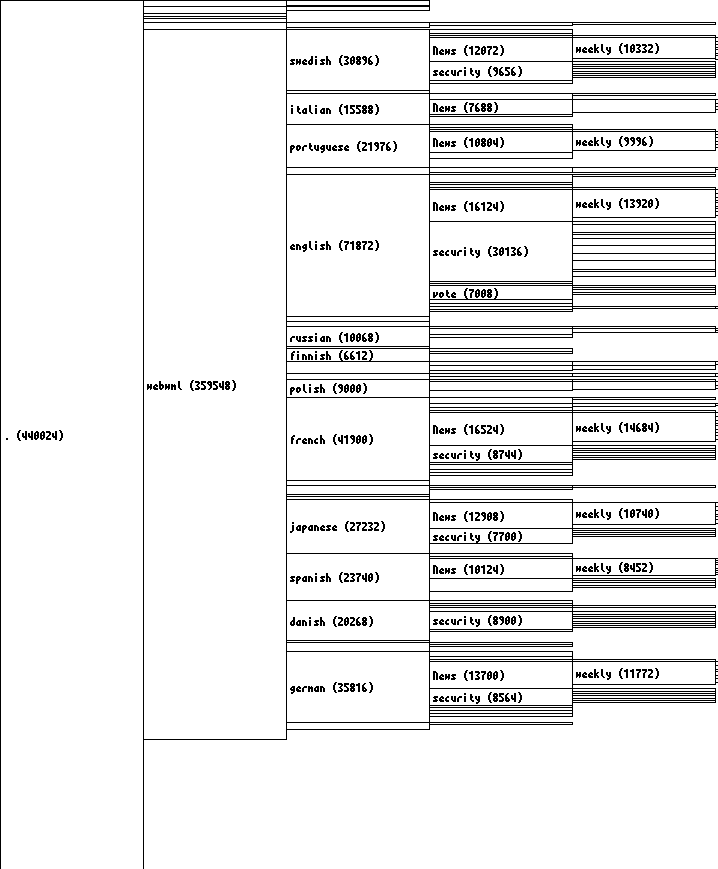
You probably all know du from GNU Coreutils. But there s more than just du around in Debian. du xdu First there is xdu, which displays du output piped into it graphically, even if du is running on some other box with the output coming over an ssh connection:
$ du   xdu
$ ssh server-without-xlibs du some-directory   xdu
Clicking on any directory except the topmost zooms into that directory. Pressing n sorts by size and s toggles the display of sizes in numbers. xdiskusage xdiskusage seems to be a fork of xdu or at least shares some GUI code with it as it looks and behaves quite similar.
But the GUI looks nicer, more modern and you don t need to pipe the output of du into it. It collects the disk usage of a given directory itself. ncdu And then there is ncdu, the ncurses du . (It has nothing to do with the German party CDU . You can easily remember that as Not CDU . ;-) It shows you the disk usage of files and subdirectories in the given directory already sorted by size, optionally displaying also ascii art bars and/or percentage (by pressing g one or more times) for better comparision between file and directory sizes. And all easily and intuitively to navigate in an ncurses text-mode user interface.
ncdu 1.3 ~ Use the arrow keys to navigate, press ? for help
--- /home/abe/debian/webwml ------------------------------------
                             /..
   70.2MB [20.0% ##########] /english
   40.9MB [11.7% #####     ] /french
   35.0MB [10.0% ####      ] /german
   30.2MB [ 8.6% ####      ] /swedish
   26.6MB [ 7.6% ###       ] /japanese
   23.2MB [ 6.6% ###       ] /spanish
   21.5MB [ 6.1% ###       ] /portuguese
   19.8MB [ 5.6% ##        ] /danish
   15.2MB [ 4.3% ##        ] /italian
    9.8MB [ 2.8% #         ] /russian
    8.8MB [ 2.5% #         ] /polish
    6.5MB [ 1.8%           ] /finnish
    5.8MB [ 1.6%           ] /chinese
    4.4MB [ 1.3%           ] /catalan
    4.3MB [ 1.2%           ] /dutch
    3.7MB [ 1.0%           ] /korean
    3.4MB [ 1.0%           ] /ukrainian
    3.0MB [ 0.9%           ] /czech
    2.6MB [ 0.7%           ] /croatian
    2.6MB [ 0.7%           ] /bulgarian
    2.4MB [ 0.7%           ] /norwegian
    1.7MB [ 0.5%           ] /hungarian
    1.6MB [ 0.4%           ] /romanian
    1.2MB [ 0.3%           ] /greek
    1.2MB [ 0.3%           ] /turkish
    1.1MB [ 0.3%           ] /slovak
  576.0kB [ 0.2%           ] /Perl
  556.0kB [ 0.2%           ] /arabic
  428.0kB [ 0.1%           ] /lithuanian
 Total disk usage: 351.1MB  Apparent size: 351.1MB  Items: 70653                                                      
And yes, I uploaded the two screenshots shown above also to screenshots.debian.net as both tools had no screenshots available yet.

16 November 2010

Ingo Juergensmann: Frozen Squeeze, broken packages and bug reports

Squeeze is frozen for some time now and will be released when it's ready, of course. Currently, I have at least two packages that have reported bugs, but it seems that they are making no progress. The first package is BackupPC.One of the bugs is #600654 and the other is #601843. Where as the first is just a cosmetic bug displaying filesystem usage of the backup volume, the other seems to have a functional impact: the backup pool doesn't get cleaned up properly each night. Sadly the maintainer seems a little bit absent, so maybe someone else can do a NMU to get BackupPC into shape for release? Would be nice, though... ;-) The other package is spamassassin or more exactly libnetaddr-ip-perl and bug #601601. Whereas the BackupPC maintainer is rather quiet, there's lot of activity for the other bug but still I get these errors when running Spamassassin by cron:
netset: cannot include 0:0:0:0:0:0:0:1/128 as it has already been included
Although I'm confident that #601601 will be solved soon, I don't really know about the BackupPC bugs, except writing additional info mails to those bugs with "add me!" comment. UPDATE 17.11.2010:
libnetaddr-ip-perl (#601601) seems to be fixed now.

Lucas Nussbaum: Feedback on Gandi hosting?

For the last few years, I ve been a mostly happy customer of Sivit (now bought by Nerim). But recently, technical problems have become more frequent, and today, for the first time, a crash made me lose some data which was rather painful to restore from backups. Also, they are still stuck on with an ancient 2.6.16 kernel. So, I m looking into alternatives, and a promising one is Gandi hosting, based on virtual machines like Sivit. Thanks!

15 November 2010

Matt Zimmerman: Ubuntu: Project, Platform, Products

When most people talk about Ubuntu, they usually mean our flagship product, Ubuntu Desktop Edition. Sometimes, they might mean the Ubuntu project, or the community of people who work on it, or various other things. Similarly, Debian might mean the Debian operating system, or the package repositories, or the project, and so on. This gets a little confusing sometimes. When I m talking about Ubuntu, I ve started to use more specific terminology to explain what I mean, and this seems to help people understand better the nature of the whole Ubuntu. In particular, I use the three Ps: This breakdown may seem a bit obvious to those of us on the inside , but it s confusing to people who are encountering it for the first time. I m sharing this in the hope that if more people start using the same words, it will get easier for people to understand how these pieces fit together. I ll also be linking to it a lot, to help put things into context using this framework.

Julien Danjou: Org-mode and holidays

Org has a nice option which allows you to show week-end days in a different color in your agenda. That means that Saturday and Sunday (when I do not work) are fontified with org-agenda-date-weekend'. But there are other days I do not work, like my vacations or holidays. Therefore, I've wrote a patch to add org-agenda-day-face-function' which is optionally called to determine what should be the face used to fontify a day. This allows me to use the same face for holidays and for week-end days, like for last Thursday which was an holiday in France. That patch has been merged in Org last week. Flattr this

Raphaël Hertzog: Save disk space by excluding useless files with dpkg

Most packages contain files that you don t need: for example translations in languages that you don t understand, or documentation that you don t read. Wouldn t it be nice if you could get rid of them and save a few megabytes? Good news: since dpkg 1.15.8 you can! dpkg has two options --path-include=glob-pattern and --path-exclude=glob-pattern that control what files are installed or not. The pattern work the same than what you re used to on the shell (see the glob(7) manual page). Passing those options on the command-line would be impractical, so the best way to use them is to put them in a file in /etc/dpkg/dpkg.cfg.d/. Beware, the order of the options does matter: when a file matches several options, the last one makes the decision. A typical usage is to first exclude a directory and then to re-include parts of that directory that you want to keep. For example if you want to drop gettext translations and translated manual pages except French, you could put this in /etc/dpkg/dpkg.cfg.d/excludes:
# Drop locales except French
path-exclude=/usr/share/locale/*
path-include=/usr/share/locale/fr/*
path-include=/usr/share/locale/locale.alias
# Drop translated manual pages except French
path-exclude=/usr/share/man/*
path-include=/usr/share/man/man[1-9]/*
path-include=/usr/share/man/fr*/*
Note that the files will vanish progressively every time that a package is upgraded. If you want to save space immediately, you have to reinstall the packages present in your system. aptitude reinstall or apt-get --reinstall install might help. In theory with aptitude you can even do aptitude reinstall ~i but it tends to not work because one package is not available (either because it was installed manually or because the installed version has been superseded by a newer version on the mirror).
Found it useful? Click here to see how you can encourage me to provide more articles like this one.

8 comments Liked this article? Click here. My blog is Flattr-enabled.

Manoj Srivastava: Manoj: Dear Lazyweb: How do you refresh or recreate your kvm virt periodically?

Dear Lazyweb, how do all y all using virts recreate the build machine setup periodically? I have tried and failed to get qemu-make-debian-root script work for me. Going through and redoing it from netinst ISO is an option but then I need debconf preseeding files, and I was wondering if there are some out there. And then there is the whole Oh, by the way, upgrade from Squeeze to Sid, please step. The less sexy alternative is going to the master copy and running a cron job to safe-upgrade each week, and re-creating any copy-on-write children. Would probably work, but I am betting there are less hackish solutions out there. First, some background. It has been an year since I interviewed for the job I currently hold. And nearly 10 months since I have been really active in Debian (apart from Debconf 10). Partly it was trying to perform well at the new job, partly it was getting permissions to work on Debian from my employer. Now that I think I have an handle on the job, and the process for getting permissions is coming to a positive end, I am looking towards getting my Debian processes and infrastructure back up to snuff. Before the interregnum, I used to have a UML machine setup to do builds. It was generated from scratch weekly using cron, and ran SELinux strict mode, and I used to have an automated ssh based script to build packages, and dump them on my box to test them. I had local git porcelain to do all this and tag releases, in a nice, effortless work flow. Now, the glory days of UML are long gone, and all the cool kids are using KVM. I have set up a kvm box, using a netinst ISO (like the majority of the HOWTO s say). I used madduck s old /etc/networking/interfaces set up to do networking using a public bridge (mostly because how cool his solution was, virsh can talk natively to a bridge for us now) and I have NFS, SELinux, ssh, and my remote build infrastructure all done, so I am ready to hop back into the fray once the lawyers actually ink the agreements. All I have to do is decide on how to refresh my build machines periodically. And I guess I should set up virsh, instead of having a shell alias around kvm. Just haven t gotten around to that.

13 November 2010

Gregor Herrmann: RC bugs 2010/43 - 2010/45

if I'm not mistaken, more & more people are trying to hunt down RC bugs nice! here are my contributions during the last weeks: some remarks:

12 November 2010

Julien Viard de Galbert: Triage X Bugs of the Week 1 (TXBW1)

Here is my report for the first week, (actualy I m a little bit late, but friday loked like a better day for such reports) That s it about 880 bugs more to go ! The X Strike Force (still) needs you ! You can have a look at the X Strike Force Bug Closing Procedure and check XSF unstable bugs sorted by date.

Rog rio Brito: Packaging fonts for a Debian-based system

Seeing now that the situation regarding Free fonts is much better than in the past, I have started packaging some that are of high enough quality so that we can have it available on our systems (be it Debian or any of the good derivatives). In particular, I spent some time during the past few days packaging some that, I think, deserve to be mentioned: Well, that's it for now. Stay tuned for more to come.

11 November 2010

Matt Zimmerman: Back to the future

In my professional role as Ubuntu CTO, I take on a number of different perspectives, which sometimes compete for my attention, including: My recent work, as Canonical has gone through a period of organizational growth and change, has prioritized the inward perspective. I took on a six-month project which was inwardly focused, temporarily handing off many of my day-to-day responsibilities (well done, Robbie!). I ve grappled with an assortment of growing pains as many new people joined Canonical over the past year. With that work behind me, it s time to rebalance myself and focus more outside of Canonical again. It s good to be back! In my outward facing capacity, I ll shortly be attending Web 2.0 Summit in San Francisco. I attend several free software conferences each year, but this is a different crowd. I hope to renew some old ties, form some new ones, and generally derive inspiration from the people and organizations represented there. Being in the San Francisco Bay area will also give me an opportunity to meet with some of Canonical s partners there, as well as friends and acquaintances from the free software community. With my head down, working hard to make things happen, it s easy to lose perspective on how that work fits into the outside world. Spending more time with people outside of Canonical and Ubuntu is an important way of balancing that effect. Looking forward, I ll be thinking about the longer term direction for the Ubuntu platform. The platform is the layer of Ubuntu which makes everything else possible: it s how we weave together products like Desktop Edition and Server Edition, and it s what developers target when they write applications. Behind the user interfaces and applications, there is a rich platform of tools and services which link it all together. It s in this aspect of Ubuntu that I ll be investing my time in research, experimentation and imagination. This includes considering how we package and distribute software, how we adapt to technological shifts, and highlighting opportunities to cooperate with other open source projects. My primary outside-in role is as chair of the Ubuntu Technical Board. In this capacity, I m accountable to the Ubuntu project, the interests of its members, and the people who use the software we provide. Originally, the TB was closely involved with a range of front-line technical decisions in Ubuntu, but today, there are strong, autonomous teams in place for the most active parts of the project, so we only get involved when there is a problem, or if a technical question comes up which doesn t fit the charter of an established team. It s something of a catch-all. I d like to re-establish the TB in a more central role in Ubuntu, looking after concerns which affect the project as a whole, such as transparency and development processes. I m also re-joining Debian as a non-uploading contributor, to work on stimulating and coordinating cooperation between Debian and Ubuntu. I m looking forward to working more with Zack on joint projects in this area. This change will help me to support Canonical and Ubuntu more effectively as they continue to grow and change. I look forward to exercising some mental muscles I haven t used very much lately, and facing some new challenges as well.

Evgeni Golov: OpenRheinRuhr 13/14 November 2010

openrheinruhr logoOn the 13/14 November 2010 there is a nice event in the so called Ruhrpott : OpenRheinRuhr. And I d like to invite YOU :)What should you expect from heading to the RIM in Oberhausen and paying 5 entry-fee? You get a nice program full of great talks (like mine about bley ;), mikas about OpenSource management, tokkees about Git and XTarans about cli-helpers and unknown tools), a bunch of nice people showing you their distro, software, etc (Debian is there too), a social event, a keysigning party and a lot of hacking and fun. So if you are somewhere nearby, join us and enjoy the event!


German version (sorry planet debian readers ;)):Am 13/14 November findet im Pott die OpenRheinRuhr statt, zu der ich euch alle herzlichst einladen moechte.Was kann man erwarten, wenn man den Weg ins RIM in Oberhausen gefunden hat und die 5 Eintritt bezahlt hat? Euch erwartet ein Programm voller Talks (zB meiner ueber bley ;), mikas ueber OpenSource Management, tokkees ueber Git und XTarans ueber Helfer auf der Kommandozeile and anderere unbekannte Tools), viele Aussteller, die die eigene Distro, Software oder was auch immer anpreisen (Debian ist natuerlich auch da), ein Social Event, eine Keysigning Party und natuerlich viel Rumgehacke und Spass. Also, jeder der grad irgendwie in der Naehe ist oder in die Naehe kommen kann: ab nach Oberhausen und geniesst ein freies Wochenende! :)

Michael Casadevall: On Achieving Goals ...

*blows the dust off his blog*

It's been quite awhile since I last wrote anything in this thing, so I guess its a good time as any, off the tails of UDS-N, to finally sit down and write something down. Since my last blog posting in May, I've been travelling around the world, attending conferences, and trying to represent both Ubuntu and Debian itself, and Canonical in all my travels. I was recently posted to China for a full month where I lived and worked out of an office, made friends with fellow Ubuntu users, and tech enthusiasts, had a wonderful time meeting with people with the Beijing Linux User's Group, and worked hard within my team at Canonical, and the legions of Ubuntu Developers to help make one of the best releases we've ever had.

As I was writing specs and drafting work items, I came to the point that I was reflecting on my own personal goals and growth in life. Two years and change ago, I was a struggling junior at Rochester Institute of Technology, a little less than two years ago, I started working full time with Canonical, and this year, I've gone and traveled to many places I've only dreamed about; Anchorage & Barrow, Alaska; Tampere, Finland; Prague, Czech Republic; and Brussels, Belgium, just to name a few. I packed up and lived in China for a month (an amazing experience, and I look forward to going back and visiting again sometime in the near future). Had you told the me of two years ago what I would be doing now, I'd probably think you were smoking something good.

One thing I've discovered in my life is that if you want to do something, you need to get out there and just ****ing do it. This may seem simple, but I think of the dreams a lot of people have that never seem to come to fruition. When I have an opportunity, I take it; going to Alaska was a dream I harbored for many years, especially entering the arctic circle, and heading to Barrow. That entire trip was booked on roughly four days notice, and the side trip to Barrow was planned the day before it actually happen. I don't regret any of it; it was one of the best things I ever done.

It brings me to what I consider the flux of this blog posting. For those who know me, I've had a goal of visiting every state within the United States. At this time last year, this map looked like this

As of two weeks ago today, this map looked like this:


Now, by the end of the day today, it will look like this:


The point I'm trying to make is if you want to do something, do it the first chance you get, or just don't do it; I say this because you never know when you will be able to do it again.

As for completing a life goal, well, it feels pretty amazing :-). I may write about that in a future blog posting ...

Steve Kemp: I miss the old Debian

I miss the days when Debian was about making software work well together. These days the user mailing lists are full of posts from users asking for help on Ubuntu [*1*], people suggesting that we copy what Ubuntu has done, and people asking for "howtos" because documentation is too scary or too absent for them to read. Yesterday the whole commercial spam on Planet debate started. Its yet another example of how in-fighting[*2*] seems to be the most fun part of Debian for too many. Me? I started and folded a company. I got Debian help and users. Some threw money at me. Joey Hess? Started making the nice-looking ikiwiki-powered branchable.com. Commercial? Yes. Spam? No. I guess there is little I can do. I could quit - as over time I've become less patient dealing with the project as a whole, but simultaneously more interested in dealing with a few specific people. But I suspect the net result would be no change. Either people would say "Ok , bye" or worse still offer my flttry: "Don't go - we lurve you". Meh. I shouldn't write when I'm annoyed, but living in a hotel will do that to you. Footy-Mc-Foot-notes. Cos HTML is hard. Lets go shopping Eat Cake.
1
The Ubuntu forums are largely full of the blind leading the blind. Or equally often the blind being ignored. I do believe that an Ubuntu stackoverflow site would be more useful than forums. But that's perhaps naive. People will still most often say "My computer doesn't work" missing all useful the details. The only obvious gain is you can avoid "me too!!!" comments, and "fix this now or I'm gonna go .. use gentoo?".
2
Back a few years when people were less civil some mailing lists and irc channesl were unpleasant places to be. These days we've solved half the problem: People mostly don't swear at each other. The distractions, the threads that don't die, even if you ignore them and don't join in the "hilarity" they still have a devisively negative effect.

10 November 2010

David Welton: The Future of Programming Languages: Economics

Someone on Hacker News asks about the future of programming languages, and I realized that it's a pretty interesting topic. Here's my take on it: Programming languages are about people, and the compromises they may or may not make in order to communicate their intentions to computers. The technology in question may change, but there will likely always be people involved, and as long as that's true, looking at the problem through the lense of economics provides useful results. Therefore, looking at programming languages pretty much requires that you look at the economics of them:
I wrote this in a hurry. Have I missed anything? How do these factors apply to languages you see emerging?

8 November 2010

Cyril Brulebois: Debugging using netconsole

Now that we have KMS, it happens things go bad enough that when X goes down, one can no longer access any console to see what happened. Mainly, one can distinguish between two cases. I m going to discuss the second case. There s a nice tool in the kernel which makes it possible to send kernel logs over the network. It s called netconsole. As far as limitations are concerned, one shall note that it s UDP only, and over Ethernet (in other words: no wireless). The good news is that it can usually make the last crucial lines available. Let s call the crashy machine a patient and the logging machine a doctor. One should keep in mind that if something goes wrong while configuring the netconsole module, it can be unloaded at anytime through:
sudo modprobe -r netconsole
Easy case: on a local network Local network Here s an example: Patient s IP is 192.168.0.1, doctor's IP is 192.168.0.2. Doctor setup What one needs on the receiving side: only netcat. A tiny warning, there are several implementations. Here s the appropriate syntax:
# netcat-traditional:
nc -l -u -p 6666   tee ~/netconsole.log
# netcat-openbsd:
nc -l -u 6666   tee ~/netconsole.log
The nc command is handled through the alternatives system, one can use update-alternative --config nc to pick the appropriate one if several netcat-* packages are installed. To list the current one, an easy way is readlink -f $(which nc). Using tee means that incoming messages are going to be printed, both to the standard output and to the specified file. Running as non-privileged user is sufficient. Patient setup Now, to have the patient send stuff to the doctor, a simple modprobe is needed:
sudo modprobe netconsole netconsole=@/,6666@192.168.0.2/
What happens here? One requests the netconsole module to be loaded, and one specifies the parameters. Details can be read in the Linux kernel documentation (Documentation/networking/netconsole.txt), but concentrating on the points of interest here: That s all! On the doctor side, one should see something along those lines:
[2920549.188090] console [netcon0] enabled
[2920549.188102] netconsole: network logging started
Slightly harder case: over internet Over internet Because one might not have a second machine handy, it s also possible to go through a router and send stuff across the internet. Here s an example: Patient s IP is 192.168.0.1, connecting to internet through a router, which IP is 192.168.0.254. The doctor, available over the internet, is 192.0.32.10. Doctor setup Exactly the same as in the previous case. The main issue one can run into is firewalls at this point. That s why one may want to switch from the default 6666 port to another one which wouldn t be filtered. One can think of 53 (DNS), but that means running nc as root since it s a privileged port (below 1024). Patient setup Routing is also possible, but that requires an extra parameter: the MAC address of the router. To obtain it, one can use the arp command:
/usr/sbin/arp 192.168.0.254
Supposing it returned the 01:02:03:04:05:06 address, loading the module becomes:
sudo modprobe netconsole netconsole=@/,6666@192.0.32.10/01:02:03:04:05:06
Now, if you re running into firewall-related issues, you can change the source for the UDP packets. The default is 6665, but assuming you want to send from an unfiltered 1234 port, that becomes:
sudo modprobe netconsole netconsole=1234@/,6666@192.0.32.10/01:02:03:04:05:06

Next.

Previous.