Search Results: "ed"

19 April 2017

Reproducible builds folks: Reproducible Builds: week 103 in Stretch cycle

Here's what happened in the Reproducible Builds effort between Sunday April 9 and Saturday April 15 2017: Upcoming events On April 26th Chris Lamb will give a talk at foss-north 2017 in Gothenburg, Sweden on Reproducible Builds. Media coverage Jake Edge wrote a summary of Vagrant Cascadian's talk on Reproducible Builds at LibrePlanet. Toolchain development and fixes Ximin Luo forwarded patches to GCC for BUILD_PATH_PREFIX_MAP support. With this patch to backported to GCC-6, as well as a patched dpkg to set the environment variable, he scheduled ~3,300 packages that are unreproducible in unstable-amd64 but reproducible in testing-amd64 - because we vary the build path in the former but not latter case. Our infrastructure ran these in just under 3 days, and we reproduced ~1,700 extra packages. This is about 6.5% of ~26,100 Debian source packages, and about 1/2 of the ones whose irreproducibility is due to build-path issues. Most of the rest are not related to GCC, such as things built by R, OCaml, Erlang, LLVM, PDF IDs, etc. (The dip afterwards, in the graph linked above, is due to reverting back to an unpatched GCC-6, but we'll be rebasing the patch continually over the next few weeks so the graph should stay up.) Packages reviewed and fixed, and bugs filed Chris Lamb: Chris West: Reviews of unreproducible packages 38 package reviews have been added, 111 have been updated and 85 have been removed in this week, adding to our knowledge about identified issues. 6 issue types have been updated: Added: Updated: Removed: diffoscope development Development continued in git on the experimental branch: Chris Lamb: Weekly QA work During our reproducibility testing, FTBFS bugs have been detected and reported by: Misc. This week's edition was written by Ximin Luo, Chris Lamb & reviewed by a bunch of Reproducible Builds folks on IRC & the mailing lists.

Steve Kemp: 3d-Printing is cool

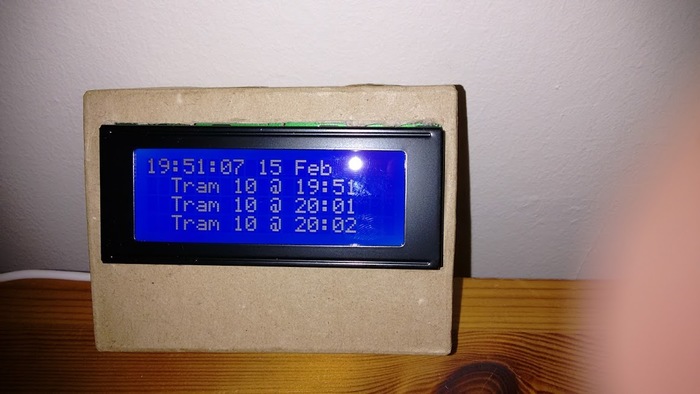
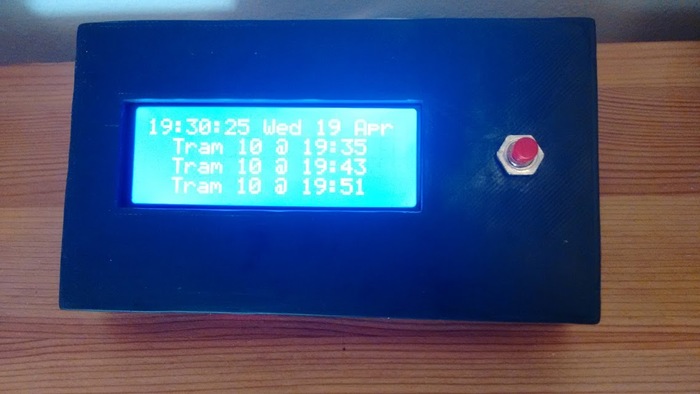
I've heard about 3d-printing a lot in the past, although the hype seems to have mostly died down. My view has always been "That seems cool", coupled with "Everybody says making the models is very hard", and "the process itself is fiddly & time-consuming". I've been sporadically working on a project for a few months now which displays tram-departure times, this is part of my drive to "hardware" things with Arduino/ESP8266 devices . Most visitors to our flat have commented on it, at least once, and over time it has become gradually more and more user-friendly. Initially it was just a toy-project for myself, so everything was hard-coded in the source but over time that changed - which I mentioned here, (specifically the Access-point setup): I've now wired up an input-button to the device too, experimenting with the different ways that a single button can carry out multiple actions: Anyway the software is neat, and I can't think of anything obvious to change. So lets move onto the real topic of this post: 3D Printing. I randomly remembered that I'd heard about an online site holding 3D-models, and on a whim I searched for "4x20 LCD". That lead me to this design, which is exactly what I was looking for. Just like open-source software we're now living in a world where you can get open-source hardware! How cool is that? I had to trust the dimensions of the model, and obviously I was going to mount my new button into the box, rather than the knob shown. But having a model was great. I could download it, for free, and I could view it online at viewstl.com. But with a model obtained the next step was getting it printed. I found a bunch of commercial companies, here in Europe, who would print a model, and ship it to me, but when I uploaded the model they priced it at 90+. Too much. I'd almost lost interest when I stumbled across a site which provides a gateway into a series of individual/companies who will print things for you, on-demand: 3dhubs. Once again I uploaded my model, and this time I was able to select a guy in the same city as me. He printed my model for 1/3-1/4 of the price of the companies I'd found, and sent me fun pictures of the object while it was in the process of being printed. To recap I started like this:
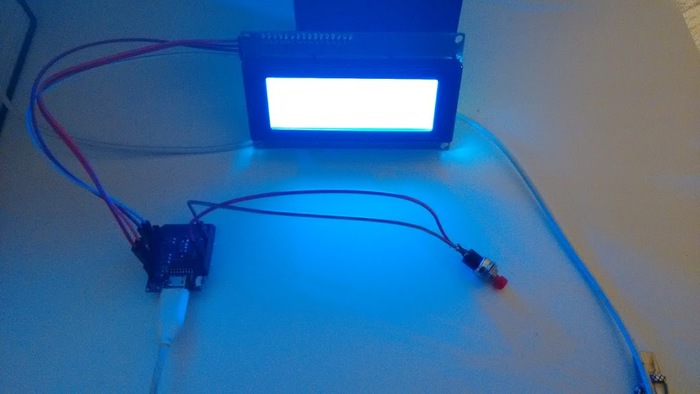
Then I boxed it in cardboard which looked better than nothing, but still not terribly great:
Now I've found an online case-design for free, got it printed cheaply by a volunteer (feels like the wrong word, after-all I did pay him), and I have something which look significantly more professional:
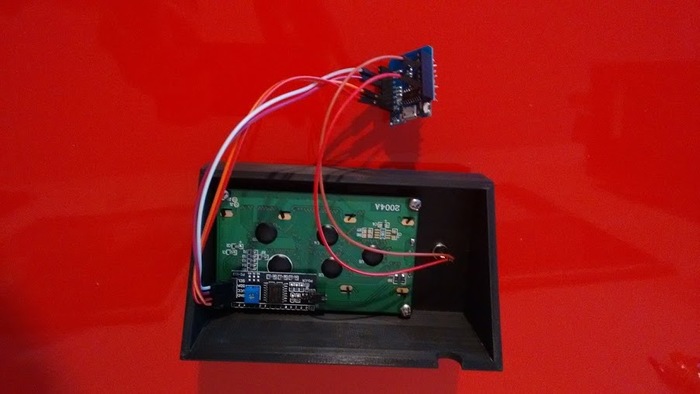
Inside it looks as neat as you would expect:
Of course the case still cost 5 times as much as the actual hardware involved (button: 0.05, processor-board 2.00 and LCD I2C display 3.00). But I've gone from being somebody who had zero experience with hardware-based projects 4 months ago, to somebody who has built a project which is functional and "pretty". The internet really is a glorious thing. Using it for learning, and coding is good, using it for building actual physical parts too? That's something I never could have predicted a few years ago and I can see myself doing it more in the future. Sure the case is a little rough around the edges, but I suspect it is now only a matter of time until I learn how to design my own models. An obvious extension is to add a status-LED above the switch, for example. How hard can it be to add a new hole to a model? (Hell I could just drill it!)

Antoine Beaupr : The rise of Linux-based networking hardware

Linux usage in networking hardware has been on the rise for some time. During the latest Netdev conference held in Montreal this April, people talked seriously about Linux running on high end, "top of rack" (TOR) networking equipment. Those devices have long been the realm of proprietary hardware and software companies like Cisco or Juniper, but Linux seems to be making some significant headway into the domain. According to Shrijeet Mukherjee, VP of Engineering at Cumulus Networks: "we are seeing a 28% adoption rate in the Fortune 50" companies. As someone who has worked in system administration and networking for over a decade, I was surprised by this: switches have always been black boxes of proprietary hardware that we barely get a shell into. But as more and more TOR hardware gets Linux support, some of that work trickles down outside of that niche. Are we really seeing the rise of Linux in high-end networking hardware?

Linux as the standard interface During his keynote at Netdev, Jesse Brandeburg explained that traffic is exploding on the Internet: "From 2006 to 2016 the compound annual growth rate was 78% of network traffic. So the network traffic is growing like crazy. In 2010 to 2023, it's going to grow by a thousand times." He also mentioned Intel was working on devices that could do up to 400 Gbps. In his talk, he argued that Linux has a critical place in the modern world by repeating the mantra that "everything is on the network, and the network runs Linux", but does it really? Through Android, Linux has become the most popular end-user device operating system and is also dominant on the server but what about the actual fabric of the network: the routers and switches that interconnect all those machines? Mukherjee, in his own keynote, argued that even though Linux has achieved dominance in the server and virtualization markets, there is a "discontinuity [...] at the boundary where the host and the network meet" and argued "that the host without the network will not survive". In other words, proprietary hardware and software in the network threaten free software in the server. Even though some manufacturers are already providing a "Linux interface" in their hardware, it is often only some sort of compatibility shell which might be compared with the Ubuntu compatibility layer in Windows: it's not a real Linux. Mukherjee pushed this idea further by saying that those companies are limiting themselves by not using the full Linux stack. He presented Linux as the "top vehicle for innovation" that provides a featureful network stack, citing VXLAN, eBPF, and Quagga as prime features used on switches. Mukherjee also praised the diversity of the user-space Linux ecosystem as something that commercial alternatives can't rival; he compared the faster Linux development to the commercial sector where similar top features stay in the beta stage for up to 3 years. Because of its dominance in the server market, consumers are expecting a Linux-like interface on their networking gear now, which means Linux could be the standard interface all providers strive toward. As a Debian developer, I can't help but smile at the thought; if there's one thing we have not been able to do among Linux distributions, it's pretty much standardize user space in a consistent interface. POSIX is old and incomplete, the FHS is showing its age, and most distributions have abandoned LSB. Yet, the idea is certainly enticing: there is a base set of tools and applications, especially for the Linux kernel, that are standardized: iproute2, ethtool, and iptables are generally consistent across distributions, even though each distribution has its own way of using them. Yet Linux is not dominant, why? Mukherjee identified the problem as "packaging issues" and listed a set of features he would like Linux to improve:
  • Standardization of the ethtool interface. The idea is to make ethtool a de-facto standard to manage switches and ports. Mukherjee gave the example that data centers spend more money on cables than any other hardware and explained that making it easier to identify cables is therefore a key functionality. Getting consistent interface naming was also a key problem identified by numerous participants at the conference. While systemd tried to fix this with the predictable network interface names specification, the interface names are not necessarily predictable across virtual machines or on special hardware; in fact, this was the topic of the first talk of the conference. ethtool also needs to support interfaces that run faster than 1 Gbps, something that still has limited support in Linux at the moment.
  • Scaling of the Linux bridge. Through the rise of "software defined networking", we are likely to see multi-switch virtual environments that need to scale to hundreds of interfaces and devices easily. This is something the Linux bridge was never designed to do and it's showing scalability issues. During the conference, there was hope that the new XDP and eBPF developments could help, but also concerns this would create yet another bridge layer inside the kernel.
Cumulus's goal seems to be to establish Linux as the industry standard for this new era of networking and it is not alone. Through its Open Compute project, Facebook is sharing open designs of data center products and, while we have yet to see commercial off-the-shelf (COTS) 24 and 48-port gigabit switches trickle down to the consumer market, the company is definitely deploying new hardware based on those specifications in its own data centers, and those devices are often based on Linux.

The Linux switch implementation So how exactly do switches work in Linux? The Linux kernel manipulates switches with three different operation structures: switchdev_ops, which we previously covered, ethtool_ops, and netdev_ops. Certain switches, however, also need distributed switch architecture (DSA) features to be properly handled. DSA is a more obscure part of the network stack that allows Linux to represent hardware switches or chains of switches using regular Linux tools like bridge, ifconfig, and so on. While switchdev is a new layer, DSA has been in the kernel since 2.6.28 in 2008. Originally developed to support Marvell switches, DSA is now a generic layer deployed in WiFi access points, set-top boxes, on-board flight entertainment systems, trains, and other industrial equipment. Switches that have an Ethernet controller need DSA, whereas the kernel can support switches without Ethernet controllers directly with switchdev drivers. The first years of DSA's development consisted only of basic maintenance but, in the last three years, DSA has seen a resurgence of contributions, as part of Linux networking push to support hardware offloading and network switches. Between 2014 and 2015, DSA added support for Broadcom hardware, wake on LAN, and hardware port bridging, among other features. DSA's development was parallel to swconfig, written by the OpenWrt project to support the small office and home office (SOHO) routers that the project is targeting. The main difference between swconfig and DSA is that DSA-supported switches show one network interface per port, whereas swconfig-configured switches show up as a single port, which limits the amount of information that can be extracted from the switch. For example, you cannot have per-port traffic statistics with swconfig. That limitation is what led to the creation of the switchdev framework, when swconfig was proposed (then refused) for inclusion in mainline. Another goal of switchdev was to support bridge hardware offloading and network interface card (NIC) virtualization. Also, whereas swconfig uses virtual LAN (VLAN) tagging to address ports, DSA enables the use of device-specific tagging headers to address different ports, which enables DSA to have better control over the switches. This allows, for example, DSA to do internet group management protocol (IGMP) snooping or implement the spanning tree protocol, whereas swconfig doesn't have those features. Some switches are actually connected to the host CPU through an Ethernet interface instead of regular PCI-Express interface, and DSA supports this as well. One advantage that remains in the swconfig approach is that it treats the internal switch as a simple external switch, and addresses ports with standard VLAN tags. This is something DSA could do, as well, but no one has bothered implementing this just yet. For now, DSA drivers use device-specific tagging mechanisms that limit the number of supported devices. Other areas of future improvement for DSA are better multi-chip support, IGMP snooping, and bonding, as well as firewall, NAT, and TC offloading.

Where is the freedom? Given all those technical improvements, you might rightfully wonder if your own wireless router or data center switch runs Linux. In recent years, we have seen more and more networking devices shipped with Linux and sometimes even OpenWrt (e.g. in the case of the Turris Omnia, which we previously covered), and especially on SOHO routers, but it sometimes means a crippled operating system that only offers you a proprietary web interface. But at least those efforts make it easier to deploy free operating systems on those devices. Based on my experience running OpenWrt on wireless routers to build the Montreal mesh network, deploying Linux on routers and switches has always been a manual process. The Ubiquiti hardware being used in the mesh network comes with an OpenWrt derivative, but it includes proprietary drivers and a proprietary web interface. To use the mesh networking protocol that was chosen, it was necessary to deploy custom OpenWrt images by hand. For years, it was a continuous struggle for OpenWrt developers to liberate generation after generation of proprietary hardware with companies like Cisco locking down the venerable WRT platform in 2006 and the US Federal Communications Commission (FCC) rules that forced TP-Link to block free software on its routers, a change that was later reverted. Most hardware providers are obviously not dedicated to software freedom: deploying Linux on their hardware is for them an economic, not political choice. As you might expect, a "Linux router" these days often means a closed device and operating system, using Linux as the only free component. I had the privilege of doing some reverse engineering on the SmartRG SR603n VDSL modem, which also doubles as a WiFi router and VoIP phone adapter. I was able to get a shell on that machine, and what I found was a custom operating system built on top of the Linux kernel. I wrote a detailed report about this two years ago and the situation then was pretty grim. Another experience I had was working over a decade in data centers, which tells an even worse story: most switches and routers there are not running free software at all. We have deployed HP ProCurve switches that provide free (as in beer) software updates and have struggled for years to find free (as in speech) software alternatives for those. We built our own routers using COTS server hardware, at a significant performance cost over the dedicated application-specific integrated circuits (ASICs) built into commercial routers, which do not offer us the trust and flexibility we were looking for. But Linux is definitely making some headway, and has been for a while. When we covered switchdev in February 2016, it was just getting started, but now vendors like Mellanox, Broadcom, Cumulus, and Intel are writing and shipping code using the framework. Cumulus, in particular, is developing a Debian-based distribution (Cumulus Linux) that it deploys for clients on targeted hardware. Most of the hardware in that list, however, is not actually open in the more radical sense: they are devices that can run free software but are not generally open-source hardware. There are some exceptions, but they sit at the higher end of the spectrum: most organizations probably don't need a 100 Gbps ports, let alone the 128 ports in the Backpack switch that Cumulus is shipping. How much this translates to actual freedom for the end-user is therefore questionable. While I have seen encouraging progress on the high end of the hardware spectrum at Netdev, I'm not sure this will translate into immediate wins in the data center or even for home users in the short term. In the long term, however, we will hopefully see some progress in Linux's rise in general-purpose networking hardware following its dominance in general-purpose computing.
The author would like to thank the Netdev organizers for travel assistance. Also, thanks to Andrew Lunn for a technical review of this article. Note: this article first appeared in the Linux Weekly News.

Lior Kaplan: Open source @ Midburn, the Israeli burning man

This year I decided to participate in Midburn, the Israeli version of burning man. Whiling thinking of doing something different from my usual habit, I found myself with volunteering in the midburn IT department and getting a task to make it an open source project. Back into my comfort zone, while trying to escape it. I found a community of volunteers from the Israeli high tech scene who work together for building the infrastructure for Midburn. In many ways, it s already an open source community by the way it works. One critical and formal fact was lacking, and that s the license for the code. After some discussion we decided on using Apache License 2.0 and I started the process of changing the license, taking it seriously, making sure it goes by the rules . Our code is available on GitHub at https://github.com/Midburn/. And while it still need to be more tidy, I prefer the release early and often approach. The main idea we want to bring to the Burn infrastructure is using Spark as a database and have already began talking with parallel teams of other burn events. I ll follow up on our technological agenda / vision. In the mean while, you are more than welcome to comment on the code or join one of the teams (e.g. volunteers module to organize who does which shift during the event).
Filed under: Israeli Community

18 April 2017

Steinar H. Gunderson: Chinese HDMI-to-SDI converters

I often need to convert signals from HDMI to SDI (and occasionally back). This requires a box of some sort, and eBay obliges; there's a bunch of different sellers of the same devices, selling them around $20 25. They don't seem to have a brand name, but they are invariably sold as 3G-SDI converters (meaning they should go up to 1080p60) and look like this: There are also corresponding SDI-to-HDMI converters that look pretty much the same except they convert the other way. (They're easy to confuse, but that's not a problem unique tothem.) I've used them for a while now, and there are pros and cons. They seem reliable enough, and they're 1/4th the price of e.g. Blackmagic's Micro converters, which is a real bargain. However, there are also some issues: The last issue is by far the worst, but it only affects 3G-SDI resolutions. 720p60, 1080p30 and 1080i60 all work fine. And to be fair, not even Blackmagic's own converters actually send 352M correctly most of the time I wish there were a way I could publish this somewhere people would actually read it before buying these things, but without a name, it's hard for people to find it. They're great value for money, and I wouldn't hesitate to recommend them for almost all use but then, there's that almost. :-)

Vincent Fourmond: make-theme-image: a script to make yourself an idea of a icon theme

I created some time ago a utils repository on github to publish miscellaneous scripts, but it's only recently that I have started to really populate it. One of my recent work is make-theme-image script, that downloads an icon them package, grabs relevant, user-specifiable, icons, and arrange them in a neat montage. The images displayed are the results of running

~ make-theme-image gnome-icon-theme moblin-icon-theme

This is quite useful to get a good idea of the icons available in a package. You can select the icons you want to display using the -w option. The following command should provide you with a decent overview of the icon themes present in Debian:

apt search -- -icon-theme   grep /   cut -d/ -f1   xargs make-theme-image

I hope you find it useful ! In any case, it's on github, so feel free to patch and share.

Norbert Preining: Gaming: Firewatch

A nice little game, Firewatch, puts you into a fire watch tower in Wyoming, with only a walkie-talkie connecting him to his supervisor Delilah. A so called first person mystery adventure with very nice graphics and great atmosphere.
Starting with your trip to the watch tower, the game sends the player into a series of missions , during which more and more clues about a mystery disappearance are revealed. The game development is rather straight forward, one has hardly any choices, and it is practically impossible to miss something or fail in some way.
The big plus of the game is the great atmosphere, the funny dialogues with Delilah, the story that pulls you into the game, and the development of the character(s). The tower, the cave, all the places one visits are delicately designed with lots of personality, making this a very human like game.
What is weak is the finish. During the game I was always thinking about whether I should tell Delilah everything, or keep some things secret. But in the end nothing matters, all ends with a simple escape in the helicopter and without any tying up the loose ends. Somehow a pity for such a beautiful game to leave the player somehow unsatisfied at the end.
But although the finish wasn t that good, I still enjoyed it more than I expected. Due to the simple flow it wont keep you busy for many hours, but as a short break a few evenings (for me), it was a nice break from all the riddle games I love so much.

Bits from Debian: Call for Proposals for DebConf17 Open Day

The DebConf team would like to call for proposals for the DebConf17 Open Day, a whole day dedicated to sessions about Debian and Free Software, and aimed at the general public. Open Day will preceed DebConf17 and will be held in Montreal, Canada, on August 5th 2017. DebConf Open Day will be a great opportunity for users, developers and people simply curious about our work to meet and learn about the Debian Project, Free Software in general and related topics. Submit your proposal We welcome submissions of workshops, presentations or any other activity which involves Debian and Free Software. Activities in both English and French are accepted. Here are some ideas about content we'd love to offer during Open Day. This list is not exhaustive, feel free to propose other ideas! To submit your proposal, please fill the form at https://debconf17.debconf.org/talks/new/ Volunteer We need volunteers to help ensure Open Day is a success! We are specifically looking for people familiar with the Debian installer to attend the Debian installfest, as resources for people seeking help to install Debian on their devices. If you're interested, please add your name to our wiki: https://wiki.debconf.org/wiki/DebConf17/OpenDay#Installfest Attend Participation to Open Day is free and no registration is required. The schedule for Open Day will be announced in June 2017. DebConf17 logo

17 April 2017

Sylvain Beucler: Practical basics of reproducible builds 3

On my quest to generate reproducible standalone binaries for GNU FreeDink, I met new friends but currently lie defeated by an unexpected enemy... Episode 1: Episode 2:
First, the random build differences when using -Wl,--no-insert-timestamp were explained.
peanalysis shows random build dates:
$ reprotest 'i686-w64-mingw32.static-gcc hello.c -I /opt/mxe/usr/i686-w64-mingw32.static/include -I/opt/mxe/usr/i686-w64-mingw32.static/include/SDL2 -L/opt/mxe/usr/i686-w64-mingw32.static/lib -lmingw32 -Dmain=SDL_main -lSDL2main -lSDL2 -lSDL2main -Wl,--no-insert-timestamp -luser32 -lgdi32 -lwinmm -limm32 -lole32 -loleaut32 -lshell32 -lversion -o hello && chmod 700 hello && analysePE.py hello   tee /tmp/hello.log-$(date +%s); sleep 1' 'hello'
$ diff -au /tmp/hello.log-1*
--- /tmp/hello.log-1490950327   2017-03-31 10:52:07.788616930 +0200
+++ /tmp/hello.log-1523203509   2017-03-31 10:52:09.064633539 +0200
@@ -18,7 +18,7 @@
 found PE header (size: 20)
     machine: i386
     number of sections: 17
-    timedatestamp: -1198218512 (Tue Jan 12 05:31:28 1932)
+    timedatestamp: 632430928 (Tue Jan 16 09:15:28 1990)
     pointer to symbol table: 4593152 (0x461600)
     number of symbols: 11581 (0x2d3d)
     size of optional header: 224
@@ -47,7 +47,7 @@
     Win32VersionValue: 0
     size of image (memory): 4640768
     size of headers (offset to first section raw data): 1536
-    checksum (for drivers): 4927867
+    checksum (for drivers): 4922616
     subsystem: 3
         win32 console binary
     DllCharacteristics: 0
Stephen Kitt mentioned 2 simple patches (1 2) fixing uninitialized memory in binutils. These patches fix the variation and were submitted to MXE (pull request).
Next was playing with compiler support for SOURCE_DATE_EPOCH (which e.g. sets __DATE__ macros).
The FreeDink DFArc frontend historically displays a build date in the About box:
    "Build Date: %s\n", ..., __TDATE__
sadly support is only landing upstream in GCC 7 :/
I had to remove that date.
Now comes the challenging parts. All my tests with reprotest checked. I started writing a reproducible build environment based on Docker (git browse).
At first I could not run reprotest in the container, so I reworked it with SSH support, and reprotest validated determinism.
(I also generate a reproducible .zip archive, more on that later.) So far so good, but were the release identical when running reprotest successively on the different environments?
(reminder: this is a .exe build that is insensitive to varying path, hence consistent in a full reprotest)
$ sha256sum *.zip
189d0ca5240374896c6ecc6dfcca00905ae60797ab48abce2162fa36568e7cf1  freedink-109.0-bin-buildsh.zip
e182406b4f4d7c3a4d239eee126134ba5c0304bbaa4af3de15fd4f8bda5634a9  freedink-109.0-bin-docker.zip
e182406b4f4d7c3a4d239eee126134ba5c0304bbaa4af3de15fd4f8bda5634a9  freedink-109.0-bin-reprotest-docker.zip
37007f6ee043d9479d8c48ea0a861ae1d79fb234cd05920a25bb3db704828ece  freedink-109.0-bin-reprotest-null.zip
Ouch! Even though both the Docker and my host are running Stretch, there are differences.
For the two host builds (direct and reprotest), there is a subtle but simple difference: HOME.
HOME is invariably non-existant in reprotest, while my normal compilation environment has an existing home (duh!). This caused a subtle bug when cross-compiling with mingw and wine-binfmt:
  checking whether we are cross compiling... no
  checking whether we are cross compiling... yes
The respective binaries were very different notably due to a different config.h.
This can be fixed by specifying --build in addition to --host when calling ./configure. I suggested reprotest have one of the tests with a valid HOME (#860428).
Now comes the big one, after the fix I still got:
$ sha256sum *.zip
3545270ef6eaa997640cb62d66dc610a328ce0e7d412f24c8f18fdc7445907fd  freedink-109.0-bin-buildsh.zip
cc50ec1a38598d143650bdff66904438f0f5c1d3e2bea0219b749be2dcd2c3eb  freedink-109.0-bin-docker.zip
3545270ef6eaa997640cb62d66dc610a328ce0e7d412f24c8f18fdc7445907fd  freedink-109.0-bin-reprotest-chroot.zip
cc50ec1a38598d143650bdff66904438f0f5c1d3e2bea0219b749be2dcd2c3eb  freedink-109.0-bin-reprotest-docker.zip
3545270ef6eaa997640cb62d66dc610a328ce0e7d412f24c8f18fdc7445907fd  freedink-109.0-bin-reprotest-null.zip
There is consistency on my host, and consistency within docker, but both are different.
Moreover, all the .o files were identical, so something must have gone wrong when compiling the libs, that is MXE. After many checks it appears that libstdc++.a is different.
Just overwriting it gets me a consistent FreeDink release on all environments.
Still, when rebuilding it (make gcc), libstdc++.a always has the same environment-dependent checksum.
45f8c5d50a68aa9919ee3602a4e3f5b2bd0333bc8d781d7852b2b6121c8ba27b  /opt/mxe/usr/lib/gcc/i686-w64-mingw32.static/5.4.0/libstdc++.a  # host
6870b84f8e17aec4b5cf23cfe9c2e87e40d9cf59772a92707152361b6ebc1eb4  /opt/mxe/usr/lib/gcc/i686-w64-mingw32.static/5.4.0/libstdc++.a  # docker
The 2 libraries are much different, there's barely any blue in hexcompare. At that time, I realized that the Docker "official" Debian are not really official, as Joey explains.
Could it be that Docker maliciously tampered with the compiler as Ken Thompson warned in 1984?? Well before jumping to conclusion let's mix & match.
$ sudo env -i /usr/sbin/chroot chroot-docker/
$ exec bash -l
$ cd /opt/mxe
$ touch src/gcc.mk
$ sha256sum /opt/mxe/usr/lib/gcc/i686-w64-mingw32.static/5.4.0/libstdc++.a 
6870b84f8e17aec4b5cf23cfe9c2e87e40d9cf59772a92707152361b6ebc1eb4  /opt/mxe/usr/lib/gcc/i686-w64-mingw32.static/5.4.0/libstdc++.a
$ make gcc
[build]     gcc                    i686-w64-mingw32.static
[done]      gcc                    i686-w64-mingw32.static                                 2709464 KiB    7m2.039s
$ sha256sum /opt/mxe/usr/lib/gcc/i686-w64-mingw32.static/5.4.0/libstdc++.a 
45f8c5d50a68aa9919ee3602a4e3f5b2bd0333bc8d781d7852b2b6121c8ba27b  /opt/mxe/usr/lib/gcc/i686-w64-mingw32.static/5.4.0/libstdc++.a
# consistent with host builds
$ sudo tar -C chroot -c .   docker import - chroot-debootstrap
$ docker run -ti chroot-debootstrap /bin/bash
$ sha256sum /opt/mxe/usr/lib/gcc/i686-w64-mingw32.static/5.4.0/libstdc++.a
45f8c5d50a68aa9919ee3602a4e3f5b2bd0333bc8d781d7852b2b6121c8ba27b  /opt/mxe/usr/lib/gcc/i686-w64-mingw32.static/5.4.0/libstdc++.a
$ touch src/gcc.mk
$ make gcc
[build]     gcc                    i686-w64-mingw32.static
[done]      gcc                    i686-w64-mingw32.static                                 2709412 KiB    7m6.608s
$ sha256sum /opt/mxe/usr/lib/gcc/i686-w64-mingw32.static/5.4.0/libstdc++.a
6870b84f8e17aec4b5cf23cfe9c2e87e40d9cf59772a92707152361b6ebc1eb4  /opt/mxe/usr/lib/gcc/i686-w64-mingw32.static/5.4.0/libstdc++.a
# consistent with docker builds
So, AFAICS when building with: then depending on whether running in a container or not we get a consistent but different libstdc++.a. This kind of issue is not detected with a simple reprotest build, as it only tests variations within a fixed build environment.
This is quite worrisome, I intend to use a container to control my build environment, but I can't guarantee that the container technology will be exactly the same 5 years from now. All my setup is simple and available for inspection at https://git.savannah.gnu.org/cgit/freedink.git/tree/autobuild/freedink-w32-snapshot/. I'd very much welcome enlightenment :)

Norbert Preining: Systemd again (or how to obliterate your system)

Ok, I have been silent about systemd and its being forced onto us in Debian like force-feeding Foie gras gooses. I have complained about systemd a few times (here and here), but what I read today really made me loose my last drips of trust I had in this monster-piece of software. If you are up for some really surprising read about the main figure behind systemd, enjoy this github issue. It s about a bug that simply does the equivalent of rm -rf / in some cases. The OP gave clear indications, the bug was fixes immediately, but then a comment from the God Poettering himself appeared that made the case drip over:

I am not sure I d consider this much of a problem. Yeah, it s a UNIX pitfall, but rm -rf /foo/.* will work the exact same way, no?Lennart Poettering, systemd issue 5644
Well, no, a total of 1min would have shown him that this is not the case. But we trust this guy the whole management of the init process, servers, logs (and soon our toilet and fridge management, X, DNS, whatever you ask for). There are two issues here: One is that such a bug is lurking in systemd since probably years. The reason is simple we pay with these kinds of bugs for the incredible complexity increase of the init process which takes over too much services. Referring back to the Turing Award lecture given by Hoare, we see that systemd took the later path:
I conclude that there are two ways of constructing a software design: One way is to make it so simple that there are obviously no deficiencies and the other way is to make it so complicated that there are no obvious deficiencies. Antony Hoare, Turing Award Lecture 1980
The other issue is how systemd developers deal with bug reports. I have reported several cases here, this is just another one: Close the issue for comments, shut up, put it under the carpet. (Image credit: The musings of an Indian Faust)

Ross Gammon: My March 2017 Activities

March was a busy month, so this monthly report is a little late. I worked two weekends, and I was planning my Easter holiday, so there wasn t a lot of spare time. Debian
  • Updated Dominate to the latest version and uploaded to experimental (due to the Debian Stretch release freeze).
  • Uploaded the latest version of abcmidi (also to experimental).
  • Pinged the bugs for reverse dependencies of pygoocanvas and goocanvas with a view to getting them removed from the archive during the Buster cycle.
  • Asked for help on the Ubuntu Studio developers and users mailing lists to test the coming Ubuntu Studio 17.04 release ISO, because I would be away on holiday for most of it.
Ubuntu
  • Worked on ubuntustudio-controls, reverting it back to an earlier revision that Len said was working fine. Unfortunately, when I built and installed it from my ppa, it crashed. Eventually found my mistake with the bzr reversion, fixed it and prepared an upload ready for sponsorship. Submitted a Freeze Exception bug in the hope that the Release Team would accept it even though we had missed the Final Beta.
  • Put a new power supply in an old computer that was kaput, and got it working again. Set up Ubuntu Server 16.04 on it so that I could get a bit more experience with running a server. It won t last very long, because it is a 32 bit machine, and Ubuntu will probably drop support for that architecture eventually. I used two small spare drives to set up RAID 1 & LVM (so that I can add more space to it later). I set up some Samba shares, so that my wife will be able to get at them from her Windows machine. For music streaming, I set up Emby Server. I wold be great to see this packaged for Debian. I uploaded all of my photos and music for Emby to serve around the home (and remotely as well). Set up Obnam to back up the server to an external USB stick (temporarily until I set up something remote). Set LetsEncrypt with the wonderful Certbot program.
  • Did the Release Notes for Ubuntu Studio 17.04 Final Beta. As I was in Brussels for two days, I was not able to do any ISO testing myself.
Other
  • Measured up the new model railway layout and documented it in xtrkcad.
  • Started learning Ansible some more by setting up ssh on all my machines so that I could access them with Ansible and manipulate them using a playbook.
  • Went to the Open Source Days conference just down the road in Copenhagen. Saw some good presentations. Of interest for my previous work in the Debian GIS Team, was a presentation from the Danish Municipalities on how they run projects using Open Source. I noted how their use of Proj 4 and OSGeo. I was also pleased to see a presentation from Ximin Luo on Reproducible Builds, and introduced myself briefly after his talk (during the break).
  • Started looking at creating a Django website to store and publish my One Name Study sources (indexes). Started by creating a library to list some of my recently read Journals. I will eventually need to import all the others I have listed in a cvs spreadsheet that was originally exported from the commercial (Windows only) Custodian software.
Plan status from last month & update for next month Debian For the Debian Stretch release:
  • Keep an eye on the Release Critical bugs list, and see if I can help fix any. In Progress
Generally:
  • Package all the latest upstream versions of my Debian packages, and upload them to Experimental to keep them out of the way of the Stretch release. In Progress
  • Begin working again on all the new stuff I want packaged in Debian.
Ubuntu
  • Start working on an Ubuntu Studio package tracker website so that we can keep an eye on the status of the packages we are interested in. Started
  • Start testing & bug triaging Ubuntu Studio packages. In progress
  • Test Len s work on ubuntustudio-controls Done
  • Do the Ubuntu Studio Zesty 17.04 Final Beta release. Done
  • Sort out the Blueprints for the coming Ubuntu Studio 17.10 release cycle.
Other
  • Give JMRI a good try out and look at what it would take to package it. In progress
  • Also look at OpenPLC for simulating the relay logic of real railway interlockings (i.e. a little bit of the day job at home involving free software fun!). In progress

Russell Coker: More KVM Modules Configuration

Last year I blogged about blacklisting a video driver so that KVM virtual machines didn t go into graphics mode [1]. Now I ve been working on some other things to make virtual machines run better. I use the same initramfs for the physical hardware as for the virtual machines. So I need to remove modules that are needed for booting the physical hardware from the VMs as well as other modules that get dragged in by systemd and other things. One significant saving from this is that I use BTRFS for the physical machine and the BTRFS driver takes 1M of RAM! The first thing I did to reduce the number of modules was to edit /etc/initramfs-tools/initramfs.conf and change MODULES=most to MODULES=dep . This significantly reduced the number of modules loaded and also stopped the initramfs from probing for a non-existant floppy drive which added about 20 seconds to the boot. Note that this will result in your initramfs not supporting different hardware. So if you plan to take a hard drive out of your desktop PC and install it in another PC this could be bad for you, but for servers it s OK as that sort of upgrade is uncommon for servers and only done with some planning (such as creating an initramfs just for the migration). I put the following rmmod commands in /etc/rc.local to remove modules that are automatically loaded:
rmmod btrfs
rmmod evdev
rmmod lrw
rmmod glue_helper
rmmod ablk_helper
rmmod aes_x86_64
rmmod ecb
rmmod xor
rmmod raid6_pq
rmmod cryptd
rmmod gf128mul
rmmod ata_generic
rmmod ata_piix
rmmod i2c_piix4
rmmod libata
rmmod scsi_mod In /etc/modprobe.d/blacklist.conf I have the following lines to stop drivers being loaded. The first line is to stop the video mode being set and the rest are just to save space. One thing that inspired me to do this is that the parallel port driver gave a kernel error when it loaded and tried to access non-existant hardware.
blacklist bochs_drm
blacklist joydev
blacklist ppdev
blacklist sg
blacklist psmouse
blacklist pcspkr
blacklist sr_mod
blacklist acpi_cpufreq
blacklist cdrom
blacklist tpm
blacklist tpm_tis
blacklist floppy
blacklist parport_pc
blacklist serio_raw
blacklist button On the physical machine I have the following in /etc/modprobe.d/blacklist.conf. Most of this is to prevent loading of filesystem drivers when making an initramfs. I do this because I know there s never going to be any need for CDs, parallel devices, graphics, or strange block devices in a server room. I wouldn t do any of this for a desktop workstation or laptop.
blacklist ppdev
blacklist parport_pc
blacklist cdrom
blacklist sr_mod
blacklist nouveau blacklist ufs
blacklist qnx4
blacklist hfsplus
blacklist hfs
blacklist minix
blacklist ntfs
blacklist jfs
blacklist xfs

Norbert Preining: Calibre on Debian

Calibre is the prime open source e-book management program, but the Debian releases often lag behind the official releases. Furthermore, the Debian packages remove support for rar packed e-books, which means that several comic book formats cannot be handled.
Thus, I have published a local repository targeting Debian/sid of calibre with binaries for amd64 where rar is enabled and as far as possible the latest version is included.
deb http://www.preining.info/debian/ calibre main
deb-src http://www.preining.info/debian/ calibre main
The releases are signed with my Debian key 0x6CACA448860CDC13 Enjoy

16 April 2017

Antoine Beaupr : Montreal Bug Squashing Party report

Un sommaire de cet article est galement traduit vers le fran ais, merci!
Last friday, a group of Debian users, developers and enthusiasts met at Koumbit.org offices for a bug squashing party. We were about a dozen people of various levels: developers, hackers and users. I gave a quick overview of Debian packaging using my quick development guide, which proved to be pretty useful. I made a deb.li link (https://deb.li/quickdev) for people to be able to easily find the guide on their computers. Then I started going through a list of different programs used to do Debian packaging, to try and see the level of the people attending: So mostly skilled Debian users (they know apt-get source) but not used to packaging (they don't know about dpkg-buildpackage). So I went through the list again and explained how they all fit together and could be used to work on Debian packages in the context of a Debian release bug squashing party. This was the fastest crash course in Debian packaging I have ever given (and probably the first too) - going through those tools in about 30 minutes. I was happy to have the guide that people could refer to later in the back. The first question after the presentation was "how do we find bugs"? which led me to add links to the UDD bugs page and release-critical bugs page. I also explained the key links on top of the UDD page to find specific sets of bugs, and explained the useful "patch" filter that allows to select bugs with our without patch. I guess that maybe half of the people were able to learn new, or improve their skills to make significant contributions or test actual patches. Other learned how to hunt and triage bugs in the BTS. Update: sorry for the wording: all contributions were really useful, thanks and apologies to bug hunters!! I myself learned how to use sbuild thanks to the excellent sbuild wiki page which I improved upon. A friend was able to pick up sbuild very quickly and use it to build a package for stretch, which I find encouraging: my first experience with pbuilder was definitely not as good. I have therefore starting the process of switching my build chroots to sbuild, which didn't go so well on Jessie because I use a backported kernel, and had to use the backported sbuild as well. That required a lot of poking around, so I ended up just using pbuilder for now, but I will definitely switch on my home machine, and I updated the sbuild wiki page to give out more explanations on how to setup pbuilder. We worked on a bunch of bugs, and learned how to tag them as part of the BSP, which was documented in the BSP wiki page. It seems we have worked on about 11 different bugs which is a better average than the last BSP that I organized, so I'm pretty happy with that. More importantly, we got Debian people together to meet and talk, over delicious pizza, thanks to a sponsorship granted by the DPL. Some people got involved in the next DebConf which is also great. On top of fixing bugs and getting people involved in Debian, my third goal was to have fun, and fun we certainly had. I didn't work on as many bugs as I expected myself, achieving only one upload in the end, but since I was answering so many questions left and right, I felt useful and that is certainly gratifying. Organization was simple enough: just get a place, send invites and get food, and the rest is just sharing knowledge and answering questions. Thanks everyone for coming, and let's do this again soon!

Bits from Debian: DPL elections 2017, congratulations Chris Lamb!

The Debian Project Leader elections finished yesterday and the winner is Chris Lamb! Of a total of 1062 developers, 322 developers voted using the Condorcet method. More information about the result is available in the Debian Project Leader Elections 2017 page. The current Debian Project Leader, Mehdi Dogguy, congratulated Chris Lamb in his Final bits from the (outgoing) DPL message. Thanks, Mehdi, for the service as DPL during this last twelve months! The new term for the project leader starts on April 17th and expires on April 16th 2018.

Chris Lamb: Elected Debian Project Leader

I'd like to thank the entire Debian community for choosing me to represent them as the next Debian Project Leader. I would also like to thank Mehdi for his tireless service and wish him all the best for the future. It is an honour to be elected as the DPL and I am humbled that you would place your faith and trust in me. You can read my platform here.

Shirish Agarwal: single person cult-based political parties

Summer heat

Summer heat

I would like to start with sharing is the mercury has been shot in recent times to record temperatures. For instance, Pune has been recording temperatures between 41 and 43 degrees consistently. The result of that has been a massive reduction in volunteer activity on my part as well as some reduction in work activity. The body wants and needs to conserve energy. Even my mobile phone s lithium-ion battery becomes too hot and I have to turn it off in the crucial time from 12 17:00 hrs after which the weather cools down a bit. I am curious to know if I m the only one or there are others like me. I have seen quite a few construction, re-construction and renovation projects taking quite a hit by this incredible heat wave. If it isn t climate change then I don t know what is. And this is not limited to Pune but the whole of Western Maharashtra, Gujarat, Madhya Pradesh and quite a few parts of North India too. In Pune we are expecting it to hit 45 degrees pretty soon. And I don t see this ending anytime soon, at least till July when the rains comes and we have some relief from this weather. Balasaheb Thackeray, Founder Shiv Sena Balasaheb Thakre/Thackeray founded the Shiv Sena in/around 1966. While he was cartoonist by trade, most of his cartoons were anti-migrant in nature. The target was the urban, unemployed Marathi youth based mostly in Mumbai and the suburbs. The Shiv Sena vandalized properties run by South Indian businessman, Gujaratis. The Shiv Sena and Balasaheb Thackeray were also responsible in part due to the massive closure of cloth mills in South Mumbai. While the workers struggled to make ends meet, some whose wife and children died, fell into prostitution, drugs or whatever they could to make ends meet while the party and more important Mr. Balasahab Thackeray prospered. In spite of the many threats, there are and were many South Indians who prospered inspite of Shiv Sena s threats. Gujaratis on the other hand went back to Gujarat and now Surat rivals Mumbai. Another decade or so and Surat and not Mumbai would be the financial capital of India, the way Gujaratis are working towards it. Then in the 90 s people from U.P. and Bihar came in search of livelihood, again the same rhetoric and even attacks were done against people from U.P. and Bihar. The only thing that was missing for all these people is a domicile certificate which you can get only after living 15 years in Mumbai. The only thing that they and other political parties have been successful is murdering journalists. I m sad to report that Maharashtra, my home state has a very bad report card in preventing such murders. And it s both the State and the Centre who have to share the blame equally. Come to 2017 and Shiv Sena doesn t have a leg to stand on. Balasaheb Thackeray is no more, his son didn t inherit Balasaheb s fiery character and the nephew has now another outfit called Maha Navnirman Sena. Also, all those who were one-time outsiders are now residents of Mumbai (with the domicile certificate) and hence registered voters. There is another angle to it as well, Marathas for far too long thought that people they will elect from their community will do something from their community just like auto rickshaw drivers thought that educated unemployed youth from their community would be better than the agents who rip them off whenever they have some work in the local R.T.O. (Road Transport Office) . Similar to auto rickshaw drivers, the Marathas realized that none of the leaders whom they elected would ever do the work. This is why when last year there were huge Maratha rallies all over the state (peaceful demonstrations all around though). I just shared Pune as am most concerned with my city although similar rallies were held in Mumbai (Khargar), Nagpur, Solapur among other places that I know of. But as shown on youtube there was no central leadership (a.k.a. leaders) and still they were the most disciplined lot. While the Marathas may say one thing, in part they are also culprits of their own past. My interactions with few Marathas was that they are still smitten by what happened in the second and the third Anglo-Maratha War . It is sad because I do see them adding lot of value provided they keep a cool head as I have seen some do. Business or service is the game only for cooler heads. Things came to a head though about couple of weeks back when Mr. Ravindra Gaikwad, a Shiv Sena M.P. assaulted some elderly Air India Staff. While things have cooled down since then, it only belittles both the person and the party. If anything, Air India can be accused of being to gentleman like in the whole case. The only crime of its own making is it has been looted since the beginning by Indian MP s and their relatives with over-staffing and old age of the planes and being over-priced in an extremely price sensitive market. It doesn t have any low-cost options but all of that is another story altogether. Converse to this, the current Prime Minister, Mr. Narendra Modi and Malcolm Turnbull enjoyed the ride of the Delhi Metro. In Politics as well as in life, symbolism scores big. That showed where Mr. Modi s priorities lie and where Mr. Gaikwad s. In the end, the writing seems to be on the wall for not just the Shiv Sena but I would say all single-personality based parties. They need to widen both their political scope and activities and have prominent personalities with strong leadership taking the country along rather than being petty-minded.
Filed under: Miscellenous Tagged: #17th century, #Air India, #anti-migrant policy, #Indian Summer, #Maratha, #Maratha History, #Me Maratha, #Me Maratha rallies, #planet-debian

15 April 2017

Dirk Eddelbuettel: Rcpp now used by 1000 CRAN packages

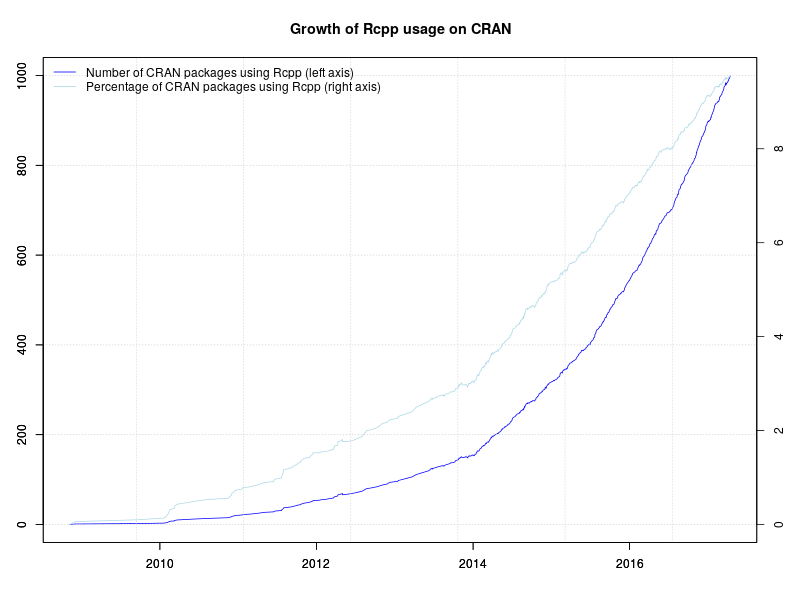
800 Rcpp packages Moments ago Rcpp passed a big milestone as there are now 1000 packages on CRAN depending on it (as measured by Depends, Imports and LinkingTo, but excluding Suggests). The graph is on the left depicts the growth of Rcpp usage over time. One easy way to compute such reverse dependency counts is the tools::dependsOnPkgs() function that was just mentioned in yesterday's R^4 blog post. Another way is to use the reverse_dependencies_with_maintainers() function from this helper scripts file on CRAN. Lastly, devtools has a function revdep() but it has the wrong default parameters as it includes Suggests: which you'd have to override to get the count I use here (it currently gets 1012 in this wider measure). Rcpp cleared 300 packages in November 2014. It passed 400 packages in June 2015 (when I only tweeted about it), 500 packages in late October 2015, 600 packages last March, 700 packages last July, 800 packages last October and 900 packages early January. The chart extends to the very beginning via manually compiled data from CRANberries and checked with crandb. The next part uses manually saved entries. The core (and by far largest) part of the data set was generated semi-automatically via a short script appending updates to a small file-based backend. A list of packages using Rcpp is kept on this page. Also displayed in the graph is the relative proportion of CRAN packages using Rcpp. The four per-cent hurdle was cleared just before useR! 2014 where I showed a similar graph (as two distinct graphs) in my invited talk. We passed five percent in December of 2014, six percent July of 2015, seven percent just before Christmas 2015, eight percent last summer, and nine percent mid-December 2016. Ten percent is next; we may get there during the summer. 1000 user packages is a really large number. This puts a whole lot of responsibility on us in the Rcpp team as we continue to keep Rcpp as performant and reliable as it has been. And with that a very big Thank You! to all users and contributors of Rcpp for help, suggestions, bug reports, documentation or, of course, code.

This post by Dirk Eddelbuettel originated on his Thinking inside the box blog. Please report excessive re-aggregation in third-party for-profit settings.

Gunnar Wolf: On Dmitry Bogatov and empowering privacy-protecting tools

There is a thorny topic we have been discussing in nonpublic channels (say, the debian-private mailing list... It is impossible to call it a private list if it has close to a thousand subscribers, but it sometimes deals with sensitive material) for the last week. We have finally confirmation that we can bring this topic out to the open, and I expect several Debian people to talk about this. Besides, this information is now repeated all over the public Internet, so I'm not revealing anything sensitive. Oh, and there is a statement regarding Dmitry Bogatov published by the Tor project But I'll get to Tor soon. One week ago, the 25-year old mathematician and Debian Maintainer Dmitry Bogatov was arrested, accused of organizing riots and calling for terrorist activities. Every evidence so far points to the fact that Dmitry is not guilty of what he is charged of He was filmed at different places at the times where the calls for terrorism happened. It seems that Dmitry was arrested because he runs a Tor exit node. I don't know the current situation in Russia, nor his political leanings But I do know what a Tor exit node looks like. I even had one at home for a short while. What is Tor? It is a network overlay, meant for people to hide where they come from or who they are. Why? There are many reasons Uninformed people will talk about the evil wrongdoers (starting the list of course with the drug sellers or child porn distributors). People who have taken their time to understand what this is about will rather talk about people for whom free speech is not a given; journalists, political activists, whistleblowers. And also, about regular people Many among us have taken the habit of doing some of our Web surfing using Tor (probably via the very fine and interesting TAILS distribution The Amnesiac Incognito Live System), just to increase the entropy, and just because we can, because we want to preserve the freedom to be anonymous before it's taken away from us. There are many types of nodes in Tor; most of them are just regular users or bridges that forward traffic, helping Tor's anonymization. Exit nodes, where packets leave the Tor network and enter the regular Internet, are much scarcer Partly because they can be quite problematic to people hosting them. But, yes, Tor needs more exit nodes, not just for bandwidth sake, but because the more exit nodes there are, the harder it is for a hostile third party to monitor a sizable number of them for activity (and break the anonymization). I am coincidentially starting a project with a group of students of my Faculty (we want to breathe life again into LIDSOL - Laboratorio de Investigaci n y Desarrollo de Software Libre). As we are just starting, they are documenting some technical and social aspects of the need for privacy and how Tor works; I expect them to publish their findings in El Nigromante soon (which means... what? ), but definitively, part of what we want to do is to set up a Tor exit node at the university Well documented and with enough academic justification to avoid our network operation area ordering us to shut it down. Lets see what happens :) Anyway, all in all Dmitry is in for a heavy time. He has been detained pre-trial at least until June, and he faces quite serious charges. He has done a lot of good, specialized work for the whole world to benefit. So, given I cannot do more, I'm just speaking my mind here in this space. [Update] Dmitry's case has been covered in LWN. There is also a statement concerning the arrest of Dmitry Bogatov by the Debian project. This case is also covered at The Register.

Dirk Eddelbuettel: #5: Easy package information

Welcome to the fifth post in the recklessly rambling R rants series, or R4 for short. The third post showed an easy way to follow R development by monitoring (curated) changes on the NEWS file for the development version r-devel. As a concrete example, I mentioned that it has shown a nice new function (tools::CRAN_package_db()) coming up in R 3.4.0. Today we will build on that. Consider the following short snippet:
library(data.table)
getPkgInfo <- function()  
    if (exists("tools::CRAN_package_db"))  
        dat <- tools::CRAN_package_db()
      else  
        tf <- tempfile()
        download.file("https://cloud.r-project.org/src/contrib/PACKAGES.rds", tf, quiet=TRUE)
        dat <- readRDS(tf)              # r-devel can now readRDS off a URL too
     
    dat <- as.data.frame(dat)
    setDT(dat)
    dat
 
It defines a simple function getPkgInfo() as a wrapper around said new function from R 3.4.0, ie tools::CRAN_package_db(), and a fallback alternative using a tempfile (in the automagically cleaned R temp directory) and an explicit download and read of the underlying RDS file. As an aside, just this week the r-devel NEWS told us that such readRDS() operations can now read directly from URL connection. Very nice---as RDS is a fantastic file format when you are working in R. Anyway, back to the RDS file! The snippet above returns a data.table object with as many rows as there are packages on CRAN, and basically all their (parsed !!) DESCRIPTION info and then some. A gold mine! Consider this to see how many package have a dependency (in the sense of Depends, Imports or LinkingTo, but not Suggests because Suggests != Depends) on Rcpp:
R> dat <- getPkgInfo()
R> rcppRevDepInd <- as.integer(tools::dependsOnPkgs("Rcpp", recursive=FALSE, installed=dat))
R> length(rcppRevDepInd)
[1] 998
R>
So exciting---we will hit 1000 within days! But let's do some more analysis:
R> dat[ rcppRevDepInd, RcppRevDep := TRUE]  # set to TRUE for given set
R> dat[ RcppRevDep==TRUE, 1:2]
           Package Version
  1:      ABCoptim  0.14.0
  2: AbsFilterGSEA     1.5
  3:           acc   1.3.3
  4: accelerometry   2.2.5
  5:      acebayes   1.3.4
 ---                      
994:        yakmoR   0.1.1
995:  yCrypticRNAs  0.99.2
996:         yuima   1.5.9
997:           zic     0.9
998:       ziphsmm   1.0.4
R>
Here we index the reverse dependency using the vector we had just computed, and then that new variable to subset the data.table object. Given the aforementioned parsed information from all the DESCRIPTION files, we can learn more:
R> ## likely false entries
R> dat[ RcppRevDep==TRUE, ][NeedsCompilation!="yes", c(1:2,4)]
            Package Version                                                                         Depends
 1:         baitmet   1.0.0                                                           Rcpp, erah (>= 1.0.5)
 2:           bea.R   1.0.1                                                        R (>= 3.2.1), data.table
 3:            brms   1.6.0                     R (>= 3.2.0), Rcpp (>= 0.12.0), ggplot2 (>= 2.0.0), methods
 4: classifierplots   1.3.3                             R (>= 3.1), ggplot2 (>= 2.2), data.table (>= 1.10),
 5:           ctsem   2.3.1                                           R (>= 3.2.0), OpenMx (>= 2.3.0), Rcpp
 6:        DeLorean   1.2.4                                                  R (>= 3.0.2), Rcpp (>= 0.12.0)
 7:            erah   1.0.5                                                               R (>= 2.10), Rcpp
 8:             GxM     1.1                                                                              NA
 9:             hmi   0.6.3                                                                    R (>= 3.0.0)
10:        humarray     1.1 R (>= 3.2), NCmisc (>= 1.1.4), IRanges (>= 1.22.10),\nGenomicRanges (>= 1.16.4)
11:         iNextPD   0.3.2                                                                    R (>= 3.1.2)
12:          joinXL   1.0.1                                                                    R (>= 3.3.1)
13:            mafs   0.0.2                                                                              NA
14:            mlxR   3.1.0                                                           R (>= 3.0.1), ggplot2
15:    RmixmodCombi     1.0              R(>= 3.0.2), Rmixmod(>= 2.0.1), Rcpp(>= 0.8.0), methods,\ngraphics
16:             rrr   1.0.0                                                                    R (>= 3.2.0)
17:        UncerIn2     2.0                          R (>= 3.0.0), sp, RandomFields, automap, fields, gstat
R> 
There are a full seventeen packages which claim to depend on Rcpp while not having any compiled code of their own. That is likely false---but I keep them in my counts, however relunctantly. A CRAN-declared Depends: is a Depends:, after all. Another nice thing to look at is the total number of package that declare that they need compilation:
R> ## number of packages with compiled code
R> dat[ , .(N=.N), by=NeedsCompilation]
   NeedsCompilation    N
1:               no 7625
2:              yes 2832
3:               No    1
R>
Isn't that awesome? It is 2832 out of (currently) 10458, or about 27.1%. Just over one in four. Now the 998 for Rcpp look even better as they are about 35% of all such packages. In order words, a little over one third of all packages with compiled code (which may be legacy C, Fortran or C++) use Rcpp. Wow. Before closing, one shoutout to Dirk Schumacher whose thankr which I made the center of the last post is now on CRAN. As a mighty fine and slim micropackage without external dependencies. Neat.

This post by Dirk Eddelbuettel originated on his Thinking inside the box blog. Please report excessive re-aggregation in third-party for-profit settings.

Next.

Previous.