Search Results: "ana"

16 January 2010

Miriam Ruiz: Packaging openFrameworks for Ubuntu and Debian

It seems that I m not blogging as often as I was some months ago. The main reason is microblogging, which is somehow quicker, even though briefer. It is also less informative, I guess, because 140 characters is a very limited length. Probably because of that, a friend of mine asked me to write a proper blog entry about this, and I think that he s probably right. openFrameworks is an open source toolkit, released under the MIT license, written in C++ and designed to assist the creative process by providing a simple and intuitive framework for experimentation. According to its authors, it was developed for folks using computers for creative, artistic expression, and who would like low level access to the data inside of media in order manipulate, analyze or explore. I attended a short course in openFrameworks some months ago, and decided that if I wanted to experiment with it, I should somehow structure the building process of the library a bit, remove the dependency on FMOD, which is not DFSG-free, even though that might require remove the whole audio subsystem, make it buildable without Code::Blocks, and hopefully build some more-or-less proper packages. I ve also added some pkg-config files, so that it becomes easier to build projects based in openFrameworks (as easy as g++ source.cpp -o test $(pkg-config openframeworks openframeworks-addons cflags libs) ). Even though the packages are still not as good as they should, they re absolutely usable right now. I ve uploaded them, as well as their dependencies, to my Ubuntu PPA (although I m using those packages in my Debian), in case that someone is interested. I ve also uploaded a couple of tiny examples (the second one downloaded from here) of openFrameworks.

15 January 2010

Adrian von Bidder: Microsoft

Maybe we could define the [ACPI] APIs so that they work well with NT and not the others even if they are open.
Or maybe we could patent something related to this.
Bill Gates, 1999, the others is Linux (Bill says so explicitly in this email, too.) Obviously, we find similar anti-Windows rethoric en masse on Linux mailing list, and obviously it's been a few years since but I find myself asking if anything really changed in the top level of MS management, except perhaps that a few people realized that trying to make the Linux / FOSS crowd look like a ridiculous bunch of amateurs wouldn't work.

Dirk Eddelbuettel: RQuantLib 0.3.2 released

A new version of RQuantLib (a package combining the quantitative analytics of QuantLib with the R statistical computing environment and language) is now out at CRAN and in Debian (where it depends on the 1.0.0 beta of QuantLib that is currently in the NEW queue with its new library version). This RQuantLib release works with either the current release 0.9.9 as well as with the just-released first beta of QuantLib 1.0.0. This versions brings a few cleanups due to minor Rcpp changes (in essence: we now define the macro R_NO_REMAP before including R's headers and this separate non-namespaced functions like error() or length() out into prefixed-versions Rf_error() and Rf_length() which is a good thing). It also adds a number of calendaring and holiday utilities that Khanh just added: tests for weekend, holiday, endOfMonth as well dayCount, date advancement and year fraction functions commonly used in fixed income. Full changelog details, examples and more details about this package are at my RQuantLib page.

14 January 2010

Jonny Lamb: Monorail

Recently, I've been working on a file transfer app for the N900. It's called monorail and I uploaded it to extras-devel last night, so you can try it out right now. Click for full-sized image I implemented an OssoABookContactView with support for filtering on Contact Capabilities (or a draft of it, at least) as old-style caps aren't great. This gives a nice list of address book contacts who have at least one account that should support receiving file transfers. It would be nice if these extra caps could go into the address book which is where they belong, but it won't. If someone would find this widget useful, I'll clean up the code and maybe throw it in its own library. Click for full-sized image
Choose one of the accounts which support file transfer. I also started to implement a sharing plugin, but it turns out it's poorly documented and appears to be impossible to do anything useful for my use-case, like popping up a dialog when the user taps "Share". The example isn't very exemplary, but does contain some amusing code. This sharing plugin is only half-written and impossible to debug. If anyone has any pointers on writing these plugins, I would appreciate them. Click for full-sized image It's a shame that although Hildon widgets can look really good on the device, it can often take some fiddling to make them look consistent with the rest of the UI. Additionally, oddities in some widgets can leave you baffled, or amused. The most annoying thing I have come across regarding this app is just how little I can get it integrated. The file manager is all hard-coded so there's no way to add a Send to Contact menu item, and no buttons can be added to the libsharing dialog (which appears when the user shares a photo) which is annoying as it looks like it's missing this feature. Click for full-sized image Oh, and Telepathy is pretty sweet.

Jonny Lamb: Telepathy on Maemo

A few weeks ago, I got a cool Christmas present from work. It's pretty sweet, and I've been writing some apps for it. I'll try and blog about them here. A while ago, I wrote some a number of account plugins for Maemo 5, so that other Telepathy connection managers could be used and well-integrated into the N900's Contacts and Conversations User interface. This enables the following extra protocols: There are still a few problems which I'll try to iron out soon enough but they appear to be working pretty well. The best thing about it is clearly the integration with the rest of the phone, as demonstrated by Marco in the screenshot above. The PR1.1 update, which is due today, also opens the door for enabling other protocols dynamically by providing libpurple plugins. I will be adding Facebook Chat support soon, and someone else has made a package for Twitter. This is in extras-testing for you all to download and try out. You can find all the packages in the "Network" category of the Application manager. The Extra protocol plugins for Conversations and Contacts metapackage (telepathy-extras, in reality) pulls in all the cool account plugins and connection managers of the time. File bugs from the maemo.org package link.

Sam Hartman: Open Source Accounting Software

I m developing a huge backlog of things to write about, going back as far as a couple of posts inspired by the Kerberos conference in October. However, those require more effort putting together the post, so I m going to focus on something more recent. Part of running a business even a small business like Painless Security is dealing with the administrative and bookkeeping. The normal solution seems to be Intuit s Quick Books. When I set up the company, I looked into that. However, Intuit s accessibility story starts with give up, and goes down hill from there. Apparently, screen reader vendors have offered to work with Intuit to help them, but have been turned down, or at least that s the strong implication I get from reading blogs from these accessibility vendors. So, I d definitely rather not give Intuit my money. I m also looking for a bit more than the minimum in accounting software. Keeping the books in order enough to pay taxes would be easy. However I want to be able to understand where I m making money; I want to be able to figure out if the fixed price contracts I enter into end up being good ideas. I want to understand how expensive community projects Painless Security gets involved in like Debian and IETF work are both in terms of direct costs and opportunity costs. I want to understand what sorts of work ends up being the most profitable. All of these are fairly typical management questions; solutions to varying degrees are understood. however it means I m actually going to use an accounting product more than just to track my invoices and prepare taxes. I decided to see what the open source world was like in this space. I started with Ledger SMB. Ledger SMB s main claim to fame is that it tries to be better than SQL Ledger. Being better than SQl Ledger is definitely a good thing. It worked well enough to generate invoices and income statements. It nominally had facilities to track the sort of per-project information I m looking for, but the facilities are not near good enough. Also, there were some issues things like the fact that total debits didn t particularly need or tend to sum to total credits got old after a very short while. Also, facilities for correcting mistakes were unfortunate. You could either operate in a mode where you could delete a transaction, or a mode where you reverse transactions. Deleting transactions in practice meant deleting most of a transaction; balances became out of sync and half of the transaction tended to stick around using some interfaces but not other interfaces. Database cleanup was almost always required. In principle, reversals are better. However, there is no facility to indicate that you re not expecting payment on a reversed invoice. The receivables/payables account balance out because of the reversing transaction, but both the reversing and reversed transaction end up becoming over-due. Hey, can you please send me some anti-money to clean this up? The code was dreadful; the goal was to have better abstraction than SQL Ledger. Perhaps that was achieved, but man that leaves a lot to desire. Now, I m playing with Open ERP. It wants to grow up some day to be a competitor to SAP R3. In a way that sounds good, although it does mean there s a high complexity cost. There s a lot of functionality. There s reasonably good separation between view and model (and possibly even controller). The code is often clean, although the random blocks of commented out code with no explanation cause me to cringe. Many aspects of the system seem incredibly well designed; you can approach the system through a web client, graphical client, two different RPC mechanisms, XL and Open Office plugins. However, there s this mix of missing stuff and completely broken that causes me to wonder whether I m going to be sad. First, there appears to be basically no support for the US. All addresses are European format and are hard coded. Each individual report needs to be changed. Recently, I found cases where as best I can tell debits and credits are just reversed. I ve found a case where backing up the database succeeds but generates a zero length file. I almost lost data through that last one. There s a complex set of mechanisms to deal with units-of-measure for products for example, some jobs billed in hours, some are billed in days. However other parts of the code just add quantities. Playing around with this I am reminded again that I really enjoy thinking about these sorts of problems. An interesting ERP project could be fun to work on. for example, I bet handling ERP needs for some cloud-centered company would be a lot of fun. Also, as part of looking at Open ERP, I ve more or less developed the necessary scripts to migrate a simple service company from Ledger SMB to Open ERP. There are limitations of course, but if this would be useful to you, drop me a line.

John Goerzen: System Administrators Might Save Your Life

There s a lot of responsibility on the shoulders of system administrators. Unless you re one, it s probably hard to grasp the full weight of it. This week has been full of reminders for me. This afternoon, shortly after lunch, I got word that people were having trouble with phones. A few minutes of testing showed that calls within our city were working fine, but it was completely impossible to place or receive long-distance calls. A little while later, a local newspaper s website indicated that numerous cities over a multi-county region, all served by the CenturyLink local telephone company, were out of service in this manner. I figure that represents hundreds of square miles, or a patch of rural Kansas roughly the size of Los Angeles. Adding to the problem was the fact that emergency 911 services are accessed via these long-distance lines that were down. For roughly three hours, 911 was completely down across this entire area. What s more, many cellphone towers and Internet access options were also taken down, since they feed from these same lines. This adds up to a situation that could very easily cost lives due to delayed response of emergency medical, fire, or police services. In the end, the problem was traced to a bad controller card on a Titan 5500 owned by AT&T. Now, here s the system administration angle: If you worked for the phone company and had to troubleshoot a problem that you knew had taken down emergency services for thousands of people, what kind of pressure would you be feeling? Would you be able to keep your cool? I m glad that I don t have that kind of job. I also wouldn t like to be the engineer (or, more likely, accountant) that decided that they didn t need any more redundancy to provide good service to the area. Especially considering this is the second time in the last year or two this has happened. But, ironically, yesterday I signed a purchase order for a new Asterisk PBX (corporate phone) server. When selecting a machine for that task, I am always completely conscious of the responsibility on my shoulders: several hundred employees rely on the machine that is ultimately my responsibility to select. Our own access to 911 would be cut if the machine were to go down. I never forget that the correct operation of the systems that our team sets up and deploys could help save someone s life, and that a malfunction could cost the company dearly in terms of revenue, productivity, image or worse. Nearly four years ago, we switched from an analog PBX, with outsourced support, to a digital VOIP system running Asterisk. Note that we use VOIP in-house, but do not use it externally. Anyhow, I can not say that the Asterisk PBX has been 100% perfect; I doubt that this could be honestly said of any PBX of any complexity. I can say, though, that it saved us well over $100,000 AND has proven far more reliable than the system it replaced. Outages are exceptionally rare and brief now. Plus we have internal expertise to fix it, rather than having to wait for a technician to be dispatched from a city 2 hours away to fix anything. I know I don t have the resources to build a perfect PBX that will never go down (if such a thing is even possible), but I take my responsibility regarding a reliable PBX extremely seriously. We used to have a frequent problem: someone would call 911, then hang up. We suspected this was often on accident maybe people hit 9 for an outside line, then misdialed their number. In any case, 911 dispatch would then call our main office, saying they got a hangup. A person or team would then go across our entire campus making sure nobody was in distress that nobody had managed to dial, then passed out, for instance. With Asterisk, I was able to help this situation. Whenever somebody calls 911 now, two emails are generated: the first contains details about the call, such as the extension number that called and the duration of the call. This goes to all people that are likely to receive a callback from 911. It may not always pinpoint the source (as with somebody using a wireless phone), but almost every time will give us a very good idea where the call came from. The second email is a recording of the call, and serves as an additional clue, but goes to fewer people. I am aware that email isn t a perfect medium, but: it let us make a dramatic (albeit imperfect) solution to a problem that very few institutions our size are able to address nearly so well. There s a lot of weight on our shoulders: keeping the accounting system up, the Internet links up, the web store or the sales phone lines, the shipping systems or the document archives up. These things going down can spell deep trouble in many ways. And sometimes the systems we maintain might save a life. Such as this morning, when someone was feeling symptoms of a heart attack, used our phones to call a colleague for help, that person called 911, and an ambulance was dispatched. I know the system worked exactly as it should, because I had two familiar emails from Asterisk in my mailbox this morning when I got to work.

13 January 2010

Paul Wise: Another decade, another ...

Thanks to all the Debian, FLOSS and Indymedia folks out there, you've made the last decade much more enjoyable.

Dirk Eddelbuettel: Rcpp 0.7.2

Not even two weeks after the Rcpp 0.7.1 release, Romain and I have a new one to present: Rcpp 0.7.2. It has been uploaded to CRAN and Debian, and the respective package management systems should carry them around in the next few hours. As always, the local page is also available for download too. A lot of the momentum for the new API is continuing, thanks in large part to Romain. A number of new classes have been added, and existing ones have been enhanced. There are more unit tests than ever, and more documentation. We have better build support (with g++ version detection so that we can add some C++0x support where available) and a new examples sub-directory. We did take one toy away, though. The Doxygen-generated docs were getting so big that we decided to keep them out of the source tarball. (And arguably, they are also too volatile.) We still have the browseable html docs as well as the pdf version (now at over 300 pages!). And we added zip archives of the docs in html, latex, and man format for download. As always, full details are in the ChangeLog on the Rcpp page. Questions, comments etc: bring them to the rcpp-devel mailing list off the R-Forge page

Theodore Ts'o: Proud to be a Googler

Although I obviously had nothing to do with Google s decision vis-a-vis China, having only started working there for a week, I was definitely glad to see it and it made me proud to be able to say that I work there. Kudos to Google s management team for having made (IMHO) the right decision. Hopefully Yahoo and Microsoft will consider carefully what the ethical implications of their collusion and collaboration with the Chinese government s attempt to control free speech and the human rights implications of the same. I have my own opinion regarding the IETF s decision to meet in Beijing, since as we ve seen with the Search Engine industry s attempt to accommodate the Chinese, engagement doesn t necessarily always lead to openness and goodness. All I can suggest is that those people who do decide to travel to that meeting be very careful about what sort of message they want to send with respect to China, as well as being very careful about protecting themselves against targetted information security attacks. No related posts.

Steve Kemp: Cover your heart! Cover your heart!

I've long been a fan of Danga's Memcached, back in 2005 I wrote about it for the first time. Recently I've been looking at the persistant version, memcachedb which is essentially a Berkeley Database using the memcached protocol as the transport layer. This allows you to get persistance for free, and means you can rely upon the content being present, rather than just hoping it will be there as an opportunistic cache. However in this brave new world of nosql I've been mulling over different options for new projects / new toys. I have to say that memcachedb lost out for me, and that Redis is my preferred flavour of new hot. Redis has a rich API allowing you to store interesting datatypes such as lists, and it allows both replication and distribution (neither of which I need just yet, but both are useful to have as options for the future). The documentation is great including a well-documented Twitter clone, and the facilities that are available are a step up from memcached, albeit obvious extensions which you'd expect if you were doing interesting things. The redis-server package is already part of Debian GNU/Linux, and creating .deb package of the Redis module was trivial. So now that I'm familiar with it, what to use it for? Well I think the first thing will be the new 2010 Valentines site. Over the years I've hosted several Livejournal Valentine sites, and this year is no different. (Why? I like matching people, and I like social stuff. This is why I did ctrl-alt-delete in the past, even if that failed it was a great learning experience and I'd do it again if I had the time/patience/more optimism). So far the site only has a couple of users but I fully expect it to ramp up considerably before the magical day (ha!). In the past I've limited the lifetime of the site(s) from Feb 1st to Feb 14th and still managed to achieve 5000+ users. Right now I'm using flat files for storage specifically to avoid database-load issues (which caused me considerable pain one year). I suspect the backend will be Redis-based in the very very near future, but in the meantime if you're open to amusement and use Livejournal then feel free to poke at it: ljvalentine.com. ObFilm: Indiana Jones and the Temple of Doom

12 January 2010

John Goerzen: Sing to Me, Muse

(a review of Homer s Iliad)
Here, therefore, huge and mighty warrior though you be, here shall you die. - Homer (The Iliad)
And with that formidable quote, I begin my review of The Iliad. I shall not exhaust you with a rehashing of the plot; that you can find on Wikipedia. Nor shall I be spending page upon page of analyzing the beautiful imagery, the implications of our understanding of fate and destiny, or all the other things that compel English majors to write page after page on the topic. Nor even shall I try to decipher whether it is a piece of history or a piece of legend. Rather, I intend to talk about why I read it: it s a really good story.
Sing to me, O goddess Muse, the wrath of Achilles, son of Peleus, which brought countless ills upon the Acheans.
As I d be reading it, I d think to myself: Ah ha! Now here we finally have a section of the story that doesn t speak to modern life. Perhaps it was a section the fear of being enslaved or butchered by conquerors, or about pride leading both sides to fight a war they need not have, or a graphic description of a spear going clear through someone s head or neck. And then, I d have to sit and think. Are we really so far removed from that? Here we are, in a supposedly civilized world. We use remotely-operated drones to drop bombs on people, and think it naught but regrettable collateral damage when the brains and intestines of dozens of innocent victims are scattered about, killing them, all for the chance of killing one enemy. But we aren t the only ones to blame; we live in a world in which killing the innocent is often the goal. People fly airplanes into skyscrapers, drop atomic weapons to flatten entire cities, and kill noncombatants in terrible numbers. And for what? A little power, some prestige, some riches, some vengeance, some wounded pride? Slavery is not dead, either. We that can happily afford Internet access most likely abhor the thought. What, though, can we make of the fact that people are starving in this world in record numbers? That our actions may literally wipe some nations off the map? Are those people as free as we are? Do our actions repress them? I suspect you can t read the Iliad without being at least a bit introspective.
Fear, O Achilles, the wrath of heaven; think on your own father and have compassion upon me, who am the more pitiable
One of the great things about reading the Iliad is that I can learn about the culture of the ancient civilizations. Now, of course, one can read about this in history books and Wikipedia. But reading some dry sentence is different from reading a powerful story written by and for them. I know that the Iliad isn t exactly a work of history, but it sure shows what made people tick: their religion, their morals, their behavior, and what they valued. I feel that I finally have some sort of insight into their society, and I am glad of it.
The day that robs a child of his parents severs him from his own kind; his head is bowed, his cheeks are wet with tears, and he will go about destitute among the friends of his father, plucking one by the cloak and another by the shirt. Some one or other of these may so far pity him as to hold the cup for a moment towards him and let him moisten his lips, but he must not drink enough to wet the roof of his mouth; then one whose parents are alive will drive him from the table with blows and angry words.
There are gory battle scenes in the Iliad, but then there are also heart-wrenching tender moments: when Hector leaves his wife to go fight, for instance, and worries about the future of his child if he should die. That s not to say I found the entire story riveting. I would have liked it to be 1/3 shorter. The battle just dragged on and on. And yet, I will grant that there was some purpose served by that: it fatigued me as a reader, which perhaps gave me a small sense of the fatigue felt by the participants in the story.
Why, pray, must the Argives needs fight the Trojans? What made the son of Atreus gather the host and bring them?
A question that was never answered, for either side: why are we so foolish that we must go to war? One tragedy among many is that neither side got smart about it until way too late, if ever they did at all. I read The Illiad in the Butler translation, which overall I liked. Some of these quotes, however, use the Lattimore one. This completes the first item on my 2010 reading list. I leave you with this powerful hope for the future, written almost three thousand years ago. Despite my criticisms above, we have made a lot of progress, haven t we? What a beautiful ideal it is, and what a long ways we have yet to walk.
I wish that strife would vanish away from among gods and mortals, and gall, which makes a man grow angry for all his great mind, that gall of anger that swarms like smoke inside of a man s heart and becomes a thing sweeter to him by far than the dripping of honey.
Sing to me, O goddess, the anger of Achilles, that one day his story may speak less to our hearts, for then will we have outgrown it.

11 January 2010

Gunnar Wolf: Engineer? Scientist?

Looking over some articles in the March 2009 issue of the Communications of the ACM magazine, I found a very good piece column (Is software engineering engineering?, Denning, Peter J., and Riehle Richard D. , Communications of the ACM, 03/2009, Volume 52, Number 3, p.24-26, (2009) ). Quoting from it:
The search for an alternative to the programmer image is already a generation old. In 1989 we asked: Are we mathematicians? Scientists? Engineers? We concluded that we are all three. We adopted the term "computing", an analogue to the European "informatics", to avoid bias towards any one label or description. (...) Predictable outcomes (principle of least surprise) Engineers believe that unexpected behaviors can be not only costly, but dangerous; consequently, they work hard to build systems whose behaviorthey can predict. In software engineering, we try to eliminate surprises by deriving rigurous specifications from well-researched requirements, then using tools from program verification and process management to assure that the specifications are met. The ACM Risks Forum documents a seemingly unending series of surprises from systems on which such attengion has been lavished. Writing in ACM SIGSOFT in 2005, Riehle suggested a cultural side of this: where researchers and artists have a high tolerance, if not love, for surprises, engineers do everything in their power to eliminate surprises. Many of our software developers have been raised in a research tradition, not an engineering tradition.
It would be an interesting excercise to find how people rate themselves in this regard in a large group of developers, and find the differences in their coding styles, or how varied (in developer profiles) are each of the sub-groups.

10 January 2010

Robert Collins: Announcing testrepository


For a while now I ve been using subunit as part of my regular development workflow. I would pipe test results to a file, use subunit to report on failures from that file, and be able to inspect all the failures at my leisure without rerunning tests or copy and pasting from far back in my history. However this is a bit adhoc, and its not trivial to get good pipelines together while its not hard, its not obvious either. And commands like tee are less readily available for Windows users. So during my holidays I started a small project to automate this workflow. I didn t get all that much done due to a combination of travel and coming down with a nasty bug near the end of my holidays which I m now recovering from. Yay health returning + medicines. If only we had medichines :) . However, I managed to get a reasonable first release out the door this evening. Grab it from launchpad or pypi. Testrepository has a few deps all listed in INSTALL.txt. Folk on Ubuntu Lucid should be able to just apt-get them all (sudo apt-get install subunit will be enough to run testrepository). If you re not on Lucid you can grab the debs manually, or use the subunit ppa (sudo add-apt-repository ppa:subunit), though I ve noticed just today that that karmic subunit build there only works with python 2.5, not the default of 2.6 I will fix that at some point. Using Testrepository is easy if you are developing python code:
$ testr init
$ python -m subunit.run project.tests.test_suite   testr load
id: 0 tests: 114
This will report any failures that occur. To see them again:
$ testr last
id: 0 tests: 114
The actual subunit streams are stored in .testrepository in sequentially numbered files (for now at least). So its very easy to get at them (for instance, subunit-stats < .testrepository/12). If you are not using python, you can still use subunit easily if you are using shunit, check or cppunit . subunit ships with bindings for shunit and cppunit, and check uses libsubunit with the CK_SUBUNIT output mode. TAP users can use tap2subunit to get a subunit stream from a TAP based testsuite. It s still early days but I m finding this much nicer than the adhoc subunit management I was doing before.

Russell Coker: The Lenovo U1 Hybrid an example of how Proprietary OSs Suck

Lenovo have announced their innovative new U1 Hybrid laptop [1]. It consists of a tablet-style device with a resistive touch-screen that runs Linux on a 1GHz ARM processor which attaches to a base computer that has a keyboard and a Core2 processor running Windows 7. They apparently have some special software to synchronise web browsing on both computers so you can maintain your web sessions when you detach the computers. How they manage to use the power of the Core2 CPU for javascript and flash intensive web sites while allowing the active browser sessions to migrate to a different OS must be a neat technical trick. Revision3 have a youtube review of the U1 which shows what it can do in terms of the hardware interface [2] Running two computers requires having two batteries, motherboards, etc which means more weight or means less battery life for the weight, whichever way you think of it the user is losing because of this choice. The idea of having two computers in one is one of these cool technical ideas which just won t provide a benefit for the users. The best thing for the users would be to have a single light-weight computer that provides an adequate amount of performance. A 1GHz ARM processor should give good performance when running Linux for most tasks (web browsing, office applications, and most games). So it seems that a good tablet with some USB ports and a matching USB keyboard would be a better option. Maybe you could have a spare battery integrated with the keyboard as most times when you want a full sized keyboard weight isn t such a big problem. The problem with MS-Windows in regard to such machines is that performance is poor and processors other than i386 and AMD64 have never really been supported (sure you can buy MS-Windows-based PDAs that have ARM and PPC CPUs, but the application support for them is minimal). These problems will never be solved. MS wants to compel users to continually upgrade their software, this requires always adding new features (bloat) while an older or less featureful OS is often a better option for lesser hardware. Vendors of proprietary applications will never support the range of CPU architectures that a free software distribution such as Debian or NetBSD supports (not that NetBSD is an ideal tablet OS but it does demonstrate what can be done if you want a portable OS). These inherent flaws in the proprietary software environment lead to some unusual hardware being designed to work around them such as the Lenovo U1. I don t have any reason to believe that the Lenovo is a bad machine, it sounds like a reasonable work-around for some of the problems that MS-Windows has forced on the industry. But I believe that it would be a much better machine if it was lighter, had a better battery life, and had a choice of keyboards all of which would have been achieved if it was designed as an ARM-only tablet machine that you can connect to an external keyboard. They could even have used a multi-core ARM CPU. But the market for such systems apparently isn t large enough for Lenovo (or anyone else) to ship ARM laptops for serious use. There have been a couple of netbooks released recently with CPUs that don t support the i386 or AMD64 instruction set, but they were aimed at web browsing use not general purpose computing. Almost everything that I do on computers could be done at least as well with a CPU that doesn t run an Intel-based instruction set, the only exception is virtualisation which doesn t seem to be well supported on architectures other than AMD64 nowadays.

Gunnar Wolf: Winter in the tropics

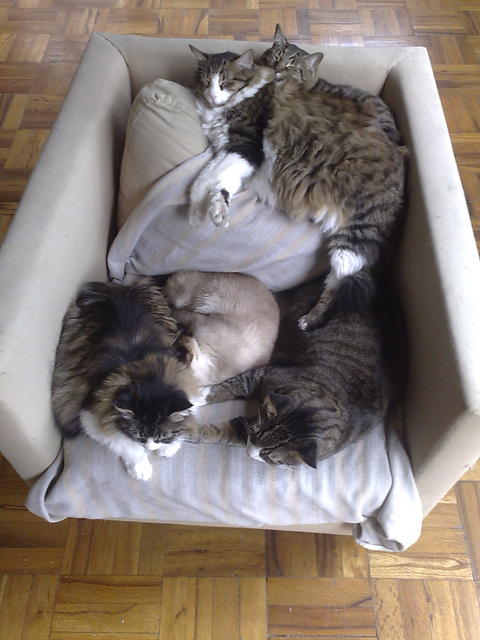
Five out of six experts agree: Five out of six cats cannot be mistaken
It. Is. Cold.
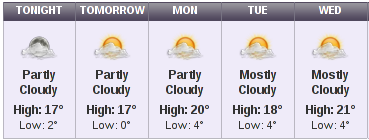
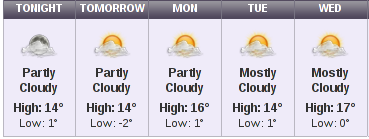
No, we are far from this very impressive picture of a fully-snowed UK seen from the sky that everybody and their dog must have seen by now. Still, in Mexico City we are experiencing the traditional one-or-two-weeks-a-year where it is genuinely cold. And, very strange being this Winter (the rainy season is Summer around here, January should be dry!) we have rain all day long. The Ajusco mountain is around 15Km south from my home, and it is the closest of the giants that surround our valley. Yesterday I managed to get some peeks at it behind the very thick layer of clouds we have. Ajusco looks really gorgeous all snowed, maybe down to the 3400m line (while the city's main area is at 2300m). This picture was not taken this year, we have snow in Ajusco almost every year (although very seldom as much as this time): (last photo is not current, we have not yet had a clear day to take a picture of our Ajusco yet this year) How does it feel? Well, I live in Coyoac n, in the flat area of the valley. Remember that houses here are not built to endure extreme temperatures (and this week is what we call extreme, of course ;-) ). According to Yahoo! Weather: And while the difference appears to be small, what about Magdalena Contreras, ~200m higher, where many people dear to me live (and have even a window pending to be installed)? People say this cold wave is the strongest in 120 years, since records are being taken. Every year people get excited, expecting that this time we will get snow. This has only happened once in at least a century, in 1966 AFAIR. I do not think this year to be atypical. Still, I have a reputation for being insensible to cold weather. Everybody wears heavy jackets while I still go to work with my usual long-sleeved shirt and that's it. But the last two days, I have been using jacket and scarf... But, of course, I don't look as gratious or cute as my cats :-
Joey Hess: please set up tor bridges

Here is a great talk from the Chaos Communication Congress about Tor and censorship: lessons learned. It's the inside scoop from the Tor guys on how they're keeping Tor usable inside China, Iran, etc despite attempts to block it. clients per day Chinese tor users via bridges If you're like me, you have resources and would like to help Tor, but the exposure of running a exit node is way too high, and even running an non-exit node seems risky. Now there's a third option, running a bridge which can be used to get to the Tor network. The great thing about doing this is that you can be pretty sure anyone using your Tor bridge is the kind of person you want to help (and not some spammer or worse). There's little reason to use a Tor bridge unless your ISP/Government is repressing you. Also, the worst thing that is likely to happen to your bridge is that $COUNTRY discovers its IP and blocks it. So the benefits seem focused and high, and the risks easily managed.

9 January 2010

Christian Perrier: [life] [running] Some news

It's quite some time since I gave news about my running junkiness. So here they are. Apparently, my last blog entry was about my worries about which marathon(s) to run next year. At least one is scheduled, of course Paris. The highest probability as of now if Berlin in September (probable enough for me to register as soon as it becomes possible)...which would also leave a possibility to run Donostia in late November if I manage to convince Elisabeth that running 3 marathons in a year is not entirely crazy. I'll also try again to run a solo marathon in late May in for t de Rambouillet (: I still have to see some wallabies that are said to be living here). Other planned runs include the Semi de Paris (Paris half-marathon), which is twinned with the Paris marathon, 5 weeks before, as well as a much smaller one, the semi-marathon des Lions in Bullion, in the Rambouillet forest, where I had a memorable run on Dec 17th on a snowy day. That will make 3 mass runs in a row, one per month, culminating to Paris marathon. Sounds like a good plan. So, since I ran the Cologne marathon, my plans were mostly to stay trained enough. For this, I went back to me regular schedule of one short 10km run on Saturday morning, then a longer one on Sunday morning, plus hopefully small runs with colleagues, or alone, at lunch break. The most interesting things to notice during this October-December timeframe were then: All this, plus many others cumulated about 375km in 3 months which is fairly what I planned to do. The goal right now is to both enjoy winter runs in snowy landscapes as we are very lucky to have a real winter this year in Paris area (I'll try to shoot some pictures tomorrow and post them on my gallery)....and properly prepare the Paris marathon, where my goal is to break the 4h barrier and go down to about 3h50 (some might say I'm not ambitious enough). A long term goal (probably 2011) is the well-known Saint Lyon long distance night run, starting from my birth city, Saint- tienne: 69km, departure at midnight, 1300m positive slope (1700m negative), up to 850m altitude from 500m, 55 editions. This on the first week-end of December, which in that season may mean "snow" (the 1990 edition was stopped at the 2/3 of the run because of a 70cm snow fall, but 80 heroes completed the whole run anyway). That run will be the next Grail, as it seems.:)

Andrew Pollock: [life] Renovations coming along

renovate
v 1: restore to a previous or better condition
  2: make brighter and prettier
remodel
v 1: do over, as of (part of) a house
  2: cast or model anew
I much prefer the term renovate to remodel. Remodelling to me feels more like tearing down internal walls and changing the actual layout of the place. But we're in America, so remodelling it is. We've had a bit of (mostly self-inflicted) scope creep. It started with just wanting to get some Ethernet cabling installed, then we decided to get recessed canned lighting (the whole lamp thing over here drives us nuts), and then we discovered that acoustic ("popcorn") ceilings are a haven for dust mites (we're both allergic) so it made sense to get the ceilings redone while they were putting the lights in. We're also getting the light switches replaced, and new childproof power outlets. We also got the electrical panel upgraded. Removing popcorn ceilings is somewhat hilarious. They put down plastic everywhere, then have at it with a garden hose, and then it just scrapes off. The ceilings they've completely finished already look a million bucks, so we're very happy with the decision to do that. The Ethernet cabling installation caused a lot of wall carnage, so we're going to get the walls repainted as well. Then we can get the carpets cleaned and stain proofed, and then we can start thinking about trying to move some non-essential stuff in. Hopefully it'll all be done by next weekend. The kitchen cabinets have a six week lead time, so the kitchen remodelling will have to be done while we're living there. Unfortunately some unexpectedly time demanding stuff has come up at work, right in the middle of this, so Sarah's had to do the bulk of the running around to sort out contractors for all of the work, and I've been stuck at work until all hours, 7 days a week. To cap it off, I've managed to come down with a cold, and feel quite crappy. NyQuil consumption is ensuing.

Next.

Previous.