Search Results: "tg"

30 January 2015

Laura Arjona: Going selfhosting: Installing Debian Wheezy in my home server

It was in my mind to open a new series of articles with topic selfhosting , because I really believe in free software based network services and since long time I want to plug a machine 24 7 at home to host my blog, microblog, MediaGoblin, XMPP server, mail, and, in conclusion, all the services that now I trust to very kind third parties that run them with free software, but I know I could run myself (and offer them to my family and friends). Last September I bought the domain larjona.net (curious, they say buy but it s a rent, for 1,2,3 years never yours. Pending another post about my adventures with the domain name, dynamic DNS, and SSL certs!) and I bought an HP Microserver G7 N54L, with 2 GB RAM. It had a 250GB SATA harddisk and I bought 2 more SATA harddisks, 1 TB each, to setup a RAID 1 (mirror). Total cost (with keyboard and mouse), 300 . A friend gave me a TFT monitor that was too old for him (1024 768) but it serves me well, (it s a server, no graphical interface, and I will connect remotely most of the times). Installing Debian stable (wheezy) I decided to install Debian stable. Jessie was not frozen yet, and since it was my first non-LAMP server install, I wanted to make sure that errors and problems would be my errors, not issues of the non-released-yet distro. I thought to install YunoHost or some other distro prepared for selfhosting, but I ve never tried them, and I have not much free time, so I decided to stick on Debian, my beloved distro, because it s the one that I know best and I m part of its awesome community. And maybe I could contribute back some bug reports or documentation. I wanted to try a crypto setup (just for fun, just for learn, for its benefits, and to be one more freecrypto-tester in the world) so after reading a bit: https://wiki.debian.org/DebianInstaller/SataRaid
https://wiki.archlinux.org/index.php/disk_encryption
http://madduck.net/docs/cryptdisk/
http://linuxgazette.net/140/kapil.html
http://smcv.pseudorandom.co.uk/2008/09/cryptroot/
http://www.linuxquestions.org/questions/linux-security-4/lvm-before-and-after-encryption-871379/ and some other pages, and try some different things, this is the setup that I managed to configure: Everything went well. Yay! Some doubts and one problem Everything went quite well except some doubts: After talking about this issues with friends (and in debian-women IRC channel), I decided to install the non-free driver, just in case, with the same reasoning as with the RAID: let the card do the job, so the CPU can care about other things. Again, I notice that learning a bit about benchmarking (and having some time to do some tests) would be nice And now, the problem: I left this problem apart and go on installing the software. I would think later what to do. Installing MediaGoblin The most urgent selfhosting service, for me, was GNU MediaGoblin, because I wanted to show my server to my family in Christmas, and upload the pictures of the babies and kids of the family. And it s a project where I contribute translations and I am a big fan, so I would be very proud of hosting my own instance. I followed the documentation to setup 2 instances of GNU MediaGoblin 0.7 (the stable release in the moment), with their corresponding PostgreSQL databases. Why two instances? Well, I want an instance to host and show my videos, images, and replicate videos that I like, and a private one for sharing photos and videos with my family. MediaGoblin has no privacy settings yet, so I installed separate instances, and the private one I put it in a different port, with a self-signed SSL cert, and enabled http-authorization in Nginx, so only authorized Linux users of my machine can accesss the website. Installing MediaGoblin was easier than what I thought. I only had some small doubts about the documentation, and they were solved in the IRC channel. You can access, for example, my user profile in my public instance, and see some different files that I already uploaded. I m very happy!! Face to face with the bug, again I had to solve the problem of the password not accepted in reboots. I began to think that it could be a bug in cryptsetup. Should I upgrade the package to the version in wheezy-backports? Jessie was almost frozen, maybe it was time to upgrade the whole system, to see if the problem was solved (and to see how my MediaGoblin was working or not in Jessie. It should work, it s almost packaged! But who knows). And if it didn t work, maybe it was time to file a bug So I upgraded my system to Debian Jessie. And after upgrade, the system didn t boot. But that s the story of another blog post (that I still need to finish to write don t worry, it has happy end, as you could see accessing my Mediagoblin site!). Comments? You can comment in this pump.io thread.
Filed under: My experiences and opinion Tagged: Debian, encryption, English, libre software, MediaGoblin, Moving into free software, N54L, selfhosting, sysadmin

27 January 2015

Laura Arjona: Upgrading my computers to Debian Jessie

Until now, I usually run Debian stable at work (in my desktop PC) and stable or testing at home in my laptop. I was upgrading to testing during the freeze, and then, stay in testing (future stable) or stable (when it s published) until the next freeze. I have changed this conservative pattern. I ve been running Jessie for many months now, and here I ll document the different experiences in the computers that I use. Upgrade or clean install? I decided to upgrade my computers instead of making a clean install (except in the ones that were not running Debian). Although the upgrade process have been fine, I m still not sure which is the best for my needs. Installing from the beginning forces me to re-read the feature list of the different pieces of software and choose the one that fits best (not the one that I was using some years ago). And maybe I just don t need that non-free driver anymore because there s free replacement already, the installer is wise. OTOH, upgrading is easier and quicker, and I got all my software and configurations (and my rubbish) there, nothing is lost. The computers Here I will link the blog posts of each computer that I upgrade, when I finish writing the corresponding articles: Comments? You can comment in this pump.io thread.
Filed under: My experiences and opinion Tagged: Debian, English, Moving into free software

Jingjie Jiang: Yet another post.

In the middle of OPW internship I originally thought taking part in FOSSOPW is a great chance to lift my coding skills and I shouldn t miss it. As time passes by, I now have a new thought towards it. # 1 It do improves your coding skill. Zack, Matthieu and I often have discussions on coding style. For example, once Zack said, For code like this, you should explicitly use an if/else clause, not if-return. I was totally unaware of this sort of issue. Actually I even didn t know how I should call this problem. Matthieu gave me a detailed FYI link on this in no time. Besides, my completeness of thinking is also trained. Recently, I was fixing a HTTP GET Method ?suite=suite-name issue. It s a trivial task. And you know most trivial tasks require lots of scattered modification on the source code base. I did have fixed most places, such as the pages of /src/packagename and /search/ . Zack did a thorough review, and pointed out that the pages rendered by /prefix has some malformed urls in the HTML. Waiiiit, I should have noticed it. But somehow I missed it. Maybe because my mind was wandering at that time? This made me think, I shall have a thorough view of what I should do before getting my hands dirty. Or more preferably, if I could write down what I exactly want to achieve before coding, then silly problems definitely wouldn t occur. This may sound a little bit like TDD. ;). # 2 It makes you look like a (not-that-good) ninja. I use a macbook. It s not my fault! I ve tried several times, but I never successfully find a laptop that is not capable of boiling eggs when running Debian. (and especially KDE+Debian). So I have no way but switched to OSX. The development of Debsources happens on a remote Ubuntu LTS (now Debian SID, haha) virtual machine. Of course I have to install all the dependency on my own, e.g., Postgres, set up port-forwarding, e.g., ssh -D, write automate shell scripts, e.g., dash, but more importantly, I am forced to live under the dark terminal with no GUI. You know the feeling when pain hurts? Yes, exactly! But I survived. How shall I call myself now? A dedicated with-a-lot-of-useless-plugin-installed vimmer? A fond-of-fancy-window tmux-er? Yep, both. I finally found a comfort zone under the black-white-blinking screen. I wonder how people feel when they see a girl hanging out in the library, facing a full-screened black console, typing at a speed of 140wpm (Yeah, I am kidding). I don t know, but please don t call me a geek. Show me your respect, I am a ninja! # 3 It tells you communication is the most important. I bet anyone who has participated in a group-based project would understand what I mean. For one perspective, communication helps to eliminate misunderstanding. So I won t doing some useless stuff for all day and finally find out that it totally doesn t meet the requirement. On the other hand, it speeds up your learning process. I often have problems on git. So in the email I will complain if I mess up with the git repo. After a short while, my dear mentors will reply in detail on how to correctly do the git stuff. My OPW journey is cool! ;).

26 January 2015

NOKUBI Takatsugu: Weak ssh public keys in github

A presentation slide, named Attacking against 5 millions SSH public keys 500 SSH is published, it is a lightning talk in Edomae security seminar in Jan 24, 2015. He grabbed ssh public keys with GitHub API (https://github.com/$ user .key), the API is obsoleted, but not closed. He found short (<= 512 bit) DSA/RSA keys and can solve prime decomposition 256bit RSA key in 3 seconds. And he repoted there are 208 weak ssh keys generated by Debian/Ubuntu (CVE-2008-0166). It was already announced by GitHub. On the other hand, such ssh keys couldn t solve prime decomposition with fastgcd. It means almost ssh keys in GitHub has no bias in almost random number generators implementations, it is a good news.

13 January 2015

Jonathan McDowell: Tracking a ship around the world

I moved back from the California Bay Area to Belfast a while back and for various reasons it looks like I m going to be here a while, so it made sense to have my belongings shipped over here. They haven t quite arrived yet, and I ll do another post about that process once they have, but I ve been doing various tweets prefixed with [shipping] during the process. Various people I ve spoken to (some who should know me better) thought this was happening manually. It wasn t. If you care about how it was done, read on. I d been given details of the ship carrying my container, and searching for that turned up the excellent MarineTraffic which let me see the current location of the ship. Turns out ships broadcast their location using AIS and anyone with a receiver can see the info. Very cool, and I spent some time having a look at various bits of shipping around the UK out of interest. I also found the ship s itinerary which give me some idea of where it would be calling and when. Step one was to start recording this data; it was time sensitive and I wanted to be able to see historical data. I took the easy route and set up a cron job to poll the location and itinerary on an hourly basis, and store the results. That meant I had the data over time, if my parsing turned out to miss something I could easily correct it, and that I wasn t hammering Marine Traffic while writing the parsing code. Next I wanted to parse the results, store them in a more manageable format than the HTML, and alert me when the ship docked somewhere or set off again. I ve been trying to learn more Python rather than doing my default action of turning to Perl for these things, and this seemed like a simple enough project to try out. Beautiful Soup seemed to turn up top for HTML parsing in Python, so that formed the basis. Throwing the info into a database so I could do queries felt like the right move so I used SQLite - if this had been more than a one off I d have considered looking at PostgreSQL and its GIS support. Finally Tweepy made it very easy to tweet from Python in about 4 lines of code. The whole thing weighed in at only 175 lines of code, mostly around pulling the info out of the HTML and then a little to deal with checking for state changes against the current status and the last piece of info in the database. The pieces of information I chose to store were the time of the update (i.e. when the ship sent it, not when my script ran), reported area, reported state, the position + course, reported origin, reported destination and eta. The fact this is all in a database makes it very easy to do a few queries on the data. How fast did the ship go?

sqlite> SELECT MAX(speed) FROM status;
MAX(speed)
21.9
What areas did it report?
sqlite> SELECT area FROM status GROUP BY area;
area
-
Atlantic North
California
Caribbean Sea
Celtic Sea
English Channel
Hudson River
Pacific North
Panama Canal
What statuses did we see?
sqlite> SELECT status FROM status GROUP BY status;
status
At Anchor
Moored
Stopped
Underway
Underway using Engine
Finally having hourly data lets me draw a map of where the ship went. The data isn t complete, because the free AIS info depends on the ship being close enough to a receiving station. That means there were a few days in the North Atlantic without updates, for example. However there s enough to give a good idea of just how well traveled my belongings are, and it gave me an excuse to play with OpenLayers.
(Apologies if the zoom buttons aren t working for you here; I think I need to kick the CSS in some manner I haven t quite figured out yet.)

Erich Schubert: Big data predictions for 2015

My big data predictions for 2015:
  1. Big data will continue to fail to deliver for most companies.
    This has several reasons, including in particular: 1: lack of data to analyze that actually benefits from big data tools and approaches (and which is not better analyzed with traditional tools). 2: lack of talent, and failure to attract analytics talent. 3: stuck in old IT, and too inflexible to allow using modern tools (if you want to use big data, you will need a flexible "in-house development" type of IT that can install tools, try them, abandon them, without going up and down the management chains) 4: too much marketing. As long as big data is being run by the marketing department, not by developers, it will fail.
  2. Project consolidation: we have seen hundreds of big data software projects the last years. Plenty of them on Apache, too. But the current state is a mess, there is massive redundancy, and lots and lots of projects are more-or-less abandoned. Cloudera ML, for example, is dead: superseded by Oryx and Oryx 2. More projects will be abandoned, because we have way too many (including much too many NoSQL databases, that fail to outperform SQL solutions like PostgreSQL). As is, we have dozens of competing NoSQL databases, dozens of competing ML tools, dozens of everything.
  3. Hype: the hype will continue, but eventually (when there is too much negative press on the term "big data" due to failed projects and inflated expectations) move on to other terms. The same is also happening to "data science", so I guess the next will be "big analytics", "big intelligence" or something like that.
  4. Less openness: we have seen lots of open-source projects. However, many decided to go with Apache-style licensing - always ready to close down their sharing, and no longer share their development. In 2015, we'll see this happen more often, as companies try to make money off their reputation. At some point, copyleft licenses like GPL may return to popularity due to this.

2 January 2015

Simon Josefsson: OpenPGP Smartcards and GNOME

The combination of GnuPG and a OpenPGP smartcard (such as the YubiKey NEO) has been implemented and working well for around a decade. I recall starting to use it when I received a FSFE Fellowship card long time ago. Sadly there has been some regressions when using them under GNOME recently. I reinstalled my laptop with Debian Jessie (beta2) recently, and now took the time to work through the issue and write down a workaround. To work with GnuPG and smartcards you install GnuPG agent, scdaemon, pscsd and pcsc-tools. On Debian you can do it like this:
apt-get install gnupg-agent scdaemon pcscd pcsc-tools
Use the pcsc_scan command line tool to make sure pcscd recognize the smartcard before continuing, if that doesn t recognize the smartcard nothing beyond this point will work. The next step is to make sure you have the following line in ~/.gnupg/gpg.conf:
use-agent
Logging out and into GNOME should start gpg-agent for you, through the /etc/X11/Xsession.d/90gpg-agent script. In theory, this should be all that is required. However, when you start a terminal and attempt to use the smartcard through GnuPG you would get an error like this:
jas@latte:~$ gpg --card-status
gpg: selecting openpgp failed: unknown command
gpg: OpenPGP card not available: general error
jas@latte:~$
The reason is that the GNOME Keyring hijacks the GnuPG agent s environment variables and effectively replaces gpg-agent with gnome-keyring-daemon which does not support smartcard commands (Debian bug #773304). GnuPG uses the environment variable GPG_AGENT_INFO to find the location of the agent socket, and when the GNOME Keyring is active it will typically look like this:
jas@latte:~$ echo $GPG_AGENT_INFO 
/run/user/1000/keyring/gpg:0:1
jas@latte:~$ 
If you use GnuPG with a smartcard, I recommend to disable GNOME Keyring s GnuPG and SSH agent emulation code. This used to be easy to achieve in older GNOME releases (e.g., the one included in Debian Wheezy), through the gnome-session-properties GUI. Sadly there is no longer any GUI for disabling this functionality (Debian bug #760102). The GNOME Keyring GnuPG/SSH agent replacement functionality is invoked through the XDG autostart mechanism, and the documented way to disable system-wide services for a normal user account is to invoke the following commands.
jas@latte:~$ mkdir ~/.config/autostart
jas@latte:~$ cp /etc/xdg/autostart/gnome-keyring-gpg.desktop ~/.config/autostart/
jas@latte:~$ echo 'Hidden=true' >> ~/.config/autostart/gnome-keyring-gpg.desktop 
jas@latte:~$ cp /etc/xdg/autostart/gnome-keyring-ssh.desktop ~/.config/autostart/
jas@latte:~$ echo 'Hidden=true' >> ~/.config/autostart/gnome-keyring-ssh.desktop 
jas@latte:~$ 
You now need to logout and login again. When you start a terminal, you can look at the GPG_AGENT_INFO environment variable again and everything should be working again.
jas@latte:~$ echo $GPG_AGENT_INFO 
/tmp/gpg-dqR4L7/S.gpg-agent:1890:1
jas@latte:~$ echo $SSH_AUTH_SOCK 
/tmp/gpg-54VfLs/S.gpg-agent.ssh
jas@latte:~$ gpg --card-status
Application ID ...: D2760001240102000060000000420000
...
jas@latte:~$ ssh-add -L
ssh-rsa AAAAB3NzaC1yc2EAAAADAQABAAABAQDFP+UOTZJ+OXydpmbKmdGOVoJJz8se7lMs139T+TNLryk3EEWF+GqbB4VgzxzrGjwAMSjeQkAMb7Sbn+VpbJf1JDPFBHoYJQmg6CX4kFRaGZT6DHbYjgia59WkdkEYTtB7KPkbFWleo/RZT2u3f8eTedrP7dhSX0azN0lDuu/wBrwedzSV+AiPr10rQaCTp1V8sKbhz5ryOXHQW0Gcps6JraRzMW+ooKFX3lPq0pZa7qL9F6sE4sDFvtOdbRJoZS1b88aZrENGx8KSrcMzARq9UBn1plsEG4/3BRv/BgHHaF+d97by52R0VVyIXpLlkdp1Uk4D9cQptgaH4UAyI1vr cardno:006000000042
jas@latte:~$ 
That s it. Resolving this properly involves 1) adding smartcard code to the GNOME Keyring, 2) disabling the GnuPG/SSH replacement code in GNOME Keyring completely, 3) reorder the startup so that gpg-agent supersedes gnome-keyring-daemon instead of vice versa, so that people who installed the gpg-agent really gets it instead of the GNOME default, or 4) something else. I don t have a strong opinion on how to solve this, but 3) sounds like a simple way forward.

23 December 2014

Ulrike Uhlig: How does my AppArmor profile get into Debian?

I have spent the last days trying to understand the relationship between AppArmor, the AppArmor profiles and Debian s AppArmor profiles. Let me try to briefly introduce you to this. First of all, let me emphasize that one needs to distinguish between AppArmor, the kernel module, and the AppArmor profiles, which define rules for application confinement. As stated on the project s wiki:
The AppArmor project source is split between the kernel module, available in the Linux kernel and git development tree and the user space tools available in launchpad.
So, we can find the upstream AppArmor profile development taking place at Canonical s launchpad. The profiles which are developed there serve as a basis for those included in Debian. It is thus useful to try to contribute to this upstream when updating a profile for Debian. Since AppArmor 2.9 has been introduced, the rules of a profiles which are not applicable for a system are ignored. Thus, collaboration between different Linux distributions shipping AppArmor will become much simpler. In the aforementioned Ubuntu repository you can find the profiles that are currently in development. Once tested and ready, they are removed from this repository and finally included into the corresponding package. For example, the profile for Evince, the GNOME PDF viewer, is available in the evince package. In Debian on the contrary, there are only some packages which ship their own profiles. This concernes for example bind, clamav, cups, tor.
But many profiles are not yet included with their package, but instead delivered through the apparmor-profiles and apparmor-profiles-extra packages. These are maintained by the the Debian AppArmor packaging team. The team takes care of merging changes from the upstream profiles into Debian. Today, the relationship between Upstream and Debian looks like this:

Upstream/bzr

Debian source package

Debian binary package

Ubuntu source package

Ubuntu binary package

apparmor

apparmor

apparmor-profiles

-

-

apparmor-profiles

apparmor-profiles-extra

apparmor-profiles-extra

-

-

ubuntu-evince

apparmor-profiles-extra

apparmor-profiles-extra

evince

evince

In the future, this should change. It would indeed be desirable that package maintainers include profiles with the packages they maintain and take care of updating them accordingly when the package itself is updated. It is much more logical to to it that way, as changes in a package like Pidgin or Evince can occur at a different point in time then when the apparmor-profiles-extra package is updated. I started working on a documentation for Debian Package Maintainers which describes how to do this.

19 December 2014

Petter Reinholdtsen: Of course USA loses in cyber war - NSA and friends made sure it would happen

So, Sony caved in (according to Rob Lowe) and demonstrated that America lost its first cyberwar (according to Newt Gingrich). It should not surprise anyone, after the whistle blower Edward Snowden documented that the government of USA and their allies for many years have done their best to make sure the technology used by its citizens is filled with security holes allowing the secret services to spy on its own population. No one in their right minds could believe that the ability to snoop on the people all over the globe could only be used by the personnel authorized to do so by the president of the United States of America. If the capabilities are there, they will be used by friend and foe alike, and now they are being used to bring Sony on its knees. I doubt it will a lesson learned, and expect USA to lose its next cyber war too, given how eager the western intelligence communities (and probably the non-western too, but it is less in the news) seem to be to continue its current dragnet surveillance practice. There is a reason why China and others are trying to move away from Windows to Linux and other alternatives, and it is not to avoid sending its hard earned dollars to Cayman Islands (or whatever tax haven Microsoft is using these days to collect the majority of its income. :)

Petter Reinholdtsen: Of course USA looses in cyber war - NSA and friends made sure it would happen

So, Sony caved in (according to Rob Lowe) and demonstrated that America lost its first cyberwar (according to Newt Gingrich). It should not surprise anyone, after the whistle blower Edward Snowden documented that the government of USA and their allies for many years have done their best to make sure the technology used by its citizens is filled with security holes allowing the secret services to spy on its own population. No one in their right minds could believe that the ability to snoop on the people all over the globe could only be used by the personnel authorized to do so by the president of the United States of America. If the capabilities are there, they will be used by friend and foe alike, and now they are being used to bring Sony on its knees. I doubt it will a lesson learned, and expect USA to loose its next cyber war too, given how eager the western intelligence communities (and probably the non-western too, but it is less in the news) seem to be to continue its current dragnet surveillance practice. There is a reason why China and others are trying to move away from Windows to Linux and other alternatives, and it is not to avoid sending its hard earned dollars to Cayman Islands (or whatever tax haven Microsoft is using these days to collect the majority of its income. :)

15 December 2014

Gustavo Noronha Silva: Web Engines Hackfest 2014

For the 6th year in a row, Igalia has organized a hackfest focused on web engines. The 5 years before this one were actually focused on the GTK+ port of WebKit, but the number of web engines that matter to us as Free Software developers and consultancies has grown, and so has the scope of the hackfest. It was a very productive and exciting event. It has already been covered by Manuel Rego, Philippe Normand, Sebastian Dr ge and Andy Wingo! I am sure more blog posts will pop up. We had Martin Robinson telling us about the new Servo engine that Mozilla has been developing as a proof of concept for both Rust as a language for building big, complex products and for doing layout in parallel. Andy gave us a very good summary of where JS engines are in terms of performance and features. We had talks about CSS grid layouts, TyGL a GL-powered implementation of the 2D painting backend in WebKit, the new Wayland port, announced by Zan Dobersek, and a lot more. With help from my colleague ChangSeok OH, I presented a description of how a team at Collabora led by Marco Barisione made the combination of WebKitGTK+ and GNOME s web browser a pretty good experience for the Raspberry Pi. It took a not so small amount of both pragmatic limitations and hacks to get to a multi-tab browser that can play youtube videos and be quite responsive, but we were very happy with how well WebKitGTK+ worked as a base for that. One of my main goals for the hackfest was to help drive features that were lingering in the bug tracker for WebKitGTK+. I picked up a patch that had gone through a number of iterations and rewrites: the HTML5 notifications support, and with help from Carlos Garcia, managed to finish it and land it at the last day of the hackfest! It provides new signals that can be used to authorize notifications, show and close them. To make notifications work in the best case scenario, the only thing that the API user needs to do is handle the permission request, since we provide a default implementation for the show and close signals that uses libnotify if it is available when building WebKitGTK+. Originally our intention was to use GNotification for the default implementation of those signals in WebKitGTK+, but it turned out to be a pain to use for our purposes. GNotification is tied to GApplication. This allows for some interesting features, like notifications being persistent and able to reactivate the application, but those make no sense in our current use case, although that may change once service workers become a thing. It can also be a bit problematic given we are a library and thus have no GApplication of our own. That was easily overcome by using the default GApplication of the process for notifications, though. The show stopper for us using GNotification was the way GNOME Shell currently deals with notifications sent using this mechanism. It will look for a .desktop file named after the application ID used to initialize the GApplication instance and reject the notification if it cannot find that. Besides making this a pain to test our test browser would need a .desktop file to be installed, that would not work for our main API user! The application ID used for all Web instances is org.gnome.Epiphany at the moment, and that is not the same as any of the desktop files used either by the main browser or by the web apps created with it. For the future we will probably move Epiphany towards this new era, and all users of the WebKitGTK+ API as well, but the strictness of GNOME Shell would hurt the usefulness of our default implementation right now, so we decided to stick to libnotify for the time being. Other than that, I managed to review a bunch of patches during the hackfest, and took part in many interesting discussions regarding the next steps for GNOME Web and the GTK+ and Wayland ports of WebKit, such as the potential introduction of a threaded compositor, which is pretty exciting. We also tried to have Bastien Nocera as a guest participant for one of our sessions, but it turns out that requires more than a notebook on top of a bench hooked up to a TV to work well. We could think of something next time ;D. I d like to thank Igalia for organizing and sponsoring the event, Collabora for sponsoring and sending ChangSeok and myself over to Spain from far away Brazil and South Korea, and Adobe for also sponsoring the event! Hope to see you all next year!

Web Engines Hackfest 2014 sponsors: Adobe, Collabora and Igalia

Web Engines Hackfest 2014 sponsors: Adobe, Collabora and Igalia

12 December 2014

Thorsten Glaser: WTF is Jessie; PA4 paper size

My personal APT repository now has a jessie suite currently just a clone of the sid suite, but so, people can get on the correct upgrade channel already. Besides that, the usual small updates to my metapackages, bugfixes, etc. You might have noticed that it s now on a (hopefully permanent) location. I ve put a donated eee-pc from my father to good use and am now running a Debian system at home. (Fun, as I m emeritus now, officially, and haven t had one during my time as active uploading DD.) I ve created a couple of cowbuilder chroots (pbuilderrc to achieve that included in the repo) and can build packages, but for i386 only (amd64 is still done on the x32 desktop at work), but, more importantly, I can build, sign and publish the repo, so it may grow. (popcon data is interesting. More than double the amount of machines I have installed that stuff on.) Update: I ve started writing a NEWS file and cobbled together an RSS 2.0 feed from that still plaintext content, but at least signalling in feedreaders upon updates.
Installing gimp and inkscape, I m asked for a default paper size by libpaper1. PA4 is still not an option, I wonder why. I also haven t managed to get MirPorts GNU groff and Artifex Ghostscript to use that paper size, so the various PDF manpages I produce are still using DIN ISO A4, rendering e.g. Mexicans unable to print them. Help welcome.

EvolvisForge blog: Tip of the day: don t use purge when cross-grading

A surprise to see my box booting up with the default GRUB 2.x menu, followed by cannot find a working init . What happened? Well, grub:i386 and grub:x32 are distinct packages, so APT helpfully decided to purge the GRUB config. OK. Manual boot menu entry editing later, re-adding GRUB_DISABLE_SUBMENU=y and GRUB_CMDLINE_LINUX= syscall.x32=y to /etc/default/grub, removing quiet again from GRUB_CMDLINE_LINUX_DEFAULT, and uncommenting GRUB_TERMINAL=console and don t forget to sudo update-grub . There. This should work. On the plus side, nvidia-driver:i386 seems to work but not with boinc-client:x32 (why, again? I swear, its GPU detection has been driving me nuts on > of all systems I installed it on, already!). On the minus side, I now have to figure out why tglase@tglase:~ $ sudo ifup -v tap1
Configuring interface tap1=tap1 (inet)
run-parts exit-on-error verbose /etc/network/if-pre-up.d
run-parts: executing /etc/network/if-pre-up.d/bridge
run-parts: executing /etc/network/if-pre-up.d/ethtool
ip addr add 192.168.0.3/255.255.255.255 broadcast 192.168.0.3 peer 192.168.0.4 dev tap1 label tap1
Cannot find device tap1
Failed to bring up tap1. this happens. This used to work before the cktN kernels.

9 December 2014

Thorsten Glaser: The colon in the shell: corrigenda

Bernhard s article on Pl net Debian about the colon command in the shell could use a clarification and a security-relevant correcture. There is, indeed, no difference between the : and true built-in commands. St phane Chazelas points out that writing : $ VARNAME:=default is bad, : "$ VARNAME:=default " is correct. Reason: someone could preset $VARNAME with, for example, /*/*/*/*/../../../../*/*/*/*/../../../../*/*/*/* which will exhaust during globbing. Besides that, the article is good. Thanks Bernhard for posting it! PS: I sometimes use the colon as comment leader in the last line of a script or function, because it, unlike the octothorpe, sets $? to 0, which can be useful. Update: As jilles pointed out in IRC, colon ( : ) is a POSIX special built-in (most importantly, it keeps assignments), whereas true is a regular built-in utility.

5 December 2014

Michael Meskes: Conferences in Q4

Together with members of almost all credativ offices world-wide I travelled to Madrid in October to attend PGConf Europe, the most important European PostgreSQL event. The conference, as usual, was greatly organized and had a lot of interesting presentations and thus, was rightfully sold-out. It again brought together a lot of the PostgreSQL community. My non-technical presentation about whether Open Source is a blessing or a curse attracted a sizeable audience despite starting early. Also we got into a good discussion about some of the points raised which again showed that Open Source in general and PostgreSQL in particular are more and more considered because of their strategic importance.Then in November I was invited to do a presentation at Open Source India Days 2014 in Bangalore or as it nowadays is called again Bengaluru. I was able to conveniently combine the trip to the conference with a scheduled visit to our office there.The conference was a very pleasant surprise. Despite being called the largest Open-Source conference in Asia I never made it there before. And, frankly, I was impressed about the size. Maybe not so surprisingly the conference was dominated by presentations about cloud solutions and technology.I, however, talked about the importance of community for businesses in particular pointing to Debian and PostgreSQL as very successful community projects. And again a large audience listened ini showing again the interest in strategic aspects of Open Source. Due to time constraints we weren't able to do a discussion during the presentation, or even allow questions/answers at the end, but a lot of people caught me afterwards to discuss points or make valuable remarks.Both events are very worthy entries for next year's schedule.

4 December 2014

Tomasz Buchert: BSP in Munich

My first plan was to participate in the Bug Squashing Party (BSP) in Paris, but finally I didn t manage to organize the travel and proper stay in the capital of France. Finally I settled on Munich and below you will find a summary of my stay there. While organizing my trip, the Munich natives offered me a couch to surf during the stay, which was very kind. In the end, however, I stayed at my friend s place - thanks a lot Mehdi! The BSP gathered Debian people interested in preparing Jessie release, but also KDE, Kolab and LibreOffice people. The host for the meeting was LiMux (on of the most known large-scale Linux deployments) which provided a venue, but also food (free!) and other attractions. Organizers, if you read this, I thank you for the amazing work that you have done. I arrived on late Friday s evening and so I didn t participate that day in bug squashing and took a good sleep instead. On Saturday and Sunday we were, well, squashing bugs. I haven t done NMUs before and it was a new experience to me, even though theoretically I know how it works. The DDs present at the BSP were more than helpful to help me when I was stuck. Here is a short description of what I have done: I also got my GPG keys signed and vice-versa, so I m much better connected to the web of trust now (7 signatures of DDs so far). All in all, it was a great experience which I recommend to everyone. The atmosphere is very motivating and there are many people who will gladly help you if you don t know or understand something. You don t have to be DD to participate even, but a minimal packaging experience is definitely very useful. I m quite sure that people would be glad to help even a complete newcomer (I certainly would do), but being able to build a package using apt-get source and debuild won t hurt anybody. At the very least you can always triage bugs: reproduce them, find the cause of the bug, propose a way to fix it, etc. As always you should be open-minded and willing to get your hands dirty. I want also thank Debian for sponsoring me which finally convinced me to participate (Munich is around 500 km from where I live and the travel is fairly expensive). Some links of interest: Many bugs still wait to be squashed (120 at the time of writing this), so let s get back to work!

2 December 2014

Peter Eisentraut: ccache and clang, part 3

In part 1 and part 2 I investigated how to use ccache with clang. That was more than three years ago. I got an email the other day that ccache bug 8118, which I filed while writing part 1, was closed, as ccache 3.2 was released. The release notes of clang 3.2 contain several items related to clang. So it was time to give this another look. Basically, the conclusions from part 2 still stand: You cannot use ccache with clang without using CCACHE_CPP2. And it is now becoming clear to me that this is an issue that is not going to go away, and it s not really even Clang s fault. Warnings! The problem is that clang s -Wall can cause warnings when compiling the preprocessed version of otherwise harmless C code. This can be illustrated by this piece of C code:
int
foo()
 
        int *p, *q;
        p = q = 0;
        p = p;
        if (p == p)
                return 1;
        if ((p == q))
                return 2;
        return 0;
 
When compiled by gcc-4.9 -Wall, this gives no warnings. When compiled by clang-3.5 -Wall, this results in test.c:7:4: warning: explicitly assigning value of variable of type 'int *' to itself [-Wself-assign] test.c:8:8: warning: self-comparison always evaluates to true [-Wtautological-compare] test.c:10:9: warning: equality comparison with extraneous parentheses [-Wparentheses-equality] test.c:10:9: note: remove extraneous parentheses around the comparison to silence this warning test1.c:10:9: note: use '=' to turn this equality comparison into an assignment You wouldn t normally write code like this, but the C preprocessor could create code with self-assignments, self-comparisons, extra parentheses, and so on. This example represents the issues I saw when trying to compile PostgreSQL 9.4 with ccache and clang; there might be others. You can address this issue in two ways:
  1. Use CCACHE_CPP2, as discussed in part 2. With ccache 3.2, you can now also put this into a configuration file: run_second_cpp = true in ~/.ccache/ccache.conf
  2. Turn off the warnings mentioned above: -Wno-parentheses-equality, -Wno-tautological-compare, -Wno-self-assign (and any others you might find). One might think that these are actually useful warnings that one might want to keep, but GCC doesn t warn about them, and if you develop primarily with GCC, your code might contain these issues anyway. In particular, I have found that -Wno-tautological-compare is necessary for legitimate code.
I think CCACHE_CPP2 is the way to go, for two reasons. Firstly, having to add more and more options to turn off warnings is obviously somewhat stupid. Secondly and more importantly, there is nothing stopping GCC from adding warnings similar to Clang s that would trigger on preprocessed versions of otherwise harmless C code. Unless they come up with a clever way to annotate the preprocessed code to the effect of this code might look wrong to you, but it looked OK before preprocessing, so don t warn about it , in a way that creates no extra warnings and doesn t lose any warnings, I don t think this issue can be solved. Speed! Now the question is, how much would globally setting CCACHE_CPP2 slow things down? To test this, I have built PostgreSQL 9.4rc1 with clang-3.5 and gcc-4.8 (not gcc-4.9 because it creates some unrelated warnings that I don t want to deal with here). I have set export CCACHE_RECACHE=true so that the cache is not read but new cache entries are computed. That way, the overhead of ccache on top of the compiler is measured. Results: (There different percentages between gcc and clang arise because gcc is faster than clang (yes, really, more on that in a future post), but the overhead of ccache doesn t change.) 10% or so is not to be dismissed, but let s remember that this applies only if there is a cache miss. If everything is cached, both methods do the same thing. Also, if you use parallel make, the overhead is divided by the number of parallel jobs. With that in mind, I have decided to put the issue to rest for myself and have made myself a ~/.ccache/ccache.conf containing
run_second_cpp = true
Now Clang or any other compiler should run without problems through ccache. Color! There is one more piece of news in the new ccache release: Another thing I talked about in part 1 was that ccache will disable the colored output of clang, and I suggested workarounds. This was actually fixed in ccache 3.2, so the workarounds are no longer necessary, and the above configuration change is really the only thing to make Clang work smoothly with ccache.

25 November 2014

Thorsten Glaser: d-i preseeding is not the answer

This post details what the d-i team currently shows as the only way. It has several shortcomings and one missing documentation part. Shortcoming: --purge is missing from the apt-get invocation. This leaves packages in rc state (requiring a manual dpkg --purge to completely remove them later, as they are then invisible to apt). Worse shortcoming: this still leaves all dependencies pulled in by systemd around on the system, because packages installed by debootstrap are not eligible for apt-get --purge autoremove . Additionally, it does not influence debootstrap s (n n-existent, see #557322, #668001, #768062) dependency resolver, leading to possibly pessimistic package selections.

Missing: you can just hit Alt-F2 and enter the command

	in-target apt-get --purge -y install sysvinit-core
 

there, no need to preseed. But this does not eliminate the aforementioned shortcomings, of course.

21 November 2014

Daniel Pocock: PostBooks 4.7 packages available, xTupleCon 2014 award

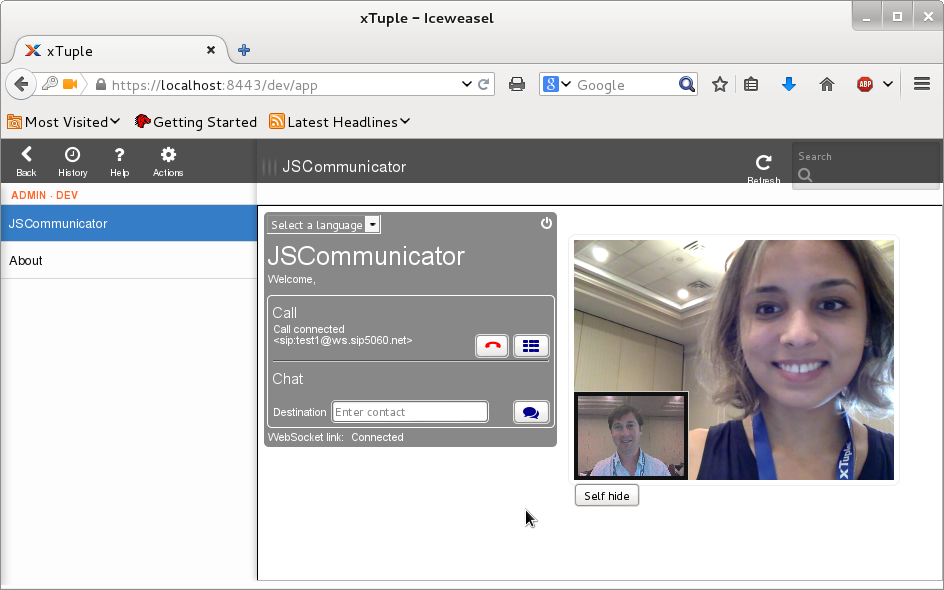
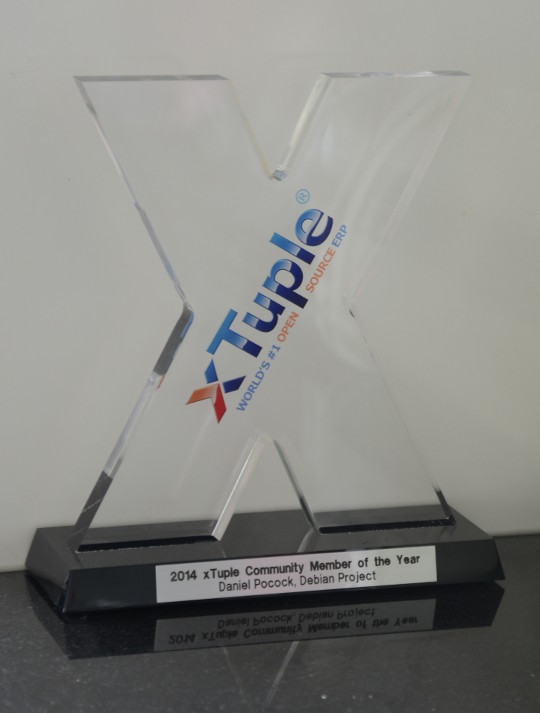
I recently updated the PostBooks packages in Debian and Ubuntu to version 4.7. This is the version that was released in Ubuntu 14.10 (Utopic Unicorn) and is part of the upcoming Debian 8 (jessie) release. Better prospects for Fedora and RHEL/CentOS/EPEL packages As well as getting the packages ready, I've been in contact with xTuple helping them generalize their build system to make packaging easier. This has eliminated the need to patch the makefiles during the build. As well as making it easier to support the Debian/Ubuntu packages, this should make it far easier for somebody to create a spec file for RPM packaging too. Debian wins a prize While visiting xTupleCon 2014 in Norfolk, I was delighted to receive the Community Member of the Year award which I happily accepted not just for my own efforts but for the Debian Project as a whole. Steve Hackbarth, Director of Product Development at xTuple, myself and the impressive Community Member of the Year trophy This is a great example of the productive relationships that exist between Debian, upstream developers and the wider free software community and it is great to be part of a team that can synthesize the work from so many other developers into ready-to-run solutions on a 100% free software platform. Receiving this award really made me think about all the effort that has gone into making it possible to apt-get install postbooks and all the people who have collectively done far more work than myself to make this possible: Here is a screenshot of the xTuple web / JSCommunicator integration, it was one of the highlights of xTupleCon: and gives a preview of the wide range of commercial opportunities that WebRTC is creating for software vendors to displace traditional telecommunications providers. xTupleCon also gave me a great opportunity to see new features (like the xTuple / Drupal web shop integration) and hear about the success of consultants and their clients deploying xTuple/PostBooks in various scenarios. The product is extremely strong in meeting the needs of manufacturing and distribution and has gained a lot of traction in these industries in the US. Many of these features are equally applicable in other markets with a strong manufacturing industry such as Germany or the UK. However, it is also flexible enough to simply disable many of the specialized features and use it as a general purpose accounting solution for consulting and services businesses. This makes it a good option for many IT freelancers and support providers looking for a way to keep their business accounts in a genuinely open source solution with a strong SQL backend and a native Linux desktop interface.
Julien Danjou: Distributed group management and locking in Python with tooz

With OpenStack embracing the Tooz library more and more over the past year, I think it's a good start to write a bit about it. A bit of history A little more than year ago, with my colleague Yassine Lamgarchal and others at eNovance, we investigated on how to solve a problem often encountered inside OpenStack: synchronization of multiple distributed workers. And while many people in our ecosystem continue to drive development by adding new bells and whistles, we made a point of solving new problems with a generic solution able to address the technical debt at the same time. Yassine wrote the first ideas of what should be the group membership service that was needed for OpenStack, identifying several projects that could make use of this. I've presented this concept during the OpenStack Summit in Hong-Kong during an Oslo session. It turned out that the idea was well-received, and the week following the summit we started the tooz project on StackForge. Goals Tooz is a Python library that provides a coordination API. Its primary goal is to handle groups and membership of these groups in distributed systems. Tooz also provides another useful feature which is distributed locking. This allows distributed nodes to acquire and release locks in order to synchronize themselves (for example to access a shared resource). The architecture If you are familiar with distributed systems, you might be thinking that there are a lot of solutions already available to solve these issues: ZooKeeper, the Raft consensus algorithm or even Redis for example. You'll be thrilled to learn that Tooz is not the result of the NIH syndrome, but is an abstraction layer on top of all these solutions. It uses drivers to provide the real functionalities behind, and does not try to do anything fancy. All the drivers do not have the same amount of functionality of robustness, but depending on your environment, any available driver might be suffice. Like most of OpenStack, we let the deployers/operators/developers chose whichever backend they want to use, informing them of the potential trade-offs they will make. So far, Tooz provides drivers based on: All drivers are distributed across processes. Some can be distributed across the network (ZooKeeper, memcached, redis ) and some are only available on the same host (IPC). Also note that the Tooz API is completely asynchronous, allowing it to be more efficient, and potentially included in an event loop. Features Group membership Tooz provides an API to manage group membership. The basic operations provided are: the creation of a group, the ability to join it, leave it and list its members. It's also possible to be notified as soon as a member joins or leaves a group. Leader election Each group can have a leader elected. Each member can decide if it wants to run for the election. If the leader disappears, another one is elected from the list of current candidates. It's possible to be notified of the election result and to retrieve the leader of a group at any moment. Distributed locking When trying to synchronize several workers in a distributed environment, you may need a way to lock access to some resources. That's what a distributed lock can help you with. Adoption in OpenStack Ceilometer is the first project in OpenStack to use Tooz. It has replaced part of the old alarm distribution system, where RPC was used to detect active alarm evaluator workers. The group membership feature of Tooz was leveraged by Ceilometer to coordinate between alarm evaluator workers. Another new feature part of the Juno release of Ceilometer is the distribution of polling tasks of the central agent among multiple workers. There's again a group membership issue to know which nodes are online and available to receive polling tasks, so Tooz is also being used here. The Oslo team has accepted the adoption of Tooz during this release cycle. That means that it will be maintained by more developers, and will be part of the OpenStack release process. This opens the door to push Tooz further in OpenStack. Our next candidate would be write a service group driver for Nova. The complete documentation for Tooz is available online and has examples for the various features described here, go read it if you're curious and adventurous!

Next.

Previous.