Search Results: "tar"

4 May 2025

Russ Allbery: Review: The Book That Held Her Heart

Review: The Book That Held Her Heart, by Mark Lawrence
Series: Library Trilogy #3
Publisher: ACE
Copyright: 2025
ISBN: 0-593-43799-3
Format: Kindle
Pages: 367
The Book That Held Her Heart is the third and final book of the Library fantasy trilogy and a direct sequel to The Book That Broke the World. Lawrence provides a much-needed summary of the previous volumes at the start of this book (thank you to every author who does this!), but I was still struggling a bit with the blizzard of character names. I recommend reading this series entry in relatively close proximity to the other two. At the end of the previous book, and following some rather horrific violence, the cast split into four groups. Three of those are pursuing different resolutions to the moral problem of the Library's existence. The fourth group opens the book still stuck with the series villains, who were responsible for the over-the-top morality that undermined my enjoyment of The Book That Broke the World. Lawrence follows all four groups in interwoven chapters, maintaining that complex structure through most of this book. I thought this was a questionable structural decision that made this book feel choppy, disconnected, and unnecessarily confusing. The larger problem, though, is that this is the payoff book, the book where we find out if Lawrence is equal to the tricky ethical questions he's raised and the world-building masterpiece that The Book That Wouldn't Burn kicked off. The answer, unfortunately, is "not really." This is not a total failure; there are some excellent set pieces and world-building twists, and the characters remain likable and enjoyable to read about (although the regrettable sidelining of Livira continues). But the grand finale is weirdly conservative and not particularly grand, and Lawrence's answer to the moral questions he raised is cliched and wholly unsatisfying. I was really hoping Lawrence was going somewhere more interesting than "Nazis bad." I am entirely sympathetic to this moral position, but so is every other likely reader of this series, and we all know how that story goes. What a waste of a compelling setup. Sadly, "Nazis bad" isn't even a metaphor for the black-and-white morality that Lawrence first introduced at the end of the previous book. It's a literal description of the main moral thrust of this book. Lawrence introduces yet another new character and timeline so that he can write about thinly-disguised Nazis persecuting even more thinly-disguised Jews, and this conflict is roughly half this book. It's also integral to the ending, which uses obvious, stock secular sainthood as a sort of trump card to resolve ideological conflicts at the heart of the series. This is one of the things I was worried about after I read the short stories that Lawrence published between the volumes of this series. All of them were thuddingly trite, which did not make me optimistic that Lawrence would find a sufficiently interesting answer to his moral trilemma to satisfy the high expectations created by the build-up. That is, I am sad to report, precisely the failure mode of this book. The resolution of the moral question of the series is arguably radical within the context of the prior world-building, but in a way that effectively reduces it to the boring, small-c conservative bromides of everyday reality. This is precisely the opposite of why I read fantasy, and I did not find Lawrence's arguments for it at all convincing. Neither, I think, did Lawrence, given that the critical debate takes place off camera so that he could avoid having to present the argument. This is, unfortunately, another series where the author's reach exceeded their grasp. The world-building of The Book That Wouldn't Burn is a masterpiece that created one of the most original and compelling settings that I have read in fantasy for a long time, but unfortunately Lawrence did not have an equally original plan for how to use the setting. This is a common problem and I'm not going to judge it too harshly; it's much harder to end a series than it is to start one. I thought the occasional flashes of brilliance was worth the journey, and they continue into this book with some elaborations on the Library's mythic structure that are going to stick in my mind. You can sense the story slipping away from the hoped-for conclusion as you read, though. The story shifts more and more away from the setting and the world-building and towards character stories, and while Lawrence's characters are fine, they're not that novel. I am happy to read about Clovis and Arpix, but I can read variations of that story in a lot of places. Livira never recovers her dynamism and drive from the first book, and there is much less beneath Yute's thoughtful calm than I was hoping to find. I think Lawrence knows that the story was not entirely working because the narrative voice becomes more strident as the morality becomes less interesting. I know of only one fantasy author who can make this type of overbearing and freighted narrative style work, and Lawrence is sadly not Guy Gavriel Kay. This is not a bad book. It is an enjoyable adventure story on its own terms, with some moments of real beauty and awe and a handful of memorable characters, somewhat undermined by a painfully obvious and unoriginal moral frame. It's only a disappointment in the context of what came before it, and it is far from the first series conclusion that doesn't quite live up to the earlier volumes. I'm glad that I read it, and the series as a whole, and I do appreciate that Lawrence brought the whole series to a firm and at least somewhat satisfying conclusion in the promised number of volumes. But I do wish the series as a whole had been as special as the first book. Rating: 6 out of 10

3 May 2025

Russ Allbery: Review: Paper Soldiers

Review: Paper Soldiers, by Saleha Mohsin
Publisher: Portfolio
Copyright: 2024
ISBN: 0-593-53912-5
Format: Kindle
Pages: 250
The subtitle of Paper Soldiers is "How the Weaponization of the Dollar Changed the World Order," which may give you the impression that this book is about US use of the dollar system for political purposes such as sanctions. Do not be fooled like I was; this subtitle is, at best, deceptive. Coverage of the weaponization of the dollar is superficial and limited to a few chapters. This book is, instead, a history of the strong dollar policy told via a collection of hagiographies of US Treasury Secretaries and written with all of the skeptical cynicism of a poleaxed fawn. There is going to be some grumbling about the state of journalism in this review. Per the author's note, Saleha Mohsin is the Bloomberg News beat reporter for the US Department of the Treasury. That is, sadly, exactly what this book reads like: routine beat reporting. Mohsin asked current and former Treasury officials what they were thinking at various points in history and then wrote down their answers without, so far as I can tell, considering any contradictory evidence or wondering whether they were telling the truth. Paper Soldiers does contain extensive notes (those plus the index fill about forty pages), so I guess you could do the cross-checking yourself, although apparently most of the interviews for this book were "on background" and are therefore unattributed. (Is this weird? I feel like this is weird.) Mohsin adds a bit of utterly conventional and uncritical economic framing and casts the whole project in the sort of slightly breathless and dramatized prose style that infests routine news stories in the US. I find this style of book unbelievably frustrating because it represents such a wasted opportunity. To me, the point of book-length journalism is precisely to not write in this style. When you're trying to crank out two or three articles a week covering current events, I understand why there isn't always space or time to go deep into background, skepticism, and contrary opinions. But when you expand that material into a book, surely the whole point is to take the time to do some real reporting. Dig into what people told you, see if they're lying, talk to the people who disagree with them, question the conventional assumptions, and show your work on the page so that the reader is smarter after finishing your book than they were before they started. International political economics is not a sequence of objective facts. It's a set of decisions made in pursuit of economic and political theories that are disputed and arguable, and I think you owe the reader some sense of the argument and, ideally, some defensible position on the merits that is more than a transcription of your interviews. This is... not that.
It's a power loop that the United States still enjoys today: trust in America's dollar (and its democratic government) allows for cheap debt financing, which buys health care built on the most advanced research and development and inventions like airplanes and the iPhone. All of this is propelled by free market innovation and the superpowered strength to keep the nation safe from foreign threats. That investment boosts the nation's economic, military, and technological prowess, making its economy (and the dollar) even more attractive.
Let me be precise about my criticism. I am not saying that every contention in the above excerpt is wrong. Some of them are probably correct; more of them are at least arguable. This book is strictly about the era after Bretton Woods, so using airplanes as an example invention is a bizarre choice, but sure, whatever, I get the point. My criticism is that paragraphs like this, as written in this book, are not introductions to deeper discussions that question or defend that model of economic and political power. They are simple assertions that stand entirely unsupported. Mohsin routinely writes paragraphs like the above as if they are self-evident, and then immediately moves on to the next anecdote about Treasury dollar policy. Take, for example, the role of the US dollar as the world's reserve currency, which roughly means that most international transactions are conducted in dollars and numerous countries and organizations around the world hold large deposits in dollars instead of in their native currency. The conventional wisdom holds that this is a great boon to the US economy, but there are also substantive critiques and questions about that conventional wisdom. You would never know that from this book; Mohsin asserts the conventional wisdom about reserve currencies without so much as a hint that anyone might disagree. For example, one common argument, repeated several times by Mohsin, is that the US can only get away with the amount of deficit spending and cheap borrowing that it does because the dollar is the world's reserve currency. Consider two other countries whose currencies are clearly not the international reserve currency: Japan and the United Kingdom. The current US debt to GDP ratio is about 125% and the current interest rate on US 10-year bonds is about 4.2%. The current Japanese debt to GDP ratio is about 260% and the current interest rate on Japanese 10-year bonds is about 1.2%. The current UK debt to GDP ratio is 160% and the current interest rate on UK 10-year bonds is 4.5%. Are you seeing the dramatic effects of the role of the dollar as reserve currency? Me either. Again, I am not saying that this is a decisive counter-argument. I am not an economist; I'm just some random guy on the Internet who finds macroeconomics interesting and reads a few newsletters. I know the Japanese bond market is unusual in ways I'm not accounting for. There may well be compelling arguments for why reserve currency status matters immensely for US borrowing capacity. My point is not that Mohsin is wrong; my point is that you have to convince me and she doesn't even try. Nowhere in this book is a serious effort to view conventional wisdom with skepticism or confront it with opposing arguments. Instead, this book is full of blithe assertions that happen to support the narrative the author was fed by a bunch of former Treasury officials and does not appear to question in any way. I want books like this to increase my understanding of the world. To do that, they need to show me multiple sides of debates and teach me how to evaluate evidence, not simply reinforce a superficial conventional wisdom. It doesn't help that whatever fact-checking process this book went through left some glaring errors. For example, on the Plaza Accord:
With their central banks working in concert, enough dollars were purchased on the open market to weaken the currency, making American goods more affordable for foreign buyers.
I don't know what happened after the Plaza Accord (I read books like this to find out!), but clearly it wasn't that. This is utter nonsense. Buying dollars on the open market would increase the value of the dollar, not weaken it; this is basic supply and demand that you learn in the first week of a college economics class. This is the type of error that makes me question all the other claims in the book that I can't easily check. Mohsin does offer a more credible explanation of the importance of a reserve currency late in the book, although it's not clear to me that she realizes it: The widespread use of the US dollar gives US government sanctions vast international reach, allowing the US to punish and coerce its enemies through the threat of denying them access to the international financial system. Now we're getting somewhere! This is a more believable argument than a small and possibly imaginary effect on government borrowing costs. It is clear why a bellicose US government, particularly one led by advocates of a unitary executive theory that elevates the US president to a status of near-emperor, want to turn the dollar into a weapon of international control. It's much less obvious how comfortable the rest of the world should be with that concentration of power. This would be a fascinating topic for a journalistic non-fiction book. Some reporter should dive deep into the mechanics of sanctions and ask serious questions about the moral, practical, and diplomatic consequences of this aggressive wielding of US power. One could give it a title like Paper Soldiers that reflected the use of banks and paper currency as foot soldiers enforcing imperious dictates on the rest of the world. Alas, apart from a brief section in which the US scared other countries away from questioning the dollar, Mohsin does not tug at this thread. Maybe someone should write that book someday. As you will have gathered by now, I think this is a bad book and I do not recommend that you read it. Its worst flaw is one that it shares with far too much mainstream US print and TV journalism: the utter credulity of the author. I have the old-fashioned belief that a journalist should be more than a transcriptionist for powerful people. They should be skeptical, they should assume public figures may be lying, they should look for ulterior motives, and they should try to bring the reader closer to some objective truths about the world, wherever they may lie. I have no solution for this degradation of journalism. I'm not even sure that it's a change. There were always reporters eager to transcribe the voice of power into the newspaper, and if we remember the history of journalism differently, that may be because we have elevated the rare exceptions and forgotten the average. But after watching too many journalists I once respected start parroting every piece of nonsense someone tells them, from NFTs to UFOs to the existential threat of AI, I've concluded that the least I can do as a reader is to stop rewarding reporters who cannot approach powerful subjects with skepticism, suspicion, and critical research. I failed in this case, but perhaps I can serve as a warning to others. Rating: 3 out of 10

2 May 2025

Daniel Lange: The Stallman wars

So, 2021 isn't bad enough yet, but don't despair, people are working to fix that:

Welcome to the Stallman wars Team Cancel: https://rms-open-letter.github.io/ (repo) Team Support: https://rms-support-letter.github.io/ (repo) Current Final stats are:

Team Cancel:  3019 signers from 1415 individual commit authors
Team Support: 6853 signers from 5418 individual commit authors
Git shortlog (Top 10):
rms_cancel.git (Last update: 2021-08-16 00:11:15 (UTC))
  1230  Neil McGovern
   251  Joan Touzet
    99  Elana Hashman
    73  Molly de Blanc
    36  Shauna
    19  Juke
    18  Stefano Zacchiroli
    17  Alexey Mirages
    16  Devin Halladay
    14  Nader Jafari
rms_support.git (Last update: 2021-09-29 07:14:39 (UTC))
  1821  shenlebantongying
  1585  nukeop
  1560  Ivanq
  1057  Victor
   880  Job Bautista
   123  nekonee
   101  Victor Gridnevsky
    41  Patrick Spek
    25  Borys Kabakov
    17  KIM Taeyeob
(data as of 2021-10-01) Technical info:
Signers are counted from their "Signed / Individuals" sections. Commits are counted with git shortlog -s.
Team Cancel also has organizational signatures with Mozilla, Suse and X.Org being among the notable signatories. The 16 original signers of the Cancel petition are added in their count. Neil McGovern, Juke and shenlebantongying need .mailmap support as they have committed with different names. Further reading: 12.04.2021 Statements from the accused 18.04.2021 Debian General Resolution The Debian General Resolution (GR) vote of the developers has concluded to not issue a public statement at all, see https://www.debian.org/vote/2021/vote_002#outcome for the results.
It is better to keep quiet and seem ignorant than to speak up and remove all doubt.
See Quote Investigator for the many people that rephrased these words over the centuries. They still need to be recalled more often as too many people in the FLOSS community have forgotten about that wisdom... 01.10.2021 Final stats It seems enough dust has settled on this unfortunate episode of mob activity now. Hence I stopped the cronjob that updated the stats above regularly. Team Support has kept adding signature all the time while Team Cancel gave up very soon after the FSF decided to stand with Mr. Stallman. So this battle was decided within two months. The stamina of the accused and determined support from some dissenting web devs trumped the orchestrated outrage of well known community figures and their publicity power this time. But history teaches us that does not mean the war is over. There will a the next opportunity to call for arms. And people will call. Unfortunately. 01.11.2024 Team Cancel is opening a new round; Team Support responds with exposing the author of "The Stallman report" I hate to be right. Three years later than the above: An anonymous member of team Cancel has published https://stallman-report.org/ [local pdf mirror, 504kB] to "justify our unqualified condemnation of Richard Stallman". It contains a detailed collection of quotes that are used to allege supporting (sexual) misconduct. The demand is again that Mr. Stallman "step[s] down from all positions at the FSF and the GNU project". Addressing him: "the scope and extent of your misconduct disqualifies you from formal positions of power within our community indefinitely". Team Support has not issues a rebuttal (yet?) but has instead identified the anonymous author as Drew "sircmpwn" DeVault, a gifted software developer, but also a vocal and controversial figure in the Open Source / Free Software space. Ironically quite similar to Richard "rms" Stallman. Their piece is published at https://dmpwn.info/ [local pdf mirror, 929kB]. They also allege a proximity of Mr. DeVault to questionable "Lolita" anime preferences and societal positions to disqualify him.

Daniel Lange: Cleaning a broken GnuPG (gpg) key

I've long said that the main tools in the Open Source security space, OpenSSL and GnuPG (gpg), are broken and only a complete re-write will solve this. And that is still pending as nobody came forward with the funding. It's not a sexy topic, so it has to get really bad before it'll get better. Gpg has a UI that is close to useless. That won't substantially change with more bolted-on improvements. Now Robert J. Hansen and Daniel Kahn Gillmor had somebody add ~50k signatures (read 1, 2, 3, 4 for the g l ory details) to their keys and - oops - they say that breaks gpg. But does it? I downloaded Robert J. Hansen's key off the SKS-Keyserver network. It's a nice 45MB file when de-ascii-armored (gpg --dearmor broken_key.asc ; mv broken_key.asc.gpg broken_key.gpg). Now a friendly:
$ /usr/bin/time -v gpg --no-default-keyring --keyring ./broken_key.gpg --batch --quiet --edit-key 0x1DCBDC01B44427C7 clean save quit

pub rsa3072/0x1DCBDC01B44427C7
erzeugt: 2015-07-16 verf llt: niemals Nutzung: SC
Vertrauen: unbekannt G ltigkeit: unbekannt
sub ed25519/0xA83CAE94D3DC3873
erzeugt: 2017-04-05 verf llt: niemals Nutzung: S
sub cv25519/0xAA24CC81B8AED08B
erzeugt: 2017-04-05 verf llt: niemals Nutzung: E
sub rsa3072/0xDC0F82625FA6AADE
erzeugt: 2015-07-16 verf llt: niemals Nutzung: E
[ unbekannt ] (1). Robert J. Hansen <rjh@sixdemonbag.org>
[ unbekannt ] (2) Robert J. Hansen <rob@enigmail.net>
[ unbekannt ] (3) Robert J. Hansen <rob@hansen.engineering>

User-ID "Robert J. Hansen <rjh@sixdemonbag.org>": 49705 Signaturen entfernt
User-ID "Robert J. Hansen <rob@enigmail.net>": 49704 Signaturen entfernt
User-ID "Robert J. Hansen <rob@hansen.engineering>": 49701 Signaturen entfernt

pub rsa3072/0x1DCBDC01B44427C7
erzeugt: 2015-07-16 verf llt: niemals Nutzung: SC
Vertrauen: unbekannt G ltigkeit: unbekannt
sub ed25519/0xA83CAE94D3DC3873
erzeugt: 2017-04-05 verf llt: niemals Nutzung: S
sub cv25519/0xAA24CC81B8AED08B
erzeugt: 2017-04-05 verf llt: niemals Nutzung: E
sub rsa3072/0xDC0F82625FA6AADE
erzeugt: 2015-07-16 verf llt: niemals Nutzung: E
[ unbekannt ] (1). Robert J. Hansen <rjh@sixdemonbag.org>
[ unbekannt ] (2) Robert J. Hansen <rob@enigmail.net>
[ unbekannt ] (3) Robert J. Hansen <rob@hansen.engineering>

Command being timed: "gpg --no-default-keyring --keyring ./broken_key.gpg --batch --quiet --edit-key 0x1DCBDC01B44427C7 clean save quit"
User time (seconds): 3911.14
System time (seconds): 2442.87
Percent of CPU this job got: 99%
Elapsed (wall clock) time (h:mm:ss or m:ss): 1:45:56
Average shared text size (kbytes): 0
Average unshared data size (kbytes): 0
Average stack size (kbytes): 0
Average total size (kbytes): 0
Maximum resident set size (kbytes): 107660
Average resident set size (kbytes): 0
Major (requiring I/O) page faults: 1
Minor (reclaiming a frame) page faults: 26630
Voluntary context switches: 43
Involuntary context switches: 59439
Swaps: 0
File system inputs: 112
File system outputs: 48
Socket messages sent: 0
Socket messages received: 0
Signals delivered: 0
Page size (bytes): 4096
Exit status: 0
And the result is a nicely useable 3835 byte file of the clean public key. If you supply a keyring instead of --no-default-keyring it will also keep the non-self signatures that are useful for you (as you apparently know the signing party). So it does not break gpg. It does break things that call gpg at runtime and not asynchronously. I heard Enigmail is affected, quelle surprise. Now the main problem here is the runtime. 1h45min is just ridiculous. As Filippo Valsorda puts it:
Someone added a few thousand entries to a list that lets anyone append to it. GnuPG, software supposed to defeat state actors, suddenly takes minutes to process entries. How big is that list you ask? 17 MiB. Not GiB, 17 MiB. Like a large picture. https://dev.gnupg.org/T4592
If I were a gpg / SKS keyserver developer, I'd That way another key can only be added to the keyserver network if it contains at least one signature from a previously known strong-set key. Attacking the keyserver network would become at least non-trivial. And the web-of-trust thing may make sense again. Updates 09.07.2019 GnuPG 2.2.17 has been released with another set of quickly bolted together fixes:
   gpg: Ignore all key-signatures received from keyservers.  This
    change is required to mitigate a DoS due to keys flooded with
    faked key-signatures.  The old behaviour can be achieved by adding
    keyserver-options no-self-sigs-only,no-import-clean
    to your gpg.conf.  [#4607]
   gpg: If an imported keyblocks is too large to be stored in the
    keybox (pubring.kbx) do not error out but fallback to an import
    using the options "self-sigs-only,import-clean".  [#4591]
   gpg: New command --locate-external-key which can be used to
    refresh keys from the Web Key Directory or via other methods
    configured with --auto-key-locate.
   gpg: New import option "self-sigs-only".
   gpg: In --auto-key-retrieve prefer WKD over keyservers.  [#4595]
   dirmngr: Support the "openpgpkey" subdomain feature from
    draft-koch-openpgp-webkey-service-07. [#4590].
   dirmngr: Add an exception for the "openpgpkey" subdomain to the
    CSRF protection.  [#4603]
   dirmngr: Fix endless loop due to http errors 503 and 504.  [#4600]
   dirmngr: Fix TLS bug during redirection of HKP requests.  [#4566]
   gpgconf: Fix a race condition when killing components.  [#4577]
Bug T4607 shows that these changes are all but well thought-out. They introduce artificial limits, like 64kB for WKD-distributed keys or 5MB for local signature imports (Bug T4591) which weaken the web-of-trust further. I recommend to not run gpg 2.2.17 in production environments without extensive testing as these limits and the unverified network traffic may bite you. Do validate your upgrade with valid and broken keys that have segments (packet groups) surpassing the above mentioned limits. You may be surprised what gpg does. On the upside: you can now refresh keys (sans signatures) via WKD. So if your buddies still believe in limiting their subkey validities, you can more easily update them bypassing the SKS keyserver network. NB: I have not tested that functionality. So test before deploying. 10.08.2019 Christopher Wellons (skeeto) has released his pgp-poisoner tool. It is a go program that can add thousands of malicious signatures to a GNUpg key per second. He comments "[pgp-poisoner is] proof that such attacks are very easy to pull off. It doesn't take a nation-state actor to break the PGP ecosystem, just one person and couple evenings studying RFC 4880. This system is not robust." He also hints at the next likely attack vector, public subkeys can be bound to a primary key of choice.

Russ Allbery: Review: Sixteen Ways to Defend a Walled City

Review: Sixteen Ways to Defend a Walled City, by K.J. Parker
Series: Siege #1
Publisher: Orbit
Copyright: April 2019
ISBN: 0-316-27080-6
Format: Kindle
Pages: 349
Sixteen Ways to Defend a Walled City is... hm, honestly, I'm not sure what the genre of this novel is. It is a story about medieval engineering and siege weapons in a Rome-inspired secondary world that so far as I can tell is not meant to match ours. There is not a hint of magic. It's not technically a fantasy, but it's marketed like a fantasy, and it's not historical fiction nor is it attempting to be alternate history. The most common description is a fantasy of logistics, so I guess I'll go with that, as long as you understand that the fantasy here is of the non-magical sort. K.J. Parker is a pen name for Tom Holt. Orhan is Colonel-in-Chief of the Engineers for the Robur empire, even though he's a milkface, not a blueskin like a proper Robur. (Both of those racial terms are quite offensive.) He started out as a slave, learned a trade, joined the navy as a shipwright, and worked his way up the ranks through luck and enemy action. He's canny, practical, highly respected by his men, happy to cheat and steal to get material for his projects and wages for his people, and just wants to build literal bridges. Nice, sturdy bridges that let people get from one place to another the short way. When this book opens, Orhan is in Classis trying to requisition some rope. He is saved from discovery of his forged paperwork by pirates burning down the warehouse that held all of the rope, and then saved from the pirates by the sorts of coincidences that seem to happen to Orhan all the time. A few subsequent discoveries about what the pirates were after, and news of another unexpected attack on the empire, make Orhan nervous enough that he takes his men to do a job as far away from the City at the heart of the empire as possible. It's just his luck to return in time to find slaughtered troops and to have to sneak his men into a City already under siege. Sixteen Ways to Defend a Walled City is told in the first person by Orhan, with an internal justification that the reader only discovers at the end of the book. That means your enjoyment of this book is going to depend a lot on how much you like Orhan's voice. This mostly worked for me; his voice is an odd combination of chatty, self-deprecating, and brusque, and it took a bit for me to get used to it, but I came around. This book is clearly competence porn nearly all the fun of this book is seeing what desperate plan Orhan will come up with next so it helps that Orhan does indeed come across as competent. The part that did not work for me was the morality. You would think from the title that would be straightforward: The City is under siege, people want to capture it and kill everyone, Orhan is on the inside, and his job is to keep them out. That would have been the morality of simplistic military fiction, but most of the appeal was in watching the problem-solving anyway. That's how the story starts, but then Parker started dropping hints of more complexity. Orhan is a disfavored minority and the Robur who run the empire are racist assholes, even though Orhan mostly gets along with the ones who work with him closely. Orhan says a few things that make the reader wonder whether the City warrants defending, and it becomes less clear whether Orhan's loyalties were as solid as they appeared to be. Parker then offers a few moral dilemmas and has Orhan not follow them in the expected directions, making me wonder where Parker was going with the morality of this story. And then we find out that the answer is nowhere. Parker is going nowhere. None of that setup has a payoff, and the ending is deeply unsatisfying and arguably pointless. I am not sure this is an objective analysis. This is one of those books where I would not be surprised to see someone else praise its realism. Orhan is in some ways a more likely figure than the typical hero of a book. He likes accomplishing things, he's a cheat and a liar when that serves his purposes, he's loyal to the people he considers friends in a way that often doesn't involve consulting them about what they want, and he makes decisions mostly on vibes and stubbornness. Both his cynicism and his idealism are different types of masks; beneath both, he's an incoherent muddle. You could argue that we're all that sort of muddle, deep down, and the consistent idealists are the unrealistic (and frightening) ones, and I think Parker may be attempting exactly that argument. I know some readers like this sort of fallibly human incoherence. But wow did I ever loathe this ending because I was not reading this book for a realistic psychological profile of an average guy. I was here for the competence porn, for the fantasy of logistics, for the experience of watching someone have a plan and get shit done. Apparently that extends to needing him to be competent at morality as well, or at least think about it as hard as he thinks about siege weapons. One of the reasons why I am primarily a genre reader is that I don't read books for depressing psychological profiles. There are enough of those in the news. I read books to spend some time in a world better than mine, where things work out the way that they are supposed to, or at least in a way that's satisfying. The other place where this book interfered with my vibes is that it's about a war, and a lot of Orhan's projects are finding more efficient ways to kill people. Parker takes a "war is hell" perspective, and Orhan gets deeply upset at the graphic sights of mangled human bodies that are the frequent results of his plans. I feel weird complaining about this because yes, it's good to be aware of the horrific things that we do to other people in wars, but man, I just wanted to watch some effective project management. I want to enjoy unexpected lateral thinking, appreciate the friendly psychological manipulation involved in getting a project to deliver on deadline, and watch someone solve logistical problems. Battlefields provide an endless supply of interesting challenges, but then Parker feels compelled to linger on the brutal consequences of Orhan's ideas and now I'm depressed and sickened rather than enjoying myself. I really wanted to like this book, and for a lot of the book I did, but that ending was a bottomless pit that sucked away all my enjoyment and retroactively made the rest of the book feel worse. I so wanted Parker to be going somewhere clever and surprising, and the disappointment when none of that happened was intense. This is probably an excessively negative reaction, and I will not be surprised when other people get along with this book better than I did, but not only will I not be recommending it, I'm now rather dubious about reading any more Parker. Followed by How to Rule an Empire and Get Away With It. Rating: 5 out of 10

1 May 2025

Ian Jackson: Free Software, internal politics, and governance

There is a thread of opinion in some Free Software communities, that we shouldn t be doing politics , and instead should just focus on technology. But that s impossible. This approach is naive, harmful, and, ultimately, self-defeating, even on its own narrow terms. Today I m talking about small-p politics In this article I m using politics in the very wide sense: us humans managing our disagreements with each other. I m not going to talk about culture wars, woke, racism, trans rights, and so on. I am not going to talk about how Free Software has always had explicitly political goals; or how it s impossible to be neutral because choosing not to take a stand is itself to take a stand. Those issues are all are important and Free Software definitely must engage with them. Many of the points I make are applicable there too. But those are not my focus today. Today I m talking in more general terms about politics, power, and governance. Many people working together always entails politics Computers are incredibly complicated nowadays. Making software is a joint enterprise. Even if an individual program has only a single maintainer, it fits into an ecosystem of other software, maintained by countless other developers. Larger projects can have thousands of maintainers and hundreds of thousands of contributors. Humans don t always agree about everything. This is natural. Indeed, it s healthy: to write the best code, we need a wide range of knowledge and experience. When we can t come to agreement, we need a way to deal with that: a way that lets us still make progress, but also leaves us able to work together afterwards. A way that feels OK for everyone. Providing a framework for disagreement is the job of a governance system. The rules say which people make which decisions, who must be consulted, how the decisions are made, and, how, if any, they can be reviewed. This is all politics. Consensus is great but always requiring it is harmful Ideally a discussion will converge to a synthesis that satisfies everyone, or at least a consensus. When consensus can t be achieved, we can hope for compromise: something everyone can live with. Compromise is achieved through negotiation. If every decision requires consensus, then the proponents of any wide-ranging improvement have an almost insurmountable hurdle: those who are favoured by the status quo and find it convenient can always object. So there will never be consensus for change. If there is any objection at all, no matter how ill-founded, the status quo will always win. This is where governance comes in. Governance is like backups: we need to practice it Governance processes are the backstop for when discussions, and then negotiations, fail, and people still don t see eye to eye. In a healthy community, everyone needs to know how the governance works and what the rules are. The participants need to accept the system s legitimacy. Everyone, including the losing side, must be prepared to accept and implement (or, at least not obstruct) whatever the decision is, and hopefully live with it and stay around. That means we need to practice our governance processes. We can t just leave them for the day we have a huge and controversial decision to make. If we do that, then when it comes to the crunch we ll have toxic rows where no-one can agree the rules; where determined people bend the rules to fit their outcome; and where afterwards people feel like the whole thing was horrible and unfair. So our decisionmaking bodies and roles need to be making decisions, as a matter of routine, and we need to get used to that. First-line decisionmaking bodies should be making decisions frequently. Last-line appeal mechanisms (large-scale votes, for example) are naturally going to be exercised more rarely, but they must happen, be seen as legitimate, and their outcomes must be implemented in full. Governance should usually be routine and boring When governance is working well it s quite boring. People offer their input, and are heard. Angles are debated, and concerns are addressed. If agreement still isn t reached, the committee, or elected leader, makes a decision. Hopefully everyone thinks the leadership is legitimate, and that it properly considered and heard their arguments, and made the decision for good reasons. Hopefully the losing side can still get their work done (and make their own computer work the way they want); so while they will be disappointed, they can live with the outcome. Many human institutions manage this most of the time. It does take some knowledge about principles of governance, and ideally some experience. Governance means deciding, not just mediating By making decisions I mean exercising their authority to rule on an actual disagreement: one that wasn t resolved by debate or negotiation. Governance processes by definition involve deciding, not just mediating. It s not governance if we re advising or cajoling: in that case, we re back to demanding consensus. Governance is necessary precisely when consensus is not achieved. If the governance systems are to mean anything, they must be able to (over)rule; that means (over)ruling must be normal and accepted. Otherwise, when the we need to overrule, we ll find that we can t, because we lack the collective practice. To be legitimate (and seen as legitimate) decisions must usually be made based on the merits, not on participants status, and not only on process questions. On the autonomy of the programmer Many programmers seem to find the very concept of governance, and binding decisionmaking, deeply uncomfortable. Ultimately, it means sometimes overruling someone s technical decision. As programmers and maintainers we naturally see how this erodes our autonomy. But we have all seen projects where the maintainers are unpleasant, obstinate, or destructive. We have all found this frustrating. Software is all interconnected, and one programmer s bad decisions can cause problems for many of the rest of us. We exasperate, why won t they just do the right thing . This is futile. People have never just ed and they re not going to start just ing now. So often the boot is on the other foot. More broadly, as software developers, we have a responsibility to our users, and a duty to write code that does good rather than ill in the world. We ought to be accountable. (And not just to capitalist bosses!) Governance mechanisms are the answer. (No, forking anything but the smallest project is very rarely a practical answer.) Mitigate the consequences of decisions retain flexibility In software, it is often possible to soften the bad social effects of a controversial decision, by retaining flexibility. With a bit of extra work, we can often provide hooks, non-default configuration options, or plugin arrangements. If we can convert the question from how will the software always behave into merely what should the default be , we can often save ourselves a lot of drama. So it is often worth keeping even suboptimal or untidy features or options, if people want to use them and are willing to maintain them. There is a tradeoff here, of course. But Free Software projects often significantly under-value the social benefits of keeping everyone happy. Wrestling software even crusty or buggy software is a lot more fun than having unpleasant arguments. But don t do decisionmaking like a corporation Many programmers experience of formal decisionmaking is from their boss at work. But corporations are often a very bad example. They typically don t have as much trouble actually making decisions, but the actual decisions are often terrible, and not just because corporations goals are often bad. You get to be a decisionmaker in a corporation by spouting plausible nonsense, sounding confident, buttering up the even-more-vacuous people further up the chain, and sometimes by sabotaging your rivals. Corporate senior managers are hardly ever held accountable typically the effects of their tenure are only properly felt well after they ve left to mess up somewhere else. We should select our leaders more wisely, and base decisions on substance. If you won t do politics, politics will do you As a participant in a project, or a society, you can of course opt out of getting involved in politics. You can opt out of learning how to do politics generally, and opt out of understanding your project s governance structures. You can opt out of making judgements about disputed questions, and tell yourself there s merit on both sides . You can hate politicians indiscriminately, and criticise anyone you see doing politics. If you do this, then you are abdicating your decisionmaking authority, to those who are the most effective manipulators, or the most committed to getting their way. You re tacitly supporting the existing power bases. You re ceding power to the best liars, to those with the least scruples, and to the people who are most motivated by dominance. This is precisely the opposite of what you wanted. If enough people won t do politics, and hate anyone who does, your discussion spaces will be reduced to a battleground of only the hardiest and the most toxic. If you don t see the politics, it s still happening If your governance systems don t work, then there is no effective redress against bad or even malicious decisions. Your roleholders and subteams are unaccountable power centres. Power radically distorts every human relationship, and it takes great strength of character for an unaccountable power centre not to eventually become an unaccountable toxic cabal. So if you have a reasonable sized community, but don t see your formal governance systems working people debating things, votes, leadership making explicit decisions that doesn t mean everything is fine, and all the decisions are great, and there s no politics happening. It just means that most of your community have given up on the official process. It also probably means that some parts of your project have formed toxic and unaccountable cabals. Those who won t put up with that will leave. The same is true if the only governance actions that ever happen are massive drama. That means that only the most determined victim of a bad decision, will even consider using such a process. Conclusions

comment count unavailable comments

Jonathan McDowell: Local Voice Assistant Step 2: Speech to Text and back

Having setup an ATOM Echo Voice Satellite and hooked it up to Home Assistant we now need to actually do something with the captured audio. Home Assistant largely deals with voice assistants using the Wyoming Protocol, which describes itself as essentially JSONL + PCM audio. It works nicely in terms of meaning everything can exist as separate modules that then just communicate over network sockets, and there are a whole bunch of Python implementations of the pieces necessary. The first bit I looked at was speech to text; how do I get what I say to the voice satellite into something that Home Assistant can try and parse? There is a nice self contained speech recognition tool called whisper.cpp, which is a low dependency implementation of inference using OpenAI s Whisper model. This is wrapped up for Wyoming as part of wyoming-whisper-cpp. Here we get into something that unfortunately seems common in this space; the repo contains a forked copy of whisper.cpp with enough differences that I couldn t trivially make it work with regular whisper.cpp. That means missing out on new development, and potential improvements (the fork appears to be at v1.5.4, upstream is up to v1.7.5 at the time of writing). However it was possible to get up and running easily enough. [I note there is a Wyoming Whisper API client that can use the whisper.cpp server, and that might be a cleaner way to go in the future, especially if whisper.cpp ends up in Debian.] I stated previously I wanted all of this to be as clean an installed on Debian stable as possible. Given most of this isn t packaged, that s meant I ve packaged things up as I go. I m not at the stage anything is suitable for upload to Debian proper, but equally I ve tried to make them a reasonable starting point. No pre-built binaries available, just Salsa git repos. https://salsa.debian.org/noodles/wyoming-whisper-cpp in this case. You need python3-wyoming from trixie if you re building for bookworm, but it doesn t need rebuilt. You need a Whisper model that s been converts to ggml format; they can be found on Hugging Face. I ve ended up using the base.en model. I found small.en gave more accurate results, but took a little longer, when doing random testing, but it doesn t seem to make much of a difference for voice control rather than plain transcribing. [One of the open questions about uploading this to Debian is around the use of a prebuilt AI model. I don t know what the right answer is here, and whether the voice infrastructure could ever be part of Debian proper, but the current discussion on the interpretation of the DFSG on AI models is very relevant.] I run this in the same container as my Home Assistant install, using a systemd unit file dropped in /etc/systemd/system/wyoming-whisper-cpp.service:
[Unit]
Description=Wyoming whisper.cpp server
After=network.target
[Service]
Type=simple
DynamicUser=yes
ExecStart=wyoming-whisper-cpp --uri tcp://localhost:10030 --model base.en
MemoryDenyWriteExecute=false
ProtectControlGroups=true
PrivateDevices=false
ProtectKernelTunables=true
ProtectSystem=true
RestrictRealtime=true
RestrictNamespaces=true
[Install]
WantedBy=multi-user.target
It needs the Wyoming Protocol integration enabled in Home Assistant; you can Add Entry and enter localhost + 10030 for host + port and it ll get added. Then in the Voice Assistant configuration there ll be a whisper.cpp option available. Text to speech turns out to be weirdly harder. The right answer is something like Wyoming Piper, but that turns out to be hard on bookworm. I ll come back to that in a future post. For now I took the easy option and used the built in Google Translate option in Home Assistant. That needed an extra stanza in configuration.yaml that wasn t entirely obvious:
media_source:
With this, and the ATOM voice satellite, I could now do basic voice control of my Home Assistant setup, with everything except the text-to-speech piece happening locally! Things such as Hey Jarvis, turn on the study light work out of the box. I haven t yet got into defining my own phrases, partly because I know some of the things I want ( What time is it? ) are already added in later Home Assistant versions than the one I m running. Overall I found this initially complicated to setup given my self-imposed constraints about actually understanding the building blocks and compiling them myself, but I ve been pretty impressed with the work that s gone into it all. Next step, running a voice satellite on a Debian box.

Guido G nther: Free Software Activities April 2025

Another short status update of what happened on my side last month. Notable might be the Cell Broadcast support for Qualcomm SoCs, the rest is smaller fixes and QoL improvements. phosh phoc phosh-mobile-settings pfs feedbackd feedbackd-device-themes gmobile Debian git-buildpackage wlroots ModemManager Libqmi gnome-clocks gnome-calls qmi-parse-kernel-dump xwayland-run osmo-cbc phosh-nightly Blog posts Bugs Reviews This is not code by me but reviews on other peoples code. The list is (as usual) slightly incomplete. Thanks for the contributions! Help Development If you want to support my work see donations. Comments? Join the Fediverse thread

Russ Allbery: Review: Beyond Pain

Review: Beyond Pain, by Kit Rocha
Series: Beyond #3
Publisher: Kit Rocha
Copyright: December 2013
ASIN: B00GIA4GN8
Format: Kindle
Pages: 328
Beyond Pain is a science fiction dystopian erotic romance novel and a direct sequel to Beyond Control. Following the romance series convention, each book features new protagonists who were supporting characters in the previous book. You could probably start here if you wanted, but there are significant spoilers here for earlier books in the series. I read this book as part of the Beyond Series Bundle (Books 1-3), which is what the sidebar information is for. Six has had a brutally hard life. She was rescued from an awful situation in a previous book and is now lurking around the edges of the Sector Four gang, oddly fascinated (as are we all) with their constant sexuality and trying to decide if she wants to, and can, be part of their world. Bren is one of the few people she lets get close: a huge bruiser who likes cage fights and pain but treats Six with a protective, careful respect that she finds comforting. This book is the story of Six and Bren getting to the bottom of each other's psychological hangups while the O'Kanes start taking over Six's former sector. Yes, as threatened, I read another entry in the dystopian erotica series because I keep wondering how these people will fuck their way into a revolution. This is not happening very quickly, but it seems obvious that is the direction the series is going. It's been a while since I've reviewed one of these, so here's another variation of the massive disclaimer: I think erotica is harder to review than any other genre because what people like is so intensely personal and individual. This is not even an attempt at an erotica review. I'm both wholly unqualified and also less interested in that part of the book, which should lead you to question my reading choices since that's a good half of the book. Rather, I'm reading these somewhat for the plot and mostly for the vibes. This is not the most competent collection of individuals, and to the extent that they are, it's mostly because the men (who are, as a rule, charismatic but rather dim) are willing to listen to the women. What they are good at is communication, or rather, they're good about banging their heads (and other parts) against communication barriers until they figure out a way around them. Part of this is an obsession with consent that goes quite a bit deeper than the normal simplistic treatment. When you spend this much time trying to understand what other people want, you have to spend a lot of time communicating about sex, and in these books that means spending a lot of time communicating about everything else as well. They are also obsessively loyal and understand the merits of both collective action and in making space for people to do the things that they are the best at, while still insisting that people contribute when they can. On the surface, the O'Kanes are a dictatorship, but they're run more like a high-functioning collaboration. Dallas leads because Dallas is good at playing the role of leader (and listening to Lex), which is refreshingly contrary to how things work in the real world right now. I want to be clear that not only is this erotica, this is not the sort of erotica where there's a stand-alone plot that is periodically interrupted by vaguely-motivated sex scenes that you can skim past. These people use sex to communicate, and therefore most of the important exchanges in the book are in the middle of a sex scene. This is going to make this novel, and this series, very much not to the taste of a lot of people, and I cannot be emphatic enough about that warning. But, also, this is such a fascinating inversion. It's common in media for the surface plot of the story to be full of sexual tension, sometimes to the extent that the story is just a metaphor for the sex that the characters want to have. This is the exact opposite of that: The sex is a metaphor for everything else that's going on in the story. These people quite literally fuck their way out of their communication problems, and not in an obvious or cringy way. It's weirdly fascinating? It's also possible that my reaction to this series is so unusual as to not be shared by a single other reader. Anyway, the setup in this story is that Six has major trust issues and Bren is slowly and carefully trying to win her trust. It's a classic hurt/comfort setup, and if that had played out in the way that this story often does, Bren would have taken the role of the gentle hero and Six the role of the person he rescued. That is not at all where this story goes. Six doesn't need comfort; Six needs self-confidence and the ability to demand what she wants, and although the way Beyond Pain gets her there is a little ham-handed, it mostly worked for me. As with Beyond Shame, I felt like the moral of the story is that the O'Kane men are just bright enough to stop doing stupid things at the last possible moment. I think Beyond Pain worked a bit better than the previous book because Bren is not quite as dim as Dallas, so the reader doesn't have to suffer through quite as many stupid decisions. The erotica continues to mostly (although not entirely) follow traditional gender roles, with dangerous men and women who like attention. Presumably most people are reading these books for the sex, which I am wholly unqualified to review. For whatever it's worth, the physical descriptions are too mechanical for me, too obsessed with the precise structural assemblage of parts in novel configurations. I am not recommending (or disrecommending) these books, for a whole host of reasons. But I think the authors deserve to be rewarded for understanding that sex can be communication and that good communication about difficult topics is inherently interesting in a way that (at least for me) transcends the erotica. I bet I'm going to pick up another one of these about a year from now because I'm still thinking about these people and am still curious about how they are going to succeed. Followed by Beyond Temptation, an interstitial novella. The next novel is Beyond Jealousy. Rating: 6 out of 10

30 April 2025

Utkarsh Gupta: FOSS Activites in April 2025

Here s my 67th monthly but brief update about the activities I ve done in the F/L/OSS world.

Debian
This was my 76th month of actively contributing to Debian. I became a DM in late March 2019 and a DD on Christmas 19! \o/ There s a bunch of things I do, both, technical and non-technical. Here s what I did:
  • Updating Matomo to v5.3.1.
  • Lots of bursary stuff for DC25. We rolled out the results for the first batch.
  • Helping Andreas Tille with and around FTP team bits.
  • Mentoring for newcomers.
  • Moderation of -project mailing list.

Ubuntu
This was my 51st month of actively contributing to Ubuntu. I joined Canonical to work on Ubuntu full-time back in February 2021. Whilst I can t give a full, detailed list of things I did (there s so much and some of it might not be public yet!), here s a quick TL;DR of what I did:
  • Released 25.04 Plucky Puffin! \o/
  • Helped open the 25.10 Questing Quokka archive. Let the development begin!
  • Jon, VP of Engineering, asked me to lead the Canonical Release team - that was definitely not something I saw coming. :)
  • We re now doing Ubuntu monthly releases for the devel releases - I ll be the tech lead for the project.
  • Preparing for the May sprints - too many new things and new responsibilities. :)

Debian (E)LTS
Debian Long Term Support (LTS) is a project to extend the lifetime of all Debian stable releases to (at least) 5 years. Debian LTS is not handled by the Debian security team, but by a separate group of volunteers and companies interested in making it a success. And Debian Extended LTS (ELTS) is its sister project, extending support to the stretch and jessie release (+2 years after LTS support). This was my 67th month as a Debian LTS and 54th month as a Debian ELTS paid contributor.
Due to DC25 bursary work, Ubuntu 25.04 release, and other travel bits, I only worked for 2.00 hours for LTS and 4.50 hours for ELTS. I did the following things:
  • [ELTS] Had already backported patches for adminer for the following CVEs:
    • CVE-2023-45195: a SSRF attack.
    • CVE-2023-45196: a denial of service attack.
    • Salsa repository: https://salsa.debian.org/lts-team/packages/adminer.
    • As the same CVEs are affected LTS, we decided to release for LTS first and then for ELTS but since I had no hours for LTS, I decided to do a bit more of testing for ELTS to make sure things don t regress in buster.
    • Will prepare LTS (and also s-p-u, sigh) updates this month and get back to ELTS thereafter.
  • [LTS] Started to prepare the LTS update for adminer for the same CVEs as for ELTS:
    • CVE-2023-45195: a SSRF attack.
    • CVE-2023-45196: a denial of service attack.
    • Haven t fully backported the patch yet but this is what I intend to do for this month (now that I have hours :D).
  • [LTS] Partially attended the LTS meeting on Jitsi. Summary here.
    • Partially because I was fighting SSO auth issues with Jitsi. Looks like there were some upstream issues/activity and it was resulting in gateway crashes but all good now.
    • I was following the running notes and keeping up with things as much as I could. :)

Until next time.
:wq for today.

29 April 2025

Petter Reinholdtsen: OpenSnitch 1.6.8 is now in Trixie

After some days of effort, I am happy to report that the great interactive application firewall OpenSnitch got a new version in Trixie, now with the Linux kernel based ebpf sniffer included for better accuracy. This new version made it possible for me to finally track down the rule required to avoid a deadlock when using it on a machine with the user home directory on NFS. The problematic connection originated from the Linux kernel itself, causing the /proc based version in Debian 12 to fail to properly attribute the connection and cause the OpenSnitch daemon to block while waiting for the Python GUI, which was unable to continue because the home directory was blocked waiting for the OpenSnitch daemon. A classic deadlock reported upstream for a more permanent solution. I really love the control over all the programs and web pages calling home that OpenSnitch give me. Just today I discovered a strange connection to sb-ssl.google.com when I pulled up a PDF passed on to me via a Mattermost installation. It is some times hard to know which connections to block and which to go through, but after running it for a few months, the default rule set start to handle most regular network traffic and I only have to have a look at the more unusual connections. If you would like to know more about what your machines programs are doing, install OpenSnitch today. It is only a apt install opensnitch away. :) I hope to get the 1.6.9 version in experimental into Trixie before the archive enter hard freeze. This new version should have no relevant changes not already in the 1.6.8-11 edition, as it mostly contain Debian patches, but will give it a few days testing to see if there are any surprises. :) As usual, if you use Bitcoin and want to show your support of my activities, please send Bitcoin donations to my address 15oWEoG9dUPovwmUL9KWAnYRtNJEkP1u1b.

28 April 2025

Scarlett Gately Moore: KDE Snaps and life. Spirits are up, but I need a little help please

I was just released from the hospital after a 3 day stay for my ( hopefully ) last surgery. There was concern with massive blood loss and low heart rate. I have stabilized and have come home. Unfortunately, they had to prescribe many medications this round and they are extremely expensive and used up all my funds. I need gas money to get to my post-op doctors appointments, and food would be cool. I would appreciate any help, even just a dollar! I am already back to work, and continued work on the crashy KDE snaps in a non KDE env. ( Also affects anyone using kde-neon extensions such as FreeCAD) I hope to have a fix in the next day or so. Fixed kate bug https://bugs.kde.org/show_bug.cgi?id=503285 Thanks for stopping by.

Sergio Talens-Oliag: ArgoCD Autopilot

For a long time I ve been wanting to try GitOps tools, but I haven t had the chance to try them for real on the projects I was working on. As now I have some spare time I ve decided I m going to play a little with Argo CD, Flux and Kluctl to test them and be able to use one of them in a real project in the future if it looks appropriate. On this post I will use Argo-CD Autopilot to install argocd on a k3d local cluster installed using OpenTofu to test the autopilot approach of managing argocd and test the tool (as it manages argocd using a git repository it can be used to test argocd as well).

Installing tools locally with arkadeRecently I ve been using the arkade tool to install kubernetes related applications on Linux servers and containers, I usually get the applications with it and install them on the /usr/local/bin folder. For this post I ve created a simple script that checks if the tools I ll be using are available and installs them on the $HOME/.arkade/bin folder if missing (I m assuming that docker is already available, as it is not installable with arkade):
#!/bin/sh
# TOOLS LIST
ARKADE_APPS="argocd argocd-autopilot k3d kubectl sops tofu"
# Add the arkade binary directory to the path if missing
case ":$ PATH :" in
  *:"$ HOME /.arkade/bin":*) ;;
  *) export PATH="$ PATH :$ HOME /.arkade/bin" ;;
esac
# Install or update arkade
if command -v arkade >/dev/null; then
  echo "Trying to update the arkade application"
  sudo arkade update
else
  echo "Installing the arkade application"
  curl -sLS https://get.arkade.dev   sudo sh
fi
echo ""
echo "Installing tools with arkade"
echo ""
for app in $ARKADE_APPS; do
  app_path="$(command -v $app)"   true
  if [ "$app_path" ]; then
    echo "The application '$app' already available on '$app_path'"
  else
    arkade get "$app"
  fi
done
cat <<EOF
Add the ~/.arkade/bin directory to your PATH if tools have been installed there
EOF
The rest of scripts will add the binary directory to the PATH if missing to make sure things work if something was installed there.

Creating a k3d cluster with opentofuAlthough using k3d directly will be a good choice for the creation of the cluster, I m using tofu to do it because that will probably be the tool used to do it if we were working with Cloud Platforms like AWS or Google. The main.tf file is as follows:
terraform  
  required_providers  
    k3d =  
      source  = "moio/k3d"
      version = "0.0.12"
     
    sops =  
      source = "carlpett/sops"
      version = "1.2.0"


data "sops_file" "secrets"  
    source_file = "secrets.yaml"
 
resource "k3d_cluster" "argocd_cluster"  
  name    = "argocd"
  servers = 1
  agents  = 2
  image   = "rancher/k3s:v1.31.5-k3s1"
  network = "argocd"
  token   = data.sops_file.secrets.data["token"]
  port  
    host_port      = 8443
    container_port = 443
    node_filters = [
      "loadbalancer",
    ]
   
  k3d  
    disable_load_balancer     = false
    disable_image_volume      = false
   
  kubeconfig  
    update_default_kubeconfig = true
    switch_current_context    = true
   
  runtime  
    gpu_request = "all"
   
 
The k3d configuration is quite simple, as I plan to use the default traefik ingress controller with TLS I publish the 443 port on the hosts 8443 port, I ll explain how I add a valid certificate on the next step. I ve prepared the following script to initialize and apply the changes:
#!/bin/sh
set -e
# VARIABLES
# Default token for the argocd cluster
K3D_CLUSTER_TOKEN="argocdToken"
# Relative PATH to install the k3d cluster using terr-iaform
K3D_TF_RELPATH="k3d-tf"
# Secrets yaml file
SECRETS_YAML="secrets.yaml"
# Relative PATH to the workdir from the script directory
WORK_DIR_RELPATH=".."
# Compute WORKDIR
SCRIPT="$(readlink -f "$0")"
SCRIPT_DIR="$(dirname "$SCRIPT")"
WORK_DIR="$(readlink -f "$SCRIPT_DIR/$WORK_DIR_RELPATH")"
# Update the PATH to add the arkade bin directory
# Add the arkade binary directory to the path if missing
case ":$ PATH :" in
  *:"$ HOME /.arkade/bin":*) ;;
  *) export PATH="$ PATH :$ HOME /.arkade/bin" ;;
esac
# Go to the k3d-tf dir
cd "$WORK_DIR/$K3D_TF_RELPATH"   exit 1
# Create secrets.yaml file and encode it with sops if missing
if [ ! -f "$SECRETS_YAML" ]; then
  echo "token: $K3D_CLUSTER_TOKEN" >"$SECRETS_YAML"
  sops encrypt -i "$SECRETS_YAML"
fi
# Initialize terraform
tofu init
# Apply the configuration
tofu apply

Adding a wildcard certificate to the k3d ingressAs an optional step, after creating the k3d cluster I m going to add a default wildcard certificate for the traefik ingress server to be able to use everything with HTTPS without certificate issues. As I manage my own DNS domain I ve created the lo.mixinet.net and *.lo.mixinet.net DNS entries on my public and private DNS servers (both return 127.0.0.1 and ::1) and I ve created a TLS certificate for both entries using Let s Encrypt with Certbot. The certificate is updated automatically on one of my servers and when I need it I copy the contents of the fullchain.pem and privkey.pem files from the /etc/letsencrypt/live/lo.mixinet.net server directory to the local files lo.mixinet.net.crt and lo.mixinet.net.key. After copying the files I run the following file to install or update the certificate and configure it as the default for traefik:
#!/bin/sh
# Script to update the
secret="lo-mixinet-net-ingress-cert"
cert="$ 1:-lo.mixinet.net.crt "
key="$ 2:-lo.mixinet.net.key "
if [ -f "$cert" ] && [ -f "$key" ]; then
  kubectl -n kube-system create secret tls $secret \
    --key=$key \
    --cert=$cert \
    --dry-run=client --save-config -o yaml    kubectl apply -f -
  kubectl apply -f - << EOF
apiVersion: traefik.containo.us/v1alpha1
kind: TLSStore
metadata:
  name: default
  namespace: kube-system
spec:
  defaultCertificate:
    secretName: $secret
EOF
else
  cat <<EOF
To add or update the traefik TLS certificate the following files are needed:
- cert: '$cert'
- key: '$key'
Note: you can pass the paths as arguments to this script.
EOF
fi
Once it is installed if I connect to https://foo.lo.mixinet.net:8443/ I get a 404 but the certificate is valid.

Installing argocd with argocd-autopilot

Creating a repository and a token for autopilotI ll be using a project on my forgejo instance to manage argocd, the repository I ve created is on the URL https://forgejo.mixinet.net/blogops/argocd and I ve created a private user named argocd that only has write access to that repository. Logging as the argocd user on forgejo I ve created a token with permission to read and write repositories that I ve saved on my pass password store on the mixinet.net/argocd@forgejo/repository-write entry.

Bootstrapping the installationTo bootstrap the installation I ve used the following script (it uses the previous GIT_REPO and GIT_TOKEN values):
#!/bin/sh
set -e
# VARIABLES
# Relative PATH to the workdir from the script directory
WORK_DIR_RELPATH=".."
# Compute WORKDIR
SCRIPT="$(readlink -f "$0")"
SCRIPT_DIR="$(dirname "$SCRIPT")"
WORK_DIR="$(readlink -f "$SCRIPT_DIR/$WORK_DIR_RELPATH")"
# Update the PATH to add the arkade bin directory
# Add the arkade binary directory to the path if missing
case ":$ PATH :" in
  *:"$ HOME /.arkade/bin":*) ;;
  *) export PATH="$ PATH :$ HOME /.arkade/bin" ;;
esac
# Go to the working directory
cd "$WORK_DIR"   exit 1
# Set GIT variables
if [ -z "$GIT_REPO" ]; then
  export GIT_REPO="https://forgejo.mixinet.net/blogops/argocd.git"
fi
if [ -z "$GIT_TOKEN" ]; then
  GIT_TOKEN="$(pass mixinet.net/argocd@forgejo/repository-write)"
  export GIT_TOKEN
fi
argocd-autopilot repo bootstrap --provider gitea
The output of the execution is as follows:
  bin/argocd-bootstrap.sh
INFO cloning repo: https://forgejo.mixinet.net/blogops/argocd.git
INFO empty repository, initializing a new one with specified remote
INFO using revision: "", installation path: ""
INFO using context: "k3d-argocd", namespace: "argocd"
INFO applying bootstrap manifests to cluster...
namespace/argocd created
customresourcedefinition.apiextensions.k8s.io/applications.argoproj.io created
customresourcedefinition.apiextensions.k8s.io/applicationsets.argoproj.io created
customresourcedefinition.apiextensions.k8s.io/appprojects.argoproj.io created
serviceaccount/argocd-application-controller created
serviceaccount/argocd-applicationset-controller created
serviceaccount/argocd-dex-server created
serviceaccount/argocd-notifications-controller created
serviceaccount/argocd-redis created
serviceaccount/argocd-repo-server created
serviceaccount/argocd-server created
role.rbac.authorization.k8s.io/argocd-application-controller created
role.rbac.authorization.k8s.io/argocd-applicationset-controller created
role.rbac.authorization.k8s.io/argocd-dex-server created
role.rbac.authorization.k8s.io/argocd-notifications-controller created
role.rbac.authorization.k8s.io/argocd-redis created
role.rbac.authorization.k8s.io/argocd-server created
clusterrole.rbac.authorization.k8s.io/argocd-application-controller created
clusterrole.rbac.authorization.k8s.io/argocd-applicationset-controller created
clusterrole.rbac.authorization.k8s.io/argocd-server created
rolebinding.rbac.authorization.k8s.io/argocd-application-controller created
rolebinding.rbac.authorization.k8s.io/argocd-applicationset-controller created
rolebinding.rbac.authorization.k8s.io/argocd-dex-server created
rolebinding.rbac.authorization.k8s.io/argocd-notifications-controller created
rolebinding.rbac.authorization.k8s.io/argocd-redis created
rolebinding.rbac.authorization.k8s.io/argocd-server created
clusterrolebinding.rbac.authorization.k8s.io/argocd-application-controller created
clusterrolebinding.rbac.authorization.k8s.io/argocd-applicationset-controller created
clusterrolebinding.rbac.authorization.k8s.io/argocd-server created
configmap/argocd-cm created
configmap/argocd-cmd-params-cm created
configmap/argocd-gpg-keys-cm created
configmap/argocd-notifications-cm created
configmap/argocd-rbac-cm created
configmap/argocd-ssh-known-hosts-cm created
configmap/argocd-tls-certs-cm created
secret/argocd-notifications-secret created
secret/argocd-secret created
service/argocd-applicationset-controller created
service/argocd-dex-server created
service/argocd-metrics created
service/argocd-notifications-controller-metrics created
service/argocd-redis created
service/argocd-repo-server created
service/argocd-server created
service/argocd-server-metrics created
deployment.apps/argocd-applicationset-controller created
deployment.apps/argocd-dex-server created
deployment.apps/argocd-notifications-controller created
deployment.apps/argocd-redis created
deployment.apps/argocd-repo-server created
deployment.apps/argocd-server created
statefulset.apps/argocd-application-controller created
networkpolicy.networking.k8s.io/argocd-application-controller-network-policy created
networkpolicy.networking.k8s.io/argocd-applicationset-controller-network-policy created
networkpolicy.networking.k8s.io/argocd-dex-server-network-policy created
networkpolicy.networking.k8s.io/argocd-notifications-controller-network-policy created
networkpolicy.networking.k8s.io/argocd-redis-network-policy created
networkpolicy.networking.k8s.io/argocd-repo-server-network-policy created
networkpolicy.networking.k8s.io/argocd-server-network-policy created
secret/autopilot-secret created
INFO pushing bootstrap manifests to repo
INFO applying argo-cd bootstrap application
INFO pushing bootstrap manifests to repo
INFO applying argo-cd bootstrap application
application.argoproj.io/autopilot-bootstrap created
INFO running argocd login to initialize argocd config
Context 'autopilot' updated
INFO argocd initialized. password: XXXXXXX-XXXXXXXX
INFO run:
    kubectl port-forward -n argocd svc/argocd-server 8080:80
Now we have the argocd installed and running, it can be checked using the port-forward and connecting to https://localhost:8080/ (the certificate will be wrong, we are going to fix that in the next step).

Updating the argocd installation in gitNow that we have the application deployed we can clone the argocd repository and edit the deployment to disable TLS for the argocd server (we are going to use TLS termination with traefik and that needs the server running as insecure, see the Argo CD documentation)
  ssh clone ssh://git@forgejo.mixinet.net/blogops/argocd.git
  cd argocd
  edit bootstrap/argo-cd/kustomization.yaml
  git commit -m 'Disable TLS for the argocd-server'
The changes made to the kustomization.yaml file are the following:
--- a/bootstrap/argo-cd/kustomization.yaml
+++ b/bootstrap/argo-cd/kustomization.yaml
@@ -11,6 +11,11 @@ configMapGenerator:
         key: git_username
         name: autopilot-secret
   name: argocd-cm
+  # Disable TLS for the Argo Server (see https://argo-cd.readthedocs.io/en/stable/operator-manual/ingress/#traefik-v30)
+- behavior: merge
+  literals:
+  - "server.insecure=true"
+  name: argocd-cmd-params-cm
 kind: Kustomization
 namespace: argocd
 resources:
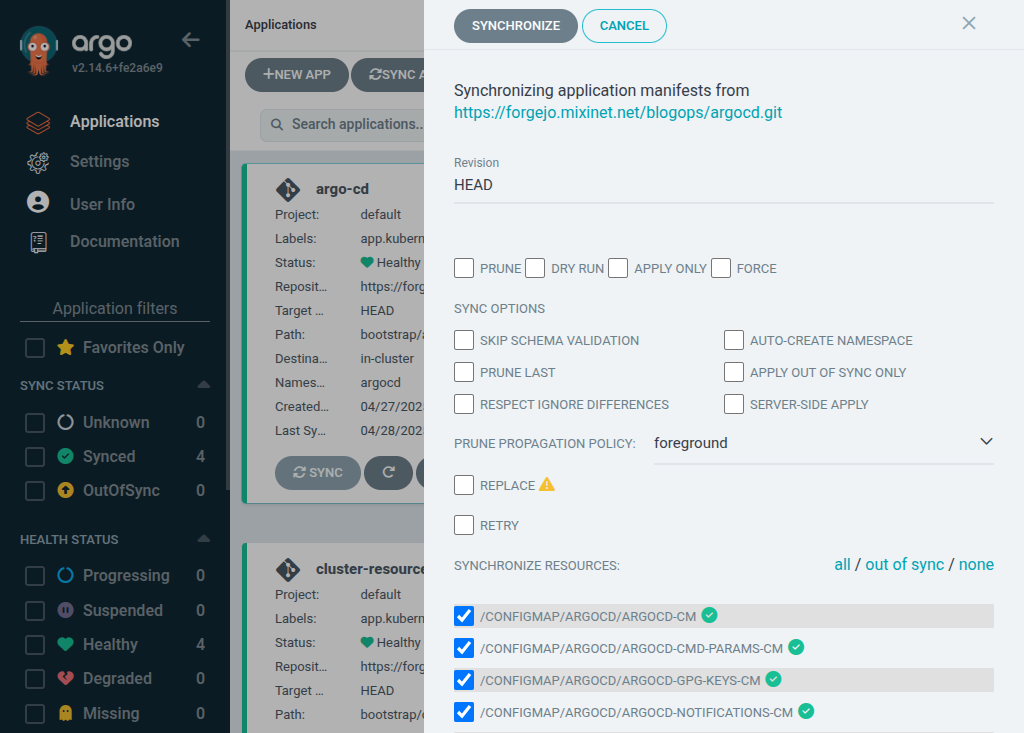
Once the changes are pushed we sync the argo-cd application manually to make sure they are applied:
argo cd sync
As a test we can download the argocd-cmd-params-cm ConfigMap to make sure everything is OK:
apiVersion: v1
data:
  server.insecure: "true"
kind: ConfigMap
metadata:
  annotations:
    kubectl.kubernetes.io/last-applied-configuration:  
       "apiVersion":"v1","data": "server.insecure":"true" ,"kind":"ConfigMap","metadata": "annotations": ,"labels": "app.kubernetes.io/instance":"argo-cd","app.kubernetes.io/name":"argocd-cmd-params-cm","app.kubernetes.io/part-of":"argocd" ,"name":"argocd-cmd-params-cm","namespace":"argocd" 
  creationTimestamp: "2025-04-27T17:31:54Z"
  labels:
    app.kubernetes.io/instance: argo-cd
    app.kubernetes.io/name: argocd-cmd-params-cm
    app.kubernetes.io/part-of: argocd
  name: argocd-cmd-params-cm
  namespace: argocd
  resourceVersion: "16731"
  uid: a460638f-1d82-47f6-982c-3017699d5f14
As this simply changes the ConfigMap we have to restart the argocd-server to read it again, to do it we delete the server pods so they are re-created using the updated resource:
  kubectl delete pods -n argocd -l app.kubernetes.io/name=argocd-server
After doing this the port-forward command is killed automatically, if we run it again the connection to get to the argocd-server has to be done using HTTP instead of HTTPS. Instead of testing that we are going to add an ingress definition to be able to connect to the server using HTTPS and GRPC against the address argocd.lo.mixinet.net using the wildcard TLS certificate we installed earlier. To do it we to edit the bootstrap/argo-cd/kustomization.yaml file to add the ingress_route.yaml file to the deployment:
--- a/bootstrap/argo-cd/kustomization.yaml
+++ b/bootstrap/argo-cd/kustomization.yaml
@@ -20,3 +20,4 @@ kind: Kustomization
 namespace: argocd
 resources:
 - github.com/argoproj-labs/argocd-autopilot/manifests/base?ref=v0.4.19
+- ingress_route.yaml
The ingress_route.yaml file contents are the following:
apiVersion: traefik.io/v1alpha1
kind: IngressRoute
metadata:
  name: argocd-server
  namespace: argocd
spec:
  entryPoints:
    - websecure
  routes:
    - kind: Rule
      match: Host( argocd.lo.mixinet.net )
      priority: 10
      services:
        - name: argocd-server
          port: 80
    - kind: Rule
      match: Host( argocd.lo.mixinet.net ) && Header( Content-Type ,  application/grpc )
      priority: 11
      services:
        - name: argocd-server
          port: 80
          scheme: h2c
  tls:
    certResolver: default
After pushing the changes and waiting a little bit the change is applied and we can access the server using HTTPS and GRPC, the first way can be tested from a browser and the GRPC using the command line interface:
  argocd --grpc-web login argocd.lo.mixinet.net:8443
Username: admin
Password:
'admin:login' logged in successfully
Context 'argocd.lo.mixinet.net:8443' updated
  argocd app list -o name
argocd/argo-cd
argocd/autopilot-bootstrap
argocd/cluster-resources-in-cluster
argocd/root
So things are working fine and that is all on this post, folks!

Valhalla's Things: POLARVIDE modular jacket

Posted on April 28, 2025
Tags: madeof:atoms, craft:sewing
A woman with early morning hair wearing a knee-length grey polar fleece jacket; it is closed at the waist with a twine belt that makes the bound front edge go in a smooth curve between the one side of the neck to the other side of the waist and then flare back outwards on the hips. The sleeves are long enough to go over the hands, and both them and the hem are cut Years ago I made myself a quick dressing gown from a white fleece IKEA throw and often wore it in the morning between waking up and changing into day clothes. One day I want to make myself a fancy victorian wrapper, to use in its place, but that s still in the early planning stage, and will require quite some work. a free cat sitting half asleep on an old couch, with a formerly white piece of fabric draped between the armrest and the seat. A piece of cardboard between two seat pillows provides additional protection from the wind. Then last autumn I discovered that the taxes I owed to the local lord (who provides protection from mice and other small animals) included not just a certain amount of kibbles, but also some warm textiles, and the dressing gown (which at this time was definitely no longer pristine) had to go. For a while I had to do without a dressing gown, but then in the second half of this winter I had some time for a quick machine sewing project. I could not tackle the big victorian thing, but I still had a second POLARVIDE throw from IKEA (this time in a more sensible dark grey) I had bought with sewing intents. The fabric in a throw isn t that much, so I needed something pretty efficient, and rather than winging it as I had done the first time I decided I wanted to try the Modular Jacket from A Year of Zero Waste Sewing (which I had bought in the zine instalments: the jacket is in the March issue). After some measuring and decision taking, I found that I could fit most of the pieces and get a decent length, but I had no room for the collar, and probably not for the belt nor the pockets, but I cut all of the main pieces. I had a possible idea for a contrasting collar, but I decided to start sewing the main pieces and decide later, before committing to cutting the other fabric. As I was assembling the jacket I decided that as a dressing gown I could do without the collar, and noticed that with the fraying-free plastic fleece I didn t really need the front facings, so I cut those in half lengthwise, pieced them together, and used them as binding to finish the front end. the back of the worn jacket, other than being clinched in by the belt it is pretty straight. Since I didn t have enough fabric for the belt I also skipped the belt loops, but I have been wearing this with random belts and I don t feel the need for them anyway. I ve also been thinking about adding a button just above the bust and use that to keep it closed, but I m still not 100% sure about it. Another thing I still need to do is to go through the few scraps of fleece that are left and see if I can piece together a serviceable pocket or two. folding the sleeves back by a good 10 cm to show the hands. Because of the size of the fabric, I ended up having quite long sleeves: I m happy with them because they mean that I can cover my hands when it s cold, or fold them back to make a nice cuff. If I ll make a real jacket with this patter I ll have to take this in consideration, and either make the sleeves shorter or finish the seam in a way that looks nice when folded back. Will I make a real jacket? I m not sure, it s not really my style of outer garment, but as a dressing gown it has already been used quite a bit (as in, almost every morning since I ve made it :) ) and will continue to be used until too worn to be useful, and that s a good thing.

26 April 2025

John Goerzen: Memoirs of the Early Internet

The Internet is an amazing place, and occasionally you can find things on the web that have somehow lingered online for decades longer than you might expect. Today I ll take you on a tour of some parts of the early Internet. The Internet, of course, is a network of networks and part of its early (and continuing) promise was to provide a common protocol that all sorts of networks can use to interoperate with each other. In the early days, UUCP was one of the main ways universities linked with each other, and eventually UUCP and the Internet sort of merged (but that s a long story). Let s start with some Usenet maps, which were an early way to document the UUCP modem links between universities. Start with this PDF. The first page is a Usenet map (which at the time mostly flowed over UUCP) from April of 1981. Notice that ucbvax, a VAX system at Berkeley, was central to the map. ucbvax continued to be a central node for UUCP for more than a decade; on page 5 of that PDF, you ll see that it asks for a Path from a major node (eg, ucbvax, devcax, harpo, duke) . Pre-Internet email addresses used a path; eg, mark@ucbvax was duke!decvax!ucbvax!mark to someone. You had to specify the route from your system to the recipient on your email To line. If you gave out your email address on a business card, you would start it from a major node like ucbvax, and the assumption was that everyone would know how to get from their system to the major node. On August 19, 1994, ucbvax was finally turned off. TCP/IP had driven UUCP into more obscurity; by then, it was mostly used by people without a dedicated Internet connection to get on the Internet, rather than an entire communication network of its own. A few days later, Cliff Frost posted a memoir of ucbvax; an obscurbe bit of Internet lore that is fun to read. UUCP was ad-hoc, and by 1984 there was an effort to make a machine-parsable map to help automate routing on UUCP. This was called the pathalias project, and there was a paper about it. The Linux network administration guide even includes a section on pathalias. Because UUCP mainly flowed over phone lines, long distance fees made it quite expensive. In 1985, the Stargate Project was formed, with the idea of distributing Usenet by satellite. The satellite link was short-lived, but the effort eventually morphed into UUNET. It was initially a non-profit, but eventually became a commercial backbone provider, and later ISP. Over a long series of acquisitions, UUNET is now part of Verizon. An article in ;login: is another description of this history. IAPS has an Internet in 1990 article, which includes both pathalias data and an interesting map of domain names to UUCP paths. As I was pondering what interesting things a person could do with NNCPNET Internet email, I stumbled across a page on getting FTP files via e-mail. Yes, that used to be a thing! I remember ftpmail@decwrl.dec.com. It turns out that page is from a copy of EFF s (Extended) Guide to the Internet from 1994. Wow, what a treasure! It has entries such as A Slice of Life in my Virtual Community, libraries with telnet access, Gopher, A Statement of Principle by Bruce Sterling, and I could go on. You can also get it as a PDF from Internet Archive. UUCP is still included with modern Linux and BSD distributions. It was part of how I experienced the PC and Internet revolution in rural America. It lacks modern security, but NNCP is to UUCP what ssh is to telnet.

25 April 2025

Simon Josefsson: GitLab Runner with Rootless Privilege-less Capability-less Podman on riscv64

I host my own GitLab CI/CD runners, and find that having coverage on the riscv64 CPU architecture is useful for testing things. The HiFive Premier P550 seems to be a common hardware choice. The P550 is possible to purchase online. You also need a (mini-)ATX chassi, power supply (~500W is more than sufficient), PCI-to-M2 converter and a NVMe storage device. Total cost per machine was around $8k/ 8k for me. Assembly was simple: bolt everything, connect ATX power, connect cables for the front-panel, USB and and Audio. Be sure to toggle the physical power switch on the P550 before you close the box. Front-panel power button will start your machine. There is a P550 user manual available. Below I will guide you to install the GitLab Runner on the pre-installed Ubuntu 24.04 that ships with the P550, and configure it to use Podman in root-less mode and without the --privileged flag, without any additional capabilities like SYS_ADMIN. Presumably you want to migrate to some other OS instead; hey Trisquel 13 riscv64 I m waiting for you! I wouldn t recommend using this machine for anything sensitive, there is an awful lot of non-free and/or vendor-specific software installed, and the hardware itself is young. I am not aware of any riscv64 hardware that can run a libre OS, all of them appear to require non-free blobs and usually a non-mainline kernel.
apt-get install minicom
minicom -o -D /dev/ttyUSB3
#cmd: ifconfig
inet 192.168.0.2 netmask: 255.255.240.0
gatway 192.168.0.1
SOM_Mac0: 8c:00:00:00:00:00
SOM_Mac1: 8c:00:00:00:00:00
MCU_Mac: 8c:00:00:00:00:00
#cmd: setmac 0 CA:FE:42:17:23:00
The MAC setting will be valid after rebooting the carrier board!!!
MAC[0] addr set to CA:FE:42:17:23:00(ca:fe:42:17:23:0)
#cmd: setmac 1 CA:FE:42:17:23:01
The MAC setting will be valid after rebooting the carrier board!!!
MAC[1] addr set to CA:FE:42:17:23:01(ca:fe:42:17:23:1)
#cmd: setmac 2 CA:FE:42:17:23:02
The MAC setting will be valid after rebooting the carrier board!!!
MAC[2] addr set to CA:FE:42:17:23:02(ca:fe:42:17:23:2)
#cmd:
apt-get install openocd
wget https://raw.githubusercontent.com/sifiveinc/hifive-premier-p550-tools/refs/heads/master/mcu-firmware/stm32_openocd.cfg
echo 'acc115d283ff8533d6ae5226565478d0128923c8a479a768d806487378c5f6c3 stm32_openocd.cfg' sha256sum -c
openocd -f stm32_openocd.cfg &
telnet localhost 4444
...
echo 'ssh-ed25519 AAA...' > ~/.ssh/authorized_keys
sed -i 's;^#PasswordAuthentication.*;PasswordAuthentication no;' /etc/ssh/sshd_config
service ssh restart
parted /dev/nvme0n1 print
blkdiscard /dev/nvme0n1
parted /dev/nvme0n1 mklabel gpt
parted /dev/nvme0n1 mkpart jas-p550-nvm-02 ext2 1MiB 100% align-check optimal 1
parted /dev/nvme0n1 set 1 lvm on
partprobe /dev/nvme0n1
pvcreate /dev/nvme0n1p1
vgcreate vg0 /dev/nvme0n1p1
lvcreate -L 400G -n glr vg0
mkfs.ext4 -L glr /dev/mapper/vg0-glr
Now with a reasonable setup ready, let s install the GitLab Runner. The following is adapted from gitlab-runner s official installation instructions documentation. The normal installation flow doesn t work because they don t publish riscv64 apt repositories, so you will have to perform upgrades manually.
# wget https://s3.dualstack.us-east-1.amazonaws.com/gitlab-runner-downloads/latest/deb/gitlab-runner_riscv64.deb
# wget https://s3.dualstack.us-east-1.amazonaws.com/gitlab-runner-downloads/latest/deb/gitlab-runner-helper-images.deb
wget https://gitlab-runner-downloads.s3.amazonaws.com/v17.11.0/deb/gitlab-runner_riscv64.deb
wget https://gitlab-runner-downloads.s3.amazonaws.com/v17.11.0/deb/gitlab-runner-helper-images.deb
echo '68a4c2a4b5988a5a5bae019c8b82b6e340376c1b2190228df657164c534bc3c3 gitlab-runner-helper-images.deb' sha256sum -c
echo 'ee37dc76d3c5b52e4ba35cf8703813f54f536f75cfc208387f5aa1686add7a8c gitlab-runner_riscv64.deb' sha256sum -c
dpkg -i gitlab-runner-helper-images.deb gitlab-runner_riscv64.deb
Remember the NVMe device? Let s not forget to use it, to avoid wear and tear of the internal MMC root disk. Do this now before any files in /home/gitlab-runner appears, or you have to move them manually.
gitlab-runner stop
echo 'LABEL=glr /home/gitlab-runner ext4 defaults,noatime 0 1' >> /etc/fstab
systemctl daemon-reload
mount /home/gitlab-runner
Next install gitlab-runner and configure it. Replace token glrt-REPLACEME below with the registration token you get from your GitLab project s Settings -> CI/CD -> Runners -> New project runner. I used the tags riscv64 and a runner description of the hostname.
gitlab-runner register --non-interactive --url https://gitlab.com --token glrt-REPLACEME --name $(hostname) --executor docker --docker-image debian:stable
We install and configure gitlab-runner to use podman, and to use non-root user.
apt-get install podman
gitlab-runner stop
usermod --add-subuids 100000-165535 --add-subgids 100000-165535 gitlab-runner
You need to run some commands as the gitlab-runner user, but unfortunately some interaction between sudo/su and pam_systemd makes this harder than it should be. So you have to setup SSH for the user and login via SSH to run the commands. Does anyone know of a better way to do this?
# on the p550:
cp -a /root/.ssh/ /home/gitlab-runner/
chown -R gitlab-runner:gitlab-runner /home/gitlab-runner/.ssh/
# on your laptop:
ssh gitlab-runner@jas-p550-01
systemctl --user --now enable podman.socket
systemctl --user --now start podman.socket
loginctl enable-linger gitlab-runner gitlab-runner
systemctl status --user podman.socket
We modify /etc/gitlab-runner/config.toml as follows, replace 997 with the user id shown by systemctl status above. See feature flags documentation for more documentation.
...
[[runners]]
environment = ["FF_NETWORK_PER_BUILD=1", "FF_USE_FASTZIP=1"]
...
[runners.docker]
host = "unix:///run/user/997/podman/podman.sock"
Note that unlike the documentation I do not add the privileged = true parameter here. I will come back to this later. Restart the system to confirm that pushing a .gitlab-ci.yml with a job that uses the riscv64 tag like the following works properly.
dump-env-details-riscv64:
stage: build
image: riscv64/debian:testing
tags: [ riscv64 ]
script:
- set
Your gitlab-runner should now be receiving jobs and running them in rootless podman. You may view the log using journalctl as follows:
journalctl --follow _SYSTEMD_UNIT=gitlab-runner.service
To stop the graphical environment and disable some unnecessary services, you can use:
systemctl set-default multi-user.target
systemctl disable openvpn cups cups-browsed sssd colord
At this point, things were working fine and I was running many successful builds. Now starts the fun part with operational aspects! I had a problem when running buildah to build a new container from within a job, and noticed that aardvark-dns was crashing. You can use the Debian aardvark-dns binary instead.
wget http://ftp.de.debian.org/debian/pool/main/a/aardvark-dns/aardvark-dns_1.14.0-3_riscv64.deb
echo 'df33117b6069ac84d3e97dba2c59ba53775207dbaa1b123c3f87b3f312d2f87a aardvark-dns_1.14.0-3_riscv64.deb' sha256sum -c
mkdir t
cd t
dpkg -x ../aardvark-dns_1.14.0-3_riscv64.deb .
mv /usr/lib/podman/aardvark-dns /usr/lib/podman/aardvark-dns.ubuntu
mv usr/lib/podman/aardvark-dns /usr/lib/podman/aardvark-dns.debian
My setup uses podman in rootless mode without passing the privileged parameter or any add-cap parameters to add non-default capabilities. This is sufficient for most builds. However if you try to create container using buildah from within a job, you may see errors like this:
Writing manifest to image destination
Error: mounting new container: mounting build container "8bf1ec03d967eae87095906d8544f51309363ddf28c60462d16d73a0a7279ce1": creating overlay mount to /var/lib/containers/storage/overlay/23785e20a8bac468dbf028bf524274c91fbd70dae195a6cdb10241c345346e6f/merged, mount_data="lowerdir=/var/lib/containers/storage/overlay/l/I3TWYVYTRZ4KVYCT6FJKHR3WHW,upperdir=/var/lib/containers/storage/overlay/23785e20a8bac468dbf028bf524274c91fbd70dae195a6cdb10241c345346e6f/diff,workdir=/var/lib/containers/storage/overlay/23785e20a8bac468dbf028bf524274c91fbd70dae195a6cdb10241c345346e6f/work,volatile": using mount program /usr/bin/fuse-overlayfs: unknown argument ignored: lazytime
fuse: device not found, try 'modprobe fuse' first
fuse-overlayfs: cannot mount: No such file or directory
: exit status 1
According to GitLab runner security considerations, you should not enable the privileged = true parameter, and the alternative appears to run Podman as root with privileged=false. Indeed setting privileged=true as in the following example solves the problem, and I suppose running podman as root would too.
[[runners]]
[runners.docker]
privileged = true
Can we do better? After some experimentation, and reading open issues with suggested capabilities and configuration snippets, I ended up with the following configuration. It runs podman in rootless mode (as the gitlab-runner user) without --privileged, but add the CAP_SYS_ADMIN capability and exposes the /dev/fuse device. Still, this is running as non-root user on the machine, so I think it is an improvement compared to using --privileged and also compared to running podman as root.
[[runners]]
[runners.docker]
privileged = false
cap_add = ["SYS_ADMIN"]
devices = ["/dev/fuse"]
Still I worry about the security properties of such a setup, so I only enable these settings for a separately configured runner instance that I use when I need this docker-in-docker (oh, I meant buildah-in-podman) functionality. I found one article discussing Rootless Podman without the privileged flag that suggest isolation=chroot but I have yet to make this work. Suggestions for improvement are welcome. Happy Riscv64 Building! Update 2025-05-05: I was able to make it work without the SYS_ADMIN capability too, with a GitLab /etc/gitlab-runner/config.toml like the following:
[[runners]]
  [runners.docker]
    privileged = false
    devices = ["/dev/fuse"]
And passing --isolation chroot to Buildah like this:
buildah build --isolation chroot -t $CI_REGISTRY_IMAGE:name image/
I ve updated the blog title to add the word capability-less as well. I ve confirmed that the same recipe works on podman on a ppc64el platform too. Remaining loop-holes are escaping from the chroot into the non-root gitlab-runner user, and escalating that privilege to root. The /dev/fuse and sub-uid/gid may be privilege escalation vectors here, otherwise I believe you ve found a serious software security issue rather than a configuration mistake.

Ian Wienand: Avoiding layer shift on Ender V3 KE after pause

With (at least) the V1.1.0.15 firmware on the Ender V3 KE 3d printer the PAUSE macro will cause the print head to run too far on the Y axis, which causes a small layer shift when the print returns. I guess the idea is to expose the build plate as much as possible by moving the head as far to the side and back as possible, but the overrun and consequent belt slip unfortunately makes it mostly useless; the main use of this probably being to switch filaments for two colour prints. Luckily you can fairly easily enable root access on the control pad from the settings menu. After doing this you can ssh to it's IP address with the default password Creality2023. From there you can modify the /usr/data/printer_data/config/gcode_macro.cfg file (vi is available) to change the details of the PAUSE macro. Find the section [gcode_macro PAUSE] and modify % set y_park = 255 % to a more reasonable value like 150. Save the file and reboot the pad so the printing daemons restart. On PAUSE this then moves the head to the far left about half-way down, which works fine for filament changes. Hopefully a future firmware version will update this; I will update this post if I find it does. c.f. Ender 3 V3 KE shifting layers after pause

Bits from Debian: Debian Project Leader election 2025 is over, Andreas Tille re-elected!

The voting period and tally of votes for the Debian Project Leader election has just concluded and the winner is Andreas Tille, who has been elected for the second time. Congratulations! Out of a total of 1,030 developers, 362 voted. As usual in Debian, the voting method used was the Condorcet method. More information about the result is available in the Debian Project Leader Elections 2025 page. Many thanks to Andreas Tille, Gianfranco Costamagna, Julian Andres Klode, and Sruthi Chandran for their campaigns, and to our Developers for voting. The new term for the project leader started on April 21st and will expire on April 20th 2026.

24 April 2025

Jonathan McDowell: Local Voice Assistant Step 1: An ATOM Echo voice satellite

Back when I setup my home automation I ended up with one piece that used an external service: Amazon Alexa. I d rather not have done this, but voice control is extremely convenient, both for us, and guests. Since then Home Assistant has done a lot of work in developing the capability of a local voice assistant - 2023 was their Year of Voice. I ve had brief looks at this in the past, but never quite had the time to dig into setting it up, and was put off by the fact a lot of the setup instructions were just Download our prebuilt components . While I admire the efforts to get Home Assistant fully packaged for Debian I accept that s a tricky proposition, and settle for running it in a venv on a Debian stable container. Voice requires a lot more binary components, and I want to have voice satellites in more than one location, so I set about trying to understand a bit better what I was deploying, and actually building the binary bits myself. This is the start of a write-up of that. I ll break it into a bunch of posts, trying to cover one bit in each, because otherwise this will get massive. Let s start with some requirements: My house server is an AMD Ryzen 7 5700G, so my expectation was that I d have enough local processing power to be able to do this. That turned out to be a valid assumption - speech to text really has come a long way in recent years. I m still running Home Assistant 2024.3.3 - the last one that supports (but complains about) Python 3.11. Trixie has started the freeze process, so once it releases I ll look at updating the HA install. For now what I have has turned out to be Good Enough, but I know there have been improvements upstream I m missing. Finally, before I get into the details, I should point out that if you just want to get started with a voice assistant on Home Assistant and don t care about what s under the hood, there are a bunch of more user friendly details on Home Assistant s site itself, and they have pre-built images you can just deploy. My first step was sorting out a voice satellite . This is the device that actually has a microphone and speaker and communicates with the main Home Assistant setup. I d seen the post about a $13 voice assistant, and as a result had an ATOM Echo sitting on my desk I hadn t got around to setting up. Here, we ignore a bit about delving into exactly what s going on under the hood, even if we re compiling locally. This is a constrained embedded device and while I m familiar with the ESP32 IDF build system I just accepted that using ESPHome and letting it do it s thing was the quickest way to get up and running. It is possible to do this all via the web with a pre-built image, but I wanted to change the wake word to Hey Jarvis rather than the default Okay Nabu , and that was a good reason to bother doing a local build. We ll get into actually building a voice satellite on Debian in later posts. I started with the default upstream assistant config and tweaked it a little for my setup:
diff of my configuration tweaks
$ diff -u m5stack-atom-echo.yaml assistant.yaml
--- m5stack-atom-echo.yaml    2025-04-18 13:41:21.812766112 +0100
+++ assistant.yaml  2025-01-20 17:33:24.918585244 +0000
@@ -1,7 +1,7 @@
 substitutions:
-  name: m5stack-atom-echo
+  name: study-atom-echo
   friendly_name: M5Stack Atom Echo
-  micro_wake_word_model: okay_nabu  # alexa, hey_jarvis, hey_mycroft are also supported
+  micro_wake_word_model: hey_jarvis  # alexa, hey_jarvis, hey_mycroft are also supported
 
 esphome:
   name: $ name 
@@ -16,15 +16,26 @@
     version: 4.4.8
     platform_version: 5.4.0
 
+# Enable logging
 logger:
+
+# Enable Home Assistant API
 api:
+  encryption:
+    key: "TGlrZVRoaXNJc1JlYWxseUl0Rm9vbGlzaFBlb3BsZSE="
 
 ota:
   - platform: esphome
-    id: ota_esphome
+    password: "itsnotarealthing"
 
 wifi:
+  ssid: "My Wifi Goes Here"
+  password: "AndThePasswordGoesHere"
+
+  # Enable fallback hotspot (captive portal) in case wifi connection fails
   ap:
+    ssid: "Study-Atom-Echo Fallback Hotspot"
+    password: "ThisIsRandom"
 
 captive_portal:

(I note that the current upstream config has moved on a bit since I first did this, but I double checked the above instructions still work at the time of writing. I end up pinning ESPHome to the right version below due to that.) It turns out to be fairly easy to setup ESPHome in a venv and get it to build + flash the image for you:
Instructions for building + flashing ESPHome to ATOM Echo
noodles@sevai:~$ python3 -m venv esphome-atom-echo
noodles@sevai:~$ . esphome-atom-echo/bin/activate
(esphome-atom-echo) noodles@sevai:~$ cd esphome-atom-echo/
(esphome-atom-echo) noodles@sevai:~/esphome-atom-echo$  pip install esphome==2024.12.4
Collecting esphome==2024.12.4
  Using cached esphome-2024.12.4-py3-none-any.whl (4.1 MB)
 
Successfully installed FontTools-4.57.0 PyYAML-6.0.2 appdirs-1.4.4 attrs-25.3.0 bottle-0.13.2 defcon-0.12.1 esphome-2024.12.4 esphome-dashboard-20241217.1 freetype-py-2.5.1 fs-2.4.16 gflanguages-0.7.3 glyphsLib-6.10.1 glyphsets-1.0.0 openstep-plist-0.5.0 pillow-10.4.0 platformio-6.1.16 protobuf-3.20.3 puremagic-1.27 ufoLib2-0.17.1 unicodedata2-16.0.0
(esphome-atom-echo) noodles@sevai:~/esphome-atom-echo$ esphome compile assistant.yaml 
INFO ESPHome 2024.12.4
INFO Reading configuration assistant.yaml...
INFO Updating https://github.com/esphome/esphome.git@pull/5230/head
INFO Updating https://github.com/jesserockz/esphome-components.git@None
 
Linking .pioenvs/study-atom-echo/firmware.elf
/home/noodles/.platformio/packages/toolchain-xtensa-esp32@8.4.0+2021r2-patch5/bin/../lib/gcc/xtensa-esp32-elf/8.4.0/../../../../xtensa-esp32-elf/bin/ld: missing --end-group; added as last command line option
RAM:   [=         ]  10.6% (used 34632 bytes from 327680 bytes)
Flash: [========  ]  79.8% (used 1463813 bytes from 1835008 bytes)
Building .pioenvs/study-atom-echo/firmware.bin
Creating esp32 image...
Successfully created esp32 image.
esp32_create_combined_bin([".pioenvs/study-atom-echo/firmware.bin"], [".pioenvs/study-atom-echo/firmware.elf"])
Wrote 0x176fb0 bytes to file /home/noodles/esphome-atom-echo/.esphome/build/study-atom-echo/.pioenvs/study-atom-echo/firmware.factory.bin, ready to flash to offset 0x0
esp32_copy_ota_bin([".pioenvs/study-atom-echo/firmware.bin"], [".pioenvs/study-atom-echo/firmware.elf"])
==================================================================================== [SUCCESS] Took 130.57 seconds ====================================================================================
INFO Successfully compiled program.
(esphome-atom-echo) noodles@sevai:~/esphome-atom-echo$ esphome upload --device /dev/serial/by-id/usb-Hades2001_M5stack_9552AF8367-if00-port0 assistant.yaml 
INFO ESPHome 2024.12.4
INFO Reading configuration assistant.yaml...
INFO Updating https://github.com/esphome/esphome.git@pull/5230/head
INFO Updating https://github.com/jesserockz/esphome-components.git@None
 
INFO Upload with baud rate 460800 failed. Trying again with baud rate 115200.
esptool.py v4.7.0
Serial port /dev/serial/by-id/usb-Hades2001_M5stack_9552AF8367-if00-port0
Connecting....
Chip is ESP32-PICO-D4 (revision v1.1)
Features: WiFi, BT, Dual Core, 240MHz, Embedded Flash, VRef calibration in efuse, Coding Scheme None
Crystal is 40MHz
MAC: 64:b7:08:8a:1b:c0
Uploading stub...
Running stub...
Stub running...
Configuring flash size...
Auto-detected Flash size: 4MB
Flash will be erased from 0x00010000 to 0x00176fff...
Flash will be erased from 0x00001000 to 0x00007fff...
Flash will be erased from 0x00008000 to 0x00008fff...
Flash will be erased from 0x00009000 to 0x0000afff...
Compressed 1470384 bytes to 914252...
Wrote 1470384 bytes (914252 compressed) at 0x00010000 in 82.0 seconds (effective 143.5 kbit/s)...
Hash of data verified.
Compressed 25632 bytes to 16088...
Wrote 25632 bytes (16088 compressed) at 0x00001000 in 1.8 seconds (effective 113.1 kbit/s)...
Hash of data verified.
Compressed 3072 bytes to 134...
Wrote 3072 bytes (134 compressed) at 0x00008000 in 0.1 seconds (effective 383.7 kbit/s)...
Hash of data verified.
Compressed 8192 bytes to 31...
Wrote 8192 bytes (31 compressed) at 0x00009000 in 0.1 seconds (effective 813.5 kbit/s)...
Hash of data verified.
Leaving...
Hard resetting via RTS pin...
INFO Successfully uploaded program.

And then you can watch it boot (this is mine already configured up in Home Assistant):
Watching the ATOM Echo boot
$ picocom --quiet --imap lfcrlf --baud 115200 /dev/serial/by-id/usb-Hades2001_M5stack_9552AF8367-if00-port0
I (29) boot: ESP-IDF 4.4.8 2nd stage bootloader
I (29) boot: compile time 17:31:08
I (29) boot: Multicore bootloader
I (32) boot: chip revision: v1.1
I (36) boot.esp32: SPI Speed      : 40MHz
I (40) boot.esp32: SPI Mode       : DIO
I (45) boot.esp32: SPI Flash Size : 4MB
I (49) boot: Enabling RNG early entropy source...
I (55) boot: Partition Table:
I (58) boot: ## Label            Usage          Type ST Offset   Length
I (66) boot:  0 otadata          OTA data         01 00 00009000 00002000
I (73) boot:  1 phy_init         RF data          01 01 0000b000 00001000
I (81) boot:  2 app0             OTA app          00 10 00010000 001c0000
I (88) boot:  3 app1             OTA app          00 11 001d0000 001c0000
I (96) boot:  4 nvs              WiFi data        01 02 00390000 0006d000
I (103) boot: End of partition table
I (107) esp_image: segment 0: paddr=00010020 vaddr=3f400020 size=58974h (362868) map
I (247) esp_image: segment 1: paddr=0006899c vaddr=3ffb0000 size=03400h ( 13312) load
I (253) esp_image: segment 2: paddr=0006bda4 vaddr=40080000 size=04274h ( 17012) load
I (260) esp_image: segment 3: paddr=00070020 vaddr=400d0020 size=f5cb8h (1006776) map
I (626) esp_image: segment 4: paddr=00165ce0 vaddr=40084274 size=112ach ( 70316) load
I (665) boot: Loaded app from partition at offset 0x10000
I (665) boot: Disabling RNG early entropy source...
I (677) cpu_start: Multicore app
I (677) cpu_start: Pro cpu up.
I (677) cpu_start: Starting app cpu, entry point is 0x400825c8
I (0) cpu_start: App cpu up.
I (695) cpu_start: Pro cpu start user code
I (695) cpu_start: cpu freq: 160000000
I (695) cpu_start: Application information:
I (700) cpu_start: Project name:     study-atom-echo
I (705) cpu_start: App version:      2024.12.4
I (710) cpu_start: Compile time:     Apr 18 2025 17:29:39
I (716) cpu_start: ELF file SHA256:  1db4989a56c6c930...
I (722) cpu_start: ESP-IDF:          4.4.8
I (727) cpu_start: Min chip rev:     v0.0
I (732) cpu_start: Max chip rev:     v3.99 
I (737) cpu_start: Chip rev:         v1.1
I (742) heap_init: Initializing. RAM available for dynamic allocation:
I (749) heap_init: At 3FFAE6E0 len 00001920 (6 KiB): DRAM
I (755) heap_init: At 3FFB8748 len 000278B8 (158 KiB): DRAM
I (761) heap_init: At 3FFE0440 len 00003AE0 (14 KiB): D/IRAM
I (767) heap_init: At 3FFE4350 len 0001BCB0 (111 KiB): D/IRAM
I (774) heap_init: At 40095520 len 0000AAE0 (42 KiB): IRAM
I (781) spi_flash: detected chip: gd
I (784) spi_flash: flash io: dio
I (790) cpu_start: Starting scheduler on PRO CPU.
I (0) cpu_start: Starting scheduler on APP CPU.
[I][logger:171]: Log initialized
[C][safe_mode:079]: There have been 0 suspected unsuccessful boot attempts
[D][esp32.preferences:114]: Saving 1 preferences to flash...
[D][esp32.preferences:143]: Saving 1 preferences to flash: 0 cached, 1 written, 0 failed
[I][app:029]: Running through setup()...
[C][esp32_rmt_led_strip:021]: Setting up ESP32 LED Strip...
[D][template.select:014]: Setting up Template Select
[D][template.select:023]: State from initial (could not load stored index): On device
[D][select:015]: 'Wake word engine location': Sending state On device (index 1)
[D][esp-idf:000]: I (100) gpio: GPIO[39]  InputEn: 1  OutputEn: 0  OpenDrain: 0  Pullup: 0  Pulldown: 0  Intr:0 
[D][binary_sensor:034]: 'Button': Sending initial state OFF
[C][light:021]: Setting up light 'M5Stack Atom Echo 8a1bc0'...
[D][light:036]: 'M5Stack Atom Echo 8a1bc0' Setting:
[D][light:041]:   Color mode: RGB
[D][template.switch:046]:   Restored state ON
[D][switch:012]: 'Use listen light' Turning ON.
[D][switch:055]: 'Use listen light': Sending state ON
[D][light:036]: 'M5Stack Atom Echo 8a1bc0' Setting:
[D][light:047]:   State: ON
[D][light:051]:   Brightness: 60%
[D][light:059]:   Red: 100%, Green: 89%, Blue: 71%
[D][template.switch:046]:   Restored state OFF
[D][switch:016]: 'timer_ringing' Turning OFF.
[D][switch:055]: 'timer_ringing': Sending state OFF
[C][i2s_audio:028]: Setting up I2S Audio...
[C][i2s_audio.microphone:018]: Setting up I2S Audio Microphone...
[C][i2s_audio.speaker:096]: Setting up I2S Audio Speaker...
[C][wifi:048]: Setting up WiFi...
[D][esp-idf:000]: I (206) wifi:
[D][esp-idf:000]: wifi driver task: 3ffc8544, prio:23, stack:6656, core=0
[D][esp-idf:000]: 
[D][esp-idf:000][wifi]: I (1238) system_api: Base MAC address is not set
[D][esp-idf:000][wifi]: I (1239) system_api: read default base MAC address from EFUSE
[D][esp-idf:000][wifi]: I (1274) wifi:
[D][esp-idf:000][wifi]: wifi firmware version: ff661c3
[D][esp-idf:000][wifi]: 
[D][esp-idf:000][wifi]: I (1274) wifi:
[D][esp-idf:000][wifi]: wifi certification version: v7.0
[D][esp-idf:000][wifi]: 
[D][esp-idf:000][wifi]: I (1286) wifi:
[D][esp-idf:000][wifi]: config NVS flash: enabled
[D][esp-idf:000][wifi]: 
[D][esp-idf:000][wifi]: I (1297) wifi:
[D][esp-idf:000][wifi]: config nano formating: disabled
[D][esp-idf:000][wifi]: 
[D][esp-idf:000][wifi]: I (1317) wifi:
[D][esp-idf:000][wifi]: Init data frame dynamic rx buffer num: 32
[D][esp-idf:000][wifi]: 
[D][esp-idf:000][wifi]: I (1338) wifi:
[D][esp-idf:000][wifi]: Init static rx mgmt buffer num: 5
[D][esp-idf:000][wifi]: 
[D][esp-idf:000][wifi]: I (1348) wifi:
[D][esp-idf:000][wifi]: Init management short buffer num: 32
[D][esp-idf:000][wifi]: 
[D][esp-idf:000][wifi]: I (1368) wifi:
[D][esp-idf:000][wifi]: Init dynamic tx buffer num: 32
[D][esp-idf:000][wifi]: 
[D][esp-idf:000][wifi]: I (1389) wifi:
[D][esp-idf:000][wifi]: Init static rx buffer size: 1600
[D][esp-idf:000][wifi]: 
[D][esp-idf:000][wifi]: I (1399) wifi:
[D][esp-idf:000][wifi]: Init static rx buffer num: 10
[D][esp-idf:000][wifi]: 
[D][esp-idf:000][wifi]: I (1419) wifi:
[D][esp-idf:000][wifi]: Init dynamic rx buffer num: 32
[D][esp-idf:000][wifi]: 
[D][esp-idf:000]: I (1441) wifi_init: rx ba win: 6
[D][esp-idf:000]: I (1441) wifi_init: tcpip mbox: 32
[D][esp-idf:000]: I (1450) wifi_init: udp mbox: 6
[D][esp-idf:000]: I (1450) wifi_init: tcp mbox: 6
[D][esp-idf:000]: I (1460) wifi_init: tcp tx win: 5760
[D][esp-idf:000]: I (1471) wifi_init: tcp rx win: 5760
[D][esp-idf:000]: I (1481) wifi_init: tcp mss: 1440
[D][esp-idf:000]: I (1481) wifi_init: WiFi IRAM OP enabled
[D][esp-idf:000]: I (1491) wifi_init: WiFi RX IRAM OP enabled
[C][wifi:061]: Starting WiFi...
[C][wifi:062]:   Local MAC: 64:B7:08:8A:1B:C0
[D][esp-idf:000][wifi]: I (1513) phy_init: phy_version 4791,2c4672b,Dec 20 2023,16:06:06
[D][esp-idf:000][wifi]: I (1599) wifi:
[D][esp-idf:000][wifi]: mode : sta (64:b7:08:8a:1b:c0)
[D][esp-idf:000][wifi]: 
[D][esp-idf:000][wifi]: I (1600) wifi:
[D][esp-idf:000][wifi]: enable tsf
[D][esp-idf:000][wifi]: 
[D][esp-idf:000][wifi]: I (1605) wifi:
[D][esp-idf:000][wifi]: Set ps type: 1
[D][esp-idf:000][wifi]: 
[D][wifi:482]: Starting scan...
[D][esp32.preferences:114]: Saving 1 preferences to flash...
[D][esp32.preferences:143]: Saving 1 preferences to flash: 1 cached, 0 written, 0 failed
[W][micro_wake_word:151]: Wake word detection can't start as the component hasn't been setup yet
[D][esp-idf:000][wifi]: I (1646) wifi:
[D][esp-idf:000][wifi]: Set ps type: 1
[D][esp-idf:000][wifi]: 
[W][component:157]: Component wifi set Warning flag: scanning for networks
 
[I][wifi:617]: WiFi Connected!
 
[D][wifi:626]: Disabling AP...
[C][api:026]: Setting up Home Assistant API server...
[C][micro_wake_word:062]: Setting up microWakeWord...
[C][micro_wake_word:069]: Micro Wake Word initialized
[I][app:062]: setup() finished successfully!
[W][component:170]: Component wifi cleared Warning flag
[W][component:157]: Component api set Warning flag: unspecified
[I][app:100]: ESPHome version 2024.12.4 compiled on Apr 18 2025, 17:29:39
 
[C][logger:185]: Logger:
[C][logger:186]:   Level: DEBUG
[C][logger:188]:   Log Baud Rate: 115200
[C][logger:189]:   Hardware UART: UART0
[C][esp32_rmt_led_strip:187]: ESP32 RMT LED Strip:
[C][esp32_rmt_led_strip:188]:   Pin: 27
[C][esp32_rmt_led_strip:189]:   Channel: 0
[C][esp32_rmt_led_strip:214]:   RGB Order: GRB
[C][esp32_rmt_led_strip:215]:   Max refresh rate: 0
[C][esp32_rmt_led_strip:216]:   Number of LEDs: 1
[C][template.select:065]: Template Select 'Wake word engine location'
[C][template.select:066]:   Update Interval: 60.0s
[C][template.select:069]:   Optimistic: YES
[C][template.select:070]:   Initial Option: On device
[C][template.select:071]:   Restore Value: YES
[C][gpio.binary_sensor:015]: GPIO Binary Sensor 'Button'
[C][gpio.binary_sensor:016]:   Pin: GPIO39
[C][light:092]: Light 'M5Stack Atom Echo 8a1bc0'
[C][light:094]:   Default Transition Length: 0.0s
[C][light:095]:   Gamma Correct: 2.80
[C][template.switch:068]: Template Switch 'Use listen light'
[C][template.switch:091]:   Restore Mode: restore defaults to ON
[C][template.switch:057]:   Optimistic: YES
[C][template.switch:068]: Template Switch 'timer_ringing'
[C][template.switch:091]:   Restore Mode: always OFF
[C][template.switch:057]:   Optimistic: YES
[C][factory_reset.button:011]: Factory Reset Button 'Factory reset'
[C][factory_reset.button:011]:   Icon: 'mdi:restart-alert'
[C][captive_portal:089]: Captive Portal:
[C][mdns:116]: mDNS:
[C][mdns:117]:   Hostname: study-atom-echo-8a1bc0
[C][esphome.ota:073]: Over-The-Air updates:
[C][esphome.ota:074]:   Address: study-atom-echo.local:3232
[C][esphome.ota:075]:   Version: 2
[C][esphome.ota:078]:   Password configured
[C][safe_mode:018]: Safe Mode:
[C][safe_mode:020]:   Boot considered successful after 60 seconds
[C][safe_mode:021]:   Invoke after 10 boot attempts
[C][safe_mode:023]:   Remain in safe mode for 300 seconds
[C][api:140]: API Server:
[C][api:141]:   Address: study-atom-echo.local:6053
[C][api:143]:   Using noise encryption: YES
[C][micro_wake_word:051]: microWakeWord:
[C][micro_wake_word:052]:   models:
[C][micro_wake_word:015]:     - Wake Word: Hey Jarvis
[C][micro_wake_word:016]:       Probability cutoff: 0.970
[C][micro_wake_word:017]:       Sliding window size: 5
[C][micro_wake_word:021]:     - VAD Model
[C][micro_wake_word:022]:       Probability cutoff: 0.500
[C][micro_wake_word:023]:       Sliding window size: 5
[D][api:103]: Accepted 192.168.39.6
[W][component:170]: Component api cleared Warning flag
[W][component:237]: Component api took a long time for an operation (58 ms).
[W][component:238]: Components should block for at most 30 ms.
[D][api.connection:1446]: Home Assistant 2024.3.3 (192.168.39.6): Connected successfully
[D][ring_buffer:034]: Created ring buffer with size 2048
[D][micro_wake_word:399]: Resetting buffers and probabilities
[D][micro_wake_word:195]: State changed from IDLE to START_MICROPHONE
[D][micro_wake_word:107]: Starting Microphone
[D][micro_wake_word:195]: State changed from START_MICROPHONE to STARTING_MICROPHONE
[D][esp-idf:000]: I (11279) I2S: DMA Malloc info, datalen=blocksize=1024, dma_buf_count=4
[D][micro_wake_word:195]: State changed from STARTING_MICROPHONE to DETECTING_WAKE_WORD

That s enough to get a voice satellite that can be configured up in Home Assistant; you ll need the ESPHome Integration added, then for the noise_psk key you use the same string as I have under api/encryption/key in my diff above (obviously do your own, I used dd if=/dev/urandom bs=32 count=1 base64 to generate mine). If you re like me and a compulsive VLANer and firewaller even within your own network then you need to allow Home Assistant to connect on TCP port 6053 to the ATOM Echo, and also allow access to/from UDP port 6055 on the Echo (it ll send audio from that port to Home Assistant, then receive back audio to the same port). At this point you can now shout Hey Jarvis, what time is it? at the Echo, and the white light will turn flashing blue (indicating it s heard the wake word). Which means we re ready to teach Home Assistant how to do something with the incoming audio.

23 April 2025

Thomas Lange: FAI 6.4 and new ISO images available

The new FAI release 6.4 comes with some nice new features. It now supports installing the Xfce edition of Linux Mint 22.1 'Xia'. There's now an additional Linux Mint ISO [1] which does an unattended Linux Mint installation via FAI and does not need a network connection because all packages are available on the ISO. The package_config configurations now support arbitrary boolean expressions with FAI classes like this:
PACKAGES install UBUNTU && XORG && ! MINT
If you use the command ifclass in customization scripts you can now also use these expressions. The tool fai-kvm for starting a KVM virtual machine now uses UEFI variables if the VM is started with an UEFI environment, so boot settings are saved during a reboot. For the installation of Rocky Linux and Almalinux in an UEFI environment some configuration files were added. New ISO images [2] are available but it may take some time until the FAIme service [3] will supports customized Linux Mint images.

Next.

Previous.