Search Results: "sten"

17 January 2022

Russ Allbery: DocKnot 7.00

The recent 6.01 release of my static web site generator was kind of a buggy mess, which uncovered a bunch of holes in my test suite and immediately turned up problems when I tried to use it to rebuild my actual web site. Most of the problems were Unicode-related; this release hopefully sorts out Unicode properly and handles it consistently. Other bugs fixed include processing of old-style pointers in a spin input tree, several rather obvious bugs in the new docknot release command, and a few long-standing issues with docknot dist that should make its results more consistent and reliable. I also got on a roll and finished the Path::Tiny transition in DocKnot, so now (nearly) all paths are internally represented as Path::Tiny objects. This meant changing some APIs, hence the version bump to 7.00. For anyone who still does a lot of Perl, I highly recommend the Path::Tiny module. If you also write Python, you will be reminded (in a good way) of Python's pathlib module, which I now use whenever possible. You can get the latest version of DocKnot from CPAN or from its distribution page.

16 January 2022

Chris Lamb: Favourite films of 2021

In my four most recent posts, I went over the memoirs and biographies, the non-fiction, the fiction and the 'classic' novels that I enjoyed reading the most in 2021. But in the very last of my 2021 roundup posts, I'll be going over some of my favourite movies. (Saying that, these are perhaps less of my 'favourite films' than the ones worth remarking on after all, nobody needs to hear that The Godfather is a good movie.) It's probably helpful to remark you that I took a self-directed course in film history in 2021, based around the first volume of Roger Ebert's The Great Movies. This collection of 100-odd movie essays aims to make a tour of the landmarks of the first century of cinema, and I watched all but a handul before the year was out. I am slowly making my way through volume two in 2022. This tome was tremendously useful, and not simply due to the background context that Ebert added to each film: it also brought me into contact with films I would have hardly come through some other means. Would I have ever discovered the sly comedy of Trouble in Paradise (1932) or the touching proto-realism of L'Atalante (1934) any other way? It also helped me to 'get around' to watching films I may have put off watching forever the influential Battleship Potemkin (1925), for instance, and the ur-epic Lawrence of Arabia (1962) spring to mind here. Choosing a 'worst' film is perhaps more difficult than choosing the best. There are first those that left me completely dry (Ready or Not, Written on the Wind, etc.), and those that were simply poorly executed. And there are those that failed to meet their own high opinions of themselves, such as the 'made for Reddit' Tenet (2020) or the inscrutable Vanilla Sky (2001) the latter being an almost perfect example of late-20th century cultural exhaustion. But I must save my most severe judgement for those films where I took a visceral dislike how their subjects were portrayed. The sexually problematic Sixteen Candles (1984) and the pseudo-Catholic vigilantism of The Boondock Saints (1999) both spring to mind here, the latter of which combines so many things I dislike into such a short running time I'd need an entire essay to adequately express how much I disliked it.

Dogtooth (2009) A father, a mother, a brother and two sisters live in a large and affluent house behind a very high wall and an always-locked gate. Only the father ever leaves the property, driving to the factory that he happens to own. Dogtooth goes far beyond any allusion to Josef Fritzl's cellar, though, as the children's education is a grotesque parody of home-schooling. Here, the parents deliberately teach their children the wrong meaning of words (e.g. a yellow flower is called a 'zombie'), all of which renders the outside world utterly meaningless and unreadable, and completely mystifying its very existence. It is this creepy strangeness within a 'regular' family unit in Dogtooth that is both socially and epistemically horrific, and I'll say nothing here of its sexual elements as well. Despite its cold, inscrutable and deadpan surreality, Dogtooth invites all manner of potential interpretations. Is this film about the artificiality of the nuclear family that the West insists is the benchmark of normality? Or is it, as I prefer to believe, something more visceral altogether: an allegory for the various forms of ontological violence wrought by fascism, as well a sobering nod towards some of fascism's inherent appeals? (Perhaps it is both. In 1972, French poststructuralists Gilles and F lix Guattari wrote Anti-Oedipus, which plays with the idea of the family unit as a metaphor for the authoritarian state.) The Greek-language Dogtooth, elegantly shot, thankfully provides no easy answers.

Holy Motors (2012) There is an infamous scene in Un Chien Andalou, the 1929 film collaboration between Luis Bu uel and famed artist Salvador Dal . A young woman is cornered in her own apartment by a threatening man, and she reaches for a tennis racquet in self-defence. But the man suddenly picks up two nearby ropes and drags into the frame two large grand pianos... each leaden with a dead donkey, a stone tablet, a pumpkin and a bewildered priest. This bizarre sketch serves as a better introduction to Leos Carax's Holy Motors than any elementary outline of its plot, which ostensibly follows 24 hours in the life of a man who must play a number of extremely diverse roles around Paris... all for no apparent reason. (And is he even a man?) Surrealism as an art movement gets a pretty bad wrap these days, and perhaps justifiably so. But Holy Motors and Un Chien Andalou serve as a good reminder that surrealism can be, well, 'good, actually'. And if not quite high art, Holy Motors at least demonstrates that surrealism can still unnerving and hilariously funny. Indeed, recalling the whimsy of the plot to a close friend, the tears of laughter came unbidden to my eyes once again. ("And then the limousines...!") Still, it is unclear how Holy Motors truly refreshes surrealism for the twenty-first century. Surrealism was, in part, a reaction to the mechanical and unfeeling brutality of World War I and ultimately sought to release the creative potential of the unconscious mind. Holy Motors cannot be responding to another continental conflagration, and so it appears to me to be some kind of commentary on the roles we exhibit in an era of 'post-postmodernity': a sketch on our age of performative authenticity, perhaps, or an idle doodle on the function and psychosocial function of work. Or perhaps not. After all, this film was produced in a time that offers the near-universal availability of mind-altering substances, and this certainly changes the context in which this film was both created. And, how can I put it, was intended to be watched.

Manchester by the Sea (2016) An absolutely devastating portrayal of a character who is unable to forgive himself and is hesitant to engage with anyone ever again. It features a near-ideal balance between portraying unrecoverable anguish and tender warmth, and is paradoxically grandiose in its subtle intimacy. The mechanics of life led me to watch this lying on a bed in a chain hotel by Heathrow Airport, and if this colourless circumstance blunted the film's emotional impact on me, I am probably thankful for it. Indeed, I find myself reduced in this review to fatuously recalling my favourite interactions instead of providing any real commentary. You could write a whole essay about one particular incident: its surfaces, subtexts and angles... all despite nothing of any substance ever being communicated. Truly stunning.

McCabe & Mrs. Miller (1971) Roger Ebert called this movie one of the saddest films I have ever seen, filled with a yearning for love and home that will not ever come. But whilst it is difficult to disagree with his sentiment, Ebert's choice of sad is somehow not quite the right word. Indeed, I've long regretted that our dictionaries don't have more nuanced blends of tragedy and sadness; perhaps the Ancient Greeks can loan us some. Nevertheless, the plot of this film is of a gambler and a prostitute who become business partners in a new and remote mining town called Presbyterian Church. However, as their town and enterprise booms, it comes to the attention of a large mining corporation who want to bully or buy their way into the action. What makes this film stand out is not the plot itself, however, but its mood and tone the town and its inhabitants seem to be thrown together out of raw lumber, covered alternatively in mud or frozen ice, and their days (and their personalities) are both short and dark in equal measure. As a brief aside, if you haven't seen a Roger Altman film before, this has all the trappings of being a good introduction. As Ebert went on to observe: This is not the kind of movie where the characters are introduced. They are all already here. Furthermore, we can see some of Altman's trademark conversations that overlap, a superb handling of ensemble casts, and a quietly subversive view of the tyranny of 'genre'... and the latter in a time when the appetite for revisionist portrays of the West was not very strong. All of these 'Altmanian' trademarks can be ordered in much stronger measures in his later films: in particular, his comedy-drama Nashville (1975) has 24 main characters, and my jejune interpretation of Gosford Park (2001) is that it is purposefully designed to poke fun those who take a reductionist view of 'genre', or at least on the audience's expectations. (In this case, an Edwardian-era English murder mystery in the style of Agatha Christie, but where no real murder or detection really takes place.) On the other hand, McCabe & Mrs. Miller is actually a poor introduction to Altman. The story is told in a suitable deliberate and slow tempo, and the two stars of the film are shown thoroughly defrocked of any 'star status', in both the visual and moral dimensions. All of these traits are, however, this film's strength, adding up to a credible, fascinating and riveting portrayal of the old West.

Detour (1945) Detour was filmed in less than a week, and it's difficult to decide out of the actors and the screenplay which is its weakest point.... Yet it still somehow seemed to drag me in. The plot revolves around luckless Al who is hitchhiking to California. Al gets a lift from a man called Haskell who quickly falls down dead from a heart attack. Al quickly buries the body and takes Haskell's money, car and identification, believing that the police will believe Al murdered him. An unstable element is soon introduced in the guise of Vera, who, through a set of coincidences that stretches credulity, knows that this 'new' Haskell (ie. Al pretending to be him) is not who he seems. Vera then attaches herself to Al in order to blackmail him, and the world starts to spin out of his control. It must be understood that none of this is executed very well. Rather, what makes Detour so interesting to watch is that its 'errors' lend a distinctively creepy and unnatural hue to the film. Indeed, in the early twentieth century, Sigmund Freud used the word unheimlich to describe the experience of something that is not simply mysterious, but something creepy in a strangely familiar way. This is almost the perfect description of watching Detour its eerie nature means that we are not only frequently second-guessed about where the film is going, but are often uncertain whether we are watching the usual objective perspective offered by cinema. In particular, are all the ham-fisted segues, stilted dialogue and inscrutable character motivations actually a product of Al inventing a story for the viewer? Did he murder Haskell after all, despite the film 'showing' us that Haskell died of natural causes? In other words, are we watching what Al wants us to believe? Regardless of the answers to these questions, the film succeeds precisely because of its accidental or inadvertent choices, so it is an implicit reminder that seeking the director's original intention in any piece of art is a complete mirage. Detour is certainly not a good film, but it just might be a great one. (It is a short film too, and, out of copyright, it is available online for free.)

Safe (1995) Safe is a subtly disturbing film about an upper-middle-class housewife who begins to complain about vague symptoms of illness. Initially claiming that she doesn't feel right, Carol starts to have unexplained headaches, a dry cough and nosebleeds, and eventually begins to have trouble breathing. Carol's family doctor treats her concerns with little care, and suggests to her husband that she sees a psychiatrist. Yet Carol's episodes soon escalate. For example, as a 'homemaker' and with nothing else to occupy her, Carol's orders a new couch for a party. But when the store delivers the wrong one (although it is not altogether clear that they did), Carol has a near breakdown. Unsure where to turn, an 'allergist' tells Carol she has "Environmental Illness," and so Carol eventually checks herself into a new-age commune filled with alternative therapies. On the surface, Safe is thus a film about the increasing about of pesticides and chemicals in our lives, something that was clearly felt far more viscerally in the 1990s. But it is also a film about how lack of genuine healthcare for women must be seen as a critical factor in the rise of crank medicine. (Indeed, it made for something of an uncomfortable watch during the coronavirus lockdown.) More interestingly, however, Safe gently-yet-critically examines the psychosocial causes that may be aggravating Carol's illnesses, including her vacant marriage, her hollow friends and the 'empty calorie' stimulus of suburbia. None of this should be especially new to anyone: the gendered Victorian term 'hysterical' is often all but spoken throughout this film, and perhaps from the very invention of modern medicine, women's symptoms have often regularly minimised or outright dismissed. (Hilary Mantel's 2003 memoir, Giving Up the Ghost is especially harrowing on this.) As I opened this review, the film is subtle in its messaging. Just to take one example from many, the sound of the cars is always just a fraction too loud: there's a scene where a group is eating dinner with a road in the background, and the total effect can be seen as representing the toxic fumes of modernity invading our social lives and health. I won't spoiler the conclusion of this quietly devasting film, but don't expect a happy ending.

The Driver (1978) Critics grossly misunderstood The Driver when it was first released. They interpreted the cold and unemotional affect of the characters with the lack of developmental depth, instead of representing their dissociation from the society around them. This reading was encouraged by the fact that the principal actors aren't given real names and are instead known simply by their archetypes instead: 'The Driver', 'The Detective', 'The Player' and so on. This sort of quasi-Jungian erudition is common in many crime films today (Reservoir Dogs, Kill Bill, Layer Cake, Fight Club), so the critics' misconceptions were entirely reasonable in 1978. The plot of The Driver involves the eponymous Driver, a noted getaway driver for robberies in Los Angeles. His exceptional talent has far prevented him from being captured thus far, so the Detective attempts to catch the Driver by pardoning another gang if they help convict the Driver via a set-up robbery. To give himself an edge, however, The Driver seeks help from the femme fatale 'Player' in order to mislead the Detective. If this all sounds eerily familiar, you would not be far wrong. The film was essentially remade by Nicolas Winding Refn as Drive (2011) and in Edgar Wright's 2017 Baby Driver. Yet The Driver offers something that these neon-noir variants do not. In particular, the car chases around Los Angeles are some of the most captivating I've seen: they aren't thrilling in the sense of tyre squeals, explosions and flying boxes, but rather the vehicles come across like wild animals hunting one another. This feels especially so when the police are hunting The Driver, which feels less like a low-stakes game of cat and mouse than a pack of feral animals working together a gang who will tear apart their prey if they find him. In contrast to the undercar neon glow of the Fast & Furious franchise, the urban realism backdrop of the The Driver's LA metropolis contributes to a sincere feeling of artistic fidelity as well. To be sure, most of this is present in the truly-excellent Drive, where the chase scenes do really communicate a credible sense of stakes. But the substitution of The Driver's grit with Drive's soft neon tilts it slightly towards that common affliction of crime movies: style over substance. Nevertheless, I can highly recommend watching The Driver and Drive together, as it can tell you a lot about the disconnected socioeconomic practices of the 1980s compared to the 2010s. More than that, however, the pseudo-1980s synthwave soundtrack of Drive captures something crucial to analysing the world of today. In particular, these 'sounds from the past filtered through the present' bring to mind the increasing role of nostalgia for lost futures in the culture of today, where temporality and pop culture references are almost-exclusively citational and commemorational.

The Souvenir (2019) The ostensible outline of this quietly understated film follows a shy but ambitious film student who falls into an emotionally fraught relationship with a charismatic but untrustworthy older man. But that doesn't quite cover the plot at all, for not only is The Souvenir a film about a young artist who is inspired, derailed and ultimately strengthened by a toxic relationship, it is also partly a coming-of-age drama, a subtle portrait of class and, finally, a film about the making of a film. Still, one of the geniuses of this truly heartbreaking movie is that none of these many elements crowds out the other. It never, ever feels rushed. Indeed, there are many scenes where the camera simply 'sits there' and quietly observes what is going on. Other films might smother themselves through references to 18th-century oil paintings, but The Souvenir somehow evades this too. And there's a certain ring of credibility to the story as well, no doubt in part due to the fact it is based on director Joanna Hogg's own experiences at film school. A beautifully observed and multi-layered film; I'll be happy if the sequel is one-half as good.

The Wrestler (2008) Randy 'The Ram' Robinson is long past his prime, but he is still rarin' to go in the local pro-wrestling circuit. Yet after a brutal beating that seriously threatens his health, Randy hangs up his tights and pursues a serious relationship... and even tries to reconnect with his estranged daughter. But Randy can't resist the lure of the ring, and readies himself for a comeback. The stage is thus set for Darren Aronofsky's The Wrestler, which is essentially about what drives Randy back to the ring. To be sure, Randy derives much of his money from wrestling as well as his 'fitness', self-image, self-esteem and self-worth. Oh, it's no use insisting that wrestling is fake, for the sport is, needless to say, Randy's identity; it's not for nothing that this film is called The Wrestler. In a number of ways, The Sound of Metal (2019) is both a reaction to (and a quiet remake of) The Wrestler, if only because both movies utilise 'cool' professions to explore such questions of identity. But perhaps simply when The Wrestler was produced makes it the superior film. Indeed, the role of time feels very important for the Wrestler. In the first instance, time is clearly taking its toll on Randy's body, but I felt it more strongly in the sense this was very much a pre-2008 film, released on the cliff-edge of the global financial crisis, and the concomitant precarity of the 2010s. Indeed, it is curious to consider that you couldn't make The Wrestler today, although not because the relationship to work has changed in any fundamentalway. (Indeed, isn't it somewhat depressing the realise that, since the start of the pandemic and the 'work from home' trend to one side, we now require even more people to wreck their bodies and mental health to cover their bills?) No, what I mean to say here is that, post-2016, you cannot portray wrestling on-screen without, how can I put it, unwelcome connotations. All of which then reminds me of Minari's notorious red hat... But I digress. The Wrestler is a grittily stark darkly humorous look into the life of a desperate man and a sorrowful world, all through one tragic profession.

Thief (1981) Frank is an expert professional safecracker and specialises in high-profile diamond heists. He plans to use his ill-gotten gains to retire from crime and build a life for himself with a wife and kids, so he signs on with a top gangster for one last big score. This, of course, could be the plot to any number of heist movies, but Thief does something different. Similar to The Wrestler and The Driver (see above) and a number of other films that I watched this year, Thief seems to be saying about our relationship to work and family in modernity and postmodernity. Indeed, the 'heist film', we are told, is an understudied genre, but part of the pleasure of watching these films is said to arise from how they portray our desired relationship to work. In particular, Frank's desire to pull off that last big job feels less about the money it would bring him, but a displacement from (or proxy for) fulfilling some deep-down desire to have a family or indeed any relationship at all. Because in theory, of course, Frank could enter into a fulfilling long-term relationship right away, without stealing millions of dollars in diamonds... but that's kinda the entire point: Frank needing just one more theft is an excuse to not pursue a relationship and put it off indefinitely in favour of 'work'. (And being Federal crimes, it also means Frank cannot put down meaningful roots in a community.) All this is communicated extremely subtly in the justly-lauded lowkey diner scene, by far the best scene in the movie. The visual aesthetic of Thief is as if you set The Warriors (1979) in a similarly-filthy Chicago, with the Xenophon-inspired plot of The Warriors replaced with an almost deliberate lack of plot development... and the allure of The Warriors' fantastical criminal gangs (with their alluringly well-defined social identities) substituted by a bunch of amoral individuals with no solidarity beyond the immediate moment. A tale of our time, perhaps. I should warn you that the ending of Thief is famously weak, but this is a gritty, intelligent and strangely credible heist movie before you get there.

Uncut Gems (2019) The most exhausting film I've seen in years; the cinematic equivalent of four cups of double espresso, I didn't even bother even trying to sleep after downing Uncut Gems late one night. Directed by the two Safdie Brothers, it often felt like I was watching two films that had been made at the same time. (Or do I mean two films at 2X speed?) No, whatever clumsy metaphor you choose to adopt, the unavoidable effect of this film's finely-tuned chaos is an uncompromising and anxiety-inducing piece of cinema. The plot follows Howard as a man lost to his countless vices mostly gambling with a significant side hustle in adultery, but you get the distinct impression he would be happy with anything that will give him another high. A true junkie's junkie, you might say. You know right from the beginning it's going to end in some kind of disaster, the only question remaining is precisely how and what. Portrayed by an (almost unrecognisable) Adam Sandler, there's an uncanny sense of distance in the emotional chasm between 'Sandler-as-junkie' and 'Sandler-as-regular-star-of-goofy-comedies'. Yet instead of being distracting and reducing the film's affect, this possibly-deliberate intertextuality somehow adds to the masterfully-controlled mayhem. My heart races just at the memory. Oof.

Woman in the Dunes (1964) I ended up watching three films that feature sand this year: Denis Villeneuve's Dune (2021), Lawrence of Arabia (1962) and Woman in the Dunes. But it is this last 1964 film by Hiroshi Teshigahara that will stick in my mind in the years to come. Sure, there is none of the Medician intrigue of Dune or the Super Panavision-70 of Lawrence of Arabia (or its quasi-orientalist score, itself likely stolen from Anton Bruckner's 6th Symphony), but Woman in the Dunes doesn't have to assert its confidence so boldly, and it reveals the enormity of its plot slowly and deliberately instead. Woman in the Dunes never rushes to get to the film's central dilemma, and it uncovers its terror in little hints and insights, all whilst establishing the daily rhythm of life. Woman in the Dunes has something of the uncanny horror as Dogtooth (see above), as well as its broad range of potential interpretations. Both films permit a wide array of readings, without resorting to being deliberately obscurantist or being just plain random it is perhaps this reason why I enjoyed them so much. It is true that asking 'So what does the sand mean?' sounds tediously sophomoric shorn of any context, but it somehow applies to this thoughtfully self-contained piece of cinema.

A Quiet Place (2018) Although A Quiet Place was not actually one of the best films I saw this year, I'm including it here as it is certainly one of the better 'mainstream' Hollywood franchises I came across. Not only is the film very ably constructed and engages on a visceral level, I should point out that it is rare that I can empathise with the peril of conventional horror movies (and perhaps prefer to focus on its cultural and political aesthetics), but I did here. The conceit of this particular post-apocalyptic world is that a family is forced to live in almost complete silence while hiding from creatures that hunt by sound alone. Still, A Quiet Place engages on an intellectual level too, and this probably works in tandem with the pure 'horrorific' elements and make it stick into your mind. In particular, and to my mind at least, A Quiet Place a deeply American conservative film below the surface: it exalts the family structure and a certain kind of sacrifice for your family. (The music often had a passacaglia-like strain too, forming a tombeau for America.) Moreover, you survive in this dystopia by staying quiet that is to say, by staying stoic suggesting that in the wake of any conflict that might beset the world, the best thing to do is to keep quiet. Even communicating with your loved ones can be deadly to both of you, so not emote, acquiesce quietly to your fate, and don't, whatever you do, speak up. (Or join a union.) I could go on, but The Quiet Place is more than this. It's taut and brief, and despite cinema being an increasingly visual medium, it encourages its audience to develop a new relationship with sound.

10 January 2022

Louis-Philippe V ronneau: Grading using the Wacom Intuos S

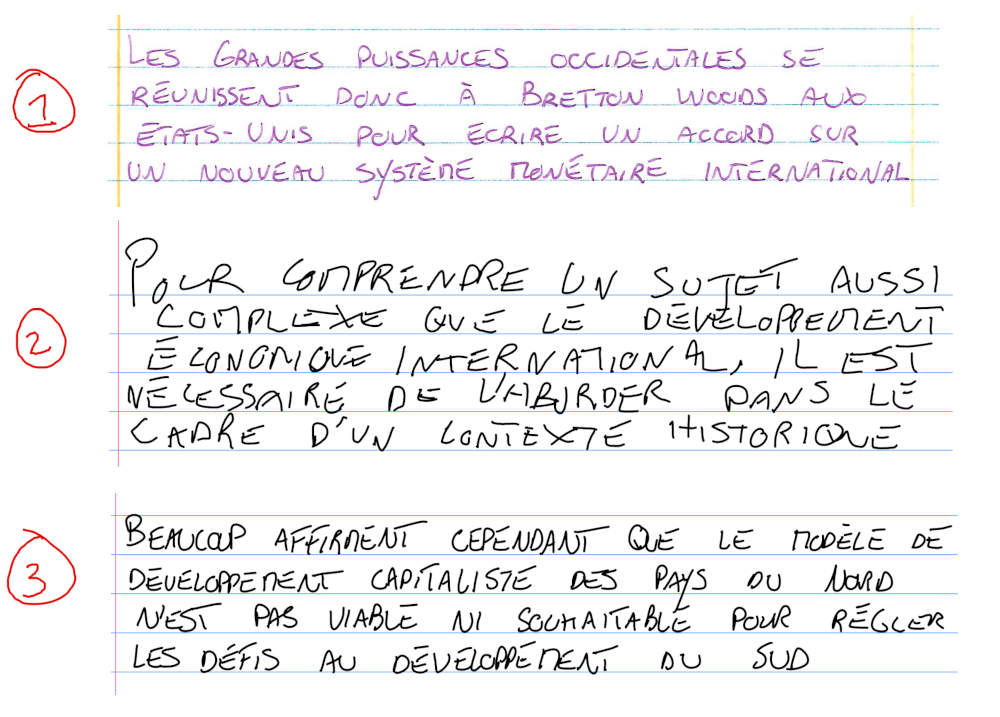
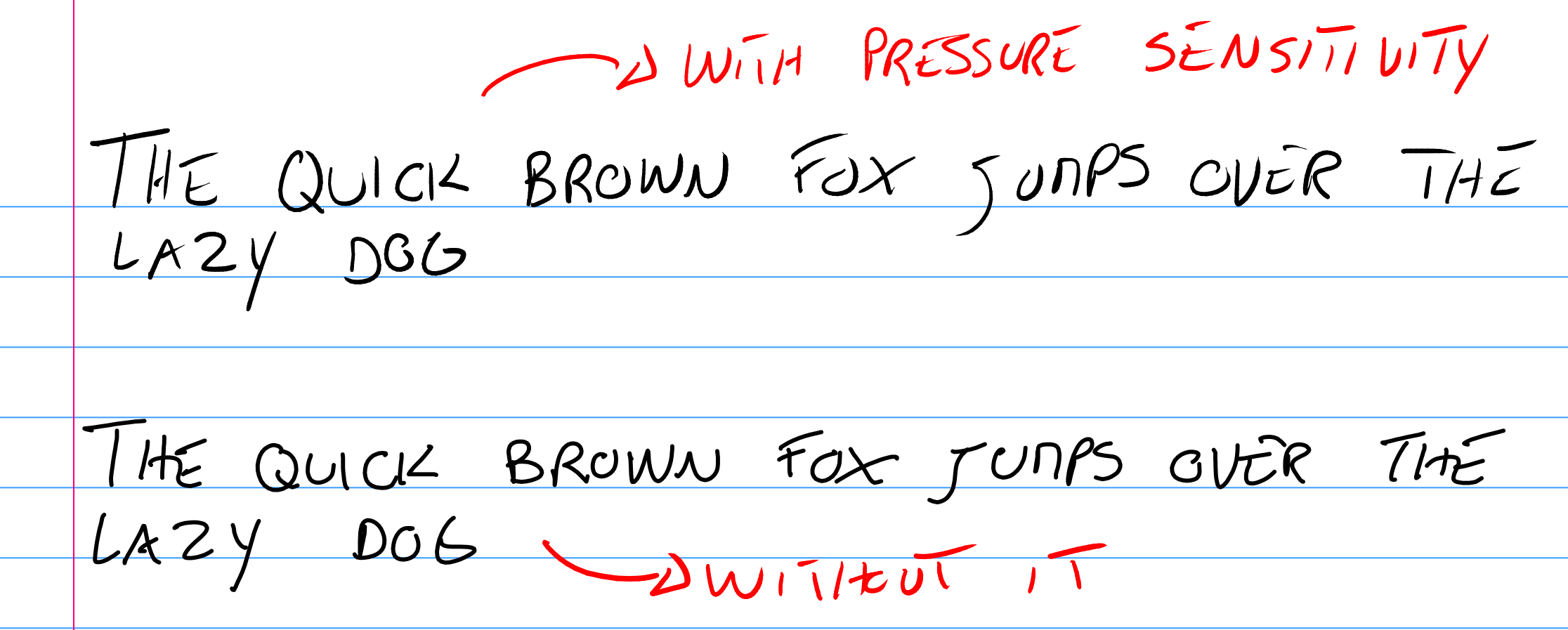
I've been teaching economics for a few semesters already and, slowly but surely, I'm starting to get the hang of it. Having to deal with teaching remotely hasn't been easy though and I'm really hoping the winter semester will be in-person again. Although I worked way too much last semester1, I somehow managed to transition to using a graphics tablet. I bought a Wacom Intuos S tablet (model CTL-4100) in late August 2021 and overall, I have been very happy with it. Wacom Canada offers a small discount for teachers and I ended up paying 115 CAD (~90 USD) for the tablet, an overall very reasonable price. Unsurprisingly, the Wacom support on Linux is very good and my tablet worked out of the box. The only real problem I had was by default, the tablet sometimes boots up in Android mode, making it unusable. This is easily solved by pressing down on the pad's first and last buttons for a few seconds, until the LED turns white. The included stylus came with hard plastic nibs, but I find them too slippery. I eventually purchased hard felt nibs, which increase the friction and makes for a more paper-like experience. They are a little less durable, but I wrote quite a fair bit and still haven't gone through a single one yet. Learning curve Learning how to use a graphical tablet took me at least a few weeks! When writing on a sheet of paper, the eyes see what the hand writes directly. This is not the case when using a graphical tablet: you are writing on a surface and see the result on your screen, a completely different surface. This dissociation takes a bit of practise to master, but after going through more than 300 pages of notes, it now feels perfectly normal. Here is a side-by-side comparison of my very average hand-writing2:
  1. on paper
  2. using the tablet, the first week
  3. using the tablet, after a couple of months
Comparison of my writing, on paper, using the tablet and using the tablet after a few weeks I still prefer the result of writing on paper, but I think this is mostly due to me not using the pressure sensitivity feature. The support in xournal wasn't great, but now that I've tried it in xournalpp (more on this below), I think I will be enabling it in the future. The result on paper is also more consistent, but I trust my skills will improve over time. Pressure sensitivity on vs off Use case The first use case I have for the tablet is grading papers. I've been asking my students to submit their papers via Moodle for a few semesters already, but until now, I was grading them using PDF comments. The experience wasn't great3 and was rather slow compared to grading physical copies. I'm also a somewhat old-school teacher: I refuse to teach using slides. Death by PowerPoint is real. I write on the blackboard a lot4 and I find it much easier to prepare my notes by hand than by typing them, as the end result is closer to what I actually end up writing down on the board. Writing notes by hand on sheets of paper is a chore too, especially when you revisit the same materiel regularly. Being able to handwrite digital notes gives me a lot more flexibility and it's been great. So far, I have been using xournal to write notes and grade papers, and although it is OK, it has a bunch of quirks I dislike. I was waiting for xournalpp to be packaged in Debian, and it now is5! I'm looking forward to using it next semester. Towards a better computer monitor I have also been feeling the age of my current computer monitor. I am currently using an old 32" 1080p TV from LG and up until now, I had been able to deal with the drawbacks. The colors are pretty bad and 1080p for such a large display isn't great, but I got used to it. What I really noticed when I started using my graphics tablet was the input lag. It's bad enough that there's a clear jello effect when writing and it eventually gives me a headache. It's so bad I usually prefer to work on my laptop, which has a nicer but noticeably smaller panel. I'm currently looking to replace this aging TV6 by something more modern. I have been waiting out since I would like to buy something that will last me another 10 years if possible. Sadly, 32" high refresh rate 4K monitors aren't exactly there yet and I haven't found anything matching my criteria. I would probably also need a new GPU, something that is not easy to come by these days.
  1. I worked at two colleges at the same time, teaching 2 different classes (one of which I was giving for the first time...) to 6 groups in total. I averaged more than 60h per week for sure.
  2. Yes, I only write in small caps. Students love it, as it's much easier to read on the blackboard.
  3. Although most PDF readers support displaying comments, some of my more clueless students still had trouble seeing them and I had to play tech support more than I wanted.
  4. Unsurprisingly, my students also love it. One of the most common feedback I get at the end of the semester is they hate slides too and are very happy I'm one of the few teachers who writes on the board.
  5. Many thanks to Barak A. Pearlmutter for maintaining this package.
  6. It dates back from 2010, when my mom replaced our old CRT by a flat screen. FullHD TVs were getting affordable and I wasn't sad to see our tiny 20-something inches TV go. I eventually ended up with the LG flatscreen a few years later when I moved out in my first apartment and my mom got something better.

9 January 2022

Russell Coker: Video Conferencing (LCA)

I ve just done a tech check for my LCA lecture. I had initially planned to do what I had done before and use my phone for recording audio and video and my PC for other stuff. The problem is that I wanted to get an external microphone going and plugging in a USB microphone turned off the speaker in the phone (it seemed to direct audio to a non-existent USB audio output). I tried using bluetooth headphones with the USB microphone and that didn t work. Eventually a viable option seemed to be using USB headphones on my PC with the phone for camera and microphone. Then it turned out that my phone (Huawei Mate 10 Pro) didn t support resolutions higher than VGA with Chrome (it didn t have the advanced settings menu to select resolution), this is probably an issue of Android build features. So the best option is to use a webcam on the PC, I was recommended a Logitech C922 but OfficeWorks only has a Logitech C920 which is apparently OK. The free connection test from freeconference.com [1] is good for testing out how your browser works for videoconferencing. It tests each feature separately and is easy to run. After buying the C920 webcam I found that it sometimes worked and sometimes caused a kernel panic like the following (partial panic log included for the benefit of people Googling this Logitech C920 problem):
[95457.805417] BUG: kernel NULL pointer dereference, address: 0000000000000000
[95457.805424] #PF: supervisor read access in kernel mode
[95457.805426] #PF: error_code(0x0000) - not-present page
[95457.805429] PGD 0 P4D 0 
[95457.805431] Oops: 0000 [#1] SMP PTI
[95457.805435] CPU: 2 PID: 75486 Comm: v4l2src0:src Not tainted 5.15.0-2-amd64 #1  Debian 5.15.5-2
[95457.805438] Hardware name: HP ProLiant ML110 Gen9/ProLiant ML110 Gen9, BIOS P99 02/17/2017
[95457.805440] RIP: 0010:usb_ifnum_to_if+0x3a/0x50 [usbcore]
...
[95457.805481] Call Trace:
[95457.805484]  
[95457.805485]  usb_hcd_alloc_bandwidth+0x23d/0x360 [usbcore]
[95457.805507]  usb_set_interface+0x127/0x350 [usbcore]
[95457.805525]  uvc_video_start_transfer+0x19c/0x4f0 [uvcvideo]
[95457.805532]  uvc_video_start_streaming+0x7b/0xd0 [uvcvideo]
[95457.805538]  uvc_start_streaming+0x2d/0xf0 [uvcvideo]
[95457.805543]  vb2_start_streaming+0x63/0x100 [videobuf2_common]
[95457.805550]  vb2_core_streamon+0x54/0xb0 [videobuf2_common]
[95457.805555]  uvc_queue_streamon+0x2a/0x40 [uvcvideo]
[95457.805560]  uvc_ioctl_streamon+0x3a/0x60 [uvcvideo]
[95457.805566]  __video_do_ioctl+0x39b/0x3d0 [videodev]
It turns out that Ubuntu Launchpad bug #1827452 has great information on this problem [2]. Apparently if the device decides it doesn t have enough power then it will reconnect and get a different USB bus device number and this often happens when the kernel is initialising it. There s a race condition in the kernel code in which the code to initialise the device won t realise that the device has been detached and will dereference a NULL pointer and then mess up other things in USB device management. The end result for me is that all USB devices become unusable in this situation, commands like lsusb hang, and a regular shutdown/reboot hangs because it can t kill the user session because something is blocked on USB. One of the comments on the Launchpad bug is that a powered USB hub can alleviate the problem while a USB extension cable (which I had been using) can exacerbate it. Officeworks currently advertises only one powered USB hub, it s described as USB 3 but also maximum speed 480 Mbps (USB 2 speed). So basically they are selling a USB 2 hub for 4* the price that USB 2 hubs used to sell for. When debugging this I used the cheese webcam utility program and ran it in a KVM virtual machine. The KVM parameters -device qemu-xhci -usb -device usb-host,hostbus=1,hostaddr=2 (where 1 and 2 are replaced by the Bus and Device numbers from lsusb ) allow the USB device to be passed through to the VM. Doing this meant that I didn t have to reboot my PC every time a webcam test failed. For audio I m using the Sades Wand gaming headset I wrote about previously [3].

8 January 2022

Jonathan Dowland: 2021 in Fiction

Cover for *This is How You Lose the Time War*
Cover for *Robot*
Cover for *The Glass Hotel*
Following on from last year's round-up of my reading, here's a look at the fiction I enjoyed in 2021. I managed to read 42 books in 2021, up from 31 last year. That's partly to do with buying an ereader: 33/36% of my reading (by pages/by books) was ebooks. I think this demonstrates that ebooks have mostly complemented paper books for me, rather than replacing them. My book of the year (although it was published in 2019) was This is How You Lose the Time War by Amal El-Mohtar and Max Gladstone: A short epistolary love story between warring time travellers and quite unlike anything else I've read for a long time. Other notables were The Glass Hotel by Emily St John Mandel and Robot by Adam Wi niewski-Snerg. The biggest disappointment for me was The Ministry for the Future by Kim Stanley Robinson (KSR), which I haven't even finished. I love KSRs writing: I've written about him many times on this blog, at least in 2002, 2006 and 2009, I think I've read every other novel he's published and most of his short stories. But this one was too much of something for me. He's described this novel a the end-point of a particular journey and approach to writing he's taken, which I felt relieved to learn, assuming he writes any more novels (and I really hope that he does) they will likely be in a different "mode". My "new author discovery" for 2021 was Chris Beckett: I tore through Two Tribes and America City before promptly buying all his other work. He fits roughly into the same bracket as Adam Roberts and Christopher Priest, two of my other favourite authors. 5 of the books I read (12%) were from my "backlog" of already-purchased physical books. I'd like to try and reduce my Backlog further so I hope to push this figure up next year. I made a small effort to read more diverse authors this year. 24% of the books I read (by book count and page count) were by women. 15% by page count were (loosely) BAME (19% by book count). Again I'd like to increase these numbers modestly in 2022. Unlike 2020, I didn't complete any short story collections in 2021! This is partly because there was only one issue of Interzone published in all of 2021, a double-issue which I haven't yet finished. This is probably a sad date point in terms of Interzone's continued existence, but it's not dead yet.

John Goerzen: Make the Internet Yours Again With an Instant Mesh Network

I m going to lead with the technical punch line, and then explain it: Yggdrasil Network is an opportunistic mesh that can be deployed privately or as part of a global-scale network. Each node gets a stable IPv6 address (or even an entire /64) that is derived from its public key and is bound to that node as long as the node wants it (of course, it can generate a new keypair anytime) and is valid wherever the node joins the mesh. All traffic is end-to-end encrypted. Yggdrasil will automatically discover peers on a LAN via broadcast beacons, and requires zero configuration to peer in such a way. It can also run as an overlay network atop the public Internet. Public peers serve as places to join the global network, and since it s a mesh, if one device on your LAN joins the global network, the others will automatically have visibility on it also, thanks to the mesh routing. It neatly solves a lot of problems of portability (my ssh sessions stay live as I move networks, for instance), VPN (incoming ports aren t required since local nodes can connect to a public peer via an outbound connection), security, and so forth. Now on to the explanation: The Tyranny of IP rigidity Every device on the Internet, at one time, had its own globally-unique IP address. This number was its identifier to the world; with an IP address, you can connect to any machine anywhere. Even now, when you connect to a computer to download a webpage or send a message, under the hood, your computer is talking to the other one by IP address. Only, now it s hard to get one. The Internet protocol we all grew up with, version 4 (IPv4), didn t have enough addresses for the explosive growth we ve seen. Internet providers and IT departments had to use a trick called NAT (Network Address Translation) to give you a sort of fake IP address, so they could put hundreds or thousands of devices behind a single public one. That, plus the mobility of devices changing IPs whenever they change locations has meant that a fundamental rule of the old Internet is now broken: Every participant is an equal peer. (Well, not any more.) Nowadays, you can t you host your own website from your phone. Or share files from your house. (Without, that is, the use of some third-party service that locks you down and acts as an intermediary.) Back in the 90s, I worked at a university, and I, like every other employee, had a PC on my desk with an unfirewalled public IP. I installed a webserver, and poof instant website. Nowadays, running a website from home is just about impossible. You may not have a public IP, and if you do, it likely changes from time to time. And even then, your ISP probably blocks you from running servers on it. In short, you have to buy your way into the resources to participate on the Internet. I wrote about these problems in more detail in my article Recovering Our Lost Free Will Online. Enter Yggdrasil I already gave away the punch line at the top. But what does all that mean?
  • Every device that participates gets an IP address that is fully live on the Yggdrasil network.
  • You can host a website, or a mail server, or whatever you like with your Yggdrasil IP.
  • Encryption and authentication are smaller (though not nonexistent) worries thanks to the built-in end-to-end encryption.
  • You can travel the globe, and your IP will follow you: onto a plane, from continent to continent, wherever. Yggdrasil will find you.
  • I ve set up /etc/hosts on my laptop to use the Yggdrasil IPs for other machines on my LAN. Now I can just ssh foo and it will work from home, from a coffee shop, from a 4G tether, wherever. Now, other tools like tinc can do this, obviously. And I could stop there; I could have a completely closed, private Yggdrasil network. Or, I can join the global Yggdrasil network. Each device, in addition to accepting peers it finds on the LAN, can also be configured to establish outbound peering connections or accept inbound ones over the Internet. Put a public peer or two in your configuration and you ve joined the global network. Most people will probably want to do that on every device (because why not?), but you could also do that from just one device on your LAN. Again, there s no need to explicitly build routes via it; your other machines on the LAN will discover the route s existence and use it. This is one of many projects that are working to democratize and decentralize the Internet. So far, it has been quite successful, growing to over 2000 nodes. It is the direct successor to the earlier cjdns/Hyperboria and BATMAN networks, and aims to be a proof of concept and a viable tool for global expansion. Finally, think about how much easier development is when you don t have to necessarily worry about TLS complexity in every single application. When you don t have to worry about port forwarding and firewall penetration. It s what the Internet should be.

    7 January 2022

    Ayoyimika Ajibade: Everyone Struggles

    Starting anything new always has in it an element of uncertainty, doubt, fears, and struggle to forge ahead, this has been my current situation as an outreachy intern working on the transition of nodejs16 and webpack5 which is about updating all packages that depend on nodejs14 and webpack4 to work well with the updated version of nodejs16 and webpack5 in the Debian operations system. Juicy right! As a software developer struggling to grasp both basic and advanced knowledge of a concept can seem daunting, much like learning anything new, you can be overwhelmed when you are surrounded and know there is a whole lot of other new concept, tools, process, languages you have to learn that are linked to what you are currently learning, as you are struggling to grasp the fundamental idea of what you are currently learning. imbued in any struggle to get a solution to the problem is where innovation and inventions lie in, and our learning becomes improved as we dive into fact-finding, getting your hypothesis after a series of tests and ultimately proffering a solution Some of my struggles as I intern with Debian has been lack of skill of the shell scripting language as that is one of the core languages to understand so as to navigate your way around maintaining packages for Debian, also funny enough having just an intermediate knowledge of the javascript programming language as arguably having a basic knowledge of javascript is necessary to building and testing javascript packages in Debian as I know only the basic of javascript since my core language is Python, that I struggle with. The good thing is that the more I keep at it the faster the chance of the struggles reducing Now to the fun part! having a community of developers who have been through the struggling phase is divine, as they make your learning experience much easier, my mentors and other community member have made learning to package modules for Debian much easier as all hands are on deck to always help out with our challenges. I remember it felt so wonderful when my first contribution got merged and I became more encouraged to update more packages. These helped me a lot in the contribution stage for Debian as I better familiar with how the system worked. I m super grateful to my mentors and co-intern as they are always there to assist me.

    How I Navigate my way through my struggles I guess the first thing about any challenge is to be aware of it and admit your limitations of particular knowledge, then you move on to creatively seek solutions by asking for help from those who know the way. Voila! Now comes the part where you have to take up their solutions, ideas, opinions and make it work for your particular case scenario that is a skill set that all Software developers must-have. Going through documentation has immensely helped solve my problems much faster and build new knowledge, as I get the fundamental idea of why and how things work. I also try to break each concept down into steps, achieve my goals for each step, then build all solutions in each step together, surfing the internet to find solutions also has a huge benefit.

    Vocabulary terms Used in Debian
    1. uscan => a tool to identify and download upstream source code from the repository, also compressing it into the required format.
    2. apt => a package manager to manage packages in Debian, similar to pip in python, npm in javascript.
    3. stretch/buster/bullseye/bookworm/sid => old old stable Debian9 - The codename for the release before the previous stable release (stretch). old stable Debian10 - The previous stable release (Buster). stable Debian11 - The current stable release (Bullseye). testing Debian12 - The next-generation stable release (Bookworm). unstable - The unstable development release (Sid) where new or updated packages are introduced. To understand more on debian release cycle
    4. reverse-rebuild => is building all modules that depend on a package in Debian while building the main package.
    5. lintian => A helper tool used to check for inconsistencies and errors in a Debian Package based on Debian standards.
    6. pkg-js-tools => A collection of tools to aid packaging Node modules in Debian.
    7. dpkg-buildpackage => A command to build upstream code in an unclean chroot or environment.
    8. quilt => A patch creation and management automation script. quilt helps manage a series of patches that a Debian package maintainer needs to be applied to upstream source when building the package.
    9. autopkgtest => a script used to test an installed binary package using the source package's tests
    10. RFS => (Request For Sponsorship) Working in the Debian ecosystem includes two roles either as a Debian Maintainer with restricted rights and privileges like uploading to the Debian archive or as a Debian Developer with all rights and privileges such as uploading to the Debian archive, as a new contributor or a Debian maintainer (with few rights and privileges) in Debian you can RFS so that your pull request (PR) can be merged to the Debian archive by a Debian Developer, much like your contribution has been accepted
    There are so many terms and tools you have to get accustomed to, but they are easy to understand and use, as enough and frequently updated wiki documentation are available to guide you through, plus a whole lot of community members you can ask questions from. strength and growth come only through continuous effort and struggle. Napoleon Hill

    6 January 2022

    Jacob Adams: Linux Hibernation Documentation

    Recently I ve been curious about how hibernation works on Linux, as it s an interesting interaction between hardware and software. There are some notes in the Arch wiki and the kernel documentation (as well as some kernel documentation on debugging hibernation and on sleep states more generally), and of course the ACPI Specification

    The Formal Definition ACPI (Advanced Configuration and Power Interface) is, according to the spec, an architecture-independent power management and configuration framework that forms a subsystem within the host OS which defines a hardware register set to define power states. ACPI defines four global system states G0, working/on, G1, sleeping, G2, soft off, and G3, mechanical off1. Within G1 there are 4 sleep states, numbered S1 through S4. There are also S0 and S5, which are equivalent to G0 and G2 respectively2.

    Sleep According to the spec, the ACPI S1-S4 states all do the same thing from the operating system s perspective, but each saves progressively more power, so the operating system is expected to pick the deepest of these states when entering sleep. However, most operating systems3 distinguish between S1-S3, which are typically referred to as sleep or suspend, and S4, which is typically referred to as hibernation.

    S1: CPU Stop and Cache Wipe The CPU caches are wiped and then the CPU is stopped, which the spec notes is equivalent to the WBINVD instruction followed by the STPCLK signal on x86. However, nothing is powered off.

    S2: Processor Power off The system stops the processor and most system clocks (except the real time clock), then powers off the processor. Upon waking, the processor will not continue what it was doing before, but instead use its reset vector4.

    S3: Suspend/Sleep (Suspend-to-RAM) Mostly equivalent to S2, but hardware ensures that only memory and whatever other hardware memory requires are powered.

    S4: Hibernate (Suspend-to-Disk) In this state, all hardware is completely powered off and an image of the system is written to disk, to be restored from upon reapplying power. Writing the system image to disk can be handled by the operating system if supported, or by the firmware.

    Linux Sleep States Linux has its own set of sleep states which mostly correspond with ACPI states.

    Suspend-to-Idle This is a software only sleep that puts all hardware into the lowest power state it can, suspends timekeeping, and freezes userspace processes. All userspace and some kernel threads5, except those tagged with PF_NOFREEZE, are frozen before the system enters a sleep state. Frozen tasks are sent to the __refrigerator(), where they set TASK_UNINTERRUPTIBLE and PF_FROZEN and infinitely loop until PF_FROZEN is unset6. This prevents these tasks from doing anything during the imaging process. Any userspace process running on a different CPU while the kernel is trying to create a memory image would cause havoc. This is also done because any filesystem changes made during this would be lost and could cause the filesystem and its related in-memory structures to become inconsistent. Also, creating a hibernation image requires about 50% of memory free, so no tasks should be allocating memory, which freezing also prevents.

    Standby This is equivalent to ACPI S1.

    Suspend-to-RAM This is equivalent to ACPI S3.

    Hibernation Hibernation is mostly equivalent to ACPI S4 but does not require S4, only requiring low-level code for resuming the system to be present for the underlying CPU architecture according to the Linux sleep state docs. To hibernate, everything is stopped and the kernel takes a snapshot of memory. Then, the system writes out the memory image to disk. Finally, the system either enters S4 or turns off completely. When the system restores power it boots a new kernel, which looks for a hibernation image and loads it into memory. It then overwrites itself with the hibernation image and jumps to a resume area of the original kernel7. The resumed kernel restores the system to its previous state and resumes all processes.

    Hybrid Suspend Hybrid suspend does not correspond to an official ACPI state, but instead is effectively a combination of S3 and S4. The system writes out a hibernation image, but then enters suspend-to-RAM. If the system wakes up from suspend it will discard the hibernation image, but if the system loses power it can safely restore from the hibernation image.
    1. The difference between soft and mechanical off is that mechanical off is entered and left by a mechanical means (for example, turning off the system s power through the movement of a large red switch)
    2. It s unclear to me why G and S states overlap like this. I assume this is a relic of an older spec that only had S states, but I have not as yet found any evidence of this. If someone has any information on this, please let me know and I ll update this footnote.
    3. Of the operating systems I know of that support ACPI sleep states (I checked Windows, Mac, Linux, and the three BSDs8), only MacOS does not allow the user to deliberately enable hibernation, instead supporting a hybrid suspend it calls safe sleep
    4. The reset vector of a processor is the default location where, upon a reset, the processor will go to find the first instruction to execute. In other words, the reset vector is a pointer or address where the processor should always begin its execution. This first instruction typically branches to the system initialization code. Xiaocong Fan, Real-Time Embedded Systems, 2015
    5. All kernel threads are tagged with PF_NOFREEZE by default, so they must specifically opt-in to task freezing.
    6. This is not from the docs, but from kernel/freezer.c which also notes Refrigerator is place where frozen processes are stored :-).
    7. This is the operation that requires special architecture-specific low-level code .
    8. Interestingly NetBSD has a setting to enable hibernation, but does not actually support hibernation

    3 January 2022

    Thorsten Alteholz: My Debian Activities in December 2021

    FTP master This month I accepted 412 and rejected 44 packages. The overall number of packages that got accepted was 423. Debian LTS This was my ninetieth month that I did some work for the Debian LTS initiative, started by Raphael Hertzog at Freexian. This month my all in all workload has been 40h. During that time I did LTS and normal security uploads of: I also started to work on libarchive Further I worked on packages in NEW on security-master. In order to faster process such packages, I added a notification when work arrived there. Last but not least I did some days of frontdesk duties. Debian ELTS This month was the forty-second ELTS month. During my allocated time I uploaded: Last but not least I did some days of frontdesk duties. Debian Astro Related to my previous article about fun with telescopes I uploaded new versions or did source uploads for: Besides the indi-stuff I also uploaded Other stuff I celebrated christmas :-).

    1 January 2022

    Chris Lamb: Favourite books of 2021: Classics

    In my three most recent posts, I went over the memoirs and biographies, the non-fiction and fiction I enjoyed in 2021. But in the last of my 2021 book-related posts, however, I'll be going over my favourite classics. Of course, the difference between regular fiction and a 'classic' is an ambiguous, arbitrary and often-meaningless distinction: after all, what does it matter if Hemingway's The Old Man and the Sea (from 1951) is a classic or not? The term also smuggles in some of the ethnocentric gatekeeping encapsulated in the term 'Western canon' too. Nevertheless, the label of 'classic' has some utility for me in that it splits up the vast amount of non-fiction I read in two... Books that just missed the cut here include: Oscar Wilde's The Picture of Dorian Gray (moody and hilarious, but I cannot bring myself to include it due to the egregious antisemitism); Tolstoy's The Kreutzer Sonata (so angry! so funny!); and finally Notes from Underground by Fyodor Dostoevsky. Of significant note, though, would be the ghostly The Turn of the Screw by Henry James.

    Heart of Darkness (1899) Joseph Conrad Heart of Darkness tells the story of Charles Marlow, a sailor who accepts an assignment from a Belgian trading company as a ferry-boat captain in the African interior, and the novella is widely regarded as a critique of European colonial rule in Africa. Loosely remade by Francis Ford Coppola as Apocalypse Now (1979), I started this book with the distinct possibility that this superb film adaptation would, for a rare treat, be 'better than the book'. However, Conrad demolished this idea of mine within two chapters, yet also elevated the film to a new level as well. This was chiefly due to how observant Conrad was of the universals that make up human nature. Some of his insight pertains to the barbarism of the colonialists, of course, but Conrad applies his shrewd acuity to the at the smaller level as well. Some of these quotes are justly famous: Ah! but it was something to have at least a choice of nightmares, for example, as well as the reference to a fastidiously turned-out colonial administrator who, with unimaginable horrors occurring mere yards from his tent, we learn he was devoted to his books, which were in applepie order . (It seems to me to be deliberately unclear whether his devotion arises from gross inhumanity, utter denial or some combination of the two.) Oh, and there's a favourite moment of mine when a character remarks that It was very fine for a time, but after a bit I did get tired of resting. Tired of resting! Yes, it's difficult to now say something original about a many-layered classic such as this, especially one that has analysed from so many angles already; from a literary perspective at first, of course, but much later from a critical postcolonial perspective, such as in Chinua Achebe's noted 1975 lecture, An Image of Africa. Indeed, the history of criticism in the twentieth century of Heart of Darkness must surely parallel the social and political developments in the Western world. (On a highly related note, the much-cited non-fiction book King Leopold's Ghost is on my reading list for 2022.) I will therefore limit myself to saying that the boat physically falling apart as it journeys deeper into the Congo may be intended to represent that our idea of 'Western civilisation' ceases to function, both morally as well as physically, in this remote environment. And, whilst I'm probably not the first to notice the potential ambiguity, when Marlow lies to Kurtz's 'Intended [wife]' in the closing section in order to save her from being exposed to the truth about Kurtz (surely a metaphor about the ignorance of the West whilst also possibly incorporating some comment on gender?), the Intended replies: I knew it. For me, though, it is not beyond doubt that what the Intended 'knows' is that she knew that Marlow would lie to her: in other words, that the alleged ignorance of everyday folk in the colonial homeland is studied and deliberate. Compact and fairly easy-to-read, it is clear that Heart of Darkness rewards even the most rudimentary analysis.

    Rebecca (1938) Daphne du Maurier Daphne du Maurier creates in Rebecca a credible and suffocating atmosphere in the shape of Manderley, a grand English mansion owned by aristocratic widower Maxim de Winter. Our unnamed narrator (a young woman seemingly na ve in the ways of the world) meets Max in Monte Carlo, and she soon becomes the second Mrs. de Winter. The tale takes a turn to the 'gothic', though, when it becomes apparent that the unemotional Max, as well as potentially Manderley itself, appears to be haunted by the memory of his late first wife, the titular Rebecca. Still, Rebecca is less of a story about supernatural ghosts than one about the things that can haunt our minds. For Max, this might be something around guilt; for our narrator, the class-centered fear that she will never fit in. Besides, Rebecca doesn't need an actual ghost when you have Manderley's overbearing housekeeper, Mrs Danvers, surely one of the creepiest characters in all of fiction. Either way, the conflict of a kind between the fears of the protagonists means that they never really connect with each other. The most obvious criticism of Rebecca is that the main character is unreasonably weak and cannot quite think or function on her own. (Isn't it curious that the trait of the male 'everyman' is a kind of physical clumsiness yet the female equivalent is shorthanded by being slightly slow?) But the na vete of Rebecca's narrator makes her easier to relate to in a way, and it also makes the reader far more capable of empathising with her embarrassment. This is demonstrated best whilst she, in one of the best evocations of this particular anxiety I have yet come across, is gingerly creeping around Manderlay and trying to avoid running into the butler. A surprise of sorts comes in the latter stages of the book, and this particular twist brings us into contact with a female character who is anything but 'credulous'. This revelation might even change your idea of who the main character of this book really is too. (Speaking of amateur literary criticism, I have many fan theories about Rebecca, including that Maxim de Winter's estate manager, Frank Crawley, is actually having an affair with Max, and also that Maxim may have a lot more involvement in Mrs Danvers final act that he lets on.) An easily accessible novel (with a great-but-not-perfect 1940 adaptation by Alfred Hitchcock, Rebecca is a real indulgence.

    A Clockwork Orange (1962) Anthony Burgess One of Stanley Kubrick's most prominent tricks was to use different visual languages in order to prevent the audience from immediately grasping the underlying story. In his 1975 Barry Lyndon, for instance, the intentionally sluggish pacing and elusive characters require significant digestion to fathom and appreciate, and the luminous and quasi-Renaissance splendour of the cinematography does its part to constantly distract the viewer from the film's greater meaning. This is very much the case in Kubrick's A Clockwork Orange as well whilst it ostensibly appears to be about a Saturnalia of violence, the 'greater meaning' of A Clockwork Orange pertains to the Christian conception of free will; admittedly, a much drier idea to bother making a film around. This is all made much clearer when reading Anthony Burgess' 1962 original novel. Alex became a 'true Christian' through the experimental rehabilitation process, and even offers to literally turn the other cheek at one point. But as Alex had no choice to do so (and can no longer choose to commit violence), he is incapable of making a free moral choice. Thus, is he really a Man? Yet whilst the book's central concern is our conception of free will in modern societies, it also appears to be a repudiation of two conservative principles. Firstly, A Clockwork Orange demolishes the idea that 'high art' leads to morally virtuous citizens. After all, if you can do a bit of the old ultra-violence whilst listening to the glorious 9th by old Ludvig van, then so much for the oft-repeated claims that culture makes you better as a person. (This, at least, I already knew from personal experience.) The other repudiation in A Clockwork Orange is in regard to the pervasive idea that the countryside is a refuge from crime and sin. By contrast, we see the gang commit their most horrific violence in rural areas, and, later, Alex is taken to the countryside by his former droogs for a savage beating. Although this doesn't seem to quite fit the novel, this was actually an important point for Burgess to include: otherwise his book could easily be read as a commentary on the corrupting influence of urban spaces, rather than of modernity itself. The language of this book cannot escape comment here. Alex narrates most of the book in a language called Nadsat, a fractured slang constructed by Burgess based on Russian and Cockney rhyming slang. (The language is strange for only a few pages, I promise. And note that 'Alex' is a very common Russian name.) Using Nadsat has the effect of making the book feel distinctly alien, but it also prevents it from prematurely aging too. Indeed, it comes as bit of a shock to realise that A Clockwork Orange was published 1962, the same year as The Beatles' released their first single, Love Me Do. I could probably say a whole lot more about this thoroughly engrossing book and its movie adaptation (eg. the meta-textual line in Kubrick's version: It's funny how the colours of the real world only seem really real when you watch them on a screen... appears verbatim in the textual original), but I'll leave it there. The book of A Clockwork Orange is not only worth the investment in the language, but is, again, somehow better than the film.

    The Great Gatsby (1925) F. Scott Fitzgerald I'm actually being a little deceitful by including this book here: I cannot really say that The Great Gatsby was a 'favourite' read of the year, but its literary merit is so undeniable (and my respect for Fitzgerald's achievement is deep enough) that the experience was one of those pleasures you feel at seeing anything done well. Here you have a book so rich in symbolic meaning that you could easily confuse the experience with drinking Coke syrup undiluted. And a text that has made the difficulty and complexity of reading character a prominent theme of the novel, as well as a technical concern of the book itself. Yet at all times you have in your mind that The Great Gatsby is first and foremost a book about a man writing a book, and, therefore, about the construction of stories and myths. What is the myth being constructed in Gatsby? The usual answer today is that the book is really about the moral virtues of America. Or, rather, the lack thereof. Indeed, as James Boice wrote in 2016:
    Could Wilson have killed Gatsby any other way? Could he have ran him over, or poisoned him, or attacked him with a knife? Not at all this an American story, the quintessential one, so Gatsby could have only died the quintessential American death.
    The quintessential American death is, of course, being killed with a gun. Whatever your own analysis, The Great Gatsby is not only magnificently written, but it is captivating to the point where references intrude many months later. For instance, when reading something about Disney's 'princess culture', I was reminded of when Daisy says of her daughter: I hope she'll be a fool that's the best thing of a girl can be in this world, a beautiful little fool . Or the billboard with the eyes of 'Doctor T. J. Eckleburg'. Or the fact that the books in Gatsby's library have never been read (so what is 'Owl Eyes' doing there during the party?!). And the only plain room in Gatsby's great house is his bedroom... Okay, fine, I must have been deluding myself: I love this novel.

    31 December 2021

    Chris Lamb: Favourite books of 2021: Fiction

    In my two most recent posts, I listed the memoirs and biographies and followed this up with the non-fiction I enjoyed the most in 2021. I'll leave my roundup of 'classic' fiction until tomorrow, but today I'll be going over my favourite fiction. Books that just miss the cut here include Kingsley Amis' comic Lucky Jim, Cormac McCarthy's The Road (although see below for McCarthy's Blood Meridian) and the Complete Adventures of Tintin by Herg , the latter forming an inadvertently incisive portrait of the first half of the 20th century. Like ever, there were a handful of books that didn't live up to prior expectations. Despite all of the hype, Emily St. John Mandel's post-pandemic dystopia Station Eleven didn't match her superb The Glass Hotel (one of my favourite books of 2020). The same could be said of John le Carr 's The Spy Who Came in from the Cold, which felt significantly shallower compared to Tinker, Tailor, Soldier, Spy again, a favourite of last year. The strangest book (and most difficult to classify at all) was undoubtedly Patrick S skind's Perfume: The Story of a Murderer, and the non-fiction book I disliked the most was almost-certainly Beartown by Fredrik Bachman. Two other mild disappointments were actually film adaptions. Specifically, the original source for Vertigo by Pierre Boileau and Thomas Narcejac didn't match Alfred Hitchock's 1958 masterpiece, as did James Sallis' Drive which was made into a superb 2011 neon-noir directed by Nicolas Winding Refn. These two films thus defy the usual trend and are 'better than the book', but that's a post for another day.

    A Wizard of Earthsea (1971) Ursula K. Le Guin How did it come to be that Harry Potter is the publishing sensation of the century, yet Ursula K. Le Guin's Earthsea is only a popular cult novel? Indeed, the comparisons and unintentional intertextuality with Harry Potter are entirely unavoidable when reading this book, and, in almost every respect, Ursula K. Le Guin's universe comes out the victor. In particular, the wizarding world that Le Guin portrays feels a lot more generous and humble than the class-ridden world of Hogwarts School of Witchcraft and Wizardry. Just to take one example from many, in Earthsea, magic turns out to be nurtured in a bottom-up manner within small village communities, in almost complete contrast to J. K. Rowling's concept of benevolent government departments and NGOs-like institutions, which now seems a far too New Labour for me. Indeed, imagine an entire world imbued with the kindly benevolence of Dumbledore, and you've got some of the moral palette of Earthsea. The gently moralising tone that runs through A Wizard of Earthsea may put some people off:
    Vetch had been three years at the School and soon would be made Sorcerer; he thought no more of performing the lesser arts of magic than a bird thinks of flying. Yet a greater, unlearned skill he possessed, which was the art of kindness.
    Still, these parables aimed directly at the reader are fairly rare, and, for me, remain on the right side of being mawkish or hectoring. I'm thus looking forward to reading the next two books in the series soon.

    Blood Meridian (1985) Cormac McCarthy Blood Meridian follows a band of American bounty hunters who are roaming the Mexican-American borderlands in the late 1840s. Far from being remotely swashbuckling, though, the group are collecting scalps for money and killing anyone who crosses their path. It is the most unsparing treatment of American genocide and moral depravity I have ever come across, an anti-Western that flouts every convention of the genre. Blood Meridian thus has a family resemblance to that other great anti-Western, Once Upon a Time in the West: after making a number of gun-toting films that venerate the American West (ie. his Dollars Trilogy), Sergio Leone turned his cynical eye to the western. Yet my previous paragraph actually euphemises just how violent Blood Meridian is. Indeed, I would need to be a much better writer (indeed, perhaps McCarthy himself) to adequately 0utline the tone of this book. In a certain sense, it's less than you read this book in a conventional sense, but rather that you are forced to witness successive chapters of grotesque violence... all occurring for no obvious reason. It is often said that books 'subvert' a genre and, indeed, I implied as such above. But the term subvert implies a kind of Puck-like mischievousness, or brings to mind court jesters licensed to poke fun at the courtiers. By contrast, however, Blood Meridian isn't funny in the slightest. There isn't animal cruelty per se, but rather wanton negligence of another kind entirely. In fact, recalling a particular passage involving an injured horse makes me feel physically ill. McCarthy's prose is at once both baroque in its language and thrifty in its presentation. As Philip Connors wrote back in 2007, McCarthy has spent forty years writing as if he were trying to expand the Old Testament, and learning that McCarthy grew up around the Church therefore came as no real surprise. As an example of his textual frugality, I often looked for greater precision in the text, finding myself asking whether who a particular 'he' is, or to which side of a fight some two men belonged to. Yet we must always remember that there is no precision to found in a gunfight, so this infidelity is turned into a virtue. It's not that these are fair fights anyway, or even 'murder': Blood Meridian is just slaughter; pure butchery. Murder is a gross understatement for what this book is, and at many points we are grateful that McCarthy spares us precision. At others, however, we can be thankful for his exactitude. There is no ambiguity regarding the morality of the puppy-drowning Judge, for example: a Colonel Kurtz who has been given free license over the entire American south. There is, thank God, no danger of Hollywood mythologising him into a badass hero. Indeed, we must all be thankful that it is impossible to film this ultra-violent book... Indeed, the broader idea of 'adapting' anything to this world is, beyond sick. An absolutely brutal read; I cannot recommend it highly enough.

    Bodies of Light (2014) Sarah Moss Bodies of Light is a 2014 book by Glasgow-born Sarah Moss on the stirrings of women's suffrage within an arty clique in nineteenth-century England. Set in the intellectually smoggy cities of Manchester and London, this poignant book follows the studiously intelligent Alethia 'Ally' Moberly who is struggling to gain the acceptance of herself, her mother and the General Medical Council. You can read my full review from July.

    House of Leaves (2000) Mark Z. Danielewski House of Leaves is a remarkably difficult book to explain. Although the plot refers to a fictional documentary about a family whose house is somehow larger on the inside than the outside, this quotidian horror premise doesn't explain the complex meta-commentary that Danielewski adds on top. For instance, the book contains a large number of pseudo-academic footnotes (many of which contain footnotes themselves), with references to scholarly papers, books, films and other articles. Most of these references are obviously fictional, but it's the kind of book where the joke is that some of them are not. The format, structure and typography of the book is highly unconventional too, with extremely unusual page layouts and styles. It's the sort of book and idea that should be a tired gimmick but somehow isn't. This is particularly so when you realise it seems specifically designed to create a fandom around it and to manufacturer its own 'cult' status, something that should be extremely tedious. But not only does this not happen, House of Leaves seems to have survived through two exhausting decades of found footage: The Blair Witch Project and Paranormal Activity are, to an admittedly lesser degree, doing much of the same thing as House of Leaves. House of Leaves might have its origins in Nabokov's Pale Fire or even Derrida's Glas, but it seems to have more in common with the claustrophobic horror of Cube (1997). And like all of these works, House of Leaves book has an extremely strange effect on the reader or viewer, something quite unlike reading a conventional book. It wasn't so much what I got out of the book itself, but how it added a glow to everything else I read, watched or saw at the time. An experience.

    Milkman (2018) Anna Burns This quietly dazzling novel from Irish author Anna Burns is full of intellectual whimsy and oddball incident. Incongruously set in 1970s Belfast during The Irish Troubles, Milkman's 18-year-old narrator (known only as middle sister ), is the kind of dreamer who walks down the street with a Victorian-era novel in her hand. It's usually an error for a book that specifically mention other books, if only because inviting comparisons to great novels is grossly ill-advised. But it is a credit to Burns' writing that the references here actually add to the text and don't feel like they are a kind of literary paint by numbers. Our humble narrator has a boyfriend of sorts, but the figure who looms the largest in her life is a creepy milkman an older, married man who's deeply integrated in the paramilitary tribalism. And when gossip about the narrator and the milkman surfaces, the milkman beings to invade her life to a suffocating degree. Yet this milkman is not even a milkman at all. Indeed, it's precisely this kind of oblique irony that runs through this daring but darkly compelling book.

    The First Fifteen Lives of Harry August (2014) Claire North Harry August is born, lives a relatively unremarkable life and finally dies a relatively unremarkable death. Not worth writing a novel about, I suppose. But then Harry finds himself born again in the very same circumstances, and as he grows from infancy into childhood again, he starts to remember his previous lives. This loop naturally drives Harry insane at first, but after finding that suicide doesn't stop the quasi-reincarnation, he becomes somewhat acclimatised to his fate. He prospers much better at school the next time around and is ultimately able to make better decisions about his life, especially when he just happens to know how to stay out of trouble during the Second World War. Yet what caught my attention in this 'soft' sci-fi book was not necessarily the book's core idea but rather the way its connotations were so intelligently thought through. Just like in a musical theme and varations, the success of any concept-driven book is far more a product of how the implications of the key idea are played out than how clever the central idea was to begin with. Otherwise, you just have another neat Borges short story: satisfying, to be sure, but in a narrower way. From her relatively simple premise, for example, North has divined that if there was a community of people who could remember their past lives, this would actually allow messages and knowledge to be passed backwards and forwards in time. Ah, of course! Indeed, this very mechanism drives the plot: news comes back from the future that the progress of history is being interfered with, and, because of this, the end of the world is slowly coming. Through the lives that follow, Harry sets out to find out who is passing on technology before its time, and work out how to stop them. With its gently-moralising romp through the salient historical touchpoints of the twentieth century, I sometimes got a whiff of Forrest Gump. But it must be stressed that this book is far less certain of its 'right-on' liberal credentials than Robert Zemeckis' badly-aged film. And whilst we're on the topic of other media, if you liked the underlying conceit behind Stuart Turton's The Seven Deaths of Evelyn Hardcastle yet didn't enjoy the 'variations' of that particular tale, then I'd definitely give The First Fifteen Lives a try. At the very least, 15 is bigger than 7. More seriously, though, The First Fifteen Lives appears to reflect anxieties about technology, particularly around modern technological accelerationism. At no point does it seriously suggest that if we could somehow possess the technology from a decade in the future then our lives would be improved in any meaningful way. Indeed, precisely the opposite is invariably implied. To me, at least, homo sapiens often seems to be merely marking time until we can blow each other up and destroying the climate whilst sleepwalking into some crisis that might precipitate a thermonuclear genocide sometimes seems to be built into our DNA. In an era of cli-fi fiction and our non-fiction newspaper headlines, to label North's insight as 'prescience' might perhaps be overstating it, but perhaps that is the point: this destructive and negative streak is universal to all periods of our violent, insecure species.

    The Goldfinch (2013) Donna Tartt After Breaking Bad, the second biggest runaway success of 2014 was probably Donna Tartt's doorstop of a novel, The Goldfinch. Yet upon its release and popular reception, it got a significant number of bad reviews in the literary press with, of course, an equal number of predictable think pieces claiming this was sour grapes on the part of the cognoscenti. Ah, to be in 2014 again, when our arguments were so much more trivial. For the uninitiated, The Goldfinch is a sprawling bildungsroman that centres on Theo Decker, a 13-year-old whose world is turned upside down when a terrorist bomb goes off whilst visiting the Metropolitan Museum of Art, killing his mother among other bystanders. Perhaps more importantly, he makes off with a painting in order to fulfil a promise to a dying old man: Carel Fabritius' 1654 masterpiece The Goldfinch. For the next 14 years (and almost 800 pages), the painting becomes the only connection to his lost mother as he's flung, almost entirely rudderless, around the Western world, encountering an array of eccentric characters. Whatever the critics claimed, Tartt's near-perfect evocation of scenes, from the everyday to the unimaginable, is difficult to summarise. I wouldn't label it 'cinematic' due to her evocation of the interiority of the characters. Take, for example: Even the suggestion that my father had close friends conveyed a misunderstanding of his personality that I didn't know how to respond it's precisely this kind of relatable inner subjectivity that cannot be easily conveyed by film, likely is one of the main reasons why the 2019 film adaptation was such a damp squib. Tartt's writing is definitely not 'impressionistic' either: there are many near-perfect evocations of scenes, even ones we hope we cannot recognise from real life. In particular, some of the drug-taking scenes feel so credibly authentic that I sometimes worried about the author herself. Almost eight months on from first reading this novel, what I remember most was what a joy this was to read. I do worry that it won't stand up to a more critical re-reading (the character named Xandra even sounds like the pharmaceuticals she is taking), but I think I'll always treasure the first days I spent with this often-beautiful novel.

    Beyond Black (2005) Hilary Mantel Published about five years before the hyperfamous Wolf Hall (2004), Hilary Mantel's Beyond Black is a deeply disturbing book about spiritualism and the nature of Hell, somewhat incongruously set in modern-day England. Alison Harte is a middle-aged physic medium who works in the various towns of the London orbital motorway. She is accompanied by her stuffy assistant, Colette, and her spirit guide, Morris, who is invisible to everyone but Alison. However, this is no gentle and musk-smelling world of the clairvoyant and mystic, for Alison is plagued by spirits from her past who infiltrate her physical world, becoming stronger and nastier every day. Alison's smiling and rotund persona thus conceals a truly desperate woman: she knows beyond doubt the terrors of the next life, yet must studiously conceal them from her credulous clients. Beyond Black would be worth reading for its dark atmosphere alone, but it offers much more than a chilling and creepy tale. Indeed, it is extraordinarily observant as well as unsettlingly funny about a particular tranche of British middle-class life. Still, the book's unnerving nature that sticks in the mind, and reading it noticeably changed my mood for days afterwards, and not necessarily for the best.

    The Wall (2019) John Lanchester The Wall tells the story of a young man called Kavanagh, one of the thousands of Defenders standing guard around a solid fortress that envelopes the British Isles. A national service of sorts, it is Kavanagh's job to stop the so-called Others getting in. Lanchester is frank about what his wall provides to those who stand guard: the Defenders of the Wall are conscripted for two years on the Wall, with no exceptions, giving everyone in society a life plan and a story. But whilst The Wall is ostensibly about a physical wall, it works even better as a story about the walls in our mind. In fact, the book blends together of some of the most important issues of our time: climate change, increasing isolation, Brexit and other widening societal divisions. If you liked P. D. James' The Children of Men you'll undoubtedly recognise much of the same intellectual atmosphere, although the sterility of John Lanchester's dystopia is definitely figurative and textual rather than literal. Despite the final chapters perhaps not living up to the world-building of the opening, The Wall features a taut and engrossing narrative, and it undoubtedly warrants even the most cursory glance at its symbolism. I've yet to read something by Lanchester I haven't enjoyed (even his short essay on cheating in sports, for example) and will be definitely reading more from him in 2022.

    The Only Story (2018) Julian Barnes The Only Story is the story of Paul, a 19-year-old boy who falls in love with 42-year-old Susan, a married woman with two daughters who are about Paul's age. The book begins with how Paul meets Susan in happy (albeit complicated) circumstances, but as the story unfolds, the novel becomes significantly more tragic and moving. Whilst the story begins from the first-person perspective, midway through the book it shifts into the second person, and, later, into the third as well. Both of these narrative changes suggested to me an attempt on the part of Paul the narrator (if not Barnes himself), to distance himself emotionally from the events taking place. This effect is a lot more subtle than it sounds, however: far more prominent and devastating is the underlying and deeply moving story about the relationship ends up. Throughout this touching book, Barnes uses his mastery of language and observation to avoid the saccharine and the maudlin, and ends up with a heart-wrenching and emotive narrative. Without a doubt, this is the saddest book I read this year.

    Russell Coker: Links December 2021

    Wired magazine has many short documentary films on YouTube, this one about How Photography is Affecting Our Brains is particularly good [1]. Matt Blaze wrote an informative blog post about Faraday cages for phones [2]. It seems that the commercial shielded bags are all pretty good while doing it yourself with aluminium foil may get similar results or may get much worse results with no obvious difference in the quality of the wrapping. Aluminium foil doesn t protect that well and doesn t protect consistently. A metal biscuit tin performed quite well and consistently, so that s a cheap option for reducing signals. Umair Haque wrote an insightful article about the single word that describes most of the problems the world faces right now [3]. Forbes has an informative article about the early days of the Ford company when they doubled wages, it proves that they didn t do so to enable workders to afford cars but to avoid staff turnover (which is expensive) [4]. Also the Ford company had a fascistic approach to employees, controlling what they were allowed to do in their spare time if they wanted the bonus payment. The wages weren t doubled, there was a bonus payment that would double the salary if the employee was eligible for the bonus. One thing that Forbes gets wrong is that they claim that it was only having higher pay than other companies that provided a benefit and that a higher minimum wage wouldn t, the problem with that idea is that a higher minimum wage would discourage people from having multiple jobs and allow more families to not have the mother working (a condition for a man to get the Ford bonus was for his wife to not work). The WSJ has an interesting article about Intel s datacenter for running all the different configurations of CPUs that they have supported over the last 10 years for security tests [5]. My Thinkpad (which is less than 10yo) is vulnerable to one of the SPECTRE family of exploits as Intel hasn t released microcode to fix it, getting fixed microcode out for all the systems from major vendors like Lenovo would be a good idea if they want to improve their security. NPR has an interesting article about the correlation between support for Trump in counties of the US with lack of vaccination and Covid19 deaths [6]. No surprises, but it s good to see the graphs. Cory Doctorow wrote an interesting article on the lack of slack in the current American education system [7]. It s not that bad in Australia but we are unfortunately moving in the American direction. Teen Vogue has an insightful article about the problems with the focus on resilience [8], while resilience is good we should make it a higher priority to avoid putting people in situations where they need to be resiliant than on encouraging resilience.

    29 December 2021

    Thorsten Alteholz: Fun with Telescopes

    Recently I purchased a small telescope to look at solar spots. When choosing a mount, I checked whether it can be controlled with OSS. In this context INDI is mentioned everywhere and my desired mount was supported. indi and kstars are already part of Debian, so apt install , selecting my mount, . oh, wait, the menu shows it, but I can not select it. Ok, that was the time when I learned about the difference of indi and indi-3rdparty. The indi package just contains a few drivers and others are available from a different repository. This split has been done either due to different release cycles of the driver, a different OSS license of it, or just due to binary blobs without source being part of some drivers. Fine, there are already packages of the 3rdparty-repository available from an Ubuntu PPA, so it should be no problem to add them do Debian as well. Some manufacturers freely distribute at least the specification of their API so that others are able to write the corresponding software. Some manufacturers even write their own driver. Examples are: A minor part actually does not have binary blobs but distributes the sources of their software. Unfortunately they have licenses that are not compatible with DFSG and those packages still need to go to non-free. Examples are: But there also seem to exist lots of manufacturers of astronomically accessories, especially cameras, that just distribute some binary blobs to talk to their hardware. This is sad, but at the moment it is just the way it is and such package need to go to non-free. Luckily their blobs are accompanied with corresponding licenses. At least those manufacturers understand how software licenses work and packaging their SDK is just straight forward. Examples are: However, when looking at the license information of some Ubuntu packages, several of them were distributed under a CC license. This is not a common license for software, so I wanted to get a confirmation whether these information are correct. Unfortunately most of such manufacturers don t want to disclose their licenses. For whatever reason they distribute their tarballs without any hint and emails to their support channels are just ignored. Examples of such bad behaviour are: However the best answer comes from the Levenhuk support. My question about the license of their SDK was answered by:
    I am afraid we cannot disclose any further information except the software file that is available on our website.
    So strictly speaking nobody is allowed to use their software. I wonder whether such competence also becomes visible in their products. I will never really know as there are more than enough OSS friendly manufacturers available. Anyway, most of the indi-3rdparty drivers are now available and I got lots of suggestions about hardware I need to buy in the future :-).

    28 December 2021

    Russ Allbery: Review: Out of Office

    Review: Out of Office, by Charlie Warzel & Anne Helen Petersen
    Publisher: Alfred A. Knopf
    Copyright: 2021
    ISBN: 0-593-32010-7
    Format: Kindle
    Pages: 260
    Out of Office opens with the provocative assertion that you were not working from home during the pandemic, even if you were among the 42% of Americans who were able to work remotely.
    You were, quite literally, doing your job from home. But you weren't working from home. You were laboring in confinement and under duress. Others have described it as living at work. You were frantically tapping out an email while trying to make lunch and supervise distance learning. You were stuck alone in a cramped apartment for weeks, unable to see friends or family, exhausted, and managing a level of stress you didn't know was possible. Work became life, and life became work. You weren't thriving. You were surviving.
    The stated goal of this book is to reclaim the concept of working from home, not only from the pandemic, but also from the boundary-destroying metastasis of work into non-work life. It does work towards that goal, but the description of what would be required for working from home to live up to its promise becomes a sweeping critique of the organization and conception of work, leaving it nearly as applicable to those who continue working from an office. Turns out that the main problem with working from home is the work part, not the "from home" part. This was a fascinating book to read in conjunction with A World Without Email. Warzel and Petersen do the the structural and political analysis that I sometimes wish Newport would do more of, but as a result offer less concrete advice. Both, however, have similar diagnoses of the core problems of the sort of modern office work that could be done from home: it's poorly organized, poorly managed, and desperately inefficient. Rather than attempting to fix those problems, which is difficult, structural, and requires thought and institutional cooperation, we're compensating by working more. This both doesn't work and isn't sustainable. Newport has a background in productivity books and a love of systems and protocols, so his focus in A World Without Email is on building better systems of communication and organization of work. Warzel and Petersen come from a background of reporting and cultural critique, so they put more focus on power imbalances and power-serving myths about the American dream. Where Newport sees an easy-to-deploy ad hoc work style that isn't fit for purpose, Warzel and Petersen are more willing to point out intentional exploitation of workers in the guise of flexibility. But they arrive at some similar conclusions. The way office work is organized is not leading to more productivity. Tools like Slack encourage the public performance of apparent productivity at the cost of the attention and focus required to do meaningful work. And the process is making us miserable. Out of Office is, in part, a discussion of what would be required to do better work with less stress, but it also shares a goal with Newport and some (but not most) corners of productivity writing: spend less time and energy on work. The goal of Out of Office is not to get more work done. It's to work more efficiently and sustainably and thus work less. To reclaim the promise of flexibility so that it benefits the employee and not the employer. To recognize, in the authors' words, that the office can be a bully, locking people in to commute schedules and unnatural work patterns, although it also provides valuable moments of spontaneous human connection. Out of Office tries to envision a style of work that includes the office sometimes, home sometimes, time during the day to attend to personal chores or simply to take a mental break from an unnatural eight hours (or more) of continuous focus, universal design, real worker-centric flexibility, and an end to the constant productivity ratchet where faster work simply means more work for the same pay. That's a lot of topics for a short book, and structurally this is a grab bag. Some sections will land and some won't. Loom's video messages sound like a nightmare to me, and I rolled my eyes heavily at the VR boosterism, reluctant as it may be. The section on DEI (diversity, equity, and inclusion) was a valiant effort that at least gestures towards the dismal track record of most such efforts, but still left me unconvinced that anyone knows how to improve diversity in an existing organization without far more brute-force approaches than anyone with power is usually willing to consider. But there's enough here, and the authors move through topics quickly enough, that a section that isn't working for you will soon be over. And some of the sections that do work are great. For example, the whole discussion of management.
    Many of these companies view middle management as bloat, waste, what David Graeber would call a "bullshit job." But that's because bad management is a waste; you're paying someone more money to essentially annoy everyone around them. And the more people experience that sort of bad management, and think of it as "just the way it is," the less they're going to value management in general.
    I admit to a lot of confirmation bias here, since I've been ranting about this for years, but management must be the most wide-spread professional job for which we ignore both training and capability and assume that anyone who can do any type of useful work can also manage people doing that work. It's simply not true, it creates workplaces full of horrible management, and that in turn creates a deep and unhelpful cynicism about all management. There is still a tendency on the left to frame this problem in terms of class struggle, on the reasonable grounds that for decades under "scientific management" of manufacturing that's what it was. Managers were there to overwork workers and extract more profits for the owners, and labor unions were there to fight back against managers. But while some of this does happen in the sort of office work this book is focused on, I think Warzel and Petersen correctly point to a different cause.
    "The reason she was underpaid on the team was not because her boss was cackling in the corner. It was because nobody told the boss it was their responsibility to look at the fucking spreadsheet."
    We don't train managers, we have no clear expectations for what managers should do, we don't meaningfully measure their performance, we accept a high-overhead and high-chaos workstyle based on ad hoc one-to-one communication that de-emphasizes management, and many managers have never seen good management and therefore have no idea what they're supposed to be doing. The management problem for many office workers is less malicious management than incompetent management, or simply no effective management at all apart from an occasional reorg and a complicated and mind-numbing annual review form. The last section of this book (apart from concluding letters to bosses and workers) is on community, and more specifically on extracting time and energy from work (via the roadmap in previous chapters) and instead investing it in the people around you. Much ink has been spilled about the collapse of American civic life, about how we went from a nation of joiners to a nation of isolated individual workers with weak and failing community institutions. Warzel and Petersen correctly lay some blame for this at the foot of work, and see the reorganization of work and an increase in work from home (and thus a decrease in commutes) as an opportunity to reverse that trend. David Brooks recently filled in for Ezra Klein on his podcast and talked with University of Chicago professor Leon Kass, which I listened to shortly after reading this book. In one segment, they talked about marriage and complained about the decline in marriage rates. They were looking for causes in people's moral upbringing, in their life priorities, in the lack of aspiration for permanence in kids these days, and in any other personal or moral failing that would allow them to be smugly judgmental. It was a truly remarkable thing to witness. Neither man at any point in the conversation mentioned either money or time. Back in the world most Americans live in, real wages have been stagnant for decades, student loan debt is skyrocketing as people desperately try to keep up with the ever-shifting requirements for a halfway-decent job, and work has expanded to fill all hours of the day, even for people who don't have to work multiple jobs to make ends meet. Employers have fully embraced a "flexible" workforce via layoffs, micro-optimizing work scheduling, eliminating benefits, relying on contract and gig labor, and embracing exceptional levels of employee turnover. The American worker has far less of money, time, and stability, three important foundations for marriage and family as well as participation in most other civic institutions. People like Brooks and Kass stubbornly cling to their feelings of moral superiority instead of seeing a resource crisis. Work has stolen the resources that people previously put into those other areas of their life. And it's not even using those resources effectively. That's, in a way, a restatement of the topic of this book. Our current way of organizing work is not sustainable, healthy, or wise. Working from home may be part of a strategy for changing it. The pandemic has already heavily disrupted work, and some of those changes, including increased working from home, seem likely to stick. That provides a narrow opportunity to renegotiate our arrangement with work and try to make those changes stick. I largely agree with the analysis, but I'm pessimistic. I think the authors are as well. We're very bad at social change, and there will be immense pressure for everything to go "back to normal." Those in the best bargaining position to renegotiate work for themselves are not in the habit of sharing that renegotiation with anyone else. But I'm somewhat heartened by how much public discussion there currently is about a more fundamental renegotiation of the rules of office work. I'm also reminded of a deceptively profound aphorism from economist Herbert Stein: "If something cannot go on forever, it will stop." This book is a bit uneven and is more of a collection of related thoughts than a cohesive argument, but if you are hungry for more worker-centric analyses of the dynamics of office work (inside or outside the office), I think it's worth reading. Rating: 7 out of 10

    26 December 2021

    Russ Allbery: DocKnot 6.00

    DocKnot is my static site generator and software release management toolkit. It's what generates all of what you're reading. DocKnot has always supported pointing to external files from inside its input tree and converting those files to HTML. This is how I include HTML conversions of POD documentation, CVS logs, text files, and other things in my web pages. This release starts the migration from an ad hoc text format for these pointers to YAML, which will permit a much richer configuration and a consistent format and extension for those external pointers. As the first supported format, DocKnot now supports Markdown conversion (using pandoc). POD conversion is also now supported via both the new pointer file syntax and the old one, but the latter is deprecated and will be removed in a later release. This release also includes some internal reorganization, a fix for RSS output on systems where the locale isn't set to English, and support for cutting releases from a main branch instead of a master branch. You can get the latest version from CPAN or the DocKnot distribution page.

    16 December 2021

    Raphaël Hertzog: Freexian s report about Debian Long Term Support, November 2021

    A Debian LTS logo
    Every month we review the work funded by Freexian s Debian LTS offering. Please find the report for November below. Debian project funding We continue to looking forward to hearing about Debian project proposals from various Debian stakeholders. This month has seen work on a survey that will go out to Debian Developers to gather feedback on what they think should be the priorities for funding in the project. Learn more about the rationale behind this initiative in this article. Debian LTS contributors In November 13 contributors were paid to work on Debian LTS, their reports are available below. If you re interested in participating in the LTS or ELTS teams, we welcome participation from the Debian community. Simply get in touch with Jeremiah if you are interested in participating. Evolution of the situation In November we released 31 DLAs. The security tracker currently lists 23 packages with a known CVE and the dla-needed.txt file has 16 packages needing an update. Thanks to our sponsors Sponsors that joined recently are in bold.

    12 December 2021

    Andrej Shadura: Coffee gear upgrade

    Two weeks ago I decided to make myself a combined birthday and Christmas present and upgrade my coffee gear. I ve got my first espresso machine back in 2013, it was a cheap Saeco Philips Poemia, which made reasonably drinkable coffee, but not being able to make good coffee made me increasingly unhappy about it. However, since it worked, I wasn t motivated enough to change anything until it stopped working. One day the nut holding the shower screen broke, and I couldn t replace it. Having no coffee machine is arguably worse than having a mediocre one, so I started looking for a new one in the budget range. Having spent about two months reading reviews for all sorts of manual espresso machines, I realised the best thing I can probably do for the money I was willing to spend at the time was to buy a second-hand Gaggia Classic. Which is what I did: I paid 260 to a person who apparently decided they prefer to press a button to get their espresso rather than have to prepare it themselves. My first attempts at making espresso weren t very much successful, as my hand grinder couldn t produce the right grind for espresso (without using pressurised baskets), so I quickly upgraded it to the 50 De Longhi electric grinder, which was much better for espresso.
    Gaggia Classic 2015 and De Longhi grinderGaggia Classic 2015 and De Longhi grinder

    This setup has worked for me for nearly 4 years, but over the time the Gaggia started malfunctioning. See, this particular Gaggia Classic is the 2015 model, which resulted in the overhaul of the design after Gaggia was acquired by Philips. They replaced the boiler, changed the exterior design a bit, and importantly for me replaced the fully metal group head with the metal and plastic version typically found in cheap espresso machines like my old Poemia.
    The Gaggia Classic 2015 group headThe Gaggia Classic 2015 group head
    The trouble with this one is that the plastic bit (barely seen on the picture, but it s inserted into the notches on the sides of the group head) is that it gets damaged over the time, especially when the portafilter is inserted very tightly. The more damaged it gets, the tigher it is necessary to insert the portafilter to avoid leakage, the more damaged it gets and so on. At one point, the Gaggia was leaking water every time I was making coffee, affecting the quality of the brew and making a mess in the kitchen. I made a mistake and removed the plastic bit only to realise it cannot be purchased separately and nobody knows how to put it back once it s been removed; I ended up paying more than a hundred euro to replace the group head as a whole. Once I ve got the Gaggia back, I became too conscious of the potential damage I can make by overengaging the portafilter, I decided it s probably the time to get a new coffee machine.
    Gaggia Classic 2015 vs 2019Gaggia Classic 2015 vs 2019
    The makers of Gaggia listened to the critics and undid the 2015 changes to the Gaggia Classic design, reverting to the previous one and fixing it they basically merged the fixes many of the owners of the old Gaggia did themselves. The group head is now without any plastic, so I don t have to worry that much about damaging it accidentally. A friend pointed out that my grinder is probably not good enough and recommended a couple of models to me; I checked Kev s Coffee Blog and found a grinder, Sage Dose Control Pro, which was available on sale in my local shop for a reasonable price. I ve also got a portafilter holder to make tamping more comfortable I used to tamp against an edge of the sink:
    The final setup:
    Gaggia Classic 2019 and Sage BCG600 Dose Control ProGaggia Classic 2019 and Sage BCG600 Dose Control Pro

    What I learnt from this is that the grinder does indeed make a huge difference. I am now able to consistently produce brews I would only occasionally get with the old De Longhi grinder. There is one downside to the new grinder. Grinder review at Alza.sk Happy with my new purchase, I went to read this review and thought to myself: lucky me, my grinder is absolutely quiet! And then I realised that the noise in my kitchen is not, in fact, produced by the fridge, but the grinder. Well, a cheap switched plug solved the issue completely (I wish sockets here each had a switch like they usually to in the UK!) Switched plug

    9 December 2021

    David Kalnischkies: APT for Advent of Code

    Screenshot of my Advent of Code 2021 status page as of today Advent of Code 2021
    Advent of Code, for those not in the know, is a yearly Advent calendar (since 2015) of coding puzzles many people participate in for a plenary of reasons ranging from speed coding to code golf with stops at learning a new language or practicing already known ones. I usually write boring C++, but any language and then some can be used. There are reports of people implementing it in hardware, solving them by hand on paper or using Microsoft Excel so, after solving a puzzle the easy way yesterday, this time I thought: CHALLENGE ACCEPTED! as I somehow remembered an old 2008 article about solving Sudoku with aptitude (Daniel Burrows via archive.org as the blog is long gone) and the good same old a package management system that can solve [puzzles] based on package dependency rules is not something that I think would be useful or worth having (Russell Coker). Day 8 has a rather lengthy problem description and can reasonably be approached in a bunch of different way. One unreasonable approach might be to massage the problem description into Debian packages and let apt help me solve the problem (specifically Part 2, which you unlock by solving Part 1. You can do that now, I will wait here.) Be warned: I am spoiling Part 2 in the following, so solve it yourself first if you are interested. I will try to be reasonable consistent in naming things in the following and so have chosen: The input we get are lines like acedgfb cdfbe gcdfa fbcad dab cefabd cdfgeb eafb cagedb ab cdfeb fcadb cdfeb cdbaf. The letters are wires mixed up and connected to the segments of the displays: A group of these letters is hence a digit (the first 10) which represent one of the digits 0 to 9 and (after the pipe) the four displays which match (after sorting) one of the digits which means this display shows this digit. We are interested in which digits are displayed to solve the puzzle. To help us we also know which segments form which digit, we just don't know the wiring in the back. So we should identify which wire maps to which segment! We are introducing the packages wire-X-connects-to-Y for this which each provide & conflict1 with the virtual packages segment-Y and wire-X-connects. The later ensures that for a given wire we can only pick one segment and the former ensures that not multiple wires map onto the same segment. As an example: wire a's possible association with segment b is described as:
    Package: wire-a-connects-to-b
    Provides: segment-b, wire-a-connects
    Conflicts: segment-b, wire-a-connects
    
    Note that we do not know if this is true! We generate packages for all possible (and then some) combinations and hope dependency resolution will solve the problem for us. So don't worry, the hard part will be done by apt, we just have to provide all (im)possibilities! What we need now is to translate the 10 digits (and 4 outputs) from something like acedgfb into digit-0-is-eight and not, say digit-0-is-one. A clever solution might realize that a one consists only of two segments so a digit wiring up seven segments can not be a 1 (and must be 8 instead), but again we aren't here to be clever: We want apt to figure that out for us! So what we do is simply making every digit-0-is-N (im)possible choice available as a package and apply constraints: A given digit-N can only display one number and each N is unique as digit so for both we deploy Provides & Conflicts again. We also need to reason about the segments in the digits: Each of the digit packages gets Depends on wire-X-connects-to-Y where X is each possible wire (e.g. acedgfb) and Y each segment forming the digit (e.g. cf for one). The different choices for X are or'ed together, so that either of them satisfies the Y. We know something else too through: The segments which are not used by the digit can not be wired to any of the Xs. We model this with Conflicts on wire-X-connects-to-Y. As an example: If digit-0s acedgfb would be displaying a one (remember, it can't) the following package would be installable:
    Package: digit-0-is-one
    Version: 1
    Depends: wire-a-connects-to-c   wire-c-connects-to-c   wire-e-connects-to-c   wire-d-connects-to-c   wire-g-connects-to-c   wire-f-connects-to-c   wire-b-connects-to-c,
             wire-a-connects-to-f   wire-c-connects-to-f   wire-e-connects-to-f   wire-d-connects-to-f   wire-g-connects-to-f   wire-f-connects-to-f   wire-b-connects-to-f
    Provides: digit-0, digit-is-one
    Conflicts: digit-0, digit-is-one,
      wire-a-connects-to-a, wire-c-connects-to-a, wire-e-connects-to-a, wire-d-connects-to-a, wire-g-connects-to-a, wire-f-connects-to-a, wire-b-connects-to-a,
      wire-a-connects-to-b, wire-c-connects-to-b, wire-e-connects-to-b, wire-d-connects-to-b, wire-g-connects-to-b, wire-f-connects-to-b, wire-b-connects-to-b,
      wire-a-connects-to-d, wire-c-connects-to-d, wire-e-connects-to-d, wire-d-connects-to-d, wire-g-connects-to-d, wire-f-connects-to-d, wire-b-connects-to-d,
      wire-a-connects-to-e, wire-c-connects-to-e, wire-e-connects-to-e, wire-d-connects-to-e, wire-g-connects-to-e, wire-f-connects-to-e, wire-b-connects-to-e,
      wire-a-connects-to-g, wire-c-connects-to-g, wire-e-connects-to-g, wire-d-connects-to-g, wire-g-connects-to-g, wire-f-connects-to-g, wire-b-connects-to-g
    
    Repeat such stanzas for all 10 possible digits for digit-0 and then repeat this for all the other nine digit-N. We produce pretty much the same stanzas for display-0(-is-one), just that we omit the second Provides & Conflicts from above (digit-is-one) as in the display digits can be repeated. The rest is the same (modulo using display instead of digit as name of course). Lastly we create a package dubbed solution which depends on all 10 digit-N and 4 display-N all of them virtual packages apt will have to choose an installable provider from and we are nearly done! The resulting Packages file2 we can give to apt while requesting to install the package solution and it will spit out not only the display values we are interested in but also which number each digit represents and which wire is connected to which segment. Nifty!
    $ ./skip-aoc 'acedgfb cdfbe gcdfa fbcad dab cefabd cdfgeb eafb cagedb ab   cdfeb fcadb cdfeb cdbaf'
    [ ]
    The following additional packages will be installed:
      digit-0-is-eight digit-1-is-five digit-2-is-two digit-3-is-three
      digit-4-is-seven digit-5-is-nine digit-6-is-six digit-7-is-four
      digit-8-is-zero digit-9-is-one display-1-is-five display-2-is-three
      display-3-is-five display-4-is-three wire-a-connects-to-c
      wire-b-connects-to-f wire-c-connects-to-g wire-d-connects-to-a
      wire-e-connects-to-b wire-f-connects-to-d wire-g-connects-to-e
    [ ]
    0 upgraded, 22 newly installed, 0 to remove and 0 not upgraded.
    
    We are only interested in the numbers on the display through, so grepping the apt output (-V is our friend here) a bit should let us end up with what we need as calculating3 is (unsurprisingly) not a strong suit of our package relationship language so we need a few shell commands to help us with the rest.
    $ ./skip-aoc 'acedgfb cdfbe gcdfa fbcad dab cefabd cdfgeb eafb cagedb ab   cdfeb fcadb cdfeb cdbaf' -qq
    5353
    
    I have written the skip-aoc script as a testcase for apt, so to run it you need to place it in /path/to/source/of/apt/test/integration and built apt first, but that is only due to my laziness. We could write a standalone script interfacing with the system installed apt directly and in any apt version since ~2011. To hand in the solution for the puzzle we just need to run this on each line of the input (~200 lines) and add all numbers together. In other words: Behold this beautiful shell one-liner: parallel -I ' ' ./skip-aoc ' ' -qq < input.txt paste -s -d'+' - bc (You may want to run parallel with -P to properly grill your CPU as that process can take a while otherwise and it still does anyhow as I haven't optimized it at all the testing framework does a lot of pointless things wasting time here, but we aren't aiming for the leaderboard so ) That might or even likely will fail through as I have so far omitted a not unimportant detail: The default APT resolver is not able to solve this puzzle with the given problem description we need another solver! Thankfully that is as easy as installing apt-cudf (and with it aspcud) which the script is using via --solver aspcud to make apt hand over the puzzle to a "proper" solver (or better: A solver who is supposed to be good at "answering set" questions). The buildds are using this for experimental and/or backports builds and also for installability checks via dose3 btw, so you might have encountered it before. Be careful however: Just because aspcud can solve this puzzle doesn't mean it is a good default resolver for your day to day apt. One of the reasons the default resolver has such a hard time solving this here is that or-groups have usually an order in which the first is preferred over every later option and so fort. This is of no concern here as all these alternatives will collapse to a single solution anyhow, but if there are multiple viable solutions (which is often the case) picking the "wrong" alternative can have bad consequences. A classic example would be exim4 postfix nullmailer. They are all MTAs but behave very different. The non-default solvers also tend to lack certain features like keeping track of auto-installed packages or installing Recommends/Suggests. That said, Julian is working on another solver as I write this which might deal with more of these issues. And lastly: I am also relatively sure that with a bit of massaging the default resolver could be made to understand the problem, but I can't play all day with this maybe some other day. Disclaimer: Originally posted in the daily megathread on reddit, the version here is just slightly better understandable as I have hopefully renamed all the packages to have more conventional names and tried to explain what I am actually doing. No cows were harmed in this improved version, either.

    1. If you would upload those packages somewhere, it would be good style to add Replaces as well, but it is of minor concern for apt so I am leaving them out here for readability.
    2. We have generated 49 wires, 100 digits, 40 display and 1 solution package for a grant total of 190 packages. We are also making use of a few purely virtual ones, but that doesn't add up to many packages in total. So few packages are practically childs play for apt given it usually deals with thousand times more. The instability for those packages tends to be a lot better through as only 22 of 190 packages we generated can (and will) be installed. Britney will hate you if your uploads to Debian unstable are even remotely as bad as this.
    3. What we could do is introduce 10.000 packages which denote every possible display value from 0000 to 9999. We would then need to duplicate our 10.190 packages for each line (namespace them) and then add a bit more than a million packages with the correct dependencies for summing up the individual packages for apt to be able to display the final result all by itself. That would take a while through as at that point we are looking at working with ~22 million packages with a gazillion amount of dependencies probably overworking every solver we would throw at it a bit of shell glue seems the better option for now.
    This article was written by David Kalnischkies on apt-get a life and republished here by pulling it from a syndication feed. You should check there for updates and more articles about apt and EDSP.

    6 December 2021

    Paul Tagliamonte: Proxying Ethernet Frames to PACKRAT (Part 5/5)

    This post is part of a series called "PACKRAT". If this is the first post you've found, it'd be worth reading the intro post first and then looking over all posts in the series.
    In the last post, we left off at being able to send and recieve PACKRAT frames to and from devices. Since we can transport IPv4 packets over the network, let s go ahead and see if we can read/write Ethernet frames from a Linux network interface, and on the backend, read and write PACKRAT frames over the air. This has the benifit of continuing to allow Linux userspace tools to work (like cURL, as we ll try!), which means we don t have to do a lot of work to implement higher level protocols or tactics to get a connection established over the link. Given that this post is less RF and more Linuxy, I m going to include more code snippits than in prior posts, and those snippits are closer to runable Go, but still not complete examples. There s also a lot of different ways to do this, I ve just picked the easiest one for me to implement and debug given my existing tooling for you, you may find another approach easier to implement! Again, deviation here is very welcome, and since this segment is the least RF centric post in the series, the pace and tone is going to feel different. If you feel lost here, that s OK. This isn t the most important part of the series, and is mostly here to give a concrete ending to the story arc. Any way you want to finish your own journy is the best way for you to finish it!

    Implement Ethernet conversion code This assumes an importable package with a Frame struct, which we can use to convert a Frame to/from Ethernet. Given that the PACKRAT frame has a field that Ethernet doesn t (namely, Callsign), that will need to be explicitly passed in when turning an Ethernet frame into a PACKRAT Frame.
    ...
    // ToPackrat will create a packrat frame from an Ethernet frame.
    func ToPackrat(callsign [8]byte, frame *ethernet.Frame) (*packrat.Frame, error)  
    var frameType packrat.FrameType
    switch frame.EtherType  
    case ethernet.EtherTypeIPv4:
    frameType = packrat.FrameTypeIPv4
    default:
    return nil, fmt.Errorf("ethernet: unsupported ethernet type %x", frame.EtherType)
     
    return &packrat.Frame 
    Destination: frame.Destination,
    Source: frame.Source,
    Type: frameType,
    Callsign: callsign,
    Payload: frame.Payload,
     , nil
     
    // FromPackrat will create an Ethernet frame from a Packrat frame.
    func FromPackrat(frame *packrat.Frame) (*ethernet.Frame, error)  
    var etherType ethernet.EtherType
    switch frame.Type  
    case packrat.FrameTypeRaw:
    return nil, fmt.Errorf("ethernet: unsupported packrat type 'raw'")
    case packrat.FrameTypeIPv4:
    etherType = ethernet.EtherTypeIPv4
    default:
    return nil, fmt.Errorf("ethernet: unknown packrat type %x", frame.Type)
     
    // We lose the Callsign here, which is sad.
     return &ethernet.Frame 
    Destination: frame.Destination,
    Source: frame.Source,
    EtherType: etherType,
    Payload: frame.Payload,
     , nil
     
    
    Our helpers, ToPackrat and FromPackrat can now be used to transmorgify PACKRAT into Ethernet, or Ethernet into PACKRAT. Let s put them into use!

    Implement a TAP interface On Linux, the networking stack can be exposed to userland using TUN or TAP interfaces. TUN devices allow a userspace program to read and write data at the Layer 3 / IP layer. TAP devices allow a userspace program to read and write data at the Layer 2 Data Link / Ethernet layer. Writing data at Layer 2 is what we want to do, since we re looking to transform our Layer 2 into Ethernet s Layer 2 Frames. Our first job here is to create the actual TAP interface, set the MAC address, and set the IP range to our pre-coordinated IP range.
    ...
    import (
    "net"
    "github.com/mdlayher/ethernet"
    "github.com/songgao/water"
    "github.com/vishvananda/netlink"
    )
    ...
    config := water.Config DeviceType: water.TAP 
    config.Name = "rat0"
    iface, err := water.New(config)
    ...
    netIface, err := netlink.LinkByName("rat0")
    ...
    // Pick a range here that works for you!
     //
     // For my local network, I'm using some IPs
     // that AMPR (ampr.org) was nice enough to
     // allocate to me for ham radio use. Thanks,
     // AMPR!
     //
     // Let's just use 10.* here, though.
     //
     ip, cidr, err := net.ParseCIDR("10.0.0.1/24")
    ...
    cidr.IP = ip
    err = netlink.AddrAdd(netIface, &netlink.Addr 
    IPNet: cidr,
    Peer: cidr,
     )
    ...
    // Add all our neighbors to the ARP table
     for _, neighbor := range neighbors  
    netlink.NeighAdd(&netlink.Neigh 
    LinkIndex: netIface.Attrs().Index,
    Type: netlink.FAMILY_V4,
    State: netlink.NUD_PERMANENT,
    IP: neighbor.IP,
    HardwareAddr: neighbor.MAC,
     )
     
    // Pick a MAC that is globally unique here, this is
     // just used as an example!
     addr, err := net.ParseMAC("FA:DE:DC:AB:LE:01")
    ...
    netlink.LinkSetHardwareAddr(netIface, addr)
    ...
    err = netlink.LinkSetUp(netIface)
    var frame = &ethernet.Frame 
    var buf = make([]byte, 1500)
    for  
    n, err := iface.Read(buf)
    ...
    err = frame.UnmarshalBinary(buf[:n])
    ...
    // process frame here (to come)
      
    ...
    
    Now that our network stack can resolve an IP to a MAC Address (via ip neigh according to our pre-defined neighbors), and send that IP packet to our daemon, it s now on us to send IPv4 data over the airwaves. Here, we re going to take packets coming in from our TAP interface, and marshal the Ethernet frame into a PACKRAT Frame and transmit it. As with the rest of the RF code, we ll leave that up to the implementer, of course, using what was built during Part 2: Transmitting BPSK symbols and Part 4: Framing data.
    ...
    for  
    // continued from above
    
    n, err := iface.Read(buf)
    ...
    err = frame.UnmarshalBinary(buf[:n])
    ...
    switch frame.EtherType  
    case 0x0800:
    // ipv4 packet
     pack, err := ToPackrat(
    // Add my callsign to all Frames, for now
     [8]byte 'K', '3', 'X', 'E', 'C' ,
    frame,
    )
    ...
    err = transmitPacket(pack)
    ...
     
     
    ...
    
    Now that we have transmitting covered, let s go ahead and handle the recieve path here. We re going to listen on frequency using the code built in Part 3: Receiving BPSK symbols and Part 4: Framing data. The Frames we decode from the airwaves are expected to come back from the call packratReader.Next in the code below, and the exact way that works is up to the implementer.
    ...
    for  
    // pull the next packrat frame from
     // the symbol stream as we did in the
     // last post
     packet, err := packratReader.Next()
    ...
    // check for CRC errors and drop invalid
     // packets
     err = packet.Check()
    ...
    if bytes.Equal(packet.Source, addr)  
    // if we've heard ourself transmitting
     // let's avoid looping back
     continue
     
    // create an ethernet frame
     frame, err := FromPackrat(packet)
    ...
    buf, err := frame.MarshalBinary()
    ...
    // and inject it into the tap
     err = iface.Write(buf)
    ...
     
    ...
    
    Phew. Right. Now we should be able to listen for PACKRAT frames on the air and inject them into our TAP interface.

    Putting it all Together After all this work weeks of work! we can finally get around to putting some real packets over the air. For me, this was an incredibly satisfying milestone, and tied together months of learning! I was able to start up a UDP server on a remote machine with an RTL-SDR dongle attached to it, listening on the TAP interface s host IP with my defined MAC address, and send UDP packets to that server via PACKRAT using my laptop, /dev/udp and an Ettus B210, sending packets into the TAP interface. Now that UDP was working, I was able to get TCP to work using two PlutoSDRs, which allowed me to run the cURL command I pasted in the first post (both simultaneously listen and transmit on behalf of my TAP interface). It s my hope that someone out there will be inspired to implement their own Layer 1 and Layer 2 as a learning exercise, and gets the same sense of gratification that I did! If you re reading this, and at a point where you ve been able to send IP traffic over your own Layer 1 / Layer 2, please get in touch! I d be thrilled to hear all about it. I d love to link to any posts or examples you publish here!

    Dirk Eddelbuettel: tidyCpp 0.0.6 on CRAN: Package Maintenance

    Another small release of the tidyCpp package arrived on CRAN this morning. The packages offers a clean C++ layer (as well as one small C++ helper class) on top of the C API for R which aims to make use of this robust (if awkward) C API a little easier and more consistent. See the vignette for motivating examples. This release makes a tiny code change, remove a YAML file for the disgraced former continuous integration service we shall not name (yet that we all used to use). And just like digest five days ago, drat four days ago, littler three days ago, RcppAPT two days ago, and RcppSpdlog yesterday, we converted the vignettes from using the minidown package to the (fairly new) simplermarkdown package which is so much more appropriate for our use of the minimal water.css style. The NEWS entry follows.

    Changes in tidyCpp version 0.0.6 (2021-12-06)
    • Assign nullptr in dtor for Protect class
    • Switch vignette engine to simplermarkdown

    Thanks to my CRANberries, there is also a diffstat report for this release. For questions, suggestions, or issues please use the issue tracker at the GitHub repo. If you like this or other open-source work I do, you can now sponsor me at GitHub.

    This post by Dirk Eddelbuettel originated on his Thinking inside the box blog. Please report excessive re-aggregation in third-party for-profit settings.

    Next.

    Previous.