Search Results: "reg"

12 June 2024

Freexian Collaborators: Monthly report about Debian Long Term Support, May 2024 (by Roberto C. S nchez)

Like each month, have a look at the work funded by Freexian s Debian LTS offering.

Debian LTS contributors In May, 17 contributors have been paid to work on Debian LTS, their reports are available:
  • Adrian Bunk did 34.25h (out of 24.0h assigned and 22.0h from previous period), thus carrying over 11.75h to the next month.
  • Bastien Roucari s did 20.0h (out of 20.0h assigned).
  • Ben Hutchings did 16.0h (out of 24.0h assigned), thus carrying over 8.0h to the next month.
  • Chris Lamb did 18.0h (out of 18.0h assigned).
  • Daniel Leidert did 8.0h (out of 10.0h assigned), thus carrying over 2.0h to the next month.
  • Emilio Pozuelo Monfort did 35.5h (out of 46.0h assigned), thus carrying over 10.5h to the next month.
  • Guilhem Moulin did 13.0h (out of 14.75h assigned and 5.25h from previous period), thus carrying over 7.0h to the next month.
  • Lee Garrett did 11.0h (out of 37.25h assigned and 8.75h from previous period), thus carrying over 35.0h to the next month.
  • Lucas Kanashiro did 10.0h (out of 20.0h assigned), thus carrying over 10.0h to the next month.
  • Markus Koschany did 40.0h (out of 40.0h assigned).
  • Ola Lundqvist did 6.5h (out of 22.5h assigned and 1.5h from previous period), thus carrying over 17.5h to the next month.
  • Roberto C. S nchez did 7.75h (out of 11.0h assigned and 1.0h from previous period), thus carrying over 4.25h to the next month.
  • Santiago Ruano Rinc n did 8.0h (out of 16.0h assigned), thus carrying over 8.0h to the next month.
  • Sean Whitton did 5.5h (out of 5.5h assigned and 0.5h from previous period), thus carrying over 0.5h to the next month.
  • Sylvain Beucler did 10.5h (out of 0.75h assigned and 45.25h from previous period), thus carrying over 35.5h to the next month.
  • Thorsten Alteholz did 14.0h (out of 14.0h assigned).
  • Tobias Frost did 7.75h (out of 10.0h assigned and 2.0h from previous period), thus carrying over 4.25h to the next month.

Evolution of the situation In May, we have released 20 DLAs. Notable security updates in May included:
  • apache2: multiple vulnerabilities which may result in HTTP response splitting, denial of service, or authorization bypass (by Bastien Roucari s, in collaboration with apache2 maintainer Yadd)
  • bind9: two vulnerabilities, called KeyTrap and NSEC3, which may result in denial of service (by Santiago Ruano Rinc n)
  • python-pymysql: potential SQL injection attack (by Chris Lamb)
The aforementioned apache2 was prepared by its Debian maintainer Yadd. This update also involved work on the package test suite in buster, which contributor Bastien Roucari s then forwarded to the apache2 package in unstable. More importantly, a regression in fossil was reported, and Bastien prepared a fix for it. Bastien coordinated the upload of both packages to minimize the introduction of regressions. Contributor Daniel Leidert also prepared an upload of runc to Debian 11 in order fix a number of CVEs still affecting that package. Finally, contributor Thorsten Alteholz prepared uploads for qtbase-opensource-src, libjwt, and libmicrohttpd in Debian 11. Note that Debian 11 will pass into the LTS phase of support in August and these updates will improve the state and long-term supportability of Debian 11. Debian 10 is presently in its final month of LTS support (as announced on the debian-lts-announce mailing list, support will end on June 30th), after which no new security updates will be made available on security.debian.org. However, Freexian and its team of paid Debian contributors will continue to maintain Debian 10 going forward for the customers of the Extended LTS offer. Subscribe right away if you sill have Debian 10 which must be kept secure (and which cannot yet be upgraded).

Thanks to our sponsors Sponsors that joined recently are in bold.

8 June 2024

Reproducible Builds: Reproducible Builds in May 2024

Welcome to the May 2024 report from the Reproducible Builds project! In these reports, we try to outline what we have been up to over the past month and highlight news items in software supply-chain security more broadly. As ever, if you are interested in contributing to the project, please visit our Contribute page on our website. Table of contents:
  1. A peek into build provenance for Homebrew
  2. Distribution news
  3. Mailing list news
  4. Miscellaneous news
  5. Two new academic papers
  6. diffoscope
  7. Website updates
  8. Upstream patches
  9. Reproducibility testing framework


A peek into build provenance for Homebrew Joe Sweeney and William Woodruff on the Trail of Bits blog wrote an extensive post about build provenance for Homebrew, the third-party package manager for MacOS. Their post details how each bottle (i.e. each release):
[ ] built by Homebrew will come with a cryptographically verifiable statement binding the bottle s content to the specific workflow and other build-time metadata that produced it. [ ] In effect, this injects greater transparency into the Homebrew build process, and diminishes the threat posed by a compromised or malicious insider by making it impossible to trick ordinary users into installing non-CI-built bottles.
The post also briefly touches on future work, including work on source provenance:
Homebrew s formulae already hash-pin their source artifacts, but we can go a step further and additionally assert that source artifacts are produced by the repository (or other signing identity) that s latent in their URL or otherwise embedded into the formula specification.

Distribution news In Debian this month, Johannes Schauer Marin Rodrigues (aka josch) noticed that the Debian binary package bash version 5.2.15-2+b3 was uploaded to the archive twice. Once to bookworm and once to sid but with differing content. This is problem for reproducible builds in Debian due its assumption that the package name, version and architecture triplet is unique. However, josch highlighted that
This example with bash is especially problematic since bash is Essential:yes, so there will now be a large portion of .buildinfo files where it is not possible to figure out with which of the two differing bash packages the sources were compiled.
In response to this, Holger Levsen performed an analysis of all .buildinfo files and found that this needs almost 1,500 binNMUs to fix the fallout from this bug. Elsewhere in Debian, Vagrant Cascadian posted about a Non-Maintainer Upload (NMU) sprint to take place during early June, and it was announced that there is now a #debian-snapshot IRC channel on OFTC to discuss the creation of a new source code archiving service to, perhaps, replace snapshot.debian.org. Lastly, 11 reviews of Debian packages were added, 15 were updated and 48 were removed this month adding to our extensive knowledge about identified issues. A number of issue types have been updated by Chris Lamb as well. [ ][ ]
Elsewhere in the world of distributions, deep within a larger announcement from Colin Percival about the release of version 14.1-BETA2, it was mentioned that the FreeBSD kernels are now built reproducibly.
In Fedora, however, the change proposal mentioned in our report for April 2024 was approved, so, per the ReproduciblePackageBuilds wiki page, the add-determinism tool is now running in new builds for Fedora 41 ( rawhide ). The add-determinism tool is a Rust program which, as its name suggests, adds determinism to files that are given as input by attempting to standardize metadata contained in binary or source files to ensure consistency and clamping to $SOURCE_DATE_EPOCH in all instances . This is essentially the Fedora version of Debian s strip-nondeterminism. However, strip-nondeterminism is written in Perl, and Fedora did not want to pull Perl in the buildroot for every package. The add-determinism tool eliminates many causes of non-determinism and work is ongoing to continue the scope of packages it can operate on.

Mailing list news On our mailing list this month, regular contributor kpcyrd wrote to the list with an update on their source code indexing project, whatsrc.org. The whatsrc.org project, which was launched last month in response to the XZ Utils backdoor, now contains and indexes almost 250,000 unique source code archives. In their post, kpcyrd gives an example of its intended purpose, noting that it shown that whilst there seems to be consensus about [the] source code for zsh 5.9 in various Linux distributions, it does not align with the contents of the zsh Git repository . Holger Levsen also posted to the list with a pre-announcement of sorts for the 2024 Reproducible Builds summit. In particular:
[Whilst] the dates and location are not fixed yet, however if you don help us with finding a suitable location soon, it is very likely that we ll meet again in Hamburg in the 2nd half of September 2024 [ ].
Lastly, Frederic-Emmanuel Picca wrote to the list asking for help understanding the non-reproducible status of the Debian silx package and received replies from both Vagrant Cascadian and Chris Lamb.

Miscellaneous news strip-nondeterminism is our tool to remove specific non-deterministic results from a completed build. This month strip-nondeterminism version 1.14.0-1 was uploaded to Debian unstable by Chris Lamb chiefly to incorporate a change from Alex Muntada to avoid a dependency on Sub::Override to perform monkey-patching and break circular dependencies related to debhelper [ ]. Elsewhere in our tooling, Jelle van der Waa modified reprotest because the pipes module will be removed in Python version 3.13 [ ].
It was also noticed that a new blog post by Daniel Stenberg detailing How to verify a Curl release mentions the SOURCE_DATE_EPOCH environment variable. This is because:
The [curl] release tools document also contains another key component: the exact time stamp at which the release was done using integer second resolution. In order to generate a correct tarball clone, you need to also generate the new version using the old version s timestamp. Because the modification date of all files in the produced tarball will be set to this timestamp.

Furthermore, Fay Stegerman filed a bug against the Signal messenger app for Android to report that their reproducible builds cannot, in fact, be reproduced. However, Fay is quick to note that she has:
found zero evidence of any kind of compromise. Some differences are yet unexplained but everything I found seems to be benign. I am disappointed that Reproducible Builds have been broken for months but I have zero reason to doubt Signal s security in any way.

Lastly, it was observed that there was a concise and diagrammatic overview of supply chain threats on the SLSA website.

Two new academic papers Two new scholarly papers were published this month. Firstly, Mathieu Acher, Beno t Combemale, Georges Aaron Randrianaina and Jean-Marc J z quel of University of Rennes on Embracing Deep Variability For Reproducibility & Replicability. The authors describe their approach as follows:
In this short [vision] paper we delve into the application of software engineering techniques, specifically variability management, to systematically identify and explicit points of variability that may give rise to reproducibility issues (e.g., language, libraries, compiler, virtual machine, OS, environment variables, etc.). The primary objectives are: i) gaining insights into the variability layers and their possible interactions, ii) capturing and documenting configurations for the sake of reproducibility, and iii) exploring diverse configurations to replicate, and hence validate and ensure the robustness of results. By adopting these methodologies, we aim to address the complexities associated with reproducibility and replicability in modern software systems and environments, facilitating a more comprehensive and nuanced perspective on these critical aspects.
(A PDF of this article is available.)
Secondly, Ludovic Court s, Timothy Sample, Simon Tournier and Stefano Zacchiroli have collaborated to publish a paper on Source Code Archiving to the Rescue of Reproducible Deployment. Their paper was motivated because:
The ability to verify research results and to experiment with methodologies are core tenets of science. As research results are increasingly the outcome of computational processes, software plays a central role. GNU Guix is a software deployment tool that supports reproducible software deployment, making it a foundation for computational research workflows. To achieve reproducibility, we must first ensure the source code of software packages Guix deploys remains available.
(A PDF of this article is also available.)

diffoscope diffoscope is our in-depth and content-aware diff utility that can locate and diagnose reproducibility issues. This month, Chris Lamb made a number of changes such as uploading versions 266, 267, 268 and 269 to Debian, making the following changes:
  • New features:
    • Use xz --list to supplement output when comparing .xz archives; essential when metadata differs. (#1069329)
    • Include xz --verbose --verbose (ie. double) output. (#1069329)
    • Strip the first line from the xz --list output. [ ]
    • Only include xz --list --verbose output if the xz has no other differences. [ ]
    • Actually append the xz --list after the container differences, as it simplifies a lot. [ ]
  • Testing improvements:
    • Allow Debian testing to fail right now. [ ]
    • Drop apktool from Build-Depends; we can still test APK functionality via autopkgtests. (#1071410)
    • Add a versioned dependency for at least version 5.4.5 for the xz tests as they fail under (at least) version 5.2.8. (#374)
    • Fix tests for 7zip 24.05. [ ][ ]
    • Fix all tests after additon of xz --list. [ ][ ]
  • Misc:
    • Update copyright years. [ ]
In addition, James Addison fixed an issue where the HTML output showed only the first difference in a file, while the text output shows all differences [ ][ ][ ], Sergei Trofimovich amended the 7zip version test for older 7z versions that include the string [64] [ ][ ] and Vagrant Cascadian relaxed the versioned dependency to allow version 5.4.1 for the xz tests [ ] and proposed updates to guix for versions 267, 268 and pushed version 269 to Guix. Furthermore, Eli Schwartz updated the diffoscope.org website in order to explain how to install diffoscope on Gentoo [ ].

Website updates There were a number of improvements made to our website this month, including Chris Lamb making the print CSS stylesheet nicer [ ]. Fay Stegerman made a number of updates to the page about the SOURCE_DATE_EPOCH environment variable [ ][ ][ ] and Holger Levsen added some of their presentations to the Resources page. Furthermore, IOhannes zm lnig stipulated support for SOURCE_DATE_EPOCH in clang version 16.0.0+ [ ], Jan Zerebecki expanded the Formal definition page and fixed a number of typos on the Buy-in page [ ] and Simon Josefsson fixed the link to Trisquel GNU/Linux on the Projects page [ ].

Upstream patches This month, we wrote a number of patches to fix specific reproducibility issues, including:

Reproducibility testing framework The Reproducible Builds project operates a comprehensive testing framework running primarily at tests.reproducible-builds.org in order to check packages and other artifacts for reproducibility. In May, a number of changes were made by Holger Levsen:
  • Debian-related changes:
    • Enable the rebuilder-snapshot API on osuosl4. [ ]
    • Schedule the i386 architecture a bit more often. [ ]
    • Adapt cleanup_nodes.sh to the new way of running our build services. [ ]
    • Add 8 more workers for the i386 architecture. [ ]
    • Update configuration now that the infom07 and infom08 nodes have been reinstalled as real i386 systems. [ ]
    • Make diffoscope timeouts more visible on the #debian-reproducible-changes IRC channel. [ ]
    • Mark the cbxi4a-armhf node as down. [ ][ ]
    • Only install the hdmi2usb-mode-switch package only on Debian bookworm and earlier [ ] and only install the haskell-platform package on Debian bullseye [ ].
  • Misc:
    • Install the ntpdate utility as we need it later. [ ]
    • Document the progress on the i386 architecture nodes at Infomaniak. [ ]
    • Drop an outdated and unnoticed notice. [ ]
    • Add live_setup_schroot to the list of so-called zombie jobs. [ ]
In addition, Mattia Rizzolo reinstalled the infom07 and infom08 nodes [ ] and Vagrant Cascadian marked the cbxi4a node as online [ ].

If you are interested in contributing to the Reproducible Builds project, please visit our Contribute page on our website. However, you can get in touch with us via:

7 June 2024

Freexian Collaborators: Debian Contributions: DebConf Bursaries, /usr-move, sbuild, and more! (by Stefano Rivera)

Contributing to Debian is part of Freexian s mission. This article covers the latest achievements of Freexian and their collaborators. All of this is made possible by organizations subscribing to our Long Term Support contracts and consulting services.

DebConf Bursary updates, by Utkarsh Gupta Utkarsh is the bursaries team lead for DebConf 24. Bursary requests are dispatched to a team of volunteers to review. The results are collated, adjusted and merged to produce priority lists of requests to fund. Utkarsh raised the team, coordinated the review, and issued bursaries to attendees.

/usr-move, by Helmut Grohne More and more, the /usr-move transition is being carried out by multiple contributors and many performed around a hundred of the requested uploads. Of these, Helmut contributed five patches and two uploads. As a result, there are less than 350 packages left to be converted, and all of the non-trivial cases have patches. We started with three times that number. Thanks to everyone involved for supporting this effort. For people interested in background information of this transition, Helmut gave a presentation at MiniDebConf Berlin 2024 (slides).

sbuild, by Helmut Grohne While unshare mode of sbuild has existed for quite a while, it is now getting significant use in Debian, and new problems are popping up. Helmut looked into an apparmor-related failure and provided a diagnosis. While relevant code would detect the chroot nature of a schroot backend and skip apparmor tests, the unshare environment would be just good enough to run and fail the test. As sbuild exposes fewer special kernel filesystems, the tests will be skipped again. Another problem popped up when gobject-introspection added a dependency on the host architecture Python interpreter in a cross build environment. sbuild would prefer installing (and failing) a host architecture Python to installing the qemu alternative. Attempts to fix this would result in systemd killing sbuild. ischroot as used by libc6.postinst would not classify the unshare environment as a chroot. Therefore libc6.postinst would run telinit which would kill the build process. This is a complex interaction problem that shall eventually be solved by providing triggers from libc6 to be implemented by affected init systems.

Salsa CI updates, by Santiago Ruano Rinc n Several issues arose about Salsa CI last month, and it is probably worth mentioning part of the challenges of defining its framework in YAML. With the upcoming end-of-support of Debian 10 buster as LTS, armel was removed from deb.debian.org, making the jobs that build images for buster/armel to fail. While the removal of buster/armel from the repositories is a natural change, it put some light on the flaws in the Salsa CI design regarding the support of the different Debian releases. Currently, the images are defined like these (from .images-debian.yml):
.all-supported-releases: &all-supported-releases
  - stretch
  - stretch-backports
  - buster
  - bullseye
  - bullseye-backports
  - bookworm
  - bookworm-backports
  - trixie
  - sid
  - experimental
And from them, different images are built according to the different jobs and how they are supported, for example:
images-prod-arm:
  stage: build
  extends: .build_template
  tags:
    - $SALSA_CI_ARM_RUNNER_TAG
  parallel:
    matrix:
      # Base image, all releases, all arches
      - IMAGE_NAME: base
        ARCH:
          - arm32v5
          - arm32v7
          - arm64v8
        RELEASE: *all-supported-releases
The removal of buster/armel could be easily reflected as:
images-prod-arm:
  stage: build
  extends: .build_template
  tags:
    - $SALSA_CI_ARM_RUNNER_TAG
  parallel:
    matrix:
      # Base image, fully supported releases, all arches
      - IMAGE_NAME: base
        ARCH:
          - arm32v5
          - arm32v7
          - arm64v8
        RELEASE:
          - stretch
          - buster
          - bullseye
          - bullseye-backports
          - bookworm
          - bookworm-backports
          - trixie
          - sid
          - experimental
      # buster only supports armhf and arm64
      - IMAGE_NAME: base
        ARCH:
          - arm32v7
          - arm64v8
        RELEASE: buster
Evidently, this increases duplication of the release support data, which is of course not optimal and it is error prone when changing the data about supported releases. A better approach would be to have two different YAML lists, such as:
# releases that have partial support. E.g.: buster is transitioning to
# Debian LTS, and buster armel is no longer found in deb.debian.org
.old-releases: &old-releases
  - stretch
  - buster

.currently-supported-releases: &currently-supported-releases
  - bullseye
  - bullseye-backports
  - bookworm
  - bookworm-backports
  - trixie
  - sid
  - experimental
and then a unified list:
.all-supported-releases: &all-supported-releases
  - *old-releases
  - *currently-supported-releases
that could be used in the matrix of the jobs that build all the images available in the pipeline container registry. However, due to limitations in GitLab, it is not possible to expand the variables or mapping values in a parallel:matrix context. At least not in an elegant fashion. This is the kind of issue that recently arose and that Santiago is currently working to solve, in the simplest possible way. Astute readers would notice that stretch is listed in the fully supported releases. And there is no problem with stretch, because it is built from archive.debian.org. Otto actually has tried to fix the broken image build job doing the same, but it is still incorrect, because the security repository is not (yet) available in archive.debian.org. Additionally, Santiago has also worked on other merge requests, such as:
  1. support branch/tags as target head in the test projects,
  2. build autopkgtest image on top of stable
  3. Add .yamllint and make it happy in the autopkgtest-lxc project
  4. enable FF_SCRIPT_SECTIONS to log multiline commands, among others.

Archiving DebConf Websites, by Stefano Rivera DebConf, the annual Debian conference, has its own new website every year. These are typically complex dynamic web applications (featuring registration, call for papers, scheduling, etc.) Once the conference is over, there is no need to keep maintaining these applications, so we archive the sites off as static HTML, and serve them from Debian s static CDN. Stefano archived the websites for the last two DebConfs. The schedule system behind DebConf 14 and 15 s websites was a derivative of Canonical s summit system. This was only used for a couple of years before migrating to wafer, the current system. Archiving summit content has been on the nice to have list for years, but nobody has ever tackled it. The machine that served the sites went away a couple of years ago. After much digging, a backup of the database was found, and Stefano got this code running on an ancient Python 2.7. Recently Stefano put this all together and hooked in an archive export to finally get this content preserved.

Python 3.x and pypy3 security bug triage, by Stefano Rivera Stefano Rivera triaged all the open security bugs against the Python 3.x and PyPy3 packages for Debian s stable and LTS releases. Several had been fixed but this wasn t recorded in the security tracker.

Linux livepatching support for Debian, by Santiago Ruano Rinc n In collaboration with Emmanuel Arias, Santiago filed ITP bug #1070494. As stated in the bug, more than an Intent to Package, it is an Intent to Design and Implement live patching support for the Linux kernel in Debian. For now, Emmanuel and Santiago have done exploratory work and they are working to understand the different possibilities to implement livepatching. One possible direction is to rely on kpatch, and the other is to package the modules using regular packaging tools. Also, it is needed to evaluate if it is possible to rely on distributing the modules via packages, or instead as a service, as it is done by some commercial distributions.

Miscellaneous contributions
  • Thorsten Alteholz uploaded cups-bjnp to improve packaging.
  • Colin Watson tracked down a baffling CI issue in openssh to unblock several merge requests, removed the user_readenv=1 option from its PAM configuration, and started on the first stage of his plan to split out GSS-API key exchange support to separate packages.
  • Colin did his usual routine work on the Python team, upgrading 26 packages to new upstream versions, and cherry-picking an upstream PR to fix a pytest 8 incompatibility in ipywidgets.
  • Colin NMUed a couple of packages to reduce the need for explicit overrides in Packages-arch-specific, and removed some other obsolete entries from there.
  • Emilio managed various library transitions, and helped finish a few of the remaining t64 transitions.
  • Helmut sent a patch for enabling piuparts to work as a regular user building on earlier work.
  • Helmut sent patches for 7 cross build failures, 6 other debian bugs and fixed an infrastructure problem in crossqa.debian.net.
  • Nicholas worked on a sponsored package upload, and discovered the blhc tool for diagnosing build hardening.
  • Stefano Rivera started and completed the re2 transition. The release team suggested moving to a virtual package scheme that includes the absl ABI (as re2 now depends on it). Adopted this.
  • Stefano continued to work on DebConf 24 planning.
  • Santiago continued to work on DebConf24 Content tasks as well as Debconf25 organisation.

4 June 2024

Dirk Eddelbuettel: ulid 0.4.0 on CRAN: Extended to Milliseconds

A new version of the ulid package is now on CRAN. The packages provides universally (unique) lexicographically (sortable) identifiers see the spec at GitHub for details on those which offer sorting which uuids lack. The R package provides access via the standard C++ library, had been put together by Bob Rudis and is now maintained by me. Mark Heckmann noticed that a ulid round trip of generating and unmarshalling swallowed subsecond informationm and posted on a well-known site I no longer go to. Duncan Murdoch was kind enough to open an issue to make me aware, and in it included the nice minimally complete verifiable example by Mark. It turns out that this issue was known, documented upstream in two issues and fixed in fork by the authors of those issues, Chris Bove. It replaces time_t as the value of record (constrained at the second resolution) with a proper std::chrono object which offers milliseconds (and much more, yay Modern C++). So I switched the two main files of library to his, and updated the wrapper code to interface from POSIXct to std::chrono object. And with that we are in business. The original example of five ulids create 100 millisecond part, then unmarshalled and here printed as a data.table as data.frame by default truncates to seconds:
> library(ulid)
> gen_ulid <- \(sleep) replicate(5,  Sys.sleep(sleep); generate() )
> u <- gen_ulid(.1)
> df <- unmarshal(u)
> data.table::data.table(df)
                        ts              rnd
                    <POSc>           <char>
1: 2024-05-30 16:38:28.588 CSQAJBPNX75R0G5A
2: 2024-05-30 16:38:28.688 XZX0TREDHD6PC1YR
3: 2024-05-30 16:38:28.789 0YK9GKZVTED27QMK
4: 2024-05-30 16:38:28.890 SC3M3G6KGPH7S50S
5: 2024-05-30 16:38:28.990 TSKCBWJ3TEKCPBY0
>
We updated the documentation accordingly, and added some new tests as well. The NEWS entry for this release follows.

Changes in version 0.4.0 (2024-06-03)
  • Switch two functions to fork by Chris Bove using std::chrono instead of time_t for consistent millisecond resolution (#3 fixing #2)
  • Updated documentation showing consistent millisecond functionality
  • Added unit tests for millisecond functionality

Courtesy of my CRANberries, there is also a diffstat report for this release. If you like this or other open-source work I do, you can sponsor me at GitHub.

This post by Dirk Eddelbuettel originated on his Thinking inside the box blog. Please report excessive re-aggregation in third-party for-profit settings.

1 June 2024

Ian Jackson: What your vote is worth - a back of the envelope calculation

tl;dr: Your vote really counts! Each vote in a UK General Election is worth maybe 100,000 - to you and all your fellow citizens taken together. If you really care about the welfare of everyone affected by actions of the UK government, then it s worth that to you too. Introduction It seems a common perception that one vote, in amongst all those millions, doesn t really matter. So maybe it s not worth voting. But, voting is (largely) what determines what the government does - and the government is big. It s as big as all the people. If you are the kind of person who cares about what happens to everyone in your polity and indeed everyone its actions affect, then even your one vote is very important indeed. A method for back of the envelope calculation It would be nice to give a quantitative estimate. Many things in our society are measured in money, so let s try taking a stab at calculating the money value of your vote. The argument I m going to make is this: the government (by which I include the legislature), which is selected by our votes, decides how to spend the national budget. So, basically, I m going to divide the budget, by the electorate. UK Parliament UK Parliamentary elections decide not only the House of Commons, but, through that, the government. The upper house, the House of Lords, has very limited influence. So I think it s fair to regard the Parliamentary election as, simply, controlling that budget. Being lazy, I m going to use Wikipedia data. We have the size of the electorate, for 2019, 47.6 million. But your influence isn t shared with the whole electorate, only with the other people who also vote. Turnout in 2019 was 67.3%. The 2019 budget isn t listed but I ll just average the 2018 and March 2020 figures 842bn and 873bn, so 857 billion. (Strictly speaking I should add up the budgets for the period of the Parliament, but that seems like a lot of effort.) There s a discrepancy in the timescale we need to account for. Your vote influences the budgets for several years, depending how long it is until the next election. Taking Wikipedia s list of elections this century there ve been 7 in 24 years. So that s an average of about 3.4y. So, multiplying it through, we have ( 857b * (24 / 7)) / (47.6M * 67.3%), giving a guess at the value of your UK General Election vote: 92,000. European Parliament 2022 budget for the European Union (Wikipedia again) was 170.6 bn. The last election, in 2019, had a turnout of 198,352,638. Each EU Parliament lasts 5 years. The Parliament, however, shares responsibility for the budget with the European Council, which is controlled, ultimately, by national governments. We have to pick a numerical value for the Parliament s share of the influence. Over the past years the Parliament has gradually been more willing to exercise its powers in this area. I m going to arbitrarily call its share 50%. The calculation, then, is 170.6 bn * 5 * 50% / 198M, giving a guess at the value of your EU Parliamentary Election vote: 2150. This much smaller figure reflects simply that the EU doesn t spend very much money, for a polity of its size. (Those stories in the British press giving the impression that the EU is massively wasteful are, simply, lies.) The interaction of this calculation with the Council s share of the influence, and with national budgets, is a bit of a question, but given the much smaller amounts involved, it doesn t seem worth thinking about that too hard. Only if you care about other people as much as yourself! All of this is only true for you if you value and want to help everyone in your society. That includes immigrants, women, unemployed people, disabled people, people who are much poorer or richer than you, etc. If you think about it in purely personal terms, your vote is hardly worth anything - because while the effect of your vote, overall, is very large, that effect is shared by everyone in your polity. So if you only care about yourself, voting is a total waste of time. The more selfish and xenophobic and racist and so on you are - caring only about people like yourself - the less your vote is worth. This is why voting is rightly seen as a civic duty. I just spent 30 to courier my EP vote to Den Haag. That only makes sense because I m very willing to spend that 30 to try to improve the spending of the 2000 or so that s my share of the EU budget. This is a very rough analysis These calculations neglect a lot of very important things: politics isn t just about the allocation of resources. It s also about values, and bad politics can seriously harm people. Arguably many of those effects of your vote, are much more important than just how the budget is set and spent. It would be interesting to see an attempt at a similar analysis but for taking into account life and death questions like hate crime, traffic violence, healthcare, refugees welfare, and so on. I m not sure how to approach that. Maybe some real social scientists have done so? References welcome. Also, even on its own terms, this analysis is very rough and ready. We haven t modelled the ability of the government to change its tax rates; perhaps we should be multiplying GDP (or some other better measure) by 90% percentile total tax rate amongst countries like this one . The amount of influence that can be wielded by one vote is probably nonlinear in the size of the political faction, but IDK in which direction. In unfair voting systems like the UK s, some people s votes are worth much more than others. In a very marginal constituency, which is a target seat, your vote might be worth tens of millions. In a safe seat, it might only be worth a few thousand. And in practical terms you don t get to choose precisely the policies you want; you have to pick a party, which is sometimes very much a question of the lesser evil. So, there is much I haven t modelled. But the key point stands: Conclusion Although your vote is diluted by everyone else s votes, together, we control the government, which affects us all. So if you care about the whole of society, the big numbers in the divisor, and the numerator, cancel out. You can think of your vote as controlling one citizen s worth of government activity.
edited 2024-06-01 09:40 Z to fix a grammar botch


comment count unavailable comments

31 May 2024

Dirk Eddelbuettel: RcppArmadillo 0.12.8.4.0 on CRAN: Upstream Bugfix

armadillo image Armadillo is a powerful and expressive C++ template library for linear algebra and scientific computing. It aims towards a good balance between speed and ease of use, has a syntax deliberately close to Matlab, and is useful for algorithm development directly in C++, or quick conversion of research code into production environments. RcppArmadillo integrates this library with the R environment and language and is widely used by (currently) 1151 other packages on CRAN, downloaded 34.6 million times (per the partial logs from the cloud mirrors of CRAN), and the CSDA paper (preprint / vignette) by Conrad and myself has been cited 584 times according to Google Scholar. Conrad released a new upstream bugfix yesterday (to improve views of sparse matrices). We uploaded it yesterday too but it once agfain took a day for the hard-working CRAN maintainers to concur that the two NOTEs from reverse-dependency checking over 1100 packages were in a fact false positves. And so it appeared on CRAN earlier today. We also increased the versioned dependency on Rcpp to match the use of optional entry-point headers Rcpp/Light, Rcpp/Lighter and Rcpp/Lightest. No other changes were made. The set of changes since the last CRAN release follows.

Changes in RcppArmadillo version 0.12.8.4.0 (2024-05-30)
  • Upgraded to Armadillo release 12.8.4 (Cortisol Injector)
    • Faster handling of sparse submatrix views
  • Update versioned Depends on Rcpp to 1.0.8 or later to match use of Light/Lighter/Lightest headers.

Courtesy of my CRANberries, there is a diffstat report relative to previous release. More detailed information is on the RcppArmadillo page. Questions, comments etc should go to the rcpp-devel mailing list off the Rcpp R-Forge page. If you like this or other open-source work I do, you can sponsor me at GitHub.

This post by Dirk Eddelbuettel originated on his Thinking inside the box blog. Please report excessive re-aggregation in third-party for-profit settings.

30 May 2024

Matthew Palmer: GitHub's Missing Tab

Visit any GitHub project page, and the first thing you see is something that looks like this: screenshot of the GitHub repository page, showing the Code, Issues, and Pull Requests tabs Code , that s fairly innocuous, and it s what we came here for. The Issues and Pull Requests tabs, with their count of open issues, might give us some sense of how active the project is, or perhaps how maintained . Useful information for the casual visitor, undoubtedly. However, there s another user community that visits this page on the regular, and these same tabs mean something very different to them. I m talking about the maintainers (or, more commonly, maintainer, singular). When they see those tabs, all they see is work. The Code tab is irrelevant to them they already have the code, and know it possibly better than they know their significant other(s) (if any). Issues and Pull Requests are just things that have to be done. I know for myself, at least, that it is demoralising to look at a repository page and see nothing but work. I d be surprised if it didn t contribute in some small way to maintainers just noping the fudge out.

A Modest Proposal So, here s my thought. What if instead of the repo tabs looking like the above, they instead looked like this: modified screenshot of the GitHub repository page, showing a new Kudos tab, with a smiley face icon, between the Code and Issues tabs My conception of this is that it would, essentially, be a kind of yearbook , that people who used and liked the software could scribble their thoughts on. With some fairly straightforward affordances elsewhere to encourage its use, it could be a powerful way to show maintainers that they are, in fact, valued and appreciated. There are a number of software packages I ve used recently, that I d really like to say a general thanks, this is awesome! to. However, I m not about to make the Issues tab look even scarier by creating an issue to say thanks, and digging up an email address is often surprisingly difficult, and wouldn t be a public show of my gratitude, which I believe is a valuable part of the interaction.

You Can t Pay Your Rent With Kudos Absolutely you cannot. A means of expressing appreciation in no way replaces the pressing need to figure out a way to allow open source developers to pay their rent. Conversely, however, the need to pay open source developers doesn t remove the need to also show those people that their work is appreciated and valued by many people around the world. Anyway, who knows a senior exec at GitHub? I ve got an idea I d like to run past them

29 May 2024

Antoine Beaupr : Playing with fonts again

I am getting increasingly frustrated by Fira Mono's lack of italic support so I am looking at alternative fonts again.

Commit Mono This time I seem to be settling on either Commit Mono or Space Mono. For now I'm using Commit Mono because it's a little more compressed than Fira and does have a italic version. I don't like how Space Mono's parenthesis (()) is "squarish", it feels visually ambiguous with the square brackets ([]), a big no-no for my primary use case (code). So here I am using a new font, again. It required changing a bunch of configuration files in my home directory (which is in a private repository, sorry) and Emacs configuration (thankfully that's public!). One gotcha is I realized I didn't actually have a global font configuration in Emacs, as some Faces define their own font family, which overrides the frame defaults. This is what it looks like, before:
A dark terminal showing the test sheet in Fira Mono Fira Mono
After:
A dark terminal showing the test sheet in Fira Mono Commit Mono
(Notice how those screenshots are not sharp? I'm surprised too. The originals look sharp on my display, I suspect this is something to do with the Wayland transition. I've tried with both grim and flameshot, for what its worth.) They are pretty similar! Commit Mono feels a bit more vertically compressed maybe too much so, actually -- the line height feels too low. But it's heavily customizable so that's something that's relatively easy to fix, if it's really a problem. Its weight is also a little heavier and wider than Fira which I find a little distracting right now, but maybe I'll get used to it. All characters seem properly distinguishable, although, if I'd really want to nitpick I'd say the and are too different, with the latter (REGISTERED SIGN) being way too small, basically unreadable here. Since I see this sign approximately never, it probably doesn't matter at all. I like how the ampersand (&) is more traditional, although I'll miss the exotic one Fira produced... I like how the back quotes ( , GRAVE ACCENT) drop down low, nicely aligned with the apostrophe. As I mentioned before, I like how the bar on the "f" aligns with the other top of letters, something in Fira mono that really annoys me now that I've noticed it (it's not aligned!).

A UTF-8 test file Here's the test sheet I've made up to test various characters. I could have sworn I had a good one like this lying around somewhere but couldn't find it so here it is, I guess.
US keyboard coverage:
abcdefghijklmnopqrstuvwxyz 1234567890-=[]\;',./
ABCDEFGHIJKLMNOPQRSTUVWXYZ~!@#$%^&*()_+ :"<>?
latin1 coverage:  
EURO SIGN, TRADE MARK SIGN:  
ambiguity test:
e coC0ODQ iI71lL! 
b6G&0B83  []() /\. 
zs$S52Z%   '" 
all characters in a sentence, uppercase:
the quick fox jumps over the lazy dog
THE QUICK FOX JUMPS OVER THE LAZY DOG
same, in french:
Portez ce vieux whisky au juge blond qui fume.
d s no l, o  un z phyr ha  me v t de gla ons w rmiens, je d ne
d exquis r tis de b uf au kir,   l a  d ge m r, &c tera.
D S NO L, O  UN Z PHYR HA  ME V T DE GLA ONS W RMIENS, JE D NE
D EXQUIS R TIS DE B UF AU KIR,   L A  D GE M R, &C TERA.
Ligatures test:
-<< -< -<- <-- <--- <<- <- -> ->> --> ---> ->- >- >>-
=<< =< =<= <== <=== <<= <= => =>> ==> ===> =>= >= >>=
<-> <--> <---> <----> <=> <==> <===> <====> :: ::: __
<~~ </ </> /> ~~> == != /= ~= <> === !== !=== =/= =!=
<: := *= *+ <* <*> *> <  < >  > <. <.> .> +* =* =: :>
(* *) /* */ [   ]     ++ +++ \/ /\  - -  <!-- <!---
Box drawing alignment tests:


Dashes alignment test:
HYPHEN-MINUS, MINUS SIGN, EN, EM DASH, HORIZONTAL BAR, LOW LINE
--------------------------------------------------


__________________________________________________
Update: here is another such sample sheet, it's pretty good and has support for more languages while being still relatively small. So there you have it, got completely nerd swiped by typography again. Now I can go back to writing a too-long proposal again. Sources and inspiration for the above:
  • the unicode(1) command, to lookup individual characters to disambiguate, for example, - (U+002D HYPHEN-MINUS, the minus sign next to zero on US keyboards) and (U+2212 MINUS SIGN, a math symbol)
  • searchable list of characters and their names - roughly equivalent to the unicode(1) command, but in one page, amazingly the /usr/share/unicode database doesn't have any one file like this
  • bits/UTF-8-Unicode-Test-Documents - full list of UTF-8 characters
  • UTF-8 encoded plain text file - nice examples of edge cases, curly quotes example and box drawing alignment test which, incidentally, showed me I needed specific faces customisation in Emacs to get the Markdown code areas to display properly, also the idea of comparing various dashes
  • sample sentences in many languages - unused, "Sentences that contain all letters commonly used in a language"
  • UTF-8 sampler - unused, similar

Other fonts In my previous blog post about fonts, I had a list of alternative fonts, but it seems people are not digging through this, so I figured I would redo the list here to preempt "but have you tried Jetbrains mono" kind of comments. My requirements are:
  • no ligatures: yes, in the previous post, I wanted ligatures but I have changed my mind. after testing this, I find them distracting, confusing, and they often break the monospace nature of the display
  • monospace: this is to display code
  • italics: often used when writing Markdown, where I do make use of italics... Emacs falls back to underlining text when lacking italics which is hard to read
  • free-ish, ultimately should be packaged in Debian
Here is the list of alternatives I have considered in the past and why I'm not using them:
  • agave: recommended by tarzeau, not sure I like the lowercase a, a bit too exotic, packaged as fonts-agave
  • Cascadia code: optional ligatures, multilingual, not liking the alignment, ambiguous parenthesis (look too much like square brackets), new default for Windows Terminal and Visual Studio, packaged as fonts-cascadia-code
  • Fira Code: ligatures, was using Fira Mono from which it is derived, lacking italics except for forks, interestingly, Fira Code succeeds the alignment test but Fira Mono fails to show the X signs properly! packaged as fonts-firacode
  • Hack: no ligatures, very similar to Fira, italics, good alternative, fails the X test in box alignment, packaged as fonts-hack
  • Hermit: no ligatures, smaller, alignment issues in box drawing and dashes, packaged as fonts-hermit somehow part of cool-retro-term
  • IBM Plex: irritating website, replaces Helvetica as the IBM corporate font, no ligatures by default, italics, proportional alternatives, serifs and sans, multiple languages, partial failure in box alignment test (X signs), fancy curly braces contrast perhaps too much with the rest of the font, packaged in Debian as fonts-ibm-plex
  • Inconsolata: no ligatures, maybe italics? more compressed than others, feels a little out of balance because of that, packaged in Debian as fonts-inconsolata
  • Intel One Mono: nice legibility, no ligatures, alignment issues in box drawing, not packaged in Debian
  • Iosevka: optional ligatures, italics, multilingual, good legibility, has a proportional option, serifs and sans, line height issue in box drawing, fails dash test, not in Debian
  • Jetbrains Mono: (mandatory?) ligatures, good coverage, originally rumored to be not DFSG-free (Debian Free Software Guidelines) but ultimately packaged in Debian as fonts-jetbrains-mono
  • Monoid: optional ligatures, feels much "thinner" than Jetbrains, not liking alignment or spacing on that one, ambiguous 2Z, problems rendering box drawing, packaged as fonts-monoid
  • Mononoki: no ligatures, looks good, good alternative, suggested by the Debian fonts team as part of fonts-recommended, problems rendering box drawing, em dash bigger than en dash, packaged as fonts-mononoki
  • Source Code Pro: italics, looks good, but dash metrics look whacky, not in Debian
  • spleen: bitmap font, old school, spacing issue in box drawing test, packaged as fonts-spleen
  • sudo: personal project, no ligatures, zero originally not dotted, relied on metrics for legibility, spacing issue in box drawing, not in Debian
So, if I get tired of Commit Mono, I might probably try, in order:
  1. Hack
  2. Jetbrains Mono
  3. IBM Plex Mono
Iosevka, Monoki and Intel One Mono are also good options, but have alignment problems. Iosevka is particularly disappointing as the EM DASH metrics are just completely wrong (much too wide). This was tested using the Programming fonts site which has all the above fonts, which cannot be said of Font Squirrel or Google Fonts, amazingly. Other such tools:

27 May 2024

Sahil Dhiman: A Late, Late Debconf23 Post

After much procrastination, I have gotten around to complete my DebConf23 (DC23), Kochi blog post. I lost the original etherpad which was started before DebConf23, for jotting down things. Now, I have started afresh with whatever I can remember, months after the actual conference ended. So things might be as accurate as my memory. DebConf23, the 24th annual Debian Conference, happened in Infopark, Kochi, India from 10th September to 17th September 2023. It was preceded by DebCamp from 3rd September to 9th September 2023. First formal bid to host DebConf in India was made during DebConf18 in Hsinchu, Taiwan by Raju Dev, which didn t came our way. In next DebConf, DebConf19 in Curitiba, Brazil, another bid was made by him with help and support from Sruthi, Utkarsh and the whole team.This time, India got the opportunity to host DebConf22, which eventually became DebConf23 for the reasons you all know. I initially met the local team on the sidelines of DebConf20, which was also my first DebConf. Having recently switched to Debian, DC20 introduced me to how things work in Debian. Video team s call for volunteers email pulled me in. Things stuck, and I kept hanging out and helping the local Indian DC team with various stuff. We did manage to organize multiple events leading to DebConf23 including MiniDebConf India 2021 Online, MiniDebConf Palakkad 2022, MiniDebConf Tamil Nadu 2023 and DebUtsav Kochi 2023, which gave us quite a bit of experience and workout. Many local organizers from these conferences later joined various DebConf teams during the conference to help out. For DebConf23, originally I was part of publicity team because that was my usual thing. After a team redistribution exercise, Sruthi and Praveen moved me to sponsorship team, as anyhow we didn t had to do much publicity and sponsorship was one of those things I could get involved remotely. Sponsorship team had to take care of raising funds by reaching out to sponsors, managing invoices and fulfillment. Praveen joined as well in sponsorship team. We also had international sponsorship team, Anisa, Daniel and various Debian Trusted Organizations (TO)s which took care of reaching out to international organizations, and we took care of reaching out to Indian organizations for sponsorship. It was really proud moment when my present employer, Unmukti (makers of hopbox) came aboard as Bronze sponsor. Though fundraising seem to be hit hard from tech industry slowdown and layoffs. Many of our yesteryear sponsors couldn t sponsor. We had biweekly local team meetings, which were turned to weekly as we neared the event. This was done in addition to biweekly global team meeting. Pathu

Pathu, DebConf23 mascot
To describe the conference venue, it happened in InfoPark, Kochi with the main conference hall being Athulya Hall and food, accommodation and two smaller halls in Four Point Hotel, right outside Infopark. We got Athulya Hall as part of venue sponsorship from Infopark. The distance between both of them was around 300 meters. Halls were named Anamudi, Kuthiran and Ponmudi based on hills and mountain areas in host state of Kerala. Other than Annamudi hall which was the main hall, I couldn t remember the names of the hall, I still can t. Four Points was big and expensive, and we had, as expected, cost overruns. Due to how DebConf function, an Indian university wasn t suitable to host a conference of this scale. Infinity Pool at Night

Four Point's Infinity Pool at Night
I landed in Kochi on the first day of DebCamp on 3rd September. As usual, met Abraham first, and the better part of the next hour was spent on meet and greet. It was my first IRL DebConf so met many old friends and new folks. I got a room to myself. Abraham lived nearby and hadn t taken the accommodation, so I asked him to join. He finally joined from second day onwards. All through the conference, room 928 became in-famous for various reasons, and I had various roommates for company. In DebCamp days, we would get up to have breakfast and go back to sleep and get active only past lunch for hacking and helping in the hack lab for the day, followed by fun late night discussions and parties. Nilesh, Chirag and Apple at DC23
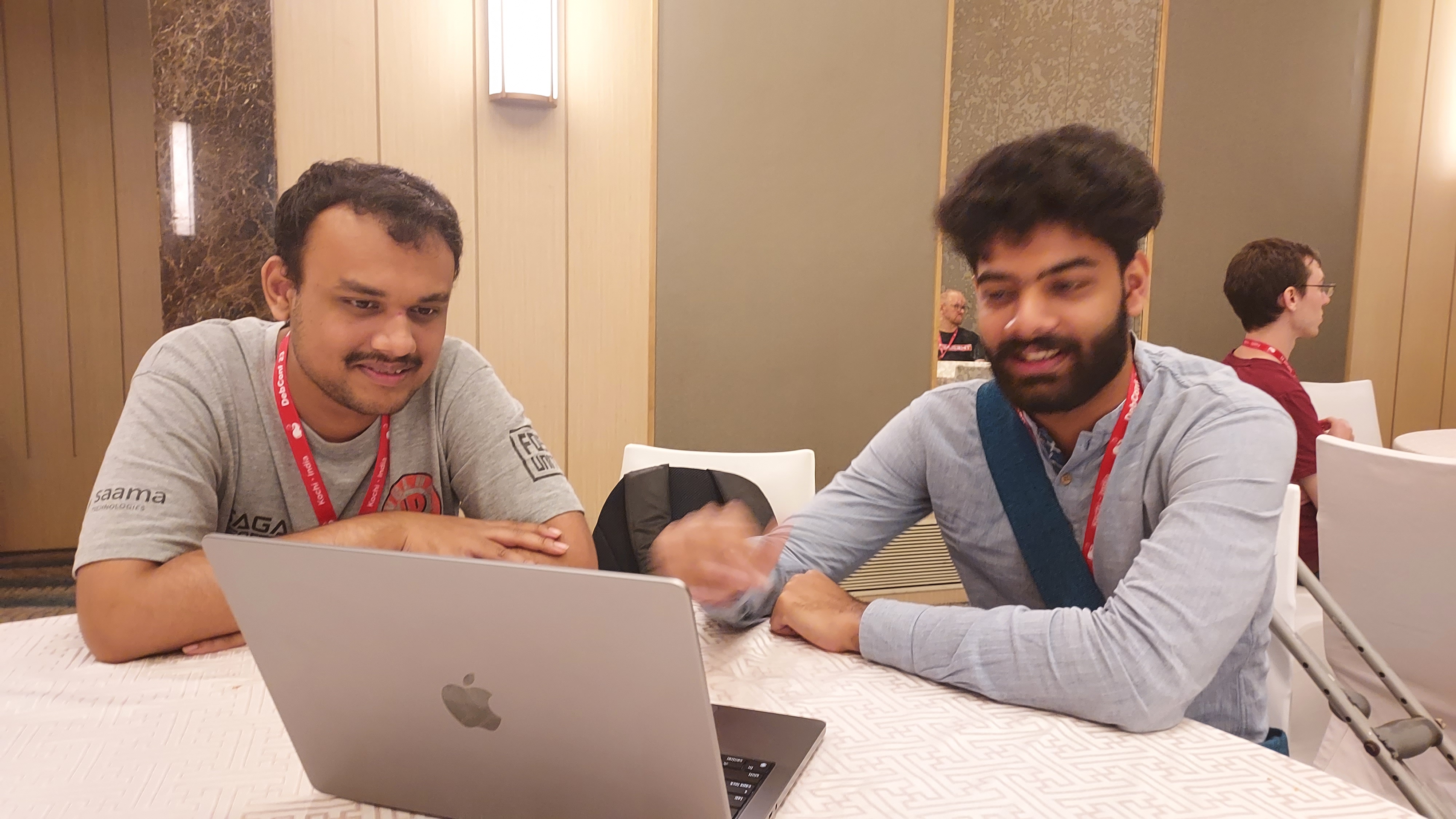
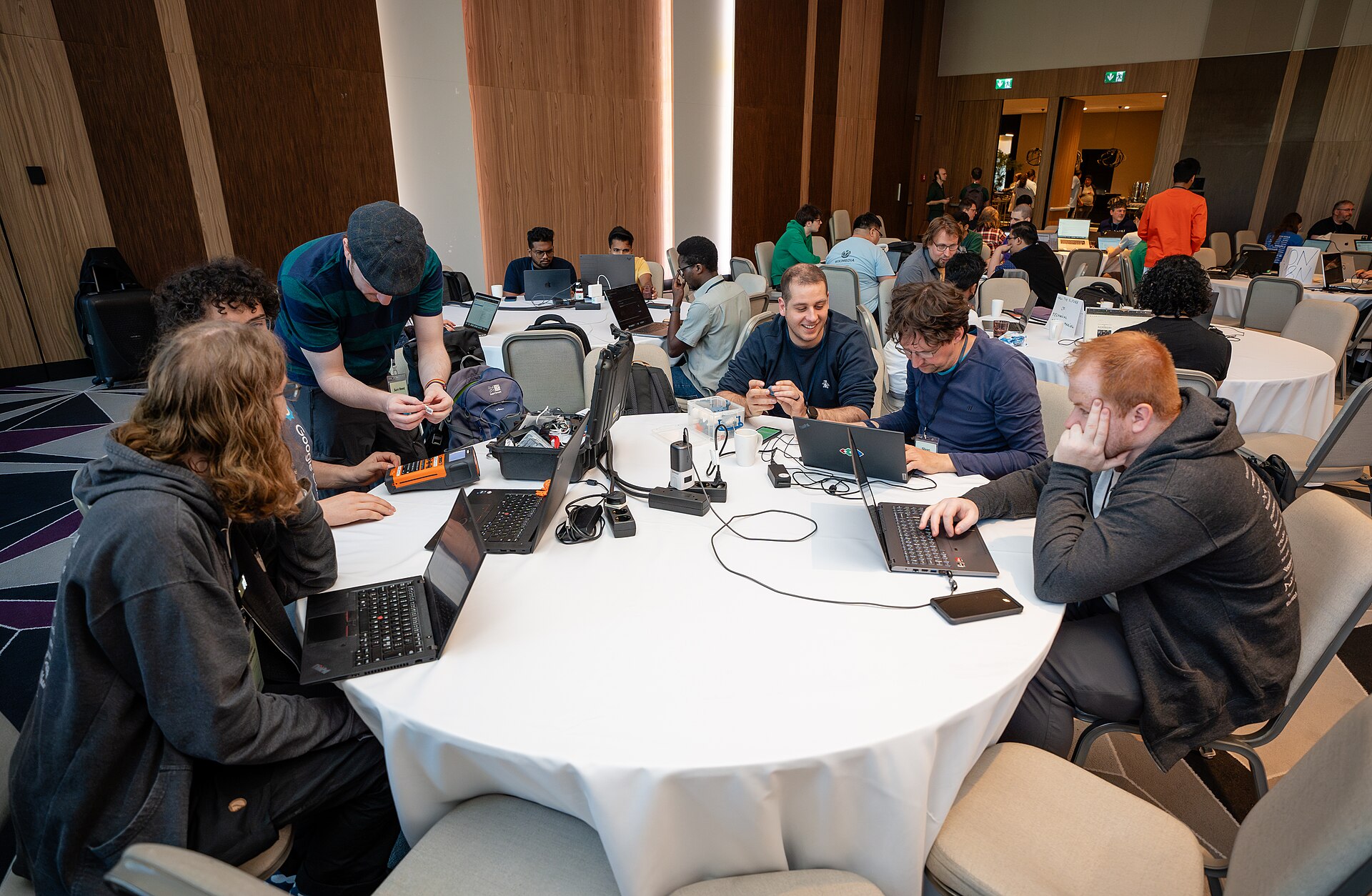
Nilesh, Chirag and Apple at DC23
The team even managed to get a press conference arranged as well, and we got an opportunity to go to Press Club, Ernakulam. Sruthi and Jonathan gave the speech and answered questions from journalists. The event was covered by media as well due to this. Ernakulam Press Club
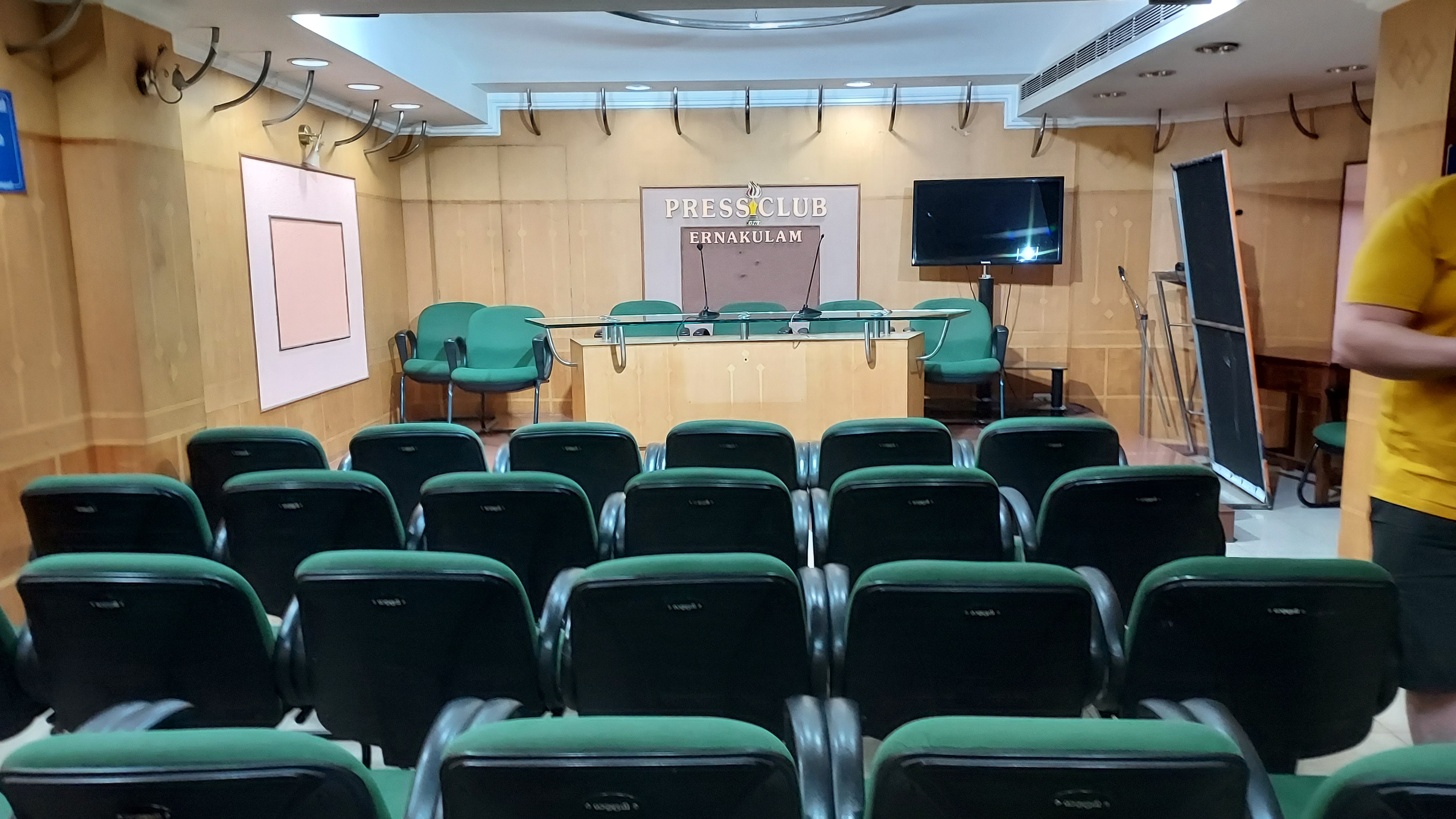
Ernakulam Press Club
During the conference, every night the team use to have 9 PM meetings for retrospection and planning for next day, which was always dotted with new problems. Every day, we used to hijack Silent Hacklab for the meeting and gently ask the only people there at the time to give us space. DebConf, it itself is a well oiled machine. Network was brought up from scratch. Video team built the recording, audio mixing, live-streaming, editing and transcoding infrastructure on site. A gaming rig served as router and gateway. We got internet uplinks, a 1 Gbps sponsored leased line from Kerala Vision and a paid backup 100 Mbps connection from a different provider. IPv6 was added through HE s Tunnelbroker. Overall the network worked fine as additionally we had hotel Wi-Fi, so the conference network wasn t stretched much. I must highlight, DebConf is my only conference where almost everything and every piece of software in developed in-house, for the conference and modified according to need on the fly. Even event recording cameras, audio check, direction, recording and editing is all done on in-house software by volunteer-attendees (in some cases remote ones as well), all trained on the sideline of the conference. The core recording and mixing equipment is owned by Debian and travels to each venue. The rest is sourced locally. Gaming Rig which served as DC23 gateway router
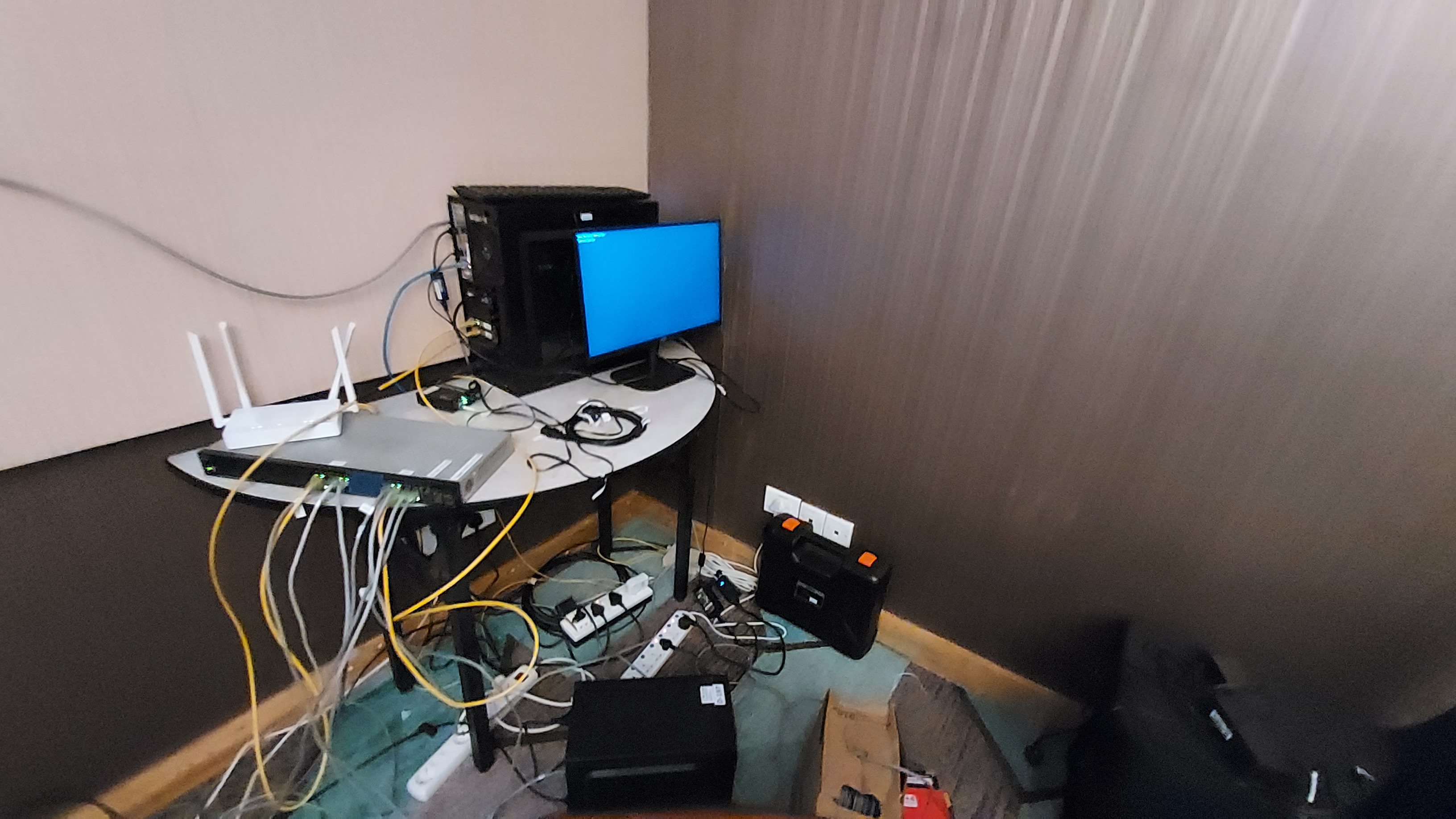
Gaming Rig which served as DC23 gateway router
It was fun seeing how almost all the things were coordinated over text on Internet Relay Chat (IRC). If a talk/event was missing a talkmeister or a director or a camera person, a quick text on #debconf channel would be enough for someone to volunteer. Video team had a dedicated support channel for each conference venue for any issues and were quick to respond and fix stuff. Network information. Screengrab from closing ceremony
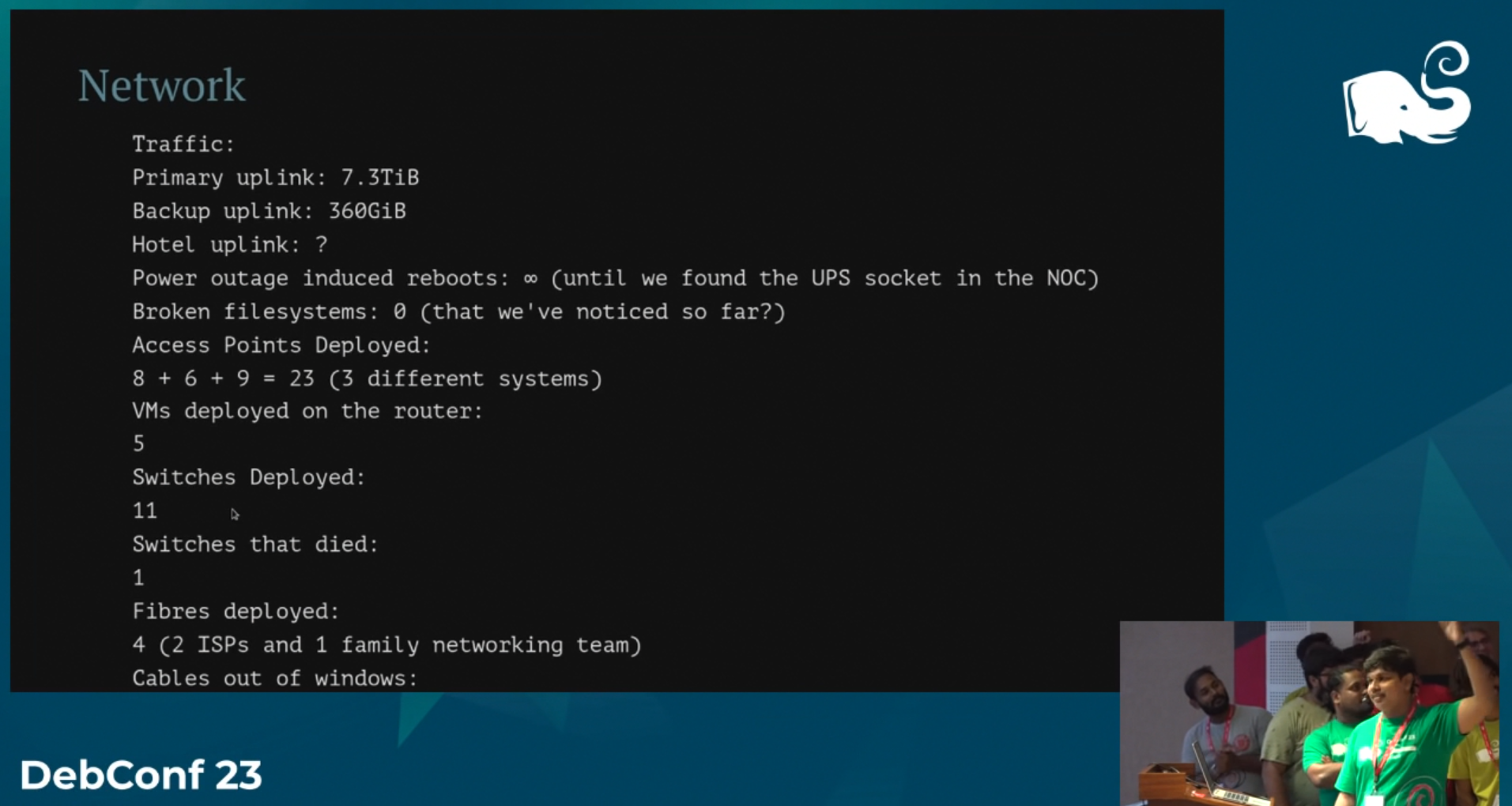
Network information. Screengrab from closing ceremony
It rained for the initial days, which gave us a cool weather. Swag team had decided to hand out umbrellas in swag kit which turned out to be quite useful. The swag kit was praised for quality and selection - many thanks to Anupa, Sruthi and others. It was fun wearing different color T-shirts, all designed by Abraham. Red for volunteers, light green for Video team, green for core-team i.e. staff and yellow for conference attendees. With highvoltage
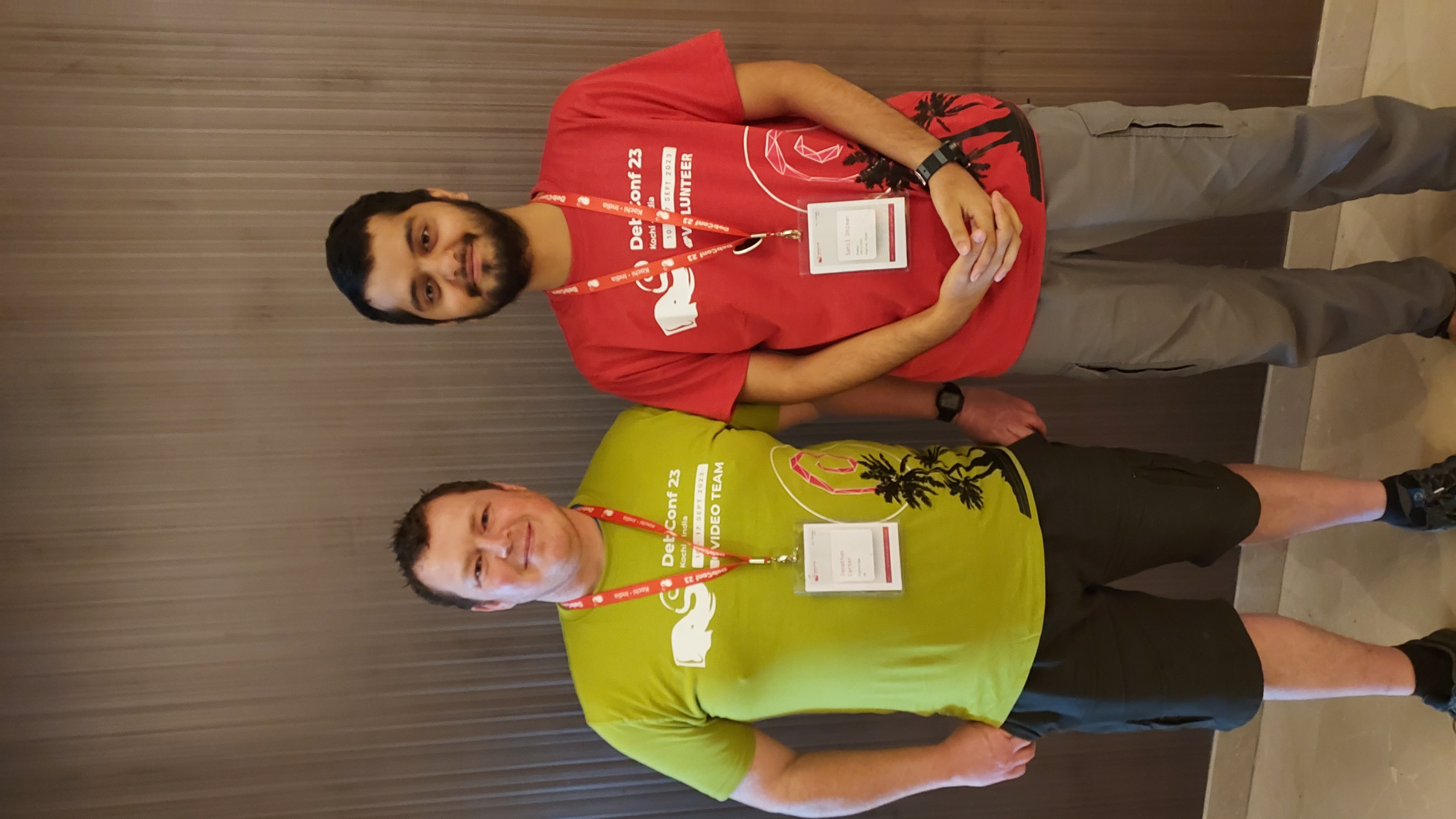
With highvoltage
We were already acclimatized by the time DebConf really started as we had been talking, hacking and hanging out since last 7 days. Rush really started with the start of DebConf. More people joined on the first and second day of the conference. As has been the tradition, an opening talk was prepared by the Sruthi and local team (which I highly recommend watching to get more insights of the process). DebConf day 1 also saw job fair, where Canonical and FOSSEE, IIT Bombay had stalls for community interactions, which judging by the crowd itself turned out to be quite a hit. For me, association with DebConf (and Debian) started due to volunteering with video team, so anyhow I was going to continue doing that this conference as well. I usually volunteer for talks/events which anyhow I m interested in. Handling the camera, talkmeister-ing and direction are fun activities, though I didn t do sound this time around. Sound seemed difficult, and I didn t want to spoil someone s stream and recording. Talk attendance varied a lot, like in Bits from DPL talk, the hall was full but for some there were barely enough people to handle the volunteering tasks, but that s what usually happens. DebConf is more of a place to come together and collaborate, so talk attendance is an afterthought sometimes. Audience in highvoltage's Bits from DPL talk
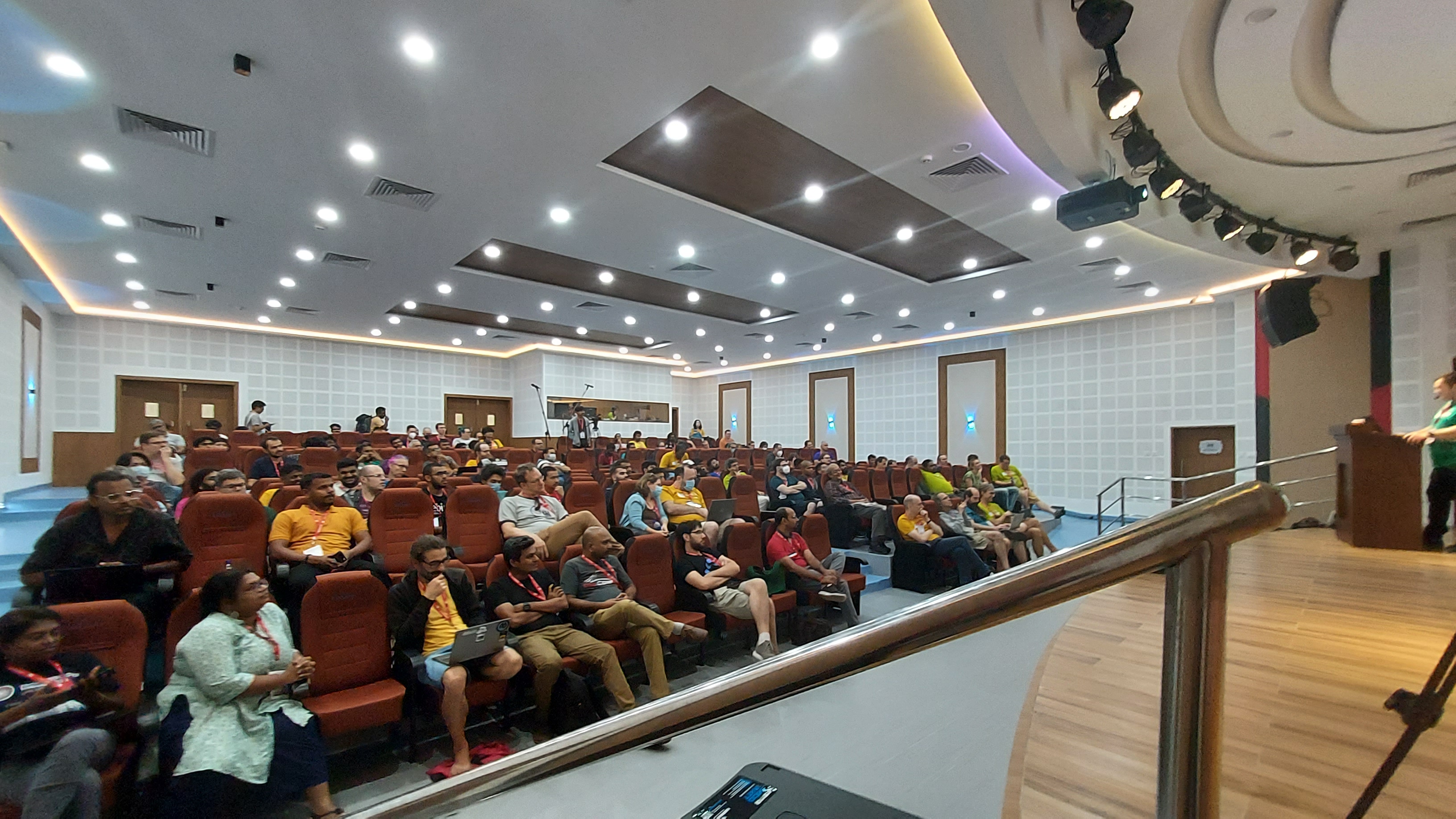
Audience in highvoltage's Bits from DPL talk
I didn t submit any talk proposals this time around, as just being in the orga team was too much work already, and I knew, the talk preparation would get delayed to the last moment and I would have to rush through it. Enrico's talk
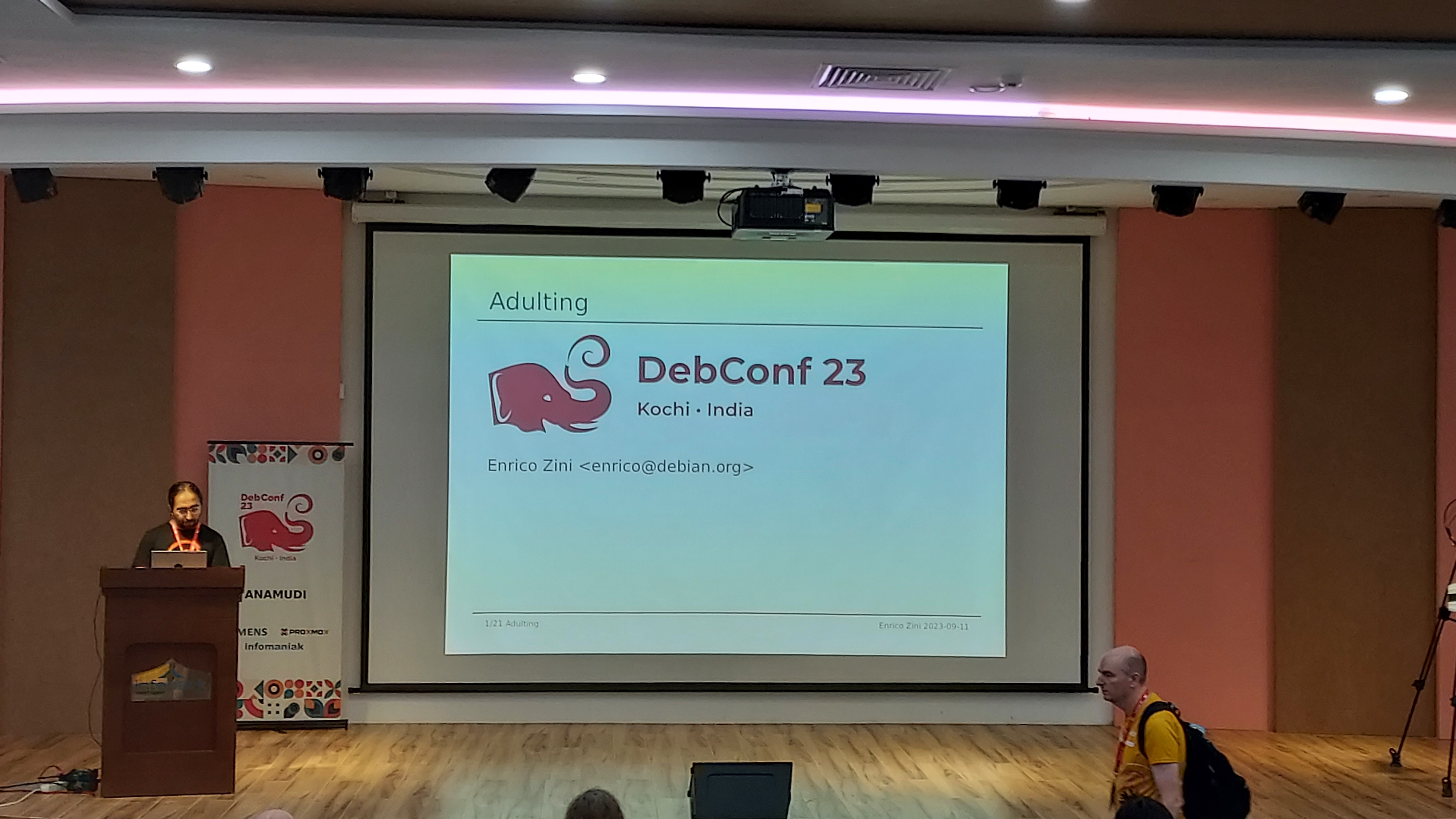
Enrico's talk
From Day 2 onward, more sponsor stalls were introduced in the hallway area. Hopbox by Unmukti , MostlyHarmless and Deeproot (joint stall) and FOSEE. MostlyHarmless stall had nice mechanical keyboards and other fun gadgets. Whenever I got the time, I would go and start typing racing to enjoy the nice, clicky keyboards. As the DebConf tradition dictates, we had a Cheese and Wine party. Everyone brought in cheese and other delicacies from their region. Then there was yummy Sadya. Sadya is a traditional vegetarian Malayalis lunch served over banana leaves. There were loads of different dishes served, the names of most I couldn t pronounce or recollect properly, but everything was super delicious. Day 4 was day trip and I chose to go to Athirappilly Waterfalls and Jungle safari. Pictures would describe the beauty better than words. The journey was bit long though. Athirappilly Falls


Athirappilly Falls

Pathu Pathu Tea Gardens
Tea Gardens
Late that day, we heard the news of Abraham gone missing. We lost Abraham. He had worked really hard all through the years for Debian and making this conference possible. Talks were cancelled for the next day and Jonathan addressed everyone. We went to Abraham s home the next day to meet his family. Team had arranged buses to Abraham s place. It was an unfortunate moment that I only got an opportunity to visit his place after he was gone. Days went by slowly after that. The last day was marked by a small conference dinner. Some of the people had already left. All through the day and next, we kept saying goodbye to friends, with whom we spent almost a fortnight together. Athirappilly Falls
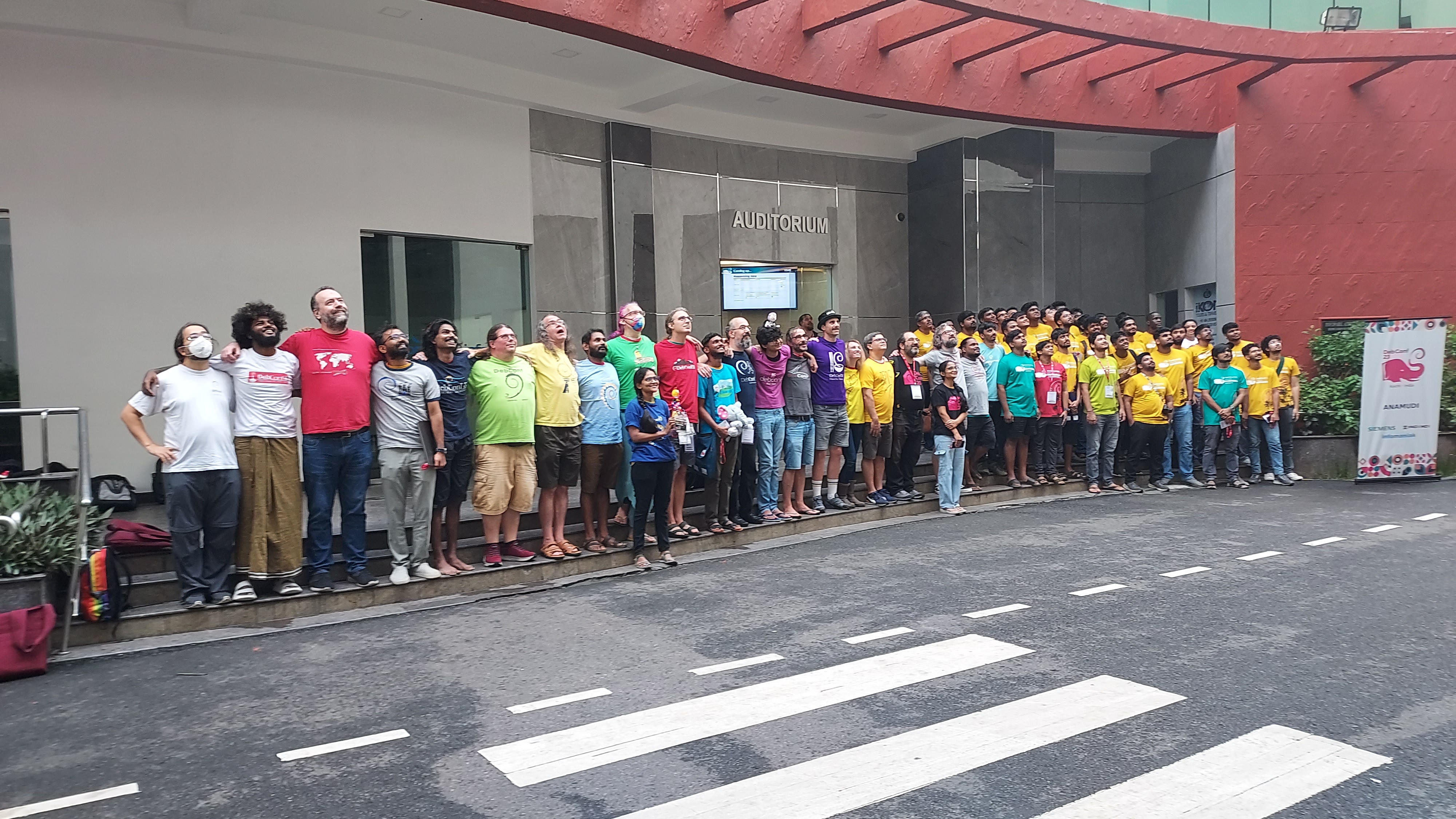
Group photo with all DebConf T-shirts chronologically
This was 2nd trip to Kochi. Vistara Airway s UK886 has become the default flight now. I have almost learned how to travel in and around Kochi by Metro, Water Metro, Airport Shuttle and auto. Things are quite accessible in Kochi but metro is a bit expensive compared to Delhi. I left Kochi on 19th. My flight was due to leave around 8 PM, so I had the whole day to myself. A direct option would have taken less than 1 hour, but as I had time and chose to take the long way to the airport. First took an auto rickshaw to Kakkanad Water Metro station. Then sailed in the water metro to Vyttila Water Metro station. Vyttila serves as intermobility hub which connects water metro, metro, bus at once place. I switched to Metro here at Vyttila Metro station till Aluva Metro station. Here, I had lunch and then boarded the Airport feeder bus to reach Kochi Airport. All in all, I did auto rickshaw > water metro > metro > feeder bus to reach Airport. I was fun and scenic. I must say, public transport and intermodal integration is quite good and once can transition seamlessly from one mode to next. Kochi Water Metro


Kochi Water Metro

Scenes from Kochi Water Metro Scenes from Kochi Water Metro
Scenes from Kochi Water Metro
DebConf23 served its purpose of getting existing Debian people together, as well as getting new people interested and contributing to Debian. People who came are still contributing to Debian, and that s amazing. Streaming video stats
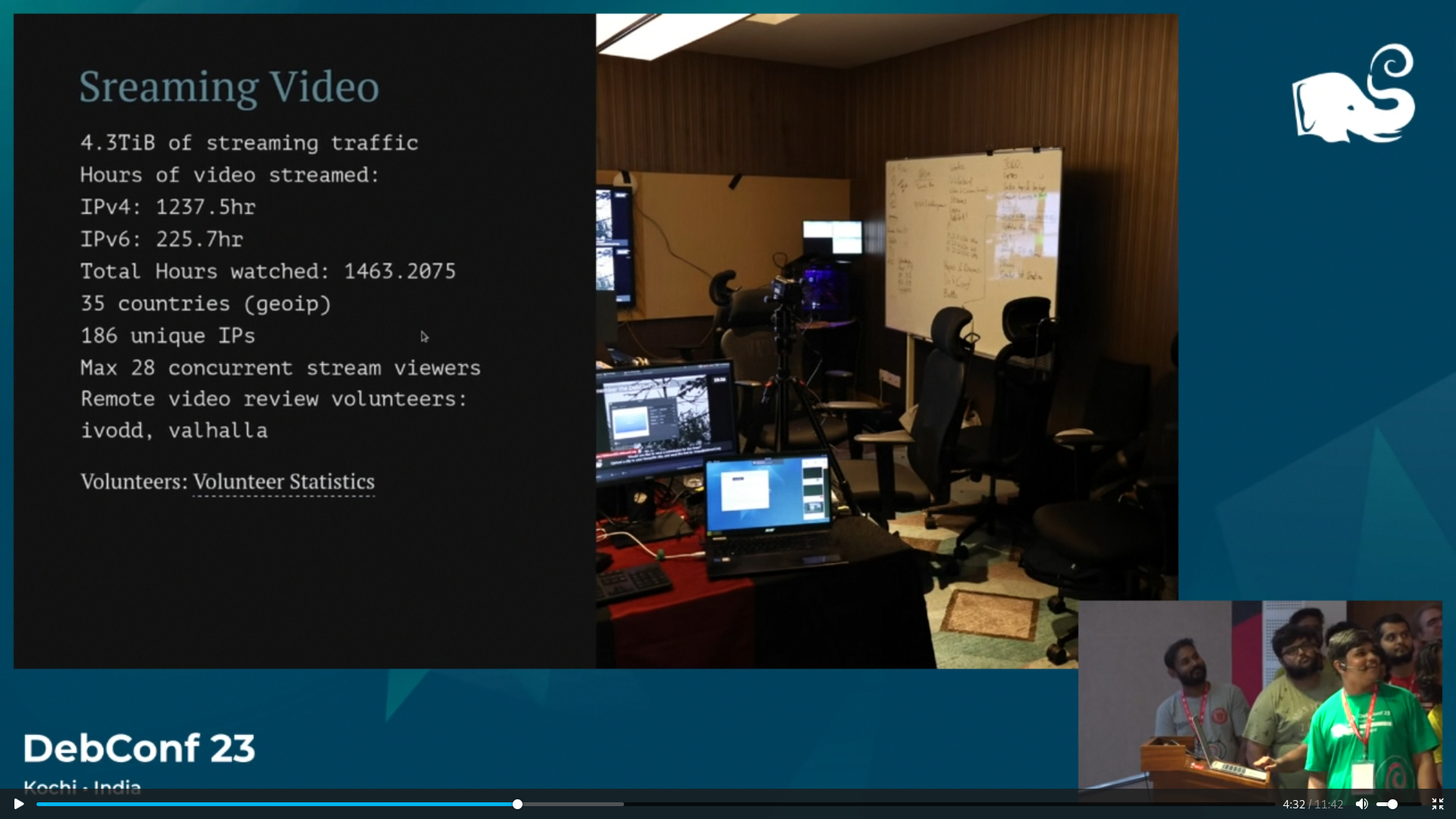
Streaming video stats. Screengrab from closing ceremony
The conference wasn t without its fair share of troubles. There were multiple money transfer woes, and being in India didn t help. Many thanks to multiple organizations who were proactive in helping out. On top of this, there was conference visa uncertainty and other issues which troubled visa team a lot. Kudos to everyone who made this possible. Surely, I m going to miss the name, so thank you for it, you know how much you have done to make this event possible. Now, DebConf24 is scheduled for Busan, South Korea, and work is already in full swing. As usual, I m helping with the fundraising part and plan to attend too. Let s see if I can make it or not. DebConf23 Group Photo
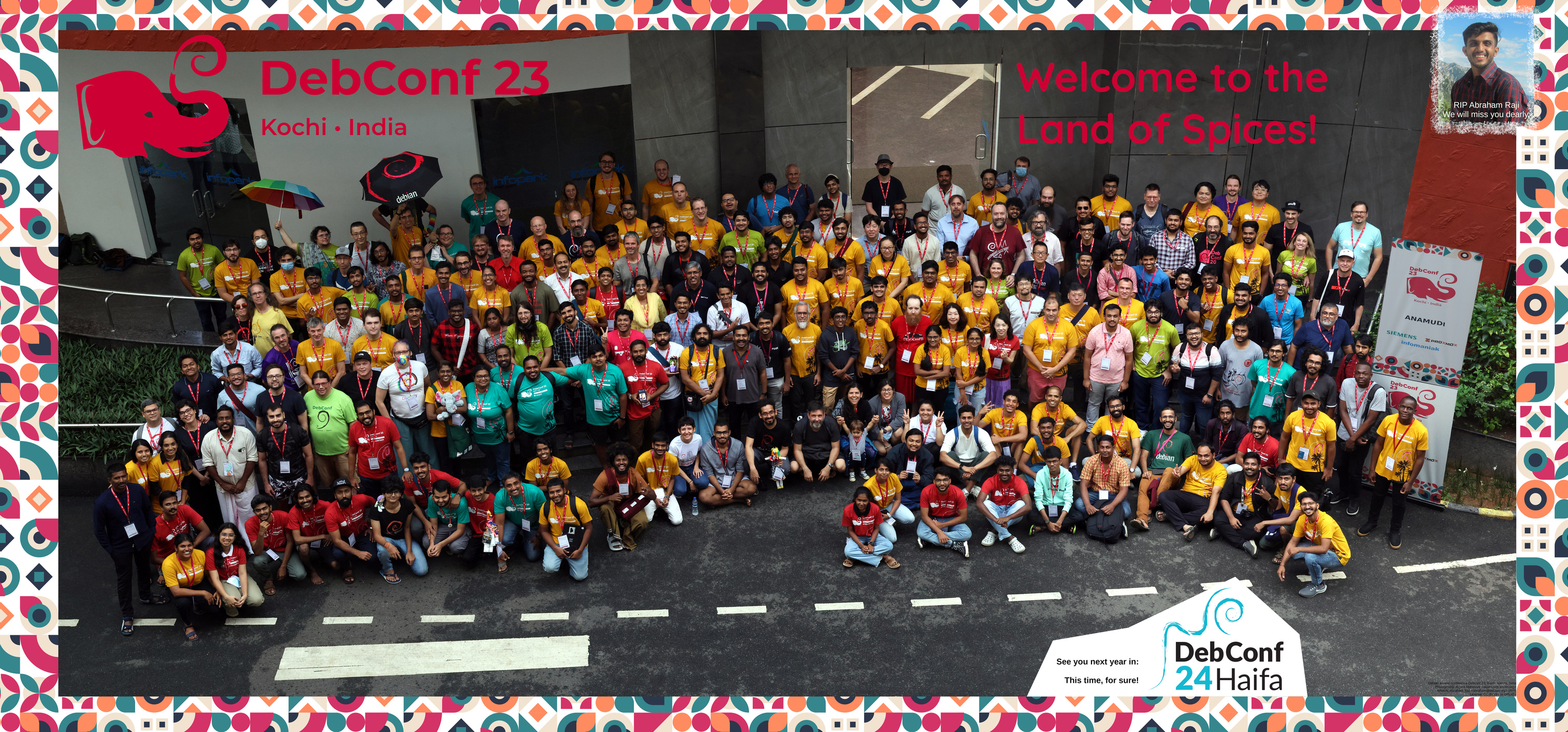
DebConf23 Group Photo. Click to enlarge.
Credits - Aigars Mahinovs
In the end, we kept on saying, no DebConf at this scale would come back to India for the next 10 or 20 years. It s too much trouble to be frank. It was probably the peak that we might not reach again. I would be happy to be proven wrong though :)


26 May 2024

Russell Coker: USB-A vs USB-C

USB-A is the original socket for USB at the PC end. There are 2 variants of it, the first is for USB 1.1 to USB 2 and the second is for USB 3 which adds extra pins in a plug and socket compatible manner you can plug a USB-A device into a USB-A socket without worrying about the speeds of each end as long as you don t need USB 3 speeds. The differences between USB-A and USB-C are:
  1. USB-C has the same form factor as Thunderbolt and the Thunderbolt protocol can run over it if both ends support it.
  2. USB-C generally supports higher power modes for charging (like 130W for Dell laptops, monitors, and plugpacks) but there s no technical reason why USB-A couldn t do it. You can buy chargers that do 60W over USB-A which could power one of our laptops via a USB-A to USB-C cable. So high power USB-A is theoretically possible but generally you won t see it.
  3. USB-C has DisplayPort alternate mode which means using some of the wires for DisplayPort.
  4. USB-C is more likely to support the highest speeds than USB-A sockets for super speed etc. This is not a difference in the standards just a choice made by manufacturers.
While USB-C tends to support higher power delivery modes in actual implementations for connecting to a PC the PC end seems to only support lower power modes regardless of port. I think it would be really good if workstations could connect to monitors via USB-C and provide power, DisplayPort, and keyboard, mouse, etc over the same connection. But unfortunately the PC and monitor ends don t appear to support such things. If you don t need any of those benefits in the list above (IE you are using USB for almost anything we do other than connecting a laptop to a dock/monitor/charger) then USB-A will do the job just as well as USB-C. The choice of which type to use should be based on price and which ports are available, EG My laptop has 2*USB-C ports and 2*USB-A so given that one USB-C port is almost always used for the monitor or for charging I don t really want to use USB-C for anything else to avoid running out of ports. When buying USB devices you can t always predict which systems you will need to connect them to. Currently there are a lot of systems without USB-C that are working well and have no need to be replaced. I haven t yet seen a system where the majority of ports are USB-C but that will probably happen in the next few years. Maybe in 2027 there will be PCs on sale with only two USB-A sockets forcing people who don t want to use a USB hub to save both of them for keyboard and mouse. Currently USB-C keyboards and mice are available on AliExpress but they are expensive and I haven t seen them in Australian stores. Most computer users don t wear out keyboards or mice so a lot of USB-A keyboard and mice will be in service for a long time. As an aside there are still many PCs with PS/2 keyboard and mouse ports in service so these things don t go away for a long time. There is one corner case where USB-C is convenient which is when you want to connect a mass storage device for system recovery or emergency backup, want a high speed, and don t want to spend time figuring out which of the ports are super speed (which can be difficult at the back of a PC with poor lighting). With USB-C you can expect a speed of at least 5Gbit/s and don t have to worry about accidentally connecting to a USB 2 port as is the situation with USB-A. For my own use the only times that I prefer USB-C over USB-A are for devices to connect to phones. Eventually I ll get a laptop that only has USB-C ports and this will change, but even then adaptors are possible. For someone who doesn t know the details of how things works it s not unreasonable to just buy the newest stuff and assume it s better as it usually is. But hopefully blog posts like this can help people make more informed decisions.

22 May 2024

Evgeni Golov: Upgrading CentOS Stream 8 to CentOS Stream 9 using Leapp

Warning to the Planet Debian readers: the following post might shock you, if you're used to Debian's smooth upgrades using only the package manager. Leapp?! Contrary to distributions like Debian and Fedora, RHEL can't be upgraded using the package manager alone. Instead there is a tool called Leapp that takes care of orchestrating the update and also includes a set of checks whether a system can be upgraded at all. Have a look at the RHEL documentation about upgrading if you want more details on the process itself. You might have noticed that the title of this post says "CentOS Stream" but here I am talking about RHEL. This is mostly because Leapp was originally written with RHEL in mind. Upgrading CentOS 7 to EL8 When people started pondering upgrading their CentOS 7 installations, AlmaLinux started the ELevate project to allow upgrading CentOS 7 to CentOS Stream 8 but also to AlmaLinux 8, Rocky 8 or Oracle Linux 8. ELevate was essentially Leapp with patches to allow working on CentOS, which has different package signature keys, different OS release versioning, etc. Sadly these patches were never merged back into Leapp. Making Leapp work with CentOS Stream 8 (and other distributions) At some point I noticed that things weren't moving and EL8 to EL9 upgrades were coming closer (and I had my own systems that I wanted to be able to upgrade in place). Annoyed-Evgeni-Development is best development? Not sure, but it produced a set of patches that allowed some movement: However, this is not yet the end of the story. At least convert dot-less CentOS versions to X.999 is open, and another followup would be needed if we go that route. But I don't expect this to be merged soon, as the patch is technically wrong - yet it makes things mostly work. The big problem here is that CentOS Stream doesn't have X.Y versioning, just X as it's a constant stream with no point releases. Leapp however relies on X.Y versioning to know which package changes it needs to perform. Pretending CentOS Stream 8 is "RHEL" 8.999 works if you assume that Stream is always ahead of RHEL. This is however a CentOS only problem. I still need to properly test that, but I'd expect things to work fine with upstream Leapp on AlmaLinux/Rocky if you feed it the right signature and repository data. Actually upgrading CentOS Stream 8 to CentOS Stream 9 using Leapp Like I've already teased in my HPE rant, I've actually used that code to upgrade virt01.conova.theforeman.org to CentOS Stream 9. I've also used it to upgrade a server at home that's responsible for running important containers like Home Assistant and UniFi. So it's absolutely battle tested and production grade! It's also hungry for kittens. As mentioned above, you can't just use upstream Leapp, but I have a Copr: evgeni/leapp.
# dnf copr enable evgeni/leapp
# dnf install leapp leapp-upgrade-el8toel9
Apart from the software, we'll also need to tell it which repositories to use for the upgrade.
# vim /etc/leapp/files/leapp_upgrade_repositories.repo
[c9-baseos]
name=CentOS Stream $releasever - BaseOS
metalink=https://mirrors.centos.org/metalink?repo=centos-baseos-9-stream&arch=$basearch&protocol=https,http
gpgkey=file:///etc/pki/rpm-gpg/RPM-GPG-KEY-centosofficial
gpgcheck=1
repo_gpgcheck=0
metadata_expire=6h
countme=1
enabled=1
[c9-appstream]
name=CentOS Stream $releasever - AppStream
metalink=https://mirrors.centos.org/metalink?repo=centos-appstream-9-stream&arch=$basearch&protocol=https,http
gpgkey=file:///etc/pki/rpm-gpg/RPM-GPG-KEY-centosofficial
gpgcheck=1
repo_gpgcheck=0
metadata_expire=6h
countme=1
enabled=1
Depending on the setup and installed packages, more repositories might be needed. Just make sure that the $stream substitution is not used as Leapp doesn't override that and you'd end up with CentOS Stream 8 repos again. Once all that is in place, we can call leapp preupgrade and let it analyze the system. Ideally, the output will look like this:
# leapp preupgrade
 
============================================================
                      REPORT OVERVIEW                       
============================================================
Reports summary:
    Errors:                      0
    Inhibitors:                  0
    HIGH severity reports:       0
    MEDIUM severity reports:     0
    LOW severity reports:        3
    INFO severity reports:       3
Before continuing consult the full report:
    A report has been generated at /var/log/leapp/leapp-report.json
    A report has been generated at /var/log/leapp/leapp-report.txt
============================================================
                   END OF REPORT OVERVIEW                   
============================================================
But trust me, it won't ;-) As mentioned above, Leapp analyzes the system before the upgrade. Some checks can completely inhibit the upgrade, while others will just be logged as "you better should have a look". Firewalld Configuration AllowZoneDrifting Is Unsupported EL7 and EL8 shipped with AllowZoneDrifting=yes, but since EL9 this is not supported anymore. As this can potentially break the networking of the system, the upgrade gets inhibited. Newest installed kernel not in use Admit it, you also don't reboot into every new kernel available! Well, Leapp won't let that pass and inhibits the upgrade. Cannot perform the VDO check of block devices In EL8 there are two ways to manage VDO: using the dedicated vdo tool and via LVM. If your system uses LVM (it should!) but not VDO, you probably don't have the vdo package installed. But then Leapp can't check if your LVM devices really aren't VDO without the vdo tooling and will inhibit the upgrade. So you gotta install vdo for it to find out that you don't use VDO LUKS encrypted partition detected Yeah. Sorry. Using LUKS? Straight into the inhibit corner! But hey, if you don't use LUKS for / you can probably get away by deleting the inhibitwhenluks actor. That worked for me, but remember the kittens! Really upgrading CentOS Stream 8 to CentOS Stream 9 using Leapp The headings are getting silly, huh? Anyway, once leapp preupgrade is happy and doesn't throw any inhibitors anymore, the actual (real?) upgrade can be done by calling leapp upgrade. This will download all necessary packages and create an intermediate initramfs that contains all the things needed for the upgrade and ask you to reboot. Once booted, the upgrade itself takes somewhere between 5 and 10 minutes. Then another minute or 5 to relabel your disks with the new SELinux policy. And three reboots (into the upgrade initramfs, into SELinux relabel, into real OS) of a ProLiant DL325 - 5 minutes each? And then for good measure another one, to flip SELinux from permissive to enforcing. Are we done yet? Nope. There are a few post-upgrade tasks you get to do yourself. Yes, the switching of SELinux back to enforcing is one of them. Please don't forget it. Using the system after the upgrade A customer once said "We're not running those systems for the sake of running systems, but for the sake of running some application ontop of them". This is very true. libvirt doesn't support Spice/QXL In EL9, support for Spice/QXL was dropped, so if you try to boot a VM using it, libvirt will nicely error out with
Error starting domain: unsupported configuration: domain configuration does not support video model 'qxl'
Interestingly, because multiple parts of the VM are invalid, you can't edit it in virt-manager (at least the one in Fedora 39) as removing/fixing one part requires applying the new configuration which is still invalid. So virsh edit <vm> it is! Look for entries like
    <channel type='spicevmc'>
      <target type='virtio' name='com.redhat.spice.0'/>
      <address type='virtio-serial' controller='0' bus='0' port='2'/>
    </channel>
    <graphics type='spice' autoport='yes'>
      <listen type='address'/>
    </graphics>
    <audio id='1' type='spice'/>
    <video>
      <model type='qxl' ram='65536' vram='65536' vgamem='16384' heads='1' primary='yes'/>
      <address type='pci' domain='0x0000' bus='0x00' slot='0x01' function='0x0'/>
    </video>
    <redirdev bus='usb' type='spicevmc'> 
      <address type='usb' bus='0' port='2'/> 
    </redirdev> 
    <redirdev bus='usb' type='spicevmc'> 
      <address type='usb' bus='0' port='3'/> 
    </redirdev>
and either just delete the or (better) replace them with VNC/cirrus
    <graphics type='vnc' port='-1' autoport='yes'>
      <listen type='address'/>
    </graphics>
    <audio id='1' type='none'/>
    <video>
      <model type='cirrus' vram='16384' heads='1' primary='yes'/>
      <address type='pci' domain='0x0000' bus='0x00' slot='0x01' function='0x0'/>
    </video>
Podman needs re-login to private registries One of the machines I've updated runs Podman and pulls containers from GitHub which are marked as private. To do so, I have a personal access token that I've used to login to ghcr.io. After the CentOS Stream 9 upgrade (which included an upgrade to Podman 5), pulls stopped working with authentication/permission errors. No idea what exactly happened, but a simple podman login fixed this issue quickly.
$ echo ghp_token   podman login ghcr.io -u <user> --password-stdin
shim has an el8 tag One of the documented post-upgrade tasks is to verify that no EL8 packages are installed, and to remove those if there are any. However, when you do this, you'll notice that the shim-x64 package has an EL8 version: shim-x64-15-15.el8_2.x86_64. That's because the same build is used in both CentOS Stream 8 and CentOS Stream 9. Confusing, but should really not be uninstalled if you want the machine to boot ;-) Are we done yet? Yes! That's it. Enjoy your CentOS Stream 9!

21 May 2024

Michael Ablassmeier: lvm thin send/recv

A few days ago i found this mail on the LKML that introduces support for userspace access to LVM thin provisioned metadata snapshots. I didn t know this is possible. Using the thin provisioning tools you can then export the metadata information for your LVM snapshots to track changed regions between them. The workflow is pretty straight forward, yet not really documented:
# lvcreate -ay -Ky --snapshot -n full_backup thingroup/vol1
  # dmsetup message /dev/mapper/thingroup-thinpool-tpool 0 reserve_metadata_snap
  # lvcreate -ay -Ky --snapshot -n inc_backup thingroup/vol1
  # thin_delta  -m --snap1 $(lvs --noheadings -o thin_id thingroup/full_backup) --snap2 $(lvs --noheadings -o thin_id thingroup/inc_backup) > delta_dump
  # dmsetup message /dev/mapper/thingroup-thinpool-tpool 0 release_metadata_snap
This all has already been implemented by a nice utility called thin-send-recv, which based on this functionality allows to (incrementally) send LVM snapshots to remote systems just like zfs send or zfs recv.

20 May 2024

Russell Coker: Respect and Children

I attended the school Yarra Valley Grammer (then Yarra Valley Anglican School which I will refer to as YV ) and completed year 12 in 1990. The school is currently in the news for a spreadsheet some boys made rating girls where unrapeable was one of the ratings. The school s PR team are now making claims like Respect for each other is in the DNA of this school . I d like to know when this DNA change allegedly occurred because respect definitely wasn t in the school DNA in 1990! Before I go any further I have to note that if the school threatens legal action against me for this post it will be clear evidence that they don t believe in respect. The actions of that school have wronged me, several of my friends, many people who aren t friends but who I wish they hadn t had to suffer and I hadn t had to witness it, and presumably countless others that I didn t witness. If they have any decency they would not consider legal action but I have learned that as an institution they have no decency so I have to note that they should read the Wikipedia page about the Streisand Effect [1] and keep it in mind before deciding on a course of action. I think it is possible to create a school where most kids enjoy being there and enjoy learning, where hardly any students find it a negative experience and almost no-one finds it traumatic. But it is not possible to do that with the way schools tend to be run. When I was at high school there was a general culture that minor sex crimes committed by boys against boys weren t a problem, this probably applied to all high schools. Things like ripping a boy s pants off (known as dakking ) were considered a big joke. If you accept that ripping the pants off an unwilling boy is a good thing (as was the case when I was at school) then that leads to thinking that describing girls as unrapeable is acceptable. The Wikipedia page for Pantsing [2] has a reference for this issue being raised as a serious problem by the British Secretary of State for Education and Skills Alan Johnson in 2007. So this has continued to be a widespread problem around the world. Has YV become better than other schools in dealing with it or is Dakking and Wedgies as well accepted now as it was when I attended? There is talk about schools preparing kids for the workforce, but grabbing someone s underpants without consent will result in instant dismissal from almost all employment. There should be more tolerance for making mistakes at school than at work, but they shouldn t tolerate what would be serious crimes in other contexts. For work environments there have been significant changes to what is accepted, so it doesn t seem unreasonable to expect that schools can have a similar change in culture. One would hope that spending 6 years wondering who s going to grab your underpants next would teach boys the importance of consent and some sympathy for victims of other forms of sexual assault. But that doesn t seem to happen, apparently it s often the opposite. When I was young Autism wasn t diagnosed for anyone who was capable of having a normal life. Teachers noticed that I wasn t like other kids, some were nice, but some encouraged other boys to attack me as a form of corporal punishment by proxy not a punishment for doing anything wrong (detentions were adequate for that) but for being different. The lesson kids will take from that sort of thing is that if you are in a position of power you can mistreat other people and get away with it. There was a girl in my year level at YV who would probably be diagnosed as Autistic by today s standards, the way I witnessed her being treated was considerably worse than what was described in the recent news reports but it is quite likely that worse things have been done recently which haven t made the news yet. If this issue is declared to be over after 4 boys were expelled then I ll count that as evidence of a cover-up. These things don t happen in a vacuum, there s a culture that permits and encourages it. The word respect has different meanings, it can mean treat a superior as the master or treat someone as a human being . The phrase if you treat me with respect I ll treat you with respect usually means if you treat me as the boss then I ll treat you as a human being . The distinction is very important when discussing respect in schools. If teachers are considered the ultimate bosses whose behaviour can never be questioned then many boys won t need much help from Andrew Tate in developing the belief that they should be the boss of girls in the same way. Do any schools have a process for having students review teachers? Does YV have an ombudsman to take reports of misbehaving teachers in the way that corporations typically have an ombudsman to take reports about bad managers? Any time you have people whose behaviour is beyond scrutiny or oversight you will inevitably have bad people apply for jobs, then bad things will happen and it will create a culture of bad behaviour. If teachers can treat kids badly then kids will treat other kids badly, and this generally ends with girls being treated badly by boys. My experience at YV was that kids barely had the status of people. It seemed that the school operated more as a caretaker of the property of parents than as an organisation that cares for people. The current YV website has a Whistleblower policy [3] that has only one occurrence of the word student and that is about issues that endanger the health or safety of students. Students are the people most vulnerable to reprisal for complaining and not being listed as an eligible whistleblower shows their status. The web site also has a flowchart for complaints and grievances [4] which doesn t describe any policy for a complaint to be initiated by a student. One would hope that parents would advocate for their children but that often isn t the case. When discussing the possibility of boys being bullied at school with parents I ve had them say things like my son wouldn t be so weak that he would be bullied , no boy will tell his parents about being bullied if that s their attitude! I imagine that there are similar but different issues of parents victim-blaming when their daughter is bullied (presumably substituting immoral for weak) but don t have direct knowledge of the topic. The experience of many kids is being disrespected by their parents, the school system, and often siblings too. A school can t solve all the world s problems but can ideally be a refuge for kids who have problems at home. When I was at school the culture in the country and the school was homophobic. One teacher when discussing issues such as how students could tell him if they had psychological problems and no-one else to talk to said some things like the Village People make really good music which was the only time any teacher said anything like It s OK to be gay (the Village People were the gayest pop group at the time). A lot of the bullying at school had a sexual component to it. In addition to the wedgies and dakking (which while not happening often was something you had to constantly be aware of) I routinely avoided PE classes where a shower was necessary because of a thug who hung around by the showers and looked hungrily at my penis, I don t know if he had a particular liking to mine or if he stared at everyone that way. Flashing and perving was quite common in change rooms. Presumably as such boy-boy sexual misbehaviour was so accepted that led to boys mistreating girls. I currently work for a company that is active in telling it s employees about the possibility of free psychological assistance. Any employee can phone a psychologist to discuss problems (whether or not they are work related) free of charge and without their manager or colleagues knowing. The company is billed and is only given a breakdown of the number of people who used the service and roughly what the issue was (work stress, family, friends, grief, etc). When something noteworthy happens employees are given reminders about this such as if you need help after seeing a homeless man try to steal a laptop from the office then feel free to call the assistance program . Do schools offer something similar? With the school fees paid to a school like YV they should be able to afford plenty of psychologist time. Every day I was at YV I saw something considerably worse than laptop theft, most days something was done to me. The problems with schools are part of larger problems with society. About half of the adults in Australia still support the Liberal party in spite of their support of Christian Porter, Cardinal Pell, and Bruce Lehrmann. It s not logical to expect such parents to discourage their sons from mistreating girls or to encourage their daughters to complain when they are mistreated. The Anglican church has recently changed it s policy to suggesting that victims of sexual abuse can contact the police instead of or in addition to the church, previously they had encouraged victims to only contact the church which facilitated cover-ups. One would hope that schools associated with the Anglican church have also changed their practices towards such things. I approve of the respect is in our DNA concept, it s like Google s former slogan of Don t be evil which is something that they can be bound to. Here s a list of questions that could be asked of schools (not just YV but all schools) by journalists when reporting on such things:
  1. Do you have a policy of not trying to silence past students who have been treated badly?
  2. Do you take all sexual assaults seriously including wedgies and dakking?
  3. Do you take all violence at school seriously? Even if there s no blood? Even if the victim says they don t want to make an issue of it?
  4. What are your procedures to deal with misbehaviour from teachers? Do the students all know how to file complaints? Do they know that they can file a complaint if they aren t the victim?
  5. Does the school have policies against homophobia and transphobia and are they enforced?
  6. Does the school offer free psychological assistance to students and staff who need it? NB This only applies to private schools like YV that have huge amounts of money, public schools can t afford that.
  7. Are serious incidents investigated by people who are independent of the school and who don t have a vested interest in keeping things quiet?
  8. Do you encourage students to seek external help from organisations like the ones on the resources list of the Grace Tame Foundation [5]? Having your own list of recommended external organisations would be good too.
Counter Arguments I ve had practice debating such things, here s some responses to common counter arguments. Conclusion I don t think that YV is necessarily worse than other schools, although I m sure that representatives of other private schools are now working to assure parents of students and prospective students that they are. I don t think that all the people who were employed as teachers there when I attended were bad people, some of them were nice people who were competent teachers. But a few good people can t turn around a bad system. I will note that when I attended all the sports teachers were decent people, it was the only department I could say such things about. But sports involves situations that can lead to a bad result, issues started at other times and places can lead to violence or harassment in PE classes regardless of how good the teachers are. Teachers who know that there are problems need to be able to raise issues with the administration. When a teacher quits teaching to join the clergy and another teacher describes it as a loss for the clergy but a gain for YV it raises the question of why the bad teacher in question couldn t have been encouraged to leave earlier. A significant portion of the population will do whatever is permitted. If you say no teacher would ever bully a student so we don t need to look out for that then some teacher will do exactly that. I hope that this will lead to changes both in YV and in other schools. But if they declare this issue as resolved after expelling 4 students then something similar or worse will happen again. At least now students know that when this sort of thing happens they can send evidence to journalists to get some action.

Debian Brasil: MiniDebConf Belo Horizonte 2024 - um breve relato

De 27 a 30 de abril de 2024 foi realizada a MiniDebConf Belo Horizonte 2024 no Campus Pampulha da UFMG - Universidade Federal de Minas Gerais, em Belo Horizonte - MG. MiniDebConf BH 2024 banners Esta foi a quinta vez que uma MiniDebConf (como um evento presencial exclusivo sobre Debian) aconteceu no Brasil. As edi es anteriores foram em Curitiba (2016, 2017, e 2018), e em Bras lia 2023. Tivemos outras edi es de MiniDebConfs realizadas dentro de eventos de Software Livre como o FISL e a Latinoware, e outros eventos online. Veja o nosso hist rico de eventos. Paralelamente MiniDebConf, no dia 27 (s bado) aconteceu o FLISOL - Festival Latino-americano de Instala o de Software Livre, maior evento da Am rica Latina de divulga o de Software Livre realizado desde o ano de 2005 simultaneamente em v rias cidades. A MiniDebConf Belo Horizonte 2024 foi um sucesso (assim como as edi es anteriores) gra as participa o de todos(as), independentemente do n vel de conhecimento sobre o Debian. Valorizamos a presen a tanto dos(as) usu rios(as) iniciantes que est o se familiarizando com o sistema quanto dos(as) desenvolvedores(as) oficiais do projeto. O esp rito de acolhimento e colabora o esteve presente em todos os momentos. MiniDebConf BH 2024 flisol N meros da edi o 2024 Durante os quatro dias de evento aconteceram diversas atividades para todos os n veis de usu rios(as) e colaboradores(as) do projeto Debian. A programa o oficial foi composta de: MiniDebConf BH 2024 palestra Os n meros finais da MiniDebConf Belo Horizonte 2024 mostram que tivemos um recorde de participantes. Dos 224 participantes, 15 eram contribuidores(as) oficiais brasileiros sendo 10 DDs (Debian Developers) e 05 (Debian Maintainers), al m de diversos(as) contribuidores(as) n o oficiais. A organiza o foi realizada por 14 pessoas que come aram a trabalhar ainda no final de 2023, entre elas o Prof. Lo c Cerf do Departamento de Computa o que viabilizou o evento na UFMG, e 37 volunt rios(as) que ajudaram durante o evento. Como a MiniDebConf foi realizado nas instala es da UFMG, tivemos a ajuda de mais de 10 funcion rios da Universidade. Veja a lista com os nomes das pessoas que ajudaram de alguma forma na realiza o da MiniDebConf Belo Horizonte 2024. A diferen a entre o n mero de pessoas inscritas e o n mero de pessoas presentes provavelmente se explica pelo fato de n o haver cobran a de inscri o, ent o se a pessoa desistir de ir ao evento ela n o ter preju zo financeiro. A edi o 2024 da MiniDebconf Belo Horizonte foi realmente grandiosa e mostra o resultado dos constantes esfor os realizados ao longo dos ltimos anos para atrair mais colaboradores(as) para a comunidade Debian no Brasil. A cada edi o os n meros s aumentam, com mais participantes, mais atividades, mais salas, e mais patrocinadores/apoiadores. MiniDebConf BH 2024 grupo
MiniDebConf BH 2024 grupo Atividades A programa o da MiniDebConf foi intensa e diversificada. Nos dias 27, 29 e 30 (s bado, segunda e ter a-feira) tivemos palestras, debates, oficinas e muitas atividades pr ticas. MiniDebConf BH 2024 palestra J no dia 28 (domingo), ocorreu o Day Trip, um dia dedicado a passeios pela cidade. Pela manh sa mos do hotel e fomos, em um nibus fretado, para o Mercado Central de Belo Horizonte. O pessoal aproveitou para comprar v rias coisas como queijos, doces, cacha as e lembrancinhas, al m de experimentar algumas comidas locais. MiniDebConf BH 2024 mercado Depois de 2 horas de passeio pelo Mercado, voltamos para o nibus e pegamos a estrada para almo armos em um restaurante de comida t pica mineira. MiniDebConf BH 2024 palestra Com todos bem alimentados, voltamos para Belo Horizonte para visitarmos o principal ponto tur stico da cidade: a Lagoa da Pampulha e a Capela S o Francisco de Assis, mais conhecida como Igrejinha da Pampulha. MiniDebConf BH 2024 palestra Voltamos para o hotel e o dia terminou no hacker space que montamos na sala de eventos para o pessoal conversar, empacotar, e comer umas pizzas. MiniDebConf BH 2024 palestra Financiamento coletivo Pela terceira vez fizemos uma campanha de financiamento coletivo e foi incr vel como as pessoas contribu ram! A meta inicial era arrecadar o valor equivalente a uma cota ouro de R$ 3.000,00. Ao atingirmos essa meta, definimos uma nova, equivalente a uma cota ouro + uma cota prata (R$ 5.000,00). E novamente atingimos essa meta. Ent o propusermos como meta final o valor de uma cota ouro + prata + bronze, que seria equivalente a R$ 6.000,00. O resultado foi que arrecadamos R$ 7.239,65 com a ajuda de mais de 100 pessoas! Muito obrigado as pessoas que contribu ram com qualquer valor. Como forma de agradecimento, listamos os nomes das pessoas que doaram. MiniDebConf BH 2024 doadores Bolsas de alimenta o, hospedagem e/ou passagens para participantes Cada edi o da MiniDebConf trouxe alguma inova o, ou algum benef cio diferente para os(a) participantes. Na edi o deste ano em Belo Horizonte, assim como acontece nas DebConfs, oferecemos bolsas de alimenta o, hospedagem e/ou passagens para ajudar aquelas pessoas que gostariam de vir para o evento mas que precisariam de algum tipo de ajuda. No formul rio de inscri o, colocamos a op o para a pessoa solicitar bolsa de alimenta o, hospedagem e/ou passagens, mas para isso, ela deveria se identificar como contribuidor(a) (oficial ou n o oficial) do Debian e escrever uma justificativa para o pedido. N mero de pessoas beneficiadas: A bolsa de alimenta o forneceu almo o e jantar todos os dias. Os almo os inclu ram pessoas que moram em Belo Horizonte e regi o. J o jantares foram pagos para os(as) participantes que tamb m receberam a bolsa de hospedagem e/ou passagens. A hospedagem foi realizada no Hotel BH Jaragu . E as passagens inclu ram de avi o ou de nibus, ou combust vel (para quem veio de carro ou moto). Boa parte do dinheiro para custear as bolsas vieram do Projeto Debian, principalmente para as passagens. Enviamos um or amento o ent o l der do Debian Jonathan Carter, e ele prontamente aprovou o nosso pedido. Al m deste or amento do evento, o l der tamb m aprovou os pedidos individuais enviados por alguns DDs que preferiram solicitar diretamente para ele. A experi ncia de oferecer as bolsas foi realmente muito boa porque permitiu a vinda de v rias pessoas de outras cidades. MiniDebConf BH 2024 grupo Fotos e v deos Voc pode assistir as grava es das palestras nos links abaixo: E ver as fotos feitas por v rios(as) colaboradores(as) nos links abaixo: Agradecimentos Gostar amos de agradecer a todos(as) os(as) participantes, organizadores(as), volunt rios(as), patrocinadores(as) e apoiadores(as) que contribu ram para o sucesso da MiniDebConf Belo Horizonte 2024. MiniDebConf BH 2024 grupo Patrocinadores Ouro: Prata: Bronze: Apoiadores Organiza o
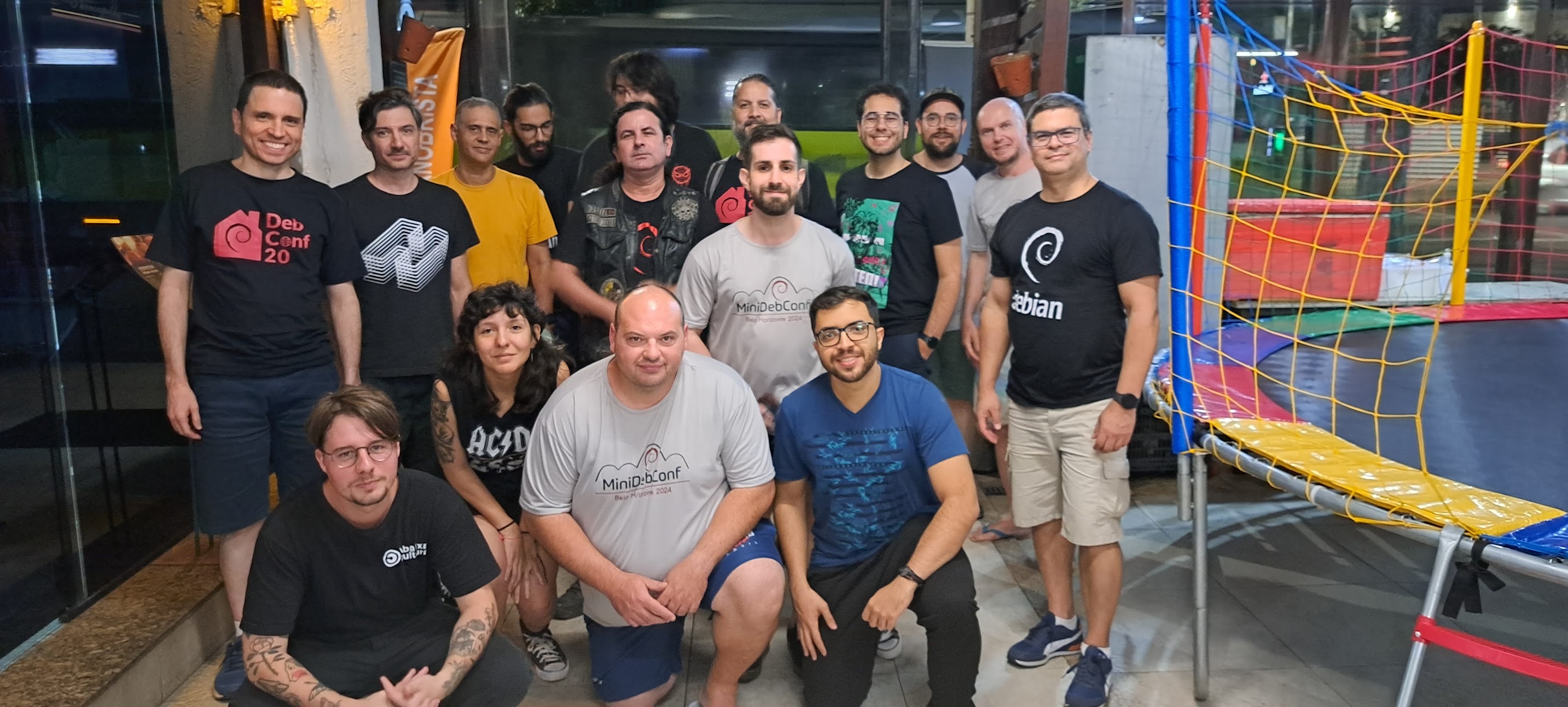
18 May 2024

Russell Coker: Kogan 5120*2160 40 Monitor

I ve just got a new Kogan 5120*2160 40 curved monitor. It cost $599 including shipping etc which is much cheaper than the Dell monitor with similar specs selling for about $2500. For monitors with better than 4K resolution (by which I don t mean 5K*1440) this is the cheapest option. The nearest competitors are the 27 monitors that do 5120*2880 from Apple and some companies copying Apple s specs. While 5120*2880 is a significantly better resolution than what I got it s probably not going to help me at 27 size. I ve had a Dell 32 4K monitor since the 1st of July 2022 [1]. It is a really good monitor and I had no complaints at all about it. It was clearer than the Samsung 27 4K monitor I used before it and I m not sure how much of that is due to better display technology (the Samsung was from 2017) and how much was due to larger size. But larger size was definitely a significant factor. I briefly owned a Phillips 43 4K monitor [2] and determined that a 43 flat screen was definitely too big. At the time I thought that about 35 would have been ideal but after a couple of years using a flat 32 screen I think that 32 is about the upper limit for a flat screen. This is the first curved monitor I ve used but I m already thinking that maybe 40 is too big for a 21:9 aspect ratio even with a curved screen. Maybe if it was 4:4 or even 16:9 that would be ok. Otherwise the ideal for a curved screen for me would be something between about 36 and 38 . Also 43 is awkward to move around my desk. But this is still quite close to ideal. The first system I tested this on was a work laptop, a Dell Latitude 7400 2in1. On the Dell dock that did 4K resolution and on a HDMI cable it did 1440p which was a disappointment as that laptop has talked to many 4K monitors at native resolution on the HDMI port with the same cable. This isn t an impossible problem, as I work in the IT department I can just go through all the laptops in the store room until I find one that supports it. But the 2in1 is a very nice laptop, so I might even just keep using it in 4K resolution when WFH. The laptop in question is deemed an executive laptop so I have to wait another 2 years for the executives to get new laptops before I can get a newer 2in1. On my regular desktop I had the problem of the display going off for a few seconds every minute or so and also occasionally giving a white flicker. That was using 5120*2160 with a DisplayPort switch as described in the blog post about the Dell 32 monitor. When I ran it in 4K resolution with the DisplayPort switch from my desktop it was fine. I then used the DisplayPort cable that came with the monitor directly connecting the video card to the display and it was fine at 5120*2160 with 75Hz. The monitor has the joystick thing that seems to have become some sort of standard for controlling modern monitors. It s annoying that pressing it in powers it off. I think there should be a separate button for that. Also the UI in general made me wonder if one of the vendors of expensive monitors had paid whoever designed it to make the UI suck. The monitor had a single dead pixel in the center of the screen about 1/4 the way down from the top when I started writing this post. Now it s gone away which is a concern as I don t know which pixels might have problems next or if the number of stuck pixels will increase. Also it would be good if there was a dark mode for the WordPress editor. I use dark mode wherever possible so I didn t notice the dead pixel for several hours until I started writing this blog post. I watched a movie on Netflix and it took the entire screen area, I don t know if they are storing movies in 64:27 ratio or if the clipped the top and bottom, it was probably clipped but still looked OK. The monitor has different screen modes which make it look different, I can t see much benefit to the different modes. The standard mode is what I usually use and it s brighter and the movie mode seems OK for the one movie I ve watched so far. In other news BenQ has just announced a 3840*2560 28 monitor specifically designed for programming [3]. This is the first time I ve heard of a monitor with 3:2 ratio with modern resolution, we still aren t at the 4:3 type ratio that we were used to when 640*480 was high resolution but it s a definite step in the right direction. It s also the only time I recall ever seeing a monitor advertised as being designed for programming. In the 80s there were home computers advertised as being computers for kids to program, but at that time it was either TV sets for monitors or monitors sold with computers. It was only after the IBM PC compatible market took off that having a choice of different monitors for one computer was a thing. In recent years monitors advertised as being for office use (meaning bright and expensive) have become common as are monitors designed for gamer use (meaning high refresh rate). But BenQ seems to be the first to advertise a monitor for the purpose of programming. They have a desktop partition feature (which could be software or hardware the article doesn t make it clear) to give some of the benefits of a tiled window manager to people who use OSs that don t support such things. The BenQ monitor is a bit small for my taste, I don t know if my vision is good enough to take advantage of 3840*2560 in a 28 monitor nowadays. I think at least 32 would be better. Google seems to be really into buying good monitors for their programmers, if every Google programmer got one of those BenQ monitors then that would be enough sales to make it worth-while for them. I had hoped that we would have 6K monitors become affordable this year and 8K become less expensive than most cars. Maybe that won t happen and we will instead have a wider range of products like the ultra wide monitor I just bought and the BenQ programmer s monitor. If so I don t think that will be a bad result. Now the question is whether I can use this monitor for 2 years before finding something else that makes me want to upgrade. I can afford to spend the equivalent of a bit under $1/day on monitor upgrades.

16 May 2024

John Goerzen: Review of Reputable, Functional, and Secure Email Service

I last reviewed email services in 2019. That review focused a lot of attention on privacy. At the time, I selected mailbox.org as my provider, and have been using them for these 5 years since. However, both their service and their support have gone significantly downhill since, so it is time for me to look at other options. Here I am focusing strongly on email. Some of the providers mentioned here provide other services (IM, video calls, groupware, etc.), and to the extent they do, I am ignoring them.

What Matters in 2024
I want to start off by acknowledging that what you need in email probably depends on your circumstances and the country in which you live. For me, I begin by naming that the largest threat most of us face isn t from state actors but from criminals: hackers, ransomware gangs, etc. It is important to take as many steps as possible to secure one s account against that. Privacy and security are both part of the mix. I still value privacy but I am acknowledging, as Migadu does, that Email as we know it and encryption are incompatible. Although some of these services strongly protect parts of the conversation, the reality is that most people will be emailing people using plain old email services which don t. For stronger security, something like Signal would be needed. (I wrote about Signal in 2021 also.) Interestingly, OpenPGP support seems to be something of a standard feature in the providers I reviewed by this point. All or almost all of them provide integration with browser-based encryption as well as server-side encryption if you prefer that. Although mailbox.org can automatically PGP-encrypt every message that arrives in plaintext, for general use, this is unwieldy; there isn t good tooling for searching mailboxes where every message is encrypted, etc. So I never enabled that feature at Mailbox. I still value security and privacy, but a pragmatic approach addresses the most pressing threats first.

My criteria
The basic requirements for an email service include:
  1. Ability to use my own domains
  2. Strong privacy policy
  3. Ability for me to use my own IMAP and SMTP clients on both desktop and mobile
  4. It must be extremely reliable
  5. It must not be free
  6. It must have excellent support for those rare occasions when it is needed
  7. Support for basic aliases
Why do I say it must not be free? Because if someone is providing a service with the quality I m talking about here, and not charging for it, it implies something is fishy: either they are unscrupulous, are financially unstable, or the product is something else like ads. I am not aware of any provider that matches the other criteria with a free account anyhow. These providers range from about $30 to $90 per year, so cheaper than a Netflix subscription. Immediately, this rules out several options:
  • Proton doesn t let me use my own clients on mobile (their bridge is desktop-only)
  • Tuta also doesn t let me use my own clients
  • Posteo doesn t let me use my own domain
  • mxroute.com lacks a strong privacy policy, and its policy has numerous causes for concern (for instance, If you repeatedly send email to invalid/unroutable recipients, they may be published on our GitHub )
I will have a bit more to say about a couple of these providers below. There are some additional criteria that are strongly desired but not absolutely required:
  1. Ability to set individual access passwords for every device/app
  2. Support for two-factor authentication (2FA/TFA/TOTP) for web-based access
  3. Support for basics in filtering: ability to filter on envelope recipient (so if I get BCC d, I can still filter), and ability to execute more than one action on filter match (eg, deliver to two folders, or deliver to a folder and forward to someone else)
IMAP and SMTP don t really support 2FA, so by setting individual passwords for every device, you can at least limit the blast radius and cut off a specific device if something is (or might be) compromised.

The candidates
I considered these providers: Startmail, Mailfence, Runbox, Fastmail, Kolab, Mailbox.org, and Migadu. I ll review each, and highlight the pricing of the plan I would most likely use. Each provider offers multiple plans; some may be more expensive and some may be cheaper than the one I reviewed. I included a link to each provider s full pricing information so you can compare for your needs. I set up trials with each of these (except Mailbox.org, with which I already had a paid account). It so happend that I had actual questions for support for each one, which gave me an opportunity to see how support responded. I did not fabricate questions, and would not have contacted support if I didn t have real ones. (This means that I asked different questions of each provider, because they were the REAL questions I had.) I ll jump to the spoiler right now: I eventually chose Migadu, with Fastmail and Mailfence as close seconds. I looked for providers myself, and also solicited recommendations in a Mastodon thread.

Mailbox.org
I begin with Mailbox, as it was my top choice in 2019 and the incumbent. Until this year, I had been quite happy with it. I had cause to reach their support less than once a year on average, and each time they replied the same day or next day. Now, however, they are failing on reliability and on support. Their spam filter has become overly aggressive. It has blocked quite a bit of legitimate mail. When contacting their support about a prior issue earlier this year, they initially took 4 days to reply, and then 6 days to reply after that. Ouch. They had me disable some spam settings. It didn t really help. I continue to lose mail. I don t know how much, because they block a lot of it before it even hits the spam folder. One of my friends texted to say mail was dropping. I raised a new ticket with mailbox, which took them 5 days to reply to. Their reply was unhelpful. As the Internet is not a static system, unforeseen events can always occur. Well yes, that s true, and I get it, false positives exist with email. But this was from an ISP s mail system with an address that had been established for years, and it was part of a larger pattern of rejecting quite a bit of legit mail. And every interaction with them recently hasn t resulted in them actually doing anything to resolve anything. It s just a paragraph or two of reply that does nothing and helps nothing. When I complained that it took 5 days to reply, they said We have not been able to reply sooner as we are currently experiencing a high volume of customer enquiries. Even though their SLA for my account is a not-great 48 business hour turnaround, they still missed it and their reason is we re busy. I finally asked what RBL had caught the blocked email, since when I checked, the sender wasn t on any RBL. Mailbox s reply: they only keep their logs for 7 days, so next time I should contact them within 7 days. Which, of course, I DID; it was them that kept delaying. Ugh! It s like they ve become a cable company. Even worse is how they have been blocking mail from GrapheneOS s discussion form. See their thread about it. In short, Graphene s mail server has a clean reputation and Mailbox has no problem with it. But because one of Graphene s IPv6 webservers has an IPv6 allocation of a size Mailbox doesn t like, they drop mail. It s ridiculous, and Mailbox was dismissive of this well-known and well-regarded Open Source project. So if the likes of GrapheneOS can t get good faith effort to deliver their mail, what chance does an individual like me have? I m sorry, but I m literally paying you to deliver email for me and provide good support. If you can t do either of those, you don t get to push that problem down onto me. Hire appropriate staff. On the technical side, they support aliases, my own clients, and have a reasonable privacy policy. Their 2FA support exists for the web interface (though weirdly not the support site), though it is somewhat weird. They do not support app passwords. A somewhat unique feature is the @secure.mailbox.org domain. If you try to receive mail at that address, mailbox.org will block it unless it uses TLS. Same for sending. This isn t E2EE, but it does at least require things not be in plaintext for the last hop to Mailbox. Verdict: not recommended due to poor reliability and support. Mailbox.Org summary:
  • Website: https://mailbox.org/en/
  • Reliability: iffy due to over-aggressive spam filtering
  • Support: Poor; takes 4-6 days for a reply and replies are unhelpful
  • Individual access passwords: No
  • 2FA: Yes, but with a PIN instead of a password as the other factor
  • Filtering: Full SIEVE feature set and GUI editor
  • Spam settings: greylisting on/off, reject some/all spam, etc. But they re insufficient to address Mailbox s overzealousness, which support says I cannot workaround within the interface.
  • Server storage location: Germany
  • Plan as reviewed: standard [pricing link]
    • Cost per year: EUR 30 (about $33)
    • Mail storage included: 10GB
    • Limits on send/receive volume: none
    • Aliases: 50 on your domain name, 25 on mailbox.org
    • Additional mailboxes: Available; each one at the same fee as the primary mailbox

Startmail
I really wanted to like Startmail. Its vault is an interesting idea and should contribute to the security and privacy of an account. They clearly care about privacy. It falls down in filtering. They have no way to filter on envelope recipient (BCC or similar). Their support confirmed this to me and that s a showstopper. Startmail support was also as slow as Mailbox, taking 5 days to respond to me. Two showstoppers right there. Verdict: Not recommended due to slow support responsiveness and weak filtering. Startmail summary:
  • Website: https://www.startmail.com/
  • Reliability: Seems to be fine
  • Support: Mediocre; Took 5 days for a reply, but the reply was helpful
  • Individual app access passwords: Yes
  • 2FA: Yes
  • Filtering: Poor; cannot filter on envelope recipient, and can t build filters with multiple actions
  • Spam settings: None
  • Server storage location: The Netherlands
  • Plan as reviewed: Custom domain (trial was Personal), [pricing link]
    • Cost per year: $70
    • Mail storage included: 20GB
    • Limits on send/receive volume: none
    • Aliases: unlimited, with lots of features: can set expiration, etc.
    • Additional mailboxes: not available

Kolab
Kolab Now is mainly positioned as a full groupware service, but they do have a email-only option which I investigated. There isn t much documentation about it compared to other providers, and also not much in the way of settings. You can turn greylisting on or off. And . that s it. It has a full suite of filtering options. They set an X-Envelope-To header which you can use with the arbitrary header match to do the right thing even for BCC situations. Filters can have multiple conditions and multiple actions. It is SIEVE-based and you can download your SIEVE definitions. If you enable 2FA, you disable IMAP and SMTP; not great. Verdict: Not an impressive enough email featureset to justify going with it. Kolab Now summary:
  • Website: https://kolabnow.com/
  • Reliability: Seems to be fine
  • Support: Fine responsiveness (next day)
  • Invidiaul app passwords: no
  • 2FA: Yes, but if you enable it, they disable IMAP and SMTP
  • Filtering: Excellent
  • Spam settings: Only greylisting on/off
  • Server storage location: Switzerland; they have lots of details on their setup
  • Plan as reviewed: Just email [pricing link]
    • Cost per year: CHF 60, about $66
    • Mail storage included: 5GB
    • Limitations on send/receive volume: None
    • Aliases: Yes. Not sure if there are limits.
    • Additional mailboxes: Yes if you set up a group account. Flexible pricing based on user count is not documented anywhere I could find.

Mailfence
Mailfence is another option, somewhat similar to Startmail but without the unique vault. I had some questions about filters, and support was quite responsive, responding in a couple of hours. Some of their copy on their website is a bit misleading, but support clarified when I asked them. They do not offer encryption at rest (like most of the entries here). Mailfence s filtering system is the kind I d like to see. It allows multiple conditions and multiple actions for each rule, and has some unique actions as well (notify by SMS or XMPP). Support says that Recipients matches envelope recipients. However, one ommission is that I can t match on arbitrary headers; only the canned list of headers they provide. They have only two spam settings:
  • spam filter on/off
  • whitelist
Given some recent complaints about their spam filter being overly aggressive, I find this lack of control somewhat concerning. (However, I discount complaints about people begging for more features in free accounts; free won t provide the kind of service I m looking for with any provider.) There are generally just very few settings for email as well. Verdict: Response and helpful support, filtering has the right structure but lacks arbitrary header match. Could be a good option. Mailfence summary:
  • Website: https://mailfence.com/
  • Reliability: Seems to be fine
  • Support: Excellent responsiveness and helpful replies (after some initial confusion about my question of greylisting)
  • Individual app access passwords: No. You can set a per-service password (eg, an IMAP password), but those will be shared with all devices speaking that protocol.
  • 2FA: Yes
  • Filtering: Good; only misses the ability to filter on arbitrary headers
  • Spam settings: Very few
  • Server storage location: Belgium
  • Plan as reviewed: Entry [pricing link]
    • Cost per year: $42
    • Mail storage included: 10GB, with a maximum of 50,000 messages
    • Limits on send/receive volume: none
    • Aliases: 50. Aliases can t be deleted once created (there may be an exeption to this for aliases on your own domain rather than mailfence.com)
    • Additional mailboxes: Their page on this is a bit confusing, and the pricing page lacks the information promised. It looks like you can pay the same $42/year for additional mailboxes, with a limit of up to 2 additional paid mailboxes and 2 additional free mailboxes tied to the account.

Runbox
This one came recommended in a Mastodon thread. I had some questions about it, and support response was fantastic I heard from two people that were co-founders of the company! Even within hours, on a weekend. Incredible! This kind of response was only surpassed by Migadu. I initially wrote to Runbox with questions about the incoming and outgoing message limits, which I hadn t seen elsewhere, as well as the bandwidth limit. They said the bandwidth limit is no longer enforced on paid accounts. The incoming and outgoing limits are enforced, and all email (even spam) counts towards the limit. Notably the outgoing limit is per recipient, so if you send 10 messages to your 50-recipient family group, that s the limit. However, they also indicated a willingness to reset the limit if something happens. Unfortunately, hitting the limit results in a hard bounce (SMTP 5xx) rather than a temporary failure (SMTP 4xx) so it can result in lost mail. This means I d be worried about some attack or other weirdness causing me to lose mail. Their filter is a pain point. Here are the challenges:
  • You can t directly match on a BCC recipient. Support advised to use a headers match, which will search for something anywhere in the headers. This works and is probably good enough since this data is in the Received: headers, but it is a little more imprecise.
  • They only have a contains , not an equals operator. So, for instance, a pattern searching for test@example.com would also match newtest@example.com . Support advised to put the email address in angle brackets to avoid this. That will work mostly. Angle brackets aren t always required in headers.
  • There is no way to have multiple actions on the filter (there is just no way to file an incoming message into two folders). This was the ultimate showstopper for me.
Support advised they are planning to upgrade the filter system in the future, but these are the limitations today. Verdict: A good option if you don t need much from the filtering system. Lots of privacy emphasis. Runbox summary:
  • Website: https://runbox.com/
  • Reliability: Seems to be fine, except returning 5xx codes if per-day limits are exceeded
  • Support: Excellent responsiveness and replies from founders
  • Individual app passwords: Yes
  • 2FA: Yes
  • Filtering: Poor
  • Spam settings: Very few
  • Server storage location: Norway
  • Plan as reviewed: Mini [pricing link]
    • Cost per year: $35
    • Mail storage included: 10GB
    • Limited on send/receive volume: Receive 5000 messages/day, Send 500 recipients/day
    • Aliases: 100 on runbox.com; unlimited on your own domain
    • Additional mailboxes: $15/yr each, also with 10GB non-shared storage per mailbox

Fastmail
Fastmail came recommended to me by a friend I ve known for decades. Here s the thing about Fastmail, compared to all the services listed above: It all just works. Everything. Filtering, spam prevention, it is all there, all feature-complete, and all just does the right thing as you d hope. Their filtering system has a canned dropdown for To/Cc/Bcc , it supports multiple conditions and multiple actions, and just does the right thing. (Delivering to multiple folders is a little cumbersome but possible.) It has a particularly strong feature set around administering multiple accounts, including things like whether users can prevent admins from reading their mail. The not-so-great part of the picture is around privacy. Fastmail is based in Australia, where the government has extensive power around spying on data, even to the point of forcing companies to add wiretap capabilities. Fastmail s privacy policy states user data may be held in Australia, USA, India, and Netherlands. By default, they share data with unidentified spam companies , though you can disable this in settings. On the other hand, they do make a good effort towards privacy. I contacted support with some questions and got back a helpful response in three hours. However, one of the questions was about in which countries my particular data would be stored, and the support response said they would have to get back to me on that. It s been several days and no word back. Verdict: A featureful option that just works , with a lot of features for managing family accounts and the like, but lacking in the privacy area. Fastmail summary:
  • Website: https://www.fastmail.com/
  • Reliability: Seems to be fine
  • Support: Good response time on most questions; dropped the ball on one tha trequired research
  • Individual app access passwords: Yes
  • 2FA: Yes
  • Filtering: Excellent
  • Spam settings: Can set filter aggressiveness, decide whether to share spam data with spam-fighting companies , configure how to handle backscatter spam, and evaluate the personal learning filter.
  • Server storage locations: Australia, USA, India, and The Netherlands. Legal jurisdiction is Australia.
  • Plan as reviewed: Individual [pricing link]
    • Cost per year: $60
    • Mail storage included: 50GB
    • Limits on send/receive volume: 300/hour
    • Aliases: Unlimited from what I can see
    • Additional mailboxes: No; requires a different plan for that

Migadu
Migadu was a service I d never heard of, but came recommended to me on Mastodon. I listed Migadu last because it is a class of its own compared to all the other options. Every other service is basically a webmail interface with a few extra settings tacked on. Migadu has a full-featured email admin console in addition. By that I mean you can:
  • View usage graphs (incoming, outgoing, storage) over time
  • Manage DNS (if you want Migadu to run your nameservers)
  • Manage multiple domains, and cross-domain relationships with mailboxes
  • View a limited set of logs
  • Configure accounts, reset their passwords if needed/authorized, etc.
  • Configure email address rewrite rules with wildcards and so forth
Basically, if you were the sort of person that ran your own mail servers back in the day, here is Migadu giving you most of that functionality. Effectively you have a web interface to do all the useful stuff, and they handle the boring and annoying bits. This is a really attractive model. Migadu support has been fantastic. They are quick to respond, and went above and beyond. I pointed out that their X-Envelope-To header, which is needed for filtering by BCC, wasn t being added on emails I sent myself. They replied 5 hours later indicating they had added the feature to add X-Envelope-To even for internal mails! Wow! I am impressed. With Migadu, you buy a pool of resources: storage space and incoming/outgoing traffic. What you do within that pool is up to you. You can set up users ( mailboxes ), aliases, domains, whatever you like. It all just shares the pool. You can restrict users further so that an individual user has access to only a subset of the pool resources. I was initially concerned about Migadu s daily send/receive message count limits, but in visiting with support and reading the documentation, what really comes out is that Migadu is a service with a personal touch. Hitting the incoming traffic limit will cause a SMTP temporary fail (4xx) response so you won t lose legit mail and support will work with you if it s a problem for legit uses. In other words, restrictions are soft and they are interpreted reasonably. One interesting thing about Migadu is that they do not offer accounts under their domain. That is, you MUST bring your own domain. That s pretty easy and cheap, of course. It also puts you in a position of power, because it is easy to migrate email from one provider to another if you own the domain. Filtering is done via SIEVE. There is a GUI editor which lets you accomplish most things, though it has an odd blind spot where you can t file a message into multiple folders. However, you can edit a SIEVE ruleset directly and you get the full SIEVE featureset, which is extensive (and does support filing a message into multiple folders). I note that the SIEVE :envelope match doesn t work, but Migadu adds an X-Envelope-To header which is just as good. I particularly love a company that tells you all the reasons you might not want to use them. Migadu s pro/con list is an honest drawbacks list (of course, their homepage highlights all the features!). Verdict: Fantastically powerful, excellent support, and good privacy. I chose this one. Migadu summary:
  • Website: https://migadu.com/
  • Reliability: Excellent
  • Support: Fantastic. Good response times and they added a feature (or fixed a bug?) a few hours after I requested it.
  • Individual access passwords: Yes. Create identities to support them.
  • 2FA: Yes, on both the admin interface and the webmail interface
  • Filtering: Excellent, based on SIEVE. GUI editor doesn t support multiple actions when filing into a folder, but full SIEVE functionality is exposed.
  • Spam settings:
    • On the domain level, filter aggressiveness, Greylisting on/off, black and white lists
    • On the mailbox level, filter aggressiveness, black and whitelists, action to take with spam; compatible with filters.
  • Server storage location: France; legal jurisdiction Switzerland
  • Plan as reviewed: mini [pricing link]
    • Cost per year: $90
    • Mail storage included: 30GB ( soft quota)
    • Limits on send/receive volume: 1000 messgaes in/day, 100 messages out/day ( soft quotas)
    • Aliases: Unlimited on an unlimited number of domains
    • Additional mailboxes: Unlimited and free; uses pooled quotas, but individual quotas can be set

Others
Here are a few others that I didn t think worthy of getting a trial:
  • mxroute was recommended by several. Lots of concerning things in their policy, such as:
    • if you repeatedly send mail to unroutable recipients, they may publish the addresses on Github
    • they will terminate your account if they think you are rude or want to contest a charge
    • they reserve the right to cancel your service at any time for any (or no) reason.
  • Proton keeps coming up, and I will not consider it so long as I am locked into their client on mobile.
  • Skiff comes up sometimes, but they were acquired by Notion.
  • Disroot comes up; this discussion highlights a number of reasons why I avoid them. Their Terms of Service (ToS) is inconsistent with a general-purpose email account (I guess for targeting nonprofits and activists, that could make sense). Particularly laughable is that they claim to be friends of Open Source, but then would take down your account if you upload copyrighted material. News flash: in order for an Open Source license to be meaningful, the underlying work is copyrighted. It is perfectly legal to upload copyrighted material when you wrote it or have the license to do so!

Conclusions
There are a lot of good options for email hosting today, and in particular I appreciate the excellent personal support from companies like Migadu and Runbox. Support small businesses!

14 May 2024

Dirk Eddelbuettel: RApiSerialize 0.1.3 on CRAN: Skipping XDR

A new bug fix release 0.1.3 of RApiSerialize got onto CRAN earlier today. This is the first release in well over a year, and permits the skip the XDR serialization format which is needed when transfering between big- and little-endian machines. But it comes at a certain run-time cost one can avoid on the (much more common) little-endian machines. This is a new option, and the old behavior is the default. Those who want to can now skip the step. The RApiSerialize package is used by both my RcppRedis as well as by Travers excellent qs package. We also addressed the recent nag by the CRAN concerning NO_REMAP .

Changes in version 0.1.3 (2024-05-13)
  • Add an xdr argument to disable XDR for an approx. threefold speed increase (Travers Ching and Dirk in #6)
  • Use R_NO_REMAP and Rf_* prefix for API calls
  • Minor continuous integration updates

Courtesy of my CRANberries, there is a diffstat report relative to previous release. More details are at the RApiSerialize page; code, issue tickets etc at the GitHub repositoryrapiserializerepo. If you like this or other open-source work I do, you can sponsor me at GitHub.

This post by Dirk Eddelbuettel originated on his Thinking inside the box blog. Please report excessive re-aggregation in third-party for-profit settings.

Evgeni Golov: Using Packit to build RPMs for projects that depend on or vendor your code

I am a huge fan of Packit as it allows us to provide RPMs to our users and testers directly from a pull-request, thus massively tightening the feedback loop and involving people who otherwise might not be able to apply the changes (for whatever reason) and "quickly test" something out. It's also a great way to validate that a change actually builds in a production environment, where no unnecessary development and test dependencies are installed. You can also run tests of the built packages on Testing Farm and automate pushing releases into Fedora/CentOS Stream, but this is neither a (plain) Packit advertisement post, nor is that functionality that I can talk about with a certain level of experience. Adam recently asked why we don't have Packit builds for our our Puppet modules and my first answer was: "well, puppet-* doesn't produce a thing we ship directly, so nobody dared to do it". My second answer was that I had blogged how to test a Puppet module PR with Packit, but I totally agree that the process was a tad cumbersome and could be improved. Now some madman did it and we all get to hear his story! ;-) What is the problem anyway? The Foreman Installer is a bit of Ruby code1 that provides a CLI to puppet apply based on a set of Puppet modules. As the Puppet modules can also be used outside the installer and have their own lifecycle, they live in separate git repositories and their releases get uploaded to the Puppet Forge. Users however do not want to (and should not have to) install the modules themselves. So we have to ship the modules inside the foreman-installer package. Packaging 25 modules for two packaging systems (we support Enterprise Linux and Debian/Ubuntu) seems like a lot of work. Especially if you consider that the main foreman-installer package would need to be rebuilt after each module change as it contains generated files based on the modules which are too expensive to generate at runtime. So we can ship the modules inside the foreman-installer source release, thus vendoring those modules into the installer release. To do so we use librarian-puppet with a Puppetfile and either a Puppetfile.lock for stable releases or by letting librarian-puppet fetch latest for nightly snapshots. This works beautifully for changes that land in the development and release branches of our repositories - regardless if it's foreman-installer.git or any of the puppet-*.git ones. It also works nicely for pull-requests against foreman-installer.git. But because the puppet-* repositories do not map to packages, we assumed it wouldn't work well for pull-requests against those. How can we solve this? Well, the "obvious" solution is to build the foreman-installer package via Packit also for pull-requests against the puppet-* repositories. However, as usual, the devil is in the details. Packit by default clones the repository of the pull-request and tries to create a source tarball from that using git archive. As this might be too simple for many projects, one can define a custom create-archive action that runs after the pull-request has been cloned and produces the tarball instead. We already use that in the Packit configuration for foreman-installer to run the pkg:generate_source rake target which executes librarian-puppet for us. But now the pull-request is against one of the Puppet modules, so Packit will clone that, not the installer. We gotta clone foreman-installer on our own. And then point librarian-puppet at the pull-request. Fun. Cloning is relatively simple, call git clone -- sorry Packit/Copr infrastructure. But the Puppet module pull-request? One can use :git => 'https://git.example.com/repo.git' in the Puppetfile to fetch a git repository. In fact, that's what we already do for our nightly snapshots. It also supports :ref => 'some_branch_or_tag_name', if the remote HEAD is not what you want. My brain first went "I know this! GitHub has this magic refs/pull/1/head and refs/pull/1/merge refs you can checkout to get the contents of the pull-request without bothering to add a remote for the source of the pull-request". Well, this requires to know the ID of the pull-request and Packit does not expose that in the environment variables available during create-archive. Wait, but we already have a checkout. Can we just say :git => '../.git'? Cloning a .git folder is totally possible after all.
[Librarian]     --> fatal: repository '../.git' does not exist
Could not checkout ../.git: fatal: repository '../.git' does not exist
Seems librarian disagrees. Damn. (Yes, I checked, the path exists.) does it maybe just not like relative paths?! Yepp, using an absolute path absolutely works! For some reason it ends up checking out the default HEAD of the "real" (GitHub) remote, not of ../. Luckily this can be fixed by explicitly passing :ref => 'origin/HEAD', which resolves to the branch Packit created for the pull-request. Now we just need to put all of that together and remember to execute all commands from inside the foreman-installer checkout as that is where all our vendoring recipes etc live. Putting it all together Let's look at the diff between the packit.yaml for foreman-installer and the one I've proposed for puppet-pulpcore:
--- a/foreman-installer/.packit.yaml    2024-05-14 21:45:26.545260798 +0200
+++ b/puppet-pulpcore/.packit.yaml  2024-05-14 21:44:47.834162418 +0200
@@ -18,13 +18,15 @@
 actions:
   post-upstream-clone:
     - "wget https://raw.githubusercontent.com/theforeman/foreman-packaging/rpm/develop/packages/foreman/foreman-installer/foreman-installer.spec -O foreman-installer.spec"
+    - "git clone https://github.com/theforeman/foreman-installer"
+    - "sed -i '/theforeman.pulpcore/ s@:git.*@:git => \"# __dir__ /../.git\", :ref => \"origin/HEAD\"@' foreman-installer/Puppetfile"
   get-current-version:
-    - "sed 's/-develop//' VERSION"
+    - "sed 's/-develop//' foreman-installer/VERSION"
   create-archive:
-    - bundle config set --local path vendor/bundle
-    - bundle config set --local without development:test
-    - bundle install
-    - bundle exec rake pkg:generate_source
+    - bash -c "cd foreman-installer && bundle config set --local path vendor/bundle"
+    - bash -c "cd foreman-installer && bundle config set --local without development:test"
+    - bash -c "cd foreman-installer && bundle install"
+    - bash -c "cd foreman-installer && bundle exec rake pkg:generate_source"
  1. It clones foreman-installer (in post-upstream-clone, as that felt more natural after some thinking)
  2. It adjusts the Puppetfile to use # __dir__ /../.git as the Git repository, abusing the fact that a Puppetfile is really just a Ruby script (sorry Ben!) and knows the __dir__ it lives in
  3. It fetches the version from the foreman-installer checkout, so it's sort-of reasonable
  4. It performs all building inside the foreman-installer checkout
Can this be used in other scenarios? I hope so! Vendoring is not unheard of. And testing your "consumers" (dependents? naming is hard) is good style anyway!

  1. three Ruby modules in a trench coat, so to say

Julian Andres Klode: The new APT 3.0 solver

APT 2.9.3 introduces the first iteration of the new solver codenamed solver3, and now available with the solver 3.0 option. The new solver works fundamentally different from the old one.

How does it work? Solver3 is a fully backtracking dependency solving algorithm that defers choices to as late as possible. It starts with an empty set of packages, then adds the manually installed packages, and then installs packages automatically as necessary to satisfy the dependencies. Deferring the choices is implemented multiple ways: First, all install requests recursively mark dependencies with a single solution for install, and any packages that are being rejected due to conflicts or user requests will cause their reverse dependencies to be transitively marked as rejected, provided their or group cannot be solved by a different package. Second, any dependency with more than one choice is pushed to a priority queue that is ordered by the number of possible solutions, such that we resolve a b before a b c. Not just by the number of solutions, though. One important point to note is that optional dependencies, that is, Recommends, are always sorting after mandatory dependencies. Do note on that: Recommended packages do not nest in backtracking - dependencies of a Recommended package themselves are not optional, so they will have to be resolved before the next Recommended package is seen in the queue. Another important step in deferring choices is extracting the common dependencies of a package across its version and then installing them before we even decide which of its versions we want to install - one of the dependencies might cycle back to a specific version after all. Decisions about package levels are recorded at a certain decision level, if we reach a conflict we backtrack to the previous decision level, mark the decision we made (install X) in the inverse (DO NOT INSTALL X), reset all the state all decisions made at the higher level, and restore any dependencies that are no longer resolved to the work queue.

Comparison to SAT solver design. If you have studied SAT solver design, you ll find that essentially this is a DPLL solver without pure literal elimination. A pure literal eliminitation phase would not work for a package manager: First negative pure literals (packages that everything conflicts with) do not exist, and positive pure literals (packages nothing conflicts with) we do not want to mark for install - we want to install as little as possible (well subject, to policy). As part of the solving phase, we also construct an implication graph, albeit a partial one: The first package installing another package is marked as the reason (A -> B), the same thing for conflicts (not A -> not B). Once we have added the ability to have multiple parents in the implication graph, it stands to reason that we can also implement the much more advanced method of conflict-driven clause learning; where we do not jump back to the previous decision level but exactly to the decision level that caused the conflict. This would massively speed up backtracking.

What changes can you expect in behavior? The most striking difference to the classic APT solver is that solver3 always keeps manually installed packages around, it never offers to remove them. We will relax that in a future iteration so that it can replace packages with new ones, that is, if your package is no longer available in the repository (obsolete), but there is one that Conflicts+Replaces+Provides it, solver3 will be allowed to install that and remove the other. Implementing that policy is rather trivial: We just need to queue obsolete replacement as a dependency to solve, rather than mark the obsolete package for install. Another critical difference is the change in the autoremove behavior: The new solver currently only knows the strongest dependency chain to each package, and hence it will not keep around any packages that are only reachable via weaker chains. A common example is when gcc-<version> packages accumulate on your system over the years. They all have Provides: c-compiler and the libtool Depends: gcc c-compiler is enough to keep them around.

New features The new option --no-strict-pinning instructs the solver to consider all versions of a package and not just the candidate version. For example, you could use apt install foo=2.0 --no-strict-pinning to install version 2.0 of foo and upgrade - or downgrade - packages as needed to satisfy foo=2.0 dependencies. This mostly comes in handy in use cases involving Debian experimental or the Ubuntu proposed pockets, where you want to install a package from there, but try to satisfy from the normal release as much as possible. The implication graph building allows us to implement an apt why command, that while not as nicely detailed as aptitude, at least tells you the exact reason why a package is installed. It will only show the strongest dependency chain at first of course, since that is what we record.

What is left to do? At the moment, error information is not stored across backtracking in any way, but we generally will want to show you the first conflict we reach as it is the most natural one; or all conflicts. Currently you get the last conflict which may not be particularly useful. Likewise, errors currently are just rendered as implication graphs of the form [not] A -> [not] B -> ..., and we need to put in some work to present those nicely. The test suite is not passing yet, I haven t really started working on it. A challenge is that most packages in the test suite are manually installed as they are mocked, and the solver now doesn t remove those. We plan to implement the replacement logic such that foo can be replaced by foo2 Conflicts/Replaces/Provides foo without needing to be automatically installed. Improving the backtracking to be non-chronological conflict-driven clause learning would vastly enhance our backtracking performance. Not that it seems to be an issue right now in my limited testing (mostly noble 64-bit-time_t upgrades). A lot of that complexity you have normally is not there because the manually installed packages and resulting unit propagation (single-solution Depends/Reverse-Depends for Conflicts) already ground us fairly far in what changes we can actually make. Once all the stuff has landed, we need to start rolling it out and gather feedback. On Ubuntu I d like automated feedback on regressions (running solver3 in parallel, checking if result is worse and then submitting an error to the error tracker), on Debian this could just be a role email address to send solver dumps to. At the same time, we can also incrementally start rolling this out. Like phased updates in Ubuntu, we can also roll out the new solver as the default to 10%, 20%, 50% of users before going to the full 100%. This will allow us to capture regressions early and fix them.

Taavi V n nen: Wikimedia Hackathon Tallinn 2024

This year's Wikimedia Hackathon was held in early May in Tallinn, Estonia. Like last year, it was a great opportunity to both see people I work with regularly, including people in my own team that I had not seen in person before, and to work with and help people that I have had very limited interactions with before. Me talking with Addshore at the Wikimedia Hackathon 2024 hacking room.
Image by Olari Pilnik is licensed under CC BY-SA 4.0.
I presented a session about Puppet (slides), the configuration management tool used on Wikimedia infrastructure (and some other projects I've been involved on) which I think went quite well. I also organized (read: picked a spot for in the schedule) the cuteness meetup. In addition to the sessions, the main focus of the event was, of course, hacking. As usual, I didn't make any major plans beforehand, and instead ended up working on several smaller projects as they popped up. Here is a list of things I can remember working on: Finally, a conversation I had at the hackathon resulted in me nominating Novem Linguae for mediawiki/* +2 access a few days after the hackathon. I had a great time, and the ferry trip to Tallinn was much nicer than the very early flight I had last year. I can't wait to see you all again :-) Disclosure: I am currently a Wikimedia Foundation contractor, and the Foundation did pay for my travel to Tallinn. This is my personal blog and these are my own opinions.

  1. Since backporting this change felt too risky to do on the weekend, and also I have a feeling I'd get in troble if I ran an unapproved bot that edited on random wikis on our production wiki farm.
  2. Anyone who got 5 or more patches to core.git merged during the Hackathon got a cool MediaWiki T-shirt.

Next.

Previous.