Search Results: "jan"

30 April 2016

Chris Lamb: Free software activities in April 2016

Here is my monthly update covering a large part of what I have been doing in the free software world (previously):
Debian My work in the Reproducible Builds project was covered in our weekly reports. (#48, #49, #50, #51 & #52)
Uploads
  • redis (2:3.0.7-3) Adding, amongst some other changes, systemd LimitNOFILE support to allow a higher number of open file descriptors.


FTP Team

As a Debian FTP assistant I ACCEPTed 135 packages: aptitude, asm, beagle, blends, btrfs-progs, camitk, cegui-mk2, cmor-tables, containerd, debian-science, debops, debops-playbooks, designate-dashboard, efitools, facedetect, flask-testing, fstl, ganeti-os-noop, gnupg, golang-fsnotify, golang-github-appc-goaci, golang-github-benbjohnson-tmpl, golang-github-dchest-safefile, golang-github-docker-go, golang-github-dylanmei-winrmtest, golang-github-hawkular-hawkular-client-go, golang-github-hlandau-degoutils, golang-github-hpcloud-tail, golang-github-klauspost-pgzip, golang-github-kyokomi-emoji, golang-github-masterminds-semver-dev, golang-github-masterminds-vcs-dev, golang-github-masterzen-xmlpath, golang-github-mitchellh-ioprogress, golang-github-smartystreets-assertions, golang-gopkg-hlandau-configurable.v1, golang-gopkg-hlandau-easyconfig.v1, golang-gopkg-hlandau-service.v2, golang-objx, golang-pty, golang-text, gpaste, gradle-plugin-protobuf, grip, haskell-brick, haskell-hledger-ui, haskell-lambdabot-haskell-plugins, haskell-text-zipper, haskell-werewolf, hkgerman, howdoi, jupyter-client, jupyter-core, letsencrypt.sh, libbpp-phyl, libbpp-raa, libbpp-seq, libbpp-seq-omics, libcbor-xs-perl, libdancer-plugin-email-perl, libdata-page-pageset-perl, libevt, libevtx, libgit-version-compare-perl, libgovirt, libmsiecf, libnet-ldap-server-test-perl, libpgobject-type-datetime-perl, libpgobject-type-json-perl, libpng1.6, librest-client-perl, libsecp256k1, libsmali-java, libtemplates-parser, libtest-requires-git-perl, libtext-xslate-perl, linux, linux-signed, mandelbulber2, netlib-java, nginx, node-rc, node-utml, nvidia-cuda-toolkit, openfst, openjdk-9, openssl, php-cache-integration-tests, pulseaudio, pyfr, pygccxml, pytest-runner, python-adventure, python-arrayfire, python-django-feincms, python-fastimport, python-fitsio, python-imagesize, python-lib389, python-libtrace, python-neovim-gui, python3-proselint, pythonpy, pyzo, r-cran-ca, r-cran-fitbitscraper, r-cran-goftest, r-cran-rnexml, r-cran-rprotobuf, rrdtool, ruby-proxifier, ruby-seamless-database-pool, ruby-syslog-logger, rustc, s5, sahara-dashboard, salt-formula-ceilometer, salt-formula-cinder, salt-formula-glance, salt-formula-heat, salt-formula-horizon, salt-formula-keystone, salt-formula-neutron, salt-formula-nova, seer, simplejson, smrtanalysis, tiles-autotag, tqdm, tran, trove-dashboard, vim, vulkan, xapian-bindings & xapian-core.

28 April 2016

Michal Čihař: Weblate 2.6

Going back to faster release cycle, Weblate 2.6 has been just released. There is improved support for Python 3 or brand new HTTP REST API. Full list of changes for 2.6: If you are upgrading from older version, please follow our upgrading instructions. You can find more information about Weblate on https://weblate.org, the code is hosted on Github. If you are curious how it looks, you can try it out on demo server. You can login there with demo account using demo password or register your own user. Weblate is also being used https://hosted.weblate.org/ as official translating service for phpMyAdmin, OsmAnd, Aptoide, FreedomBox, Weblate itself and many other projects. Should you be looking for hosting of translations for your project, I'm happy to host them for you or help with setting it up on your infrastructure. Further development of Weblate would not be possible without people providing donations, thanks to everybody who have helped so far! The roadmap for next release is just being prepared, you can influence this by expressing support for individual issues either by comments or by providing bounty for them.

Filed under: English phpMyAdmin SUSE Weblate 0 comments

25 April 2016

Gunnar Wolf: Passover / Pesaj, a secular viewpoint, a different viewpoint... And slowly becoming history!

As many of you know (where "you" is "people reading this who actually know who I am), I come from a secular Jewish family. Although we have some religious (even very religious) relatives, neither my parents nor my grandparents were religious ever. Not that spirituality wasn't important to them My grandparents both went deep into understanding by and for themselves the different spiritual issues that came to their mind, and that's one of the traits I most remember about them while I was growing up. But formal, organized religion was never much welcome in the family; again, each of us had their own ways to concile our needs and fears with what we thought, read and understood. This week is the Jewish celebration of Passover, or Pesaj as we call it (for which Passover is a direct translation, as Pesaj refers to the act of the angel of death passing over the houses of the sons of Israel during the tenth plague in Egypt; in Spanish, the name would be Pascua, which rather refers to the ritual sacrifice of a lamb that was done in the days of the great temple)... Anyway, I like giving context to what I write, but it always takes me off the main topic I want to share. Back to my family. I am a third-generation member of the Hashomer Hatzair zionist socialist youth movement; my grandmother was among the early Hashomer Hatzair members in Poland in the 1920s, both my parents were active in the Mexico ken in the 1950s-1960s (in fact, they met and first interacted there), and I was a member from 1984 until 1996. It was also thanks to Hashomer that my wife and I met, and if my children get to have any kind of Jewish contact in their lifes, I hope it will be through Hashomer as well. Hashomer is a secular, nationalist movement. A youth movement with over a century of history might seem like a contradiction. Over the years, of course, it has changed many details, but as far as I know, the essence is still there, and I hope it will continue to be so for good: Helping shape integral people, with identification with Judaism as a nation and not as a religion; keeping our cultural traits, but interpreting them liberally, and aligned with a view towards the common good Socialism, no matter how the concept seems pass nowadays. Colectivism. Inclusion. Peaceful coexistence with our neighbours. Acceptance of the different. I could write pages on how I learnt about each of them during my years in Hashomer, how such concepts striked me as completely different as what the broader Jewish community I grew up in understood and related to them... But again, I am steering off the topic I want to pursue. Every year, we used to have a third Seder (that is, a third Passover ceremony) at Hashomer. A third one, because as tradition mandates two ceremonies to be held outside Israel, and a movement comprised of people aged between 7 and 21, having a seder competing with the familiar one would not be too successful, we held a celebration on a following day. But it would never be the same as the "formal" Pesaj: For the Seder, the Jewish tradition mandates following the Hagada The Seder always follows a predetermined order (literally, Seder means order), and the Hagad (which means both legend and a story that is spoken; you can find full Hagadot online if you want to see what rites are followed; I found a seemingly well done, modern, Hebrew and English version, a more traditional one, in Hebrew and Spanish, and Wikipedia has a description including its parts and rites) is, quite understandably, full with religious words, praises for God, and... Well, many things that are not in line with Hashomer's values. How could we be a secular movement and have a big celebration full with praises for God? How could we yearn for life in the kibbutz distance from the true agricultural meaning of the celebration? The members of Hashomer Hatzair repeatedly took on the task (or, as many would see it, the heresy) of adapting the Hagada to follow their worldview, updated it for the twentieth century, had it more palatable for our peculiarities. Yesterday, when we had our Seder, I saw my father still has together with the other, more traditional Hagadot we use two copies of the Hagad he used at Hashomer Hatzair's third Seder. And they are not only beautiful works showing what they, as very young activists thought and made solemn, but over time, they are becoming historic items by themselves (one when my parents were still young janijim, in 1956, and one when they were starting to have responsabilities and were non-formal teachers or path-showers, madrijim, in 1959). He also had a copy of the Hagad we used in the 1980s when I was at Hashomer; this last one was (sadly?) not done by us as members of Hashomer, but prepared by a larger group between Hashomer Hatzair and the Mexican friends of Israeli's associated left wing party, Mapam. This last one, I don't know which year it was prepared and published on, but I remember following it in our ceremony. So, I asked him to borrow me the three little books, almost leaflets, and scanned them to be put online. Of course, there is no formal licensing information in them, much less explicit authorship information, but they are meant to be shared So I took the liberty of uploading them to the Internet Archive, tagging them as CC-0 licensed. And if you are interested in them, flowing over and back between Spanish and Hebrew, with many beautiful texts adapted for them from various sources, illustrated by our own with the usual heroic, socialist-inspired style, and lovingly hand-reproduced using the adequate technology for their day... Here they are: I really enjoyed the time I took scanning and forming them, reading some passages, imagining ourselves and my parents as youngsters, remembering the beautiful work we did at such a great organization. I hope this brings this joy to others like it did to me. , . Once shomer, always shomer.

24 April 2016

Norbert Preining: Armenia and Turkey Erdo an did it again

It is 101 years to the day that Turkey started the first genocide of the 20th century, the Armenian Genocide. And Recep Tayyip Erdo an, the populistic and seemingly maniac president of Turkey, does not drop any chance to continue the shame of Turkey. armenien-genocide After having sued a German comedian of making fun of him followed promptly by an as shameful cowtow of Merkel by allowing the jurisdiction to start prosecuting Jan B hmermann, heis continuing suing other journalists, and above all putting pressure on the European Community to not support a concert tour of the Dresdner Sinfoniker in memoriam of the genocide. European Values have disappeared, and politicians pay stupid tribute to a dictator-like Erdo an who is destroying free speech and free media, not only in his country but all around the world. Must be a good friend of Abe, both are installing anti-freedom laws. Shame on Europe for this. And Turkey, either vote Erdo an out of office, or you should not (and hopefully will never) be allowed into the EC, because you don t belong there.

17 April 2016

Andreas Metzler: balance sheet snowboarding season 2015/16

A very weak season, mainly due to two reasons: Here is the balance sheet:
2005/06 2006/07 2007/08 2008/09 2009/10 2010/11 2011/12 2012/13 2013/14 2014/15 2015/2016
number of (partial) days2517293730302523302417
Dam ls101051016231042994
Diedamskopf1542423134141911312
Warth/Schr cken03041310021
total meters of altitude12463474096219936226774202089203918228588203562274706224909138037
highscore10247m8321m12108m11272m11888m10976m13076m13885m12848m1327811015
# of runs309189503551462449516468597530354

10 April 2016

Russ Allbery: Largish haul

Let's see if I can scrounge through all of my now-organized directories of ebooks and figure out what I haven't recorded here yet. At least the paper books make that relatively easy, since I don't shelve them until I post them. (Yeah, yeah, I should actually make a database.) Hugh Aldersey-Williams Periodic Tales (nonfiction)
Sandra Ulbrich Almazan SF Women A-Z (nonfiction)
Radley Balko Rise of the Warrior Cop (nonfiction)
Peter V. Brett The Warded Man (sff)
Lois McMaster Bujold Gentleman Jole and the Red Queen (sff)
Fred Clark The Anti-Christ Handbook Vol. 2 (nonfiction)
Dave Duncan West of January (sff)
Karl Fogel Producing Open Source Software (nonfiction)
Philip Gourevitch We Wish to Inform You That Tomorrow We Will Be Killed With Our Families (nonfiction)
Andrew Groen Empires of EVE (nonfiction)
John Harris @ Play (nonfiction)
David Hellman & Tevis Thompson Second Quest (graphic novel)
M.C.A. Hogarth Earthrise (sff)
S.L. Huang An Examination of Collegial Dynamics... (sff)
S.L. Huang & Kurt Hunt Up and Coming (sff anthology)
Kameron Hurley Infidel (sff)
Kevin Jackson-Mead & J. Robinson Wheeler IF Theory Reader (nonfiction)
Rosemary Kirstein The Lost Steersman (sff)
Rosemary Kirstein The Language of Power (sff)
Merritt Kopas Videogames for Humans (nonfiction)
Alisa Krasnostein & Alexandra Pierce (ed.) Letters to Tiptree (nonfiction)
Mathew Kumar Exp. Negatives (nonfiction)
Ken Liu The Grace of Kings (sff)
Susan MacGregor The Tattooed Witch (sff)
Helen Marshall Gifts for the One Who Comes After (sff collection)
Jack McDevitt Coming Home (sff)
Seanan McGuire A Red-Rose Chain (sff)
Seanan McGuire Velveteen vs. The Multiverse (sff)
Seanan McGuire The Winter Long (sff)
Marc Miller Agent of the Imperium (sff)
Randal Munroe Thing Explainer (graphic nonfiction)
Marguerite Reed Archangel (sff)
J.K. Rowling Harry Potter: The Complete Collection (sff)
K.J. Russell Tides of Possibility (sff anthology)
Robert J. Sawyer Starplex (sff)
Bruce Schneier Secrets & Lies (nonfiction)
Mike Selinker (ed.) The Kobold Game to Board Game Design (nonfiction)
Douglas Smith Chimerascope (sff collection)
Jonathan Strahan Fearsome Journeys (sff anthology)
Nick Suttner Shadow of the Colossus (nonfiction)
Aaron Swartz The Boy Who Could Change the World (essays)
Caitlin Sweet The Pattern Scars (sff)
John Szczepaniak The Untold History of Japanese Game Developers I (nonfiction)
John Szczepaniak The Untold History of Japanese Game Developers II (nonfiction)
Jeffrey Toobin The Run of His Life (nonfiction)
Hayden Trenholm Blood and Water (sff anthology)
Coen Teulings & Richard Baldwin (ed.) Secular Stagnation (nonfiction)
Ursula Vernon Book of the Wombat 2015 (graphic nonfiction)
Ursula Vernon Digger (graphic novel) Phew, that was a ton of stuff. A bunch of these were from two large StoryBundle bundles, which is a great source of cheap DRM-free ebooks, although still rather hit and miss. There's a lot of just fairly random stuff that's been accumulating for a while, even though I've not had a chance to read very much. Vacation upcoming, which will be a nice time to catch up on reading.

4 April 2016

Raphaël Hertzog: My Free Software Activities in February and March 2016

My monthly report covers a large part of what I have been doing in the free software world. I write it for my donators (thanks to them!) but also for the wider Debian community because it can give ideas to newcomers and it s one of the best ways to find volunteers to work with me on projects that matter to me. I skipped my monthly report last time so this one will cover two months. I will try to list only the most important things to not make it too long.  The Debian Handbook I worked with Ryuunosuke Ayanokouzi to prepare a paperback version of the Japanese translation of my book. Thanks to the efforts of everybody, it s now available. Unfortunately, Lulu declined to take it in distribution program so it won t be available on traditional bookstores (like Amazon, etc.). The reason is that they do not support non-latin character sets in the meta-data. I tried to cheat a little bit by inputting the description in English (still explaining that the book was in Japanese) but they rejected it nevertheless because the English title could mislead people. So the paperback is only available on lulu.com. Fortunately, the shipping costs are reasonable if you pick the most economic offer. Following this I invited the Italian, Spanish and Brazilian Portuguese translators to complete the work (they were close will all the strings already translated, mainly missing translated screenshots and some backcover content) so that we can also release paperback versions in those languages. It s getting close to completion for them. Hopefully we will have those available until next month. Distro Tracker In early February, I tweaked the configuration to send (by email) exceptions generated by incoming mails and by routine task. Before this they were logged but I did not take the time to look into them. This quickly brought a few issues into light and I fixed them as they appeared: for instance the bounce handling code was getting confused when the character case was not respected, and it appears that some emails come back to us after having been lowercased. Also the code was broken when the References field used more than one line on incoming control emails. This brought into light a whole class of problems with the database storing twice the same email with only differing case. So I did further work to merge all those duplicate entries behind a single email entry. Later, the experimental Sources files changed and I had to tweak the code to work with the removal of the Files field (relying instead on Checksums-* to find out the various files part of the entry). At some point, I also fixed the login form to not generate an exception when the user submits an empty form. I also decided that I no longer wanted to support Django 1.7 in distro tracker as Django 1.8 is the current LTS version. I asked the Debian system administrators to update the package on tracker.debian.org with the version in jessie-backports. This allowed me to fix a few deprecation warnings that I kept triggering because I wanted the code to work with Django 1.7. One of those warnings was generated by django-jsonfield though and I could not fix it immediately. Instead I prepared a pull request that I submitted to the upstream author. Oh, and a last thing, I tweaked the CSS to densify the layout on the package page. This was one of the most requested changes from the people who were still preferring packages.qa.debian.org over tracker.debian.org. Kali and new pkg-security team As part of my Kali work, I have been fixing RC bugs in Debian packages that we use in Kali. But in many cases, I stumbled upon packages whose maintainers were really missing in action (MIA). Up to now, we were only doing non-maintainers upload (NMU) but I want to be able to maintain those packages more effectively so we created a new pkg-security team (we re only two right now and we have no documentation yet, but if you want to join, you re welcome, in particular if you maintain a package which is useful in the security field). arm64 work. The first 3 packages that we took over (ssldump, sucrack, xprobe) are actually packages that were missing arm64 builds. We just started our arm64 port on Kali and we fixed them for that architecture. Since they were no longer properly maintained, in most cases it was just a matter of using dh_autoreconf to get up-to-date config. sub,guess files. We still miss a few packages on arm64: vboot-utils (that we will likely take over soon since it s offered for adoption), ruby-libv8 and ruby-therubyracer, ntopng (we have to wait a new luajit which is only in experimental right now). We also noticed that dh-make-golang was not available on arm64, after some discussion on #debian-buildd, I filed two bugs for this: #819472 on dh-make-golang and #819473 on dh-golang. RC bug fixing. hdparm was affected by multiple RC bugs and the release managers were trying to get rid of it from testing. This removed multiple packages that were used by Kali and its users. So I investigated the situation of that package, convinced the current maintainers to orphan it, asked for new maintainers on debian-devel, reviewed multiple updates prepared by the new volunteers and sponsored their work. Now hdparm is again RC-bug free and has the latest upstream version. We also updated jsonpickle to 0.9.3-1 to fix RC bug #812114 (that I forwarded upstream first). Systemd presets support in init-system-helpers. I tried to find someone (to hire) to implement the system preset feature I requested in #772555 but I failed. Still Andreas Henriksson was kind enough to give it a try and sent a first patch. I tried it and found some issues so I continued to improve it and simplify it I submitted an updated patch and pinged Martin Pitt. He pointed me to the DEP-8 test failures that my patch was creating. I quickly fixed those afterwards. This patch is in use in Kali and lets us disable network services by default. I would like to see it merged in Debian so that everybody can setup systemd preset file and have their desire respected at installation time. Misc bug reports. I filed #813801 to request a new upstream release of kismet. Same for masscan in #816644 and for wkhtmltopdf in #816714. We packaged (before Debian) a new upstream release of ruby-msgpack and found out that it was not building on armel/armhf so we filed two upstream tickets (with a suggested fix). In #814805, we asked the pyscard maintainer to reinstate python-pyscard that was dropped (keeping only the Python3 version) as we use the Python 2 version in Kali. And there s more: I filed #816553 (segfault) and #816554 against cdebootstrap. I asked for dh-python to have a better behaviour after having being bitten by the fact that dh with python3 was not doing what I expected it to do (see #818175). And I reported #818907 against live-build since it is failing to handle a package whose name contains an upper case character (it s not policy compliant but dpkg supports them). Misc packaging I uploaded Django 1.9.2 to unstable and 1.8.9 to jessie-backports. I provided the supplementary information that Julien Cristau asked me in #807654 but despite this, this jessie update has been ignored for the second point release in a row. It is now outdated until I update it to include the security fixes that have been released in the mean time but I m not yet sure that I will do it the lack of cooperation of the release team for that kind of request is discouraging. I sponsored multiple uploads of dolibarr (on security update notably) and tcpdf (to fix one RC bug). Thanks See you next month for a new summary of my activities.

No comment Liked this article? Click here. My blog is Flattr-enabled.

31 March 2016

Chris Lamb: Free software activities in March 2016

Here is my monthly update covering a large part of what I have been doing in the free software world (previously):
Debian
  • Presented Reproducible Builds - fulfilling the original promise of free software at FOSSASIA '16.
  • Uploaded libfiu (0.94-4), adding a patch from Logan Rose to fix a FTBFS with ld --as-needed.
My work in the Reproducible Builds project was also covered in more depth in Lunar's weekly reports (#44, #45, #46, #47).
LTS

This month I have been paid to work 7 hours on Debian Long Term Support (LTS). Whilst the LTS team will take over support from the Security Team on April 26, 2016, in the meantime I did the following:
  • Archived the squeeze distribution (via the FTPteam).
  • Assisted in preparing updates for python-django.
  • Helping end-users migrate to wheezy now that squeeze LTS has reached end-of-life.


FTP Team

As a Debian FTP assistant I ACCEPTed 143 packages: acme-tiny, berkshelf-api, circlator, cloud-utils, corsix-th, cronic, diaspora-installer, dub, dumb-init, firehol, firetools, flask-bcrypt, flask-oldsessions, flycheck, ganeti, geany-plugins, git-build-recipe, git-phab, gnome-shell-extension-caffeine, gnome-shell-extension-mediaplayer, golang-github-cheggaaa-pb, golang-github-coreos-ioprogress, golang-github-cyberdelia-go-metrics-graphite, golang-github-cznic-ql, golang-github-elazarl-goproxy, golang-github-hashicorp-hil, golang-github-mitchellh-go-wordwrap, golang-github-mvdan-xurls, golang-github-paulrosania-go-charset, golang-github-xeipuuv-gojsonreference, golang-github-xeipuuv-gojsonschema, grilo-plugins, gtk3-nocsd, herisvm, identity4c, lemonldap-ng, libisal, libmath-gsl-perl, libmemcached-libmemcached-perl, libplack-middleware-logany-perl, libplack-middleware-logwarn-perl, libpng1.6, libqmi, librdf-generator-http-perl, libtime-moment-perl, libvirt-php, libxml-compile-soap-perl, libxml-compile-wsdl11-perl, linux, linux-tools, mdk-doc, mesa, mpdecimal, msi-keyboard, nauty, node-addressparser, node-ansi-regex, node-argparse, node-array-find-index, node-base62, node-co, node-component-consoler, node-crypto-cacerts, node-decamelize, node-delve, node-for-in, node-function-bind, node-generator-supported, node-invert-kv, node-json-localizer, node-normalize-git-url, node-nth-check, node-obj-util, node-read-file, node-require-dir, node-require-main-filename, node-seq, node-starttls, node-through, node-uid-number, node-uri-path, node-url-join, node-xmlhttprequest-ssl, ocrmypdf, octave-netcdf, open-infrastructure-container-tools, osmose-emulator, pdal, pep8, pg-backup-ctl, php-guzzle, printrun, pydocstyle, pysynphot, python-antlr3, python-biom-format, python-brainstorm, python-django-adminsortable, python-feather-format, python-gevent, python-lxc, python-mongoengine, python-nameparser, python-pdal, python-pefile, python-phabricator, python-pika-pool, python-pynlpl, python-qtawesome, python-requests-unixsocket, python-saharaclient, python-stringtemplate3, r-cran-adegraphics, r-cran-assertthat, r-cran-bold, r-cran-curl, r-cran-data.table, r-cran-htmltools, r-cran-httr, r-cran-lazyeval, r-cran-mcmc, r-cran-openssl, r-cran-pbdzmq, r-cran-rncl, r-cran-uuid, rawtran, reel, ruby-certificate-authority, ruby-rspec-pending-for, ruby-ruby-engine, ruby-ruby-version, scribus-ng, specutils, symfony, tandem-mass, tdb, thrift, udfclient, vala, why3, wmaker, xdg-app & xiccd.

30 March 2016

Mike Gabriel: Pushing X.org Git repos to Github et al.

TL;DR; If you want to know why cloning several of the X.org repositories to Github or GitLab instances fails and how this can be worked around, you may want to continue reading. Why we stumbled over this issue... As a joint effort of the Arctica Project, TheQVD and X2Go, Ulrich Sibiller and I are currently preparing a build workflow for the nxagent X-server (version 3) [1] that allows building nxagent against the modular X.org 7.0 (using autoconf and automake) rather than the monolithic build workflow of X.org 6.9 (using ancient imake). Our goal is to rewind all X.org components required for building nxagent back to a state where nxagent successfully builds and runs. Then we will go through various, (probably) monthly cycles of Our first hurdle... After Ulrich now has a functioning nxagent-against-X.org-7.0-workflow locally, we want to get everything into the Arctica Project's Github namespace. Which fails...
[mike@minobo xorg.upstream]$ git clone https://anongit.freedesktop.org/git/xorg/lib/libX11.git
Cloning into 'libX11'...
remote: Counting objects: 18520, done.
remote: Compressing objects: 100% (3441/3441), done.
remote: Total 18520 (delta 15094), reused 18325 (delta 14954)
Receiving objects: 100% (18520/18520), 5.98 MiB   549.00 KiB/s, done.
Resolving deltas: 100% (15094/15094), done.
Checking connectivity... done.
[mike@minobo xorg.upstream]$ cd libX11/
[mike@minobo libX11 (master)]$ git remote rename origin upstream 
[mike@minobo libX11 (master)]$ git remote add origin git@github.com:ArcticaProject/libX11.git
[mike@minobo libX11 (master)]$ git push --mirror origin 
Counting objects: 18520, done.
Delta compression using up to 4 threads.
Compressing objects: 100% (3301/3301), done.
remote: error: object 70d5e4d45dd7bf1e05b099cb5a4dd529344084f0: missingSpaceBeforeDate: invalid author/committer line - missing space before date
remote: fatal: Error in object
error: pack-objects died of signal 13
error: failed to push some refs to 'git@github.com:ArcticaProject/libX11.git'
This issue should be a known issue at X.org / Mesa upstream [2]. The underlying problem occurs with Git 2.5 and above... If you run git-fsck from Git (>= 2.5) against several of the X.org Git repositories, you will stumble over the above issue. For libX11.git, we see these errors reported when running git-fsck from current Debian unstable:
mike@sid:~/xorg/libX11.git$ git fsck 
Checking object directories: 100% (256/256), done.
error in tag 70d5e4d45dd7bf1e05b099cb5a4dd529344084f0: missingSpaceBeforeDate: invalid author/committer line - missing space before date
error in tag a3bfe698090a5d41f1e9acb1b57a049085d6b04e: missingSpaceBeforeDate: invalid author/committer line - missing space before date
error in tag c1fc8c9aec1bc92d03d08d5e986dd40b194a7a3e: missingSpaceBeforeDate: invalid author/committer line - missing space before date
error in tag d4c27f7e7d8e2ea32418f341ad85c33f3b76862d: missingSpaceBeforeDate: invalid author/committer line - missing space before date
error in tag 79780379aee21bf4d4bcb046a3b54774893ea6b1: missingSpaceBeforeDate: invalid author/committer line - missing space before date
error in tag a638de80ec20dc1de625cd323ed19a6646fecf2e: missingSpaceBeforeDate: invalid author/committer line - missing space before date
error in tag f6a6414e4e52a971a35fd118c350567e2383d034: missingSpaceBeforeDate: invalid author/committer line - missing space before date
error in tag b5c6810e21be2e7ccfac8f0539d46bf75dbe50a0: missingSpaceBeforeDate: invalid author/committer line - missing space before date
error in tag 86cec9d20428cc190ec7278a0abe481b180288ac: missingSpaceBeforeDate: invalid author/committer line - missing space before date
error in tag ac912988091574790c7cffbbc2c60b8c59f8fcef: missingSpaceBeforeDate: invalid author/committer line - missing space before date
error in tag 2d01674092951cd3284b3b099978b2436ea468ad: missingSpaceBeforeDate: invalid author/committer line - missing space before date
error in tag 922d0534154668918eaa09a36cc5cd53fc6b71b7: missingSpaceBeforeDate: invalid author/committer line - missing space before date
error in tag 8ef91b9cc0a4a7b0361f6b40b3f735221c8272cb: missingSpaceBeforeDate: invalid author/committer line - missing space before date
error in tag 1516173727005a87aa501e1ad708d72e6ae6e753: missingSpaceBeforeDate: invalid author/committer line - missing space before date
error in tag 77c9e63a3abff1593ccbed249b2c3ae7f68e1833: missingSpaceBeforeDate: invalid author/committer line - missing space before date
error in tag 58044c7087137ce2b521297dbb31934ccaedc94e: missingSpaceBeforeDate: invalid author/committer line - missing space before date
error in tag 2e0d061c6830891dcc856a04aac900e5bb6d0779: missingSpaceBeforeDate: invalid author/committer line - missing space before date
error in tag 2f58c7cc4cbf3d30927f6301039b6bf018ed38fd: missingSpaceBeforeDate: invalid author/committer line - missing space before date
error in tag 77fc2e1e26019c3ba92275d249fe1979570255d2: missingSpaceBeforeDate: invalid author/committer line - missing space before date
error in tag 9b2e06fa262f23dbcbbccd42be6477e08a452268: missingSpaceBeforeDate: invalid author/committer line - missing space before date
error in tag 7f99410bb9cc9f7cbbc2d43d8ad044771a6eec0a: missingSpaceBeforeDate: invalid author/committer line - missing space before date
error in tag 99b59b83f126b4abb9da89f577a5b8147d543c25: missingSpaceBeforeDate: invalid author/committer line - missing space before date
error in tag 97170c33f99761acd932f968e21d6d7664e7ba80: missingSpaceBeforeDate: invalid author/committer line - missing space before date
error in tag b39966d452127c992987d082f69321f950ae4c39: missingSpaceBeforeDate: invalid author/committer line - missing space before date
error in tag 05e20c3bd8ac6b7e873607db73894486a4ac0519: missingSpaceBeforeDate: invalid author/committer line - missing space before date
error in tag f478497b5a3e9d6b92237e0f408c9f0f18108f52: missingSpaceBeforeDate: invalid author/committer line - missing space before date
error in tag c5ed936f28ce70c8932e33d67a6e06d140e35ba8: missingSpaceBeforeDate: invalid author/committer line - missing space before date
error in tag 2b6beba295a6ff997dfe15a732c95ae6577fa735: missingSpaceBeforeDate: invalid author/committer line - missing space before date
error in tag 32edbb1e9c5b7d1c6f8639dab85e5368d303df7f: missingSpaceBeforeDate: invalid author/committer line - missing space before date
error in tag 490fbe2afb9ffc7057c0eb150f7cdd4d4fa8686c: missingSpaceBeforeDate: invalid author/committer line - missing space before date
error in tag fc605ac48bd7d675d6d04162a0f3bfebe27f2037: missingSpaceBeforeDate: invalid author/committer line - missing space before date
error in tag 6289ecc26d1d505f395c59da744a9354d7aad2a2: missingSpaceBeforeDate: invalid author/committer line - missing space before date
error in tag 8c9c30dac72aebd1a2c31a55a47c0ac11bc328db: missingSpaceBeforeDate: invalid author/committer line - missing space before date
error in tag 3b7aa57994924be0dad693e837559d9ee900299c: missingSpaceBeforeDate: invalid author/committer line - missing space before date
error in tag b02ad9a8ec96e3c1027ca71289aeef5b8748e17e: missingSpaceBeforeDate: invalid author/committer line - missing space before date
error in tag 4402ab1a86226a9cd0ce84fb8147b1c4958c684d: missingSpaceBeforeDate: invalid author/committer line - missing space before date
error in tag bb02b4fbde316644c771d28d5edeeb9b213a6d6a: missingSpaceBeforeDate: invalid author/committer line - missing space before date
error in tag 95b6462c70213b562c9d2b8726eda706edc9c456: missingSpaceBeforeDate: invalid author/committer line - missing space before date
error in tag a99fea43ad53907623f269942c55237c238645e0: missingSpaceBeforeDate: invalid author/committer line - missing space before date
error in tag 0c417ce98a6cf927ce7a1359b198b2bb746c707e: missingSpaceBeforeDate: invalid author/committer line - missing space before date
error in tag ce3ff6b102f360fc9dcd3a85361f44da054de0b1: missingSpaceBeforeDate: invalid author/committer line - missing space before date
error in tag 2fb7b16b38a365c5009bd170d4463634c1f3de26: missingSpaceBeforeDate: invalid author/committer line - missing space before date
error in tag 95570f484bfde5fc2ed8548cb17b87d8114a2866: missingSpaceBeforeDate: invalid author/committer line - missing space before date
error in tag d6e5895c104cfe0d135494a605013dd2910a93a1: missingSpaceBeforeDate: invalid author/committer line - missing space before date
error in tag 49be7144523c4a56afcb389a9aa021d167710d2c: missingSpaceBeforeDate: invalid author/committer line - missing space before date
error in tag 020353d1b982ac938d229039ca13bfea5793fcd9: missingSpaceBeforeDate: invalid author/committer line - missing space before date
error in tag 991792d4f8477ab65ad4d8a0245c9a3bbb1f0294: missingSpaceBeforeDate: invalid author/committer line - missing space before date
error in tag e8037555efe299a7143370b485f754f6b08ffac7: missingSpaceBeforeDate: invalid author/committer line - missing space before date
error in tag 4fdc8e36a5022f3e32d5567305d8e9cde4011f1a: missingSpaceBeforeDate: invalid author/committer line - missing space before date
error in tag 9c93a19a76163328e30a7306bb0babe3175fb9a2: missingSpaceBeforeDate: invalid author/committer line - missing space before date
error in tag 9f90bf4424250f80340b3e2803d343c74d2adb0b: missingSpaceBeforeDate: invalid author/committer line - missing space before date
error in tag 2e7a8c7974777e3e869de9013025dc3f61633e1e: missingSpaceBeforeDate: invalid author/committer line - missing space before date
error in tag 59b7c06da2a64d72668394e9239e3dfe8a5cff59: missingSpaceBeforeDate: invalid author/committer line - missing space before date
error in tag 0263c4f684faa9a5126a0db524d5d35be7277e52: missingSpaceBeforeDate: invalid author/committer line - missing space before date
error in tag 1514e654c1a9b346cbfca5a81f6d331f106242aa: missingSpaceBeforeDate: invalid author/committer line - missing space before date
error in tag 6aa83ec3d1d82ee332cedcf4e99d3cbd56e73edd: missingSpaceBeforeDate: invalid author/committer line - missing space before date
Checking objects: 100% (18523/18523), done.
What actually is going wrong here... When looking at one of those tags (luckily, only tags are affected), we see that something's not ok with the date string of the tag (I am not a Git plumber, so sorry for being superficial here):
mike@sid:~/xorg/libX11.git$ git show 2fb7b16b38a365c5009bd170d4463634c1f3de26
tag XORG-RELEASE-1-TM-MERGE
Tagger: Alan Coopersmith 
Date:   Thu Jan 1 00:00:00 1970 +0000
        ^^^^^^^^^^^^^^^^^^^^^^^^^^^^^
commit 84adc60cae8e944777563501dd633622a28bdb3b
Author: Alan Coopersmith 
Date:   Sat Mar 27 07:08:16 2004 +0000
    Fix typo (IsModiferKey should be IsModifierKey)
[... not quoting the diff for the above commit ...]
How to work around that issue... We then got the idea that we could redo those tags with the date string derived from the commit that this tag points at. This can be scripted (credits go to an unnamed person in Ulrich's surrounding!!!):
mike@sid:~/xorg/libX11$ cat repair.sh
#!/bin/bash
set -x
git fsck 2>&1   tee git-fsck.log   grep "error in tag"   sed -r -e 's/error in tag ([0-9a-f]+):.*/\1/p'   while read broken; do
         echo $broken
         commit=$(git rev-parse $ broken ^ commit )
         tag=$(git cat-file tag $broken   sed -n 's/^tag //p')
         tag_msg=$(git cat-file tag $broken   sed -n '/^$/,$p'   tail -n +2)
         export GIT_COMMITTER_NAME="$(git log -1 --format='%cn' $commit)"
         export GIT_COMMITTER_EMAIL="$(git log -1 --format='%ce' $commit)"
         export GIT_COMMITTER_DATE="$(git log -1 --format='%cD' $commit)"
         git tag -a -f -m "$tag_msg" $tag $commit
done
# drop all old content...
git reflog expire --expire=all --all
git gc --prune=all
# no more errors should be reported...
git fsck
Copy this repair.sh into the Git repo itself and let the script walk over your tags. After this script has been applied you can push the X.org Git repo with broken tags redone to Git hosters like Github or GitLab. light+love,
Mike [1] https://github.com/ArcticaProject/nx-libs
[2] https://lists.freedesktop.org/archives/mesa-dev/2016-February/106268.html

28 March 2016

Lars Wirzenius: Obnam user survey, 2016

In January and February of 2016 I ran an Obnam user survey. I'm not a statistician, but here is my analysis of the results. Executive summary: Obnam is slow, buggy, and the name is bad. But they'd like to buy stickers and t-shirts. Method I wrote up a long list of questions about things I felt were of interest to me. I used Google Forms to collect responses, and exported them as a CSV file, and analysed based on that. I used Google Forms, even though it is not free software, as it was the easiest service I got to work that also seemed it'd be nice for people to use. I could have run the survey using Ikiwiki, but it wouldn't have been nearly as nice. I could have found and hosted some free software for this, but that would have been much more work. Most questions had free form text responses, and this was both good and bad. It was good, because many of the responses included things I could never have expected. It was bad, because it took me a lot more time and effort to process those. I think next time I'll keep the number of free text responses down. For some of the questions, I hand-processed the responses to a more or less systematic form, in order to count things with a bit of code. For others, I did not, and show the full list of responses (I'm lazy, we don't need a survey to determine that). The responses See http://code.liw.fi/obnam/survey-2016.html for the responses, after hand-processing. For the questions for which it makes sense, a script has tabulated the various responses and calculated percentages. I haven't produced graphs, as I don't know how to do that easily. (Maybe next time I'll enlist the help of statisticians.) Conclusions

27 March 2016

Chris Lamb: Generating dynamic Python tests using metaclasses

One common testing anti-pattern is a single testcase that loops over multiple yet independent inputs:
from django.test import TestCase
class MyTests(TestCase):
    def test_all(self):
        for x in (
            'foo',
            'bar',
            'baz',
            # etc.
        ):
            self.assertEqual(test(x), None)

Whilst this code style typically occurs in an honourable attempt to avoid a DRY violation, these tests:
  1. Can only report the first failure
  2. Prevent individual inputs from being tested independently
  3. Are typically slower than their neighbours, or a performance hotspot generally
  4. Do not allow for parallel computation, a feature recently added to Django 1.9

(Note that whilst foo, bar, etc. are defined statically above for simplicity, the values could be determined dynamically by, for example, iterating over the filesystem.)
If you have such tests, consider splitting them out using a metaclass like so:
class MyTestsMeta(type):
    def __new__(cls, name, bases, attrs):
        for x in (
            'foo',
            'bar',
            'baz',
        ):
            attrs['test_%s' % x] = cls.gen(x)
        return super(MyTestsMeta, cls).__new__(cls, name, bases, attrs)
    @classmethod
    def gen(cls, x):
        # Return a testcase that tests  x .
        def fn(self):
            self.assertEqual(test(x), None)
        return fn
class MyTests(TestCase):
    __metaclass__ = MyTestsMeta
This has the effect of replacing the single testcase with individual test_foo, test_bar & test_baz testcases. Each test can then be run separately:
$ ./manage.py test myproject.myapp.tests.MyTests.test_baz
Creating test database for alias 'default'...
.
----------------------------------------------------------------------
Ran 1 test in 0.039s
OK
Destroying test database for alias 'default'...
... or we can test them all in parallel:
$ ./manage.py test myproject.myapp.tests.MyTests --parallel
Creating test database for alias 'default'...
.
----------------------------------------------------------------------
Ran 3 tests in 0.065s
OK
Destroying test database for alias 'default'...


You must ensure that the tests have unique names to avoid cases masking each other. In the above example we could simply use the input string itself, but if you have no obvious candidate you could try using Python's enumerate method to generate a unique, if somewhat opaque, suffix:
for idx, x in enumerate((
    'foo',
    'bar',
    'baz',
)):
    attrs['test_%d' % idx] = cls.gen(x)

One alternative approach to a metaclass is to generate the test methods and use setattr, to bind them to the TestCase class. However, using a metaclass:
  1. Is cleaner and/or more "Pythonic"
  2. Avoids a number of subtle pitfalls with parameter binding
  3. Prevents your TestCase class from being polluted with loop variables, etc.
  4. Can be composed or abstracted into reusable testing components


Note that you can still use setUp and all the other unittest.TestCase and django.test.TestCase methods as before:
from .utils import MyBaseTestCase # custom superclass
class MyTestsMeta(type):
    # <snip>
    @classmethod
    def gen(cls, x):
        def fn(self):
            self.assertRedirects(...)
        return fn
class MyTests(MyBaseTestCase):
    __metaclass__ = MyTestsMeta
    def setUp(self):
        super(MyTests, self).setUp()
        # Code here is run before every test
    def test_other(self):
        # Test some other functionality here


UPDATE: Stu Cox asked: Do you even need the metaclass, or could you do this with __new__ straight on the TestCase? Curiously, unittest does not initialise classes in the typical way if you do not explicitly define at least one test_ method.

26 March 2016

Dirk Eddelbuettel: Rcpp 0.12.4: And another one

The fourth update in the 0.12.* series of Rcpp has now arrived on the CRAN network for GNU R, and has just been pushed to Debian as well. This follows four days of idleness in the incoming/ directory: Word is that the tireless CRAN maintainers were traveling and only covering simpler packages. The 0.12.4 release follows the 0.12.0 release from late July, the 0.12.1 release in September, the 0.12.2 release in November, and the 0.12.3 release in January -- making it the eight release at the steady bi-montly release frequency. As before, this release is more of a maintenance release addressing a number of small bugs, nuisances or documentation issues without adding any major new features. Rcpp has become the most popular way of enhancing GNU R with C or C++ code. As of today, 615 packages on CRAN depend on Rcpp for making analytical code go faster and further. That is up by more than sixty packages from the last release in January! As during the last few releases, we have new first-time contributors. Kirill Mueller extended Nullable<> to const objects. James "coatless" Balamuta helped with a much-needed update to the Rcpp FAQ concerning recommendations for OS X installations. Colin Gillespie corrected another (small) vignette issue. Contributions from the rest of the gang as well as by-now regular contributors such as Nathan or Dan are detailed below.
Changes in Rcpp version 0.12.4 (2016-03-22)
  • Changes in Rcpp API:
    • New accessors as() and clone() were added to the Nullable class (Dan in PR #423 closing #421)
    • The Nullable<>::operator SEXP() and Nullable<>::get() now also work for const objects (Kirill Mueller in PR #417).
    • A subsetting error was fixed (Qiang via #432 closing #431).
  • Changes in Rcpp Sugar:
    • Added new Sugar function median() (Nathan in PR #425 closing #424)
    • Added new Sugar function cbind() (Nathan in PR #447 closing #407)
  • Changes in Rcpp Attributes:
    • A plugin for C++14 was added (Dan in PR #427)
  • Changes in Rcpp Documentation:
    • An entry was added to the Rcpp-FAQ vignette describing the required packages for vignette building (#422).
    • Use on OS X was further detailed (James Balamuta in #433 with further review by Bob Rudis).
    • An entry was added concerning the hard-code limit of arguments to some constructor and function (cf #435).
    • The Rcpp-FAQ vignette now contains a table of content.
    • Typos and indentation were corrected in the Rcpp Sugar vignette (#445 by Colin Gillespie).
Thanks to CRANberries, you can also look at a diff to the previous release. As always, even fuller details are on the Rcpp Changelog page and the Rcpp page which also leads to the downloads page, the browseable doxygen docs and zip files of doxygen output for the standard formats. A local directory has source and documentation too. Questions, comments etc should go to the rcpp-devel mailing list off the R-Forge page.

This post by Dirk Eddelbuettel originated on his Thinking inside the box blog. Please report excessive re-aggregation in third-party for-profit settings.

14 March 2016

Bits from Debian: New Debian Developers and Maintainers (January and February 2016)

The following contributors got their Debian Developer accounts in the last two months: The following contributors were added as Debian Maintainers in the last two months: Congratulations!

Julian Andres Klode: Dropping SHA-1 support in APT

Tomorrow is the anniversary of Caesar s assassination APT will see a new release, turning of support for SHA-1 checksums in Debian unstable and in Ubuntu xenial, the upcoming LTS release. While I have no knowledge of an imminent attack on our use of SHA1, Xenial (Ubuntu 16.04 LTS) will be supported for 5 years, and the landscape may change a lot in the next 5 years. As disabling the SHA1 support requires a bit of patching in our test suite, it s best to do that now rather than later when we re forced to do it. This will mean that starting tomorrow, some third party repositories may stop working, such as the one for the web browser I am writing this with. Debian Derivatives should be mostly safe for that change, if they are registered in the Consensus, as that has checks for that. This is a bit unfortunate, but we have no real choice: Technical restrictions prevent us from just showing a warning in a sensible way. There is one caveat, however: GPG signatures may still use SHA1. While I have prepared the needed code to reject SHA1-based signatures in APT, a lot of third party repositories still ship Release files signed with signatures using SHA-1 as the digest algorithms. Some repositories even still use 1024-bit DSA keys. I plan to enforce SHA2 for GPG signatures some time after the release of xenial, and definitely for Ubuntu 16.10, so around June-August (possibly during DebConf). For xenial, I plan to have a SRU (stable release update) in January to do the same (it s just adding one member to an array). This should give 3rd party providers a reasonable time frame to migrate to a new digest algorithm for their GPG config and possibly a new repository key. Summary
Filed under: Debian, Ubuntu

10 March 2016

Michal &#268;iha&#345;: Weblate 2.5

After almost six months of development Weblate 2.5 has been released. It brings lot of improvements and it's quite hard to point few ones. The most important ones include support for Python 3, reports generators, placeables highlighting, extended keyboard shortcuts, configurable dashboard or group based ACLs. Full list of changes for 2.5: If you are upgrading from older version, please follow our upgrading instructions. You can find more information about Weblate on https://weblate.org, the code is hosted on Github. If you are curious how it looks, you can try it out on demo server. You can login there with demo account using demo password or register your own user. Weblate is also being used https://hosted.weblate.org/ as official translating service for phpMyAdmin, OsmAnd, Aptoide, FreedomBox, Weblate itself and many other projects. Should you be looking for hosting of translations for your project, I'm happy to host them for you or help with setting it up on your infrastructure. Further development of Weblate would not be possible without people providing donations, thanks to everybody who have helped so far! The roadmap for next release is just being prepared, you can influence this by expressing support for individual issues either by comments or by providing bounty for them.

Filed under: English Weblate 0 comments

8 March 2016

Guido G nther: Debian Fun in February 2016

Debian LTS February was the tenth month I contributed to Debian LTS under the Freexian umbrella. In total I spent 7 hours (of allocated 11.15 hours) working on squeeze-lts: and to make sure we have fewer issues that are fixed in squeeze-lts but affect wheezy On non LTS time I cooked up a script to make it simpler to check if a package has security support in a certain release. Now that squeeze-lts is history I'd like to thank the Debian Security Team for their help and answers to all the questions related to security tracker, DSAs, DLAs and whatnot. I'm looking forward to wheezy-lts now Other Debian stuff

7 March 2016

Ritesh Raj Sarraf: Laptop Mode Tools 1.69 Released

Today is an auspicious day. For those who know (or follow) the Hindu religion will be familiar; Today is Maha Shivaratri On this day, It is great delight for me to be able to release Laptop Mode Tools, version 1.69 This release adds on many bug fixes and some enhancements. There is a new module (disabled by default) for cpuhotplug. The release tarball also includes a basic PolicyKit file for convenience, that packagers can use for the Laptop Mode Tools Graphical Configuration Interface. Apart from the policykit file, the graphical invocation script has been slightly fine tuned to work under pkexec and sudo. Some defaults have been tuned based on user requests - This should improve in situations where your External USB Mouse/Keyboard used to suspend after idle time periods. In January this year, I had the pleasure of meeting Bart Samwel in person at his office in Amsterdam. For those who don't know, Bart started off Laptop Mode Tools around 2004, and I took over maintenance around 2008. Meeting in person has been a delight, especially with the ones you work over email for years; This is something I cherished last year at Debconf 15 too. IMPORTANT:- Until now, Laptop Mode Tools project was hosted on Bart's webserver. Now, as you read, the homepage and mailing lists have changed. I'd urge all users to subscribe to the new mailing list and update their bookmarks. Homepage: https://github.com/rickysarraf/laptop-mode-tools/wiki Mailing List: https://groups.google.com/d/forum/laptop-mode-tools Note: For users who are not comfortable with creating a google a/c for mailing list subscription, you should still be able to subscribe with your personal email address. Please follow the steps in the mentioned homepage. Since last couple releases, I've also been providing RPM packages for Opensuse Tumbleweed and Fedora. The same should be available on the github release page. The Debian package will follow shortly in the Debian repository. Thank you and a Happy Maha Shivaratri. Har Har Mahadev.
1.69 - Mon Mar  7 17:44:42 IST 2016
    * Wait for all forked modules to complete
    * Add new module: cputhotplug
    * CPU online/offine is reverse here
    * Fix shell syntax
    * Install policykit file
    * Detach polling daemon from main process
    * Do NOT touch speed if throttling is not set
    * Restore to MAX speed when back to AC Power
    * Fix manpage about DISABLE_ETHERNET_ON_BATTERY setting
    * Update documentation about ENABLE_LAPTOP_MODE_ON_AC setting
    * Change powersaving default for USB class devices
    * Drop usbhid from default (black)list
    * Add usb keyboard driver to the list default list
    * Be consistent with passing args to LMT from different invokers
    * Honor device plug/unplug events on a per device basis;
      like how Chromium initially submitted this patch
    * Also be consistent with option in the event parser
    * Update links in README.md
    * Update new github homepage location
    * Add lmt-config-gui shell script

Categories:

Keywords:

Like:

3 March 2016

Ben Hutchings: Debian LTS work, February 2016

February marked the end of Debian 6.0 "squeeze" LTS, though there was some initial confusion (partly my fault) over which day of month it should end. I carried over 10 hours from January and was assigned another 11.25 hours of work by Freexian's Debian LTS initiative. I worked a total of 14 hours. I started the month with "the final" update to the linux-2.6 kernel package (DLA-412-1), fixing 5 CVEs and incorporating upstream stable update 2.6.32.70. After it was agreed that support would continue to the end of the month, I made one more update on the last day (DLA-439-1), fixing 4 CVEs, a regression, and some issues I had found lacking CVEs (one is now CVE-2012-6701). I helped to edit the end-of-life announcement for Squeeze LTS. I spent a fairly quiet week in the front desk, triaging new issues for squeeze. As I've volunteered to handle embargoed issues, I prepared security updates to libssh and libssh2 and issued them minutes after the public disclosure of the similarly disastrous CVE-2016-0739 and CVE-2016-0787 issues.

1 March 2016

Vincent Sanders: Hope is tomorrow's veneer over today's disappointment.

Recently I have been very hopeful about the 96boards Hikey SBC and as Evan Esar predicted I have therefore been very disappointed. I was given a Hikey after a Linaro connect event some time ago by another developer who could not get the system working usefully and this is the tale of what followed.
The Standard Design
This board design was presented as Linaro creating a standard for the 64bit Single Board Computer (SBC) market. So I had expected that a project with such lofty goals would have considered many factors and provided at least as good a solution as the existing 32bit boards.

The lamentable hubris of creating a completely new form factor unfortunately sets a pattern for the whole enterprise. Given the aim towards "makers" I would have accepted that the system would not be a ATX PC size motherboard, but mini/micro/nano and pico ITX have been available for several years.

If opting for a smaller "credit card" form factor why not use one of the common ones that have already been defined by systems such as the Raspberry Pi B+? Instead now every 96Board requires special cases and different expansion boards.

Not content with defining their own form factor the design also uses a 8-18V supply, this is the only SBC I own that is not fed from a 5V supply. I understand that a system might require more current than a micro USB connector can provide, but for example the Banana Pi manages with a DC barrel jack readily capable of delivering 25W which would seem more than enough

The new form factor forced the I/O connectors to be placed differently to other SBC, given the opportunity to concentrate all connectors on one edge (like ATX designs) and avoid the issues where two or three sides are used. The 96board design instead puts connectors on two edges removing any possible benefit this might have given.

The actual I/O connectors specified are rather strange. There is a mandate for HDMI removing the possibility of future display technology changes. The odd USB arrangement of two single sockets instead of a stacked seems to be an attempt to keep height down but the expansion headers and CPU heatsink mean this is largely moot.

The biggest issue though is mandating WIFI but not Ethernet (even as an option), everything else in the design I could logically understand but this makes no sense. It means the design is not useful for many applications without adding USB devices.

Expansion is presented as a 2mm pitch DIL socket for "low speed" signals and a high density connector for "high speed" signals. The positioning and arrangement of these connectors proffered an opportunity to improve upon previous SBC designs which was not taken. The use of 2mm pitch and low voltage signals instead of the more traditional 2.54mm pitch 3.3v signals means that most maker type applications will need adapting from the popular Raspberry Pi and Arduino style designs.

In summary the design appears to have been a Linaro project to favour one of their members which took a Hisilicon Android phone reference design and put it onto a board with no actual thought beyond getting it done. Then afterwards attempted to turn that into a specification, this has simply not worked as an approach.

My personal opinion is that this specification is fatally flawed and, is a direct cause of, the bizarre situation where the "consumer" specification exists alongside the "enterprise" edition which itself has an option of microATX form factor anyhow!
The ImplementationIf we ignore the specification appearing to be nothing more than a codification of the original HiKey design we can look at the HiKey as an implementation.

Initially the board required modifying to add headers to attach a USB to 1.8V LVTTL serial adaptor on the UART0 serial port. Once Andy Simpkins had made this change for me I was able to work through the instructions and attempt to install a bootloader and OS image.

The initial software was essentially HiSilicon vendor code using the Android fastboot system to configure booting. There was no source and the Ubuntu OS images were an obvious afterthought to the Android images. Just getting these images installed required a great deal of effort, repetition and debugging. It was such a dreadful experience this signalled the commencement one of the repeated hiatuses throughout this project, the allure of 64 bit ARM computing has its limits even for me.

When I returned to the project I attempted to use the system from the on-board eMMC but the pre-built binary only kernel and OS image were very limited. Building a replacement kernel , or even modules for the existing one proved fruitless and the system was dreadfully unstable.

I wanted to use the system as a builder for some Open Source projects but the system instability ruled this out. I considered attempting to use virtualisation which would also give better system isolation for builder systems. By using KVM running a modern host kernel and OS as a guest this would also avoid issues with the host systems limitations. At which point I discovered the system had no virtualisation enabled apparently because the bootloader lacked support.

In addition to these software issues there were hardware problems, despite forcing the use of USB for all additional connectivity the USB implementation was dreadful. For a start all USB peripherals have to run at the same speed! One cannot mix full (12Mbit) and high speed (480Mbit) devices which makes adding a USB Ethernet and SATA device challenging when you cannot use a keyboard.

And because I needed more challenges only one of the USB root hubs was functional. In effect this made the console serial port critical as it was the only reliable way to reconfigure the system without a keyboard or network link (and WIFI was not reliable either)
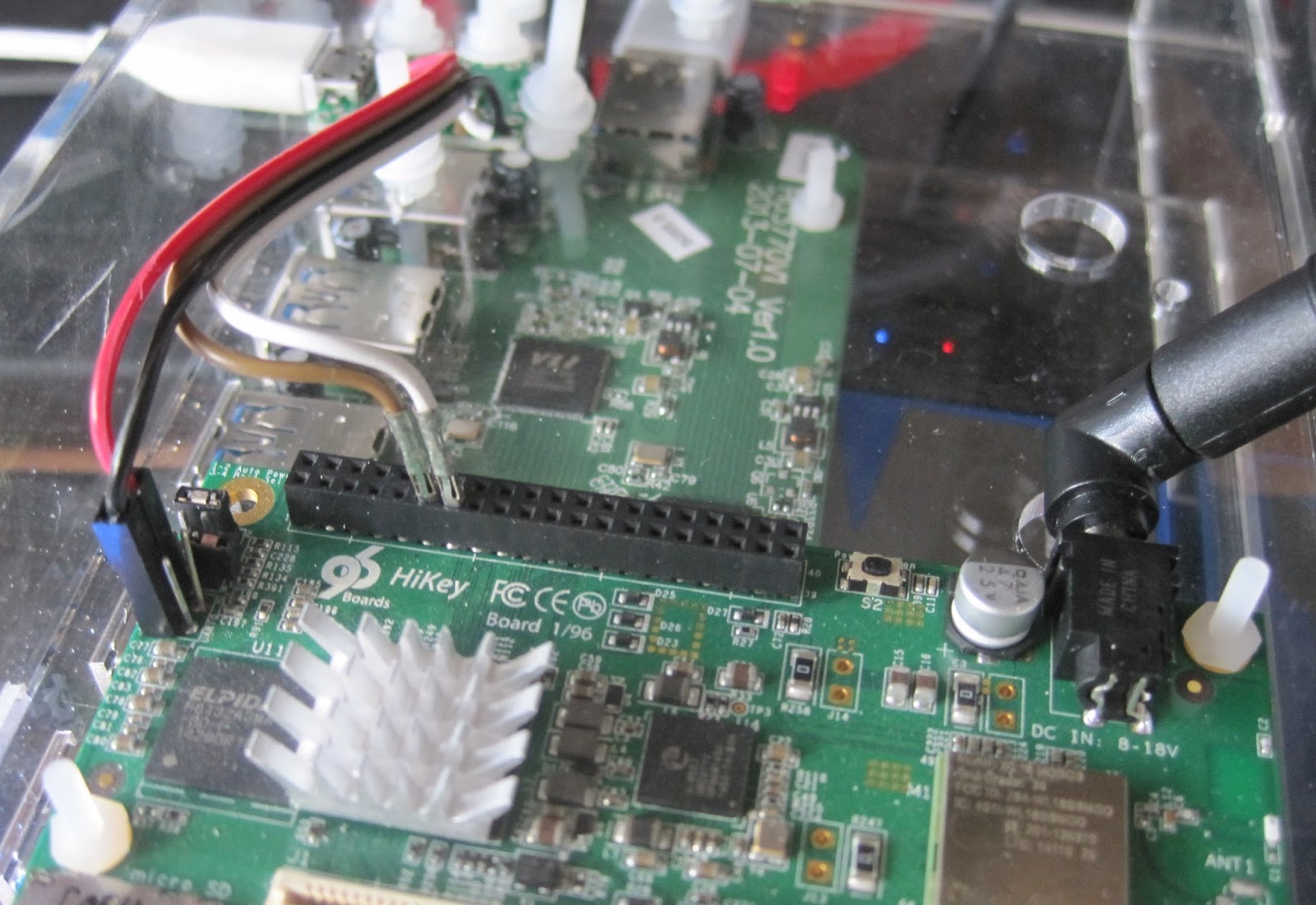
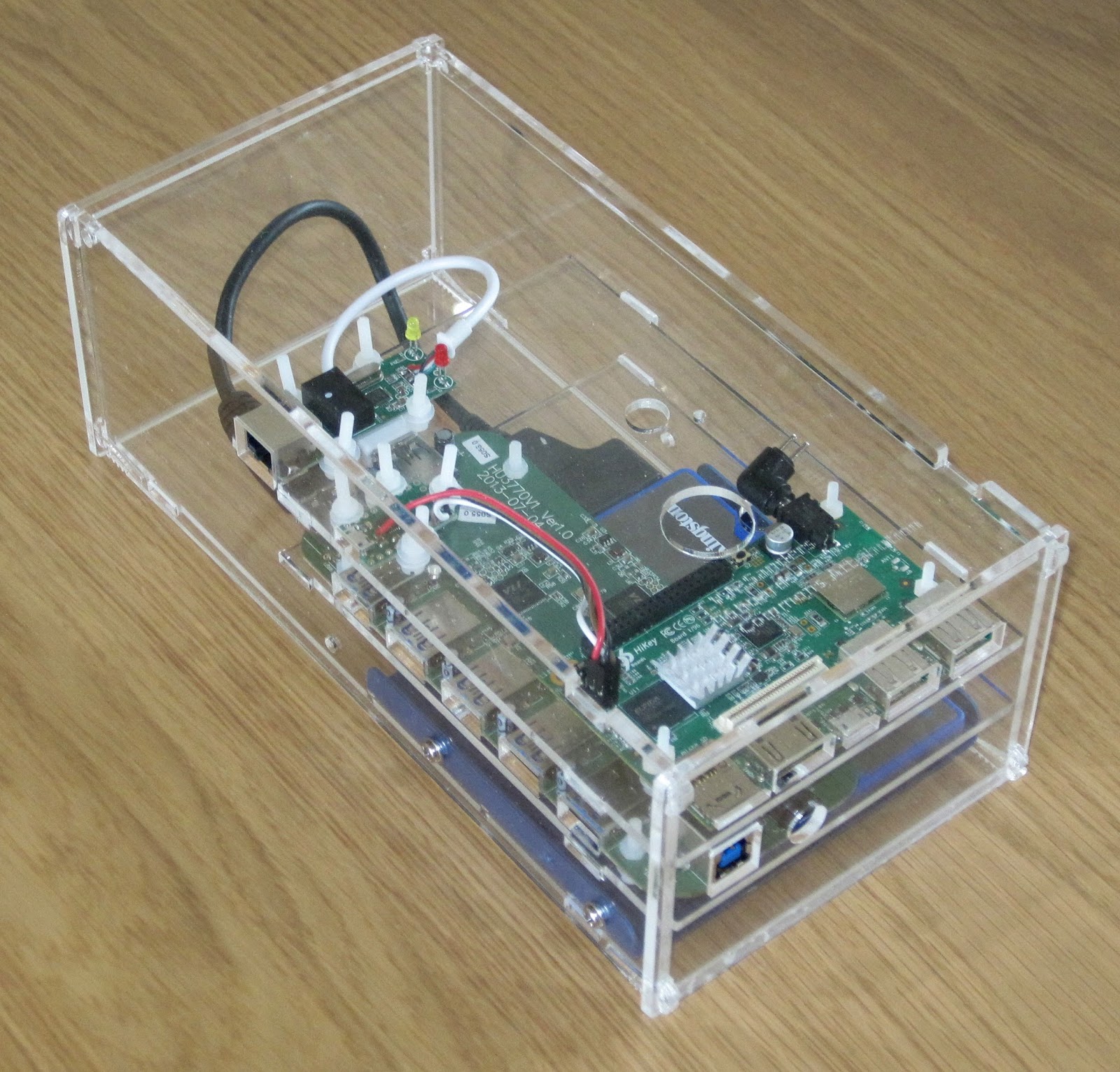
After another long pause in proceedings I decided that I should house all the components together and that perhaps being out on my bench might be the cause of some instability. I purchased a powered Amazon basics USB 2 hub, an Ethernet adaptor and a USB 2 SATA interface in the hope of accessing some larger mass storage.

The USB hub power supply was 12V DC which matched the Hikey requirements so I worked out I could use a single 4A capable supply and run a 3.5inch SATA hard drive too. I designed a laser cut enclosure and mounted all the components. As it turned out I only had a 2.5inch hard drive handy so the enclosure is a little over size. If I were redoing this design I would attempt to make it fit in 1U of height and be mountable in a 19inch rack instead it is an 83mm high (under 2U) box.

A new software release had also become available which purported to use an UEFI bootloader after struggling to install this version unsuccessfully, made somewhat more problematic by the undocumented change from UART0 (unpopulated header) to UART3 on the low speed 2mm pitch header. The system seemed to start the kernel which panicked and hung either booting from eMMC or SD card. Once again the project went on hold after spending tens of hours trying to make progress.
Third time's a charmAs the year rolled to a close I once again was persuaded to look at the hikey, I followed the much improved instructions and installed the shiny new November software release which appears to have been made for the re-release of the Hikey through LeMaker. This time I obtained a Debian "jessie" system that booted from the eMMC.

Having a booted system meant I could finally try and use it. I had decided to try and use the system to host virtual machines used as builders within the NetSurf CI system.

The basic OS uses a mixture of normal Debian packages with some replacements from Linaro repositories. I would have prefered to see more use of Debain packages even if they were from the backports repositories but on the positive side it is good to see the use of Debian instead of Ubuntu.

The kernel is a heavily patched 3.18 built in a predominantly monolithic (without modules) manner with the usual exceptions such as the mali and wifi drivers (both of which appear to be binary blobs). The use of a non-mainline capable SoC means the standard generic distribution kernels cannot be used and unless Linaro choose to distribute a kernel with the feature built in it is necessary to compile your own from sources.

The default install has a linaro user which I renamed to my user and ensured all the ssh keys and passwords on the system were changed. This is an important step when using this pre-supplied images as often a booted system is identical to every other copy.

To access mass storage my only option was via USB, indeed to add any additional expansion that is the only choice. The first issue here is that the USB host support is compiled in so when the host ports are initialised it is not possible to select a speed other than 12MBit. The speed is changed to 480Mbit by using a user space application found in the users home directory (why this is not a tool provided by a package and held in sbin I do not know).

When the usb_speed tool is run there is a chance that the previously enumerated devices will be rescanned and what was /dev/sda has become /dev/sdb if this happens there is a high probability that the system must be rebooted to prevent random crashes due to the "zombie" device.

Because the speed change operation is unreliable it cannot be reliably placed in the boot sequence so this must be executed by hand on each boot to get access to the mass storage.

NetSurf project already uses a x86_64 virtual host system which runs an LLVM physical volume from which we allocate logical volumes for each VM. I initially hoped to do this with the hikey but as soon as I tried to use the logical volume with a VM the system locked up with nothing shown on console. I did not really try very hard to discover why and instead simply used files on disc for virtual drives which seemed to work.

To provide reliable network access I used a USB attached Ethernet device, this like the mass storage suffered from unreliable enumeration and for similar reasons could not be automated requiring manually using the serial console to start the system.

Once the system was started I needed to install the guest VM. I had hoped I might be able to install locally from Debian install media as I do for x86 using the libvirt tools. After a great deal of trial and error I finally was forced to abandon this approach when I discovered the Linaro kernel is lacking iso9660 support so installing from standard media was not possible.

Instead I used the instructions provided by Leif Lindholm to create a virtual machine image on my PC and copied the result across. These instructions are great except I used version 2.5 of Qemu instead of 2.2 which had no negative effect. I also installed the Debian backports for Jessie to get an up to date 4.3 kernel.

After copying the image to the Hikey I started it by hand from the command line as a four core virtual machine and was successfully able to log in. The guest would operate for up to a day before stopping with output such as

$
Message from syslogd@ciworker13 at Jan 29 07:45:28 ...
kernel:[68903.702501] BUG: soft lockup - CPU#0 stuck for 27s! [mv:24089]

Message from syslogd@ciworker13 at Jan 29 07:45:28 ...

kernel:[68976.958028] BUG: soft lockup - CPU#2 stuck for 74s! [swapper/2:0]

Message from syslogd@ciworker13 at Jan 29 07:47:39 ...
kernel:[69103.199724] BUG: soft lockup - CPU#3 stuck for 99s! [swapper/3:0]

Message from syslogd@ciworker13 at Jan 29 07:53:21 ...
kernel:[69140.321145] BUG: soft lockup - CPU#3 stuck for 30s! [rs:main Q:Reg:505]

Message from syslogd@ciworker13 at Jan 29 07:53:21 ...
kernel:[69192.880804] BUG: soft lockup - CPU#0 stuck for 21s! [jbd2/vda3-8:107]

Message from syslogd@ciworker13 at Jan 29 07:53:21 ...
kernel:[69444.805235] BUG: soft lockup - CPU#3 stuck for 22s! [swapper/3:0]

Message from syslogd@ciworker13 at Jan 29 07:55:21 ...
kernel:[69570.177600] BUG: soft lockup - CPU#1 stuck for 112s! [systemd:1]

Timeout, server 192.168.7.211 not responding.

After this output the host system would not respond and had to be power cycled never mind the guest!

Once I changed to single core operation the system would run for some time until the host suffered from the dreaded kernel OOM killer. I was at a loss as to why the oom killer was running as the VM was only allocated half the physical memory (512MB) allowing the host what I presumed to be an adequate amount.

By adding a 512MB swapfile the system was able to push the few hundred kilobytes it wanted to swap and the system was now stable! The swapfile of course has to be started by hand as the external storage is unreliable and unavailable at boot.

I converted the qemu command line to a libvirt config using the virsh tool
virsh domxml-from-native qemu-argv cmdln.args
The converted configuration required manual editing to get a working system but now I have a libvirt based VM guest I can control along with all my other VM using the virt-manager tool.

This system is now stable and has been in production use for a month at time of writing. The one guest VM is a single core 512MB aarch64 system which takes over 1100 seconds (19 minutes) to do what a Banana Pi 2 dual core 1GB memory 32bit native ARM system manages in 300 seconds.

It seems the single core limited memory system with USB SATA attached storage is very, very slow.

I briefly attempted to run the CI system job natively within the host system but within minutes it crashed hard and required a power cycle to retrieve, it had also broken the UEFI boot. I must thank Leif for walking me through recovering the system otherwise I would have needed to start over.
ConclusionsI must stress these conclusions and observations are my own and do not represent anyone else.

My main conclusions are:

This project has taken almost a year to get to the final state and has been one of the least enjoyable within that time. The only reason I have a running system at the end of it is sheer bloody mindedness because after spending hundreds of hours of my free time I was not prepared to see it all go to waste.

To be fair, the road I travelled is now much smoother and if the application is suited to having a mobile phone without a screen then the Hikey probably works as a solution. For me, however, the Hikey product with the current hardware and software limitations is not something I would recommend in preference to other options.

Stein Magnus Jodal: February contributions

The following is a short summary of my open source work in February, just like in previous months.

Debian

Mopidy
  • Released Mopidy-Spotify 2.3.1: Works around search being broken in libspotify by using the Spotify Web API for the search functionality, and nothing else.
  • Wrapped up and released Mopidy 2.0 release. This was a quite large release that ports to GStreamer 1.x and adds support for gapless playback. It was uploaded to Debian in time to be part of Ubuntu 16.04 LTS.
  • Released Mopidy-Spotify 3.0.0: A couple of small compatibility fixes to work with Mopidy 2.x and GStreamer 1.x.
  • Updates to packages not in Debian, only at apt.mopidy.com:
    • Uploaded mopidy-spotify-tunigo 1.0.0-0mopidy1. Far down the chain, it depends on libspotify, which is not in Debian.
    • Uploaded mopidy-spotify 2.0.0-0mopidy1.
  • Updated homebrew-mopidy with lots of new releases:
    • Mopidy 2.0.0
    • Mopidy-Dirble 1.3.0
    • Mopidy-SoundCloud 2.0.2
    • Mopidy-Spotify 2.3.0, 2.3.1 and 3.0.0
    • python-backports-abc 0.4
    • python-backports-ssl-match-hostname 3.5.0.1
    • python-certifi 2015.11.20.1
    • python-cffi 1.5.0 and 1.5.2
    • python-requests 2.9.1
    • python-singledispatch 3.4.0.3
    • python-six 1.10.0
    • python-tornado 4.3
  • Rebased my feature/py3-compat branch on top of Mopidy 2.0.
  • Planned breaking changes for Mopidy 3.0: unbundling of Mopidy.js, removal of deprecated core APIs, model APIs, audio APIs and removal of the http/static_dir config.
  • Planned breaking changes to modernize Mopidy.js: change default calling convention to by-position-or-by-name, replace When.js with ES6 Promise, replace Bane.js with EventEmitter, and replace Buster.js with Karma+Mocha.

Comics
  • Started working on the upgrade to Django 1.8. Most deps are upgraded. The major remaining pieces is to upgrade django-registration from 0.8 to 2.0 and to replace the years-old vendored copy of django-invitation (singular) with django-invitations (plural).

Next.

Previous.