Search Results: "eric"

27 July 2016

Norbert Preining: TUG 2016 Day 2 Figures to Fonts

The second day of TUG 2016 was again full of interesting talks spanning from user experiences to highly technical details about astrological chart drawing, and graphical user interfaces to TikZ to the invited talk by Robert Bringhurst on the Palatino family of fonts. tug2016-bringhurst With all these interesting things there is only one thing to compain I cannot get out of the dark basement and enjoy the city After a evening full of sake and a good night s sleep we were ready to dive into the second day of TUG. Kaveh Bazargan A graphical user interface for TikZ The opening speaker of Day 2 was Kaveh. He first gave us a quick run-down on what he is doing for business and what challenges publishers are facing in these times. After that he introduced us to his new development of a command line graphical user interface for TikZ. I wrote command line on purpose, because the editing operations are short commands issued on a kind of command line, which will give an immediate graphical feedback. Basic of the technique is a simplified TikZ-like meta language that is not only easy to write, but also easy to parse. While the amount of supported commands and features of TikZ is still quite small, I think the basic idea is a good one, and there is a good potential in it. Matthew Skala Astrological charts with horoscop and starfont Next up was Matthew who introduced us to the involved task of typesetting astrological charts. He included comparisons with various commercial and open source solutions, where Matthew of course, but me too, felt that his charts came of quite well! As an extra bonus we got some charts of famous singers, as well as the TUG 2016 horoscope. David Tulett Development of an e-textbook using LaTeX and PStricks David reported on his project to develop an e-textbook on decision modeling (lots of math!) using LaTeX and PStricks. His e-book is of course a PDF. There were a lot of very welcoming feedback free (CC-BY-NC-ND) textbooks for sciences are rare and we need more of them. Christian Gagn An Emacs-based writing workflow inspired by TeX and WEB, targeting the Web Christian s talk turned around editing and publishing using org-mode of Emacs and the various levels of macros one can use in this setup. He finished with a largely incomprehensible vision of a future equational logic based notation mode. I have used equational logic in my day-in-day-out job, and I am not completely convinced that this is a good approach for typesetting and publishing but who knows, I am looking forward to a more logic-based approach! Barbara Beeton, Frank Mittelbach In memoriam: Sebastian Rahtz (1955-2016) Frank recalled Sebastian s many contribution to a huge variety of fields, and recalled our much missed colleague with many photos and anecdotes. Jim Hefferon A LaTeX reference manual Jim reported about the current state of a LaTeX reference manual, which tries to provide a documentation orthogonally to the many introduction and user guides available, by providing a straight down-to-earth reference manual with all the technical bells and whistles necessary. As I had to write myself a reference manual for a computer language, it was very interested to see how they dealt with many of the same problems I am facing. Arthur Reutenauer, Mojca Miklavec Hyphenation past and future: hyph-utf8 and patgen Arthur reports about the current statue of the hyphenation pattern project, and in particular the license and usage hell they recently came into with large cooperations simply grabbing the patterns without proper attribution. In a second part he gave a rough sketch of his shot at a reimplementation of patgen. Unfortunately he wrote in rather unreadable hand-writing on a flip-chart, which made only the first line audience to actually see what he was writing. Federico Garcia-De Castro TeXcel? As an artist organizing large festivals Federico has to fight with financial planning and reports. He seemed not content with the abilities of the usual suspects, so he developed a way to do Excel like book-keeping in TeX. Nice idea, I hope I can use that system for the next conference I have to organize! Jennifer Claudio A brief reflection on TeX and end-user needs Last speaker in the morning session was Jennifer who gave us a new and end-user s view onto the TeX environment, and the respective needs. These kind of talks are a very much welcomed contrast to technical talks and hopefully all of us developers take home some of her suggestions. Sungmin Kim, Jaeyoung Choi, Geunho Jeong MFCONFIG: Metafont plug-in module for the Freetype rasterizer Jaeyoung reported about an impressive project to make Metafont fonts available to fontconfig and thus windowing systems. He also explained their development of a new font format Stemfont, which is a Metafont-like system that can work also for CJK fonts, and which they envisage to be built into all kind of mobile devices. Michael Sharpe New font offerings Cochineal, Nimbus15 and LibertinusT1Math Michael reports about his last font projects. The first two being extensions of the half-made half-butchered rereleased URW fonts, as well as his first (?) math font project. I talked to him over lunch one day, and asked him how many man-days he need for these fonts, and his answer was speaking a lot: For the really messed up new URW fonts, like Cochineal, he guessed about 5 man-months of work, while other fonts only needed a few days. I think we all can be deeply thankful to all the work he is investing into all these font projects. Robert Bringhurst The evolution of the Palatino tribe The second invited talk was Robert Bringhurst, famous for his wide contributions to typpography, book culture in general, as well as poetry. He gave a quick historic overview on the development of the Palatino tribe of fonts, with lots of beautiful photos. I was really looking forward to Robert s talk, and my expectations were extremely high. And unfortunately I must say I was quite disappointed. Maybe it is his style of presentation, but the feeling he transfered to me (the audience?) was that he was going through a necessary medical check, not much enjoying the presentation. Also, the content itself was not really full of his own ideas or thoughts, but a rather superficial listing of historical facts. Of course, a person like Robert Bringhurst is so full of anecdotes and background knowledge still was a great pleasure to listen and lots of things to learn, I only hoped for a bit more enthusiasm. TUG Annual General Meeting The afternoon session finished with the TUG Annual General Meeting, reports will be sent out soon to all TUG members. Herbert Schulz Optional workshop: TeXShop tips & tricks After the AGM, Herbert from MacTeX and TeXShop gave an on-the-spot workshop on TeXShop. Since I am not a Mac user, I skipped on that.
Another late afternoon program consisted of an excursion to Eliot s bookshop, where many of us stacked up on great books. This time again I skipped and took a nap. In the evening we had a rather interesting informal dinner in the food court of some building, where only two shops were open and all of us lined up in front of the Japanese Curry shop, and then gulped down from plastic boxes. Hmm, not my style I have to say, not even for informal dinner. But at least I could meet up with a colleague from Debian and get some gpg key signing done. And of course, talking to all kind of people around. The last step for me was in the pub opposite the hotel, with beer and whiskey/scotch selected by specialists in the field.

25 July 2016

Norbert Preining: TUG 2016 Day -1 Wines and Waters

This years TUG is held in Toronto, Canada, and our incredible host Pavneet has managed to put together an busy program of excursions and events around the real conference. The -1st day (yeah, you read right, the minus-first day), that is two days before the actual conference starts, was dedicated to an excursion to enjoying wines at the wine estate Ch teau des Charmes, followed by a visit to the Niagara falls.
The amount of water running down the Horseshoe Falls is incredible
What should I say, if the first thing after getting out of the bus is a good wine, then there is nothing to go wrong I arrived in Toronto already two days earlier in the late afternoon, and spend Friday relaxing, recovering from the long flight, walking the city a bit, trying to fix my cold, and simply going slowly. Saturday morning we met already at a comfortable 10am in the morning (still to early for me, due to jet lag and a slightly late evening before), but the first 2h of bus drive allowed us to relax. Our first stop was the Ch teau des Charmes, and impressive building surrounded by vineyards.
Entrance to the Ch teau des Charmes
We were immediately handed over to a sandwich lunch with white, red, and ice wine. Good start! And although the breakfast wasn t that long time ago, the delicious sandwiches (at least the vegetarian ones I tried) were good foundation for the wine.
Lunch impressions at Ch teau des Charmes
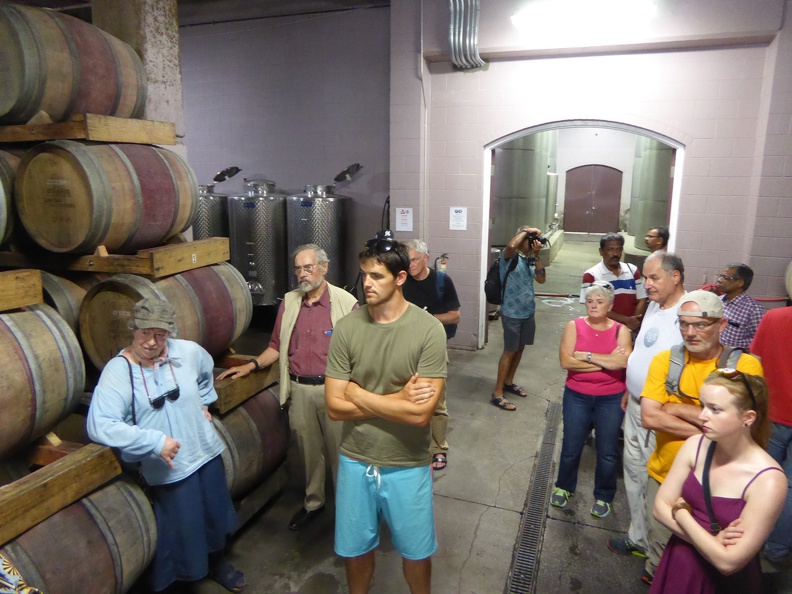
After having refilled our energy reserves, we are ready to start our tour. Our guide, very, if not over, enthusiastic, explains us that practically everything related to wine in Canada has been started at this Ch teau from the current owner the Ch teau system where farmer and wine producer are the same, import of European grapes, winter protection methods, wine making I was close to forgetting our Roman and Greek ancestors. At least she admitted that the Ice wine was brought over by an Austrian but perfection was done here, were the controls of the government are much stricter than anywhere else hmmm, somehow I cannot completely believe all this narrative, but at least it is enjoyable. So now that we know all about the history, we dive into the production process area, and the barrel space, always accompanied with extensive comments and (self-)praise.
Enjoying the explanations of our very enthusiastic guide
After this exhaustive and exhausting round, we are guided back to the patio to taste another three different wines, a white (bit too warm, not so much my taste), a rose (very good), and a red made from a new grape variety that has mutated first here on the Ch teau (interesting). As I didn t have enough, I tried to get something out of the big containers directly, but without success!
Me trying to get a full load of wine
Happy and content, and after passing through the shopping area, we are boarding the bus to continue direction of the Niagara Falls. Passing by at quite some nice houses of definitely quite rich people (although Pavneet told me that houses in Toronto are far more expensive than those here how can someone afford this?), we first have a view onto the lower Niagara river. A bit further one we are let out to see huge whirlpools in the river, where boat tours are bringing sightseers on a rough ride ride into the pool.
Whirlpools along the Niagara river
Only a slight bit further on we finally reach the Niagara falls, with the great view onto the American falls in full power, and the Horseshoe Falls further up.
Horseshoe Falls in view
We immediately boarded a boat tour making a short trip to the Horseshoe Fall. Lining up with hundreds and hundreds of other spectators, we prepare for the splash with red rain wear (the US side uses blue, not that any side would rescue a wrong person and create an illegal immigrant!). The trip passes first under the American Falls and continues right into the mist that fills all the area in the middle of the Horseshoe falls. Spectacular impression with walls of water falling down on both sidess.
Panorama of the Horseshoe Falls
Returned from the splash and having dried our feet, we walk along the ridge to see the Horseshoe falls from close up. The amount of water falling down these falls is incredible, and so is the erosion that creates the brown foam on the water down in the pool, made up from pulverized limestone. Blessed as we were, the sun was laughing all the day and we got a nice rainbow right in the fall.
Horseshoe Falls with boat and rainbow, lovely.
The surroundings of the fall are less impressive Disney land? Horror cabinet? Jodel bar? A wild mixture of amusement park style locations squeezed together and overly full with people as if enjoying the nature itself would not be enough. All immersed by ever blasting loudspeaker music.
Torture around Niagara falls
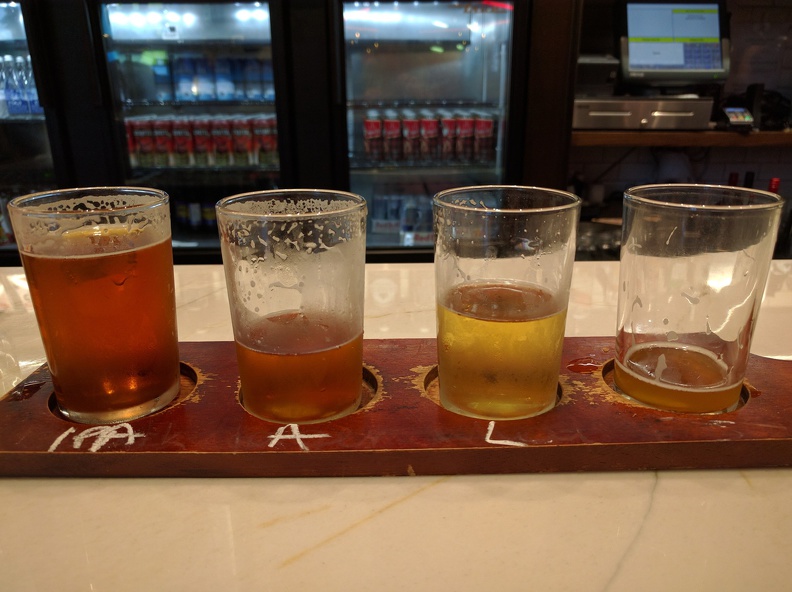
The only plus point I could find in this encampment of forced happiness was a local craft beer brewer where one could taste 8 different beers I made it only to four, though.
Beer tasting at Niagara Brewery, IPA, Amber ale, Lager, and some Light Fruity Radler beer.
Finally night was falling in and we moved down to the falls again to enjoy the illumination of the falls.
Night view onto Niagara falls
After this wonderful finish we boarded the bus and back to Toronto, where we arrived around mid-night. A long but very pleasurable Day Minus One! Further photos can be seen at the gallery TUG 2016 Day Minus One.

24 July 2016

Russ Allbery: Review: The Run of His Life

Review: The Run of His Life, by Jeffrey Toobin
Publisher: Random House
Copyright: 1996, 1997
Printing: 2015
ISBN: 0-307-82916-2
Format: Kindle
Pages: 498
The O.J. Simpson trial needs little introduction to anyone who lived through it in the United States, but a brief summary for those who didn't. O.J. Simpson is a Hall of Fame football player and one of the best running backs to ever play the game. He's also black, which is very relevant much of what later happened. After he retired from professional play, he became a television football commentator and a spokesperson for various companies (particularly Hertz, a car rental business). In 1994, he was arrested for the murder of two people: his ex-wife, Nicole Brown Simpson, and Ron Goldman (a friend of Nicole's). The arrest happened after a bizarre low-speed police chase across Los Angeles in a white Bronco that was broadcast live on network television. The media turned the resulting criminal trial into a reality TV show, with live cable television broadcasts of all of the court proceedings. After nearly a full year of trial (with the jury sequestered for nine months more on that later), a mostly black jury returned a verdict of not guilty after a mere four hours of deliberation. Following the criminal trial, in an extremely unusual legal proceeding, Simpson was found civilly liable for Ron Goldman's death in a lawsuit brought by his family. Bizarre events surrounding the case continued long afterwards. A book titled If I Did It (with "if" in very tiny letters on the cover) was published, ghost-written but allegedly with Simpson's input and cooperation, and was widely considered a confession. Another legal judgment let the Goldman family get all the profits from that book's publication. In an unrelated (but also bizarre) incident in Las Vegas, Simpson was later arrested for kidnapping and armed robbery and is currently in prison until at least 2017. It is almost impossible to have lived through the O.J. Simpson trial in the United States and not have formed some opinion on it. I was in college and without a TV set at the time, and even I watched some of the live trial coverage. Reactions to the trial were extremely racially polarized, as you might have guessed. A lot of black people believed at the time that Simpson was innocent (probably fewer now, given subsequent events). A lot of white people thought he was obviously guilty and was let off by a black jury for racial reasons. My personal opinion, prior to reading this book, was a common "third way" among white liberals: Simpson almost certainly committed the murders, but the racist Los Angeles police department decided to frame him for a crime that he did commit by trying to make the evidence stronger. That's a legitimate reason in the US justice system for finding someone innocent: the state has an obligation to follow correct procedure and treat the defendant fairly in order to get a conviction. I have a strong bias towards trusting juries; frequently, it seems that the media second-guesses the outcome of a case that makes perfect sense as soon as you see all the information the jury had (or didn't have). Toobin's book changed my mind. Perhaps because I wasn't watching all of the coverage, I was greatly underestimating the level of incompetence and bad decision-making by everyone involved: the prosecution, the defense, the police, the jury, and the judge. This court case was a disaster from start to finish; no one involved comes away looking good. Simpson was clearly guilty given the evidence presented, but the case was so badly mishandled that it gave the jury room to reach the wrong verdict. (It's telling that, in the far better managed subsequent civil case, the jury had no trouble reaching a guilty verdict.) The Run of His Life is a very detailed examination of the entire Simpson case, from the night of the murder through the end of the trial and (in an epilogue) the civil case. Toobin was himself involved in the media firestorm, breaking some early news of the defense's decision to focus on race in The New Yorker and then involved throughout the trial as a legal analyst, and he makes it clear when he becomes part of the story. But despite that, this book felt objective to me. There are tons of direct quotes, lots of clear description of the evidence, underlying interviews with many of the people involved to source statements in the book, and a comprehensive approach to the facts. I think Toobin is a bit baffled by the black reaction to the case, and that felt like a gap in the comprehensiveness and the one place where he might be accused of falling back on stereotypes and easy judgments. But other than hole, Toobin applies his criticism even-handedly and devastatingly to all parties. I won't go into all the details of how Toobin changed my mind. It was a cumulative effect across the whole book, and if you're curious, I do recommend reading it. A lot was the detailed discussion of the forensic evidence, which was undermined for the jury at trial but looks very solid outside the hothouse of the case. But there is one critical piece that I would hope would be handled differently today, twenty years later, than it was by the prosecutors in that case: Simpson's history of domestic violence against Nicole. With what we now know about patterns of domestic abuse, the escalation to murder looks entirely unsurprising. And that history of domestic abuse was exceedingly well-documented: multiple external witnesses, police reports, and one actual prior conviction for spousal abuse (for which Simpson did "community service" that was basically a joke). The prosecution did a very poor job of establishing this history and the jury discounted it. That was a huge mistake by both parties. I'll mention one other critical collection of facts that Toobin explains well and that contradicted my previous impression of the case: the relationship between Simpson and the police. Today, in the era of Black Lives Matter, the routine abuse of black Americans by the police is more widely known. At the time of the murders, it was less recognized among white Americans, although black Americans certainly knew about it. But even in 1994, the Los Angeles police department was notorious as one of the most corrupt and racist big-city police departments in the United States. This is the police department that beat Rodney King. Mark Fuhrman, one of the police officers involved in the case (although not that significantly, despite his role at the trial), was clearly racist and had no business being a police officer. It was therefore entirely believable that these people would have decided to frame a black man for a murder he actually committed. What Toobin argues, quite persuasively and with quite a lot of evidence, is that this analysis may make sense given the racial tensions in Los Angeles but ignores another critical characteristic of Los Angeles politics, namely a deference to celebrity. Prior to this trial, O.J. Simpson largely followed the path of many black athletes who become broadly popular in white America: underplaying race and focusing on his personal celebrity and connections. (Toobin records a quote from Simpson earlier in his life that perfectly captures this approach: "I'm not black, I'm O.J.") Simpson spent more time with white businessmen than the black inhabitants of central Los Angeles. And, more to the point, the police treated him as a celebrity, not as a black man. Toobin takes some time to chronicle the remarkable history of deference and familiarity that the police showed Simpson. He regularly invited police officers to his house for parties. The police had a long history of largely ignoring or downplaying his abuse of his wife, including not arresting him in situations that clearly seemed to call for that, showing a remarkable amount of deference to his side of the story, not pursuing clear violations of the court judgment after his one conviction for spousal abuse, and never showing much inclination to believe or protect Nicole. Even on the night of the murder, they started following a standard playbook for giving a celebrity advance warning of investigations that might involve them before the news media found out about them. It seems clear, given the evidence that Toobin collected, that the racist Los Angeles police didn't focus that animus at Simpson, a wealthy celebrity living in Brentwood. He wasn't a black man in their eyes; he was a rich Hall of Fame football player and a friend. This obviously raises the question of how the jury could return an innocent verdict. Toobin provides plenty of material to analyze that question from multiple angles in his detailed account of the case, but I can tell you my conclusion: Judge Lance Ito did a horrifically incompetent job of managing the case. He let the lawyers wander all over the case, interacted bizarrely with the media coverage (and was part of letting the media turn it into a daytime drama), was not crisp or clear about his standards of evidence and admissibility, and, perhaps worst of all, let the case meander on at incredible length. With a fully sequestered jury allowed only brief conjugal visits and no media contact (not even bookstore shopping!). Quite a lot of anger was focused on the jury after the acquittal, and I do think they reached the wrong conclusion and had all the information they would have needed to reach the correct one. But Toobin touches on something that I think would be very hard to comprehend without having lived through it. The jury and alternate pool essentially lived in prison for nine months, with guards and very strict rules about contact with the outside world, in a country where compensation for jury duty is almost nonexistent. There were a lot of other factors behind their decision, including racial tensions and the sheer pressure from judging a celebrity case about which everyone has an opinion, but I think it's nearly impossible to underestimate the psychological tension and stress from being locked up with random other people under armed guard for three quarters of a year. It's hard for jury members to do an exhaustive and careful deliberation in a typical trial that takes a week and doesn't involve sequestration. People want to get back to their lives and families. I can only imagine the state I would be in after nine months of this, or how poor psychological shape I would be in to make a careful and considered decision. Similarly, for those who condemned the jury for profiting via books and media appearances after the trial, the current compensation for jurors is $15 per day (not hour). I believe at the time it was around $5 per day. There are a few employers who will pay full salary for the entire jury service, but only a few; many cap the length at a few weeks, and some employers treat all jury duty as unpaid leave. The only legal requirement for employers in the United States is that employees that serve on a jury have their job held for them to return to, but compensation is pathetic, not tied to minimum wage, and employers do not have to supplement it. I'm much less inclined to blame the jurors than the system that badly mistreated them. As you can probably tell from the length of this review, I found The Run of His Life fascinating. If I had followed the whole saga more closely at the time, this may have been old material, but I think my vague impressions and patchwork of assumptions were more typical than not among people who were around for the trial but didn't invest a lot of effort into following it. If you are like me, and you have any interest in the case or the details of how the US criminal justice system works, this is a fascinating case study, and Toobin does a great job with it. Recommended. Rating: 8 out of 10

22 July 2016

Dirk Eddelbuettel: RcppCCTZ 0.0.5

Version 0.0.5 of RcppCCTZ arrived on CRAN a couple of days ago. It reflects an upstream fixed made a few weeks ago. CRAN tests revealed that g++-6 was tripping over one missing #define; this was added upstream and I subsequently synchronized with upstream. At the same time the set of examples was extended (see below). Somehow useR! 2016 got in the way and while working on the then-incomplete examples during the traveling I forgot to release this until CRAN reminded me that their tests still failed. I promptly prepared the 0.0.5 release but somehow failed to update NEWS files etc. They are correct in the repo but not in the shipped package. Oh well. CCTZ is a C++ library for translating between absolute and civil times using the rules of a time zone. In fact, it is two libraries. One for dealing with civil time: human-readable dates and times, and one for converting between between absolute and civil times via time zones. It requires only a proper C++11 compiler and the standard IANA time zone data base which standard Unix, Linux, OS X, ... computers tend to have in /usr/share/zoneinfo. RcppCCTZ connects this library to R by relying on Rcpp. Two good examples are now included, and shown here. The first one tabulates the time difference between New York and London (at a weekly level for compactness):
R> example(tzDiff)
tzDiffR> # simple call: difference now
tzDiffR> tzDiff("America/New_York", "Europe/London", Sys.time())
[1] 5
tzDiffR> # tabulate difference for every week of the year
tzDiffR> table(sapply(0:52, function(d) tzDiff("America/New_York", "Europe/London",
tzDiff+                                       as.POSIXct(as.Date("2016-01-01") + d*7))))
 4  5 
 3 50 
R> 
Because the two continents happen to spring forward and fall backwards between regular and daylight savings times, there are, respectively, two and one week periods where the difference is one hour less than usual. A second example shifts the time to a different time zone:
R> example(toTz)
toTzR> toTz(Sys.time(), "America/New_York", "Europe/London")
[1] "2016-07-14 10:28:39.91740 CDT"
R> 
Note that because we return a POSIXct object, it is printed by R with the default (local) TZ attribute (for "America/Chicago" in my case). A more direct example asks what time it is in my time zone when it is midnight in Tokyo:
R> toTz(ISOdatetime(2016,7,15,0,0,0), "Japan", "America/Chicago")
[1] "2016-07-14 15:00:00 CDT"
R>
More changes will come in 0.0.6 as soon as I find time to translate the nice time_tool (command-line) example into an R function. Changes in this version are summarized here:
Changes in version 0.0.5 (2016-07-09)
  • New utility example functions toTz() and tzDiff
  • Synchronized with small upstream change for additional #ifdef for compiler differentiation
We also have a diff to the previous version thanks to CRANberries. More details are at the RcppCCTZ page; code, issue tickets etc at the GitHub repository.

This post by Dirk Eddelbuettel originated on his Thinking inside the box blog. Please report excessive re-aggregation in third-party for-profit settings.

20 July 2016

Daniel Stender: Theano in Debian: maintenance, BLAS and CUDA

I'm glad to announce that we have the current release of Theano (0.8.2) in Debian unstable now, it's on its way into the testing branch and the Debian derivatives, heading for Debian 9. The Debian package is maintained in behalf of the Debian Science Team. We have a binary package with the modules in the Python 2.7 import path (python-theano), if you want or need to stick to that branch a little longer (as a matter of fact, in the current popcon stats it's the most installed package), and a package running on the default Python 3 version (python3-theano). The comprehensive documentation is available for offline usage in another binary package (theano-doc). Although Theano builds its extensions on run time and therefore all binary packages contain the same code, the source package generates arch specific packages1 for the reason that the exhaustive test suite could run over all the architectures to detect if there are problems somewhere (#824116). what's this? In a nutshell, Theano is a computer algebra system (CAS) and expression compiler, which is implemented in Python as a library. It is named after a Classical Greek female mathematician and it's developed at the LISA lab (located at MILA, the Montreal Institute for Learning Algorithms) at the Universit de Montr al. Theano tightly integrates multi-dimensional arrays (N-dimensional, ND-array) from NumPy (numpy.ndarray), which are broadly used in Scientific Python for the representation of numeric data. It features a declarative Python based language with symbolic operations for the functional definition of mathematical expressions, which allows to create functions that compute values for them. Internally the expressions are represented as directed graphs with nodes for variables and operations. The internal compiler then optimizes those graphs for stability and speed and then generates high-performance native machine code to evaluate resp. compute these mathematical expressions2. One of the main features of Theano is that it's capable to compute also on GPU processors (graphical processor unit), like on custom graphic cards (e.g. the developers are using a GeForce GTX Titan X for benchmarks). Today's GPUs became very powerful parallel floating point devices which can be employed also for scientific computations instead of 3D video games3. The acronym "GPGPU" (general purpose graphical processor unit) refers to special cards like NVIDIA's Tesla4, which could be used alike (more on that below). Thus, Theano is a high-performance number cruncher with an own computing engine which could be used for large-scale scientific computations. If you haven't came across Theano as a Pythonistic professional mathematician, it's also one of the most prevalent frameworks for implementing deep learning applications (training multi-layered, "deep" artificial neural networks, DNN) around5, and has been developed with a focus on machine learning from the ground up. There are several higher level user interfaces build in the top of Theano (for DNN, Keras, Lasagne, Blocks, and others, or for Python probalistic programming, PyMC3). I'll seek for some of them also becoming available in Debian, too. helper scripts Both binary packages ship three convenience scripts, theano-cache, theano-test, and theano-nose. Instead of them being copied into /usr/bin, which would result into a binaries-have-conflict violation, the scripts are to be found in /usr/share/python-theano (python3-theano respectively), so that both module packages of Theano can be installed at the same time. The scripts could be run directly from these folders, e.g. do $ python /usr/share/python-theano/theano-nose to achieve that. If you're going to heavy use them, you could add the directory of the flavour you prefer (Python 2 or Python 3) to the $PATH environment variable manually by either typing e.g. $ export PATH=/usr/share/python-theano:$PATH on the prompt, or save that line into ~/.bashrc. Manpages aren't available for these little helper scripts6, but you could always get info on what they do and which arguments they accept by invoking them with the -h (for theano-nose) resp. help flag (for theano-cache). running the tests On some occasions you might want to run the testsuite of the installed library, like to check over if everything runs fine on your GPU hardware. There are two different ways to run the tests (anyway you need to have python ,3 -nose installed). One is, you could launch the test suite by doing $ python -c 'import theano; theano.test() (or the same with python3 to test the other flavour), that's the same what the helper script theano-test does. However, by doing it that way some particular tests might fail by raising errors also for the group of known failures. Known failures are excluded from being errors if you run the tests by theano-nose, which is a wrapper around nosetests, so this might be always the better choice. You can run this convenience script with the option --theano on the installed library, or from the source package root, which you could pull by $ sudo apt-get source theano (there you have also the option to use bin/theano-nose). The script accept options for nosetests, so you might run it with -v to increase verbosity. For the tests the configuration switch config.device must be set to cpu. This will also include the GPU tests when a proper accessible device is detected, so that's a little misleading in the sense of it doesn't mean "run everything on the CPU". You're on the safe side if you run it always like this: $ THEANO_FLAGS=device=cpu theano-nose, if you've set config.device to gpu in your ~/.theanorc. Depending on the available hardware and the used BLAS implementation (see below) it could take quite a long time to run the whole test suite through, on the Core-i5 in my laptop that takes around an hour even excluded the GPU related tests (which perform pretty fast, though). Theano features a couple of switches to manipulate the default configuration for optimization and compilation. There is a rivalry between optimization and compilation costs against performance of the test suite, and it turned out the test suite performs a quicker with lesser graph optimization. There are two different switches available to control config.optimizer, the fast_run toggles maximal optimization, while fast_compile runs only a minimal set of graph optimization features. These settings are used by the general mode switches for config.mode, which is either FAST_RUN by default, or FAST_COMPILE. The default mode FAST_RUN (optimizer=fast_run, linker=cvm) needs around 72 minutes on my lower mid-level machine (on un-optimized BLAS). To set mode=FAST_COMPILE (optimizer=fast_compile, linker=py) brings some boost for the performance of the test suite because it runs the whole suite in 46 minutes. The downside of that is that C code compilation is disabled in this mode by using the linker py, and also the GPU related tests are not included. I've played around with using the optimizer fast_compile with some of the other linkers (c py and cvm, and their versions without garbage collection) as alternative to FAST_COMPILE with minimal optimization but also machine code compilation incl. GPU testing. But to my experience, fast_compile without another than the linker py results in some new errors and failures of some tests on amd64, and this might the case also on other architectures, too. By the way, another useful feature is DebugMode for config.mode, which verifies the correctness of all optimizations and compares the C to Python results. If you want to have detailed info on the configuration settings of Theano, do $ python -c 'import theano; print theano.config' less, and check out the chapter config in the library documentation in the documentation. cache maintenance Theano isn't a JIT (just-in-time) compiler like Numba, which generates native machine code in the memory and executes it immediately, but it saves the generated native machine code into compiledirs. The reason for doing it that way is quite practical like the docs explain, the persistent cache on disk makes it possible to avoid generating code for the same operation, and to avoid compiling again when different operations generate the same code. The compiledirs by default are located within $(HOME)/.theano/. After some time the folder becomes quite large, and might look something like this:
$ ls ~/.theano
compiledir_Linux-4.5--amd64-x86_64-with-debian-stretch-sid--2.7.11+-64
compiledir_Linux-4.5--amd64-x86_64-with-debian-stretch-sid--2.7.12-64
compiledir_Linux-4.5--amd64-x86_64-with-debian-stretch-sid--2.7.12rc1-64
compiledir_Linux-4.5--amd64-x86_64-with-debian-stretch-sid--3.5.1+-64
compiledir_Linux-4.5--amd64-x86_64-with-debian-stretch-sid--3.5.2-64
compiledir_Linux-4.5--amd64-x86_64-with-debian-stretch-sid--3.5.2rc1-64
If the used Python version changed like in this example you might to want to purge obsolete cache. For working with the cache resp. the compiledirs, the helper theano-cache comes in handy. If you invoke it without any arguments the current cache location is put out like ~/.theano/compiledir_Linux-4.5--amd64-x86_64-with-debian-stretch-sid--2.7.12-64 (the script is run from /usr/share/python-theano). So, the compiledirs for the old Python versions in this example (11+ and 12rc1) can be removed to free the space they occupy. All compiledirs resp. cache directories meaning the whole cache could be erased by $ theano-cache basecompiledir purge, the effect is the same as by performing $ rm -rf ~/.theano. You might want to do that e.g. if you're using different hardware, like when you got yourself another graphics card. Or habitual from time to time when the compiledirs fill up so much that it slows down processing with the harddisk being very busy all the time, if you don't have an SSD drive available. For example, the disk space of build chroots carrying (mainly) the tests completely compiled through on default Python 2 and Python 3 consumes around 1.3 GB (see here). BLAS implementations Theano needs a level 3 implementation of BLAS (Basic Linear Algebra Subprograms) for operations between vectors (one-dimensional mathematical objects) and matrices (two-dimensional objects) carried out on the CPU. NumPy is already build on BLAS and pulls the standard implementation (libblas3, soure package: lapack), but Theano links directly to it instead of using NumPy as intermediate layer to reduce the computational overhead. For this, Theano needs development headers and the binary packages pull libblas-dev by default, if any other development package of another BLAS implementation (like OpenBLAS or ATLAS) isn't already installed, or pulled with them (providing the virtual package libblas.so). The linker flags could be manipulated directly through the configuration switch config.blas.ldflags, which is by default set to -L/usr/lib -lblas -lblas. By the way, if you set it to an empty value, Theano falls back to using BLAS through NumPy, if you want to have that for some reason. On Debian, there is a very convenient way to switch between BLAS implementations by the alternatives mechanism. If you have several alternative implementations installed at the same time, you can switch from one to another easily by just doing:
$ sudo update-alternatives --config libblas.so
There are 3 choices for the alternative libblas.so (providing /usr/lib/libblas.so).
  Selection    Path                                  Priority   Status
------------------------------------------------------------
* 0            /usr/lib/openblas-base/libblas.so      40        auto mode
  1            /usr/lib/atlas-base/atlas/libblas.so   35        manual mode
  2            /usr/lib/libblas/libblas.so            10        manual mode
  3            /usr/lib/openblas-base/libblas.so      40        manual mode
Press <enter> to keep the current choice[*], or type selection number:
The implementations are performing differently on different hardware, so you might want to take the time to compare which one does it best on your processor (the other packages are libatlas-base-dev and libopenblas-dev), and choose that to optimize your system. If you want to squeeze out all which is in there for carrying out Theano's computations on the CPU, another option is to compile an optimized version of a BLAS library especially for your processor. I'm going to write another blog posting on this issue. The binary packages of Theano ship the script check_blas.py to check over how well a BLAS implementation performs with it, and if everything works right. That script is located in the misc subfolder of the library, you could locate it by doing $ dpkg -L python-theano grep check_blas (or for the package python3-theano accordingly), and run it with the Python interpreter. By default the scripts puts out a lot of info like a huge perfomance comparison reference table, the current setting of blas.ldflags, the compiledir, the setting of floatX, OS information, the GCC version, the current NumPy config towards BLAS, NumPy location and version, if Theano linked directly or has used the NumPy binding, and finally and most important, the execution time. If just the execution time for quick perfomance comparisons is needed this script could be invoked with -q. Theano on CUDA The function compiler of Theano works with alternative backends to carry out the computations, like the ones for graphics cards. Currently, there are two different backends for GPU processing available, one docks onto NVIDIA's CUDA (Compute Unified Device Architecture) technology7, and another one for libgpuarray, which is also developed by the Theano developers in parallel. The libgpuarray library is an interesting alternative for Theano, it's a GPU tensor (multi-dimensional mathematical object) array written in C with Python bindings based on Cython, which has the advantage of running also on OpenCL8. OpenCL, unlike CUDA9, is full free software, vendor neutral and overcomes the limitation of the CUDA toolkit being only available for amd64 and the ppc64el port (see here). I've opened an ITP on libgpuarray and we'll see if and how this works out. Another reason for it would be great to have it available is that it looks like CUDA currently runs into problems with GCC 610. More on that, soon. Here's a litle checklist for setting up your CUDA device so that you don't have to experience something like this:
$ THEANO_FLAGS=device=gpu,floatX=float32 python ./cat_dog_classifier.py 
WARNING (theano.sandbox.cuda): CUDA is installed, but device gpu is not available (error: Unable to get the number of gpus available: no CUDA-capable device is detected)
hardware check For running Theano on CUDA you need an NVIDIA graphics card which is capable of doing that. You can recheck if your device is supported by CUDA here. When the hardware isn't too old (CUDA support started with GeForce 8 and Quadro X series) or too strange I think it isn't working only in exceptional cases. You can check your model and if the device is present in the system on the bare hardware level by doing this:
$ lspci   grep -i nvidia
04:00.0 3D controller: NVIDIA Corporation GM108M [GeForce 940M] (rev a2)
If a line like this doesn't get returned, your device most probably is broken, or not properly connected (ouch). If rev ff appears at the end of the line that means the device is off meaning powered down. This might be happening if you have a laptop with Optimus graphics hardware, and the related drivers have switched off the unoccupied device to safe energy11. kernel module Running CUDA applications requires the proprietary NVIDIA driver kernel module to be loaded into the kernel and working. If you haven't already installed it for another purpose, the NVIDIA driver and the CUDA toolkit are both in the non-free section of the Debian archive, which is not enabled by default. To get non-free packages you have to add non-free (and it's better to do so, also contrib) to your package source in /etc/apt/sources.list, which might then look like this:
deb http://httpredir.debian.org/debian/ testing main contrib non-free
After doing that, perform $ apt-cache update to update the package lists, and there you go with the non-free packages. The headers of the running kernel are needed to compile modules, you can get them together with the NVIDIA kernel module package by running:
$ sudo apt-get install linux-headers-$(uname -r) nvidia-kernel-dkms build-essential
DKMS will then build the NVIDIA module for the kernel and does some other things on the system. When the installation has finished, it's generally advised to reboot the system completely. troubleshooting If you have problems with the CUDA device, it's advised to verify if the following things concerning the NVIDIA driver resp. kernel module are in order: blacklist nouveau Check if the default Nouveau kernel module driver (which blocks the NVIDIA module) for some reason still gets loaded by doing $ lsmod grep nouveau. If nothing gets returned, that's right. If it's still in the kernel, just add blacklist nouveau to /etc/modprobe.d/blacklist.conf, and update the booting ramdisk with sudo update-initramfs -u afterwards. Then reboot once more, this shouldn't be the case then anymore. rebuild kernel module To fix it when the module haven't been properly compiled for some reason you could trigger a rebuild of the NVIDIA kernel module with $ sudo dpkg-reconfigure nvidia-kernel-dkms. When you're about to send your hardware in to repair because everything looks all right but the device just isn't working, that really could help (own experience). After the rebuild of the module or modules (if you have a few kernel packages installed) has completed, you could recheck if the module really is available by running:
$ sudo modinfo nvidia-current
filename:       /lib/modules/4.4.0-1-amd64/updates/dkms/nvidia-current.ko
alias:          char-major-195-*
version:        352.79
supported:      external
license:        NVIDIA
alias:          pci:v000010DEd00000E00sv*sd*bc04sc80i00*
alias:          pci:v000010DEd*sv*sd*bc03sc02i00*
alias:          pci:v000010DEd*sv*sd*bc03sc00i00*
depends:        drm
vermagic:       4.4.0-1-amd64 SMP mod_unload modversions 
parm:           NVreg_Mobile:int
It should be something similiar to this when everything is all right. reload kernel module When there are problems with the GPU, maybe the kernel module isn't properly loaded. You could recheck if the module has been properly loaded by doing
$ lsmod   grep nvidia
nvidia_uvm             73728  0
nvidia               8540160  1 nvidia_uvm
drm                   356352  7 i915,drm_kms_helper,nvidia
The kernel module could be loaded resp. reloaded with $ sudo nvidia-modprobe (that tool is from the package nvidia-modprobe). unsupported graphics card Be sure that you graphics cards is supported by the current driver kernel module. If you have bought new hardware, that's quite possible to come out being a problem. You can get the version of the current NVIDIA driver with:
$ cat /proc/driver/nvidia/version 
NVRM version: NVIDIA UNIX x86_64 Kernel Module 352.79  Wed Jan 13 16:17:53 PST 2016
GCC version:  gcc version 5.3.1 20160528 (Debian 5.3.1-21)
Then, google the version number like nvidia 352.79, this should get you onto an official driver download page like this. There, check for what's to be found under "Supported Products". I you're stuck with that there are two options, to wait until the driver in Debian got updated, or replace it with the latest driver package from NVIDIA. That's possible to do, but something more for experienced users. occupied graphics card The CUDA driver cannot work while the graphical interface is busy like by processing the graphical display of your X.Org server. Which kernel driver actually is used to process the desktop could be examined by this command:12
$ grep '(II).*([0-9]):' /var/log/Xorg.0.log
[    37.700] (II) intel(0): Using Kernel Mode Setting driver: i915, version 1.6.0 20150522
[    37.700] (II) intel(0): SNA compiled: xserver-xorg-video-intel 2:2.99.917-2 (Vincent Cheng <vcheng@debian.org>)
 ... 
[    39.808] (II) intel(0): switch to mode 1920x1080@60.0 on eDP1 using pipe 0, position (0, 0), rotation normal, reflection none
[    39.810] (II) intel(0): Setting screen physical size to 508 x 285
[    67.576] (II) intel(0): EDID vendor "CMN", prod id 5941
[    67.576] (II) intel(0): Printing DDC gathered Modelines:
[    67.576] (II) intel(0): Modeline "1920x1080"x0.0  152.84  1920 1968 2000 2250  1080 1083 1088 1132 -hsync -vsync (67.9 kHz eP)
This example shows that the rendering of the desktop is performed by the graphical device of the Intel CPU, which is just like it's needed for running CUDA applications on your NVIDIA graphics card, if you don't have another one. nvidia-cuda-toolkit With the Debian package of the CUDA toolkit everything pretty much runs out of the box for Theano. Just install it with apt-get, and you're ready to go, the CUDA backend is the default one. Pycuda is also a suggested dependency of the binary packages, it could be pulled together with the CUDA toolkit. The up-to-date CUDA release 7.5 is of course available, with that you have Maxwell architecture support so that you can run Theano on e.g. a GeForce GTX Titan X with 6,2 TFLOPS on single precision13 at an affordable price. CUDA 814 is around the corner with support for the new Pascal architecture15. Like the GeForce GTX 1080 high-end gaming graphics card already has 8,23 TFLOPS16. When it comes to professional GPGPU hardware like the Tesla P100 there is much more computational power available, scalable by multiplication of cores resp. cards up to genuine little supercomputers which fit on a desk, like the DGX-117. Theano can use multiple GPUs for calculations to work with highly scaled hardware, I'll write another blog post on this issue. Theano on the GPU It's not difficult to run Theano on the GPU. Only single precision floating point numbers (float32) are supported on the GPU, but that is sufficient for deep learning applications. Theano uses double precision floats (float64) by default, so you have to set the configuration variable config.floatX to float32, like written on above, either with the THEANO_FLAGS environment variable or better in your .theanorc file, if you're going to use the GPU a lot. Switching to the GPU actually happens with the config.device configuration variable, which must be set to either gpu or gpu0, gpu1 etc., to choose a particular one if multiple devices are available. Here's is a little test script check1.py, it's taken from the docs and slightly altered. You can run that script either with python or python3 (there was a single test failure on the Python 3 package, so the Python 2 library might be a little more stable currently). For comparison, here's an example on how it perfoms on my hardware, one time on the CPU, one more time on the GPU:
$ THEANO_FLAGS=floatX=float32 python ./check1.py 
[Elemwise exp,no_inplace (<TensorType(float32, vector)>)]
Looping 1000 times took 4.481719 seconds
Result is [ 1.23178029  1.61879337  1.52278066 ...,  2.20771813  2.29967761
  1.62323284]
Used the cpu
$ THEANO_FLAGS=floatX=float32,device=gpu python ./check1.py 
Using gpu device 0: GeForce 940M (CNMeM is disabled, cuDNN not available)
[GpuElemwise exp,no_inplace (<CudaNdarrayType(float32, vector)>), HostFromGpu(GpuElemwise exp,no_inplace .0)]
Looping 1000 times took 1.164906 seconds
Result is [ 1.23178029  1.61879349  1.52278066 ...,  2.20771813  2.29967761
  1.62323296]
Used the gpu
If you got a result like this you're ready to go with Theano on Debian, training computer vision classifiers or whatever you want to do with it. I'll write more on for what Theano could be used, soon.

  1. Some ports are disabled because they are currently not supported by Theano. There are NotImplementedErrors and other errors in the tests on the numpy.ndarray object being not aligned. The developers commented on that, see here. And on some ports the build flags -m32 resp. -m64 of Theano aren't supported by g++, the build flags can't be manipulated easily.
  2. Theano Development Team: "Theano: a Python framework for fast computation of mathematical expressions"
  3. Marc Couture: "Today's high-powered GPUs: strong for graphics and for maths". In: RTC magazine June 2015, pp. 22 25
  4. Ogier Maitre: "Understanding NVIDIA GPGPU hardware". In: Tsutsui/Collet (eds.): Massively parallel evolutionary computation on GPGPUs. Berlin, Heidelberg: Springer 2013, pp. 15-34
  5. Geoffrey French: "Deep learing tutorial: advanved techniques". PyData London 2016 presentation
  6. Like the description of the Lintian tag binary-without-manpage says, that's not needed for them being in /usr/share.
  7. Tom. R. Halfhill: "Parallel processing with CUDA: Nvidia's high-performance computing platform uses massive multithreading". In: Microprocessor Report January 28, 2008
  8. Faber et.al: "Parallelwelten: GPU-Programmierung mit OpenCL". In: C't 26/2014, pp. 160-165
  9. For comparison, see: Valentine Sinitsyn: "Feel the taste of GPU programming". In: Linux Voice February 2015, pp. 106-109
  10. https://lists.debian.org/debian-devel/2016/07/msg00004.html
  11. If Optimus (hybrid) graphics hardware is present (like commonly today on PC laptops), Debian launches the X-server on the graphics processing unit of the CPU, which is ideal for CUDA. The problem with Optimus actually is the graphics processing on the dedicated GPU. If you are using Bumblebee, the Python interpreter which you want to run Theano on has be to be started with the launcher primusrun, because Bumblebee powers the GPU down with the tool bbswitch every time it isn't used, and I think also the kernel module of the driver is dynamically loaded.
  12. Thorsten Leemhuis: "Treiberreviere. Probleme mit Grafiktreibern f r Linux l sen": In: C't Nr.2/2013, pp. 156-161
  13. Martin Fischer: "4K-Rakete: Die schnellste Single-GPU-Grafikkarte der Welt". In C't 13/2015, pp. 60-61
  14. http://www.heise.de/developer/meldung/Nvidia-CUDA-8-bringt-Optimierungen-fuer-die-Pascal-Architektur-3164254.html
  15. Martin Fischer: "All In: Nvidia enth llt die GPU-Architektur 'Pascal'". In: C't 9/2016, pp. 30-31
  16. Martin Fischer: "Turbo-Pascal: High-End-Grafikkarte f r Spieler: GeForce GTX 1080". In: C't 13/2016, pp. 100-103
  17. http://www.golem.de/news/dgx-1-nvidias-supercomputerchen-mit-8x-tesla-p100-1604-120155.html

9 July 2016

Matthew Garrett: "I recieved a free or discounted product in return for an honest review"

My experiences with Amazon reviewing have been somewhat unusual. A review of a smart switch I wrote received enough attention that the vendor pulled the product from Amazon. At the time of writing, I'm ranked as around the 2750th best reviewer on Amazon despite having a total of 18 reviews. But the world of Amazon reviews is even stranger than that, and the past couple of weeks have given me some insight into it.

Amazon's success is fairly phenomenal. It's estimated that there's over 50 million people in the US paying $100 a year to get free shipping on Amazon purchases, and combined with Amazon's surprisingly customer friendly service there's a lot of people with a very strong preference for choosing Amazon rather than any other retailer. If you're not on Amazon, you're hurting your sales.

And if you're an established brand, this works pretty well. Some people will search for your product directly and buy it, leaving reviews. Well reviewed products appear higher up in search results, so people searching for an item type rather than a brand will still see your product appear early in the search results, in turn driving sales. Some proportion of those customers will leave reviews, which helps keep your product high up in the results. As long as your products aren't utterly dreadful, you'll probably maintain that position.

But if you're a brand nobody's ever heard of, things are more difficult. People are unlikely to search for your product directly, so you're relying on turning up in the results for more generic terms. But if you're selling a more generic kind of item (say, a Bluetooth smart bulb) then there's probably a number of other brands nobody's ever heard of selling almost identical objects. If there's no reason for anybody to choose your product then you're probably not going to get any reviews and you're not going to move up the search rankings. Even if your product is better than the competition, a small number of sales means a tiny number of reviews. By the time that number's large enough to matter, you're probably onto a new product cycle.

In summary: if nobody's ever heard of you, you need reviews but you're probably not getting any.

The old way of doing this was to send review samples to journalists, but nobody's going to run a comprehensive review of 3000 different USB cables and even if they did almost nobody would read it before making a decision on Amazon. You need Amazon reviews, but you're not getting any. The obvious solution is to send review samples to people who will leave Amazon reviews. This is where things start getting more dubious.

Amazon run a program called Vine which is intended to solve this problem. Send samples to Amazon and they'll distribute them to a subset of trusted reviewers. These reviewers write a review as normal, and Amazon tag the review with a "Vine Voice" badge which indicates to readers that the reviewer received the product for free. But participation in Vine is apparently expensive, and so there's a proliferation of sites like Snagshout or AMZ Review Trader that use a different model. There's no requirement that you be an existing trusted reviewer and the product probably isn't free. You sign up, choose a product, receive a discount code and buy it from Amazon. You then have a couple of weeks to leave a review, and if you fail to do so you'll lose access to the service. This is completely acceptable under Amazon's rules, which state "If you receive a free or discounted product in exchange for your review, you must clearly and conspicuously disclose that fact". So far, so reasonable.

In reality it's worse than that, with several opportunities to game the system. AMZ Review Trader makes it clear to sellers that they can choose reviewers based on past reviews, giving customers an incentive to leave good reviews in order to keep receiving discounted products. Some customers take full advantage of this, leaving a giant number of 5 star reviews for products they clearly haven't tested and then (presumably) reselling them. What's surprising is that this kind of cynicism works both ways. Some sellers provide two listings for the same product, the second being significantly more expensive than the first. They then offer an attractive discount for the more expensive listing in return for a review, taking it down to approximately the same price as the original item. Once the reviews are in, they can remove the first listing and drop the price of the second to the original price point.

The end result is a bunch of reviews that are nominally honest but are tied to perverse incentives. In effect, the overall star rating tells you almost nothing - you still need to actually read the reviews to gain any insight into whether the customer actually used the product. And when you do write an honest review that the seller doesn't like, they may engage in heavy handed tactics in an attempt to make the review go away.

It's hard to avoid the conclusion that Amazon's review model is broken, but it's not obvious how to fix it. When search ranking is tied to reviews, companies have a strong incentive to do whatever it takes to obtain positive reviews. What we're left with for now is having to laboriously click through a number of products to see whether their rankings come from thoughtful and detailed reviews or are just a mass of 5 star one liners.

comment count unavailable comments

7 July 2016

Matthew Garrett: Bluetooth LED bulbs

The best known smart bulb setups (such as the Philips Hue and the Belkin Wemo) are based on Zigbee, a low-energy, low-bandwidth protocol that operates on various unlicensed radio bands. The problem with Zigbee is that basically no home routers or mobile devices have a Zigbee radio, so to communicate with them you need an additional device (usually called a hub or bridge) that can speak Zigbee and also hook up to your existing home network. Requests are sent to the hub (either directly if you're on the same network, or via some external control server if you're on a different network) and it sends appropriate Zigbee commands to the bulbs.

But requiring an additional device adds some expense. People have attempted to solve this in a couple of ways. The first is building direct network connectivity into the bulbs, in the form of adding an 802.11 controller. Go through some sort of setup process[1], the bulb joins your network and you can communicate with it happily. Unfortunately adding wifi costs more than adding Zigbee, both in terms of money and power - wifi bulbs consume noticeably more power when "off" than Zigbee ones.

There's a middle ground. There's a large number of bulbs available from Amazon advertising themselves as Bluetooth, which is true but slightly misleading. They're actually implementing Bluetooth Low Energy, which is part of the Bluetooth 4.0 spec. Implementing this requires both OS and hardware support, so older systems are unable to communicate. Android 4.3 devices tend to have all the necessary features, and modern desktop Linux is also fine as long as you have a Bluetooth 4.0 controller.

Bluetooth is intended as a low power communications protocol. Bluetooth Low Energy (or BLE) is even lower than that, running in a similar power range to Zigbee. Most semi-modern phones can speak it, so it seems like a pretty good choice. Obviously you lose the ability to access the device remotely, but given the track record on this sort of thing that's arguably a benefit. There's a couple of other downsides - the range is worse than Zigbee (but probably still acceptable for any reasonably sized house or apartment), and only one device can be connected to a given BLE server at any one time. That means that if you have the control app open while you're near a bulb, nobody else can control that bulb until you disconnect.

The quality of the bulbs varies a great deal. Some of them are pure RGB bulbs and incapable of producing a convincing white at a reasonable intensity[2]. Some have additional white LEDs but don't support running them at the same time as the colour LEDs, so you have the choice between colour or a fixed (and usually more intense) white. Some allow running the white LEDs at the same time as the RGB ones, which means you can vary the colour temperature of the "white" output.

But while the quality of the bulbs varies, the quality of the apps doesn't really. They're typically all dreadful, competing on features like changing bulb colour in time to music rather than on providing a pleasant user experience. And the whole "Only one person can control the lights at a time" thing doesn't really work so well if you actually live with anyone else. I was dissatisfied.

I'd met Mike Ryan at Kiwicon a couple of years back after watching him demonstrate hacking a BLE skateboard. He offered a couple of good hints for reverse engineering these devices, the first being that Android already does almost everything you need. Hidden in the developer settings is an option marked "Enable Bluetooth HCI snoop log". Turn that on and all Bluetooth traffic (including BLE) is dumped into /sdcard/btsnoop_hci.log. Turn that on, start the app, make some changes, retrieve the file and check it out using Wireshark. Easy.

Conveniently, BLE is very straightforward when it comes to network protocol. The only thing you have is GATT, the Generic Attribute Protocol. Using this you can read and write multiple characteristics. Each packet is limited to a maximum of 20 bytes. Most implementations use a single characteristic for light control, so it's then just a matter of staring at the dumped packets until something jumps out at you. A pretty typical implementation is something like:

0x56,r,g,b,0x00,0xf0,0x00,0xaa

where r, g and b are each just a single byte representing the corresponding red, green or blue intensity. 0x56 presumably indicates a "Set the light to these values" command, 0xaa indicates end of command and 0xf0 indicates that it's a request to set the colour LEDs. Sending 0x0f instead results in the previous byte (0x00 in this example) being interpreted as the intensity of the white LEDs. Unfortunately the bulb I tested that speaks this protocol didn't allow you to drive the white LEDs at the same time as anything else - setting the selection byte to 0xff didn't result in both sets of intensities being interpreted at once. Boo.

You can test this out fairly easily using the gatttool app. Run hcitool lescan to look for the device (remember that it won't show up if anything else is connected to it at the time), then do gatttool -b deviceid -I to get an interactive shell. Type connect to initiate a connection, and once connected send commands by doing char-write-cmd handle value using the handle obtained from your hci dump.

I did this successfully for various bulbs, but annoyingly hit a problem with one from Tikteck. The leading byte of each packet was clearly a counter, but the rest of the packet appeared to be garbage. For reasons best known to themselves, they've implemented application-level encryption on top of BLE. This was a shame, because they were easily the best of the bulbs I'd used - the white LEDs work in conjunction with the colour ones once you're sufficiently close to white, giving you good intensity and letting you modify the colour temperature. That gave me incentive, but figuring out the protocol took quite some time. Earlier this week, I finally cracked it. I've put a Python implementation on Github. The idea is to tie it into Ulfire running on a central machine with a Bluetooth controller, making it possible for me to control the lights from multiple different apps simultaneously and also integrating with my Echo.

I'd write something about the encryption, but I honestly don't know. Large parts of this make no sense to me whatsoever. I haven't even had any gin in the past two weeks. If anybody can explain how anything that's being done there makes any sense at all[3] that would be appreciated.

[1] typically via the bulb pretending to be an access point, but also these days through a terrifying hack involving spewing UDP multicast packets of varying lengths in order to broadcast the password to associated but unauthenticated devices and good god the future is terrifying

[2] For a given power input, blue LEDs produce more light than other colours. To get white with RGB LEDs you either need to have more red and green LEDs than blue ones (which costs more), or you need to reduce the intensity of the blue ones (which means your headline intensity is lower). Neither is appealing, so most of these bulbs will just give you a blue "white" if you ask for full red, green and blue

[3] Especially the bit where we calculate something from the username and password and then encrypt that using some random numbers as the key, then send 50% of the random numbers and 50% of the encrypted output to the device, because I can't even

comment count unavailable comments

1 July 2016

Joachim Breitner: When to reroll a six

This is a story about counter-intuitive probabilities and how a small bit of doubt turned out to be very justified. It begins with the game To Court the King (German: Um Krone und Kragen ). It is a nice game with dice and cards, where you start with a few dice, and use your dice rolls to buy additional cards, which give you extra dice or special powers to modify the dice that you rolled. You can actually roll your dice many times, but every time, you have to set aside at least one die, which you can no longer change or reroll, until eventually all dice have been set aside. A few years ago, I have played this game a lot, both online (on yucata.de) as well as in real life. It soon became apparent that it is almost always better to go for the cards that give you an extra die, instead of those that let you modify the dice. Intuitively, this is because every additional die allows you to re-roll your dice once more. I concluded that if I have a certain number of dice (say, n), and I want to have a sum as high as possible at the end, then it may make sense to reroll as many dice as possible, setting aside only those showing a 6 (because that is the best you can get) or, if there is no dice showing a 6, then a single die with the best score. Besides for small number of dice (2 or 3), where even a 4 or 5 is worth keeping, this seemed to be a simple, obvious and correct strategy to maximize the expected outcome of this simplified game. It is definitely simple and obvious. But some doubt that it was correct remained. Having one more die still in the game (i.e. not set aside) definitely improves your expected score, because you can reroll the dice more often. How large is this advantage? What if it ever exceeds 6 then it would make sense to reroll a 6. The thought was strange, but I could not dismiss it. So I did what one does these days if one has a question: I posed it on the mathematics site of StackExchange. That was January 2015, and nothing happened. I tried to answer it myself a month later, or at least work towards at an answer, and did that by brute force. Using a library for probabilistic calculations for Haskell I could write some code that simply calculated the various expected values of n dice for up to n = 9 (beyond that, my unoptimized code would take too long):
1:  3.50000 (+3.50000)
2:  8.23611 (+4.73611)
3: 13.42490 (+5.18879)
4: 18.84364 (+5.41874)
5: 24.43605 (+5.59241)
6: 30.15198 (+5.71592)
7: 35.95216 (+5.80018)
8: 41.80969 (+5.85753)
9: 47.70676 (+5.89707)
Note that this calculation, although printed as floating point numbers, is performed using fractions of unbounded integers, so there are no rounding issues that could skew the result. The result supported the hypothesis that there is no point in rolling a 6 again: The value of an additional die grows and approaches 6 from beyond, but judging from these number is never going to reach it. Then again nothing happened. Until 14 month later, when some Byron Schmuland came along, found this an interesting puzzle, and set out a 500 point bounty to whoever solved this problem. This attracted a bit attention, and a few not very successful attempts at solving this. Eventually it reached twitter, where Roman Cheplyaka linked to it. Coincidally a day later some joriki came along, and he had a very good idea: Why not make our life easier and think about dice with less sides, and look at 3 instead of 6. This way, and using a more efficient implementation (but still properly using rationals), he could do a similar calculation for up to 50 dice. And it was very lucky that he went to 50, and not just 25, because up to 27, the results were very much as expected, approaching value of +3 from below. But then it surpassed +3 and became +3.000000008463403. In other words: If you have roll 28 dice, and you have exactly two dice showing a 3, then it gives you better expected score if you set aside only one 3, and not both of them. The advantage is minuscule, but that does not matter it is there. From then on, the results behaved strangely. Between 28 and 34, the additional value was larger than 3. Then, from 35 on again lower than 2. It oscillated. Something similar could be observed when the game is played with coins. Eventually, joriki improved his code and applied enough tricks so that he could solve it also for the 6-sided die: The difference of the expected value of 198 dice and having 199 dice is larger than 6 (by 10 21...)! The optimizations that allowed him to calculate these numbers in a reasonable amount of time unfortunately was to assume that my original hypothesis (never rerolling a 6 is optimal), which held until n < 199. But this meant that for n > 199, the code did not yield correct results. What is the rationale of the story? Don t trust common sense when it comes to statistics; don t judge a sequence just from a few initial numbers; if you have an interesting question, post it online and wait for 16 months.

21 June 2016

Ian Wienand: Zuul and Ansible in OpenStack CI

In a prior post, I gave an overview of the OpenStack CI system and how jobs were started. In that I said
(It is a gross oversimplification, but for the purposes of OpenStack CI, Jenkins is pretty much used as a glorified ssh/scp wrapper. Zuul Version 3, under development, is working to remove the need for Jenkins to be involved at all).
Well some recent security issues with Jenkins and other changes has led to a roll-out of what is being called Zuul 2.5, which has indeed removed Jenkins and makes extensive use of Ansible as the basis for running CI tests in OpenStack. Since I already had the diagram, it seems worth updating it for the new reality.
OpenStack CI Overview While previous post was really focused on the image-building components of the OpenStack CI system, overview is the same but more focused on the launchers that run the tests. Overview of OpenStack CI with Zuul and Ansible
  1. The process starts when a developer uploads their code to gerrit via the git-review tool. There is no further action required on their behalf and the developer simply waits for results of their jobs.

  2. Gerrit provides a JSON-encoded "fire-hose" output of everything happening to it. New reviews, votes, updates and more all get sent out over this pipe. Zuul is the overall scheduler that subscribes itself to this information and is responsible for managing the CI jobs appropriate for each change.

  3. Zuul has a configuration that tells it what jobs to run for what projects. Zuul can do lots of interesting things, but for the purposes of this discussion we just consider that it puts the jobs it wants run into gearman for a launcher to consume. gearman is a job-server; as they explain it "[gearman] provides a generic application framework to farm out work to other machines or processes that are better suited to do the work". Zuul puts into gearman basically a tuple (job-name, node-type) for each job it wants run, specifying the unique job name to run and what type of node it should be run on.

  4. A group of Zuul launchers are subscribed to gearman as workers. It is these Zuul launchers that will consume the job requests from the queue and actually get the tests running. However, a launcher needs two things to be able to run a job a job definition (what to actually do) and a worker node (somewhere to do it). The first part what to do is provided by job-definitions stored in external YAML files. The Zuul launcher knows how to process these files (with some help from Jenkins Job Builder, which despite the name is not outputting XML files for Jenkins to consume, but is being used to help parse templates and macros within the generically defined job definitions). Each Zuul launcher gets these definitions pushed to it constantly by Puppet, thus each launcher knows about all the jobs it can run automatically. Of course Zuul also knows about these same job definitions; this is the job-name part of the tuple we said it put into gearman. The second part somewhere to run the test takes some more explaining. To the next point...

  5. Several cloud companies donate capacity in their clouds for OpenStack to run CI tests. Overall, this capacity is managed by a customized management tool called nodepool (you can see the details of this capacity at any given time by checking the nodepool configuration). Nodepool watches the gearman queue and sees what requests are coming out of Zuul. It looks at node-type of jobs in the queue (i.e. what platform the job has requested to run on) and decides what types of nodes need to start and which cloud providers have capacity to satisfy demand. Nodepool will start fresh virtual machines (from images built daily as described in the prior post), monitor their start-up and, when they're ready, put a new "assignment job" back into gearman with the details of the fresh node. One of the active Zuul launchers will pick up this assignment job and register the new node to itself.

  6. At this point, the Zuul launcher has what it needs to actually get jobs started. With an fresh node registered to it and waiting for something to do, the Zuul launcher can advertise its ability to consume one of the waiting jobs from the gearman queue. For example, if a ubuntu-trusty node is provided to the Zuul launcher, the launcher can now consume from gearman any job it knows about that is intended to run on an ubuntu-trusty node type. If you're looking at the launcher code this is driven by the NodeWorker class you can see this being created in response to an assignment via LaunchServer.assignNode. To actually run the job where the "job hits the metal" as it were the Zuul launcher will dynamically construct an Ansible playbook to run. This playbook is a concatenation of common setup and teardown operations along with the actual test scripts the jobs wants to run. Using Ansible to run the job means all the flexibility an orchestration tool provides is now available to the launcher. For example, there is a custom console streamer library that allows us to live-stream the console output for the job over a plain TCP connection, and there is the possibility to use projects like ARA for visualisation of CI runs. In the future, Ansible will allow for better coordination when running multiple-node testing jobs after all, this is what orchestration tools such as Ansible are made for! While the Ansible run can be fairly heavyweight (especially when you're talking about launching thousands of jobs an hour), the system scales horizontally with more launchers able to consume more work easily. When checking your job results on logs.openstack.org you will see a _zuul_ansible directory now which contains copies of the inventory, playbooks and other related files that the launcher used to do the test run.

  7. Eventually, the test will finish. The Zuul launcher will put the result back into gearman, which Zuul will consume (log copying is interesting but a topic for another day). The testing node will be released back to nodepool, which destroys it and starts all over again nodes are not reused and also have no sensitive details on them, as they are essentially publicly accessible. Zuul will wait for the results of all jobs for the change and post the result back to Gerrit; it either gives a positive vote or the dreaded negative vote if required jobs failed (it also handles merges to git, but that is also a topic for another day).

Work will continue within OpenStack Infrastructure to further enhance Zuul; including better support for multi-node jobs and "in-project" job definitions (similar to the https://travis-ci.org/ model); for full details see the spec.

19 June 2016

Paul Tagliamonte: Go Debian!

As some of the world knows full well by now, I've been noodling with Go for a few years, working through its pros, its cons, and thinking a lot about how humans use code to express thoughts and ideas. Go's got a lot of neat use cases, suited to particular problems, and used in the right place, you can see some clear massive wins. I've started writing Debian tooling in Go, because it's a pretty natural fit. Go's fairly tight, and overhead shouldn't be taken up by your operating system. After a while, I wound up hitting the usual blockers, and started to build up abstractions. They became pretty darn useful, so, this blog post is announcing (a still incomplete, year old and perhaps API changing) Debian package for Go. The Go importable name is pault.ag/go/debian. This contains a lot of utilities for dealing with Debian packages, and will become an edited down "toolbelt" for working with or on Debian packages. Module Overview Currently, the package contains 4 major sub packages. They're a changelog parser, a control file parser, deb file format parser, dependency parser and a version parser. Together, these are a set of powerful building blocks which can be used together to create higher order systems with reliable understandings of the world. changelog The first (and perhaps most incomplete and least tested) is a changelog file parser.. This provides the programmer with the ability to pull out the suite being targeted in the changelog, when each upload was, and the version for each. For example, let's look at how we can pull when all the uploads of Docker to sid took place:
func main()  
    resp, err := http.Get("http://metadata.ftp-master.debian.org/changelogs/main/d/docker.io/unstable_changelog")
    if err != nil  
        panic(err)
     
    allEntries, err := changelog.Parse(resp.Body)
    if err != nil  
        panic(err)
     
    for _, entry := range allEntries  
        fmt.Printf("Version %s was uploaded on %s\n", entry.Version, entry.When)
     
 
The output of which looks like:
Version 1.8.3~ds1-2 was uploaded on 2015-11-04 00:09:02 -0800 -0800
Version 1.8.3~ds1-1 was uploaded on 2015-10-29 19:40:51 -0700 -0700
Version 1.8.2~ds1-2 was uploaded on 2015-10-29 07:23:10 -0700 -0700
Version 1.8.2~ds1-1 was uploaded on 2015-10-28 14:21:00 -0700 -0700
Version 1.7.1~dfsg1-1 was uploaded on 2015-08-26 10:13:48 -0700 -0700
Version 1.6.2~dfsg1-2 was uploaded on 2015-07-01 07:45:19 -0600 -0600
Version 1.6.2~dfsg1-1 was uploaded on 2015-05-21 00:47:43 -0600 -0600
Version 1.6.1+dfsg1-2 was uploaded on 2015-05-10 13:02:54 -0400 EDT
Version 1.6.1+dfsg1-1 was uploaded on 2015-05-08 17:57:10 -0600 -0600
Version 1.6.0+dfsg1-1 was uploaded on 2015-05-05 15:10:49 -0600 -0600
Version 1.6.0+dfsg1-1~exp1 was uploaded on 2015-04-16 18:00:21 -0600 -0600
Version 1.6.0~rc7~dfsg1-1~exp1 was uploaded on 2015-04-15 19:35:46 -0600 -0600
Version 1.6.0~rc4~dfsg1-1 was uploaded on 2015-04-06 17:11:33 -0600 -0600
Version 1.5.0~dfsg1-1 was uploaded on 2015-03-10 22:58:49 -0600 -0600
Version 1.3.3~dfsg1-2 was uploaded on 2015-01-03 00:11:47 -0700 -0700
Version 1.3.3~dfsg1-1 was uploaded on 2014-12-18 21:54:12 -0700 -0700
Version 1.3.2~dfsg1-1 was uploaded on 2014-11-24 19:14:28 -0500 EST
Version 1.3.1~dfsg1-2 was uploaded on 2014-11-07 13:11:34 -0700 -0700
Version 1.3.1~dfsg1-1 was uploaded on 2014-11-03 08:26:29 -0700 -0700
Version 1.3.0~dfsg1-1 was uploaded on 2014-10-17 00:56:07 -0600 -0600
Version 1.2.0~dfsg1-2 was uploaded on 2014-10-09 00:08:11 +0000 +0000
Version 1.2.0~dfsg1-1 was uploaded on 2014-09-13 11:43:17 -0600 -0600
Version 1.0.0~dfsg1-1 was uploaded on 2014-06-13 21:04:53 -0400 EDT
Version 0.11.1~dfsg1-1 was uploaded on 2014-05-09 17:30:45 -0400 EDT
Version 0.9.1~dfsg1-2 was uploaded on 2014-04-08 23:19:08 -0400 EDT
Version 0.9.1~dfsg1-1 was uploaded on 2014-04-03 21:38:30 -0400 EDT
Version 0.9.0+dfsg1-1 was uploaded on 2014-03-11 22:24:31 -0400 EDT
Version 0.8.1+dfsg1-1 was uploaded on 2014-02-25 20:56:31 -0500 EST
Version 0.8.0+dfsg1-2 was uploaded on 2014-02-15 17:51:58 -0500 EST
Version 0.8.0+dfsg1-1 was uploaded on 2014-02-10 20:41:10 -0500 EST
Version 0.7.6+dfsg1-1 was uploaded on 2014-01-22 22:50:47 -0500 EST
Version 0.7.1+dfsg1-1 was uploaded on 2014-01-15 20:22:34 -0500 EST
Version 0.6.7+dfsg1-3 was uploaded on 2014-01-09 20:10:20 -0500 EST
Version 0.6.7+dfsg1-2 was uploaded on 2014-01-08 19:14:02 -0500 EST
Version 0.6.7+dfsg1-1 was uploaded on 2014-01-07 21:06:10 -0500 EST
control Next is one of the most complex, and one of the oldest parts of go-debian, which is the control file parser (otherwise sometimes known as deb822). This module was inspired by the way that the json module works in Go, allowing for files to be defined in code with a struct. This tends to be a bit more declarative, but also winds up putting logic into struct tags, which can be a nasty anti-pattern if used too much. The first primitive in this module is the concept of a Paragraph, a struct containing two values, the order of keys seen, and a map of string to string. All higher order functions dealing with control files will go through this type, which is a helpful interchange format to be aware of. All parsing of meaning from the Control file happens when the Paragraph is unpacked into a struct using reflection. The idea behind this strategy that you define your struct, and let the Control parser handle unpacking the data from the IO into your container, letting you maintain type safety, since you never have to read and cast, the conversion will handle this, and return an Unmarshaling error in the event of failure. Additionally, Structs that define an anonymous member of control.Paragraph will have the raw Paragraph struct of the underlying file, allowing the programmer to handle dynamic tags (such as X-Foo), or at least, letting them survive the round-trip through go. The default decoder contains an argument, the ability to verify the input control file using an OpenPGP keyring, which is exposed to the programmer through the (*Decoder).Signer() function. If the passed argument is nil, it will not check the input file signature (at all!), and if it has been passed, any signed data must be found or an error will fall out of the NewDecoder call. On the way out, the opposite happens, where the struct is introspected, turned into a control.Paragraph, and then written out to the io.Writer. Here's a quick (and VERY dirty) example showing the basics of reading and writing Debian Control files with go-debian.
package main
import (
    "fmt"
    "io"
    "net/http"
    "strings"
    "pault.ag/go/debian/control"
)
type AllowedPackage struct  
    Package     string
    Fingerprint string
 
func (a *AllowedPackage) UnmarshalControl(in string) error  
    in = strings.TrimSpace(in)
    chunks := strings.SplitN(in, " ", 2)
    if len(chunks) != 2  
        return fmt.Errorf("Syntax sucks: '%s'", in)
     
    a.Package = chunks[0]
    a.Fingerprint = chunks[1][1 : len(chunks[1])-1]
    return nil
 
type DMUA struct  
    Fingerprint     string
    Uid             string
    AllowedPackages []AllowedPackage  control:"Allow" delim:"," 
 
func main()  
    resp, err := http.Get("http://metadata.ftp-master.debian.org/dm.txt")
    if err != nil  
        panic(err)
     
    decoder, err := control.NewDecoder(resp.Body, nil)
    if err != nil  
        panic(err)
     
    for  
        dmua := DMUA 
        if err := decoder.Decode(&dmua); err != nil  
            if err == io.EOF  
                break
             
            panic(err)
         
        fmt.Printf("The DM %s is allowed to upload:\n", dmua.Uid)
        for _, allowedPackage := range dmua.AllowedPackages  
            fmt.Printf("   %s [granted by %s]\n", allowedPackage.Package, allowedPackage.Fingerprint)


Output (truncated!) looks a bit like:
...
The DM Allison Randal <allison@lohutok.net> is allowed to upload:
   parrot [granted by A4F455C3414B10563FCC9244AFA51BD6CDE573CB]
...
The DM Benjamin Barenblat <bbaren@mit.edu> is allowed to upload:
   boogie [granted by 3224C4469D7DF8F3D6F41A02BBC756DDBE595F6B]
   dafny [granted by 3224C4469D7DF8F3D6F41A02BBC756DDBE595F6B]
   transmission-remote-gtk [granted by 3224C4469D7DF8F3D6F41A02BBC756DDBE595F6B]
   urweb [granted by 3224C4469D7DF8F3D6F41A02BBC756DDBE595F6B]
...
The DM     <aelmahmoudy@sabily.org> is allowed to upload:
   covered [granted by 41352A3B4726ACC590940097F0A98A4C4CD6E3D2]
   dico [granted by 6ADD5093AC6D1072C9129000B1CCD97290267086]
   drawtiming [granted by 41352A3B4726ACC590940097F0A98A4C4CD6E3D2]
   fonts-hosny-amiri [granted by BD838A2BAAF9E3408BD9646833BE1A0A8C2ED8FF]
   ...
...
deb Next up, we've got the deb module. This contains code to handle reading Debian 2.0 .deb files. It contains a wrapper that will parse the control member, and provide the data member through the archive/tar interface. Here's an example of how to read a .deb file, access some metadata, and iterate over the tar archive, and print the filenames of each of the entries.
func main()  
    path := "/tmp/fluxbox_1.3.5-2+b1_amd64.deb"
    fd, err := os.Open(path)
    if err != nil  
        panic(err)
     
    defer fd.Close()
    debFile, err := deb.Load(fd, path)
    if err != nil  
        panic(err)
     
    version := debFile.Control.Version
    fmt.Printf(
        "Epoch: %d, Version: %s, Revision: %s\n",
        version.Epoch, version.Version, version.Revision,
    )
    for  
        hdr, err := debFile.Data.Next()
        if err == io.EOF  
            break
         
        if err != nil  
            panic(err)
         
        fmt.Printf("  -> %s\n", hdr.Name)
     
 
Boringly, the output looks like:
Epoch: 0, Version: 1.3.5, Revision: 2+b1
  -> ./
  -> ./etc/
  -> ./etc/menu-methods/
  -> ./etc/menu-methods/fluxbox
  -> ./etc/X11/
  -> ./etc/X11/fluxbox/
  -> ./etc/X11/fluxbox/window.menu
  -> ./etc/X11/fluxbox/fluxbox.menu-user
  -> ./etc/X11/fluxbox/keys
  -> ./etc/X11/fluxbox/init
  -> ./etc/X11/fluxbox/system.fluxbox-menu
  -> ./etc/X11/fluxbox/overlay
  -> ./etc/X11/fluxbox/apps
  -> ./usr/
  -> ./usr/share/
  -> ./usr/share/man/
  -> ./usr/share/man/man5/
  -> ./usr/share/man/man5/fluxbox-style.5.gz
  -> ./usr/share/man/man5/fluxbox-menu.5.gz
  -> ./usr/share/man/man5/fluxbox-apps.5.gz
  -> ./usr/share/man/man5/fluxbox-keys.5.gz
  -> ./usr/share/man/man1/
  -> ./usr/share/man/man1/startfluxbox.1.gz
...
dependency The dependency package provides an interface to parse and compute dependencies. This package is a bit odd in that, well, there's no other library that does this. The issue is that there are actually two different parsers that compute our Dependency lines, one in Perl (as part of dpkg-dev) and another in C (in dpkg). To date, this has resulted in me filing three different bugs. I also found a broken package in the archive, which actually resulted in another bug being (totally accidentally) already fixed. I hope to continue to run the archive through my parser in hopes of finding more bugs! This package is a bit complex, but it basically just returns what amounts to be an AST for our Dependency lines. I'm positive there are bugs, so file them!
func main()  
    dep, err := dependency.Parse("foo   bar, baz, foobar [amd64]   bazfoo [!sparc], fnord:armhf [gnu-linux-sparc]")
    if err != nil  
        panic(err)
     
    anySparc, err := dependency.ParseArch("sparc")
    if err != nil  
        panic(err)
     
    for _, possi := range dep.GetPossibilities(*anySparc)  
        fmt.Printf("%s (%s)\n", possi.Name, possi.Arch)
     
 
Gives the output:
foo (<nil>)
baz (<nil>)
fnord (armhf)
version Right off the bat, I'd like to thank Michael Stapelberg for letting me graft this out of dcs and into the go-debian package. This was nearly entirely his work (with a one or two line function I added later), and was amazingly helpful to have. Thank you! This module implements Debian version comparisons and parsing, allowing for sorting in lists, checking to see if it's native or not, and letting the programmer to implement smart(er!) logic based on upstream (or Debian) version numbers. This module is extremely easy to use and very straightforward, and not worth writing an example for. Final thoughts This is more of a "Yeah, OK, this has been useful enough to me at this point that I'm going to support this" rather than a "It's stable!" or even "It's alive!" post. Hopefully folks can report bugs and help iterate on this module until we have some really clean building blocks to build solid higher level systems on top of. Being able to have multiple libraries interoperate by relying on go-debian will be a massive ease. I'm in need of more documentation, and to finalize some parts of the older sub package APIs, but I'm hoping to be at a "1.0" real soon now.

15 June 2016

Reproducible builds folks: Reproducible builds: week 59 in Stretch cycle

What happened in the Reproducible Builds effort between June 5th and June 11th 2016: Media coverage Ed Maste gave a talk at BSDCan 2016 on reproducible builds (slides, video). GSoC and Outreachy updates Weekly reports by our participants: Documentation update - Ximin Luo proposed a modification to our SOURCE_DATE_EPOCH spec explaining FORCE_SOURCE_DATE. Some upstream build tools (e.g. TeX, see below) have expressed a desire to control which cases of embedded timestamps should obey SOURCE_DATE_EPOCH. They were not convinced by our arguments on why this is a bad idea, so we agreed on an environment variable FORCE_SOURCE_DATE for them to implement their desired behaviour - named generically, so that at least we can set it centrally. For more details, see the text just linked. However, we strongly urge most build tools not to use this, and instead obey SOURCE_DATE_EPOCH unconditionally in all cases. Toolchain fixes Packages fixed The following 16 packages have become reproducible due to changes in their build-dependencies: apertium-dan-nor apertium-swe-nor asterisk-prompt-fr-armelle blktrace canl-c code-saturne coinor-symphony dsc-statistics frobby libphp-jpgraph paje.app proxycheck pybit spip tircd xbs The following 5 packages are new in Debian and appear to be reproducible so far: golang-github-bowery-prompt golang-github-pkg-errors golang-gopkg-dancannon-gorethink.v2 libtask-kensho-perl sspace The following packages had older versions which were reproducible, and their latest versions are now reproducible again after being fixed: The following packages have become reproducible after being fixed: Some uploads have fixed some reproducibility issues, but not all of them: Patches submitted that have not made their way to the archive yet: Package reviews 68 reviews have been added, 19 have been updated and 28 have been removed in this week. New and updated issues: 26 FTBFS bugs have been reported by Chris Lamb, 1 by Santiago Vila and 1 by Sascha Steinbiss. diffoscope development strip-nondeterminism development disorderfs development tests.reproducible-builds.org Misc. Steven Chamberlain submitted a patch to FreeBSD's makefs to allow reproducible builds of the kfreebsd installer. Ed Maste committed a patch to FreeBSD's binutils to enable determinstic archives by default in GNU ar. Helmut Grohne experimented with cross+native reproductions of dash with some success, using rebootstrap. This week's edition was written by Ximin Luo, Chris Lamb, Holger Levsen, Mattia Rizzolo and reviewed by a bunch of Reproducible builds folks on IRC.

11 June 2016

Paul Tagliamonte: It's all relative

As nearly anyone who's worked with me will attest to, I've long since touted nedbat's talk Pragmatic Unicode, or, How do I stop the pain? as one of the most foundational talks, and required watching for all programmers. The reason is because netbat hits on something bigger - something more fundamental than how to handle Unicode -- it's how to handle data which is relative. For those who want the TL;DR, the argument is as follows: Facts of Life:
  1. Computers work with Bytes. Bytes go in, Bytes go out.
  2. The world needs more than 256 symbols.
  3. You need both Bytes and Unicode
  4. You cannot infer the encoding of bytes.
  5. Declared encodings can be Wrong
Now, to fix it, the following protips:
  1. Unicode sandwich
  2. Know what you have
  3. TEST
Relative Data I've started to think more about why we do the things we do when we write code, and one thing that continues to be a source of morbid schadenfreude is watching code break by failing to handle Unicode right. It's hard! However, watching what breaks lets you gain a bit of insight into how the author thinks, and what assumptions they make. When you send someone Unicode, there are a lot of assumptions that have to be made. Your computer has to trust what you (yes, you!) entered into your web browser, your web browser has to pass that on over the network (most of the time without encoding information), to a server which reads that bytestream, and makes a wild guess at what it should be. That server might save it to a database, and interpolate it into an HTML template in a different encoding (called Mojibake), resulting in a bad time for everyone involved. Everything's awful, and the fact our computers can continue to display text to us is a goddamn miracle. Never forget that. When it comes down to it, when I see a byte sitting on a page, I don't know (and can't know!) if it's Windows-1252, UTF-8, Latin-1, or EBCDIC. What's a poem to me is terminal garbage to you. Over the years, hacks have evolved. We have magic numbers, and plain ole' hacks to just guess based on the content. Of course, like all good computer programs, this has lead to its fair share of hilarious bugs, and there's nothing stopping files from (validly!) being multiple things at the same time. Like many things, it's all in the eye of the beholder. Timezones Just like Unicode, this is a word that can put your friendly neighborhood programmer into a series of profanity laden tirades. Go find one in the wild, and ask them about what they think about timezone handling bugs they've seen. I'll wait. Go ahead. Rants are funny things. They're fun to watch. Hilarious to give. Sometimes just getting it all out can help. They can tell you a lot about the true nature of problems. It's funny to consider the isomorphic nature of Unicode rants and Timezone rants. I don't think this is an accident. U n i c o d e timezone Sandwich Ned's Unicode Sandwich applies -- As early as we can, in the lowest level we can (reading from the database, filesystem, wherever!), all datetimes must be timezone qualified with their correct timezone. Always. If you mean UTC, say it's in UTC. Treat any unqualified datetimes as "bytes". They're not to be trusted. Never, never, never trust 'em. Don't process any datetimes until you're sure they're in the right timezone. This lets the delicious inside of your datetime sandwich handle timezones with grace, and finally, as late as you can, turn it back into bytes (if at all!). Treat locations as tzdb entries, and qualify datetime objects into their absolute timezone (EST, EDT, PST, PDT) It's not until you want to show the datetime to the user again should you consider how to re-encode your datetime to bytes. You should think about what flavor of bytes, what encoding -- what timezone -- should I be encoding into? TEST Just like Unicode, testing that your code works with datetimes is important. Every time I think about how to go about doing this, I think about that one time that mjg59 couldn't book a flight starting Tuesday from AKL, landing in HNL on Monday night, because United couldn't book the last leg to SFO. Do you ever assume dates only go forward as time goes on? Remember timezones. Construct test data, make sure someone in New Zealand's +13:45 can correctly talk with their friends in Baker Island's -12:00, and that the events sort right. Just because it's Noon on New Years Eve in England doesn't mean it's not 1 AM the next year in New Zealand. Places a few miles apart may go on Daylight savings different days. Indian Standard Time is not even aligned on the hour to GMT (+05:30)! Test early, and test often. Memorize a few timezones, and challenge your assumptions when writing code that has to do with time. Don't use wall clocks to mean monotonic time. Remember there's a whole world out there, and we only deal with part of it. It's also worth remembering, as Andrew Pendleton pointed out to me, that it's possible that a datetime isn't even unique for a place, since you can never know if 2016-11-06 01:00:00 in America/New_York (in the tzdb) is the first one, or second one. Storing EST or EDT along with your datetime may help, though! Pitfalls Improper handling of timezones can lead to some interesting things, and failing to be explicit (or at least, very rigid) in what you expect will lead to an unholy class of bugs we've all come to hate. At best, you have confused users doing math, at worst, someone misses a critical event, or our security code fails. I recently found what I regard to be a pretty bad bug in apt (which David has prepared a fix for and is pending upload, yay! Thank you!), which boiled down to documentation and code expecting datetimes in a timezone, but accepting any timezone, and silently treating it as UTC. The solution is to hard-fail, which is an interesting choice to me (as a vocal fan of timezone aware code), but at the least it won't fail by misunderstanding what the server is trying to communicate, and I do understand and empathize with the situation the apt maintainers are in. Final Thoughts Overall, my main point is although most modern developers know how to deal with Unicode pain, I think there is a more general lesson to learn -- namely, you should always know what data you have, and always remember what it is. Understand assumptions as early as you can, and always store them with the data.

2 June 2016

Rapha&#235;l Hertzog: My Free Software Activities in May 2016

My monthly report covers a large part of what I have been doing in the free software world. I write it for my donators (thanks to them!) but also for the wider Debian community because it can give ideas to newcomers and it s one of the best ways to find volunteers to work with me on projects that matter to me. Debian LTS Due to some departure and increased workload, I wanted to find out a few new paid contributors for Debian LTS. So I sent a mail to debian-jobs@lists.debian.org and contrary to last time (where I posted the announce only here on my blog), I had plenty of replies I ended up enrolling 6 new contributors and refusing 3 persons that did not have the required profile. All new contributors are supposed to handle at least one LTS update on their free time to get up to speed. But from the 6 new contributors only 3 managed to handle their training update in May.  During the month I spent quite some time providing guidance to the new contributors both in private mails and on the debian-lts mailing list. I also reviewed a xen update where I had (rightfully) some doubts about the work done. Packaging work fonts-cantarell. After having diagnosed the problem last month, I got annoyed enough by the lack of a fixed package that I found a way to package a newer upstream release of fonts-cantarell without requiring a fontforge update that was likely to take some time still so I prepared and uploaded 0.0.24-1. cpputest. Bug #823711 reported some license issues with some of the files. I immediately forwarded this upstream (issue 961) and fixed it in Debian by repacking the upstream tarball. Fortunately upstream has been quick to handle his and there s a new upstream release (3.8) where the problematic files have been dropped. live-boot. Kali s live images were no longer booting (stuck in the initrd) and with the help of Ben Hutchings we diagnosed this back to #823069 which I fixed in live-boot 20160511. udev. I filed #824025 to request that the rule defining the MAC-based name of USB network interfaces be isolated in its own file so that it can be easily disabled (we do that in Kali). Misc stuff. I packaged Django 1.8.13 in jessie-backports. I filed

#824165 against sbuild being broken with $apt_allow_unauthenticated = 1; in .sbuildrc. I filed a wishlist bug #824168 against apt-listchanges to suggest that it ignores news from auto-installed packages. I filed #825923 to report a regression in python-nltk (discovered in Kali first). Infrastructure work packages.debian.org. A few months ago, I wrote a patch for packages.debian.org so that it forwards emails to tracker.debian.org instead of packages.qa.debian.org. At that time, I was in touch with Rhonda and was hoping that she would apply it rather quickly (the patch is rather short). After a few more pings, she made it clear that she was not alone and that I should rather file a proper request so that someone else can also process it. So I filed #824085 and tried to find someone else to apply my patch. Most of the members of pkg_maint said that they were part of the group only due to generic webmaster involvement but that they did not want to touch that part. Fortunately, Martin Zobel Helas was more receptive to my request and helped me to deploy my changes. I committed my change and Martin pulled it in the live checkout on picconi.debian.org. This update is also a first step towards the possibility to use foo@packages.debian.org and/or teams+foo@tracker.debian.org in the Maintainer field of a package. With this we can get rid of dedicated mailing lists that just duplicate the work of the package tracker. And we no longer need to care about the fact that the Maintainer is handled differently than Uploaders since all (human) co-maintainers would then be listed in Uploaders only (and the package tracker would deal appropriately with mails sent to the Maintainer). Distro Tracker. I improved the import process to be able to force a new processing of source packages that were already imported. This was useful to let it recognize architectures which were newly added in its database (and that were ignored and thus not displayed up to now). I also made a first review of the AppStream patch submitted by Matthias Klump in #806740. Thanks See you next month for a new summary of my activities.

No comment Liked this article? Click here. My blog is Flattr-enabled.

31 May 2016

Chris Lamb: Free software activities in May 2016

Here is my monthly update covering a large part of what I have been doing in the free software world (previously):
Debian My work in the Reproducible Builds project was covered in our weekly reports. (#53, #54, #55, #56 & #57)
Debian LTS

This month I have been paid to work 18 hours on Debian Long Term Support (LTS). In that time I did the following:
  • A week of "frontdesk" duties, triaging CVEs, assigning tasks, etc.
  • Issued DLA 464-1 for libav, a multimedia player, server, encoder and transcoder library that fixed a use-after free vulnerability.
  • Issued DLA 469-1 for libgwenhywfar (an OS abstraction layer that allows porting of software to different operating systems like Linux, *BSD, Windows, etc.) correcting the use of an outdated CA certificate bundle.
  • Issued DLA 470-1 for libksba, a X.509 and CMS certificate support library. patching a buffer vulnerability.
  • Issued DLA 474-1 for dosfstools, a collection of utilities for making and checking MS-DOS FAT filesystems, fixing an invalid memory and heap overflow vulnerability.
  • Issued DLA 482-1 for libgd2 graphics library, rectifying a stack consumption vulnerability.

Uploads
  • python-django (1.9.6-1) New upstream bugfix release.
  • redis (3.2.0-1, etc.) New upstream release, correct build on more exotic architectures and minor packaging fixups.
  • gunicorn (19.5.0-1 & 19.6.0-1) New upstream releases and minor packaging fixups.


Paul Tagliamonte: Iron Blogger DC

Back in 2014, Mako ran a Boston Iron Blogger chapter, where you had to blog once a week, or you owed $5 into the pot. A while later, I ran it (along with Molly and Johns), and things were great. When I moved to DC, I had already talked with Tom Lee and Eric Mill about running a DC Iron Blogger chapter, but it hasn t happened in the year and a half I ve been in DC. This week, I make good on that, with a fantastic group set up at dc.iron-blogger.com; with more to come (I m sure!). Looking forward to many parties and though provoking blog posts in my future. I m also quite pleased I ll be resuming my blogging. Hi, again, planet Debian!

19 May 2016

Antoine Beaupr : My free software activities, May 2016

Debian Long Term Support (LTS) This is my 6th month working on Debian LTS, started by Raphael Hertzog at Freexian. This is my largest month so far, for which I had requested 20 hours of work.

Xen work I spent the largest amount of time working on the Xen packages. We had to re-roll the patches because it turned out we originally just imported the package from Ubuntu as-is. This was a mistake because that package forked off the Debian packaging a while ago and included regressions in the packaging itself, not just security fixes. So I went ahead and rerolled the whole patchset and tested it on Koumbit's test server. Brian May then completed the uploaded, which included about 40 new patches, mostly from Ubuntu.

Frontdesk duties Next up was the frontdesk duties I had taken this week. This was mostly uneventful, although I had forgotten how to do some of the work and thus ended up doing extensive work on the contributor's documentation. This is especially important since new contributors joined the team! I also did a lot of Debian documentation work in my non-sponsored work below. The triage work involved chasing around missing DLAs, triaging away OpenJDK-6 (for which, let me remind you, security support has ended in LTS), raised the question of Mediawiki maintenance.

Other LTS work I also did a bunch of smaller stuff. Of importance, I can note that I uploaded two advisories that were pending from April: NSS and phpMyAdmin. I also reviewed the patches for the ICU update, since I built the one for squeeze (but didn't have time to upload before squeeze hit end-of-life). I have tried to contribute to the NTP security support but that was way too confusing to me, and I have left it to the package maintainer which seemed to be on top of things, even if things mean complete chaos and confusion in the world of NTP. I somehow thought that situation had improved with the recent investments in ntpsec and ntimed, but unfortunately Debian has not switched to the ntpsec codebase, so it seems that the NTP efforts have diverged in three different projects instead of closing into a single, better codebase.

Future LTS work This is likely to be my last month of work on LTS until September. I will try to contribute a few hours in June, but July and August will be very busy for me outside of Debian, so it's unlikely that I contribute much to the project during the summer. My backlog included those packages which might be of interest to other LTS contributors:
  • libxml2: no upstream fix, but needs fixing!
  • tiff ,3 : same mess
  • libgd2: maintainer contacted
  • samba regression: mailed bug #821811 to try to revive the effort
  • policykit-1: to be investigated
  • p7zip: same

Other free software work

Debian documentation I wrote an detailed short guide to Debian package development, something I felt was missing from the existing corpus, which seems to be too focus in covering all alternatives. My guide is opinionated: I believe there is a right and wrong way of doing things, or at least, there are best practices, especially when just patching packages. I ended up retroactively publishing that as a blog post - now I can simply tag an item with blog and it shows up in the blog. (Of course, because of a mis-configuration on my side, I have suffered from long delays publishing to Debian planet, so all the posts dates are off in the Planet RSS feed. This will hopefully be resolved around the time this post is published, but this allowed me to get more familiar with the Planet Venus software, as detailed in that other article.) Apart from the guide, I have also done extensive research to collate information that allowed me to create workflow graphs of the various Debian repositories, which I have published in the Debian Release section of the Debian wiki. Here is the graph: It helps me understand how packages flow between different suites and who uploads what where. This emerged after I realized I didn't really understand how "proposed updates" worked. Since we are looking at implementing a similar process for the security queue, I figured it was useful to show what changes would happen, graphically. I have also published a graph that describes the relations between different software that make up the Debian archive. The idea behind this is also to provide an overview of what happens when you upload a package in the Debian archive, but it is more aimed at Debian developers trying to figure out why things are not working as expected. The graphs were done with Graphviz, which allowed me to link to various components in the graph easily, which is neat. I also prefered Graphviz over Dia or other tools because it is easier to version and I don't have to bother (too much) about the layout and tweaking the looks. The downside is, of course, that when Graphviz makes the wrong decision, it's actually pretty hard to make it do the right thing, but there are various workarounds that I have found that made the graphs look pretty good. The source is of course available in git but I feel all this documentation (including the guide) should go in a more official document somewhere. I couldn't quite figure out where. Advice on this would be of course welcome.

Ikiwiki I have made yet another plugin for Ikiwiki, called irker, which enables wikis to send notifications to IRC channels, thanks to the simple irker bot. I had trouble with Irker in the past, since it was not quite reliable: it would disappear from channels and not return when we'd send it a notification. Unfortunately, the alternative, the KGB bot is much heavier: each repository needs a server-side, centralized configuration to operate properly. Irker's design is simpler and more adapted to a simple plugin like this. Let's hope it will work reliably enough for my needs. I have also suggested improvements to the footnotes styles, since they looked like hell in my Debian guide. It turns out this was an issue with the multimarkdown plugin that doesn't use proper semantic markup to identify footnotes. The proper fix is to enable footnotes in the default Discount plugin, which will require another, separate patch. Finally, I have done some improvements (I hope!) on the layout of this theme. I made the top header much lighter and transparent to work around an issue where followed anchors would be hidden under the top header. I have also removed the top menu made out of the sidebar plugin because it was cluttering the display too much. Those links are all on the frontpage anyways and I suspect people were not using them so much. The code is, as before, available in this git repository although you may want to start from the new ikistrap theme that is based on Bootstrap 4 and that may eventually be merged in ikiwiki directly.

DNS diagnostics Through this interesting overview of various *ping tools, I got found out about the dnsdiag tool which currently allows users to do DNS traces, tampering detection and ping over DNS. In the hope of packaging it into Debian, I have requested clarifications regarding a modification to the DNSpython library the tool uses. But I went even further and boldly opened a discussion about replacing DNSstuff, the venerable DNS diagnostic tools that is now commercial. It is somewhat surprising that there is no software that has even been publicly released that does those sanity checks for DNS, given how old DNS is. Incidentally, I have also requested smtpping to be packaged in Debian as well but httping is already packaged.

Link checking In the process of writing this article, I suddenly remembered that I constantly make mistakes in the various links I post on my site. So I started looking at a link checker, another tool that should be well established but that, surprisingly, is not quite there yet. I have found this neat software written in Python called LinkChecker. Unfortunately, it is basically broken in Debian, so I had to do a non-maintainer upload to fix that old bug. I managed to force myself to not take over maintainership of this orphaned package but I may end up doing just that if no one steps up the next time I find issues in the package. One of the problems I had checking links in my blog is that I constantly refer to sites that are hostile to bots, like the Debian bugtracker and MoinMoin wikis. So I published a patch that adds a --no-robots flag to be able to crawl those sites effectively. I know there is the W3C tool but it's written in Perl, and there's probably zero chance for me to convince those guys to bypass robots exclusion rules, so I am sticking to Linkchecker.

Other Debian packaging work At my request, Drush has finally been removed from Debian. Hopefully someone else will pick up that work, but since it basically needs to be redone from scratch, there was no sense in keeping it in the next release of Debian. Similarly, Semanticscuttle was removed from Debian as well. I have uploaded new versions of tuptime, sopel and smokeping. I have also file a Request For Help for Smokeping. I am happy to report there was a quick response and people will be stepping up to help with the maintenance of that venerable monitoring software.

Background radiation Finally, here's the generic background noise of me running around like a chicken with his head cut off: Finally, I should mention that I will be less active in the coming months, as I will be heading outside as the summer finally came! I somewhat feel uncomfortable documenting publicly my summer here, as I am more protective of my privacy than I was before on this blog. But we'll see how it goes, maybe you'll hear non-technical articles here again soon!

16 May 2016

Steinar H. Gunderson: stretch on ODROID XU4

I recently acquired an ODROID XU4. Despite being 32-bit, it's currently at the upper end of cheap SoC-based devboards; it's based on Exynos 5422 (which sits in Samsung Galaxy S5), which means 2 GHz quadcore Cortex-A15 (plus four slower Cortex-A7, in a big.LITTLE configuration), 2 GB RAM, USB 3.0, gigabit Ethernet, a Mali-T628 GPU and eMMC/SD storage. (My one gripe about the hardware is that you can't put on the case lid while still getting access to the serial console.) Now, since I didn't want it for HTPC or something similar (I wanted a server/router I could carry with me), I didn't care much about the included Ubuntu derivative with all sorts of Samsung modifications, so instead, I went on to see if I could run Debian on it. (Spoiler alert: You can't exactly just download debian-installer and run it.) It turns out there are lots of people who make Debian images, but they're still filled with custom stuff here and there. In recent times, people have put down heroic efforts to make unified ARM kernels; servers et al can now enumerate hardware using ACPI, while SoCs (such as the XU4) have a device tree file (loaded by the bootloader) containing a functional description of what hardware exists and how it's hooked up. And lo and behold, the 4.5.0 armmp kernel from stretch boots and mostly works! Well except for that there's no HDMI output. :-) There are two goals I'd like to achieve by this exercise: First, it's usually much easier to upgrade things if they are close to mainline. (I wanted support for sch_fq, for instance, which isn't in 3.10, and the vendor kernel is 3.10.) Second, anything that doesn't work in Debian is suddenly exposed pretty harshly, and can be filed bugs for and fixed which benefits not only XU4 users (if nothing else, because the custom distros have to carry less delta), but usually also other boards as most issues are of a somewhat more generic nature. Yet, the ideal seems to puzzle some of the more seasoned people in the ODROID user groups; I guess sometimes it's nice to come in as a na ve new user. :-) So far, I've filed bugs or feature requests to the kernel (#823552, #824435), U-Boot (#824356), grub (#823955, #824399), and login (#824391) and yes, that includes for the aforemented lack of HDMI output. Some of them are already fixed; with some luck, maybe the XU4 can be added next to the other Exynos5 board at the compatibility list for the armmp kernels at some point. :-) You can get the image at http://storage.sesse.net/debian-xu4/. Be sure to read the README and the linked ODROID forum post.

12 May 2016

Antoine Beaupr : Notmuch, offlineimap and Sieve setup

I've been using Notmuch since about 2011, switching away from Mutt to deal with the monstrous amount of emails I was, and still am dealing with on the computer. I have contributed a few patches and configs on the Notmuch mailing list, but basically, I have given up on merging patches, and instead have a custom config in Emacs that extend it the way I want. In the last 5 years, Notmuch has progressed significantly, so I haven't found the need to patch it or make sweeping changes.

The huge INBOX of death The one thing that is problematic with my use of Notmuch is that I end up with a ridiculously large INBOX folder. Before the cleanup I did this morning, I had over 10k emails in there, out of about 200k emails overall. Since I mostly work from my laptop these days, the Notmuch tags are only on the laptop, and not propagated to the server. This makes accessing the mail spool directly, from webmail or simply through a local client (say Mutt) on the server, really inconvenient, because it has to load a very large spool of mail, which is very slow in Mutt. Even worse, a bunch of mail that was archived in Notmuch shows up in the spool because it's just removed tags in Notmuch: the mails are still in the inbox, even though they are marked as read. So I was hoping that Notmuch would help me deal with the giant inbox of death problem, but in fact, when I don't use Notmuch, it actually makes the problem worse. Today, I did a bunch of improvements to my setup to fix that. The first thing I did was to kill procmail, which I was surprised to discover has been dead for over a decade. I switched over to Sieve for filtering, having already switched to Dovecot a while back on the server. I tried to use the procmail2sieve.pl conversion tool but it didn't work very well, so I basically rewrote the whole file. Since I was mostly using Notmuch for filtering, there wasn't much left to convert.

Sieve filtering But this is where things got interesting: Sieve is so simpler to use and more intuitive that I started doing more interesting stuff in bridging the filtering system (Sieve) with the tagging system (Notmuch). Basically, I use Sieve to split large chunks of emails off my main inbox, to try to remove as much spam, bulk email, notifications and mailing lists as possible from the larger flow of emails. Then Notmuch comes in and does some fine-tuning, assigning tags to specific mailing lists or topics, and being generally the awesome search engine that I use on a daily basis.

Dovecot and Postfix configs For all of this to work, I had to tweak my mail servers to talk sieve. First, I enabled sieve in Dovecot:
--- a/dovecot/conf.d/15-lda.conf
+++ b/dovecot/conf.d/15-lda.conf
@@ -44,5 +44,5 @@
 protocol lda  
   # Space separated list of plugins to load (default is global mail_plugins).
-  #mail_plugins = $mail_plugins
+  mail_plugins = $mail_plugins sieve
  
Then I had to switch from procmail to dovecot for local delivery, that was easy, in Postfix's perennial main.cf:
#mailbox_command = /usr/bin/procmail -a "$EXTENSION"
mailbox_command = /usr/lib/dovecot/dovecot-lda -a "$RECIPIENT"
Note that dovecot takes the full recipient as an argument, not just the extension. That's normal. It's clever, it knows that kind of stuff. One last tweak I did was to enable automatic mailbox creation and subscription, so that the automatic extension filtering (below) can create mailboxes on the fly:
--- a/dovecot/conf.d/15-lda.conf
+++ b/dovecot/conf.d/15-lda.conf
@@ -37,10 +37,10 @@
 #lda_original_recipient_header =
 # Should saving a mail to a nonexistent mailbox automatically create it?
-#lda_mailbox_autocreate = no
+lda_mailbox_autocreate = yes
 # Should automatically created mailboxes be also automatically subscribed?
-#lda_mailbox_autosubscribe = no
+lda_mailbox_autosubscribe = yes
 protocol lda  
   # Space separated list of plugins to load (default is global mail_plugins).

Sieve rules Then I had to create a Sieve ruleset. That thing lives in ~/.dovecot.sieve, since I'm running Dovecot. Your provider may accept an arbitrary ruleset like this, or you may need to go through a web interface, or who knows. I'm assuming you're running Dovecot and have a shell from now on. The first part of the file is simply to enable a bunch of extensions, as needed:
# Sieve Filters
# http://wiki.dovecot.org/Pigeonhole/Sieve/Examples
# https://tools.ietf.org/html/rfc5228
require "fileinto";
require "envelope";
require "variables";
require "subaddress";
require "regex";
require "vacation";
require "vnd.dovecot.debug";
Some of those are not used yet, for example I haven't tested the vacation module yet, but I have good hopes that I can use it as a way to announce a special "urgent" mailbox while I'm traveling. The rationale is to have a distinct mailbox for urgent messages that is announced in the autoreply, that hopefully won't be parsable by bots.

Spam filtering Then I filter spam using this fairly standard expression:
########################################################################
# spam 
# possible improvement, server-side:
# http://wiki.dovecot.org/Pigeonhole/Sieve/Examples#Filtering_using_the_spamtest_and_virustest_extensions
if header :contains "X-Spam-Flag" "YES"  
  fileinto "junk";
  stop;
  elsif header :contains "X-Spam-Level" "***"  
  fileinto "greyspam";
  stop;
 
This puts stuff into the junk or greyspam folder, based on the severity. I am very aggressive with spam: stuff often ends up in the greyspam folder, which I need to check from time to time, but it beats having too much spam in my inbox.

Mailing lists Mailing lists are generally put into a lists folder, with some mailing lists getting their own folder:
########################################################################
# lists
# converted from procmail
if header :contains "subject" "FreshPorts"  
    fileinto "freshports";
  elsif header :contains "List-Id" "alternc.org"  
    fileinto "alternc";
  elsif header :contains "List-Id" "koumbit.org"  
    fileinto "koumbit";
  elsif header :contains ["to", "cc"] ["lists.debian.org",
                                       "anarcat@debian.org"]  
    fileinto "debian";
# Debian BTS
  elsif exists "X-Debian-PR-Message"  
    fileinto "debian";
# default lists fallback
  elsif exists "List-Id"  
    fileinto "lists";
 
The idea here is that I can safely subscribe to lists without polluting my mailbox by default. Further processing is done in Notmuch.

Extension matching I also use the magic +extension tag on emails. If you send email to, say, foo+extension@example.com then the emails end up in the foo folder. This is done with the help of the following recipe:
########################################################################
# wildcard +extension
# http://wiki.dovecot.org/Pigeonhole/Sieve/Examples#Plus_Addressed_mail_filtering
if envelope :matches :detail "to" "*"  
  # Save name in $ name  in all lowercase except for the first letter.
  # Joe, joe, jOe thus all become 'Joe'.
  set :lower "name" "$ 1 ";
  fileinto "$ name ";
  #debug_log "filed into mailbox $ name  because of extension";
  stop;
 
This is actually very effective: any time I register to a service, I try as much as possible to add a +extension that describe the service. Of course, spammers and marketers (it's the same really) are free to drop the extension and I suspect a lot of them do, but it helps with honest providers and this actually sorts a lot of stuff out of my inbox into topically-defined folders. It is also a security issue: someone could flood my filesystem with tons of mail folders, which would cripple the IMAP server and eat all the inodes, 4 times faster than just sending emails. But I guess I'll cross that bridge when I get there: anyone can flood my address and I have other mechanisms to deal with this. The trick is to then assign tags to all folders so that they appear in the Notmuch-emacs welcome view:
echo tagging folders
for folder in $(ls -ad $HOME/Maildir/$ PREFIX */   egrep -v "Maildir/$ PREFIX (feeds.* Sent.* INBOX/ INBOX/Sent)\$"); do
    tag=$(echo $folder   sed 's#/$##;s#^.*/##')
    notmuch tag +$tag -inbox tag:inbox and not tag:$tag and folder:$ PREFIX $tag
done
This is part of my notmuch-tag script that includes a lot more fine-tuned filtering, detailed below.

Automated reports filtering Another thing I get a lot of is machine-generated "spam". Well, it's not commercial spam, but it's a bunch of Nagios, cron jobs, and god knows what software thinks it's important to send me emails every day. I get a lot less of those these days since I'm off work at Koumbit, but still, those can be useful for others as well:
if anyof (exists "X-Cron-Env",
          header :contains ["subject"] ["security run output",
                                        "monthly run output",
                                        "daily run output",
                                        "weekly run output",
                                        "Debian Package Updates",
                                        "Debian package update",
                                        "daily mail stats",
                                        "Anacron job",
                                        "nagios",
                                        "changes report",
                                        "run output",
                                        "[Systraq]",
                                        "Undelivered mail",
                                        "Postfix SMTP server: errors from",
                                        "backupninja",
                                        "DenyHosts report",
                                        "Debian security status",
                                        "apt-listchanges"
                                        ],
           header :contains "Auto-Submitted" "auto-generated",
           envelope :contains "from" ["nagios@",
                                      "logcheck@"])
     
    fileinto "rapports";
 
# imported from procmail
elsif header :comparator "i;octet" :contains "Subject" "Cron"  
  if header :regex :comparator "i;octet"  "From" ".*root@"  
        fileinto "rapports";
   
 
elsif header :comparator "i;octet" :contains "To" "root@"  
  if header :regex :comparator "i;octet"  "Subject" "\\*\\*\\* SECURITY"  
        fileinto "rapports";
   
 
elsif header :contains "Precedence" "bulk"  
    fileinto "bulk";
 

Refiltering emails Of course, after all this I still had thousands of emails in my inbox, because the sieve filters apply only on new emails. The beauty of Sieve support in Dovecot is that there is a neat sieve-filter command that can reprocess an existing mailbox. That was a lifesaver. To run a specific sieve filter on a mailbox, I simply run:
sieve-filter .dovecot.sieve INBOX 2>&1   less
Well, this doesn't do anything. To really execute the filters, you need the -e flags, and to write to the INBOX for real, you need the -w flag as well, so the real run looks something more like this:
sieve-filter -e -W -v .dovecot.sieve INBOX > refilter.log 2>&1
The funky output redirects are necessary because this outputs a lot of crap. Also note that, unfortunately, the fake run output differs from the real run and is actually more verbose, which makes it really less useful than it could be.

Archival I also usually archive my mails every year, rotating my mailbox into an Archive.YYYY directory. For example, now all mails from 2015 are archived in a Archive.2015 directory. I used to do this with Mutt tagging and it was a little slow and error-prone. Now, i simply have this Sieve script:
require ["variables","date","fileinto","mailbox", "relational"];
# Extract date info
if currentdate :matches "year" "*"   set "year" "$ 1 ";  
if date :value "lt" :originalzone "date" "year" "$ year "  
  if date :matches "received" "year" "*"  
    # Archive Dovecot mailing list items by year and month.
    # Create folder when it does not exist.
    fileinto :create "Archive.$ 1 ";
   
 
I went from 15613 to 1040 emails in my real inbox with this process (including refiltering with the default filters as well).

Notmuch configuration My Notmuch configuration is a in three parts: I have small settings in ~/.notmuch-config. The gist of it is:
[new]
tags=unread;inbox;
ignore=
#[maildir]
# synchronize_flags=true
# tentative patch that was refused upstream
# http://mid.gmane.org/1310874973-28437-1-git-send-email-anarcat@koumbit.org
#reckless_trash=true
[search]
exclude_tags=deleted;spam;
I omitted the fairly trivial [user] section for privacy reasons and [database] for declutter. Then I have a notmuch-tag script symlinked into ~/Maildir/.notmuch/hooks/post-new. It does way too much stuff to describe in details here, but here are a few snippets:
if hostname   grep angela > /dev/null; then
    PREFIX=Anarcat/
else
    PREFIX=.
fi
This sets a variable that makes the script work on my laptop (angela), where mailboxes are in Maildir/Anarcat/foo or the server, where mailboxes are in Maildir/.foo. I also have special rules to tag my RSS feeds, which are generated by feed2imap, which is documented shortly below:
echo tagging feeds
( cd $HOME/Maildir/ && for feed in $ PREFIX feeds.*; do
    name=$(echo $feed   sed "s#$ PREFIX feeds\\.##")
    notmuch tag +feeds +$name -inbox folder:$feed and not tag:feeds
done )
Another example that would be useful is how to tag mailing lists, for example, this removes the inbox tag and adds the notmuch tags to emails from the notmuch mailing list.
notmuch tag +lists +notmuch      -inbox tag:inbox and "to:notmuch@notmuchmail.org"
Finally, I have a bunch of special keybindings in ~/.emacs.d/notmuch-config.el:
;; autocompletion
(eval-after-load "notmuch-address"
  '(progn
     (notmuch-address-message-insinuate)))
; use fortune for signature, config is in custom
(add-hook 'message-setup-hook 'fortune-to-signature)
; don't remember what that is
(add-hook 'notmuch-show-hook 'visual-line-mode)
;;;;;;;;;;;;;;;;;;;;;;;;;;;;;;;;;;;;;;;;;;;;;;;;;;;;;;;;;;;;;;;;;;;;;;;;
;;; keymappings
;;;;;;;;;;;;;;;;;;;;;;;;;;;;;;;;;;;;;;;;;;;;;;;;;;;;;;;;;;;;;;;;;;;;;;;;
(define-key notmuch-show-mode-map "S"
  (lambda ()
    "mark message as spam and advance"
    (interactive)
    (notmuch-show-tag '("+spam" "-unread"))
    (notmuch-show-next-open-message-or-pop)))
(define-key notmuch-search-mode-map "S"
  (lambda (&optional beg end)
    "mark message as spam and advance"
    (interactive (notmuch-search-interactive-region))
    (notmuch-search-tag (list "+spam" "-unread") beg end)
    (anarcat/notmuch-search-next-message)))
(define-key notmuch-show-mode-map "H"
  (lambda ()
    "mark message as spam and advance"
    (interactive)
    (notmuch-show-tag '("-spam"))
    (notmuch-show-next-open-message-or-pop)))
(define-key notmuch-search-mode-map "H"
  (lambda (&optional beg end)
    "mark message as spam and advance"
    (interactive (notmuch-search-interactive-region))
    (notmuch-search-tag (list "-spam") beg end)
    (anarcat/notmuch-search-next-message)))
(define-key notmuch-search-mode-map "l" 
  (lambda (&optional beg end)
    "undelete and advance"
    (interactive (notmuch-search-interactive-region))
    (notmuch-search-tag (list "-unread") beg end)
    (anarcat/notmuch-search-next-message)))
(define-key notmuch-search-mode-map "u"
  (lambda (&optional beg end)
    "undelete and advance"
    (interactive (notmuch-search-interactive-region))
    (notmuch-search-tag (list "-deleted") beg end)
    (anarcat/notmuch-search-next-message)))
(define-key notmuch-search-mode-map "d"
  (lambda (&optional beg end)
    "delete and advance"
    (interactive (notmuch-search-interactive-region))
    (notmuch-search-tag (list "+deleted" "-unread") beg end)
    (anarcat/notmuch-search-next-message)))
(define-key notmuch-show-mode-map "d"
  (lambda ()
    "delete current message and advance"
    (interactive)
    (notmuch-show-tag '("+deleted" "-unread"))
    (notmuch-show-next-open-message-or-pop)))
;; https://notmuchmail.org/emacstips/#index17h2
(define-key notmuch-show-mode-map "b"
  (lambda (&optional address)
    "Bounce the current message."
    (interactive "sBounce To: ")
    (notmuch-show-view-raw-message)
    (message-resend address)
    (kill-buffer)))
;;;;;;;;;;;;;;;;;;;;;;;;;;;;;;;;;;;;;;;;;;;;;;;;;;;;;;;;;;;;;;;;;;;;;;;;
;;; my custom notmuch functions
;;;;;;;;;;;;;;;;;;;;;;;;;;;;;;;;;;;;;;;;;;;;;;;;;;;;;;;;;;;;;;;;;;;;;;;;
(defun anarcat/notmuch-search-next-thread ()
  "Skip to next message from region or point
This is necessary because notmuch-search-next-thread just starts
from point, whereas it seems to me more logical to start from the
end of the region."
  ;; move line before the end of region if there is one
  (unless (= beg end)
    (goto-char (- end 1)))
  (notmuch-search-next-thread))
;; Linking to notmuch messages from org-mode
;; https://notmuchmail.org/emacstips/#index23h2
(require 'org-notmuch nil t)
(message "anarcat's custom notmuch config loaded")
This is way too long: in my opinion, a bunch of that stuff should be factored in upstream, but some features have been hard to get in. For example, Notmuch is really hesitant in marking emails as deleted. The community is also very strict about having unit tests for everything, which makes writing new patches a significant challenge for a newcomer, which will often need to be familiar with both Elisp and C. So for now I just have those configs that I carry around. Emails marked as deleted or spam are processed with the following script named notmuch-purge which I symlink to ~/Maildir/.notmuch/hooks/pre-new:
#!/bin/sh
if hostname   grep angela > /dev/null; then
    PREFIX=Anarcat/
else
    PREFIX=.
fi
echo moving tagged spam to the junk folder
notmuch search --output=files tag:spam \
        and not folder:$ PREFIX junk \
        and not folder:$ PREFIX greyspam \
        and not folder:Koumbit/INBOX \
        and not path:Koumbit/** \
      while read file; do
          mv "$file" "$HOME/Maildir/$ PREFIX junk/cur"
      done
echo unconditionnally deleting deleted mails
notmuch search --output=files tag:deleted   xargs -r rm
Oh, and there's also customization for Notmuch:
;; -*- mode: emacs-lisp; auto-recompile: t; -*-
(custom-set-variables
 ;; from https://anarc.at/sigs.fortune
 '(fortune-file "/home/anarcat/.mutt/sigs.fortune")
 '(message-send-hook (quote (notmuch-message-mark-replied)))
 '(notmuch-address-command "notmuch-address")
 '(notmuch-always-prompt-for-sender t)
 '(notmuch-crypto-process-mime t)
 '(notmuch-fcc-dirs
   (quote
    ((".*@koumbit.org" . "Koumbit/INBOX.Sent")
     (".*" . "Anarcat/Sent"))))
 '(notmuch-hello-tag-list-make-query "tag:unread")
 '(notmuch-message-headers (quote ("Subject" "To" "Cc" "Bcc" "Date" "Reply-To")))
 '(notmuch-saved-searches
   (quote
    ((:name "inbox" :query "tag:inbox and not tag:koumbit and not tag:rt")
     (:name "unread inbox" :query "tag:inbox and tag:unread")
     (:name "unread" :query "tag:unred")
     (:name "freshports" :query "tag:freshports and tag:unread")
     (:name "rapports" :query "tag:rapports and tag:unread")
     (:name "sent" :query "tag:sent")
     (:name "drafts" :query "tag:draft"))))
 '(notmuch-search-line-faces
   (quote
    (("deleted" :foreground "red")
     ("unread" :weight bold)
     ("flagged" :foreground "blue"))))/
 '(notmuch-search-oldest-first nil)
 '(notmuch-show-all-multipart/alternative-parts nil)
 '(notmuch-show-all-tags-list t)
 '(notmuch-show-insert-text/plain-hook
   (quote
    (notmuch-wash-convert-inline-patch-to-part notmuch-wash-tidy-citations notmuch-wash-elide-blank-lines notmuch-wash-excerpt-citations)))
 )
I think that covers it.

Offlineimap So of course the above works well on the server directly, but how do run Notmuch on a remote machine that doesn't have access to the mail spool directly? This is where OfflineIMAP comes in. It allows me to incrementally synchronize a local Maildir folder hierarchy with a a remote IMAP server. I am assuming you already have an IMAP server configured, since you already configured Sieve above. Note that other synchronization tools exist. The other popular one is isync but I had trouble migrating to it (see courriels for details) so for now I am sticking with OfflineIMAP. The configuration is fairly simple:
[general]
accounts = Anarcat
ui = Blinkenlights
maxsyncaccounts = 3
[Account Anarcat]
localrepository = LocalAnarcat
remoterepository = RemoteAnarcat
# refresh all mailboxes every 10 minutes
autorefresh = 10
# run notmuch after refresh
postsynchook = notmuch new
# sync only mailboxes that changed
quick = -1
## possible optimisation: ignore mails older than a year
#maxage = 365
# local mailbox location
[Repository LocalAnarcat]
type = Maildir
localfolders = ~/Maildir/Anarcat/
# remote IMAP server
[Repository RemoteAnarcat]
type = IMAP
remoteuser = anarcat
remotehost = anarc.at
ssl = yes
# without this, the cert is not verified (!)
sslcacertfile = /etc/ssl/certs/DST_Root_CA_X3.pem
# do not sync archives
folderfilter = lambda foldername: not re.search('(Sent\.20[01][0-9]\..*)', foldername) and not re.search('(Archive.*)', foldername)
# and only subscribed folders
subscribedonly = yes
# don't reconnect all the time
holdconnectionopen = yes
# get mails from INBOX immediately, doesn't trigger postsynchook
idlefolders = ['INBOX']
Critical parts are:
  • postsynchook: obviously, we want to run notmuch after fetching mail
  • idlefolders: receives emails immediately without waiting for the longer autorefresh delay, which means that most mailboxes don't see new emails until 10 minutes in the worst case. unfortunately, doesn't run the postsynchook so I need to hit G in Emacs to see new mail
  • quick=-1, subscribedonly, holdconnectionopen: makes most runs much, much faster as it skips unchanged or unsubscribed folders and keeps the connection to the server
The other settings should be self-explanatory.

RSS feeds I gave up on RSS readers, or more precisely, I merged RSS feeds and email. The first time I heard of this, it sounded like a horrible idea, because it means yet more emails! But with proper filtering, it's actually a really nice way to process emails, since it leverages the distributed nature of email. For this I use a fairly standard feed2imap, although I do not deliver to an IMAP server, but straight to a local Maildir. The configuration looks like this:
---
include-images: true
target-refix: &target "maildir:///home/anarcat/Maildir/.feeds."
feeds:
- name: Planet Debian
  url: http://planet.debian.org/rss20.xml
  target: [ *target, 'debian-planet' ]
I have obviously more feeds, the above is just and example. This will deliver the feeds as emails in one mailbox per feed, in ~/Maildir/.feeds.debian-planet, in the above example.

Troubleshooting You will fail at writing the sieve filters correctly, and mail will (hopefully?) fall through to your regular mailbox. Syslog will tell you things fail, as expected, and details are in your .dovecot.sieve.log file in your home directory. I also enabled debugging on the Sieve module
--- a/dovecot/conf.d/90-sieve.conf
+++ b/dovecot/conf.d/90-sieve.conf
@@ -51,6 +51,7 @@ plugin  
        # deprecated imapflags extension in addition to all extensions were already
   # enabled by default.
   #sieve_extensions = +notify +imapflags
+  sieve_extensions = +vnd.dovecot.debug
   # Which Sieve language extensions are ONLY available in global scripts. This
   # can be used to restrict the use of certain Sieve extensions to administrator
This allowed me to use debug_log function in the rulesets to output stuff directly to the logfile.

Further improvements Of course, this is all done on the commandline, but that is somewhat expected if you are already running Notmuch. Of course, it would be much easier to edit those filters through a GUI. Roundcube has a nice Sieve plugin, and Thunderbird also has such a plugin as well. Since Sieve is a standard, there's a bunch of clients available. All those need you to setup some sort of thing on the server, which I didn't bother doing yet. And of course, a key improvement would be to have Notmuch synchronize its state better with the mailboxes directly, instead of having the notmuch-purge hack above. Dovecot and Maildir formats support up to 26 flags, and there were discussions about using those flags to synchronize with notmuch tags so that multiple notmuch clients can see the same tags on different machines transparently. This, however, won't make Notmuch work on my phone or webmail or any other more generic client: for that, Sieve rules are still very useful. I still don't have webmail setup at all: so to read email, I need an actual client, which is currently my phone, which means I need to have Wifi access to read email. "Internet Caf s" or "this guy's computer" won't work as well, although I can always use ssh to login straight to the server and read mails with Mutt. I am also considering using X509 client certificates to authenticate to the mail server without a passphrase. This involves configuring Postfix, which seems simple enough. Dovecot's configuration seems a little more involved and less well documented. It seems that both [OfflimeIMAP][] and K-9 mail support client-side certs. OfflineIMAP prompts me for the password so it doesn't get leaked anywhere. I am a little concerned about building yet another CA, but I guess it would not be so hard... The server side of things needs more documenting, particularly the spam filters. This is currently spread around this wiki, mostly in configuration.

Security considerations The whole purpose of this was to make it easier to read my mail on other devices. This introduces a new vulnerability: someone may steal that device or compromise it to read my mail, impersonate me on different services and even get a shell on the remote server. Thanks to the two-factor authentication I setup on the server, I feel a little more confident that just getting the passphrase to the mail account isn't sufficient anymore in leveraging shell access. It also allows me to login with ssh on the server without trusting the machine too much, although that only goes so far... Of course, sudo is then out of the question and I must assume that everything I see is also seen by the attacker, which can also inject keystrokes and do all sorts of nasty things. Since I also connected my email account on my phone, someone could steal the phone and start impersonating me. The mitigation here is that there is a PIN for the screen lock, and the phone is encrypted. Encryption isn't so great when the passphrase is a PIN, but I'm working on having a better key that is required on reboot, and the phone shuts down after 5 failed attempts. This is documented in my phone setup. Client-side X509 certificates further mitigates those kind of compromises, as the X509 certificate won't give shell access. Basically, if the phone is lost, all hell breaks loose: I need to change the email password (or revoke the certificate), as I assume the account is about to be compromised. I do not trust Android security to give me protection indefinitely. In fact, one could argue that the phone is already compromised and putting the password there already enabled a possible state-sponsored attacker to hijack my email address. This is why I have an OpenPGP key on my laptop to authenticate myself for critical operations like code signatures. The risk of identity theft from the state is, after all, a tautology: the state is the primary owner of identities, some could say by definition. So if a state-sponsored attacker would like to masquerade as me, they could simply issue a passport under my name and join a OpenPGP key signing party, and we'd have other problems to deal with, namely, proper infiltration counter-measures and counter-snitching.

9 May 2016

Riku Voipio: Booting ubuntu 16.04 cloud images on Arm64

For testing kvm/qemu, prebaked images cloud images are nice. However, there is a few steps to get started. First we need a recent Qemu (2.5 is good enough). An efi firmware is needed, and cloud-utils, for customizing our VM.

sudo apt install -y qemu qemu-utils cloud-utils
wget https://releases.linaro.org/components/kernel/uefi-linaro/15.12/release/qemu64/QEMU_EFI.fd
wget https://cloud-images.ubuntu.com/xenial/current/xenial-server-cloudimg-arm64-uefi1.img
Cloud images are plain - there is no user setup, no default user/pw combo, so to log in to the image, we need to customize the image on first boot. The defacto tool for this is cloud-init. The simplest method for using cloud-init is passing a block media with a settings file - of course for real cloud deployment, you would use one of fancy network based initialization protocols cloud-init supports. Enter the following to a file, say cloud.txt:

#cloud-config

users:
- name: you
ssh-authorized-keys:
- ssh-rsa AAAAB3Nz....
sudo: ['ALL=(ALL) NOPASSWD:ALL']
groups: sudo
shell: /bin/bash
This minimal config will just set you a user with ssh key. A more complex setup can install packages, write files and run arbitrary commands on first boot. In professional setups, you would most likely end up using cloud-init only to start Ansible or another configuration management tool.

cloud-localds cloud.img cloud.txt
qemu-system-aarch64 -smp 2 -m 1024 -M virt -bios QEMU_EFI.fd -nographic \
-device virtio-blk-device,drive=image \
-drive if=none,id=image,file=xenial-server-cloudimg-arm64-uefi1.img \
-device virtio-blk-device,drive=cloud \
-drive if=none,id=cloud,file=cloud.img \
-netdev user,id=user0 -device virtio-net-device,netdev=user0 -redir tcp:2222::22 \
-enable-kvm -cpu host
If you are on an X86 host and want to use qemu to run an aarch64 image, replace the last line with "-cpu cortex-a57". Now, since the example uses user networking with tcp port redirect, you can ssh into the VM:

ssh -p 2222 you@localhost
Welcome to Ubuntu 16.04 LTS (GNU/Linux 4.4.0-22-generic aarch64)
....

3 May 2016

Jamie McClelland: Monitoring Deflect

May First/People Link has several members that are targets of politically motivated denial of service attacks (mostly groups that support reproductive justice for women and palestinian rights). To fight off the attacks, we work closely with Deflect - a non-governmental organization based in Canada that fights against this kind of censorship. When a site is down, it's not always easy to understand why. Deflect runs as many as 5 edge servers, any of them could be down. And, of course, the origin server could also be down. I tried using a commericial/free as in beer service for monitoring up time, but when it reported the site being down, I had no idea which part was down. So... httping to the rescue. Unfortunately, it depends on --divert-connect which is only available in Debian Stretch. I run the script via a cron job and output the results to a log file.
    #!/bin/bash
    # Test all given edges 
    domain="$1"
    origin="$2"
    proto=http
    if [ -n "$3" ]; then
        proto="$3"
    fi
    if [ -z "$domain" ]; then
        printf "Please pass the domain as first argument.\n"
        exit 1
    fi
    if ! ping -c 1 4.2.2.1 >/dev/null; then
        # printf "We are offline. Not running.\n"
        exit 1
    fi
    ips=$(dig +short "$domain")
    if [ "$?" -ne "0" ]; then
        # printf "DNS lookup failure. Not running.\n"
        exit 1
    fi
    if [ -n "$origin" ]; then
        ips="$ips $origin"
    fi
    l=
    if [ "$proto" = "https" ]; then
        l=-l
    fi
    for ip in $ips; do
        date=$(date +%Y.%m.%d-%H:%M)
        for i in 1 2 3; do
            out=$(httping $l -m -t 5 -c 1 --divert-connect "$ip" "$proto://$domain")
            [ -z "$out" ] && out=1
            printf "%s %s %s\n" "$date" "$ip" "$out"
        done
    done

Next.

Previous.