i3lock is a popular X11 screen lock utility. As far as
customization goes, it only allows one to set a background from a PNG
file. This limitation is part of the design of i3lock: its primary
goal is to keep the screen locked, something difficult enough with
X11. Each additional feature would increase the attack surface and
move away from this goal.1 Many are frustrated with these
limitations and extend i3lock through simple wrapper scripts or by
forking it.2 The first solution is usually safe, but the
second goes against the spirit of i3lock.
XSecureLock is a less-known alternative to i3lock. One of the
most attractive features of this locker is to delegate the screen
saver feature to another process. This process can be anything as long
it can attach to an existing window provided by XSecureLock, which
won t pass any input to it. It will also put a black window below it
to ensure the screen stays locked in case of a crash.
XSecureLock is shipped with a few screen savers, notably one using
mpv to display photos or videos, like the Apple TV aerial
videos. I have written my own saver using Python and GTK.3
It shows a background image, a clock, and the current
weather.4
Custom screen saver for XSecureLock
I add two patches over XSecureLock:
Sleep before mapping screen saver window. This patch prevents a
flash of black when starting XSecureLock by waiting a bit for the
screen saver to be ready before displaying it. As I am also using a
custom dimmer fading to the expected background before locking,
the flash of black was quite annoying for me. I have good hope this
patch will be accepted upstream.
Do not mess with DPMS/blanking. This patch prevents
XSecureLock from blanking the screen. I think this is solely the
role of the X11 DPMS extension. This makes the code simpler. I am
unsure if this patch would be accepted by upstream.
XSecureLock also delegates the authentication window to another
process, but I was less comfortable providing a custom one as it is a
bit more security-sensitive. While basic, the shipped authentication
application is fine by me.
I think people should avoid modifying i3lock code and use
XSecureLock instead. I hope this post will help a bit.
This Reddit post enumerates many of these alternatives.
Using GTK makes it a bit difficult to use some low-level
features, like embedding an application into an existing window.
However, the high-level features are easier, notably drawing an
image and a text with a shadow.
Weather is retrieved by another script running on a
timer and written to a file. The screen saver watches this file
for updates.
Shattered Pillars is the second book in the Eternal Sky series,
which begins with Range of Ghosts. You
should read them in order, and ideally close together, since they (along
with the next book) form a single continuous story.
I made the horrible mistake of reading the first book of an Elizabeth Bear
series and then letting four years go by before reading the second one.
Bear's trademark style is to underexplain things to the point that it can
be hard to follow the plot when you remember it, let alone after more than
sufficient time to forget even the general shape of the plot. I therefore
spent most of this book (and a bit of Internet searching) trying to dig up
pieces of my memory and reconstruct the story. Learn from my error and
read the trilogy as one novel if you're going to read it.
Please, authors and publishers, put a short plot synopsis at the start of
series books. No, your hints about what happened previously that you
weave into the first two chapters are not as good as a one-page plot
synopsis. No, I don't want to have to re-read the first book; do you have
any idea how many books I own but haven't read? No, the Internet doesn't
provide plot synopses for every book. Give me a couple of paragraphs and
help me enjoy your fiction! Argh.
Possible spoiler warnings for the first book are in order because I don't
remember the first book well enough to remember what plot details might be
a spoiler.
As Shattered Pillars opens, Temur, Samarkar, and their companions
have reached the western city of Asitaneh, seeking help from Temur's
grandfather to rescue Edene from the Nameless. This will require
breaching the Nameless fortress of Ala-Din. That, in turn, will entangle
Temur and Samarkar in the politics of the western caliphate, where
al-Sepehr of the Nameless is also meddling. Far to the east, from where
Samarkar came, a deadly plague breaks out in the city of Tsarepheth, one
that follows an eerily reliable progression and is even more sinister than
it may first appear. Al-Sepehr's plans to sow chaos and war using ancient
evil magic and bend the results to his favor continue apace. But one of
the chess pieces he thought he controlled has partly escaped his grasp.
Behind all of this lurks the powers of Erem and its scorching, blinding,
multi-sunned sky. Al-Sepehr believes he understands those powers well
enough to use them. He may be wrong.
This is entirely the middle book of a trilogy, in that essentially
nothing is resolved here. All the pieces in motion at the start of this
book are still in motion at the end of this book. We learn a lot more
about the characters, get some tantalizing and obscure glances at Erem,
and end the book with a firmer idea of the potential sides and powers in
play, but there is barely any plot resolution and no proper intermediate
climax. This is a book to read as part of a series, not on its own.
That said, I enjoyed this book considerably more than I would have
expected given how little is resolved. Bear's writing is vivid and
engrossing and made me feel like I was present in this world even when
nothing apparently significant was happening. And, as usual, her
world-building is excellent if you like puzzles, stray hints, and
complicated, multi-faceted mythology. This is a world in which the sky
literally changes depending on which magical or mythological system reigns
supreme in a given area, which in the Erem sections give it a science
fiction flavor. If someone told me Bear could merge Silk Road historical
fantasy with some of the feel of planetary romance (but far more
sophisticated writing), I would have been dubious, but it works.
Perhaps the best thing about this book is that all of the characters feel
like adults. They make complex, nuanced decisions in pursuit of their
goals, thoughtfully adjust to events, rarely make obviously stupid
decisions, and generally act like the intelligent and experienced people
that they are. This is refreshing in epic fantasy, where the plot tends
to steamroll the characters and where often there's a young chosen one at
the center of the plot whose courage and raw power overcomes repeated
emotional stupidity. Shattered Pillars is careful, precise, and
understated where epic fantasy is often brash, reckless, and
over-explained. That plus the subtle and deep world-building makes this
world feel older and more complex than most series of this sort.
There's also a magical horse, who is delightfully uninterested in
revealing anything about where it came from or why it's magical, and who
was probably my favorite character of the book. Hrahima, the giant
tiger-woman, is a close second. I was intrigued to learn more about her
complicated relationship with her entirely separate mythology, and hope
there's more about that the third book.
The villain is still hissable, but a bit less blatantly so on camera. It
helps that the scenes from the villains' perspective primarily focus on
his more interesting servants. One of the problems with this book, and I
think one of the reasons why it feels so transitional and intermediate, is
that there are a lot of viewpoint characters and a lot of
scene-switching. We're kept up-to-date with four separate threads of
events, generally with more than one viewpoint character in each of those
threads, and at times (particularly with the wizards of Tsarepheth) I had
trouble keeping all the supporting characters straight. Hopefully the
third book will quickly merge plot lines and bring some of this complexity
together.
I wish I'd read this more closely to Range of Ghosts. Either that
or a plot synopsis would have helped me enjoy it more. But this is solid
epic fantasy by one of SFF's better writers, and now I'm invested in the
series again. Some unfortunate logistics are currently between me and the
third book, but it won't be four years before I finish the series.
Followed by Steles of the Sky.
Rating: 7 out of 10
I've been using Vim as my main text editor for 18 years, but for most of that
time I've been using something very close to the default configuration: my
vimrc contained not much more than preferences for indentation and how to
visually indicate white space characters like tabs.
Last but not least, I've used a single colour scheme for most of that time:
Zenburn.
In 20151 I started exploring a few Vim plugins2. To manage
them, I started by choosing a plugin manager,
Pathogen3. Recently I
noticed that the plugin's author, Tim Pope, now recommends new users just use
Vim's built in package management instead. I got curious about Tim Pope's
other plugins: He has written a great deal of them.
Given I've spent most of two decades with a barely-configured Vim, you can
imagine that I don't want to radically alter the way it works, and so I did
not expect to want to use a lot of plugins. The utility of a plugin would have
to outweight the disadvantages of coming to rely on one. But when browsing
Tim's plugins, time and time again, I found myself reacting to description
with How did I manage without this?. And so, I've ended up installing all
of the following, all by Tim Pope:
vim-rsi - readline key mappings in a few sensible places
vim-sleuth Figure out whitespace preferences (tabs, indentation level) from the current buffer
vim-speeddating handle dates (YYYY-MM-DD) properly with the increment/decrement functions (<C-A>, <C-X>)
vim-surround mappings to manage "pairs" of characters nicely (e.g. brackets, quotes)
vim-unimpaired pairs of complementary mappings, e.g. short mappings for :cnext and :cprevious
vim-vinegar quality-of-live improvements to netrw, Vim's built-in file browser
I had to look this up, probably because I started at redhat
I have opinions about Plugins, what supporting them means
architecturally for your application, the interaction with Open
Source, and stuff like that, perhaps for another post.
To try out Vim plugins the first thing you need to figure out is how to manage
them (install, activate, configure). Vim grew a Plugin manager in version 8
(2016). Prior to that, people wrote third-party ones. For this reason there is
a frankly absurd number of Plugin managers, including: Vim's own; Vim Plug;
Vundle; Dein; Volt and Pathogen.
A new maintenance RcppSMC release 0.2.6 arrived at CRAN yesterday. It chiefly updates the code to comply with g++-11 which default to C++17 which brings us std::data(). And if one is not careful, as we weren t in three files, this can clash with other uses of data as I tweeted a good week ago. Otherwise some JSS URLs now sport the preferred shorter doi form.
RcppSMC provides Rcpp-based bindings to R for the Sequential Monte Carlo Template Classes (SMCTC) by Adam Johansen described in his JSS article. Sequential Monte Carlo is also referred to as Particle Filter in some contexts. The package features the Google Summer of Code work by Leah South in 2017, and by Ilya Zarubin in 2021.
This release is summarized below.
Changes in RcppSMC version 0.2.6 (2021-12-17)
Updated URLs to JSS for the new DOI scheme upon their request
Adjusted three source files for C++17 compilation under g++-11
Armadillo is a powerful and expressive C++ template library for linear algebra aiming towards a good balance between speed and ease of use with a syntax deliberately close to a Matlab. RcppArmadillo integrates this library with the R environment and language and is widely used by (currently) 937 other packages on CRAN, and downloaded over 22 million times (per the partial logs from the cloud mirrors of CRAN).
This release brings another bug fix release 10.7.5 by Conrad in the long-term support 10.7.* series we started with 0.10.7.0 on September 30. As the bug fixes can come a little quicker than the desired monthly cadence CRAN aims for, we skipped a few of those release for CRAN only but of course still provide them via the Rcpp drat repo.
The full set of changes (since the last CRAN release 0.10.7.3.0) follows. It includes the nice fixes to the fields type mentioned right after the last release.
Changes in RcppArmadillo version 0.10.7.5.0 (2021-12-16)
Upgraded to Armadillo release 10.7.5
fix aliasing bug in diagmat()
fix detection of 2x2 triangular matrices
Changes in RcppArmadillo version 0.10.7.4.0 (2021-11-23)
Upgraded to Armadillo release 10.7.4
faster handling of diagonal matrices by inv_sympd(), pinv(), rank()
more robust detection of incorrect data format by .load()
Correct dimensions setting in import/export of arma::field types, protected by #define (Jonathan Berrisch in #352 fixing #351)
Add unit tests for fields both with and without new #define (Dirk)
A new release 0.4.18 of RProtoBuf arrived on CRAN earlier today. RProtoBuf provides R with bindings for the Google Protocol Buffers ( ProtoBuf ) data encoding and serialization library used and released by Google, and deployed very widely in numerous projects as a language and operating-system agnostic protocol.
This release, the first since March of last year, contains two contributed pull requests improving or extending the package, some internal maintance updating the CI setup as well as retiring an old-yet-unused stub interface for RPC, as well as an update for UCRT builds on Windows.
The following section from the NEWS.Rd file has more details.
Changes in RProtoBuf version 0.4.18 (2021-12-15)
Support string_view in FindMethodByName() (Adam Cozzette in #72).
CI use was updated first at Travis, later at GitHub and now uses r-ci (Dirk in #74 and (parts of) #76).
The (to the best of our knowledge) unused minimal RPC mechanism has been removed, retiring one method and one class as well as the import of the RCurl package (Dirk in #76).
The toJSON() method supports two (upstream) formatting toggles (Vitali Spinu in #79 with minor edit by Dirk).
Windows UCRT builds are now supported (Jeroen in #81, Dirk and Tomas Kalibera in #82).
Boost is a very large and comprehensive set of (peer-reviewed) libraries for the C++ programming language, containing well over 100 individual libraries. The BH package provides a sizeable subset of header-only libraries for (easier, no linking required) use by R. It is fairly widely used: the (partial) CRAN mirror logs (aggregated from the cloud mirrors) show over 28 million package downloads.
Version 1.78.0 of Boost was released in a few days ago on their schedule with April, August and December releases. We follow these releases at a lower (annual) cadence, and BH 1.78.0-0 catches up to Boost 1.78 from the 1.75 version packaged last winter. Three reverse-depends checks revealed only minors needs for changes (after I corrected a fat-finger typo, whoops) in a handful of packages whose maintainers I contacted via PRs or emails. With that, CRAN permitted the upload yesterday. My thanks once again to the maintainers of these packages for helping it along promptly, and of course to the CRAN team.
This release adds the new header-only library Boost Lambda2 offering simple but functional lambda functions (for C++14 and later), as well as Boost Process to manage system processes.
Via my CRANberries, there is a diffstat report relative to the previous release.
Comments and suggestions about BH are welcome via the issue tracker at the GitHub repo.
If you like this or other open-source work I do, you can now sponsor me at GitHub.
Boost is a very large and comprehensive set of (peer-reviewed) libraries for the C++ programming language, containing well over 100 individual libraries. The BH package provides a sizeable subset of header-only libraries for (easier, no linking required) use by R. It is fairly widely used: the (partial) CRAN mirror logs (aggregated from the cloud mirrors) show over 28 million package downloads.
Version 1.78.0 of Boost was released in a few days ago on their schedule with April, August and December releases. We follow these releases at a lower (annual) cadence, and BH 1.78.0-0 catches up to Boost 1.78 from the 1.75 version packaged last winter. Three reverse-depends checks revealed only minors needs for changes (after I corrected a fat-finger typo, whoops) in a handful of packages whose maintainers I contacted via PRs or emails. With that, CRAN permitted the upload yesterday. My thanks once again to the maintainers of these packages for helping it along promptly, and of course to the CRAN team.
This release adds the new header-only library Boost Lambda2 offering simple but functional lambda functions (for C++14 and later), as well as Boost Process to manage system processes.
Via my CRANberries, there is a diffstat report relative to the previous release.
Comments and suggestions about BH are welcome via the issue tracker at the GitHub repo.
If you like this or other open-source work I do, you can now sponsor me at GitHub.
Another (minor) nanotime release, now at version 0.3.5, just arrived at CRAN. It follows the updates RDieHarder 0.2.3 and RcppCCTZ 0.2.10 earlier today in bringing a patch kindly prepared by Tomas Kalibera for the upcoming (and very useful) UCRT changes for Windows involving small build changes for the updated Windows toolchain.
nanotime relies on the RcppCCTZ package for (efficient) high(er) resolution time parsing and formatting up to nanosecond resolution, and the bit64 package for the actual integer64 arithmetic. Initially implemented using the S3 system, it has benefitted greatly from a rigorous refactoring by Leonardo who not only rejigged nanotime internals in S4 but also added new S4 types for periods, intervals and durations.
The NEWS snippet adds more details.
Changes in version 0.3.5 (2021-12-14)
Applied patch by Tomas Kalibera for Windows UCRT under the upcoming R 4.2.0 expected for April.
A new release 0.2.10 of RcppCCTZ is now on CRAN.
RcppCCTZ uses Rcpp to bring CCTZ to R. CCTZ is a C++ library for translating between absolute and civil times using the rules of a time zone. In fact, it is two libraries. One for dealing with civil time: human-readable dates and times, and one for converting between between absolute and civil times via time zones. And while CCTZ is made by Google(rs), it is not an official Google product. The RcppCCTZ page has a few usage examples and details. This package was the first CRAN package to use CCTZ; by now four others packages include its sources too. Not ideal, but beyond our control.
This version switches to r-ci, and just like RDieHarder includes a patch kindly prepared by Tomas Kalibera for the upcoming (and very useful) UCRT changes for Windows involving small build changes for the updated Windows toolchain.
An new version 0.2.3 of the random-number generator tester RDieHarder (based on the DieHarder suite developed / maintained by Robert Brown with contributions by David Bauer and myself) is now on CRAN.
This release comes only about one and half months after the previous release 0.2.2 and is once again related to R and CRAN changes. The upcoming (and very useful) UCRT changes for Windows involve small build changes for the updated Windows toolchain so this release includes a patch kindly prepared by Tomas Kalibera. And because compilers get cleverer and cleverer over time, I also address a warning and error found by the newest gcc in what is otherwise unchanged and years old C code In addition, two other warnings were fixed right after the previous release.
Thanks to CRANberries, you can also look at the most recent diff.
If you like this or other open-source work I do, you can now sponsor me at GitHub.
A new package of mine arrived on CRAN yesterday in its inaugural 0.0.1 upload: qlcal.
qlcal is based on the calendaring subset of QuantLib. It is provided (for the R package) as a set of included files, so the package is self-contained and does not depend on an external QuantLib library (which can be challenging to build). The only build requirements are Rcpp for the seamless R/C++ integration, and BH for Boost headers.
qlcal covers over sixty country / market calendars and can compute holiday lists, its complement (i.e. business day lists) and much more. As a teaser see this two-liner for 2022 holiday for the Federal Reserve calendar in the United States, now including Juneteenth (on June 20 next year) as the most recently added holiday:
See the project page and package documentation for more details, and more examples.
Going forward, and time permitting, it would be nice to slowly reduce the Boost dependency to make the underlying qlcal C++ library more self-sufficient.
If you like this or other open-source work I do, you can now sponsor me at GitHub.
Advent of Code 2021Advent of Code, for those not in the know,
is a yearly Advent calendar (since 2015) of coding puzzles many people
participate in for a plenary of reasons ranging from speed coding to code
golf with stops at learning a new language or practicing already known
ones.
I usually write boring C++, but any language and then some can be used.
There are reports of people implementing it in hardware, solving them by
hand on paper or using Microsoft Excel
so, after solving a puzzle the easy way yesterday, this time
I thought: CHALLENGE ACCEPTED! as I somehow remembered an old 2008
article about solving Sudoku with aptitude
(Daniel Burrows via archive.org as the blog is long gone)
and the good same old a package management system that can solve [puzzles] based on package dependency rules is not something that I think would be useful or worth having (Russell Coker).
Day 8 has a rather lengthy
problem description and can reasonably be approached in a bunch of
different way. One unreasonable approach might be to massage the
problem description into Debian packages and let apt help me solve the
problem (specifically Part 2, which you unlock by solving Part 1. You
can do that now, I will wait here.)
Be warned: I am spoiling Part 2 in the following, so solve it yourself
first if you are interested.
I will try to be reasonable consistent in naming things in the following
and so have chosen: The input we get are lines like acedgfb cdfbe gcdfa fbcad dab cefabd cdfgeb eafb cagedb ab cdfeb fcadb cdfeb cdbaf.
The letters are wires mixed up and connected to the segments of the
displays: A group of these letters is hence a digit (the first 10)
which represent one of the digits 0 to 9 and (after the pipe) the four
displays which match (after sorting) one of the digits which means
this display shows this digit. We are interested in which digits are
displayed to solve the puzzle. To help us we also know which segments
form which digit, we just don't know the wiring in the back.
So we should identify which wire maps to which segment!
We are introducing the packages wire-X-connects-to-Y for this which
each provide & conflict1 with the virtual packages segment-Y and
wire-X-connects.
The later ensures that for a given wire we can only pick one segment and
the former ensures that not multiple wires map onto the same segment.
As an example: wire a's possible association with segment b is
described as:
Note that we do not know if this is true! We generate packages for
all possible (and then some) combinations and hope dependency resolution
will solve the problem for us. So don't worry, the hard part will be
done by apt, we just have to provide all (im)possibilities!
What we need now is to translate the 10 digits (and 4 outputs) from
something like acedgfb into digit-0-is-eight and not, say
digit-0-is-one. A clever solution might realize that a one consists
only of two segments so a digit wiring up seven segments can not be
a 1 (and must be 8 instead), but again we aren't here to be clever:
We want apt to figure that out for us! So what we do is simply making
every digit-0-is-N (im)possible choice available as a package and
apply constraints: A given digit-N can only display one number and
each N is unique as digit so for both we deploy Provides
& Conflicts again.
We also need to reason about the segments in the digits: Each of the
digit packages gets Depends on wire-X-connects-to-Y where X is each
possible wire (e.g. acedgfb) and Y each segment forming the digit
(e.g. cf for one). The different choices for X are or'ed together,
so that either of them satisfies the Y.
We know something else too through: The segments which are not used by
the digit can not be wired to any of the Xs. We model this with
Conflicts on wire-X-connects-to-Y.
As an example: If digit-0s acedgfb would be displaying a one
(remember, it can't) the following package would be installable:
Repeat such stanzas for all 10 possible digits for digit-0 and then
repeat this for all the other nine digit-N. We produce pretty much the
same stanzas for display-0(-is-one), just that we omit the second
Provides & Conflicts from above (digit-is-one) as in the display
digits can be repeated. The rest is the same (modulo using display
instead of digit as name of course).
Lastly we create a package dubbed solution which depends on all 10
digit-N and 4 display-N all of them virtual packages apt will have
to choose an installable provider from and we are nearly done!
The resulting Packages file2 we can give to apt while requesting to
install the package solution and it will spit out not only the display
values we are interested in but also which number each digit represents
and which wire is connected to which segment. Nifty!
$ ./skip-aoc 'acedgfb cdfbe gcdfa fbcad dab cefabd cdfgeb eafb cagedb ab   cdfeb fcadb cdfeb cdbaf'
[ ]
The following additional packages will be installed:
  digit-0-is-eight digit-1-is-five digit-2-is-two digit-3-is-three
  digit-4-is-seven digit-5-is-nine digit-6-is-six digit-7-is-four
  digit-8-is-zero digit-9-is-one display-1-is-five display-2-is-three
  display-3-is-five display-4-is-three wire-a-connects-to-c
  wire-b-connects-to-f wire-c-connects-to-g wire-d-connects-to-a
  wire-e-connects-to-b wire-f-connects-to-d wire-g-connects-to-e
[ ]
0 upgraded, 22 newly installed, 0 to remove and 0 not upgraded.
We are only interested in the numbers on the display through, so grepping
the apt output (-V is our friend here) a bit should let us end up with
what we need as calculating3 is (unsurprisingly) not a strong suit of
our package relationship language so we need a few shell commands to
help us with the rest.
$ ./skip-aoc 'acedgfb cdfbe gcdfa fbcad dab cefabd cdfgeb eafb cagedb ab   cdfeb fcadb cdfeb cdbaf' -qq
5353
I have written the skip-aoc script as a testcase for apt,
so to run it you need to place it in
/path/to/source/of/apt/test/integration and built apt first, but that
is only due to my laziness. We could write a standalone script
interfacing with the system installed apt directly and in any apt
version since
~2011.
To hand in the solution for the puzzle we just need to run this on each
line of the input (~200 lines) and add all numbers together. In other
words: Behold this beautiful shell one-liner:
parallel -I ' ' ./skip-aoc ' ' -qq < input.txt paste -s -d'+' - bc
(You may want to run parallel with -P to properly grill your CPU as
that process can take a while otherwise and it still does anyhow as
I haven't optimized it at all the testing framework does a lot of
pointless things wasting time here, but we aren't aiming for the
leaderboard so )
That might or even likely will fail through as I have so far omitted a
not unimportant detail: The default APT resolver is not able to solve
this puzzle with the given problem description we need another solver!
Thankfully that is as easy as installing apt-cudf (and with it aspcud)
which the script is using via --solver aspcud to make apt hand over the
puzzle to a "proper" solver (or better: A solver who is supposed to be
good at "answering set" questions). The buildds are using this for
experimental and/or backports builds and also for installability checks
via dose3 btw, so you might have encountered it before.
Be careful however: Just because aspcud can solve this puzzle doesn't
mean it is a good default resolver for your day to day apt. One of the
reasons the default resolver has such a hard time solving this here is
that or-groups have usually an order in which the first is preferred over
every later option and so fort. This is of no concern here as all these
alternatives will collapse to a single solution anyhow, but if there are
multiple viable solutions (which is often the case) picking the "wrong"
alternative can have bad consequences. A classic example would be
exim4 postfix nullmailer. They are all MTAs
but behave very different. The non-default solvers also tend to lack
certain features like keeping track of auto-installed packages or
installing Recommends/Suggests. That said, Julian is working on
another solver
as I write this which might deal with more of these issues.
And lastly: I am also relatively sure that with a bit of massaging the
default resolver could be made to understand the problem, but I can't
play all day with this maybe some other day.
Disclaimer: Originally posted in the daily megathread
on reddit, the version here is just slightly better understandable as
I have hopefully renamed all the packages to have more conventional
names and tried to explain what I am actually doing.
No cows were harmed in this improved version, either.
If you would upload those packages somewhere, it would be good
style to add Replaces as well, but it is of minor concern for apt
so I am leaving them out here for readability.
We have generated 49 wires, 100 digits, 40 display and 1 solution
package for a grant total of 190 packages. We are also making use of
a few purely virtual ones, but that doesn't add up to many packages
in total. So few packages are practically childs play for apt given it
usually deals with thousand times more. The instability for those
packages tends to be a lot better through as only 22 of 190 packages
we generated can (and will) be installed. Britney will hate you if
your uploads to Debian unstable are even remotely as bad as this.
What we could do is introduce 10.000 packages which denote every
possible display value from 0000 to 9999. We would then need to
duplicate our 10.190 packages for each line (namespace them) and then
add a bit more than a million packages with the correct dependencies
for summing up the individual packages for apt to be able to display
the final result all by itself. That would take a while through as at
that point we are looking at working with ~22 million packages with
a gazillion amount of dependencies probably overworking every solver
we would throw at it a bit of shell glue seems the better option for
now.
This article was written by David Kalnischkies on apt-get a life and republished here by pulling it from a syndication feed. You should check there for updates and more articles about apt and EDSP.
Welcome to the 34th post in the rambunctiously refreshing R recitations, or R4. Today s post is about architecture.
Mies defined modernism. When still in Europe, I had been to the Neue Nationalgalerie in Berlin which provides a gorgeous space for the arts. Twenty-five years ago, I worked next to his Toronto-Dominion Center in Toronto. Here in Chicago we have numerous buildings: the Federal Center (the Dirksen, the Kluczynski and the US Post Office rounding out the square in the Loop), multiple buildings on the Illinois Tech (aka IIT) Campus where he taught in the architecture department he created and lead, the (formerly called) IBM Plaza building at the river and more.
Structure and minimalism, often based on the same core elements of black steel beams and glass, are a landmark of these buildings. One immediately senses that there is nothing left to take away.
Code and programming can be similar. We too compose based on parts we assemble and combine to create something hopefully larger than the parts. The difficulty arising from too many dependencies is something we discussed before both here in this 2018 post but also via the tinyverse site.
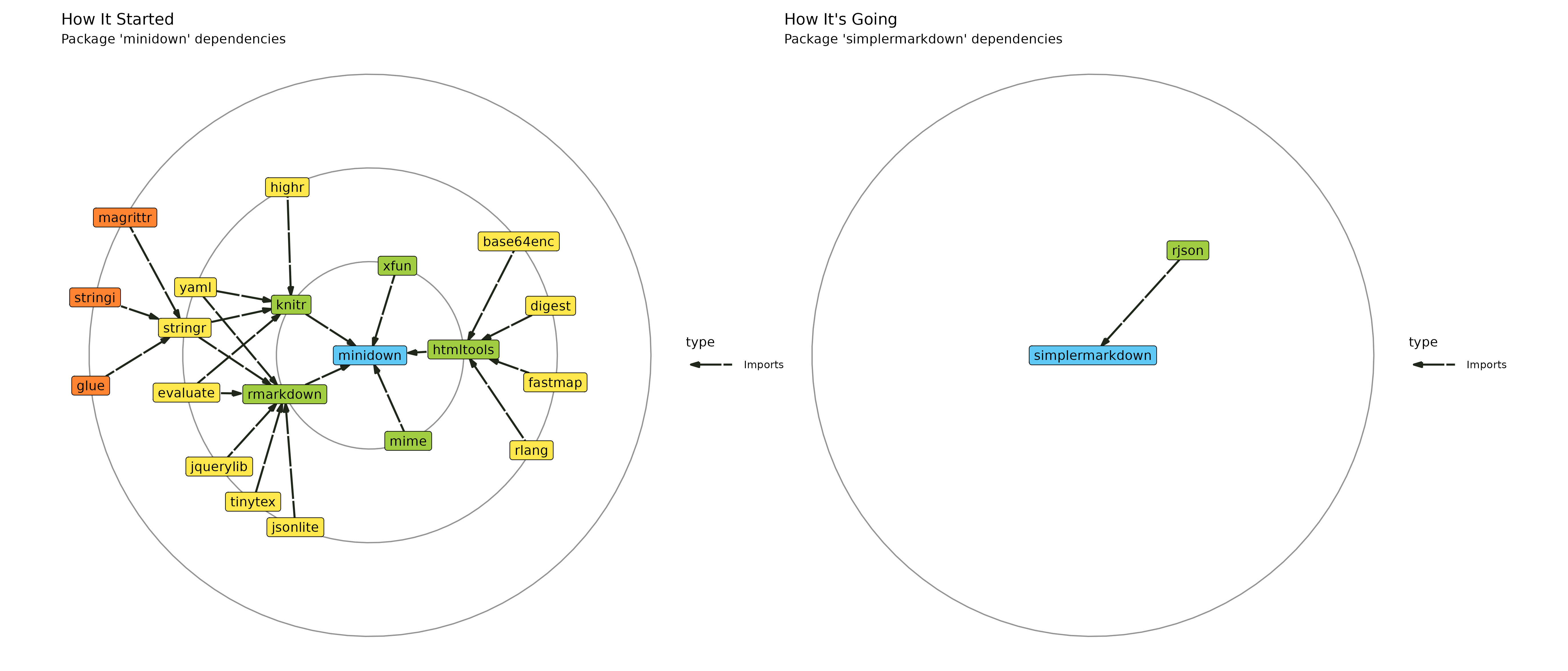
Over the last seven days, and via uploads to new versions to CRAN, I have switched the vignettes of seven packages from using minidown (which in turn requires rmarkdown and knitr, plus their aggregate dependencies) to using simplermarkdown with its sole dependency. That is, of course, a personal choice. I tend to not even knit much in my vignettes (and simplermarkdown supports what I do) but to rely mostly on pandoc for code rendering. So I only need a small subset of the functionality provided, but I can not access just that as the default comes with numerous bells, whistles as well as enough other instruments to form a small marching band.
A picture may express this better:
(courtesy of the deepdep package for the figures).
Which of these two setups is less likely to surprise you with random breaks, say in continuous integration? Which takes less time to install, and burns fewer cpu cycles just to be set up, each time we run a new test? Which is taxing your students, colleagues, collaborators, users, less on setup for use or replication? The first, comprises a total of 29 dependencies, or the second with just one?
My money is on the second choice. Less is more.
The Rblp team is happy to announce a new version 0.3.12 of Rblpapi which just arrived at CRAN. Rblpapi provides a direct interface between R and the Bloomberg Terminal via the C++ API provided by Bloomberg (but note that a valid Bloomberg license and installation is required).
This is the twelveth release since the package first appeared on CRAN in 2016. Changes are detailed below and include both extensions to functionality, actual bug fixes and changes to the package setup. Special thanks goes to Michael Kerber, Yihui Xie and Kai Lin for contributing pull requests!
Changes in Rblpapi version 0.3.12 (2021-12-07)
bdh() supports new option returnAs (Michael Kerber and Dirk in #335 fixing #206)
Remove extra backtick in vignette (Yihui Xie in #343)
Fix a segfault from bulk access with bds (Kai Lin in #347 fixing #253)
Support REQUEST_STATUS in bdh (Kai Lin and John in #349 fixing #348)
Courtesy of my CRANberries, there is also a diffstat report for the this release. As always, more detailed information is on the Rblpapi page. Questions, comments etc should go to the issue tickets system at the GitHub repo.
If you like this or other open-source work I do, you can now sponsor me at GitHub.
On the road to AppStream 1.0, a lot of items from the long todo list have been done so far only one major feature is remaining, external release descriptions, which is a tricky one to implement and specify. For AppStream 1.0 it needs to be present or be rejected though, as it would be a major change in how release data is handled in AppStream.
Besides 1.0 preparation work, the recent 0.15 release and the releases before it come with their very own large set of changes, that are worth a look and may be interesting for your application to support. But first, for a change that affects the implementation and not the XML format:
1. Completely rewritten caching code
Keeping all AppStream data in memory is expensive, especially if the data is huge (as on Debian and Ubuntu with their large repositories generated from desktop-entry files as well) and if processes using AppStream are long-running. The latter is more and more the case, not only does GNOME Software run in the background, KDE uses AppStream in KRunner and Phosh will use it too for reading form factor information. Therefore, AppStream via libappstream provides an on-disk cache that is memory-mapped, so data is only consuming RAM if we are actually doing anything with it.
Previously, AppStream used an LMDB-based cache in the background, with indices for fulltext search and other common search operations. This was a very fast solution, but also came with limitations, LMDB s maximum key size of 511 bytes became a problem quite often, adjusting the maximum database size (since it has to be set at opening time) was annoyingly tricky, and building dedicated indices for each search operation was very inflexible. In addition to that, the caching code was changed multiple times in the past to allow system-wide metadata to be cached per-user, as some distributions didn t (want to) build a system-wide cache and therefore ran into performance issues when XML was parsed repeatedly for generation of a temporary cache. In addition to all that, the cache was designed around the concept of one cache for data from all sources , which meant that we had to rebuild it entirely if just a small aspect changed, like a MetaInfo file being added to /usr/share/metainfo, which was very inefficient.
To shorten a long story, the old caching code was rewritten with the new concepts of caches not necessarily being system-wide and caches existing for more fine-grained groups of files in mind. The new caching code uses Richard Hughes excellent libxmlb internally for memory-mapped data storage. Unlike LMDB, libxmlb knows about the XML document model, so queries can be much more powerful and we do not need to build indices manually. The library is also already used by GNOME Software and fwupd for parsing of (refined) AppStream metadata, so it works quite well for that usecase. As a result, search queries via libappstream are now a bit slower (very much depends on the query, roughly 20% on average), but can be mmuch more powerful. The caching code is a lot more robust, which should speed up startup time of applications. And in addition to all of that, the AsPool class has gained a flag to allow it to monitor AppStream source data for changes and refresh the cache fully automatically and transparently in the background.
All software written against the previous version of the libappstream library should continue to work with the new caching code, but to make use of some of the new features, software using it may need adjustments. A lot of methods have been deprecated too now.
2. Experimental compose support
Compiling MetaInfo and other metadata into AppStream collection metadata, extracting icons, language information, refining data and caching media is an involved process. The appstream-generator tool does this very well for data from Linux distribution sources, but the tool is also pretty heavyweight with lots of knobs to adjust, an underlying database and a complex algorithm for icon extraction. Embedding it into other tools via anything else but its command-line API is also not easy (due to D s GC initialization, and because it was never written with that feature in mind). Sometimes a simpler tool is all you need, so the libappstream-compose library as well as appstreamcli compose are being developed at the moment. The library contains building blocks for developing a tool like appstream-generator while the cli tool allows to simply extract metadata from any directory tree, which can be used by e.g. Flatpak. For this to work well, a lot of appstream-generator s D code is translated into plain C, so the implementation stays identical but the language changes.
Ultimately, the generator tool will use libappstream-compose for any general data refinement, and only implement things necessary to extract data from the archive of distributions. New applications (e.g. for new bundling systems and other purposes) can then use the same building blocks to implement new data generators similar to appstream-generator with ease, sharing much of the code that would be identical between implementations anyway.
2. Supporting user input controls
Want to advertise that your application supports touch input? Keyboard input? Has support for graphics tablets? Gamepads? Sure, nothing is easier than that with the new control relation item and supports relation kind (since 0.12.11 / 0.15.0, details):
3. Defining minimum display size requirements
Some applications are unusable below a certain window size, so you do not want to display them in a software center that is running on a device with a small screen, like a phone. In order to encode this information in a flexible way, AppStream now contains a display_length relation item to require or recommend a minimum (or maximum) display size that the described GUI application can work with. For example:
This will make the application require a display length greater or equal to 300 logical pixels. A logical pixel (also device independent pixel) is the amount of pixels that the application can draw in one direction. Since screens, especially phone screens but also screens on a desktop, can be rotated, the display_length value will be checked against the longest edge of a display by default (by explicitly specifying the shorter edge, this can be changed).
This feature is available since 0.13.0, details. See also Tobias Bernard s blog entry on this topic.
4. Tags
This is a feature that was originally requested for the LVFS/fwupd, but one of the great things about AppStream is that we can take very project-specific ideas and generalize them so something comes out of them that is useful for many. The new tags tag allows people to tag components with an arbitrary namespaced string. This can be useful for project-internal organization of applications, as well as to convey certain additional properties to a software center, e.g. an application could mark itself as featured in a specific software center only. Metadata generators may also add their own tags to components to improve organization. AppStream gives no recommendations as to how these tags are to be interpreted except for them being a strictly optional feature. So any meaning is something clients and metadata authors need to negotiate. It therefore is a more specialized usecase of the already existing custom tag, and I expect it to be primarily useful within larger organizations that produce a lot of software components that need sorting. For example:
This feature is available since 0.15.0, details.
5. MetaInfo Creator changes
The MetaInfo Creator (source) tool is a very simple web application that provides you with a form to fill out and will then generate MetaInfo XML to add to your project after you have answered all of its questions. It is an easy way for developers to add the required metadata without having to read the specification or any guides at all.
Recently, I added support for the new control and display_length tags, resolved a few minor issues and also added a button to instantly copy the generated output to clipboard so people can paste it into their project. If you want to create a new MetaInfo file, this tool is the best way to do it!
The creator tool will also not transfer any data out of your webbrowser, it is strictly a client-side application.
And that is about it for the most notable changes in AppStream land! Of course there is a lot more, additional tags for the LVFS and content rating have been added, lots of bugs have been squashed, the documentation has been refined a lot and the library has gained a lot of new API to make building software centers easier. Still, there is a lot to do and quite a few open feature requests too. Onwards to 1.0!
Another small release of the tidyCpp package arrived on CRAN this morning. The packages offers a clean C++ layer (as well as one small C++ helper class) on top of the C API for R which aims to make use of this robust (if awkward) C API a little easier and more consistent. See the vignette for motivating examples.
This release makes a tiny code change, remove a YAML file for the disgraced former continuous integration service we shall not name (yet that we all used to use). And just like digest five days ago, drat four days ago, littler three days ago, RcppAPT two days ago, and RcppSpdlog yesterday, we converted the vignettes from using the minidown package to the (fairly new) simplermarkdown package which is so much more appropriate for our use of the minimal water.css style.
The NEWS entry follows.
A new version 0.0.7 of RcppSpdlog is now on CRAN. RcppSpdlog bundles spdlog, a wonderful header-only C++ logging library with all the bells and whistles you would want that was written by Gabi Melman, and also includes fmt by Victor Zverovich.
This release brings upstream bugfix releases 1.9.1 and 1.9.2 of spdlog. We also removed the YAML file (and badge) for the disgraced former continuous integration service we shall not name (yet that we all used to use). And just like digest four days ago, drat three days ago, littler two days ago, and RcppAPT yesterday, we converted the vignettes from using the minidown package to the (fairly new) simplermarkdown package which is so much more appropriate for our use of the minimal water.css style.
The (minimal) NEWS entry for this release follows.
Changes in RcppSpdlog version 0.0.7 (2021-12-05)
Upgraded to upstream bug fix releases spdlog 1.9.1 and 1.9.2
A new version of the RcppAPT package interfacing from R to the C++ library behind the awesome apt, apt-get, apt-cache, commands and their cache powering Debian, Ubuntu and the like arrived on CRAN earlier today.
RcppAPT allows you to query the (Debian or Ubuntu) package dependency graph at will, with build-dependencies (if you have deb-src entries), reverse dependencies, and all other goodies. See the vignette and examples for illustrations.
This release updates some package metadata, adds a new package testing helper, and, just like digest three days ago, drat two days ago, and littler yesterday, we converted the vignettes from using the minidown package to the (fairly new) simplermarkdown package which is so much more appropriate for our use of the minimal water.css style.
Changes in version 0.0.8 (2021-12-04)
New test file version.R ensures NEWS file documents current package version
The sixteenth release of littler as a CRAN package just landed, following in the now fifteen year history (!!) as a package started by Jeff in 2006, and joined by me a few weeks later.
littler is the first command-line interface for R as it predates Rscript. It allows for piping as well for shebang scripting via #!, uses command-line arguments more consistently and still starts faster. It also always loaded the methods package which Rscript only started to do in recent years.
littler lives on Linux and Unix, has its difficulties on macOS due to yet-another-braindeadedness there (who ever thought case-insensitive filesystems as a default were a good idea?) and simply does not exist on Windows (yet the build system could be extended see RInside for an existence proof, and volunteers are welcome!). See the FAQ vignette on how to add it to your PATH. A few examples are highlighted at the Github repo, as well as in the examples vignette.
This release brings a more robust and featureful install2.r script (thanks to Gergely Dar czi), corrects some documentation typos (thanks to John Kerl), and now compacts pdf vignette better when using the build.r helper. It also one more updates the URLs for the two RStudio downloaders, and adds a simplermarkdown wrapper. Next, we removed the YAML file (and badge) for the disgraced former continuous integration service we shall not name (yet that we all used to use). And, following digest two days ago and drat yesterday, we converted the vignettes from using the minidown package to the (fairly new) simplermarkdown package which is so much more appropriate for our use of the minimal water.css style.
The full change description follows.
Changes in littler version 0.3.15 (2021-12-03)
Changes in examples
The install2 script can select download methods, and cope with errors from parallel download (thanks to Gergely Daroczi)
The build.r now uses both as argument to --compact-vignettes
The RStudio download helper were once again updated for changed URLs
New caller for simplermarkdown::mdweave_to_html
Changes in package
Several typos were correct (thanks to John Kerl)
Travis artifacts and badges have been pruned
Vignettes now use simplermarkdown
My CRANberries service provides a comparison to the previous release. Full details for the littler release are provided as usual at the ChangeLog page, and also on the package docs website. The code is available via the GitHub repo, from tarballs and now of course also from its CRAN page and via install.packages("littler"). Binary packages are available directly in Debian as well as soon via Ubuntu binaries at CRAN thanks to the tireless Michael Rutter.
Comments and suggestions are welcome at the GitHub repo.
If you like this or other open-source work I do, you can now sponsor me at GitHub.
 Custom screen saver for XSecureLock
 I've been using Vim as my main text editor for 18 years, but for most of that
time I've been using something very close to the default configuration: my
 A new maintenance


 (courtesy of the
 The sixteenth release of