Search Results: "daniel"

26 November 2013

Daniel Pocock: The free software country?

Loch Ness Monster, Scotland There is big news in Europe right now, especially the UK, about the Scottish nation's manifesto for independence. I thought this was really amazing, a country that is going to move to free software and protect its citizens from horrors like DRM. I couldn't wait to find out more, for example, will they use Linux or *BSD? After all, how many nations today can really consider themselves independent when they are trapped in the use of complex and opaque systems that require ongoing royalty payments to a foreign corporation, much like ancient villages paying their tithes to Rome? Today it is actually worse: these independent nations are not just sacrificing their cash - the new Rome is also using those same secret, proprietary systems to raid their subjects' privacy. So I went to the manifesto's web site to get the details. I couldn't even find the words "software" or "technology" listed in the policy index on the front page - and software doesn't even appear in the search results. A section on Culture, Communications and Digital only really looks at the issues for the media (BBC after independence). They don't even make any comment about the British Telecom (BT) pension crisis and whether Scotland will abandon BT's services, leaving only those customers south of the border to continue subsidising the deficit through higher phone bills. There is some hope, with the dot scot (.scot) top level domain coming in 2015 regardless of the referendum outcome. Does this mean an independent Scotland is going to be run without technology at all then? That could be an interesting way to avoid the type of infiltration of communications technology that has been taking place in Brussels. Or do the people calling the shots simply fail to realise the impact of software and communications technology on a modern day concept of independence? Party date set For those who just care about gatecrashing the post-independence party, start booking your leave for March 2016.

21 November 2013

Petter Reinholdtsen: All drones should be radio marked with what they do and who they belong to

Drones, flying robots, are getting more and more popular. The most know ones are the killer drones used by some government to murder people they do not like without giving them the chance of a fair trial, but the technology have many good uses too, from mapping and forest maintenance to photography and search and rescue. I am sure it is just a question of time before "bad drones" are in the hands of private enterprises and not only state criminals but petty criminals too. The drone technology is very useful and very dangerous. To have some control over the use of drones, I agree with Daniel Suarez in his TED talk "The kill decision shouldn't belong to a robot", where he suggested this little gem to keep the good while limiting the bad use of drones:
Each robot and drone should have a cryptographically signed I.D. burned in at the factory that can be used to track its movement through public spaces. We have license plates on cars, tail numbers on aircraft. This is no different. And every citizen should be able to download an app that shows the population of drones and autonomous vehicles moving through public spaces around them, both right now and historically. And civic leaders should deploy sensors and civic drones to detect rogue drones, and instead of sending killer drones of their own up to shoot them down, they should notify humans to their presence. And in certain very high-security areas, perhaps civic drones would snare them and drag them off to a bomb disposal facility. But notice, this is more an immune system than a weapons system. It would allow us to avail ourselves of the use of autonomous vehicles and drones while still preserving our open, civil society.
The key is that every citizen should be able to read the radio beacons sent from the drones in the area, to be able to check both the government and others use of drones. For such control to be effective, everyone must be able to do it. What should such beacon contain? At least formal owner, purpose, contact information and GPS location. Probably also the origin and target position of the current flight. And perhaps some registration number to be able to look up the drone in a central database tracking their movement. Robots should not have privacy. It is people who need privacy.

18 November 2013

Daniel Pocock: $75,000 to explore free software during maternity leave?

A number of countries offer women various social benefits during maternity leave. A new scheme in Australia promises to give virtually all women one hundred percent of their salary (capped at a whopping $12,500 per month) and extend maternity leave to 6 months. Some believe it has been funded by abolishing fibre-to-the-home, but that is another topic... This is a dramatic upgrade - in both cash and time - from the existing scheme where women have 18 weeks leave at the minimum wage. In Australia, the "minimum wage" figure is a fantasy, well below the real cost of living. In practice, the existing scheme and economic pressure force many women back into their job in less than 18 weeks. The new scheme with a one hundred percent salary replacement eliminates much of that pressure. Many European countries offer women some payment that pays the real cost of living, for example, EUR 2,400 per month in France. That is more than the minimum wage in Australia, enough to cover food, clothing and rent in most French cities. Australia's new system, in comparison, will give women on high salaries enough cash to immediately hire a nanny and other discretionary expenses that will maintain their lifestyle as much as they can within reason while dealing with a new baby. The cap is 300% higher than in France and it is 100% wage replacement, whereas many European schemes only give women a percentage of their salary. For this reason, many people have described it as the "Rolls Royce" of maternity pay. Just who are the women in these higher salary brackets? It is hardly any surprise that many of them are in IT and engineering professions. The upper salary range of the new maternity leave scheme appears to squarely match with the cashflows of female software developers, web designers, project managers and potentially many other professionals with a background in science or engineering. Many women worry about being out of the workforce for too long and the potential impact on their skills and professional networks. In computing jobs, technology can change a lot in 6 months. There are many men and women who enjoy computing in their free time as much as in their job. For female developers with this time out of the office, the world's most comfortable maternity leave scheme could be an opportunity to spend a little time exploring the free software world. Just to be clear, I'm not suggesting that women should be reaching for the laptop when they first go into labor and getting plugged in to the web before the umbilical cord has been severed. Some people find technology to be a rewarding pursuit throughout their whole life, while others simply see it as a job. For those who find free software interesting, some may simply pursue something creative that has no relation to the IT projects in their job, some may bring some new experiences back to their job. Others may choose to reconsider their career, performing free software development work on a freelance basis rather than going back to an office environment. The "Rolls Royce" maternity pay scheme could provide a comfortable buffer for them as they evaluate their next steps and make such decisions.

15 November 2013

Daniel Pocock: Switzerland changes

For those with fond memories of the very successful DebConf13... This photo is actually from a few years ago, but the white stuff has started to appear in some parts of the country. Maybe someone local will even be able to sneak down there and draw the Debian swirl in the snow.

11 November 2013

Daniel Pocock: Outreach Program for Women applications

The deadline for Outreach Program for Women applications is very imminent and a range of applications have now appeared on the OPW wiki It is great to see Debian has attracted a diverse range of women who all appear to have coding experience. Code samples have been submitted in Java, C++ and Python among other things and they come from a range of locations around the globe, including Brazil, the UK, Iran and India. Experience counts Looking through the records of some of these applications, it is interesting to see a range of experience and connections in industry and the wider open source family:
  • translator for O'Reilly
  • IBM internship
  • Linux module programming
  • Working alongside one of the Mercurial contributors in a previous role
Funding needed Recent emails from the OPW organisors and DPL have highlighted the need to raise more funding to ensure that Debian can offer OPW internships to the selected applicants. Solving the biggest problem of GSoC 2014 Many of these applicants are students and will be eligible for GSoC 2014. According to the Google FAQ, even students who graduate in 2014 are eligible as long as they are enrolled in a course on the cut-off date 21 April 2014 One of the biggest challenges facing GSoC mentors is the selection of students who are capable of completing good work and have a long term interest in open source. One of the best ways to overcome that challenge is to start forming relationships with potential GSoC students well in advance and get to know them as they make small contributions over an extended period of time. The interest that these candidates have expressed in Debian and OPW suggests that some of them may well be suitable for Debian to help them get onto this track for the next GSoC. Not only will this make the GSoC 2014 selection process easier but it may help us to select more GSoC candidates with a long term outlook. Women in science, engineering and the wider business world More news items have appeared recently about women in science and engineering and other leadership roles:

In the early 1950s, Morgan was the only female analyst among 900 rocket scientists at North American Aviation. She was also one of the few without a college degree.

"What I saw a thousand times during the downturn was, 'We'd like to give her that opportunity, but we need to go with the sure thing - we can't afford diversity right now,'" - Sallie Krawcheck, former chief executive at Merrill Lynch

10 November 2013

Gregor Herrmann: RC bugs 2013/45

here's the list of RC bugs I've worked on during the last week.

3 November 2013

Gregor Herrmann: RC bugs 2013/44

I'm getting the hang of the more or less daily RC bug fixing again. below you find what I did this week. as a side note: as you can see, quite a few of the patches are taken from ubuntu; it's great that someone over there already took the time to come up with a fix; thanks! not so great is that only one of them was in the BTS. guys, you have already been better at forwarding your patches to the debian BTS, please try to get back into this good habit :)

31 October 2013

Daniel Pocock: init systems: what do users want?

The debate about Debian init system replacement continues and many developers have given their opinions. However, what do the users want? What type of features will make it easier for users to adopt and promote Debian and free software in general? Could this even help bring improvements to other distributions too? Some of the possibilities I've previously raised for discussion (and they are not specific to Debian by any means):
  • Better integration with tools for service monitoring (for example, so Nagios can automatically detect all the services on a system and the dependency relationship between them, avoiding any manual configuration of the monitoring system)
  • Better integration with tools for service management (for example, so Nagios can more easily restart a service without having to provide some action script developed by hand)
  • Better support for dependencies in clustering and distributed environments (e.g. Apache on host A should only start after MySQL is running on host B or host C)
  • Support for multiple instances of a service, each with separate configuration files on the same host
Some of the systems up for discussion go some of the way to addressing these types of requirements - none of them go all the way. What other requirements do people have? Should Debian wait a little longer and let the different solutions compete to offer more of these things before any decision is made? My own feeling is that Debian should not commit to something that will involve any loss in current features or support for ports and we should use this opportunity to find the best possible set of features for the future.

30 October 2013

Daniel Kahn Gillmor: getting to TLS (STARTTLS HOWTO)

Many protocols today allow you to upgrade to TLS from within a cleartext version of the protocol. This often falls under the rubric of "STARTTLS", though different protocols have different ways of doing it. I often forget the exact steps, and when i'm debugging a TLS connection (e.g. with tools like gnutls-cli) i need to poke a remote peer into being ready for a TLS handshake. So i'm noting the different mechanisms here. lines starting with C: are from the client, lines starting with S: are from the server. many of these are (roughly) built into openssl s_client, using the -starttls option. Sometimes this doesn't work because the handshake needs tuning for a given server; other times you want to do this with a different TLS library. To use the techniques below with gnutls-cli from the gnutls-bin package, just provide the --starttls argument (and the appropriate --port XXX argument), and then hit Ctrl+D when you think it's ok to start the TLS negotiation. SMTP The polite SMTP handshake (on port 25 or port 587) that negotiates a TLS upgrade looks like:
C: EHLO myhostname.example
S: [...]
S: 250-STARTTLS
S: [...]
S: 250 [somefeature]
C: STARTTLS
S: 220 2.0.0 Ready to start TLS
<Client can begin TLS handshake>
IMAP The polite IMAP handshake (on port 143) that negotiates a TLS upgrade looks like:
S: OK [CAPABILITY IMAP4rev1 [...] STARTTLS [...]] [...]
C: A STARTTLS
S: A OK Begin TLS negotiation now
<Client can begin TLS handshake>
POP The polite POP handshake (on port 110) that negotiates a TLS upgrade looks like:
S: +OK POP3 ready
C: STLS
S: +OK Begin TLS 
<Client can begin TLS handshake>
XMPP The polite XMPP handshake (on port 5222 for client-to-server, or port 5269 for server-to-server) that negiotiates a TLS upgrade looks something like (note that the domain requested needs to be the right one):
C: <?xml version="1.0"?><stream:stream to="example.net"
C:  xmlns="jabber:client" xmlns:stream="http://etherx.jabber.org/streams" version="1.0">
S: <?xml version='1.0'?>
S: <stream:stream
S:  xmlns:db='jabber:server:dialback'
S:  xmlns:stream='http://etherx.jabber.org/streams'
S:  version='1.0'
S:  from='example.net'
S:  id='d34edc7c-22bd-44b3-9dba-8162da5b5e72'
S:  xml:lang='en'
S:  xmlns='jabber:server'>
S: <stream:features>
S: <dialback xmlns='urn:xmpp:features:dialback'/>
S: <starttls xmlns='urn:ietf:params:xml:ns:xmpp-tls'/>
S: </stream:features>
C: <starttls xmlns="urn:ietf:params:xml:ns:xmpp-tls" id="1"/>
S: <proceed xmlns='urn:ietf:params:xml:ns:xmpp-tls'/>
<Client can begin TLS handshake>
NNTP RogerBW (in the comments below) points out that NNTP has TLS support:
C: CAPABILITIES
S: [...]
S: STARTTLS
S: [...]
S: .
C: STARTTLS
S: 382 Continue with TLS negotiation
PostgreSQL I got mail from James Cloos suggesting how to negotiate an upgrade to TLS over the PostgreSQL RDBMS. He points to the protocol docs, and in particular, to multiple protocol flow documents, and SSLRequest and StartupMessage chunks of the protocol spec (and clarification that data is sent in network byte order). It won't work in a text-mode communication, but it's worth noting here anyway: The client starts by sending these eight octets:
0x00 0x00 0x00 0x08 0x04 0xD2 0x16 0x2F
and the server replies with 'S' for secure or 'N' for not. If the reply is S, TLS negotiation follows. The message represents int32(8) specifying that there are 8 octets and int16(1234),int16(5678). All sent in network order. (The non-TLS case starts with a similar message with int16(3),int16(0) for protocol version 3.0. Starttls is essentially pg protocol version 1234.5678.) what else? I don't know (but would like to) how to do: If you know other mechanisms, or see bugs with the simple handshakes i've posted above, please let me know either by e-mail or on the comments here. Other interesting notes: RFC 2817, a not-widely-supported mechanism for upgrading to TLS in the middle of a normal HTTP session.Tags: gnutls, imap, pop, postgresql, smtp, starttls, tls, xmpp

27 October 2013

Gregor Herrmann: RC bugs 2013/41-43

after a bit of a break I try to get back into regular RC bug fixing. here's what I've done recently:

24 October 2013

Daniel Pocock: Final report on GSoC 2013 projects

Google Summer of Code finished recently. This is the first year that I have participated as a mentor for the Debian Project. Its a big responsibility to be part of the Debian team and to be one of the Debian team members representing Debian at the GSoC Mentor Summit. Birthdays all round This has been a particularly important year for the Debian Project, as the project celebrated our 20th birthday recently, on 16 August 2013, one of the final days of DebConf13 in Switzerland. GSoC celebrates its 10th year in 2014, with a generous 10% boost in the student stipend to mark the occasion. Google: don't be evil Google's "Don't be evil" approach to business has always been an interesting point for discussion. In my view, there are few cases of absolute good or absolute evil that we can universally classify and agree on. At a more pragmatic level, various people have commented that GSoC is a recruiting program for Google: some have even cited this as a reason not to participate. This is a more interesting point for discussion. The results of the program are not exclusive to the headhunters at Google. Anybody can browse through the Debian GSoC weekly student reports from each student to find out exactly what the students were up to and try to recruit them. Mentors and the projects they belong to have not been forced to sign any wide-ranging non-disclosure agreements or non-compete agreements with Google. In one recent example, the xWiki open source project even went as far as setting up a new office in Romania and employing some former GSoC students on a permanent basis.

Assorted images from Iasi, Romania, where xWiki set up an office employing former GSoC students How does Google benefit then? Well, there appear to be several possibilities:
  • Generating a huge amount of goodwill and recognition for the value that they place on the development of the next generation of software engineers
  • Stimulating the expansion of high quality free software projects, many of which they use directly or indirectly for their internal projects
  • Access to private evaluations prepared by the mentors. These evaluations don't take more than an hour for the mentors to complete but they do serve to give Google's headhunters a slight headstart over anybody else who is scouring the web for the names of graduates who completed GSoC
Overall, it appears to fit the definition of a "win-win" scenario: yes, Google gets stuff out of it, but the benefit is not exclusive to Google and projects like Debian are winners too. My initial approach I started by reviewing some of these materials: One particular concept that I took note of was the need to give students some opportunity to be innovative and original in their project proposals. In other words, it has been suggested that students should not be given a precise specification: rather, they should be given some very general concepts or goals and asked to suggest some funky, innovative new idea. The wisdom of this approach varies. If your free software project has some very specific gap that you need to fill, you may only be interested in taking a student who can fill that gap and you may not want to waste the time of other applicants. On the other hand, if you do precisely document this gap you want filled, you may get a bunch of very similar proposals from students and it may be more difficult to distinguish which of them is the most desirable candidate. Furthermore, if your expectations are too rigid, you may not benefit from a top-gun coming in and contributing some really exciting piece of work that you hadn't even thought of. In the end, I opted for providing more generic project briefs and looking at how students responded. The briefs that I published are available here. Coding tasks during the selection process There is no doubt about it, coding tasks are an important part of ensuring students are capable of development work before they are selected. They are also very important for us as mentors. It is not uncommon for some of us to be completely out of touch with the capabilities of other developers. The coding tasks completed by the students during the selection phase allow us to get a feel for their capabilities and set reasonable expectations for how much they can achieve during the course of the project. To simplify the management of coding tasks and engage the students in the Debian community at large, I decided to create tasks as wishlist items in the Debian bug tracking system, such as this dynalogin bug report. The prospective GSoC students were asked to put their name in the bug tracker to take ownership of the task they would complete. Student project proposals For the real-time communications project, I felt all the students slightly underestimated the complexity of this field and would have to be extremely lucky to complete everything they hoped to. After all, this is a field that the free software movement has been wrestling with for years without gaining the upper hand. For somebody with good knowledge of the projects in this space, it is possible to guide the students towards meaningful and achievable subprojects. Nonetheless, the proposals were useful for me in understanding which part of the topics were most attractive to the students. For the other project areas, the student proposals were slightly more specific. Fabian's appeared to be the most specific and well considered proposal for the one-time-password project, in fact, it appeared very much like a project that he could work through from start to finish. Debian teamwork Anybody looking at the GSoC web site will notice that there is a certain amount of overhead in joining the program, promotion, payment administration and optional participation in the GSoC Mentor Summit. As a large organisation, Debian established a dedicated SoC administration team who looked after the GSoC and Outreach Program for Women administrivia. As a developer and mentor, I found this arrangement was highly effective and allowed me to focus over 99% of my efforts on the front-line work, selecting students and supporting them through their projects. Project results One of the more controversial issues during the Debian 7 (wheezy) release cycle was the inclusion of the Mumble voice conferencing software. Although the software has some serious issues, it was eventually escalated to the technical committee and allowed to remain in Debian, partly due to lack of any alternative. One of the first results from Catalin's project was the creation of an alternative, the new reConServer project, based on the librecon conversation manager API from the reSIProcate SIP stack. reConServer is a significantly more generic solution than Mumble, as it allows any SIP peer to participate in an audio conference. It supports TURN for NAT traversal too. Catalin then went on to make the first working implementation of a scheme for passing context information from a web site to SIP WebRTC call as described in the IETF draft. All work has been integrated into release tarballs and packaging. Fabian worked through the latest standards for one-time passwords, extending the oath-toolkit and dynalogin projects to implement mutual two-factor authentication with just about any arbitrary crypto suite using one-time passwords. This work is yet to be merged into an official release of dynalogin as it requires co-ordination with the oath-toolkit release and package updates. However, there is a compelling demonstration in his video from DebConf13 and the source is available under Fabian's github account. In the post-Snowden world, the work from both of these student projects will be hugely valuable to people wanting to tighten up their computer security and communication security practices. The development process Deciding to mentor more than one project turned out to be a worthwhile decision. At first, this might seem like a big risk but it is manageable with support from co-mentors. The upside is that different students work at different speeds, they have different code styles, they even work at different times of the day or week and mentoring more than one student/project allows the mentor to gain a better appreciation of how the students differ than if mentoring only a single project. For Catalin's project, it became obvious at an early stage that he would benefit from having a dedicated server to run the VoIP applications on public IP addresses and low-latency networks while testing them. I spun up a virtual machine with IPv4 and IPv6 in my Xen Cloud Platform and this was extremely helpful for both of us. Throughout the project, I took a hands-off approach and often left the students to their own devices. I gave some suggestions to Catalin about the object-oriented design and this was enough for him to fill in the gaps and write all the code by himself. Fabian's project had fewer ambiguities and he was able to use existing code as a model more frequently than Catalin. It is possible that the students may have produced more code if I had thought through the designs myself and given them definite blue-prints. However, I feel that this would have made it harder for me to appreciate their own abilities and test the limits of their design skills. DebConf13 participation One of the highlights for the students was their participation in DebConf13. Both students presented a session at the conference showcasing some of their work. The DebConf video team produces high quality videos of all sessions at the conference and this in turn provides some great evidence of the students' capabilities and what GSoC adds to Debian and the wider free software universe. I would encourage other mentors to actively contemplate ways to involve their students in conferences during or shortly after the completion of their project work. Looking ahead Google has recently confirmed that Google Summer of Code will be repeated in 2014. It is the 10th anniversary of the program and to celebrate, students will get 10% extra pay. Thank you There are many people to thank for the success of these projects and the wider success of the Debian GSoC team:
  • The Debian GSoC and OPW organisation admin team
  • Google and the Google Open Source Programs Office
  • All the co-mentors who assisted on these projects with me: Simon Josefsson, Luke Faraone, Sylvain Berfini, Eloy Coto and Jes s P rez Rubio
  • The students themselves, C t lin Constantin U urelu and Fabian Gr nbichler
  • All the other very capable and motivated students who applied, submitted code samples but were not selected to participate: many of these students could have also completed a successful project and turning them away is one of the most difficult tasks for mentors in a volunteer organisation like Debian


21 October 2013

Daniel Pocock: Debian team at GSoC summit 2013

One of the most exciting things about the GSoC mentor summit 2013 has been the large number of participants who are Debian Developers, Debian Maintainers or other members of the wider Debian family Debian team members at GSoC mentor summit 2013
AttachmentSize
debian-gsoc-summit-group.jpg175.13 KB

19 October 2013

Daniel Pocock: Debian at GSoC mentor summit 2013

We're having so much fun that I'm just posting a couple of pictures... a full report will come later Sylvestre and Daniel
Paul

15 October 2013

Daniel Pocock: Debian Outreach Program for Women 2013

Debian's Outreach Program for Women (OPW) is underway. This is a huge thing and not just something that female developers need to be concerned with. Untapped potential Many computer science schools see about twenty percent of places occupied by female students. In the Debian community, however, about one percent of developers are female. As there are about one thousand male developers, this suggests there are another one hundred potential female developers and contributors out there who are not aware of the fact that they could be part of Debian. Finding these people and helping them fulfil their potential makes the project better for everybody. Women are heavy lifters People should not assume that these women are going to need their hands held. When the Jitsi project recently moved to Github, the Github repository reports made the surprise revelation that Yana is the top contributor - by a fifty percent margin. Will women save the world this week? It is not just in software engineering that women have significant potential. As the men running the US bumble around with their high-stakes game of chicken, it is notable that last week the US Federal Reserve appointed their first female chairman, Janet Yellen. It is unlikely that her first meeting with female IMF boss Christine Lagarde would have satisfied stereotypes about casual gossip or shopping; more likely, they would be contemplating how to save the world economy if rogue congressmen push the US into default - a possibility that is no longer just an outlier. Integrating financial software in Debian With that in mind, one of the projects I've offered to mentor under OPW involves creating further integration between free software for finance and accounting on Debian. Several applicants have already contact me about this. Fundraising to support OPW 2013 Debian is currently raising funds to support this program. The project administrators are hopefully going to provide more details soon about how funding will be allocated and how many projects will proceed.

12 October 2013

Lars Wirzenius: Moving repositories to git.liw.fi

I'm moving all my git repositories from Gitorious and git.gitano.org.uk to my new Gitano instance at git.liw.fi. Gitano is a git server written by Daniel Silverstone, and it's wonderful. I will be converting my non-git repositories to git, on git.liw.fi, later on.
8 October 2013

Daniel Kahn Gillmor: Unaccountable surveillance is wrong

As I mentioned earlier, the information in the documents released by Edward Snowden show a clear pattern of corporate and government abuse of the information networks that are now deeply intertwined with the lives of many people all over the world. Surveillance is a power dynamic where the party doing the spying has power over the party being surveilled. The surveillance state that results when one party has "Global Cryptologic Dominance" is a seriously bad outcome. The old saw goes "power corrupts, and absolute power corrupts absolutely". In this case, the stated goal of my government appears to be absolute power in this domain, with no constraint on the inevitable corruption. If you are a supporter of any sort of a just social contract (e.g. International Principles on the Application of Human Rights to Communications Surveillance), the situation should be deeply disturbing. One of the major sub-threads in this discussion is how the NSA and their allies have actively tampered with and weakened the cryptographic infrastructure that everyone relies on for authenticated and confidential communications on the 'net. This kind of malicious work puts everyone's communication at risk, not only those people who the NSA counts among their "targets" (and the NSA's "target" selection methods are themselves fraught with serious problems). The US government is supposed to take pride in the checks and balances that keep absolute power out of any one particular branch. One of the latest attempts to simulate "checks and balances" was the President's creation of a "Review Group" to oversee the current malefactors. The review group then asked for public comment. A group of technologists (including myself) submitted a comment demanding that the review group provide concrete technical details to independent technologists. Without knowing the specifics of how the various surveillance mechanisms operate, the public in general can't make informed assessments about what they should consider to be personally safe. And lack of detailed technical knowledge also makes it much harder to mount an effective political or legal opposition to the global surveillance state (e.g. consider the terrible Clapper v. Amnesty International decision, where plaintiffs were denied standing to sue the Director of National Intelligence because they could not demonstrate that they were being surveilled). It's also worth noting that the advocates for global surveillance do not themselves want to be surveilled, and that (for example) the NSA has tried to obscure as much of their operations as possible, by over-classifying documents, and making spurious claims of "national security". This is where the surveillance power dynamic is most baldly in play, and many parts of the US government intelligence and military apparatus has a long history of acting in bad faith to obscure its activities. The people who have been operating these surveillance systems should be ashamed of their work, and those who have been overseeing the operation of these systems should be ashamed of themselves. We need to better understand the scope of the damage done to our global infrastructure so we can repair it if we have any hope of avoiding a complete surveillance state in the future. Getting the technical details of these compromises in the hands of the public is one step on the path toward a healthier society. PostscriptLest I be accused of optimism, let me make clear that fixing the technical harms is necessary, but not sufficient; even if our technical infrastructure had not been deliberately damaged, or if we manage to repair it and stop people from damaging it again, far too many people still regularly accept ubiquitous private (corporate) surveillance. Private surveillance organizations (like Facebook and Google) are too often in a position where their business interests are at odds with their users' interests, and powerful adversaries can use a surveillance organization as a lever against weaker parties. But helping people to improve their own data sovereignty and to avoid subjecting their friends and allies to private surveillance is a discussion for a separate post, i think.Tags: cryptography, nsa

28 September 2013

Daniel Kahn Gillmor: RIP Cookiepuss

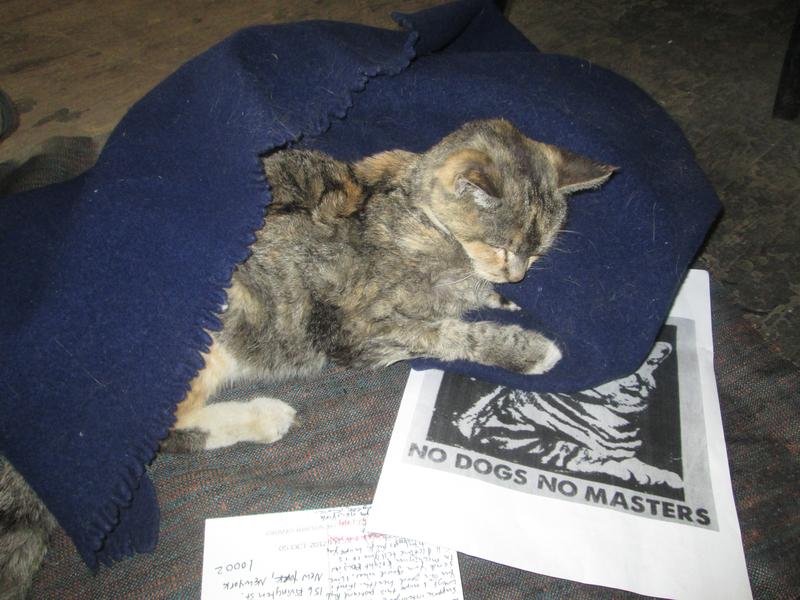
Yesterday, i said a sad goodbye to an old friend at ABC No Rio. Cookiepuss was a steadfast companion in my volunteer shifts at the No Rio computer center, a cranky yet gregarious presence. I met her soon after moving to New York, and have hung out with her nearly every week for years. [Cookiepuss -- No Dogs No Masters] She had the run of the building at ABC No Rio, and was friends with all sorts of people. She was known and loved by punks and fine artists, by experimental musicians and bike mechanics, computer geeks and librarians, travelers and homebodies, photographers, screenprinters, anarchists, community organizers, zinesters, activists, performers, and weirdos of all stripes. For years, she received postcards from all over the world, including several from people who had never even met her in person. In her younger days, she was a ferocious mouser, and even as she shrank with age and lost some of her teeth she remained excited about food. She was an inveterate complainer; a pants-shredder; a cat remarkably comfortable with dirt; a welcoming presence to newcomers and a friendly old curmudgeon who never seemed to really hold a grudge even when i had to do horrible things like help her trim her nails. After a long life, she died having said her goodbyes, and surrounded by people who loved her. I couldn't have asked for better, but I miss her fiercely.
25 September 2013

Daniel Kahn Gillmor: half a minute for science!

A friend is teaching a class on data analysis. She is building a simple and rough data set for the class to examine, and to spur discussion. You can contribute in half a minute! Here's how:
  1. get a stopwatch or other sort of timer (whatever device you're reading this on probably has such a thing).
  2. start the timer, but don't look at it.
  3. wait for what you think is 30 seconds, and then look at the timer
  4. how many actual seconds elapsed?
The data doesn't need to be particularly high-precision (whole second values are fine). The other data points my friend is looking for are age (in years, again, whole numbers are fine) and gender. You can send me your results by e-mail, (i suspect you can find my address if you're reading this blog). Please put "half a minute for science" in the subject line, and make sure you include: Science thanks you!Tags: science

23 September 2013

Daniel Pocock: PostBooks packages available

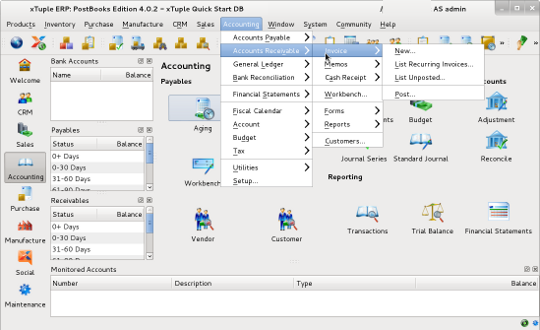
A common theme that comes up in free software evangelism is the question of how to tap into the huge expenditure that small to medium-sized businesses make for off-the-shelf licensed software. It is well known that many small companies are paying over the odds compared to the site-license rates given to big business, so why is it that small businesses are not rushing to adopt free and open source solutions? The answer is not likely to be found by fighting a battle on pricing (even though it is a battle that free software is inherently well prepared for). Rather, the most compelling strategy involves helping businesses find better ways to solve their own problems. A problem that every business encounters in every industry is the maintenance of proper financial records. Up until now, packaged solutions like GnuCash and HomeBank, available in many Linux distributions, have only catered for the smallest businesses and household accounting. At the other end of the spectrum, solutions like Compiere/Adempiere and OpenERP require a level of effort to install and maintain that makes them unsuitable for small users and businesses that don't need their full range of features. OpenERP briefly appeared as a Debian package but subsequently dropped out due to difficulties supporting the package. There is another choice, PostBooks. PostBooks has recently been packaged for Debian and this experience leads me to believe it will be supportable in Fedora and other distributions too. PostBooks, which started off as a commercial product, was re-licensed as an open source solution in 2007. In March 2013, PostBooks was project of the month on Sourceforge. Of particular note,
  • PostBooks has a Qt-based GUI where users of equivalent commercial solutions are likely to feel comfortable very quickly
  • PostBooks does not depend on any dedicated server processes other than a PostgreSQL database
  • Using the quickstart database, it can be set up in less than half a day, making it suitable for many consultants and freelancers who may otherwise use a product having a setup wizard (such as QuickBooks).
  • However, with features like inventory, invoicing, a sophisticated data import GUI (known as CSVImp), a true SQL backend, multi-currency and multiple concurrent users, it scales beyond the use cases that Quickbooks and Sage Accounting are capable of servicing.
  • The company behind PostBooks, xTuple, is well established and offers related services such as training and an annual user conference (which takes place in just a few weeks). Many business users are likely to find this style of support very reassuring and familiar, even if they don't plan to immediately take advantage of these things.
Limitations Two particular limitations caught my attention early when evaluating PostBooks: The developers have acknowledged these limitations and offered to complete these solutions with a crowd-funding campaign dubbed Feature Mob 2.

While everybody likes a free lunch, I personally feel that developers are perfectly entitled to request payment for their work. Having already taken a great leap of faith in open-sourcing a product that had previously been developed in-house, companies like xTuple need to look at new ways to generate revenue. Having looked at some of the prices of equivalent solutions, I felt quite comfortable pledging a similar amount based on four things:
  • it is based on the Kickstarter model, they only keep the money if their funding target is reached and feature implementation goes ahead
  • they are releasing the work as open source
  • the desire to have the option of using a highly capable free software solution that will be around well into the future
  • the probability that this is one piece of software that is likely to create more commercial opportunities for free software developers
Next steps People trying the packages and people who potentially want to package PostBooks for other distributions are very welcome to come and ask questions in the xTuple Debian maintainers packaging list or using the xTuple web forums. Please also feel free to report bugs through the Debian bug tracker.

19 September 2013

Daniel Pocock: Install Debian wheezy and jessie directly with btrfs RAID1

Some time ago, I provided an installation report for installing Debian wheezy onto a btrfs RAID1 filesystem. It is not supported directly from the installer partitioning menu partman, but it is not hard to trick the installer to do it, as described in the bug report. I believe this may be a worthy release goal for Debian 8 (jessie), but it is not something I can commit to facilitate myself so I am sharing my experience with it for those who may want to volunteer. Anybody wanting to test it can easily do so with VirtualBox if they don't want to dedicate a real machine to it or if they don't have two real disks in their test machine. My own testing simply involved creating two VirtualBox virtual disks on a single SATA disk. Procedure Here is an abbreviated version of the procedure from the installation report linked above. Run the Debian installer as normal up to the partitioning menu Use manual partition mode Create one big btrfs partition on one HDD (either on a raw partition or on an LV) Designate the partition on one disk as the root FS, designate the partition on the other as unused/unformatted. Continue through the setup, installing to one disk After rebooting into Debian, follow these steps to add the other disk into a RAID1 A variation of this procedure is to use a shell while the installer is running to make the RAID1 during the installation and observe whether /etc/fstab is created correctly. Potential gotchas: is the default fstab sufficient or does it need to be modified after the conversion to RAID1? Does the initframfs need to be regenerated (and potentially modified by hand?) to make it work? Issues to be discussed / resolved Mixing BTRFS filesystems with Logical Volume Management - how many permutations should the installer support? What do people expect/need/require? How to boot if a disk fails? Can grub boot from either? Warning the user when the FS detects instability or failure in either disk

Next.

Previous.