Junichi Uekawa: Thinking of how a metronome could be ergonomic on the web.
 Thinking of how a metronome could be ergonomic on the web.
metronome?.
Thinking of how a metronome could be ergonomic on the web.
metronome?.

 Update on 2025-07-28: added note about Debian 13/trixie support for OpenVox (thanks, Ben Ford!)
Debian v13 with codename trixie is scheduled to be published as new stable release on 9th of August 2025.
I was the driving force at several of my customers to be well prepared for the upcoming stable release (my efforts for trixie started in August 2024). On the one hand, to make sure packages we care about are available and actually make it into the release. On the other hand, to ensure there are no severe issues that make it into the release and to get proper and working upgrades. So far everything is looking pretty well and working fine, the efforts seemed to have payed off. :)
As usual with major upgrades, there are some things to be aware of, and hereby I m starting my public notes on trixie that might be worth for other folks. My focus is primarily on server systems and looking at things from a sysadmin perspective.
Further readings
As usual start at the official Debian release notes, make sure to especially go through What s new in Debian 13 + issues to be aware of for trixie (strongly recommended read!).
Package versions
As a starting point, let s look at some selected packages and their versions in bookworm vs. trixie as of 2025-07-20 (mainly having amd64 in mind):
| Package | bookworm/v12 | trixie/v13 |
|---|---|---|
| ansible | 2.14.3 | 2.19.0 |
| apache | 2.4.62 | 2.4.64 |
| apt | 2.6.1 | 3.0.3 |
| bash | 5.2.15 | 5.2.37 |
| ceph | 16.2.11 | 18.2.7 |
| docker | 20.10.24 | 26.1.5 |
| dovecot | 2.3.19 | 2.4.1 |
| dpkg | 1.21.22 | 1.22.21 |
| emacs | 28.2 | 30.1 |
| gcc | 12.2.0 | 14.2.0 |
| git | 2.39.5 | 2.47.2 |
| golang | 1.19 | 1.24 |
| libc | 2.36 | 2.41 |
| linux kernel | 6.1 | 6.12 |
| llvm | 14.0 | 19.0 |
| lxc | 5.0.2 | 6.0.4 |
| mariadb | 10.11 | 11.8 |
| nginx | 1.22.1 | 1.26.3 |
| nodejs | 18.13 | 20.19 |
| openjdk | 17.0 | 21.0 |
| openssh | 9.2p1 | 10.0p1 |
| openssl | 3.0 | 3.5 |
| perl | 5.36.0 | 5.40.1 |
| php | 8.2+93 | 8.4+96 |
| podman | 4.3.1 | 5.4.2 |
| postfix | 3.7.11 | 3.10.3 |
| postgres | 15 | 17 |
| puppet | 7.23.0 | 8.10.0 |
| python3 | 3.11.2 | 3.13.5 |
| qemu/kvm | 7.2 | 10.0 |
| rsync | 3.2.7 | 3.4.1 |
| ruby | 3.1 | 3.3 |
| rust | 1.63.0 | 1.85.0 |
| samba | 4.17.12 | 4.22.3 |
| systemd | 252.36 | 257.7-1 |
| unattended-upgrades | 2.9.1 | 2.12 |
| util-linux | 2.38.1 | 2.41 |
| vagrant | 2.3.4 | 2.3.7 |
| vim | 9.0.1378 | 9.1.1230 |
| zsh | 5.9 | 5.9 |
 The last two weeks I attended DebConf and DebCamp in Brest, France.
Usually, I like to do a more detailed write-up of DebConf, but I was already quite burnt out when I got here, so I ll circle back to a few things that were important to me in later posts.
In the meantime, thanks to everyone who made this DebConf possible, whether you volunteered for one task or were part of the organisation team. Also a special thanks to the wonderful sponsors who made this entire event possible!
See you next year in Argentina!

Jellyfish, taken during daytrip at aquarium.

21dc99cgit log --raw --all --find-object=21dc99c finds the patch already applied as
198e69cc4150aba1e7af740a2111ace6a267779e1002-v2-media_verisilicon_fix_av1_decoder_clock_frequency.patch applies cleanlyreform-debian-packages/README.md
$  apt-get install git gpg gpgv build-essential bc rsync kmod cpio bison flex libelf-dev libssl-dev debhelper libdw-dev
$ cp /boot/config-6.15.4-mnt-reform-arm64 .config
$ make olddefconfig
$ yes ''   make localmodconfig
$ make KBUILD_IMAGE=arch/arm64/boot/Image bindeb-pkg -j$(nproc)
reform-debian-packages, and update the relevant Makefile.
diff --git a/arch/arm64/boot/dts/rockchip/Makefile b/arch/arm64/boot/dts/rockchip/Makefile
index 26533be1dd86..83ef850cd113 100644
--- a/arch/arm64/boot/dts/rockchip/Makefile
+++ b/arch/arm64/boot/dts/rockchip/Makefile
@@ -163,6 +163,7 @@ dtb-$(CONFIG_ARCH_ROCKCHIP) += rk3588-h96-max-v58.dtb
 dtb-$(CONFIG_ARCH_ROCKCHIP) += rk3588-jaguar.dtb
 dtb-$(CONFIG_ARCH_ROCKCHIP) += rk3588-jaguar-pre-ict-tester.dtbo
 dtb-$(CONFIG_ARCH_ROCKCHIP) += rk3588-mnt-reform2.dtb
+dtb-$(CONFIG_ARCH_ROCKCHIP) += rk3588-mnt-pocket-reform.dtb
 dtb-$(CONFIG_ARCH_ROCKCHIP) += rk3588-nanopc-t6.dtb
 dtb-$(CONFIG_ARCH_ROCKCHIP) += rk3588-nanopc-t6-lts.dtb
 dtb-$(CONFIG_ARCH_ROCKCHIP) += rk3588-ok3588-c.dtb
diff --git a/arch/arm64/boot/dts/rockchip/rk3588-mnt-pocket-reform.dts b/arch/arm64/boot/dts/rockchip/rk3588-mnt-pocket-reform.dts
new file mode 100644
index 000000000000..81533cedc200
DTC     arch/arm64/boot/dts/rockchip/rk3588-mnt-pocket-reform.dtb
arch/arm64/boot/dts/rockchip/rk3588-mnt-pocket-reform.dts:1020.3-13: Warning (reg_format): /dsi@fde30000/panel:reg: property has invalid length (4 bytes) (#address-cells == 2, #size-cells == 1)
arch/arm64/boot/dts/rockchip/rk3588-mnt-pocket-reform.dtb: Warning (pci_device_reg): Failed prerequisite 'reg_format'
arch/arm64/boot/dts/rockchip/rk3588-mnt-pocket-reform.dtb: Warning (pci_device_bus_num): Failed prerequisite 'reg_format'
arch/arm64/boot/dts/rockchip/rk3588-mnt-pocket-reform.dtb: Warning (i2c_bus_reg): Failed prerequisite 'reg_format'
arch/arm64/boot/dts/rockchip/rk3588-mnt-pocket-reform.dtb: Warning (spi_bus_reg): Failed prerequisite 'reg_format'
arch/arm64/boot/dts/rockchip/rk3588-mnt-pocket-reform.dts:1018.8-1033.4: Warning (avoid_default_addr_size): /dsi@fde30000/panel: Relying on default #address-cells value
arch/arm64/boot/dts/rockchip/rk3588-mnt-pocket-reform.dts:1018.8-1033.4: Warning (avoid_default_addr_size): /dsi@fde30000/panel: Relying on default #size-cells value
 So, for the first year, this year s DebConf had the DebConf Academic Track ,
that is, content for a one-day-long set of short sessions, for which of them
there was a written article presenting the content often with a very academic
format, but not necessarily. I hope that for future DebConfs we will continue to
hold this track, and that we can help bridge the gap: to get people that are
not usually from the academic / universitary prepare content that will be
formally expressed and included in a long-lasting, indexed book of
proceedings. We did have (informal) proceedings in many of the early DebConfs,
and I m very happy to regain that, but with 20 years of better practices.
Anyway, of course, I took the opportunity to join this experiment, and together
with my Mexican colleague Tzolkin Gardu o who is finishing her PhD here in
France (or should I say, second to her, as she is the true leading author of our
work). And here you can see the paper we submitted to the DebConf Academic
Track, which will be published soon:
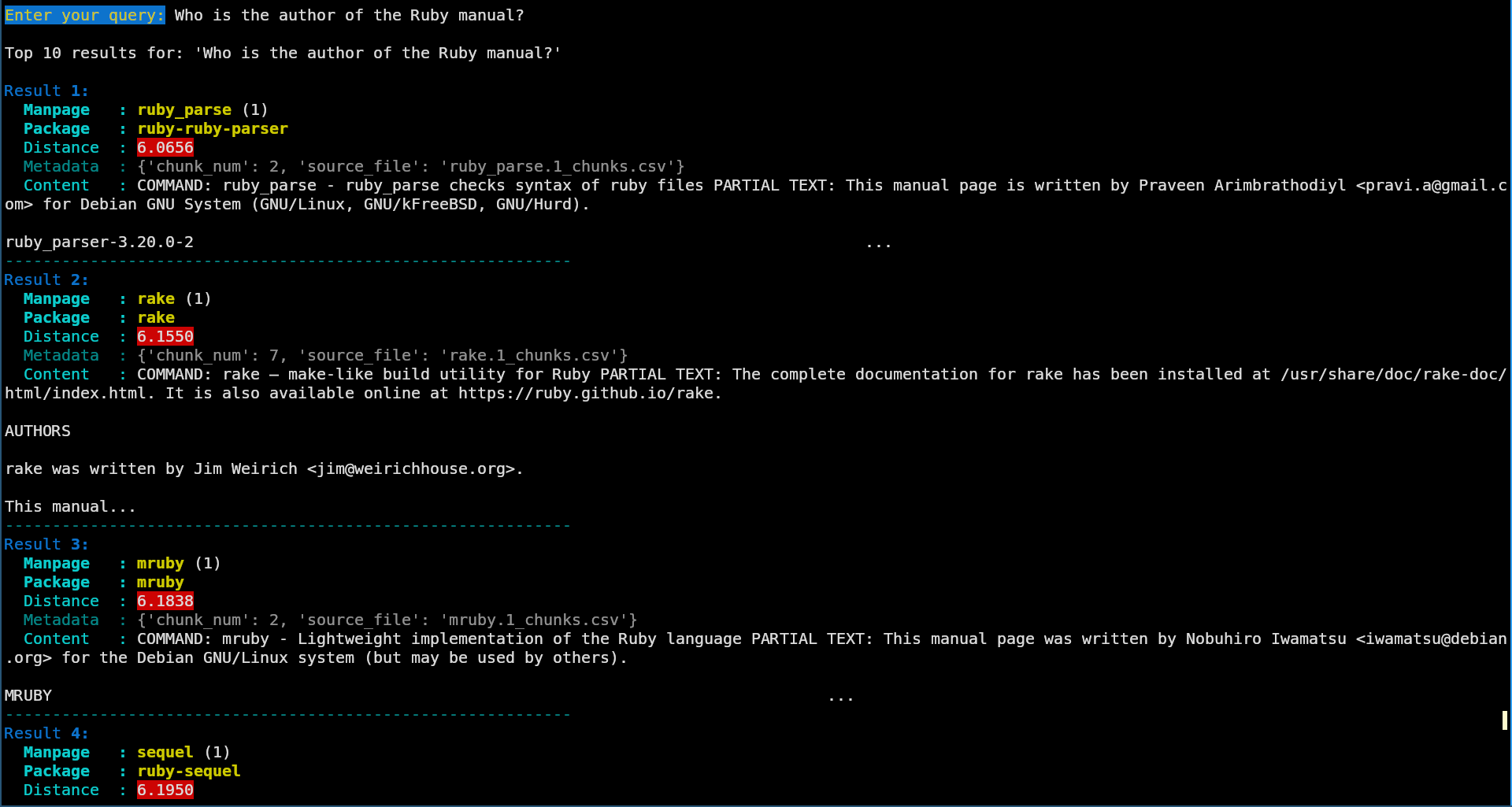
A retrieval-augmented-generation pipeline to help users query system-provided
documentation
The corresponding source code is all available at Tzolkin s
repository in GitHub.
So, what is it about, in shorter words and layman terms?
Debian has lots of documentation, but lacks in discoverability. We targetted our
venerable manpages: It is well known that manpages are relevant, well-organized
documentation describing how to use each of the binaries we ship in Debian. Eric
Raymond wrote in his well-known essay The Art of Unix Programming
(2003)
that the Unix cultural style is telegraphic but complete. It does not hold you
by the hand, but it usualy points in the right direction.
Our original intent was to digest all of the information in our manpages, but we
narrowed it to only the first section of the manual due to the limitations of
the hardware a good friend lent us to play with LLMs. We took four different
base, redistributable (although, yes, non-DFSG-free) Large Language Models
downloaded from HuggingFace (T5-small, MiniLM-L6-v2, BGE-small-en and
Multilingual-e5-small), and trained them with the 34579 pages found inside
/usr/share/man/man1 of all of the existing Debian packages. We did some
interesting fine-tuning (for further details, please refer to the paper itself
or to our GitHub repository.
The idea is to present an interactive tool that udnerstand natural language
queries, and answers with the specific manpage to which they better relate
(I d like to say they answer best , but Tzolkin has repeatedly tried to correct
my understanding of the resulting vectorial distances).
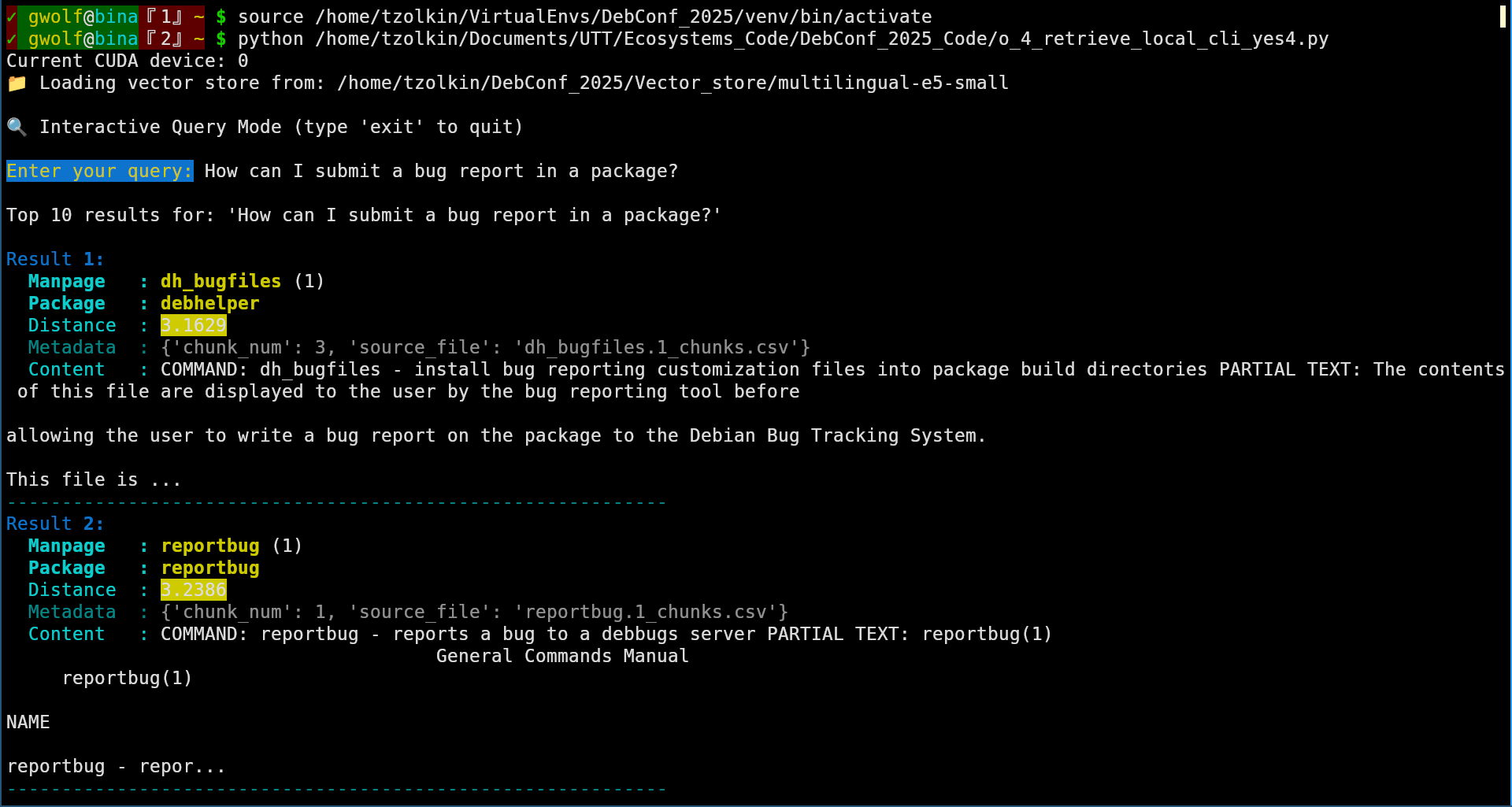
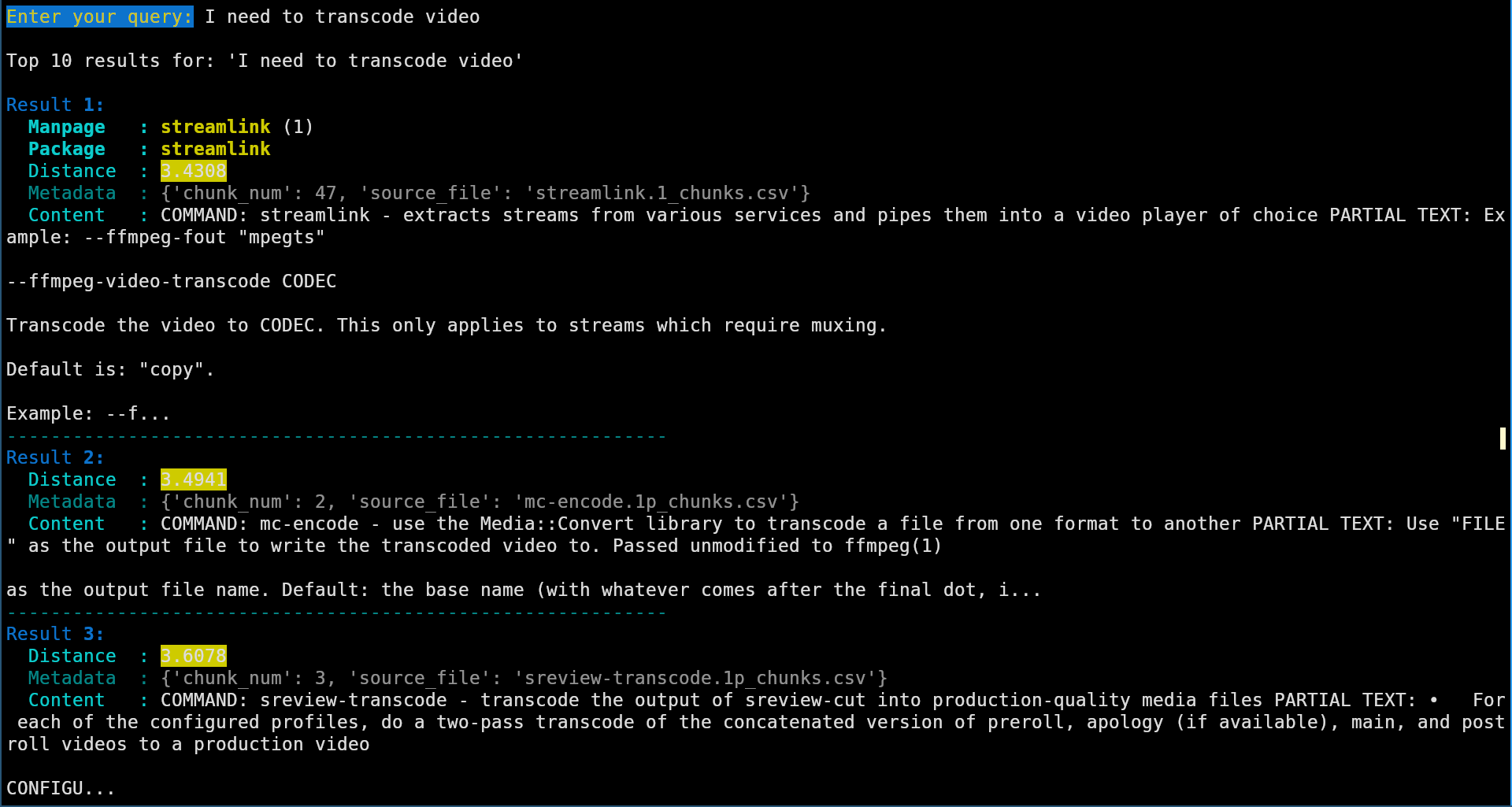
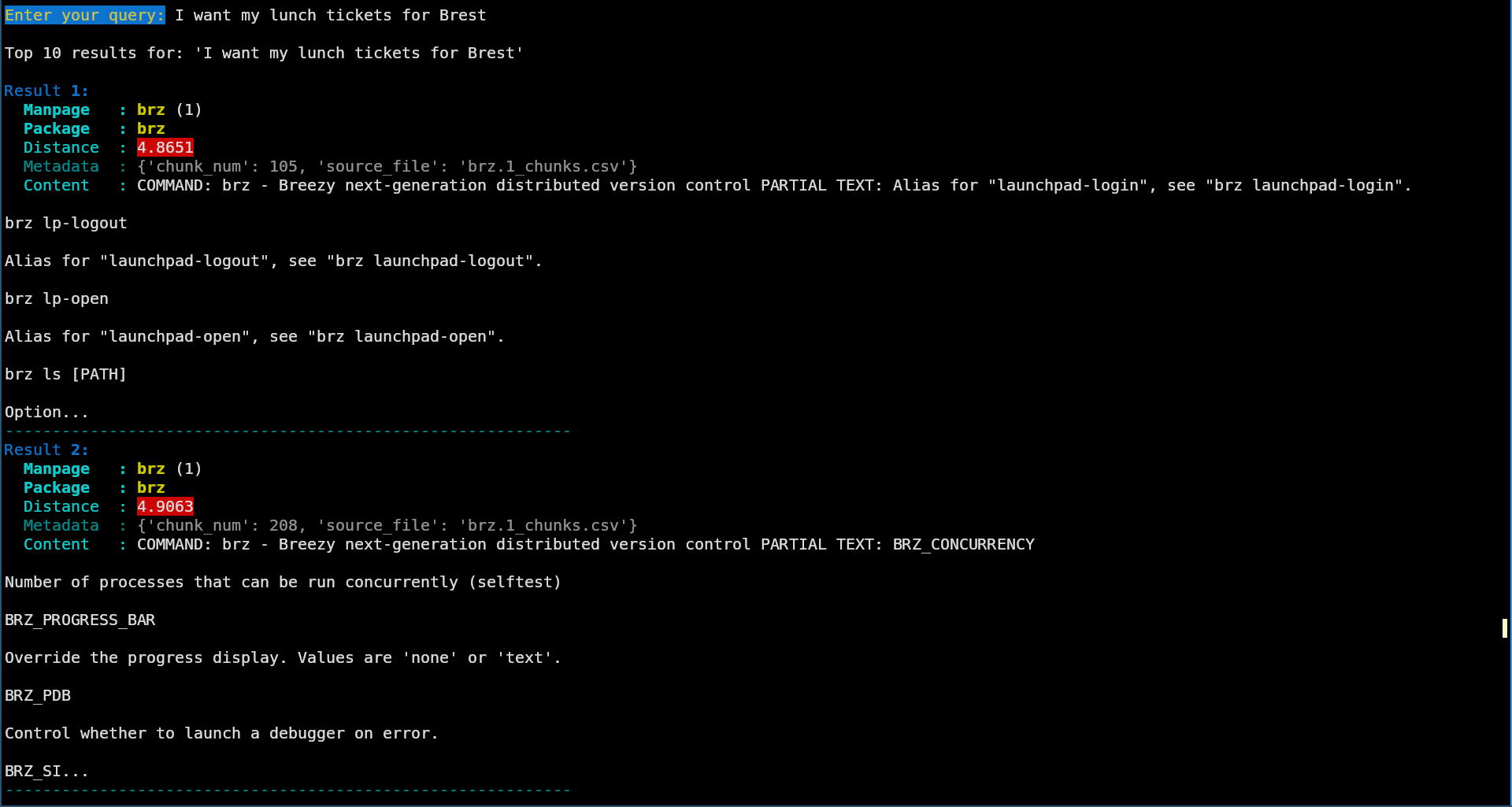
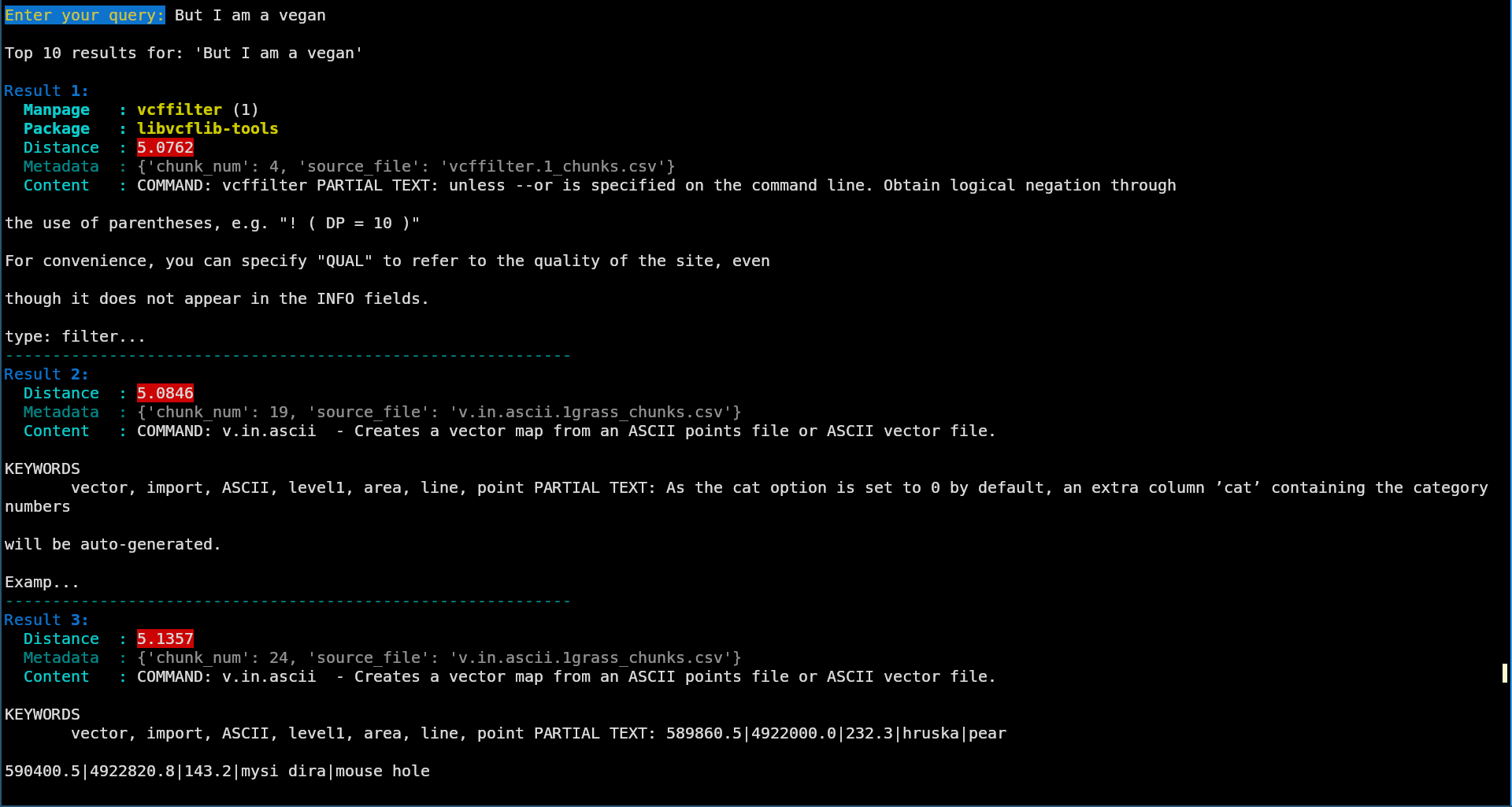
I had prepared some images to present as interaction examples, but I ll wrap up
this post with something even better So, this is what you would get with the
following queries:
get fetch origin, checking out the tag of the new release and tagging that
with git tag upstream/0.9.0. Then I bumped the version in the
debian/experimental branch, adapted the debian/control file for the changed
wlroots dependency, committed and built the package using git-buildpackage to
check if it builds fine and there are no lintian errors.
Then I moved on to look at tag2upload.
As a starting point for using tag2upload I read the blogpost by Jonathan Carter
My first tag2upload
upload. It
pointed me to one very important option of git debpush, namely the
--baredebian option which I have to use because I use the bare Debian git
layout. Given that the last upload of labwc I did was to unstable, I also had
to add the --force=changed-suite.
I also started right away to use the --tag-only option, because for my first
tests I only wanted to have local changes and nothing pushed to anywhere.
I also used the --dry-run option. This led to the following command:
> git debpush --baredebian --force=changed-suite --dry-run --tag-only
tags 0.9.0, upstream/0.9.0 all exist in this repository
tell me which one you want to make an orig.tar from: git deborig --just-print '--version=0.9.0-1' TAG
git-debpush: git-deborig failed; maybe try git-debpush --upstream=TAG
git-deborig,
but I was using git-debpush. I also did not want to make an orig.tar! The
--upstream option in the git-debpush(1)
manual
gave an explanation for this:
When pushing a non-native package, git-debpush needs a tag for the upstream part of your package. By default git-debpush asks git-deborig(1), which searches for a suitable tag based on the upstream version in debian/changelog.So apparently
git-debpush can not find out what the correct tag for the
upstream version is, because git-deborig can not find out what the correct
tag for the upstream version is. git-debpush simply calls git deborig --just-print --version="$version" in line 437.
This fails because I initially created a second upstream/0.9.0 to the existing
0.9.0 release tag. I do this for git-buildpackage to find the upstream sources,
but with multiple tags git-deborig is not sure which one is the tag it should
use (although both point to the same commit).
So I removed the upstream/0.9.0 tag and ran git debpush again and now there
was no error message (besides the warning regarding the changed suite) but it also
did not give an feedback about what is happening. So I tried without the --dry-run
option. Again, no output whatsoever, other than the warning about the changed
release, BUT my gnupg asked me for permission to sign via my yubikey! And
when I looked at the list of tags, I saw that there is now a debian/0.9.0-1
tag that was not there before! Looking at the tag I saw that it was a tag in
the format described in the
tag2upload(5)
manual page, containing the following lines:
labwc release 0.9.0-1 for experimental
[dgit distro=debian split --quilt=baredebian]
[dgit please-upload source=labwc version=0.9.0-1 upstream-tag=0.9.0 upstream=4beee3851f75b53afc2e8699c594c0cc222115bd]
4beee3851f75b53afc2e8699c594c0cc222115bd commit
ID is the commit the 0.9.0 tag points to.
Now that I had a signed commit tag in the correct format, I went to the labwc
packaging repository on salsa and enabled
the webhook to trigger the tag2upload service (I just saw that the
documentation was updated and there is now
a global webhook on salsa, so this step is not needed anymore).
Finally I pushed the tags using git push --tags. I could also have used
git-debpush for this step, but I d rather use git directly. I then looked at
the tag2upload queue and saw how a worker
built and uploaded the newest labwc release and I also got an email from the
tag2upload service [tag2upload 275] uploaded labwc 0.9.0-1. And a couple of
minutes later I got the confirmation that labwc 0.9.0-1 was accepted into
experimental. Great!
So, to conclude: for tag2upload to work we simply need a git tag in the correct
format. The tag2upload service now gets triggered by every pushed tag on salsa
but only acts on tags that adhere to the tag2upload(5)
format.
git-debpush is a simply bash script that creates such a tag and by default also
pushes the tag.
I think the script could be a bit more verbose, for example telling me that it
created a tag and the name of that tag. I think the dependency on git-deborig
is also a problem. I use git-buildpackage to build my packages and by default
git-buildpacakge assumes upstream tags are of the form upstream/%(version)s
(source).
I could now change that for all the packages I maintain, but I also think it
makes sense to control the tag myself and not use a tag that is controlled by
upstream. Upstream could change or delete that tag or I might need to create a
tag for a version that is not tagged by upstream.
I also think git-debpush is a rather mileading command name, given that the
main task of the script is to create a tag in the correct format.
Other than that, I m pretty happy about this service. I have a rather crappy
uplink at home and it is not so uncommon for my uploads to fail because the
connection dropped during dput. Using a simple git based upload approach
makes these problems a thing of the past. I might look into other ways to
create the needed tag, though.

 Debian packaging is notoriously hard. Far too many new contributors give up while trying, and many long-time contributors leave due to burnout from having to do too many thankless maintenance tasks. Some just skip testing their changes properly because it feels like too much toil.
Debcraft is my attempt to solve this by automating all the boring stuff, and making it easier to learn the correct practices and helping new and old packagers better track changes in both source code and build artifacts.
debian/ subdirectory. For example, instead of a script running install -m 755 bin/btop /usr/bin/btop there is a file debian/btop.install containing the line usr/bin/btop.
This makes the overall system more robust and reliable, and allows, for example, extensive static analysis to find problems without having to build the package. The notable exception is the debian/rules file, which contains procedural code that can modify any aspect of the package build. Almost all other files are declarative.
Benefits include, among others, that the effect of a Debian-wide policy change can be relatively easily predicted by scanning what attributes and configurations all packages have declared.
The drawback is that to understand the syntax and meaning of each file, one must understand which build tools read which files and traverse potentially multiple layers of abstraction. In my view, this is the root cause for most of the perceived complexity.
debian/ subdirectory leads to in the final package.debcraft build, which will not only build the package but also fetch the sources if not already present, and with flags such as --distribution or --source-only build for any requested Debian or Ubuntu release, or generate source packages only for Debian or PPA upload purposes.
For ease of use, the output is colored and includes helpful explanations on what is being done, and suggests relevant Debian documentation for more information.
Most importantly, the build artifacts, along with various logs, are stored in separate directories, making it easy to compare before and after to see what changed as a result of the code or dependency updates (utilizing diffoscope among others).
While the above helps to debug successful builds, there is also the debcraft shell command to make debugging failed builds significantly easier by dropping into a shell where one can run various dh commands one-by-one.
Once the build works, testing autopkgtests is as easy as running debcraft test. As with all other commands, Debcraft is smart enough to read information like the target distribution from the debian/changelog entry.
When the package is ready to be released, there is the debcraft release command that will create the Debian source package in the correct format and facilitate uploading it either to your Personal Package Archive (PPA) or if you are a Debian Developer to the official Debian archive.
debcraft improve will try to fix all issues that are possible to address automatically. It utilizes, among others, lintian-brush, codespell and debputy. This makes repetitive Debian maintenance tasks easier, such as updating the package to follow the latest Debian policies.
To update the package to the latest upstream version there is also debcraft update. It will read the package configuration files such as debian/gbp.conf and debian/watch and attempts to import the latest upstream version, refresh patches, build and run autopkgtests. If everything passes, the new version is committed. This helps automate the process of updating to new upstream versions.
apt install debcraft. To use Debcraft on some other distribution or to get the latest features available in the development version install it using:
git clone https://salsa.debian.org/debian/debcraft.git
cd debcraft
make install-local
debcraft --help.
By the way, if you aspire to become a Debian Developer, and want to follow my examples in using state-of-the-art tooling and collaborate using salsa.debian.org, feel free to reach out for mentorship. I am glad to see more people contribute to Debian!
apt update acquires various files from a package repository, what is Acquire-By-Hash, and how it all works for Kali Linux: a Debian-based distro that doesn't support Acquire-By-Hash, and which is distributed via a network of mirrors and a redirector.
In a second part, I explore some "Hash Sum Mismatch" errors that we can hit with Kali Linux, errors that would not happen if only Acquire-By-Hash was supported. If anything, this blog post supports the case for adding Acquire-By-Hash support in reprepro, as requested at https://bugs.debian.org/820660.
All of this could have just remained some personal notes for myself, but I got carried away and turned it into a blog post, dunno why... Hopefully others will find it interesting, but you really need to like troubleshooting stories, packed with details, and poorly written at that. You've been warned!
Introducing Acquire-By-Hash
Acquire-By-Hash is a feature of APT package repositories, that might or might not be supported by your favorite Debian-based distribution. A repository that supports it says so, in the Release file, by setting the field Acquire-By-Hash: yes.
It's easy to check. Debian and Ubuntu both support it:
$ wget -qO- http://deb.debian.org/debian/dists/sid/Release   grep -i ^Acquire-By-Hash:
Acquire-By-Hash: yes
$ wget -qO- http://archive.ubuntu.com/ubuntu/dists/devel/Release   grep -i ^Acquire-By-Hash:
Acquire-By-Hash: yes
$ wget -qO- http://http.kali.org/kali/dists/kali-rolling/Release   grep -i ^Acquire-By-Hash:   echo not supported
not supported
$ wget -qO- https://archive.raspberrypi.com/debian/dists/trixie/Release   grep -i ^Acquire-By-Hash:   echo not supported
not supported
$ wget -qO- http://packages.linuxmint.com/dists/faye/Release   grep -i ^Acquire-By-Hash:   echo not supported
not supported
$ wget -qO- https://apt.pop-os.org/release/dists/noble/Release   grep -i ^Acquire-By-Hash:   echo not supported
not supported
Acquire-By-Hash is not ubiquitous. But wait, what is Acquire-By-Hash to start with? To answer that, we have to take a step back and cover some basics first.
The HTTP requests performed by 'apt update'
What happens when one runs apt update? APT first requests the Release file from the repository(ies) configured in the APT sources. This file is a starting point, it contains a list of other files (sometimes called "Index files") that are available in the repository, along with their hashes. After fetching the Release file, APT proceeds to request those Index files. To give you an idea, there are many kinds of Index files, among which:
Packages files: list the binary packages that are available in the repositorySources files: list the source packages that are available in the repositoryContents files: list files provided by each package (used by the command apt-file)apt update downloads only the Packages files.
Let's try to make it more visual: here's a representation of a apt update transaction, assuming that all the components of the repository are enabled:
apt update -> Release -> Packages (main/amd64)
                      -> Packages (contrib/amd64)
                      -> Packages (non-free/amd64)
                      -> Packages (non-free-firmware/amd64)
apt -q -o Debug::Acquire::http=true update 2>&1 grep ^GET. For Kali Linux you'll see something pretty similar to what I described above. Try it!
$ podman run --rm kali-rolling apt -q -o Debug::Acquire::http=true update 2>&1   grep ^GET
GET /kali/dists/kali-rolling/InRelease HTTP/1.1    # <- returns a redirect, that is why the file is requested twice
GET /kali/dists/kali-rolling/InRelease HTTP/1.1
GET /kali/dists/kali-rolling/non-free/binary-amd64/Packages.gz HTTP/1.1
GET /kali/dists/kali-rolling/main/binary-amd64/Packages.gz HTTP/1.1
GET /kali/dists/kali-rolling/non-free-firmware/binary-amd64/Packages.gz HTTP/1.1
GET /kali/dists/kali-rolling/contrib/binary-amd64/Packages.gz HTTP/1.1
$ podman run --rm debian:sid apt -q -o Debug::Acquire::http=true update 2>&1   grep ^GET
GET /debian/dists/sid/InRelease HTTP/1.1
GET /debian/dists/sid/main/binary-amd64/by-hash/SHA256/22709f0ce67e5e0a33a6e6e64d96a83805903a3376e042c83d64886bb555a9c3 HTTP/1.1
Acquire-By-Hash: yes that is present in the Debian's Release file.
What does Acquire-By-Hash mean for 'apt update'
The idea with Acquire-By-Hash is that the Index files are named after their hash on the repository, so if the MD5 sum of main/binary-amd64/Packages is 77b2c1539f816832e2d762adb20a2bb1, then the file will be stored at main/binary-amd64/by-hash/MD5Sum/77b2c1539f816832e2d762adb20a2bb1. The path main/binary-amd64/Packages still exists (it's the "Canonical Location" of this particular Index file), but APT won't use it, instead it downloads the file located in the by-hash/ directory.
Why does it matter? This has to do with repository updates, and allowing the package repository to be updated atomically, without interruption of service, and without risk of failure client-side.
It's important to understand that the Release file and the Index files are part of a whole, a set of files that go altogether, given that Index files are validated by their hash (as listed in the Release file) after download by APT.
If those files are simply named "Release" and "Packages", it means they are not immutable: when the repository is updated, all of those files are updated "in place". And it causes problems. A typical failure mode for the client, during a repository update, is that: 1) APT requests the Release file, then 2) the repository is updated and finally 3) APT requests the Packages files, but their checksum don't match, causing apt update to fail. There are variations of this error, but you get the idea: updating a set of files "in place" is problematic.
The Acquire-By-Hash mechanism was introduced exactly to solve this problem: now the Index files have a unique, immutable name. When the repository is updated, at first new Index files are added in the by-hash/ directory, and only after the Release file is updated. Old Index files in by-hash/ are retained for a while, so there's a grace period during which both the old and the new Release files are valid and working: the Index files that they refer to are available in the repo. As a result: no interruption of service, no failure client-side during repository updates.
This is explained in more details at https://www.chiark.greenend.org.uk/~cjwatson/blog/no-more-hash-sum-mismatch-errors.html, which is the blog post from Colin Watson that came out at the time Acquire-By-Hash was introduced in... 2016. This is still an excellent read in 2025.
So you might be wondering why I'm rambling about a problem that's been solved 10 years ago, but then as I've shown in the introduction, the problem is not solved for everyone. Support for Acquire-By-Hash server side is not for granted, and unfortunately it never landed in reprepro, as one can see at https://bugs.debian.org/820660.
reprepro is a popular tool for creating APT package repositories. In particular, at Kali Linux we use reprepro, and that's why there's no Acquire-By-Hash: yes in the Kali Release file. As one can guess, it leads to subtle issues during those moments when the repository is updated. However... we're not ready to talk about that yet! There's still another topic that we need to cover: this window of time during which a repository is being updated, and during which apt update might fail.
The window for Hash Sum Mismatches, and the APT trick that saves the day
Pay attention! In this section, we're now talking about packages repositories that do NOT support Acquire-By-Hash, such as the Kali Linux repository.
As I've said above, it's only when the repository is being updated that there is a "Hash Sum Mismatch Window", ie. a moment when apt update might fail for some unlucky clients, due to invalid Index files.
Surely, it's a very very short window of time, right? I mean, it can't take that long to update files on a server, especially when you know that a repository is usually updated via rsync, and rsync goes to great length to update files the most atomically as it can (with the option --delay=updates). So if apt update fails for me, I've been very unlucky, but I can just retry in a few seconds and it should be fixed, isn't it? The answer is: it's not that simple.
So far I pictured the "package repository" as a single server, for simplicity. But it's not always what it is. For Kali Linux, by default users have http.kali.org configured in their APT sources, and it is a redirector, ie. a web server that redirects requests to mirrors that are nearby the client. Some context that matters for what comes next: the Kali repository is synced with ~70 mirrors all around the world, 4 times a day. What happens if your apt update requests are redirected to 2 mirrors close-by, and one was just synced, while the other is still syncing (or even worse, failed to sync entirely)? You'll get a mix of old and new Index files. Hash Sum Mismatch!
As you can see, with this setup the "Hash Sum Mismatch Window" becomes much longer than a few seconds: as long as nearby mirrors are syncing the window is opened. You could have a fast and a slow mirror next to you, and they can be out of sync with each other for several minutes every time the repository is updated, for example.
For Kali Linux in particular, there's a "detail" in our network of mirrors that, as a side-effect, almost guarantees that this window lasts several minutes at least. This is because the pool of mirrors includes kali.download which is in fact the Cloudflare CDN, and from the redirector point of view, it's seen as a "super mirror" that is present in every country. So when APT fires a bunch of requests against http.kali.org, it's likely that some of them will be redirected to the Kali CDN, and others will be redirected to a mirror nearby you. So far so good, but there's another point of detail to be aware of: the Kali CDN is synced first, before the other mirrors. Another thing: usually the mirrors that are the farthest from the Tier-0 mirror are the longest to sync. Packing all of that together: if you live somewhere in Asia, it's not uncommon for your "Hash Sum Mismatch Window" to be as long as 30 minutes, between the moment the Kali CDN is synced, and the moment your nearby mirrors catch up and are finally in sync as well.
Having said all of that, and assuming you're still reading (anyone here?), you might be wondering... Does that mean that apt update is broken 4 times a day, for around 30 minutes, for every Kali user out there? How can they bear with that? Answer is: no, of course not, it's not broken like that. It works despite all of that, and this is thanks to yet another detail that we didn't go into yet. This detail lies in APT itself.
APT is in fact "redirector aware", in a sense. When it fetches a Release file, and if ever the request is redirected, it then fires the subsequent requests against the server where it was initially redirected. So you are guaranteed that the Release file and the Index files are retrieved from the same mirror! Which brings back our "Hash Sum Mismatch Window" to the window for a single server, ie. something like a few seconds at worst, hopefully. And that's what makes it work for Kali, literally. Without this trick, everything would fall apart.
For reference, this feature was implemented in APT back in... 2016! A busy year it seems! Here's the link to the commit: use the same redirection mirror for all index files.
To finish, a dump from the console. You can see this behaviour play out easily, again with APT debugging turned on. Below we can see that only the first request hits the Kali redirector:
$ podman run --rm kali-rolling apt -q -o Debug::Acquire::http=true update 2>&1   grep -e ^Answer -e ^HTTP
Answer for: http://http.kali.org/kali/dists/kali-rolling/InRelease
HTTP/1.1 302 Found
Answer for: http://mirror.freedif.org/kali/dists/kali-rolling/InRelease
HTTP/1.1 200 OK
Answer for: http://mirror.freedif.org/kali/dists/kali-rolling/non-free-firmware/binary-amd64/Packages.gz
HTTP/1.1 200 OK
Answer for: http://mirror.freedif.org/kali/dists/kali-rolling/contrib/binary-amd64/Packages.gz
HTTP/1.1 200 OK
Answer for: http://mirror.freedif.org/kali/dists/kali-rolling/main/binary-amd64/Packages.gz
HTTP/1.1 200 OK
Answer for: http://mirror.freedif.org/kali/dists/kali-rolling/non-free/binary-amd64/Packages.gz
HTTP/1.1 200 OK
apt update does (in terms of HTTP requests), we know that Release files and Index files are part of a whole, and we know that a repository can be updated atomically thanks to the Acquire-By-Hash feature, so that users don't experience interruption of service or failures of any sort, even with a rolling repository that is updated several times a day, like Debian sid.
We've also learnt that, despite the fact that Acquire-By-Hash landed almost 10 years ago, some distributions like Kali Linux are still doing without it... and yet it works! But the reason why it works is more complicated to grasp, especially when you add a network of mirrors and a redirector to the picture. Moreover, it doesn't work as flawlessly as with the Acquire-By-Hash feature: we still expect some short (seconds at worst) "Hash Sum Mismatch Windows" for those unlucky users that run apt update at the wrong moment.
This was a long intro, but that really sets the stage for what comes next: the edge cases. Some situations in which we can hit some Hash Sum Mismatch errors with Kali. Error cases that I've collected and investigated over the time...
If anything, it supports the case that Acquire-By-Hash is really something that should be implemented in reprepro. More on that in the conclusion, but for now, let's look at those edge cases.
Edge Case 1: the caching proxy
If you put a caching proxy (such as approx, my APT caching proxy of choice) between yourself and the actual packages repository, then obviously it's the caching proxy that performs the HTTP requests, and therefore APT will never know about the redirections returned by the server, if any. So the APT trick of downloading all the Index files from the same server in case of redirect doesn't work anymore.
It was rather easy to confirm that by building a Kali package during a mirror sync, and watch if fail at the "Update chroot" step:
$ sudo rm /var/cache/approx/kali/dists/ -fr
$ gbp buildpackage --git-builder=sbuild
+------------------------------------------------------------------------------+
  Update chroot                                Wed, 11 Jun 2025 10:33:32 +0000
+------------------------------------------------------------------------------+
Get:1 http://http.kali.org/kali kali-dev InRelease [41.4 kB]
Get:2 http://http.kali.org/kali kali-dev/contrib Sources [81.6 kB]
Get:3 http://http.kali.org/kali kali-dev/main Sources [17.3 MB]
Get:4 http://http.kali.org/kali kali-dev/non-free Sources [122 kB]
Get:5 http://http.kali.org/kali kali-dev/non-free-firmware Sources [8297 B]
Get:6 http://http.kali.org/kali kali-dev/non-free amd64 Packages [197 kB]
Get:7 http://http.kali.org/kali kali-dev/non-free-firmware amd64 Packages [10.6 kB]
Get:8 http://http.kali.org/kali kali-dev/contrib amd64 Packages [120 kB]
Get:9 http://http.kali.org/kali kali-dev/main amd64 Packages [21.0 MB]
Err:9 http://http.kali.org/kali kali-dev/main amd64 Packages
  File has unexpected size (20984689 != 20984861). Mirror sync in progress? [IP: ::1 9999]
  Hashes of expected file:
   - Filesize:20984861 [weak]
   - SHA256:6cbbee5838849ffb24a800bdcd1477e2f4adf5838a844f3838b8b66b7493879e
   - SHA1:a5c7e557a506013bd0cf938ab575fc084ed57dba [weak]
   - MD5Sum:1433ce57419414ffb348fca14ca1b00f [weak]
  Release file created at: Wed, 11 Jun 2025 07:15:10 +0000
Fetched 17.9 MB in 9s (1893 kB/s)
Reading package lists...
E: Failed to fetch http://http.kali.org/kali/dists/kali-dev/main/binary-amd64/Packages.gz  File has unexpected size (20984689 != 20984861). Mirror sync in progress? [IP: ::1 9999]
   Hashes of expected file:
    - Filesize:20984861 [weak]
    - SHA256:6cbbee5838849ffb24a800bdcd1477e2f4adf5838a844f3838b8b66b7493879e
    - SHA1:a5c7e557a506013bd0cf938ab575fc084ed57dba [weak]
    - MD5Sum:1433ce57419414ffb348fca14ca1b00f [weak]
   Release file created at: Wed, 11 Jun 2025 07:15:10 +0000
E: Some index files failed to download. They have been ignored, or old ones used instead.
E: apt-get update failed
$ grep kali /etc/approx/approx.conf
#kali http://http.kali.org/kali <- do not use the redirector!
kali  http://kali.download/kali
$ sudo debootstrap kali-dev kali-dev http://http.kali.org/kali
[...]
I: Target architecture can be executed
I: Retrieving InRelease
I: Checking Release signature
I: Valid Release signature (key id 827C8569F2518CC677FECA1AED65462EC8D5E4C5)
I: Retrieving Packages
I: Validating Packages
W: Retrying failed download of http://http.kali.org/kali/dists/kali-dev/main/binary-amd64/Packages.gz
I: Retrieving Packages
I: Validating Packages
W: Retrying failed download of http://http.kali.org/kali/dists/kali-dev/main/binary-amd64/Packages.gz
I: Retrieving Packages
I: Validating Packages
W: Retrying failed download of http://http.kali.org/kali/dists/kali-dev/main/binary-amd64/Packages.gz
I: Retrieving Packages
I: Validating Packages
W: Retrying failed download of http://http.kali.org/kali/dists/kali-dev/main/binary-amd64/Packages.gz
I: Retrieving Packages
I: Validating Packages
I: Resolving dependencies of required packages...
I: Resolving dependencies of base packages...
I: Checking component main on http://http.kali.org/kali...
I: Retrieving adduser 3.152
[...]
wget, and it retries up to 10 times in case of failure. It's not as sophisticated as APT: it doesn't detect when the Release file is served via a redirect.
As a consequence, what happens above can be explained as such:
main component enabled, and only the Index file for this component have been retrieved. It looks like that:
$ sudo debootstrap kali-dev kali-dev http://http.kali.org/kali
[...]
I: Base system installed successfully.
$ cat kali-dev/etc/apt/sources.list
deb http://http.kali.org/kali kali-dev main
$ ls -l kali-dev/var/lib/apt/lists/
total 80468
-rw-r--r-- 1 root root    41445 Jun 19 07:02 http.kali.org_kali_dists_kali-dev_InRelease
-rw-r--r-- 1 root root 82299122 Jun 19 07:01 http.kali.org_kali_dists_kali-dev_main_binary-amd64_Packages
-rw-r--r-- 1 root root    40562 Jun 19 11:54 http.kali.org_kali_dists_kali-dev_Release
-rw-r--r-- 1 root root      833 Jun 19 11:54 http.kali.org_kali_dists_kali-dev_Release.gpg
drwxr-xr-x 2 root root     4096 Jun 19 11:54 partial
sources.list with other components, then run apt update: APT will download the missing Index files. But if you're unlucky, that might fail:
$ sudo sed -i 's/main$/main contrib non-free non-free-firmware/' kali-dev/etc/apt/sources.list
$ cat kali-dev/etc/apt/sources.list
deb http://http.kali.org/kali kali-dev main contrib non-free non-free-firmware
$ sudo chroot kali-dev apt update
Hit:1 http://http.kali.org/kali kali-dev InRelease
Get:2 http://kali.download/kali kali-dev/contrib amd64 Packages [121 kB]
Get:4 http://mirror.sg.gs/kali kali-dev/non-free-firmware amd64 Packages [10.6 kB]
Get:3 http://mirror.freedif.org/kali kali-dev/non-free amd64 Packages [198 kB]
Err:3 http://mirror.freedif.org/kali kali-dev/non-free amd64 Packages
  File has unexpected size (10442 != 10584). Mirror sync in progress? [IP: 66.96.199.63 80]
  Hashes of expected file:
   - Filesize:10584 [weak]
   - SHA256:71a83d895f3488d8ebf63ccd3216923a7196f06f088461f8770cee3645376abb
   - SHA1:c4ff126b151f5150d6a8464bc6ed3c768627a197 [weak]
   - MD5Sum:a49f46a85febb275346c51ba0aa8c110 [weak]
  Release file created at: Fri, 23 May 2025 06:48:41 +0000
Fetched 336 kB in 4s (77.5 kB/s)
Reading package lists... Done
E: Failed to fetch http://mirror.freedif.org/kali/dists/kali-dev/non-free/binary-amd64/Packages.gz  File has unexpected size (10442 != 10584). Mirror sync in progress? [IP: 66.96.199.63 80]
   Hashes of expected file:
    - Filesize:10584 [weak]
    - SHA256:71a83d895f3488d8ebf63ccd3216923a7196f06f088461f8770cee3645376abb
    - SHA1:c4ff126b151f5150d6a8464bc6ed3c768627a197 [weak]
    - MD5Sum:a49f46a85febb275346c51ba0aa8c110 [weak]
   Release file created at: Fri, 23 May 2025 06:48:41 +0000
E: Some index files failed to download. They have been ignored, or old ones used instead.
$ sudo chroot kali-dev apt -q -o Debug::Acquire::http=true update 2>&1   grep -e ^Answer -e ^HTTP
Answer for: http://http.kali.org/kali/dists/kali-dev/InRelease
HTTP/1.1 304 Not Modified
Answer for: http://http.kali.org/kali/dists/kali-dev/contrib/binary-amd64/Packages.gz
HTTP/1.1 302 Found
Answer for: http://http.kali.org/kali/dists/kali-dev/non-free/binary-amd64/Packages.gz
HTTP/1.1 302 Found
Answer for: http://http.kali.org/kali/dists/kali-dev/non-free-firmware/binary-amd64/Packages.gz
HTTP/1.1 302 Found
Answer for: http://kali.download/kali/dists/kali-dev/contrib/binary-amd64/Packages.gz
HTTP/1.1 200 OK
Answer for: http://mirror.sg.gs/kali/dists/kali-dev/non-free-firmware/binary-amd64/Packages.gz
HTTP/1.1 200 OK
Answer for: http://mirror.freedif.org/kali/dists/kali-dev/non-free/binary-amd64/Packages.gz
HTTP/1.1 200 OK
304 (aka. "Not Modified") from the redirector. Why is that?
This is due to If-Modified-Since also known as RFC-7232. APT supports this feature when it retrieves the Release file, it basically says to the server "Give me the Release file, but only if it's newer than what I already have". If the file on the server is not newer than that, it answers with a 304, which basically says to the client "You have the latest version already". So APT doesn't get a new Release file, it uses the Release file that is already present locally in /var/lib/apt/lists/, and then it proceeeds to download the missing Index files. And as we can see above: it then hits the redirector for each requests, and might be redirected to different mirrors for each Index file.
So the important bit here is: the APT "trick" of downloading all the Index files from the same mirror only works if the Release file is served via a redirect. If it's not, like in this case, then APT hits the redirector for each files it needs to download, and it's subject to the "Hash Sum Mismatch" error again.
In practice, for the casual user running apt update every now and then, it's not an issue. If they have the latest Release file, no extra requests are done, because they also have the latest Index files, from a previous apt update transaction. So APT doesn't re-download those Index files. The only reason why they'd have the latest Release file, and would miss some Index files, would be that they added new components to their APT sources, like we just did above. Not so common, and then they'd need to run apt update at a unlucky moment. I don't think many users are affected in practice.
Note that this issue is rather new for Kali Linux. The redirector running on http.kali.org is mirrorbits, and support for If-Modified-Since just landed in the latest release, version 0.6. This feature was added by no one else than me, a great example of the expression "shooting oneself in the foot".
An obvious workaround here is to empty /var/lib/apt/lists/ in the chroot after debootstrap completed. Or we could disable support for If-Modified-Since entirely for Kali's instance of mirrorbits.
Summary and Conclusion
The Hash Sum Mismatch failures above are caused by a combination of things:
Acquire-By-Hash was supported in the Kali packages repository.
Now is not a bad moment to try to land this feature in reprepro. After development halted in 2019, there's now a new upstream, and patches are being merged again. But it won't be easy: reprepro is a C codebase of around 50k lines of code, and it will take time and effort for the newcomer to get acquainted with the codebase, to the point of being able to implement a significant feature like this one.
As an alternative, aptly is another popular tool to manage APT package repositories. And it seems to support Acquire-By-Hash already.
Another alternative: I was told that debusine has (experimental) support for package repositories, and that Acquire-By-Hash is supported as well.
Options are on the table, and I hope that Kali will eventually get support for Acquire-By-Hash, one way or another.
To finish, due credits: this blog post exists thanks to my employer OffSec.
Thanks for reading!
reform-debian-packages/README.md$ git clone https://gitlab.collabora.com/hardware-enablement/rockchip-3588/linux.git collabora
$ cd collabora && git git switch -c rockchip-devel origin/rockchip-devel
reform-debian-packages/linux/patches6.15/rk3588-mnt-reform2joshc for the suggestion of the b4 tool.
b4 am 1744940759-23823-1-git-send-email-shawn.lin@rock-chips.com
.mbx file ready for git am (roughly equivalent to
fetching the /raw version from lore, with some extra checks).git rev-list --no-merges --since 2025-01-01 refs/heads/rockchip-devel \
while read ref
do
echo trying $ref
git checkout $ref
git apply --check v3_20250418_shawn_lin_pci_dw_rockchip_add_system_pm_support.mbx && echo SUCCESS && break
done
$ git branch -D tmp ; git switch -c tmp 9dff55ebaef7
$ git am v3_20250418_shawn_lin_pci_dw_rockchip_add_system_pm_support.mbx
$ git rebase -i rockchip-devel
rockchip_pcie_unmask_dll_indicator used to reduce code duplication, and in all
3 cases I just took the version of the code from Shawn's patch.
EDIT This rebase turns out to miss (at least) changes in the names
of the PCI* constants. By amusing(?) coincidence, as I was
discovering that, the patch was being rebased by someone more
competent at collabora, and is now in the rockchip-devel branch.
previous episode next episode
 A maintenance release 0.3.132 of the anytime
package arrived on CRAN today.
The package is fairly feature-complete, and code and functionality
remain mature and stable.
anytime
is a very focused package aiming to do just one thing really
well: to convert anything in integer, numeric, character,
factor, ordered, input format to either POSIXct (when called as
anytime) or Date objects (when called as
anydate) and to do so without requiring a format
string as well as accomodating different formats in one input
vector. See the anytime page,
or the GitHub repo
for a few examples, and the beautiful documentation site
for all documentation.
This release covers a corner case reported in a GitHub issue: the
(nonsensical but possible) input of zero-length (floating point or
integer) vectors was not dealt with properly which lead to an error. We
now return the requested type (POSIXct or
Date, depending on the call) also with length zero. Two
minor maintenance tasks were also addressed since the last release six
months ago.
The short list of changes follows.
Courtesy of my CRANberries, there is also a diffstat report of changes relative to the previous release. The issue tracker tracker off the GitHub repo can be use for questions and comments. More information about the package is at the package page, the GitHub repo and the documentation site.Changes in anytime version 0.3.12 (2025-07-14)
- Continuous integration now uses r-ci action with embedded bootstrap
- The versioned depends on Rcpp now requires 1.0.8 or newer to support use of the updated header file structure
- The corner-case of an empty (numeric or integer) vector argument is now addressed, new tests have been added (#135)))
This post by Dirk Eddelbuettel originated on his Thinking inside the box blog. If you like this or other open-source work I do, you can now sponsor me at GitHub.
# index 31090770fffcc94e15 from the first patch in the series
$ git log --raw --all --find-object=31090770fffcc94e15
# The applied version of the first patch is  b06d125e6280603a34d9064cd9c12748ca2edb04
$ git switch -c base b06d125e6280603a34d9064cd9c12748ca2edb04^
$ mbox-extract-patch < ~/Downloads/PATCH-v4-1-5-PCI-ERR-Remove-misleading-TODO-regarding-kernel-panic.mbox   git am
$ git rebase -i master  # two applied patches skipped
$ git switch master && git merge base
mbox-extract-patch is from package mailscripts.git am -3 ~/tmp/PATCH-v3-PCI-dw-rockchip-Add-support-for-slot-reset-on-link-down-event.txt DebConf25, the 25th annual
Debian Developer Conference, is taking place in
Brest, France from 14 to 19 July 2025.
Debian contributors from all over the world have come together at the Campus of
IMT Atlantique Bretagne-Pays de la Loire, Brest, to participate and work in a
conference exclusively ran by volunteers.
As the conference begins on July 14, the French National Day, Debian can make
France's motto its own: "Libert , galit , fraternit ", Freedom for Free
and Open Source Software, Equity for the equal right (and duties) of everyone
to use, modify and share Free Software, Fraternity which perfectly covers what
our code of conduct defines.
Today the main conference starts with around 500 expected attendants and over
140 scheduled activities, including 45-minute and 20-minute talks, Bird of a
Feather ("BoF") team meetings, workshops, a job fair, as well as
a variety of other events.
The full schedule is updated each
day, including activities planned ad-hoc by attendees over the course of the
conference.
If you would like to engage remotely, you can follow the video streams
available from the DebConf25 website for the
events happening in the three talk rooms: M ridienne, Grand amphi and
Petit amphi accessible from the DebConf25 homepage.
Or you can join the conversations happening inside the talk rooms via the
OFTC IRC network in the
#debconf-meridienne,
#debconf-grandamphi,
#debconf-petitamphi, and
#debconf-bof channels.
Please also join us in the #debconf channel for
common discussions related to DebConf.
You can also follow the live coverage of news about DebConf25 provided by our
micronews service or the @debian profile on
your favorite social network.
DebConf is committed to a safe and welcoming environment for all participants.
Please see our Code of Conduct page
for more information on this.
Debian thanks the commitment of numerous sponsors to support DebConf25,
particularly our Platinum Sponsors: Infomaniak, Proxmox, Viridien,
EDF, and AMD.

 DebConf25, the 26th edition of the Debian
conference is taking place in Brest Campus of
IMT Atlantique Bretagne-Pays de la Loire,
France. We appreciate the organizers for their hard work, and hope this event
will be highly beneficial for those who attend in person as well as online.
This event would not be possible without the help from our generous sponsors.
We would like to warmly welcome the sponsors of DebConf 25, and introduce them to
you.
We have five Platinum sponsors.
 Welcome to the 6th report from the Reproducible Builds project in 2025. Our monthly reports outline what we ve been up to over the past month, and highlight items of news from elsewhere in the increasingly-important area of software supply-chain security. If you are interested in contributing to the Reproducible Builds project, please see the Contribute page on our website.
In this report:
 On Saturday 2nd August, Vagrant Cascadian and Chris Lamb will be presenting at this year s FOSSY 2025. Their talk, titled Never Mind the Checkboxes, Here s Reproducible Builds!, is being introduced as follows:
There are numerous policy compliance and regulatory processes being developed that target software development but do they solve actual problems? Does it improve the quality of software? Do Software Bill of Materials (SBOMs) actually give you the information necessary to verify how a given software artifact was built? What is the goal of all these compliance checklists anyways or more importantly, what should the goals be? If a software object is signed, who should be trusted to sign it, and can they be trusted forever?The talk will introduce the audience to Reproducible Builds as a set of best practices which allow users and developers to verify that software artifacts were built from the source code, but also allows auditing for license compliance, providing security benefits, and removes the need to trust arbitrary software vendors. Hosted by the Software Freedom Conservancy and taking place in Portland, Oregon, USA, FOSSY aims to be a community-focused event: Whether you are a long time contributing member of a free software project, a recent graduate of a coding bootcamp or university, or just have an interest in the possibilities that free and open source software bring, FOSSY will have something for you . More information on the event is available on the FOSSY 2025 website, including the full programme schedule. Vagrant and Chris will also be staffing a table this year, where they will be available to answer any questions about Reproducible Builds and discuss collaborations with other projects.
 In Debian this month:
debian-repro-status tool and mmdebstrap s support for hooks:
  $ mmdebstrap --variant=apt --include=debian-repro-status \
       --chrooted-customize-hook=debian-repro-status \
       trixie /dev/null 2>&1   grep "Your system has"
   INFO  debian-repro-status > Your system has 100.00% been reproduced.
Having several.buildinfofiles for the same architecture is something that we plausibly want to have eventually. Imagine running two sets of buildds and assembling a single upload containing buildinfo files from both buildds in the same upload. In a similar vein, as a developer I may want to supply several.buildinfofiles with my source upload (e.g. for multiple architectures). Doing any of this is incompatible with current incoming processing and withreprepro.
 In GNU Guix, Timothee Mathieu reported that a long-standing issue with reproducibility of shell containers across different host operating systems has been solved. In their message, Timothee mentions:
I discovered that pytorch (and maybe other dependencies) has a reproducibility problem of order 1e-5 when on AVX512 compared to AVX2. I first tried to solve the problem by disabling AVX512 at the level of pytorch, but it did not work. The dev of pytorch said that it may be because some components dispatch computation to MKL-DNN, I tried to disable AVX512 on MKL, and still the results were not reproducible, I also tried to deactivate in openmpi without success. I finally concluded that there was a problem with AVX512 somewhere in the dependencies graph but I gave up identifying where, as this seems very complicated.
 The IzzyOnDroid Android APK repository made more progress in June. Not only have they just passed 48% reproducibility coverage, Ben started making their reproducible builds more visible, by offering rbtlog shields, a kind of badge that has been quickly picked up by many developers who are proud to present their applications reproducibility status.
 Lastly, in openSUSE news, Bernhard M. Wiedemann posted another monthly update for their work there.
 diffoscope is our in-depth and content-aware diff utility that can locate and diagnose reproducibility issues. This month, Chris Lamb made the following changes, including preparing and uploading versions
298, 299 and 300 to Debian:
python3-defusedxml to the Build-Depends in order to include it in the Docker image. [ ]HEADERSIGNATURES and HEADERIMMUTABLE as a special-case to avoid unnecessarily large diffs. Thanks to Daniel Duan for the report and suggestion. [ ][ ] OSS Rebuild has added a new network analyzer that provides transparent HTTP(S) interception during builds, capturing all network traffic to monitor external dependencies and identify suspicious behavior, even in unmodified maintainer-controlled build processes.
The text-based user interface now features automated failure clustering that can group similar rebuild failures and provides natural language failure summaries, making it easier to identify and understand patterns across large numbers of build failures.
OSS Rebuild has also improved the local development experience with a unified interface for build execution strategies, allowing for more extensible environment setup for build execution. The team also designed a new website and logo.
 Once again, there were a number of improvements made to our website this month including:
docker instructions on the diffoscope website. [ ]
arandr, curl, dpdk, dpdk, eww, gnucash, gramps, latex2html, llvm20, mp, nvidia-open-driver-G06-signed, obs, ovmf, pcre2, perl-XML-LibXML, perl, python-reportlab, python313, qt6-datavis3d, qt6-declarative, qt6-sensors, qt6-virtualkeyboard, rage-encryption, scummvm, timescaledb & zoxide.rpmbuild expands the %jobs variable in the .src.rpm header, including: chromium, cmake, edk2, firefox-esr, gnome-keyring-sharp, gtk2-engine-aurora, gtk2-engine-cleanice, gtk2-engines, libqt5-qtlocation, libreoffice, luabind, lxmenu-data, mozc, MozillaThunderbird, perl-DateTime-Calendar-Mayan, perl-Getopt-ArgvFile, perl-MooseX-Meta-TypeConstraint-ForceCoercion, perl-XML-Entities, python-convertdate, suitesparse & webkit2gtk3gramps (use SOURCE_DATE_EPOCH when compressing man pages)tree-puzzle.cctools.python-django-import-export. The Reproducible Builds project operates a comprehensive testing framework running primarily at tests.reproducible-builds.org in order to check packages and other artifacts for reproducibility. In June, however, a number of changes were made by Holger Levsen, including:
all)amd64)arm64)armel)armhf)i386)ppc64el)riscv64)/usr/bin. [ ]riscv64 nodes that should be ignored. [ ][ ]ppc64el architecture (see #1106757). [ ]any architecture. [ ]linux-sysctl-defaults on Debian trixie systems as we need ping functionality. [ ]fs.nr_open kernel turnable. [ ]CPUSchedulingPolicy=idle systemd flag on the workers. [ ]
#reproducible-builds on irc.oftc.net.
rb-general@lists.reproducible-builds.org
 In the last past weeks, I have done something I had been meaning to do for a
while but always pushed back at the bottom of my TODO pile: prepare for my
death.
I am still quite young and perfectly healthy (mentally and physically) and I do
plan to live a long and full life, but death is something that comes from us all
and can strike anytime. Having witnessed friends and colleagues who lost loved
ones who did not prepare adequately for their passing, dealing with all this
legal stuff ahead of time seems like the best gift you can leave them.
Writing my will was the easiest part of this "preparation for death" process.
I have few material possessions and I'm leaving everything to my SO. As for the
copyright for my code, I have decided everything I wrote will be licensed under
CC0 (public domain) when I die. Quebec where I live also accepts
holograph wills, which means I didn't have to hire a notary.
Apart from the will, I also wrote a protection mandate1, filled
out Quebec's organ donation form2, took a contract for prearranged
funeral services3 and finally, wrote a disaster recovery plan.
This recovery plan was by far the longest and most tedious part of this entire
ordeal. If all your machines use full-disk encryption and you die or forget
your passwords (for example after a head injury), can your data be recovered?
How do you arbitrate between easy recovery and data security? If all your local
devices burn down and you also pass away in the process, how will your next of
kin access your remote backups and extract the relevant data (in my case, my
password manager)?
I had to ask myself many complex questions in this process and although I won't
be sharing my disaster recovery plan here (security through obscurity), I urge
you to take the time to do something similar yourself and make sure you will
leave a house in order when you go away.

 Like each month, have a look at the work funded by Freexian s Debian LTS offering.
sbuild maintainers added the unshare backend to
enable better isolation of builds, but in doing so sbuild now effectively
bundles a container runtime. unschroot is an attempt to separate containment
from sbuild by implementing the same features and more in a schroot-compatible
way. Last year, vague feature parity
was achieved, but going beyond required changing the model from keeping state in
the filesystem to keeping Linux namespaces as session state. A proof of concept
is now available. While it still has sharp corners, it enables building packages
on a squashfs with an overlayfs or id-mapped bind mounting of your ccache
neither of which is possible with sbuild s unshare backend. There shall be a
DebConf25 presentation
about this work.
pterm (PuTTY s terminal emulator) when running
in a Wayland session, and backported the resulting upstream fix
to trixie./usr-move. Most prominently
Christian Hofstaedler reported an upgrade failure.
/usr-move is a contributing factor here as that s what caused systemd to
upgrade a number of Breaks and Replaces to Conflicts. dumat needed some
help with dropping mips64el from testing and
Theodore Ts o forwarded a fuse2fs upgrade failure.rebootstrap failures and worked around build failures
related to gcc-15 when they had patches and sent ones otherwise.AH00484: server reached MaxRequestWorkers setting, consider raising the MaxRequestWorkers settingFor starters, it means I have to relearn how
MaxRequestWorkers functions in Apache:
For threaded and hybrid servers (e.g. event or worker), MaxRequestWorkers restricts the total number of threads that will be available to serve clients. For hybrid MPMs, the default value is 16 (ServerLimit) multiplied by the value of 25 (ThreadsPerChild). Therefore, to increase MaxRequestWorkers to a value that requires more than 16 processes, you must also raise ServerLimit.Ok remind me what
ServerLimit refers to?
For the prefork MPM, this directive sets the maximum configured value for MaxRequestWorkers for the lifetime of the Apache httpd process. For the worker and event MPMs, this directive in combination with ThreadLimit sets the maximum configured value for MaxRequestWorkers for the lifetime of the Apache httpd process. For the event MPM, this directive also defines how many old server processes may keep running and finish processing open connections. Any attempts to change this directive during a restart will be ignored, but MaxRequestWorkers can be modified during a restart. Special care must be taken when using this directive. If ServerLimit is set to a value much higher than necessary, extra, unused shared memory will be allocated. If both ServerLimit and MaxRequestWorkers are set to values higher than the system can handle, Apache httpd may not start or the system may become unstable. With the prefork MPM, use this directive only if you need to set MaxRequestWorkers higher than 256 (default). Do not set the value of this directive any higher than what you might want to set MaxRequestWorkers to. With worker, use this directive only if your MaxRequestWorkers and ThreadsPerChild settings require more than 16 server processes (default). Do not set the value of this directive any higher than the number of server processes required by what you may want for MaxRequestWorkers and ThreadsPerChild. With event, increase this directive if the process number defined by your MaxRequestWorkers and ThreadsPerChild settings, plus the number of gracefully shutting down processes, is more than 16 server processes (default).Got it? In other words, you can consider raising the
MaxRequestWorkers
setting all you want, but you can t just change that setting, you have to read
about several other compliated settings, do some math, and spend a lot of time
wondering if you are going to remember what you just did and how to undo it if
you blow up your server.
On the plus side, typically, nobody should increase this limit - because if the
server runs out of connections, it usually means something else is wrong.
In our case, on a shared web server running Apache2 and PHP-FPM, it s usually
because a single web site has gone out of control.
But wait! How can that happen, we are using PHP-FPM s max_children setting to prevent
a single PHP web site from taking down the server?
After years of struggling with this problem I have finally made some headway.
Our PHP pool configuration typically looks like this:
user = site342999writer
group = site342999writer
listen = /run/php/8.1-site342999.sock
listen.owner = www-data
listen.group = www-data
pm = ondemand
pm.max_children = 12
pm.max_requests = 500
php_admin_value[memory_limit] = 256M
<FilesMatch \.php$>
        SetHandler "proxy:unix:/var/run/php/8.1-site342999.sock fcgi://localhost"
</FilesMatch>
max_children?
According to the docs:
By default, mod_proxy will allow and retain the maximum number of connections
that could be used simultaneously by that web server child process. Use the
max parameter to reduce the number from the default. The pool of connections
is maintained per web server child process, and max and other settings are
not coordinated among all child processes, except when only one child process
is allowed by configuration or MPM design.
The max parameter seems to default to the ThreadsPerChild, so it seems that
the default here is to allow any web site to consume ThreadsPerChild (25) x
ServerLimit (16), which is also the max number of over all connections. Not
great.
To make matter worse, there is another setting available which is mysteriously
called acquire:
If set, this will be the maximum time to wait for a free connection in the
connection pool, in milliseconds. If there are no free connections in the
pool, the Apache httpd will return SERVER_BUSY status to the client.
By default this is not set which seems to suggest Apache will just hang on to
connections forever until a free PHP process becomes available (or some other
time out happens).
So, let s try something different:
 <Proxy "fcgi://localhost">
    ProxySet acquire=1 max=12
  </proxy>
SetHandler statement above. It s documented on the Apache mod_proxy
page.
Now we limit the maximum pool size per process to half of what is available for
the entire server and we tell Apache to immediately throw a 503 error if we
have exceeded our maximum number of connecitons.
Now, if a site is overwhelmed with traffic, instead of maxing out the available
Apache connections while leaving user with constantly spinning browsers, the
users will get 503 ed and the server will be able to server other sites.
    base-commit: 08733088b566b58283f0f12fb73f5db6a9a9de30
    change-id: 20250430-b4-pci_dwc_reset_support-d720dbafb7ea
    prerequisite-change-id: 20250404-pcie-reset-slot-730bfa71a202:v4
    prerequisite-patch-id: 2dad85eb26838d89569b12c19d70f392fa592667
    prerequisite-patch-id: 6238a682bd8e9476e5911b7a59263c3fc618d63e
    prerequisite-patch-id: 37cab00bc255a62b1e8396a48a3afba5e1751abd
    prerequisite-patch-id: ff711f65cf9926374646b76cd38bdd823d576764
    prerequisite-patch-id: 1654cca919d024b9a9190b28e90f722975c797e8
git-patch-id and also how to split a long regex disjunction into
multiple lines.git log --patch --no-merges v6.13.. \
git patch-id --stable \
grep -F -e 2dad85eb26838d89569b12c19d70f392fa592667 \
-e 6238a682bd8e9476e5911b7a59263c3fc618d63e \
-e 37cab00bc255a62b1e8396a48a3afba5e1751abd \
-e ff711f65cf9926374646b76cd38bdd823d576764 \
-e 1654cca919d024b9a9190b28e90f722975c797e8
37cab00bc255a62b1e8396a48a3afba5e1751abd d1c696dba120624256ab335ab8247f535b872309
2dad85eb26838d89569b12c19d70f392fa592667 b06d125e6280603a34d9064cd9c12748ca2edb04
pci/slot-reset. Where does that branch live?git remote add pci https://git.kernel.org/pub/scm/linux/kernel/git/pci/pci.git
git fetch pci
git for-each-ref refs/remotes/pci --format "%(refname)" \
while read branch
do
echo "checking $branch"
git log --patch --no-merges --since 2025-01-01 $branch \
git patch-id --stable \
grep -F -e 2dad85eb26838d89569b12c19d70f392fa592667 \
-e 6238a682bd8e9476e5911b7a59263c3fc618d63e \
-e 37cab00bc255a62b1e8396a48a3afba5e1751abd \
-e ff711f65cf9926374646b76cd38bdd823d576764 \
-e 1654cca919d024b9a9190b28e90f722975c797e8
done
git-for-each-ref, so I guess not a total loss.
previous episode next episode
rmmod dwc3 was causing
more problems than it solved, in particularly reliable hard lockup on one of the CPUs.
My revised test script is
set -x
echo platform >  /sys/power/pm_test
echo reboot > /sys/power/disk
sleep 2
rmmod mt76x2u
sleep 2
echo disk >  /sys/power/state
sleep 2
modprobe mt76x2u
pcie not resuming properly.
[   65.306842] usbcore: deregistering interface driver mt76x2u
[   65.343606] wlx000a5205eb2d: deauthenticating from 20:05:b7:00:2d:89 by local choice (Reason: 3=DEAUTH_LEAVING)
[   67.995239] PM: hibernation: hibernation entry
[   68.048103] Filesystems sync: 0.022 seconds
[   68.049005] Freezing user space processes
[   68.051075] Freezing user space processes completed (elapsed 0.001 seconds)
[   68.051760] OOM killer disabled.
[   68.052597] PM: hibernation: Basic memory bitmaps created
[   68.053108] PM: hibernation: Preallocating image memory
[   69.719040] PM: hibernation: Allocated 366708 pages for snapshot
[   69.719650] PM: hibernation: Allocated 1466832 kbytes in 1.66 seconds (883.63 MB/s)
[   69.720370] Freezing remaining freezable tasks
[   69.723558] Freezing remaining freezable tasks completed (elapsed 0.002 seconds)
[   69.728002] rk_gmac-dwmac fe1b0000.ethernet end0: Link is Down
[   69.992324] rockchip-dw-pcie a40c00000.pcie: Failed to receive PME_TO_Ack
[   69.993405] PM: hibernation: debug: Waiting for 5 seconds.
[   76.059484] rockchip-dw-pcie a40c00000.pcie: Phy link never came up
[   76.060043] rockchip-dw-pcie a40c00000.pcie: fail to resume
[   76.060546] rockchip-dw-pcie a40c00000.pcie: PM: dpm_run_callback(): genpd_restore_noirq returns -110
[   76.061363] rockchip-dw-pcie a40c00000.pcie: PM: failed to restore noirq: error -110
Next.