Search Results: "ron"

19 October 2010

Torsten Landschoff: Fun with my Sony PRS-600 eBook reader

I finally bought myself an eBook reader. To be precise, I got the Sony PRS-600 Reader Touch Edition. Two reasons: First of all, the display is only really great with a powerful light source. The reflection is a bit of a nuisance but I can live with it. What I don t like is the PDF support of the device. Viewing a normal page, the font faces are so tiny that it is not readable in any way. The zoom feature works around that, but you can t switch pages from there. Instead you have to unzoom, go to the next page and zoom again. Crappy! There is also the reflow option, which does not mix with source code figures in my books. I am glad that most of my electronic books are from The Pragmatic Bookshelf, which means that I can download them in Epub as well, all without DRM. Thanks, guys! For the PDFs I would like to carry, I googled a while and stumbled across this blog post. The example to work with source documents worked fine for The Little Book of Semaphores at least. But even with BRISS I did not (yet) manage to crop books I bought from APress. Most likely I will try doing it via a bit of python scripting and the poppler bindings for python. I also bought my first DRM content: Star Trek Vanguard: Harbinger. I really enjoyed the book, but the download was a PITA. After buying, you only get a link to a ASCM file, which is not useful by itself. One needs Adobe Digital Editions to download it. So I installed it into a virtual machine which has XP installed. After that, I was able to read it on the PC, which wasn t the goal of the exercise. To put it on the reader, one needs to authorize it from the same Windows software and upload the file. All that stuff took almost an hour and of course the digital edition of the book is more expensive than getting it from amazon germany. But at least I did not have to wait for delivery. Having finished the book I wanted to buy the second part, but of course it is only available for canadian residents on ebooks.com. I researched a number of ebook sites which mostly sell it only in the US. Funny enough, the first hits when searching where pirated versions of the book in full text. Why do they make it so hard to get stuff legally? *sigh*

18 October 2010

Stefano Zacchiroli: midterm feedback sought

time flies when you're (busy) having fun If you could excuse me for an off-by-one (day) error, exactly 6 months ago I cried OH MY! in reaction to DPL election results. Time flies when you're (busy) having fun. 6 months it's a long time, lots of stuff can happen in such a time frame. But 6 months is also a relatively short time frame to get up to speed in a new job. 6 months, finally, also corresponds to the midterm of any given DPL term. While I've been doing a sort of personal "self assessment" of my DPL activities (and sooner or later I will take the time to put that down into public writing), this seems to be the perfect moment to ask others for feedback. 6 more months of the current term are ahead of us, and there is still time to change or adapt what I've been doing and how I've been doing it. So, in case you care about what a DPL can do to make your staying in Debian more fun and useful for the Project, then this is your turn to let me know. Feel free to mention not only what you think I've been doing right, but also and in fact more importantly what you think I've been doing wrong. (Tip of the day: as usual in volunteer communities, lingering on the side of constructive criticism will maximize the chances of having your suggestions implemented.) I would very much appreciate if you could take a moment to think about it and get back to me, via the medium you prefer: leave a comment here, mail me, or whatever else you please. Remember that a good deal of DPL day to day activities is about representing the Debian Project and it's entirely up to you, project members, to say how that should best be done. So many thanks in advance for your invaluable feedback, I'm looking forward to it!

Raphaël Hertzog: Understanding Debian s release process

Currently, the main product of the Debian project is its stable release[1]. Those release come out approximately every 18-24 months. This article gives a short overview of the process leading to the next stable release. Creating a new distribution Immediately after a stable release, a new distribution is created in the Debian archive. Its initial content is a copy of the (just released) stable distribution. Its codename is decided by the release managers and there s a tradition of picking a character s name from the Toy Story movie. As an example, the wheezy distribution will be created once squeeze (aka Debian 6.0) is out. For simplicity there s a generic name to refer to the distribution used to prepare the next stable release: it s testing. In the Debian archive, testing is just a symbolic link pointing to the right directory (squeeze currently). Updating packages, working on release goals During most of the cycle, developers work on packaging new upstream versions and implementing release goals. They upload their packages in the unstable distribution. From there packages trickle to the testing distribution once they satisfy some quality checks: they must not have new release-critical bugs, they must have been built on all architectures that were previously supported, they must not break any dependency in testing, and they must have spent at least 10 days in unstable. This minimal period ensures the package has been tested and gives enough time to users to file bugs if the package is suffering from problems. If the problems are deemed release-critical, they will block the migration of the package to testing. During this part of the release cycle, the main work of the release team is ensuring that updated packages flow from unstable to testing. It can be a tricky task: package dependencies frequently tie packages together so that they can only migrate to testing together. If only one of the tied packages is not ready (for example if a new revision has been uploaded and has not spent 10 days in unstable yet), then none of them can migrate. Stabilizing, polishing, fixing release-critical issues The constant churn of new packages makes it very difficult to build a very polished release. That s why, at some point, release managers freeze the testing distribution: automatic updates are stopped and they vet every single update made to testing. They have strong requirements, the goal is to only allow updates fixing release critical bugs, or those which are low-risk and bring significant value to the user experience (like new translations, updated documentation, etc.). During freeze, some packages are also removed because the current upstream version can t be supported for the lifetime of the stable release. The freeze tends to slow down the pace of changes in unstable. Many maintainers opt to push new upstream versions in experimental instead so that if they need to update their packages in testing, they can still do it through unstable. This procedure is recommended by the release managers because it means that updates that they unblock have been tested as usual. It s not the case for updates uploaded directly to testing (through testing-proposed-updates). This behavior is rather annoying for the bleeding-edge users that use testing or unstable like a rolling release. Release time Once release managers are satisfied of the quality of the new distribution, some last minute work is needed, like generating the CD images. In the Debian archive, the release is made official by pointing the stable symbolic link to the new distribution (and the oldstable one to the previous distribution). Now it s party time, the cycle is over, and a new one can start. :-) [1] The Constantly Usable Testing project aims to make testing a first-class product like stable but with a very different update policy.
Follow me on Identi.ca, Twitter and Facebook.

Flattr this Share/Bookmark 3 comments Support my work

Benjamin Mako Hill: Redefining "Realistic"

When talking about free culture or free software, many people suggest that they would love to support free models, but that they don't see how to make it all work. Until they have an alternate model in front of them, they cannot bring themselves to argue for a more ethical alternative. I disagree with this approach. Instead, I say, "this is the world I want to live in and, even though I don't know exactly how to get to there from here, I'm going to refuse to settle for anything short of this ideal." Most people dismiss such thinking as "impractical" and "unrealistic." I think most people are being unimaginative. Robot jockeys are one recent illustrative reason, among many, that I feel comfortable taking this position. Some background is necessary for those that are unfamiliar with the example. A decade ago, several Gulf emirates used thousands of young boys from Sudan and South Asia as jockeys for camel racing. Human rights groups campaigned against the practice and suggested that these boys were at sometimes held as slaves and intentionally underfed to keep their weight low. Despite criticism, camel racers resisted moving away from young boys as jockeys. If they moved to heavier adults instead of young boys, they reasoned, the camels would be much slower. Of course, they were right. But they were being unimaginative in the alternatives they were considering. As the young jockeys became a increasingly unjustifiable public relations disaster for the states that supported it, law-makers in several Gulf states gave in to calls from UNICEF and others and created laws to outlaw the practice. Within three years of UAE passing strict laws against child jockeys, Swiss engineers, funded by racers desperate for an alternative, had created the first robotic camel jockey. Within several years these jockeys were lighter, cheaper, more responsive to the owner, and well on their way to being more effective than any young boy. When forced, by law and by an ethical prerogative, to come up with an alternative to young boys, racers created a solution that was superior, along nearly every axis, to the system they had fought to keep. Although the costs to society of proprietary software cannot be compared to slavery and abuse, the basic same pattern of solution-seeking can be seen in the example of free software. Early free software advocates suggested that most programmers would likely need to take a paycut. As it turned out, vibrant and successful economic models to support free software have supported a large and growing free software industry. But we have free software business models only because a small group of principled individuals refused to settle for what they knew, came up with creative ethical business models that "just might work," and put their own paychecks on the line to try them out. As open source has shown, some of these creative solutions offered models superior to what we had before. In the world of software development, free software redefined "practical" and "realistic." One can think of solving human problems as like searching for the highest point in hilly terrain in thick fog. It's easy to get stuck on the top of the first little hill you walk up (i.e., a local maximum) and then conclude you can never do better. If we refuse to compromise and force ourselves to leave that first little hill, chances are pretty good we'll find a "higher" peak. Of course, it is also possible that we will find the global maximum or the best possible solution to a given problem. In those cases, any change will mean a sacrifice. But when dealing with most most social and legal dilemmas, there are enough variables involved that this seems very unlikely. Indeed, most big problems can be thought of as having many interacting dimensions -- and only some of these will be ethical concerns. In other words, most social problems are more like the problem of child camel jockeys than they are like trying to transcend the laws of physics. Business models and laws for the regulation of technology and knowledge are extremely complicated human creations. Do we really think we cannot create ethical systems to compensate cultural creators that are at least as good as what we have now? If we never force ourselves to be "impractical" and "unrealistic", we will never find out.

17 October 2010

Gerfried Fuchs: Debian at openSUSE conference

Within the next few days there will be the openSUSE conference held in Nuremberg/Germany. The topic of the conference was set to Collaboration Across Borders and along that theme they invited other distributions to submit talks. Given my involvement with the Derivatives Frontdesk zack asked me whether I'd like to submit a talk proposal. I usually have a hard time to refuse such questions this will actually happen. My talk will be in the Distributions Track on Thursday afternoon, the topic is Debian The Project and its Resources. The resources that I will cover are those that can be very useful to other distributions too, and last Thursday I tested the talk at our local Debienna Meeting, gathered further ideas and feedback to cover in the talk. Thanks to you, guys! Unfortunately contrary to what we are used to in Debian (extraordinary thanks to the Video Team!!!) there will be no streaming or recording of the talks from what I was told, so you have either to hurry to be there, or be satisfied with the slides I'll put up after the talk. It's the best I can offer. See you around!

/debian permanent link Comments: 5 Flattr this

Dirk Eddelbuettel: RPostgreSQL 0.1-7

After a somewhat long hiatus, RPostgreSQL version 0.1-7 has now been released to CRAN. RPostgreSQL connects R to PostgreSQL database systems using the standard DBI interface. This version fixes a number of issues that had been compiled in the issue tracker on the project site at Google Code. Tomoaki Nishiyama, who joined our small development group for his package a few weeks ago, was instrumental in a number of these fixes, with assistance from Joe Conway. The relevant NEWS file entry follows below:
Version 0.1-7 -- 2010-10-17
    o   Several potential buffer overruns were fixed
    o   dbWriteTable now writes a data.frame to database through a network
        connection rather than a temporary file. Note that row_names may be
        changed in future releases.  Also, passing in filenames instead of
        data.frame is not supported at this time. 
    o   When no host is specified, a connection to the PostgreSQL server 
        is made via UNIX domain socket (just like psql does)
    o   Table and column names are case sensitive, and identifiers are escaped
        or quoted appropriately, so that any form of table/column names can be
        created, searched, or removed, including upper-, lower- and mixed-case.
    o   nullOk in dbColumnInfo has a return value of NA when the column does
        not correspond to a column in the table. The utility of nullOk is
        doubtful but not removed at this time.
    o   Correct Windows getpid() declaration (with thanks to Brian D. Ripley)
    o   A call of as.POSIXct() with a time format string wrongly passed to TZ
        has been corrected; this should help with intra-day timestamps (with
        thanks to Steve Eick)
    o   Usage of tmpdir has been improved on similarly to Linux (with thanks
        to Robert McGehee)
More information is on the my RPostgreSQL page, and on project site at Google Code.

16 October 2010

Pietro Abate: hidden ssh service via tor

We live in a nat-ed / firewall-ed world. Almost all DSL providers don't give public IPs and when the do, they are often behind a draconian firewall. In this context having an emergency remote shell, despite not fast and not public is very handy. A simple way to solve this problem it to create a hidden server on the tor network and the access the shell from anywhere in the world without caring of change of IPs, routing, dns or anything else. On debian you can just install tor from the official repository. Since Tor is not available in ubuntu (but it is available on debian), we need to get it directly from the tor website. There is a nice write-up on the ubuntu site : https://help.ubuntu.com/community/Tor . And these are the details on the tor website. So we add this to apt.sources
deb http://deb.torproject.org/torproject.org lucid main
and the we aptitude install tor .The package will install and run by default the tor daemon. Next step is to edit /etc/tor/torrc to add the proxy server.
HiddenServiceDir /var/lib/tor/ssh/
HiddenServicePort 22 127.0.0.1:22
Remember also to install the openssh-server server if you don't have it already. And this is it. In the directory /var/lib/tor/ssh/ you will find a file with the hostname on the TOR ring that you have to use to connect to you new hidden server. On the client side we need to aptitude install connect-proxy. It's a simple tool to tunnel ssh through a socks5 connection. Now you are ready to test. In your ~/.ssh/config you can simply add something like
Host *.onion
ProxyCommand connect -R remote -5 -S 127.0.0.1:9050 %h %p
and then ssh-way youronionhost.onion server . The connection will be veeeeery slow since you are going through different layers of encryption and indirection. You should also check the hostid of your server before connecting and dropping in a pub-key as you should never trust your friendly TOR providers (US govt, Chinese gvt, Iranian govt, etc ...). For emergency is actually pretty handy. For anything else if will make you die of boredom ...

Update Ahhh . It seems I've assumed that since TOR was not available on ubuntu, this was the same on debian. Tor is definitely available on debian, but not on ubuntu. Blah... check before asserting wrong information ! Post fixed.

Martin-Éric Racine: Batch-editing EXIF data to add copyrights?

I've recently become more serious about my photographic hobby and it dawned onto me that manually editing each JPEG to add my copyright was entirely the wrong approach. Thus, I was wondering if anybody would know of a Free Software tool that can batch edit the EXIF data in JPEG images? What I'd like to accomplish is simple: Preferences go for a tool that is already packaged for Debian or Ubuntu but, worst comes, I could package the software myself.

Vincent Sanders: Coming to terms

Yesterday was not a great day. One of the family's cats died.
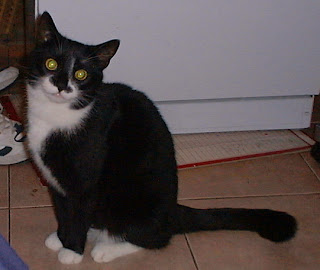
Molly just after she arrived 26th September 2000
Molly, for that was her name, came to us the week Melodie and I moved into our first house together. September 15th 2000, in the middle of the fuel protests which were raging at the time, we hired a van and moved in.

Most people would have considered that enough for one week! We happened to be in Halifax on the Sunday afternoon at the supermarket and decided to visit the RSPCA because somehow we decided what our new home needed was a cat.

On that day a decade ago we saw Molly and Lucy, a pair of cats who needed a new home as their previous owners had a baby who was allergic to them. I still recall them skulking at the back of their cage in the cattery, Lucy who was reluctant to come down of a perch to be petted and Molly looking generally unhappy. No-one else wanted this misfit pair because they were already both over 5 years old, the warden despairing of ever finding them a home.

Of course they were obviously the right animals for us! ;-) So by the end of the week we had taken them home. Molly immediately showed how things were going to be by shredding her way out of the RSPCA provided double walled cardboard carrier. To the day she died she detested being placed inside a carrier, funny that.
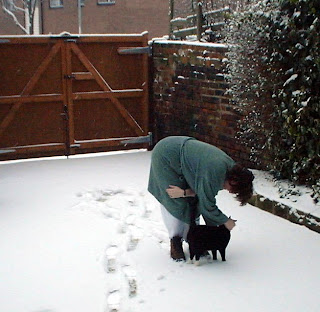
Melodie and Molly in the snow 28th December 2000
By the end of the year, when the snow came, the cats ruled the house and we were all happy together.

Little did we realise that soon in the summer of 2001 there would be another arrival to the family.
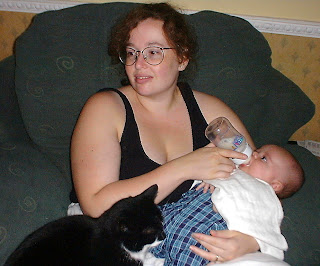
Molly with Melodie and Alex 2001
The arrival of our first child in June 2001 was a complete change in all our lives but we all managed to settle back into a routine. Although the banishment of the cats from upstairs remained a point of disagreement for a long time.

As Alex grew up the cats learned that feeding times for Alex could result in all manner of things falling from above. Soon Alex was mobile which resulted in different lessons on cats being sharp objects if not treated with respect. In February 2003 our family grew once more with the arrival of Joshua. The cats, now used to infants, took this in their stride.
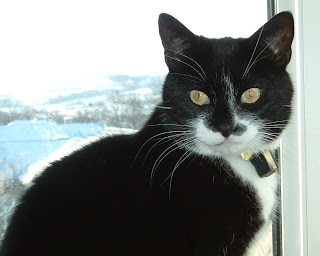
Molly in Febuary 2004 hiding on a windowsill
While still about day to day the cats are not captured on camera so often form this point on.

Over the forthcoming months they ensured they were out of reach of the newborn and the precocious toddler.

By the time of Joshuas first birthday in 2004 Molly had taken to hiding "out of the way" as much as possible but remained as affectionate as ever.

Molly in a box March 2007
As the children grew up and life progressed Molly became ever more at home and developed the odd aggravating trait like taking clean washing off airers and dragging it out the window, through the cat flap and upstairs so she could sleep on it!

She still enjoyed participating in claiming boxes and defending them vigorously though!

The kids took on the job of feeding the cats which made their bond closer ensuring they were greeted by happy cats sitting lookout as they came home from school each day.

Molly continued to be a good companion and an infuriating self centred animal like all good cats.
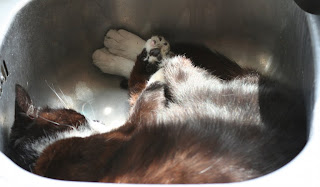
Molly asleep in the kitchen sink
Then on Tuesday evening our Neighbour knocked on our front door. They gave us the news that one of our cats had been run over and taken to the Vet. I immediately went to the back door and called and shook the treat box.

Lucy came running, but molly did not. We rang the vets who confirmed they had molly (we had them electronically tagged back in Halifax) and that they advised we did not come and see her until they had chance to asses her and deal with the shock.

As the days progressed her prognosis improved and then sank. She had a broken jaw, broken teeth, a dislocated hip, extensive bruising and something was definitely wrong with her kidney function.

Thursday evening the whole family went to see her and she purred and seemed happy to see us, she looked as bad as I feared though and somehow I knew there and then that this was probably goodbye. The children stroked her and petted her for a while and we left with an odd sadness, oh and to the sound of molly trying to gouge the veterinary nurse.

Yesterday she was due to have surgery to fix her jaw and hip...Alas when she was anaesthetised and x-rayed once more it became evident the hip was not just dislocated but her femur was fractured and there was additional damage. So just after midday came the call to ask what we wanted to do. The vet could attempt the repairs but due to her age and the other complications it was probably futile. So with heavy heart we agreed the best thing was not to revive her and she died a short time later.

I shall miss her morning greetings, her demands for attention, her sleeping in odd places and her companionship. I keep calling for her at meal times forgetting she will never come. I think Lucy is upset too, after spending their lives together her friend is gone and I cannot explain that to her.

So that is the end of Molly, a good cat.


15 October 2010

Pietro Abate: network management in an heterogeneous environment

I love titles with plenty of buzz-words :) After a bit of google-ing I finally found the right combination of tools that fit my needs. Luckily they are all packaged for debian and well documented. Auto-configure your network is an old topic. There are plenty of articles and howtos. Moreover the gnome NetworkManager already solves many problems alone. But since I don't use NetworkManager I tried to find a solution that works well with wicd. The "right" combination for me so far is to use guessnet and ifplugd to handle my wired connection and use Wicd for the wireless network. In theory, you can go for a fully automated solution using guessnet and wpa_supplicant, but I find much better to hide all the complexity of wpa_supplicant and just use a simple - and unobtrusive - UI to handle my wireless. First thing is to convince Wicd to leave alone my wired connection. This is pretty easy since Wicd wont touch your wired interface if it finds an entry in /etc/network/interfaces for it. Moreover to selecting always switch to a wired connection when available will make Wicd to leave alone you routing tables even if there is a wireless connection available that is marked as automatically connect to this network. Second you need to install guessnet and ifplugd
aptititude install guessnet ifplugd
I've noticed that the default settings for ifplugd work pretty well except for the -q option that sometimes lives my interface configured even if I've been disconnected for quite a while. Using ifplugd default, I re-obtain an address every time the cable is plugged-in, maybe causing a small delay in some occasion, but I prefer waiting that de-configuring the interface by hand. Guessnet needs a tiny bit of work. The debian package has already nice defaults that you can copy directly in your /etc/network/interfaces.
# Use guessnet
mapping eth0
script guessnet-ifupdown
map default: dhcp
map timeout: 3
map verbose: true

iface interface inet manual
test missing-cable
pre-up echo No link present.
pre-up false

# By default, perform DHCP
iface dhcp inet dhcp
These will make sure you avoid long timeouts and you leave the interface configured even if no cable is connected. Now you have to add one entry per network that you want to configure:
iface home inet dhcp
test1-peer address 192.168.0.30 mac 88:43:e1:xx:xx:xx
For example to use dhcp on your home network (and of course run any if-up / if-down script as you like). Or :
iface work inet static
address 192.168.0.1
netmask 255.255.255.224
gateway 192.168.0.234
dns-search buuu.org
dns-nameservers 192.168.0.30
test peer address 192.168.0.1 mac 00:1e:xx:xx:xx
to set a static address at work. Guessnet is nice and well integrated with ifupdown. Very flexible and documented. I had however the impression that from time to time the documentation I found on the net was not in sync with the latest release... I've also noticed that a component of guessnet is not in the package anymore. Guessnet-scan is a small program that will output a stanza to be used with ifupdown based on values sniffed on the wire. This is a kinda of extreme / hackish way to get connected but i reckon a nice tool to have. Hopefully it will make it back in the package sometimes soon... ps: first post on debian planet !

Dirk Eddelbuettel: Rcpp 0.8.7

With the scheduled R release of version 2.12.0 this morning, we have just uploaded version 0.8.7 of Rcpp to CRAN; Debian will follow shortly once the autobuilders have processed R 2.12.0 This Rcpp release depends on R 2.12.0 as two things have changed. First, we play along with change in R concerning the ordering of inheritance for time classes. But secondly, and more importantly, we support in Rcpp the corresponding change R itself which brings the new ReferenceClasses. Here is corresponding bit from R's NEWS file for R 2.12.0:
    o A facility for defining reference-based S4 classes (in the OOP
      style of Java, C++, etc.) has been added experimentally to
      package methods; see ?ReferenceClasses.
[...]
    o An experimental new programming model has been added to package
      methods for reference (OOP-style) classes and methods.  See
      ?ReferenceClasses.
This was made possible in large part by code committed by John Chambers (whom we had welcomed recently as a co-author to Rcpp) building on the changes he made to R 2.12.0 itself, as well on the work Romain had done with 'Rcpp Modules'. The R help page for ReferenceClasses carries a reference (bad pun) to Rcpp 0.8.7 so these two releases do go together. This should be a lot of fun over the next little while: S3, S4, and now ReferenceClasses. We also made a number of internal changes some of which leads to speed-ups and internal improvement. The NEWS entry follows below:
0.8.7   2010-10-15
    o   As of this version, Rcpp depends on R 2.12 or greater as it interfaces 
        the new reference classes (see below) and also reflects the POSIXt class
        reordering both of which appeared with R version 2.12.0
    o   new Rcpp::Reference class, that allows internal manipulation of R 2.12.0
        reference classes. The class exposes a constructor that takes the name
        of the target reference class and a field(string) method that implements
        the proxy pattern to get/set reference fields using callbacks to the 
        R operators "$" and "$<-" in order to preserve the R-level encapsulation
    o   the R side of the preceding item allows methods to be written
        in R as per ?ReferenceClasses, accessing fields by name and
        assigning them using "<<-".  Classes extracted from modules
        are R reference classes.  They can be subclassed in R, and/or R methods
        can be defined using the $methods(...) mechanism.
    o   internal performance improvements for Rcpp sugar as well as an added
        'noNA()' wrapper to omit tests for NA values -- see the included
        examples in inst/examples/convolveBenchmarks for the speedups
    o   more internal performance gains with Functions and Environments
As always, even fuller details are in Rcpp Changelog page and the Rcpp page which also leads to the downloads, the browseable doxygen docs and zip files of doxygen output for the standard formats. A local directory has source and documentation too. Questions, comments etc should go to the rcpp-devel mailing list off the R-Forge page

14 October 2010

Russ Allbery: pkg-config and Autoconf

Five different people asked or commented, in reply to my previous journal post about pkg-config files, why I didn't just have Autoconf generate the pkg-config configuration file directly. One could use the same template that I proposed in the previous post, but rather than adding the sed fragment to Makefile.am, instead add libfoo.pc to AC_CONFIG_FILES and let configure and config.status generate it directly. This is simpler, but it has two problems: I therefore prefer this approach, even though it's a bit more complex. I think it's more robust against both unusual ways in which people want to build my source packages and any future changes to Autoconf. Note, for example, that it's possible and sometimes useful to configure a package with a command like:
    ./configure --libdir='$ datadir '
(admittedly, more common to do that the other way arond) but that would fail with a pkg-config configuration file generated directly from Autoconf unless I'd anticipated that usage and added both datadir and datarootdir to the pkg-config template even though I wasn't using either. I've updated my build system coding style page to include this rationale.

Axel Beckert: Thoughts on Gitorious and GitHub plus a useful git hook

When I took over the developement of xen-tools, I looked around for an appropriate git hosting. I especially had a look at GitHub and Gitorious. If you just regard the features, GitHub is definitely more targetted on single developers and Gitorious more towards projects: At GitHub, every repository has its URL under the URL of a user page which makes it nearly impossible to have user independent, official repositories for projects which have more than one official developer. At Gitorious, every hosted repository needs to belong to a project, even if it s only a published configuration. But a project can have more than one git repository. You only seem to be able to have personal repositories if you clone some existing Gitorious repository. So from a feature point of view, the xen-tools git repositories fit way better to Gitorious hosting while the git repositories with zshrc, conkerorrc and desktop configuration files defintely have a more fitting addresses on GitHub, in my case http://github.com/xtaran/$repository. On Gitorious, they are now together under a project called Axel s configuration files at http://gitorious.org/abe which contains git repositories of my on grml s .zshrc based .zshrc, my configuration for Conkeror and all the files necessary for my ratpoison/xmobar based netbook/laptop desktop. I though feel a little bad for giving the project the very short slug name abe instead of abe-config (as I did initially) since abe is IMHO not a proper project name for my configuration files and possibly other projects would have a more reasonable claim for that project name on Gitorious. But that way it suites more its purpose: Gather some of my git repositories which don t belong to a proper project. But there s another important point when comparing Gitorious and GitHub: Free Software needs free tools as Benjamin Mako Hill posted recently on Planet Debian. Despite my (probably well known) distrust against Google and therefore also Google Code, and despite knowing the history of SourceForge becoming non-free, I was not that much aware that GitHub s software is only partially open source and therefore also not free software while Gitorious is both as it s licensed under the GNU Affero General Public License (like StatusNet/identi.ca for example) which is basically GPLv3, but its ideas applied to hosted web applications scenario (where the GPL itself doesn t grasp), too. Initially I just had the xen-tools git repositories on Gitorious and all my small one-repository projects as copies of the repositories on my own git server on GitHub to get some more publicity for them and allow social cloning . After reading Mako s article, I decided to at least have repository clones on Gitorious of all repositories I mirror at GitHub, too. That way I force nobody to use the non-free tools on GitHub for social cloning one of my git repositories. And of course I have copies of my code somewhere on the net as backup. Or to say it with Linus Torvalds (slightly updated) words: Only wimps use tape backup: real men just upload their important stuff on git, and let the rest of the world clone it. ;-) But isn t that tedious to always push your code to three repositories? No, it isn t. I just push my code to git.noone.org where I have configured the according remotes and the following post-receive hook:
#!/bin/sh
                                                                     
read oldrev newrev refname
git push gitorious $ refname:t 
git push github $ refname:t 
The only other thing necessary is to use ssh-agent and SSH agent forwarding to at least the host you re pushing to.

Russell Coker: Links October 2010

Bruce Schneier wrote an insightful post about why designing products for wiretapping is a bad idea [1]. It seems that large parts of the Internet will be easy to tap (for both governments and criminals) in the near future unless something is done. The bad results of criminal use will outweigh any benefits of government use. Sam Watkins wrote an informative post about Android security [2]. Among other things any application can read all stored data including all photos, that s got to be a problem for anyone who photographs themself naked Rebecca Saxe gave an interesting TED talk about how brains make moral judgements [3]. Somehow she managed to speak about the Theory of Mind without mentioning Autism once. The Guardian has an amusing article by Cory Doctorow about security policies in banks [4]. He advocates promoting statistical literacy (or at least not promoting a lack of it) as a sound government policy. He also suggests allowing regulators to fine banks that get it wrong. Steven Johnson gave an interesting TED talk about Where Good Ideas Come From [5]. It s a bit slow at the start but gets good at the end. Adam Grosser gave an interesting TED talk about a fridge that was designed for use in Africa [6]. The core of the Absorption Refrigerator is designed to be heated in a pot of water in a cooking fire and it can then keep food cool for 12 hours. It s a pity that they couldn t design it to work on solar power to avoid the fuel use for the cooking fire. Josh Silver gave an interesting TED talk about liquid filled spectacles [7]. The glasses are shipped with a syringe filled with liquid at each side that is used to inflate the lenses to the desired refractive index. The wearer can just adjust the syringes until they get to the right magnification, as there are separate syringes the glasses work well with people who s eyes aren t identical (which is most people). Once the syringes are at the right spots the user can tighten some screws to prevent further transfer of liquid and cut the syringes off to give glasses that aren t overly heavy but which can t be adjusted any more, I guess that a natural extension to this would be to allow the syringes to be re-attached so that the user could adjust them every year to match declining vision. One thing that this wouldn t do is counter for Astigmatism (where the lens of the eye doesn t focus light to a point), but I guess they could make lenses to deal with a few common varieties of Astigmatism so that most people who have that problem can get a reasonable approximation. The current best effort is to make the glasses cost $19, which is 19 days salary for some of the poorest people in the world. Glasses in Australia cost up to $650 for a pair (or a more common cost of $200 or about $100 after Medicare) which would be about one day s salary. Eben Bayer gave an inspiring TED talk about one of the ways that mushrooms can save the planet [8]. He has designed molds that can be filled with Pasteurised organic waste (seed husks etc) and then seeded with fungal spores. The fungus then grows mycelium (thin fungal root fibers) through the organic waste making it into a solid structure which fits the shape of the mold. This is currently being used to replace poly-styrene foam for packaging and can apparently be used for making tiles that are fire retardant and sound proof for constructing buildings. The main benefits of the material are that it can be cheaply made without petrochemicals and that it is bio-degradable, I m not sure how the bio-degradable part would work with constructing buildings maybe they would just replace the panels every few years. Annie Lennox gave a TED talk about her Sing foundation to care for women and children who are affected by AIDS [9]. She describes the effect of AIDS in Africa as Genocide. Robert Ballard gave a very informative TED talk about exploring the oceans [10]. This was one of the most informative TED talks I ve seen and Robert is also one of the most enthusiastic speakers I ve seen, it s really worth watching! We really need more money spent on exploring the oceans. Jessa Gamble gave an interesting TED talk which suggests that the best thing to do is to go to bed at about sunset and then have a couple of hours of relaxing time during the middle of the night [11]. Apparently the subjects of body-block experiments who live for a month in a bunker without natural light or access to a clock get better sleep in this manner than they ever had in their life and feel fully awake for the first time. World Changing is a blog that has a lot of interesting articles about climate change and related issues [12]. It s worth a read. Cynthia Schneider gave an interesting TED talk about how reality competition TV is affecting reality [13]. Shows that are derived from the American Idol concept are driving a resurgence in some traditional forms of performance art while also promoting equality among other things it s apparent that winning is more important than misogyny. The Ritual of the Calling of an Engineer is an interesting concept [14]. I think it would be good to have something similar for Computer Science. Benjamin Mako Hill wrote an interesting and insightful essay about Piracy and Free Software [15].

Andrew Pollock: [life] Airship ride

I was fortunate to get to take a ride on the airship that has in recent times taken up residence in our back yard. It was a 90 minute flight around the South Bay Area (south over CA-85, then north to Stanford over I-280), over the bay itself to Fremont, over the salt evaporation ponds, and then back to Moffett Field. Visibility was fairly good, but there was a bit of smog around. The airship itself was really cool. It only seats 12 people, and it wasn't quite full. I didn't count the passengers, but there were about 3 or 4 empty seats. Once the airship stopped its initial climb, we were free to leave our seats and roam the gondola. There was an openable window at the front and rear of the gondola, and it was big enough to stick your head out, which made for some good photos. At the back, was a bench seat, and an inclined window, so you could lean right out the back. Even the lavatory had a window. The cockpit was literally just at the end of the gondola, so you could inspect all the controls and instruments, and have a chat with the pilot. Disembarking was a delicate counter-balancing affair. Two people off, two people on. We were the first load of passengers for the day, so they jettisoned a heap of water once we were all on board. Overall, it was a lot of fun, and a very smooth ride. I'm not sure that it's worth $495, though. Photos from the flight are here

MJ Ray: UCEPROTECT and SORBS SPAM: Two DNSBLs to Avoid

I just had another conflict with a debatable anti-spam configuration. I think it was debatable rather than obviously wrong, so I m not going to rant about the specific setup, but while discussing it with other postmasters, the following two Domain Name Service Blacklist (DNSBL) facts surprised me:
  1. UCEPROTECT3 can be evaded if you pay them EUR 75 every 2 years. UCEPROTECT is a German organisation but refuses to publish the details usually found on an Impressum so you could be funding spammers, for all you know. Their four suggestions to stop spam (no C-R, rate limits, block port 25, refuse to sell) seem so unlikely to stop spam it s either na ve or insincere.
  2. SORBS asks ISPs to pay USD 50 to get delisted from the SORBS SPAM database. It s to charity rather than SORBS, but it still seems like a protection racket. Spammers can get out of jail for a few dollars?
Those lists both seem quite trigger-happy to me, which isn t surprising as these payment demands encourage listing first and asking questions later. It means I won t be using these two lists anywhere soon.

13 October 2010

Cyril Brulebois: How many

How many bugs can be filed at once? 55 bugs in a row, so that the desired bug number is reached. It took some time to prepare all those reports, which eventually resulted in 55 successive bug numbers, on top of last-reported #599945 at the time, ta-da! I love it when a plan comes together! Just as a reminder, the main idea behind those bug reports is to get as many FTBFSes as possible reported, as previous mentioned. How many X packages can be uploaded between two dinstall runs? 14 packages. Now that things are settling down a bit on the squeeze front, I managed to have a look at X Server 1.9 (more precisely, 1.9.0.901 aka 1.9.1 rc1), which had already been worked on by Christopher James Halse Rogers (thanks!). Uploaded source packages include: So, what about the major (ati/radeon, intel, and nouveau) drivers? More on that later; if you want to test 1.9 with those, pick xserver-xorg-dev from experimental and build your driver against it. Hopefully only a few days should pass before you get an update on that topic. How many times did this blog go haywire? Possibly none, even though it was recently reworked so that http://ikibiki.org/ and http://blog.ikibiki.org/ are distinct. Some d-i or xorg tags may be added to older posts when time allows, but those shouldn t pop up in planet again. Flattr this!

12 October 2010

MJ Ray: Blog Action and Blog Action Day

Blog Action Day approaches on Friday. The call this year is for clean water and some high profile blogs including the UKFCO and the White House will be joining in. But until then, you can look at the wonderful direct blog action by Lars Wirzenius In defense of Nicole and others after this shocking episode. I hope Lars is wrong in this case and the Davids will join together in their common interest to overthrow the Goliath. There is a far longer prelude than Lars describes, going back to the April 2005 launch of Liblime (announcement here). An independently-authored history of Koha and LibLime and the recent problems can be found at LWN.net (US$7/month if you woud like to subscribe and support LWN). Actually, I m not sure if PTFS is even a Goliath. They seem to stomp around a lot, but how big are they? Biggest credible guess I ve seen is 125 people across all products (not only Koha), which is fewer than the 150ish Koha-Community developers (not all supporters). So there you have it: Koha is bigger than PTFS. Literally.

11 October 2010

Luke Faraone: Key transition

As Christian mentioned, the Debian Keyring Maintainers did a promote this weekend of the new keyring. I figure it s an opportune time to perform a public key transition, since this had the effect of replacing my key on the keyring. For my new key, 0xF9FDD506, I decided to opt for a 4096-bit RSA, which is stronger than I should have to worry about for the foreseeable future. The key is much better connected than my previous one, 0x0AC70206. I also have a transition document, ripped almost word-for-word from Christian s. If you signed my previous key, you should sign the new one unless you re feeling extra paranoid today.

Next.

Previous.