Search Results: "cas"

24 December 2009

Clint Adams: Muppetry

I'm a notoriously late adopter of new technologies. Sure, if I think that something is potentially a good idea, I'll go for it, but for the most part, I assume that things are stupid. I refused to use the WWW for many years, thinking it was idiotic. Now I use the WWW. I find microblogging to be inane and narcissistic at best, but I have derived mild amusement from Shaq on Twitter. Microsoft Windows is something I thought would be ridiculously unsuccessful, because it didn't do anything I would find useful. The list goes on and on, and includes something known in the popular vernacular as configuration management . I've been hearing about BladeLogic and Opsware for quite some time, and idly wondering who the incompetent fools are that need something like this. Back in my day we could manage 100 servers with relative ease; no centralized authentication (because it was a running argument about whether NIS sucked more than NIS+ or vice-versa), no cfengine, no prebuilt server images or any of that jazz. If, for some reason, we needed to make the same change to all servers at once, or some subset thereof, we would just script it. So when one of my acquaintances started raving about Puppet, I assumed it was equally pointless. We'll call him Downs. Downs exhibits a pattern of behavior where he will rave about something for a few weeks, sometimes without having even tried it first, and then eventually become disillusioned with it and start ranting with the same fervor with which he had insisted that whatever fad of the week was the greatest thing ever. It came as no surprise to me when he fell out of love with Puppet and started raving about how much better Chef is. In case you're wondering, he still has not tried Chef to this day. Finally someone convinced me of the value of Puppet. I do not think it is the Way and the Light, but I do see a few situations wherein it makes sense to sacrifice efficiency, flexibility, sanity, and system resources to gain a way of building a near-identical machine from scratch. Now, beyond the flaws inherent to a solution like this, Puppet does have some annoying flaws which I find unnecessary, and which Downs ranted about back when I had absolutely no idea what he was talking about. I disregarded his alleged preference for Chef, but I have heard intelligent people extoll the virtues of Chef, and to a lesser extent Bcfg2. So I took a very brief look at each of those, and was pretty much horrified by what I found. If I need something Puppet-like in the very near future, I will probably be choosing Puppet. I have no intention of running Puppet on machines I manage all by myself though. For that eventuality I am NIHing something with what I consider a better design. The current code is published, but it does not do very much, and requires linking with libdpkg.a which does not exist in any package (but Guillem's working on that, I think). I have no idea whether or not I'll have the motivation to finish it all by myself, but it is Free Software. This post is intentionally weak on details, or deets as the kids call them.

Muammar El Khatib: Installing Adobe Air in Debian AMD 64 (TweetDeck can be used)

I love twitting using TweetDeck. So that, I started to investigate how to install Adobe Air in Debian AMD64 and, it was a real pain in the ass. I have found a way of installing it in Debian AMD64.

First of all, you need to install the following packages:

$ sudo apt-get install ia32-libs lib32nss-mdns lib32asound2 lib32gcc1 lib32ncurses5 lib32stdc++6 lib32z1 libc6 libc6-i386 lib32nss-mdns libcanberra-gtk-module


After installing them, we have to create some symlinks from the location of some of those libraries in /emul/ia32-linux/usr/lib/ to /usr/lib32/. For accomplishing it, do the next:

$ cd /usr/lib32/
$sudo ln -s /emul/ia32-linux/usr/lib/libnss3.so .
$sudo ln -s /emul/ia32-linux/usr/lib/libssl3.so .
$sudo ln -s /emul/ia32-linux/usr/lib/libsmime3.so .
$sudo ln -s /emul/ia32-linux/usr/lib/libnspr4.so .
$sudo ln -s /emul/ia32-linux/usr/lib/libnssutil3.so.1d .
$sudo ln -s /emul/ia32-linux/usr/lib/libplc4.so.0d .
$sudo ln -s /emul/ia32-linux/usr/lib/libplds4.so .


In the case that you have problems with libplds4.so.0d, create the symlink like this:


$sudo ln -s /emul/ia32-linux/usr/lib/libplds4.so.0d libplds4.so.0d


Now, it is time to download Adobe AIR (in this case version 1.5).

$wget http://airdownload.adobe.com/air/lin/download/latest/AdobeAIRInstaller.bin


Once it is downloaded, we have to make the .bin file an executable:

$ sudo chmod +x AdobeAIRInstaller.bin


Then, we can proceed to install it:

$ sudo ./AdobeAIRInstaller.bin


If you get an error like this:

Error loading the runtime (libnss3.so: wrong ELF class: ELFCLASS64)


It means that you haven't done the symlink from /emul/ia32-linux/usr/lib/libnss3.so to /usr/lib32/ correctly or that you haven't installed the library which is missed ('apt-file search' is your friend).

If everything goes fine, then the last steps are:

sudo cp /usr/lib/libadobecertstore.so /usr/lib32


Note: make a symlink if you prefer.

And for TweetDeck I had to do this:

Download libgnome-keyring0 for 32 bits (in this example I used the one from SID, if you are using testing, download the one from that release that you are using), extract it with dpkg and copy the libraries to /usr/lib32:

$ wget http://ftp.us.debian.org/debian/pool/main/g/gnome-keyring/libgnome-keyring0_2.28.2-1_i386.deb
$ sudo dpkg-deb -x libgnome-keyring0_2.28.2-1_i386.deb libgnome-keyring0_2.28.2-1
$ sudo cp libgnome-keyring0_2.28.2-1/usr/lib/* /usr/lib32/


Then install TweetDeck (http://tweetdeck.com/download/) and Enjoy :-)

Note: If you find any problem, please do not hesitate to write a comment so that I can help you or we can improve this post.

23 December 2009

Gunnar Wolf: Preparing for the geeky holidays with suitable wine

Preparing for the geeky holidays with suitable wine
Quoting The Klezmatics: It's everybody-else's annual end-of-the-year-time holiday, the name of which respectfully we do not choose to say, but that does not prohibit us in any concievable way from wishing you a very merry everybody-else's end-of-the-year-time holiday!
In order to properly welcome this 2010 in a geeky fashion, I got the following wines to share with my friends: Happy $ joyful_ocassion !

Robert Collins: bzr selftest uses testtools


the emperor has new clothes bzr has just changed the base class for its test suite from unittest.TestCase to testtools.TestCase . This change has cleaned up a bunch of test logic, deleted a significant amount of code (much of which was redundant with Python unittest) and added some useful and important features. bzr has only been able to make this change due to testtools expanding its mission from a simple aggregation of proven unittest extensions into one where new extensions that *make unittest more extensible*. My deepest thanks to Jonathan for permitting me to use testtools as the vehicle to put these extension-enabling-extensions (and for his patience in reviewing said changes!). The change was pretty easy: The bulk of the changes were in bzrlib.tests and bzrlib.tests.test_selftest. I chose to cleanup an ugly API at the same time which added a little scattershot across a number of tests. And there are more changes that can be done to take better advantage of testtools the amount of deleted and cleaned up code isn t complete. Even so, its a pretty clear win:
18 files changed, 228 insertions(+), 496 deletions(-)
What went? bzr had an implementation of TestCase.run. This function is the main workhorse of Python s unittest module, and yet sadly it has to be replaced to change the exceptions that can be raised(to signal new outcomes), or to improve on test cleanup. Testtools provides an API to permit registering new exception types and handlers for them. Like python 2.7 testtools also provides the TestCase.addCleanup API, and these two things combined mean that bzr no longer needs to reimplement the run method. For expected failures, bzr uses a helper method TestCase.expectFailure to perform an existing assertion and convert the test into an expected failure if that assertion does not trigger. This was another feature testtools already provides and thus got deleted. All the custom code for skipping and expected failures got deleted, and the other outcomes bzr uses turned into extensions (as per the run discussion above). In bzr test cases generate a log (because bzr generates a log) and previously the TestResult in bzrlib inspected each test that had been executed to extract the log. This was made simpler by using the details API that testtools provides (see testtools.TestCase.addDetail), which permits tests to add arbitrary data in a semi-structured fashion. This is supported by subunit and a long standing bug with bzr selftest --parallel was fixed as a result logs from tests run in other processes are now carried across the process barrier intact and are presented cleanly. Some other minor cleanups are in unittest compatibility code, where bzr would degrade gracefully with unittest runners, and testtools provides such logic comprehensively, so all that got deleted too. Whats new? I think the most significant new facility that testtools offers bzrlib is assertThat. This assertion is inspired by the very nice assertThat in JUnit (which has changed substantially since Python s unittest was written based on it). This assertion separates the two concerns of raise an exception and decide if an exception should be raised . The separation allows for better reuse of custom checking code, because it permits composition in a cleaner way than extra assertion methods permit. Testtools does not include many matchers as yet, but matchers are easy to write, and if one were to write a small adapter to the hamcrest library, there are a bunch of ready made matchers there (though they have a very Java feel such as is not meaning is which is why Testtools did not use that library). Secondly, the addDetail API referenced above, in combination with testtools.TestCase.addOnException will permit capturing the entire working area when a test fails, something that developers currently have to fiddle about with breakpoints to achieve. This hasn t been done, but is a straight forward patch I hope to do in the new year. Lastly, Testtools offers testtools.TestCase.getUniqueInteger and testtools.TestCase.getUniqueString, which are not as yet used in bzr tests, but we may start using them soon. Beyond that, the other features of testtools are already present in bzrlib, and we simply need to find and delete more duplicated code.

Benjamin Mako Hill: What's in a name?

Over the summer, there was a bit of a tussle at the highest level of Ubuntu governance over whether or not Canonical Ltd., the company that funds the majority of work done directly in Ubuntu, should name its file syncing and backup service Ubuntu One. Canonical's service involved a freely licensed client included in the Ubuntu distribution but, as a network service running on Canonical servers, it was not clearly a part of Ubuntu (the GNU/Linux distribution) or Ubuntu (the community) in the way the term was usually used within the community. Although the network service itself was not Franklin Street Statement free, this was not the most important issue for everyone who objected to the name. The major issue for many seemed to boil down to the fact that, free or not, Ubuntu One is a service run entirely by Canonical outside the reaches of the Ubuntu governance structures. Decisions were made and not everybody -- and maybe not anybody -- was absolutely happy with the outcome. My goal is not try to revive old arguments here. As far as I'm concerned, the issues are settled and the service is called Ubuntu One. That said, the questions raised during the episode are fundamental to Ubuntu and to other firm-sponsored FLOSS projects. Now that the dust has settled, they are worth reflecting on. From a legal perspective, there never was any ambiguity. Canonical "owns" the Ubuntu trademark. In this important sense, "Ubuntu" means whatever Canonical says it means. This is hardly new. As just one example, the Official Ubuntu Book (of which I am an author) was written by community members but became official because Canonical blessed it. But despite the fact that they don't need to, Canonical has often consulted with the community and its governance structures about trademark licensing policy. This was also not a case of Canonical not listening to the community. Canonical employees approached the Ubuntu Community Council (Ubuntu's highest governance board of which I am a member), listened carefully to concerns, and responded thoughtfully. The question was not even about a clash between what Canonical and the CC thought about the issue. An unambiguous majority of the board, including all the Canonical employees and several of the community members, supported the idea of Canonical using the trademark. The question was one about who gets to make the decisions about the Ubuntu name and about what role the community and Canonical would each play. Despite the fact that a majority of the Ubuntu community council was likely to support the proposed name, the CC was told by Canonical CEO Mark Shuttleworth that a vote was irrelevant. Canonical made it clear that decisions about the Ubuntu trademark were simply not in the CC's purview. The decision on how the name was to be used was something that Canonical was not willing to delegate to an "outside" (the firm) governance body. Few businesses would. And although I don't agree with the decision as a community representative, I might have even made the same call from Canonical's shoes. In traditional firms, it's usually pretty clear where the organization's boundary lies. In FLOSS projects -- and especially in FLOSS project like Ubuntu who are sponsored in very large part by a single for-profit company -- boundaries are fuzzier. The conversation about "Ubuntu One" can be seen as a fight over what "Ubuntu" refers to, and, more importantly, who gets to answer that question. In deciding whether to call a service "Ubuntu", a decision is made on what Ubuntu is. Names are powerful. Is Ubuntu just a Canonical project? Are Ubuntu's contributors really just Canonical contributors by proxy? I think the answer to both questions is "no" but the boundary issues involved are complicated and under constant negotiation. Every time Canonical uses the Ubuntu name itself or grants others the ability to do so, these boundary issues are negotiated, one way or another. This boundary setting work reveals an important tension that firms releasing FLOSS must all struggle with. To what extent and in what ways do communities get to decide what a FLOSS project is and to what extent do sponsoring firms get to do so? How should projects and firms do this most effectively? What should we even be optimizing for? I think that any resulting balance has a huge effect on whether a FLOSS project is, on one hand, released under a free license but run like any old corporate project or, on the other, a true "bazaar" style project where no single firm dominates -- or where they fall on that spectrum. Names and trademarks are one way that projects define their own identities and act as an important frontier in this balancing act. As every firm/project negotiates their own answers to questions of names and boundaries, there are important implications for the project's ability to attract volunteers, solicit contributions from other firms, and more. The confusion around conversations about Ubuntu One shows that we still have a lot to learn.

Peter Eisentraut: Patience

Occasionally, there are concerns expressed about the adoption rate of Python 3. Now that PostgreSQL 8.5alpha3 is released with Python 3 support in PL/Python, let's see what the schedule might be until this hits real use.

Python 3.0 was released in December 2008 and was admitted to be somewhat experimental. At that point, PostgreSQL 8.4 was already in some kind of freeze, so adding a feature as signicant as Python 3 support was not feasible at that point.

In fact, we opted to do two significant rounds of fixing/enhancing/refactoring of PL/Python before tackling Python 3 support: fixed byte string (bytea) support and Unicode support. Both of those benefit Python 2 users, and they made the eventual port to Python 3 quite simple.

PostgreSQL 8.5 might release around May 2010. Debian squeeze is currently in testing and doesn't even contain Python 2.6 or Python 3.1 yet, due to some technical problems and a bit of infighting. Debian freezes in March 2010, which means without PostgreSQL 8.5 but hopefully with Python 2.6 and 3.1. The final release of squeeze should then be later in 2010, which means the earliest that a significant number of Debian users are going to look into moving any of their code at all nearer to Python 3 (via 2.6) is going to be late 2010. (Other operating system distributions will have other schedules, of course.)

The next Debian release (squeeze+1), which will presumably include PostgreSQL 8.5 or later and a solid Python 3.x environment, will then not be released before January 2012, if we believe the current 18-months-plus-slip cycle of Debian. So it will be mid-2012 until significant numbers have upgraded Debian and PostgreSQL to the then-current versions. If you are sticking to a stable and supported operating system environment, this is the earliest time you actually have the option to migrate to the Python 3 variant of PL/Python across the board for your applications. Of course in practice this is not going to be the first thing you are going to do, so by the time you actually port everything, it might be late 2012 or even 2013. Also, if you are heavily invested in PL/Python, you are probably not going to upgrade much your other Python code before PL/Python is ready.

This will then be 3 years after the PL/Python 3 code is written and 4 years after the release of Python 3.0. And 2 years before Python 2.x is expected to go out of maintenance in 2015.

So, to all users and developers: patience.

Incidentally, I fully expect to still be using IPv4 by then. ;-)

22 December 2009

Lucas Nussbaum: Doctor Capello!

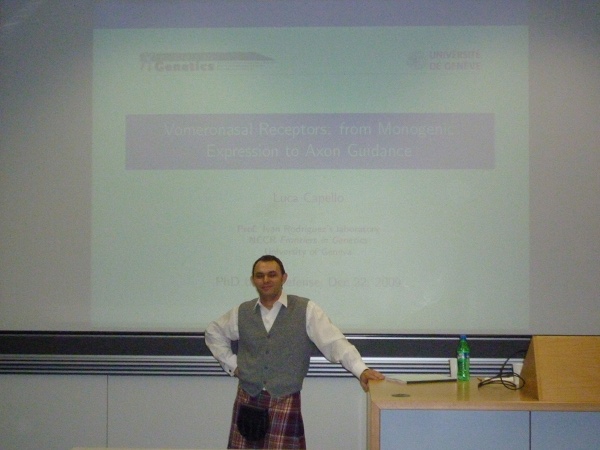
He might too shy to tell everybody, but the world must know. Luca Capello successfully defended his PhD thesis today at Universit de Gen ve, getting a Tr s Bien mention. I must admit that my last biology lesson was 13 years ago, so I m not sure I can really comment on his work on Vomeronasal Receptors: from Monogenic Expression to Axon Guidance. But I was very impressed by the quality of the experimental process, especially compared to what we do in computer science. Debian was well represented at the defense, since Axel Beckert, Didier Raboud and the Debian kilt were also there. Welcome to the list of Debian Developers holding PhD degrees, Luca!

Luca waiting at the door (again).
luca1
Luca ready to start.

Ian Wienand: An open letter to the bald-headed salesman in Harvey Norman, Norwest, Castle Hill

I usally find blog rants useless, but sometimes something is just so annoying one is sufficiently inspired. Today I went with my parents to buy them a Tivo at Harvey Norman, Norwest, Castle Hill, NSW, Australia. I am a big Tivo fan; the interface is good and it "just works". I don't mind paying for (or in this recommending paying for) good products. After selecting the Tivo model, I asked for a HDMI cable. The salesman made a series of questions about what sort of HD TV it was being plugged into; I quickly sensed this as a probe to see what sort of suckers we were, and requested just a "normal" cable. At this point, he insisted on a $130 (you guessed it) Monster cable, and had the audacity to say that we didn't need one of the really expensive cables because our TV wasn't good enough! I openly expressed my concern, but the annoying high-pressure sales pitch had just begun. The amount of, frankly, crap that he spewed about 4-bit this, 10-bit that, legislating of labels, DA signal levels, mythical customers who regretted buying the cheap cables and who knows what else was to the point of being comical if it weren't so insistent and said with such seeming authority. There is only one thing that matters - if the cable has passed the functional requirements for being certified to have the distinctive HDMI logo plastered on it. From the HDMI FAQ:
Q. What testing is required? Prior to mass producing or distributing any Licensed Product or component that claims compliance with the HDMI Specification (or allowing someone else to do such activities), each Adopter must test a representative sample for HDMI compliance. First, the Adopter must self test as specified in the then-current HDMI Compliance Test Specification. The HDMI Compliance Test Specification provides a suite of testing procedures, and establishes certain minimum requirements specifying how each HDMI Adopter should test Licensed Products for conformance to the HDMI Specification.
Now, I can understand that if you buy any old HDMI cable off Ebay for $1, it may be a knock-off that uses the HDMI logo illegally. But there is no way that the certified $50 Philips cable (still very over-priced, but at least not insane, and discounted to $35) performs any differently to some overpriced Monster model certified to exactly the same standard. The thing that annoyed me most was his analogy to buying a tyre. He stated that "if you walked up to a tyre salesman and I said don't want the Pirelli's, just put the cheap-o tires on my Ferrari" I'd be insane, and thus by extension of that logic I was insane for not buying a Monster cable for my great new Tivo. This analogy is completely flawed and really just dishonest. A Ferrari is much more powerful and goes much faster than a standard car. It is plausible it needs a better engineered tyre to perform adequately given the additional stresses it undergoes. A Tivo doesn't put out any more or any less bits than any other HDMI certified equipment, no matter what you do. If the cable is certified as getting all the bits to the other end under whatever environmental conditions specified by the HDMI people, then it's going to work for the 99% of people with normal requirements. Nobody wants to make a significant investment in a piece of audio-visual equipment and feel they are getting something that isn't optimal. Harvey Norman's use of this understandable consumer sentiment to sell ridiculously over-priced cables that do nothing is extremely disappointing. I'm sure the commissions on these things encourage this behaviour, so it is useless expecting the retailer or individual sales assistant to change their policy to reccommend reasonably priced cables. However, it is really Tivo and other manufactuers who get the raw end of this deal; a $130 cable is over 20% of the price the actual Tivo! That is surely affecting people's purchasing decisions. If Tivo and others included a certified HDMI cable with their device, as they do with component cables, and had "Certified HDMI 1.3 cable included" plastered on the box, it would be a harder sell to explain why the manufactuer would bother shipping a certified cable that is supposedly insufficient, and consumers would hopefully avoid the very distasteful high-pressure theatrics I was subjected to today.

Lior Kaplan: Oracle removes gnome packages from its database requirements


As a sysadmin I try to make sure my servers will have the minimal installation needed in order for them to work. In most cases this policy works fine, but some applications depend on too much unneeded software like GUI or sound packages. Two years ago I wrote about Why does Oracle s applications needs xscreensaver in order to run ? . It seems that finally things have changed. In it s latest version of the 10g r2 release notes (B15666-14), Oracle dropped the control-center and gnome-libs packages from the software requirements. This change is only relevant for RHEL5, as the list for RHEL4 (x86_64) haven t changed except from dropping xscreensaver and adding some other packages. Notice that for RHEL5, 3 packages were added in order to let the installer display it s graphical interface:
  • libXp-1.0.0 (i386)
  • libXt-1.0.2 (i386)
  • libXtst-1.0.1 (i386)
I m glad to see Oracle update it s software requirements as a lot of people in the databases world are afraid to make changes which are against the official documentation, regardless of how wrong it might be. Posted in Proprietary software, Red Hat Enterprise Linux, System Administration Tagged: Oracle, software requirements

21 December 2009

Lucas Nussbaum: Debian s KVM + Ubuntu karmic => bug?

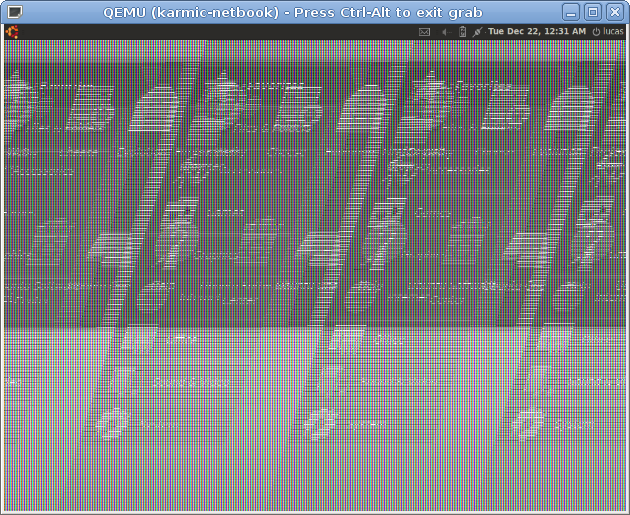
I ve been playing with virtualization, and KVM in particular. However, I m running into an interesting problem. Below is how Ubuntu Netbook Remix look inside my KVM (either using virt-viewer, virt-manager or directly KVM to display the VM). Note how the top panel is fine. I m using KVM 88 from experimental (but I had the same problem with KVM 85 from unstable), the cirrus video driver inside the VM, and an up-to-date karmic VM.
Has someone ran into that problem already? If yes, where is it tracked? I m been failing to find the correct search keywords so far. kvm-unr

Martin-Éric Racine: Wanted: a coherent, sane Finnish political party

In more than 11 years in Finland, I've been politically involved in a couple of political parties on the Right side of the spectrum - mainly because those parties tend to favor a free market economy and a work-oriented immigration. In one case, I was invited by fellow immigrants to attend the meetings of their favorite party's English section, because of my expertise on Immigration legislation and common practices. In an other case, a member of the Finnish parliament invited me to participate in his party's immigrant workgroup, which resulted in my getting involved in a number of proactive initiatives and eventually joining that party as a card-carrying member. Simultaneously, I was approached by no less than 4 Finnish political parties to become a candidate in the municipal elections (in Finland, foreigners who have lived at least 2 years on an A-status residence permit can vote and stand as a candidate in municipal elections). Despite this, I've come to the conclusion that none of these Finnish political parties is genuine: On one hand, there's politicians who claim to know everything about the Immigration question and yet their speeches tell an entirely different story than what immigrants experience. On the other hand, there's politicians who complain about the immigrants' lack of participation in political life, but who quickly add that their personal group of supporters is all they're interested in hearing from. Correlating these facts, it's been found by many politically-involved immigrants that Finnish political parties don't genuinely want to involve immigrants; all they are interested in is acquiring a few extra votes from the immigrant population and in transferring those votes to their party's star Finnish candidate, who often is someone favored by the party's old-timers but disavowed by the majority of grassroot members. In a few more extreme cases, party brasses will sheepishly admit that all they want is a couple of niggers in the candidate list to show a vague sense of adhesion to the multicultural agenda - despite the assurances they have given to often naive immigrant candidates that they "genuinely" hope that they'll be elected. As it turns out, many immigrants are actively involved at the grassroot level and receiving the praises of their Finnish colleagues for their innovative and proactive initiatives. As a result, genuinely interested Finns have joined forces with active immigrants to launch various initiatives for improving Finland's competitive position in the global economy through a thriving cosmopolitanism and a stronger culture of entrepreneurship. For instance, I am personally involved at several public and private sector initiatives. Nonetheless, grassroot initiatives can only ever accomplish so much; without the unflinching support of Finland's significant political players, several key elements of these innovative solutions cannot be implemented. However, given the grassroot's frustrating experiences of the political scene, one cannot help but wonder: Is there any Finnish political party whose actions are coherent with its stated political agenda and in sync with the grassroot initiatives being put forward by the immigrants and their Finnish associates?

20 December 2009

Stefano Zacchiroli: RC bugs of the week - week 15

RCBW - week #15 Here are last weektoday squashes, by yours truly: Some highlights:

Wouter Verhelst: Re: Grrr

I received a number of comments on my "Grrr" post, all of which missed the point: Yes, I am aware that there are many more ways to fix this issue beyond a memcpy. However, the example code is legal and would not crash the application, if not for the fact that libc thinks I am doing something wrong. On top of that, this kind of overflow "protection" only kicks in when the code is compiled with -O2 rather than with -g -O0. While I am not sure whether the difference is due to the absense of debugger symbols, or rather due to the different optimization levels, fact is that software which runs fine in debugging should also run fine in production. There are good arguments for compiling all C code with -Wall -Werror, and I do that as a matter of course for all C software that I write. However, sometimes automated tools are just wrong in their compile- or run-time bug detection, in which case such it should be possible to disable that detection. This is one such case, and my blog post was more about ranting about the inability to do so, rather than about the fact that I had to memcpy when in fact there were other options available. But yeah, perhaps I should have been clearer about that. Forgive me for not being clear after having fought with compilers for far too long.

Wouter Verhelst: Good, not evil

There is a bit of a fluff online currently about the following clause in the "jsmin" code (whatever that is):
The software shall be used for good, not evil
This seems to have started when Google rejected a project based on that code due to its license being not free or open source according to their standards, and therefore not welcome anymore. The arguments then quickly degenerated into things like 'when did google stop being against evil'. But those are all besides the point. One of the most important properties of free and open source software is that anyone can use it for any purpose; there are no restrictions to using them. The DFSG (and hence, the OSD which was derived from the DFSG) encode this as follows:
No Discrimination Against Fields of Endeavor
The license must not restrict anyone from making use of the program in a specific field of endeavor. For example, it may not restrict the program from being used in a business, or from being used for genetic research.
You may think "how is 'evil' a field of endeavor", but that is the wrong question. To "use software for evil" can mean any of a number of things, including "nuclear research", "weapons development", "abortion", or, heck "the cash register in a butchery shop", depending on the ethical and moral framework through which the person writing the license sees the world. The ability to give someone a CD or DVD with a bunch of software on there, being able to tell them that they can just use this in any which way they see fit, is a very strong and important feature of the free and open source community. Every time someone comes up with a clause like the above, however, this ability is diluted somewhat; and if it is readily accepted within the greater free and open source movement, then eventually everyone interested in using a piece of software must first check whether they're not trying to use software that forbids someone's pet evil, and we lose one of the greatest strenghts that does exist for free software, but not for proprietary software. The sad thing is, the jsmin author seems to agree. From a video/transcript on which he talks about his absurd license clause is the following quote:
Also about once a year, I get a letter from a lawyer, every year a different lawyer, at a company I don't want to embarrass the company by saying their name, so I'll just say their initials IBM
[laughter]
saying that they want to use something I wrote. Because I put this on everything I write, now. They want to use something that I wrote in something that they wrote, and they were pretty sure they weren't going to use it for evil, but they couldn't say for sure about their customers. So could I give them a special license for that? Of course. So I wrote back this happened literally two weeks ago "I give permission for IBM, its customers, partners, and minions, to use JSLint for evil."
Or, in other words, all you have to do if you want to use this software for evil is set up a second company, tell Douglas that this second company wants to sell software that uses his software to people who might use it for "evil", even though the first company won't, and you're in business. Because Douglas doesn't really oppose evildoers. So the question is, why is that clause in there in the first place? There are only two possibilities; either Douglas didn't really think about those issues, in which case I hope he will one day see the light and remove the clause; or he did, and decided to go ahead and put that clause there anyway. And that would be evil.

Robert Collins: Various releases


Recently I ve been working on the Python unittest API in my spare time, with a long term goal of making it possible to safely and sensibly glue many different plugins together into the core. Two important components of that goal are being able to extend the data included in a test result, and being able to change how a test is run (such as adding new exceptions that should be treated as specific outcomes python unittest uses exceptions to signal outcomes). In testtools 0.9.2 we have an answer to both those issues. I m really happy with the data included in outcomes API, TestCase.addDetail . The API for extending outcomes works, but only addresses part of that issue for now. Subunit 0.0.4, which is available for older Ubuntu releases in the Subunit releases PPA now, and mostly built on Debian (so it will propogate through to Lucid in due course) has support for the addDetail API. Subunit now depends on testtools, reducing the non-protocol related code and generally making things simpler. Using those two together, bzr s parallelised test suite has been improved as well, allowing it to include the log file for tests run in separate processes (previously it was silently discarded). The branch to do this will be merged soon, its just waiting on some sysadmin love to get these new versions into its merge-test environment. This change also provides complete capturing of the log when users want to supply a subunit log containing failed tests. The python code to do this is pretty simple:
def setUp(self):
    super(TestCase, self).setUp()
    self.addDetail("log", content.Content(content.ContentType("text", "plain",
         "charset": "utf8" ), lambda:[self._get_log(keep_log_file=True)]))
I ve made a couple of point releases to python-junitxml recently, fixing some minor bugs. I need to figure out how to add the extra data that addDetails permits to the xml output. I suspect its a strict superset and so I ll have to filter stuff down. If anyone knows about similar extensions done to junit s XML format before, please leave a comment :)

Joerg Jaspert: Dinstall status

If you are one of the majority of people that have no access to Debians ftp-master host, but still do want to know in which state our main archive update, the dinstall run, is: http://ftp-master.debian.org/dinstall.status to the rescue. This file is now updated during dinstall. It is not telling exactly which function is currently running, that would be too much detail (we have over 50), but it is giving a good overview of the area dinstall is in. There are currently 6 states it reports: The format of the file is pretty simple, it consists of 3 lines, at the time of writing this blog post it looks like
Dinstall start: Sun Dec 20 07:52:01 UTC 2009 (1261295521)
Current action: scripts
Action start: Sun Dec 20 09:12:08 UTC 2009 (1261300328)
It tells when dinstall started, what the current action is and when that one started. In case you want to do some math on the dates it is also provided as an epoch. Have fun.

19 December 2009

Mike Hommey: Iceweasel bug triaging

I ve spent a few hours going through all the unclassified important bugs assigned to iceweasel. This resulted in In the closed bugs, there were several kind of bugs: It will feel good when it will be visible on the bug graph. Still 500+ to go *sigh* Who wants to jump on the bandwagon ? ;)

Russell Coker: Shared Objects and Big Applications

Some time ago I wrote a little utility named memlockd [1]. Memlockd will lock files into memory which allows significantly faster access when the system pages heavily, in my simulated tests I have found that having the programs and shared objects needed for logging in locked in memory can make it possible to login without a timeout when there is heavy paging, this can make the difference between recovering a system with some processes that are out of control and having to reboot it (often without discovering the root cause). As always happens some people use my software in ways that I never planned. One guy is using it to try and make OpenOffice.org load faster. I m not sure that this is a good idea. In a typical installation when configured for the purpose that I intended it (system recovery from a rabbit process) memlockd will take a bit less than 10M of RAM on an i386 platform (that is for bash, login, sshd, getty, busybox, and all necessary shared objects and a few data files. Since RHEL 4 Red Hat distributions have whinged at boot time if there was less than 256M of RAM available, installation of a Red Hat based system on anything less than 128M of RAM has been impossible for some years, and Debian systems perform very poorly with less than about 128M of RAM when you run apt-get. I initially designed memlockd to run on my SE Linux Play Machine which has 128M of RAM in it s current incarnation. Locking 7.5% of RAM on the system may impact performance, but as a large part of that RAM is used for things like libc and bash which tend to be partially paged in at all times this shouldn t be a noticeable impact. But locking 100M or more of OpenOffice seems more likely to have the potential to hurt performance, I often run OpenOffice on a machine with 512M of RAM and the biggest desktop machine I use has 1.5G of RAM for me it wouldn t make sense to lock OpenOffice into memory. But it could be that there is some unusual aspect of his system that makes running memlockd with OpenOffice likely to give worthy benefits in performance without significantly hurting performance for other programs, for example it could have 4G of RAM and a really slow disk. It is also a possibility that the usage of the system makes OpenOffice so much more important than other programs that any decrease in performance in other areas is not relevant. In any case I m happy to help people use my software to do unusual things so I ll support this use. I ve been asked why memlockd doesn t seem to give much benefit when starting up OpenOffice when run with +/opt/openoffice.org3/program/soffice.bin in the config file, where the + means to lock all shared objects that ldd reports that the binary needs. for n in ldd /usr/lib/openoffice/program/soffice.bin sed -e s/^.*=..// -e s/\ .*// sort -u ; do readlink -f $n ; done sort -u > ldd.txt I used the above command to get a list of all shared objects that ldd reports for the soffice.bin program. On my system (Debian/Lenny i386) it reports 77 shared objects loaded. When memlockd locks all those ps reports that the RSS is 51944K. cat /proc/1234/maps sed -e s/^.*\ // sort -u > /tmp/map.txt Then I used the above command to get a list of the files that are memory mapped by OpenOffice when running OpenOffice calc where 1234 is the PID of the soffice.bin process (I expect that the numbers will be similar for writer, impress, etc I just happened to have a spreadsheet open). It reports 172 memory mapped files which include 9 files related to fonts and 64 shared objects under /usr/lib/openoffice/program which are not found by ldd among other things. It s quite common for a large application to use dlopen(3) at run-time to map shared objects instead of linking against them. Running memlockd with this list gave an RSS of 118644K, which is more likely to give a useful performance boost to OpenOffice load times.

MJ Ray: Similarities between the co-op and Google

This is a bit of a silly note for a Saturday while I m currently working on translating the co-op s web pages into Esperanto. The old site was translated, but the new site launched as English-only. I d like to have other languages too, but I ll start with the one that s easiest for me as a test case to get the internationalisation working again. That means that I m currently lost in django-blocks language settings. Apparently both our co-op and Google speak Esperanto. Facebook is mostly translated. Most Plone-based sites have some translation, but often it s only the standard Plone parts and any customisations remain in English, which looks a bit odd. Have you seen Esperanto on other major websites where you weren t expecting it?

18 December 2009

Robert Collins: Why upstreams should do distribution packaging


Software comes in many shapes and styles. One of the problems the author of software faces is distributing it to their users. As distributors we should not discourage upstreams that wish to generate binary packages themselves, rather we should cooperate with them, and ideally they will end up maintaining their stable release packages in our distributions. Currently the Debian and Ubuntu communities have a tendancy to actively discourage this by objecting when an upstream software author includes a debian/ directory in their shipped code. I don t know if Redhat or Suse have similar concerns, but for the dpkg toolchain, the presence of an upstream debian directory can cause toolchain issues. In this blog post, I hope to make a case that we should consider the toolchain issues bugs rather than just-the-way-it-is, or even features. To start at the beginning, consider the difficulty of installing software: the harder it is to install a piece of software, the more important having it has to be for a user to jump through hoops to install it. Thus projects which care about users will make it easy to install and there is a spectrum of ease. At one end,
checkout from version control, install various build dependencies like autoconf, gcc and so on
through to
download and run this installer
Now, where some software authors get lucky, is when someone else makes it easy to install their software, they make binary packages, so that users can simply do
apt-get install product
Now some platforms like MacOSX and Microsoft Windows really do need an installer, but in the Unix world we generally have packaging systems that can track interdependencies between libraries, download needed dependencies automatically, perform uninstalls and so on. Binary packaging in a Linux distribution has numerous benefits including better management of security updates (because a binary package can sensibly use shared libraries that are not part of the LSB). So given the above, its no surprise to me to see the following sort of discussion on #ubuntu-motu:
  1. upstream> Hi, I want to package product.
  2. developer> Hi, you should start by reading the packaging guide
  3. (upstream is understandably daunted the packaging guide is a substantial amount of information, but only a small fraction is needed to package any one product.)
or (less usefully)
  1. upstream> Hi, I want to package product.
  2. developer> If you want to contribute, you should start with existing bugs
  3. upstream> But I want to package product.
Another conversation, which I think is very closely related is
  1. developer> Argh, product has a debian dir, why do they do this to me?!
The reasons for this should be pretty obvious at this point:
  • Folk want to make their product easy to install and are not themselves DD s, DM s or MOTU s.
  • So they package it privately such as in a PPA, or their own archive.
  • When they package it, they naturally put the packaging rules in their source tree.
Now, why should we encourage this, rather than ask the upstream to delete their debian directory? Because it lets us, distributors, share the packaging effort with the upstream. Upstreams that are making packages will likely be doing this for betas, or even daily builds. As such they will find issues related to new binaries, libraries and so on well in advance of their actual release. And if we are building on their efforts, rather than discarding them, we can spend less time repeating what they did and more packaging other things. We can also encourage the upstream to become a maintainer in the distro and do their own uploads: many upstreams will come to this on their own, but by working with them as they take their early steps we can make this more likely and an easier path.

Next.

Previous.