Search Results: "ana"

22 January 2010

Steve Kemp: We have to be ready to do anything. Do you hear me?

Good people steal ideas, right? On that basis I setup a static domain to host the javascript and icons I use upon a few different sites & projects. This was preempted by the release of a new version of the excellent jQuery library. I also managed to put together a tremendous hack to solve a pretty annoying problem running multiple distributions from a single external kernel under KVM. Ubuntu users, in particular, will be well aware of dmesg SPAM coming from the use of CONFIG_SYSFS_DEPRECATED. In short the way that the kernel presents information beneath the /sys tree has changed over the life of the kernel - and this has a knock-on effect to the userspace supplied by different distributions and releases of GNU/Linux.
Some distributions need an "old" kernel and an "old" udev with "old" udev rules in order to create the appropriate device nodes such that the kernel will boot & mount its filesystems. (i.e. These need CONFIG_SYSFS_DEPRECATED to be set.) Conversely some distributions mandate a "new" minimum kernel version, and supply a "new" version of udev with "new" udev rules and they absolutely will not function when presented with an "old" kernel. (i.e. They must have kernels without CONFIG_SYSFS_DEPRECATED set.)
I've solved this problem via a kernel patch which is both evil and genius. The details are a little me-specific, but in short: Ultimately udev doesn't get an empty /dev tree to play with, instead it finds one already pre-populated, such that any devices it cannot create are there regardless - because the devtmpfs implementation has already created them. Genius. And evil. So very evil. Meh. Steal that idea. I dare you .. (I'm impressed at how well devtmpfs works, and how easy I was able to make my "patch of evil"tm. Just a few lines in fs/namespace.c.) ObSubject: The Last House On The Left

Theppitak Karoonboonyanan: Thailand Mini-DebCamp 2010

Hello, Planet Debian. I'm pleased to have announced about the first Debian event in Thailand: Thailand MiniDebCamp 2010. This is a follow-up to Taiwan MiniDebConf 2009 in last September in Taipei. At the end of that event, we discussed about having a mini-DebCamp in Thailand during the New Year holidays. However, with many factors, it has been moved to this March. And the date has been settled on 13-19 March. The place will be Khon Kaen University (KKU) in Khon Kaen, a north-eastern province of Thailand (close to Lao, if you look for it in a map). In this event, we plan to arrange a Bug Squad Party for the Squeeze release, and some meetings between DDs and local people, to encourage more Debian activities in Thailand and nearby countries. Thailand has started its GNU/Linux development and usage since no later than 1997. Currently, we have projects like Thai Linux Working Group for upstream Thai resource developments; OpenTLE.Org and thaiopensource.org for local distros (Ubuntu-based); and some communities like ubuntuclub, debianclub, and more others for other distros. The user base is slowly growing, while developer base is yet growing more slowly. We have had domestic events occasionally. But certainly, an international one like this would effectively encourage more prospecters, as well as create closer cooperations with the global projects. We also hope this event to be a meeting point for developers from nearby regions. And internationalization, among other issues, can be discussed and worked out. So, please be invited to join and discuss. Please make sure to add your name to the Wiki page so we can prepare things for you, including accommodation. And feel free to propose your agenda in BarCamp style. It will be summarized some time before the event date. We also have a mailing list for updates and discussions.

Russell Coker: Three Monopolists

  1. This afternoon I tried to unlock my old Three mobile phones for the purpose of getting cheap net access as described in my previous post [1]. I wanted to use Dodo 3G Internet (via the Optus network) for my parents which would cost them $139 per year and I wanted to use my old Three phone tethered to their PC as the 3G modem (cheaper than buying a new 3G modem). I took in 3 Three phones to the Three store to get unlocked, I actually have 4 old Three phones (my wife and I are each on our third Three phone) but I seem to have misplaced one. It turned out that the two newer phones (LG U890) can t be unlocked as they are permanently locked to the Three network. The older LG U8110 can be unlocked, doing this took 30 minutes of the Three employee speaking to other Three employees on the phone and I will now have to wait 4 days to receive an SMS with the unlock code. So the Three anti-competitive behavior of making it unreasonably difficult to get a phone unlocked and of selling phones that (supposedly) can never be unlocked wasted them 30 minutes of store employee time when other potential customers were queuing up as well as 30 minutes of employee time in their call center. If the call-center employee was based in Australia then as the minimum wage is $14.31 per hour [2] that would have cost them at least $14.31 for 2*30min of work, as a rule of thumb it s generally regarded that the costs of employing people are twice the salary (including costs of maintaining office/shop space, paying managers, doing paperwork, etc). So it probably cost Three about $29 to unlock one of my phones and tell me that the others can t be unlocked, when I find phone 4 it will cost them another $29. As $29 is my typical monthly bill this has got to make an impact on the profitability of Three. If they were smart they would have sent me an SMS when I got a new phone telling me whether the old phone can be unlocked and if so giving me the code to do so. For phones that can be unlocked I doubt that would make anyone unlock their phone who wouldn t do so anyway, and for phones that can t be unlocked they could encourage the owner to give the phone to someone who wants a phone for pre-paid use (thus locking in a new customer). It probably won t be worth the effort of cracking an LG U890 phone to save my parents $10 per annum. As I couldn t get the LG U8110 to talk to my laptop I guess that forces my parents to eventually use Three for 3G net access. But they could have just matched the Dodo price and got the same result without having me spend half an hour in their store. Update: I just enquired about ending my Three contract for 3G net access ($15 per month for 1G of data) in favor of the yearly prepaid option of $149 per annum for 12G. The prepaid option would save me $31 per annum and allow me to use more than 1G in the busy months. But it seems that I subscribed to a two year contract for that one and I have 6 months to go. Over those 6 months they will make about $15 extra in revenue from me while annoying me in the process, this probably isn t a good deal. As my 3G modem is locked to the Three network even if I didn t have a contract I would still be unable to use a different provider.

  2. My mother phoned Optus about her Internet connection and discovered that she had supposedly renewed her Optus cable Internet contract in September last year. Presumably someone from Optus phoned my parents and asked what seemed like a routine do you want to keep using the Internet? question but was really a do you agree to a 2 year contract with a $250 penalty clause for exiting early? . This isn t the first time that Oprus has scammed my parents (previously they charged them rental for a phone that they never supplied), I guess that they have a practice of pulling such stunts on pensioners. I guess I ll have to call the TIO, which will end up costing them more than the $250 penalty clause. The irony here is that as Dodo uses the Optus network I would have used Optus by choice for my parents, but now that they are being scum I will willingly pay the extra $10 per annum to use Three (which while annoying aren t actually hostile).

  3. Finally while Google is admirably living up to their don t be evil motto in regards to China [3] their conduct regarding Google Talk leaves a lot to be desired. Two employees of a company I work for use Google Talk for their instant messaging, this has a Windows client but also allows general access via the Jabber protocol. So these two guys wanted to talk to me via Jabber but Google would just send me email saying X has invited you to sign up for Google Talk so you can talk to each other for free over your computers , I received 5 such messages from a colleague who was particularly persistent. It seems impossible for the Google Talk server to send a chat request to my personal Jabber server (which works well with a variety of other Jabber servers). So I have now started using my Gmail address to talk via the Jabber protocol to other Gmail users. This means that I have a TCP connection to the Google servers open most of the time and Google can boast of having one more active Gmail user. But it doesn t seem to really provide them a benefit. I am going to keep using my main email address as my primary Jabber ID and only use my Gmail address for talking to Google Talk users and only when paid to do so. But as a result of this I recommend that everyone avoid Google Talk as much as possible. Use open Jabber servers such as the ones run by Jabber.org.

It seems to me that none of these companies are really gaining anything from trying to lock customers in. They would be better off spending their efforts on being friendly to people and making them want to be repeat users/customers.

John Goerzen: 98.9% of Kansas may die next month

My subject line is a little over-dramatic, but only a little. Like many states, Kansas is facing a severe budget problem. Last year, the state cut many programs to the bone and beyond. Nursing homes, schools, universities, and charities have all been hard-hit. A 10% cut in Medicaid reimbursement rates and similar cuts to education have been devastating. Institutions are wondering how they can survive. Here s the thing: in rural communities, the very survival of the community is often dependent upon the survival of its schools, nursing home, hospital, or college. Take any one of those things away and the community begins a slow and painful death. This has happened over and over, and right now the Kansas legislature has a simple choice: Do they make a temporary 1% increase in sales tax, and also some increases in tobacco/alcohol taxes, or not? If they do, they can get funding back to normal levels. If they do not, funding will be cut even further, which will certainly cripple many institutions. There are a lot of people opposed to this tax. I m not one of them; I think it s key to the survival of our rural communities and the competitiveness of the state as a whole. 98.9% of Kansas is rural. See the gravity of the situation? Please, if you are a Kansas resident, write your representatives and leave a comment here saying you did (and what you wrote, if you like). The easiest way to find your state senator and representative is to go to a state website, then scroll down to information by county , click on your county, and then click on the districts to see a map if you need one. (The find by address feature seems to be hopelessly broken.) Here s what I wrote: Subject: Please raise my taxes I write with a request I don t make lightly: please raise my taxes, and support the 1% sales tax increase with the 3-year sunset provision. The consequences of failing to do so are terrible. Losing nursing homes or schools would mean the long-term death of many rural communities. Our community leaders are fearing not just for nursing homes being gone; there is a real threat of entire communities facing a slow extinction. The 10% Medicaid cuts already made are having a devastating impact on many quality institutions, and if left in place for any length of time could result in quality organizations closing, or refusing to accept Medicaid. And even deeper cuts are being contemplated. Even for those that plan well and have long term care insurance would be harmed if the nursing homes they might contemplate living in one day have closed due to today s Medicare cuts. I fear for our schools as well. Our two boys will be of school age
soon, and we live in a district that is of one of Kansas exceptionally strong rural schools. So far, our school is coping, but I am concerned about the drive to consolidate our rural schools, which would result in unreasonable travel distances and would be unlikely to duplicate the excellence of the schools we have now. I fear for our early childhood and university systems; without a good beginning in life, Kansas will face higher costs later. Without an affordable university system, Kansas will be less competitive. If small communities lose their schools, nursing homes, college students, or hospitals, some of them won t survive as towns. This hurts everyone in the state. When my wife and I moved from Indianapolis to rural Kansas in 2002, we, like many homebuyers, carefully studied the quality of schools and medical facilities available. If Kansas wants to be able to attract residents and the businesses that want a qualified labor pool, it must remain competitive. Forcing our best institutions to close a permanent problem over a short-term budget problem isn t going to help with that at all. It will hurt all of Kansas, rural and urban alike, if vast portions of our state become less attractive due to these problems. We likely would not have moved to the state at all if its rural communities were dead or dying. How many taxpaying Kansans will we lose if we let their communities suffer? Americans these days have plenty of choices where to live. I don t see many people choosing where to live based on a 1% difference in sales tax. I do see plenty of people making decisions based on quality of schools, hospitals, universities, roads, and even nursing homes. Please help save our rural communities and keep Kansas all of it competitive.

21 January 2010

Robert Collins: LCA 2010 Friday keynote/lightning talks


Nathan Torkington on 3 lightning keynotes: 1) Lessons learnt! Technology solves problems no it doesn t, its all about the meatsacks! If you live a good life you ll never have to care about marketing steer the meatsacks English is an imperative language for controlling meatsacks. Tell the smart meatsacks what you want (english is declarative). 2) Open source in New Zealand: A bit of a satire :) Sheep calculator , tatoos as circuit diagrams. The reserve bank apparently has a *working* water-economy-simulator. Shades of Terry Pratchett! 3) Predictions more satire about folk that make predictions financial analysts, science journalists. After that, it was lightning talk time. I ve just grabbed some highlights. Selena Deckelmann talked about going to Ondo in Nigeria and un-rigging an election:
  1. Run for political office.
  2. Lose but polls had suggested the reverse result
  3. Don t give up protest file May 14 2007
  4. Use technology fingerprint scanning 84814 duplicate fingerprints, 360 exactly the same fingerprints
  5. Patience 2 years and the courts reversed the election
http://flossmanuals.net nice friendly manuals in many languages writen at book sprints. Kate Olliver presented on making an origami penguin. Mark Osbourne presented Open Source School a school in New Zealand that has gone completely open source, even though the NZ school system pays microsoft 10Million/year for a country wide license.

Daniel Kahn Gillmor: TCP weirdness, IMAP, wireshark, and perdition

This is the story of a weirdly unfriendly/non-compliant IMAP server, and some nice interactions that arose from a debugging session around it. Over the holidays, i got to do some computer/network debugging for friends and family. One old friend (I'll call him Fred) had a series of problems i managed to help work through, but was ultimately basically stumped based on the weird behavior of an IMAP server. Here's the details (names of the innocent and guilty have been changed), just in case it helps other folks in at least diagnosing similar situations. the diagnosis The initial symptom was that Fred's computer was "very slow". Sadly, this was a Windows machine, so my list of tricks for diagnosing sluggishness is limited. I went through a series of questions, uninstalling things, etc, until we figured it would be better to just have him do his usual work while i watched, kibitzing on what seemed acceptable and what seemed slow. Quite soon, we hit a very specific failure: Fred's Thunderbird installation (version 2, FWIW) was sometimes hanging for a very long period of time during message retrieval. This was not exhaustion of the CPU, disk, RAM, or other local resource. It was pure network delay, and it was a frequent (if unpredictable) frustrating hiccup in his workflow. One thought i had was Thunderbird's per-server max_cached_connections setting, which can sometimes cause a TB instance to hang if a remote server thinks Thunderbird is being too aggressive. After sorting out why Thunderbird was resetting the values after we'd set them to 0 (grr, thanks for the confusing UI, folks!), we set it to 1, but still had the same occasional, lengthy (about 2 minutes) hang when transfering messages between folders (including the trash folder!), or when reading new messages. Sending mail was quite fast, except for occasional (similarly lengthy) hangs writing the copy to the sent folder. So IMAP was the problem (not SMTP), and the 2-minute timeouts smelled like an issue with the networking layer to me. At this point, i busted out wireshark, the trusty packet sniffer, which fortunately works as well on Windows as it does on GNU/Linux. Since Fred was doing his IMAP traffic in the clear, i could actually see when and where in the IMAP session the hang was happening. (BTW, Fred's IMAP traffic is no longer in the clear: after all this happened, i switched him to IMAPS (IMAP wrapped in a TLS session), because although the IMAP server in question actually supports the STARTTLS directive, it fails to advertise it in response to the CAPABILITIES query, so Thunderbird refuses to try it. arrgh.) The basic sequence of Thunderbird's side of an initial IMAP conversation (using plain authentication, anyway) looks something like this:
1 capability
2 login "user" "pass"
3 lsub "" "*"
4 list "" "INBOX"
5 select "INBOX"
6 UID fetch 1:* (FLAGS)
What i found with this server was that if i issued commands 1 through 5, and then left the connection idle for over 5 minutes, then the next command (even if it was just a 6 NOOP or 6 LOGOUT) would cause the IMAP server to issue a TCP reset. No IMAP error message or anything, just a failure at the TCP level. But a nice, fast, responsive failure -- any IMAP client could recover nicely from that by just immediately opening a new connection. I don't mind busy servers killing inactive connections after a reasonable timeout. If it was just this, though, Thunderbird should have continued to be responsive. the deep weirdness But if i issued commands 1 through 6 in rapid succession (the only difference is that extra 6 UID fetch 1:* (FLAGS) command), and then let the connection idle for 5 minutes, then sent the next command: no response of any kind would come from the remote server (not even a TCP ACK or TCP RST). In this circumstance, my client OS's TCP stack would re-send the data repeatedly (staggered at appropriate intervals), until finally the client-side TCP timeout would trigger, and the OS would report the failure to the app, which could turn around and do a simple connection restart to finish up the desired operation. This was the underlying situation causing Fred's Thunderbird client to hang. In both cases above (with or without the 6th command), the magic window for the idle cutoff was a little more than 300 seconds (5 minutes) of idleness. If the client issued a NOOP at 4 minutes, 45 seconds from the last NOOP, it could keep a connection active indefinitely. Furthermore, i could replicate the exact same behavior when i used IMAPS -- the state of the IMAP session itself was somehow modifying the TCP session behavior characteristics, whether it was wrapped in a TLS tunnel or not. One interesting thing about this set of data is that it rules out most common problems in the network connectivity between the two machines. Since none of the hops between the two endpoints know anything about the IMAP state (especially under TLS), and some of the failures are reported properly (e.g. the TCP RST in the 5-command scenario), it's probably safe to say that the various routers, NAT devices, and such were not themselves responsible for the failures. So what's going on on that IMAP server? The service itself does not announce the flavor of IMAP server, though it does respond to a successful login with You are so in, and to a logout with IMAP server logging out, mate. A bit of digging on the 'net suggests that they are running a perdition IMAP proxy. (clearly written by an Aussie, mate!) But why does it not advertise its STARTTLS capability, even though it is capable? And why do some idle connections end up timing out without so much as an RST, when other idle connections give at least a clean break at the TCP level? Is there something about issuing the UID command that causes perdition to hand off the connection to some other service, which in turn doesn't do proper TCP error handling? I don't really know anything about the internals of perdition, so i'm just guessing here. the workaround I ultimately recommended to Fred to reduce the number of cached connections to 1, and to set Thunderbird's interval to check for new mail down to 4 minutes. Hopefully, this will keep his one connection active enough that nothing will timeout, and will keep the interference to his workflow to a minimum. It's an unsatisfactory solution to me, because the behavior of the remote server still seems so non-standard. However, i don't have any sort of control over the remote server, so there's not too much i can do to provide a real fix (other than point the server admins (and perdition developers?) at this writeup). I don't even know the types of backend server that their perdition proxy is balancing between, so i'm pretty lost for better diagnostics even, let alone a real resolution. some notes I couldn't have figured out the exact details listed above just using Thunderbird on Windows. Fortunately, i had a machine with a decent OS available, and was able to cobble together a fake IMAP client from a couple files (imapstart contained the lines above, and imapfinish contained 8 LOGOUT), bash, and socat. Here's the bash snippet i used as a fake IMAP client:
spoolout()   while read foo; do sleep 1 && printf "%s\r\n" "$foo" ; done  
( sleep 2 && spoolout < imapstart && sleep 4 && spoolout < imapfinish && sleep 500 )   socat STDIO TCP4:imap.fubar.example.net:143
To do the test under IMAPS, i just replaced TCP4:imap.fubar.example.net:143 with OPENSSL:imap.fubar.example.net:993. And of course, i had wireshark handy on the GNU/Linux machine as well, so i could analyze the generated packets over there. One thing to note about user empowerment: Fred isn't a tech geek, but he can be curious about the technology he relies on if the situation is right. He was with me through the whole process, didn't get antsy, and never tried to get me to "just fix it" while he did something else. I like that, and wish i got to have that kind of interaction more (though i certainly don't begrudge people the time if they do need to get other things done). I was nervous about breaking out wireshark and scaring him off with it, but it turned out it actually was a good conversation starter about what was actually happening on the network, and how IP and TCP traffic worked. Giving a crash course like that in a quarter of an hour, i can't expect him to retain any concrete specifics, of course. But i think the process was useful in de-mystifying how computers talk to each other somewhat. It's not magic, there are just a lot of finicky pieces that need to fit together a certain way. And Wireshark turned out to be a really nice window into that process, especially when it displays packets during a real-time capture. I usually prefer to do packet captures with tcpdump and analyze them as a non-privileged user afterward for security reasons. But in this case, i felt the positives of user engagement (how often do you get to show someone how their machine actually works?) far outweighed the risks. As an added bonus, it also helped Fred really understand what i meant when i said that it was a bad idea to use IMAP in the clear. He could actually see his username and password in the network traffic! This might be worth keeping in mind as an idea for a demonstration for workshops or hacklabs for folks who are curious about networking -- do a live packet capture of the local network, project it, and just start asking questions about it. Wireshark contains such a wealth of obscure packet dissectors (and today's heterogenous public/open networks are so remarkably chatty and filled with weird stuff) that you're bound to run into things that most (or all!) people in the room don't know about, so it could be a good learning activity for groups of all skill levels. Tags: debugging, imap, perdition, wireshark

MJ Ray: In Berkeley or Boston? Want to work for a co-op?

Our four comrades over at Quilted co-op are looking for a new worker-owner, either a project manager, a developer (Drupal, Wordpress, Rails, Perl and/or PHP), or a designer based in Berkeley or Boston. The eventual plan is to all be in one location, probably SF bay. The job ad mentions encouraging LGBTQQ people . Lesbian, Gay, Bi, Trans and I ll show my ignorance, but what s the QQ?

Jaldhar Vyas: There's No Hope With Dope

With Guantanamo Bay about to be shut down, and President Obamas' first year in office complete, what do the American public think of him?
% of Americans who approved of Pres. Bush after one year in office
% of Americans who favor waterboarding the Christmas bomber
% of Americans who approve of Pres. Obama after one year in office
How did this happen? Well, once upon a time, the USA was really racist. Then a light skinned African American with no negro dialect entered the presidential contest and the country entered a new post-racial era. Unfortunately not everyone had the audacity to hope. Things got so bad, people wanted to cut obamas nuts off but the change we sought within us prevailed and became president. Unfortunately some parts of the US are still filled with overweight Jesus and gun loving Walmart shoppers who insist on voting Republican even though that party doesn't exist anymore. Why? Racism. It's the only possible explanation

20 January 2010

Robert Collins: LCA 2010 Thursday Keynote Glyn Moody


Glyn Moody Hackers at the end of the world. Rebel code is now 10 years old 50+ interviews over a year and could be considered an archaeology now :) I probably haven t down the keynote justice it was excellent but high density you should watch it online ;) Glyn talks about open access various examples like the public library of science (and how the scientific magazine business made 30%-40% profit margins. The Human Genome Project & the Bermuda Principles : public submimssion of annotated sequences. In 2000 Celera were going to patent the entire human genome. Jim Kent spent 3 weeks writing a program to join together the sequenced fragments on a 100 PC 800Mhz Pentium processor. This was put into the public domain on just before Celera completed their processing and by that action Celera were prevented from patenting *us*. Openness as a concept is increasing within the scientific community open access to result, open data, open science (the full process). An interesting aspect to it is open notebook science daily writeups, not peer reviewed: release early, release often for science. Amazingly, Project Gutenberg started in 1971! Glyn ties together the scientific culture (all science is open to some degree) and artistic culture (artists share and build on /reference each others work) by talking about a lag between free software and free content worlds. In 1999 Larry Lessig setup Copyright s Commons built around an idea of counter-copyright copyleft for non-code. This didn t really fly, and Creative Commons was setup 2 years later. Wikipedia and newer sharing concepts like twitter/facebook etc are discussed. But what about the real world: transparency and governments, or companies? They are opening up. However, data release != control release. And there are challenges we all need to face:
  • GFinancialC my gain is your loss . Very opaque system.
  • GEnvironmentalC my gain is our loss
Glyn argues we need a different approach to economic governance: the commons. 2009 Nobel laureate for Economic Sciences Elinor Ostrom work on commons and their management via user associations which is what we do in open source! Awesome!

Thorsten Glaser: Various topics, and, at least *some* people think!

Marc Fleury, JBoss founder joins the ranks of Tonnerre, me, and other people requesting that MySQL (and MariaDB!) please finally die. Everyone, don't even fork it. Use a real database instead. Or, at least, SQLite. Really. We're going to FOSDEM 2010 (of course I've been at every FOSDEM that was not just an OSDEM, Benny and gecko2 are regular attendees as well, as are other projects of mine such as FreeWRT and Debian GNU/kFreeBSD, by proxy). There will be a recent MirBSD snapshot I've yet got to build, with the new floppy format ustarfs (idea, but no single line of their stinking ridiculously huge code, stolen from NetBSD ) and other improvements (albeit less than I wanted to get done by then). The days before, I'll attend the first FusionForge meeting to break up the French Cabal, with my work hat on. That is also my first time in France (outside of the Elsa ). People, make a good impression on me to overcome the classic prejudices ;-) This weekend I'm going to meet my Debian Application Manager zack, have some good beer (ugh... first this, then Paris, then good belgian beer...) and fix some bugs, all while learning even more. Sounds like fun, but I almost feel overwhelmed, in contrast to the years of much less travelling from my past. I've also started sort-of mentoring Simon, one of our apprentices at work, into the Debian processes. (On an unrelated side note, formorer recently said bpo will become bp.d.o soon. Great!) Please don't laugh at this excuse for a webpage, as I've yet to fill it in, but my CLI for the KDE Wallet is hereby deemed ready for public consumption, with a bug-fix release 2.01 (bugs actually found during preparation of a port to Debian sid and KDE 4, which is much much worse than KDE 3, plus it looks so absolutely disgusting I'm not even sure Windows Mistda is worse). I hope the package will end up in NEW soon (and once progressed to testing I may be able to make the KDE 3 variant official via lenny backports; my WTF *.deb repo will hold them until then.

There are more webpages I need to fill in... mksh's TaC, arc4random (which needs some major redesign as well) and BSD::arc4random, the RANDEX protocol (entropy exchange over IRC) and its plugins and patches, ... Not just Mac OSX (and, I hope, iPhoneOS) will soon come with mksh(1), but also Android (I prepared patches to make it /bin/sh, which works quite well although I need to find out how to make a hardlink so that #!/bin/mksh scripts will run) and Maemo, for which I wrote an mksh package in a garage project, which also needs some love w.r.t. testing on actual devices, menu integration, etc. (Please contact me if you can help with either of the three.) We also have lewellyn:#ksh making a package for the new OpenSolaris system (thanks again). People persuading Apple to put it on the jesusPhone are also welcome. (This does not mean I endorse any of these right now, I'd probably get the most of a WinCE PDA with built-in GPSr, WLAN and maybe GSM/GPRS.) English and French native speakers, please review, and Dutch native speakers may contribute a translation of, our flyers. (Source code for these is not available, sorry. Benny makes them in Quark on System 7 in Basilisk II, used to be Classic until Apple yanked it. But still, they use only free fonts, free imagery or such the MirOS Project is allowed to use, and beat every single other FOSS project flyer I've ever seen by far!) There's probably more I could write, I bet I forgot half of it anyway, but I'll leave it at that for now. Get yourself a nice cup of hot chocolate, pour an Espresso into it, and enjoy the mix with a piece of cake (I'd say strawberry or mousse-pear but all they had was cassis-cr me) and pity me for not knowing any French next month.

Julian Andres Klode: python-apt 0.7.93 just hit unstable.


I just uploaded python-apt 0.7.93 to unstable with support for Python 2.6 and Python 3.1, meaning that there is now a single development branch again. This uploads brings developers the new API with real classes in apt_pkg (you can now use pydoc to view documentation), C++ bindings for making apt-pkg applications scriptable (although they should be considered experimental), a test suite (although aptsources fails in one test for now) and many new context managers for enhanced Python 3 coding fun. And objects are now freed when their reference count reaches 0. A more complete list of news can be found in the What s New In python-apt 0.7.100 part of the documentation. For the next releases until 0.7.100 release, the focus is clearly on fixing bugs and improving the documentation. We need more tests of the Python 3 builds, especially in areas dealing with str and unicode stuff. Have fun, read the documentation, and code. Posted in Debian

19 January 2010

Robert Collins: LCA2010 Wednesday Keynote


Another must-grab-the-video talk : Mako s keynote. Antifeatures, principles vs pragmatism do come together. The principled side RMS & the FSF important to control ones technology because its important to control ones life. The pragmatic side quality, no vendor lock etc. False dichotomy.. freedom imparts pragmatic benefits even though it doesn t intrinsically import quality, good design: 95% of projects 5 contributors; median number of contributors 1, and such small collaborations are no different than a closed source one. Definition of antifeatures built functionality to make a product do something one does not want it to do. Great example of phone books: spammers pay for access to the lists, and thus we have to pay *not to be listed*, but its actually harder to list and print our numbers in the first place. Mako makes a lovely analogy to the mafia there. Similarly with Sony charging 50 dollars not to install trialware on windows laptops in the past. Cameras: Canon cameras disabled RAW saving . CHDK, an open source addon for the camera outputs RAW again. Panasonic are locking down their cameras to reject third party batteries. The tivo is an example of how focusing on licensing can miss the big picture: free stack, but still locked into a subscription to get an ongoing revenue stream. Dongles! Mako claimed there wasn t a facebook appreciation group for dongles there is. Github: paying for the billing model lots of code there to figure out how many projects in a repo, so that they can charge on that basis. DRM is the mother of all antifeatures 10K people writing DRM code that no users want!

Neil Williams: mobile broadband connections


  1. My Orange 3G mobile broadband USB modem won't operate properly with gnome-ppp because it doesn't use a real username or password and needs more customised chatscript support than gnome-ppp appears to be able to support.

  2. I stopped using network-manager-gnome and started using wicd instead due to problems with nm-applet at that time, which doesn't see the USB modem (and doesn't drop wlan0 for it either). I'm not sure if nm-applet would now work with the USB modem.

  3. I've got the modem working with sudo pon orange but I wanted a GUI.


Instead - and, frankly, just as an experiment to get used to auto-detecting things - I decided to write a little program that puts a status icon in place if HAL reports no modem capability, then raises a simple window to manage the connection when the modem becomes available. (I had a shell script using zenity that was almost good enough but without automated launch.)

The window is trivially simple, it just lists the available connections in /etc/ppp/peers and has a toggle button to connect or disconnect the selected connection. Almost no error checking, no configuration support for the pon scripts themselves. I might add a default connection using gconf later. Yes, I know it's HAL but PolicyKit/DeviceKit just seemed too complicated when it was simpler to use libhal's own dbus support.

I'm happy to just use this for me but if anyone else is interested in this kind of app, I might be persuaded to put the source code somewhere public and continue development with a view to uploading to Debian. Naturally, if gnome-ppp or wicd could be adapted to replace it, that would be good too. (I'll file wishlist bugs if it isn't just me who wants this - I only need this functionality for a few months and a quick and dirty version is enough just for me. By the time the bugs are fixed, I probably won't be using mobile broadband any more.)

18 January 2010

MJ Ray: The Koha Company-go-round

While I was under snow last week, the world saw a flurry of Koha company news. We found out that PTFS is to acquire LibLime and ByWater Solutions and BibLibre are partnering for the U.S. With the past ByWater Solutions and PTFS, Inc. partnering, it seems like four of the younger Koha companies (established 2005, 2007, 2008 and PTFS started with Koha in 2008 I think) are now linked together, so it s not entirely surprising that ByWater congratulates PTFS on the purchase of LibLime. What did surprise me is the impressed with PTFS s resources quote from Liblime owner Josh. Some librarians are asking What will the acquistion of Liblime mean to Koha libraries? but I m wondering what does this mean for the Koha project? Well, there s still our co-op (established 2002) and the other older private Koha companies (Calyx, Katipo and so on), as well as the rest of the younger ones, so I think there s still the motivation for a vendor-neutral non-profit group to host the project. Recent history has shown that it s too painful if any one private company hosts it. It ll be interesting to see how the recent private company deals help that work. If all goes well, a bright new day for Koha, as wizzyrea hopes. On another level, I m a bit disappointed that a theoretical Free and Open Source Software player (even if things like LibLime Enterprise Koha had muddied the water) has been sold to a mixed FOSS+proprietary player. I m almost cross with Liblime s owners for selling up, but I don t know if that s fair. Selling up is a fairly common exit move in private companies, so shouldn t I expect it? Do librarians expect it? Is this why some seem reluctant to buy from start-ups which are still independent? As you may know, TTLLP software.coop is in common ownership, so we can t really be bought. This is a self-defence or legacy-guaranteeing mechanism for our cooperative, where our assets are pledged to other common ownership cooperatives if our corporation dies. I think it also has the fringe benefit that we re a fairly safe home for things like trademarks. This unbuyability means that I feel I m watching the sales and cross-linking of our competitors from the sidelines, from a viewpoint more like Koha users than the other vendors, waiting for the dust to settle and the chips to fall where they may. Whatever happens there, software.coop will still be here. Unsurprisingly, there have been a couple of new entrants into Koha support, although the Liblime-controlled Koha project website doesn t show them yet and reportedly its new support company submission form has been broken for weeks, which is irritating. Interesting co-op-y things are happening in the wider library systems world, too, with Karen Coombs going to work for the OCLC library cooperative and Polaris Library Systems workers buying the company although I m not sure yet if they re becoming a worker co-op or merely employee-owned. I suspect many of these announcements are timed for #alamw10 which is a big US library conference. Has anyone seen more co-op or Koha announcements which I haven t spotted in the conference PR flood?

Christine Spang: Quodlibet: looking for mentee comaintainer

Quodlibet is a GTK+ audio library manager / player. In Debian, it makes up four binary packages: quodlibet, quodlibet-ext, exfalso, and quodlibet-plugins. It's big/popular enough to get a few bugs filed against it and for people to yell when things break, but not so big as to be overwhelming. Since the previous comaintainer has been inactive for some time, I've been thinking that it might be nice to have a comaintainer again. During my academic term at MIT or if I'm on vacation, I don't get to things as quickly as I should. The package has also gone through a period of inactive Debian maintainers and a period of inactive upstream maintainers, so it's accumulated a fair number of ignored bugs in the BTS. And in general, having others to fall back on is a good thing, as long as it doesn't lead to no one taking responsibility. So, here's a deal: I want a comaintainer. There's a catch, though: this person doesn't need to be already involved in Debian. In fact, I'd prefer it if she weren't. If you have a good grasp on the English language, enthusiasm for Debian, and a willingness to learn some technical skills, contact me, preferably via email, and let me know who you are. Quodlibet is written in python, but I'm explicitly not saying that you need to know python in order to help out. You'll gain the benefit of having someone willing to answer your questions and direct your efforts and an automatic sponsor for uploads you prepare. I can't say I have a ton of time to put into mentoring someone, but I'm willing to put in some, so hopefully such an arrangement will turn out well for all parties involved: you, me, upstream, and Debian. :)

John Goerzen: Netbook / Notebook Update

Two days ago, I posted about looking for a new netbook or notebook, and asked for people s advice. Since then, I ve done some investigation based on these suggestions. Rejected Candidates First, I ve outright rejected several options. The Thinkpad X100e was out, mainly because it doesn t compare favorably to the Acer 1810TZ. The X100e s battery life is worse than the 1810TZ, it is heaver, and has a single-core CPU. Secondly, the EeePC 1201N was ruled out. Again, its battery life was quite a bit worse than the 1801TZ, and also worse than my existing Eee 901. Finally, the EeePC was out because of its extremely slow performance. Remaining Candidates I took information from notebookcheck for models I was interested in, and those suggested in the comments at the earlier post. After reviewing them, I made a comparison chart showing issues that matter most to me. Candidates: Battery Life Let s start with battery life. The X200s presents an interesting picture here. In the 9-cell battery, we can expect over 15 hours of life in idle mode, and 7 hours when surfing the Internet over wifi. This was best in class performance for the idle and surf tests, but when under load it drops to one of the worst ad only 2.57 hours. This could correlate with what Lars Wirzenius commented, saying the X200s battery life is poor: obviously it is doing a lot of power management in software to achieve its runtimes, and if a default Linux installation isn t doing that power management, battery life could be poor. The other standard in terms of battery life was the Acer 1810TZ, with 12 hours runtime in idle usage and almost 6 when surfing the net with wifi: that s an hour longer than my Eee 901. It was also the best performer under full load of anything on my chart. Disappointing results were turned in by the HP 2530p. Even with a 9-cell battery, it couldn t match the 1810TZ s battery life. The Dell E4200, with its 6-cell battery, fared even worse though I should note notebookcheck hasn t tested the E4200, so those figures come from elsewhere. Candidates: Size and Weight Looking at weight, the X200s and E6200 turn in amazing weights at under 3 pounds for a 12 notebook. HP s 2530p is the heaviest in the group at 3.84 pounds with the 6-cell battery (the 9-cell will be heavier but I couldn t find specs on it). The 1810TZ checks in at 3.1 pounds, a bit more than half a pound heavier than my Eee 901. Considering size, the E4200 is the thinnest in the group at just 0.79 inches thick. The 2530p is also thin, but is one of the deepest. The Eee 901 is smallest in terms of length and depth, but it is the thickest of all. Candidates: Performance Here you can really see why I complain about the Eee 901 being slow. On the PCMark 05 test, it had a third of the performance of the 1810TZ. The best performer was the X200s, followed by HP s 2530p. In terms of hard disk speed, the E4200 was fastest due to its SSD (though I suspect these tests are not fully evaluating write performance). The SSD on the EeePC 901 didn t help it; it finished with less than half the speed of the E4200. Conclusions From this chart, it looks like there are only three really interesting models: the X200s with its top-of-the-line performance and display, the HP 2530p, and the 1810TZ with its stellar battery life. The disappointing battery life on the E4200 rules it out for me. The battery life on the HP 2530p is modiocre, but it has a touchpad. For the 1810TZ, my main concerns are size of screen and the fact that the screen is glossy. I am not at all a fan of glossy screens. For the HP 2530p, we ve had an HP 2510p in at work. Its size is virtually identical to the 2530p, and felt a bit bigger than I d like. It was also lighter than the 2530p, but still a bit heaver that I d like to see. But the 12 screen might be worth it. The X200s lacks a touchpad, which is a major annoyance in my book. I have reports of 7-hour battery life on it with the L9400 CPU under Ubuntu. Another person has reported 12 hours on Arch Linux using a power saving guide (which looks helpful in general as well). Considering size and weight, the X200s is lighter than the 1810TZ, though only by a little if using the 9-cell battery. It s very slightly bigger in every dimension than the 1810TZ, but perhaps not enough to influence the decision. What are your thoughts?

17 January 2010

Steve Kemp: Dammit, Martin! This is compressed air!

So I previously mentioned I'd knocked up a simple automation tool, for deploying policies (read "scripts") from a central location to a number of distinct machines. There seemed to be a small amount of interest, so I've written it all up: Why slaughter? I have no idea. Yesterday evening it made sense, somehow, on the basis it rhymed with auto - (auto as in automation). This morning it made less sense. But meh. This list of primitives has grown a little and the brief examples probably provide a little bit of flavour. In short you: All in all its probably more complex than it needs to be, but I've managed to get interesting things primarily with these new built-in primitives and none of it is massively Debian, or even Linux, specific. ObSubject: Jaws

Mirco Bauer: Smuxi 0.7 Release + Smuxi 0.8 Plans + FOSDEM 2010

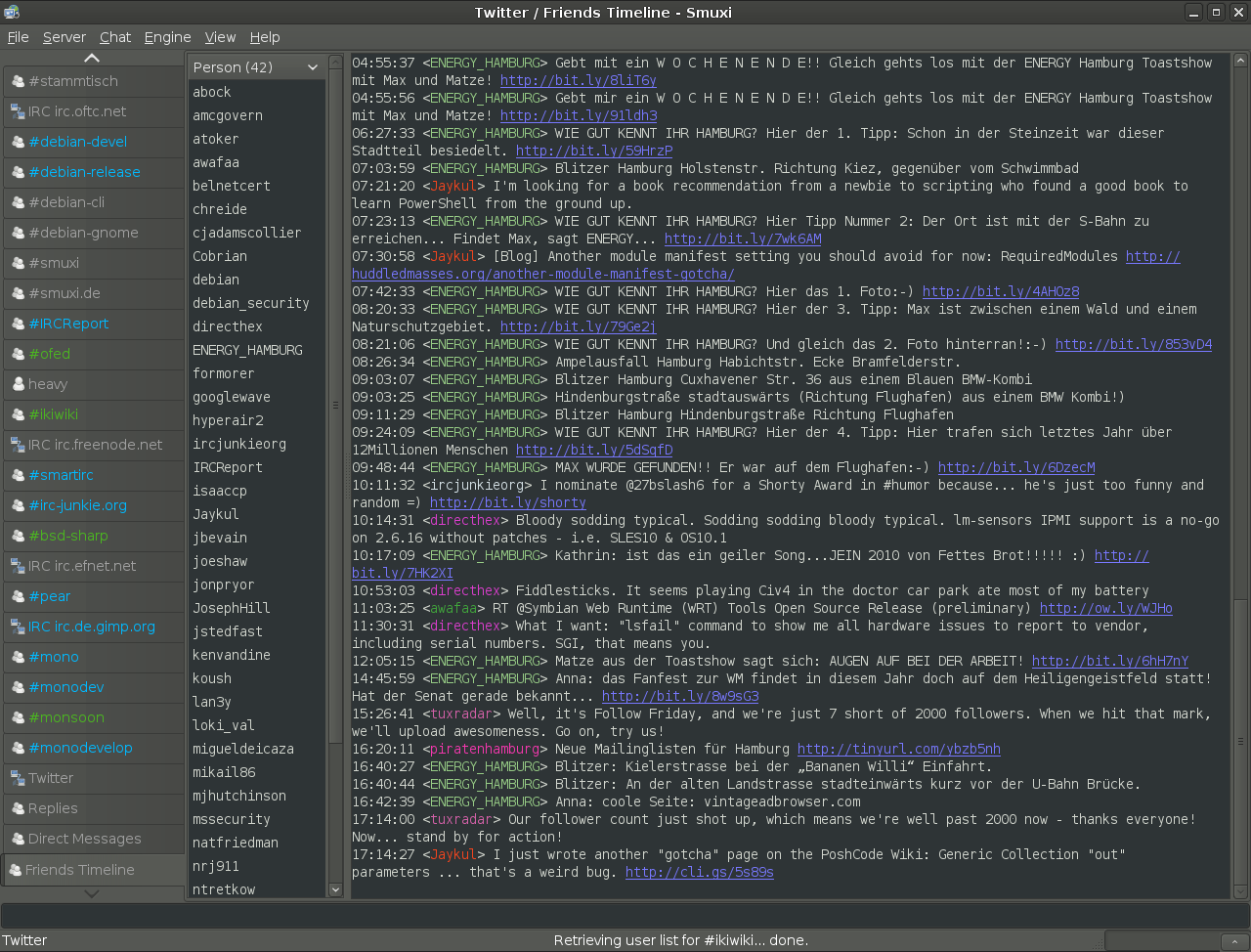
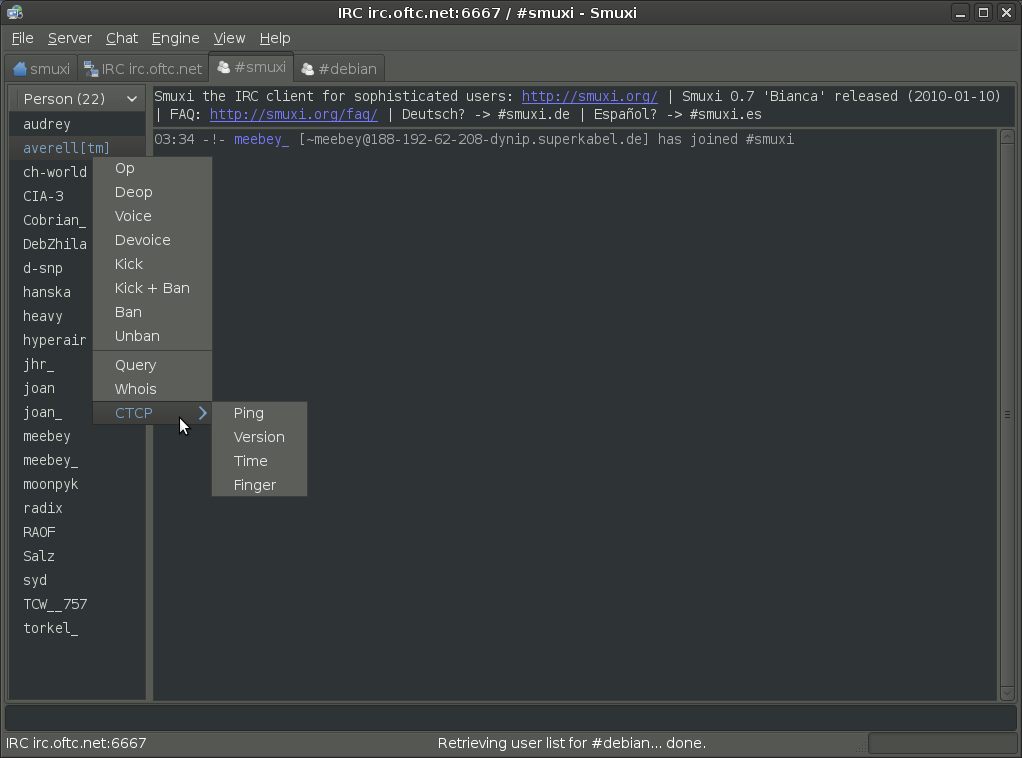
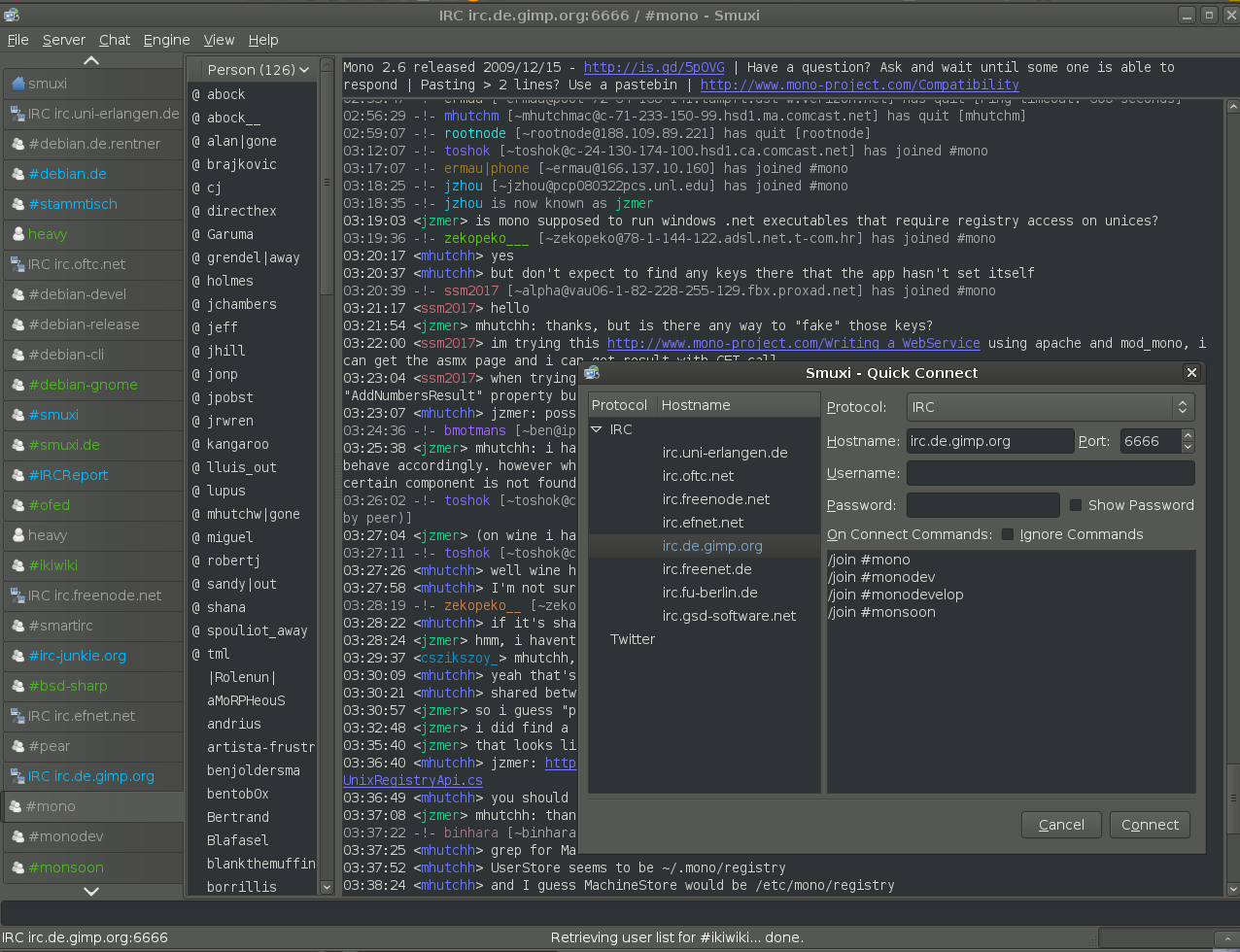
Merry Christmas! Happy New Year! Yeah, it's that time of year again, I am writing a blog post bigsmile.png. As some of you have probably already noticed I managed to get Smuxi 0.7 released a few days ago. Almost all of my Xmas vacation I was hacking on Smuxi. This is the best Smuxi release ever (guaranteed!). The most notable features I implemented in the 0.7 release are: Twitter support, handling for high latency networks (UTMS, WLAN, busy DSL) and an improved IRC experience through tweaks such as splitting oversized messages and new context menus. This release also contains very nice contributions from David Paleino [2] and Cl ment Bourgeois. Both joined the hackfest during my Xmas vacation and made the hacking sessions on Smuxi even more fun. Thanks for that guys! Here you can find a full list of changes. As everbody likes screenshots and as screenshots say a thousand words, here they are: Quick Connect
Twitter
User Menu
Which direction will Smuxi head in after the 0.7 release? For the 0.8 release, I plan to focus on making the IRC support feature complete. That means we will get DCC, SSL, IPv6 and logging support. Nothing of that sounds very special but I am already investigating how Smuxi can be integrated with the promising new Zeitgeist project. I interviewed one of the developers for potential communication between Smuxi and Zeitgeist. Last but not least, I want to announce that I will be attending FOSDEM 2010 in Brussels. I also will give a talk about Smuxi there, scheduled on 2010-02-07 at 16:30. If you want to have a chat, a beer, do some GPG keysigning, or ask me any questions, I am available bigsmile.png PS: If you want more updates than once per year, just follow me on Twitter

16 January 2010

C.J. Adams-Collier: AoE root for KVM guests

So. I m trying to get familiar with libvirt and friends. To this end, I ve set up a Lucid virtual machine booting from PXE into an initrd environment which does a pivot_root to an AoE block device. The #virt channel on irc.oftc.net told me that in order to have libvirt provide PXE capability, I would have to install a recent version of libvirt. I built version 0.7.5-3 from sid on my karmic laptop and it seems to be working okay. I decided to set up the pxe root directoy in /var/lib/tftproot just because that s what the example code had in it. I had to manually configure a virtual network. Here is the XML config file:
$ sudo virsh net-dumpxml netboot
<network>
  <name>netboot</name>
  <uuid>81ff0d90-c91e-6742-64da-4a736edb9a9b</uuid>
  <forward mode='nat'/>
  <bridge name='virbr1' stp='off' delay='1' />
  <domain name='example.com'/>
  <ip address='192.168.123.1' netmask='255.255.255.0'>
    <tftp root='/var/lib/tftproot' />
    <dhcp>
      <range start='192.168.123.2' end='192.168.123.254' />
      <bootp file='pxelinux.0' />
    </dhcp>
  </ip>
</network>
This, of course, depends on the pxelinux.0 file. Luckily, this is packaged up in syslinux and can be installed with a simple
$ sudo apt-get install syslinux
$ sudo mkdir /var/lib/tftproot
$ sudo cp /usr/lib/syslinux/pxelinux.0 /var/lib/tftproot
I had to create a pxelinux config file for the virtual machine (indexed by mac address). Note that I put a console=ttyS0,115200 argument on the kernel command line so that I can attach to the serial port from the host system for copy/paste debugging. Also of importance is the root=/dev/etherd/e0.1p1 argument, specifying which block device we ll be doing the pivot_root to eventually.
$ mkdir /var/lib/tftproot/pxelinux.cfg/
$ cat /var/lib/tftproot/pxelinux.cfg/01-52-54-00-44-34-67
DEFAULT linux
LABEL linux
SAY Now booting the kernel from PXELINUX...
KERNEL vmlinuz-lucid0
APPEND ro root=/dev/etherd/e0.1p1 console=ttyS0,115200 initrd=initrd.img-lucid0
I decided to use the karmic kernel for lucid initially. I ll eventually switch over to the lucid kernel ;)
$ sudo cp /boot/vmlinuz-2.6.31-17-generic /var/lib/tftproot/vmlinuz-lucid0
I copied /etc/initramfs-tools to ~/tmp/lucid so that I didn t mess up the system initrd scripts:
$ mkdir -p ~/tmp/lucid && cp -r /etc/initramfs-tools ~/tmp/lucid/
Since mkinitramfs doesn t currently have a system for AoE root, I had to do a bit of fiddling. I copied the NFS root boot script and made a couple of modifications.
$ diff -u /usr/share/initramfs-tools/scripts/nfs ~/tmp/lucid/initramfs-tools/scripts/aoe
--- /usr/share/initramfs-tools/scripts/nfs	2008-06-23 23:10:21.000000000 -0700
+++ /home/cjac/tmp/lucid/initramfs-tools/scripts/aoe	2010-01-15 14:56:28.098298027 -0800
@@ -5,59 +5,25 @@
 retry_nr=0
 # parse nfs bootargs and mount nfs
-do_nfsmount()
+do_aoemount()
  
-
 	configure_networking
-	# get nfs root from dhcp
-	if [ "x$ NFSROOT " = "xauto" ]; then
-		# check if server ip is part of dhcp root-path
-		if [ "$ ROOTPATH#*: " = "$ ROOTPATH " ]; then
-			NFSROOT=$ ROOTSERVER :$ ROOTPATH 
-		else
-			NFSROOT=$ ROOTPATH 
-		fi
-
-	# nfsroot=[<server-ip>:]<root-dir>[,<nfs-options>]
-	elif [ -n "$ NFSROOT " ]; then
-		# nfs options are an optional arg
-		if [ "$ NFSROOT#*, " != "$ NFSROOT " ]; then
-			NFSOPTS="-o $ NFSROOT#*, "
-		fi
-		NFSROOT=$ NFSROOT%%,* 
-		if [ "$ NFSROOT#*: " = "$NFSROOT" ]; then
-			NFSROOT=$ ROOTSERVER :$ NFSROOT 
-		fi
-	fi
+        ip link set up dev eth0
-	if [ -z "$ NFSOPTS " ]; then
-		NFSOPTS="-o retrans=10"
-	fi
+        ls /dev/etherd/
-	[ "$quiet" != "y" ] && log_begin_msg "Running /scripts/nfs-premount"
-	run_scripts /scripts/nfs-premount
-	[ "$quiet" != "y" ] && log_end_msg
+        echo > /dev/etherd/discover
-	if [ $ readonly  = y ]; then
-		roflag="-o ro"
-	else
-		roflag="-o rw"
-	fi
+        ls /dev/etherd/
-	nfsmount -o nolock $ roflag  $ NFSOPTS  $ NFSROOT  $ rootmnt 
+        mount $ ROOT  $ rootmnt 
  
-# NFS root mounting
+# AoE root mounting
 mountroot()
  
-	[ "$quiet" != "y" ] && log_begin_msg "Running /scripts/nfs-top"
-	run_scripts /scripts/nfs-top
-	[ "$quiet" != "y" ] && log_end_msg
-
-	modprobe nfs
-	# For DHCP
-	modprobe af_packet
+	modprobe aoe
 	# Default delay is around 180s
 	# FIXME: add usplash_write info
@@ -67,17 +33,13 @@
 		delay=$ ROOTDELAY 
 	fi
-	# loop until nfsmount succeds
+	# loop until aoemount succeds
 	while [ $ retry_nr  -lt $ delay  ] && [ ! -e $ rootmnt $ init  ]; do
 		[ $ retry_nr  -gt 0 ] && \
-		[ "$quiet" != "y" ] && log_begin_msg "Retrying nfs mount"
-		do_nfsmount
+		[ "$quiet" != "y" ] && log_begin_msg "Retrying AoE mount"
+		do_aoemount
 		retry_nr=$(( $ retry_nr  + 1 ))
 		[ ! -e $ rootmnt $ init  ] && /bin/sleep 1
 		[ $ retry_nr  -gt 0 ] && [ "$quiet" != "y" ] && log_end_msg
 	done
-
-	[ "$quiet" != "y" ] && log_begin_msg "Running /scripts/nfs-bottom"
-	run_scripts /scripts/nfs-bottom
-	[ "$quiet" != "y" ] && log_end_msg
  
(below is the full file in case udiff is less convenient)
$ cat ~/tmp/lucid/initramfs-tools/scripts/aoe
# NFS filesystem mounting			-*- shell-script -*-
# FIXME This needs error checking
retry_nr=0
# parse nfs bootargs and mount nfs
do_aoemount()
 
	configure_networking
        ip link set up dev eth0
        ls /dev/etherd/
        echo > /dev/etherd/discover
        ls /dev/etherd/
        mount $ ROOT  $ rootmnt 
 
# AoE root mounting
mountroot()
 
	modprobe aoe
	# Default delay is around 180s
	# FIXME: add usplash_write info
	if [ -z "$ ROOTDELAY " ]; then
		delay=180
	else
		delay=$ ROOTDELAY 
	fi
	# loop until aoemount succeds
	while [ $ retry_nr  -lt $ delay  ] && [ ! -e $ rootmnt $ init  ]; do
		[ $ retry_nr  -gt 0 ] && \
		[ "$quiet" != "y" ] && log_begin_msg "Retrying AoE mount"
		do_aoemount
		retry_nr=$(( $ retry_nr  + 1 ))
		[ ! -e $ rootmnt $ init  ] && /bin/sleep 1
		[ $ retry_nr  -gt 0 ] && [ "$quiet" != "y" ] && log_end_msg
	done
 
There was also a small modification to the initramfs.conf file:
$ diff -u /etc/initramfs-tools/initramfs.conf ~/tmp/lucid/initramfs-tools/initramfs.conf
--- /etc/initramfs-tools/initramfs.conf	2008-07-08 18:37:42.000000000 -0700
+++ /home/cjac/tmp/lucid/initramfs-tools/initramfs.conf	2010-01-15 14:33:38.088295207 -0800
@@ -47,14 +47,16 @@
 #
 #
-# BOOT: [ local   nfs ]
+# BOOT: [ local   nfs   aoe]
 #
 # local - Boot off of local media (harddrive, USB stick).
 #
 # nfs - Boot using an NFS drive as the root of the drive.
 #
+# aoe - Boot using an AoE drive as the root of the drive.
+#
-BOOT=local
+BOOT=aoe
 #
 # DEVICE: ...
I also needed to add aoe to the list of modules included in the initramfs:
$ echo aoe >> ~/tmp/lucid/initramfs-tools/modules
In order to generate the initrd.img file from this new config, I ran the following:
$ sudo mkinitramfs -d ~/tmp/lucid/initramfs-tools/ -o /var/lib/tftproot/initrd.img-lucid0
I created a lucid VM by installing from the desktop install disk. You can grab the ISO here: http://cdimage.ubuntu.com/daily-live/current/ I ll leave the creation of the virtual machine and installation as an exercise for the reader. I put the filesystem on an lvm volume group called vg0 in a logical volume called lucid0 (ie, /dev/vg0/lucid0). At this point, I created a new virtual machine called lucid0. Here is the xml for the domain:
$ sudo virsh dumpxml lucid0
<domain type='kvm' id='1'>
  <name>lucid0</name>
  <uuid>96fbad21-4f25-5700-ddd8-1a565c7170ee</uuid>
  <memory>524288</memory>
  <currentMemory>524288</currentMemory>
  <vcpu>1</vcpu>
  <os>
    <type arch='x86_64' machine='pc-0.11'>hvm</type>
    <boot dev='network'/>
  </os>
  <features>
    <pae/>
  </features>
  <clock offset='localtime'/>
  <on_poweroff>destroy</on_poweroff>
  <on_reboot>restart</on_reboot>
  <on_crash>restart</on_crash>
  <devices>
    <emulator>/usr/bin/kvm</emulator>
    <interface type='network'>
      <mac address='52:54:00:44:34:67'/>
      <source network='netboot'/>
      <target dev='vnet0'/>
    </interface>
    <serial type='pty'>
   <source path='/dev/pts/4'/>
      <target port='0'/>
    </serial>
  <console type='pty' tty='/dev/pts/4'>
   <source path='/dev/pts/4'/>
      <target port='0'/>
    </console>
    <input type='tablet' bus='usb'/>
    <input type='mouse' bus='ps2'/>
    <graphics type='vnc' port='5901' autoport='yes' listen='127.0.0.1' keymap='en-us'/>
    <sound model='es1370'/>
    <video>
      <model type='cirrus' vram='9216' heads='1'/>
    </video>
  </devices>
</domain>
Now we re ready to start the AoE target and launch the virtual machine. If you don t have vblade installed, do so now:
$ sudo apt-get install vblade
Start the target up with the following command:
$ sudo vbladed 0 1 virbr1 /dev/vg0/lucid0
Now, if all goes well, you should be able to watch the virtual machine boot up and do its thing like so:
$ sudo virsh start lucid0 && sudo screen -S lucid0 sudo virsh ttyconsole lucid0 115200
If you get errors about /dev/etherd/e0.1p1 not existing (these might look like this):
Begin: Retrying AoE mount ...
err         discover    interfaces  revalidate  flush
mount: mounting /dev/etherd/e0.1p1 on /root failed: No such file or directory
Done.
then you might want to try restarting vbladed like this:
$ sudo kill -9 ps auwx grep vblade grep -v grep awk ' print $2 ' && sudo vbladed 0 1 virbr1 /dev/vg0/lucid0
So. Now you should have a lucid gdm in your virt-manager console. Any questions? #virt on irc.oftc.net
<script>//<script language="javascript" src="http://reddit.com/button.js?t=1"></script>

Ingo Juergensmann: Drupal 7 alpha 1 released

As Dries Buytaert, the creator and head of development of Drupal, announced on Twitter, the new major (pre-)version of Drupal, namely Drupal 7 alpha 1 has been released! This was on the 9th birthday of Drupal.

This is great news and the release notes are mentioning some aspects why this is so:

Revamped User Interface
An incredible amount of work has gone into improving the user experience and administration interface. The new administration theme "Seven", the overlay module, the dashboard and the configurable shortcut bar, all lead to a much more user-friendly interface. In-place editing is enabled for blocks and nodes by default, so modifying the content of a site becomes much simpler.

Custom Fields
Drupal 7 bundles in the ability to add custom fields, similar in functionality to the Content Construction Kit (CCK) module. However, fields are no longer limited only to content types; they can be added to users, taxonomy terms, and other entities. Fields also have support for translations.

Image Handling
Drupal 7 brings native image handling to core. Image fields may be added to content, and have image styles applied to them, such as scaling, cropping, and other effects.
Update Manager
Building on Drupal 6's Update module, which keeps site administrators informed when new module and theme releases are available, the new Update Manger module can also install and upgrade modules and themes.

Front-end "under-the-hood" improvements
A new render API allows for highly granular theming, core template files have been revamped to provide more semantic markup, Drupal 7 now has built-in RDFa support, includes jQuery UI and a new AJAX framework, and a new core theme "Stark" which exposes Drupal's markup directly for those who want to dive in and start theming.

In addition, Drupal 7 has several major accessibility enhancements, making it the most accessible release of Drupal to date!

Back-end "under-the-hood" improvements
A revamped database layer resolving nearly all limitations in the Drupal 6 database layer, automated testing framework, new PHP stream-based file API that supports private and public files simultaneously, revamped node access system, new hooks for more flexible system interaction, an Entity API, a job queue API, and many, many, many more improvements.

Drupal 7 is also the most scalable release to date, with features such as built-in proxy server support, advanced caching techniques, and Content Delivery Network support for static files.


Alone the inclusion of CCK and Views are great news, whereas all PostgreSQL users will benefit from the new database layer under the hood. I've tested a pre-alpha development version some weeks ago and that Drupal 7 experience was already great. So, it would be nice to see Drupal 7 in Debian soon as well, but I guess a alpha 1 version might be too early to be packaged.

Next.

Previous.