Search Results: "will"

12 August 2013

Sylvestre Ledru: Merchandising at Debconf

Debian France and Debian Swiss associations are now selling products at Debconf. We are now selling
Buff
23 CHF / 18 euros
Black polo
31 CHF / 25 euros
Rugby polo
50 CHF / 40 euros
Mousepad
13 CHF / 10 euros
We have also some new hoodies.
They come in 4 colors: black, white, grey and dark blue.
With or without zip:
Without zip: 44 CHF / 35 euros
With zip: 50 CHF / 40 euros With also have hats:
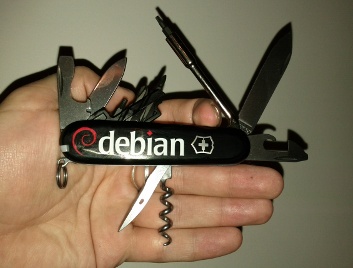
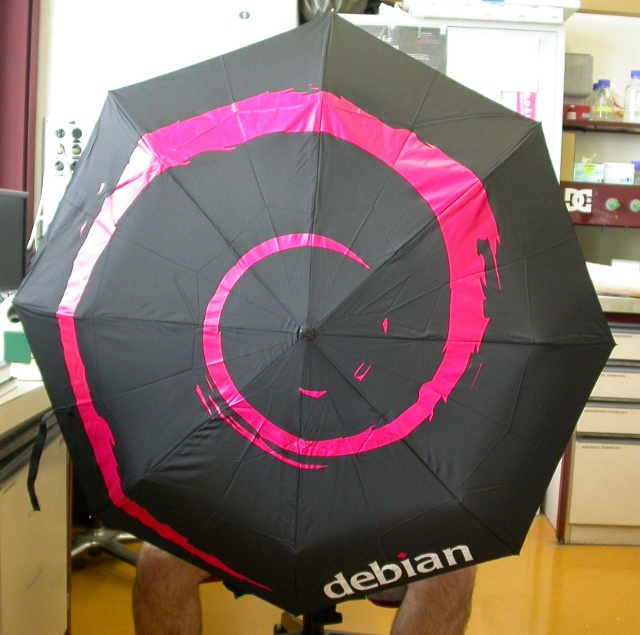
Price: 10 CHF / 9 euros We have also the Debian umbrellas and knifes.

Photo credit Kibi
For those who are at Debconf, they are for sell at the Debconf front desk from 4 to 6 and will be probably available for sell on enventelibre after the event.

Joey Hess: please build a haskell to perl compiler

The Fay compiler is a simple way to build fairly comprehensible javascript code from Haskell source. It occurs to me that it should be rather easy to modify Fay to emit perl code rather than javascript. This would allow contributing things like plugins to various perl programs, without writing perl. Of course, the same idea could probably be used to compile Haskell to other languages like python, but perl seems particularly well suited as a second Fay target, since javascript and it have quite similar syntax and similar support for features like closures which Fay relies on. I do not have time to work on this idea myself. It would be a good project for a beginning Haskell programmer. You probably don't even need to fully understand monads to do it! Essentially, look at Fay output examples, translate them from javascript to perl, and then much of the code changes in Fay would probably be in simple string generation code.
I will forward any bitcoins sent to the address 149eBtWS6i8cwQdPQJJ8hAGpDuEqNidyTj to whoever makes this. If it doesn't happen in 1 year, any donations will be forwarded to the EFF instead.

Aigars Mahinovs: Soon to be on my way to Debconf too

Going to Debconf13
I also soon will be on my way to Debconf13 and those who asked for more photos from the place on Planet Debian will soon start getting their fill ;) Privacy note: as always, I will be trying to balance the need for people to get lots of pictures as fast as possible with privacy of people, who do not want to be in published photos. The way this has been done before and will be done this time (at least from my side) is that: Update: http://www.aigarius.com/blog/2013/08/12/not-going-after-all/

Aigars Mahinovs: Not going after all

I was very excited to go to Debconf13, but in the last minute I caught some kind of virus and went down with fever in the night before the flight. I am sure Wouter will take over group photo duties. And I will just take this week of vacation to rest up and check out the video streaming :)

11 August 2013

Steve Kemp: Lumail now uses GMime

A hectic day and now we use GMime for all MIME-fu. This has allowed me to decode headers correctly, setup MIME parts properly in outgoing mails with attachments, and cleanup the code-base. The next release of Lumail will contain basically just this change, as it is pretty drastic. But first I need to work out how to make binaries for Squeeze compiled against the back-ported version of gmime-2.6.x. (Previously we used libmimetic. Which was awesome in its way, but caused me some pain with RFC 2047 header-decoding.)

Lisandro Damián Nicanor Pérez Meyer: Qt in Debian: using Qt4 and/or Qt5 in your packages

Hi everyone! We now have both Qt4 and Qt5 in the archive. Those using Qt4 should not need to make any changes in their packages, although you can be extra-safe with a few steps. Don't rush, just read below.
Some backgroundSune took the time some months ago to consult upstream for a sane way to allow both SDKs to coexist without us distros having to reinvent the wheel choosing which tools have to be in use in each case.

After a long discussion, upstream decided to write qtchooser (already in the archive) to be able to select between Qt4, Qt5 and even special user's cases like cross-platform builds.

So instead of going trough Debian's alternatives as we did with Qt3/Qt4, we will make use of this new tool.
My package uses Qt, how should I proceed?There are many ways of choosing either of the versions of Qt:

- Using any qtchooser method (preferred):

* Exporting QT_SELECT with 4, qt4, 5 or qt5 as a value in debian/rules.
* Call the tool using the '-qtx' parameter, where x can be replaced with any of the options above.

- Build-depending on qt4-default or qt5-default. You can't B-D on both of them, as they can't coexist.

It is good to notice that:

- any qtchooser method will take precedence over build depending on qtX-default.
- If you export XDG_CONFIG_DIRS it will ignore the default paths to qtchooser's configs we setted up in the packages.

We have also provided qt4-[arch-triplet] and qt5-[arch-triplet] options for special cases.

Once again, if you are already using Qt4, there is no need to rush. See below.

Can is use both Qt4 and Qt5 in my package?You can't mix Qt4 and Qt5 in the same binary, but you may provide libraries compiled against one or the other. For example, your source package foo could provide both libqt4foo1 and libqt5foo1. You need to mangle your debian/rules and/or build system accordingly to achieve this. At the time of this writing I don't know of any examples yet.

So are you going to break the archive with a big transition?No, we have done our best to avoid having to make any changes to existing Qt4 packages. Qt tools should default to Qt4 except if overriden by any method described above.

My package uses Qt4, can I leave it as it is?While there is no need to apply the changes in this case, explicitly setting the Qt version will surely not hurt at all. But don't rush ;-)


Gregor Herrmann: DebCamp 2013

[no pictures here, just a short report]. Today DebConf, this year's edition of the annual Debian developer conference, started with two inspiring talks about Debian proper, one by Lucas Nussbaum, the other by Joey Hess. This also means that yesterday DebCamp ended, the period preceeding DebConf and dedicated to working on Debian together with others. Here's a short report from my point of view: I arrived here on Tuesday, the first day of DebCamp. I immediately fell in love with the venue, & despite the early stage of setup, everything I needed was working fine for me from the very start. Like in previous years, I used the time to do work in the Debian Perl Group, especially taking advantage of the presence of other team members. That's the great thing about DebCamp & DebConf: collaborating in real-life & real-time, from quickly asking a question over sitting together to think about solutions for a problem to "just" chatting & thereby developping ideas for the future. In the previous days I I really enjoy my time here, & I'm especially happy to meet some people for the first time in meat space. This is only possible due to the generous support of the DebConf sponsors & the immense efforts of the DebConf team. Thank you!

10 August 2013

DebConf team: DebConf13 video streams (Posted by Holger Levsen and the DebConf videoteam)

This is just a quick note that the video streams of DebConf13 will be available at the following URLs: May you have a productive and joyful DebConf - and thanks for volunteering + talking if you do so! DebConf is what you make it.

Rudy Godoy: Bulding non-service cartridges for RedHat Openshift

Cloud is passing the hype curve and we are seeing more stable developments and offerings on the market. Lately I ve been playing with RedHat s Openshift. Openshift is a PaaS (Platform as a Service) offering that intends to be an alternative for vendors such as Heroku. The focus for such offerings is to give developers enough flexibility and tools that handle the application deployment and maintenance process in a way that is integrated with their existing development workflow and tools. I ve been using Heroku for a while to deploy small to medium size projects. I liked the tools and developer-centered experience they offer. Openshift is quite new on the market and it comes in two flavors: Openshift Online, which is a PaaS service, and Openshift Enterprise, which allows organization to setup a PaaS within their own infrastructure. Both of them powered by the Openshift origin software. I ll not compare Heroku vs. Openshift feature by feature but from my experience I can tell that Openshift is far from mature and will need to give developers more features to increase adoption. When developing applications for Openshift developers are given a set of application stack components, similar to Heroku s buildpacks. They call them cartridges. You can think of them as operating system packages, since the idea is the same: have a particular application stack component ready to be used by application developers. Most of the cartridges offered by the service are base components such as application server, programming language interpreters (Ruby, Python, etc), web development frameworks and data storage, such as relational and non-relational databases. Cartridges are installed inside a gear, which is a sort of application container (I believe it uses LXC internally). Unsurprisingly this Openshift component doesn t leverage on existing packaging for RHEL 64bit, the OS that powers the service. I d expect such things from the RedHat ecosystem. I had to develop a cartridge to have a particular BI engine to be used as embed component by application developers. After reading docs and reference I realized this can be piece of cake, since I have packaging experience. Wrong. Well, quite so. The tricky part for Openshift Online is that it does not offer enough information on the cartridge install process so you can see what s going wrong. To be able to see more details on the process you ll need to setup an Openshift origin server and use it as a testing facility. Turns out that having a Origin server to operate correctly is also a challenging task and consumed a lot of my time. Over the recent weeks I ve learned from origin developers that such features are on the road map for the upcoming releases. That s good news. One of the challenges I had, and still have to figure out, is that unlike the normal cartridges mine didn t required to launch any service. Since it is a BI engine I just needed to configure and deploy to an application server such as JBoss. Cartridge format requires to have a sort of service init.d script under bin along with setup, install and configuration scripts that are ran on install. Although every day I become more familiar with origin and Openshift internals I still have work to do. Nice thing is that I was already familiar with LXC and Ruby-based applications so I could figure where things are placed and where to look for errors on origin quite easily. The cartridges are on my github account if you care to take a look and offer advice.

Kurt Roeckx: Anti-piracy and privacy

In the Dutch language area (Netherlands and Flanders) most e-book publishers changed from using DRM to using a watermark since February. It's now something like 62% with watermark, 24% with DRM and 14% without either. I was hoping that more with move to the watermark, but it doesn't seem to change much. The watermark in the e-books are used to find the original buyer in case of piracy. The information in the e-book does not itself identify the buyer, it just some random ID. That ID can then be used to trace back to buyer. We work with a 3rd party to deliver the e-books to our consumers. They get a random string from us that we can use to trace back the order, and from there we can trace back who bought it. The 3rd party than generates their own random string and puts that in the e-book. They only only keep those 2 random strings, and so have no way to trace this back to the buyer, we are the only one that known who bought it. And I think this is how it should work. I think this is also what the privacy laws require us to do. But now we got a new contract that states that we must directly give information about the buyer if some anti-piracy agency (BREIN) finds an e-book file online. We must keep the information about the buyer for minimum of 2 years and maximum of 5 years. And if we don't sign the contract we won't be allowed to sell e-books with watermark anymore. So this means that they want to bypass the normal judicial system, and probably contact those buyers they accuse of piracy directly. I questioned that this was legal. They say that it is legal according to the Dutch privacy law, but I have a hard time interpreting any of the options in article 8 as that we can give that information without the explicit consent of the person. I guess you can interpret option f in several ways, and that their lawyers do it differently than me. This will probably remain unclear until some court decides on it.

Rémi Vanicat: I'm going to Debconf13 Vaumarcus

Going to Debconf13 I'm going to debconf13. After been in debian for quite a long time, I finally will see in person some of those mail address I see for so long.

Matthew Garrett: When to add a platform-specific quirk to a Linux driver

If you're tempted to add a platform-specific quirk to a Linux driver, pause and do the following:

  1. Check whether the platform works correctly with the generic Windows driver for the hardware in question. If it requires a platform-specific driver rather than the generic one, adding a quirk is probably ok.
  2. If the generic Windows driver works, check whether there's any evidence of platform-specific code in the Windows driver. This will typically be in the .inf file, but occasionally you'll want to run strings against the Windows driver and see whether any functions or strings match the platform in question. If there's evidence of special-casing in the generic Windows driver, adding a quirk is probably ok
  3. If the generic Windows driver works and doesn't appear to have any platform-specific special casing, don't add a quirk. You'll plausibly fix the machine you care about, but you won't fix any others that have the same behaviour. Even worse, if someone does eventually fix the problem properly, there's a risk that your special-casing will now break your system.

The moral to this story is: if you think adding a quirk is the right solution, you're almost certainly wrong.

comment count unavailable comments

9 August 2013

Gunnar Wolf: Not in Switzerland But still, cheering for Debian's 20th anniversary!

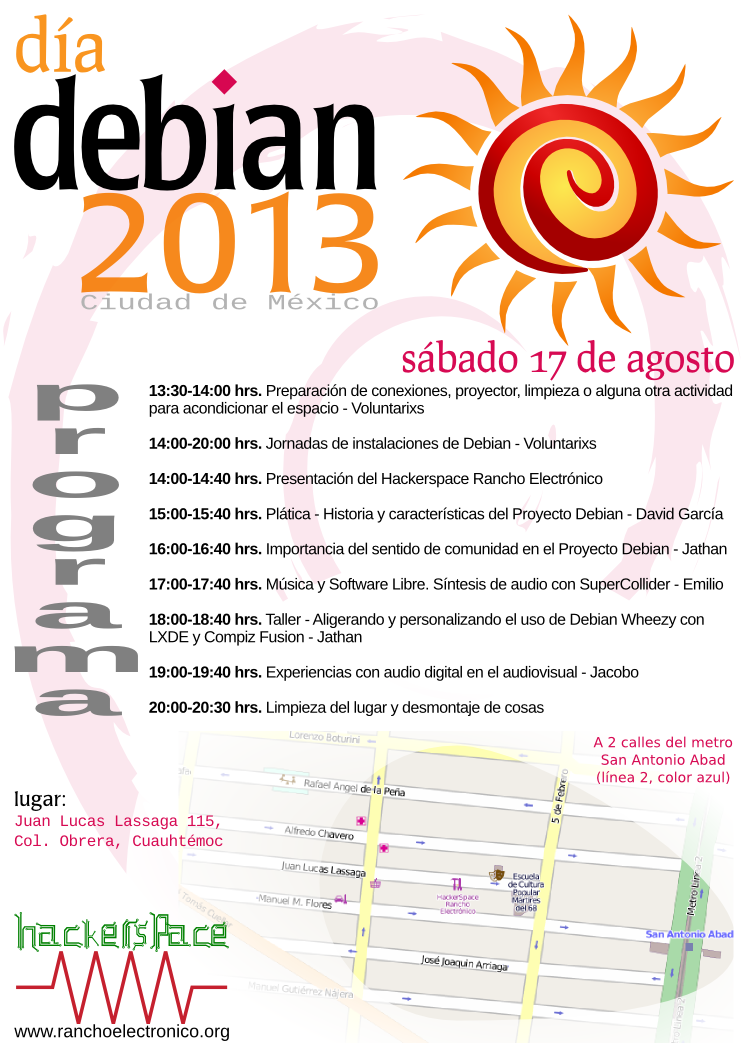
So... Well, contrary to the popular sentiment in Planet Debian, this year I'm very sorry to inform that... -( This is the first DebConf I miss in ten years, so... Yes, it's a big bummer for me. I'm not attending because this year, DebC(amp onf) coincide with the two first weeks of classes at my university And as a new teacher, I cannot afford to miss it! Anyway, but that should not stand in the way to attend a nice Debian 20th anniversary party! Parties will be held around the world. (Didn't find your city? Plan something and add it *now!*). In Mexico City, the nice guys at the very interesting Rancho Electr nico hackerspace took the lead, and organized the following activities: Debian Day 2013 Mexico City program Don't you yet know the hackerspace? You should go there! It's in a very centric location, just two blocks West from Metro San Antonio Abad (Juan Lucas Lassaga 114, col. Obrera). And the only two times I have been there, it has been good fun. Surely this Saturday we can have a nice party as well! The planned activities are from 13:30 to 20:30. See you there!
Craig Small: pidof moving to procps

pidof is a program that finds the PID of a named program. In some ways it is like a cut-down pgrep found in the procps package. pidof currently sits in sysvinit-tools. There are plans to move all utilities that use the proc filesystem under one package which will make the maintenance of them simpler, which in effect means moving pidof from sysvinit-tools to procps. The short-term bump should make it better in the long term. Now as I wear two hats (Debian maintainer and procps upstream) there are two very important things I/we need to know. Debian developers can chime in on the debian-devel email list, or email myself. If its an upstream issue then either email me, or even better, the procps email list

Michal Čihař: Roadmap for Weblate 1.7

Weblate 1.6 is already two weeks out without any regressions, so now it's time to think about features for 1.7. I definitely want to improve support for monolingual translation formats as they currently suffer by various metadata issues (eg. checks not working correctly). This requires quite big change in underlying database, but I think it's quite manageable. When talking about checks, I want to make them configurable per project as global configuration is quite limiting for shared sites like hosted Weblate. I will definitely need to touch registration and authentication, either by supporting latest django-registration API or to move some other solution with support for federated login. Which of these approaches will be used depends on my time, what is always the most limiting factor. This might sound as too few features, but I'd like to make releases more often, so that should fit into this plan. However if you want to push for some feature, you still have two days to fund something on Catincan!

Filed under: English Weblate 0 comments Flattr this!

8 August 2013

Nicolas Dandrimont: Hello from DebCamp

DebConf flag (minus the wind) Small update as someone was complaining about the lack of pictures from DebCamp on planet. Not to worry, everything is going fine, and some of the most important stuff is ready s3kr3t You can see a few pictures from the gallery. The view from the venue is quite outstanding (it was better when there was some sun on Tuesday, but my camera battery was out ). On my TODO-list: See you there!

Michael Stapelberg: Going to DebConf

I will arrive at DebConf 2013 on Sunday afternoon. In case you are interested in Go (the programming language), systemd, i3 or getting your package reviewed, please talk to me! :-) Looking forward to meeting many of you in real life.

Neil McGovern: IT recruitment sexism is alive and well

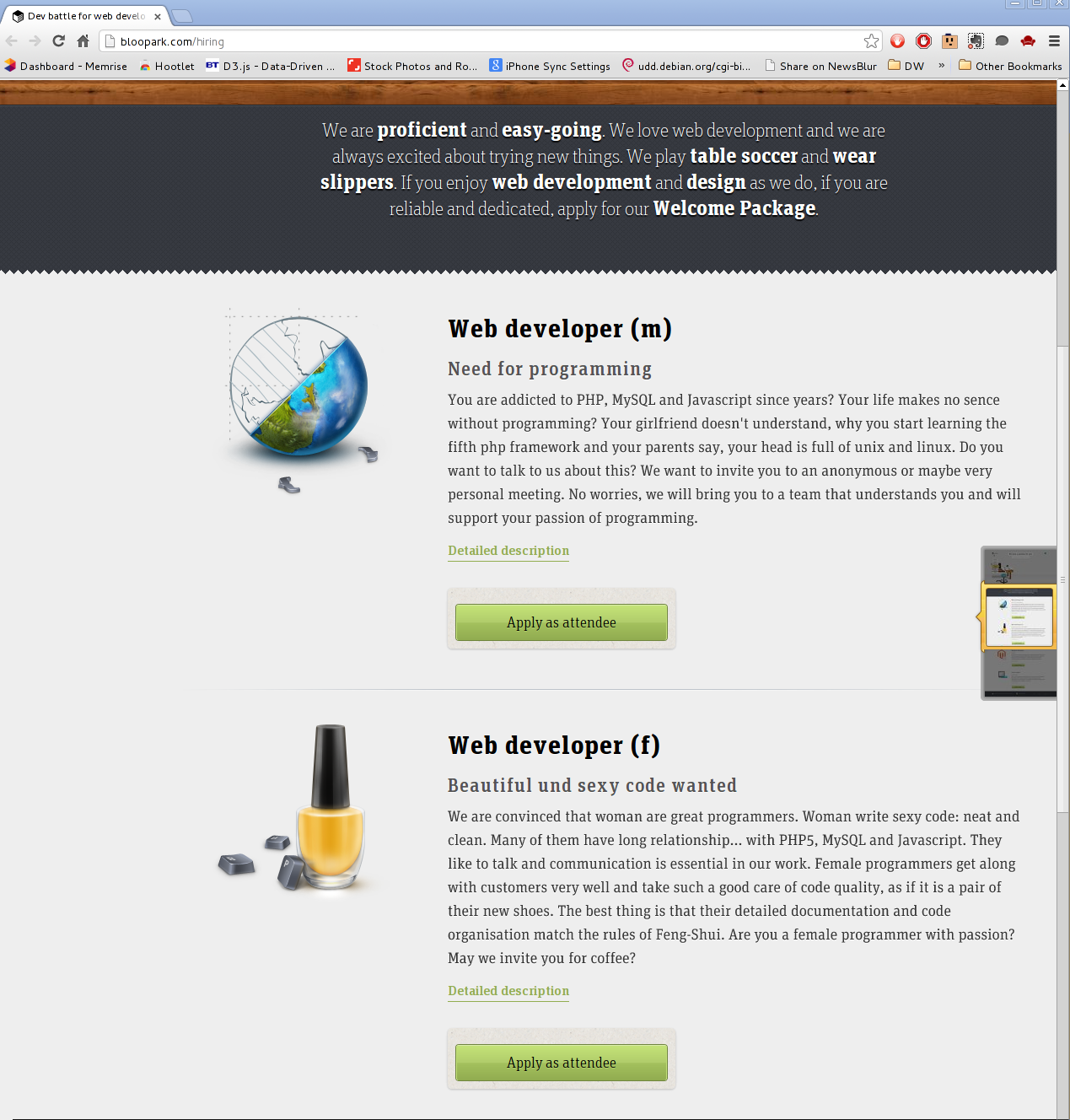
sexismWith the number of female software engineers standing at 20.9% [1], recruitment of females into the industry is a major concern. A friend of mine, Rosemary Francis who's MD of Ellexus, has a great talk about this issue. It mentions various methods you can use to tailor your job applications to be more attractive to females, by simply being careful not to exclude or put off potential applicants. However, there is also a very poor way of doing so, which is highly sexist and plays to stereotypes. As we can see from Bloopark's hiring page, this is exactly what they have done.
Web developer (m)
Need for programming
You are addicted to PHP, MySQL and Javascript since years? Your life makes no sence without programming? Your girlfriend doesn't understand, why you start learning the fifth php framework and your parents say, your head is full of unix and linux. Do you want to talk to us about this? We want to invite you to an anonymous or maybe very personal meeting. No worries, we will bring you to a team that understands you and will support your passion of programming. Web developer (f)
Beautiful und sexy code wanted
We are convinced that woman are great programmers. Woman write sexy code: neat and clean. Many of them have long relationship... with PHP5, MySQL and Javascript. They like to talk and communication is essential in our work. Female programmers get along with customers very well and take such a good care of code quality, as if it is a pair of their new shoes. The best thing is that their detailed documentation and code organisation match the rules of Feng-Shui. Are you a female programmer with passion? May we invite you for coffee?
Really? New pair of shoes? Pictures of nail varnish? They're in a relationship with code? And why does the male version need to have a girlfriend rather than a boyfriend? [1] US Bureau of Labor Statistics (BLS) - ftp://ftp.bls.gov/pub/special.requests/lf/aa2010/aat11.txt

Enrico Zini: Getting new Front Desk members (part of things to do at Debconf)

Getting new Front Desk members (part of things to do at Debconf) We need more Front Desk members. Jonathan Wiltshire has kindly put together a job description for the current status quo. Currently we'd like a person to have been an Application Manager before joining Front Desk, but FD tasks are now more diverse than they used to be, and I'd like to spend some time thinking about it, for example here. Job Description for Front Desk Assistant Front Desk assistants are often the first point of contact for new applicants to Debian's New Member process, and are responsible for guiding them through all stages. Front Desk collates applications, assigns them to an Application Manager, checks over the completed application and hands it off to the Account Managers. Front Desk also handles membership of the collab-maint Alioth project. It is not currently involved with applications for Debian Maintainer status. You will 'meet' a wide variety of applicants, some of whom are excited to be starting their journey to Debian membership, whilst others are already established and taking the next step to full developer status. This is a mostly procedural role, but some diplomatic skills are required, particularly when applications are held up for reasons beyond your control. You must have excellent written communication, an eye for detail, and a thorough understanding of what it is to be Debian Members. Expect to spend 2-3 hours per week on this role, divided by as many days as you can manage (to ensure mail is dealt with as soon as possible). The most time-consuming part is processing the completed application. Responsibilities:
  1. To be the first point of contact at Front Desk
  2. To perform initial triage of applications
  3. To match each application with an appropriate Application Manager
  4. To ensure applicants are processed in a timely manner, which may require intervening with an application when it is not progressing satisfactorily
  5. To check completed applications for any missing detail and pass them on to the Account Managers
  6. To handle collab-maint membership business
  7. To answer any queries from applicants, Application Managers, and other stakeholders
  8. To monitor output from the NM routine jobs and fix or escalate any problems
Front Desk staff are not expected to make a judgement call on applicants, though some discretion can be used when appropriate.

Next.

Previous.