Search Results: "ron"

31 October 2010

Lucas Nussbaum: Mini DebConf Paris 2010

So, I m (almost) back from the first edition of MiniDebConf Paris, which was a success thanks to the great organizing skills in panic mode of Carl Chenet and Mehdi Dogguy. I think that everybody is already looking forward to the next edition. I met lots of people, and it was great to be able to finally put faces on names from the french free software community. I gave two talk there, the first one on Debian and Ubuntu (slides), the second one on Debian Quality Assurance (slides), which both went well (I think). I also hacked a bit: If you want to help me, here are some easy tasks that need takers (it s unlikely that I ll be able to tackle them anytime soon): One of the other things I d like to do is discuss ways to improve the synchronization of UDD (currently, it s synchronized at arbitrary times, while we could sync Sources+Packages just after dinstall, for example).

Erich Schubert: The next 'terror lie' - campaign time again

There is something fishy with the latest "printer bomb" reports. One one hand, they claim the parcels were adressed to "jewish synagogues in Chicago". On the other hand, they claim they were meant to explode in the air. So: why would you address them to a synagogue then? Sending a parcel from Jemen to a synagogue probably is a sure thing to have it thoroughly checked? I don't trust any of their reports. Don't get me wrong; for example I do not believe the WTC was blown up using explosives like most of the conspiration theorists out there do. But they are not telling the truth with these parcels, either. Also given that they claimed there were way over 20 parcels sent, and the security was that weak, how come all of them were found? When they decide to make up a story for us (either for having a reason to kill more people in Jemen or just for election reasons) they should at least bother to make up a consistent story ...

Ondřej Čertík: git has won

I switched to git from mercurial about two years ago. See here why I switched and here my experience after 4 months. Back then I was unsure, whether git will win, but I thought it has a bigger momentum. Well, I think that now it's quite clear that git has already won. Pretty much everybody that I collaborate with is using git now.

I use github everyday, and now thanks to github pull requests, I think it's the best collaboration platform out there (compared to Google Code, Sourceforge, Bitbucket or Launchpad).

I think it's partly because the github guys have a clear vision of what has to be done in order to make collaboration more easier and they do it, but more importantly that git branches is the way to go, as well as other git features, that are "right" from the beginning (branches, interactive rebase, and so on), while other VCS like bzr and mercurial simply either don't have them, or are getting them, but it's hard to get used to it (for example mercurial uses the "mercurial queues", and I think that is the totally wrong approach to things).

Anyway, this is just my own personal opinion. I'll be happy to discuss it in the comments, if you disagree.

David Bremner: Extracting text from pdf with pdfedit

It turns out that pdfedit is pretty good at extracting text from pdf files. Here is a script I wrote to do that in batch mode.
#!/bin/sh
# Print the text from a pdf document on stdout
# Copyright: (c) 2006-2010 PDFedit team  <http://sourceforge.net/projects/pdfedit>
# Copyright: (c) 2010, David Bremner <david@tethera.net>
# Licensed under version 2 or later of the GNU GPL
set -e
if [ $# -lt 1 ]; then
    echo usage: $0 file [pageSep]
    exit 1
fi
#!/bin/sh
# Print the text from a pdf document on stdout
# Copyright:   2006-2010 PDFedit team  <http://sourceforge.net/projects/pdfedit>
# Copyright:   2010, David Bremner <david@tethera.net>
# Licensed under version 2 or later of the GNU GPL
set -e
if [ $# -lt 1 ]; then
    echo usage: $0 file [pageSep]
    exit 1
fi
/usr/bin/pdfedit -console -eval '
function onConsoleStart()  
    var inName = takeParameter();
    var pageSep = takeParameter();
    var doc = loadPdf(inName,false);

    pages=doc.getPageCount();
    for (i=1;i<=pages;i++)  
        pg=doc.getPage(i);
        text=pg.getText();
        print(text);
        print("\n");
        print(pageSep);
     
 
' $1 $2
Yeah, I wish #!/usr/bin/pdfedit worked too. Thanks to Aaron M Ucko for pointing out that -eval could replace the use of a temporary file. Oh, and pdfedit will be even better when the authors release a new version that fixes truncating wide text

30 October 2010

Russell Coker: Parkour in Melbourne

When I was walking past Southbank when I saw some Parkour being practiced. I watched for a while and spoke to the instructor after the informal lesson was finished. He s a professional instructor with the Melbourne branch of the Australian Parkour Association [1] and he sometimes gives free advice to newbies that he meets on the street (in this case a group of 6 teenage boys). From the web site it seems that the standard lesson fee is $15 for an indoor lesson or $10 for an outdoor lesson with a $5 discount for members of the Australian Parkour Association [2], which is really cheap for a 2 hour lesson! APA membership costs $10 to join plus a $50 annual membership fee. It s worth reading the ParkourPedia information about the spirit/philosophy that is Parkour [3]. It s interesting to note that there can be no official Parkour shows because if you do it for anyone else then it s not Parkour so much for all the Parkour videos on Youtube. Also another issue with the Youtube videos is that Parkour isn t about doing the most dangerous things you can possibly survive in an urban environment, it can be practiced in country areas and isn t supposed to be unreasonably dangerous. The outdoor Parkour lessons start near the Arts center in the middle of Melbourne and presumably some of them go past Southbank as it has some interesting things to jump over. So it s worth watching out for people jumping over various obstacles instead of walking around them. They may not be doing a Parkour show, but it s in public and anyone can watch.

28 October 2010

John Goerzen: Rudy Schmidt & Time Capsules

This evening, I arrived at church for mens chorus practice. I was surprised to see this sign on the door:
Rudy Schmidt died rather unexpectedly, but peacefully on Wednesday morning at his home .
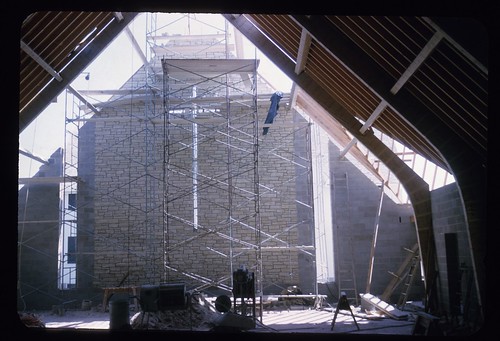
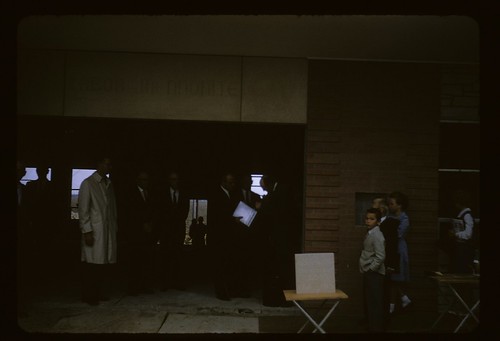
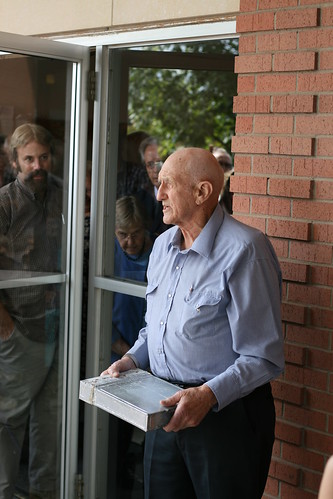
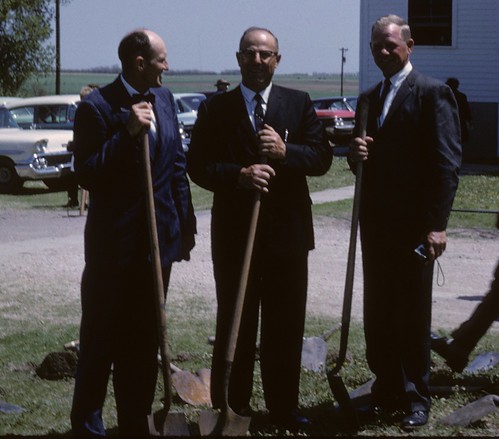
One of the benefits of living in a small community is that I get to know people of all ages around here. Not just people my own age, or coworkers. A few years ago, I worked on a history project for our church s centennial. Back in the 1960s, Rudy was one of the people in charge of building our current church. So he was a person I was interested in visiting with. Here he is, on the left, during the 1964 groundbreaking ceremony for the new building (the old one is visible in the background). 022 stamped may 1964cropped.jpg I and a few others went to his home one time a few years ago and we had a wonderful evening. Rudy shared all sorts of stories with us which I am happy to say I recorded. But moreover, Rudy was an avid photographer. There were some rare and brilliant color slides of the church being built in his collection. He let me borrow and scan some of them. Here are my two favorites: 015 stamped july 1964.jpg 016 stamped oct 1964.jpg Back in 1965, there was a ceremony at the setting of the cornerstone of Tabor Church. The people at the time assembled some papers and memorabilia and put them in a time capsule. Rudy Schmidt sealed the capsule and it was placed in the spot for it behind the cornerstone. Here is a photo of that ceremony. 013 stamped nov 1964.jpg 44 years later, on the occasion of Tabor s centennial, it was time to open the time capsule. The other building committee people, such as Jake Koehn, had passed away, so Rudy was the one to open it. He gave a few words in front of the large crowd, and mentioned that when he sealed it away, he smelled some smoke when he soldered it shut. Jake Koehn told him, Don t worry, nobody will ever see it again anyway and they had a little laugh about it. Now he was going to open it up and see if anything survived. img_6173.jpg It all did just a few minor burn marks. We enjoyed looking at all the items. Then the church placed some new items into the capsule. It was closed up again, to be opened in maybe 50 years. With luck, I ll still be around to see it opened again. Even if I m not, maybe Jacob and Oliver will be able to. And so it seems very fitting that the last hands to touch that box for the next 50 years were Rudy Schmidt s, when he placed it back in its spot on Oct. 12, 2008. img_6243.jpg

26 October 2010

Christian Perrier: Running geek results

OK, I still have to load my photos of Debconf10 somewhere. Shame on me. My gallery is broken (no longer allows uploads, even local ones!). Still, do you remember that we somehow mentioned that a small bunch of geeks did run together a local race at Debconf10? Indeed, a dozen of Debconf10 attendees did participate to the Van Cortland Track Club Summer Series run of Thursday August 5th. And all of us completed this 5km cross-country run in Van Cortland Park, in Bronx, turning it into the most international attendance of this local race. We now have the official results.. So please congratulate No l K the for finishing 17th scratch, 2nd in his category...or Gaudenz Steinlin being 32th only 41 seconds after No l. Or Iustin 107th, Gregory, 113th, Luca (and kilt) 140th, Maxy 163th, Marga 167th. Even /me though I finished 5 minutes after that Kevin british guy who I ran with the week-end before, dammit. Or whoever I'm forgetting (we were more than this, IIRC). Geeks can run. Fast, for some of them (I still need to have No l telling me about his last marathon).

Jelmer Vernooij: OpenChange server and SOGo

There's more good news on the OpenChange front. Julien has been working together with Wolfgang and Ludovic from Inverse recently to leverage the server-side support in OpenChange to provide native Exchange server support in SOGo. A couple of days ago we announced that there now is an initial version that allows the use of Outlook against a SOGo server through OpenChange.

<object data="http://www.youtube.com/v/oSZJ95YeXYE?fs=1&amp;hl=en_US&amp;hd=1" height="385" type="application/x-shockwave-flash" width="480"><param name="movie" value="http://www.youtube.com/v/oSZJ95YeXYE?fs=1&amp;hl=en_US&amp;hd=1"><param name="movie" value="http://www.youtube.com/v/oSZJ95YeXYE?fs=1&amp;hl=en_US&amp;hd=1"><param name="allowFullScreen" value="true"><param name="allowscriptaccess" value="always"></object> (alternatively you can find the screencast here) As far as I know, this is the first time it's possible to actually use Outlook clients with a non-Microsoft Exchange-compatible server without the need for plugins on the Outlook side. And it's all Free Software. Of course, this is just a preview, and not something we'd recommend everybody to run in production yet. But it's exciting to finally see this come together. We already have OpenChange packages in Debian and Ubuntu but I hope I can help get SOGo packaged for both distributions as well.

David Welton: Kindle?

I'm thinking about getting a Kindle, and I thought I'd write down some thoughts, even if they're a bit jumbled, and invite commentary. Good: One thing I really like, living here in Italy, is that I would be able to get English language books instantaniously, and not pay shipping or import duties on them. Whatever disadvantages there may be, that is a huge advantage. Closely tied to that: if we ever move back to the US, shipping all our books will be very expensive. Having some of them in an electronic format would lighten that load considerably. It's fairly cheap. At $180, it's not something I'd want to treat carelessly, but it's significantly less expensive than various existing tables. Long battery life means it's not something you have to worry much about. E-ink looks like it's easier on the eyes than LCD screens. I'm not sure, but also its slow update speed might be a "feature not a bug" in the sense that you're not so easily distracted by the internet being just one click away. Bad: I love having real, physical books in my house. I grew up in a house full of books, and I want the same thing for my daughter. I like being able ot look through them, pick one up, and read about something. Real books are very convenient, as long as you're not lugging around hundreds of them. I like not having to worry too much about dropping them, about getting a bit of water on one or that sort of thing. You can cart them around in a backpack with little worry, take them to the beach, and so on. As far as I can tell, Knuth's books are not available for, nor would appear like they do on paper. That's the golden standard for me: once "The Art of Computer Programming" looks good on an e-reader, it will be really and truly ready. We're not there yet. It's not general purpose. Like I said above, maybe this is good for reading, but there are also times when it'd be nice to have a general purpose device, with email, maps, applications, and so on. A while back, Amazon announced some sort of beta program for a kindle SDK. I haven't heard much of anything since. So it looks like it's not really possible to code for it, which is a bit disappointing. I like to have that option available, even if I don't always exercise it. Unknown: The pricing: sometimes Kindle versions are cheaper (especially, in my case, considering shipping, and, potentially, import duties), but sometimes they aren't, which seems a bit unfair, given that you cannot sell the book if you don't like it. I'm not sure how it would work out for me in the aggregate. Digital Rights Management, or DRM, means you can't, say, sell someone a "used" ebook. This is, in some ways, understandeable, because it's not like an e-book degrades with time as a physical one might. Were it possible to sell on your old books, that might radically change the market. I could see that having both good consequences (cheaper books), but also negative ones for authors (less money). I suppose this topic merits a post or two, or even an entire book of its own, because it's a complicated subject without, in my opinion, "easy" answers. Suffice it to say, though, that there are some drawbacks, but I suppose it's also nice that Amazon "knows" which books I have, so even if I switch to a different reader, I still have my books. And it's good that authors can get paid to work on a book. Not having actually bought it yet, I have no idea how it actually 'feels' to read a book with one. I love curling up with a good book, something I certainly can't do with my laptop. The Kindle looks light and small enough that it could work, but maybe it's just too high tech and sleek to provide that same comfortable coziness. Or maybe I'm just a luddite where books are concerned?
Do you have one? Do you use it? For all kinds of books or just certain kinds (technical books, cheap 'fun' reads, whatever...)? What's the experience like?

Sergio Talens-Oliag: Debian Squeeze, PowerPC and the Linux Containers

Two kids, their really busy mother and my paid job leave me without much time to blog or do Debian related work lately (well, at least on my free time, I do Debian related things at work, but mostly as a user, not as a developer). Anyway, a couple of weeks ago I decided it was time to upgrade my home servers to Squeeze and I did it, but it was harder than expected. At home I'm using two old laptops as servers, an old Aluminium PowerBook and an Asus EeePC; the Asus was installed to replace an older PowerBook (a really old one, BTW) that I was using as home server since my father gave it to me. The plan was to use OpenVZ on the Asus to move all the PowerPC services to a couple of Virtual Environments, but as I wanted to migrate and change almost all the services I never got enough free time to finish the job and when the old PowerBook hardware failed I replaced it with another PowerBook that I wasn't using anymore, but instead of reinstalling the machine I did a clean Lenny install using a kernel with support for linux-vserver (OpenVZ does not work on PowerPC) and transformed the old machine installation (it was an Etch installation at the time) into a Virtual Private Server that run on the new hardware. Having both systems running I upgraded the VPS to Lenny and, as usually happens, left the things as they were without consolidating the services into only one machine, as I initially planned. With this state of affairs I upgraded the Asus to Squeeze without much trouble (in fact I installed a kernel without OpenVZ support, as the services I use from this laptop were running on the host and not on a VE) and did the same with the PowerPC host, but to my surprise the linux-vserver VPS failed to start with a message that seemed to imply that the VServer support was not enabled. I should have filled a bug on the BTS then, but as I looked into how to solve the issue I found bugs saying that the meaning of the message was that I had no support for linux-vserver and I needed to start the VPS ASAP, as it was the machine that runs my SMTP server. Before doing a restore of my last backup I did some digging and found a lot of messages recommending to move OpenVZ and Linux-VServer virtual machines to LXC and decided to give it a try. First I built a container on the Asus and it worked OK, after that I did the same on the PowerPC, but the script failed; luckily the patch was trivial, the problem was on the /usr/lib/lxc/templates/lxc-debian script; it uses arch to get the Debian architecture, but for powerpc it gives ppc instead of powerpc, so it needs to be fixed on the script (Note to self: I have to submit bug + patch to the lxc package to fix it). After creating this container and trying it I tried to boot my old VPS with a LXC configuration: After a couple of tries I noticed that the system was not booting because it was missing the devices files needed; to fix it I copied the /dev directory of my first LXC test and using a chroot I also removed the udev packages from the container. After that last changes the machine booted as expected and all services were running OK. To summarize, I decided to do the move to LXC and fixed the configuration to boot the virtual machines on each restart: I know that LXC is still missing some functionality (I hate the way the container stop function kills everything instead of doing a run-level change, I guess I'll be using hacks until I move to a newer kernel with the proper support enters into Debian), but having the code on the mainline kernel is a great bonus and the user level utilities are good enough for my home needs... and I hope they'll arrive to a point where we'll be able to migrate the OpenVZ containers at work (we are using Proxmox and the support of the OpenVZ patchset is starting to worry us). On my next post: The Freak Firewall or The Story of a HA Firewall based on OpenBSD's pf running on Debian GNU/kFreeBSD hosts.

Ingo Juergensmann: Grub on RAID and Configuration

I've been running grub for quite a long time on my machine, but when I rebooted the other day, I noticed that there's currently a problem with the grub installation on my system: it doesn't boot anymore! ;) My machine has 3 drives, with an LVM for the data on a RAID5. Then there is another RAID1 for /boot. This worked all the years quite reliable with grub. Now grub complains that it can't find the kernel anymore. The reason seems to be (from /boot/grub/grub.cfg):
echo 'Loading Linux 2.6.32-5-amd64 ...'
linux /boot/vmlinuz-2.6.32-5-amd64 root=UUID=36213d56-67cf-428d-b801-4171fd9d6943 ro vga=775
echo 'Loading initial ramdisk ...'
initrd /boot/initrd.img-2.6.32-5-amd64
For some reason I don't know there's a /boot in front of /vmlinuz... which prevents loading the kernel. There's a "set root='(md0)'" line in the config as well, but I assume that this is correct, because /dev/md0 is my /boot on RAID0. The rootfs is on /dev/md2, another RAID0. So, I can't set root='md2' because there's no /boot/grub directory in the first place. When I editing the linux and initrd lines in the boot prompt and remove the /boot, everything is fine and my system boots up just fine. Was there an intended change in grub-pc package that causes this behaviour or is ist just a plain bug?

25 October 2010

Jonathan Wiltshire: Facebook groups: a gift to framers

I didn t quite believe what I was seeing until I searched and found several other people noticing the same behaviour. For background, Facebook recently introduced the concept of groups not in the sense we ve been used to, but more like lists. Groups are supposed to be to lists what databases are to bits of paper. You can add friends to groups to organise them, send them group emails, run a collective mailing list, and so on. Except that in practice, this is another really good way of exploiting lazy users. See, there are some things to know about groups: The second point may be wrong it s very unclear exactly what permission is afforded to a group member and when or where information about the group membership is published. Since my day job is in private education, this immediately makes me think of two terrifying scenarios:
  1. A student inadvertently gets added to a large group and nobody notices because there is so much other traffic. Whatever my other privacy settings, anything I or anyone else posted to the group is now visible to him this is the same as the previous group arrangement. The difference is that he can now go on and add anyone else Mark Zuckerberg himself even without any kind of checks by the group administrator. A membership system like this quickly spirals out of control.
  2. Somebody with a grudge maybe I took too long fixing their PC adds me to a group with, shall we say, inappropriate or unsavoury content while I m away on holiday and tips off the child protection officer. Better yet, he first sends an email to all staff expressing horror and asking them to verify this in case it s his computer lying. Now there are multiple witnesses to the fact that I was a member of this group, and I return from the sea side to find a P45 on the door mat.
Unlike free software, I can t fix this. Fortunately, I have: enabled every email notification under the sun; few and trustworthy friends; according to my profile, no interests or contact details whatsoever; and no care for groups. I m happy with my lists, thanks all the same.
Comments flattr this!

Evgeni Golov: RC bugs 2010/42

gregoa writes he squashed only 5 bugs in two weeks, and I think he still deserves a huge kudos too, as he squashes them for a long time now :)
And while at it, kudos to everyone who does not post their stats to planet, actually find those bugs, etc etc. Thanks that we have such a community!Now to the usual list of (pseudo) squashed bugs:

Gunnar Wolf: Biking without a set destination: Bas lica de Guadalupe

Sunday. A good day to take some time to myself, and get some much needed excercise. And the pseudo-meditation that comes with it: That's one of the factors I love the most about cycling. It's possibly my favorite way of just idling, of allowing for the time to pass without me noticing, just watching the movie of life, watching the world go around me with very little effort. I just love cycling. I have posted here several mentions of the Ciclot n: Every month, the last Sunday, our city government closes a ~32Km circuit to make it for cycling (and skating, and walking, and jogging, and other human-powered locomotion) use. Whenever I am in the city and have the possibility, I do the Ciclot n. Two months ago, I even did it twice in a row, for a total of almost 70Km. But this Sunday was not the last Sunday of the month! So, why am I writing this? Well, because when I left home today at ~10AM, I thought it was. Only when I reached Circuito Interior and had a this is full of cars moment, I remembered October has 31 days. And next Sunday I'll very probably be in Oaxaca city (for the Hackmitin 04h4ck4 2010). And I didn't want to miss the fun of a nice Sunday ride! I don't care if streets are closed just for bikes I am used to riding in traffic. Of course, this meant I would not take the central lanes in Circuito Interior on the way back, taking the ~10 bridges (which are quite tiring, to be honest!). It also meant I was free to make my own route. So, I thought, a nice small ~20-30Km ride will do. I'll just get to Eje 2 Sur or so, and back by another route (i.e. Plutarco E. Calles or so). But as I got closer to Reforma, I realized that every Sunday (independent of a Ciclot n), Reforma is closed for the "Paseos Dominicales" - Shorter than a Ciclot n, but still a nice way to share the streets with other cyclists. So I headed for Reforma. Part of Reforma (from the ngel roundabout westward) was closed due to a precisely cyclist race. But from there eastwards we had the street for us. Good, lets head downtown. The surprise came when I saw that it was not only towards downtown, but passing Av. Ju rez, Reforma continued to be closed just for cyclist use northwards. Great! Lets see how far does it go. The first surprise there: A couple of days ago, it was the "Noche de los Alebrijes". The alebrijes are a beautiful and very elaborated Mexican typical handicraft, depicting psychodelic dragons or dragonic representations of animals. Of course, alebrijes are usually ~30cm long... But here we had huge ones! And verrrry elaborated! How much so? You tell me. And as I started off... A nice thing about cycling is that you get to meditate. My body continued cycling, taking care not to run over the kids that are not so proficient, stoping at each red light... At some point, my mind entered back the body, and I realized we were passing by Tlatelolco (ok, to be honest, the picture was taken when crossing southwards, on my way back), about to cross Circuito Interior on the North, in that symbolically very strange place where Paseo de la Reforma (a long, beautiful avenue named after the war that marked the complete separation between church and Mexican state, in 1860) becomes two streets... Calzada de los Misterios and Calzada de Guadalupe. And, yes, it is among the greatest peregrination routes in the world. On December 12, the Holiday of the Guadalupe Virgin, up to 7 million people go visit her temple. And also around here, when my mind was busy inside my body, I noticed a pair from the Un paseo a ciegas (roughly translated, a blind ride) program was riding just by me. I knew about this program, but had never seen them before So I took the opportunity to get to know this program. Basically: Two people ride a tandem bike. The one in front, as always, drives and steers. The one in the back is a blind person, who gets the amazing sensation of freedom and enjoyment that only a bike gives you. Un paseo a ciegas is held every Sunday at 9AM except for the last Sunday every month. And I definitively want to be part of it! They told me the program has been adopted as well in Puebla, and if I recall correctly, it will soon be started in Quer taro and Guadalajara. Anyway, by then I realized the ride was probably going to reach the Bas lica, a very impressive church I had just visited for the first time ever a couple of weeks ago. And yes we went all the way up Guadalupe until the place where the street gets impossible to bike on, then left along a small street, and back to the South by Misterios. Then, all the way along Reforma again, saying goodbye to Cuitlahuac, Jos de San Mart n, Sim n Bol var, El Caballito, Cristobal Col n, Cuauhtemoc, La Palmera, El ngel... And back home. Of course, not without the sight of some bizarre signs we enjoy so much to find, point at and laugh. Have I ever told you, my nameless reader, that I love this city? I love getting surprised with so many great things. I love the distances I can safely ride on my bike without ever being far from a bike repair shop (which are only needed when they are far away). I love being surrounded by people breathing their freedom to take the streets. I love the safety of our wide, long streets (and no, I'm not joking here Mexico City is among the safest places for cyclists I have been to). I love its weather, that allows me to go out and enjoy the street at any time of year. And I love biking in it, one of the best ways to get to know so many bits of the city I would have never ventured into otherwise.

22 October 2010

Sylvain Le Gall: Compiling pcre-ocaml with Visual Studio 2008

One big change in the recent OASIS v0.2 release is the replacement of Str by Pcre. The big advantage of Pcre is that it can be used in multi-threaded environment, whereas it is not recommended to do so with Str. Since OASIS is used by the OCsigen part of OASIS-DB, we need to make it work safely with Lwt with multiple users at the same time. Note that, we can probably use Str directly with Lwt, because it is not really multi-threaded. But we want to be safe on this point and Pcre is a very powerful library. But the OCaml Pcre library depends on an external C library (pcre). This is not a problem on Linux et al, where it is shipped with the OS by default. But on Windows, you need to build it yourself. We want to do it using Microsoft Visual Studio 2008, mainly because OCaml was compiled with it -- and it seems the most natural way to build C library on Windows. As usual, building Open Source C libraries using MS Visual Studio, is not the most common way to process. However, the use of CMake enables a simple way to do it. Here is how we can compile pcre and pcre-ocaml for Windows: CMake-GUI with pcre Visual Studio 2008 with pcre The best way to test your newly created OCaml pcre library is to try to compile an example from the examples directory of pcre-ocaml itself. Sylvain Le Gall is an OCaml consultant at OCamlCore SARL

21 October 2010

Rapha&#235;l Hertzog: The secret plan behind the 3.0 (quilt) Debian source package format

New source package formats do wondersWhile I have spent countless hours working on the new source format known as 3.0 (quilt) , I ve just realized that I have never blogged about its features and the reasons that lead me to work on it. Let s fix this. The good old 1.0 format Up to 2008, dpkg-source was only able to cope with a single source format (now named 1.0 ). That format was used since the inception of the project. While it worked fine for most cases, it suffered from a number of limitations mainly because it stored the Debian packaging files as a patch to apply on top of the upstream source tarball. This patch can have two functions: creating the required files in the debian sub-directory and applying changes to the upstream sources. Over time, if the maintainer made several modifications to the upstream source code, they would end up entangled (and undocumented) in this single patch. In order to solve this problem, patch systems were created (dpatch, quilt, simple-patchsys, dbs, ) and many maintainers started using them. Each implementation is slightly different but the basic principle is always the same: store the upstream changes as multiple patches in the debian/patches/ directory and apply them at build-time (and remove them during cleanup). Design goals for the new formats When I started working on the new source package format, I set out to get rid of all the known limitations and to integrate a patch system in dpkg-source. I wanted to clear up the situation so that learning packaging only requires to learn one patch system and would not require modifying debian/rules to use it. I picked quilt because it was popular, came with a large set of features, and was not suffering from NIH syndrome. This lead to the 3.0 (quilt) source format. I also created 3.0 (native) as a distinct format. 1.0 was able to generate two types of source packages (native and non-native) but I did not want to continue with this mistake of mixing both in a single format. The KISS principle dictated that the user should pick the format of his choice, put it in debian/source/format and be done with it. Now the build can rightfully fail when the requirements are not met instead of doing something unexpected as a fallback. Features of 3.0 (quilt) This is the format that replaces the non-native variant of the 1.0 source format. The features below are specific to the new format and differentiate it from its ancestor: Features of 3.0 (native) This format is very similar to the native variant of the 1.0 source format except for two things: Timeline Looking back at the history is interesting. This project already spans multiple years and is not really over until a majority of packages have switched to the new formats. As you can see this project is not over yet, although the most difficult part is already behind me. For my part, the biggest lesson is that you won t ever get enough review until your work is used within unstable. So if you have a Debian project that impacts a lot of people, make sure to organize an official review process from the start. And specifying your project through a Debian Enhancement Proposal is probably the best way to achieve this. If you appreciate the work that I put into this project, feel free to join Flattr and to flattr dpkg from time to time. Or check out my page Support my work .

Flattr this Share/Bookmark 12 comments Support my work

Axel Beckert: New upstream versions of xrootconsole and keynav in Debian Experimental

I recently uploaded new upstream versions of two neat small X tools to Debian Experimental: Both packages introduce several new features and I d be happy if users of these packages in Debian Sid or Debian Sid users curious about them could test the versions in Debian Experimental. xrootconsole 0.6 + patches xrootconsole saw no love since 2006 with the last maintainer upload having been in 2002. Nevertheless it never got kicked out of Debian just because of this. The package had been forcibly orphaned just less than a year ago. So it s no big wonder that this new upstream version I packaged was released already back in 2004. :-) But besides packaging a new upstream version, bumping Standards-Version and debhelper compatibility, fixing tons of lintian warnings and some bugs, I also added two patches which add new features not (yet) available upstream: Of course I informed upstream about these feature patches, but I haven t got any feedback yet. But I got feedback from Julien Viard de Galbert, and he ll join me in packaging xrootconsole as co-maintainer. keynav 0.20101014.3067 I adopted the Debian package of keynav recently, subscribed to the keynav mailing list (well, it s a Google group), got a nice welcome mail from the very friendly upstream developer Jordan Sissel who offered to help with any keynav issues. I told him what features I d like to see in keynav to fit better the setup where I m using it. And just a few days later there was a new upstream release including both features I suggested, some more neat new features, and one bug fix. Jordan Sissel writes in the upstream changelog (emphasis and italic text by me): Both packages will be reuploaded to Debian Sid (Unstable) after the release of Debian Squeeze (currently testing ).

20 October 2010

Sylvain Le Gall: Unison on windows tips

The big advantage of Unison on Windows is that it allows quite easily to synchronize between Windows and Linux. For those who need to work on Windows with the same set of files as on Linux, this is a big plus. Other tools do it as well, but the 2-way sync of Unison is quite nice. When you need to compile a software on Linux and Windows, you can modify both side at the same time and (almost) don't have problems. On Windows, the .unison and unison.log are located into your %HOMEPATH%, which the upper directory of the classic Documents folder. In the directory .unison, you will find the .prf files that describe your unison profiles. As usual, default.prf in this directory is the default profile. Basic The basic tips are: Disable directory indexing You can also disable virus live scan -- if you think it is safe!!!! SSH Using ssh under Windows is always a challenge. As a matter of fact, this tool doesn't match Windows context and it is not as integrated as in Linux/BSD. There is Putty which can help you. It has a good support for remote shell but it is not very easy to setup with Unison. Putty and OpenSSH doesn't have precisely the same set of options and Unison relies on some not available in Putty. There is a script called ssh2plink.bat that can help you using Putty's plink as with Unison. I used it for a while, but this didn't give the expected throughput. The best option is to use the ssh command provided by Cygwin. In this case you have at the same time good throughput and unison integration. I explain here how to configure you Cygwin's ssh to use a SSH key. You can bypass the following steps, if you wish to use a password or if you have already setup your ssh to connect to the target computer. Launch Cygwin's setup.exe and select openssh for installation. To add a SSH key, launch the cygwin shell:
$ ssh-keygen -t rsa
Generating public/private rsa key pair.
[...]
Copy the file .ssh/id_rsa.pub to your target computer's .ssh/authorized_keys. You should be aware that the file format can be Windows EOL style (in this case use dos2unix to convert the file) and if you copy/paste from a dos box, some end of lines are added and you should remove them from the authorized_keys, to have a single line key. Once, you have installed your ssh key into target computer, you should try to connect directly from the cygwin shell.
$ ssh XXX
Now, you can configure sshcmd = c:\cygwin\bin\ssh.exe to your default.prf. Using Cygwin's ssh allow you to get ~2MB/s (or more) when you only get ~100KB/s using ssh2plink.bat. If you have any other tips to improve Unison on Windows, I will be happy to test them and post it here.

Matt Zimmerman: Ubuntu and Qt

I like to think that in the Ubuntu project, we re pragmatic about technology. This means keeping an open mind, considering alternatives, and evaluating them objectively. It means bearing in mind the needs of the user, and measuring ourselves based on how well we solve their problems (not merely our own). It is in this spirit that I have been thinking about Qt recently. We want to make it fast, easy and painless to develop applications for Ubuntu, and Qt is an option worth exploring for application developers. In thinking about this, I ve realized that there is quite a bit of commonality between the strengths of Qt and some of the new directions in Ubuntu: Overall, I think Qt has a lot to offer people who want to develop applications for (and on) Ubuntu, particularly now. It already powers popular cross-platform applications like VLC, not to mention the entire Kubuntu distribution. I missed it when this happened last year, but Qt is now available under either the LGPL 2.1 or the GPL 3.0, which should make it suitable for virtually any Ubuntu application. It has strong commercial backing as well as a large developer community. No single solution will meet all developers needs, of course, and Ubuntu supports multiple toolkits and frameworks for this reason, but Qt seems like a great tool to have in our toolbox for the road ahead.

19 October 2010

Kees Cook: CVE-2010-2963 v4l compat exploit

If you re running a 64bit system, and you ve got users with access to a video device (/dev/video*), then be sure you update your kernels for CVE-2010-2963. I ve been slowly making my way through auditing the many uses in the Linux kernel of the copy_from_user() function, and ran into this vulnerability. Here s the kernel code from drivers/media/video/v4l2-compat-ioctl32.c:
static int get_microcode32(struct video_code *kp, struct video_code32 __user *up)
 
        if (!access_ok(VERIFY_READ, up, sizeof(struct video_code32))  
                copy_from_user(kp->loadwhat, up->loadwhat, sizeof(up->loadwhat))  
                get_user(kp->datasize, &up->datasize)  
                copy_from_user(kp->data, up->data, up->datasize))
                        return -EFAULT;
        return 0;
 
Note that kp->data is being used as the target for up->data in the final copy_from_user() without actually verifying that kp->data is pointing anywhere safe. Here s the caller of get_microcode32:
static long do_video_ioctl(struct file *file, unsigned int cmd, unsigned long arg)
 
        union  
                struct video_tuner vt;
                struct video_code vc;
...
          karg;
        void __user *up = compat_ptr(arg);
...
        switch (cmd)  
...
        case VIDIOCSMICROCODE:
                err = get_microcode32(&karg.vc, up);
...
So, the contents of up are totally under control of the caller, and the contents of karg (in our case, the video_code structure) are not initialized at all. So, it seems like a call for VIDIOCSMICROCODE would write video_code->datasize bytes from video_code->data into some random kernel address, just causing an Oops, since we don t control what is on the kernel s stack. But wait, who says we can t control the contents of the kernel s stack? In fact, this compat function makes it extremely easy. Let s look back at the union. Notice the struct video_tuner? That gets populated from the caller s up memory via this case of the switch (cmd) statement:
...
        case VIDIOCSTUNER:
        case VIDIOCGTUNER:
                err = get_video_tuner32(&karg.vt, up);
...
So, to control the kernel stack, we just need to call this ioctl twice in a row: once to populate the stack via VIDIOCSTUNER with the contents we want (including the future address for video_code->data, which starts at the same location as video_tuner->name[20]), and then again with VIDIOCSMICROCODE. Tricks involved here are: the definition of the VIDIOCSMICROCODE case in the kernel is wrong, and calling the ioctls without any preparation can trigger other kernel work (memory faults, etc) that may destroy the stack contents. First, we need the real value for the desired case statement. This turns out to be 0 4020761b. Next, we just repeatedly call the setup ioctl in an attempt to get incidental kernel work out of the way so that our last ioctl doing the stack preparation will stick, and then we call the buggy ioctl to trigger the vulnerability. Since the ioctl already does a multi-byte copy, we can now copy arbitrary lengths of bytes into kernel memory. One method of turning an arbitrary kernel memory write into a privilege escalation is to overwrite a kernel function pointer, and trigger that function. Based on the exploit for CVE-2010-3081, I opted to overwrite the security_ops function pointer table. Their use of msg_queue_msgctl wasn t very good for the general case since it s near the end of the table and its offset would depend on kernel versions. Initially I opted for getcap, but in the end used ptrace_traceme, both of which are very near the top the security_ops structure. (Though I need share credit here with Dan Rosenberg as we were working together on improving the reliability of the security_ops overwrite method. He used the same approach for his excellent RDS exploit.) Here are the steps for one way of taking an arbitrary kernel memory write and turning it into a root escalation: Here s the source for Vyakarana as seen running in Enlightenment using cap_getcap (which is pretty unstable, so you might want to switch it to use ptrace_traceme), and as a stand-alone memory writer. Conclusions: Keep auditing the kernel for more arbitrary writes; I think there are still many left. Reduce the exploitation surface within the kernel itself (which PaX and grsecurity have been doing for a while now), specifically:

Next.

Previous.