
Search Results: "nic"

3 December 2010

Raphaël Hertzog: Librement: a new way to help people who want to contribute to free software

Find your way in the free software worldI have this project in my head, I want to work on it but I always lack the time. In order to go forward, I thought I could write about it, at least it would let me clarify my ideas and the core goals. So here I am, I will present you Librement (I have registered the alioth project but it s empty). The core goal is to make it easy for every user to contribute to free software in some way. I will now present the main features that I envision. Defining skills and interests In order to propose tasks that the user can do, we must have an idea of his skills. So on the first run (and later through a preferences menu) the user will be invited to define his skills: Maybe we can also ask which skills he would like to learn. Because contributing to free software is a nice opportunity to learn new skills! We should also find out what the user is interested in. What are his favorite free software projects? What kind of contributions would he like to do (documentation, translation, coding, bug fixing, bug triaging, creating artwork, donations, etc.)? Choose activities and pick concrete tasks Based on the user s skills and his interests, the software shows a list of possible activities. The user can then sort that list, from the most interesting one to those that he doesn t want to do. Each activity can generate concrete tasks. For example, the activity Do translation for Debian could generate a task Translate strings in debconf/fr.po or Review translations in partman/fr.po . Work on tasks When the user decides to work on a task, a step-by-step assistant helps him/her. It can automate some steps and provide explanations for the remaining ones, for example in the case of a translation for Debian: If the tasks is not completed in one go, the user can resume it the next time. Each free software project must provide some meta-information describing the various workflows involved for contributing to the different parts of the project. If necessary the project can also provide new plugins to support new operations that are not available in the default library. Setting goals In order to keep the user motivated, the software could track how much time he spent contributing to free software and it could verify if the user reached the goals he picked up for himself. Maybe it can also hook into the OMG Trophy Awarding System. The sky is the limit I hope that you now have a clearer idea of what this desktop application is supposed to be. There are literally hundreds of ways to contribute to free software and I like the idea that we can streamline the process for most users. All the plugins implementing activities can use local information (list of packages installed with their versions, configuration settings, etc.) to propose tasks targetted to the user and highly beneficial for the corresponding free software projects. For example, a bug tagged unreproducible might benefit from a few more users trying to reproduce it. The software could direct the user to this bug report if it detects that he/she runs the same version on the same architecture and that this software is regularly run on the system. Many projects have created operations or events to encourage people to contribute, they could all be implemented as dedicated activities in Librement. I m thinking of stuff like Gnome Love, Ubuntu s 5-a-day, Ubuntu s 100 papercuts, etc. Even for people who have no time to contribute, the application can still be useful by referencing the various ways to donate money (or material) to projects that they are using. Feedback welcome I m excited by the potential of such an application, but it s normal since it s my idea. Do you believe it can be useful and popular? Do you have ideas of exciting activities that such a framework can offer? PS: If you wonder how I came up with the name Librement , here s the explanation. It s a French word which means freely . And users who want to give back are trying to live up to the principles of free software, which I sum up by they are trying to live freely .
Follow me on Identi.ca, Twitter and Facebook. Or subscribe to this blog by RSS or by email.

11 comments Liked this article? Click here. My blog is Flattr-enabled.

2 December 2010

Biella Coleman: If I could have, I would have

As I previously blogged about, I wrote an Annual Review of Anthropology on digital media last year. About a month ago, I found out that anyone can download it thanks to a link provided by the ARA, which we are allowed to put on one institutional web page. So go here (and go to the citation for the link) for those who are interested in a way too short review of some of the ethnographic literature on digital media. Writing the piece left me many psychological wounds and scars, one of which had to do with the fact that I probably overlooked some folks. I have been left out of review type essays and honestly, it sucks. I tried to be as comprehensive as possible: I chose not to massively whittle down the scope (which was an option) and was able to smuggle in more citations than originally allowed and yet I still cut out 200 citations. But in the end I overlooked some folks as I found out about them too late. If I could go back in time, this is who I would include (well there are others but I have chosen these for now). So Shaka McGlotten: not only does he have a cool name, he studies some cool stuff like DIY online porn, race, and zombies. He has published a bunch of articles and a book is forthcoming. Check out his work here. I missed this book Online a Lot of the Time: Ritual, Fetish, and Sign by Ken Hills which looks quite pertinent and a great read. Jonathan Marshall is an anthropologist in Sydney who has been working on digital stuff for a long while now and recently published Living Cybermind, which covers in detail modes of interacting and communicating in a detailed examination of a mailing list by the name of Cybermind. Although this book is not out yet, it will be soon and looks fascinating: Digital Jesus (great cover). From what I understand, and one of the reasons I want to dive into the book , is because it is so longitudinal, at least when measured in Internet years. Rob Howard has studied Christians online since the days of Usenet to the present and thus this ethnography promises to have some real meat to it. I am eagerly anticipating the forthcoming book by Beth Coleman . I had a chance to read a chapter recently and it looks fantastic. While in some respects grounded in virtual worlds, it is far more expansive than that topic, addressing a range of issues from desire, experience, emotion and race. Can t wait. I cite four dissertations in the ARA mostly because I read them, thought they were great, and material based on the dissertation is en route to being published in some form in the next future. The one dissertation I wish I had read is Jenny Cool s thesis on cyberorganic.

Daniel Kahn Gillmor: forwarding unix domain sockets with ssh and socat

i suspect a lot of people are used to forwarding TCP sockets with SSH -- for example, to connect locally to a mysql daemon that runs only on the loopback interface of a remote machine (this is debian's default mysql-server configuration):
ssh -N -T -oExitOnForwardFailure=yes -L 3306:localhost:3306 remoteuser@mysqlserver.example
But sometimes, the remote service runs on a UNIX-domain socket, not on a TCP socket -- for example, debian's default configuration for postgresql is to have it listen only on a UNIX domain socket in /var/run/postgresql, and use SO_PEERCRED with a simple system account == psql account mapping scheme to authenticate users without needing any extra credentials. This is not quite as simple to forward over ssh, but it's doable as long as socat is installed on both your local host and on the remote postgres server. Here's one way to do it if $SOCKET_DIR points to the full path of a directory under the user's control (this is all one command, split across lines for easier reading):
socat "UNIX-LISTEN:$SOCKET_DIR/.s.PGSQL.5432,reuseaddr,fork" \
   EXEC:'ssh remoteuser@psqlserver.example socat STDIO UNIX-CONNECT\:/var/run/postgresql/.s.PGSQL.5432'
Then, you'd connect with something like:
psql "user=remoteuser host=$SOCKET_DIR"
Each such psql connection will trigger an ssh connection to be made. Of course, this won't work well if ssh has to prompt for passwords, but you should be using ssh-agent anyway, right? There are at least a couple nice features of being able to use postgresql from a local client like this: Of course, postgresql itself already comes with a nice range of high-quality network-capable authentication mechanisms you could use. But many of them (like GSSAPI or X.509 mutual key-based authentication over TLS) require additional infrastructure setup; and you probably already have sshd up and running on that machine -- so why not make use of it?Tags: postgresql, socat, ssh, tip, unix-domain socket

1 December 2010

Leo 'costela' Antunes: Screenshots on unrooted Android

A few weeks ago I noticed an image on my Froyo phone which appeared to be a screenshot. This came as a surprise, since I don t have any screenshot applications installed and am generally economic when it comes to the amount of fluff on my phone. I did a few searches and there doesn t seem to be any visible mention of this feature out there, only mentions of how to do it with the SDK or with specific apps. Since today I finally managed to discover how to actually do it again (holding the Back button and pressing Home), I took these screenshots using different launchers to be sure it wasn t some feature of ADW.Laucher. I still haven t beat my laziness to actually reset to factory settings and make sure it s not some other random app (which would be a bit unsettling, actually) and it could also be a Samsung specific feature, implemented as one of those pesky unremovable apps. Can anybody out there confirm this (not particularly useful) feature? Did I miss it being published somewhere? [UPDATE]: I found a couple of hidden apps that probably have something to do with this (through Settings Applications Manage applications All). The first one is an obvious suspect, but since it isn t named after Samsung (which admittedly doesn t mean much) I figured it might be activated by the second one, which in my overly-creative and not-really-investigative mind could be a sort of hotkey-daemon. [UPDATE 2: well, that's ignoring the obvious fact that SEC stands for "Samsung Electronics Corporation". D'oh!]
I don t think the feature is important or interesting enough for me to investigate much further, but still I thought I might leave some pointers if people want to get this on their ROMs.

Gintautas Miliauskas: Windows (II): User Interface

(This is a part of a series of posts on my recent experience with Windows. See Windows (I) for the first post.)

The Windows user interface is definitely acceptable. The charge that it is too colorful or toy-like is completely unfounded. Rather, perhaps geeks should spend less time looking at their gray Motif boxy controls. In terms of speed, the UI is generally more responsive than on Linux, though maybe less so than previous versions of Windows (that could be because my Intel video IGP is a slouch).

An interesting observation is that apps are almost as heterogeneous in terms of interface as in GNU/Linux, even though the standard controls are ubiquitous. Even apps by Microsoft can be separated into different "generations" of UI (e.g., folder windows, Control Panel, Microsoft Office). Also it is clear that generally more attention is paid to UI and usability by app developers, although perhaps not as much as in Apple products.

The greatest asset and the worst offender at the same time, by far, is the overall GUI orientation of the system. Needless to say, it aids discoverability, but reduces scripting capabilities. Problem is, even if you do not need to write scripts per se, command-line actions are useful because they can be repeated and chained very easily, using shell history. In Windows, I occasionally find myself doing much repetitive clicking that would likely be an "Alt-Tab Up Enter" (or sometimes just one key) sequence in Linux. Moreover, the lack of good standartized scripting is a huge pain during app deployments which tend be repetetive. I did not like Windows on servers before, and I do not like it now.

To be fair, my complaints about scripting capabilities may be partly moot because I have only used vanilla Windows batch files, and have not looked at all into Windows PowerShell, which is a new-generation scripting tool. The examples are fairly impressive. The language has a nice look and is clearly powerful, but also looks somewhat complicated which keeps me away until I find a good reason to learn it.

Initially I missed workspaces. The one app I found that was supposed to emulate workspaces would take several seconds to switch the workspace, so it was completely unusable. I learned to do without them rather quickly though. Actually I'm starting to think that using many workspaces is a sign that you are doing too many things at once and also they are an invitation to distraction (how many of you have a "blog reader" workspace right aside your "work" workspace, ready at your fingertips at a moment's notice?). Workspaces do have one killer feature: you can jump directly to a given workspace instead of cycling through windows. This is very useful when working with more than two apps, in which case without workspaces you are forced to think about the morphing Alt-Tab queue when switching windows.

Speaking about UI generations, I much prefer the ribbon toolbars of the new Office. The still-prevalent toolbars with zillions of old-style 32x32 (or 16x16) toolbar icons are really ugly. Typically only a few of the toolbar buttons are actually useful, and they make the user interface unnecessarily cramped and busy. The move to fewer and larger toolbar buttons is definitely on the right track.

The explorer context menus also tend to grow crazy long. Every app wants to get in there, and in the end you have a context menu that takes up half a screen vertically. Needless to say, most of those items are not used much. Sure, you can opt out during app installation, but at that time it is difficult to say how useful the context menu item will be, and there's no easy way (i.e. easier than just ignoring the cruft) to remove the entries afterwards.

In my coming posts I will cover package management and application development on Windows.

Dirk Eddelbuettel: RcppGSL 0.1.0

Earlier in the year, Romain and I did a bunch of initial work on a wrapper from R to the GNU GSL by way of our Rcpp package for seamless R and C++ integration. But other work kept us busy and this fell a little to the side. We have now found some time to finish this work for a first release, together with a nicely detailed eleven page package vignette. As of today, the package is now a CRAN package, and Romain already posted a nice announcement on his blog and on the rcpp-devel list. So what does RcppGSL do? I gave the package its own webpage here as well and listed these points as key features of RcppGSL: Also provided is a simple example which is a simple implementation of a column norm (which we could easily compute directly in R, but we are simply re-using an example from Section 8.4.14 of the GSL manual):
#include <RcppGSL.h>
#include <gsl/gsl_matrix.h>
#include <gsl/gsl_blas.h>
extern "C" SEXP colNorm(SEXP sM)  
  try  
        RcppGSL::matrix<double> M = sM;     // create gsl data structures from SEXP
        int k = M.ncol();
        Rcpp::NumericVector n(k);           // to store results
        for (int j = 0; j < k; j++)  
            RcppGSL::vector_view<double> colview = gsl_matrix_column (M, j);
            n[j] = gsl_blas_dnrm2(colview);
         
        M.free() ;
        return n;                           // return vector
    catch( std::exception &ex )  
        forward_exception_to_r( ex );
    catch(...)  
        ::Rf_error( "c++ exception (unknown reason)" );
   
  return R_NilValue; // -Wall
 
This example function is implemented in an example package contained in the RcppGSL package itself -- so that users have a complete stanza to use in their packages. This will then build a user package on Linux, OS X and Windows provided the GSL is installed (and on Windows you have to do all the extra steps of defining an environment variable pointing to and of course install Rtools to build in the first place---Linux and OS X are so much easier for development). Another complete example is in the package itself and provides a faster (compiled) alternative to the standard lm() function in R; this example is the continuation of the same example I had in several versions of my Intro to HPC with R tutorials and in the Rcpp package itself as an early example. We will try to touch base with CRAN package authors using both GSL and Rcpp to see how this can help them. The API in our package may well be incomplete, but we are always happy to try to respond to requests for additional features brought to our attention, preferably via the rcpp-devel list. More information is on the RcppGSL page. Questions, comments etc should go to the rcpp-devel mailing list off the R-Forge page.

Axel Beckert: Useful but Unknown Unix Tools: htop

You probably know about top , in Debian and Ubuntu part of the procps package. Ever wanted to see CPU and memory usage as bars and not numbers? Ever wanted to kill a process from inside top by just selecting its row instead of having to type its pid? Ever tried to press a cursor key inside top? It makes a noise and says Unknown command - try h for help . Short said: top is not that interactive. Ever wanted top to be more colorful? Well, there is a solution to all these issues. It s called htop (Debian package) and is some kind of colorful, ncurses based cross-over between top and a Midnight Commander for processes:

htop on single core machine htop on single core machine with MC theme htop on idling 16 core machine htop on 16 core machine under load
More screenshots of htop at screenshot.debian.net and at the project s site at SourceForge. It can do many things, top can t do:

One more cool thing about htop: It s also available on the Nokia N900 as app . The only thing I found so far that top can do, but htop can t, is top s batch mode (e.g. with top -b -n 1 ) where it runs non-interactively and its output can even be piped to other processes. The Xymon/Hobbit monitoring system uses that as input for some machine statistics.

30 November 2010

Jordi Mallach: The unforeseen consequences of our GR 11 Summer walk

I knew walking all over the Pyrenees during a whole month would come with some side effects. I could imagine having a few muscular issues in my legs and some back pain for a while after getting back; after all we did over 7 hours of exercise every single day during a month. What I got after our hike was totally unexpected... I should have run a half marathon in Gandia on the 21st, and instead I stayed at home doing some assignments. When we came back, I was in a really good condition, and wanted to keep the good shape we had built the month before. Given I haven't been able to swim for nearly a year now, due to the Misterious Shoulder Injury and I don't have enough time to go out cycling regularly, I centered my efforts in running, with the idea of starting to get prepared for cross/mountain races this season. Training had to wait a little because some days after getting back, I got a sudden pain on both knees, which even made climbing stairs difficult. It stuck for a while, and when it finally went away, more or less, I went ahead and tried going out for a run. I haven't been training for over two years, so I indended to increase the distances proggressively. The first day I went out, I ran really nicely for the first 25 minutes, and suddenly I started getting an intense pain in the outer side of my right knee, to the point I could barely walk back home. I've tried letting them rest for weeks, and every time I try them, the pain comes back. My physiotherapist says my body has developed quite a few asymmetries, probably caused by the many days I had to walk crippled by a big blister in my right foot. As time passes, I feel I'm losing all the physical improvements I had developed during the summer, and I can't do anything about it. The new approach to tackle this is yoga. I know my body isn't too elastic, and the lack of stretching during the walk made it even worse, so I'll try to forget about real traning during some time and focus on healing my muscles. Hopefully, this will help me resolve the nastiest physical problem I've ever come across.

Joey Hess: debugging musings

Debugging a computer program is such an interesting activity because it's not really a matter of fixing a program. It's a matter of fixing your own understanding to the point that the cause of the bug becomes obvious. So debugging means constantly challenging your assumptions, constantly looking for the overlooked insignificant thing that turns out to be crucial. I mostly debug by print statements. I don't like it much, but it works. I add some print statements around the problem area and see if what's going on matches what the model in my head thinks should be going on. If it doesn't, I try to fix the model, and if it does, I focus the print statements in tighter and tighter, deeper and deeper, until I finally reach the bug. It's nasty and ah-hoc, but it works really well, mostly. And I know I'm in good company doing it. But that method can fail; I myself can end up caught in a loop. Like today, tracking down an obscure bug in Branchable's auditing subsystem, when I found myself at what was apparantly the point of a bug: Function A was supposed to call function B, but B never seemed to be called. So surely A was buggy, and I instrumented it to bits with print statements and stuff, and started wondering if the libraries it relied on were somehow breaking it in non-obvious ways before it could call B, or maybe there was a bug in the runtime language that was breaking the call to B. Going deeper and deeper didn't help, because the thing I was overlooking was up at the top level -- one of the first print statements I inserted showed that all this code was running twice. Why? Didn't seem relevant to the bug so I ignored it. Of course what I was ignoring was a symptom of the real problem: The first run was by another subsystem, that happened to redefine function B temporarily.. Actually, one of the nice things about Haskell is that print statements are not very helpful in debugging pure code. Pure code tends to get loaded up in ghci and tested interactively, and the bug is then clear. Or a quickcheck test case gets written with an invariant that the pure code should satisfy. I spent a whole day a few weeks ago writing an inverse form of a buggy function in git-annex just so I could feed them both into quickcheck and automate debugging. (Most of that time was spent wrestling with unicode decomposition .. ugh.) Being used to getting down in the buggy code with print statements, that at the time felt rather like a waste of time unrelated to getting on with making my program work, but it was very much worth it since I got my program working 100% in even crazy edge cases, and got a test suite for free, too. Most of my debugging of Haskell code so far has not involved bugs in pure code. The most memorable bug was actually a bug in ghc's IO manager, which I'd have never tracked down without Josh's help. The problem with finding bugs in the runtime environment or compiler is that after you've found enough over the years, you're more likely to go down false paths distrusting runtime environments, like I did with the bug today. The beginner's assumption is that the runtime environment just works, but I by now may have over-challenged that assumption. :)

Robert Collins: testrepository iteration for python projects

Tesetrepository has a really nice workflow for fixing a set of failing tests:
  1. Tell it about the failing tests (e.g. by doing a full test run, or running a single known failing test)
  2. Run just the known failing tests (testr run failing)
  3. Make a change
  4. Goto step 2
As you fix up the tests testr will just give your test runner a smaller and smaller list of tests to run. However I haven t been able to use that feature when developing (most) Python programs. Today though, I added the necessary support to testtools, and as a result subunit (which inherits its thin test runner shim from testtools) now supports load-list. With this a simple .testr.conf can support this lovely workflow. This is the one used in testrepository itself: it runs the testrepository tests, which are regular unittest tests, using subunit.run this gives it subunit output, and tells testrepository how to run a subset of tests.

[DEFAULT]
test_command=python -m subunit.run $IDOPTION testrepository.tests.test_suite
test_id_option=--load-list $IDFILE

29 November 2010

David Paleino: Using Git tutorial for Debian-Women

On the 25th of November I held a training session for the Debian Women project, about Using Git. A transcript of the session is available. The session took 2,5 hours, more than I really expected (one hour less), but I had many questions asked. There were ~160 attendants, but many of those asking questions seem to have missed that this was a "basic" session, for people who never used it. All in all, it was a great experience. While preparing the talk, I had the chance to re-read some forgotten manpages, which clarified some points, so it was really useful for me as well :) Given the kind of questions I had, it would be nice to have an "Advanced Git" session, maybe in January-February. Any volunteers? I'll sure be attending it :) FYI, the next session will be held by POX (Piotr O arowski) next Thursday (Dec, 2). It will be about Python libraries/application packaging, you'll have to read the introductory session as a pre-requisite.

Vincent Sanders: Mobile Telecommunication Luddite

Actually I can not really be called a Luddite because I am not really against telecommunication progress nor do I fear it will negatively effect my employment...but the title sounded good? ;-)
Anyhow, I have a strange relationship with mobile phones. My ability to have a functioning device has historically limited their usefulness to me.

Because of my low usage and odd attitude for a techie I have always used PAYG for my personal phone. Work may have provided me with a device with a contract for being on-call etc. but in general its been PAYG all the way. My first phone was a Nokia 1610 back in the late nineties, second user after my employer at the time contract upgraded and had a load of "leftovers". I paid 50quid for it and bought a ten quid SIM and ten pounds credit.

My phones
The standing joke among my friends for the next decade has been that whatever provider I moved to they would go out of business within the year. I went through about eight providers in ten years. And for the first six the same tenner credit went with me! Each time the PAYG provider folded etc. I would be moved on to someone new with a tenners credit and a new SIM and number.

After Easy Mobile closed they did not have an option of a new provider with credit and the "recommended" provider was very poor, so this time I shopped around and went with Tesco mobile but remembered to take my number, which did at least stop my colleagues making fun of me for another move.

During this period my phones were no better than my providers. I bought a Nokia 1100 and used other peoples leftovers. Culminating in Daniel Silverstone taking pity on me and giving me his Sony Ericsson K800 at the end of his contract, despite acquiring an ADP1 and a G1 (both have which have dropped dead) this is the phone I have been using for three years now.

Due to my dreadful relationship I did not get the most from the technology and felt like I was missing out. Over the last few years to try and address this I have set myself a target of having a phone physically with me, turned on and in credit at all times. This I have finally managed for a whole six month stretch and as a reward I have bought myself a nice Android based smartphone on contract with T-Mobile.

I have done all the administrative things to port the number so no-one will need to alter their address books :-)

After only a few days of usage I have already discovered why the combination of smart phone and decent contract are so appealing. The freedom to just call and text and use the internet wherever you are without stopping to worry if you have enough credit is a wonderful thing. And decent hardware with the guarantee that if it breaks all I have to do is go into the store and they give me a new one.

I went for the HTC Wildfire instead of the Desire on cost grounds (100 pounds up front instead of 290) which seems perfectly reasonable hardware performance wise. My one and only niggle is T-mobile have nobbled the media player so it only plays some mp3s and not oggs or flacs. No real challenge, just a bit disappointing that vendurs seem to think they need to fiddle.


Russell Coker: The Sad State of Shopping in Australia

Paul Wayper has written a blog post criticising the main chains of grocery stores in Australia [1]. That is the cartel of Coles and Woolworths (which was formerly known as Safeway in some parts of Australia), and the German newcomer Aldi.While he does make some good points I think he was a little harsh on Aldi. As a portion of the stock on shelves (by quantity stocked, shelf space, number of products, or almost any other metric) it seems that Aldi easily beats every other decent sized grocery chain for the portion of the stock being organic food. Aldi also has a very high portion of their stock being fair-trade also probably beating the other chains handily. Having organic fair-trade food sold in bulk at low prices is a really good thing!Paul criticises the lack of range on offer in the major chains. Aldi has the smallest range as their entire business model is based around offering a small range of products in a relatively small store at very low prices. That dramatically decreases the amount of stock that they have and therefore decreases the amount that is spoiled and the expense of storing and tracking it all. I wonder if the success of Aldi can drive other stores to getting a better range of products. Why buy a small range of products from Coles or Woolworths when you can get a similar small range from Aldi at low prices that the business models of Coles and Woolworths can t match? This may even drive consumers to buying core products (bread, milk, pasta, etc) and some basic luxury products (cooking wine, basic chocolate, cheap soda, etc) from Aldi and then buying other products from specialist stores. This might result in more delicatessens!Aldi also has a weekly selection of special items. For example selling snow boots etc just before winter starts. In most parts of Australia we don t see snow much and a cheap pair of snow boots is a good investment for the one day a year that most people spend at the snow. These specials provide real benefits to consumers although not to the Australian economy.Paul complains about own brand products. But for some products such as sugar you will get the same product from home brand as from other brands (there aren t really many options for sugar) and it ll probably end up being Australian just due to economics.When you buy big-name products you are mostly paying for marketing. For some things there are real taste differences (such as Coke for me), but for lots of things there are no difference, so I m happy to buy own brand . Generally not paying for marketing is a good thing.I totally agree with Paul s point about buying Australian to help the local economy and also to avoid the transmission of diseases. Any treaty which forces us to accept the import of products from countries that have diseases that can be transmitted to Australian crops should be voided. It seems that the WTO is specifically designed to benefit corporations at the expense of member countries and their citizens.Paul gave a positive review to IGA, I wasn t impressed with my local IGA the last time I visited it. But I ll give it another go.

Rapha&#235;l Hertzog: How to find the right Debian packages: high-level search interface

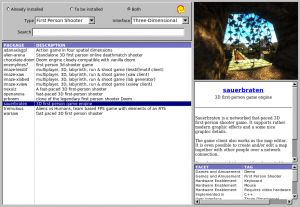
The Debian archive is known to be one of the largest software collections available in the free software world. With more than 16,000 source packages and 30,000 binary packages, users sometimes have trouble finding packages that are relevant to them. Debian developer Enrico Zini has been working on infrastructure to solve this problem. During the recent mini-debconf Paris, Enrico gave a talk presenting what he has been working on in the last few years, which hasn t gotten yet the attention it deserves . Enrico is known in the Debian community for the introduction of debtags, a system used to classify all packages using facets. Each facet describes a specific kind of property: type of user-interface, programming language it s written in, type of document manipulated, purpose of the software, etc. His most recent work builds on that. It is available in Debian and Ubuntu in the apt-xapian-index package. Its purpose is to allow advanced queries over the database of available packages. Users of apt-xapian-index He started by presenting some early users of the infrastructure. The most widely know is Ubuntu s software center. Its search feature provides results almost instantly thanks to apt-xapian-index. But it is a very simple interface that doesn t exploit many of the advanced features provided by the apt-xapian-index. Another early adopter, making use of some more advanced features, is GoPlay!. It s a graphical user interface to find games. It makes use of debtags to classify games so that you can browse, for example, all 3D action/arcade games related to cars. GoPlay has even been extended to be a more generic debtags based package browser and the package now also provides GoLearn!, GoAdmin!, GoNet!, GoOffice!, GoSafe!, and GoWeb!. Fuss-launcher is an application launcher and not a package browser, but by using apt-xapian-index, it s able to reuse information provided at the package level to make it easier to find installed applications. Package descriptions tend to be more verbose than those embedded in .desktop files. Enrico also showed another nice feature to the audience: if you drag a document onto its window, it will show you a list of applications that can open it. Last but not least, apt-xapian-index provides a command line search tool that is vastly superior to the traditional apt-cache search: it s axi-cache search (axi stands for apt-xapian-index). Enrico compared the output of a search on the letter r . While apt-cache spits out an infinite list of packages containing this letter somewhere in the description, axi-cache only listed packages related to GNU R. He also demonstrated the contextual tab completion. It makes it easy to use debtags and to refine your search. Once you have typed a first keyword, the tab-completion for the second one only contains keywords or debtags that are actually able to provide more restrictive results. Advanced queries with logical operations (AND, OR, NOT, XOR) are also supported. Features of the backend Enrico then dived into the internals. Xapian s search engine is at the root of this infrastructure. He likes it because it s a simple library (i.e. no daemon) and it has nice Python bindings. While apt-xapian-index s core work is to index the descriptions of all the packages, it actually stores much more and can be easily extended with plugins (written in Python). For instance, the information stored encompasses: He already has plans to store more: adding popularity contest data (see wishlist bugs #602180 and #602182) will make it possible to sort query results in a useful way. The most widely used applications are good choices when it comes to community support, and they are likely of better quality due to the larger user base. Adding timestamps of the last installation/upgrade/removal, will make it easier to pin-point a regression to a specific package update. The generated index is world-readable and can be used from any application provided it can use the Xapian library which is written in C++ but has bindings for Perl, Python, PHP, Java, Tcl, C#, and Ruby. Call for experimentation Enrico believes that many useful applications have yet to be invented on top of apt-xapian-index s features. He s calling for experimentation and asking for new ideas. The only practical limit that he has encountered is the size of the index: currently it varies between 50 Mb (Debian unstable without translation) and 70 Mb (Debian stable/testing/unstable with one translation). He would like it to not grow over 100 Mb since it s installed by default (due to aptitude recommending it) and he s not comfortable with the idea of using more than 20% of the disk footprint of a basic install just for this service. That s why the index was configured to not store the position of the terms: it s thus not possible to find out packages whose description contains the word statistical immediately followed by the word computing . You can however find those which have both terms somewhere in their description. Enrico wondered if apt-xapian-index offers too much freedom. That could explain why few people experimented with it despite his numerous blog posts with code samples and information on how to get started using it. But it s not difficult to imagine use cases for this data. It could be used to extend tools like rc-alert or wnpp-alert, for example. They provide a long list of Debian packages that are looking for some help and are installed on the machine. With apt-xapian-index, it would be possible to restrict the results to the set of packages written in a specific programming language or for a particular desktop environment. The more likely explanation is that too few people know about the tool. There are many more itches to scratch where apt-xapian-index s features could be very useful, and my guess is that Enrico s wishes will eventually come true.
This article was first published in Linux Weekly News. Click here to subscribe to my newsletter and keep up with the Debian/Ubuntu news thanks to my monthly digest.

No comment Liked this article? Click here. My blog is Flattr-enabled.

Bdale Garbee: AltOS 0.8 Released

Keith and I just released version 0.8 of AltOS, the open source firmware and software system associated with our TeleMetrum hobby rocket avionics system. The AltosUI ground station user interface is significantly improved, with lots of new features including a much cleaner view of what's happening during different stages of the flight experience, a post-flight data plotting interface with pan and zoom, and a very cool live view of where the rocket is overlayed on data from Google Maps! All existing TeleMetrum owners are encouraged to download, install, and begin using this new version immediately.

28 November 2010

Gregor Herrmann: RC bugs 2010/46 - 2010/47

this time my report on my work on RC bugs contains the list of what I did during the bug squashing party in bern. thanks to the nice guys from switzerland, france, & italy for the great time, & especially to gaudenz for organising the meeting!

Biella Coleman: The Existential Philsophy of Procrastination

out of cous The New Yorker has a very nice piece about the follies and foibles of procrastination. I really identified with it, especially the ruminations of multiple/divided selves (I do feel more like Biella s instead of Biella especially during moments of extreme procrastination). The heart of the piece has to do with the existential face of procrastination, which the author nails with this quote by Mark Kingwell:
Procrastination most often arises from a sense that there is too much to do, and hence no single aspect of the to-do worth doing. . . . Underneath this rather antic form of action-as-inaction is the much more unsettling question whether anything is worth doing at all
This reminds me of another one of my favorite (and kinda distributing but also kinda liberating) quotes by Henry Miller:
Life has to be given a meaning because of the obvious fact that it has no meaning
Finally, the most humorous bit in the article had to do with Victor Hugo, who apparently, to stave off distraction, would write in the nude and then make what sounds like his man servant hide his clothes so he could not go outside. Reminds me that prior to the Internet, there were certainly other ways to squander time. For now, I encourage some procrastination: read it and you might get some insight as to this habit, which seems to afflict so many.

27 November 2010

Robert Millan: About ZFS in Squeeze (2)

Sometimes it s nice being wrong. Contrary to what I predicted, ZFS will be supported in Debian Squeeze using the official installer. This means that Debian Squeeze will be one of the first GNU distributions to support ZFS. In fact, even though ZFS support didn t make it to Debian-Installer beta1 by the time it was released, it is now available in the netboot images (this happens because netboot images fetch newer installer components from the internet). As a consequence of this my unofficial installer can now be considered obsolete. So why did I say something that turned out to be grossly inaccurate? It s not due to anyone s fault really. At that time, the version of Parted that included ZFS detection hadn t migrated to Squeeze. The unblock policy didn t appear to allow this migration. However, the Release Team kindly decided to make an exception that allowed this, and after Parted had migrated the changes in Debian-Installer itself went in quite smoothly.

Paul van Tilburg: 10 Years of Spacelabs

A few months ago I realised it has been 10 years already since Spacelabs 1 was founded. Today we will celebrate that with a reunion and probably reminisce about past projects, events and experiences. Therefore, I thought it would be nice to accompany this with a post. The past Spacelabs was founded to create something that sits in between research and consumer appliances. Since we are associated to the Electro-Optical Communication group these things often had to do with bandwidth. For example, showing the ease of use of plastic optical fiber or participate in GPRS/UMTS trials. However, due to the loose structure of Spacelabs, we ventured into many other projects of our own such a information system-enabled fridge with a barcode reader, a dynamic DNS system, etc. At some point we got our own Internet connection with an accompanying subnet. It has been fun and rewarding to learn how to setup and run a mini ISP. Spacelabs doesn t have any formal structure: when you are on the mailing list, you are a member. There are no regular meetings, no hierarchy, no obligations. So in some ways, we are a group that is much like a free/open source software community. I think that this approach has provided us the drive to work both on projects during our free time as well as our own ideas. I feel that Spacelabs has contributed so much to my life. It might not be the typical study association, but it was a big supplement to my studies, it was fun and it was completely ours. Not only did it teach me many, many technical things from networks to program languages to software design but it also gave me experiences on other levels, such as very attuned group work and responsibilities for key systems. Spacelabs in 2006 The future Soon, everyone connected to Spacelabs will have finished their Master s or PhD (in my case) and nobody will be left to continue the project. Although this is a bit sad, I think we can be proud of what we have accomplished, learnt and experienced. I will miss our location high in the Potentiaal/E-hoog building overlooking Eindhoven, and our being together as a group. We are however not gone yet, there is still a lot to plan and to work on if we want to rescue the huge amount of servers and services that we have accumulated over the years if we were to leave

1 Yes, the website is very much from the past.

Christian Perrier: Goodbye bubulle

Don't be scared (or don't celebrate, depends...), I'm not leaving any project I'm part of. "Goodbye bubulle"....because yesterday, I modified my login on my laptop. I indeed plan to use LDAP authentication at work with it and my login there is surprisingly boringly "cperrier". So, I had to change my local login as first step of the switch to pam_ldapd+pam_ccreds. So, eh, I had to drop any reference to "bubulle" locally. It was surprisingly easy, indeed. Still, in case mails to me happen to bounce...please tell me on IRC (where I'm still "bubulle": this nickname is now nearly 20 years old and some readers of this blog remember why I am so sentimentally stuck with it).

Next.

Previous.