Search Results: "ads"

9 April 2015

Lars Wirzenius: DPL elections for 2015 are going on

The Debian Project Leader electsions are going on. This is the yearly election for the leader, where members of the project vote for a new leader for a year. The debate this year seemed to me to be quite quiet, and voting activity seems to not be very high, either. Pity. Many years ago, the election period used to be quite energetic, bringing up some quite good viewpoints. There seems to also not have been the usual repeat of the voting announcement, not sure what's going there. There's time until next Tuesday midnight (in the UTC time zone) to vote. Below are links to the vote page (with instructions for voting) and the (corrected) initial announcment. I voted for Neil as my top candidate. I think he's got the best background and personality for being the leader of this project of ours.

Daniel Pocock: Never fly Etihad again?

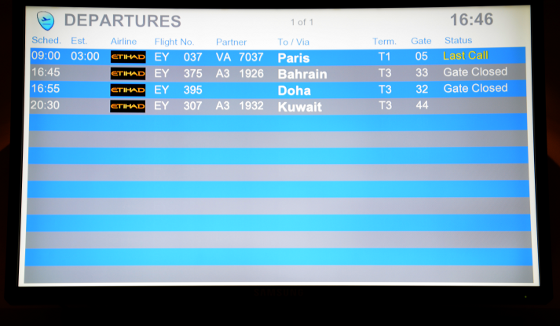
This is the first time we've flown out to Australia with Etihad and it may also be the last. We were due to fly back into Europe at CDG and head down to Lyon for the mini-DebConf this weekend. departure board, 18 hour delay for Paris Lets look at how our Etihad experience has worked out: 21:00 UTC Tuesday - waking up on Wednesday morning in Melbourne (UTC+10) 13:00 UTC Wednesday - leaving Melbourne about 11pm Wednesday night, a 12-13 hour flight to Abu Dhabi. We had heard about the air traffic control strikes in France (where we are going) and asked the airline if we should fly and they told us everything would be OK. 02:30 UTC Thursday - touchdown in Abu Dhabi, 6:30 am local time. Go to the transfer counter to ask for our boarding passes to CDG. At this stage, we were told that the connecting flight to CDG had been delayed 20 hours due to French strikes. As we are trying to reach Lyon for the mini-DebConf this weekend, we asked if we could leave Abu Dhabi on a 09:00 flight to Geneva. The Etihad staff told us to contact our travel agent (the flight was booked through Expedia) and for the next hour everybody's time was wasted making calls to Expedia who kept telling us to speak to Etihad. Whenever the Etihad customer service staff tried to speak to Expedia, the Expedia call center would hang up. Eventually, the Etihad staff told us that the deadline for putting us on the Geneva flight had passed and we would be stuck in Abu Dhabi for at least 20 hours. For flights to and from Europe, airlines have a responsibility to arrange hotels for passengers if there is a lengthy delay. If the airline is at fault, they must also pay some extra cash compensation but for a strike situation that is not applicable. Etihad has repeatedly fobbed us off. Initially we were given vouchers for Burger King or a pizza slice and told to hang around the transfer counter. By about 12:00 UTC (4pm local time, nine hours of waiting around the transfer counter) there was still no solution. One passenger was so upset that the airport security were called to speak to him and he was taken away. The airline staff kept giving excuses. Some passengers had been sent to a hotel but others left behind. I asked them again about our hotel and they kept trying to fob me off. Faced with the possibility that I would miss two nights of sleep and eight hours time difference coming into Europe, I continued asking the Etihad staff to own up to their responsibilities and they eventually offered us access to their airport lounge. We discovered some other passengers in the lounge too, including the passenger who had earlier been escorted away by security. This is unlike anything we've experienced with any other airline. At every opportunity (the check-in at Melbourne, or when the Geneva flight was boarding), the airline has failed to make arrangements that would have avoided cost and inconvenience. Assuming the flight goes ahead with a 20 hour delay, we will arrive in CDG some time Friday morning and not really sleep in a proper bed again until Friday night, about 70 hours after getting up in Melbourne on Wednesday morning. Thanks Etihad, you are a waking nightmare. The airline has been evasive about how they will deal with our onward travel from CDG to Lyon. We had booked a TGV train ticket already but it is not valid after such a long delay and it seems quite possible that trains will be busier than usual thanks to the air traffic control strike. So we don't even know if we will be loitering around a Paris airport or railway station for hours on Friday and nobody from the airline or Expedia really seems to care. Conclusion The only conclusion I can reach from this experience is that Etihad can't be trusted, certainly not for long journies such as Australia to Europe. Having flown through Singapore, Kuala Lumpur and Hong Kong, I know that air passengers have plenty of options available and there are many airlines that do go the extra mile to look after passengers especially on such long journeys. The airline missed opportunities to re-route us at every opportunity. It looks like they help some passengers (like those who did get to hotels) but leave many others high and dry just to stay within their budget.

8 April 2015

Gunnar Wolf: Guests in the classroom: C sar Y ez (@caesarcomptus) talks about memory assignation algorithms

Once again, on March 11 I had a great guest to save me some work and give a talk at my class! This time it was C sar Y ez, and he talked about memory management algorithms, emphasizing on ARC. The video is available, both at this server and in archive.org. Thanks a lot!

Steve McIntyre: More arm64 hardware for Debian - Applied Micro X-Gene

As a follow-up to my post about bootstrapping arm64 in Debian, we've had more hardware given to Debian for us to use in porting and building packages for arm64. Applied Micro sent me an X-Gene development machine to set up and use. Unfortunately, the timing was unlucky and the machine sat on my desk unopened for a few weeks while I was on long holiday in Australia. Once I was back, I connected it up and got it working. Out of the box, a standard Jessie arm64 installation worked using network boot (dhcp and tftp). I ran through d-i as normal and installed a working system, then handed it over to the DSA and buildd folks to get the machine integrated into our systems. Easy! The machine is now up and running as arm-arm-03.debian.org and has been building packages for a few weeks now. You can see the stats here on the buildd.debian.org site. In terms of installation, I also got the machine to boot using one of our netinst images on a USB stick, but that path didn't get very far. The USB drivers for this hardware have only quite recently gone into the mainline kernel, and haven't been backported to the Debian Jessie kernel yet. I'm hoping to get those included shortly. There's also an option to replace the U-Boot firmware that came with the X-Gene with UEFI instead, which would be much more helpful for a server platform like this. I'll look into doing that upgrade soon too, but probably after the Jessie release is done. I don't want to jinx things just now. *grin* Thanks to APM for their generous donation here, and particularly to Richard Zenkert for his help in getting this machine shipped to us.

Ben Hutchings: Call for testing: linux 3.16.7-ckt9-1

As it is nearly time to release Debian 8 (codename jessie), I've uploaded a new version of the Linux kernel to unstable which I hope will be the version to go into the initial release (8.0). The changes from the current version in testing are mostly bug fixes: Please test this new version (which should be on mirrors within the next 24 hours) and report any regressions you spot. It's now too late to add new hardware support for Debian 8.0, but we'll probably be able to improve it in subsequent point releases. So, please also report driver changes that should be backported from later kernel versions to improve hardware support, with severity of 'important'. If you can provide precise information about which upstream commits are needed, that makes things easier for us, and you should add the 'patch' tag.

Junichi Uekawa: New Month.

New Month. New Life.

7 April 2015

Wouter Verhelst: C11 function overloading

About four years ago, the ISO 9899:2011 "C11" standard was announced. At the time, I had a short look at (a draft version of) the standards document, and found a few interesting bits in there. Of course, however, due to it only very recently having been released, I did not have much hope of it being implemented to any reasonable amount anywhere yet. Which turned out to be the case. Even if that wasn't true, writing code that uses C11 features and expecting it to work just about anywhere else would have been a bad idea back then. We're several years down the line now, however, and now the standard has been implemented to a reasonable extent in most compilers. GCC claims its "support [for C11] is at a similar level of completeness to (...) C99 support" since GCC 4.9. Since my laptop has GCC 4.9, I looked at one feature in C11 that I have been wanting to use for a while: Generic selection.
#include <stdint.h>
#include <inttypes.h>
#include <stdio.h>
void say32(uint32_t i)  
    printf("32-bit variable: %" PRId32 "\n", i);
 
void say64(uint64_t i)  
    printf("64-bit variable: %" PRId64 "\n", i);
 
void sayother(int i)  
    printf("This is something else.\n");
 
#define say(X) _Generic((X), uint32_t: say32, uint64_t: say64, default: sayother)(X)
int main(void)  
    uint32_t v32 = 32;
    uint64_t v64 = 64;
    uint8_t v8 = 8;
    say(v32);
    say(v64);
    say(v8);
 
Output of the above:
32-bit variable: 32
64-bit variable: 64
This is something else.
or, "precompiler-assisted function overloading for C". Should be useful for things like:
#define ntoh(X) _Generic((X), int16_t: ntohs, uint16_t: ntohs, int32_t: ntohl, uint32_t: ntohl)(X)
#define hton(X) _Generic((X), int16_t: ntohs, uint16_t: htons, int32_t: ntohl, uint32_t: htonl)(X)
... and if one adds the ntohll found here, it can do 64 bit as well.

Thorsten Glaser: exciting news, or so

I implemented <? support (including <?php ) script embedding support for *.inc in MirWebseite today; the specific syntax was explicitely requested by Natureshadow. Ugh. My own hacking activities are progressing, even if slowly. I do some other interesting, funny, social, beneficial, etc. stuff in between, though. I ll even have to get some of my DD buddies to sponsor me some QA uploads of packages I formerly maintained, whereever changes are queued up such as better old-format repo compatibility in cvs(GNU) Though some of the stuff I do at work is currently done only there sorry. Also: prepare to be fully enlightened about just what evil (nice picture) Docker is. I especially liked the comparison of containers to a herd of cattle, mere numbers, replaceable, whereas VMs are cats, each with their individual name, lovely petted each day, etc. ObHint: Some may have noticed I do have a Twitter account now. I do not really use it much. I got it because I wanted to rant at someone who only gave Twitter as means to contact them (a European company running a lottery for USA citizens only). But I found one nice thing: @HourlyCats (though @FacesPics and @BahnAnsagen are funny too, and the Postillon anyway). The internet is there for cat content, anyway.
Ahem. Do not contact me there, use IRC, more specifically, the Freenode network, and possibly memoserv to mirabilos instead, I can t fit things into 140 chars, that s just ridiculous. Also, don t follow me. It may contain rants, it s NSFW, and I m not censoring there. As I said: I do not use it. So should you. (But kudos for having a mostly functional fallback site (the mobile one), which even works in PocketIE (Windows Mobile) and Opera 9, though not so much lynx(1) ) odc (from #!/bin/mksh on IRC) is hacking support to use mksh instead of GNU bash for bootstrapping pkgsrc (e.g. on Solaris). Nice! Good luck! propos mksh(1), dear Debian armel and armhf buildd maintainer colleagues, pretty please with strawberries and chocolate ice on top (I just had that on waffles at my favourite ice salon, so I may be biased), do like s390x and update your chroots and wanna-build give-back mksh, as we requested, so the privacy fix makes it into jessie. Thanks in advance! Oh, and Y_Plentyn and I both have been putting more and updated packages into my APT repository. XTaran held a talk at CLT 2015 mentioning it maybe I should write up some docs about how to use it for which purposes (e.g. how to avoid systemd but not get the other packages from it, or how to use it with systemd (trivial but has to be stated, it s freedom of choice after all), etc.)? Besides decent fanfiction (the stories in the Uzumaki Naruto universe seem, on average, to be much longer than those in the Harry Potter one), the weather is becoming good, so I ve already been enjoying going out for some geocaching and will have the bike fixed at the shop RSN (it suffers a bit each winter, as it stands outside, since our basement is mouldy, which is worse than a bit of rust IMHO) to get more activity in. Also planning to head to the GPS Maze in Mainz and, besides what time FrOSCon (including preparation) allows, heading to DebConf for a while. mirabilos  Waypoints

Wouter Verhelst: C11 operator overloading

C11 function overloading About four years ago, the ISO 9899:2011 "C11" standard was announced. At the time, I had a short look at (a draft version of) the standards document, and found a few interesting bits in there. Of course, however, due to it only very recently having been released, I did not have much hope of it being implemented to any reasonable amount anywhere yet. Which turned out to be the case. Even if that wasn't true, writing code that uses C11 features and expecting it to work just about anywhere else would have been a bad idea back then. We're several years down the line now, however, and now the standard has been implemented to a reasonable extent in most compilers. GCC claims its "support [for C11] is at a similar level of completeness to (...) C99 support" since GCC 4.9. Since my laptop has GCC 4.9, I looked at one feature in C11 that I have been wanting to use for a while: Generic selection.
#include <stdint.h>
#include <inttypes.h>
#include <stdio.h>
void say32(uint32_t i)  
    printf("32-bit variable: %" PRId32 "\n", i);
 
void say64(uint64_t i)  
    printf("64-bit variable: %" PRId64 "\n", i);
 
void sayother(int i)  
    printf("This is something else.\n");
 
#define say(X) _Generic((X), uint32_t: say32, uint64_t: say64, default: sayother)(X)
int main(void)  
    uint32_t v32 = 32;
    uint64_t v64 = 64;
    uint8_t v8 = 8;
    say(v32);
    say(v64);
    say(v8);
 
Output of the above:
32-bit variable: 32
64-bit variable: 64
This is something else.
or, "precompiler-assisted function overloading for C". Should be useful for things like:
#define ntoh(X) _Generic((X), int16_t: ntohs, uint16_t: ntohs, int32_t: ntohl, uint32_t: ntohl)(X)
#define hton(X) _Generic((X), int16_t: ntohs, uint16_t: htons, int32_t: ntohl, uint32_t: htonl)(X)
... and if one adds the ntohll found here, it can do 64 bit as well.

Mario Lang: I am sorry, but this looks insane

I am a console user. I really just started to use X11 again about two weeks ago, to sometimes test an a Qt application I am developing. I am not using Firefox or anything similar, all my daily work happens in shells and inside of emacs, in a console, not in X11. BRLTTY runs all the time, translating the screen content to something that my braille display can understand, sent out via USB. So the most important programs to me, are really emacs, and brltty. This is my desktop, that is up since 179 days.
PID   USER      PR  NI    VIRT    RES    SHR S  %CPU %MEM     TIME+ COMMAND
 1227 message+  20   0    7140   2860    672 S   0,0  0,1 153:33.10 dbus-daemon
21457 root      20   0   44456   1116    788 S   0,0  0,1 146:42.47 packagekitd
    1 root      20   0   24348   2808   1328 S   0,0  0,1 109:16.99 systemd
 7897 mlang     20   0  585776 121656   4188 S   0,0  6,0 105:22.40 emacs
13332 root      20   0   10744    432    220 S   0,0  0,0  91:55.96 ssh
19581 root      20   0    4924   1632   1076 S   0,0  0,1  53:33.56 systemd
19596 root      20   0   20312   9764   9660 S   0,0  0,5  48:10.76 systemd-journal
10172 root      20   0   85308   2472   1672 S   0,0  0,1  20:30.18 NetworkManager
   29 root      20   0       0      0      0 S   0,0  0,0  18:40.24 kswapd0
13334 root      20   0  120564   5748    304 S   0,0  0,3  16:20.89 sshfs
    7 root      20   0       0      0      0 S   0,0  0,0  15:21.15 rcu_sched
14245 root      20   0    7620    316    152 S   0,0  0,0  15:08.64 ssh
  438 root      20   0       0      0      0 S   0,0  0,0  12:14.80 jbd2/dm-1-8
11952 root      10 -10   42968   2028   1420 S   0,0  0,1  10:36.20 brltty
I am sorry, but this doesn't look right, not at all. I am not even beginning to talk about dbus-daemon and systemd. Why the HECK does packagekitd (which I definitely don't use actively) use up more then two hours of plain CPU time? What did it do, talk to NSA via an asymmetric cipher, or what?! I play music via sshfs, sometimes FLAC files. That barely consumed more CPU time then brltty, which is probably the most active daemon on my system, erm, it should be. I don't want to chime into any flamewars. I have accepted that we have systemd. But this does not look right! I remember, back in the good old days, emacs and brltty were my top CPU users.

Lucas Nussbaum: Tentative systemd slides

I recently spent some time updating my systemd knowledge and decided to put together some slides that I ll use for a lecture. I m interested in feedback about things that are missing, unclear, etc. Available on slideshare, as PDF, and as LaTeX source.

Olivier Berger: Publishing my papers as Linked Research

I intend to make the extra effort of republishing my own research papers as Linked Research, i.e. in a form readable by humans (HTML5), but also embedding meta-data (as RDF) for machine processing. I ve started with Authoritative Linked Data descriptions of Debian source packages using ADMS.SW (a good candidate, as it deals with Linked Data ;). You ll notice the menu which helps select different style sheets for preparing clean printable versions, not far from the LaTeX output usually converted to PDF. I hope this will pave the way to more Linked Research, and less opaque publications. The only hassle at the moment is the conversion from LaTeX to HTML5 which I m doing manually, in Emacs + nxml-mode. Update: Check the preprint links in my publications page, for more papers.

6 April 2015

Daniel Pocock: Dandenongs

The final part of our latest Australia trip took us to the Dandenong Ranges. To borrow a term from the Germans and Swiss, Mount Dandenong could be considered Melbourne's Hausberg or local mountain. On the south side of the mountain, tourists and children are impressed by the Puffing Billy railway at Belgrave: Keen runners can race the train in about May each year in a 13km course through the mountains. You need to stay at least thirty seconds ahead of the train to avoid being stuck at the level crossings. My own fastest time was about two minutes faster than the train. Leaving Belgrave, there is a short but steep drive up to the Mount Dandenong summit following the road towards Monbulk and Olinda. From the top, you can view the whole city, Port Philip Bay and various other mountain ranges in other directions:

Jonathan Carter: Squashfs Performance Testing

Experiments Last week I discovered The Fan Club s Experiments page. It reminds me of the Debian Experiments community on Google+. I like the concept of trying out all kinds of different things and reporting back to the community on how it works. I ve been meaning to do more of that myself so this is me jumping in and reporting back on something I ve been poking at this weekend. Introducing Squashfs Squashfs is a read-only compressed filesystem commonly used on embedded devices, Linux installation media and remote file systems (as is done in LTSP). Typically, a system like tmpfs, unionfs or aufs is mounted over this read-only system to make it usable as a root filesystem. It has plenty of other use cases too but for the purposes of this entry we ll stick with those use cases in mind. It supports gzip, lzo and xz(lzma) as compression back-ends. It also supports block sizes from 4K up to 1M. Compression technique as well as block size can have major effects on both performance and file size. In most cases the defaults will probably be sufficient, but if you want to find a good balance between performance and space saving, then you ll need some more insight. My Experiment: Test effects of squashfs compression methods and block sizes I m not the first person to have done some tests on squashfs performance and reported on it. Bernhard Wiedemann and the Squashfs LZMA project have posted some results before, and while very useful I want more information (especially compress/uncompress times). I was surprised to not find a more complete table elsewhere either. Even if such a table existed, I probably wouldn t be satisfied with it. Each squashfs is different and it makes a big difference whether it contains already compressed information or largely uncompressed information like clear text. I d rather be able to gather compression ratio/times for a specific image rather than for one that was used for testing purposes once-off. So, I put together a quick script that takes a squashfs image, extracts it to tmpfs, and then re-compressing it using it all the specified compression techniques and block sizes and then uncompressing those same images for their read speeds. My Testing Environment For this post, I will try out my script on the Ubuntu Desktop 14.04.2 LTS squashfs image. It s a complex image that contains a large mix of different kinds of files. I m extracting it to RAM since I want to avoid having disk performance as a significant factor. I m compressing the data back to SSD and extracting from there for read speed tests. The SSD seems fast enough not to have any significant effect on the tests. If you have a slow storage, the results of the larger images (with smaller block sizes) may be skewed unfavourably. As Bernhard mentioned on his post, testing the speed of your memory can also be useful, especially when testing on different kinds of systems and comparing the results:
# dd if=/dev/zero of=/dev/null bs=1M count=100000
104857600000 bytes (105 GB) copied, 4.90059 s, 21.4 GB/s
CPU is likely to be your biggest bottleneck by far when compressing. mksquashfs is SMP aware and will use all available cores by default. I m testing this on a dual core Core i7 laptop with hyper-threading (so squashfs will use 4 threads) and with 16GB RAM apparently transferring around 21GB/s. The results of the squashfs testing script will differ greatly based on the CPU cores, core speed, memory speed and storage speed of the computer you re running it on, so it shouldn t come as a surprise if you get different results than I did. If you don t have any significant bottleneck (like slow disks, slow CPU, running out of RAM, etc) then your results should more or less correspond in scale to mine for the same image. How to Run It Create a directory and place the filesystem you d like to test as filesystem.squashfs, then:
$ apt-get install squashfs-tools 
$ wget https://raw.githubusercontent.com/highvoltage/squashfs-experiments/master/test-mksquashfs.sh
$ bash test-mksquashfs.sh
With the default values in that file, you ll end up with 18 squashfs images taking up about 18GB of disk space. I keep all the results for inspection, but I ll probably adapt/fix the script to be more friendly to disk space usage some time. You should see output that look something like this, with all the resulting data in the ./results directory.
* Setting up...
- Testing gzip
  * Running a squashfs using compression gzip, blocksize 4096
  * Running a squashfs using compression gzip, blocksize 8192
  * Running a squashfs using compression gzip, blocksize 16384
  ...
- Testing lzo
  * Running a squashfs using compression lzo, blocksize 4096
  * Running a squashfs using compression lzo, blocksize 8192
  * Running a squashfs using compression lzo, blocksize 16384
  ...
- Testing xz
  * Running a squashfs using compression xz, blocksize 4096
  * Running a squashfs using compression xz, blocksize 8192
  * Running a squashfs using compression xz, blocksize 16384
  ...
* Testing uncompressing times...
  * Reading results/squashfs-gzip-131072.squashfs...
  * Reading results/squashfs-gzip-16384.squashfs...
  * Reading results/squashfs-gzip-32768.squashfs...
  ...
* Cleaning up...
On to the Results The report script will output the results into CSV. Here s the table with my results. Ratio is percentage of the size of the original uncompressed data, CTIME and UTIME is compression time and uncompress time for the entire image.
Filename Size Ratio CTIME UTIME
squashfs-gzip-4096.squashfs 1137016 39.66% 0m46.167s 0m37.220s
squashfs-gzip-8192.squashfs 1079596 37.67% 0m53.155s 0m35.508s
squashfs-gzip-16384.squashfs 1039076 36.27% 1m9.558s 0m26.988s
squashfs-gzip-32768.squashfs 1008268 35.20% 1m30.056s 0m30.599s
squashfs-gzip-65536.squashfs 987024 34.46% 1m51.281s 0m35.223s
squashfs-gzip-131072.squashfs 975708 34.07% 1m59.663s 0m22.878s
squashfs-gzip-262144.squashfs 970280 33.88% 2m13.246s 0m23.321s
squashfs-gzip-524288.squashfs 967704 33.79% 2m11.515s 0m24.865s
squashfs-gzip-1048576.squashfs 966580 33.75% 2m14.558s 0m28.029s
squashfs-lzo-4096.squashfs 1286776 44.88% 1m36.025s 0m22.179s
squashfs-lzo-8192.squashfs 1221920 42.64% 1m49.862s 0m21.690s
squashfs-lzo-16384.squashfs 1170636 40.86% 2m5.008s 0m20.831s
squashfs-lzo-32768.squashfs 1127432 39.36% 2m23.616s 0m20.597s
squashfs-lzo-65536.squashfs 1092788 38.15% 2m48.817s 0m21.164s
squashfs-lzo-131072.squashfs 1072208 37.43% 3m4.990s 0m20.563s
squashfs-lzo-262144.squashfs 1062544 37.10% 3m26.816s 0m15.708s
squashfs-lzo-524288.squashfs 1057780 36.93% 3m32.189s 0m16.166s
squashfs-lzo-1048576.squashfs 1055532 36.85% 3m42.566s 0m17.507s
squashfs-xz-4096.squashfs 1094880 38.19% 5m28.104s 2m21.373s
squashfs-xz-8192.squashfs 1002876 34.99% 5m15.148s 2m1.780s
squashfs-xz-16384.squashfs 937748 32.73% 5m11.683s 1m47.878s
squashfs-xz-32768.squashfs 888908 31.03% 5m17.207s 1m43.399s
squashfs-xz-65536.squashfs 852048 29.75% 5m27.819s 1m38.211s
squashfs-xz-131072.squashfs 823216 28.74% 5m42.993s 1m29.708s
squashfs-xz-262144.squashfs 799336 27.91% 6m30.575s 1m16.502s
squashfs-xz-524288.squashfs 778140 27.17% 6m58.455s 1m20.234s
squashfs-xz-1048576.squashfs 759244 26.51% 7m19.205s 1m28.721s
Some notes:

Eddy Petri&#537;or: HOWTO: Dnsmasq server for network booting using TFTP and DHCP

Dnsmasq is a very lightweight server that besides the expected DNS caching functionality, it also offers DHCP and TFTP functionality in a single binary.

This makes it very useful if one needs to network boot a system since you can have the TFTP and DHCP part of the setup done easily, and only add NFS for a complete network boot.

Add to that that

One extra nice thing dnsmasq has is that it can mark specific hosts, addresses or ranges with some internal markers, then use those markers as symbolic names to apply settings based for classes of devices.

In the configuration snippet below, there is a rule I set up to make sure I would apply the 'netbsd' label to any system connecting through specific ethernet interfaces (one is the interface of the system, the other is a USB NIC I use from time to time):
#You will need a range for static IPs in the main file
dhcp-range=192.168.77.250,192.168.77.254,static

# give the name 'kinder' to any machine connecting through the given ethernet nics and apply 'netbsd' label
dhcp-host=00:1a:70:99:60:BB,00:06:4F:0D:B1:95, kinder, 192.168.77.251, set:netbsd

# Machines tagged 'netbsd' shall use the given NFS root path
dhcp-option=tag:netbsd, option:root-path,/export/netbsd-nslu2/root
# Enable dnsmasq's built-in TFTP server
enable-tftp

# Set the root directory for files available via FTP.
tftp-root=/srv/tftp
Saving this configuration file in /etc/dnsmasq.d/kinder-netboot will enable this to be used by dnsmasq if this line is present in /etc/dnsmasq.conf
conf-dir=/etc/dnsmasq.d
Commenting it will disable the netbsd part easily.

5 April 2015

Ingo Juergensmann: It has been 30 years now...

Sometimes you happen to realize how old you are when listening to the radio where they announce hits from your days of youth as "oldies". Or when todays youth asking you what a music casette or a 5.25" floppy disk is. You're even older than that when you still know 8" disks. We have one of those on our pin board. Or you may realize your age when your favorite computer of your youth will celebrate its 30th anniversary this year! In 1985 the Amiga was introduced to the public - and 30 years later Amigas around the world are still running! Some are still operated under AmigaOS, some are running maybe NetBSD, but some are running the Debian m68k port - even though the port was expelled from Debian years ago! But some people still take care of this port and it is keeping up with building packages, although mostly due to emulators doing the most work. But anyway, the Amiga is turning 30 this year! And what a great machine this was! It brought multitasking, colorful graphics and multi-channel audio to the masses. It was years ahead of its competitors, but it was doomed to fail because of management failures by the producing company Commodore, which went bankrupt in 1994. The "30th Anniversary Event" will take place on July 25th at the Computer History Museum in Mountain View, California, USA - if the kickstarting the event will be successful during the next two weeks. So, when you earned your first merits in computing on an Amiga as well, you might want to give your Amiga history another kickstart! Not the Kickstart floppy as the A1000 needed to boot up, but fundraising the event on kickstart.org! I think this event is not only important to old Amiga users from the good old days, but for the rememberance of computing history in general. Without doubt the Amiga set new standards in computer history and is an important part of industrial heritage.
Kategorie:

Daniel Pocock: Australian wildlife

Here are some of the animals we have seen so far during our trip to Australia. Kookaburra Some kookaburras flying into the trees around a friend's beach house at Kennett River on the Great Ocean Road. Koala's in the wild It is easy to find koala bears in many of the trees around Kennett River: Python At the Moonlit Sanctuary, we were introduced to a python: BBQ My cousin Hagen prepares the BBQ for lunch at the sanctuary: More koala bears It was also possible to get up close to one of the koala bears at the sanctuary. Be careful not to get so close to them in the wild. Wallaby The wallaby is like a small kangaroo: Kangaroo Carla was able to get up close to a family of kangaroos and feed them some snacks: Tasmanian Devil Saving the best for last, the Tasmanian devil is not just a cartoon character. His jaw is strong enough to crush your finger as if you had been run over by a train and he can run faster than just about anybody except for a trained sprinter. Consequently, we didn't jump in the enclosure to pose with him for this photo:

3 April 2015

Thorsten Alteholz: My Debian Activities in March 2015

FTP assistant Recently the NEW queue grew due to lots of uploads of new KDE software and several smaller node-packages. The KDE-stuff will be processed one after another, but the node-stuff seems to be rather strange. After the last discussion I was told that all those small packages can be accumulated into bigger chunks. I hope this discussion doesn t need to be repeated again Anyway, this month I marked 117 packages for accept and rejected 51 packages. Squeeze LTS This was my ninth month that I did some work for the Squeeze LTS initiative, started by Raphael Hertzog at Freexian. This month I got assigned a workload of 15.25h and I spent these hours to upload new versions of: Finally I was also able to upload the binutils package. Up to now, I got no complaints that something is not working anymore, so yeah, I seem to make it. The next big adventure will be a new upload of PHP. I already started with some patches, but it is still a good piece of work. I also uploaded update for DLA 164-1] unace security update, [DLA 168-1] konversation security update and [DLA 172-1] libextlib-ruby security update although no LTS sponsor indicated any interest. Other packages This month the severity of one bug in greylistd had been raised from normal to severe and such I had to upload a new version. Thanks to Andreas Beckmann for raising and for providing a patch. I also uploaded a new version of dict-elements and closed a bug related to reproducible builds. As I am the maintainer of libkeepalive, I got an email from Andreas Florath. He wanted to persuade me to create a package for his library libdontdie, which is rather similar to libkeepalive but has some improvements. As I promised to do some more packaging work, he didn t have to argue much and voila, there now is a new package libdontdie available. As the cooperation with him is really pleasant, I also created a package for his other project: pipexec. Donations Thanks alot to all donors, this month I got 30 in total. I really appreciate this and hope that everybody is pleased with my commitment. Don t hesitate to make suggestions for improvements.

Francois Marier: Using OpenVPN on Android Lollipop

I use my Linode VPS as a VPN endpoint for my laptop when I'm using untrusted networks and I wanted to do the same on my Android 5 (Lollipop) phone. It turns out that it's quite easy to do (doesn't require rooting your phone) and that it works very well.

Install OpenVPN Once you have installed and configured OpenVPN on the server, you need to install the OpenVPN app for Android (available both on F-Droid and Google Play). From the easy-rsa directory you created while generating the server keys, create a new keypair for your phone:
./build-key nexus6        # "nexus6" as Name, no password
and then copy the following files onto your phone:
  • ca.crt
  • nexus6.crt
  • nexus6.key
  • ta.key

Create a new VPN config If you configured your server as per my instructions, these are the settings you'll need to use on your phone: Basic:
  • LZO Compression: YES
  • Type: Certificates
  • CA Certificate: ca.crt
  • Client Certificate: nexus6.crt
  • Client Certificate Key: nexus6.key
Server list:
  • Server address: hafnarfjordur.fmarier.org
  • Port: 1194
  • Protocol: UDP
  • Custom Options: NO
Authentication/Encryption:
  • Expect TLS server certificate: YES
  • Certificate hostname check: YES
  • Remote certificate subject: server
  • Use TLS Authentication: YES
  • TLS Auth File: ta.key
  • TLS Direction: 1
  • Encryption cipher: AES-256-CBC
  • Packet authentication: SHA384 (not SHA-384)
That's it. Everything else should work with the defaults.

2 April 2015

Rudy Godoy: No SSH for you how to fix OpenRG routers

I find interesting when faced a taken-for-granted situation, in particular in the tech world. This time s history is about an Internet ADSL connection that allows all traffic but SSH. Yes, you read it correctly. It was very bizarre confirming such event was a real-life situation. I don t claim to be a networking expert but at least I want to think I m well educated. After few minutes I ve focused my efforts on dealing with the ADSL router/modem s networking configuration. The device is provided by Movistar (formerly Telefonica) and it runs OpenRG. I ve discovered that other people have experienced the same issue and what Movistar did was basically replacing the device. Of course the problem is gone after that. So, this post is dedicated to those who don t give up. Following the steps below will allow SSH outbound traffic for a OpenRG-based device. OpenRG device specs
Software Version: 6.0.18.1.110.1.52 Upgrade
Release Date: Oct 7 2014
Diagnostic When you do the command below, it shows nothing but timeout. Even when you SSH the router it doesn t establish connection to it.
ssh -vv host.somewhere.com
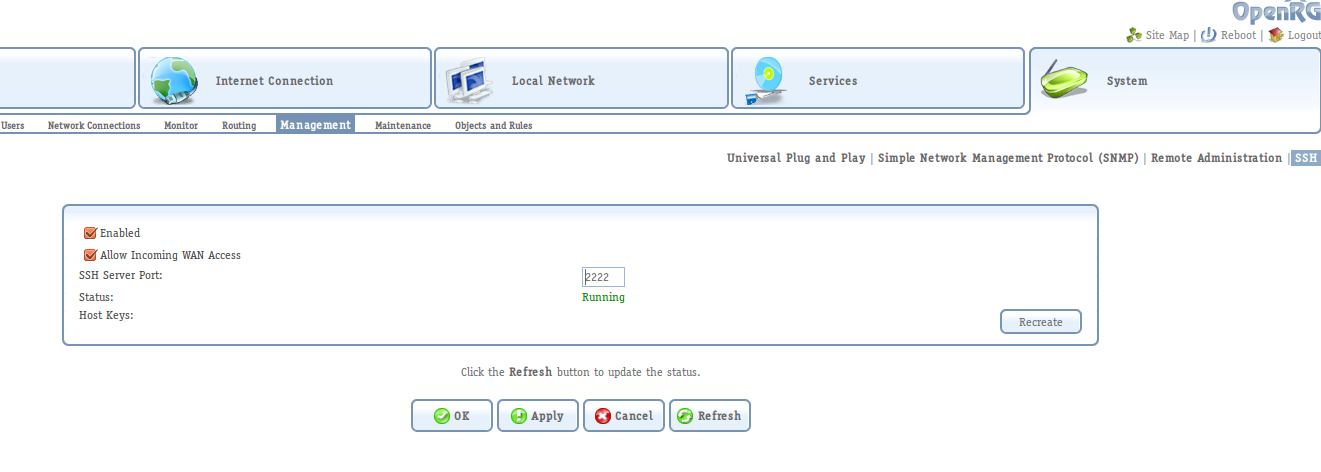
Solution Change router s SSH service port. This step will allow you to access the console-based configuration for the router (since I haven t found any way to do the steps described below from the web management interface). To do so, go to System > Management > SSH. Update the service port to something else than 22, for instance 2222.
OpenRG SSH service configuration

OpenRG SSH service configuration

Connect to the SSH interface Once you have changed the SSH service port, you can access it from a SSH client.
ssh -p 2222 admin@192.168.1.1
admin@192.168.1.1's password: 
OpenRG>
Once you have the console prompt, issue the following commands to allow SSH outbound traffic coming from the LAN and Wifi networks. After the last command, which saves and updates the device s configuration, you should be able to do SSH from any computer in your network to the Internet (thanks to tips from inkhorn).
OpenRG> conf set fw/policy/0/chain/fw_br0_in/rule/0/enabled 0
Returned 0
OpenRG> conf set fw/policy/0/chain/fw_br1_in/rule/0/enabled 0
Returned 0
OpenRG> conf reconf 1
Returned 0

Next.

Previous.