Search Results: "spa"

7 March 2010

Jaldhar Vyas: 7DRL Challenge - day 1

I've decided to take part in the 2010 Seven Day Roguelike Challenge My entry will be written in JavaScript as a KDE4 plasmoid (thus simultaneously allowing me to take part in this competition) Unfortunately today had to be spent in RL family activities so I'm already behind. however I've done lots of research into Roguelike development and I have accomplished the first step finding a name. Candidates are: ...and the winner is: It will be a simple combat heavy coffeebreak game inspired by things such as Solo Dungeon Bash and Pocket Dungeon though as time permits I will add as many more roguelike features as I can.

Daniel Burrows: Installing OpenWRT on a Linksys WRT54GL v1.1

I finally got a few hours free this morning to check an item off my home system administration checklist: upgrading the wireless router's firmware to OpenWRT. There were a couple motivations for this, including the fact that my SoundBridge Radio couldn't maintain a connection to my firefly server using the built-in firmware, and I had read that OpenWRT would work better. Since this is posted on Planet Debian, I should mention why I didn't use DebianWRT. The basic answer is this text at the top of the DebianWRT homepage:
Currently the most common methods used to run Debian on these systems is to install OpenWRT or a similar firmware, add disk space either by USB storage or NFS, create a debian chroot by either running cdebootstrap from inside OpenWRT or debootstrap --foreign on a PC, and running Debian from this chroot. For example, instructions for the WLHDD.
I'm not sure whether this is because DebianWRT is experimental, or because its goal is to use routers as cheap general computers. Either way, it sounds way too complicated and/or fragile for what I'm interested in (i.e., a wireless router with better software). The goal here is to get something that does a better job than the built-in WRT firmware, but doesn't require too much tinkering to get working or to maintain. I have plenty of outlets for my tinkering urges already. Nothing here was exactly difficult, but it was hard to find all the information I needed to get things working. Hopefully documenting the steps I went through here will save someone else some time. Step 1: acquire the firmware This was trickier than you might think. If you click on the download link at the OpenWRT web site, you end up at the top of an FTP server populated with a vast quantity of stuff. Worse, when you find the actual firmware images, you'll quickly discover that there are piles and piles of them divided between sixteen directories, and no guidance as to which one to pick. And picking the wrong one will turn your beautiful router into a doorstop. Luckily, the OpenWRT documentation contains a section called "Getting Started". Unluckily, that section consists of the following text:
1.1 Getting started 1.1.1 Installation 1.1.2 Initial configuration 1.1.3 Failsafe mode
Whoops, someone forgot to execute on a TODO. :-) Undeterred, I consulted the usual fallback reference, Google. It pointed me at several references, some of which were hidden on other parts of the OpenWRT site. Armed with these, I was able to determine that:
  1. My WRT54GL v1.1 probably uses a Broadcom 5352 chipset.
  2. The correct firmware, according to multiple sources, is probably in the kamikaze top-level director, the latest version's subdirectory, and the bcrm-2.4 directory under the version (the link is to 8.09.2, which is current as of March 6, 2010). Apparently the bcrm47xx directory doesn't have wireless support; it helpfully contains a file called NO-BROADCOM-WIRELESS to warn you off, but unhelpfully doesn't include any additional information in that file (like what exactly is broken or that you can find a working firmware in a sibling directory) ... oh well.
  3. The firmware file that you want is openwrt-wrt54g-squashfs.bin, even though it doesn't match the model number of the router. This directory could use a README file explaining which hardware is supported by each of the dozen or so firmware files it contains.
Step 2: install the firmware After Step 1, this was a real relief. I just used the built-in Linksys firmware installer, pointed it at the .bin file, and it went. Step 3: configure the router The installation guide I followed was pretty much silent about what to do after I got the firmware on. Luckily, this is just a software problem, meaning it's much more familiar territory for me.
  1. First things first: I checked that I could still get a DHCP lease. It worked.
  2. Armed with that, I tried telneting to the router. I used the resulting root prompt to set a password on the root account.
  3. I logged out and tried telneting in. Apparently the router is configured to disallow root logins over telnet if you don't have a password. Good for them (although why allow telnet at all?); oops for me.
  4. Luckily, an ssh server was installed by default. I like using keys to log in, so I tracked down the documentation on configuring the server to use public-key authentication; it turns out there's a single global key file named /etc/dropbear/authorized_keys that's exactly like OpenSSH's per-user authorized_keys file. No idea what would happen if I had multiple users, but I won't.
  5. The next obstacle: I didn't have an Internet connection. For some reason, my cable modem didn't want to give the router a DHCP lease. On the off-chance that it was remembering too much, I rebooted it and ran ifup wan. That fixed the problem. I still don't know why.
  6. Not a step, but a useful note: in the process of figuring the above out, I found readlog. It's basically dmesg for syslog files; it shows the most recent lines written to syslog. This is useful because there isn't a real syslog file, due to the fact that there would be no room to store it on the 54GL.
  7. Finally, I had to get wireless working. The documentation is very helpful when it comes to describing the syntax of the wireless configuration. Unfortunately, I read the list of encryption options and missed the section right below where their meanings are explained (although, to be honest, I might not have understood the implications of the explanation without the research I did anyway).
    option encryption none, wep, psk, psk2, wpa, wpa2
    I wanted WPA2 encryption, so I entered wpa2. And nothing worked. After a good hour of trying different options on the client, swapping software components in and out on the router, experimenting with the encryption key syntax, and crawling Google, I finally found my answer. If you just want WPA2 encryption, you must not use wpa2 as the encryption type. Instead, use psk2. It turns out out that wpa2 actually means use WPA2 and also use an external RADIUS server for authentication. psk2 is the system you're familiar with from a typical consumer wireless router.
Step 4: enjoy And with that, it works. Unfortunately, contrary to what I wrote here originally, my Roku still doesn't work. On the other hand, having a real Linux installation is helpful for debugging it. Currently my suspicion is that the router isn't passing multicast packets between the wired and wireless interfaces (broadcast works fine, multicast doesn't). That said, it seems like if I restart Firefly just before I start playing music, I can play reasonably reliably -- as long as I don't stop, because if I do, the Roku forgets that the music server is there. Either way, I've spent about as much time fighting this as I can afford. :-/ One lingering worry I have is security; unlike Debian, which has both a security mailing list and tools to inform me when I need to install a security update, the OpenWRT firmware doesn't seem to have any mechanism for distributing security notices. True, there is an openwrt-security-announce list, but it appears to be entirely unused, as is openwrt-announce. Something to keep an eye on, then. Also (file under note to self), I need to remember to verify that the router isn't exposing services to the outside world. The default iptables configuration is hideously complex; with just a quick glance, it could be setting up a floral shop for all I can tell. I'll need to test this empirically and maybe analyze the rules in more depth.

6 March 2010

Sandro Tosi: Project Euler - Problem 14

Inspired by S. Lott and his blog post (and by the pure genius that xkcd is giving us these days, today included) I gave a look to Project Euler problem 14, that's about the Collatz conjecture.

The straightforward recursive solution:
def collatz(n):
if n == 1:
return 1
if n % 2 == 0:
return 1 + collatz(n/2)
else:
return 1 + collatz(3*n + 1)
very rapidly converges to... an error:
RuntimeError: maximum recursion depth exceeded
So I've recoded it a bit using a cache dictionary to store all the intermediate values in it:
cache =  1: 1 

def collatz(n, res):
nn = n

while True:
if n in cache:
if nn != n:
cache[nn] = cache[n]
return cache[nn]

if n % 2 == 0:
cache[n] = 1 + collatz(n/2, cache)
else:
cache[n] = 1 + collatz(3*n + 1, cache)
Now loping for all the numbers lower than 1 million we find the solution to the problem: the number with the longest path is 837799 with a path length of 524. The code runs in about 4secs.

Since I got that cache dict around to play with, I graphed with Matplotlib (strange, ha ;) ) the frequencies of each path length:
There are few short paths, several long paths but rare to occur, and most of the paths have length between 100 and 200 (more or less).

UPDATE: I've removed length variable, not needed (left from a previous version of the code) and fixed the path length for 837799, wrongly reported.

5 March 2010

Enrico Zini: Global trends

Global trends For some time I have been trying to pinpoint what it is that is brewing in Italy and risks spreading elsewhere, like it happened in the past. I don't need to be decent to stay in power While following a train of thought during a political/philosophical lecture I figured that a current growing trend is to have public figures that are more and more indecent. In Italy it is very hard to find a public figure you can look up to. It is hard to name a politician that is not involved in some shady exchange of favours or some abues of their powers, and we got used to seeing people in power implicated in major corruption scandals, perverted prostitution affairs, or dealings with international criminal organisations. They do not normally end up in jail, and in fact they keep being very firmly in power, because they manage to stretch or change the laws to get away, or at least to delay trials in order to trigger some statute of limitations. Is there a pattern here that, although maybe not as clearly defined as in Italy, can be found more or less globally? Yesterday I thought that this could be such a pattern:
I don't need to be decent to stay in power
If I think of it like that, then it is most definitely not just an Italian phenomenon. If you tell "one doesn't need to be decent to stay in power" to a British, or to a French, I would not expect them to see anything strange with it. We all find it depressing, but we are all used to it. It is a pattern with repercussions, though: once that becomes normal in a society, it means that people who get to be in power are free to abuse their power much as they want, as long as they are careful enough not to end up in jail. Because, well, nowadays one doesn't need to be decent to stay in power. I don't need to follow the law to stay in power That first pattern is already quite well accepted in Italy. So much well accepted, that I think we are starting to see what comes next. At the end of March we are going to have elections for some regional governors. Funnily enough, in Lazio, the very important region around Rome, the centre-right coalition failed to submit the paperwork on time, and is out of the elections. It is not just red tape: at some point someone will have to print out the ballots and dispatch them to the voting booths, so one expects to have the coalition logos and the names of the candidates submitted in time, together with signatures supporting the candidates and whatever else the election process needs. Well, they missed the deadline, they got there after closing time and the building was, well, closed. It was a fantastic opportunity for a laugh. Memes blossomed on the Italian intarwebs and we now have 2 or 3 new expressions to mean "stupid". However, now it's hard to tell what is going to happen. On one hand, you can't exclude one of the two major coalitions because of some bureaucratic detail like an office closing time. But on the other hand, several minor coalitions have been excluded in all sorts of past elections because of similar things, and it really would not be fair to start making exceptions now. But Lombardia, the region around Milan and Emilia Romagna, the one around Bologna, both very, very important, are having similar kinds of problems. In both regions the previous governors are running again, for the 3rd time in a row, and most likely they legally can't do it, and if elected one can sue and force them to resign, because they have been in power long enough. Lots of paper is being shuffled at the moment to figure if they can get away with it or not. Oh, and the lawyers of the candidate for the Milan region also managed to get to the tribunal after closing time, but apparently there was still someone inside and they managed to shout loud enough, or somesuch. Anyway, the situation is getting hot. The Lazio coalition that has been excluded because of their incompetence is now hard at work pushing their potential voters to mount a fracas. Chances are that eventually they'll get away with it, and manage to take part to the election. If that happens, they will likely get close to winning it. So this seems to be a new pattern that is emerging:
I don't need to follow the law to stay in power
Which, again, is a pattern with quite some repercussions. It is something much more radical than just an issue with morality: it means feudalism, it means we are culturally ready to accept dictatorship. So, please do me a favour: do not think for a moment that Italy is just a funny place with lemons and tomatoes, and watch out for these patterns emerging around you.

4 March 2010

Uwe Hermann: libopenstm32 - a Free Software firmware library for STM32 ARM Cortex-M3 microcontrollers

Olimex STM32-H103 eval board I guess it's time to finally announce libopenstm32, a Free Software firmware library for STM32 ARM Cortex-M3 microcontrollers me and a few other people have been working on in recent weeks. The library is licensed under the GNU GPL, version 3 or later (yes, that's an intentional decision after some discussions we had). The code is available via git:
 $ git clone git://libopenstm32.git.sourceforge.net/gitroot/libopenstm32/libopenstm32
 $ cd libopenstm32
 $ make
Building is done using a standard ARM gcc cross-compiler (arm-elf or arm-none-eabi for instance), see the summon-arm-toolchain script for the basic idea about how to build one. The current status of the library is listed in the wiki. In short: some parts of GPIOs, UART, I2C, SPI, RCC, Timers and some other basic stuff works and has register definitions (and some convenience functions, but not too many, yet). We're working on adding support for more subsystems, any help with this is highly welcome of course! Luckily ARM stuff (and especially the STM32) has pretty good (and freely available) datasheets. We have a few simple example programs, e.g. for the Olimex STM32-H103 eval board (see photo). JTAG flashing can be done using OpenOCD, for example. Feel free to join the mailing lists and/or the #libopenstm32 IRC channel on Freenode. The current list of projects where we plan to use this library is Open-BLDC (an Open Hardware / Free Software brushless motor controller project by Piotr Esden-Tempski), openmulticopter (an Open Hardware / Free Software quadrocopter/UAV project), openbiosprog (an Open Hardware / Free Software BIOS chip flash programmer I'm in the process of designing using gEDA/PCB), and probably a few more. If you plan to work on any new (or existing) microcontroller hardware- or software-projects involving an STM32 microcontroller, please consider using libopenstm32 (it's the only Free Software library for this microcontroller family I know of) and help us make it better and more complete. Thanks!

3 March 2010

Jonathan McDowell: Meta: Rant about rants about PGP keysigning problems

(This has ended up longer than I intended, largely because I felt I should then get into why. I'm aware I haven't got into all the nuances, so I hope readers familiar with the area will appreciate this is the compact version.)

Thorsten had a rant last week about PGP keysigning problems. He apologises for his tone, but that's not the issue I take with his rant.

It starts "Keysigning is useless". And yet his complaints seem to be:

None of these seem to actually be about keysigning being useless. The process of doing it, maybe, though he misses the main valid rant about this I'd have, which is that most mass keysignings don't actually allow you to accurately verify the identity of other participants unless you already know them reasonably well. (The LCA2010 keysigning and DebConf5 in Helsinki spring to mind as 2 good examples of bad keysignings I've attended, but speaking to others suggests it's far from an isolated thing.)

Torsten does say that he'll continue to do keysigning on a per-person basis, so it doesn't sound like he's completely given up. I'm posting this largely so other Debian related people don't get the idea that it's not important to think about keysigning.

Why should we care?

Firstly, let's clarify what I mean when I sign someone else's key. If I sign your key then I think that I believe you hold the private part of a key that has your name and an email address I believe I can use to contact you on it. It means I have seen government issued ID that matches that name. It also means that I have interacted with you (and watched others interact with you) under that persona. In short I am happy that the key is a reasonable digital representation of your identity - something signed by it either comes from you or has involved the key being compromised or you coerced into using it against your will.

Why is this useful?

It gets useful thanks to the web of trust; ie the idea that there are a bunch of people I trust partially to sign other keys, and if enough of them have signed a key then I can have a reasonable expectation that the key belongs to the person I want to talk to. Which means I might be prepared to send private data to them. Or Debian might be prepared to accept an upload from them. Which, when you're dealing with a community that spans the planet and where most of the contributors haven't met each other, is pretty freakin' useful - I, as part of Debian's keyring team, don't need to personally be able to identify every Debian developer. All I need to do is be able to trust other DDs to be able to do so. (Though maybe I'm missing out on something here - perhaps Debian should be paying for Gunnar and me to travel the world verifying fingerprints. \o/)

(I still do mass keysignings btw. I'm picky about which keys I actually sign - this is in no way intended as a slight against those I don't, but a mass keysigning at least lets me know that the people involved are happy to exchange fingerprints. Though, FWIW, I normally have ID on me and frequently have fingerprint slips, so if you know me and want me to sign your key/want to sign mine then by all means ask me when you see me!)

Stefano Zacchiroli: RC bugs of the week - issue 23

RCBW - #23 Wacky week, last week. Not only I've (almost) completed my moving to the new house, but we have also had guests in the lab for some full-immersion-paper-writing. That had left very little time for RC squashing, but I've catched up a bit in the week-end. Without any further ado, here are this week's squashes: Random points: In totally unrelated news: I've bought my ticket for DebConf10 (YAY!), according to my usual debconf customs: 4 days of debcamp + all the conf. See you there (in a while). ... and congrats to Adnan for the winning DebConf11 bid!

2 March 2010

Guido G nther: Libguestfs: Detecting Debian kernels and packages

Here are some more examples of libguestfs usage: What kernels, modules and packages are in a (currently powered off) libvirt based virtual machine vmfoo:
virt-inspector -c qemu:///system vmfoo
Show free space in virtual machine vmfoo:
virt-df -c qemu:///system vmfoo
List file systems:
virt-list-filesystems -c qemu:///system -l vmfoo
Edit /etc/passwd in vmfoo:
virt-edit -c qemu:///system lenny-base-clone /etc/passwd
Tell guestfish to mount all filesystems of virtual machine vmfoo for more complex inspection and manipulation tasks like LVM operations, partitioning, resizing or filesystem check or creation:
guestfish $(virt-inspector -c qemu:///system --ro-fish vmfoo)
Debian packages are still on alioth.

1 March 2010

Rob Taylor: RDF Beginners Guide and Competition

The video of our talk at FOSDEM 2010 didn t come out great, so I ve made a slidecast of the RDF beginners guide that I gave as part of that talk. Enjoy below! At FOSDEM we also announced a competition for the coolest hack using RDF, SPARQL and Tracker with the prize kindly sponsored by Codethink. The prize is a Google Nexus One. After some discussion we ve decided to open up the competition to everyone and extend the deadline to the 15th of March. So if this tutorial inspires a great idea, get it coded up and submitted! On #tracker on GIMPNet there are great bunch of hackers who can help you get your idea up and running. There are no hard rules for the competition, we just want to see implementations of cool ideas. The code doesn t have to be perfect, the only requirement is that the judges can check it out and run it on their systems. All entries should be submitted to tracker-competition@codethink.co.uk by the deadline. <object height="300" width="400"><param name="allowfullscreen" value="true"><param name="allowscriptaccess" value="always"><param name="movie" value="http://vimeo.com/moogaloop.swf?clip_id=9848513&amp;server=vimeo.com&amp;show_title=1&amp;show_byline=1&amp;show_portrait=0&amp;color=&amp;fullscreen=1"><embed allowfullscreen="true" allowscriptaccess="always" height="300" src="http://vimeo.com/moogaloop.swf?clip_id=9848513&amp;server=vimeo.com&amp;show_title=1&amp;show_byline=1&amp;show_portrait=0&amp;color=&amp;fullscreen=1" type="application/x-shockwave-flash" width="400"></embed></object> RDF Beginner s Guide from Rob Taylor on Vimeo. Update!
Looks like I hit a bug in PiTiVi that caused the render to get mangled. I ve rerendered and it should all be good now. If Vimeo is being slow for you , you can download the ogg here. Edward, I promise to log a repro as soon as I can!

28 February 2010

Jordi Mallach: Tinyproxy 1.8

A while ago, I was asked to recompile Tinyproxy to enable transparent proxying support, which was not being compiled in etch's Debian package. As it tends to happen, once I got the source and looked into doing a quick rebuild with --enable-transparent-proxy, I noticed the package was in such a bad shape, that I couldn't just leave it like that, so I found myself doing a few more changes, which mostly involved updating the packaging so it didn't suck a lot, and splitting the Debian patches so things could be sent upstream or dropped when new versions appeared. However, even if Ed had asked me to go ahead and take over the package, this was meant to be a one-day effort, and soon I had forgotten about Tinyproxy, except for the ocassional bug mail getting through the PTS. It also didn't help that Tinyproxy had been pretty much dead upstream for years. So lately, a few bug reports were reporting a gasp new major Tinyproxy release, after 7 years of basically nothing. OMG, what do I see, there's a Git repo! And an upstream Bugzilla! Somehow, feeling I owed Ed a reply to his unanswered request, I went ahead and tagged tinyproxy 1.6.3-3.2 in collab-maint, and started working on the new version. Adding myself to Uploaders, and getting rid of the make no unnecessary changes vetto, I rewrote most of the packaging. And for a change, I looked for and found a #tinyproxy channel on IRC and told muks and obnox that the days of Tinyproxy's stay in the Debian/Ubuntu limbo were over.
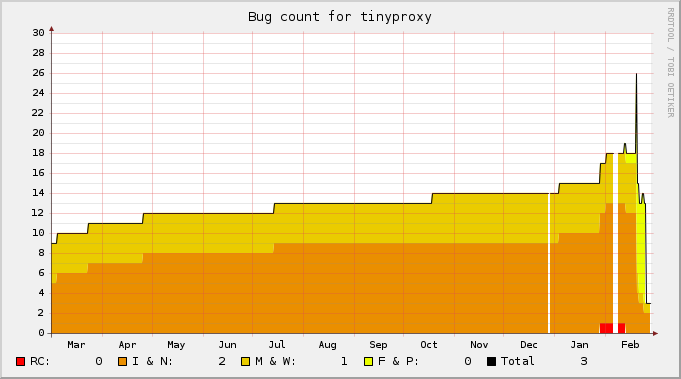
They were happy to get a few bugs and patches forwareded upstream, and asked me why all of this hadn't happened before. Pitty is that a few longstanding issues were well known in Debian but not so obvious for the new upstream maintainers, and are present in 1.8.0. Hopefully all will be dealt with in 1.8.1 or the next major version. The lesson is: if you work on an apparently abandoned package, after cleaning the mess in your NMU, try to spend 15 more minutes trying to contact upstream (if available), pointing them at the patch tracker and our list of bugs: chances are many are still useful. Also, contact the Debian maintainer, and if they ask you to take over, at least post a RFA so someone else can. If you're a Tinyproxy user, I'd be happy to hear if the current package in Debian unstable works for you. If you were having weird issues with 1.6.x, chances are 1.8 will fix them. The package can be installed on stable with no extra dependencies, so if you're feeling adventurous, go ahead and upgrade.
Russell Coker: Carpal Tunnel Syndrome

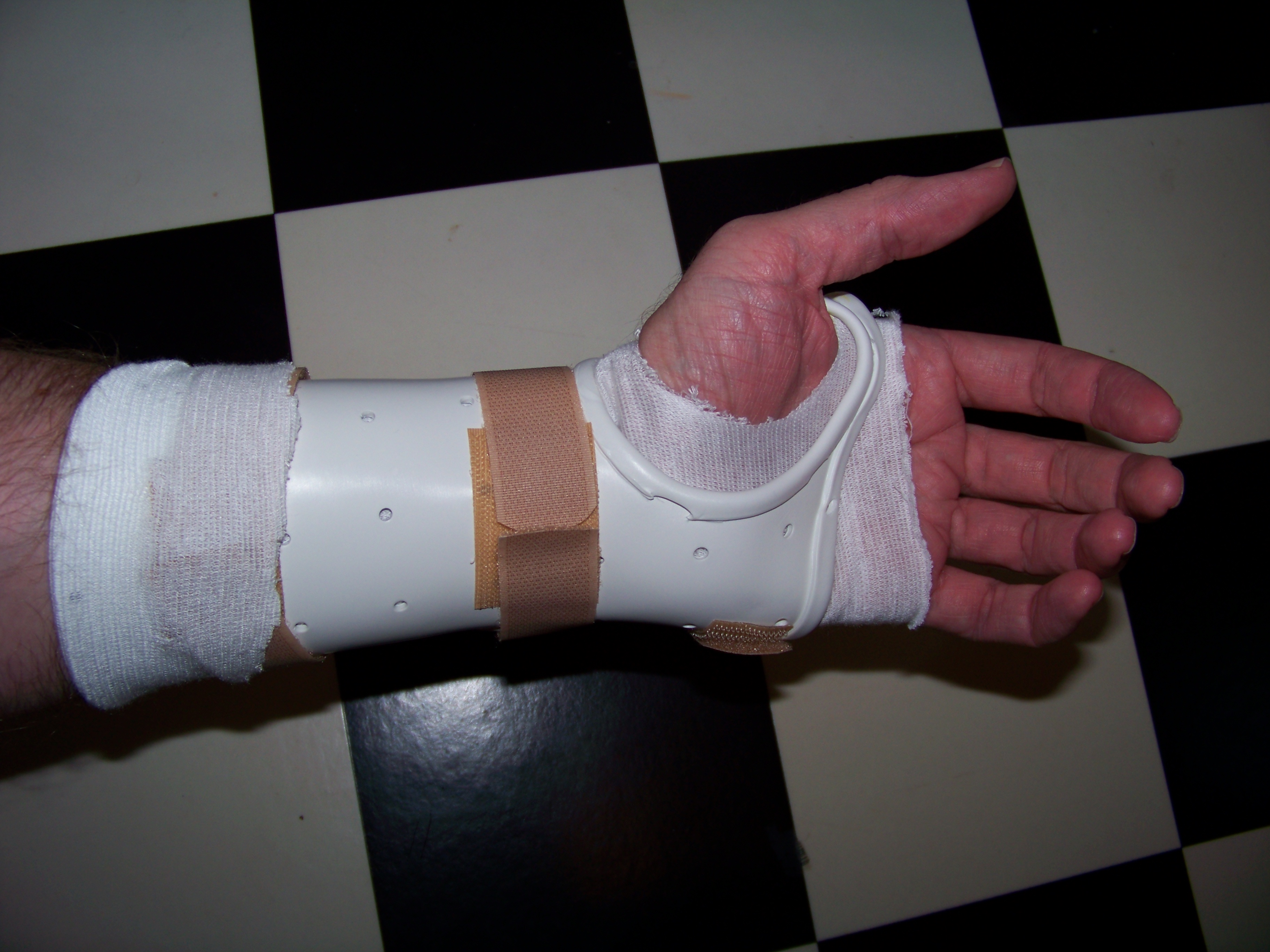
Wrist brace for Carpal Tunnel Syndrome Diagnosis A few weeks ago I was referred to a specialist for the treatment of Carpal Tunnel Syndrome. I first noticed the symptoms in early January, it started happening at night with a partial numbness in the fingers of my left hand. I didn t think much of it at first as it s the expected symptom of sleeping in a position that reduces the blood flow. But when it kept happening with my left hand and never happening with my right and then started getting worse (including happening during the day) I sought medical advice. The doctor asked me to bend my hand down (as if trying to touch my left elbow with the fingers of my left hand). Within about 10 seconds this caused numbness this result from bending one s wrist is a major symptom of CTS. Treatment On Thursday I saw a specialist about this, she agreed with the GP s diagnosis and made a wrist brace for me. She started by cutting off a length of a tube of elastic woven material (similar to a sock) and then cutting a thumb hole, that became the lining. Then to make the hard part she put a sheet of plastic in an electric saucepan (which had water simmering) until it started to melt and then used a spatula to fish it out. The melting temperature of the plastic wasn t that high (it was soft at about 50C when she put it on my arm), it wasn t at all sticky when it was partially melted, and it didn t seem to conduct heat well. After wearing the wrist brace non-stop for a few days I have noticed an improvement already. Hopefully I will make a full recovery in a matter of a month or so, I will probably have to wear a wrist brace when sleeping for the rest of my life, but that s no big deal it s more comfortable to sleep with a wrist brace than a partially numb hand. I ve also been prescribed a set of exercises to help remove scar tissue from the nerves. I haven t done them much yet. In terms of being annoying, the wrist-brace has 3mm diameter holes in a square grid pattern with a 25mm spacing. This doesn t let much air through and in warm weather my arm gets sweaty and starts to itch. I m thinking of drilling some extra holes to alleviate this the part which makes my arm itch doesn t need much mechanical strength. The only task which has been really impeded has been making peanut butter sandwiches, maybe it was making sandwiches not typing that caused CTS? ;) In any case I m not giving up typing but I would consider giving up peanut butter sandwiches. I really hope to avoid the surgical option, it doesn t seem pleasant at all. Other One final thing to note is that Repetitive Strain Injury (RSI) is entirely different. RSI is a non-specific pain associated with repetitive tasks while CTS is a specific problem in one or two nerves where they go through the wrist. RSI apparently tends to reduce the effective strength of the afflicted limb, while milder cases of CTS (such as mine) cause no decrease in strength of course a severe case of CTS results in muscle atrophy due to reduced nerve signals, but I shouldn t ever get that. Many people think that RSI and CTS are essentially the same thing I used to think that until a few weeks ago when I read the Wikipedia pages in preparation to seeing a doctor about it. I want to obtain some of the plastic that was used to make my wrist brace, it could be really handy to have something that convenient for making boxes, containers, and supports for various things among other things it doesn t appear to generate static. The low melting temperature will prevent certain computer uses (the hot air that comes out of a cooling system for a high-end CPU would probably melt it), but it could probably be used to make the case for an Opteron system with careful design. I m guessing that the cost of the plastic is a very small portion of the $150 I paid to the specialist so it shouldn t be that expensive and I m sure it would be even cheaper if it wasn t bought from a medical supply store. If I ever get time to do some work on an Arduino system or something similar then I will definitely try to get some of this plastic for the case. Also the Wikipedia page has a picture of what appears to be a mass-produced wrist brace. I think that it might be improved by having the picture of the custom one that I wear added to the page. I unconditionally license the picture for free use by Wikipedia and others under the CC by attribution license. So if anyone thinks that a picture of my hand would improve Wikipedia then they can make the change.

26 February 2010

Martin F. Krafft: ACTA leak: no surprises about transparency blockers

The most common criticism of the Anti-Counterfeiting Trade Agreement (ACTA) is the lack of transparency. Before the nations disclose the terms of the agreement under negotiation, we are unable to gain an idea of the big picture, let alone voice our opinions and push for changes. Our politicians don t want us to know. We rely on leaked documents for our information. This is backwards in a world where a state should represent its people. This smells foul to me. There are undoubtedly some good reasons for the treaty, and if we can contain worldwide, large-scale trade of counterfeited goods and medicine, then that would be a net benefit to us all. However, we must not allow certain governments to succomb to the pressure of (commercially-motivated) lobbyists, to extend that pressure onto other nations using trade as a means of pressure, and to slash our freedom as if it were an inconvenient obstacle in their way. Only if the terms under negotiation become publicly available, and the public is given a voice, then we can help our governments in entering an agreement that is in the interest of its people, rather than a threat to us. It is hardly surprising that total capitalist nation USA are the strongest opponents of transparency, because the public might delay or even prevent the treaty. I was also not surprised to see South Korea and Germany in the list of supporters of secrecy either. It is interesting to see that the leaders of Singapore, Belgium, Portugal, and Denmark also seem to believe that these negotiations should be withheld from the public. Does anyone know about Switzerland? I tip my hat to New Zealand, Canada, Australia, Netherlands, Sweden, Finland, Ireland, Hungary, Poland, Estonia, and Austria for their support of transparency.

Dirk Eddelbuettel: R and Sudoku solvers: Plus ca change...

Christian Robert blogged about a particularly heavy-handed solution to last Sunday's Sudoku puzzle in Le Monde. That had my symapthy as I like evolutionary computing methods, and his chart is rather pretty. From there, this spread on to the REvolutions blogs where David Smith riffed on it, and showed the acual puzzle. That didn't stop things as Christian blogged once more about it, this time welcoming his post-doc Robin Ryder who posts a heavy analysis on all this that is a little much for me at this time of day. But what everybody seems to be forgetting is that R has had a Sudoku solver for years, thanks to the sudoku package by David Brahm and Greg Snow which was first posted four years ago. What comes around, goes around. With that, and about one minute of Emacs editing to get the Le Monde puzzle into the required ascii-art form, all we need to do is this:
R> library(sudoku)
R> s <- readSudoku("/tmp/sudoku.txt")
R> s
      [,1] [,2] [,3] [,4] [,5] [,6] [,7] [,8] [,9]
 [1,]    8    0    0    0    0    1    2    0    0
 [2,]    0    7    5    0    0    0    0    0    0
 [3,]    0    0    0    0    5    0    0    6    4
 [4,]    0    0    7    0    0    0    0    0    6
 [5,]    9    0    0    7    0    0    0    0    0
 [6,]    5    2    0    0    0    9    0    4    7
 [7,]    2    3    1    0    0    0    0    0    0
 [8,]    0    0    6    0    2    0    1    0    9
 [9,]    0    0    0    0    0    0    0    0    0
R> system.time(solveSudoku(s))
      [,1] [,2] [,3] [,4] [,5] [,6] [,7] [,8] [,9]
 [1,]    8    4    9    6    7    1    2    5    3
 [2,]    6    7    5    2    4    3    9    1    8
 [3,]    3    1    2    9    5    8    7    6    4
 [4,]    1    8    7    4    3    2    5    9    6
 [5,]    9    6    4    7    8    5    3    2    1
 [6,]    5    2    3    1    6    9    8    4    7
 [7,]    2    3    1    8    9    4    6    7    5
 [8,]    4    5    6    3    2    7    1    8    9
 [9,]    7    9    8    5    1    6    4    3    2
   user  system elapsed
  5.288   0.004   5.951
R>
That took all of five seconds while my computer was also compiling a particularly resource-hungry C++ package.... Just in case we needed another illustration that it is hard to navigate the riches and wonders that is CRAN...

Eddy Petri&#537;or: How to: git push via ssh; alternative users on the same host

Let's assume you're part of a project X that uses git for version control on a server host.it. Due to historical reasons your login on machine host.it is 'eddyp'. You're also part of another project Y which is hosted on server host.me. In this project you have always used 'eddy' as your ssh login for the git push.


Now, project Y decides to change hosting and moves the repo on server host.it. Since the logins were also migrated, now you have login 'eddyp' for project X and login 'eddy' for project B.

You changed the URI in remote.origin.url, but you are faced with this error when pushing from project Y to server host.it:

Counting objects: 7, done.
Compressing objects: 100% (4/4), done.
Writing objects: 100% (4/4), 476 bytes, done.
Total 4 (delta 2), reused 0 (delta 0)
error: unable to create temporary sha1 filename ./objects/56: Permission denied

fatal: failed to write object
error: unpack failed: unpacker exited with error code


The problem is that you are probably trying to login with 'eddyp' on server host.it from project Y since you ~/.ssh/config contains a 'user eddyp' clause for host host.it.


You can avoid this problem and identify to server host.it with different logins depending on the project via a small nice trick using fake hostnames in ~/.ssh/config:


Host eddyp.host.com
User eddyp
Hostname host.it

Host eddy.host.com
User eddy
Hostname host.it


And setting the remote.origin.url setting accordingly in the repo for project Y and project X:


eddy@projx $ git config remote.origin.url ssh://eddyp.host.it/srv/git/projx.git

eddy@projy $ git config remote.origin.url ssh://eddy.host.it/srv/git/projy.git

25 February 2010

Christine Spang: help fund women's travel to Libre Planet

At the FSF's Libre Planet conference this year in March, there will be a track focusing on increasing the participation of women in free software. If you are able and support this cause, consider donating to fund additional women's travel to this event. Being able to meet in person with other people like you is such an energizing opportunity. Give this gift to someone who wouldn't otherwise be able to make it!

Uwe Hermann: How to setup an encrypted USB-disk software-RAID-1 on Debian GNU/Linux using mdadm and cryptsetup

This is what I set up for backups recently using a cheap USB-enclosure which can house 2 SATA disks and shows them as 2 USB mass-storage devices to my system (using only one USB cable). Without any further introduction, here goes the HOWTO: First, create one big partition on each of the two disks (/dev/sdc and /dev/sdd in my case) of the exact same size. The cfdisk details are omitted here.
  $ cfdisk /dev/sdc
  $ cfdisk /dev/sdd
Then, create a new RAID array using the mdadm utility:
  $ mdadm --create /dev/md0 --level=1 --raid-devices=2 /dev/sdc1 /dev/sdd1
The array is named md0, consists of the two devices (--raid-devices=2) /dev/sdc1 and /dev/sdd1, and it's a RAID-1 array, i.e. data is simply mirrored on both disks so if one of them fails you don't lose data (--level=1). After this has been done the array will be synchronized so that both disks contain the same data (this process will take a long time). You can watch the current status via:
  $ cat /proc/mdstat
  Personalities : [raid1]
  md0 : active raid1 sdd1[1] sdc1[0]
        1465135869 blocks super 1.1 [2/2] [UU]
        [>....................]  resync =  0.0% (70016/1465135869) finish=2440.6min speed=10002K/sec
  unused devices: 
Some more info is also available from mdadm:
  $ mdadm --detail --scan
  ARRAY /dev/md0 metadata=1.01 name=foobar:0 UUID=1234578:1234578:1234578:1234578
  $ mdadm --detail /dev/md0
  /dev/md0:
          Version : 1.01
    Creation Time : Sat Feb  6 23:58:51 2010
       Raid Level : raid1
       Array Size : 1465135869 (1397.26 GiB 1500.30 GB)
    Used Dev Size : 1465135869 (1397.26 GiB 1500.30 GB)
     Raid Devices : 2
    Total Devices : 2
      Persistence : Superblock is persistent
      Update Time : Sun Feb  7 00:03:21 2010
            State : active, resyncing
   Active Devices : 2
  Working Devices : 2
   Failed Devices : 0
    Spare Devices : 0
   Rebuild Status : 0% complete
             Name : foobar:0  (local to host foobar)
             UUID : 1234578:1234578:1234578:1234578
           Events : 1
      Number   Major   Minor   RaidDevice State
         0       8       33        0      active sync   /dev/sdc1
         1       8       49        1      active sync   /dev/sdd1
Next, you'll want to create a big partition on the RAID device (cfdisk details omitted)...
  $ cfdisk /dev/md0
...and then encrypt all the (future) data on the device using dm-crypt+LUKS and cryptsetup:
  $ cryptsetup --verbose --verify-passphrase luksFormat /dev/md0p1
  Enter your desired pasphrase here (twice)
  $ cryptsetup luksOpen /dev/md0p1 myraid
After opening the encrypted container with cryptsetup luksOpen you can create a filesystem on it (ext3 in my case):
  $ mkfs.ext3 -j -m 0 /dev/mapper/myraid
That's about it. In future you can access the RAID data by using the steps below. Starting the RAID and mouting the drive:
  $ mdadm --assemble /dev/md0 /dev/sdc1 /dev/sdd1
  $ cryptsetup luksOpen /dev/md0p1 myraid
  $ mount -t ext3 /dev/mapper/myraid /mnt
Shutting down the RAID:
  $ umount /mnt
  $ cryptsetup luksClose myraid
  $ mdadm --stop /dev/md0
That's all. Performance is shitty due to all the data being shoved out over one USB cable (and USB itself being too slow for these amounts of data), but I don't care too much about that as this setup is meant for backups, not performance-critical stuff.

Ian Wienand: Building a quiet, cool media/house server

After getting sick of having to underclock my existing home server to get it to remain up for any period of time, along with the horrendous noise, I finally found the time and budget to rebuild. My goals were: In the end I went with The case is really awesome. Very easy to access, and the fan is extremley quiet. It very cleverly holds 3 full-size hard-disks; two mounted vertically on either side, and one horizontally in the middle. The final space is for a DVD -- after that it's pretty cramped inside! It makes claims it is a very efficient power supply. It has a very bright blue LED on the front, and the face-plate over the DVD looks nice but the button doesn't quite reach the eject button on my drive, so it's software eject only. All over, definitely recommend. The motherboard is fairly good. One annoying thing is that it only has 3 SATA ports -- I think it's reasonable to want to have a primary drive, two mirrored large disks plus a DVD for a nice little media server. It also has no parallel-IDE, which is reasonable these days. However, if you wanted to install a wireless card you'd be out of luck if you also wanted to put in another SATA card, as it only has one PCI slot. There are plenty of USB ports for a USB wireless card, however. It also comes with two SATA cables, which isn't mentioned anywhere I could see (hopefully this saves you a trip back to Fry's to return your extra cables :). The CPU fan is a little on the loud side, as mentioned in some other forums. It is also located right where the power supply cables come down in this case, making for a fairly tight fit. Here's a lspci for those interested in such things
00:00.0 Host bridge: nVidia Corporation MCP79 Host Bridge (rev b1)
00:00.1 RAM memory: nVidia Corporation MCP79 Memory Controller (rev b1)
00:03.0 ISA bridge: nVidia Corporation MCP79 LPC Bridge (rev b2)
00:03.1 RAM memory: nVidia Corporation MCP79 Memory Controller (rev b1)
00:03.2 SMBus: nVidia Corporation MCP79 SMBus (rev b1)
00:03.3 RAM memory: nVidia Corporation MCP79 Memory Controller (rev b1)
00:03.5 Co-processor: nVidia Corporation MCP79 Co-processor (rev b1)
00:04.0 USB Controller: nVidia Corporation MCP79 OHCI USB 1.1 Controller (rev b1)
00:04.1 USB Controller: nVidia Corporation MCP79 EHCI USB 2.0 Controller (rev b1)
00:06.0 USB Controller: nVidia Corporation MCP79 OHCI USB 1.1 Controller (rev b1)
00:06.1 USB Controller: nVidia Corporation MCP79 EHCI USB 2.0 Controller (rev b1)
00:08.0 Audio device: nVidia Corporation MCP79 High Definition Audio (rev b1)
00:09.0 PCI bridge: nVidia Corporation MCP79 PCI Bridge (rev b1)
00:0b.0 IDE interface: nVidia Corporation MCP79 SATA Controller (rev b1)
00:10.0 PCI bridge: nVidia Corporation MCP79 PCI Express Bridge (rev b1)
00:15.0 PCI bridge: nVidia Corporation MCP79 PCI Express Bridge (rev b1)
01:05.0 RAID bus controller: Silicon Image, Inc. PCI0680 Ultra ATA-133 Host Controller (rev 02)
02:00.0 VGA compatible controller: nVidia Corporation ION VGA (rev b1)
03:00.0 Ethernet controller: Realtek Semiconductor Co., Ltd. RTL8111/8168B PCI Express Gigabit Ethernet controller (rev 03)
I know there are issues with the controller of the Patriot SSD, which would probably worry me for a general purpose machine. However for the primary disk of a server machine I'm not too fussed. The silence is golden and cool-running and low power consumption really helps too. I wouldn't really say it seems that blazing fast. It comes with a handy mount so it fits in a full-size hard-disk slot. Hard to beat for the price. One concession I made to avoid excessive writes was mounting /tmp on tmpfs; this is where it's nice to have 4GB of RAM. Handbrake seems to do a lot of work in /tmp for example. The two green hard-disks (software mirrored) are also inaudible. I'm hoping different brands should at least not fail at the same time. I'm not sure if they're auto-spinning down, but you can't really tell if they're on or not, even under load. Even when running flat-out re-encoding a DVD in the enclosed cabinet with minimal airflow the CPU temperature hasn't gone above 60C; normal CPU temp is around 40C. Performance is adequate -- running PlayOn in a VMware workstation XP VM almost works. It's kind of hard to take photos inside a case, but here's an attempt: <object height="300" width="400"> <param name="flashvars" value="offsite=true&amp;lang=en-us&amp;page_show_url=%2Fphotos%2Fiwienand%2Fsets%2F72157623509152266%2Fshow%2F&amp;page_show_back_url=%2Fphotos%2Fiwienand%2Fsets%2F72157623509152266%2F&amp;set_id=72157623509152266&amp;jump_to="> <param name="movie" value="http://www.flickr.com/apps/slideshow/show.swf?v=71649"> <param name="allowFullScreen" value="true"><embed allowfullscreen="true" flashvars="offsite=true&amp;lang=en-us&amp;page_show_url=%2Fphotos%2Fiwienand%2Fsets%2F72157623509152266%2Fshow%2F&amp;page_show_back_url=%2Fphotos%2Fiwienand%2Fsets%2F72157623509152266%2F&amp;set_id=72157623509152266&amp;jump_to=" height="300" src="http://www.flickr.com/apps/slideshow/show.swf?v=71649" type="application/x-shockwave-flash" width="400"></embed></object> Debian unstable installed without issues (except for some weird bug with the boot hanging for 60 seconds due to the RTL driver). It is also very strange installing from USB to an SSD no noise!

23 February 2010

Mike Hommey: Green is beautiful

buildd status for xulrunner mostly green This is it! xulrunner now builds and successfully runs the checks and xpcshell-tests on all release architectures, including arm, mips, powerpc and sparc, that were all failing 2 weeks ago. 2 patch pulled from upstream, 5 patches written and sent upstream, and several more as not quite successful attempts. What puzzles me is that e.g. the arm issue in the test suite has been known upstream for a year, yet Firefox was released on maemo (arm) without it being fixed. I mean, it only took me a few hours (if you don t count the time lost waiting for the builds to end), starting with no specific knowledge of arm, and even less of jit compilers. Anyways, this all means work on 1.9.2 can go on.

Adnan Hodzic: Jahorina

Every winter I just get incredibly damp and depressed Wilt Well this year, I ve found an ultimate remedy + stress reliever since I m all jumpy around DebConf11 decision coming around this Saturday Fingers Crossed So to whoever has the same problem during winter take your board/skies (whatever your fix is) and hit the mountains! This weekend I went to Bosnian Olympic mountain Jahorina; couple of days later stress free, depression free and ready for new challenges, in the meantime I ll let pictures talk for themselves Wink
My friend and I
Black and white in colors
Ready to go down the slope
Camera can t display this beauty
Notice how close the clouds are
This image is my current wallpaper
On our way to sky Smile
Road to our cottage
Our little cozy cottage
Board ninja

22 February 2010

Stefano Zacchiroli: RC bugs of the week - issue 22

RCBW - #22 With a mini-rush in the week-end, I'm now back on track to the weekly schedule of RCBW; here are this week's squashes: About this week highlights:

Next.

Previous.

