Search Results: "ron"

20 November 2010

Axel Beckert: Useful but Unknown Unix Tools: WebDAV client for the commandline

Ever wondered how to test or connect to a WebDAV server on the commandline? Don t want to use a bloaty GUI file manager to connect to a WebDAV server? Then use cadaver (Debian package), a WebDAV client reminiscent of the classic ftp commandline client (plus tab completion :-).
$ cadaver https://webdav.phys.ethz.ch/unixhome/abe/vortraege
Authentication required for D-PHYS on server  webdav.phys.ethz.ch':
Username: abe
Password: 
dav:/unixhome/abe/vortraege/> ls
Listing collection  /unixhome/abe/vortraege/': succeeded.
Coll:   wml                                    0  Mar 13  2007
dav:/unixhome/abe/vortraege/> quit
Connection to  webdav.phys.ethz.ch' closed.
There is also nd which works more like ncftpget/ncftpput/wget/wput, but I didn t get the current version in Debian to work with our WebDAV server. Last time I used nd was back then at ECOS times more than half a decade ago.

Petter Reinholdtsen: Lenny->Squeeze upgrades, apt vs aptitude with the Gnome and KDE desktop

I'm still running upgrade testing of the Lenny Gnome and KDE Desktop, but have not had time to spend on reporting the status. Here is a short update based on a test I ran 20101118. I still do not know what a correct migration should look like, so I report any differences between apt and aptitude and hope someone else can see if anything should be changed. This is for Gnome: Installed using apt-get, missing with aptitude
apache2.2-bin aptdaemon at-spi baobab binfmt-support browser-plugin-gnash cheese-common cli-common cpp-4.3 cups-pk-helper dmz-cursor-theme empathy empathy-common finger freedesktop-sound-theme freeglut3 gconf-defaults-service gdm-themes gedit-plugins geoclue geoclue-hostip geoclue-localnet geoclue-manual geoclue-yahoo gnash gnash-common gnome gnome-backgrounds gnome-cards-data gnome-codec-install gnome-core gnome-desktop-environment gnome-disk-utility gnome-screenshot gnome-search-tool gnome-session-canberra gnome-spell gnome-system-log gnome-themes-extras gnome-themes-more gnome-user-share gs-common gstreamer0.10-fluendo-mp3 gstreamer0.10-tools gtk2-engines gtk2-engines-pixbuf gtk2-engines-smooth hal-info hamster-applet libapache2-mod-dnssd libapr1 libaprutil1 libaprutil1-dbd-sqlite3 libaprutil1-ldap libart2.0-cil libatspi1.0-0 libboost-date-time1.42.0 libboost-python1.42.0 libboost-thread1.42.0 libchamplain-0.4-0 libchamplain-gtk-0.4-0 libcheese-gtk18 libclutter-gtk-0.10-0 libcryptui0 libcupsys2 libdiscid0 libeel2-data libelf1 libepc-1.0-2 libepc-common libepc-ui-1.0-2 libfreerdp-plugins-standard libfreerdp0 libgail-common libgconf2.0-cil libgdata-common libgdata7 libgdl-1-common libgdu-gtk0 libgee2 libgeoclue0 libgexiv2-0 libgif4 libglade2.0-cil libglib2.0-cil libgmime2.4-cil libgnome-vfs2.0-cil libgnome2.24-cil libgnomepanel2.24-cil libgnomeprint2.2-data libgnomeprintui2.2-common libgnomevfs2-bin libgpod-common libgpod4 libgtk2.0-cil libgtkglext1 libgtksourceview-common libgtksourceview2.0-common libmono-addins-gui0.2-cil libmono-addins0.2-cil libmono-cairo2.0-cil libmono-corlib2.0-cil libmono-i18n-west2.0-cil libmono-posix2.0-cil libmono-security2.0-cil libmono-sharpzip2.84-cil libmono-system2.0-cil libmtp8 libmusicbrainz3-6 libndesk-dbus-glib1.0-cil libndesk-dbus1.0-cil libopal3.6.8 libpolkit-gtk-1-0 libpt-1.10.10-plugins-alsa libpt-1.10.10-plugins-v4l libpt2.6.7 libpython2.6 librpm1 librpmio1 libsdl1.2debian libservlet2.4-java libsrtp0 libssh-4 libtelepathy-farsight0 libtelepathy-glib0 libtidy-0.99-0 libxalan2-java libxerces2-java media-player-info mesa-utils mono-2.0-gac mono-gac mono-runtime nautilus-sendto nautilus-sendto-empathy openoffice.org-writer2latex openssl-blacklist p7zip p7zip-full pkg-config python-4suite-xml python-aptdaemon python-aptdaemon-gtk python-axiom python-beautifulsoup python-bugbuddy python-clientform python-coherence python-configobj python-crypto python-cupshelpers python-cupsutils python-eggtrayicon python-elementtree python-epsilon python-evolution python-feedparser python-gdata python-gdbm python-gst0.10 python-gtkglext1 python-gtkmozembed python-gtksourceview2 python-httplib2 python-louie python-mako python-markupsafe python-mechanize python-nevow python-notify python-opengl python-openssl python-pam python-pkg-resources python-pyasn1 python-pysqlite2 python-rdflib python-serial python-tagpy python-twisted-bin python-twisted-conch python-twisted-core python-twisted-web python-utidylib python-webkit python-xdg python-zope.interface remmina remmina-plugin-data remmina-plugin-rdp remmina-plugin-vnc rhythmbox-plugin-cdrecorder rhythmbox-plugins rpm-common rpm2cpio seahorse-plugins shotwell software-center svgalibg1 system-config-printer-udev telepathy-gabble telepathy-mission-control-5 telepathy-salut tomboy totem totem-coherence totem-mozilla totem-plugins transmission-common xdg-user-dirs xdg-user-dirs-gtk xserver-xephyr zip
Installed using apt-get, removed with aptitude
arj bluez-utils cheese dhcdbd djvulibre-desktop ekiga eog epiphany-extensions epiphany-gecko evolution-exchange fast-user-switch-applet file-roller gcalctool gconf-editor gdm gedit gedit-common gnome-app-install gnome-games gnome-games-data gnome-nettool gnome-system-tools gnome-themes gnome-utils gnome-vfs-obexftp gnome-volume-manager gnuchess gucharmap guile-1.8-libs hal libavahi-compat-libdnssd1 libavahi-core5 libavahi-ui0 libbind9-50 libbluetooth2 libcamel1.2-11 libcdio7 libcucul0 libcurl3 libdirectfb-1.0-0 libdmx1 libdvdread3 libedata-cal1.2-6 libedataserver1.2-9 libeel2-2.20 libepc-1.0-1 libepc-ui-1.0-1 libexchange-storage1.2-3 libfaad0 libgadu3 libgalago3 libgd2-noxpm libgda3-3 libgda3-common libggz2 libggzcore9 libggzmod4 libgksu1.2-0 libgksuui1.0-1 libgmyth0 libgnome-desktop-2 libgnome-pilot2 libgnomecups1.0-1 libgnomeprint2.2-0 libgnomeprintui2.2-0 libgpod3 libgraphviz4 libgtk-vnc-1.0-0 libgtkhtml2-0 libgtksourceview1.0-0 libgtksourceview2.0-0 libgucharmap6 libhesiod0 libicu38 libisccc50 libisccfg50 libiw29 libjaxp1.3-java-gcj libkpathsea4 liblircclient0 libltdl3 liblwres50 libmagick++10 libmagick10 libmalaga7 libmozjs1d libmpfr1ldbl libmtp7 libmysqlclient15off libnautilus-burn4 libneon27 libnm-glib0 libnm-util0 libopal-2.2 libosp5 libparted1.8-10 libpisock9 libpisync1 libpoppler-glib3 libpoppler3 libpt-1.10.10 libraw1394-8 libsdl1.2debian-alsa libsensors3 libsexy2 libsmbios2 libsoup2.2-8 libspeexdsp1 libssh2-1 libsuitesparse-3.1.0 libsvga1 libswfdec-0.6-90 libtalloc1 libtotem-plparser10 libtrackerclient0 libvoikko1 libxalan2-java-gcj libxerces2-java-gcj libxklavier12 libxtrap6 libxxf86misc1 libzephyr3 mysql-common rhythmbox seahorse sound-juicer swfdec-gnome system-config-printer totem-common totem-gstreamer transmission-gtk vinagre vino w3c-dtd-xhtml wodim
Installed using aptitude, missing with apt-get
gstreamer0.10-gnomevfs
Installed using aptitude, removed with apt-get
[nothing]
This is for KDE: Installed using apt-get, missing with aptitude
autopoint bomber bovo cantor cantor-backend-kalgebra cpp-4.3 dcoprss edict espeak espeak-data eyesapplet fifteenapplet finger gettext ghostscript-x git gnome-audio gnugo granatier gs-common gstreamer0.10-pulseaudio indi kaddressbook-plugins kalgebra kalzium-data kanjidic kapman kate-plugins kblocks kbreakout kbstate kde-icons-mono kdeaccessibility kdeaddons-kfile-plugins kdeadmin-kfile-plugins kdeartwork-misc kdeartwork-theme-window kdeedu kdeedu-data kdeedu-kvtml-data kdegames kdegames-card-data kdegames-mahjongg-data kdegraphics-kfile-plugins kdelirc kdemultimedia-kfile-plugins kdenetwork-kfile-plugins kdepim-kfile-plugins kdepim-kio-plugins kdessh kdetoys kdewebdev kdiamond kdnssd kfilereplace kfourinline kgeography-data kigo killbots kiriki klettres-data kmoon kmrml knewsticker-scripts kollision kpf krosspython ksirk ksmserver ksquares kstars-data ksudoku kubrick kweather libasound2-plugins libboost-python1.42.0 libcfitsio3 libconvert-binhex-perl libcrypt-ssleay-perl libdb4.6++ libdjvulibre-text libdotconf1.0 liberror-perl libespeak1 libfinance-quote-perl libgail-common libgsl0ldbl libhtml-parser-perl libhtml-tableextract-perl libhtml-tagset-perl libhtml-tree-perl libio-stringy-perl libkdeedu4 libkdegames5 libkiten4 libkpathsea5 libkrossui4 libmailtools-perl libmime-tools-perl libnews-nntpclient-perl libopenbabel3 libportaudio2 libpulse-browse0 libservlet2.4-java libspeechd2 libtiff-tools libtimedate-perl libunistring0 liburi-perl libwww-perl libxalan2-java libxerces2-java lirc luatex marble networkstatus noatun-plugins openoffice.org-writer2latex palapeli palapeli-data parley parley-data poster psutils pulseaudio pulseaudio-esound-compat pulseaudio-module-x11 pulseaudio-utils quanta-data rocs rsync speech-dispatcher step svgalibg1 texlive-binaries texlive-luatex ttf-sazanami-gothic
Installed using apt-get, removed with aptitude
amor artsbuilder atlantik atlantikdesigner blinken bluez-utils cvs dhcdbd djvulibre-desktop imlib-base imlib11 kalzium kanagram kandy kasteroids katomic kbackgammon kbattleship kblackbox kbounce kbruch kcron kdat kdemultimedia-kappfinder-data kdeprint kdict kdvi kedit keduca kenolaba kfax kfaxview kfouleggs kgeography kghostview kgoldrunner khangman khexedit kiconedit kig kimagemapeditor kitchensync kiten kjumpingcube klatin klettres klickety klines klinkstatus kmag kmahjongg kmailcvt kmenuedit kmid kmilo kmines kmousetool kmouth kmplot knetwalk kodo kolf kommander konquest kooka kpager kpat kpdf kpercentage kpilot kpoker kpovmodeler krec kregexpeditor kreversi ksame ksayit kshisen ksig ksim ksirc ksirtet ksmiletris ksnake ksokoban kspaceduel kstars ksvg ksysv kteatime ktip ktnef ktouch ktron kttsd ktuberling kturtle ktux kuickshow kverbos kview kviewshell kvoctrain kwifimanager kwin kwin4 kwordquiz kworldclock kxsldbg libakode2 libarts1-akode libarts1-audiofile libarts1-mpeglib libarts1-xine libavahi-compat-libdnssd1 libavahi-core5 libavc1394-0 libbind9-50 libbluetooth2 libboost-python1.34.1 libcucul0 libcurl3 libcvsservice0 libdirectfb-1.0-0 libdjvulibre21 libdvdread3 libfaad0 libfreebob0 libgd2-noxpm libgraphviz4 libgsmme1c2a libgtkhtml2-0 libicu38 libiec61883-0 libindex0 libisccc50 libisccfg50 libiw29 libjaxp1.3-java-gcj libk3b3 libkcal2b libkcddb1 libkdeedu3 libkdegames1 libkdepim1a libkgantt0 libkleopatra1 libkmime2 libkpathsea4 libkpimexchange1 libkpimidentities1 libkscan1 libksieve0 libktnef1 liblockdev1 libltdl3 liblwres50 libmagick10 libmimelib1c2a libmodplug0c2 libmozjs1d libmpcdec3 libmpfr1ldbl libneon27 libnm-util0 libopensync0 libpisock9 libpoppler-glib3 libpoppler-qt2 libpoppler3 libraw1394-8 librss1 libsensors3 libsmbios2 libssh2-1 libsuitesparse-3.1.0 libswfdec-0.6-90 libtalloc1 libxalan2-java-gcj libxerces2-java-gcj libxtrap6 lskat mpeglib network-manager-kde noatun pmount tex-common texlive-base texlive-common texlive-doc-base texlive-fonts-recommended tidy ttf-dustin ttf-kochi-gothic ttf-sjfonts
Installed using aptitude, missing with apt-get
dolphin kde-core kde-plasma-desktop kde-standard kde-window-manager kdeartwork kdebase kdebase-apps kdebase-workspace kdebase-workspace-bin kdebase-workspace-data kdeutils kscreensaver kscreensaver-xsavers libgle3 libkonq5 libkonq5-templates libnetpbm10 netpbm plasma-widget-folderview plasma-widget-networkmanagement xscreensaver-data-extra xscreensaver-gl xscreensaver-gl-extra xscreensaver-screensaver-bsod
Installed using aptitude, removed with apt-get
kdebase-bin konq-plugins konqueror

Jon Dowland: transition

I've just finished reading and thoroughly enjoying Transition by Iain Banks. Despite a terrible writeup in the Guardian, I found the book to concentrate just as strongly on character as world-building, but I wouldn't be surprised if a sequel was on the cards. The novel is, in part, an exploration of the many worlds theory of quantum mechanics. Or at least that's it's setting. In the UK, it has been published without the traditional 'M' infix denoting Science Fiction, although it is undeniably so: It's not even pretending to be anything else. The book reminded me of Quarantine, and to a lesser extend Permutation City, both by Greg Egan; and another book I've read recently which I can't reveal without spoiling this one.

Adrian von Bidder: Tool: incron

One in the obvious, now that you mention it category. The package description is good enough:
incron is an "inotify cron" system. It works like the regular cron but is driven by filesystem events instead of time events. This package provides two programs, a daemon called "incrond" (analogous to crond) and a table manipulator "incrontab" (like "crontab").
Where filesystem events is anything that is reported by inotify; see the inotify(7) manpage. I didn't test and/or use it since I stumbled on it while searching for something completely different, but it sure sounds useful. The important feature not mentioned in the package description: can it limit how often an event triggers a script execution? Reading the manpage, it doesn't appear so, but there's IN_NO_LOOP to ... disable monitoring events until the current one is completely handled (until its child process exits). Which obviously opens up all kinds of race conditions. So I guess this tool needs to be used with care. Still, I guess a good candidate is monitoring /etc/aliases to run newaliases on change.

19 November 2010

Axel Beckert: Useful but Unknown Unix Tools: Swiss Army Knife for SMTP

Which mail server administrator hasn t tested his servers using telnet on port 25, speaking SMTP himself? And which of them made a typo and had to retype everything due to missing readline support of telnet? If you want to check SMTP over SSL aka SMTPS, you had to use openssl s_client -connect yourserver:465 . And what did you use to check TLS support on port 25? Just forget about those hassles and use swaks (Debian package), the Swiss Army Knife for SMTP. It does all the annoying stuff (using the correct syntax, typing fast enough, SSL, TLS, etc.) for you while still giving you full control over the SMTP session, especially showing you all input and output:
$ swaks -t abe@noone.org -s sym.noone.org -q RCPT
=== Trying sym.noone.org:25...
=== Connected to sym.noone.org.
<-  220 sym.noone.org ESMTP Postfix (Debian/GNU)
 -> EHLO nemo.deuxchevaux.org
<-  250-sym.noone.org
<-  250-PIPELINING
<-  250-SIZE 10240000
<-  250-ENHANCEDSTATUSCODES
<-  250 8BITMIME
 -> MAIL FROM:<abe@nemo.deuxchevaux.org>
<-  250 2.1.0 Ok
 -> RCPT TO:<abe@noone.org>
<** 450 4.2.0 <abe@nemo.deuxchevaux.org>: Sender address rejected: Greylisted, see http://postgrey.schweikert.ch/help/noone.org.html
 -> QUIT
<-  221 2.0.0 Bye
=== Connection closed with remote host.
Since the moment I discovered swaks, I never telnetted to port 25 anymore.

David Paleino: Low-memory madness

When your console looks like:
# free -m
-bash: fork: Cannot allocate memory
Something's definitely wrong.

Ond&#345;ej &#268;ert&iacute;k: Google Code vs GitHub for hosting opensource projects

Cython is now considering options where to move the main (mercurial) repository, and Robert Bradshaw (one of the main Cython developers) has asked me about my experience with regards to Google Code and GitHub, since we use both with SymPy.

Google Code is older, and it was the first service that provided free (virtually unlimited) number of projects that you could easily and immediately setup. At that time (4 years ago?) that was something unheard of. However, the GitHub guys in the meantime not only made this available too, but also implemented features, that (as far as I know) no one offers at all, in particular hosting your own pages at your own domain (but at GitHub's servers, some examples are sympy.org and docs.sympy.org), commenting on git branches and pull requests before the code gets merged in (I am 100% convinced that this is the right approach, as opposed to comment on the code after it gets in), allow to easily fork the repository and it has simply more social features, that the Google Code doesn't have.

I believe that managing an opensource project is mainly a social activity, and GitHub's social features really make so many things easier. From this point of view, GitHub is clearly the best choice today.

I think there is only one (but potentially big) problem with GitHub, that its issue tracker is very bad, compared to the Google Code one. For that reason (and also because we already use it), we keep our issues at Google Code with SymPy.

The above are the main things to consider. Now there are some little things to keep in mind, that I will briefly touch below: Google Code doesn't support git and blocks access from Cuba and other countries, when you want to change the front page, you need to be an admin, while at GitHub I simply add push access to all sympy developers, so anyone just pushes a patch to this repository: https://github.com/sympy/sympy.github.com, and it automatically appears on our front page (sympy.org), with Google Code we had to write long pages (in our docs) about how to send patches, with GitHub we just say, send us a pull request, and point to: http://help.github.com/pull-requests/. In other words, GitHub takes care of teaching people how to use git and figure out how to send patches, and we can concentrate on reviewing the patches and pushing them in.

Wikipages at github are maintained in git, and they provide the webfrontend to it as opensource, so there is no vendor lock-in. Anyone with github account can modify our wiki pages, while the Google Code pages can only be modified by people that I add to the Google Code project, which forced us to install mediawiki on my linode server (hosted at linode.com, which by the way is an excellent VPS hosting service, that I have been using for couple of years already and I can fully recommend it), and I had to manage it all the time, and now we are moving our pages to the github wiki, so that I have one less thing to worry about.

So as you can see, I, as admin, have less things to worry about, as github manages everything for me now, while with Google Code, I had to manage lots of things on my linodes.

One other thing to consider is that GitHub is only for git, but they also provide svn and hg access (both push and pull, they translate the repository automatically between git and svn/hg), I never really used it much, so I don't know how stable this is. As I wrote before, I think that git is the best tool now for maintaining a project, and I think that github is now the best choice to host it (except the issue tracker, where Google Code is better).

Andrew Pollock: [tech] Finally decided to order something

Okay, I've finally settled on something. I decided to pass on the ASRock box. The price was just too high for my liking, and I've ordered a Zotac ZBOX HD-ID11. Yes, it's going to have a dirty proprietary NVIDIA graphics chipset. The interwebs tell me that it's the only one that will do H.264 decoding in hardware. I'm not sure I particularly care, for my application. It comes with DVI and HDMI, and a DVI-to-VGA dongle, so I should still be able to plug it into whatever floats my boat. What I did did just realise, about 15 minutes after I placed the order and was changing Zoe's diaper, was that I don't have a remote control solution now. The ASRock box included a remote control. I figure I can use one of the 6 USB ports and get some sort of USB infra-red adapter, and probably keep using the Hauppauge remote that came with my PVR-350 card. With the money I've saved buying the ZBOX, I've ordered a 40Gb Intel SSD, so that should make for a nice, no-moving-parts front end (assuming everything works). Everything should arrive before Thanksgiving, so I'll have a few days off work to tinker. Here's hoping I haven't bought a lemon.
18 November 2010

Axel Beckert: Useful but Unknown Unix Commandline Options: sort -h

The GNU coreutils command du knows about the option -h to output human readable (or at least human friendly) values with unit prefixes, e.g. k, M or G. The GNU coreutils command sort also can sort by numbers for quite a long time using the option -n , but that doesn t work on the output of du -h . So you usually just did one of the following commands, but couldn t easily combine them:
$ du -h
$ du   sort -n
For approximately a year, GNU sort now knows about another command line option named -h . You guessed it probably: sort -h can sort human readable values with SI prefixes, e.g.
$ du -h   sort -h   tail -15
34M     ./ttf-mplus-033/debian/ttf-mplus
34M     ./ttf-mplus-033/debian/ttf-mplus/usr
34M     ./ttf-mplus-033/debian/ttf-mplus/usr/share
34M     ./ttf-mplus-033/debian/ttf-mplus/usr/share/fonts
34M     ./ttf-mplus-033/debian/ttf-mplus/usr/share/fonts/truetype
34M     ./ttf-mplus-033/debian/ttf-mplus/usr/share/fonts/truetype/ttf-mplus
35M     ./ttf-mplus-034
57M     ./ttf-mplus-029
60M     ./php5-5.2.6/ext
60M     ./ttf-mplus-030
63M     ./ttf-mplus-031
65M     ./ttf-mplus-032
67M     ./ttf-mplus-033
81M     ./php5-5.2.6
1.5G    .
$
You can get this feature already in Debian Unstable (Sid) and Testing (Squeeze, the upcoming stable release), and Ubuntu Maverick and Natty, but not yet in the current Debian Stable release (Lenny) nor in the last Ubuntu LTS release (Lucid Lynx).

Andrew Pollock: [tech] Avoiding Pouslbo like the plague

I got a fair bit of feedback from my latest post about the Boxee Box, none of it particularly favourable about the GMA500/Poulsbo chipset, so regretfully, I won't be buying a Boxee Box. Too bad, it looked cute, and was cheap. A David H rdeman dropped me an email, and brought to my attention the ASRock Core 100HT-BD I was nearly going to buy the wrong thing off Amazon (there's also an NVIDIA ION-based variant), but I found a non-BluRay variant on NewEgg for about $100 less than the BluRay version. It's certainly more expensive than something like a Boxee Box, but hey, if it's going to work... I think if I had the choice, I'd get an SSD for it, but I can see how this goes with a rotating disk. The current MythTV box has a rotating disk in it (just not for storage of recorded content) and it seems sufficiently quiet. The other nice thing about this box is it has VGA and HDMI, so I can totally try this thing out on the current TV before replacing it. Now the question is, do I place an order today...?

Axel Beckert: Useful but Unknown Unix Tools: friends of du

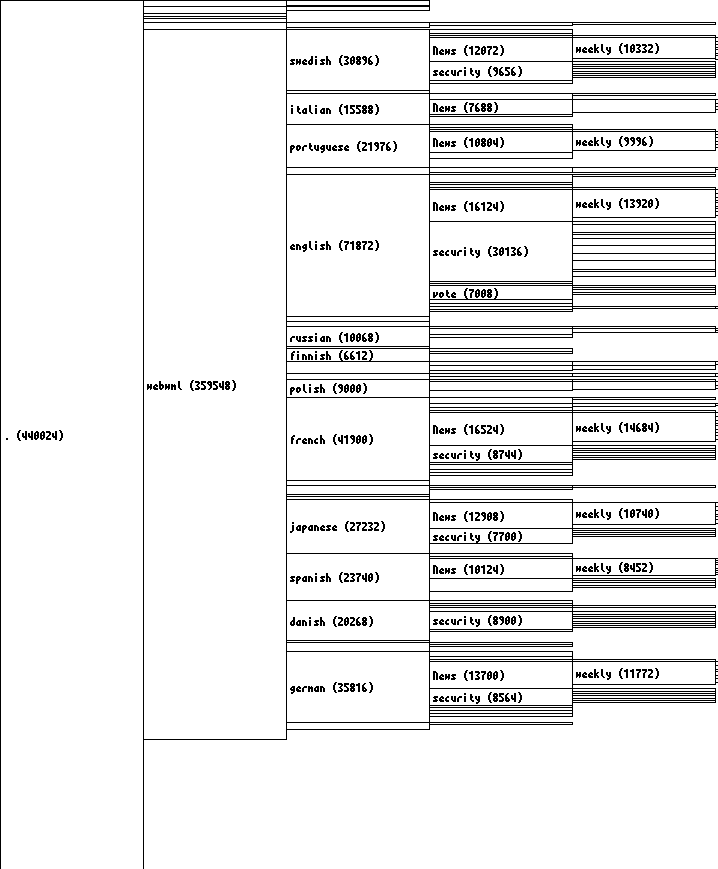
You probably all know du from GNU Coreutils. But there s more than just du around in Debian. du xdu First there is xdu, which displays du output piped into it graphically, even if du is running on some other box with the output coming over an ssh connection:
$ du   xdu
$ ssh server-without-xlibs du some-directory   xdu
Clicking on any directory except the topmost zooms into that directory. Pressing n sorts by size and s toggles the display of sizes in numbers. xdiskusage xdiskusage seems to be a fork of xdu or at least shares some GUI code with it as it looks and behaves quite similar.
But the GUI looks nicer, more modern and you don t need to pipe the output of du into it. It collects the disk usage of a given directory itself. ncdu And then there is ncdu, the ncurses du . (It has nothing to do with the German party CDU . You can easily remember that as Not CDU . ;-) It shows you the disk usage of files and subdirectories in the given directory already sorted by size, optionally displaying also ascii art bars and/or percentage (by pressing g one or more times) for better comparision between file and directory sizes. And all easily and intuitively to navigate in an ncurses text-mode user interface.
ncdu 1.3 ~ Use the arrow keys to navigate, press ? for help
--- /home/abe/debian/webwml ------------------------------------
                             /..
   70.2MB [20.0% ##########] /english
   40.9MB [11.7% #####     ] /french
   35.0MB [10.0% ####      ] /german
   30.2MB [ 8.6% ####      ] /swedish
   26.6MB [ 7.6% ###       ] /japanese
   23.2MB [ 6.6% ###       ] /spanish
   21.5MB [ 6.1% ###       ] /portuguese
   19.8MB [ 5.6% ##        ] /danish
   15.2MB [ 4.3% ##        ] /italian
    9.8MB [ 2.8% #         ] /russian
    8.8MB [ 2.5% #         ] /polish
    6.5MB [ 1.8%           ] /finnish
    5.8MB [ 1.6%           ] /chinese
    4.4MB [ 1.3%           ] /catalan
    4.3MB [ 1.2%           ] /dutch
    3.7MB [ 1.0%           ] /korean
    3.4MB [ 1.0%           ] /ukrainian
    3.0MB [ 0.9%           ] /czech
    2.6MB [ 0.7%           ] /croatian
    2.6MB [ 0.7%           ] /bulgarian
    2.4MB [ 0.7%           ] /norwegian
    1.7MB [ 0.5%           ] /hungarian
    1.6MB [ 0.4%           ] /romanian
    1.2MB [ 0.3%           ] /greek
    1.2MB [ 0.3%           ] /turkish
    1.1MB [ 0.3%           ] /slovak
  576.0kB [ 0.2%           ] /Perl
  556.0kB [ 0.2%           ] /arabic
  428.0kB [ 0.1%           ] /lithuanian
 Total disk usage: 351.1MB  Apparent size: 351.1MB  Items: 70653                                                      
And yes, I uploaded the two screenshots shown above also to screenshots.debian.net as both tools had no screenshots available yet.

Axel Beckert: Useful but Unknown Unix Tools

Most of my talks are either talks about commandline basics (Commandline Helpers about GNU Coreutils and Findutils usage; Understanding Shell Quoting) or collections of small tips and tricks, e.g. about SSH, History Expansion, or commandline tools. Valentin Haenel called this second type of talks nugget talks . I like that term. My newest talk (German only so far, next occasion at the LUGS meeting in Zurich on 16th of December 2010) is such a nugget talk and is about useful but unknown tools. While preparing that talk I noticed that the amount of neat but less known tools I collected for possible inclusion into that talk would be enough for a whole day or so. I noticed that I ll never be able to give a talk about all that stuff. To not letting these tips rot in that file uncommented, I decided that I ll write (more or less) short blog postings about these tools, similar to and inspired by Myon s blog postings about Cool Unix Features as well as the no more existing or at least broken Debian Package of the Day and Debian Package a Day. While Myon mostly posted long-time but still unknown features, my postings will mostly cover useful but unknown packages available in Debian and most debian-derived distributions like grml and Ubuntu. Some postings may also just highlight some features of common tools or packages like e.g. GNU Coreutils. You can subscribe to these tips via RSS or just view all of them in your web browser at http://noone.org/blog/English/Computer/Debian/CoolTools/.

16 November 2010

Ingo Juergensmann: Frozen Squeeze, broken packages and bug reports

Squeeze is frozen for some time now and will be released when it's ready, of course. Currently, I have at least two packages that have reported bugs, but it seems that they are making no progress. The first package is BackupPC.One of the bugs is #600654 and the other is #601843. Where as the first is just a cosmetic bug displaying filesystem usage of the backup volume, the other seems to have a functional impact: the backup pool doesn't get cleaned up properly each night. Sadly the maintainer seems a little bit absent, so maybe someone else can do a NMU to get BackupPC into shape for release? Would be nice, though... ;-) The other package is spamassassin or more exactly libnetaddr-ip-perl and bug #601601. Whereas the BackupPC maintainer is rather quiet, there's lot of activity for the other bug but still I get these errors when running Spamassassin by cron:
netset: cannot include 0:0:0:0:0:0:0:1/128 as it has already been included
Although I'm confident that #601601 will be solved soon, I don't really know about the BackupPC bugs, except writing additional info mails to those bugs with "add me!" comment. UPDATE 17.11.2010:
libnetaddr-ip-perl (#601601) seems to be fixed now.

Andrew Pollock: [tech] The knock-on effects of buying a new TV

I'm considering replacing our 5 year old 32" TV with a 40" Sony Internet TV, largely "just because" it has Google TV. That and I have spousal approval to get a new, bigger TV (it just has to be wall mounted). The dilemma is MythTV. It's currently still running on the Dell Dimension 3100 that I bought years ago, and connected via VGA to the TV. The Sony Internet TV is HDMI or nothing, so at the very least, I need to get a DVI-capable video card in my MythTV box. The more or less natural choice would be an NVIDIA card, despite them having a closed-source driver. At least it's well supported under Linux. The problem is, as far as I can determine, NVIDIA cards require at least a 300 watt power supply, and the Dimension 3100 has only a 230 watt power supply. So now I'm looking at having to replace the MythTV box. I'm currently running the front end and the back end on the same box, so it'd be a fairly simple case of splitting the back end from the front end, and just getting something new to be the front end. So now I'm in the market for something small, low-power, has a HDMI (or DisplayPort) interface, and enough grunt for HD playback. I'm wondering if the Boxee Box is the solution. Interface-wise, it has HDMI, so I'm good there, and I believe the marketing claims it can do HD playback. I just don't know how hackable it is. I think it's running Linux, so in theory this should be doable, so long as there isn't some weird hardware in it with a binary-only driver. For the price, it's probably worth just getting one to see. The annoying thing is, I have nothing in the house that is DVI or HDMI capable, so I have no way of testing this out prior to buying the TV.

15 November 2010

Alessio Treglia: Bits from the Debian Multimedia Maintainers

This brief announcement was published in the debian-devel-announce mailing list and I repeat it here for your information.
Hi! Since there has been a lot happening in the Debian Multimedia world during the Squeeze release, so we figured we should give you an update on that. Who are we? In the dark old ages, there were two teams involved in multimedia: the Debian Multimedia and Debian Multimedia Packages teams. Please note that neither of them is related to debian-multimedia.org (which is maintained by Christian Marillat, and is known to break current ffmpeg-based applications like mplayer and vlc in Debian Squeeze.). During late 2008, both teams were merged into one, the Debian Multimedia Maintainers team, to avoid effort fragmentation. Since then, there has been a lot of work done: Consumer Multimedia in Debian Consumer Multimedia is about playing and, well, consuming multimedia. Squeeze will feature: Squeeze will not feature: Producer Multimedia in Debian Producer multimedia is software for producing multimedia. Squeeze will
feature: End user applications: Platforms and technologies: Squeeze will not feature: Debian Multimedia Blend There is also an effort to start a Debian Multimedia Blend to give a better overview about what multimedia applications are available in Debian. There is a short list for a quick overview as well as a long package list separated in sections to give a more detailed overview (including translations, screenshots, popularity of package etc). You are invited to help improving the tasks either directly in SVN or by sending patches to Andreas Tille <tille@debian.org> or debian-multimedia@lists.debian.org (see below). Note that not all of the packages listed in the tasks pages are maintained by the Debian Multimedia team, since they are aimed at producing useful package sets instead of showing only our own packages. For those who want to squash some bugs in multimedia packages there is also the bugs page generated by the Blends tools, or our team bug page. Other activity The team has seen a lot of growth since the merger. Of the current 52 members of the Alioth team, 20 were added during 2009 and 18 in 2010, many of whom are involved in upstream development as well as the debian packaging. The number of packages has also grown, with 112 of the current 205 git repositories in our team area having its first commit during 2010. Where to reach us The Debian Multimedia Maintainers can be reached at pkg-multimedia-maintainers@lists.alioth.debian.org, should you have any questions. We have also decided to repurpose the old debian-multimedia@lists.debian.org address for user and more general discussion. We would like to invite everyone interested in multimedia to join us there. Interested developers/packagers can also join us at the first address. Some of the team members are also in the #debian-multimedia channel on OFTC.

Regards,

Alessio Treglia on behalf of the Debian Multimedia Maintainers

Manoj Srivastava: Manoj: Dear Lazyweb: How do you refresh or recreate your kvm virt periodically?

Dear Lazyweb, how do all y all using virts recreate the build machine setup periodically? I have tried and failed to get qemu-make-debian-root script work for me. Going through and redoing it from netinst ISO is an option but then I need debconf preseeding files, and I was wondering if there are some out there. And then there is the whole Oh, by the way, upgrade from Squeeze to Sid, please step. The less sexy alternative is going to the master copy and running a cron job to safe-upgrade each week, and re-creating any copy-on-write children. Would probably work, but I am betting there are less hackish solutions out there. First, some background. It has been an year since I interviewed for the job I currently hold. And nearly 10 months since I have been really active in Debian (apart from Debconf 10). Partly it was trying to perform well at the new job, partly it was getting permissions to work on Debian from my employer. Now that I think I have an handle on the job, and the process for getting permissions is coming to a positive end, I am looking towards getting my Debian processes and infrastructure back up to snuff. Before the interregnum, I used to have a UML machine setup to do builds. It was generated from scratch weekly using cron, and ran SELinux strict mode, and I used to have an automated ssh based script to build packages, and dump them on my box to test them. I had local git porcelain to do all this and tag releases, in a nice, effortless work flow. Now, the glory days of UML are long gone, and all the cool kids are using KVM. I have set up a kvm box, using a netinst ISO (like the majority of the HOWTO s say). I used madduck s old /etc/networking/interfaces set up to do networking using a public bridge (mostly because how cool his solution was, virsh can talk natively to a bridge for us now) and I have NFS, SELinux, ssh, and my remote build infrastructure all done, so I am ready to hop back into the fray once the lawyers actually ink the agreements. All I have to do is decide on how to refresh my build machines periodically. And I guess I should set up virsh, instead of having a shell alias around kvm. Just haven t gotten around to that.

14 November 2010

Marco d'Itri: Other people's ethics and tastes

In the last years I noticed a growing trend of people pushing for "new" rules about what is appropriate or not for single developers or for the project as a whole. In too many cases even just considering these ideas to be an obvious fact... I prefer to not give specific examples because these would divert the attention from the main topic and would be affected by my own biases. At this point I believe it is useful to remember that all ethical issues which are not explicitly covered by the Social Contract are just the developers' own opinions. It may even be a good idea, but other developers are not and should not be compelled to agree with it no matter how good or important you believe it is. You are entitled to having your own ethics and even ranting about it on Planet Debian, but I am entitled to not caring at all without this making me a worse Debian Developer. Let's try to be grown ups and not be excessively annoyed by other people's choices. This is why I want to convey this simple message to the people who keep preaching about what is proper for me or for Debian: please fuck you. If I want to receive lectures about what is right or wrong then I surely know where I can find a priest. For some reason, now I see fit to mention that I have an Amazon wishlist...

11 November 2010

Matt Zimmerman: Back to the future

In my professional role as Ubuntu CTO, I take on a number of different perspectives, which sometimes compete for my attention, including: My recent work, as Canonical has gone through a period of organizational growth and change, has prioritized the inward perspective. I took on a six-month project which was inwardly focused, temporarily handing off many of my day-to-day responsibilities (well done, Robbie!). I ve grappled with an assortment of growing pains as many new people joined Canonical over the past year. With that work behind me, it s time to rebalance myself and focus more outside of Canonical again. It s good to be back! In my outward facing capacity, I ll shortly be attending Web 2.0 Summit in San Francisco. I attend several free software conferences each year, but this is a different crowd. I hope to renew some old ties, form some new ones, and generally derive inspiration from the people and organizations represented there. Being in the San Francisco Bay area will also give me an opportunity to meet with some of Canonical s partners there, as well as friends and acquaintances from the free software community. With my head down, working hard to make things happen, it s easy to lose perspective on how that work fits into the outside world. Spending more time with people outside of Canonical and Ubuntu is an important way of balancing that effect. Looking forward, I ll be thinking about the longer term direction for the Ubuntu platform. The platform is the layer of Ubuntu which makes everything else possible: it s how we weave together products like Desktop Edition and Server Edition, and it s what developers target when they write applications. Behind the user interfaces and applications, there is a rich platform of tools and services which link it all together. It s in this aspect of Ubuntu that I ll be investing my time in research, experimentation and imagination. This includes considering how we package and distribute software, how we adapt to technological shifts, and highlighting opportunities to cooperate with other open source projects. My primary outside-in role is as chair of the Ubuntu Technical Board. In this capacity, I m accountable to the Ubuntu project, the interests of its members, and the people who use the software we provide. Originally, the TB was closely involved with a range of front-line technical decisions in Ubuntu, but today, there are strong, autonomous teams in place for the most active parts of the project, so we only get involved when there is a problem, or if a technical question comes up which doesn t fit the charter of an established team. It s something of a catch-all. I d like to re-establish the TB in a more central role in Ubuntu, looking after concerns which affect the project as a whole, such as transparency and development processes. I m also re-joining Debian as a non-uploading contributor, to work on stimulating and coordinating cooperation between Debian and Ubuntu. I m looking forward to working more with Zack on joint projects in this area. This change will help me to support Canonical and Ubuntu more effectively as they continue to grow and change. I look forward to exercising some mental muscles I haven t used very much lately, and facing some new challenges as well.

Steve Kemp: The pain of a new IP address

Tonight I was having some connectivity issues, so after much diagnostic time and pain I decided to reboot my router. At the moment my home router came back my (external) IP address changed, and suddenly I found I could no longer login to my main site. Happily however I have serial console access, and I updated things such that my new IP address was included in the hosts.allow file. [*] The next step was to push that change round my other boxes, and happily I have my own tool slaughter which allows me to make such global changes in a client-pulled fashion. 60 minutes later cron did its magic and I was back. This reminds me that I let the slaughter tool stagnate. Mostly because I only use it to cover my three remote boxes and my desktop, and although I received one bug report (+fix!) I never heard of anybody else using it. I continue to use and like CFEngine at work. Puppet & Chef have been well argued against elsewhere, and I'm still to investigate BFG2 + FAI. Mostly I'm happy with slaughter. My policies are simple, readable, and intuitive. Learn perl? Learn the "CopyFile" and you're done. For example. By contrast the notion of state machines, functional operations, and similar seem over-engineered in other tools. Perhaps thats my bug, perhaps that's just the way things are - but the rants linked to above makes sense to me and I find myself agreeing 100%. Anyway; slaughter? What I want to do is rework it such that all policies are served via rsync and not via HTTP. Other changes, such as the addition of new primitives, don't actually seem necessary. But serving content via rsync just seems like the right way to go. (The main benefit is recursive copies of files become trivial.) I'd also add the ability to mandate GPG-signatures on policies, but that's possible even now. The only step backwards I see is that currently I can serve content over SSL, but that should be fixable even if via stunnel.
*
My /etc/hosts.allow file contains this:
ALL: 127.0.0.1
ALL: /etc/hosts.allow.trusted
ALL: /etc/hosts.allow.trusted.apache
Then hosts.allow.trusted contains:
# www.steve.org.uk
80.68.85.46
# www.debian-administration.org
80.68.80.176
# my home.
82.41.x.x
I've never seen anybody describe something similar, though to be fair it is documented. To me it just seems clean to limit the IPs in a single place. To conclude hosts.allow.trusted.apache is owned by root.www-data, and can be updated via a simple CGI script - which allows me to add a single IP address on the fly for the next 60 minutes. Neat.
ObQuote: Tony is a little boy that lives in my mouth. - The Shining

10 November 2010

Lior Kaplan: Linus fixes a sound bug ?

Well, kinda. Just follow the comments on this bug report regarding a sound problem in Fedora 14. A user reported about not being able to get mp3 play smoothly and a few other confirmed the issue with Fedora 14. Tests pointed at the kernel or sound driver. A user (Michael Young) and the Linus him self proved this wrong. and Michael found out it caused by a feature in glibc. From there Linus provided a work around till the glibc guys will fix the issue (and as for now they claim it s not a bug). I m sure the user who opened the bug reported didn t expect this whole chain of events it s quite amazing.
Filed under: Fedora

Next.

Previous.