Today, I released Lintian 2.5.19. It is mostly a bug-fix release, but it also features a new tag. The new tag, homepage-in-binary-package, is emitted for packages where the source package has no Homepage-field, but one of its binaries do. The problem is that some tools (e.g. the PTS) only processes the data from the .dsc files (or Sources indices from the mirrors) and would in these cases miss the Homepage of the page.
We now also carry a work around for a bug in tool, t1disasm, where it ends up in an infinite recursion (i.e. until the C call stack overflows). That issue is filed as #724571. The work around is to prevent Lintian from exiting with a failure (which causes packages to be auto-rejected when uploaded to Debian archive). These problems are currently reduced to a warning on stderr.
In other (Lintian related news), the full run was completed yesterday after only 4 days (rather than the 8, I expected). While that is a pleasant surprise, I cannot find any changes in Lintian since the last run that would explain this difference. My current conjecture is that our last pseudo full run (when we added amd64) included more processing since the amd64 packages would not have any pre-collected information.
With the follow up run to catch packages uploaded after the full run, Lintian spent a little more than 3 and half days (~86.5 hours) processing about 20700 package groups. This gives an average of about 240 groups an hour (or ~4 a minute). Though, remember these numbers include some data having been pre-collected from previous run on the majority of packages.
Just saw this ad today at my Institute's door. Rough translation:
Interim programmer sought
Requisites:
High school
One year of experience
Theorical and practical exams on the area
Familiarity handling electronic equipment, such as computers, perforators/punchers, terminals and similar.
[Yes, this is a joke post. I don't know how anybody is using such an obsolete job description. A job description at least three decades out of date]
[Well, yes, I understand it, because I knowhow that particular union works. But I cannot accept it is for real]
[...And no, please don't apply for the job. You will be miserable in the unlikely event you are chosen]
As a maintainer of several software packages I often find myself copying text snippets from the README file into different places (savannah, github, freecode, emails, etc). Recently I had a need to generate a list of software packages that included every project s name, brief summary, license and URL. I could have generated that list manually by copying the text from every project s README and COPYING files. However then I would have to maintain my list manually to keep it in sync with all the projects. This easily leads to stale information, so I thought a better approach would be to put the information I needed into each projects source code version control system. The advantage is that the manual work to extract the information may be automated by a script, since the data is in a usable format. I ll explain here how my solution works.
To be able to find the information using only the URL to the repository, I needed a filename convention. The filename I chose was BLURB; for the etymology, see Wikipedia s page about Blurb. The data format in the file is similar to normal email headers.
An example illustrate the principles well. Below is the BLURB file for one of my projects.
Author: Yubico
Basename: libyubikey
Homepage: http://opensource.yubico.com/yubico-c/
License: BSD-2-Clause
Name: Yubico C low-level Library
Project: yubico-c
Summary: C library for manipulating Yubico YubiKey One-Time Passwords (OTPs)
The format is simple: UTF-8 text with each line starting with a header followed by a colon ( : ), some whitespace, and some content. If a line starts with whitespace, it is a continuation of the previous line s content (trim leading whitespace). The following table describes the fields that I use. I may update this blog post in the future with new fields or improved explanations (for reference, current date is 2013-09-24).
Header
Meaning
Project
Short identifier for the project (e.g., gcc , emacs )
Name
Official name of the project in English
Summary
Brief one-line summary of the project s purpose in English
The tarball basename, if different from the project name
Finally some reflection of the solution. After quick design, I thought that I couldn t be the first one with this problem, and I tried to find other similar efforts. I haven t been able to find any standardization effort that have the following properties:
Stores the information inside each upstream project s own source code repository
Provides a filename convention so that it is possible to find the data with only the source code repository link
Encode data in a format that is easy to extract using simple command line tools
Not encode information about releases (i.e., what happened in a particular version)
The related efforts that I found were SPDX which at first look seemed to offer what I wanted. However on closer examination it failed to deliver on all the requirements above, and appeared to have somewhat different goals. However I found the SPDX license list useful and refer to it. Another effort is Eric S. Raymond s freecode-submit and shipper but its primary focus is to encode information about each release. The design of the BLURB file is clearly influenced by these tools. Another influence has been Debian s specification for machine-readable copyright information. The Free Software Foundation s list of software projects seemed like another candidate, but it doesn t suggest any way to store the information in the upstream project itself.
This is my final report :) the GSoC was great, I learned a lot about
the Hurd and Mach programming in general. I am also very pleased to
announce that I reached my initial goal and almost all of my patches
already made it upstream and into Debian :)
I spent my last week fixing issues I introduced
and splitting up /hurd/init into two programs. This
would make it possible to integrate the patch that frees PID 1 for
sysvinit into the Hurd upstream sources. I didn't quite finish the
separation, but my proof of concept works and I will finish this as my
next Hurd project.
Looking back at the last fourteen weeks, I accomplished the following:
I implemented /proc/mounts, umount, freed up PID 1 for sysvinit, fixed
ifupdown, sysvinit and initscripts on Hurd, implemented a
proof-of-concept cgroupfs and fixed many small issues along the
way. Almost all of my patches are already upstream and in Debian, a
Debian/Hurd booting using sysvinit is just a few uploads away.
It has been a lot of fun and I will definitively see you around :)
Justus
A common theme that comes up in free software evangelism is the question of how to tap into the huge expenditure that small to medium-sized businesses make for off-the-shelf licensed software. It is well known that many small companies are paying over the odds compared to the site-license rates given to big business, so why is it that small businesses are not rushing to adopt free and open source solutions?
The answer is not likely to be found by fighting a battle on pricing (even though it is a battle that free software is inherently well prepared for). Rather, the most compelling strategy involves helping businesses find better ways to solve their own problems.
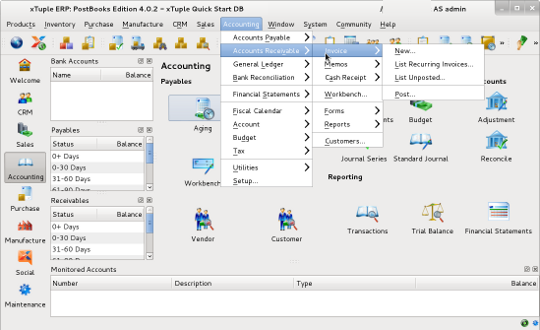
A problem that every business encounters in every industry is the maintenance of proper financial records. Up until now, packaged solutions like GnuCash and HomeBank, available in many Linux distributions, have only catered for the smallest businesses and household accounting. At the other end of the spectrum, solutions like Compiere/Adempiere and OpenERP require a level of effort to install and maintain that makes them unsuitable for small users and businesses that don't need their full range of features. OpenERP briefly appeared as a Debian package but subsequently dropped out due to difficulties supporting the package.
There is another choice, PostBooks. PostBooks has recently been packaged for Debian and this experience leads me to believe it will be supportable in Fedora and other distributions too. PostBooks, which started off as a commercial product, was re-licensed as an open source solution in 2007. In March 2013, PostBooks was project of the month on Sourceforge.
Of particular note,
PostBooks has a Qt-based GUI where users of equivalent commercial solutions are likely to feel comfortable very quickly
PostBooks does not depend on any dedicated server processes other than a PostgreSQL database
Using the quickstart database, it can be set up in less than half a day, making it suitable for many consultants and freelancers who may otherwise use a product having a setup wizard (such as QuickBooks).
However, with features like inventory, invoicing, a sophisticated data import GUI (known as CSVImp), a true SQL backend, multi-currency and multiple concurrent users, it scales beyond the use cases that Quickbooks and Sage Accounting are capable of servicing.
The company behind PostBooks, xTuple, is well established and offers related services such as training and an annual user conference (which takes place in just a few weeks). Many business users are likely to find this style of support very reassuring and familiar, even if they don't plan to immediately take advantage of these things.
Limitations
Two particular limitations caught my attention early when evaluating PostBooks:
There is no integrated support for tracking credit card expenditure, which is another very common requirement for many small businesses and professional/freelance consultants.
The developers have acknowledged these limitations and offered to complete these solutions with a crowd-funding campaign dubbed Feature Mob 2.
While everybody likes a free lunch, I personally feel that developers are perfectly entitled to request payment for their work. Having already taken a great leap of faith in open-sourcing a product that had previously been developed in-house, companies like xTuple need to look at new ways to generate revenue.
Having looked at some of the prices of equivalent solutions, I felt quite comfortable pledging a similar amount based on four things:
it is based on the Kickstarter model, they only keep the money if their funding target is reached and feature implementation goes ahead
they are releasing the work as open source
the desire to have the option of using a highly capable free software solution that will be around well into the future
the probability that this is one piece of software that is likely to create more commercial opportunities for free software developers
Next steps
People trying the packages and people who potentially want to package PostBooks for other distributions are very welcome to come and ask questions in the xTuple Debian maintainers packaging list or using the xTuple web forums. Please also feel free to report bugs through the Debian bug tracker.
The third lesson of the Arte y cultura en circulaci n: crear y compartir en tiempos digitales course was quite easy, at least for me, as it's one of the topics I've been involved with for a long time: Authors' rights and ways to exercise them.
This lesson starts by talking about the paradoxes created in the reality beneath copyright mostly due to the zero-cost-for-perfect-copy reality we live in today, and then goes on to introduce the most widely spread licensing schemes for cultural works nowadays: The Creative Commons licensing schemes.
What I felt very interesting is that the lesson tackles the most common issues raised by authors choosing CC licensing: The Non-Commercial and Non-Derivatives restrictions. While authors are usually not very hard to convince about the virtues (and their personal benefit) in CC licensing, it's usually hard for authors to accept and relinquish the "locks" on non-derivability and non-commercial-use.
Now, as to the homework: This time, I have to admit it was a no-brainer to me. The homework was to take part of a "Licenciat n": Publish some work under a open or free license (a work of any kind; it can be text, photo, video, etc.; it can be a new or a pre-existing work) and argue as to why did you choose said license.
Even the act of writing this blog post means I'm releasing some work. The bottom of my blog reads, All the material found at this site is freely available, and you can use it as you wish, except when the document mentions explicitly different conditions. Yes, this is not a widely known, preexisting licensing scheme, and more or less goes along the lines of CC0 There are some good things I have posted in this blog, some things I am proud about. This post goes more towards the average quality: Not adding anything of great value to the world, just reiterating/reposting what is already said. But I know this blog is syndicated over several different places, and its content might be copied over to other places. I don't need to know or be notified about it. I just care for people to be able to reach back if they want to do it.
But, of course, if I'm asked to do a homework, I prefer not to have it so self-referential. What else to license?
We are over halfway across the Wiki Loves Monuments contest for 2013. This year I am clearly not as active on it as I was last year, but yesterday I uploaded about 60 photos from our recent trips, from historical monuments in some towns/cities within ~150Km of Mexico City: Puebla, Tlaxcala, Cacaxtla, Toluca, Santiago Tianguistenco. I intend to upload more. Those photos are licensed CC-BY-SA. Why? Mainly, because it is the defaul for the contest. One of the lessons learned working on Debian is that the less the license I choose deviates from what the upstream authors of a larger project prefer, the more useful my work will be. And being Wikimedia a host of many related projects, I prefer to completely abide by their recommendations unless there is a real, strong reason not to do so.
Also, I know that at least most the photos I am uploading are not of contest quality (although some are quite nice, but we don't take that long to take a shot, and our camera is probably too basic to get a quality shot, if not by mere chance). I am using the WLM contest as an excuse to categorize and upload my pictures Of course, I'm not including personal photos, but... If I found a building, place or landscape interesting enough to take a photo of, why not make said photo available for whoever needs it, in a canonical, easy to reach media repository (as Wikimedia Commons) is)?
And finally, I think it's time to start getting more open and forward-going with a project that I have been giving a lot of work during the past year, a project that has been even eating quite a bit of my Debian time: My upcoming book. While this book is not yet freely licensed (it is freely distributed online, but does not yet have an explicit license, and I mention it on my teaching/project page. Why? Because it still has some figures and data which are not mine, and which I have to re-elaborate to be able to legally license it.
But anyway I am writing a book on the subject of Operating Systems, and am basing my teaching on it. The first semester was basically hell for me, as I was working almost full time on it, and needed to allocate some time as well to the rest of my formal work. This second semester has been quite smoother. And there is a very important (to me) initiative to which I (or should I now start saying, we) submitted this work: The LATIn Project: An initiative to collaboratively create quality, freely redistributable text books for the university level, natively in Spanish, for their use in Latin American countries.
I was not able to propose this book due to some formalities Projects have to be proposed by professors in participant universities, and UNAM is not one of them. However, I offered this work to people in the Universidad Nacional de Rosario, Argentina, and they managed to push the project forward. Together with people from Universidad Aut noma de Aguascalientes (M xico) and Universidad del Cauca (Colombia), the project was approved by LATIn.
And this LATIn project can also be seen as a why do you agree to license your work this way? candidate: I have already written most of what I'd be happy to call a full book. Of course, I do expect my colleagues to chime in with more content, and I expect us to produce a true collaborative project. But as I am not part of the member universities, they will get paid for their contribution And not me. What do I have to gain from this?
More than anything else, the circulation of my work. I'm sure that, were I to publish from UNAM, I would have a good projection. I was (am!) thinking of looking for opportunities to present the book to teachers on the subject, as well as to computing engineering/science students, but the most attractive part (for me) for LATIn is that part of the prize will be that the book will be used to base work on for teaching at least during 2014 in the three said universities And of course, my/our work will only start then, as we will have to further circulate the work.
Anyway... I expected this post to be small. But as you can see, I am happy with important work perspectives :-)
One of the earlier examples of students using MIT computer resources
to lay the groundwork for a later commercial endeavour, Zork was
originally written in a LISP derivative called MDL.
This was later tuned into the Zork Implementation Language, a domain
specific language that was compiled to target the Z-machine rather
than a specific piece of hardware. Combined with machine-specific
Z-machine interpreters, this allowed rapid porting of games to a wide
range of platforms - the only thing that needed to be rewritten was
the interpreter, and that could be reused for any future games running
on the same hardware.
Infocom were eventually acquired and killed off, but fan interest in
their games continued. New Z-machine interpreters were written in
order to allow their games (including Zork) to be run on platforms
that Infocom had never targetted. One of the best known is Frotz. This has the advantage
of being (a) portable and (b) including a "dumb" UI that makes no
assumptions about the availablity of any vaguely useful
functionality. Like, say, a Curses library.
So, Frotz seemed like the natural choice when this happened. But despite having a set of functionality that makes it look much
more like an OS than a boot environment, UEFI doesn't actually expose
a standard C library. The EFI
Application Development Kit solves this particular design
decision. Porting Frotz ended up involving far more fixing up of Frotz
bugs that tripped up -Werror than anything else. One note, though -
make sure you include DevShell in the list of required packages at
build time, otherwise file i/o will mysteriously fail.
The tying of file i/o to the shell protocol unfortunately means that
Frotz can't be directly launched by the firmware. The Boot to Zork images
therefore contain a UEFI shell in the standard boot location
(\EFI\BOOT\BOOTX64.EFI) which is executed when the firmware attempts
to boot the device. The shell then looks for a file called
"startup.nsh" in the root directory of the boot device and executes
it. Unfortunately this doesn't actually set the shell equivalent of
the current device, and so just launching Frotz from startup.nsh fails
when Frotz can't open the Zork data file. The solution for this is
simple, if ugly - the script walks through the list of devices,
looking for one that contains ZORK1.DAT in the root directory. It then
changes to that device and launches Frotz. If Frotz exits, it then
resets the system.
This could be avoided by doing some more work and turning Frotz into a
more UEFI-native application. Teaching Frotz to make native UEFI calls
would avoid the requirement for the shell protocols, and the firmware
provides a mechanism to obtain the path of the currently running
executable which would avoid the need to explicitly locate the
device. But I'm lazy and this was a "I'm spending the day on a plane"
project initially inspired by a Sazerac-fuelled conversation during
the UEFI plugfest, not a demonstration of UEFI best practices.
UEFI Boot To Zork and the source code to the modified Frotz can be downloaded here.
Today I had to pleasure of releasing Lintian 2.5.18.1. It is a minor bug fix release on top of Lintian 2.5.18 (which I also released today ). When I was about to deploy the new version of Lintian on lintian.debian.org, I noticed a couple of errors in the log file that smelled of bugs. Indeed, when I investigated them I found two bugs, which were both introduced in Lintian 2.5.17.
Due to another bug in 2.5.17 and the some of the false-positives fixes, we are now doing a full run on lintian.debian.org. After having run for 7 hours, Lintian passed cipux . My rough estimate suggests that it will take 8 days at the current rate. For comparision, when we added amd64, Lintian spent 5 days processing all the new binaries (plus their source and the old binaries built from those source packages).
Of course estimate is rather rough. In particular, I am not sure that the heavy duty groups (e.g. linux and libreoffice) are evenly spread out among the letters of the alphabeth. Anyhow, there will be no updates on lintian.debian.org for the next week or so.
Today I finally pushed out a new binary release of my slaughter server-automation tool. (Think "CFEngine-lite", with perl. full documetnation is available. Though nobody ever reads it.)
Otherwise the weekend is being quiet; we spent last night mostly drinking vodka, until midnight rolled over, and along with some messing around with a camera ("Wow, your arms are getting bigger!")
Today has consisted of a Turkish breakfast, an Indonesian dinner, and an ice-cream based tea.
I could write more, but I'm hung-over. A rare thing for me.
Review: Throne of the Crescent Moon, by Saladin Ahmed
Series:
Crescent Moon Kingdoms #1
Publisher:
DAW
Copyright:
January 2013
ISBN:
0-7564-0778-8
Format:
Mass market
Pages:
367
Doctor Adoulla Makhslood is the last ghul hunter in Dhamsawaat. He's an
old man, and tired, and increasingly uncertain whether he wants to
continue putting his life in danger to fight one more fight. But there
are no replacements; his young and idealistic dervish apprentice, despite
obvious skill, is too inexperienced and uninterested in the knowledge and
investigation that makes Adoulla so good at what he does. So, when a
young boy shows up on his doorstep, a survivor of a vicious ghul attack,
he goes hunting once again. And both finds something much darker and
stronger than he expected and meets an unexpected ally: a shape-shifting
girl who is herself a survivor of something far worse than ghuls.
Throne of the Crescent Moon is a first-novel fantasy that has made
quite a splash, including a Hugo nomination (although I thought a win was
unlikely, and I was right). One of the more interesting comments I've
read about it was the observation by
Jo Walton that if it had come out in 1980, it would have been an
amazing, unusually wonderful, non-normative book. That it isn't is
evidence of the changes in fantasy since then. The field has grown.
As you might guess from the publisher's insistence on comparing it with
The Arabian Nights, and from the names mentioned above, this book
is set in an unspecified Middle Eastern culture and draws heavily from its
mythology. It does not contain any western characters; the entire story
is native to its region. The same is true of the mythology, which gave it
a refreshing originality for me. And while I'm not the best one to judge,
the presentation of that setting seemed free of the tint of the exotic.
People live here, there are factions and multiple cultures, and the
supernatural is a backdrop to most of the city.
This would be very unusual decades ago. It's a bit less unusual now, and
the story itself is a familiar ensemble fantasy, if refreshingly free of
extended map exploration journeys. Ahmed brings together five characters
with very different backgrounds and throws their varying talents at a
problem. A few of those elements are a bit too familiar: female
sexuality as a threat to male power is a world-building element that I
could do without, for example. I also found the villain completely
inadequate in its unidimensional evil (reinforced with a few more torture
scenes than I needed to read), and even the attempted complication felt
too predictable to me.
Except for one touch of perspective, I'd call Throne of the
Crescent Moon a competent, enjoyable, but somewhat forgettable fantasy
novel, albeit one that's refreshingly concerned with a city instead of
countrysides and travel. That touch is in the age of several of the
protagonists. We get sections following several of the main characters
in tight third person, but Adoulla is the first protagonist and the focus
of much of the book. And Adoulla is neither young nor inexperienced,
and is not going through the typical fantasy bildungsroman.
He's old, experienced, a bit set in his ways, cranky, cantankerous, and
deeply in love with his city. In tone, this shifts the story towards
Star Wars as seen through the eyes of Obi-Wan Kenobi instead of
Luke Skywalker. And that change I really liked, and would be happy to see
become more common in fantasy.
There was a bit of a downside for me in three of the five main characters
being older. At times, Throne of the Crescent Moon has an elegiac
tone, a feeling of life, power, and time slipping away and cultures and
ways of life being lost. That's not my favorite thematic element. I tend
to find it more depressing than I really want in my reading. But, here,
the mature perspective more than makes up for some occasional negativity.
I particularly liked how the older characters treated the likely budding
young romance, which would have been the center of many books in this
genre, with bemused detachment and playful encouragement without giving it
more significance than it deserves. There's another romance that ends up
being more significant, and which needs the weight of time and well-lived
lives to become so.
I don't think this book deserves a Hugo, but it is an enjoyable fantasy
with some interesting characters and a refreshing perspective and setting.
The villain really isn't adequate to the story, there's a bit too much
torture for my liking, and I could have done without a few of the tropes,
but it's a solid entry in its genre and a pleasant few hours of reading.
And despite being advertised as the first of a series, it comes to a
satisfying conclusion.
Rating: 7 out of 10
On a regular basis, I find myself the odd-man-out when it comes to talking
about how to work with Python on Debian systems. I'm going to write this and
post it so that I might be able to point people at my thoughts without having
to write the same email in response to each thread that pops up.
Turns out I don't fit in with the Debian hardliners (which is to say, the
mindset that pip sucks and shouldn't exist), nor do I fit in with the Python
hardliners (which is to say apt and dpkg are out of date, and neither have
a place on a Development machine).
I think our discourse on this topic has become petty and stupid in general.
Let's all try to step back and drop a bit of the attitude.
pip doesn't suck, and neither does apt.
The truth is, both sides are wrong. As with any subject, the real
answer here is much more nuanced than either side presents it. I'm going to
try and present my opinion on this, in the way that both my Pythonista self
and my Debianite self see the issue. Hopefully I can keep this short, to
the point, and caked with logic.
The case for dpkg (the Debianite in me)
In defense of dpkg and apt, imagine having to install python-gnome2
on all your systems when you install. It'd be hell on earth.
Imagine having a user try to do this. It's insane to assume that
end-users will be using pip for this purpose.
pip is fun and all, but it's also installing 100% untrusted code to your
system (perhaps as root, if you're using pip with sudo for some reason),
and hasn't been reviewed for software freeness, which is something Debian
(and Debian users) take seriously. This isn't even to mention the hell that
pip wreaks on dpkg controlled files / packages.
Try to remember how much of your system running (yes, right now) is running
because of Python or Python modules. Try to imagine how much of a pain in
the ass it'd be if you couldn't boot into GNOME to use nm-applet to connect
to wifi to pip install something. I'm sure even the most extreme pip'er
understands the need for Operating System level package management.
Debian also has a bigger problem scope - we're not maintaining a library
in Debian for kicks, we're maintaining it so that end user applications may
use the library. When we update something like Django, we have to make sure
that we don't break anything using it (although, to be honest, the fact that we
package webapps is an entire rant for later) before we get to update it to the
newest release.
Hell, with a few coffees, I could automate the process of releasing a .deb
with a new upstream release, 100% unattended. I won't, however, since this is
an insane idea. Let's go over a brief list of things I do before uploading a
new package:
Review the entire codebase for simple mistakes.
Review the entire codebase for license issues.
Review the entire codebase for files without source, and track down
(and include source for) any sourceless files (such as pickle
files, etc).
Get to know the upstream, get to know open bugs, write something using
the lib, in case I need to debug later.
Install the package.
Test the package.
Work out any Debian package issues (this is easy).
Now, a brief list of things I do before I update a package:
Review the changes between the last uploaded version (in diff format, if
it's sane, otherwise get the VCS and review), ensure all the above are still
OK.
Review for Debian-local issues (such as how it will upgrade, using
piuparts, and adequate, etc).
Check to make sure it won't break any reverse dependencies.
Review for bugfixes that I might need to bring back to the stable release.
Figure out if I should (or even can) backport the package, if API is
stable.
Review for bugs (upstream or in Debian) that I need to mention in the
debian/changelog.
Clearly, this isn't a quick-and-dirty task. It's not a matter of getting a
package updated (technically), it's a much more detailed process than that.
This is also why Debian is so highly regarded for its technical virtuosity,
and why the
ISS decided to deploy Debian in space,
despite other commercial distros such as Red Hat, or Ubuntu, and
community distros, such as Fedora or Arch.
It's also not Debian's job to package the world in the archive. This is an
insane task, and it's not Debian's place to do it. We introduce libraries
as things need them, not because we wrote some new library that someone
may find slightly useful at some point in the future. maybe.
Upstream developers and language communities (not only Python here) tend to
lose sight of why we're doing this in the first place, which
is our users. This isn't some sort of technical pissing contest to see who can
distribute the software in the best way. Debian-folk always keep end users
as our highest priority.
I quote the
Debian Social Contract, when I say
that Our priorities are our users and free software. No one's trying to
get developers to use dpkg to create software. In fact, as you'll see
below, I actively discourage using system modules for development.
The case for pip (the Pythonista in me)
In defense of pip, the idea that Debian will keep the latest versions of
packages is insane. The idea that we can keep pace with upstream releases is
nuts, and the idea that every upstream release on pypi is ready to ship is
bananas. b-a-n-a-n-a-annas.
As a developer, I don't want to support every release, and I surely don't want
other people depending on some random snapshot.
Often times, I'll put stuff up on pypi as a preview, or to release often, and
solicit feedback without having to give out instructions on using a git
checkout (it's also easier to have them try a version from pypi so I can
cross-ref the git tag to reproduce issues when they file them)
pypi is easy, ubiquitous and works regardless of the platform, which means
less of my development time is spent packaging stuff up for platforms I don't
really care about (Arch, Fedora, OSX, Windows), even though I value
feedback from users on those systems. The effort it takes to release something
is limited to python setup.py sdist upload, and it's in a place (and in a
shape) that anyone can use it without having 10 sets of platform-local
instructions.
Even ignoring all the above, when I'm writing a new app or bit of code,
I want to be sure I'm targeting the latest version of the code I depend on,
so that future changes to API won't hit me as hard. By following
along with my dependencies' development, I can be sure that my code breaks
early, and breaks in development, not production. Upstreams also tend to not
like bug reports against old branches, so ensuring I have the latest code from
pypi means I can properly file bugs.
Lastly, I prefer virtualenv based setups for development, since I'm usually
working on many things at once. This often means version mismatches in
libraries, which brings in API changes (another whole rant here as well).
I don't want to keep installing and uninstalling packages to switch between
the two projects, and using a chroot(8) means a lot of overhead and that it's
disconnected from my development environment / filesystem, so I resort to
virtualenv to isolate my Development environment.
Final notes
I don't want to keep arguing about this. Just accept that the world's a big
place and that there exist use-cases that both apt and pip need to exist
and work in the way they're working now. At the very least, try and understand
there exist smart people on both sides, and no one is trying to screw anyone
over or keep their own little private club to themselves. Hopefully, going
forward, we can make sure that the integration between these two tools gets
better, not worse.
Help make this dream a reality. Contribute to a productive tone, not a
destructive one. In short:
Use pip without sudo always. Don't tell people to use sudo.
Use apt or dpkg when deploying system-wide.
Understand people are going to package, and they will be more concerned
about software using your library then keeping your library up to date.
Understand Debian Developers and package maintainers have to do a lot of
work when updating or sponsoring an upload.
Understand upstream developers can't be bothered to fix every issue
with every release (release early, release often) with some snapshot
you introduced into unstable.
Use pip and virtualenv in development setups, so we can upgrade your
app when we upgrade the lib.
I have just uploaded Lintian 2.5.18 to unstable. While fixing 22 bugs, it only features 5 new tags.
debian-changelog-has-wrong-weekday
debian-rules-missing-good-practice-target-dfsg
empty-udeb-package
file-name-in-PATH-is-not-ASCII
misplaced-extra-member-in-deb
The release also include fixes to some false-positives, such as python:any dependencies triggering python-script-but-no-python-dep, a rewritten README file. We also included a patch to make Lintian accept the Original-Maintainer field by default for non-Debian vendors (even if they do not have a profile and Lintian ends up loading the debian/main profile).
We also added support for running Lintian directly from a git checkout or source tree without setting LINTIAN_ROOT (or passing root). Since that was the primary use-case for root that option has now been deprecated. I also had lintian and lintian-info require the include-dir and [no-]user-dir options as the first if given at all.
I would like to thank Bastien Roucari s, Gaudenz Steinlin, Gunnar Wolf, J r my Bobbio and Lucas Nussbaum for contributing to Lintian and the many who submitted reports or suggestions for improvements. I would also like to thank Brian hugmeir Fraser, who assisted me in identifying and working around a bug in Perl s glob function when run under threads (filed upstream as RT#119897).
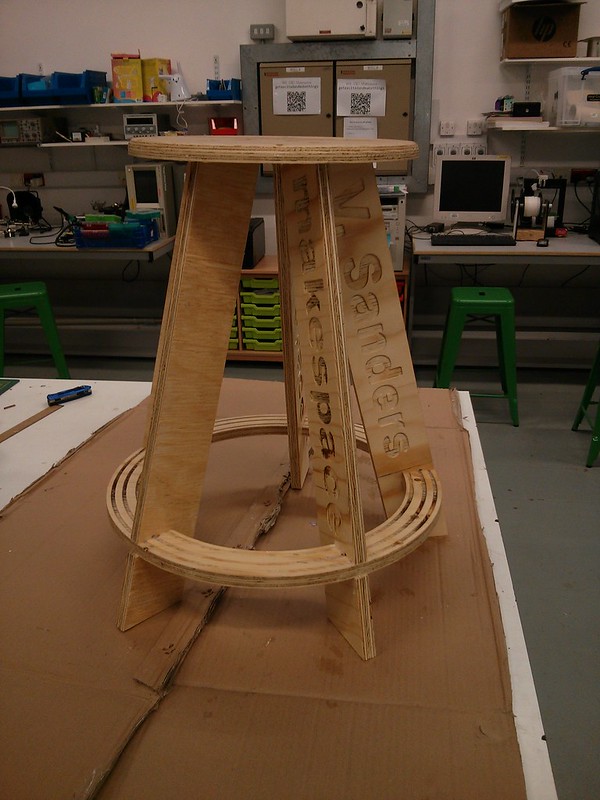
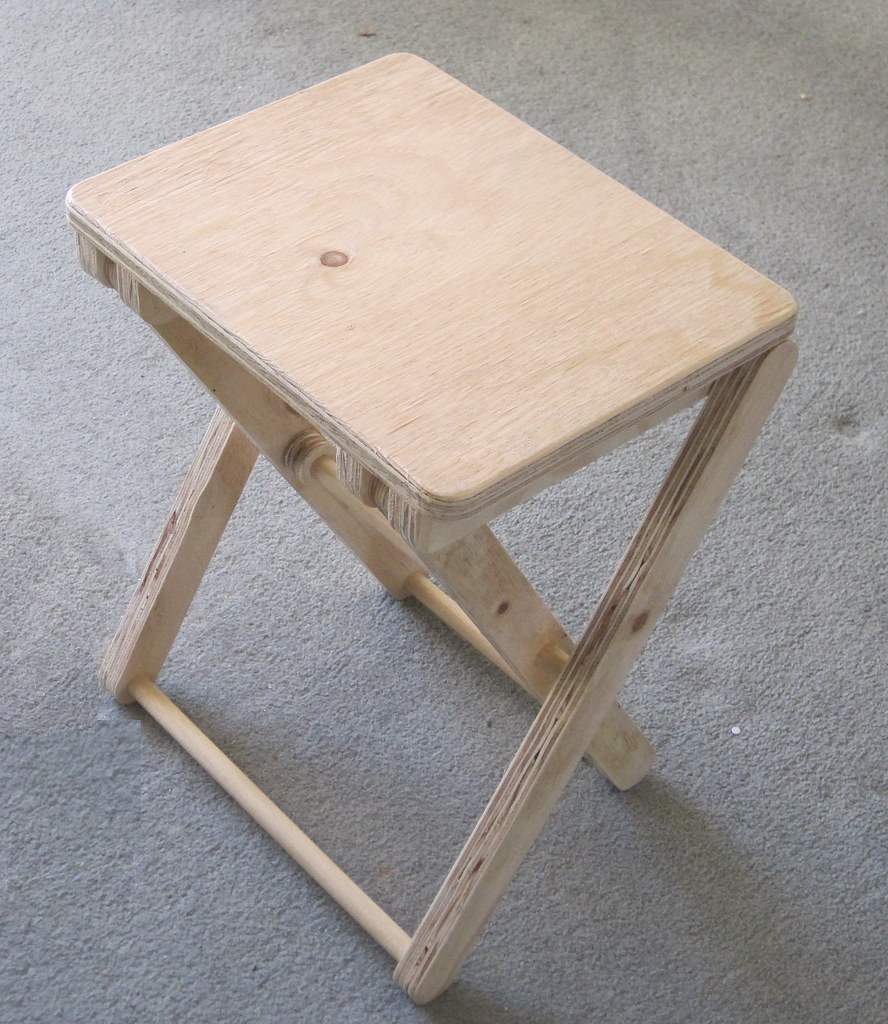
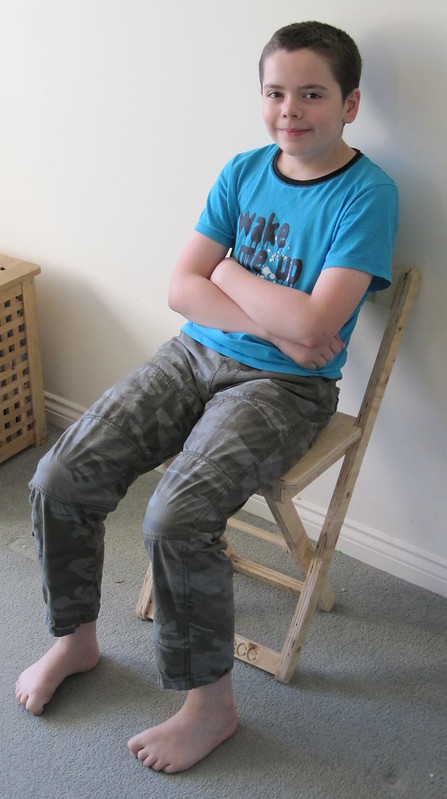
Well at least he should be according to Sartre though I am not entirely convinced the repercussions of my choice to manufacture another folding chair were entirely thought through.
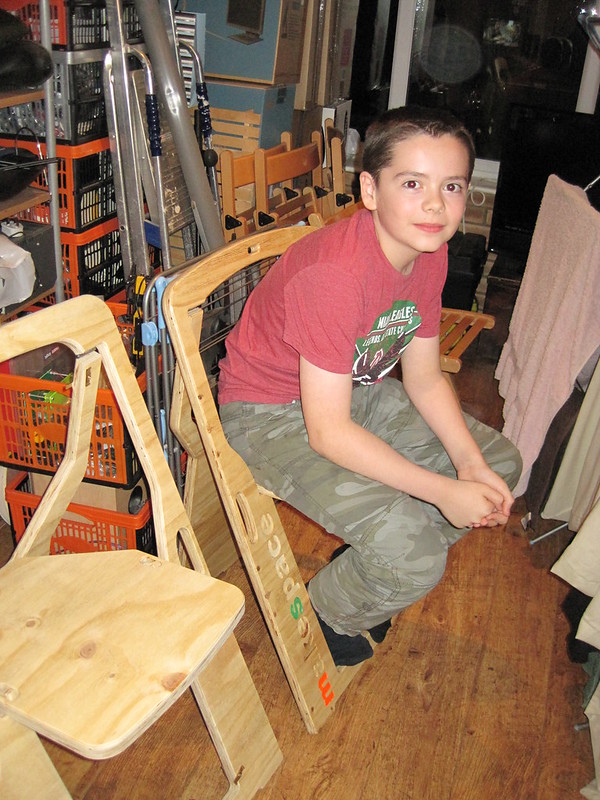
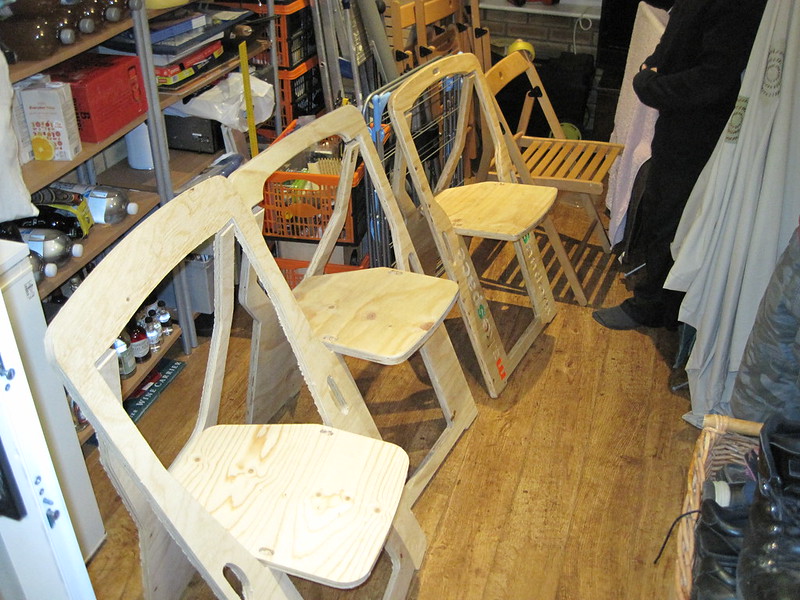
After my most recent posting the urge to do "just one more iteration" became too great and I succumbed. I therefore present version 4 of my folding chair which corrects all the previously discovered issues.
The popliteal height (420mm) and buttock popliteal length (400mm) are both comfortable for a wide selection of people. The seat slopes a few degrees front to back and the back rest no longer comes further forward than the rear of the seat.
There is a small gap above where the seat folds in when flat but that is only an aesthetic issue when being stored.
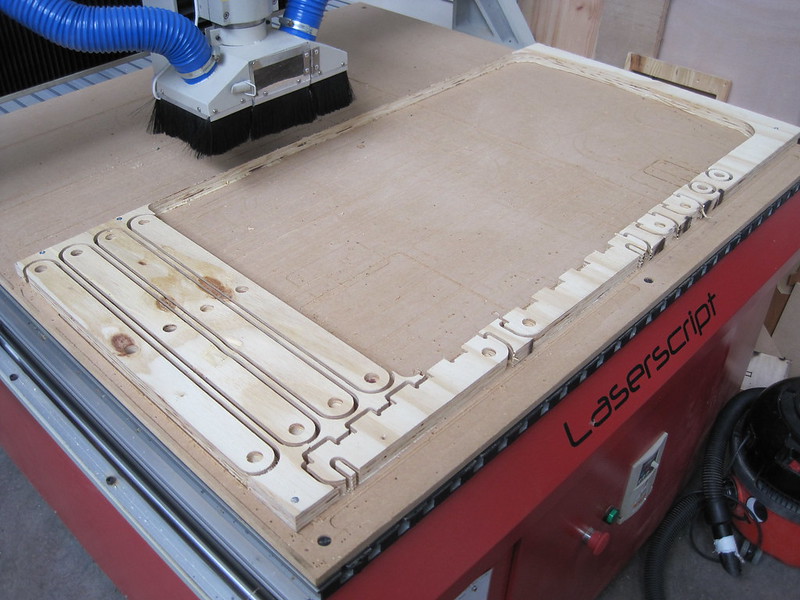
Manufacture wise the design is simple to produce although I really will have to teach our CNC router how to use the round over bit to reduce the finishing steps as currently that takes longer than the CNC operation.
In future if I make more of these I will use this design and, once she is less annoyed at me for making another chair, I am going to consult with my wife on adding some cushioning material to the seat and backrest.
And of course that concludes my furniture making for a while...yeah, right!
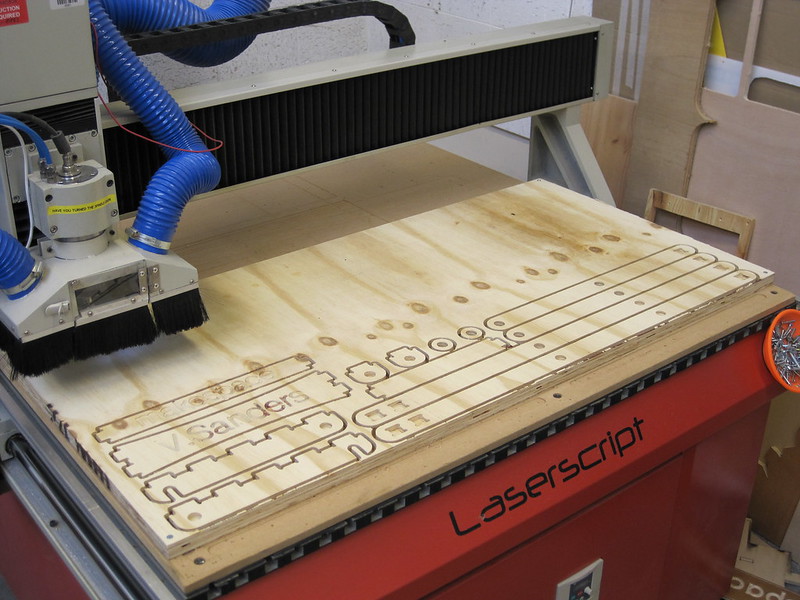
there have been comments which have complained about my usage of space on sheets and suggested I waste too much material. That is probably true and in my own defence I have not been working with this machine for very long and am not quite used to what I can "get away with" yet.
I was looking at the sheet after removing the last chair design and had a thought, I had not attempted a side X type folding design and perhaps I could squeeze one into the offcuts? I kinda got carried away, it roughly went:
Measure the available offcut space
Measured the remaining 18mm dowel leftover from my dowel hinge experiments
Found the largest width and height area I could get out of the sheet the CNC router ruined.
Sketched a design
Capture design to a DXF
Carefully spread the pieces over the available material in the CAM software
Generate a toolpath.
Cut material
If all of that sounds like and utterly mad way to design a size X stool, you are of course correct, but it worked, and it was a very fast process taking less than four hours from idea to stool.
There are a couple of issues:
the popliteal height is 470mm ( I was aiming at 420 and missed...badly)
It uses a lot of expensive hardwood dowel (1373mm plus cutting width and only way I could get it accurate was to use the disc sander to remove fractions till the length was correct)
I used pockets for the interference seat joints rather than through cuts and discovered that you need to allow tolerance depth (the pegs are 10mm deep and the sockets need to be at least 10.2 not the 10mm I cut)
Dowel joints are great but have a small surface area so friction fit joints work loose.
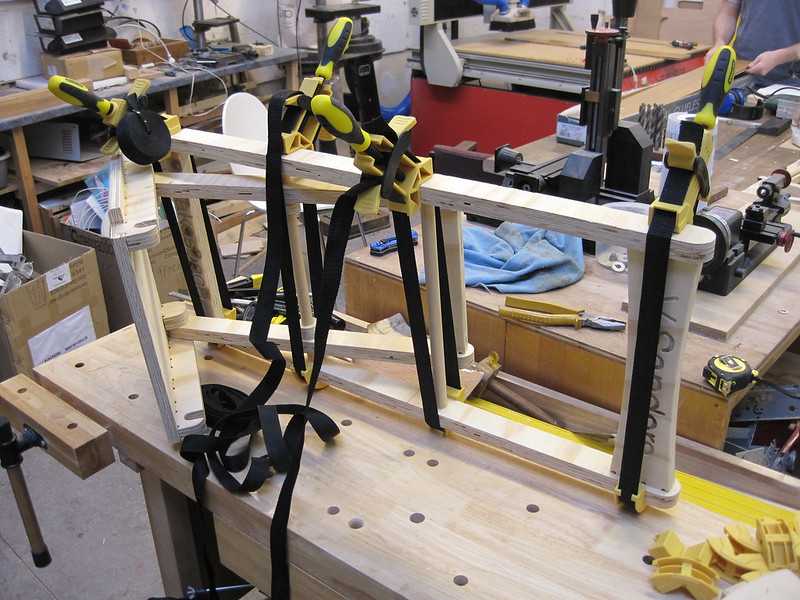
The seat went together dry fit and Paul tested it for me, however that last issue soon made me realise that this time I was going to have to resort to glue. Yes, sorry, this design needs to be glued to remain stable (I know plywood contains glue...please stop telling me that).
It is pretty simple to put together and aside from needing half the clamps in makespace to hold it in place while the glue dried, I had no trouble.
Though this is definitely not a case of use glue "sparingly" I put generous amounts in all the dowel joints and all the seat slots and got very little ooze so I guess it could have used more.
The final varnished stool is pretty robust but folds up nicely the concept of hooking to its own pivot dowel means it stays closed when flat which makes it very portable.
Total cost was an estimated 10.00 ( 4.25 dowel, 2.50 of 24mm ply, 1.75 for 18mm ply, 0.50 tool wear, 1.00 varnish) though the materials in my case could be argued to have cost nothing.
It has been suggested that I could make an entire picnic table and chairs set this way but if I did I would reduce the stool height by 50mm and examine ways to use less dowel.
Or in this case my final (and yes I am going to do something else next) chair design. It is based on the stool, in fact it is the stool design with the outer legs extended and a back rest added.
The modified design reduces the dowel requirements to 775mm but requires a bit more sheet material (cannot get this one entirely from offcuts).
Total cost was an estimated 10.50 ( 2.50 dowel, 4.50 of 24mm ply, 1.75 for 18mm ply, 0.50 tool wear, 1.25 varnish).
Because it is based on the stool design it suffers from the height issue and in addition the back rest is a bit far back to be completely comfortable.
Neither of the side X designs have flaws that interest me enough to follow the iterative approach again to solve them. Both the designs work well enough and rounded out my adventures with folding chairs and indeed furniture for now.
I have just bought a wireless phone charging system based on the Qi Inductive Power Standard. I bought a charging device which connects to a standard micro-USB cable and receivers for the Samsung Galaxy Note 2 and Samsung Galaxy S3 phones I own. Both those phones have contacts in the back of their case that are designed for wireless charging so you can install a charging device inside them. The charging devices make the case fit a little tight, and the charging device is stuck to the phone battery with contact adhesive, this makes it impractical to change the battery on a phone with such a device and makes it a little more difficult to swap out a battery case. One nice feature of the Nexus 4 is that it has Qi charging built in, that saved me $19 and was also more convenient.
I believe that the main advantage of a wireless charger is to avoid the risk of damage to the phone if it s dropped while connected to a USB charger. This allows the phone to be charged in situations where you might need to quickly or regularly unplug it to go somewhere. One example of how I might use it is when working at an office so I could charge my phone while at my desk and then quickly take it with me if I had to go to a meeting (sadly I have worked in many offices where they have so many meetings). Another example is for sysadmin work where I have to frequently visit devices to fix them.
The wireless charging mat that I bought from Kogan connects to a standard micro-USB plug, the good thing about this is that it s easy to find cables and it can take power from any PC. The bad thing about this is that the resistance of the USB cable is a factor that limits the power that a phone can receive, when using wireless charging you have the limit of the cable resistance as well as some power loss from the wireless transmission. After any extended period of charging the charging mat feels warm to the touch and the phone that s been resting on it feels warmer than usual. The warmth is an indication of energy loss which means longer charging times, a longer charging time isn t necessarily a problem as the convenience of wireless charging can allow longer charging times, but if you want to charge your phone in a hurry before you go somewhere then wireless isn t a good choice.
In the past I ve discovered that the battery in a Samsung Galaxy S3 can t be charged if the phone is at 46C [1]. 46C might seem extremely hot to people in some parts of the world (EG northern Europe and Canada) but the temperature in even southern parts of mainland Australia can get that hot and it can be hotter in central and northern parts, so phone temperature can be a real issue. Currently my house is at 21C according to a digital thermometer, the Galaxy S3 and the Note 2 are being charged from USB and report temperatures of 27C and 23C respectively. While the thermometer in my house and those in the phones probably aren t really accurate it seems reasonable to assume that the battery of a relatively idle smart-phone that s being charged will be a few degrees warmer than the ambient temperature. The Qi charger makes things a lot worse as it even feels warm to the touch. So maybe a phone on a Qi charger would be 8 degrees warmer than the ambient temperature or more. That implies that in Australian summer weather a Qi charger won t be useful outside or in any building that lacks air-conditioning. So I think we can give up on the idea of using Qi devices to charge phones at a BBQ.
The final problem I have is that the Qi device is quite small, I took the above picture with my phone face-down because no part of the charger is visible in normal use. With that size I can t just dump a phone like a Note 2 on top of the charging mat and expect it to work. I have to carefully place it so that it balances and so that the wireless receptor inside the phone matches the transmitter in the mat, if the phone isn t placed correctly then the Qi mat won t detect it and won t supply full power to the transmitter.
Conclusion
I m fairly disappointed in this device. The waste heat makes it unsuitable for Australian summer conditions and slows charging. The difficulty of correctly placing the phone reduces the convenience which is one of the major features.
The price was $19 for each charging card for the Note 2 and the S3 and $29 for the charging mat to give a total of $67. I think it s worth the money for me to cover the risk of one of my phones having it s USB port damaged. Using a Qi charger on occasion will decrease the probability of such damage and allow the phone to be used after receiving certain types of damage.
The prices of those phones nowadays are $389 for a Galaxy S3 (Kogan price), $250 for a Nexus 4 (when it was on sale in the Google store), and probably about $500 for a Galaxy Note 2 (last time Kogan offered them). So by paying $67 for Qi charging I believe that I m getting some degree of damage insurance for just over $1100 worth of phones. It seems likely that the Nexus 5 will ship with Qi charging support and that the Galaxy Note 3 will also support an optional Qi charging card (which will probably also be $19 or some similar price) so the charging mat should be useful for a long time.
While I m disappointed I don t regret buying the device. But I would be hesitant to recommend it to other people and definitely wouldn t recommend it to someone who doesn t have a significant interest and investment in smart phones.
A client has recently asked for my advice on web editing software. There are lots of programs out there for editing web sites and according to a quick Google search there are free Windows programs to do most things that you would want to do.
The first thing I m wondering about is whether the best option is to just get a Linux PC for web editing. PCs capable of running Linux are almost free nowadays (any system which is too slow for the last couple of Windows versions will do nicely). While some time will have to be spent in learning a new OS someone who uses Linux for such tasks will be able to use fully-featured programs such as the GIMP which are installed as part of the OS. While it is possible to configure a Windows system to run rsync to copy a development site to the production server and to have all the useful tools installed it s much easier to run a few apt-get or yum commands to install the software and then copy some scripts to the user s home directory.
The next issue is whether web editing is the best idea. Sites that are manually edited tend to be very simple, inconsistent, or both. Some sort of CMS seems to be the better option. WordPress is a CMS that I m very familiar with so it s easy for me to install it for a client, while I try and resist the temptation to force my favorite software on clients there is the issue that I can install WordPress quickly which therefore saves money for my client. WordPress is a CMS that supports installing different themes (and has a huge repository of free themes). The content that it manages consists of pages and posts , two arbitrary types of document. Supporting two types of document with a common look and feel and common important data in a side-bar seems to describe the core functionality used by most web sites for small businesses.
Does anyone have any other ideas for ways of solving this problem? Note that it should be reasonably easy to use for someone who hasn t had much experience at doing such things, it shouldn t take much sysadmin time to install or cost to run.
While I suspect that professional speakers have separate presentation
laptops that they use only to give talks, I don't do this often enough to
justify the hassle and cost of a separate machine. However, I do use a
separate user account to present from.
It allows me to focus on my presentation and not stress out about running
into configuration problems or exposing private information. But mostly, I
think it's about removing anything that could be distracting for the
audience.
The great thing of having a separate user for this is that you can do whatever
you want in your normal account and still know that the other account is ready
to go and configured for presenting on a big screen.
Basics
The user account I use when giving talks is called presenter and it has
the same password as my main user account, just to keep things
simple. However, it doesn't need to belong to any of the UNIX groups that my
main user account belongs to.
In terms of configuration, it looks like this:
power management and screen saver are turned off
all sound effects are turned off
window manager set to the default one (as opposed to a weird tiling one)
desktop notifications are turned off
Of course, this user account only has the software I need while
presenting. You won't find an instant messaging, IRC or Twitter client
running on there.
The desktop only has the icons I need for the presentation: slides and
backup videos (in case the network is down and/or prevents me from doing a
live demo).
Web browsers
While I usually have my presentations in PDF format (for maximum
compatibility, you never know when you'll have to borrow someone else's
laptop), I use web browsers (different ones to show that my demos work with
all of them) all the time for demos.
Each browser:
clears everything (cookies, history, cache, etc.) at the end of the session
has the site I want to demo as the homepage
only contains add-ons or extensions I need for the demos
has the minimal number of toolbars and doesn't have any bookmarks
has search suggestions turned off
never asks to remember passwords
Terminal and editors
Some of my demos may feature coding demos and running scripts, which is why
I have my terminal and editor set to:
a large font size
a color scheme with lots of contrast
It's all about making sure that the audience can see everything and follow
along easily.
Also, if you have the sl package installed system-wide, you'll
probably want to put the following in your ~/.bashrc:
alias sl="ls"
alias LS="ls"
Rehearsal
It's very important to rehearse the whole presentation using this
account to make sure that you have everything you need and that you are
comfortable with the configuration (for example, the large font size).
If you have access to a projector or a digital TV, try connecting your
laptop to it. This will ensure that you know how to change the resolution
of the external monitor and to turn mirroring ON and OFF ahead of time
(especially important if you never use the default window manager or desktop
environment). I keep a shortcut to the display settings in the sidebar.
Localization
Another thing I like to do is to set my operating system and browser
locales to the one where I am giving a talk, assuming that it is a western
language I can understand to some extent.
It probably doesn't make a big difference, but I think it's a nice touch and
a few people have commented on this in the past. My theory is that it might
be less distracting to the audience if they are shown the browser UI and
menus they see every day. I'd love to have other people's thoughts on this
point though.
Also, pay attention to the timezone since it could be another source of
distraction as audience members try to guess what timezone your computer is
set to.
Anything else?
If you also use a separate account for your presentations, I'd be curious to
know whether there are other things you've customised. If there's anything I
missed, please leave a comment!
After years of waiting, Google has finally enabled IPv6 for their
email service Gmail. And a few weeks ago, they updated their policy,
adding one specific rule: reject email from IP addresses with no reverse
name:
% nc -Cv gmail-smtp-in.l.google.com. smtp
Connection to gmail-smtp-in.l.google.com. 25 port [tcp/smtp] succeeded!
220 mx.google.com ESMTP bz2si13656083wjc.108 - gsmtp
HELO boo.example.com
250 mx.google.com at your service
MAIL FROM: <me@example.com>
250 2.1.0 OK bz2si13656083wjc.108 - gsmtp
RCPT TO: <you@gmail.com>
250 2.1.5 OK bz2si13656083wjc.108 - gsmtp
DATA
354  Go ahead bz2si13656083wjc.108 - gsmtp
Subject: Test
From: Me <me@example.com>
To: You <you@gmail.com>
Test.
.
550-5.7.1 [2001:db8:8e3f:43c7::12      16] Our system has detected that this
550-5.7.1 message does not meet IPv6 sending guidelines regarding PTR records
550-5.7.1 and authentication. Please review
550-5.7.1 https://support.google.com/mail/?p=ipv6_authentication_error for more
550 5.7.1 information. bz2si13656083wjc.108 - gsmtp
That sucks
It is not a sane anti-spam measure, because not having a reverse
name tells absolutely nothing about the email emitter or the
message itself: it only indicates that the email emitter has a lame
access provider. Specifically:
spammers can have perfect reverse names;
regular email emitter can have no reverse name because
their access provider suck, and have no way of fixing it
because all access providers suck the same way.
While IPv6 is the future of the Internet, this measure
discourages its use. Yes, providing no reverse names suck, but it is
by no mean the user's fault, and since IPv6 is more complicated to
implement than IPv4, Internet actors must tolerate youth errors or
people will just keep what works, i.e. IPv4.
By the way, I would love to have a perfect Internet access provider,
but that does not exist where I live, and I do not think it exists at all
anywhere. Google, instead of complaining
about lame access providers, you are welcome to offer me a fibre service
with decent upload rate, static IPv4, static IPv6 /64, customizable
reverse DNS for IPv4 and IPv6, and full respect of the network
neutrality. Until then, I am doing the best I can with the least bad
provider available.
Workaround
As I said, their is an easy workaround. Google does not accept my
mail on IPv6? Fine, I will keep using IPv4. Only for Google of course,
no need to punish the whole Internet for Google's damn restrictions.
With Postfix, you can do that this way (thanks to Christian
Skala for his blog post about this problem). In
/etc/postfix/master.fr, enable an IPv4-only SMTP
client service:
smtp4 unix - - - - - smtp -o inet_protocols=ipv4
Then, in /etc/postfix/main.cf, define a transport
map if you do not already use one:
transport_maps = hash:/etc/postfix/transport
Create that transport map
/etc/postfix/transport or complete it:
gmail.com smtp4:
Finally, hash that transport map and have Postfix reload its
configuration:
# postmap /etc/postfix/transport
# service postfix reload
I seem to be adhering to Beckett's approach recently but for some reason, after my previous stool attempts, despite having a functioning design I felt I had to do just one more iteration.
Going back to a previous concept of having five legs instead of three while this did not improve the rotational problems with the 12mm thick material, it did make the design more stable overall and less prone to tipping.
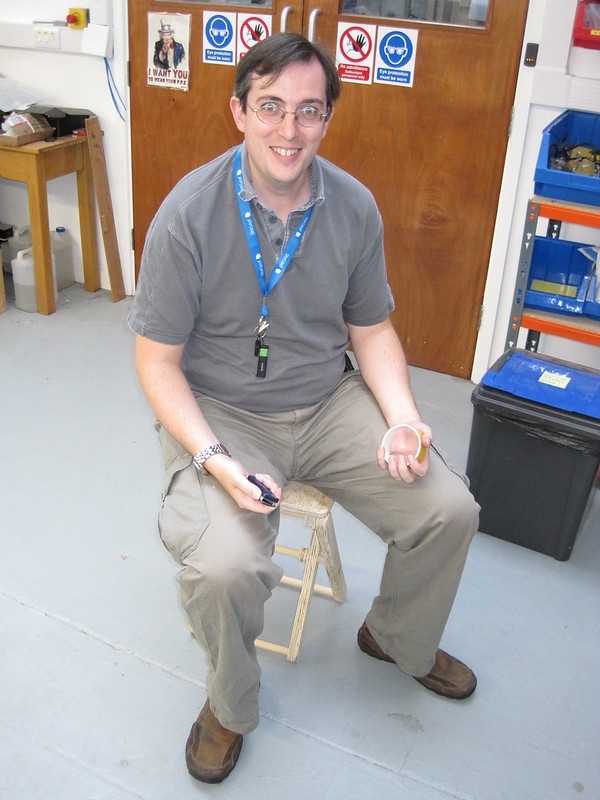
The five legged solution realised in 18mm plywood resulted in my final design for this concept. As my friend Stephen demonstrates the design is pretty solid even for those of us with a more ample frame. There are now a couple of them in use at the space alongside the three legged earlier versions.
I was finally satisfied with the result and thought I was done with furniture making for a while. My adorable wife then came up with a challenge, she wanted a practical foldable chair her requirements were:
Must be robust enough to cope with guests of all sizes
Use as little storage space as possible.
Not ugly.
Inexpensive enough they can be given as gifts.
Things for individual humans to sit on raised off the floor, or chairs as we call them, have been around for a long time. My previous research for the stool indicated that chairs have a long history with examples still surviving from the ancient egyptians. From this I assumed there would be nothing novel in this project and to quote the song it's all been done before
Given this perspective my research started with an image search for "folding chair". The results immediately showed there were two common shapes. Either the chair base was formed with a pair of linked X shapes with the seat across the top, or an A frame style where the seat is across the centre.
My initial thoughts were to replicate the IKEA style A frame design until I noticed that some designs were made from a single sheet of timber with a small number of profile cuts. I searched for pre-existing design files but found none, perhaps I had found something novel to do after all.
Some quick measurements of chairs in shops (and more weird looks, mainly from my family) suggested 900mm is generally the highest a chair ought to stand. I selected a popliteal height of 420mm as a general use compromise which is a bit less than the 430mm of most mass produced chairs. I also decided there should be a front to rear drop across the seat which ought to improve comfort a little.
Material selection was based upon what I had to hand which consisted of a couple of sheets of structural plywood (1220x606x18mm temperate softwood - probably spruce although not specified) which had not become stools yet. Allowing for edge wastage and tool width this gave me a working area from a sheet of 1196x582mm.
I sketched the side view of the chair numbering the three parts. I decided part 1 would be 1000mm total height with top and bottom cross braces 80mm high, assuming the 900mm tall target, the A frame apex would be at 820mm height.
If we assert that the apex is immediately below the top cross brace on part 1 this gives 920mm at which point we have two sides of a right angled triangle (820 and 920) from which we can calculate the top angle is 26 . This also means part 2 will be 840mm long with the same 820 height this gives an angle of 10 .
I did the maths for the seat triangle using the 36 angle and 420mm popliteal height. Having experienced how flexible 18mm plywood was in the face dimension I decided to make the frame sides 50mm wide leaving, after 6mm tool path widths, enough space for a 358mm wide seat .
Once the dimensions were decided the design went pretty quickly producing something that looked similar to the designs I had seen earlier.
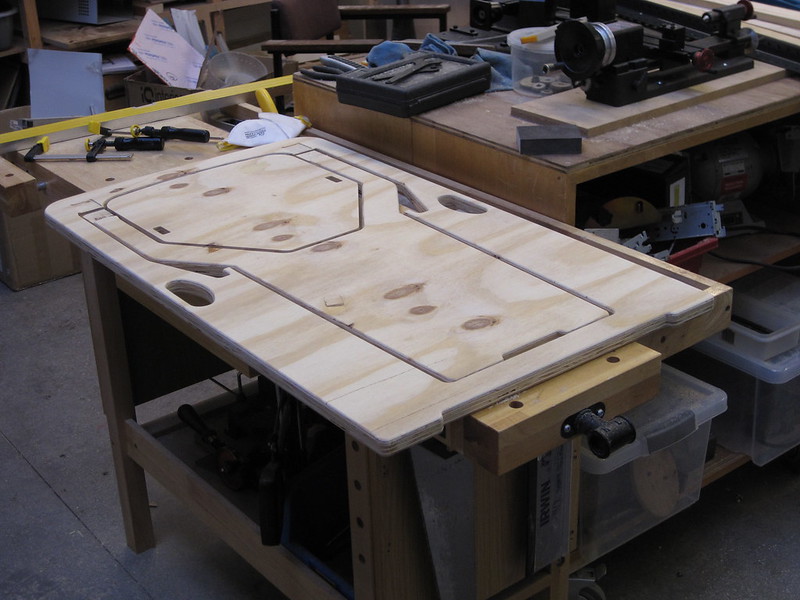
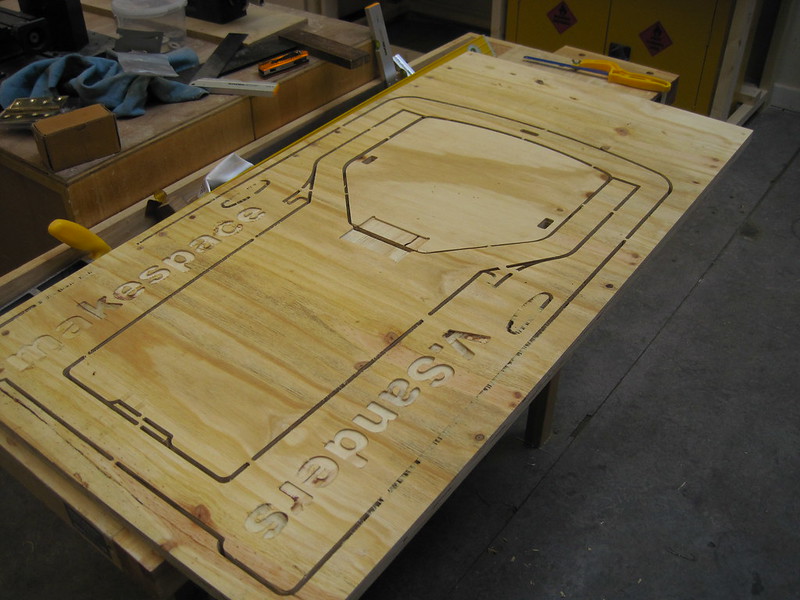
Generating toolpaths for this design proved challenging with the CAM software we had available, mainly because arranging multiple "inner" and "outer" cuts along the same path and having the tabs line up was obviously not an anticipated feature.
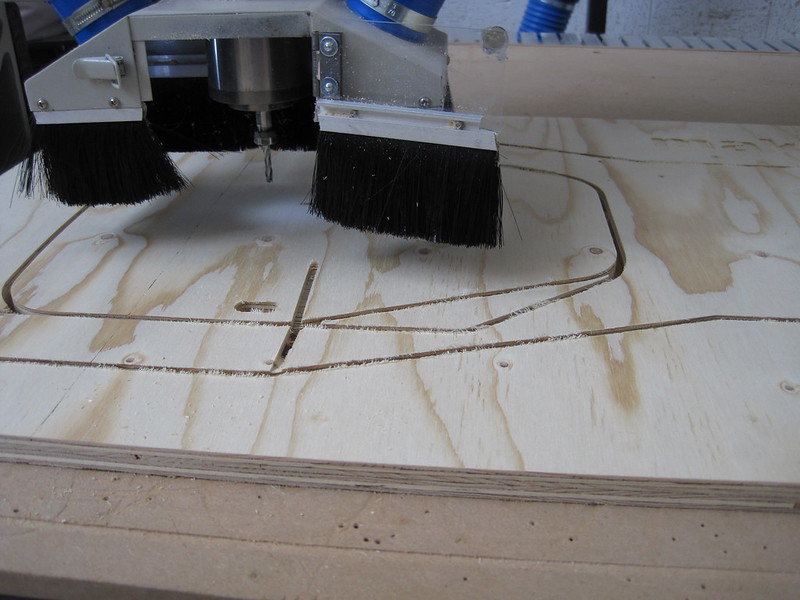
Things had been going far too well for me and during the routing operation our machine decided to follow an uncommanded toolpath excursion mid job (it cut a dirty great hole through the middle of my workpiece where I did not want it) ruining the sheet of material.
Fortunately, once factory reset and reconfigured, the machine ran the job correctly the second time although we still do not know why it went wrong. The parts were cut free of their tabs and hinges fitted.
The resulting design worked with a couple of problems:
I had made an error in my maths and added when I should have subtracted, as a result the seat slopes back to front which is not very comfortable.
The chair feels very wide and tall.
The front face (part 1) flexes alarmingly between the seat and the ground when subjected to large loads.
So time for a second iteration, this time I selected a thicker plywood to reduce the bend under large loads (OK already, I mean me). After shopping around for several days I discovered that unlike 12mm and 18mm thick plywood 24mm thick is much harder to find at a sensible price especially if you want it cut into 1220x606 sheets from the full 1220x2440.
I eventually physically went to Ridgeons and looked at what they actually had in the warehouse and got a price on a sheet of brazilian elliotis pine structural plywood for 43.96 which they cut for me while I waited. Being physically present also gave me the opportunity to pick a "less bad" sheet from the stack much to the annoyance of the Ridgeons employee for not just taking the top one.
This time I reduced the apex height by 30mm, the length of part 1 by 80mm. I also reduced the frame width by 10mm relying on the increased thickness of the plywood to maintain the strength. In area terms it is actually an increase in material (50mm*17.7mm = 885 against 40mm*22.80 = 912). I also included rebates for the top hinges within the design allowing them to be mounted flush within the sheet width.
The new design was cut (without incident this time) and the edges rounded off. I also added some simple catches to keep the seat and back inline while being transported.
While this version worked I had made a couple of mistakes again. The first was simply a radius versus diameter error on the handles which meant too much material was removed from a high stress area causing increased bending.
The second error was a stupid mistake that where I had worked the latch holes in the seat to the wrong side of my measure line meaning the apex angle was 35.5 not the expected 33.6 which meant the backrest felt "too far forward"
The third version rectified those two errors and improved the seat front curve a little to further reduce the unneeded material in the back rest.
The fabrication of this design was double sided allowing for the seat hinge to be fully rebated and become flush and also adding some text similar to the stools.
This version still suffers from a backrest that is a bit too far forward and my sons complain it makes them sit up too straight. The problem is that the angle of the front face (23.6 ) means that to move the rest back 20mm means the piece needs to extend another 50mm beyond the frame apex which would probably make the chair feel tall again.
I guess this is a compromise that would take another iteration or two to solve, alas my wife has declared a moratorium on more chairs unless I find somewhere to put the failed prototypes other than her conservatory.
One other addition would be a better form of catch for transport. The ones in version 2 work but are ugly, magnets inset into the frame have been suggested but not actually implemented yet.
In conclusion I think I succeeded with the original brief and am pretty pleased with the result. A neatly folding chair that can be stacked simply by having a pile of them and are easy to move and setup.
The price per chair is a little higher than I would like at 22 ( 11 for timber, 5 for hinges and screws , 5 for varnish and 1 for tool wear) plus about 2 hours labour (two sided routing plus roundover takes ages)
It s a somewhat strange feeling to spend time fixing things that broke
instead of implementing new things, but it s not like I m a creative
guy anyway
buildd.debian.orgwent down,
but
it s now up again
thanks to the relevant admins. The
CGI part mentioned by Philipp
was fun to debug: the CGI worked when called from a shell, but not
from Apache (with an apparently strange DNS resolution error). I
suggested attaching it with strace, and the result was even
stranger: a connection to nscd s socket was attempted but the DNS
resolution through the network wasn t. A closer look revealed the
nsswitch.conf file was read, and its configuration was OK, so
what? Looking at libnss_dns.so.2, one could see the usual
syscalls for library loading: open, read, fstat, mmap oh
wait, mmap failed with ENOMEM (Cannot allocate memory). Tollef
bumped the rlimits on the Apache side,
and that was it.
Linux kernel ABI bump notifications: they were
acting weird
since kernel people resumed uploading -trunk- kernels to
experimental. That was identified a while ago, but since I like
tested bugfixes,
I actually did wait for it to happen; fixed in
r68876.
Of course, d-i s git repository
was updated
to bump the ABI from 3.10-2-* to 3.10-3-* accordingly.
#722939 was reported against
udev-udeb since depending on a deb library isn t a good thing
when you re an udeb binary.
Trying to look into d-i build failures earlier this month,
I thought I managed to reproduce the issue,
but that was just my misunderstanding the way apt works. Long story
short, *InRelease and *Packages files are checked before
they re put under lists/; modifying the contents isn t expected:
the modification time is used to set the If-Modified-Since header
when trying to fetch a new version from the server, and it s OK to
get a 304 Not Modified in that case. As a side effect, that means
the files can be hand-edited, for example because you need to work
around the dependency bug mentioned above, and one will still get
Hit lines for all those files. If something goes wrong, one can
still rm the files and start over, but that looks like a large
hammer. Let s see if the issue can get reproduced (and debugged!)
later on.
For those last two points, the long term plan is:
To check udeb installability automatically to catch such dependency
issues as early as possible.
To keep many more logs, so that one can still read the whole output
a few weeks after the fact, and so that one can compare some logs
to try and spot difference in a semi-automated fashion.
Hopefully getting this done this week (famous last words, eh?).
It seems I'm catching up with the pace of this course I'm following and that is compelling me to go back to posting on my blog, Arte y cultura en circulaci n: crear y compartir en tiempos digitales .
This week's lesson is (again, in Spanish) Las fronteras del remix (the boundaries of remixes). An interesting text, open to everybody (regardless of whether you are signed up for the course or, I hope, whether time has passed since the course took place).
And this week's homework is to find "our favorite" non-original work (I picked one among my favorite works And, yes, this is partly because I am part of the "club" of deniers of true originality: We cannot create anything without being part of a surrounding culture, without a common heritage and language with which we speak to our audience) and to find something about it, anything considered important or significative as to its antecedents. What do I like about this work, what grabs my attention. Do I consider it to be a true new creative work? Why?
I am taking as an example Leo Masliah, an Uruguayan writer and musician (writer and interpreter). I have followed and enjoyed Masliah's work since 1996, and although by far I'm most familiar with his musical works, I have two books (a novel and a series of short stories). Among his facets, I most enjoy the acid, nihilistic/dadaistic streaks. I chose three of his songs to talk about I am linking to anonline resource where possible, but uploading the three songs to this blog to make his work better known, so that people understand what I talk about, and with my best intentions. Of course, if there is any request to remove the material, I will do it right away. I hope this can be seen as fair/academic use, although this blog is somewhat widely read.
This song was in the first Masliah cassette I came across, Although musically it is an original work, the lyrics are a clear, almost line-by-line reply to the ever-repeated Unicornio song, by Silvio Rodr guez. This song (which I'm sure that every Spanish speaker reading this lines knows, like it or not It defines for me a good deal of Rodr guez hyper-sweetness and clicheness) has been analyzed over and over looking for a meaning. Silvio recorded this song in 1981, and by 1987 Masliah published this answer, mocking each of the lines.
So, this song can be seen as an original creation, as it contains no literal copy neither of the music nor of the lyrics of the original, but it cannot be understood without being familiar with Silvio's lost unicornio. It would just be an almost-dadaistic rant. But every person that has tasted Silvio Rodr guez cloying song will surely laugh with this one.
I find this to be a very unique piece. It bonds together Argentinian folklore and USA pop.
Masliah sings the famous Argentinian song Zamba de Balderrama, (Castilla / Leguizam n), a song lamenting that the very popular bar and artist stage Balderrama, in Salta (North-Western corner of Argentina), seemed to be on the brink of closing. Of course, when Mart n, Constanza, Regina and me went to Balderrama in July 2010, the danger of closing this place had long been averted. And basically every Argentinian knows this song by heart.
The interesting part is that Masliah sings this song (as he presents it as the closing piece for one of his concerts) being short on time, and decides to present two acts together: Zamba de Balderrama and We don't need another hero, by Tina Turner, from the Mad Max soundtrack. So, of course, even if it's obvious that Masliah had to stretch bits to make them fit together, he achieved a very funny, interesting and unique blend of two completely unrelated works. He derives from one as well as from the other, but creates something unique and new.
I was thinking what to write for this assignment , and had already chosen the two other songs. Yesterday, we were visiting our friends Octavio and Claudia, in Guanajuato, and I heard for the first time the original(?) version of Donna Lee, by Miles Davis (although often credited to Charlie Parker). That led me to remember Masliah's interpretation, in his Cl sicos album. This album is basically made up with similar excercises: Taking an instrumental piece, with Masliah singing over it. Some of the lyrics follow the story (i.e. the children stories), others just talk nonsense to illustrate a point (i.e. "La voz del medio", "the middle voice") follows the non-protagonist score trying not to grab much attention to the lyrics but to highlight the often ignored melody)... Donna Lee is just a fun excercise on following the melody asking what was in the head of the author that led him to invent such a strange, hard music.
Masliah is a great music performer, although often it seems he tries to hide it (i.e. by abusing the dissonances, ex-profeso singing off-key, etc), and a very funny and crazy author. Most of his works have a deep satirical tone, and it's common to find either simple winks or complete "borrowings" in a clear remix fashion, but nobody will doubt on the originality of his works.





 Of particular note,

 One of the earlier examples of students using MIT computer resources
to lay the groundwork for a later commercial endeavour,

 Today I finally pushed out a new
 On a regular basis, I find myself the odd-man-out when it comes to talking
about how to work with Python on Debian systems. I'm going to write this and
post it so that I might be able to point people at my thoughts without having
to write the same email in response to each thread that pops up.
Turns out I don't fit in with the Debian hardliners (which is to say, the
mindset that




 While I suspect that professional speakers have separate presentation
laptops that they use only to give talks, I don't do this often enough to
justify the hassle and cost of a separate machine. However, I do use a
separate user account to present from.
It allows me to focus on my presentation and not stress out about running
into configuration problems or exposing private information. But mostly, I
think it's about removing anything that could be distracting for the
audience.
The great thing of having a separate user for this is that you can do whatever
you want in your normal account and still know that the other account is ready
to go and configured for presenting on a big screen.
 After years of waiting, Google has finally enabled IPv6 for their
email service Gmail. And a few weeks ago, they updated their policy,
adding one specific rule: reject email from IP addresses with no reverse
name: