Search Results: "sto"

29 July 2012

Joey Hess: build a dynamic webapp in Yesod in just three days

This screencast shows what I built. Scroll down for my Yesod braindump. <video controls="controls" src="http://joeyh.name/screencasts/git-annex-webapp.ogg"></video> video link I've been astonished how quickly this went together. This is my first time using any sort of web framework, and I used a still unusual one, Yesod. It's my first time using Bootstrap too. It's also the first time I've done any AJAX programming! Bootstrap was something I'd heard of and seen some suspiciously similar looking sites built with, but it was really a pleasant surprise. Being able to make things that work and look good on the web without struggling with CSS is such a nice change. For the first time, it makes the web feel like a UI toolkit to me. As I've learned Yesod, I kept seeing problems the web framework solves that I either solved in an ad-hoc basis in Ikiwiki, or didn't realize were problems. In the former group are things like having a consistent way to store a URL to redirect to after an action (such as logging in) finishes, and generating urls programmatically in ways that avoid broken links. In the latter group are things like exploiting types to guarantee mistakes can't be made. And also the abstraction of widgets, which combine html, css, and javascript, in a way that can be composed with other widgets. Overall, I'm really enjoying Yesod, and it's making me productive in new ways. I also see a lot of potential in Yesod to improve from where it is.
    webpage = bootstrap Dynamic $ do
        setTitle "FooCorp"
        login <- getLogin
        navbar [FixedTop] $ do
            brand "FooCorp"
            link AboutR
            link BlogR
            nav [PullRight] $
                link . maybe LoginR ProfileR login
        div [ContainerFluid] $ content login
        where
            content Nothing = heroUnit $ do
                para $ "We're the FooCorp for you."
                button "Register Today" [Primary, Large] SignUpR
                carousel
                    [ amazingFeatures
                    , aboutFooCorp
                    , pricing
                    ]
            content (Just user)  = do
                para $ "Welcome back " ++ name user ++ "!"
                showProfile user

Gregor Herrmann: RC bugs 2012/27-30

during the last weeks I was quite busy with other things (like DebCamp, DebConf, & vacations), so this is a report covering 4 weeks. at least I managed to catch up during the last days a bit

28 July 2012

Vincent Bernat: Switching to the awesome window manager

I have happily used FVWM as my window manager for more than 10 years. However, I recently got tired of manually arranging windows and using the mouse so much. A window manager is one of the handful pieces of software getting in your way at every moment which explains why there are so many of them and why we might put so much time in it. I decided to try a tiling window manager. While i3 seemed pretty hot and powerful (watch the screencast!), I really wanted something configurable and extensible with some language. So far, the common choices are: I chose awesome, despite the fact that StumpWM vote for Lisp seemed a better fit (but it is more minimalist). I hope there is some parallel universe where I enjoy StumpWM. Visually, here is what I got so far: awesome dual screen setup

Awesome configuration Without a configuration file, awesome does nothing. It does not come with any hard-coded behavior: everything needs to be configured through its Lua configuration file. Of course, a default one is provided but you can also start from scratch. If you like to control your window manager, this is somewhat wonderful. awesome is well documented. The wiki provides a FAQ, a good introduction and the API reference is concise enough to be read from the top to the bottom. Knowing Lua is not mandatory since it is quite easy to dive into such a language. I have posted my configuration on GitHub. It should not be used as is but some snippets may be worth to be stolen and adapted into your own configuration. The following sections put light on some notable points.

Keybindings Ten years ago was the epoch of scavanger hunts to recover IBM Model M keyboards from waste containers. They were great to type on and they did not feature the infamous Windows keys. Nowadays, this is harder to get such a keyboard. All my keyboards now have Windows keys. This is a major change with respect to configure a window manager: the left Windows key is mapped to Mod4 and is usually unused by most applications and can therefore be dedicated to the window manager. The main problem with the ability to define many keybindings is to remember the less frequently used one. I have monkey-patched awful.key module to be able to attach a documentation string to a keybinding. I have documented the whole process on the awesome wiki. awesome online help

Quake console A Quake console is a drop-down terminal which can be toggled with some key. I was heavily relying on it in FVWM. I think this is still a useful addition to any awesome configuration. There are several possible solutions documented in the awesome wiki. I have added my own1 which works great for me. Quake console

XRandR XRandR is an extension which allows to dynamically reconfigure outputs: you plug an external screen to your laptop and you issue some command to enable it:
$ xrandr --output VGA-1 --auto --left-of LVDS-1
awesome detects the change and will restart automatically. Laptops usually come with a special key to enable/disable an external screen. Nowadays, this key does nothing unless configured appropriately. Out of the box, it is mapped to XF86Display symbol. I have associated this key to a function that will cycle through possible configurations depending on the plugged screens. For example, if I plug an external screen to my laptop, I can cycle through the following configurations:
  • only the internal screen,
  • only the external screen,
  • internal screen on the left, external screen on the right,
  • external screen on the left, internal screen on the right,
  • no change.
The proposed configuration is displayed using naughty, the notification system integrated in awesome. Notification of screen reconfiguration

Widgets I was previously using Conky to display various system-related information, like free space, CPU usage and network usage. awesome comes with widgets that can fit the same use. I am relying on vicious, a contributed widget manager, to manage most of them. It allows one to attach a function whose task is to fetch values to be displayed. This is quite powerful. Here is an example with a volume widget:
local volwidget = widget(  type = "textbox"  )
vicious.register(volwidget, vicious.widgets.volume,
         '<span font="Terminus 8">$2 $1%</span>',
        2, "Master")
volwidget:buttons(awful.util.table.join(
             awful.button(   , 1, volume.mixer),
             awful.button(   , 3, volume.toggle),
             awful.button(   , 4, volume.increase),
             awful.button(   , 5, volume.decrease)))
You can also use a function to format the text as you wish. For example, you can display a value in red if it is too low. Have a look at my battery widget for an example. Various widgets

Miscellaneous While I was working on my awesome configuration, I also changed some other desktop-related bits.

Keyboard configuration I happen to setup all my keyboards to use the QWERTY layout. I use a compose key to input special characters like . I have also recently use Caps Lock as a Control key. All this is perfectly supported since ages by X11 I am also mapping the Pause key to XF86ScreenSaver key symbol which will in turn be bound to a function that will trigger xautolock to lock the screen. Thanks to a great article about extending the X keyboard map with xkb, I discovered that X was able to switch from one layout to another using groups2. I finally opted for this simple configuration:
$ setxkbmap us,fr '' compose:rwin ctrl:nocaps grp:rctrl_rshift_toggle
$ xmodmap -e 'keysym Pause = XF86ScreenSaver'
I switch from us to fr by pressing both left Control and left Shift keys.

Getting rid of most GNOME stuff Less than one year ago, to take a step forward to the future, I started to heavily rely on some GNOME components like GNOME Display Manager, GNOME Power Manager, the screen saver, gnome-session, gnome-settings-daemon and others. I had numerous problems when I tried to setup everything without pulling the whole GNOME stack. At each GNOME update, something was broken: the screensaver didn t start automatically anymore until a full session restart or some keybindings were randomly hijacked by gnome-settings-daemon. Therefore, I have decided to get rid of most of those components. I have replaced GNOME Power Manager with system-level tools like sleepd and the PM utilities. I replaced the GNOME screensaver with i3lock and xautolock. GDM has been replaced by SLiM which now features ConsoleKit support3. I use ~/.gtkrc-2.0 and ~/.config/gtk-3.0/settings.ini to configure GTK+. The future will wait.

Terminal color scheme I am using rxvt-unicode as my terminal with a black background (and some light transparency). The default color scheme is suboptimal on the readability front. Sharing terminal color schemes seems a popular activity. I finally opted for the derp color scheme which brings a major improvement over the default configuration. Comparison of terminal color schemes I have also switched to Xft for font rendering using DejaVu Sans Mono as my default font (instead of fixed) with the following configuration in ~/.Xresources:
Xft.antialias: true
Xft.hinting: true
Xft.hintstyle: hintlight
Xft.rgba: rgb
URxvt.font: xft:DejaVu Sans Mono-8
URxvt.letterSpace: -1
The result is less crisp but seems a bit more readable. I may switch back in the future. Comparison of terminal fonts

Next steps My reliance to the mouse has been greatly reduced. However, I still need it for casual browsing. I am looking at luakit a WebKit-based browser extensible with Lua for this purpose.

  1. The console gets its own unique name. This allows awesome to reliably detect when it is spawned, even on restart. It is how the Quake console works in the mod of FVWM I was using.
  2. However, the layout is global, not per-window. If you are interested by a per-window layout, take a look at kbdd.
  3. Nowadays, you cannot really survive without ConsoleKit. Many PolicyKit policies do not rely on groups any more to grant access to your devices.

Jon Dowland: books

I'm forty pages into a battered copy of "Complicity" by Iain Banks. I picked this copy up for the princely sum of 90p at Barter Books last weekend. For the uninitiated, Barter Books is a grand old bookshop situated in a disused train station in Alnwick, Northumberland. It has the dubious pleasure of being the originator of the "keep calm and carry on" fad. At the time that I bought it, I wasn't sure whether it was already in my swollen reading pile, but 90p wasn't a great loss if so. I could leave it in the book pile at my next hotel. (it was, and that's a sorry indictment of the state of my reading pile.) This gnarled paperback has character. There's a faded price sticker on the back revealing a first-hand price in Australian Dollars. The book started its post-sale life on the other side of the world. Where else has it been? I take some small pleasure in planning the next step in its future. To imagine this book with a long tail of readers having a free market value of 90p, or roughly the price of a posh chocolate bar, I'm struck by both wondering how publishers and writers like Mr Banks make a living (and yet they do) but also how the pricing of ebooks, completely lacking in this character I've written about and non-transferable, seems over inflated to the end user. I've been struggling to short list a selection of books to take on holiday. Most of my friends have responded "buy a kindle", with a complete lack of sympathy for my predicament. I'm borrowing one which means I can finally find out whether I'll "take" to it. I'm concerned I'll not be able to get sucked into a story in the same way I can with a paper book. I certainly won't rely on just the kindle for my reading needs. I don't want to prejudge my experiment too much but I suspect I won't be convinced. Where I can see technology supporting my reading is in addition to the paper book: particularly for non fiction, technical books, academic papers, more graphical-oriented things (photo books, graphic novels). I do have a small but growing collection of old, rare-in-print texts that I've only been able to source as PDFs. I think something like the Google Nexus 7 would do the job for these and fit into my life more readily than the kindle.

Alberto Garc a: GUADEC 2012

Third day of GUADEC already. And in Coru a! Coru a This is a very special city for me. I came here in 1996 to study Computer Science. Here I discovered UNIX for the first time, and spent hours learning how to use it. It s funny to see now those old UNIX servers being displayed in a small museum in the auditorium where the main track takes place. It was also here where I learnt about free software, installed my first Debian system, helped creating the local LUG and met the awesome people that founded Igalia with me. Then we went international, but our headquarters and many of our people are still here so I guess we can still call this home. So, needless to say, we are very happy to have GUADEC here this time. I hope you all are enjoying the conference as much as we are. I m quite satisfied with how it s been going so far, the local team has done a good job organising everything and taking care of lots of details to make the life of all attendees easier. I especially want to stress all the effort put into the network infrastructure, one of the best that I remember in a GUADEC conference. At Igalia we ve been very busy lately. We re putting lots of effort in making WebKit better, but our work is not limited to that. Our talks this year show some of the things we ve been doing: We are also coordinating 4 BOFs (a11y, GNOME OS, WebKit and Grilo) and hosted a UX hackfest in our offices before the conference. And we have a booth next to the info desk where you can get some merchandising and see our interactivity demos. WebKitGTK+ In case you missed the conference this year, all talks are being recorded and the videos are expected to be published really soon (before the end of the conference). So enjoy the remaining days of GUADEC, and enjoy Coru a! And of course if you re staying after the conference and want to know more about the city or about Galicia, don t hesitate to ask me or anyone from the local team, we ll be glad to help you. Queimada

Martin-&#201;ric Racine: OpenWRT: SLAAC and DHCPv6 on White Russian

As I recently reported, I have been trying to configure my Linksys WRT54GL running the OpenWRT firmware (version 0.9 a.k.a. White Russian) to support SLAAC and DHCPv6 out of the box.Most of the feedback I got involved upgrading the OpenWRT firmware to a more recent release that might not fit the available storage capacity of the device, which felt like too risky of an operation to attempt.The solution I found instead involved adding ipkg sources to OpenWRT's backports repository, which offers a minimalistic DHCPv6 client. Although I haven't been able to find any proper documentation for this client, the content of its configuration file is mostly intelligible. What remains now is to actually configure it to cooperate with the kernel's native SLAAC implementation and, whenever an IPv6 network is found on the ISP side, to propagate the address space, DNS and routing information to my LAN using radvd.Would anyone located within the Helsinki metropolitan area happen to have an IPv6 testing environment that would at least allow me to configure and test my router?

Luke Faraone: Simple two-factor authentication


Do you want to allow "Rebooting of Cluster 19" as Jane Doe, Foo Corp? Yes/NoI've been thinking a lot recently about information security and passwords. It's widely agreed that two-factor authentication, which combines something-you-know (a password) with something you have (eg. a smart card or some one-time-password) is superior to using a password by itself. Most solutions I've seen, short of client-side certificates, both require a trusted third party and provide little auditability.

I'm working on a project which attempts to address those problems. Basically, the idea is that you attempt to perform an action on a website, like logging in, moving some money between accounts, or restarting a cluster. Then, your mobile device ((iPhone used in the graphic to the right because a SVG was handy. Image adapted from work by Virgile Pypaert [CC-BY-SA-3.0], via Wikimedia Commons)) (Android, iPhone, or some custom hardware) starts buzzing, displaying the text of the action. When you approve or deny the action, your device uses a locally stored private key to sign the text of the approval and send it back to the server. The server checks that you approved the same transaction number and text, then allows the action. The server can store the approval notice to allow auditors later to determine that somebody in possession of the private key signed the action request.

So far, I've written a small Django server application, and a Python CLI device and client. They're not yet ready for a public release; I need to write up installation instructions and test it a bit more, but I'll publish them soon on Launchpad. On the usability side of things, I plan to conduct some trials in January comparing it to things like Google Authenticator.

This should be less susceptible to MITM attacks than one-time-passwords, since you can authenticate specific transactions, rather than entire sessions.

On the other hand, I'm no security researcher. Dear lazyweb, are there any problems with the above approach? Also, if I'm going to release this (as I plan to once I get something working), I need a name. Ideas?

27 July 2012

Julien Danjou: Ceilometer, the OpenStack metering project

For the last months, I've been working on a metering project for OpenStack, so it's time to talk a bit about it. OpenStack is a growing cloud platform providing IaaS. A problem easily identified by everyone building a public cloud platform is that nothing is provided to retrieve the platform usage data. Some data are available in some places, but not everything is, and you have to do a lot of processing from the various components to get something useful in the end. But in order to bill customers that are using your public cloud platform, you need to dot his. In this regard, a lot of companies running public OpenStack based infrastructure wrote their own solution to cover this functional areas, and to become able to bill theirs customers. To avoid everybody doing and maintaining such a stack in their corners, the Ceilometer has been created. The project aims to cover the metering aspect of the OpenStack components, pulling usage data from every components and storing them into a single place. It then offer a retrieving point for this data via a REST API. The initial specifications have been written in April this year, and actual implementation started in May. The project is currently worked on by me, Dreamhost and Canonical. We already have designed an architecture that we are implementing, and we hope to release a first usable version with Folsom. Ceilometer architecture I did a presentation of this project yesterday at XLCloud, which has been very well received. <iframe allowfullscreen="true" frameborder="0" height="389" mozallowfullscreen="true" src="https://docs.google.com/presentation/embed?id=11ALGC4xuWcRvXKTSnnsteJUkArsTfQW-7IAfWRRI5kQ&amp;start=false&amp;loop=false&amp;delayms=3000" webkitallowfullscreen="true" width="480"></iframe> If you are interested in helping us and contributing, feel free to join us during one of our weekly IRC meeting or fix some bugs. :-)

C.J. Adams-Collier: The blog was down yesterday

The brief outage was due to a scheduled move of the servers to a separate rack and subnet dedicated to our work with the Center for Information Assurance & Cybersecurity (ciac) at the University of Washington Bothell (uwb), and a11y.com I am currently exercising the new (to us) equipment and hope to winnow the less than awesome equipment over the next quarter. I spent the last six months finding the best in breed of the surplussed DL385 and DL380 chassis we (work) were going to have recycled. The team and I were able to find enough equipment to bring up one of each with eight and six gigs of memory, respectively. These will make excellent hypervisors for provisioning embedded instances of Slackware, Fedora, RHEL, CentOS, Debian, FreeBSD, OpenSolaris, OpenIndiana, FreeDOS, etc. When I initially configured this xen paravirt environment, I failed to plan for integration with libvirt, so I am now re-jiggering the software bridges so that they are managed using virt-manager. My experience doing this in the Eastsound lab has proved to be quite rewarding. Once network, storage and memory allocation are handled by libvirt, it will be trivial to automate the process of deploying, reclaiming, and managing these Telecommunications Resources efficiently and effectively using Perl. The new equipment we racked over the last weekend all has hardware assisted virtualization and is capable of hosting operating systems which have not been patched to communicate with the host hypervisor. This provides a higher level of assurance that guests will receive the full amount of provisioned resources and reduces the likelihood of resource conflicts, should the cluster operations team mistakenly over-commit. It also makes it possible for these nodes to host Windows-based operating systems. Oh, and they will also host these not insignificant things called BIG-IP Local Traffic Manager Virtual Edition (VE) and BIG-IP GTM Virtual Edition.

Keith Packard: sandybridge-caching

Playing around with LLC controls on Sandybridge today. What I wanted to know was how caching backbuffers affects application performance. The reason for this question is that when the driver uses page flipping to display a new frame, we force the new scanout buffer to be uncached because the display hardware only scans out from main memory. However, when we go back to using this buffer as the next back-buffer, we don t turn the caching bits back on as that requires writing GTT entries to change caching modes. This means that swapping via page-flipping and swapping via copying has a large change in main memory access patterns during rendering page flipping applications use an uncached back buffer while copying applications use a cached back buffer. What effect does the back-buffer caching-mode have on application performance? The changes In the kernel, I have three modes 1) Existing code. Set buffer objects to cache mode none when preparing them as scanout buffers. The first time the application flips to a back buffer, caching is disabled on that buffer forever 2) Flip back and forth. Set buffers to cache mode none when used as scanout. When that stops, flip them back to cache mode llc. This involves a whole lot of clflushing and GTT rewriting, obviously. 3) Flush to memory, but don t disable caching. In this mode, the buffer gets flushed (from both CPU and GPU) before being used as a scanout, but the cache mode isn t changed. Benchmarking with glxgears The first test was pretty simple I hacked up glxgears (yes, glxgears is not a benchmark) to redraw the same frame multiple times (including the clear) per swap to provide a scalable amount of work per swap. No pixel operations, so this is just writing to the back buffer. Thes numbers are the median of 5 runs, except for those obviously limited by the refresh rate.
RepsExistingFlipFlush
10606060
20606060
4042.07034.11337.130
8021.25917.95718.658
Note the linear scaling over reps (once you get below refresh). I think this means that the swap overhead is in the noise, including flushing and rewriting GTT entries. Given that my screen is (yuck) 1366x768 pixels, or just over 4MB, and my total LLC is 4MB, it s seems like the performance changes here are likely caused by the rendering ejecting every other object from the cache. What s wrong with benchmarking with glxgears? Of course, glxgears is not a benchmark, and I realized while collecting this data that, in particular, it never reads from the backbuffer, and most pixels are only written once by the clear operation at the start of the rendering code. So, it forces everything else out of the cache at the start of each drawing cycle, but doesn t stick anything useful into the cache. Benchmarking nexuiz, a (more) real application For the next test, I ran nexuiz demo1.dem in all three modes. Numbers out of that weren t nearly as stable as glxgears, and I m afraid I didn t write all of them down, but I got numbers between 45 and 50 frames per second in all three modes. None significantly faster, none significantly slower. So, for these two tests, caching has no positive effect on overall rendering performance. Obviously, I need to collect data from more applications to see if the effect is general. I sure hope so, because the alternative will be to find some heuristic to direct when to enable caching. The patch This is on top of kernel version 3.5.
diff --git a/drivers/gpu/drm/i915/i915_drv.h b/drivers/gpu/drm/i915/i915_drv.h
index b0b676a..f69fba8 100644
--- a/drivers/gpu/drm/i915/i915_drv.h
+++ b/drivers/gpu/drm/i915/i915_drv.h
@@ -1335,6 +1335,10 @@ int __must_check
 i915_gem_object_pin_to_display_plane(struct drm_i915_gem_object *obj,
                     u32 alignment,
                     struct intel_ring_buffer *pipelined);
+
+void
+i915_gem_object_unpin_from_display_plane(struct drm_i915_gem_object *obj);
+
 int i915_gem_attach_phys_object(struct drm_device *dev,
                struct drm_i915_gem_object *obj,
                int id,
diff --git a/drivers/gpu/drm/i915/i915_gem.c b/drivers/gpu/drm/i915/i915_gem.c
index 288d7b8..b606bd2 100644
--- a/drivers/gpu/drm/i915/i915_gem.c
+++ b/drivers/gpu/drm/i915/i915_gem.c
@@ -2851,6 +2851,9 @@ int i915_gem_object_set_cache_level(struct drm_i915_gem_object *obj,
    return 0;
  
+#define JUST_FLUSH 0
+#define FLIP_CACHING   0
+
 /*
  * Prepare buffer for display plane (scanout, cursors, etc).
  * Can be called from an uninterruptible phase (modesetting) and allows
@@ -2883,7 +2886,11 @@ i915_gem_object_pin_to_display_plane(struct drm_i915_gem_object *obj,
     * of uncaching, which would allow us to flush all the LLC-cached data
     * with that bit in the PTE to main memory with just one PIPE_CONTROL.
     */
+#if JUST_FLUSH
+   ret = i915_gem_object_finish_gpu(obj);
+#else
    ret = i915_gem_object_set_cache_level(obj, I915_CACHE_NONE);
+#endif
    if (ret)
        return ret;
@@ -2913,6 +2920,16 @@ i915_gem_object_pin_to_display_plane(struct drm_i915_gem_object *obj,
    return 0;
  
+void
+i915_gem_object_unpin_from_display_plane(struct drm_i915_gem_object *obj)
+ 
+   i915_gem_object_unpin(obj);
+#if FLIP_CACHING
+   if (HAS_LLC(obj->base.dev))
+       i915_gem_object_set_cache_level(obj, I915_CACHE_LLC);
+#endif
+ 
+
 int
 i915_gem_object_finish_gpu(struct drm_i915_gem_object *obj)
  
diff --git a/drivers/gpu/drm/i915/intel_display.c b/drivers/gpu/drm/i915/intel_display.c
index a8538ac..76a2012 100644
--- a/drivers/gpu/drm/i915/intel_display.c
+++ b/drivers/gpu/drm/i915/intel_display.c
@@ -1821,7 +1821,7 @@ err_interruptible:
 void intel_unpin_fb_obj(struct drm_i915_gem_object *obj)
  
    i915_gem_object_unpin_fence(obj);
-   i915_gem_object_unpin(obj);
+   i915_gem_object_unpin_from_display_plane(obj);
  
 static int i9xx_update_plane(struct drm_crtc *crtc, struct drm_framebuffer *fb,

26 July 2012

Benjamin Mako Hill: User Innovation on NPR Radio

I was invited onto NPR in Boston this week for a segment on user innovation alongside Eric von Hippel (my advisor at MIT) and Carliss Baldwin from Harvard Business School. I talked about innovation that has happened on the CHDK platform -- a cool firmware hack for Canon cameras example I use in some of my teaching -- plus a little bit about free software, the democratization of development and design tools, and a little bit about user communities that LEGO has cultivated. I would have liked the conversation and terminology to do more to emphasize user freedom and free software, but I'm otherwise pretty happy with the result. The segment will be aired again on NPR in Boston this weekend and is available on the WGBH website.

25 July 2012

Michal &#268;iha&#345;: Weblate hacking #3

As you can see on github, there are currently no open issues for Weblate's 1.2 milestone. Looks like I've done most of my Hackweek VIII project faster than expected, but I might add some more improvements. Everything went quite smoothly, but anyway I've decided to postpone some issues. The major reason is that I'm not really sure whether these are good ideas and won't implement something until I'll get more feedback. You can find such issues labeled "needs decision". Comments there are especially welcome :-). On the code side, I've improved support for po file headers, did various improvements on maintenance scripts and improved about page. Also current code from git is now deployed at demo.weblate.org, so feel free to test it. I'm especially curious how the simple and stupid spam protection will work in reality. Now it's time for ice cream and then I'll think what to implement next :-).

Filed under: English Suse Weblate 0 comments Flattr this!

24 July 2012

Gunnar Wolf: Ten theses in favor of free download of cultural goods on the Internet (by Enrique G. Gallegos)

This is one of the days where reading my everyday newspaper was worth more than just getting bitter at the news. I found this text in La Jornada, my usual newspaper. I liked it very much, and decided to translate it for a wider audience. Of course, if you can read Spanish, do yourself a favor and go to the original. It is not that the text is so easy to translate. And, after all, I'm not a native English writer. I'm trying to do a literal translation, even when disagreeing with the author. Ten theses in favor of free download of cultural goods on the Internet Enrique G. Gallegos Poet and philosopher. Currently a researcher in Universidad Aut noma Metropolitana-C
  1. Historical legacy. Criticists who promote the persecution of piracy and free downloads of cultural works from the Internet argue that the patrimonial rights have been wronged; they start off suposing that a cultural work is formed from a historical void, as if there was a "nothing" to begin with, and then a "something" appeared. Nothing more fallacious: All cultural products has its precedents, and thanks to these it generates part of its best forces.
  2. Opening towards the future. Human beings are projected into the future. As the main philosophies of the 20th century have explored, one of the singular characteristics of mankind is the ability to think and imagine the future. Products of culture are the best ways to think and project society, politics, love, hope, needs, failures A song, a poem, an essay, can trigger imaginary worlds with a transformative potential. To deny this to humanity with "patrimonial damage" as an argument is to mutilate man's temporal nature.
  3. Recognition of the present. Cultural works generate moments of reflection, criticism and pleasure; they can trigger actions demanding commitment, solidarity and strong indignation against injustice. If every cultural work is adscribed in some way to a historic tradition, and if cultural products anre necessary to imagine other possible worlds and open our future, it's not less true that they also allow us to recognize our present by making us more sensitive to others' ideas, sensations and emotions. Without culture, there is no present nor others' presence.
  4. Divulgation of the cultural heritage. If culture is "heritage of mankind", it should be also spread by any possible way. But not just spread, but actively sought for the biggest number of people to be able to effectively have access to it. In a potentially interconnected world, Internet is the most adequate world for it (despite its limitations). Therefore, penalizing free downloads means avoiding spreading it and restricting access to those groups who don't have enough economic resources.
  5. Preserving cultural heritage. If we agree that cultural works are heritage of mankind, we need to take every action needed to preserve them. But preserving culture does not only mean keeping the products in museums, galleries or never-polluted drawers; it rather means to keep them in the collective memory and in the flow of constant interpretations and appropiations. Said in other words, the genuine way to preserve culture is to allow universal access to cultural goods. That's why, holding that free copies and downloads of books, music, videos, etc. over the Internet are harmful, is an incompatible argument with the obligation to preserve cultural heritage.
  6. They are not goods. Cultural works are material and spiritual manifestations of mankind, concretions of its historicity; they are, also, expressions of emotions, ideas and projections of other lives and other worlds. That's why they cannot be equated to goods or inserted in patrimonialist logic. The market might want to cheat by giving a certain price to a painting by Orozco or auctioning a Baudelaire manuscript, but it will never be able to aprehend their true meaning as cultural works. And it's not that culture is not faluable, but taht its estimation criteria do not follow the rules of market, but those of the imponderable and unlimited.
  7. Price disproportion. Assuming we accept the possibility that intermediaries charge for the services they perform, the value of a book, record or movie should never exceed the daily wage of a worker or employee. But this ellection would only be one more option within the effective possibility that people opt to download or freely copy the cultural work. The final decision as to which media to go to should be a sovereign resolution of the culture-interested person.
  8. The principle of the most benefit. Even when copies and free downloads over Internet could generate a patrimonial "wrong" to third parties, the cultural benefit obtained by it will always be greater in as much that it carries out intensely the principle to foster, spread and access the cultural heritage of mankind. To think otherwise is to privilege the few over the many.
  9. The real evil is elsewhere. Murder, women- and children-trade, poverty and misery are the real evils that ache mankind. According to the United Nations, in 2010 there were 468 thousand murders in the world; the estimation is that 3500 million people live in poverty; in their 2009 inform, the UN found over 2400 victims of "people trade", kidnapped as sex slaves; in some regions in Africa, close to 30% of children suffer acute malnutrition and six people (between children and adults) die every day from hunger. That's why pretending that free download of cultural works is an evil is clearly a tricky and deceptive speech
  10. Against the intermediary-salesman. Culture does not need intermedieries that reduce cultural works to goods. Culture is too important to leavie it in the hands of salespeople that simplistly equate cultural goods with cakes. An intermediary of this kind will never understand the difference between a work of art and a disposable razor blade. What the world needs is more support from the government from every country to artists, creators and poets, as well as ensuring the conditions for the absolute mobility freedom for cultural works.

Michal &#268;iha&#345;: Weblate hacking #2

Second day of Hackweek VIII is over and there has been again great progress on Weblate. I've started with improving documentation. Most of improvements were possible by using djangodocs extension for Sphinx, which allows better documenting of Django admin commands and settings. Then I've focused on handling languages as there were some things which I did not like. Most importantly, Weblate will now try to use existing languages even if used code does not 100% match (eg. cs_CZ and cs-CZ are treated equal). Also with help of locale aliases, some specific variants won't be created and generic one used instead (eg. cs_CZ will use cs, as these are actually same). If there will be need to differentiate them, you still can create language manually and Weblate will use matched one. Last thing is translation locking - translator can now lock translation for exclusive use and nobody else will be able to work on that. This will help in situations where more people started to work on same translation and basically duplicated the effort. There are 3 open issues targeted for 1.2 release, but I'm not sure if some of these are good ideas, let's keep the decision for next days.

Filed under: English Suse Weblate 0 comments Flattr this!

23 July 2012

Michal &#268;iha&#345;: Weblate hacking #1

The first day of Hackweek VIII is about to end for me and it's time to share some of the results. As planned, I've started hacking on Weblate. The most prominent feature from today are email notifications. You can now monitor the translation in various ways - be informed about new strings to translate, new contributor, added suggestion or simply watch all translations. Another bigger change is rearranging of main page, which now provides instant access to per language stats, which were quite hidden before. Rest of time was spent on adding some sort of spam protection (need to deploy this to demo to see how successful it is) and one more promoting widget (88x31 pixels). There are 6 open issues targeted for 1.2 release, so there is still something to do in next days :-).

Filed under: English Suse Weblate 0 comments Flattr this!

22 July 2012

Sylvestre Ledru: Who is in control of LLVM/Clang ?

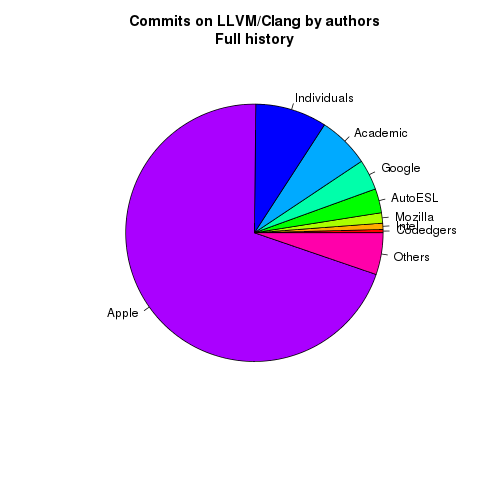
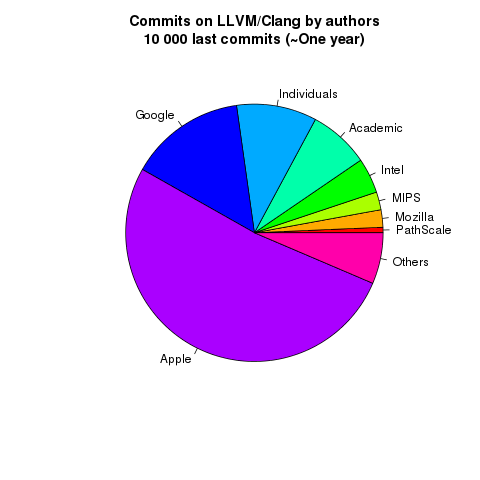
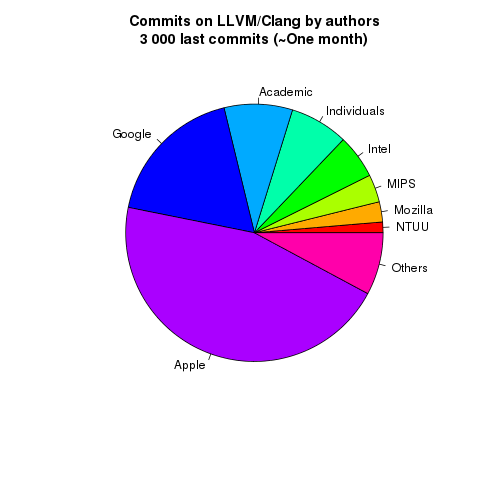
During my various chats and presentations on LLVM/Clang, one of the common criticism on LLVM/Clang is about the Apple's (supposed?) control on the platform. Even if I am not concerned by this concern, here are some statistics about the development. Basically, I used the git history to build a list of all the author. If domain names were clear (ex: @google.com, @apple.com, etc), I used them for the paternity of the commit. If there were not clear (ex: @gmail.com, @me.com), I dig on the web to find the employer (Linkedin was my friend). Of course, identifying individuals are pretty tough. Their percentages can be considered as a minimal figure. Full history 10 000 commits (about a year)
3 000 commits (~a month)
To sum up, we can easily see that the percentage of contributions of Apple is decreasing over the time.
However, we all know that the number of commits is not the best metric to measure the control of one on a project. Source: Processed data (please contact me in case of mistake)

21 July 2012

Petter Reinholdtsen: Free Culture in Norwegian - 5 chapters done, 74 percent left to do

I reported earlier that I am working on a norwegian version of the book Free Culture by Lawrence Lessig. Progress is good, and yesterday I got a major contribution from Anders Hagen Jarmund completing chapter six. The source files as well as a PDF and EPUB version of this book are available from github. I am happy to report that the draft for the first two chapters (preface, introduction) is complete, and three other chapters are also completely translated. This completes 26 percent of the number of strings (equivalent to paragraphs) in the book, and there is thus 74 percent left to translate. A graph of the progress is present at the bottom of the github project page. There is still room for more contributors. Get in touch or send github pull requests with fixes if you got time and are willing to help make this book make it to print. :) The book translation framework could also be a good basis for other translations, if you want the book to be available in your language.

Andrew Pollock: [life] Sarah sans gallbladder

I can't remember exactly when, it was either pre-Zoe heart-related diagnostic imaging or during her pregnancy with Zoe, that it became apparent that Sarah had gall stones. Apparently it's not uncommon for women to develop them after pregnancy, and it turns out that Sarah is slightly more genetically predisposed to getting them to boot. So it wasn't terribly surprising when she started having some pain recently. She had another ultrasound to confirm it, and went off to see a surgeon. Apparently they care more about the symptoms than the number of stones in the gallbladder, and they don't bother removing the stones and keeping the gallbladder, so she was booked in for a cholecystectomy last Thursday. It was a pretty straightforward procedure, she was out of the operating room in just under an hour, and awake a bit over an hour after that. I've had a few friends need to have a cholecystectomy, and the photos on Wikipedia have always fascinated me, particularly this one. It seems so freaky to have a gallbladder full of that much gravel. It can't be comfortable. We're going to be able to pick up Sarah's stones on Monday, so it'll be interesting to see what they look like. Sarah's recovering now. It's one of the few surgeries she's had under general anaesthesia where she hasn't been sick afterwards, so that was a good start. The procedure was done laparoscopically, using four incisions, and to give themselves room to work, they inflate the body with carbon dioxide gas, which then has to work its way out of her body over the following days. So she's dealing with some bloating, bruising and swelling at the moment, but not doing too badly. Apparently if you're vertical for too long, the gas can work its way up to your diaphragm, which causes some shoulder pain, so the trick has been to walk around a bit, then lie down for a bit, and then rinse and repeat. She's not allowed to lift Zoe for 3-4 weeks, which presents a few challenges for us, but nothing insurmountable (hopefully). We converted Zoe's crib to a toddler bed a week before the surgery, and Zoe thought that was just the best thing ever, and has taken to it really well. I'm around at home for breakfast and dinner, so I can take care of the lifting into and out of the high chair for those meals, and Zoe can eat lunch at her little table. Zoe's also pretty good about getting into and out of the car by herself (not that Sarah can drive until she's off the painkillers) and she's normally in daycare two days a week. She's in daycare again on Monday, so Sarah won't have to deal with Zoe on her own until Tuesday, and we have backup daycare arrangements we can fall back on if need be. Zoe's been very good about Sarah not being able to pick her up, and been very gentle. It helped with the explanation that Sarah could show her all of her "owwies". The surgeon was saying that only 1 in 400 people need to alter their diet after removing their gallbladder, so we're hopeful that Sarah will do just fine without it. She'll certainly be more comfortable in the long run.

Siegfried Gevatter: A gentle introduction to Zeitgeist s Python API

In this post I ll make a quick introduction by example on how to use Zeitgeist s Python API for good and profit. If you re interested in using Zeitgeist from C instead, see the libzeitgeist examples; to use it with C++/Qt, Trever s a web browser in 4 steps may be of interest. First things first In case you re not familiar with Zeitgeist, it may prove helpful to first read Mikkel s introduction to Zeitgeist post. If that s too much to read, just should know that Zeitgeist is an event log. Like the history in your browser, it keeps track of what websites you open at which point in time. It also keeps track of when you close them, and of what browser you used, since it s a system-wide service. Furthermore, it does the same for files, conversations, e-mails, and anything else you want to insert into it. So Zeitgeist is a database of events, and an event can be pretty much anything. But what does it look like? It s main attributes are the following: Additionally, each event has one or more subjects, which have the following attributes: Retrieving recent data Okay, so let s say you want to know the last song you ve listened to (if you have a Zeitgeist-enabled music player). It s a simple as:
from zeitgeist.client import ZeitgeistClient
from zeitgeist.datamodel import *
 
zeitgeist = ZeitgeistClient()
 
def on_events_received(events):
    if events:
        song = events[0]
        print "Last song: %s" % song.subjects[0].uri
    else:
        print "You haven't listened to any songs."
 
template = Event.new_for_values(subject_interpretation=Interpretation.AUDIO)
zeitgeist.find_events_for_template(template, on_events_received, num_events=1)
 
# Start a mainloop - note: the Qt mainloop also works
from gi.repository import GLib
GLib.MainLoop().run()
This may need some explaining. We start by importing the Zeitgeist client and some associated data structures (such as Event and Interpretation), and create an instance of the client. The ZeitgeistClient class is a wrapper around Zeitgeist s D-Bus API which not only makes it much nicer to use, but also makes it easy to install monitors (as we will see later) and provides convenient functionality such as automatic reconnection if the connection to the engine is lost. To query for the most recent song, we just need to create a template with the restrictions we want to impose and submit it to Zeitgeist using the find_events_for_template call. If you haven t read Mikkel s post yet, please do so, as it introduces the structure of events and subjects (in short: an event has a timestamp, some other properties, and one or more subjects representing the resources -files, websites, people - involved in the event). The Python API is inherently asynchronous (if for some reason you need a synchronous API, you may still use the lower level ZeitgeistDBusInterface class), so we need to define a callback function to handle the results we receive from the Zeitgeist engine. Finally, we need to create a main loop so the asynchronous functions can run.
Now this was a pretty simple example. Let s make it more interesting. One song isn t much, so let s get the 5 most recent songs. Also, now we want both songs and videos. The first part is pretty easy, we just need to change the num_events parameter. For the second extension, we have to change the event template. In fact, now we need two different event templates and the find_events_for_templates function, which takes an arbitrary number of event templates and ORs them. The result is as follows:
from zeitgeist.client import ZeitgeistClient
from zeitgeist.datamodel import *
 
zeitgeist = ZeitgeistClient()
 
def on_events_received(events):
    for event in events:
        print "- %s" % event.subjects[0].uri
 
tmpl1 = Event.new_for_values(subject_interpretation=Interpretation.AUDIO)
tmpl2 = Event.new_for_values(subject_interpretation=Interpretation.VIDEO)
zeitgeist.find_events_for_templates([tmpl1, tmpl2],
                                    on_events_received, num_events=5)
 
# Start a mainloop
from gi.repository import GLib
GLib.MainLoop().run()
This will work, but unless you re lucky you re likely to get some duplicate line. Why is this? Well, other than that you may have used the same file twice, don t forget that what you are requesting are actually events. If you ve started playing a given song, you probably also stopped playing it, so that s actually two of them (an AccessEvent and a LeaveEvent). Since this isn t what we want, we ll change the query a bit:
zeitgeist.find_events_for_templates(
    [tmpl1, tmpl2],
    on_events_received,
    num_events=5,
    result_type=ResultType.MostRecentSubjects,
    storage_state=StorageState.Available)
By requesting the most recent subjects, vs. the most recent events, we can filter out events with duplicate URI. See the ResultType documentation for other modes you can use. Note particularly the MostPopularSubjects result type. I also used the chance to introduce the storage_state parameter. This one will filter out events for files Zeitgeist knows aren t available (this mostly means online resources won t be shown if you don t have a network connnection; there s also support for handling external storage media, but because of problems with GIO this is currently disabled). Last but not least, the find_events_for_* methods also accept a timerange parameter. It defaults to TimeRange.until_now(), but you may change it to TimeRange.always() (if for some reason you re working with events in the future) or to any other time range of your choice. Here it s important to note that Zeitgeist s timestamps use millisecond precision.
For more advanced queries, you can use more complex combinations of events and subject templates. The rule to keep in mind here is that events are OR d and subjects are ANDed. Additionally, some field (actor, origin, mimetype, uri and current_uri) may be prefixed with an exclamation mark ( ! ) for NOT, or you may append an asterisc ( * ) to them for prefix search. You can even combine the two operators together. Here s an example of a template you could build:
subj1 = Subject.new_for_values(interpretation=Interpretation.SOURCE_CODE,
                               uri="file:///home/rainct/Development/*")
subj2 = Subject.new_for_values(uri="!file:///home/rainct/Development/zeitgeist/*")
tmpl1 = Event.new_for_values(interpretation=Interpretation.MODIFY_EVENT,
                             subjects=[subj1, subj2])
templates = [tmpl1]
In my case, this template would fetch a list of the source code files I modified most recently but excluding those related to the Zeitgeist project. Working with big sets of data In case you re trying to do something crazy, you may end up with a Zeitgeist query complaining that it exceeded the memory limit. You re not supposed to do that. Instead, we provide some methods for working with large collections of events.
from zeitgeist.client import ZeitgeistClient
from zeitgeist.datamodel import *
 
zeitgeist = ZeitgeistClient()
 
def on_events_received(events):
    for event in events:
        print '- %s' % event.subjects[0].uri
 
def on_ids_received(event_ids):
    print 'A total of %d source code files were found.' % len(event_ids)
    print 'Fetching the first 100...'
    zeitgeist.get_events(event_ids[:100], on_events_received)
 
tmpl = Event.new_for_values(subject_interpretation=Interpretation.SOURCE_CODE)
zeitgeist.find_event_ids_for_templates(
    [tmpl],
    on_ids_received,
    num_events=10000, # you can use 0 for "all events", but do you really need to?
    timerange=TimeRange.from_seconds_ago(3600*24*30*3),
    result_type=ResultType.MostPopularSubjects)
 
# Start a mainloop
from gi.repository import GLib
GLib.MainLoop().run()
And there you have the source code files you worked with during the last 3 months, ordered from most to least popular (popularity is measured counting the number of events; for more precision, maybe you could limit the results to events with interpretation AccessEvent). Why do we provide this mechanism instead of querying with a simple offset? Well, this avoids problems when the log changes (events are inserted or deleted). Have you ever been exploring the latest posts in some website, and as you change to the next page some of the results from the previous page show up again (because new posts have been added in the meantime)? With Zeitgeist this won t happen. Receiving information in real time At this point you re an expert at requesting all sorts of data from Zeitgeist, but now you want to show a list of the last kitten images you ve viewed, updated in real time. Don t worry, Zeitgeist can provide for this:
from zeitgeist.client import ZeitgeistClient
from zeitgeist.datamodel import *
 
zeitgeist = ZeitgeistClient()
 
def on_insert(time_range, events):
    # do awesome stuff with the events here
    print events
 
def on_delete(time_range, event_ids):
    # a previously inserted event was deleted
    print event_ids
 
templates = [Event.new_for_values(subject_uri='file:///home/user/kittens/*',
                                  subject_interpretation=Interpretation.IMAGE)]
zeitgeist.install_monitor(TimeRange.always(), templates, on_insert, on_delete)
 
# Start a mainloop
from gi.repository import GLib
GLib.MainLoop().run()
It s important to note that on_delete won t be called when an image is deleted (that d be a newly inserted event with interpretation=DELETE_EVENT); rather, it s called when a previously inserted event is deleted (for example, using the forget recent history option in Activity Log Manager). In case you re curious: for best performance, this doesn t actually use D-Bus signals. Instead, this little call will setup a D-Bus object behind the scenes and register it with the Zeitgeist engine, so it can notify said object when (and only when) an event of its interest is registered. To stop receiving notifications for a template, you ll need the save the object returned by the install_monitor call:
m = zeitgeist.install_monitor(TimeRange.always(), templates, on_insert, on_delete)
zeitgeist.remove_monitor(m)
Pro Tip: You can use the Zeitgeist Explorer GUI to quickly try out different queries (note: it s still work in progress, so much funcionality is missing, but it does work somewhat). Contextual awesomeness: finding related events By now you re familiar with retrieving events and keeping them up to date. Now it s time for a little secret:
import time
from zeitgeist.client import ZeitgeistClient
from zeitgeist.datamodel import *
 
zeitgeist = ZeitgeistClient()
 
def on_related_received(uris):
    print 'Related URIs:'
    for uri in uris:
        print ' - %s' % uri
 
query_templates = [Event.new_for_values(
    subject_interpretation=Interpretation.SOURCE_CODE,
    subject_uri='file:///home/rainct/Development/zeitgeist/*',
    subject_mimetype="text/x-vala")]
 
result_templates = [Event.new_for_values(
    subject_interpretation=Interpretation.WEBSITE,
    subject_manifestation=Manifestation.WEB_DATA_OBJECT)]
 
now = time.time()*1000
zeitgeist.find_related_uris_for_events(
    query_templates,
    on_related_received,
    time_range=TimeRange(now - 1000*3600*24*30*6, now),
    result_event_templates=result_templates,
    num_events=10)
 
# Start a mainloop
from gi.repository import GLib
GLib.MainLoop().run()
This little query example will return up to 10 websites I used at the same time as the Vala files inside my Zeitgeist directory, considering only data from the last 6 months. Nice, huh? This is an experimental feature, and it doesn t work well when operating on big inputs, so it s usually better to use the find_related_uris_for_uris variant (which replaces the first query_templates parameter with a list of URIs). Advanced searching: the FTS extension Some people think prefix searches aren t good enough for them, and this is why the Zeitgeist engine ships by default with a FTS (Full Text Search) extension. Using the methods provided by this extension you can perform more advanced queries against subjects current_uri and text properties (unlike the name may suggest, the FTS extension doesn t index the content of the files, but just the information in the event). This is exposed as zeitgeist_index_search in libzeitgeist (the C library), but unfortunately isn t currently available in the Python API. If you still need it, you ll have to fallback to pretty much using the D-Bus interface (you still get reconnection support, though). Here s an example:
from zeitgeist.client import ZeitgeistClient
from zeitgeist.datamodel import *
 
zeitgeist = ZeitgeistClient()
index = zeitgeist._iface.get_extension('Index', 'index/activity')
 
query            = 'hello' # search query
time_range       = TimeRange.always()
event_templates  = []
offset           = 0
num_events       = 10
result_type      = 100 # magic number for "relevancy" (ResultType.* also work)
 
def on_reply(events, num_estimated_matches):
    print 'Got %d out of ~%d results.' % (len(events), num_estimated_matches)
    events = map(Event, events)
    for event in events:
        print ' - %s' % event.subjects[0].uri
 
def on_error(exception):
    print 'Error from FTS:', exception
 
index.Search(query, time_range, event_templates,
             offset, num_events, result_type,
             reply_handler=on_reply, error_handler=on_error)
 
# Start a mainloop
from gi.repository import GLib
GLib.MainLoop().run()
The most interesting thing here is the query parameter. Quoting from the C documentation:
The default boolean operator is AND. Thus the query foo bar will
be interpreted as foo AND bar. To exclude a term from the result
set prepend it with a minus sign - eg foo -bar. Phrase queries
can be done by double quoting the string "foo is a bar". You can
truncate terms by appending a *.
There are a few keys you can prefix to a term or phrase to search
within a specific set of metadata. They are used like key:value.
The keys name and title search strictly within the text field of
the event subjects. The key app searches within the application
name or description that is found in the actor attribute of the
events. Lastly you can use the site key to search within the
domain name of the subject URIs.
You can also control the results with the boolean operators AND
and OR and you may use brackets, ( and ), to control the operator
precedence.
Modifying the log So far we ve only queried Zeitgeist for information, let s get a bit more active. You can delete events from Zeitgeist with the following query:
from zeitgeist.client import ZeitgeistClient
 
zeitgeist = ZeitgeistClient()
 
def on_deleted(timerange):
    print 'Deleted events going from %s to %s' % (timerange[0], timerange[1])
 
event_ids = [50] # put the IDs of the events you want to delete here
 
zeitgeist.delete_events(event_ids, on_deleted)
 
# Start a mainloop
from gi.repository import GLib
GLib.MainLoop().run()
The confirmation callback will receive a timerange going from the first to the last event. If no events were deleted (because they didn t exist), you ll get (-1, -1).
And now for the interesting part. If your application involves resources (files, websites, contacts, etc.) of any sort, you ll probably want to let Zeitgeist know that you re using them. It s time that you write a data-source! We start by registering the data-source. Here we go:
import time
from gi.repository import GLib
from zeitgeist.client import ZeitgeistClient
from zeitgeist.datamodel import *
 
zeitgeist = ZeitgeistClient()
 
def on_status_changed_callback(enabled):
    """ This method will be called whenever someone enables or disables
        the data-source. """
    if enabled:
        print 'Data-source enabled and ready to send events!'
    else:
        print 'Data-source disabled; don\'t send event, they\'ll be ignored.'
 
def register():
    # Always use the same unique_id. Name and description can change
    # freely.
    unique_id = 'com.example.your.data.source'
    name = 'user visible name (may be translated)'
    description = 'user visible description (may be translated)'
 
    # Describe what sort of events will be inserted (optional)
    subject_template = Subject()
    subject_template.interpretation = Interpretation.PLAIN_TEXT_DOCUMENT
    subject_template.manifestation = Manifestation.FILE_DATA_OBJECT
    templates = []
    for interp in (Interpretation.ACCESS_EVENT, Interpretation.LEAVE_EVENT):
        event_template = Event()
        event_template.interpretation = interp
        event_template.manifestation = Manifestation.USER_ACTIVITY
        event_template.append_subject(subject_template)
        templates.append(event_template)
 
    zeitgeist.register_data_source(unique_id, name, description, templates,
                                   on_status_changed_callback)
Once that s done (and if it is enabled), we are free to send our events:
def log(title, uri, opened):
    subject = Subject.new_for_values(
        uri=uri,
        interpretation=Interpretation.PLAIN_TEXT_DOCUMENT,
        manifestation=Manifestation.FILE_DATA_OBJECT,
        origin=GLib.path_get_dirname(uri),
        mimetype='text/plain',
        text=title)
    event = Event.new_for_values(
        timestamp=time.time()*1000,
        manifestation=Manifestation.USER_ACTIVITY,
        actor='application://your_application_name.desktop',
        subjects=[subject])
    if opened:
        event.interpretation = Interpretation.ACCESS_EVENT
    else:
        event.interpretation = Interpretation.LEAVE_EVENT
 
    def on_id_received(event_ids):
        print 'Logged %s (%d) with event id %d.' % (title, opened, event_ids[0])
 
    zeitgeist.insert_events([event], on_id_received)
 
if __name__ == '__main__':
    register()
 
    log('test.txt', 'file:///tmp/test.txt', opened=True)
    log('another_file.txt', 'file:///tmp/another_file.txt', opened=True)
    log('another_file.txt', 'file:///tmp/another_file.txt', opened=False)
    log('test.txt', 'file:///tmp/test.txt', opened=False)
 
    # Start a mainloop
    GLib.MainLoop().run()
If you don t know what interpretation and manifestation your subject should have, you can use the following utility methods:
from zeitgeist.mimetypes import *
 
print get_interpretation_for_mimetype('text/plain')
print get_manifestation_for_uri('file:///tmp/test.txt')
Event better, with Zeitgeist 0.9 you can just leave the subject (but not event!) interpretation and manifestation fields empty, and they ll be guessed the same way as if you used those utility methods. Pro Tip: You can examine all registered data-sources and toggle whether they are enabled or not using the zeitgeist-data-sources-gtk.py tool. Conclusion Wow, I m impressed if you ve got this far. By now you should have quite a good idea on how to use the Zeitgeist API, and I m looking forward to seeing what you do with it in your next awesome project. If you have any problem with Zeitgeist, feel free to visit us on IRC (#zeitgeist on irc.freenode.net), or join our mailing list. We ll also be at GUADEC next week, so if you re there make sure to say hi! In case you missed them, here are some useful links:
No comments
Siegfried-Angel Gevatter Pujals, 2012. Permalink License Post tags: ,
flattr this!

Next.

Previous.