Search Results: "mak"

21 March 2013

Jonas Smedegaard: What is FreedomBox? And when can I have one?

On wednesday 7. of November I gave a talk at EPFSUG in Brussels about FreedomBox. EPFSUG is an interest group of Free Software users working inside the European Parliament. The FreedomBox is a project to help non-geeks care about their personal privacy when online, same ways as geeks have practiced for a decade or more. The goal is a small, cheap physical box looking like and operating like an internet gateway or wifi router many are accustomed to nowadays - but with three additions: "Privacy" is commonly mistaken as "secrecy": Privacy is to keep you in control of your information - you can then use that control to keep secrets from others or to share with others as you like. Talking about personal privacy in the European Parliament can seem a bit of a stretch. It is not a home but a (huge) office space, where it is perhaps less obvious that you should treat some information as personal, or that you are even allowed to do so. Try watch the videos, and if you have questions then please don't hesitate to get in touch with me about them. At the EPFSUG meeting was also a presentation by an emplyee who had succesfully installed and used Free Software at the internal network of the Parliament, but then later told that it wasn't allowed - because the IT staff need to be in control of your computer activities at the place! The head of IT services at the Parliament attended the meeting and gave a short improvised talk at the end, expressing positive interest in behalf of the established IT services at the place towards our grassroots activities - and even praising explicitly EPFSUG as being the ideal place for all EU citizens to ask questions about Free Software in relation to the European Parliament. See for yourself in the video of Giancarlo! Thanks a lot especially to Erik Josefsson for making this event reality! Slides, sources and videos from the event.

Benjamin Mako Hill: Lookalikes

Is Croatian kiberkomunist (i.e., cyber-communist ) artist and hacker Marcell Mars living a secret life as a Nantucket Reds -wearing preppie from the American northeast? Marcell Mars and Nantucket Preppy Lookalikes

Maximilian Attems: Gnome shell weather extension

Noticed with a lot of happiness today that Gnome extensions list a new one showing weather information. (:

Jonas Smedegaard: FreedomBox - scratching someone elses itch

Today Sunday November 11th I give a talk at FSCONS in Gothenburg about FreedomBox. FSCONS is an annual scandinavian hacker conference, with a very friendly attitude and atmosphere. The FreedomBox is a project to help non-geeks care about their personal privacy when online, same ways as geeks have practiced for more than a decade. The project is exciting in that is frames a common dream among lots of hackers and therefore sparks new innovation and renewed commitment. The goal is frustrating to tackle, because us hackers most often solve problems close to ourselves (a.k.a. is driven by "an itch to scratch"), and only very few of us are interface designers, which are crucially needed to make things usable for non-geeks. Slides and sources for them.

Daniel Pocock: Migrating to Xen Cloud Platform (XCP Xen-API) on Debian wheezy

I recently decided to upgrade my server and host it in a new location (turns out that leaving the UK hosting was a smart move too, as new UK laws to rein in the press are more likely to punish and censor private web sites and bloggers) As part of the upgrade, starting off with Debian 7 (wheezy) seemed to make a lot of sense. I've been using Xen as a standard server virtualization platform since Debian 5 (lenny), and upgrading through Debian 6 (squeeze) without any major problems. I had been managing it with the traditional xm toolstack without any major concerns. Wheezy benefits from supporting Xen Cloud Platform with a standard set of packages, and it has been promoted heavily as a key technology in wheezy. XCP appealed to me for various reasons: The gotchas Reading through that list, it seems like there is no reason not to use XCP. In fact, there are major differences between the way xl/xm tools manage a host and the way XCP manages a host. While xl/xm offer the flexibility to manually configure networking and storage any way you like, XCP is more like a cookie-cutter virtualization system. It needs to be: without having low level control over networking and storage on the physical host, it could not offer things like hot-migration. Some people might get a shock, however, when moving to such a locked-down platform, as it takes away some of the things you would normally control manually on a Debian server:
  • XCP takes over networking. Your /etc/network/interfaces file must be almost empty - you can still set up firewall rules from a separate script, but don't plan on having any customised IP address configuration or routing.
  • XCP still has some bugs, such as requiring a quick config hack to use any subnet size other than /24, or another hack to make HVM networking function for any non-Linux VM. Hopefully these will be fixed before the official wheezy release.
  • XCP management tools don't support IPv6 - although this doesn't prevent using IPv6 in a VM. If you were planning to use dom0 as an IPv6 gateway for the domUs, it won't work: however, you can set up a domU bridged to the physical ethernet so it can act as an IPv6 gateway for the other VMs.
  • XCP takes over your storage and creates it's own PV, VG and LVs. This can inadvertently lead to the creation of a nested volume group if you are not aware of the exact way this works.
Making it work Despite these gotchas, I have managed to get it working, doing all the things that were possible on regular Xen + Debian squeeze. I would suggest that anybody attempting this read through all the bugs of severity important or serious and the updated README.Debian file (patch in bug 702337) to get off to a quick start without repeating some of the problems faced by early adopters like myself.

20 March 2013

Masayuki Hatta: Recipe for Debian Haskell packaging

The following is what I usually do when I want to debianize a Haskell stuff from Hackage. This is a personal recipe, by no means official procedure or such. I may be wrong, badly at that.
  1. Check pkg-haskell repository whether your intended package already exists or not. Somebody might work on it already.
  2. Find the webpage of your intended package at HackageDB, then download Cabal source package . Untar it. The tarball filename should be changed to fit the Debian source package convention. For example, if the original name is something like foobar-1.0.tar.gz, then it should be haskell-foobar_1.0.orig.tar.gz.
  3. File ITP. reportbug is your friend.
  4. Run cabal-debian in untared dir:
     $ cabal-debian --debianize --quilt
    
    We do have the upstream tarball, so use quilt. See http://wiki.debian.org/UsingQuilt. It might give you warnings about changelog. debian/changelog doesn t exist yet, so ignore it.
  5. Now read http://wiki.debian.org/Haskell/CollabMaint/Processes and http://wiki.debian.org/Haskell/CollabMaint/PackageTemplate carefully. Then do things as they say. These two are short, but well-written instructions. Edit the generated debian/control appropriately. Do not forget to make your debian/copyright machine-friendly. See http://www.debian.org/doc/packaging-manuals/copyright-format/1.0/.
  6. Test whether your package is flawless and really buildable. Do lintian. Use pbuilder.
     $ lintian haskell-foobar_1.0-1_amd64.changes
     # pbuilder --build haskell-foobar_1.0-1.dsc
    
  7. Read http://wiki.debian.org/Haskell/CollabMaint/DarcsBasic. Darcs is quite easy to use, and you don t have to be the master of Darcs to merely debianize things anyway. Basically, what I usually do is
     $ darcs record -a; darcs push --repo=debian
    
    Darcs is well-suited to Haskell-related development, but seems you can use Git, too.
  8. Change debian/changelog. UNRELEASED in the first line should be unstable or experimental . Do not forget to close ITP.
  9. Finally, do
     $ debuild -tc; debcommit -r; debrelease; darcs push --repo=debian
    
    That s all folks!

DebConf team: DebConf13 matching fund (Posted by Didier Raboud)

As part of the DebConf13 fundraising effort, a generous sponsor, Brandorr Group, has proposed to start a matching fund in USD for DebConf13; in place through the end of April 30th. The rules are quite simple: For details, please see our Monetary support from individuals page, which also has a short url, for convenience: http://deb.li/dc13donate. Help welcome As always, the DebConf team is looking for volunteers. Some jobs need technical skills, but many DebConf tasks are about working to deadlines on non-technical issues (e.g. fundraising, budgeting, talk scheduling). You can see more information about some of the jobs to be done on the DebConf wiki. Please do think about getting involved and sharing your ideas with us, to help us make DebConf an even more useful event for Debian in the future. We look forward to welcoming you to Vaumarcus!

19 March 2013

Daniel Pocock: My low-tech investment strategy

People often ask me why I invest in low-tech, old-school investments like gold and silver bullion. Surely for somebody working with technology every day, I would have some advantage in the world of investment? The events of Cyprus this week should provide a clear answer: we've all been told that there is nothing safer than cash in the bank, protected by a Government deposit insurance scheme. Yet it appears that in a pattern reminiscent of the real life Ocean's 11 bank robbery, the culprits waited for a long weekend and set about doing the unthinkable after the lights went out on a Friday night. Three days wasn't enough for them to complete their plan (or getaway?), and so Cypriot banks are closed for a further two days. Just like in the type of bank robbery seen in the movies, the money was put there by people who worked for it, and it is taken away by people who didn't. Sadly, this is also a reflection on a society as a whole. As a result of apathy, contentedness, obsession with non-issues such as immigration, or excuses about how we don't care about politics, nobody has bothered to watch the politicians. The 2008 British film The Bank Job showed real robbers sent into a bank in the traditional manner (it is based on the true story of the 1971 Baker Street robbery). Although not substantiated, conjecture in the press suggests that British authorities were involved and got real crooks to make it look authentic. Today's press suggests that Cypriot authorities are in a similar way trying to make it look like Germany is the bad guy. Back to the gold and silver. A recent report in Science Magazine suggests it takes 100,000 years for natural processes such as earthquakes to create even small deposits of precious metals. Most politicians are taking their pension in less than 10 years and wouldn't have the time or power to interfere with or manipulate such an inherently natural physical phenomenon, and this is why bullion has remained a consistent and respected investment for thousands of years. Does anyone imagine that fresh reserves of gold are forming in the cavities under Cyprus during this week's tremors? Or will those cavities be somewhat more sparse?

Matthew Garrett: Using pstore to debug awkward kernel crashes

The problem with Samsung laptops bricking themselves turned out to be down to the UEFI variable store becoming more than 50% full and Samsung's firmware being dreadful, but the trigger was us writing a crash dump to the nvram. I ended up using this feature to help someone get a backtrace from a kernel oops during suspend today, and realised that it's not been terribly well publicised, so.

First, make sure pstore is mounted. If you're on 3.9 then do:

mount -t pstore /sys/fs/pstore /sys/fs/pstore

For earlier kernels you'll need to find somewhere else to stick it. If there's anything in there, delete it - we want to make sure there's enough space to save future dumps. Now reboot twice[1]. Next time you get a system crash that doesn't make it to system logs, mount pstore again and (with luck) there'll be a bunch of files there. For tedious reasons these need to be assembled in reverse order (part 12 comes before part 11, and so on) but you should have a crash log. Report that, delete the files again and marvel at the benefits that technology has brought to your life.

[1] UEFI implementations generally handle variable deletion by flagging the space as reclaimable rather than immediately making it available again. You need to reboot in order for the firmware to garbage collect it. Some firmware seems to require two reboot cycles to do this properly. Thanks, firmware.

comment count unavailable comments

18 March 2013

Daniel Pocock: Switzerland Glacier Express

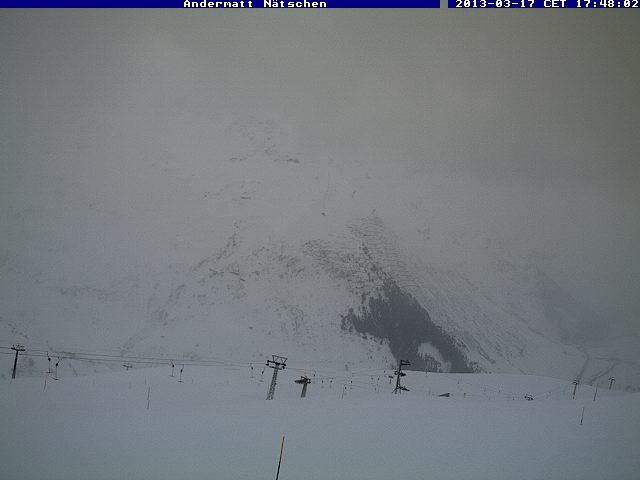
With many people coming to visit this year, both for DebConf13 and holidays, I'm going to start sharing some Swiss travel tips here in the blog. One of Switzerland's most popular tourist promotions is the Glacier Express railway. Here are the facts and a cool video. Avoid tickets/itineraries with fixed dates for visiting the mountains. The full Glacier Express journey is about 6 hours, and if it is cloudy or foggy, it is 6 hours in a train just like any other train. Some days really are cloudy and you won't see a single mountain. Try and make sure you have several flexible days in Switzerland so you can go up the mountains when the weather is optimal. Check the weather using the live webcam service Below is a typical webcam image for a bad day (I was up there Saturday skiing and it was perfect, Sunday was every tourist's nightmare). Compare this picture with the video further down: You can find a live feed like this for most Swiss mountain destinations with a web search Regular passenger trains run on the same route You don't need to buy an expensive Glacier Express' ticket. A regular passenger train does the same route every hour. No fixed reservation is necessary either and you can hop off and back on again along the way at many little stops. Oberalp Pass, at 2000 meters, is a good place to stop and hike (up to the peaks if you are keen, down to Andermatt if you want an easy walk with breathtaking views) What's more, the expensive trains are fully sealed and you can't open the windows. The regular trains do let you open the windows, so you can fully immerse yourself in the experience like this riding down from Natschen to Andermatt (1,500m): <video controls="" height="340" poster="http://danielpocock.com/sites/danielpocock.com/files/train-poster.png" width="560">
<source src="http://danielpocock.com/sites/danielpocock.com/files/DSC_1776.mp4" type="video/mp4"></source>
<source src="http://danielpocock.com/sites/danielpocock.com/files/DSC_1776.webm" type="video/webm"></source>
</video> To plan an itinerary, you can check Swiss train timetables at the official web site http://www.sbb.ch/en

Gerfried Fuchs: Backports Integrated Into The Main Archive

Dear users and supporters of the backports service! The Backports Team is pleased to announce the next important step on getting backports more integrated. People who are reading debian-infrastructure-announce will have seen that there was an archive maintenance last weekend: starting with wheezy-backports the packages will be accessible from the regular pool instead of a separate one, and all backports uploads will be processed through the regular upload queue (including those for squeeze-backports and squeeze-backports-sloppy). For Users What exactly does that mean for you? For users of wheezy, the sources.list entry will be different, a simple substitute of squeeze for wheezy won't work. The new format is:
deb http://ftp.debian.org/debian/ wheezy-backports main
So it is debian instead of debian-backports, and offered through the regular mirror network. Feel invited to check your regular mirror if it carries backports and pull from there. For Contributers What does it mean for contributing developers? Uploads for backports are no longer to be pushed to backports-master but to ftp.upload.debian.org, like any other regular package. Also, given that the packages are served from the same archive install there is no need to include the original tarball in the upload any longer because the archive knows it (Squeeze and beyond). Also, given that the upload goes to the same upload queue, there is only one keyring used anymore, so no more pain with expired or replaced keys. We though still keep the rule of adding your UID to an ACL list (this also includes DM additions). This is mostly only to give us the chance to remind you that uploads to backports are directly available for installation onto stable systems and you thus should take special care there. We carefully tried to take over the old ACLs, in case you can't upload anymore, please tell us so we can look into the issue. I've mentioned wheezy-backports (and squeeze-backports-sloppy) a few times here already, and you might wonder when it will be available. Technically, it is available from now on. Practically, while you could already upload to it, the set up of the buildd network is more painful than expected, so please allow the Buildd Team some days for setting them up. The upload rules for wheezy-backports are the same: packages that are in the next suite are accepted. Given that Jessie isn't created yet, we want you to think about whether the package you want to upload will go into Jessie final, and that you are taking a closer look once Jessie is created and the package entered there about the upgradeability. For the time until the suite is available, you can see this as relaxed upload rule. The same goes for squeeze-backports-sloppy: packages from two suites after Squeeze are acceptable, which turns it into the same relaxed rule as wheezy-backports above. Please also keep in mind that uploads to squeeze-backports-sloppy usually should be accompanied by uploads to wheezy-backports so people are able to upgrade from squeeze-backports-sloppy to wheezy with wheezy-backports. Thanks Finally, we want to thank the FTP-Master Team for their fine work on making this happen. The documentation on backports-master has been updated, and in case of any doubt or question, feel free to ask them on either the debian-backports mailinglist, or in case of sensitive topics ask us directly. Enjoy!
Rhonda for the Backports Team

/debian permanent link Comments: 1 Flattr this

Benjamin Mako Hill: SCARF ACE

Imako_scarf Although I don t mean to brag I have a really great scarf-hood-combination garment. I was wearing said awesome scarf in a rather cold apartment during my remote participation in the Learning Creative Learning class. I would like to think that I said some interesting and insightful things. But if I didn t, I m glad to hear my scarf which now has its very own sub-reddit was able to impress and entertain.

17 March 2013

Soeren Sonnenburg: Shogun Toolbox Version 2.1.0 Released!

We have just released shogun 2.1.0. This release contains over 800 commits since 2.0.0 with a load of bugfixes, new features and improvements (see the changelog for details) that make Shogun more efficient, robust and versatile. In particular, Christian Montanari developed a first alpha version of a perl modular interface, Heiko Strathmann did add Linear Time MMD on Streaming Data, Viktor Gal wrote a new structured output solver and Sergey Lisitsyn added support for tapkee - a dimension reduction framework. Read more at http://www.shogun-toolbox.org

Benjamin Mako Hill: Conversation on Freedom and Openness in Learning

On Monday, I was a visitor and guest speaker in a session on Open Learning in a class on Learning Creative Learning which aims to offer a course for designers, technologists, and educators. The class is being offered publicly by the combination surprising but very close to my heart of Peer 2 Peer University and the MIT Media Lab. The hour-long session was facilitated by Philipp Schmidt and was mostly structured around a conversation with Audrey Watters and myself. The rest of the course materials and other video lectures are on the course website. You can watch the video on YouTube or below. I thought it was a thought-provoking conversation! <iframe allowfullscreen="" frameborder="0" height="315" src="http://www.youtube.com/embed/l9HM80cv160" width="560"></iframe> If you re interested in alternative approaches to learning and free software philosophy, I would also urge you to check out an essay I wrote in 2002: The Geek Shall Inherit the Earth: My Story of Unlearning. Keep in mind that the essay is probably the most personal thing I have ever published and I wrote it more than a decade ago it as a twenty-one year old undergraduate at Hampshire College. Although I ve grown and learned enormously in the last ten years, and although I would not write the same document today, I am still proud of it.

Petter Reinholdtsen: Skolelinux 6 got a video review from Pcwizz

Via twitter I just discovered that Pcwizz have done a video review on Youtube of Skolelinux / Debian Edu version 6. He installed the standalone profile and the video show a walk-through of of the menu content, demonstration of a few programs and his view of our distribution. There is also some really nice quotes (transcribed by me, might have heard wrong). While looking thought the Graphics menu:
"Basically everything you ever need in a school environment."
And as a general evaluation of the entire distribution:
"So, yeah, a bit bloated. It kept all the Debian stuff in there, just to keep it nice and GNU. So, I do not want to go on about it, but lets give it 7 out of 10. I am not going to use it. That is because I am not deploying a school network. There may be some mythical feature to help you deploy Skolelinux on a school network."
To bad he did not test the server profile, and discovered the PXE installation option. It make it possible to install only the main server from CD, and the rest of the machines via the net, and might be considered the mythical feature he talk about. :) While looking through the menus, there is also this funny comment about the part of the K menu generated from the Debian menu subsystem:
"[The K menu] have a special Debian section for software that no-one is going to look at, because it contain lots of junky stuff that you actually don't need in the education distribution, but have just been included because it isn't stripped out for some reason."
I guess it is yet another argument for merging the Debian menu and Gnome/KDE desktop menu entries into one consistent menu system instead of two incomplete and partly inconsistent menu systems. The entire video is available below for those accepting iframe embedding: <iframe allowfullscreen="allowfullscreen" frameborder="0" height="315" src="http://www.youtube.com/embed/wPzTZ61Pcuc" width="560"></iframe>

16 March 2013

Andrew Cater: UK Government suggesting the use of FLOSS for some projects.

Seen on Slashdot

https://www.gov.uk/service-manual/making-software/open-source.html

UK Government appearing to suggest a preference for developers that they should use open source where feasible for future UK Government projects for "Digital by Default" deliveries to UK Government and citizens.

This _is_ a beta version, but it is interesting to see this.

Lucas Nussbaum: Ideas from the -vote@ DPL election discussions

After one week of campaign on -vote@, many subjects have been mentioned already. I m trying here to list the concrete, actionable ideas I found interesting (does not necessarily mean that I agree with all of them) and that may be worth further discussion at a less busy time. There s obviously some amount of subjectivity in such a list, and I m also slightly biased ;) . Feel free to point to missing ideas or references (when an idea appeared in several emails, I ve generally tried to use the first reference). On the campaign itself, and having general discussions inside Debian: On getting new users and contributors to Debian: Infrastructure, processes, releases: Relationships with upstreams/downstreams: This list could be moved to wiki.d.o if others find sufficiently useful to help maintaining it.

Stefano Zacchiroli: bits from the DPL for February 2013 and a half

Dear project members, here's another report of DPL activities, this time for a period longer than usual (February + 1st week of March), so that the next one will be at the very end of the current DPL term. Highlights Appointments DPL helpers Two more DPL helpers IRC meetings have happened, minutes and logs of both are available. Assets Events Past At the beginning of February, I've attended FOSDEM 2013, together with many other Debian people. I didn't have any specific talk this year, but it's been a chance to talk F2F about several ongoing issues (see logs), and help mediating in some conflicts. I've also accepted the invitation to participate in the GNOME Advisory Board meeting, together with Laurent Bigonville of our GNOME team. No report of that has been prepared as of yet (sorry about that), but we have both reported "live" to the rest of the team on IRC. Future Miscellaneous A couple of months ago I've mentioned that I had filed an application, as Debian representative, to participate in a working table to define software procurement rules for the Italian public administration. Good news: my application has been accepted, together with those of other well-known FOSS communities and organizations (e.g. KDE, FSFE). I'll keep you posted of how it goes. Let's go back to elect a new DPL and release Wheezy now,
Cheers.
PS the day-to-day activity logs for February and March 2013 are available at the usual place master:/srv/leader/news/bits-from-the-DPL.txt.20130 2,3

Steve Kemp: Handling bookmarks?

I've a collection of about 500 bookmarks which I've barely touched for a few years. I started organizing them late the other night, because I'd been off work sick for two days and that was about the most I felt up for doing with a computer. The intention was to "tidy" them, and then setup some way of syncing them across browsers/computers. In the end I didn't like any of the syncing plugins I could find - xmarks, etc - so I decided to take a step backwards. I'd exported my bookmarks to HTML page, via firefox, before I started, and then later in a fit of pique I deleted the whole damn lot of them. So now a few years worth of bookmarks are stored in a single HTML file. But wait, we can use revision control can't we? We can host that file on github/similar. We can rely upon merges to deal with conflicts - simple if we just add lines to the end, or delete lines. Maybe that's the best way to store bookmarks? I updated the bookmark file to read:

<ul>
<li tags="debian, personal"><a href="http://www.debian-administration.org/">Debian Admin</a></li>
..
</ul>
Adding "tags" to the LI-container and then some simple jQuery code gave me the ability to search/filter the bookmarks and auto-populate tags. A small example placed online here: The obvious comment is that this makes adding new bookmarks a bit harder, but we'll see.. The javascript works in the browsers I tested, and for those that have none the bookmarks will just be a simple unordered list which should be universal. I expect the javascript could be improved by a real developer.

Clint Adams: Los pollitos dicen p o-p o, eternamente

A boy died. He knew he was dying. He tried to get help. We don't know if it occurred to him to switch off the modem and make a phone call, or if he was too weak to get up and do it. We know he sent an email. He didn't type perfect English at the best of times, and as his life slipped away from him, he misspelled many things. He misspelled ambulance . He may have misspelled diabetes . That was all fine the meaning was clear enough but the bit where it gets tragic is that he misspelled .net in the To: line. So instead of arriving at its destination, the NOC of his employer, where it would have opened up a ticket and been seen by a human at some point, the email bounced. We will never know whether they could have or would have done anything in time. We will never know if, had whoever been on postmaster duty at his ISP at the time been paying attention, he could have been saved. These things were debated angrily, by people struggling to make sense of something, but it changes nothing. The email bounced, and he died.

Next.

Previous.