Search Results: "nic"

6 January 2011

Matthew Palmer: Tethering to an Android phone

Whilst my philosophy with mobile phones has always been "if it can make and receive calls and SMSes, it's good enough for me", the geek in me occasionally lusts for a smartphone. So I now have an Android phone. Once you have a smartphone, you need a plan that includes data. Once you've got that, you realise that your USB mobile internet dongle is somewhat redundant, as long as you can get your laptop talk through the phone. It turns out, with Android, it's pretty easy. First, root your phone. There are a couple of tethering apps that don't require rooting, but the tradeoff is you end up having to install proprietary drivers in your laptop, and if I'm going to have a security hole somewhere, I prefer it to be in my phone, not my laptop. Rooting an Android phone is trivially easy with Universal Androot. Despite warnings I've seen to the contrary, it didn't even wipe my phone's apps and settings, although that might be a lucky coincidence. Backups, people! Then we need the tethering app -- I use Barnacle Wifi Tether, because it's open source, easy to use, and fully featured. Trivial to install from the market, you just start it up and it's ready to go. It acts as an ad-hoc wireless router, with a DHCP server and NAT to make life easy. In theory it supports WPA and WEP, but that doesn't appear to work for me. If anyone on the train is desperate enough to leech off my wireless, they're welcome to it. The hardest part, ironically, was getting the laptop to connect. Having never played with ad-hoc mode before, it took me a little while to sort out exactly what was supposed to happen, but within 5 minutes I'd worked it out and was pinging The Internet. Win!

5 January 2011

Wouter Verhelst: Substituting gdb debug paths

Gdb is a debugger with many, many, many(1) options. Some of them are rather obscure, others... less so. While it's always had the ability to read source files and do useful stuff with them, recent versions of gdb have gained another interface (which you get by calling "gdb -tui") that makes it a bit easier to watch the source as you step through the code. Additionally (and I don't know how long that feature's been there), you can do some interesting things with source paths. Such as substituting a source path prefix by another prefix -- useful if you've moved sources around. This is accomplished by way of the 'set substitute-path' command:
(gdb) set substitute-path /home/buildd /home/wouter
Now whenever gdb is told by the debugging info to search for a file /home/buildd/foo/bar/baz.c, it will instead search for /home/wouter/foo/bar/baz.c. Very useful. One problem with the above approach, however, is that you need to know what the original path is the /home/buildd in our example. If you've built the binary yourself, you just need to remember where you built it, and you're all set. But what if you haven't built the binary yourself? I used to use strings for that, and look for any likely candidates, but that isn't very reliable and requires a bit of hunting through many many lines that just happen to look like strings to what really is a fairly naive program. Additionally, it doesn't work when the debugging symbols are in a separate file (as implemented by dh_strip), amongst others. But no worries! There's a simple solution. Rather than using strings, use readelf -w instead, and grep for DW_AT_comp_dir, which will give you the correct source directory to substitute. I'm happily single-stepping through a library now. If that isn't nice. 1 no really, many

Christian Perrier: Becoming Libre

After reading about noise made around Ubuntu switching to LibreOffice, I just decided to look at what we have in Debian. And, of course, with no surprise, I found the work of our tireless Ren Engelhard, who built Debian packages for LibreOffice, in experimental (as, currently, unstable is targeted to the squeese release). I hope that Debian and Ubuntu efforts to get LibreOffice packages are synced...though the announcement pointed by Simon Phipps leaves me with huge doubts about this really happening. Hopefully, Ubuntu zealots or Canonical employees will prove me wrong. And, in the meantime...no more OpenOffice.org packages on my system. LibreOffice packages are here and meant to stay here.

Dirk Eddelbuettel: The kindness of strangers

A couple of days ago, an email arrived in which I am kindly asked to provide my PayPal coordinates. And before you dear reader start to laugh, it was actually perfectly genuine and came from a very happy user of the Finance::YahooQuote Perl module. DJ Padzensky wrote this well over a decade ago, and I first introduced and then maintained it as a package in Debian for what is now almost twelve years. I have also been acting as upstream maintainer for the last eight or so years providing the occassional patch to keep up with changes at the Yahoo! server side. After a short reflection, I decided to keep it simple. I undusted a wishlist I had once created over at Amazon, yet never publicised. And amazingly, within minutes of minutes of passing the URL on, I received a cheerful email stating that three books are their merry way. Appropriately enough, two were from Springer's useR! series and another one was a brand new GPU programming title. And they all arrived yesterday. I am still stunned. So with that, my time to say thanks! This was a genuinely nice gesture, and I really appreciate it. I have been doing open source work for over fifteen years now, and I would not still be doing it if I did not enjoy it myself. I continue to learn a lot in the process, and have had a chance to meet lot interesting folks. Yet it is also nice to get a little Thanks every now and them.

4 January 2011

Yves-Alexis Perez: gvim remote server and workspace-specific editor window

These days, I've been used to a very specific $EDITOR usage. I use my (Xfce) workspaces as context switch. Basically, each time I need to start a new activity I open a new workspace, open some terminals, maybe a browser, an editor (gvim) window etc. Then when I'm done, I delete that workspace. I can have multiple activities at once, and switch from one to another depending on various stuff. On those workspaces, I'd like to be able to have only one editor window, even when I open new files using gvim foo.c . But I'd like to have one editor window per workspace, not one global editor, since I'd like the editor to be context-specific too. I recently heard about the gvim remote stuff, and I've came with the following gvim function (zsh syntax):

function gvim()
desktop=$(xprop -root -notype -f _NET_CURRENT_DESKTOP 0c '$0+\n' _NET_CURRENT_DESKTOP)
if [ "$#" -ge "1" ];
then
gvimargs="--remote-tab-silent"
fi
=gvim --servername $desktop $gvimargs $*
The xprop trick is a hackish way to stick one gvim window per workspace, it might need to be adjusted if one has a two monitors setup and want to be able to have one editor per monitor per workspace. Basically, that snippet checks if a gvim server already exists with the current workspace name. If yes, it opens the file(s) in it, if not it run a new gvim server and opens the file there. It works more or less fine, but it has one problem: it fails badly when one needs to give args to the gvim call. Those args are usually placed *before* filenames, so in my case it won't work. One way to fix this would be to loop on all the args, check if the arg is an existing file, in case add it to $files. If not, add it to $args, then call gvim with the correct order. Works, except when you want to edit a new file, where you're back to point one. All in all, it'd work, but it's not really a nice way to do it, imho. So I'm calling for help, in case anyone has an idea about that. Basically, is there a way to say to gvim always open files in a remote server, run it if it's not already running using the config file and not an argument (so I don't mess with the command line). I do need the servername to be desktop specific though, so it's still a difficulty. NOTE: I know that emacs has some kind of remote server habilities too, but I'm not sure how it works and if it'd be possible to do that in emacs, and I'm not really an emacs user and don't really intend to switch. If you have any idea, feel free to comment (by mail), I might do a later post when I have an enhanced solution.

Adrian von Bidder: Cyrus

Just say no. Filed under Debian since this is a Univention system which is based on Debian (still etch, though.) And what specifically annoyed me was today I knew from other experiences that one shouldn't use cyrus, but it can't be said often enough... And since I usually don't use it, it amazes me anew every time I have to babysit an installation. While I don't have a similarly big installation to compare it, I've found Dovecot to be very nice. Admittedly it doesn't have that many features.

3 January 2011

John Goerzen: Wikis, Amateur Radio, and Debian

As I have been getting involved with amateur radio this year, I ve been taking notes on what I m learning about certain things: tips from people on rigging up a bicycle antenna to achieve a 40-mile range, setting up packet radio in Linux, etc. I have long run a personal, private wiki where I put such things. But I really wanted a convenient place to put this stuff in public. There was no reason to keep it private. In fact, I wanted to share with others what I ve learned. And, as I wanted to let others add their tips if they wish, I set up a public MoinMoin instance on . So far, most of my attention has focused on the amateur radio section of it This has worked out pretty well for me. Sometimes I will cut and paste tips from emails into there, and then after trying them out, edit them into a more coherent summary based on my experiences. Now then, on to packet radio and Debian. Packet radio is a digital communications mode that runs on the amateur radio bands. It is a routable, networking protocol that typically runs at 300bps, 1200bps, and 9600bps. My packet radio page gives a better background on it, but essentially AX.25 the packet protocol is similar to a scaled-down TCP/IP. One interesting thing about packet is that, since it can use the HF bands, can have direct transcontinental wireless links. More common are links spanning 30-50 miles on VHF and UHF, as well as those going across a continent on HF. Linux is the only operating system I know of that has AX.25 integrated as a first-class protocol in the kernel. You can create AX.25 sockets and use them with the APIs you re familiar with already. Not only that, but the Linux AX.25 stack is probably the best there is, and it interfaces easily with TCP/IP there are global standards for encapsulating TCP/IP within AX.25 and AX.25 within UDP, and both are supported on Linux. Yes, I have telnetted to a machine to work on it over VHF. Of Linux distributions, Debian appears to have the best AX.25 stack built-in. The AX.25 support in Linux is great, but it s rather under-documented. So I set up a page for packet radio on Linux. I ve had a great deal of fun with this. It s amazing what you can do running a real networking protocol at 300bps over long-distance radio. I ve had real-time conversations with people, connected to their personal BBS and sent them mail, and even use AX.25 nodes (think of them as a kind of router or bridge; you can connect in to them and the connect back out on the same or different frequencies to extend your reach) to connect out to systems that I can t reach directly. MoinMoin has worked out well for this. It has an inviting theme and newbie-friendly interface (I want to encourage drive-by contributions).

Mike Hommey: The measured effect of I/O on application startup

I did some experiments with the small tool I wrote in previous post in order to gather some startup data about Firefox. It turns out it can t flush directories and other metadata from the page cache, making it unfortunately useless for what I m most interested in. So, I gathered various startup information about Firefox, showing how page cache (thus I/O) has a huge influence on startup. The data in this post are mean times and 95% confidence interval for 50 startups with an existing but fresh profile, in a mono-processor GNU/Linux x86-64 virtual machine (using kvm) with 1GB RAM and a 10GB raw hard drive partition over USB, running, except when said otherwise, on an i7 870 (up to 3.6GHz with Intel Turbo Boost). The Operating System itself is an up-to-date Debian Squeeze running the default GNOME environment. Firefox startup time is measured as the difference between the time in ms right before starting Firefox and time in ms as returned by javascript in a data:text/html page used as home page. Startup vs. page cache
Average startup time (ms)
Entirely cold cache (drop_caches) 5887.62 0.88%
Cold cache after boot 3382.0 0.51%
Selectively cold cache (see below) 2911.46 0.48%
Hot cache (everything previously in memory) 250.74 0.18%
The selectively cold cache case makes use of the flush program from previous post and a systemtap script used to get the list of files read during startup. This script will be described in a separate post. As you can see, profiling startup after echo 3 > /proc/sys/vm/drop_caches takes significantly more time than in the normal conditions users would experience, because of all system libraries that would normally be in the page cache being flushed, hence biasing the view one can have of the actual startup performance. Mozilla build bots were running, until recently, a ts_cold startup test that, as I understand it, had this bias (which is part of why it was stopped). The Hot cache value is also interesting because it shows that the vast majority of cold startup time is due to hard disk I/O (and no, there is no page faults number difference). I/O vs CPU Interestingly, testing on a less beefy machine (Core 2 Duo 2.2GHz) with the same USB disk and kvm setup shows something not entirely intuitive:
Average (ms)
Entirely cold cache 6748.42 1.01%
Cold cache after boot 3973.64 0.53%
Selectively cold cache 3445.7 0.43%
Hot cache 570.58 0.70%
I, for one, would have expected I/O bound startups to only be slower by around 320ms, which is roughly the hot cache startup difference, or, in other words, the CPU bound startup difference. But I figured I was forgetting an important factor. I/O vs. CPU scaling Modern processors do frequency scaling, which allows the processor to run slowly when underused, and faster when used, thus saving power. It was first used on laptop processors to reduce power drawn from the battery, allowing batteries to last longer, and is now used on desktop processors to reduce power consumption. It unfortunately has a drawback, in that it introduces some latency when the scaling kicks in. A not so nice side effect of frequency scaling is that when a process is waiting for I/O, the CPU is underused, making the CPU usually run at its slowest frequency. When the I/O ends and the process runs again, the CPU can go back to full speed. This means every I/O can induce, on top of latency because of, e.g. disk seeks, CPU scaling latency. And it actually has much more impact than I would have thought. Here are results on the same Core 2 Duo, with frequency scaling disabled, and the CPU forced to its top speed :
Average (ms)
Entirely cold cache 5824.1 1.13%
Cold cache after boot 3441.8 0.43%
Selectively cold cache 3025.72 0.29%
Hot cache 576.88 0.98%
(I would have liked to do the same on the i7, but Intel Turbo Boost complicates things and I would have needed to get two new sets of data) Update: I actually found a way to force one core at its max frequency and run kvm processes on it, giving the following results:
Average (ms)
Entirely cold cache 5395.94 0.83%
Cold cache after boot 3087.47 0.31%
Selectively cold cache 2673.64 0.21%
Hot cache 258.52 0.35%
I haven t gathered enough data to have accurate figures, but it also seems that forcing the CPU frequency to a fraction of the fastest supported frequency gives the intuitive results where the difference between all I/O bound startup times is the same as the difference for hot cache startup times. As such, I/O bound startup improvements would be best measured as an improvement in the difference between cold and hot cache startup times, i.e. (cold2 - hot2) - (cold1 - hot1), at a fixed CPU frequency. Startup vs. desktop environment We saw above that the amount of system libraries in page cache directly influences application startup times. And not all GNU/Linux systems are made equal. While the above times were obtained under a GNOME environment, some other desktop environments don t use the same base libraries, which can make Firefox require to load more of them at cold startup. The most used environment besides GNOME is KDE, and here is what cold startup looks like under KDE:
Average startup time (ms)
GNOME cold cache 3382.0 0.51%
KDE cold cache 4031.9 0.48%
It s significantly slower, yet not as slow as the entirely cold cache case. This is due to KDE not using (thus not pre-loading) some of the GNOME core libraries, yet using libraries in common, like e.g. libc (obviously), or dbus.

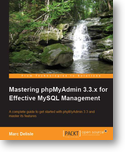
Michal Čihař: Mastering phpMyAdmin 3.3.x for Effective MySQL Management

The book Mastering phpMyAdmin 3.3.x for Effective MySQL Management is already available for some time, but I still think I should promote a little bit in my blog so here it is :-). The book covers all you might want to know about using phpMyAdmin. It really does not make sense to copy text from book description, so feel free to find yourself what all it does cover. As every time, this book is written by Marc Delisle, who is for several years project admin, so probably the person who knows most about hidden features. Usually technical review of the book is done by some other developers and this time it was me doing this job (among other reviewers). I hope we did good job and you will like this book. Mastering phpMyAdmin 3.3.x for Effective MySQL Management book cover PS: As a nice bonus, the phpMyAdmin project receives money from every purchased book.

Filed under: English Phpmyadmin 0 comments Flattr this!

2 January 2011

Lucas Nussbaum: Giving up on Ruby packaging

I have finally reached a decision regarding my involvement in the Debian Ruby packaging efforts. I have decided to stop. This has been a very hard decision to make. I have invested huge amounts of time in that work over the years. I still love the language, and will continue to use it on a daily basis for my own developments. I still hope that it will succeed. I know that some people will be disappointed by that decision (and that others will think your work was useless anyway, people should use RVM and rubygems ). But I also know that I won t be able to push for all the required changes alone. I just don t have the time, nor the motivation. For the record, here are the changes I would have liked to see in the Ruby community. The core Ruby development community should mature.

The core Ruby development community is still dominated by Japanese developers. While not a bad thing in itself, it is easily explained by the fact that the main development mailing list, where most of the important decisions are taken, is in japanese. ruby-dev@ should be closed, and all the technical discussions should happen on the english-speaking ruby-core@ list instead. The release management process should also improve. Currently, it looks like a total mess. The following Ruby development branches are actively maintained:
ruby_1_8 (106 commits over the last six months)
ruby_1_8_6 (4 commits over the last six months)
ruby_1_8_7 (35 commits over the last six months)
ruby_1_9_1 (4 commits over the last six months)
ruby_1_9_2 (227 commits over the last six months)
trunk (1543 commits over the last six months) While the state of the ruby_1_8_6 and ruby_1_9_1 branches is clear (very important bugfixes only), the state of all of the other branches is rather unclear.
What s the stable Ruby branch? 1.8 or 1.9? If it s 1.9, why are people still actively developing in the ruby_1_8 branch? How long will they continue to be maintained in parallel, dividing the manpower? Is a Ruby 1.8.8 release to be expected? Will it be ABI/API compatible with 1.8.7? Is the ruby_1_8_7 branch really bugfixes-only? How much testing of it has been done? If it s bugfixes-only and regression-free, I should push it to Debian squeeze, due to be released in a few weeks. But would you recommend that? Due to past breakages in the ruby_1_8_7 branch, it s unlikely that we will do it.
Is the ruby_1_9_2 a regression-free, bugfix-only branch? If yes, isn t 227 commits over 6 months a lot? What will be the version of the next release of trunk ? When is it expected? Will it be ABI-compatible with the current ruby_1_9_2 branch? API-compatible?
New releases in the 1.8.7 and 1.9.2 branches were done on december 25th. Why were they no betas or RCs allowing wider testing? How much testing has been done behind the scenes? Most of those questions have no clear answer. The Ruby development community should build a common understanding of the status of the various branches, and of their release expectations. Releasing on december 25th of each year sounds fun, but is releasing when everybody is on vacation really a good idea? It would be fantastic to have something similar to Python Enhancement Proposals in the Ruby community. But having open discussions in english about the major issues would already be great. Ruby is not just the interpreter.
The Ruby development community should clearly define what the Ruby platform is. There are some big players, like Rails, and newer interpreter releases should not be done before ensuring that those big players still work. Also, since we have alternative Ruby interpreters, like JRuby, Rubinius and MacRuby, we need a clear process on how they integrate with the rest of the ecosystem. For example, having each of them rely on their own outdated fork of the whole stdlib is ridiculous, since it s not where they compete. The Ruby community should acknowledge that RVM and Rubygems are not for everybody. People who say so should be laughed at. Of course, RVM and Rubygems are nice tools for some people. But it is completely wrong to believe that compiling from source using RVM should be the standard way of installing Ruby, or that all people interested in installing Redmine should know that Ruby has its own specific packaging system. The Ruby community should work with their target platforms to improve how Ruby is distributed instead of reinventing the wheel. That includes Debian, but also RedHat-based distros, for example. It is likely that it won t be possible to reach a one-size-fits-all situation. But that s real life. Some people in the Ruby community should stop behaving like assholes. As one of the Debian Ruby maintainers, I have been routinely accused of creating crippled packages on purpose (FTR, I don t think that the Debian packages are crippled, despite what the rumors says). Debian is not the only target of that. Just yesterday, someone called for abandonning YARV (the new Ruby VM in Ruby 1.9), calling it Yet Another Random Vailure. This kind of comments is really hurting the people who are investing their free time in Ruby, and is turning away people who consider getting involved. In Debian, we have had a lot of problems getting people to help with Ruby maintenance since they are getting shit from the community all the time. So, what s the future for Ruby in Debian? Update: there s also a number of interesting comments about this post on this site.
Update 2: First, thanks a lot for all the interesting comments. I will make some follow-up posts trying to summarize what was said. It seems that this post also triggered some reactions on ruby-core@, with Charles Olivier explaining the JRuby stdlib fork, and Yui Naruse clarifying that all questions are welcomed on ruby-core@. This is great, really.

1 January 2011

Steve Kemp: It would be nice if we could record which files populate or read

It would be really neat if there were some tool which recorded which dotfiles an application read, used, or created. As an example emacs uses .emacs, but won't create it. However firefox will create and fill ~/.mozilla if it isn't present, and links will create ~/.links2. What would we do with that data? I'm not sure off the top of my head, but I think it is interesting to collect regardless. Perhaps a simple tool such as apt-file to download the data and let you search:
who-creates ~/.covers
who-creates ~/.dia
Obviously the simple use is to purge user-data when matching packages are removed - e.g. dpkg-posttrigger hook. But that's a potentially dangerous thing to do. Anyway I'm just pondering - I expect that over time applications will start switching to using "centralised" settings such as ~/.gconf2 etc. In the menatime I've started cleaning up ~/ on my own machines - things like ~/.spectemurc, ~/.grip, etc. ObQuote: What a long sword. I like that in a man - Blood of the Samurai (Don't be tempted; awful film.)

Junichi Uekawa: It's a new year.

It's a new year. May new and innovative things happen.

31 December 2010

Joey Hess: on not coding late

It's midnight and I really want to be coding. I'm half way or so through adding a git-annex-shell to git-annex, which will enable some nice features with ssh access. I've done the research, and written the documentation[1], laid all the necessary refactoring groundwork, and written much of the code and just have to connect it all up and test it. This is a dangerous point to be at, because I have it all in my head, but I'm tired. If I start coding now, I could make a stupid mistake and find myself stuck in a blind alley at 5 am. I've been there before. Even if I avoid hard stuff, I'd surely look up and an hour or more would have gone by, it'd be past 1 am -- and I know that once I stop coding it can take me hours to spin my thoughts back down to the point where I can go to sleep. Also, I can feel the back of my mind still working on something. Some bits feel like they might not quite mesh up right in my mental model. I don't consciously know what the problem is. I need to sleep on it; it will probably be clearer later. Like yesterday when I lifted a bag of groceries into the car and paused, realizing code I'd written two months ago had a major bug, one I'd never seen, in an edge case that had never came up, but was surely there. I always assumed that when programmers got older and stopped coding late it was because they couldn't take the strain. Nah. We're just coding even as we sleep. :)

[1] Documentation is where I do my design. This is why git-annex has quantities of documentation that Linux Weekly News finds surprising.

30 December 2010

Stefano Zacchiroli: how to contribute to Debian

... looking for an HOWTO? These days, possibly because it's holiday in several countries around the world, I'm receiving a higher number of "how can I help Debian?" mails than usual. This is good and makes me happy! Those mails show we have a community who cares about giving back to Free Software, in exchange of what they have received via Debian. Routinely, in my replies, I point people to the following list of documentation we have on how to contribute to Debian: Am I missing something? At the same time, it happens that I reply to people who clearly went through (at least some of) the above resources, but which are still blocked at the "what I do next?" step. I guess this is because some of the day to day practices of Debian life are not described in the documentation we have. For instance, I find scarce references to "cultural" aspects of Debian technical life such as: And I'm sure I'm missing quite some other cultural/folklore traits, which look obvious to longstanding members of the Debian community, but which are probably not so obvious to external people. So, dear lazyweb, have you started contributing to Debian and remember your experience? If so, I'd like to hear from you. In particular, I'd like to hear your suggestions on how we can improve our documentation on the matter (patches welcome, as usual!). Bonus point. Of the various pieces of documentation we have, it seems that a sufficiently detailed HOWTO-style document, covering both technical and cultural aspects, is missing. If you are into writing for Debian, that might be an experiment worth trying.

29 December 2010

Lars Wirzenius: Obnam 0.14 and btree 0.14

After several months of leisurely development (I've read through everything on the Internet several times, and notified everyone who was wrong), I have finally gotten obnam, my backup application, into a state where it successfully backs up my laptop's hard disk to a USB disk. I therefore declare it to be perfe... no, wait, I don't. It's slow. It's probably buggy in ways that will make you want to abandon computers forever. It's also slow. And buggy. Did I mention it is slow, making backups at only a few megabytes per second? Disclaimers aside, I am happy to have gotten obnam to this stage. It's not nearly ready, but it's getting along nicely. If you've been curious about obnam ever since I first mentioned it in 2007, now might be a good time to try it out. I would be very interested in hearing any feedback. Obnam is implemented using copy-on-write B-trees, and I've also released my B-tree implementation. See the NEWS file in each source tree for information for what's changed since the previous release. Links: I have made Debian packages of obnam, btree, and some of my other stuff that they need, for all, amd64, and i386 architectures. The repository is at http://code.liw.fi/debian/, so add this to your sources.list if you want to use that:

deb http://code.liw.fi/debian squeeze main
Note, however, that I do not guarantee that this repository will be in any useful state at any given time. I use it, and rely on it, and will fix things when they bother me, but that's all the guarantee I give. (Do you get the impression I've read too many contracts?) Once obnam is ready, and Debian squeeze is released, I'll upload it to Debian, and then you'll get it for any architecture Debian runs one. If anyone wants to help me maintain the packages for Debian, please e-mail me. If, on the other hand, you'd like to help make obnam faster, or better, the bug tracker has some pointers. Right now speed is perhaps the biggest problem. The B-tree library needs optimizing, as does obnam itself. And the LRU cache I use. The worst missing feature is encryption support. I do my backups to a local hard disk, which is full-disk encrypted, which is why I haven't cared about implementing encryption yet. Also, I need to design a good way to manage keys, etc. Help with that would be quite welcome.

Mike Hommey: Efficient way to get files off the page cache

There s this great feature in modern operating systems called the page cache. Simply put, it keeps in memory what normally is stored on disk and helps both read and write performance. While it s all nice for a day to day use, it often gets in the way when one wants to track performance issues with cold cache (when the files you need to access are not in the page cache yet). A commonly used command to flush the Linux page cache is the following:
# echo 3 > /proc/sys/vm/drop_caches
Unfortunately, its effect is broad, and it flushes the whole page cache. When working on cold startup performance of an application like Firefox, what you really want is to have your page cache in a state close to what it was before you started the application. One way to get in a better position than flushing the entire page cache is to reboot: the page cache will be filled with system and desktop environment libraries during the boot process, making the application startup closer to what you want. But it takes time. A whole lot of it. In one of my what if moments, I wondered what happens to the page cache when using posix_fadvise with the POSIX_FADV_DONTNEED hint. Guess what? It actually reliably flushes the page cache for the given range in the given file. At least it does so with Debian Squeeze s Linux kernel. Provided you have a list of files your application loads that aren t already in the page cache, you can flush these files and only these from the page cache. The following source code compiles to a tool to which you give a list of files as arguments, and that flushes these files:
#include <unistd.h>
#include <fcntl.h>
#include <sys/stat.h>
int main(int argc, char *argv[])  
  int i, fd;
  for (i = 1; i < argc; i++)  
    if ((fd = open(argv[i], O_RDONLY)) != -1)  
      struct stat st;
      fstat(fd, &st);
      posix_fadvise(fd, 0, st.st_size, POSIX_FADV_DONTNEED);
      close(fd);
     
   
  return 0;
 
It s actually a pretty scary feature, especially on multi-user environments, because any user can flush any file she can open, repeatedly, possibly hitting system performance. By the way, on systems using lxc (and maybe other containers, I don t know), running the echo 3 > /proc/sys/vm/drop_caches command from a root shell in a container does flush the host page cache, which could be dangerous for VPS hosting services using these solutions. Update: I have to revise my judgment, it appears posix_fadvise(,,,POSIX_FADV_DONTNEED) doesn t flush (parts of) files that are still in use by other processes, which still makes it very useful for my usecase, but also makes it less dangerous than I thought. The drop_cache problem is still real with lxc, though.

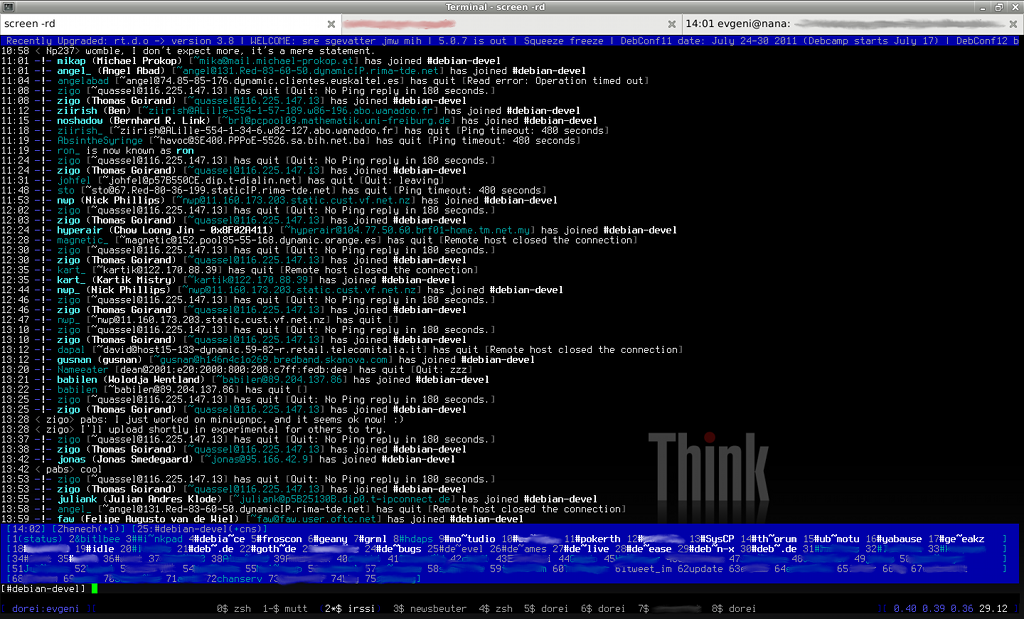
Evgeni Golov: because people asked: my irssi advanced windowlist setup

As XTaran and uschebit asked yesterday at the 27C3 about my nice windowlist in irssi, here is what I use: adv_windowlist.pl. Download it, put it into you ~/.irssi/scripts and load it with /script load adv_windowlist. Now you have a list with all those window names in them, but it s still a bit ugly ;)First of all, get rid of the default Act list of irssi: /statusbar window remove actNow let s customize awl a bit:Done! Your irssi should look like this now:
28 December 2010

Steve Kemp: Minor success has been achieved in reimplimenting mod_rewrite

So yesterday I mentioned the mod_rewrite-compatible proxy server. Today I've spent several hours getting to grips with that. I've progressed far enough along that the trivial cases are handled, as the following test case shows:
void
TestParamteredMatch (CuTest * tc)
 
    /**
     * We pretend this came in via the network.
     */
    char *request = "GET /login/steve.kemp/secret#password HTTP/1.1\n\n";
    /**
     * This is the mod_rewrite rule we're going to test.
     */
    char *rule    = "RewriteRule
                       ^/login/(.*)/(.*)/*$
                         /cgi-bin/index.cgi?mode=login;lname=$1;lpass=$2";
    int res = 0;
    /* Parse the HTTP request */
    struct http_request *req = http_request_new (request);
    CuAssertPtrNotNull (tc, req);
    /* Ensure it looks sane. */
    CuAssertStrEquals(tc, "/login/steve.kemp/secret#password", req->path );
    /* Create the rewrite rule */
    struct rewrite_rule *r = rewrite_rule_new (rule);
    CuAssertPtrNotNull (tc, r);
    /* Assert it contains what we think it should. */
    CuAssertStrEquals(tc, "^/login/(.*)/(.*)/*$", r->pattern );
    /* Apply - expect success (==1) */
    res = rewrite_rule_apply( r, req );
    CuAssertIntEquals (tc, 1, res );
    /* Ensure path is updated. */
    CuAssertStrEquals(tc, "/cgi-bin/index.cgi?mode=login;lname=steve.kemp;lpass=secret#password", req->path );
    free_http_request (req);
    free_rewrite_rule (r);
 
So all is good? Sadly not. I was expecting to handle a linked list of simple rules, but I've now realised that this isn't sufficient. Consider the following two (real) examples:
#
#  If the path is /robots.txt and the hostname isn't repository.steve.org.uk
# then redirect to the master one.
#
RewriteCond % http_host  !^repository\.steve\.org\.uk
RewriteRule /robots.txt$  http://repository.steve.org.uk/robots.txt [R=permanent,L]
#
#  Request for :  http://foo.repository.steve.org.uk 
#  becomes:  http://repository.steve.org.uk/cgi-bin/hgwebdir.cgi/foo/file/tip
#
RewriteCond % http_host  .
RewriteCond % http_host  !^repository.steve.org.uk [NC]
RewriteCond % http_host  ^([^.]+)\.repository.steve.org.uk [NC]
RewriteRule ^/$ http://repository.steve.org.uk/cgi-bin/hgwebdir.cgi/%1/file/tip [QSA,L]
So rather than having a simple linked list of rules for each domain I need to have a list of rules - each of which might in turn contain sub-rules. In terms of parsing this is harder than I'd like because it means I need to maintain state to marry up the RewriteCond & RewriteRules. Still the problem isn't insurmountable and I'm pleased with the progress I've made. Currently I can implement enough of mod_rewrite that I could handle all of my existing sites except the single site I have with the complex rule demonstrated above. (In all honesty I guess I could simplify my setup by dropping the wildcard hostname handling for the repository.steve.org.uk name, but I do kinda like it, and it makes for simple canonical mercurial repositories.) ObQuote: - 300

Wouter Verhelst: Wanted: a "DAS keyboard" with ISO mechanical layout

Some people claim that AZERTY is a crime against humanity. I claim that if you're going to point and laugh at one layout in defense of another, you should have that other be something actually better, like the dvorak or Turkish F layout, not QWERTY. One additional reason: the mechanical layout of a US QWERTY keyboard (the ANSI layout) is inferior to the mechanical layout of the AZERTY keyboards. This is a mathematical fact the ISO layout has 102 keys, the ANSI one has only 101 of them. In that light, I find it highly disappointing that Thinkgeek.com's Das Keyboard uses the ANSI mechanical layout, and that there is no ISO version of the same thing. If there were, I'd have bought one years ago. (Yes, that's meant as a hint, in case you didn't catch that) Update: apparently it exists, it's just that ThinkGeek doesn't have it. For those who want one, it's available here, amongst others.

Matthew Garrett: More Android source code

Telechips also appear to have released the source for their TCC89XX devices, which ought to provide at least some level of support for the Augen devices.

(I promise that I will talk about things that aren't GPL-related in the near future)

Next.

Previous.