Robert Collins: Why platform specific package systems exist and won t go away
A while back mdz blogged about challenges facing Ubuntu and other Linux distributions. He raises the point that runtime libraries for Python / Ruby etc have a unique set of issues because they tend to have their own packaging systems. Merely a month later he attended Debconf 2010 where a presentation was given on the issues that Java packages have on Dpkg based systems. Since then the conversation seems to have dried up. I ve been reminded of it recently in discussions within Canonical looking at how we deploy web services.
Matt suggested some ways forward, including:
 . We d need to support multiple installations (because of mutually incompatible dependencies between applications), and we d need to support multiple language bindings in some fashion some approachable fashion where the upstream will feel capable of fixing and tweaking what we offer. We re going to need to support offline updates, replication, local builds, local repositories, and various signing strategies to match the various tradeoffs made by the upstream tools.
For the anti-virus / fresh data case, we d need to support a similar set of operating systems, though I strongly suspect that there would be more tolerance for limited support in that most things in that space either have very platform specific code, or they are just a large-scale form of the egg/gem/npm problem, which also wants easy updates.
What next?
We should validate this discussion with at least two or three upstreams. Find out whats missing I suspect a lot and whats wrong I hope not much . Then we ll be in a position to decide if there is a tractable, widespread solution *possible*.
Separately, we should stop fighting with upstreams that have their own packaging systems. They are satisfying different use cases than our core distro packaging systems are designed to solve. We should stop mindlessly repackaging things from e.g. eggs to debs, unless we need that specific thing as part of the transitive runtime or buildtime dependencies for the distribution itself. In particular, if us folk that build system packaging tools adopt and use the upstream application packaging tools, we can learn in a deep way the (real) advantages they have, and become more able to reason about how to unify the various engineering efforts going into them and perhaps even eventually satisfy them using dpkg/rpm on our machines.


- Decouple applications from the core
- Treat data as a service (rather than packages) get data live from the web rather than going web -> distro-package -> user machines.
- Simplify integration between packaging systems (including non-packaged things)
- Written in languages that are familiar to the consumers of the tools.
- Targeted at use on top of existing platforms, by non-privileged users, and where temporary breakage is fine.
- Intended to get the software packaged in them onto widely disparate operating systems.
- Very narrow they make huge assumptions about how things can fit together, which their specific language/toolchain permits, and don t generalise beyond that.
- Don t provide for security updates in any specific form: that is left up to folk that ship individual things within the manager.
- Are written in languages which are very easy to bootstrap onto an architecture, and to deploy onto bare metal (as part of installation).
- Designed for delivering system components, and to avoid be able to upgrade the toolchain itself safely.
- Originally built to install onto one operating system, ports to other operating systems are usually fragile and only adopted in niche.
- Are hugely broad they install data, scripts, binaries, and need to know about late binding, system caches etc for every binary and runtime format the operating system supports
- Make special provision to allow security updates to be installed in a low latency fashion, without requiring anything consuming the package that is updated to change [but usually force-uninstalling anything that is super-tightly coupled to a library version].
- Exist to update daemons that run with system wide escalated privileges, or even file system layer drivers.
- Update datasets in realtime.
- Without permitting updates that are produced by third parties.
- The anti-virus / fresh data set case.
- The egg/gem/npm/ specific case.
. We d need to support multiple installations (because of mutually incompatible dependencies between applications), and we d need to support multiple language bindings in some fashion some approachable fashion where the upstream will feel capable of fixing and tweaking what we offer. We re going to need to support offline updates, replication, local builds, local repositories, and various signing strategies to match the various tradeoffs made by the upstream tools.
For the anti-virus / fresh data case, we d need to support a similar set of operating systems, though I strongly suspect that there would be more tolerance for limited support in that most things in that space either have very platform specific code, or they are just a large-scale form of the egg/gem/npm problem, which also wants easy updates.
What next?
We should validate this discussion with at least two or three upstreams. Find out whats missing I suspect a lot and whats wrong I hope not much . Then we ll be in a position to decide if there is a tractable, widespread solution *possible*.
Separately, we should stop fighting with upstreams that have their own packaging systems. They are satisfying different use cases than our core distro packaging systems are designed to solve. We should stop mindlessly repackaging things from e.g. eggs to debs, unless we need that specific thing as part of the transitive runtime or buildtime dependencies for the distribution itself. In particular, if us folk that build system packaging tools adopt and use the upstream application packaging tools, we can learn in a deep way the (real) advantages they have, and become more able to reason about how to unify the various engineering efforts going into them and perhaps even eventually satisfy them using dpkg/rpm on our machines.

 Do you remember at school, when the teachers mentioned that something would be on your "permanent record"? The big secret is that there isn't one. Apologies to all teachers, but it's not likely this blog's demographic will reach your students. However, since the advent of the internet, a permanent record does exist. Everywhere from the
 Sometimes, very rarely, I am happy that the spam filters in my personal mail server are so far from perfect.
Many of us were amazed, some days ago, news broke that

 IT S FINALLY IN!
With this last upload of the MiniUPnP daemon 1.7-3, I ve reached a first milestone: all of the MiniUPnP libraries, daemons and clients are finally in Debian, in a shape which I am not ashamed anymore.
What is UPnP for?
Back in the days (around Linux 2.0.3x), the only way to share a single Internet connection was to run a Linux box as your gateway. These days are far gone, and nearly every home connection is done through a mini home router, which also often provides a small switch and a WiFi access point. Every computer on the LAN gets its connectivity through the router thanks to NAT, and to be more accurate, masquerading. That works very well for outbound connections (browse the web, send a mail, etc.), but it is then a lot harder that something connects to a server located in the LAN. If you run a permanent server with a fixed LAN IP address, that s fine, you just configure your router to do some port forwarding, so that any inbound connection will be forwarded to the computer of your choice in the LAN. But if one application needs to listen on the public IP address just for a while (for example, IRC using DCC connection), so that something can connect to it, it becomes a way more tricky. That s when UPnP comes into play. UPnP stands for Universal Plug and Play. It s a protocol so that any application on the LAN can open ports on the public IP address of the gateway. Note that an UPnP router is also often referenced as UPnP IGD (Internet Gateway Device).
Why using MiniUPnP, don t we have already linux-igd?
Before my packaging work, the only UPnP server that was available in Debian was linux-igd, which has a dependency on libupnpX. That library is quite big for what it does (about 500KiB, on top of which you have to install the 200KiB daemon itself), while MiniUPnP is designed to be lightweight (only 158K, with dependencies on iptables, iproute, uuid-runtime and libc6 only). That seems ridiculous, but when you have only 8MiB of flash in your old router, saving few hundreds KiB is really important, and here, we re saving more than 500 KiB, with a full implementation of the UPnP protocol, and the Microsoft NATPmP implemented as well (yes, Microsoft decided that one protocol wasn t enough, and that they should implement their own (sic!)).
Who is using MiniUPNP?
Probably, you already have the libminiupnpc installed in your SID/wheezy desktop, because the transmission bittorent client which is installed with Gnome by default, depends on it, and minissdpd might be in your desktop too, if you installed the Recommends: packages as well. Which is why these are scoring quite high already in popcon. Previously, transmission was embedding its own version of the MiniUPnP client library, so it s nice to have it as a standalone shared library now.
Also, because of its very light weight, and the fact that UPnP is often needed for gaming (both XBOX 360 and PSP need, and can use, the MiniUPnP daemon that runs on your IGD), many ISP who ship a router to their customer, install MiniUPnP in it. For example, at least, the 2nd and 3rd largest Internet access provider in France (Free Telecom and SFR) are shipping MiniUPnPd in their box (one of them using OpenWRT on their router). So probably as well, you are also using MiniUPnP daemon without knowing it.
But isn t UPnP unsafe?
To this question, I d answer that connecting to Internet is unsafe. It isn t less safe than connecting to Internet on a WiFi hotspot for example. So adding UPnP support on your gateway doesn t make it less safe, especially since MiniUPnP has some features to help with security (like an ACL with IP and port lists, or a secure mode were the router will only open ports to the client requesting it). Also, we are running a distribution where dependencies are easy to check, so it s easy for you to check if a client uses UPnP or not, and decide to trust it (or not). I personally have no issue trusting transmission, x-chat or warzone2010 (more exactly: I don t trust that incoming connectivity will make it less safe for these applications, there are so many other things that could go wrong).
MiniUPnP consists of what?
MiniUPnP is a set of 4 source packages to handle all of your UPnP needs:
- The client library, libminiupnpc (and the corresponding -dev package), with its sidekick miniupnpc client program (you can use it to check the public IP of your gateway, or manually open ports).
- The UPnP IGD daemon, miniupnpd, which just reached Debian Experimental. The latest version, 1.7-3, also includes debconf configuration so that you can choose the NIC and IP address to bind on. If you installed previous version, I strongly recommend upgrading to fix previous problems.
- The libnatpmp client library (and the -dev package) for implementing the Microsoft protocol as a client (it also has a client package binary for your tests).
- The minissdpd daemon to keep memory of all UPnP devices that announced themselves, and speed-up using the UPnP protocol (used by the MiniUPnP client library).
A long process to have MiniUPnP in Debian
All these 4 pieces of the puzzle were not as easy as it seems to be packaged in Debian. Especially, the IGD daemon, MiniUPnPd, used to depend on some header files that were not packaged in Debian. This was a decision of the iptables maintainers, which even after a long discussion, refused to add the necessary headers because it wasn t supposed to be a kernel API. While this might really be truth, the issue was that there was no public API available in the Linux kernel at all, and other distributions (Fedora, Gentoo, etc.) really did supply these needed files. As a consequence, during a very long time (years literally), shamefully, it was impossible to build the MiniUPnP daemon in Debian, while it was no problem on other distributions. Note that I do not want to start a troll discussion here, I m just stating facts, both parties have very strong and respectable arguments. Anyway, this needed API was finally embedded in MiniUPnPd itself thanks to a contributor to the project, and now it builds on both the Squeeze and the Wheezy (that is Linux 3.2) kernel without any issue.
Call for testing
Unfortunately, I don t have a Linux box as my Internet gateway. So I did the tests that I could: I installed MiniUPnPd on one computer on my LAN, and checked that I could open ports from another computer. So it seems to work, but I had no way to really test it live , with some real clients. So if you have an Debian SID box as your Internet gateway, feedback would be highly appreciated.
What is remaining to do?
A transition from libminiupnpc5 to libminiupnpc8 has to happen. Of course, this is too late for Wheezy, so this will happen right after the release. There s not so many reverse dependencies, so it should be ok, but I (yet) have zero experience with transitions. BTW, I had hard time to find out what this transition process was, and maybe some more effort for documenting it would help others (I m thinking about adding some text in the Debian wiki for that). Also, I have called for help on debian-devel, because I m currently the only one maintaining all these 4 source packages, and I m trying to have all my packages checked by others, and team maintained. So if you want to give a hand, or just declare yourself as a backup if I m busy, please raise your hand! Upstream is a friend of mine, and is very reactive to any requests (it very rarely took more than 48 hours to get a reply).
Enjoy MiniUPnP and report bugs!
Again, feedback would be appreciated. :)


 Favicons for Server Tabs
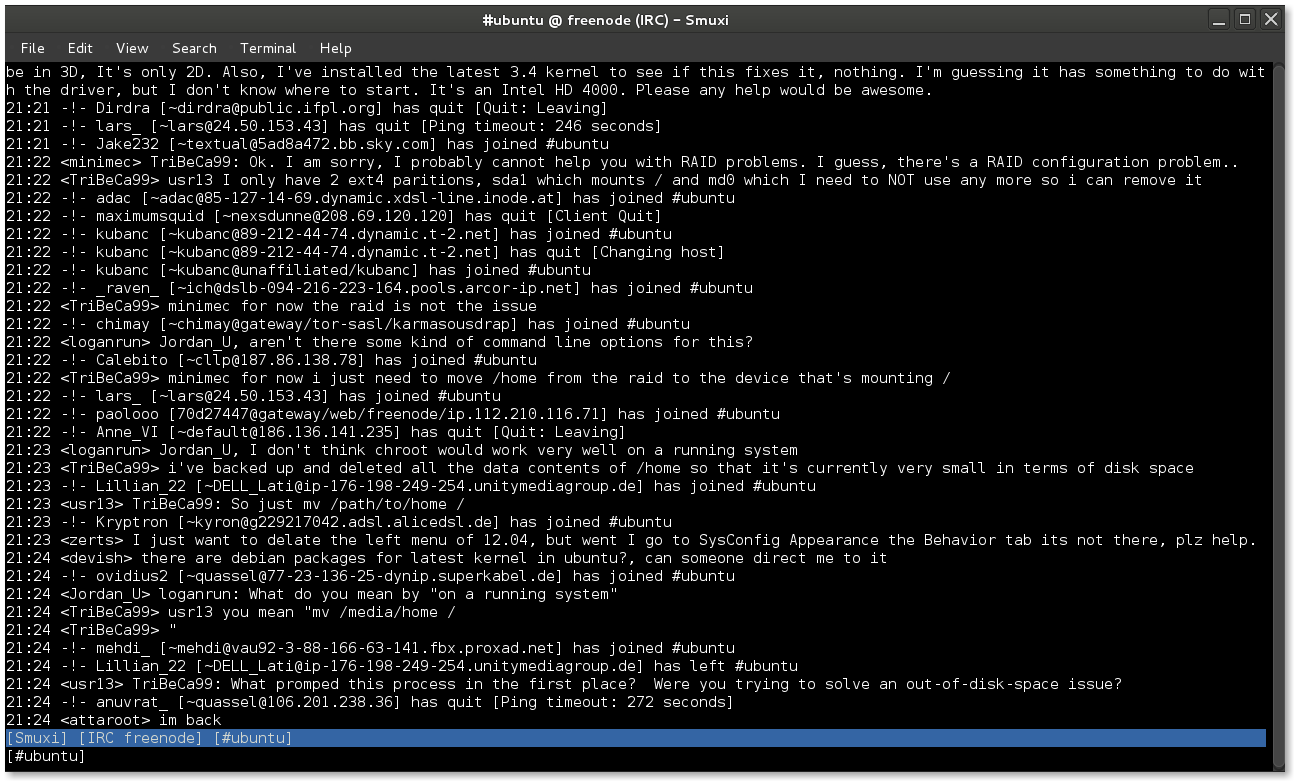
Distinguishing server tabs can be difficult, especially if you have plenty of
them. All server tabs have the same icon so you need to search for the right
name. I wondered why this issue doesn't happen so easily with a web browser
which usually also has lots of tabs open. Besides the page name there is the
favicon right in front. So why can't Smuxi make use of that simple but effective
technology? Well,
 Quick Join Bar
One thing that makes IRC really difficult for new comers is the important IRC
concept that channels are network specific. So what happens is people try to
find / join the channel they are looking for but on the wrong network. They
have to connect to the right server/network and then switch to the right tab,
before they can join the channel (using the /join command or join dialog). The
developers of Smuxi had a brainstorming session and came up with something that
should be easy enough for anyone to use and finally solves the issue: the
 Ewww, that looks ugly, doesn't it? I will make this one short, here is the cure
with
 Enhanced Text Frontend
The text frontend which is still in alpha state has received the following
enhancements: new /exit command, new /help command, regular and xterm window
title, and, several fixed crashes.
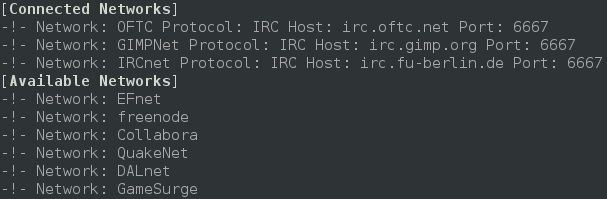 The /connect command now allows you to

 The number of strings to translate increase as I insert the index
entries into the docbook. They were missing with the docbook version
I initially started with. There are still quite a few index entries
missing, but everyone starting with A, B, O, Z and Y are done. I
currently focus on completing the index entries, to get a complete
english version of the docbook source.
There is still need for translators and people with docbook
knowledge, to be able to get a good looking book (I still struggle
with dblatex, xmlto and docbook-xsl) as well as to do the draft
translation and proof reading. And I would like the figures to be
redrawn as SVGs to make it easy to translate them. Any SVG master
around? I am sure there are some legal terms that are unfamiliar to
me. If you want to help, please get in touch, and check out the
project files currently available from
 There's been a few links to
 The Debian project is 19 years old now. Following
 For Debian s birthday, Francesca Ciceri of the Debian Publicity team

 What if you have a mis-behaving electronic device, which might corrupt files you
store on it? I'm interested in tools to inspect incremental backups, look at file
changes and alert me if they are suspicious.
For example, if an MP3 changes, did the MPEG data change, or the ID3 tag, or
something else? An ID3 change is likely to be on purpose, MPEG data less so.
Similar for JPEGs and EXIF metadata.
I decided to poke around in my backups of my music player. I discovered some pretty
weird stuff.
Firstly, quite a few MP3s seem to have changed on my player over time. I found 788
instances of MP3s changing a very small amount: an 11 byte
 A
