Search Results: "will"

2 October 2013

Matthew Garrett: The state of XMir

XMir's been delayed from Ubuntu 13.10. The stated reason is that multi-monitor support isn't sufficiently reliable. That's true, but it's far from the only problem that XMir still has:

It's clear that XMir has turned into a larger project than Canonical had originally anticipated, but that's hardly surprising. There's only one developer with previous X experience working on it full-time, and the announced schedule provided no opportunity to deal with unexpected problems. As if that weren't enough, there's obvious conflict between Ubuntu Desktop and Ubuntu Phone when it comes to developer time and required functionality. The one hardware vendor who's willing to take a public stand has demonstrated that they have no interest in supporting XMir, despite Canonical assuring people that they were already engaging in productive negotiations with GPU manufacturers.

Multiple monitor support may be the single most obvious feature where XMir is lacking, but it's not the only one. Technically and politically, this code is a long way from being ready for prime time. Without significant community contribution, Canonical need to focus on prioritising it appropriately rather than expecting a tiny number of developers to perform miracles. Or, alternatively, they could just drop XMir entirely and focus on Unity 8.

comment count unavailable comments

Raphael Geissert: A bashism a week: dangerous exports

As a user of a shell you have most likely had the need to export a variable to another process; i.e. set/modify an environment variable.

Now, how do you stop exporting an environment variable? can you export anything else?

The bash shell offers the -n option of the export built-in, claiming it "remove[s] the export property". However, this feature is not part of the POSIX:2001 standard and is, therefore, a bashism.

A portable way to stop exporting an environment variable is to unset it. E.g. the effect of "export MY_VAR=foo" can be reverted by calling "unset MY_VAR" - surely enough, this will also destroy the content of the variable.

An equivalent could then be:

# to stop exporting/"unexport" the MY_VAR environment variable:
my_var="$MY_VAR" ; unset MY_VAR ;
MY_VAR="$my_var" ; unset my_var ;


The above code will make a copy of the variable before destroying it and then restoring its content.

How about exporting other things? did you know that you can export shell functions?

With the bash shell, you can export a function with the -f parameter of the export built-in. Needless to say, this is a bashism. Its secret? it's just an environment variable with the name of the function and the rest of the function definition as its value.

Try this:

$ echo="() /bin/echo 'have some bash' ; " bash -c 'echo "Hello World!"'
have some bash


Yes, this means that if you can control the content of an environment variable passed to bash you can probably execute whatever code you want. It comes handy when you want to alter a script's behaviour without modifying the script itself.

Possibilities are endless thanks to bash's support for non-standard characters in function names. Functions with slashes can also be exported, for example:

/sbin/ifconfig()
echo "some people say you should be using ip(1) instead" ;


Are you into bug hunting? export exec='() echo mount this ; '

1 October 2013

Gunnar Wolf: Piracy and culture circulation: #encirc13

This week's lesson on the Arte y cultura en circulaci n: crear y compartir en tiempos digitales course talks about piracy and the circulation of culture, a topic that over time has been debated over and over. And a topic, yes, that can always lead to interesting discussions. This time, we are requested to choose one among ten ideas among the media groups' discourse on what piracy is and means for the "cultural industry". There are tons of material written already on several of those ten lines (i.e. piracy disincentivates creativity, or two that can be seen as two faces of the same argument, If a consumer can have free access to cultural products, he will stop spending his money on them and Every time a consumer has access to an illegal copy, the industry loses a sale), and some are quite obvious (i.e. Piracy makes job positions be lost... Just look at the amount of people the unauthorized distribution industry feeds! Or possibly, Piracy is a prosper industry that gives money to people distributing illegal products Of course, that is true. The problem is, what causes said products to be illegal to begin with? Should they be so?). Some other ideas talk about harsher penalties and ways to punish illegal copying in order to drive actors out of that sector (and into the... void?) So, I chose item #4: Cultural products have a high cost because their production is complex (and a tag could be made, linking complex with expensive). I think this item can lead to a long discussion as to what does this complexity and cost mean. Some cultural products do require quite a bit of investment, yes. Others don't. How do content producers make the jump to produce expensive works? If I am a new programmer/artist/writer/screenplayer/whatever, most likely, my products will be not very complex or expensive. I will start small. And if I excel at my work, somebody will look at me and, in some way, become my patron, my sponsor. Being a sponsor might mean that, based on the results of my good work, I could get hired as a software developer at a large company, or an editorial company would buy the patrimonial rights of my book/music (be it for a fixed fee or for a percentage of sales), or whatever. But the leap is not made quantically A newcomer to the cultural scene will at first, most likely, have a hard time selling his products. At first, it takes convincing just getting people to take a shot at looking at your work ( Hey, please take a look at my program and tell me what you think about it! , Would you be interested in listening to my latest song? And those two are by far ahead of the first attempts where the interactions would more likely be Turn off that $#^#!^ computer, it's well past bedtime or stop murdering that guitar, I'm having a headache ). Maybe the toughest part is to get people to agree to read/hear your work. And there, you start into a continuum Selling your CDs while performing on the street, then getting to play to a bar, then getting somebody to want to produce (maybe even "discover"!) you. Publish some short stories in your school magazine, then in a "From our audience" section in a larger magazine, then a collective book, your self-published book, yet-unwritten books by contract... The same story over and over again, in each different field. Ok, yes, but... This logic succession still leaves space for the Important Producers with the Mighty Big Pockets for the most wanted/largest productions, right? And were unauthorized distribution (piracy) to be the norm (as it currently is, dare I say), wouldn't they stop producing an important portion of cultural works? I'd be tempted to say so. However, a different actor comes into play. When Mighty Big Pockets comes into play, they no longer worry only about getting money from each cultural creation, but from all derived uses of it. And the cultural creation industry (when seen as an industry) goes very much hand in hand with the advertising, marketing industries They end up blending with each other. So, the biggest best sellers will most likely have a hit from illegal copiers. Books are still a great business, but hey An even better business is (usually) movie making. And when you make a movie out of a great story, you will surely link some advertising into it (or at the very least, push advertising/product pushing campaigns to go after it). And there, illegal distribution actually helps the money circle to grow stronger. In the early 1990s, the link between dinosaurs and carbonated drinks was a top seller (because Pepsi was a Jurassic Park sponsor). Although I have always loathed the madness around the World Cups (and basically anything that involves football of any kind), I can perfectly remember several of the theme songs for most of the world cups played during my lifetime. So, in short... No. Illegal distribution does marginally little harm to the money income to the cultural business, at any level. And where it does get some direct harm, it increases the money flux given the auxiliary channels.

Michael Casadevall: Spanish or Bust: Attaining fluency in 90 days or else ...

"How do you have an adventure?"

"You take a stupid idea, and follow through ..."

Perhaps, I've truly lost my mind for once, but I've decided to embark on a personal project to try and achieve some fluency in Spanish in just 90 days, and posting it to the internet to try and keep me honest and on track towards doing so. I will post future updates as I go, and would welcome help from anyone who would be interested in helping!

The cost of failure: being forced to praise Wndows 8 in a future video, and run it for one week on my laptop.


(I apologize for the quality, but I finally managed to find the nerve to record myself doing this, and just uploaded before I lost it again)


30 September 2013

Sylvain Le Gall: OUnit 2.0, official release

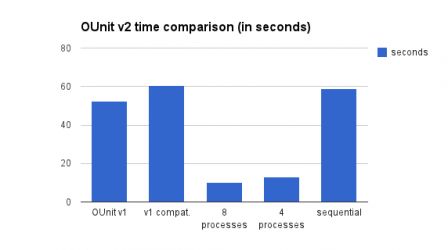
After 1.5 month of work, I am proud to officialy release OUnit 2.0.0. This is a major rewrite of OUnit to include various feature that I think was missing from OUnit1. The very good news is that the port of the OASIS test suite has proven that this new version of OUnit can drastically improve the running time of a test suite. OUnit is a unit test framework for OCaml. It allows one to easily create unit-tests for OCaml code. It is based on HUnit, a unit testing framework for Haskell. It is similar to JUnit, and other XUnit testing frameworks. Download OUnit v2.0.0 Documentation of v2.0.0 Website The basic features: Migration path OUnit 2.0.0 still provides the OUnit module which is exactly the same as the last OUnit 1.X version. This way, you are not forced to migrate. However, this means that you will gain no advantage of the new release and even some slowdown due to increase complexity of the code. Though, I strongly recommend to upgrade to OUnit2. Here is a checklist to do the migration: The OASIS test suite migration In order to check that everything was working correctly, I have migrated the OASIS test suite to OUnit2. This is a big test suite (210 test cases) and it includes quite big sequences of tests (end to end tests from calling oasis setup to compiling and installing the results). This was really time consuming and I wish to see a significant speedup for the tests with OUnit2. You can see the result in term of code of the full migration here. Here are the results on my Intel Core i7 920/SSD: OUnit v2 benchmark The migration was quite heavy because this test suite had a big design problem. It uses in-place modification of the test data. I think I pick this design because I thought this was a good idea to decrease the running time. As a matter of fact, this was a huge mistake, that keeps popping failed test cases because one of the previous tests was failing. I have refactored all this and now we start by copying the test data into a temporary directory, which ensure that everything is always starting from pristine test data. During the redesign, I have decided to reduce the number of tests by merging some of them. This should have no big impact on the running time, although this is not as pure 1:1 comparison with OUnit v1. Although it is still testing exactly the same thing. This explain the loss of ~50 tests, which in fact has been merged in other tests. The overall speedup is 4x compared to OUnit v1, when using processes. However there is a 12% increase compared to OUnit v1 for sequential and a 15% increase when using OUnit v1 compatibility layer. While this is not very good score, I hope this is small enough to compensate the huge win of being able to run tests in parallel with processes. And now the magic ! At this point, if you read carefully the numbers, you would have noticed that there is a 4.5x decrease in speed when you compare sequential and 4 processes for OUnit2. Since we are only actively testing in 4 shards, it looks strange. I don't expect a super-linear speedup due to the use of processes. I have checked that every tests was indeed running and found no solutions to this mystery. Right now, I think this is due to the fact that we are running less tests in more processes which should lighten the load of the GC (which may not trigger at all). I am not sure about this explanation and will welcome any bug report which shows a problem in the implementation of either sequential or processes runner. Although, this is great. Help still wanted If you find any bugs with OUnit v2, this is the time to submit a bug. OUnit BTS If you want to try to fix bugs by yourself, please checkout the latest version of OUnit:
 $> darcs get http://forge.ocamlcore.org/anonscm/darcs/ounit/ounit
Patches always welcome.

29 September 2013

Dirk Eddelbuettel: Rcpp 0.10.5

A new version of Rcpp is now on the CRAN network for GNU R; binaries for Debian have been uploaded as well. Once more, this release brings a large number of exciting changes to Rcpp. Some concern usability, some bring new features, some increase performance; see below for the detailed list. We have now released three updates on a quarterly cycle; if we keep this up the next version ought to be ready at the end of December. As in the past, we tested the release rather rigorously by checking against all packages I could (relatively easily) built on my server: this time it successfully passed \code R CMD check for all 107 packages I can build locally out of a total of 136 packages. (Two failed: one for an error in \code Makevars , and one for the need of an X11 server during tests; this may get addressed in the in test script next time). As all of these 107 packages passed, we do not expect any issues with dependent packages. Should there be issues we would appreciate a note, preferably with reproducible code, to the rcpp-devel mailing list. The complete NEWS entry for 0.10.4 is below; more details are in the ChangeLog file in the package and on the Rcpp Changelog page.
Changes in Rcpp version 0.10.5 (2013-09-28)
  • Changes in R code:
    • New R function demangle that calls the DEMANGLE macro.
    • New R function sizeof to query the byte size of a type. This returns an object of S3 class bytes that has a print method showing bytes and bits.
  • Changes in Rcpp API:
    • Add defined(__sun) to lists of operating systems to test for when checking for lack of backtrace() needed for stack traces.
    • as<T*>, as<const T*>, as<T&> and as<const T&> are now supported, when T is a class exposed by modules, i.e. with RCPP_EXPOSED_CLASS
    • DoubleVector as been added as an alias to NumericVector
    • New template function is<T> to identify if an R object can be seen as a T. For example is<DataFrame>(x). This is a building block for more expressive dispatch in various places (modules and attributes functions).
    • wrap can now handle more types, i.e. types that iterate over std::pair<const KEY, VALUE> where KEY can be converted to a String and VALUE is either a primitive type (int, double) or a type that wraps. Examples :
      • std::map<int, double> : we can make a String from an int, and double is primitive
      • boost::unordered_map<double, std::vector<double> >: we can make a String from a double and std::vector<double> can wrap itself
      Other examples of this are included at the end of the wrap unit test file (runit.wrap.R and wrap.cpp).
    • wrap now handles containers of classes handled by modules. e.g. if you expose a class Foo via modules, then you can wrap vector<Foo>, ... An example is included in the wrap unit test file.
    • RcppLdFlags(), often used in Makevars files of packages using Rcpp, is now exported from the package namespace.
  • Changes in Attributes:
    • Objects exported by a module (i.e. by a RCPP_MODULE call in a file that is processed by sourceCpp) are now directly available in the environment. We used to make the module object available, which was less useful.
    • A plugin for openmp has been added to support use of OpenMP.
    • Rcpp::export now takes advantage of the more flexible as<>, handling constness and referenceness of the input types. For users, it means that for the parameters of function exported by modules, we can now use references, pointers and const versions of them. The file Module.cpp file has an example.
    • No longer call non-exported functions from the tools package
    • No longer search the inline package as a fallback when loading plugins for the the Rcpp::plugins attribute.
  • Changes in Modules:
    • We can now expose functions and methods that take T& or const T& as arguments. In these situations objects are no longer copied as they used to be.
  • Changes in sugar:
    • is_na supports classes DatetimeVector and DateVector
  • Changes in Rcpp documentation:
    • The vignettes have been moved from inst/doc/ to the vignettes directory which is now preferred.
    • The appearance of the vignettes has been refreshed by switching to the Bistream Charter font, and microtype package.
  • Deprecation of RCPP_FUNCTION_*:
    • The macros from the preprocessor_generated.h file have been deprecated. They are still available, but they print a message in addition to their expected behavior.
    • The macros will be permanently removed in the first Rcpp release after July 2014.
    • Users of these macros should start replacing them with more up-to-date code, such as using 'Rcpp attributes' or 'Rcpp modules'.
Thanks to CRANberries, you can also look at a diff to the previous release 0.10.4. As always, even fuller details are on the Rcpp Changelog page and the Rcpp page which also leads to the downloads, the browseable doxygen docs and zip files of doxygen output for the standard formats. A local directory has source and documentation too. Questions, comments etc should go to the rcpp-devel mailing list off the R-Forge page

Ian Campbell: qcontrol 0.5.2

I've just released qcontrol 0.5.2. Changes since the last release: Get it from gitorious or http://www.hellion.org.uk/qcontrol/releases/0.5.2/. The Debian package will be uploaded shortly.

Joachim Breitner: Heidelberg Laureates Forum 2013

During the last week I was attending the first Heidelberg Laureates Forum as one of the lucky 200 accepted young scientists. The HFL is a (from now on hopefully yearly) event that brings together Fields Medalists, Abel Prize laureates and Turing Award winners with young scientists (undergraduates, Ph.D. students and postdocs) from both fields in the city of Heidelberg. The extremely well organized week consisted of lectures from the laureates, some workshops held by postdocs, excursions and plenty of good food. Videos of the lectures are available (but don t work on Linux, at least not for me ), and I have shot a few pictures of the event as well. I believe that my favourite lectures where Michael Atiyah s Advice to a Young Mathematician , Vladimir Voevodsky s Univalent Foundations of Mathematics , William Morton Kahan s Desperately Needed Remedies for the Undebuggability of Large-Scale Floating-Point Computations in Science and Engineering and Alan Kay s Putting Turing to Work . Where are all the functional programmers? During that event, one gets to talk to many other math and computer scientists researchers; sometimes just Where are you from? and What do you do? , sometimes long discussions. Unfortunately, I hardly found one who is into functional programming language research is that only because the event was parallel to ICFP (which I really would have liked to attend as well), or is functional programming really just about 1% of all computer science? What is a proof? My other research interest lies in interactive theorem proving, especially using Isabelle. Of course that is a topic that one can discuss with almost everyone at that event, including the mathematicians. The reactions were rather mixed: On the one end of the spectrum, some mathematicians seriously doubt that they would ever trust a computer to check proofs and that it would ever be efficient enough to use. Others would not mind having a button that tells whether their paper written in LaTeX is correct , but were not keen to invest time or thought into making the proof readable by the computer. And then there were some (but very few!) who had not heard of theorem proving before and were very excited by the prospect of being able to obtain certainty about their proofs immediately and without having to bother other scientists with it. During the mathematician s panel discussions, where I posed the question Do you see value in or even a need for machine-checked proofs in mathematics. , Efim Zelmanov (Fields Medal 1994) said a proof is what other mathematicians see as a proof . I found this attitude a bit surprising for me, a proof has always been a rigorous derivation within a formal system (say, ZFC set theory), and what we write in papers is a (less formal) description of the actual proof, whose existence we believe in. Therefore I was very happy to see Vladimir Voevodsky give a very committed talk about Univalent Foundations and how using that as the language for mathematics will allow more of mathematics to be cast in a formal, machine-checked form. I got the chance to discuss this with him in person, as I wanted to hear his option on Isabelle, and especially on the usefulness of the style of structured proof that Isar provides, and which is closer to the style of proofs that mathematicians use in papers. He said that he enjoyed writing his proof in the style required in Type Theory and in Coq, and that maybe mathematicians should and will adjust to the language of the system, while I believe that a structured proof languages like Isar, independent of the underlying logic (HOL in this case; which is insufficient to form a base for all of abstract mathematics), is a very useful feature and that proof assistants should adjust to the mathematicians.
We also briefly discussed the idea of mine to work with theorem provers already with motivated students in high schools, e.g. in math clubs, and found that simple proofs about arithmetic of natural numbers could be feasible here, without being too trivial. All in all a very rewarding and special week, and I can only recommend to try to attend one of the next forums, if possible.

Petter Reinholdtsen: Finally, Debian Edu Wheezy is released today!

A few hours ago, the announcement for the first stable release of Debian Edu Wheezy went out from the Debian publicity team. The complete announcement text can be found at the Debian News section, translated to several languages. Please check it out. There is one minor known problem that we will fix very soon. One can not install a amd64 Thin Client Server using PXE, as the /var/ partition is too small. A workaround is to extend the partition (use lvresize + resize2fs in tty 2 while installing).

MJ Ray: Send updates to live cycling news reports to the speech synth

The BBC coverage of the UCI Women Road Race World Championship wasn t starting until 3pm, BBC Radio 5 Live had football and Sports Extra was playing an advert loop (really BBC?), Eurosport wasn t covering the race at all, RAI Sport 2 had coverage which was fine while I was watching the TV, but my Italian isn t good enough to follow the commentary and I wanted to get some other stuff done. So the obvious thing is to have the computer watch for changes to the great http://live.cyclingnews.com/ ticker and read them out, right? Well, it was to me. Here s the script I used:
#!/usr/bin/rc
# Send updates to live cycling news reports to the speech synth
# initialise
url=http://live.cyclingnews.com/
if (~ $1 *:*)  
  url=$1
 
last=""
while (true)  
    # download the update and strip html - if you don't have html2text try
    # sed -e '1,/<ol/d;s/<br[^>]*>/n/g;s/<[^>]*>//g;s/ / /g;s/[[:space:]]*$//'
    next= () curl -s $url   html2text -width 9999   sed -e 's/^ *[0-9]*. //'  
    # look for some added lines in the update section - timezone will need changing for non-European races
    say= () diff -u < echo $last  < echo $next  
        sed -ne '/^+/!d;s///;s/**//g;/ CES*T/,/^ *$/p'   head -9  
    # feed them to the speech synth in reverse order
    echo $say '
      Race Update'   tac   spd-say -e
    # update variables, pause and loop
    last=$next
    # set this to a prime number over 60, like 61, 67, 71, 73, 79, 83, 89
    sleep 67
 
Any questions, comments or improvements? I could have done more, like not saying Race Update even when there was no update, but I wanted to start listening as soon as possible!

28 September 2013

Jelmer Vernooij: Book Review: Bazaar Version Control

Packt recently published a book on Version Control using Bazaar written by Janos Gyerik. I was curious what the book was like, and they kindly provided me with a digital copy. The book is split into roughly five sections: an introduction to version control using Bazaar's main commands, an overview of the available workflows, some chapters on the available extensions and integration, some more advanced topics and finally, a quick introduction to programming using bzrlib. It is assumed the reader has no pre-existing knowledge about version control systems. The first chapters introduce the reader to the concept of revision history, branching and merging and finally collaboration. All concepts are first discussed in theory, and then demonstrated using the Bazaar command-line UI and the bzr-explorer tool. The book follows roughly the same track as the official documentation, but it is more extensive and has more fancy drawings of revision graphs. The middle section of the book discusses the modes in which Bazaar can be used - centralized or decentralized - as well as the various ways in which code can be landed in the main branch ("workflows"). The selection of workflows in the book is roughly the same as those in the official Bazaar documentation. The author briefly touches on a number of other software engineering topics such as code reviews, code formatting and automated testing, though not sufficiently to make it useful for people who are unfamiliar with these techniques. Both the official documentation and the book complicate things unnecessarily by listing every possible option. The next chapter is a basic howto on the use of Bazaar with various hosting solutions, such as Launchpad, Redmine and Trac. The Advanced Features chapter covers a wide range of obscure and less obscure features in Bazaar: uncommit, shelves, re-using working trees, lightweight checkouts, stacked branches, signing revisions and using e-mail hooks. The chapter on foreign version control system integration is a more extensive version of the public docs. It has some factual inaccuracies; in particular, it recommends the installation of a 2 year old buggy version of bzr-git. The last chapter provides quite a good introduction to the Bazaar APIs and plugin writing. It is a fair bit better than what is available publically. Overall, it's not a bad book but also not a huge step forward from the official documentation. I might recommend it to people who are interested in learning Bazaar and who do not have any experience with version control yet. Those who are already familiar with Bazaar or another version control system will not find much new. The book misses an opportunity by following the official documentation so closely. It has the same omissions and the same overemphasis on describing every possible feature. I had hoped to read more about Bazaar's data model, its file format and some of the common problems, such as parallel imports, format hell and slowness.

27 September 2013

Erich Schubert: Big Data madness and reality

"Big Data" has been hyped a lot, and due to this now is burning down to get some reality checking. It's been already overdue, but it is now happening.
I have seen a lot of people be very excited about NoSQL databases; and these databases do have their use cases. However, you just cannot put everything into NoSQL mode and expect it to just work. That is why we have recently seen NewSQL databases, query languages for NoSQL databases etc. - and in fact, they all move towards relational database management again.
Sound new database systems seem to be mostly made up of three aspects: in-memory optimization instead of optimizing for on-disk operation (memory just has become a lot cheaper the last 10 years), the execution of queries on the servers that store the actual data (you may want to call this "stored procedures" if you like SQL, or "map-reduce" if you like buzzwords), and optimized memory layouts (many of the benefits of "colum store" databases come from having a single, often primitive, datatype for the full column to scan, instead of alternating datatypes in records.

However, here is one point you need to consider:
is your data actually this "big"? Big as in: Google scale.
I see people use big data and Hadoop a lot when they just shouldn't. I see a lot of people run Hadoop in a VM on their laptop. Ouch.
The big data technologies are not a one-size-fits-all solution. They are the supersize-me solution, and supersize just does not fit every task.
When you look at the cases where Hadoop is really successful, it is mostly in keeping the original raw data, and enabling people to re-scan the full data again when e.g. their requirements changed. This is where Hadoop is really good at: managing 100 TB of data, and allowing you to quickly filter out the few GB that you really need for your current task.
For the actual analysis - or when you don't have 100 TB, and a large cluster anyway - then just don't try to hadoopify everything.
Here is a raw number from a current experiment. I have a student work on indexing image data; he is implementing some state of the art techniques. For these, a large number of image features are extracted, and then clustering is used to find "typical" features to improve image search.
The benchmarking image set is 56 GB (I have others with 2 TB to use next). The subset the student is currently processing is 13 GB. Extracting 2.3 million 128 dimensional feature vectors reduces this to about 1.4 GB. As you can see, the numbers drop quickly.
State of the art seems to be to load the data into Hadoop, and run clustering (actually, this is more of a vector quantization than clustering) into 1000 groups. Mahout is the obvious candidate to run this on Hadoop.
However, as I've put a lot of effort into the data mining software ELKI, I considered also to try processing it in ELKI.
By cutting the data into 10 MB blocks, Mahout/Hadoop can run the clustering in 52x parallel mappers. k-Means is an iterative algorithm, so it needs multiple processes. I have fixed the number of iterations to 10, which should produce a good enough approximation for my use cases.
K-means is embarrassingly parallel, so one would expect the cluster to really shine at this task. Well, here are some numbers:

So what is happening? Why is ELKI beating Mahout by a factor of 10x?
It's (as always) a mixture of a number of things:
Let me emphasize this: I'm not saying, Hadoop/Mahout is bad. I'm saying: this data set is not big enough to make Mahout beneficial.

Conclusions: As long as your data fits into your main memory and takes just a few hours to compute, don't go for Hadoop.
It will likely be faster on a single node by avoiding the overhead associated with (current) distributed implementations.
Sometimes, it may also be a solution to use the cluster only for preparing the data, then get it to a powerful workstation, and analyze it there. We did do this with the images: for extracting the image features, we used a distributed implementation (not on Hadoop, but on a dozen PCs).
I'm not saying it will stay that way. I have plans for starting "Project HELKI", aka "ELKI on Hadoop". Because I do sometimes hit the barrier of what I can compute on my 8 core CPU in an "reasonable" amount of time. And of course, Mahout will improve over time, and hopefully lose some of its "Java boxing" weight.
But before trying to run everything on a cluster, always try to run it on a single node first. You can still figure out how to scale up later, once you really know what you need.
And last but not least, consider whether scaling up really makes sense. K-means results don't really get better with a larger data set. They are averages, and adding more data will likely only change the last few digits. Now if you have an implementation that doesn't pay attention to numerical issues, you might end up with more numerical error than you gained from that extra data.
In fact, k-means can effectively be accelerated by processing a sample first, and only refining this on the full data set then. And: sampling is the most important "big data" approach. In particular when using statistical methods, consider whether more data can really be expected to improve your quality.
Better algorithms: K-means is a very crude heuristic. It optimizes the sum of squared deviations, which may be not too meaningful for your problem. It is not very noise tolerant, either. And there are thousands of variants. For example bisecting k-means, which no longer is embarrassingly parallel (i.e. it is not as easy to implement on MapReduce), but took just 7 minutes doing 20 iterations for each split. The algorithm can be summarized as starting with k=2, then always splitting the largest cluster in two until you have the desired k. For many use cases, this result will be just as good as the full k-means result.
Don't get me wrong. There are true big data problems. Web scale search, for example. Or product and friend recommendations at Facebook scale. But chances are that you don't have this amount of data. Google probably doesn't employ k-means at that scale either. (actually, Google runs k-means on 5 mio keypoints for vector quantization; which, judging my experience here, can still be done one a single host; in particular with hierarchical approaches such as bisecting k-means)
Don't choose the wrong tool for the wrong problem!

26 September 2013

Steve Kemp: Random hacking for fun

Recently I've been playing gtetrinet, against the publicly accessible server at tetrinet.debian.net. If you're unfamiliar with the game it is a multi-player variant of Tetris. You clear many lines and your opponents suffer. Want to make them suffer some more? Use the special blocks you acquire. Special blocks? How about shuffling your opponents playing field? Adding new semi-formed rows? etc. All good stuff. There is support for up to six players. To fire a special block at the player in field 1 you press "1". To fire the special block to the player in field 6 press "6". But to fire a block at yourself, to clear your playing field ("nuke") or remove a single line ("clear") you have to know what player-number you are, which will change from day to day, as it is literally a marker for the order you joined the channel in. It seems obvious that there should be a special-case keybinding "fire to self", and indeed there was bug #291844 filed in 2005 saying as much. I've just submitted a functional patch to resolve this, and already my playing is getting better. Join me sometime.

25 September 2013

Gunnar Wolf: Is there some old-school programmer available around here?

Is there some old-school programmer available around here?
Just saw this ad today at my Institute's door. Rough translation: Interim programmer sought Requisites: [Yes, this is a joke post. I don't know how anybody is using such an obsolete job description. A job description at least three decades out of date] [Well, yes, I understand it, because I knowhow that particular union works. But I cannot accept it is for real] [...And no, please don't apply for the job. You will be miserable in the unlikely event you are chosen]

Sylvain Le Gall: OUnit 2.0 progress, September 2013

Continuing last month progress report onOUnit2. The release is just a few days away, I am testing real life application and the core of the work is already in the VCS. The basic features: Still remaining to do, but quite straightforward: Some things that I decided not to do for OUnit 2.0 release: The main development is now done, but before releasing I decided to test it first on a real scale application. The first big migration to OUnit2, will be the OASIS test suite. This is a pretty big test suite (100+ tests) that takes a fair amount of time to run. I hope that during the next week I will be able to port the whole test suite and come back with some timing results. You can follow my progress on porting OASIS to OUnit 2.0, in github. Help wanted If you have a long standing issue with OUnit, this is the time to submit a bug. OUnit BTS If you want to try the dev version of OUnit:
 $> darcs get http://forge.ocamlcore.org/anonscm/darcs/ounit/ounit
Patches always welcome. You can read the documentation of the devel version the website.

23 September 2013

Justus Winter: Final GSoC report

This is my final report :) the GSoC was great, I learned a lot about the Hurd and Mach programming in general. I am also very pleased to announce that I reached my initial goal and almost all of my patches already made it upstream and into Debian :) I spent my last week fixing issues I introduced and splitting up /hurd/init into two programs. This would make it possible to integrate the patch that frees PID 1 for sysvinit into the Hurd upstream sources. I didn't quite finish the separation, but my proof of concept works and I will finish this as my next Hurd project. Looking back at the last fourteen weeks, I accomplished the following: I implemented /proc/mounts, umount, freed up PID 1 for sysvinit, fixed ifupdown, sysvinit and initscripts on Hurd, implemented a proof-of-concept cgroupfs and fixed many small issues along the way. Almost all of my patches are already upstream and in Debian, a Debian/Hurd booting using sysvinit is just a few uploads away. It has been a lot of fun and I will definitively see you around :) Justus

David Pashley: A New Chapter

It s been a while since I posted anything to my personal site, but I figured I should update with the news that I m leaving Brighton (and the UK) after nearly nine years living by the seaside. I ll be sad to leave this city, which is the greatest place to live in the country, but I have to opportunity to go explore the world and I d be crazy to let it pass me by. So what am I doing? In ten short days, I plan to sell all my possessions bar those I need to live and work day to day and will be moving to Spain for three months. I m renting a flat in Madrid, where I ll continue to work for my software development business and set about improving both my Spanish and my fitness. If you want to follow my adventures, or read about the reasons for my change, then check out the Experimental Nomad website. The post A New Chapter appeared first on David Pashley.com.

Daniel Pocock: PostBooks packages available

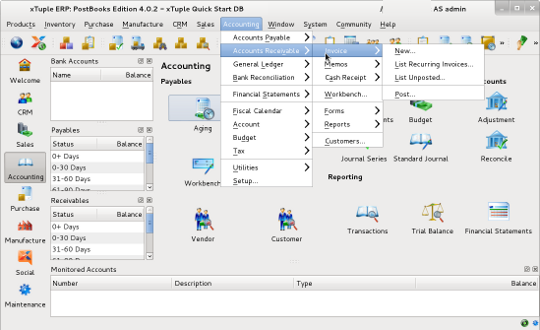
A common theme that comes up in free software evangelism is the question of how to tap into the huge expenditure that small to medium-sized businesses make for off-the-shelf licensed software. It is well known that many small companies are paying over the odds compared to the site-license rates given to big business, so why is it that small businesses are not rushing to adopt free and open source solutions? The answer is not likely to be found by fighting a battle on pricing (even though it is a battle that free software is inherently well prepared for). Rather, the most compelling strategy involves helping businesses find better ways to solve their own problems. A problem that every business encounters in every industry is the maintenance of proper financial records. Up until now, packaged solutions like GnuCash and HomeBank, available in many Linux distributions, have only catered for the smallest businesses and household accounting. At the other end of the spectrum, solutions like Compiere/Adempiere and OpenERP require a level of effort to install and maintain that makes them unsuitable for small users and businesses that don't need their full range of features. OpenERP briefly appeared as a Debian package but subsequently dropped out due to difficulties supporting the package. There is another choice, PostBooks. PostBooks has recently been packaged for Debian and this experience leads me to believe it will be supportable in Fedora and other distributions too. PostBooks, which started off as a commercial product, was re-licensed as an open source solution in 2007. In March 2013, PostBooks was project of the month on Sourceforge. Of particular note,
  • PostBooks has a Qt-based GUI where users of equivalent commercial solutions are likely to feel comfortable very quickly
  • PostBooks does not depend on any dedicated server processes other than a PostgreSQL database
  • Using the quickstart database, it can be set up in less than half a day, making it suitable for many consultants and freelancers who may otherwise use a product having a setup wizard (such as QuickBooks).
  • However, with features like inventory, invoicing, a sophisticated data import GUI (known as CSVImp), a true SQL backend, multi-currency and multiple concurrent users, it scales beyond the use cases that Quickbooks and Sage Accounting are capable of servicing.
  • The company behind PostBooks, xTuple, is well established and offers related services such as training and an annual user conference (which takes place in just a few weeks). Many business users are likely to find this style of support very reassuring and familiar, even if they don't plan to immediately take advantage of these things.
Limitations Two particular limitations caught my attention early when evaluating PostBooks: The developers have acknowledged these limitations and offered to complete these solutions with a crowd-funding campaign dubbed Feature Mob 2.

While everybody likes a free lunch, I personally feel that developers are perfectly entitled to request payment for their work. Having already taken a great leap of faith in open-sourcing a product that had previously been developed in-house, companies like xTuple need to look at new ways to generate revenue. Having looked at some of the prices of equivalent solutions, I felt quite comfortable pledging a similar amount based on four things:
  • it is based on the Kickstarter model, they only keep the money if their funding target is reached and feature implementation goes ahead
  • they are releasing the work as open source
  • the desire to have the option of using a highly capable free software solution that will be around well into the future
  • the probability that this is one piece of software that is likely to create more commercial opportunities for free software developers
Next steps People trying the packages and people who potentially want to package PostBooks for other distributions are very welcome to come and ask questions in the xTuple Debian maintainers packaging list or using the xTuple web forums. Please also feel free to report bugs through the Debian bug tracker.

Gunnar Wolf: This week it was an easy one: On picking free licensing schemes #encirc13

The third lesson of the Arte y cultura en circulaci n: crear y compartir en tiempos digitales course was quite easy, at least for me, as it's one of the topics I've been involved with for a long time: Authors' rights and ways to exercise them. This lesson starts by talking about the paradoxes created in the reality beneath copyright mostly due to the zero-cost-for-perfect-copy reality we live in today, and then goes on to introduce the most widely spread licensing schemes for cultural works nowadays: The Creative Commons licensing schemes. What I felt very interesting is that the lesson tackles the most common issues raised by authors choosing CC licensing: The Non-Commercial and Non-Derivatives restrictions. While authors are usually not very hard to convince about the virtues (and their personal benefit) in CC licensing, it's usually hard for authors to accept and relinquish the "locks" on non-derivability and non-commercial-use. Now, as to the homework: This time, I have to admit it was a no-brainer to me. The homework was to take part of a "Licenciat n": Publish some work under a open or free license (a work of any kind; it can be text, photo, video, etc.; it can be a new or a pre-existing work) and argue as to why did you choose said license. Even the act of writing this blog post means I'm releasing some work. The bottom of my blog reads, All the material found at this site is freely available, and you can use it as you wish, except when the document mentions explicitly different conditions. Yes, this is not a widely known, preexisting licensing scheme, and more or less goes along the lines of CC0 There are some good things I have posted in this blog, some things I am proud about. This post goes more towards the average quality: Not adding anything of great value to the world, just reiterating/reposting what is already said. But I know this blog is syndicated over several different places, and its content might be copied over to other places. I don't need to know or be notified about it. I just care for people to be able to reach back if they want to do it. But, of course, if I'm asked to do a homework, I prefer not to have it so self-referential. What else to license? We are over halfway across the Wiki Loves Monuments contest for 2013. This year I am clearly not as active on it as I was last year, but yesterday I uploaded about 60 photos from our recent trips, from historical monuments in some towns/cities within ~150Km of Mexico City: Puebla, Tlaxcala, Cacaxtla, Toluca, Santiago Tianguistenco. I intend to upload more. Those photos are licensed CC-BY-SA. Why? Mainly, because it is the defaul for the contest. One of the lessons learned working on Debian is that the less the license I choose deviates from what the upstream authors of a larger project prefer, the more useful my work will be. And being Wikimedia a host of many related projects, I prefer to completely abide by their recommendations unless there is a real, strong reason not to do so. Also, I know that at least most the photos I am uploading are not of contest quality (although some are quite nice, but we don't take that long to take a shot, and our camera is probably too basic to get a quality shot, if not by mere chance). I am using the WLM contest as an excuse to categorize and upload my pictures Of course, I'm not including personal photos, but... If I found a building, place or landscape interesting enough to take a photo of, why not make said photo available for whoever needs it, in a canonical, easy to reach media repository (as Wikimedia Commons) is)? And finally, I think it's time to start getting more open and forward-going with a project that I have been giving a lot of work during the past year, a project that has been even eating quite a bit of my Debian time: My upcoming book. While this book is not yet freely licensed (it is freely distributed online, but does not yet have an explicit license, and I mention it on my teaching/project page. Why? Because it still has some figures and data which are not mine, and which I have to re-elaborate to be able to legally license it. But anyway I am writing a book on the subject of Operating Systems, and am basing my teaching on it. The first semester was basically hell for me, as I was working almost full time on it, and needed to allocate some time as well to the rest of my formal work. This second semester has been quite smoother. And there is a very important (to me) initiative to which I (or should I now start saying, we) submitted this work: The LATIn Project: An initiative to collaboratively create quality, freely redistributable text books for the university level, natively in Spanish, for their use in Latin American countries. I was not able to propose this book due to some formalities Projects have to be proposed by professors in participant universities, and UNAM is not one of them. However, I offered this work to people in the Universidad Nacional de Rosario, Argentina, and they managed to push the project forward. Together with people from Universidad Aut noma de Aguascalientes (M xico) and Universidad del Cauca (Colombia), the project was approved by LATIn. And this LATIn project can also be seen as a why do you agree to license your work this way? candidate: I have already written most of what I'd be happy to call a full book. Of course, I do expect my colleagues to chime in with more content, and I expect us to produce a true collaborative project. But as I am not part of the member universities, they will get paid for their contribution And not me. What do I have to gain from this? More than anything else, the circulation of my work. I'm sure that, were I to publish from UNAM, I would have a good projection. I was (am!) thinking of looking for opportunities to present the book to teachers on the subject, as well as to computing engineering/science students, but the most attractive part (for me) for LATIn is that part of the prize will be that the book will be used to base work on for teaching at least during 2014 in the three said universities And of course, my/our work will only start then, as we will have to further circulate the work. Anyway... I expected this post to be small. But as you can see, I am happy with important work perspectives :-)

22 September 2013

Matthew Garrett: Implementing UEFI Boot to Zork

One of the earlier examples of students using MIT computer resources to lay the groundwork for a later commercial endeavour, Zork was originally written in a LISP derivative called MDL. This was later tuned into the Zork Implementation Language, a domain specific language that was compiled to target the Z-machine rather than a specific piece of hardware. Combined with machine-specific Z-machine interpreters, this allowed rapid porting of games to a wide range of platforms - the only thing that needed to be rewritten was the interpreter, and that could be reused for any future games running on the same hardware. Infocom were eventually acquired and killed off, but fan interest in their games continued. New Z-machine interpreters were written in order to allow their games (including Zork) to be run on platforms that Infocom had never targetted. One of the best known is Frotz. This has the advantage of being (a) portable and (b) including a "dumb" UI that makes no assumptions about the availablity of any vaguely useful functionality. Like, say, a Curses library. So, Frotz seemed like the natural choice when this happened. But despite having a set of functionality that makes it look much more like an OS than a boot environment, UEFI doesn't actually expose a standard C library. The EFI Application Development Kit solves this particular design decision. Porting Frotz ended up involving far more fixing up of Frotz bugs that tripped up -Werror than anything else. One note, though - make sure you include DevShell in the list of required packages at build time, otherwise file i/o will mysteriously fail. The tying of file i/o to the shell protocol unfortunately means that Frotz can't be directly launched by the firmware. The Boot to Zork images therefore contain a UEFI shell in the standard boot location (\EFI\BOOT\BOOTX64.EFI) which is executed when the firmware attempts to boot the device. The shell then looks for a file called "startup.nsh" in the root directory of the boot device and executes it. Unfortunately this doesn't actually set the shell equivalent of the current device, and so just launching Frotz from startup.nsh fails when Frotz can't open the Zork data file. The solution for this is simple, if ugly - the script walks through the list of devices, looking for one that contains ZORK1.DAT in the root directory. It then changes to that device and launches Frotz. If Frotz exits, it then resets the system. This could be avoided by doing some more work and turning Frotz into a more UEFI-native application. Teaching Frotz to make native UEFI calls would avoid the requirement for the shell protocols, and the firmware provides a mechanism to obtain the path of the currently running executable which would avoid the need to explicitly locate the device. But I'm lazy and this was a "I'm spending the day on a plane" project initially inspired by a Sazerac-fuelled conversation during the UEFI plugfest, not a demonstration of UEFI best practices. UEFI Boot To Zork and the source code to the modified Frotz can be downloaded here.

comment count unavailable comments

Next.

Previous.