The Wirecutter, an in-depth comparative review site for various electrical and electronic devices, just published an opinion piece on whether users should be worried about security issues in IoT devices. The summary: avoid devices that don't require passwords (or don't force you to change a default and devices that want you to disable security, follow general network security best practices but otherwise don't worry - criminals aren't likely to target you.
It all started last June when my son had his Janoi (Yagnopavita) ceremony -- the ritual by which a Brahmana boy becomes "twice-born" and eligible to study the Vedas. As well as a profound religious experience, it is also an important social occasion with a reception for as many friends and family as can attend. (I think our final guest total was ~250.) This meant new outfits for everyone which might be exciting for some people but not me. I still don't know why I couldn't just keep wearing the khes and pitambar from the puja but no, apparently that's a faux pas. So I relented and agreed to wear my "darbari" suit from my wedding. And it didn't fit. I knew I had gained some weight in the intermediate 17 years but the thing was sitcom levels of too small. I ended up having to purchase a new one, a snazzy (and shiny!) maroon number with gold stripes (or were they black stripes?) Problem having been solved, much was eaten, more weight was gained and then I forgot about the whole thing.
Tip 1: Actually Do Something.
I have over the years tried to improve my physical condition but it has never gotten very far. For instance I have a treadmill/coatrack and a couple of years ago I began using it in earnest. I got to the point where I actually ran a 10K race without dying. But I did not train systematically and I ended up in some pain which caused me to stop working out for a while and then I never got around to restarting. Diets have also failed because I don't have a clear idea of what and how much I am eating. All I know is that women go into the kitchen and when they come out they have food. By what eldritch process this occurs is a mystery, I just eat whats given to me thankful that the magic happens. Once I was moved to try and help but quickly fell afoul of the lack of well-defined algorithms in Gujarati home cooking.
"How much saffron should I add?"
"this much."
"How much is this much in SI units?"
"You're annoying me. Get out."Fast forward to March of this year. For my birthday, my wife got me a Fitbit fitness tracker. This is what I had needed all this time. It measure heart rate, distance travelled, time slept and several other pieces of info you can use to really plan a fitness regimen rationally. For example, I was chagrined to learn that sometimes when I'm at the computer, I am so immobile that the fitbit thought I was asleep. So I started planning to taken more frequent breaks. (A recent firmware upgrade has added the ability to nudge to walk atleast 250 paces each daytime hour which is handy for this.) Also by checking my heart rate I discovered that I went on the treadmill I ran too fast thereby stressing my body for little gain and ending up going too slow to get much aerobic effect. Now I can pace myself appropriately for maximum cardiac efficiency without ending up injuring myself and giving up. I also get a little more activity each day by simple changes such as taking the stairs instead of the lift and instead of getting off at the 14th street PATH I go all the way to 34th street and walk down. Tip 2: You must have data in order to see what you did right or wrong and to plan what you need to do moving forward. One caveat about these fitness trackers. They are not anywhere as accurate as a proper checkup from a doctor who specializes in such things. If you want to do any kind of pro or amateur athletics you probably should not rely on them but for the average shlub who just wants to avoid appearing on the news being winched off his sofa by the fire brigade they are good enough. Another practice I began was keeping a food diary. It can be a real eye-opener to see how much you are actually eating. It is probably much more than you thought. I am fortunate that my diet is pretty good to begin with. Vegetarian, (not vegan, Hindus eat dairy products,) mostly home-cooked with fresh ingredients, not fried or processed, and I don't drink alcohol. However there were a few optimizations I could make. I drink a lot of soda; atleast two cans a day. I really ought to stop altogether but in lieu of that I have atleast switched from Coke to Coke Zero thereby saving a lot of empty calories. I now eat 4 rotlis with my dinner instead of six. We as a family eat more green vegetables instead of potatos, skim milk instead of whole fat, canola oil instead of corn oil, and less rice and don't slather ghee on everything quite so much. One entirely new practice I've adopted that may seem faddish but works for me is intermittent fasting. The idea is to steadily train your body to need less food by eating all your days allowed amount pf calories during a 6-8 hour window and not eating at all during the remaining time. It's hard to get used to for many people but I fast atleast 2-3 times a month for religious reasons anyway so I adapted pretty quickly. The fitbit tells me how many calories I am expending and how many I can eat to maintain a healthy level of weight loss but other than that I don't bother with "food groups" or specific diets such as paleo, or low-carb etc. As long as what you eat is reasonably balanced and you are burning more calories than you are adding, it should be enough for weight loss. Indeed from the end of March to now, I've lost 3 stones (20Kg) even with the occasional "cheat" day. Tip 3: All published diets are bullshit without scientifically proven efficacy. Don't bother with them. Experiment instead and see what works for you and your metabolism. As long as you are getting all the proper nutrients (you shouldn't need a supplement unless you have an actual medical condition.) and you have a net calorie deficit, it's all good. If you eat food you enjoy, you are more likely to stick to your diet. The proper amount of sleep is one area of a healthy lifestyle I am still doing poorly in and the reasons are not all raven-related. I have always had problems with insomnia and was once actually diagnosed with sleep apnea. Losing weight has helped a lot but the fitbit is still reporting that I toss and turn a lot during the night. And that's when I'm in bed in the first place. I stay up much too late which can also lead to subsidiary bad behaviours such as midnight snacking. It's something I need to work on. Tip 4: Stop blogging at all hours of the night, It's not doing you any good. So that's what I'm doing. Moving forward, I need to deal with the sleep thing and I would also like to start some program of strength-training, I'm doing ok in terms of aerobic exercise but from what I've read, you also have to build up muscles to keep weight loss permanent. The difficulty is that it would involve joining a gym and then actually going to that gym so I've put it off for now. The immediate threat is Diwali (and Thanksgiving and Christmas...) My wife bought 4 lbs of sweets today and I can feel their presence in the fridge calling to me.
docs/metadata) that's
mostly JSON plus some documentation fragments and generates README,
the web page for the package (in thread, the macro language I use for all
my web pages), and (the other thing I've wanted to do and didn't want to
tackle without this tool) README.md, a Markdown version of
README that will look nice on GitHub.
The templates that come with the package are all rather specific to me,
particularly the thread template which would be unusable by anyone else.
I have no idea if anyone else will want to use this package (and right now
the metadata format is entirely undocumented). But since it's a shame to
not release things as free software, and since I suspect I may need to
upload it to Debian since, technically, this tool is required to "build"
the README file distributed with my packages, here it is. I've
also uploaded it to CPAN (it's my first experiment with the App::*
namespace for things that aren't really meant to be used as a standalone
Perl module).
You can get the latest version from the DocKnot distribution page (which is indeed generated with DocKnot).
Also now generated with DocKnot are the rra-c-util and C TAP Harness
distribution pages. Let me know if you see anything weird; there are
doubtless still a few bugs.
As web search engines and IRC seems to be of no help, maybe someone
here has a helpful idea. I have some service written in python that
comes with a .service file for systemd. I now want to build&install a
working service file from the software's setup.py. I can override
the build/build_py commands of setuptools, however that way I still
lack knowledge wrt. the bindir/prefix where my service script will be
installed.
Solution
Turns out, if you override the install command (not the
install_data!), you will have self.root and self.install_scripts
(and lots of other self.install_*). As a result, you can read the
template and write the desired output file after calling super's
run method. The fix was inspired by GateOne (which, however
doesn't get the --root parameter right, you need to strip
self.root from the beginning of the path to actually make that work
as intended).
As suggested on IRC, the snippet (and my software) no use pkg-config
to get at the systemd path as well. This is a nice improvement
orthogonal to the original problem. The implementation here follows
bley.
def systemd_unit_path():
try:
command = ["pkg-config", "--variable=systemdsystemunitdir", "systemd"]
path = subprocess.check_output(command, stderr=subprocess.STDOUT)
return path.decode().replace('\n', '')
except (subprocess.CalledProcessError, OSError):
return "/lib/systemd/system"
class my_install(install):
_servicefiles = [
'foo/bar.service',
]
def run(self):
install.run(self)
if not self.dry_run:
bindir = self.install_scripts
if bindir.startswith(self.root):
bindir = bindir[len(self.root):]
systemddir = "%s%s" % (self.root, systemd_unit_path())
for servicefile in self._servicefiles:
service = os.path.split(servicefile)[1]
self.announce("Creating %s" % os.path.join(systemddir, service),
level=2)
with open(servicefile) as servicefd:
servicedata = servicefd.read()
with open(os.path.join(systemddir, service), "w") as servicefd:
servicefd.write(servicedata.replace("%BINDIR%", bindir))
Comments, suggestions and improvements, of course, welcome!
Nageru 1.4.0 is out (and on its way through
the Debian upload process right now), so now you can do live video mixing with multichannel
audio to your heart's content. I've already blogged about most of the
interesting new features, so instead, I'm trying to answer a question:
What took so long?
To be clear, I'm not saying 1.4.0 took more time than I really anticipated
(on the contrary, I pretty much understood the scope from the beginning,
and there was a reason why I didn't go for building this stuff into 1.0.0);
but if you just look at the changelog from the outside, it's not immediately
obvious why multichannel audio support should take the better part of three
months of develoment. What I'm going to say is of course going to be obvious
to most software developers, but not everyone is one, and perhaps my
experiences will be illuminating.
Let's first look at some obvious things that isn't the case: First of all,
development is not primarily limited by typing speed. There are about 9,000
lines of new code in 1.4.0 (depending a bit on how you count), and if it was
just about typing them in, I would be done in a day or two. On a good
keyboard, I can type plain text at more than 800 characters per minute but
you hardly ever write code for even a single minute at that speed. Just as
when writing a novel, most time is spent thinking, not typing.
I also didn't spend a lot of time backtracking; most code I wrote actually
ended up in the finished product as opposed to being thrown away. (I'm not
as lucky in all of my projects.) It's pretty
common to do so if you're in an exploratory phase, but in this case, I had a
pretty good idea of what I wanted to do right from the start, and that plan
seemed to work. This wasn't a difficult project per se; it just needed
to be done (which, in a sense, just increases the mystery).
However, even if this isn't at the forefront of science in any way (most code
in the world is pretty pedestrian, after all), there's still a lot of
decisions to make, on several levels of abstraction. And a lot of those
decisions depend on information gathering beforehand. Let's take a look at
an example from late in the development cycle, namely support for using MIDI
controllers instead of the mouse to control the various widgets.
I've kept a pretty meticulous TODO list; it's just a text file on my laptop,
but it serves the purpose of a ghetto bugtracker. For 1.4.0, it contains 83
work items (a single-digit number is not ticked off, mostly because I decided
not to do those things), which corresponds roughly 1:2 to the number of
commits. So let's have a look at what the ~20 MIDI controller items went into.
First of all, to allow MIDI controllers to influence the UI, we need a way
of getting to it. Since Nageru is single-platform on Linux, ALSA is the
obvious choice (if not, I'd probably have to look for a library to put
in-between), but seemingly, ALSA has two interfaces (raw MIDI and sequencer).
Which one do you want? It sounds like raw MIDI is what we want, but actually,
it's the sequencer interface (it does more of the MIDI parsing for you,
and generally is friendlier).
The first question is where to start picking events from. I went the simplest
path and just said I wanted all events anything else would necessitate a UI,
a command-line flag, figuring out if we wanted to distinguish between
different devices with the same name (and not all devices potentially even
have names), and so on. But how do you enumerate devices? (Relatively simple,
thankfully.) What do you do if the user inserts a new one while Nageru is
running? (Turns out there's a special device you can subscribe to that will
tell you about new devices.) What if you get an error on subscription?
(Just print a warning and ignore it; it's legitimate not to have access to
all devices on the system. By the way, for PCM devices, all of these answers
are different.)
So now we have a sequencer device, how do we get events from it? Can we do it in the main loop? Turns out
it probably doesn't integrate too well with Qt, but it's easy enough to put
it in a thread. The class dealing with the MIDI handling now needs locking;
what mutex granularity do we want? (Experience will tell you that you nearly
always just want one mutex. Two mutexes give you all sorts of headaches with
ordering them, and nearly never gives any gain.) ALSA expects us to poll()
a given set of descriptors for data, but on shutdown, how do you break out
of that poll to tell the thread to go away? (The simplest way on Linux is
using an eventfd.)
There's a quirk where if you get two or more MIDI messages right after each
other and only read one, poll() won't trigger to alert you there are more
left. Did you know that? (I didn't. I also can't find it documented. Perhaps
it's a bug?) It took me some looking into sample code to find it. Oh, and
ALSA uses POSIX error codes to signal errors (like nothing more is
available ), but it doesn't use errno.
OK, so you have events (like controller 3 was set to value 47 ); what do you do
about them? The meaning of the controller numbers is different from
device to device, and there's no open format for describing them. So I had to
make a format describing the mapping; I used protobuf (I have lots of
experience with it) to make a simple text-based format, but it's obviously
a nightmare to set up 50+ controllers by hand in a text file, so I had to
make an UI for this. My initial thought was making a grid of spinners
(similar to how the input mapping dialog already worked), but then I realized
that there isn't an easy way to make headlines in Qt's grid. (You can
substitute a label widget for a single cell, but not for an entire row.
Who knew?) So after some searching, I found out that it would be better
to have a tree view (Qt Creator does this), and then you can treat that
more-or-less as a table for the rows that should be editable.
Of course, guessing controller numbers is impossible even in an editor,
so I wanted it to respond to MIDI events. This means the editor needs
to take over the role as MIDI receiver from the main UI. How you do
that in a thread-safe way? (Reuse the existing mutex; you don't generally
want to use atomics for complicated things.) Thinking about it, shouldn't the
MIDI mapper just support multiple receivers at a time? (Doubtful; you don't
want your random controller fiddling during setup to actually influence
the audio on a running stream. And would you use the old or the new mapping?)
And do you really need to set up every single controller for each bus,
given that the mapping is pretty much guaranteed to be similar for them?
Making a guess bus button doesn't seem too difficult, where if you
have one correctly set up controller on the bus, it can guess from
a neighboring bus (assuming a static offset). But what if there's
conflicting information? OK; then you should disable the button.
So now the enable/disable status of that button depends on which cell
in your grid has the focus; how do you get at those events? (Install an event
filter, or subclass the spinner.) And so on, and so on, and so on.
You could argue that most of these questions go away with experience;
if you're an expert in a given API, you can answer most of these questions
in a minute or two even if you haven't heard the exact question before.
But you can't expect even experienced developers to be an expert in all
possible libraries; if you know everything there is to know about Qt,
ALSA, x264, ffmpeg, OpenGL, VA-API, libusb, microhttpd and Lua
(in addition to C++11, of course), I'm sure you'd be a great fit for
Nageru, but I'd wager that pretty few developers fit that bill.
I've written C++ for almost 20 years now (almost ten of them professionally),
and that experience certainly helps boosting productivity, but I can't
say I expect a 10x reduction in my own development time at any point.
You could also argue, of course, that spending so much time on the editor
is wasted, since most users will only ever see it once. But here's the
point; it's not actually a lot of time. The only reason why it seems
like so much is that I bothered to write two paragraphs about it;
it's not a particular pain point, it just adds to the total. Also,
the first impression matters a lot if the user can't get the editor
to work, they also can't get the MIDI controller to work, and is likely
to just go do something else.
A common misconception is that just switching languages or using libraries
will help you a lot. (Witness the never-ending stream of software that
advertises written in Foo or uses Bar as if it were a feature.)
For the former, note that nothing I've said so far is specific to my choice
of language (C++), and I've certainly avoided a bunch of battles by making
that specific choice over, say, Python. For the latter, note that most of these problems are actually related
to library use libraries are great, and they solve a bunch of problems
I'm really glad I didn't have to worry about (how should each button look?),
but they still give their own interaction problems. And even when you're a
master of your chosen programming environment, things still take time,
because you have all those decisions to make on top of your libraries.
Of course, there are cases where libraries really solve your entire problem
and your code gets reduced to 100 trivial lines, but that's really only when
you're solving a problem that's been solved a million times before. Congrats
on making that blog in Rails; I'm sure you're advancing the world. (To make
things worse, usually this breaks down when you want to stray ever so
slightly from what was intended by the library or framework author. What
seems like a perfect match can suddenly become a development trap where you
spend more of your time trying to become an expert in working around the
given library than actually doing any development.)
The entire thing reminds me of the famous essay
No Silver Bullet by Fred
Brooks, but perhaps even more so, this quote from
John Carmack's .plan has
struck with me (incidentally about mobile game development in 2006,
but the basic story still rings true):
To some degree this is already the case on high end BREW phones today. I have a pretty clear idea what a maxed out software renderer would look like for that class of phones, and it wouldn't be the PlayStation-esq 3D graphics that seems to be the standard direction. When I was doing the graphics engine upgrades for BREW, I started along those lines, but after putting in a couple days at it I realized that I just couldn't afford to spend the time to finish the work. "A clear vision" doesn't mean I can necessarily implement it in a very small integral number of days.In a sense, programming is all about what your program should do in the first place. The how question is just the what , moved down the chain of abstractions until it ends up where a computer can understand it, and at that point, the three words multichannel audio support have become those 9,000 lines that describe in perfect detail what's going on.

| Planet site | Admin contact | |
|---|---|---|
| All projects | Free-RTC Planet (http://planet.freertc.org) | contact planet@freertc.org |
| XMPP | Planet Jabber (http://planet.jabber.org) | contact ralphm@ik.nu |
| SIP | Planet SIP (http://planet.sip5060.net) | contact planet@sip5060.net |
| SIP (Espa ol) | Planet SIP-es (http://planet.sip5060.net/es/) | contact planet@sip5060.net |
My plan for this week s lecture of the CIS 194 Haskell course at the University of Pennsylvania is to dwell a bit on the concept of Functor, Applicative and Monad, and to highlight the value of the Applicative abstraction.
I quite like the example that I came up with, so I want to share it here. In the interest of long-term archival and stand-alone presentation, I include all the material in this post.1
import Data.Char
import Data.Maybe
import Data.List
import System.Environment
import System.IO
import System.Exit
newtype Parser a = P (String -> Maybe (a, String))
runParser :: Parser t -> String -> Maybe (t, String)
runParser (P p) = p
parse :: Parser a -> String -> Maybe a
parse p input = case runParser p input of
Just (result, "") -> Just result
_ -> Nothing -- handles both no result and leftover input
noParserP :: Parser a
noParserP = P (\_ -> Nothing)
pureParserP :: a -> Parser a
pureParserP x = P (\input -> Just (x,input))
instance Functor Parser where
fmap f p = P $ \input -> do
(x, rest) <- runParser p input
return (f x, rest)
instance Applicative Parser where
pure = pureParserP
p1 <*> p2 = P $ \input -> do
(f, rest1) <- runParser p1 input
(x, rest2) <- runParser p2 rest1
return (f x, rest2)
instance Monad Parser where
return = pure
p1 >>= k = P $ \input -> do
(x, rest1) <- runParser p1 input
runParser (k x) rest1
anyCharP :: Parser Char
anyCharP = P $ \input -> case input of
(c:rest) -> Just (c, rest)
[] -> Nothing
charP :: Char -> Parser ()
charP c = do
c' <- anyCharP
if c == c' then return ()
else noParserP
anyCharButP :: Char -> Parser Char
anyCharButP c = do
c' <- anyCharP
if c /= c' then return c'
else noParserP
letterOrDigitP :: Parser Char
letterOrDigitP = do
c <- anyCharP
if isAlphaNum c then return c else noParserP
orElseP :: Parser a -> Parser a -> Parser a
orElseP p1 p2 = P $ \input -> case runParser p1 input of
Just r -> Just r
Nothing -> runParser p2 input
manyP :: Parser a -> Parser [a]
manyP p = (pure (:) <*> p <*> manyP p) orElseP pure []
many1P :: Parser a -> Parser [a]
many1P p = pure (:) <*> p <*> manyP p
sepByP :: Parser a -> Parser () -> Parser [a]
sepByP p1 p2 = (pure (:) <*> p1 <*> (manyP (p2 *> p1))) orElseP pure []
A parser using this library for, for example, CSV files could take this form:
parseCSVP :: Parser [[String]]
parseCSVP = manyP parseLine
where
parseLine = parseCell sepByP charP ',' <* charP '\n'
parseCell = do
charP '"'
content <- manyP (anyCharButP '"')
charP '"'
return content
cell = '"', not-quote , '"';
line = (cell, ',', cell ''), newline;
csv = line ;
It is straightforward to create a Haskell data type to represent an EBNF syntax description. Here is a simple EBNF library (data type and pretty-printer) for your convenience:
data RHS
= Terminal String
NonTerminal String
Choice RHS RHS
Sequence RHS RHS
Optional RHS
Repetition RHS
deriving (Show, Eq)
ppRHS :: RHS -> String
ppRHS = go 0
where
go _ (Terminal s) = surround "'" "'" $ concatMap quote s
go _ (NonTerminal s) = s
go a (Choice x1 x2) = p a 1 $ go 1 x1 ++ " " ++ go 1 x2
go a (Sequence x1 x2) = p a 2 $ go 2 x1 ++ ", " ++ go 2 x2
go _ (Optional x) = surround "[" "]" $ go 0 x
go _ (Repetition x) = surround " " " " $ go 0 x
surround c1 c2 x = c1 ++ x ++ c2
p a n a > n = surround "(" ")"
otherwise = id
quote '\'' = "\\'"
quote '\\' = "\\\\"
quote c = [c]
type Production = (String, RHS)
type BNF = [Production]
ppBNF :: BNF -> String
ppBNF = unlines . map (\(i,rhs) -> i ++ " = " ++ ppRHS rhs ++ ";")
RHS type directly, but we can do something more nifty: We create a data type that keeps track, via a phantom type parameter, of what Haskell type the given EBNF syntax is the specification:
newtype Grammar a = G RHS
ppGrammar :: Grammar a -> String
ppGrammar (G rhs) = ppRHS rhs
So a value of type Grammar t is a description of the textual representation of the Haskell type t.
Here is one simple example:
anyCharG :: Grammar Char
anyCharG = G (NonTerminal "char")
Here is another one. This one does not describe any interesting Haskell type, but is useful when spelling out the special characters in the syntax described by the grammar:
charG :: Char -> Grammar ()
charG c = G (Terminal [c])
A combinator that creates new grammar from two existing grammars:
orElseG :: Grammar a -> Grammar a -> Grammar a
orElseG (G rhs1) (G rhs2) = G (Choice rhs1 rhs2)
We want the convenience of our well-known type classes in order to combine these values some more:
instance Functor Grammar where
fmap _ (G rhs) = G rhs
instance Applicative Grammar where
pure x = G (Terminal "")
(G rhs1) <*> (G rhs2) = G (Sequence rhs1 rhs2)
Note how the Functor instance does not actually use the function. How should it? There are no values inside a Grammar!
We cannot define a Monad instance for Grammar: We would start with (G rhs1) >>= k = , but there is simply no way of getting a value of type a that we can feed to k. So we will do without a Monad instance. This is interesting, and we will come back to that later.
Like with the parser, we can now begin to build on the primitive example to build more complicated combinators:
manyG :: Grammar a -> Grammar [a]
manyG p = (pure (:) <*> p <*> manyG p) orElseG pure []
many1G :: Grammar a -> Grammar [a]
many1G p = pure (:) <*> p <*> manyG p
sepByG :: Grammar a -> Grammar () -> Grammar [a]
sepByG p1 p2 = ((:) <$> p1 <*> (manyG (p2 *> p1))) orElseG pure []
Let us run a small example:
dottedWordsG :: Grammar [String]
dottedWordsG = many1G (manyG anyCharG <* charG '.')
*Main> putStrLn $ ppGrammar dottedWordsG
'', ('', char, ('', char, ('', char, ('', char, ('', char, ('',
Oh my, that is not good. Looks like the recursion in manyG does not work well, so we need to avoid that. But anyways we want to be explicit in the EBNF grammars about where something can be repeated, so let us just make many a primitive:
manyG :: Grammar a -> Grammar [a]
manyG (G rhs) = G (Repetition rhs)
With this definition, we already get a simple grammar for dottedWordsG:
*Main> putStrLn $ ppGrammar dottedWordsG
'', char , '.', char , '.'
This already looks like a proper EBNF grammar. One thing that is not nice about it is that there is an empty string ('') in a sequence ( , ). We do not want that.
Why is it there in the first place? Because our Applicative instance is not lawful! Remember that pure id <*> g == g should hold. One way to achieve that is to improve the Applicative instance to optimize this case away:
instance Applicative Grammar where
pure x = G (Terminal "")
G (Terminal "") <*> G rhs2 = G rhs2
G rhs1 <*> G (Terminal "") = G rhs1
(G rhs1) <*> (G rhs2) = G (Sequence rhs1 rhs2)
Now we get what we want:
*Main> putStrLn $ ppGrammar dottedWordsG
char , '.', char , '.'
Remember our parser for CSV files above? Let me repeat it here, this time using only Applicative combinators, i.e. avoiding (>>=), (>>), return and do-notation:
parseCSVP :: Parser [[String]]
parseCSVP = manyP parseLine
where
parseLine = parseCell sepByP charG ',' <* charP '\n'
parseCell = charP '"' *> manyP (anyCharButP '"') <* charP '"'
And now we try to rewrite the code to produce Grammar instead of Parser. This is straightforward with the exception of anyCharButP. The parser code for that inherently monadic, and we just do not have a monad instance. So we work around the issue by making that a primitive grammar, i.e. introducing a non-terminal in the EBNF without a production rule pretty much like we did for anyCharG:
primitiveG :: String -> Grammar a
primitiveG s = G (NonTerminal s)
parseCSVG :: Grammar [[String]]
parseCSVG = manyG parseLine
where
parseLine = parseCell sepByG charG ',' <* charG '\n'
parseCell = charG '"' *> manyG (primitiveG "not-quote") <* charG '"'
Of course the names parse are not quite right any more, but let us just leave that for now.
Here is the result:
*Main> putStrLn $ ppGrammar parseCSVG
('"', not-quote , '"', ',', '"', not-quote , '"' ''), '
'
The line break is weird. We do not really want newlines in the grammar. So let us make that primitive as well, and replace charG '\n' with newlineG:
newlineG :: Grammar ()
newlineG = primitiveG "newline"
Now we get
*Main> putStrLn $ ppGrammar parseCSVG
('"', not-quote , '"', ',', '"', not-quote , '"' ''), newline
which is nice and correct, but still not quite the easily readable EBNF that we saw further up.
newtype Grammar a = G (BNF, RHS)
runGrammer :: String -> Grammar a -> BNF
runGrammer main (G (prods, rhs)) = prods ++ [(main, rhs)]
ppGrammar :: String -> Grammar a -> String
ppGrammar main g = ppBNF $ runGrammer main g
Now we have to adjust all our primitive combinators (but not the derived ones!):
charG :: Char -> Grammar ()
charG c = G ([], Terminal [c])
anyCharG :: Grammar Char
anyCharG = G ([], NonTerminal "char")
manyG :: Grammar a -> Grammar [a]
manyG (G (prods, rhs)) = G (prods, Repetition rhs)
mergeProds :: [Production] -> [Production] -> [Production]
mergeProds prods1 prods2 = nub $ prods1 ++ prods2
orElseG :: Grammar a -> Grammar a -> Grammar a
orElseG (G (prods1, rhs1)) (G (prods2, rhs2))
= G (mergeProds prods1 prods2, Choice rhs1 rhs2)
instance Functor Grammar where
fmap _ (G bnf) = G bnf
instance Applicative Grammar where
pure x = G ([], Terminal "")
G (prods1, Terminal "") <*> G (prods2, rhs2)
= G (mergeProds prods1 prods2, rhs2)
G (prods1, rhs1) <*> G (prods2, Terminal "")
= G (mergeProds prods1 prods2, rhs1)
G (prods1, rhs1) <*> G (prods2, rhs2)
= G (mergeProds prods1 prods2, Sequence rhs1 rhs2)
primitiveG :: String -> Grammar a
primitiveG s = G (NonTerminal s)
The use of nub when combining productions removes duplicates that might be used in different parts of the grammar. Not efficient, but good enough for now.
Did we gain anything? Not yet:
*Main> putStr $ ppGrammar "csv" (parseCSVG)
csv = ('"', not-quote , '"', ',', '"', not-quote , '"' ''), newline ;
But we can now introduce a function that lets us tell the system where to give names to a piece of grammar:
nonTerminal :: String -> Grammar a -> Grammar a
nonTerminal name (G (prods, rhs))
= G (prods ++ [(name, rhs)], NonTerminal name)
Ample use of this in parseCSVG yields the desired result:
parseCSVG :: Grammar [[String]]
parseCSVG = manyG parseLine
where
parseLine = nonTerminal "line" $
parseCell sepByG charG ',' <* newline
parseCell = nonTerminal "cell" $
charG '"' *> manyG (primitiveG "not-quote") <* charG '"
*Main> putStr $ ppGrammar "csv" (parseCSVG)
cell = '"', not-quote , '"';
line = (cell, ',', cell ''), newline;
csv = line ;
This is great!
parseCSVG and parseCSVP are! Would it not be great if we could implement that functionality only once, and get both a parser and a grammar description out of it? This way, the two would never be out of sync!
And surely this must be possible. The tool to reach for is of course to define a type class that abstracts over the parts where Parser and Grammer differ. So we have to identify all functions that are primitive in one of the two worlds, and turn them into type class methods. This includes char and orElse. It includes many, too: Although manyP is not primitive, manyG is. It also includes nonTerminal, which does not exist in the world of parsers (yet), but we need it for the grammars.
The primitiveG function is tricky. We use it in grammars when the code that we might use while parsing is not expressible as a grammar. So the solution is to let it take two arguments: A String, when used as a descriptive non-terminal in a grammar, and a Parser a, used in the parsing code.
Finally, the type classes that we except, Applicative (and thus Functor), are added as constraints on our type class:
class Applicative f => Descr f where
char :: Char -> f ()
many :: f a -> f [a]
orElse :: f a -> f a -> f a
primitive :: String -> Parser a -> f a
nonTerminal :: String -> f a -> f a
The instances are easily written:
instance Descr Parser where
char = charP
many = manyP
orElse = orElseP
primitive _ p = p
nonTerminal _ p = p
instance Descr Grammar where
char = charG
many = manyG
orElse = orElseG
primitive s _ = primitiveG s
nonTerminal s g = nonTerminal s g
And we can now take the derived definitions, of which so far we had two copies, and define them once and for all:
many1 :: Descr f => f a -> f [a]
many1 p = pure (:) <*> p <*> many p
anyChar :: Descr f => f Char
anyChar = primitive "char" anyCharP
dottedWords :: Descr f => f [String]
dottedWords = many1 (many anyChar <* char '.')
sepBy :: Descr f => f a -> f () -> f [a]
sepBy p1 p2 = ((:) <$> p1 <*> (many (p2 *> p1))) orElse pure []
newline :: Descr f => f ()
newline = primitive "newline" (charP '\n')
And thus we now have our CSV parser/grammar generator:
parseCSV :: Descr f => f [[String]]
parseCSV = many parseLine
where
parseLine = nonTerminal "line" $
parseCell sepBy char ',' <* newline
parseCell = nonTerminal "cell" $
char '"' *> many (primitive "not-quote" (anyCharButP '"')) <* char '"'
We can now use this definition both to parse and to generate grammars:
*Main> putStr $ ppGrammar2 "csv" (parseCSV)
cell = '"', not-quote , '"';
line = (cell, ',', cell ''), newline;
csv = line ;
*Main> parse parseCSV "\"ab\",\"cd\"\n\"\",\"de\"\n\n"
Just [["ab","cd"],["","de"],[]]
parseINIP :: Parser INIFile
parseINIP = many1P parseSection
where
parseSection =
(,) <$ charP '['
<*> parseIdent
<* charP ']'
<* charP '\n'
<*> (catMaybes <$> manyP parseLine)
parseIdent = many1P letterOrDigitP
parseLine = parseDecl orElseP parseComment orElseP parseEmpty
parseDecl = Just <$> (
(,) <*> parseIdent
<* manyP (charP ' ')
<* charP '='
<* manyP (charP ' ')
<*> many1P (anyCharButP '\n')
<* charP '\n')
parseComment =
Nothing <$ charP '#'
<* many1P (anyCharButP '\n')
<* charP '\n'
parseEmpty = Nothing <$ charP '\n'
Transforming that to a generic description is quite straightforward. We use primitive again to wrap letterOrDigitP:
descrINI :: Descr f => f INIFile
descrINI = many1 parseSection
where
parseSection =
(,) <* char '['
<*> parseIdent
<* char ']'
<* newline
<*> (catMaybes <$> many parseLine)
parseIdent = many1 (primitive "alphanum" letterOrDigitP)
parseLine = parseDecl orElse parseComment orElse parseEmpty
parseDecl = Just <$> (
(,) <*> parseIdent
<* many (char ' ')
<* char '='
<* many (char ' ')
<*> many1 (primitive "non-newline" (anyCharButP '\n'))
<* newline)
parseComment =
Nothing <$ char '#'
<* many1 (primitive "non-newline" (anyCharButP '\n'))
<* newline
parseEmpty = Nothing <$ newline
This yields this not very helpful grammar (abbreviated here):
*Main> putStr $ ppGrammar2 "ini" descrINI
ini = '[', alphanum, alphanum , ']', newline, alphanum, alphanum , ' '
But with a few uses of nonTerminal, we get something really nice:
descrINI :: Descr f => f INIFile
descrINI = many1 parseSection
where
parseSection = nonTerminal "section" $
(,) <$ char '['
<*> parseIdent
<* char ']'
<* newline
<*> (catMaybes <$> many parseLine)
parseIdent = nonTerminal "identifier" $
many1 (primitive "alphanum" letterOrDigitP)
parseLine = nonTerminal "line" $
parseDecl orElse parseComment orElse parseEmpty
parseDecl = nonTerminal "declaration" $ Just <$> (
(,) <$> parseIdent
<* spaces
<* char '='
<* spaces
<*> remainder)
parseComment = nonTerminal "comment" $
Nothing <$ char '#' <* remainder
remainder = nonTerminal "line-remainder" $
many1 (primitive "non-newline" (anyCharButP '\n')) <* newline
parseEmpty = Nothing <$ newline
spaces = nonTerminal "spaces" $ many (char ' ')
*Main> putStr $ ppGrammar "ini" descrINI
identifier = alphanum, alphanum ;
spaces = ' ' ;
line-remainder = non-newline, non-newline , newline;
declaration = identifier, spaces, '=', spaces, line-remainder;
comment = '#', line-remainder;
line = declaration comment newline;
section = '[', identifier, ']', newline, line ;
ini = section, section ;
const = digit, digit ;
spaces = ' ' newline ;
atom = const '(', spaces, expr, spaces, ')', spaces;
mult = atom, spaces, '*', spaces, atom , spaces;
plus = mult, spaces, '+', spaces, mult , spaces;
expr = plus;
The production of expr is recursive (via plus, mult, atom). We have seen above that simply defining a Grammar a recursively does not go well.
One solution is to add a new combinator for explicit recursion, which replaces nonTerminal in the method:
class Applicative f => Descr f where
recNonTerminal :: String -> (f a -> f a) -> f a
instance Descr Parser where
recNonTerminal _ p = let r = p r in r
instance Descr Grammar where
recNonTerminal = recNonTerminalG
recNonTerminalG :: String -> (Grammar a -> Grammar a) -> Grammar a
recNonTerminalG name f =
let G (prods, rhs) = f (G ([], NonTerminal name))
in G (prods ++ [(name, rhs)], NonTerminal name)
nonTerminal :: Descr f => String -> f a -> f a
nonTerminal name p = recNonTerminal name (const p)
runGrammer :: String -> Grammar a -> BNF
runGrammer main (G (prods, NonTerminal nt)) main == nt = prods
runGrammer main (G (prods, rhs)) = prods ++ [(main, rhs)]
The change in runGrammer avoids adding a pointless expr = expr production to the output.
This lets us define a parser/grammar-generator for the arithmetic expressions given above:
data Expr = Plus Expr Expr Mult Expr Expr Const Integer
deriving Show
mkPlus :: Expr -> [Expr] -> Expr
mkPlus = foldl Plus
mkMult :: Expr -> [Expr] -> Expr
mkMult = foldl Mult
parseExpr :: Descr f => f Expr
parseExpr = recNonTerminal "expr" $ \ exp ->
ePlus exp
ePlus :: Descr f => f Expr -> f Expr
ePlus exp = nonTerminal "plus" $
mkPlus <$> eMult exp
<*> many (spaces *> char '+' *> spaces *> eMult exp)
<* spaces
eMult :: Descr f => f Expr -> f Expr
eMult exp = nonTerminal "mult" $
mkPlus <$> eAtom exp
<*> many (spaces *> char '*' *> spaces *> eAtom exp)
<* spaces
eAtom :: Descr f => f Expr -> f Expr
eAtom exp = nonTerminal "atom" $
aConst orElse eParens exp
aConst :: Descr f => f Expr
aConst = nonTerminal "const" $ Const . read <$> many1 digit
eParens :: Descr f => f a -> f a
eParens inner =
id <$ char '('
<* spaces
<*> inner
<* spaces
<* char ')'
<* spaces
And indeed, this works:
*Main> putStr $ ppGrammar "expr" parseExpr
const = digit, digit ;
spaces = ' ' newline ;
atom = const '(', spaces, expr, spaces, ')', spaces;
mult = atom, spaces, '*', spaces, atom , spaces;
plus = mult, spaces, '+', spaces, mult , spaces;
expr = plus;
recNonTerminal and explicitly passing around the recursive call (i.e. the exp in the example). To implement that we have to adjust our Grammar type as follows:
newtype Grammar a = G ([String] -> (BNF, RHS))
The idea is that the list of strings is those non-terminals that we are currently defining. So in nonTerminal, we check if the non-terminal to be introduced is currently in the process of being defined, and then simply ignore the body. This way, the recursion is stopped automatically:
nonTerminalG :: String -> (Grammar a) -> Grammar a
nonTerminalG name (G g) = G $ \seen ->
if name elem seen
then ([], NonTerminal name)
else let (prods, rhs) = g (name : seen)
in (prods ++ [(name, rhs)], NonTerminal name)
After adjusting the other primitives of Grammar (including the Functor and Applicative instances, wich now again have nonTerminal) to type-check again, we observe that this parser/grammar generator for expressions, with genuine recursion, works now:
parseExp :: Descr f => f Expr
parseExp = nonTerminal "expr" $
ePlus
ePlus :: Descr f => f Expr
ePlus = nonTerminal "plus" $
mkPlus <$> eMult
<*> many (spaces *> char '+' *> spaces *> eMult)
<* spaces
eMult :: Descr f => f Expr
eMult = nonTerminal "mult" $
mkPlus <$> eAtom
<*> many (spaces *> char '*' *> spaces *> eAtom)
<* spaces
eAtom :: Descr f => f Expr
eAtom = nonTerminal "atom" $
aConst orElse eParens parseExp
Note that the recursion is only going to work if there is at least one call to nonTerminal somewhere around the recursive calls. We still cannot implement many as naively as above.
identifier = letter, letter digit '-' ;
spaces = ' ' newline ;
quoted-char = non-quote-or-backslash '\\', '\\' '\\', '\'';
terminal = '\'', quoted-char , '\'', spaces;
non-terminal = identifier, spaces;
option = '[', spaces, rhs, spaces, ']', spaces;
repetition = ' ', spaces, rhs, spaces, ' ', spaces;
group = '(', spaces, rhs, spaces, ')', spaces;
atom = terminal non-terminal option repetition group;
sequence = atom, spaces, ',', spaces, atom , spaces;
choice = sequence, spaces, ' ', spaces, sequence , spaces;
rhs = choice;
production = identifier, spaces, '=', spaces, rhs, ';', spaces;
bnf = production, production ;
This grammar is set up so that the precedence of , and is correctly implemented: a , b c will parse as (a, b) c.
In this syntax for BNF, terminal characters are quoted, i.e. inside ' ', a ' is replaced by \' and a \ is replaced by \\ this is done by the function quote in ppRHS.
If you do this, you should able to round-trip with the pretty-printer, i.e. parse back what it wrote:
*Main> let bnf1 = runGrammer "expr" parseExpr
*Main> let bnf2 = runGrammer "expr" parseBNF
*Main> let f = Data.Maybe.fromJust . parse parseBNF. ppBNF
*Main> f bnf1 == bnf1
True
*Main> f bnf2 == bnf2
True
The last line is quite meta: We are using parseBNF as a parser on the pretty-printed grammar produced from interpreting parseBNF as a grammar.
Applicative, and not Monad. Applicative is less powerful, so by giving less power to the user of our Descr interface, the other side, i.e. the implementation, can be more powerful.
The reason why Applicative is ok, but Monad is not, is that in Applicative, the results do not affect the shape of the computation, whereas in Monad, the whole point of the bind operator (>>=) is that the result of the computation is used to decide the next computation. And while this is perfectly fine for a parser, it just makes no sense for a grammar generator, where there simply are no values around!
We have also seen that a phantom type, namely the parameter of Grammar, can be useful, as it lets the type system make sure we do not write nonsense. For example, the type of orElseG ensures that both grammars that are combined here indeed describe something of the same type.
Applicative yesterday. <*> and <* the > point out where the arguments are that are being passed to the function on the left.
A new release of Rblpapi is now on CRAN. Rblpapi provides a direct interface between R and the Bloomberg Terminal via the C++ API provided by Bloomberg Labs (but note that a valid Bloomberg license and installation is required).
This is the sixth release since the package first appeared on CRAN last year. This release brings new functionality via new (getPortfolio()) and extended functions (getTicks()) as well as several fixes:
Courtesy of CRANberries, there is also a diffstat report for the this release. As always, more detailed information is on the Rblpapi page. Questions, comments etc should go to the issue tickets system at the GitHub repo.Changes in Rblpapi version 0.3.5 (2016-10-25)
- Add new function
getPortfolioto retrieve portfolio data viabds(John in #176)- Extend
getTicks()to (optionally) return non-numeric data as part ofdata.frameordata.table(Dirk in #200)- Similarly extend
getMultipleTicks(Dirk in #202)- Correct statement on timestamp for
getBars(Closes issue #192)- Minor edits to a few files in order to either please
R(-devel) CMD check --as-cran, or update documentation
This post by Dirk Eddelbuettel originated on his Thinking inside the box blog. Please report excessive re-aggregation in third-party for-profit settings.
After the Debian Desktop Team made the
call for proposing themes,
a total of twelve choices
have been submitted, and any Debian contributor has received
the opportunity to vote on them in a survey.
We received 3,479 responses ranking the different choices,
and softWaves has been the winner among them.
We'd like to thank all the designers that have participated
providing nice wallpapers and artwork for Debian 9,
and encourage everybody interested in this area of Debian,
to join the Design Team.
It is being considered
to package all of them so they are easily available in Debian.
If you want to help in this effort, or package any other artwork
(for example, particularly designed to be accessibility-friendly),
please contact the Debian Desktop Team, but hurry up,
because the freeze for new packages in the next release of Debian
starts on January 5th, 2017.
This is the second time that Debian ships a theme by Juliette Belin,
who also created the theme "Lines"
that enhances our actual stable release, Debian 8.
Congratulations, Juliette, and thank you very much for your continued commitment to Debian!
I m proud (yes, really) to announce DNS66, my host/ad blocker for Android 5.0 and newer. It s been around since last Thursday on F-Droid, but it never really got a formal announcement.
DNS66 creates a local VPN service on your Android device, and diverts all DNS traffic to it, possibly adding new DNS servers you can configure in its UI. It can use hosts files for blocking whole sets of hosts or you can just give it a domain name to block (or multiple hosts files/hosts). You can also whitelist individual hosts or entire files by adding them to the end of the list. When a host name is looked up, the query goes to the VPN which looks at the packet and responds with NXDOMAIN (non-existing domain) for hosts that are blocked.
You can find DNS66 here:
Today, new version has been deployed on Hosted Weblate. It brings many long requested features and enhancements.
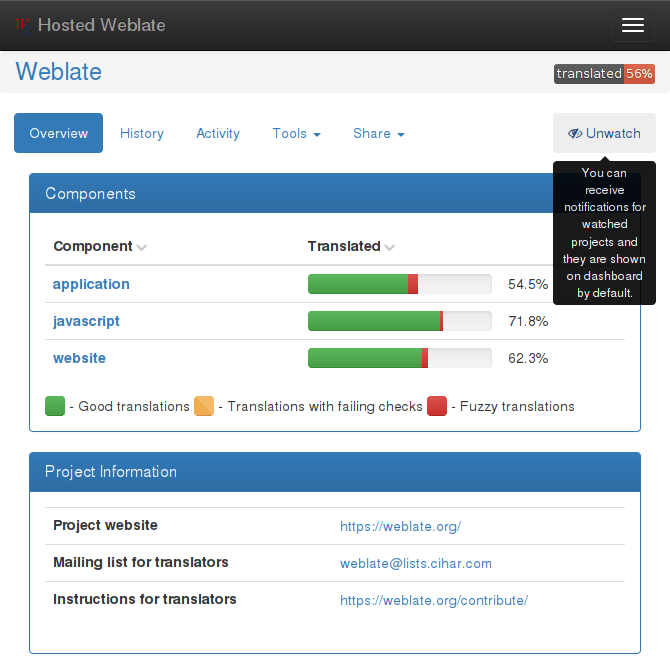
Adding project to watched got way simpler, you can now do it on the project page using watch button:
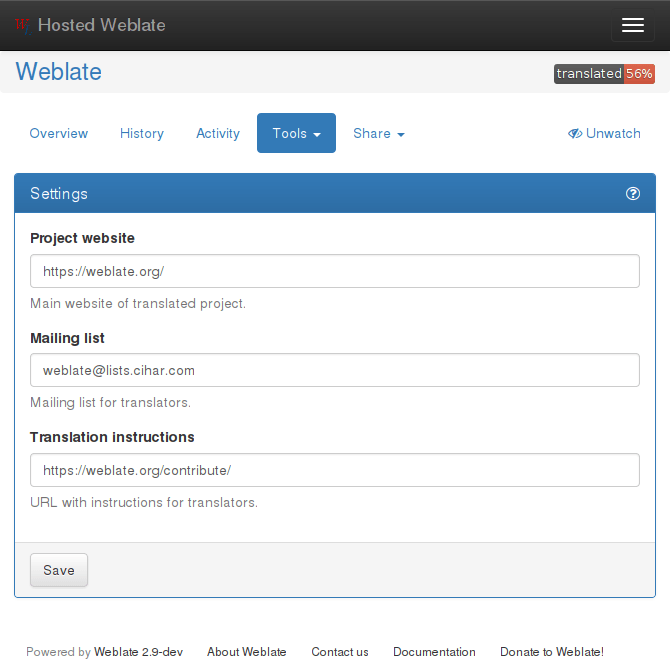
Another feature which will be liked by project admins is that they can now change project metadata without contacting me. This works for both project and component level:
And adding some fancy things, there is new badge showing status of translations into all languages. This is how it looks for Weblate itself:
Filed under: Debian English phpMyAdmin SUSE Weblate 0 comments
| Series: | Sarantine Mosaic #2 |
| Publisher: | Eos |
| Copyright: | 2000 |
| Printing: | February 2001 |
| ISBN: | 0-06-102002-8 |
| Format: | Mass market |
| Pages: | 560 |
Today marks the 13th anniversary since the last passenger flight from New York arrived in the UK. Every seat was filled, a feat that had become increasingly rare for a plane that was a technological marvel but a commercial flop .
$package_$architecture_$version.buildinfo file.
We anticipate the next dpkg upload to sid will create .buildinfo files by default. Whilst it's clear that we also need to teach dak to deal with them (#763822) its not actually clear how to handle .buildinfo files after dak has processed them and how to make them available to the world.
To this end, Chris Lamb has started development on a proof-of-concept .buildinfo server to see what issues arise. Source
Reproducible work in other projects
| Publisher: | Basic Books |
| Copyright: | 2013 |
| ISBN: | 0-465-05065-4 |
| Format: | Trade paperback |
| Pages: | 298 |
A little over eight years ago, I wrote a short blog post which somewhat dryly noted that I had completed the five marathons constituting the World Marathon Majors. I had completed Boston, Chicago and New York during 2007, adding London and then Berlin (with a personal best) in 2008. The World Marathon Majors existed then, but I was not aware of a website. The organisation was aiming to raise the profile of the professional and very high-end aspect of the sport. But marathoning is funny as they let somewhat regular folks like you and me into the same race. And I always wondered if someone kept track of regular folks completing the suite...
I have been running a little less the last few years, though I did get around to complete the Illinois Marathon earlier this year (only tweeted about it and still have not added anything to the running section of my blog). But two weeks ago, I was once again handing out water cups at the Chicago Marathon, sending along two tweets when the elite wheelchair and elite male runners flew by. To the first, the World Marathon Majors account replied, which lead me to their website. Which in turn lead me to the Five Star Finisher page, and the newer / larger Six Star Finisher page now that Tokyo has been added.
And in short, one can now request one's record to be added (if they check out). So I did. And now I am on the Five Star Finisher page!
I don't think I'll ever surpass that as a runner. The table header and my row look like this:
If only my fifth / sixth grade physical education teacher could see that---he was one of those early running nuts from the 1970s and made us run towards / around this (by now enlarged) pond and boy did I hate that :) Guess it did have some long lasting effects. And I casually circled the lake a few years ago, starting much further away from my parents place. Once you are in the groove for distance...
But leaving that aside, running has been fun and I with some luck I may have another one or two marathons or Ragnar Relays left. The only really bad part about this is that I may have to get myself to Tokyo after all (for something that is not an ISM workshop) ...
This post by Dirk Eddelbuettel originated on his Thinking inside the box blog. Please report excessive re-aggregation in third-party for-profit settings.
As mentioned
previously I am working toward getting
Gitano into Stretch. Last time we spoke about
lace, on which a colleague and friend of
mine (Richard Maw) did a large pile of work. This time I'm going to
discuss deprecation approaches and building more capability out of fewer
features.
First, a little background -- Gitano is written in Lua which is a
deliberately small language whose authors spend more time thinking about what
they can remove from the language spec than they do what they could add in. I
first came to Lua in the 3.2 days, a little before 4.0 came out. (The authors
provide a lovely timeline in case you're interested.) With each of the
releases of Lua which came after 3.2, I was struck with how the authors looked
to take a number of features which the language had, and collapse them into
more generic, more powerful, smaller, fewer features.
This approach to design stuck with me over the subsequent decade, and when I
began Gitano I tried to have the smallest number of core features/behaviours,
from which could grow the power and complexity I desired. Gitano is, at its
core, a set of files in a single format (clod) stored in a consistent manner
(Git) which mediate access to a resource (Git repositories). Some of those
files result in emergent properties such as the concept of the 'owner' of a
repository (though that can simply be considered the value of the
project.owner property for the repository). Indeed the concept of the owner
of a repository is a fiction generated by the ACL system with a very small
amount of collusion from the core of Gitano. Yet until recently Gitano had a
first class command set-owner which would alter that one configuration value.
[gitano] set-description ---- Set the repo's short description (Takes a repo)
[gitano] set-head ---- Set the repo's HEAD symbolic reference (Takes a repo)
[gitano] set-owner ---- Sets the owner of a repository (Takes a repo)
Those of you with Gitano installations may see the above if you ask it for
help. Yet you'll also likely see:
[gitano] config ---- View and change configuration for a repository (Takes a repo)
The config command gives you access to the repository configuration file
(which, yes, you could access over git instead, but the config command can be
delegated in a more fine-grained fashion without having to write hooks). Given
the config command has all the functionality of the three specific set-*
commands shown above, it was time to remove the specific commands.
set-description, set-head, or
set-owner commands then you will want to switch to the config command before
you migrate your server to the current or any future version of Gitano.
In brief, where you had:
ssh git@gitserver set-FOO repo something
You now need:
ssh git@gitserver config repo set project.FOO something
It looks a little more wordy but it is consistent with the other features that
are keyed from the project configuration, such as:
ssh git@gitserver config repo set cgitrc.section Fooble Section Name
And, of course, you can see what configuration is present with:
ssh git@gitserver config repo show
Or look at a specific value with:
ssh git@gitserver config repo show specific.key
As always, you can get more detailed (if somewhat cryptic) help with:
ssh git@gitserver help config
Next time I'll try and touch on the new PGP/GPG integration support.
Next.




