Search Results: "tar"

14 December 2013

Richard Hartmann: SteamOS

So SteamOS has been released. While that's marginally interesting in and as of itself, there are two observations to be made:
  1. Microsoft, Nintendo, and Sony will feel an impact. More functionality on cheaper hardware which can easily by upgraded; I bet quite a few managers are not happy, at the moment.
  2. While the stand-alone Linux Steam client was initially targeted at Ubuntu, SteamOS is based on Debian Wheezy.
Actual Linux (not Android) for the end user The first one means more Linux installations. In the living room. On a machine that children are really focussed on and will want to play with, quite literally. The next logical step is for people who play games to install SteamOS on their other machines; desktops, laptops, everywhere they want to game. This could really be the tipping point where the average adolescent computer enthusiast does not need to reboot into Linux to fool around with, but the other way round: To need to boot to Windows for a few select legacy applications which don't run on the FLOSS variant of Wine like Office or Photoshop. And once this momentum starts to shift, other software vendors will follow the money trail. Could 2014 finally be.... the year of Linux on the desktop...? Debian vs Debian-based The latter one is also really interesting... Obviously, I don't know why Valve decided to go down this road, but there are several reasons which come to mind: What we are left with is a major player entering the ring of Linux for end-users and choosing Debian over Ubuntu. Hopefully, improvements to the base system will be fed back upstream, enabling all Debian-based distributions to profit easily, not only Ubuntu-based ones. I am willing to bet that two years ago, SteamOS would have been based on Ubuntu, not Debian. Recently, there's been a lot of backlash over various decisions which Canonical forced onto Ubuntu and it will be interesting to see how this plays out in the long run... I will be interesting to see how much pain Linux Mint and Kubuntu will endure. Forecast Users All in all, we are looking at a massive influx of new users into the Debian ecosystem. How massive? 65 million registered users massive. 7 million concurrent users at once, 1.2 million users actively playing the top 100 games at the same time massive. This is huge. Contributors In time, a substantial part of that userbase will switch over one or more of their machines over to SteamOS. The tinkerers among them will realize they can install plain Debian and install Steam as a package. The hackers among those will start to improve upon their systems; and what better way to do that then to go upstream? If even a tiny fraction of users makes it this far, the count of actively involved contributors with Debian will skyrocket if we let them join. Raspbian and some other not-quite-ideal decisions come to mind. Vendors Commercial software vendors need to stay profitable. Thus, they are forced to support distributions which promise enough paying users. In the past, this meant mainly SuSE and Red Hat; they had commercial backers, went through certifications, etc. In the recent past, this also meant Ubuntu. All of a sudden, Debian stable has a potential market of tens of millions of average computer users and computer enthusiasts. A lot of whom will want to continue to use their OS of choice at work, as well. Oh boy...

13 December 2013

Gerfried Fuchs: [dunkelbunt]

Tuesday was a really nice evening. A few weeks ago I found a poster about the concert of [dunkelbunt], and got my ticket only on monday. I was told by the ticket sellers that they still have plenty left. In the end when I turned up at the event at tuesday though the concert hall was fully packed with people and I was told that it actually was sold out. There wasn't much place inside the hall left, so I mostly stood in the doorway to the bar area and enjoyed the music from there. If you listen to their songs you might get an idea why the music catched me and I started to let the music move my body, literally. It's a great feeling after a tough day, and there were some other nice people around which let the same happen to them so it did feel less awkward for me. Anyway, if you want to find out if their music can do the same to you, here are some songs to listen to: Enjoy!

/music permanent link Comments: 1 Flattr this

Keith Packard: xserver-warnings

Cleaning up X server warnings So I was sitting in the Narita airport with a couple of other free software developers merging X server patches. One of the developers was looking over my shoulder while the X server was building and casually commented on the number of warnings generated by the compiler. I felt like I had invited someone into my house without cleaning for months embarrassed and ashamed that we d let the code devolve into this state. Of course, we ve got excuses the X server code base is one of the oldest pieces of regularly used free software in existence. It was started before ANSI-C was codified. No function prototypes, no const , no void * , no enums or stdint.h. There may be a few developers out there who remember those days (fondly, of course), but I think most of us are glad that our favorite systems language has gained a lot of compile-time checking in the last 25 years. We ve spent time in the past adding function prototypes and cleaning up other warnings, but there was never a point at which the X server compiled without any warnings. More recently, we ve added a pile of new warning flags when compiling the X server which only served to increase the number of warnings dramatically. The current situation With the master branch of the X server and released versions of the dependencies, we generate 1047 warnings in the default build. -Wcast-qual considered chatty The GCC flag, -Wcast-qual, complains when you cast a pointer and change the const qualifier status. A very common thing for the X server to do is declare pointers as const to mark them as immutable once assigned. Often, the relevant data is actually constructed once at startup in allocated memory and stored to the data structure. During server reset, that needs to be freed, but free doesn t take a const pointer, so we cast to (void *), which -Wcast-qual then complains about. Loudly. Of the 1047 warnings, 380 of them are generated by this one warning flag. I ve gone ahead and just disabled it in util/macros for now. String constants are a pain The X server uses string constants to initialize defaults for font paths, configuration options, font names along with a host of other things. These end up getting stored in variables that can also take allocated storage. I ve gone ahead and declared the relevant objects as const and then fixed the code to suit. I don t have a count of the number of warnings these changes fixed; they were scattered across dozens of X server directories, and I was fixing one directory at a time, but probably more than half of the remaining warnings were of this form. And a host of other warnings Fixing the rest of the warnings was mostly a matter of stepping through them one at a time and actually adjusting the code. Shadowed declarations, unused values, redundant declarations and missing printf attributes were probably the bulk of them though. Changes to external modules Instead of just hacking the X server code, I ve created patches for other modules where necessary to fix the problems in the right place. Getting the bits In case it wasn t clear, the X server build now generates zero warnings on my machine. I m hoping that this will also be true for other people. Patches are available at:
xserver - git://people.freedesktop.org/~keithp/xserver warning-fixes
fontsproto - git://people.freedesktop.org/~keithp/fontsproto fontsproto-next
mesa/drm - git://people.freedesktop.org/~keithp/drm warning-fixes
util/macros - already upstream on master
Keeping our house clean Of course, these patches are all waiting until 1.15 ships so that we don t accidentally break something important. However, once they re merged, I ll be bouncing any patches which generate warnings on my system, and if other people find warnings when they build, I ll expect them to send patches as well. Now to go collect the tea cups in my office and get them washed along with the breakfast dishes so I won t be embarrassed if some free software developers show up for lunch today.

Daniel Kahn Gillmor: OpenPGP Key IDs are not useful

Fingerprints and Key IDsOpenPGPv4 fingerprints are made from an SHA-1 digest over the key's public key material, creation date, and some boilerplate. SHA-1 digests are 160 bits in length. The "long key ID" of a key is the last 64 bits of the key's fingerprint. The "short key ID" of a key is the last 32 bits of the key's fingerprint. You can see both of the key IDs as a hash in and of themselves, as "32-bit truncated SHA-1" is a sort of hash (albeit not a cryptographically secure one). I'm arguing here that short Key IDs and long Key IDs are actually useless, and we should stop using them entirely where we can do so. We certainly should not be exposing normal human users to them. (Note that I am not arguing that OpenPGP v4 fingerprints themselves are cryptographically insecure. I do not believe that there are any serious cryptographic risks currently associated with OpenPGP v4 fingerprints. This post is about Key IDs specifically, not fingerprints.)Key IDs have serious problemsAsheesh pointed out two years ago that OpenPGP short key IDs are bad because they are trivial to replicate. This is called a preimage attack against the short key ID (which is just a truncated fingerprint). Today, David Leon Gil demonstrated that a collision attack against the long key ID is also trivial. A collision attack differs from a preimage attack in that the attacker gets to generate two different things that both have the same digest. Collision attacks are easier than preimage attacks because of the birthday paradox. dlg's colliding keys are not a surprise, but hopefully the explicit demonstration can serve as a wakeup call to help us improve our infrastructure. So this is not a way to spoof a specific target's long key ID on its own. But it indicates that it's more of a worry than most people tend to think about or plan for. And remember that for a search space as small as 64-bits (the long key ID), if you want to find a pre-image against any one of 2k keys, your search is actually only in a (64-k)-bit space to find a single pre-image. The particularly bad news: gpg doesn't cope well with the two keys that have the same long key ID:
0 dkg@alice:~$ gpg --import x
gpg: key B8EBE1AF: public key "9E669861368BCA0BE42DAF7DDDA252EBB8EBE1AF" imported
gpg: Total number processed: 1
gpg:               imported: 1  (RSA: 1)
0 dkg@alice:~$ gpg --import y
gpg: key B8EBE1AF: doesn't match our copy
gpg: Total number processed: 1
2 dkg@alice:~$ 
This probably also means that caff (from the signing-party package) will also choke when trying to deal with these two keys. I'm sure there are other OpenPGP-related tools that will fail in the face of two keys with matching 64-bit key IDs. We should not use Key IDs I am more convinced than ever that key IDs (both short and long) are actively problematic to real-world use of OpenPGP. We want two things from a key management framework: unforgability, and human-intelligible handles. Key IDs fail at both. So reasonable tools should not expose either short or long key IDs to users, or use them internally if they can avoid them. They do not have any properties we want, and in the worst case, they actively mislead people or lead them into harm. What reasonable tool should do that? How to replace Key IDs If we're not going to use Key IDs, what should we do instead? For anything human-facing, we should be using human-intelligible things like user IDs and creation dates. These are trivial to forge, but people can relate to them. This is better than offering the user something that is also trivial to forge, but that people cannot relate to. The job of any key management UI should be to interpret the cryptographic assurances provided by the certifications and present that to the user in a comprehensible way. For anything not human-facing (e.g. key management data storage, etc), we should be using the full key itself. We'll also want to store the full fingerprint as an index, since that is used for communication and key exchange (e.g. on calling cards). There remain parts of the spec (e.g. PK-ESK, Issuer subpackets) that make some use of the long key ID in ways that provide some measure of convenience but no real cryptographic security. We should fix the spec to stop using those, and either remove them entirely, or replace them with the full fingerprints. These fixes are not as urgent as the user-facing changes or the critical internal indexing fixes, though. Key IDs are not useful. We should stop using them.Tags: collision, crypto, gpg, openpgp, pgp, security

Sylvain Le Gall: Release of OASIS 0.4.0

I am happy to announce that OASIS v0.4.0 has just been released. Logo OASIS small OASIS is a tool to help OCaml developers to integrate configure, build and install systems in their projects. It should help to create standard entry points in the source code build system, allowing external tools to analyse projects easily. This tool is freely inspired by Cabal which is the same kind of tool for Haskell. You can find the new release here and the changelog here. More information about OASIS in general on the OASIS website. I have recently resumed my work on OASIS and this will be hopefully the new version that will lead to quicker iteration in the development of OASIS. The development process was slowdown by the fact, that I feared introducing new fields in _oasis or regression. This was a pain and I decided to change my development model. Features The most important step is the introduction of AlphaFeatures and BetaFeatures fields. They allow to introduce pieces of code that will only be activated if certain features are listed in those fields. It should help to be always ready to release. The features also cover other aspect like flag_tests and flag_docs which has been introduced in OASIS v0.3.0. In fact the features API is now used to introduce all enhancement while keeping backward compatibility with regard to OASISFormat. Rather than defining a ~since_version:0.3 for fields we use a feature that handle the maturity level of the feature. When I feel a specific feature is ready to ship, I just change the InDev Alpha to InDev Beta and then SinceVersion 0.4. On the long term, when we won't support anymore a version of OASIS that existed before the SinceVersion, the feature will always be true and I will fully integrate it in the code. The only constraint around features is: if you use AlphaFeatures or BetaFeatures field, you must use the latest OASISFormat... Features section in the manual. Example of features available: Automate Another topic is automation of testing releases. For OASIS v0.3.0, I ran tests on all platforms manually, late in the development of v0.3.0 and it was painful to fix. So I have decided to setup a Jenkins instance that automate testing on Linux. On the long term, I plan to also setup a Mac OS X builder and start looking at Windows as well. This should help me catch errors early and be able to fix them quickly. However, for v0.4.0 I have decided to just release what I have and which has mainly be tested on Linux. The point here is to quickly release and iterate, rather than wait for perfection. Hopefully end user testing will allow to quickly discover new bugs. Time boxed release In the coming months, I will try to do time boxed releases. I will try to release version of OASIS every 15th of the month. The point here is to try to iterate faster and avoid long delay between release. See you in 1 month for the next release.

11 December 2013

Daniel Pocock: Get WebRTC going faster

On Saturday, Lumicall began offering free calls from browser to mobile using the free and open WebRTC technology. It should be no surprise that the service has been popular. Is it really free and open? The only way to prove this technology is free is to help people implement this for themself. On Monday, I uploaded reSIProcate v1.9.0 beta7 packages to Debian. The reSIProcate SIP proxy, repro, is one of the core components of the solution behind the free Lumicall service. Simply install the repro and resiprocate-turn-server packages using apt-get and make the following changes to the configuration (use your own IP addresses of course). I've taken this diff from my own runtime environment, only hiding my passwords, so that you can see exactly how I got it working:
--- repro.config.orig	2013-12-11 17:36:27.179228324 +0100
+++ repro-ws.sip5060.net.config	2013-12-11 17:48:24.159938649 +0100
@@ -143,6 +143,41 @@
 # Transport6TlsClientVerification = None
 # Transport6RecordRouteUri = sip:h1.sipdomain.com;transport=WS
 
+Transport1Interface = 195.8.117.57:80
+Transport1Type = WS
+Transport1RecordRouteUri = auto
+
+Transport2Interface = 2001:67c:1388:1000::57:80
+Transport2Type = WS
+Transport2RecordRouteUri = auto
+
+Transport3Interface = 195.8.117.57:5060
+Transport3Type = TCP
+Transport3RecordRouteUri = auto
+
+Transport4Interface = 2001:67c:1388:1000::57:5060
+Transport4Type = TCP
+Transport4RecordRouteUri = auto
+
+Transport5Interface = 195.8.117.57:443
+Transport5Type = WSS
+#Transport5RecordRouteUri = auto
+Transport5TlsDomain = ws.sip5060.net
+Transport5TlsClientVerification = None
+Transport5RecordRouteUri = sip:ws.sip5060.net;transport=WSS
+Transport5TlsCertificate = /etc/ssl/ssl.crt/ws.sip5060.net-bundle.crt
+Transport5TlsPrivateKey = /etc/ssl/private/ws.sip5060.net-key.pem
+
+Transport6Interface = 2001:67c:1388:1000::57:443
+Transport6Type = WSS
+#Transport6RecordRouteUri = auto
+Transport6TlsDomain = ws.sip5060.net
+Transport6TlsClientVerification = None
+Transport6RecordRouteUri = sip:ws.sip5060.net;transport=WSS
+Transport6TlsCertificate = /etc/ssl/ssl.crt/ws.sip5060.net-bundle.crt
+Transport6TlsPrivateKey = /etc/ssl/private/ws.sip5060.net-key.pem
+
+
 # Comma separated list of DNS servers, overrides default OS detected list (leave blank 
 # for default)
 DNSServers =
@@ -455,7 +490,7 @@
 ForceRecordRouting = false
 
 # Assume path option
-AssumePath = false
+AssumePath = true
 
 # Disable registrar
 DisableRegistrar = false
@@ -481,7 +516,7 @@
 # WARNING: Before enabling this, ensure you have a RecordRouteUri setup, or are using
 # the alternate transport specification mechanism and defining a RecordRouteUri per
 # transport: TransportXRecordRouteUri
-DisableOutbound = true
+DisableOutbound = false
 
 # Set the draft version of outbound to support (default: RFC5626)
 # Other accepted values are the versions of the IETF drafts, before RFC5626 was issued
@@ -505,7 +540,7 @@
 # WARNING: Before enabling this, ensure you have a RecordRouteUri setup, or are using
 # the alternate transport specification mechanism and defining a RecordRouteUri per
 # transport: TransportXRecordRouteUri
-EnableFlowTokens = false
+EnableFlowTokens = true
 
 # Enable use of flow-tokens in non-outbound cases for clients detected to be behind a NAT.  
 # This a more selective flow token hack mode for clients not supporting RFC5626.  The 

This is a diff against the /etc/repro/repro.config file distributed in the Debian package version 1.9.0~beta7-1. In the example above, I've included WSS transport defintions for WebSockets over TLS. Use the standard procedure for creating webserver SSL certificates to create certificates for repro and make sure you insert the correct filenames in the TLS parameters above. I've also duplicated every transport for IPv6. If you don't want TLS/WSS or IPv6, just comment those entries out (and renumber the remaining transports). Web-based SIP proxy setup Once you have repro running, go to the web admin interface (port 5080, username: admin, password: admin) and finish the setup using the web UI. The following steps are essential:
  • Add your domain (and restart the repro daemon after adding your domain)
  • Add some users
  • Add any routes to external services (optional - in my next blog I'll demonstrate how to route WebRTC calls to Asterisk using the Debian packages and less than 20 lines of configuration)
Set up reTurn, the TURN server Just put your IP addresses in /etc/reTurnServer.config and add the following line to /etc/reTurnServer-users.txt:
test:notasecret:reTurn:authorized
IMPORTANT: the realm in the users file (reTurn in the example and default config) must be identical to the AuthenticationRealm in the /etc/reTurnServer.config file. On your own web site Simply install your own apache server and clone the webrtc.lumicall.org demo site. Modify the file js/custom.js and include the settings for your own server.
# cd /var/www
# mkdir webcall
# cd webcall
# wget -r -nH http://webrtc.lumicall.org
# vi js/custom.js
In the custom.js, make sure you use a ws:// URL if you didn't set up SSL certificates and use a wss:// URL if you did. The IP or domain of your repro server must be in the ws:// or wss:// URL. Now navigate to the URL ending with /webcall on your server. For RHEL, Fedora and other RPM users Can somebody please assist with the review of the cajun-jsonapi dependency package so I can upload this new version of reSIProcate to Fedora? I'm also planning to make v1.9.0 available in EPEL6 when it is released in January. Questions? Please come and ask questions or discuss your experiences on the Free RTC mailing list sponsored by FSF Europe.

10 December 2013

Kees Cook: live patching the kernel

A nice set of recent posts have done a great job detailing the remaining ways that a root user can get at kernel memory. Part of this is driven by the ideas behind UEFI Secure Boot, but they come from the same goal: making sure that the root user cannot directly subvert the running kernel. My perspective on this is toward making sure that an attacker who has gained access and then gained root privileges can t continue to elevate their access and install invisible kernel rootkits. An outline for possible attack vectors is spelled out by Matthew Gerrett s continuing useful kernel lockdown patch series. The set of attacks was examined by Tyler Borland in Bypassing modules_disabled security . His post describes each vector in detail, and he ultimately chooses MSR writing as the way to write kernel memory (and shows an example of how to re-enable module loading). One thing not mentioned is that many distros have MSR access as a module, and it s rarely loaded. If modules_disabled is already set, an attacker won t be able to load the MSR module to begin with. However, the other general-purpose vector, kexec, is still available. To prove out this method, Matthew wrote a proof-of-concept for changing kernel memory via kexec. Chrome OS is several steps ahead here, since it has hibernation disabled, MSR writing disabled, kexec disabled, modules verified, root filesystem read-only and verified, kernel verified, and firmware verified. But since not all my machines are Chrome OS, I wanted to look at some additional protections against kexec on general-purpose distro kernels that have CONFIG_KEXEC enabled, especially those without UEFI Secure Boot and Matthew s lockdown patch series. My goal was to disable kexec without needing to rebuild my entire kernel. For future kernels, I have proposed adding /proc/sys/kernel/kexec_disabled, a partner to the existing modules_disabled, that will one-way toggle kexec off. For existing kernels, things got more ugly. What options do I have for patching a running kernel? First I looked back at what I d done in the past with fixing vulnerabilities with systemtap. This ends up being a rather heavy-duty way to go about things, since you need all the distro kernel debug symbols, etc. It does work, but has a significant problem: since it uses kprobes, a root user can just turn off the probes, reverting the changes. So that s not going to work. Next I looked at ksplice. The original upstream has gone away, but there is still some work being done by Jiri Slaby. However, even with his updates which fixed various build problems, there were still more, even when building a 3.2 kernel (Ubuntu 12.04 LTS). So that s out too, which is too bad, since ksplice does exactly what I want: modifies the running kernel s functions via a module. So, finally, I decided to just do it by hand, and wrote a friendly kernel rootkit. Instead of dealing with flipping page table permissions on the normally-unwritable kernel code memory, I borrowed from PaX s KERNEXEC feature, and just turn off write protect checking on the CPU briefly to make the changes. The return values for functions on x86_64 are stored in RAX, so I just need to stuff the kexec_load syscall with mov -1, %rax; ret (-1 is EPERM):
#define pr_fmt(fmt) KBUILD_MODNAME ": " fmt
#include <linux/init.h>
#include <linux/module.h>
#include <linux/slab.h>
static unsigned long long_target;
static char *target;
module_param_named(syscall, long_target, ulong, 0644);
MODULE_PARM_DESC(syscall, "Address of syscall");
/* mov $-1, %rax; ret */
unsigned const char bytes[] =   0x48, 0xc7, 0xc0, 0xff, 0xff, 0xff, 0xff,
                                0xc3  ;
unsigned char *orig;
/* Borrowed from PaX KERNEXEC */
static inline void disable_wp(void)
 
        unsigned long cr0;
        preempt_disable();
        barrier();
        cr0 = read_cr0();
        cr0 &= ~X86_CR0_WP;
        write_cr0(cr0);
 
static inline void enable_wp(void)
 
        unsigned long cr0;
        cr0 = read_cr0();
        cr0  = X86_CR0_WP;
        write_cr0(cr0);
        barrier();
        preempt_enable_no_resched();
 
static int __init syscall_eperm_init(void)
 
        int i;
        target = (char *)long_target;
        if (target == NULL)
                return -EINVAL;
        /* save original */
        orig = kmalloc(sizeof(bytes), GFP_KERNEL);
        if (!orig)
                return -ENOMEM;
        for (i = 0; i < sizeof(bytes); i++)  
                orig[i] = target[i];
         
        pr_info("writing %lu bytes at %p\n", sizeof(bytes), target);
        disable_wp();
        for (i = 0; i < sizeof(bytes); i++)  
                target[i] = bytes[i];
         
        enable_wp();
        return 0;
 
module_init(syscall_eperm_init);
static void __exit syscall_eperm_exit(void)
 
        int i;
        pr_info("restoring %lu bytes at %p\n", sizeof(bytes), target);
        disable_wp();
        for (i = 0; i < sizeof(bytes); i++)  
                target[i] = orig[i];
         
        enable_wp();
        kfree(orig);
 
module_exit(syscall_eperm_exit);
MODULE_LICENSE("GPL");
MODULE_AUTHOR("Kees Cook <kees@outflux.net>");
MODULE_DESCRIPTION("makes target syscall always return EPERM");
If I didn t want to leave an obvious indication that the kernel had been manipulated, the module could be changed to: And with this in place, it s just a matter of loading it with the address of sys_kexec_load (found via /proc/kallsyms) before I disable module loading via modprobe. Here s my upstart script:
# modules-disable - disable modules after rc scripts are done
#
description "disable loading modules"
start on stopped module-init-tools and stopped rc
task
script
        cd /root/modules/syscall_eperm
        make clean
        make
        insmod ./syscall_eperm.ko \
                syscall=0x$(egrep ' T sys_kexec_load$' /proc/kallsyms   cut -d" " -f1)
        modprobe disable
end script
And now I m safe from kexec before I have a kernel that contains /proc/sys/kernel/kexec_disabled.

2013, Kees Cook. This work is licensed under a Creative Commons Attribution-ShareAlike 3.0 License.
Creative Commons License

Dimitri John Ledkov: Hi! My name is... (what?) My name is... (who?) My name is... Slim Shady

On the 21st of November I have become a British citizen, and on the 9th of December I have changed my name by signing a statutory declaration with the following clauses:
I absolutely and entirely renounce, relinquish and abandon the use of my former name of Dmitrijs edkovs and assume, adopt and determine to take and use from the date hereof the new name of Dimitri John Ledkov in substitution for my former name of Dmitrijs edkovs.
I shall at all times hereafter, in all records, deeds, documents and other writings and in all actions and proceedings, as well as in all dealings and transactions and on all occasions whatsoever, use and subscribe my new name of Dimitri John Ledkov in substitution for my former name of Dmitrijs edkovs so relinquished to the intent that I may hereafter be called, known and identified by the new name of Dimitri John Ledkov and not by my former name of Dmitrijs edkovs.
I authorise and require all persons, at all times, to identify, describe and address me by my new name of Dimitri John Ledkov. I make this solemn declaration conscientiously, believing the same to be true and by virtue of the provisions of the Statutory Declarations Act 1835.
Now I need to get new passport, IDs and change my name pretty much everywhere. I have started the ball rolling and hopefully I'll be known by my new name everywhere soon enough.

Regards,

Dimitri.

Bartosz Fe&#324;ski: another two days of paid work on Debian

Last year I told you that I spent two full-time days working on Debian as a part of initiative sponsored by my current employer. This year I ve devoted these two days again for Debian. Quick summary of what I was able to do during these two days. 11 bugs, 4 lintian errors and 43 warnings were fixed. In addition 3 packages now use new source format (usually that means repackaging software from scratch). 4 uses new copyright format and the newest Standards-Version. 5 packages were updated to the newest upstream version. Changelog entries:
potrace (1.11-1) unstable; urgency=low
* The Akamai Technologies paid volunteer days release.
* New upstream version.
* Completely repackaged from scratch (funny experience as usual):
- uses new copyright format
- uses debhelper compatibility level 9 w/hardening options
- uses the newest Standards-Version
- fixes 11 lintian warnings and 2 errors
* Fixes typo in manpage. (Closes: #694492) -- Bartosz Fenski Mon, 9 Dec 2013 11:23:32 +0100 makeself (2.2.0-1) unstable; urgency=low * The Akamai Technologies paid volunteer days release.
* New upstream release. (Closes: #690105)
- handles df output in more portable way (Closes: #641804)
* Repackaged from scratch.
- uses new packaging format 3.0 (Closes: #670738)
- uses new copyright format
- uses debhelper compatibility level 9
- uses the newest Standards-Version
- fixes 2 lintian errors and 6 warnings -- Bartosz Fenski Mon, 09 Dec 2013 17:32:45 +0100 dibbler (1.0.0~rc1-1) unstable; urgency=low * The Akamai Technologies paid volunteer days release.
* New upstream release candidate 1 version (Closes: #686539)
- doesn't drop dhcp session during pppd restarts (Closes: #641237)
- doesn't hang indefinitely on 'stop' (Closes: #675272)
* Calls dh --with autotools_dev to prevent build failures (Closes: 727356)
* Includes Japanese debconf translation (Closes: #718921)
* Updated Standards-Version (no changes needed)
* Uses debhelper compatibility level 9 w/hardening options
* init scripts now source init functions
* Fixes 20 lintian warnings. -- Bartosz Fenski Tue, 10 Dec 2013 10:05:56 +0100 calcurse (3.1.4-1) unstable; urgency=low * The Akamai Technologies paid volunteer days release.
* New upstream version.
* ACK previous NMU - thanks!
* Bumped Standards-Version (no changes needed) -- Bartosz Fenski Tue, 10 Dec 2013 12:22:06 +0100 ipcalc (0.41-4) unstable; urgency=low * The Akamai Technologies paid volunteer days release.
* Fixes overzealous input checking (Closes: #332468)
* Martin F Krafft removed as co-maintainer (Closes: #719098)
+ package now uses new copyright format
* Bumped Standards-Version (no changes needed) -- Bartosz Fenski Tue, 10 Dec 2013 13:05:15 +0100 msort (8.53-1) unstable; urgency=low * The Akamai Technologies paid volunteer days release.
* New upstream release.
* ACK previous NMUs, thanks!
* Switched to new source format.
* Switched to new copyright format.
* Moved patches to new quilt format and described them.
* Bumped Standards-Version (no changes needed)
* Has correct tcl/tk dependencies (Closes: #545135)
* Doesn't segfault with certain input (Closes: #630485)
-- Bartosz Fenski Tue, 10 Dec 2013 16:39:44 +0100
Thank you Akamai ;)

9 December 2013

John Goerzen: Delicious Holiday Recipes

I ve come up with some new favorites this season. The boys and Laura were around for all three, and I am happy to report there were many kitchen smiles over these! From-Scratch Hot Chocolate There s something about hot chocolate made from scratch, with chocolate melted into milk, instead of a powder stirred in. It takes quite a bit more time, and probably has more calories, but it is quite delicious. The key to a delicious result where milk is concerned is to take things slow and keep stirring. You don t want the chocolate to scorch at the bottom of the pan. Heating up the milk before the chocolate should help things mix in more easily as well. The basis for this recipe was here, and it called for 2 cups milk and 2 cups half-and-half. I trust my heavy whipping cream was fine! <grin> There are also some other variations on that site. This nearly made my little cast iron kettle overflow, so next time I made a 3/4 recipe. Hot Spiced Cider We put up a Christmas tree yesterday, so I thought hot spiced cider would be perfect for the occasion. I went searching for recipes, and many of them called for cloves (which have to be sifted out later or put in a spice bag). I wasn t going to have time to delay two boys from setting up a Christmas tree long enough for that, so I found this basic recipe to work well. However, I, as usual, made some modifications ;-) Mmmmm . yum . Turkey or Chicken Noodle Soup The annual what to do with all that leftover turkey quest strikes again. I like chicken noodle soup, so why not a turkey noodle soup done the same way? Here s what I used, roughly, in my large 6-quart cast iron cooking pot (aka Dutch oven ): Start with the broth, onion, basil, oregano, pepper, and bay leaf. Heat up the mixture and add the vegetables. Bring it to boiling, then add the uncooked noodles. Return to boiling, then reduce heat, cover, and simmer for 8 minutes. Add the turkey or chicken and diced tomatoes, and simmer until hot enough to serve. The nice thing about soups is that they freeze well and make great winter leftovers. This recipe makes quite a lot of soup; you may wish to halve it. This recipe was adapted from one in a Better Homes & Gardens cookbook.

8 December 2013

Christoph Berg: TF101 flickering and a loose cable

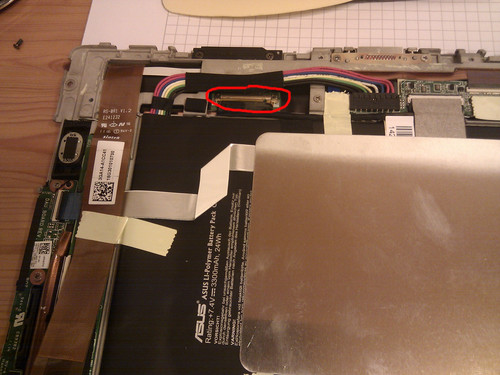
My ASUS Transformer TF101 had suddenly started flickering in all sorts of funny colors some weeks ago. As tapping it gently on the table in the right angle made the problem go away temporarily, it was clear the problem was about a loose cable, or some other hardware connection issue. As I needed to go on a business trip the other day, I didn't look up the warranty expiration day until later that week. Then, Murphy struck: the tablet was now 2 years + 1 day old! Calling ASUS, some friendly guy there suggested I still tried to get ASUS to accept it for warranty, because the tablet had been with them last year for 5 days, so if they added that, it would still be within the warranty period. I filled out the RMA form, but one hour later the reply was they rejected it because it was out of warranty. Another guy on the phone then said they would probably only do the adding if it had been with them for maybe 10 days, or actually really 30 days, or whatever. Some googling suggested that the loose cable theory was indeed worth a try, so I took it apart. Thanks to a forum post I could then locate the display connector and fix it. Putting the case back together was actually harder than disassembling it because some plastic bits got stuck, but now everything is back to normal.

Russell Coker: A Basic Income for Australia

There has been a lot of discussion recently about the concept of a Basic Income (Wikipedia), largely due to the efforts to change the Swiss constitution to provide a Basic Income [1]. The concept of a Basic Income is that residents get a fixed payment without having to be sick, disabled, looking for work, or eligible for other forms of social security. A Basic Income wouldn t replace all other forms of social security, one of the most obvious examples is that sick people will often need money for medical care in additional to living expenses. Also I believe that it shouldn t be means tested in any way. I think that one of the problems with current payment schemes is that there are complex eligibility criteria which require effort for the applicant and for government agencies to prevent accidental or fraudulent over-payment. The tax rates could be raised slightly to make it revenue neutral. Newstart In Australia the main form of social security for unemployed people at the moment is called Newstart [2]. Currently Newstart payments range from a maximum of $501 per fortnight for a single person ($13,026 per annum), to a maximum of $699.90 per fortnight for someone who is a carer. The Newstart payments start to decrease if the recipient earns more than $62 per fortnight. The minimum wage in Australia is $16.37 per hour for permanent work or $20.30 for casual work [3]. So if someone works for more than 3 hours at a casual rate (and I can t imagine 4 hours a fortnight being anything other than casual) then their Newstart payments will decrease. The payment decreases are fairly significant, for every dollar that is earned about 50 cents will be deducted from the payments. That s a great incentive to either avoid opportunities to do part-time work or to do cash-only work that s outside the tax system. The most obvious way of implementing a Basic Income would be to replace Newstart. Then anyone who is in that situation would be free to just not get a job which would be OK IMHO as people who don t want to work probably wouldn t do a good job if the government forced them to get a job. People who are unemployed who want to work could work as much as they want and scale up according to what their employer asks and how much money they need. Currently the full-time minimum wage is $622.20 per week (I m not sure exactly how they get that from $16.37). That s almost 2.5* the Newstart allowance for a single person (but less than twice the Newstart allowance for a carer). While Newstart (and the other forms of social security) don t provide a great income, it seems that the difference between Newstart and the minimum wage isn t that great particularly when you consider that working involves some expenses for travel etc. There doesn t seem to be a great financial incentive for someone to leave Newstart and get a minimum wage job. People Who Want Social Security Some people think it s great to get government payments while others find it embarrassing to need such payments and won t necessarily apply if they are eligible. I think that the current system of forcing people to apply for social security is a way of discouraging people who find themselves unexpectedly in a difficult situation but doesn t discourage people who are happy not to work. This seems to effectively reduce the incidence of payments to the people who most tax-payers would regard as the most worthy recipients. Economics Charles Stross wrote about some ideas related to this [4]. He suggests that as the workforce participation has been steadily reducing due to technology we should move to a social model that isn t based around working to live but working to buy luxuries that aren t covered by the Basic Income. One of the many economic changes related to a Basic Income is that the minimum wage could be smaller than it might otherwise be. For example if the minimum wage was decreased by the same amount that the Basic Income provided then the minimum income would remain the same while employers would pay less, this would affect the viability of certain types of contract work web sites if they were subject to minimum wage laws (currently they just ignore the minimum wage laws by paying based on job completion instead of hours worked). I don t think that the minimum wage should decrease that much though, currently employers are able to run viable businesses with the minimum wage laws and I don t think that a Basic Income should be used as a way of helping corporations avoid paying their employees. If we had a Basic Income then there s many ways that it could be used to stabilise the economy. If people could pay their rent even if they lost their job then a down-turn in one area of the economy wouldn t immediately affect other areas. Also if rent payments were deducted automatically from an account used to receive the Basic Income then landlords would be more likely to rent to poor people as they could be guaranteed to receive rent payments (it would be easy to have a contractual agreement for rent to take priority and have bank computers enforce that). The Implementation Problem I don t think that my idea would have any significant negative effects. It wouldn t decrease government revenues if tax was adjusted accordingly. It wouldn t make people stop working as people who don t want to work already avoid it. It would help people who are out of work to get work by reducing the barriers to entry in terms of paperwork and of unreasonable cuts to Newstart making it bad value to take part time work. I think that the big problem with implementing it is people who want to prevent poor people from having opportunities. They want to reduce social security and minimum wages even though such changes will in the long run only give less tax revenue and greater expense in law enforcement. It seems rather ironic that such hostility often comes from people at the low end of the middle class whos jobs are most likely to be at risk from new technology. As on-going technological development reduces the number of workers that are required to keep things running we need to have some form of payment to the people who aren t doing enough work to survive. A decent Basic Income is a much better option than giving Newstart payments and forcing a significant portion of the population into a degrading search for jobs that don t exist. As that s the inevitable future I think we should make political changes to deal with it sooner rather than later. However a Basic Income might be implemented now it s surely going to be a lot better than what might happen if we wait until the majority of the population are unemployed before doing something about it.

Russell Coker: A Better University

I previously wrote about the financial value of a university degree [1], my general conclusion is that the value is decreasing for most fields of employment that don t have a legal requirement for a degree. In the past I wrote about some ideas for a home university [2], basically extending the home-schooling concept to a university level. I recently read John Scalzi s post about being poor [3], many of the comments address the difficulty of getting to college and how it impacts career possibilities. From reading that it seems that my ideas about a home university are mostly based around what middle-class people can afford. Also getting a job afterwards will probably be a lot easier for someone who was born into the middle classes. It seems to me that a large part of the problem with the university system is the expectation that they will both provide for academic research and train people for jobs. Dr. David Helfand has some great ideas for running a university to give the higher education that a university is supposed to provide rather than the work training that most universities actually provide [4]. His ideas aren t theoretical, they have been implemented and proven to work. Note that Dr Helfand s talk starts slowly, the second half is the best (for those of you with short attention spans). The fact that most people think of a university degree in terms of getting a job seems to be a failure of the university system to fulfill it s original aim. If Dr Helfand s ideas take off then it would really address the problem of universities not educating people. But that still leaves the issue of job training. Is a Degree Mandatory? I think that to some degree people expect that a university degree is necessary job training even when it isn t. I wonder what would happen if it was generally agreed that the right thing to do was to search for a job between the end of high school and the start of university, then anyone who got a suitable offer could defer their university course and see what career success they could achieve without it. When I was at school the general idea was that after completing year 12 everyone just had a holiday until the start of university as the entire point of school was to get into university. While hiring managers prefer candidates who have degrees they also prefer to hire people who will accept a lower salary, so hiring an 18yo with no degree may give better value than a 21yo who has a degree. I believe that making university degrees more accessible has reduced inequality which is a good thing. But making degrees mandatory (which is widely believed by high school students and thus is the situation that they have to deal with) contributes to greater inequality. While university doesn t cost much by middle-class standards it is still expensive for poor people. If a university degree wasn t considered to be mandatory then the number of people employed to teach at a university level would be smaller. This would hopefully mean that the average skill of university lecturers would increase (I hope that the least skillful lecturers would be the ones to find work elsewhere).

7 December 2013

Hideki Yamane: I was in Mini DebConf in Taiwan 2013

I've done GPG key sign for Mini DebConf in Taiwan 2013 participates, and written an article for Japanese magazine, Software Design 2014/Jan. This means, my short trip has been ended, at last.


In this event, I've talked about "local community" for Debian, a bit (PDF/ODF are in Debian Wiki).
Local Community for Debian (2013 Taiwan miniDebConf) from Hideki Yamane

Probably you know, most of Debian contributors are in Euro/America(North and South), not in Asia. But there are lots of talented people. It means: there is huge possibility for Debian :)


I hope we Asian Debian people unite and publish its community work more, and do "DebConf in Asia" - in the future.

6 December 2013

Petter Reinholdtsen: Debian Edu interview: Klaus Knopper

It has been a while since I managed to publish the last interview, but the Debian Edu / Skolelinux community is still going strong, and yesterday we even had a new school administrator show up on #debian-edu to share his success story with installing Debian Edu at their school. This time I have been able to get some helpful comments from the creator of Knoppix, Klaus Knopper, who was involved in a Skolelinux project in Germany a few years ago. Who are you, and how do you spend your days? I am Klaus Knopper. I have a master degree in electrical engineering, and is currently professor in information management at the university of applied sciences Kaiserslautern / Germany and freelance Open Source software developer and consultant. All of this is pretty much of the work I spend my days with. Apart from teaching, I'm also conducting some more or less experimental projects like the Knoppix GNU/Linux live system (Debian-based like Skolelinux), ADRIANE (a blind-friendly talking desktop system) and LINBO (Linux-based network boot console, a fast remote install and repair system supporting various operating systems). How did you get in contact with the Skolelinux / Debian Edu project? The credit for this have to go to Kurt Gramlich, who is the German coordinator for Skolelinux. We were looking for an all-in-one open source community-supported distribution for schools, and Kurt introduced us to Skolelinux for this purpose. What do you see as the advantages of Skolelinux / Debian Edu? What do you see as the disadvantages of Skolelinux / Debian Edu? For these reasons and experience from our project, I would now rather consider using plain Debian for schools next time, until Skolelinux is more closely integrated into Debian and becomes upgradeable without reinstallation. Which free software do you use daily? GNU/Linux with LXDE desktop, bash for interactive dialog and programming, texlive for documentation and correspondence, occasionally LibreOffice for document format conversion. Various programming languages for teaching. Which strategy do you believe is the right one to use to get schools to use free software? Strong arguments are

Gunnar Wolf: For people in Mexico: Workshop next Wednesday! Video editing from the command line (by Chema Serralde, @joseserralde)

(Yes, yes... Maybe I should post in Spanish.. But hey, gotta keep consistecy in my blog!) General, public, open invitation Are you in Mexico City, or do you plan to be next Wednesday (December 11)? Are you interested in video edition? In Free Software? I will have the pleasure to host at home the great Chema Serralde, a good friend, and a multifacetic guru both in the technical and musical areas. He will present a workshop: Video editing from the command line. I asked Chema for an outline of his talk, but given he is a busy guy, I will basically translate the introduction he prepared for this same material in FSL Vallarta, held two weeks ago.
With the help of the commandline, you can become a multimedia guru. We will edit a video using just a terminal. This skill will surprise your friends and your couple. But the most important is that this knowledge is just an excuse to understand step by step what does a video CODEC mean, what is a FORMAT, and how video and audio editors work; by using this knowledge, you will be able to set the basis for multimedia editing, without the promises and secrets of propietary editors. How much does my file weigh and why? How to improve a video file's quality? Why cannot I read my camera's information from GNU/Linux? By the end of this workshop, we well see how some libraries help you develop your first audio and video application, what are their main APIs and uses.
Logistics Everybody is welcome to come for free, no questions asked, no fees collected. I can offer coffee for all, but if you want anything else to eat/drink, you are welcome to bring it. We do require you to reserve and confirm your place (mail me to my usual mail address). We have limited space, and I must set an absolute quota of 10 participants. Some people hide their address... Mine is quite publicly known: Av. Copilco 233, just by Parque Hugo Margain, on the Northern edge of UNAM (Metro Copilco). The course starts at 16:00, and lasts... As long as we make it last ;-) So, that said... See you there! :-D [update]: Chema sent me the list of topics he plans to cover. Copy/pasting from his mail, in Spanish:
TALLER REL MPAGO DE EDICI N AUDIOVISUAL EN L NEA DE COMANDO
Jos Mar a Serralde Ruiz, facilitador
  1. Editando como cavern cola.
    1. Manipulaci n b sica de archivos multimedia en entornos POSIX.
    2. S un Bash VJ (videojockey)
    3. Vaciando y entubando
  2. Editando como cient fico.
    1. Encabezados y fourcc
    2. 3 familias de CODECS de v deo y sus patentes
    3. 3 famlias de CODECS de audio y sus patentes
    4. Muxers, demuxers y muxes.
  3. Editando como artista.
    1. Cajas de herramientas en software libre para procesamiento de v deo.
    2. Procesamiento en tiempo real de v deo (el que se crea artista pierde)
    3. Derritiendo v deo, audio con calcetines MELT + SOX
Software necesario (sistemas operativos POSIX, windouseros acercarse con el af n de repensar sus vidas): mplayer, avconv/ffmpeg (libavcodec), melt, sox, imagemagick

5 December 2013

Daniel Kahn Gillmor: The legal utility of deniability in secure chat

This Monday, I attended a workshop on Multi-party Off the Record Messaging and Deniability hosted by the Calyx Institute. The discussion was a combination of legal and technical people, looking at how the characteristics of this particular technology affect (or do not affect) the law. This is a report-back, since I know other people wanted to attend. I'm not a lawyer, but I develop software to improve communications security, I care about these questions, and I want other people to be aware of the discussion. I hope I did not misrepresent anything below. I'd be happy if anyone wants to offer corrections. BackgroundOff the Record Messaging (OTR) is a way to secure instant messaging (e.g. jabber/XMPP, gChat, AIM). The two most common characteristics people want from a secure instant messaging program are:
Authentication
Each participant should be able to know specifically who the other parties are on the chat.
Confidentiality
The content of the messages should only be intelligible to the parties involved with the chat; it should appear opaque or encrypted to anyone else listening in. Note that confidentiality effectively depends on authentication -- if you don't know who you're talking to, you can't make sensible assertions about confidentiality.
As with many other modern networked encryption schemes, OTR relies on each user maintaining a long-lived "secret key", and publishing a corresponding "public key" for their peers to examine. These keys are critical for providing authentication (and by extension, for confidentiality). But OTR offers several interesting characteristics beyond the common two. Its most commonly cited characteristics are "forward secrecy" and "deniability".
Forward secrecy
Assuming the parties communicating are operating in good faith, forward secrecy offers protection against a special kind of adversary: one who logs the encrypted chat, and subsequently steals either party's long-term secret key. Without forward secrecy, such an adversary would be able to discover the content of the messages, violating the confidentiality characteristic. With forward secrecy, this adversary is be stymied and the messages remain confidential.
Deniability
Deniability only comes into play when one of the parties is no longer operating in good faith (e.g. their computer is compromised, or they are collaborating with an adversary). In this context, if Alice is chatting with Bob, she does not want Bob to be able to cryptographically prove to anyone else that she made any of the specific statements in the conversation. This is the focus of Monday's discussion. To be clear, this kind of deniability means Alice can correctly say "you have no cryptographic proof I said X", but it does not let her assert "here is cryptographic proof that I did not say X" (I can't think of any protocol that offers the latter assertion). The opposite of deniability is a cryptographic proof of origin, which usually runs something like "only someone with access to Alice's secret key could have said X."
The traditional two-party OTR protocol has offered both forward secrecy and deniability for years. But deniability in particular is a challenging characteristic to provide for group chat which is the domain of Multi-Party OTR (mpOTR). You can read some past discussion about the challenges of deniability in mpOTR (and why it's harder when there are more than two people chatting) from the otr-users mailing list. If you're not doing anything wrong... The discussion was well-anchored by a comment from another participant who cheekily asked "If you're not doing anything wrong, why do you need to hide your chat at all, let alone be able to deny it?" The general sense of the room was that we'd all heard this question many times, from many people. There are lots of problems with the ideas behind the question from many perspectives. But just from a legal perspective, there are at least two problems with the way this question is posed: In these situations, people confront real risk from the law. If we care about these people, we need to figure out if we can build systems to help them reduce that legal risk (of course we also need to fix broken laws, and the legal environment in general, but those approaches were out of scope for this discussion). The Legal Utility of Deniability Monday's meeting was called specifically because it wasn't clear how much real-world usefulness there is in the "deniability" characteristic, and whether this feature is worth the development effort and implementation tradeoffs required. In particular, the group was interested in deniability's utility in legal contexts; many (most?) people in the room were lawyers, and it's also not clear that deniability has much utility outside of a formal legal setting. If your adversary isn't constrained by some rule of law, they probably won't care at all whether there is a cryptographic proof or not that you wrote a particular message (In retrospect, one possible exception is exposure in the media, but we did not discuss that scenario). Places of possible usefulness So where might deniability come in handy during civil litigation or a criminal trial? Presumably the circumstance is that a piece of a chat log is offered as incriminating evidence, and the defendant is trying to deny something that they appear to have said in the log. This denial could take place in two rather different contexts: during rules over admissibility of evidence, or (once admitted) in front of a jury. In legal wrangling over admissibility, apparently a lot of horse-trading can go on -- each side concedes some things in exchange for the other side conceding other things. It appears that cryptographic proof of origin (that is, a lack of deniability) on the chat logs themselves might reduce the amount of leverage a defense lawyer can get from conceding or arguing strongly over that piece of evidence. For example, if the chain of custody of a chat transcript is fuzzy (i.e. the transcript could have been mishandled or modified somehow before reaching trial), then a cryptographic proof of origin would make it much harder for the defense to contest the chat transcript on the grounds of tampering. Deniability would give the defense more bargaining power. In arguing about already-admitted evidence before a jury, deniability in this sense seems like a job for expert witnesses, who would need to convince the jury of their interpretation of the data. There was a lot of skepticism in the room over this, both around the possibility of most jurors really understanding what OTR's claim of deniability actually means, and on jurors' ability to distinguish this argument from a bogus argument presented by an opposing expert witness who is willing to lie about the nature of the protocol (or who misunderstands it and passes on their misunderstanding to the jury). The complexity of the tech systems involved in a data-heavy prosecution or civil litigation are themselves opportunities for lawyers to argue (and experts to weigh in) on the general reliability of these systems. Sifting through the quantities of data available and ensuring that the appropriate evidence is actually findable, relevant, and suitably preserved for the jury's inspection is a hard and complicated job, with room for error. OTR's deniability might be one more element in a multi-pronged attack on these data systems. These are the most compelling arguments for the legal utility of deniability that I took away from the discussion. I confess that they don't seem particularly strong to me, though some level of "avoiding a weaker position when horse-trading" resonates with me. What about the arguments against its utility? Limitations The most basic argument against OTR's deniability is that courts don't care about cryptographic proof for digital evidence. People are convicted or lose civil cases based on unsigned electronic communications (e.g. normal e-mail, plain chat logs) all the time. OTR's deniability doesn't provide any legal cover stronger than trying to claim you didn't write a given e-mail that appears to have originated from your account. As someone who understands the forgeability of e-mail, i find this overall situation troubling, but it seems to be where we are. Worse, OTR's deniability doesn't cover whether you had a conversation, just what you said in that conversation. That is, Bob can still cryptographically prove to an adversary (or before a judge or jury) that he had a communication with someone controlling Alice's secret key (which is probably Alice); he just can't prove that Alice herself said any particular part of the conversation he produces. Additionally, there are runtime tradeoffs depending on how the protocol manages to achieve these features. For example, forward secrecy itself requires an additional round trip or two when compared to authenticated, encrypted communications without forward secrecy (a "round trip" is a message from Alice to Bob followed by a message back from Bob to Alice). Getting proper deniability into the mpOTR spec might incur extra latency (imagine having to wait 60 seconds after everyone joins before starting a group chat, or a pause in the chat of 15 seconds when a new member joins) or extra computational power (meaning that they might not work well on slower/older devices) or an order of magnitude more bandwidth (meaning that chat might not work at all on a weak connection). There could also simply be complexity that makes it harder to correctly implement a protocol with deniability than an alternate protocol without deniability. Incorrectly-implemented software can put its users at risk. I don't know enough about the current state of mpOTR to know what the specific tradeoffs are for the deniability feature, but it's clear there will be some. Who decides whether the tradeoffs are worth the feature? Other kinds of deniability Further weakening the case for the legal utility of OTR's deniability, there seem to be other ways to get deniability in a legal context over a chat transcript. There are deniability arguments that can be made from outside the protocol. For example, you can always claim someone else took control of your computer while you were asleep or using the bathroom or eating dinner, or you can claim that your computer had a virus that exported your secret key and it must have been used by someone else. If you're desperate enough to sacrifice your digital identity, you could arrange to have your secret key published, at which point anyone can make signed statements with it. Having forward secrecy makes it possible to expose your secret key without exposing the content of your past communications to any listener who happened to log them. Conclusion My takeaway from the discussion is that the legal utility of OTR's deniability is non-zero, but quite low; and that development energy focused on deniability is probably only justified if there are very few costs associated with it. Several folks pointed out that most communications-security tools are too complicated or inconvenient to use for normal people. If we have limited development energy to spend on securing instant messaging, usability and ubiquity would be a better focus than this form of deniability. Secure chat systems that take too long to make, that are too complex, or that are too cumbersome are not going to be adopted. But this doesn't mean people won't chat at all -- they'll just use cleartext chat, or maybe they'll use supposedly "secure" protocols with even worse properties: for example, without proper end-to-end authentication (permitting spoofing or impersonation by the server operator or potentially by anyone else); with encryption that is reversible by the chatroom operator or flawed enough to be reversed by any listener with a powerful computer; without forward secrecy; or so on. As a demonstration of this, we heard some lawyers in the room admit to using Skype to talk with their clients even though they know it's not a safe communications channel because their clients' adversaries might have access to the skype messaging system itself. My conclusion from the meeting is that there are a few particular situations where deniability could be useful legally, but that overall, it is not where we as a community should be spending our development energy. Perhaps in some future world where all communications are already authenticated, encrypted, and forward-secret by default, we can look into improving our protocols to provide this characteristic, but for now, we really need to work on usability, popularization, and wide deployment. Thanks Many thanks to Nick Merrill for organizing the discussion, to Shayana Kadidal and Stanley Cohen for providing a wealth of legal insight and legal experience, to Tom Ritter for an excellent presentation of the technical details, and to everyone in the group who participated in the interesting and lively discussion. Tags: chat, deniability, otr, security

4 December 2013

Jonathan McDowell: Thoughts on SSDs and encryption

My laptop is just over 3 years old, which is about the point I start to think about a replacement. At present there's nothing that's an obvious contender so I've been looking at an SSD to prolong it by another year or two. One of the other thoughts I had is that I currently use dm-crypt under Linux to provide whole disk encryption for everything except the boot partition - I have a bunch of my personal financial and immigration documents stored that I'd prefer not to get disclosed if my laptop is stolen. Modern drives have started offered integral AES encryption options, so perhaps I could offload that to the drive (my i5 470UM lacks the hardware instructions for this). General consensus in the pub (where all the best security advice is to be found) is that no one present trusted SSD firmware authors to not use some badly chosen AES crypto mode, or leave the key lying around plain text in easily readable flash, or some other implementation mishap. So how hard would it be to retrofit reliable (or at least source verifiable and thus more reliable) crypto to an SSD? There was an impressive article recently about reverse engineering the firmware of a HDD, to the point of modifying data returned to the host and also running Linux on the controller. It seems that SSD firmware should be easier - NAND is simpler to talk to than motors and magnetic sensors, right? It's a case of gluing together a SATA interface, a NAND controller and an AES offload engine, yes? Aside from the minor matter of finding a suitable drive with an available JTAG interface, a controller with docs (or more likely that can be reverse engineered) and enough time to produce a replacement open firmware, that is. Alternatively can anyone provide some idea of how secure the available laptop SSDs on the market actually are? I'm fine with "the NSA can read your data if they want" because a determined attacker will be able to find other ways to get my data anyway, but I don't want "anyone who finds the drive can use this loophole in the firmware by wiggling some bits with jtag to dump the key and read all your data".

3 December 2013

Matthew Garrett: Subverting security with kexec

(Discussion of a presentation I gave at Kiwicon last month)

Kexec is a Linux kernel feature intended to allow the booting of a replacement kernel at runtime. There's a few reasons you might want to do that, such as using Linux as a bootloader[1], rebooting without having to wait for the firmware to reinitialise or booting into a minimal kernel and userspace that can be booted on crash in order to save system state for later analysis.

But kexec's significantly more flexible than this. The kexec system call interface takes a list of segments (ie, pointers to a userspace buffer and the desired target destination) and an entry point. The kernel relocates those segments and jumps to the entry point. That entry point is typically code referred to as purgatory, due to the fact that it lives between the world of the first kernel and the world of the second kernel. The purgatory code sets up the environment for the second kernel and then jumps to it. The first kernel doesn't need to know anything about what the second kernel is or does. While it's conventional to load Linux, you can load just about anything.

The most important thing to note here is that none of this is signed. In other words, despite us having a robust in-kernel mechanism for ensuring that only signed modules can be inserted into the kernel, root can still load arbitrary code via kexec and execute it. This seems like a somewhat irritating way to patch the running kernel, so thankfully there's a much more straightforward approach.

I modified kexec to add an additional loader and uploaded the code here. Build and install it. Make sure that /sys/module/module/parameters/sig_enforce on your system is "Y". Then, as root, do something like:
kexec --type="dummy" --address= printf "0x%x" $(( $(grep "B sig_enforce" /proc/kallsyms awk ' print "0x"$1 ') & 0x7fffffff)) --value=0 --load-preserve-context --mem-max=0x10000 /bin/true
to load it[2]. Now do kexec -e and watch colours flash and check /sys/module/module/parameters/sig_enforce again.

The beauty of this approach is that it doesn't rely on any kernel bugs - it's using kernel functionality that was explicitly designed to let you do this kind of thing (ie, run arbitrary code in ring 0). There's not really any way to fix it beyond adding a new system call that has rather tighter restrictions on the binaries that can be loaded. If you're using signed modules but still permit kexec, you're not really adding any additional security.

But that's not the most interesting way to use kexec. If you can load arbitrary code into the kernel, you can load anything. Including, say, the Windows kernel. ReactOS provides a bootloader that's able to boot the Windows 2003 kernel, and it shouldn't be too difficult for a sufficiently enterprising individual to work out how to get Windows 8 booting. Things are a little trickier on UEFI - you need to tell the firmware which virtual physical map to use, and you can only do it once. If Linux has already done that, it's going to be difficult to set up a different map for Windows. Thankfully, there's an easy workaround. Just boot with the "noefi" kernel argument and the kernel will skip UEFI setup, letting you set up your own map.

Why would you want to do this? The most obvious reason is avoiding Secure Boot restrictions. Secure Boot, if enabled, is explicitly designed to stop you booting modified kernels unless you've added your own keys. But if you boot a signed Linux distribution with kexec enabled (like, say, Ubuntu) then you're able to boot a modified Windows kernel that will still believe it was booted securely. That means you can disable stuff like the Early Launch Anti-Malware feature or driver signing, or just stick whatever code you want directly into the kernel. In most cases all you'd need for this would be a bootloader, kernel and an initrd containing support for the main storage, an ntfs driver and a copy of kexec-tools. That should be well under 10MB, so it'll easily fit on the EFI system partition. Copy it over the Windows bootloader and you should be able to boot a modified Windows kernel without any terribly obvious graphical glitches in the process.

And that's the story of why kexec is disabled on Fedora when Secure Boot is enabled.

[1] That way you only have to write most drivers once
[2] The address section finds the address of the sig_enforce symbol in the kernel, and the value argument tells the dummy code what value to set that address to. --load-preserve-context informs the kernel that it should save hardware state in order to permit returning to the original kernel. --mem-max indicates the highest address that the kernel needs to back up. /bin/true is just there to satisfy the argument parser.

comment count unavailable comments

Iustin Pop: A not so dark sky

I'm aware of how not-dark our modern city night sky is, but sometimes it still heavily surprises me how full of light it actually is. Yesterday I went about five kilometres out of Z rich; I thought at that distance, on a reasonably dark hill, it would be good enough for some night-sky shots. So I setup my tripod, only to realise I can't expose over 30 seconds because (at low ISO and fast aperture, shooting not straight up), everything is bleached out: I couldn't believe my eyes. Yes, I heard that one needs to go 100Km out of big cities, but but So I went and found that since about 2004, all of Switzerland is light polluted - even going on top of Jungfrau, for example, wouldn't completely eliminate it. I also learned about Merle Walker's equation - yeah, 200Km or more away from light sources would be good. Not here, in this quite small, quite populated country in the middle of Europe :/ I realised that as soon as my eyes got acclimated to the location I was at, I could easily see everything around me, due to the light pollution. I miss a really dark sky - I remember a couple of years back, in a different country, stopping at night on the side of the road, and being shocked at how the sky was filled with starts. I didn't have any camera with me at that time Heck, I remember seeing the Milky Way way back as a child, but nowadays when I get out of work, I can barely see 4-5 points of light in the sky. Anyway, enough with ranting Thanks to modern technology, one can recover lots of detail, even in a washed out picture. So in the end, shooting straight up, I could get some resemblance of structure (and this was only at 28mm, which is not that wide): Or alternatively, one can use the glowing light for a bit of play/contrast: I also played with stacking images via Deep Sky Stacker, but stacking - I learned to my surprise - only works to reduce noise in the final image, and not to make it "brighter" or more detailed. Live and learn The result was a bit better than not stacked, but not by much: This was a 25 5s, ISO 800, f/4, same 28mm lens. What I found surprising is the "non-star object" (to call it so) near the centre of the image - I have no idea what it is, it definitely doesn't look like a star, it could be an elliptical galaxy or so. I tried navigating back in time via Stellarium, but I don't remember the orientation of the lens, so it will remain a mystery to me. Anyway, two more pictures and higher resolutions on a Smugmug album. Feel free to leave a comment or drop me an email if you have suggestions where to take nice night sky photos in Switzerland

Next.

Previous.