Search Results: "reg"

15 January 2009

Ross Burton: 3G Woes

Has anyone out there used a recent Nokia phone (E65 to be precise) as a modem with Network Manager 0.7? I can't seem to get the magic right, and get one of two failures:
NetworkManager: <info>  (ttyACM0): powering up... 
NetworkManager: <info>  Registered on Home network 
an 15 10:50:04 blackadder NetworkManager: <info>  Associated with network: +COPS: 0,2,"23415" 
  NetworkManager: <WARN>  dial_done(): Dialing timed out </WARN>
Or:
NetworkManager: <info>  Activation (ttyACM0) Stage 1 of 5 (Device Prepare) complete. 
NetworkManager: <info>  (ttyACM0): powering up... 
NetworkManager: <info>  Registered on Home network 
NetworkManager: <info>  Associated with network: +COPS: 0,2,"23415" 
NetworkManager: <info>  Connected, Woo! 
NetworkManager: <info>  Activation (ttyACM0) Stage 2 of 5 (Device Configure) scheduled..
. 
NetworkManager: <info>  Activation (ttyACM0) Stage 2 of 5 (Device Configure) starting...
 
NetworkManager: <info>  (ttyACM0): device state change: 4 -> 5 
NetworkManager: <info>  Starting pppd connection 
NetworkManager: <debug> [1232015456.962700] nm_ppp_manager_start(): Command line: /usr/s
bin/pppd nodetach lock nodefaultroute user web ttyACM0 noipdefault usepeerdns lcp-echo-failure 0 lcp-echo-interval 
0 ipparam /org/freedesktop/NetworkManager/PPP/4 plugin /usr/lib/pppd/2.4.4/nm-pppd-plugin.so 
NetworkManager: <debug> [1232015456.964964] nm_ppp_manager_start(): ppp started with pid
 29590 
NetworkManager: <info>  Activation (ttyACM0) Stage 2 of 5 (Device Configure) complete. 
pppd[29590]: Plugin /usr/lib/pppd/2.4.4/nm-pppd-plugin.so loaded.
pppd[29590]: pppd 2.4.4 started by root, uid 0
NetworkManager: <WARN>  pppd_timed_out(): Looks like pppd didn't initialize our dbus mod
ule
Anyone know what the problem could be?

Joey Hess: fakechroot warning label

fakechroot, or any similar tool that uses a facility such as LD_PRELOAD, is not suitable for use in a security context. Such tools are way cool, but can be trivially broken out of by the attacker. Kapil Paranjape suggests using fakechroot for locking down ssh authorized keys for unison. The idea being unison will run in a (fake)chroot, set up by a regular, non-root user, and will thus be limited to the files you want it to access. First problem is, any statically linked executable on the system (unison can be used to upload one too) is immune to the fakechroot.
joey@gnu:~>FAKECHROOT_EXCLUDE_PATH=/bin fakeroot fakechroot chroot /tmp/empty /bin/sh
sh-3.2# ls
sh-3.2# ls /
sh-3.2# cd ..
sh-3.2# ls
sh-3.2# sash
Stand-alone shell (version 3.7)
> cd ..
> ls
empty  gconfd-joey  gpg-XhukMB  keyring-ZxSuTB  orbit-joey
> cd ..
> ls
bin    etc         lib     opt   selinux  usr
Getting unison to run a static executable in a setup such as Kapil describes is left as an exercise for the more determined attacker than I. Here, though, is an easier way.
sh-3.2# ls /
sh-3.2# ls /bin/..
bin    etc         lib     opt   selinux  usr
To understand why this works, notice that I left /bin excluded when I ran fakechroot. (Still .. Is this a bug in fakechroot?) Or, you could use unison to upload a symlink:
joey@gnu:~>ln -s / /tmp/empty/root
joey@gnu:~>FAKECHROOT_EXCLUDE_PATH=/bin fakeroot fakechroot chroot /tmp/empty /bin/sh
sh-3.2# ls root
bin    etc         lib     opt   selinux  usr

Moral: Taking a program, be it fakechroot or unison, that was never designed with security in mind, and trying to use it as a security barrier, is an open invitation to pain.

Russell Coker: Old PDA vs New Mobile Phone for PDA use

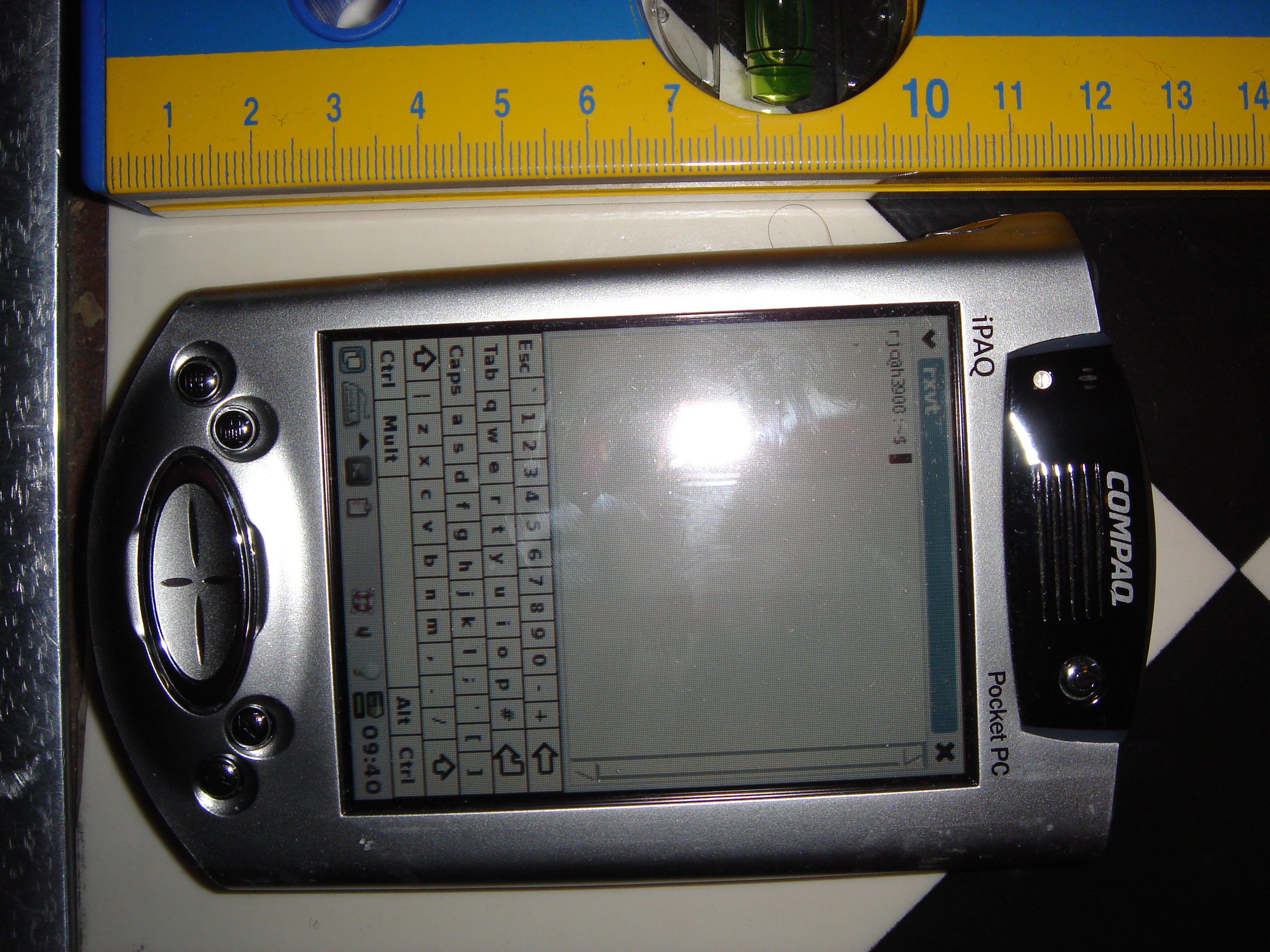
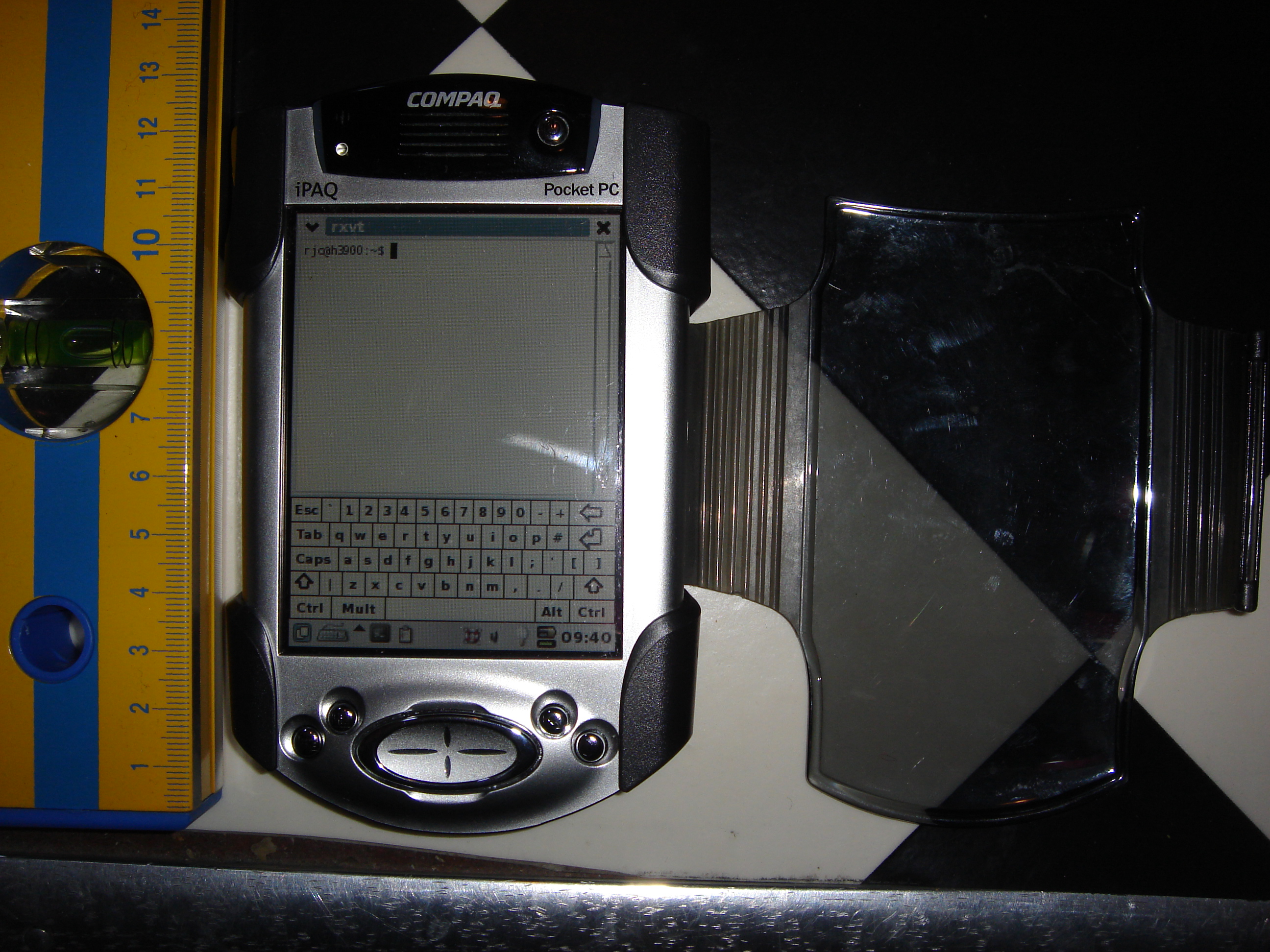
Since about 2002 I have been using a iPaQ [1] for taking notes while on the move. I have a pair of H3950 iPaQs that were given to me for the purpose of some software development work. As modern mobile phones have telephony as a small part of their feature set I think it s worth comparing a 2002 iPaQ with a 2009 mobile phone in terms of the note taking functionality. I have just got myself an LG U990 Viewty mobile phone [2]. It has a screen resolution of 240*320 which is the highest resolution that is remotely common for a mobile phone - and the same resolution as my 2002 model iPaQ. The LG KC910 Renoir has a resolution of 240*400 and seems to be the only phone that my carrier provides which has a higher resolution. The iPhone [3] has a resolution of 480*320. So it seems that the most expensive modern mobile phone that is available in Australia has a screen resolution that is only twice that of a 2002 PDA. I believe that in Japan you could buy a PDA with a higher resolution than 240*320 in 2002. My iPaQ is running Linux, so I can do whatever I want with it. I have a bar at the bottom of the screen with icons to launch, I configure it with the programs that I need most often and they are always one click away. While with my mobile phone I always have two large icons for paid services from my telco and I can t add icons for the things that I want. My iPaQ has a virtual keyboard that can be displayed in portrait or landscape mode. The above pictures show it in the portrait mode which allows the greatest area of screen space for text. The landscape mode is good for entering long lines of text even though the total number of words that can be displayed on screen is smaller. The size of my iPaQ is 134mm in height, between 77 and 84mm in width (it tapers) and 15.9mm thick without it s protective sleeve. The protective sleeve (shown in the second picture) adds about another 5mm to the width and thickness. My iPaQ is 1.76* the volume of my Viewty phone and at 184g vs 112g is 1.64* the mass. With it s sleeve on it is about 2.4* the volume. It s larger but with the sleeve it s a lot more solid, a touch-screen is very fragile so putting a touch-screen device in your back pocket without a sleeve is not a viable option. So I now own a mobile phone that has more storage, RAM, and CPU power than my iPaQ, but is less useful for the basic task of writing small documents and seems to have no facility for drawing diagrams. Most recent mobile phones have the ability to record voice (my Viewty can store 34 hours on it s internal storage and supports mini-SD cards for extra storage). But my Viewty lacks the ability to pause voice recording so if I wanted a series of notes during a meeting I would get a series of short voice recordings rather than a single file with many items. The todo list is also fairly poor in the Viewty, so even disregarding the poor keyboard on the touch-screen it would compare badly to the iPaQ. So it seems that an iPaQ that is almost seven years old when running Linux and the GPE Palmtop Environment [4] with with default configuration handily beats one of the latest and greatest mobile phones for all areas of common functionality. If the Viewty had it s source code available I would be tempted to contribute some patches (even if it was not free software). Finally, before someone suggests an Android [5], Greenphone [6] or other phone that s relatively open and programmable, I wanted a phone that had a good camera (by phone standards) and came essentially for free on an affordable contract. Maybe in two years time (when my current contract ends) there will be such a phone on offer. Mobile phones aren t THAT important to me, so while I would like to encourage the development of open telephony platforms it s a much lower priority than about a dozen free software projects. I expect that in the future something like an Android will become a great mobile phone with great PDA functionality. But for the moment I ll use an iPaQ and a Viewty.

14 January 2009

Axel Beckert: Sedating irssi's nick highlight for microblogging messages

My favourite IRC client is irssi. I like it so much that I even use it for all my instant messaging needs. The gateway of choice between irssi and mostly Jabber is Bitlbee. I also microblog on identi.ca, a free (free as in AGPL) microblogging service based on laconi.ca. In comparsion to the non-free and proprietary Twitter microblogging, identi.ca has all the features which Twitter turned off already again. For me the most important feature of Twitter was tweeting via XMPP (aka Jabber). Since Twitter turned off that feature, Twitter increasingly fast became unimportant for me. Identi.ca still has this feature and cultivates it further. So usually don t visit the identi.ca website that often anymore but get the microblogging stream of my friends via XMPP and Bitlbee directly into my irssi. Although this is very convenient, it has one big disadvantage: In comparison to an IRC channel, not only notices directed to me personally but every incoming notice beeps, because Bitlbee sends them either as /MSG or prepends my nick name. For normal IRC communication /MSG should beep, and you can t make exceptions for that so easily in irssi. I asked on #bitlbee (OFTC) and on #irssi (IRCNet). On #irssi funnily the first answer was I tried that yesterday, no success from Shrike. So I m not alone, although Shrike uses Jaiku and not identi.ca. Then I had the idea to get Bitlbee to not prepend my nick name for all those identi.ca notices which go into the &bitlbee channel but I didn t find a way to configure this in Bitlbee. But Shrike found a way to do this with already existing irssi plugins: The trigger.pl plugin (available e.g. in Debian s irssi-scripts package or on scripts.irssi.org) can add triggers which replace parts of the message. So the following three lines helped me to reduce the noise microblogging causes in my irssi:
/script load trigger
/trigger add -publics -masks 'identica!update@identi.ca' -channels '&bitlbee' -regexp "^XTaran: " -replace ''
/trigger save
And on the command line I just needed a symlink to automatically start the trigger plugin on irssi startup:
ln -vis /usr/share/irssi/scripts/trigger.pl ~/.irssi/scripts/autorun/
So now again only the important messages beep. :-)

David Welton: The "Gig" Economy?

This article talks about the rise of people working part-time, doing various 'gigs': http://www.thedailybeast.com/blogs-and-stories/2009-01-12/the-gig-economy/full/ Perhaps her intended audience is not interested in "dull" things like economics, but even someone like me with just a smattering of reading in economics can't help but think of Coase and his Theory of the Firm when reading it. The question is: why do firms exist? Why isn't the economy composed of a huge network of independent contractors? If markets and prices and such work so well, why do these big, monolithic companies, which internally, are not 'free markets' exist? His answer is, greatly simplified, "transaction costs". From the article:
Every time the boss turns around asking for a key member of staff to join today s frantically convened cost-cutting strategy meeting the reply comes back, It s not Sam s day to come in and he s the one working on it. Julia can come, though. Julia? What she got to do with it? Yeah, well, we ll have to bring her up to speed.
In other words, while there is a savings from not having Sam present every day, there is also a cost associated with it, which includes having had to look for and interview Sam to do some work, and bargaining over a price for Sam's services, and then "bring him up to speed". You have to do those things with regular employees too, but you have to do them less often with people who stick around for years. So if one wanted to look, in a less anecdotal way and slightly more scientific way, about whether the US, or other countries, are turning into "gig economies", one could do worse than look at the transaction costs associated with utilizing contractors as opposed to permanent employees. If those costs have fallen (it may be easier to find people, thanks to the internet, for example), perhaps it is more efficient to have more contractors and fewer full time employees and so the equilibrium will tilt in that direction. Of course, another explanation might simply be that the economy is bad, and companies don't have the budget to take on more people, so they get by with what they can in the short term. In terms of the social costs and benefits to a "gig economy"... well, that discussion is best left for other sites, as it's a big, long, complex one with lots of politics and economics and eventually boils down to everyone's own view of how the society they live in ought to look, which is very much outside the scope of this journal.

David Welton: Hosting, Commodities, and "The Cloud"

Anyone connected to the world of IT has been bludgeoned over the head with "cloud" news lately, to the point where the term has become vague and mostly a buzzword. There is, however, something behind the phenomenon, described in Nick Carr's book The Big Switch, with more computing power being centralized at large data centers where economies of scale come into play. I had an interesting chat with Marco D'Itri a while back, about hosting and commodities. It's clear that there is some commoditization going on, but he maintains that hosting is not a commodity. I've been thinking about it and the conclusion I've come to is that some parts of the business are certainly commodities: disk space, memory, bandwidth, and processor cycles. Those things, are, ultimately, what we want to buy when we buy 'hosting'. However, the bits and pieces between that, and people who build on top of those services (i.e. someone who runs a web site) are not really a commodity, yet. Customer service, for instance, might vary a great deal between providers. What will happen in that space, will we see a baseline price for the commodities, and hosting resellers built on top of that that offer different levels of service? I do think that the "mom and pop" hosting type of situations will gradually disappear in favor of larger data centers that can take advantage of economics of scale, though. Also, as I've written about in the past, in Web Hosting - A Market for Lemons, there are some serious information asymmetry issues - how do you know the people providing your service are serious? How do you know they're using good components that wont' break often, rather than cheap junk that will lead to frequent outages? If you have the resources, you can build a system like Google's, where it doesn't matter what fails, it just works around it, but the basic tools that most of us are working with right now aren't that high level. I was reminded of the information asymmetry issue by this article, written by the Dreamhost folks, Web Hosting's Dirty Laundry, which describes how they caught a 'review' site trying to get money from Dreamhost for positive reviews, which is interesting in light of the lemon problem. Wikipedia has some criteria for a lemon market here: http://en.wikipedia.org/wiki/The_Market_for_Lemons#Criteria, which include the following:
Deficiency of effective public quality assurances (by reputation or regulation and/or of effective guarantees / warranties
If it's difficult to get real, honest, impartial reviews of hosting services, that is a push in the direction of 'lemons'. Of course, it's not impossible to get this information, but it seems that a lot of us still go by "hearsay" - what others we know use and report to be ok. To compare it with another product, I'd probably ask around to friends prior to purchasing a new car, but whatever I get is likely to work ok, even if it's not the absolute best. On the other hand, the wrong hosting provider might be very much a "fly by night" operation that leads to a lot of downtime, so I'm far more likely to listen to what other people have to say, and be far more cautious about buying "any old thing". Opinions? Comments? Thoughts? Where do you see this industry going?

David Welton: The "Gig" Economy?

This article talks about the rise of people working part-time, doing various 'gigs': http://www.thedailybeast.com/blogs-and-stories/2009-01-12/the-gig-economy/full/ Perhaps her intended audience is not interested in "dull" things like economics, but even someone like me with just a smattering of reading in economics can't help but think of Coase and his Theory of the Firm when reading it. The question is: why do firms exist? Why isn't the economy composed of a huge network of independent contractors? If markets and prices and such work so well, why do these big, monolithic companies, which internally, are not 'free markets' exist? His answer is, greatly simplified, "transaction costs". From the article:
Every time the boss turns around asking for a key member of staff to join today???s frantically convened cost-cutting strategy meeting the reply comes back, ???It???s not Sam???s day to come in and he???s the one working on it. Julia can come, though.??? ???Julia? What she got to do with it???? ???Yeah, well, we???ll have to bring her up to speed.???
In other words, while there is a savings from not having Sam present every day, there is also a cost associated with it, which includes having had to look for and interview Sam to do some work, and bargaining over a price for Sam's services, and then "bring him up to speed". You have to do those things with regular employees too, but you have to do them less often with people who stick around for years. So if one wanted to look, in a less anecdotal way and slightly more scientific way, about whether the US, or other countries, are turning into "gig economies", one could do worse than look at the transaction costs associated with utilizing contractors as opposed to permanent employees. If those costs have fallen (it may be easier to find people, thanks to the internet, for example), perhaps it is more efficient to have more contractors and fewer full time employees and so the equilibrium will tilt in that direction. Of course, another explanation might simply be that the economy is bad, and companies don't have the budget to take on more people, so they get by with what they can in the short term. In terms of the social costs and benefits to a "gig economy"... well, that discussion is best left for other sites, as it's a big, long, complex one with lots of politics and economics and eventually boils down to everyone's own view of how the society they live in ought to look, which is very much outside the scope of this journal.

David Welton: Hosting, Commodities, and "The Cloud"

Anyone connected to the world of IT has been bludgeoned over the head with "cloud" news lately, to the point where the term has become vague and mostly a buzzword. There is, however, something behind the phenomenon, described in Nick Carr's book The Big Switch, with more computing power being centralized at large data centers where economies of scale come into play. I had an interesting chat with Marco D'Itri a while back, about hosting and commodities. It's clear that there is some commoditization going on, but he maintains that hosting is not a commodity. I've been thinking about it and the conclusion I've come to is that some parts of the business are certainly commodities: disk space, memory, bandwidth, and processor cycles. Those things, are, ultimately, what we want to buy when we buy 'hosting'. However, the bits and pieces between that, and people who build on top of those services (i.e. someone who runs a web site) are not really a commodity, yet. Customer service, for instance, might vary a great deal between providers. What will happen in that space, will we see a baseline price for the commodities, and hosting resellers built on top of that that offer different levels of service? I do think that the "mom and pop" hosting type of situations will gradually disappear in favor of larger data centers that can take advantage of economics of scale, though. Also, as I've written about in the past, in Web Hosting - A Market for Lemons, there are some serious information asymmetry issues - how do you know the people providing your service are serious? How do you know they're using good components that wont' break often, rather than cheap junk that will lead to frequent outages? If you have the resources, you can build a system like Google's, where it doesn't matter what fails, it just works around it, but the basic tools that most of us are working with right now aren't that high level. I was reminded of the information asymmetry issue by this article, written by the Dreamhost folks, Web Hosting's Dirty Laundry, which describes how they caught a 'review' site trying to get money from Dreamhost for positive reviews, which is interesting in light of the lemon problem. Wikipedia has some criteria for a lemon market here: http://en.wikipedia.org/wiki/The_Market_for_Lemons#Criteria, which include the following:
Deficiency of effective public quality assurances (by reputation or regulation and/or of effective guarantees / warranties
If it's difficult to get real, honest, impartial reviews of hosting services, that is a push in the direction of 'lemons'. Of course, it's not impossible to get this information, but it seems that a lot of us still go by "hearsay" - what others we know use and report to be ok. To compare it with another product, I'd probably ask around to friends prior to purchasing a new car, but whatever I get is likely to work ok, even if it's not the absolute best. On the other hand, the wrong hosting provider might be very much a "fly by night" operation that leads to a lot of downtime, so I'm far more likely to listen to what other people have to say, and be far more cautious about buying "any old thing". Opinions? Comments? Thoughts? Where do you see this industry going?

13 January 2009

Simon McVittie: Compiling against uninstalled versions of libraries

Developers seem to do a lot of fighting with bleeding-edge libraries installed in a --prefix, so I thought I'd share how I develop telepathy-glib (a library) and telepathy-gabble (a program using that library). ~/Collabora/telepathy/tpglib on my laptop is a git clone of telepathy-glib.git, branched using the process I documented on http://telepathy.freedesktop.org/wiki/Git, which is basically: ~/Collabora/telepathy/gabble is a git clone of telepathy-gabble.git, using the same process. In my Gabble checkout, I used to configure like this:
cd ~/Collabora/telepathy/gabble
./autogen.sh \
TP_GLIB_CFLAGS="-I$ HOME /Collabora/telepathy/tpglib" \
TP_GLIB_LIBS="$ HOME /Collabora/telepathy/tpglib/telepathy-glib/libtelepathy-glib.la"
This would make libtool link Gabble against the copy of telepathy-glib built by my bleeding-edge git checkout, without ever needing to install it. This allowed me to try out my latest telepathy-glib changes with Gabble's more extensive regression tests, which was a great win. It also meant I could develop Gabble branches that required a not-yet-released telepathy-glib, and all without touching my system copy of telepathy-glib (the one I use to run Empathy and talk to people - which is the packaged version from Debian unstable or experimental). The reason I could do this is that I laid out the telepathy-glib source tree in The Right Way , which is: if a header is designed to be used via #include <my-library/foo.h>, then it goes in a my-library/ directory in the source tree, and includes other headers (even from the same project) with #include <my-library/other.h>. This means you can just add the top directory of the source tree to your include path (which automake does by default) and the right thing will happen. (Actually, this is a slight simplification of the truth: because telepathy-glib contains generated headers, you have to add the top directory of the build tree to your include path too, if you want to support out-of-tree builds. Which, of course, you do.) Other projects that do this correctly include GLib and Avahi. Avahi is a particularly interesting example because it has numerous libraries in the same tarball (including avahi-common, avahi-core, avahi-glib and avahi-gobject, which form a dependency chain). Projects that don't do this correctly include telepathy-mission-control (which is on my hit list for further swamp-draining) and libtelepathy (which is obsolete). Today I committed a patch to telepathy-glib, inspired by GStreamer, to generate telepathy-glib-uninstalled.pc. The presence of this patch simplifies the process further, to:
./autogen.sh PKG_CONFIG_PATH=$HOME/Collabora/tpglib/telepathy-glib
This has the same benefits as setting TP_GLIB_CFLAGS and TP_GLIB_LIBS, but is easier to remember, and is more future-proof against changes to telepathy-glib. It only works because pkg-config has a special case for this situation - if you ask for the package "foo", pkg-config will always look for foo-uninstalled.pc before foo.pc. (Edited 2009-01-13: putting environment variables on the ./configure or ./autogen.sh command line like ./autogen.sh PKG_CONFIG_PATH=foo is better than putting them in the environment like PKG_CONFIG_PATH=foo ./autogen.sh, since it works around Debian bug #398901 and bugs like it)

Petr Rockai: darcs 2.2.0rc1

(This post is somewhat late, the final release is in two days. However, we still need testing and reports of possible issues.) I am pleased to announce that darcs 2.2 is coming along nicely. I would like to ask everyone to give a ride to darcs 2.2, release candidate 1. This release again comes in two flavours:
  1. The source tarball, http://repos.mornfall.net/darcs/darcs-2.2.0rc1.tar.gz, which can be built using the traditional autoconf-based buildsystem. This is the fully supported version. After downloading and unpacking, you can issue:
    $ ./configure
    $ make
    $ ./darcs --version
    
    or
    # make install
    
    More detailed instructions inside the tarball (file README).
  2. Cabalised source. You can either download a tarball from http://repos.mornfall.net/darcs/darcs-2.1.99.0.tar.gz and build manually (see the build instructions in README inside the tarball), or, alternatively, you can use cabal-install to obtain a copy (the release candidate is now available on hackage):
    $ cabal update  
    $ cabal install darcs
    
    This should give you a darcs binary in ~/.cabal/bin you should probably add that to your PATH.
This is a preliminary changelog since version 2.1.2 (released last November): Preliminary list of issues that have been fixed in darcs since version 2.1.2: 1223 sporadic init.sh test failure (2.1.1rc2+472)
525 amend-record => darcs patches show duplicate additions
1247 make TAGS is broken
1273 renameFile: does not exist (No such file or directory)
1165 get should print last gotten tag
1249 2.1.2 (+ 342 patches) local drive detection on Windows error
1238 wish: darcs help setpref should list all prefs
1199 Backup files darcs added after external merge
1043 pull => mergeAfterConflicting failed in geteff (2.0.2+)
1117 Whatsnew should warn on non-recorded files
1101 darcs send cc recipient not included in success message Thanks to Thorkil Naur for compiling this list. I would like to thank all contributors developers, testers, bystanders for helping darcs get along further. It s been hard times recently for darcs, as many of you probably know. Nevertheless, we are regaining confidence in future darcs development. No way are we going to leave darcs fall by the road. I am sure that this one time, I speak for everyone in our developer and user community.

11 January 2009

Michal &#268;iha&#345;: Say good bye to python-gammu

python-gammu has been here for more than five years and now it is gone! Well not really, I only integrated it into regular Gammu sources, what is anyway logical place where it belongs. Especially when looking on last releases, which were anyway bound together. The fact that several past releases have to happen together for both python-gammu and Gammu is not the only reason for merge. The other two major reasons are cross-compilation and testing. Besides this, with merged source, it will be easier for some distributions to deploy newer Gammu to released products. For testing I definitely could use some python based test framework, but I'd like to have all test results in a single place and I didn't find something what would easily integrate some python test framework with some dashboard and also would be capable of doing C testing. Also current CTest/CDash combo used in Gammu really fits my needs for good overview what is going on in daily tests, so I preferred to stay with current system. Cross-compilation support is really missing in distutils and I was using set of hacks to make it properly produce binaries for Windows on Linux. With current CMake based setup, all this is just matter of providing Python instance to use. On the downside, I can not really drop distutils usage, as they will still be needed for creating binary installer for Windows, unless I'll find some clever way how to do this in CMake (which I really doubt).

Russell Coker: Planet Flooding

One annoying thing that happens regularly is Planet Flooding . This is when one of the many blogs that is syndicated by a public Planet installation changes it s time stamps and has 10 or more old posts appear as new. It s doubly annoying when the blogger in question knows about the problem. Planet Flooding is easy to solve. If you are changing your blogging software or doing something else that may result in old posts appearing to be new then all you have to do is configure your blog to include a small number of posts (maybe two or three) in the RSS feed. Seeing two old posts re-appearing plus a new post explaining it is not going to annoy anyone. If you run a Planet (or Venus) installation then configure it to have a maximum number of posts per feed. For a Planet that syndicates feeds from a number of individuals and only includes a few days of traffic (which is probably a category that covers most Planets) there is no need for more than four items per feed. For a severe case of Planet flooding (EG posts which always appear as being the newest and are therefore at the top of the list) the thing to do is to immediately remove the feed until the problem is fixed. Allowing a broken blog configuration to annoy other people is not doing any favors for the blogger in question, it simply drives people to filter the Planet to exclude the articles by that blogger. Yes it does take some work to adjust the configuration of the Planet, but that is surely no more work than replying to email rejecting requests for the configuration to be adjusted. The first aim of running a blog or a Planet should be to make it readable, Planet flooding breaks this for the Planet and for the blogger who caused it. It is a technical problem and needs a technical solution (which can be temporarily removing the blog from the Planet syndication list).

Wouter Verhelst: FOSDEM 2009: Debian talk schedule almost ready

Lessons learned: using the phrase third, final, and slightly desperate is an excellent way to motivate people into reacting to your Call for Talks. I've even had to reject some people now, unfortunately. Maybe next year, I'll use that phrase in my first call for talks. Then again, maybe not. Anyway, of course that does mean that there are no slots available anymore. If you wanted to hold a talk in the Debian devroom, you've had plenty of opportunity and will now have to wait until next year. There are still some minor loose ends that need to be filled in (of course there are always people who will wait until the very last moment to send mails they need to send... including me), but once that's done, I'll announce the schedule on the -events-eu mailinglist, and probably here too. And if you're worried that the word 'desperate' perhaps got us some boring talks in the end, don't be; the talks that are on the schedule are, I hope, all very interesting. Watch this space! So, things left to do, in no particular order: That's it for now, I guess. Back to your regularly-scheduled flamewar.

Gregory Colpart: Set up IPv6 in Xen domU with nat-mode

I have a Xen dom0 with nat-mode and IPv6 enabled. Set up IPv6 in Xen domU is like a classical IPv6 network: add IPv6 addresses on vif interfaces on dom0 and IPv6 addresses on domU (manually or with radvd on dom0). The only tip is how adding IPv6 addresses on vif interfaces which are dynamically created by Xen. Here is my dirty hack to do it on /etc/xen/scripts/vif-nat file:
        [ "$dhcp" != 'no' ] && dhcp_up
        +# Add IPv6 addresses
        +[ "$vif_ip" = '192.168.0.1' ] && ifconfig "$vif" add 2001:6f8:143d:1::101:1234/64
        +[ "$vif_ip" = '192.168.0.2' ] && ifconfig "$vif" add 2001:6f8:143d:2::101:1234/64
        ;;
    offline)
Where $vif_ip is the IP address from domU configuration : vif=['ip=192.168.0.1]. I think the best solution is adding ipv6 option to domU configuration. I will consider to open a wishlist bug for that.

Russell Coker: Video Camera for Shared Movies

I have never felt inclined to create content for Youtube due to the low resolution of the display and the fact that only one format is supported (Flash which is totally non-free). The existence of blip.tv has inspired my interest in creating videos for distribution on the net. blip.tv has higher resolution than Youtube and supports multiple formats. Currently the multiple format support is limited to allowing users to upload whatever they want and then Flash (FLV) will be provided for download in addition to the original file(s). So for example I could upload MPEG4 and Quicktime movie files for the same content which would result in three download options (MPG, MOV, and FLV). It would be nice if they could support more formats as the default (maybe support transcoding to OGG), but it s certainly a lot better than Youtube. So the question then is how to create content. One option that I plan to use is Istanbul - the GNOME desktop session recorder [1]. It will record everything that happens on the desktop (or a section of the desktop) to an OGG file while also optionally recording audio input. This allows the creation of tutorials for performing various tasks on the computer. Another option is to do animation, either completely computer generated or by combining a set of JPEG files into an animation file. This doesn t interest me to the degree necessary to make me invest the necessary time. But the most common way of producing video content is via a camera. So the question becomes what camera to get. My current camera is a Sony Cyber-shot DSC-T5 [2]. It is a 5.1 mega-pixel camera with 3* optical zoom and supports 640*480 resolution movies at up to 30 fps. The quality of photos and video that it produces seems to be quite good, I don t have any particular problem with the camera that I want to address by purchasing a new one, so a major aim of buying a new camera was the fact that it s a few years old and something better must be available at a low price! I asked for advice about this on my local LUG mailing list. One piece of advice that was offered by several people was to use a Digital Video camera with Firewire output to record quality video. They spoke about common digital cameras as point and shoot with the acronym P&S - which seems to be used as a term of abuse by people who are really into cameras. If using a DV camera with Firewire support (which is apparently a really important feature) then apparently Kino [4] is the program to use to capture the raw video data. While the advice in regard to a digital video camera sounds good I m not going to take it. Such DV cameras start at about $300 and appear to be physically larger. While a larger camera (with a larger lens) will give better quality pictures and higher frame rates with lower levels of ambient light I am planning to do my serious video recording in a controlled environment with reasonable lighting. Really I m not THAT serious about video recording, so I don t plan to spend $300 or more - I ll accept the lower quality as a trade-off for lower price and greater convenience. I have seen an advert for a camera described as a DC-777 at a good price from DirectBuy.com.au [3]. The camera in question is one that has no reviews anywhere on the net and seems to be a re-badged version of someone else s camera. It initially sounded quite good with 11mega-pixel resolution, but the fine print shows that it has a 7MP CCD and uses interpolation to get a higher resolution. Also the movie capability is 640*480 at 30fps (the same as my Sony). So the benefit of using the DC-777 would be the rotating display which can face the same direction as the lens thus allowing someone who is making a video of themself to see what they are creating. This doesn t seem to be $200 worth of benefit, but the camera might be a reasonable deal for someone who doesn t already have a decent P&S digital camera. Another interesting piece of advice I received from my local LUG was that the amount of time taken to get a good image (which determines the shutter speed on a good camera or the maximum frame rate for video) is determined in part by the size of the elements in the CCD. So with all other things being equal a camera that supports higher resolution will require longer exposure. For my use the benefit of higher resolution photos is often for the purpose of cropping pictures of objects that were too far away to allow completely zooming in. 3* optical zoom (as implemented in my current camera) is a limit when photographing objects that are far away in good light conditions (in poor light it s often a factor of the lens size). In the past when looking at digital cameras I would make the resolution of the picture the prime criteria - with the idea that bigger is better. But now it seems that the smart thing to do is to make optical zoom the prime criteria for general purpose camera use. Also having a larger lens is a significant benefit, but as the overall volume of the camera is going to be roughly proportional to the radius of the lens cubed it can t get that big without some serious compromises on portability. Obviously an SLR [5] offers significant quality benefits. But if you are unwilling to spend so much money a good result can be obtained by what are sometimes called Big Zoom Digital cameras. These are cameras with a body shape that resembles a SLR, they vary in size between the P&S cameras and SLRs, and have fixed lenses that are significantly larger than those of P&S cameras. I gave such a camera to a relative for Christmas and I was very impressed by the quality of pictures and movies that it produced. I chose a Kodak camera with 12* optical zoom which was quite impressive (unfortunately the 15* model had sold out). One of the benefits of a Big Zoom Digital camera over a DSLR is that as there is no option to replace the lens there is also no possibility to get dust inside the camera (which is apparently a problem with SLR cameras). For my own use I plan to stick with my Sony Cybershot. I can t get anything significantly better for an amount of money that I am prepared to spend, and I also don t really want a larger camera. So I think I ll buy a tripod (or maybe two tripods of different sizes), that should deliver a real benefit for my photography without costing much. Update: One thing I forgot to mention is the film speed rating (AKA the ISO number) [6]. A higher ISO number means that the camera can take faster pictures in less light. The Wikipedia page reports that camera manufacturers are permitted to interpret the ISO scheme in several different ways, so they can essentially just make stuff up. Probably the best that can be said for the ISO number is that any camera which advertises it is aimed at more serious users and is therefore likely to be of higher quality. I m sure that if I was to spend $700 or more then I would get a camera with an advertised ISO number that actually means something, but I don t have any plans to ever do that. Matt made a good comment that the quality of the glass matters. For an SLR you can consider the lens quality independently of the quality of the rest of the camera. But for cheap cameras it s just a matter of the entire package.

9 January 2009

James Morrison: Grand Canyon for new years

Sarah came up a great idea for us to do over the long, long weekend after New Years. She wanted to go to the Grand Canyon, and hike in it. I, also enjoying hiking trips, went along.

We organized the trip rather late, I think on the 27th of Dec from my parents house (I think my mom enjoys being around for trip planning since it reminds her of the trips she should plan). Given our late planning we could only get a reservation at Phantom Ranch for the night of the 1st. So the trip plan was get back to SF on 30 Dec 2008. Take bart from the airport, sleep/pack (in either order), then drive to Williams, AZ on the 31st. Take a bus the to Grand Canyon on the 1st, hike down to Phantom Ranch, sleep, hike back up to the top, see the Grand Canyon from the top. Take a bus back to Williams and drive somewhere near the Hoover Dam. Sleep. Drive, see the Hoover Dam, get to Las Vegas, and see the Cirque du Soleil show Ka. Sleep. Drive home.

So that was the plan, now for the execution. We got back to SF on time and picked up our bags from the baggage claim without any issue. The next morning we got up and moving. The optimistic hope was that we would be on the road by 8am to Williams, then stop in Fresno for gear and food. It turns out we weren't ready to go until 10, so we got hiking poles and fake crampons at the REI in SF. We also did our grocery shopping in SF. We were on the road to Williams by noon. We shared the driving Sarah took the parts with traffic, I took the 4 and two lane highways. The fortunate part about this is that I drove through the San Joaquin. One the way there, it was basically IFR conditions (I had no instruments), so I was driving through a cloud (some call it fog) and I couldn't see anything that wasn't on the road. It was really pretty but not the best for a road with lots of ups, downs and turns. I felt like a race car driver. The other interesting part (at least while I was driving) was going through the Mojave desert at sundown. I don't think Sarah has any pictures, but it was very pretty.

Finally we arrived in Williams, AZ and got to the Grand Canyon Railway Hotel, at 2345hrs, (for those counting that means we were on the road for 10h 45m). We checked in by 2358hrs on 31 Dec 2008. So we stood by the fire for two minutes, counted down, and kissed for New Years.

In the morning, things went as expected, we backed our bags to hike 10 miles, and put the rest of the stuff in the car. We got in a van that took us to the Grand Canyon. Our driver up to the Grand Canyon was very nice and showed us the sites along the way. We also met two Japanese exchange students on their way to see the Grand Canyon.

On the way was slow since we took a lot of pictures (Sarah has them all since I lots my 1GB SD card before it made its way into my camera). Unfortunatly, Sarah got tired on the way down, and also hurt her ankle. So we stumbled our way to Phantom Ranch around 1600. From the time we got to the ranch until supper at 1830, we laid back and relaxed, we needed it, our feed were sore and Sarah iced her ankle. The food at Phantom Ranch was good, not great, and there was enough of it after being on our feet all day. At end end of the day, we slept, as planned. In the morning we got up for the early breakfast. Again, it was decently, but not great, but there was enough food. Unfortunatly, Sarah was sick (She'd figured out how to deal with her ankle though) (Oh, and she isn't pregnant). So we harrassed the rangers, got some imodium, and started on our way back up the Bright Angel Trail, we took the Bright Angel Trail down and were planning on the South Kaibab trail up but the Bright Angel Trail has places to stop the South kaibab trail doesn't. Again were were planning on an early 630hrs start, but started a little later at 745hrs. We used our poles with gusto on the way back up and made it up by 1345, 6hrs on the way back up, the same time it took us to get down. The rest of the daylight hours was spent taking the village bus around the Grand Canyon village and seeing the sights from the top.

After the Grand Canyon, we drove to Kingman, stayed there, then continued on, saw the Hoover Dam, it is like Itaipu, but less political and taller, then went on to vegas. In Vegas we saw the inside of a couple hotels, I spent $1 on a slot machine, then we say Ka. Ka is an amazing show, I don't think it really suck in until after the show was over all the things the performers pulled off. That said, the stage itself was an engineering marvel that I watched almost as much as the performers.

After Vegas, the drive back was mostly uneventful, the fog in San Joaquin was a little lighter, but still heavy, Mojave is prettier at sunset and it is still good to sleep in my own bed.

Benjamin Mako Hill: BadVista Declares Victory

Over two years ago, the FSF started its BadVista campaign with the goal of educating the public on problems related to software freedom, DRM, and more, with Microsoft's latest operating system. Today, the FSF is declaring victory; the name "Vista" is synonymous in the public eye with failure. The real credit, I suppose, should go to Microsoft. Vista's design put the desires of big media companies, software companies, and Microsoft itself ahead of the desires of users. Vista defeated itself. But the FSF's campaign drew a huge amount attention to the problems with Vista --- especially early on --- and provided a central location aggregating and amplifying criticism of Vista. In doing so, the FSF played an important role in helping the whole process along and in balancing this criticism with a more positive message about free software alternatives. Gratitude is due to the FSF staff, members, and supports who made BadVista a success. Please read the announcement, Digg the article, support the FSF, and follow its other work in its other campaigns so that all the FSF's work can be as successful as BadVista.

7 January 2009

Lucas Nussbaum: Date/time anecdotes

If you don t know that leap years don t always happen every 4 years, you really should read about the switch from the Julian to the Gregorian calendar. PostgreSQL s documentation on the topic is also interesting, as well as the output of ncal -p. On a related subject, the insertion of a leap second triggered a few interesting blog posts from Dave Jones (1, 2, 3), and also a Linux bug, reported on slashdot, and already fixed. (Yes, that post was mostly an I-need-to-bookmark-this post.)

Erich Schubert: Blog rewrite upcoming

I'm going to re-do my blog sometime soon.The host my current blog is running on is going to retire "anytime soonish" (I happen to be responsible for that, so I will know when). So I will need to move my blog someplace else (I want to merge it into my regular web page, too). Right now, it's based on an ancient version of Pyblosxom with a couple of custom hacks, and is pretty much unmaintainable.So I'm also looking for an appropriate blog software, but I'm not yet sure about my requirements, so I don't have a clear software favorite yet. I don't need a browser based editor, and I'm not interested in interactive features such as comments or trackbacks.Mnemosyne is one of my favourites, because it's a rather low-level, bare-bones approach. Its templating is XML-based (KID) and it's Python.Ikiwiki actually calls itself a "wiki compiler", but I know that some people use it for their blogs. It also does valid XHTML, although its templating isn't designed for XML safety.Features that I would like to have: I guess I'll just end up writing a blog software for myself. The current text files are an odd mixture of HTML and plain text anyway, so I'll need to write an importer for the old data myself anyway (plus then I can also do some URI mapping to redirect old links). My current web pages are generated via an XSLT transformation, so I maybe just re-use that for templating.The thing which probably gives the largest issues is pagination of list views. (Especially when you want the pagination to be stable even when new entries are added while a user is browsing the pages, which is nice to have because of search engines and links). I don't think a fully static rendering will work here.

Erich Schubert: Blog rewrite upcoming

I'm going to re-do my blog sometime soon.The host my current blog is running on is going to retire "anytime soonish" (I happen to be responsible for that, so I will know when). So I will need to move my blog someplace else (I want to merge it into my regular web page, too). Right now, it's based on an ancient version of Pyblosxom with a couple of custom hacks, and is pretty much unmaintainable.So I'm also looking for an appropriate blog software, but I'm not yet sure about my requirements, so I don't have a clear software favorite yet. I don't need a browser based editor, and I'm not interested in interactive features such as comments or trackbacks.Mnemosyne is one of my favourites, because it's a rather low-level, bare-bones approach. Its templating is XML-based (KID) and it's Python.Ikiwiki actually calls itself a "wiki compiler", but I know that some people use it for their blogs. It also does valid XHTML, although its templating isn't designed for XML safety.Features that I would like to have: I guess I'll just end up writing a blog software for myself. The current text files are an odd mixture of HTML and plain text anyway, so I'll need to write an importer for the old data myself anyway (plus then I can also do some URI mapping to redirect old links). My current web pages are generated via an XSLT transformation, so I maybe just re-use that for templating.The thing which probably gives the largest issues is pagination of list views. (Especially when you want the pagination to be stable even when new entries are added while a user is browsing the pages, which is nice to have because of search engines and links). I don't think a fully static rendering will work here.[Update: Sean pointed out that by using title-only in archive pages I can avoid having to paginate. Thanks! I also received TONS of software recommendations. Ranging from PHP over bash (URGH, I want valid XHTML) to mod_lisp based (no special Apache modules, please. Should run everywhere.)]

Next.

Previous.