Search Results: "ina"

18 November 2013

Daniel Pocock: $75,000 to explore free software during maternity leave?

A number of countries offer women various social benefits during maternity leave. A new scheme in Australia promises to give virtually all women one hundred percent of their salary (capped at a whopping $12,500 per month) and extend maternity leave to 6 months. Some believe it has been funded by abolishing fibre-to-the-home, but that is another topic... This is a dramatic upgrade - in both cash and time - from the existing scheme where women have 18 weeks leave at the minimum wage. In Australia, the "minimum wage" figure is a fantasy, well below the real cost of living. In practice, the existing scheme and economic pressure force many women back into their job in less than 18 weeks. The new scheme with a one hundred percent salary replacement eliminates much of that pressure. Many European countries offer women some payment that pays the real cost of living, for example, EUR 2,400 per month in France. That is more than the minimum wage in Australia, enough to cover food, clothing and rent in most French cities. Australia's new system, in comparison, will give women on high salaries enough cash to immediately hire a nanny and other discretionary expenses that will maintain their lifestyle as much as they can within reason while dealing with a new baby. The cap is 300% higher than in France and it is 100% wage replacement, whereas many European schemes only give women a percentage of their salary. For this reason, many people have described it as the "Rolls Royce" of maternity pay. Just who are the women in these higher salary brackets? It is hardly any surprise that many of them are in IT and engineering professions. The upper salary range of the new maternity leave scheme appears to squarely match with the cashflows of female software developers, web designers, project managers and potentially many other professionals with a background in science or engineering. Many women worry about being out of the workforce for too long and the potential impact on their skills and professional networks. In computing jobs, technology can change a lot in 6 months. There are many men and women who enjoy computing in their free time as much as in their job. For female developers with this time out of the office, the world's most comfortable maternity leave scheme could be an opportunity to spend a little time exploring the free software world. Just to be clear, I'm not suggesting that women should be reaching for the laptop when they first go into labor and getting plugged in to the web before the umbilical cord has been severed. Some people find technology to be a rewarding pursuit throughout their whole life, while others simply see it as a job. For those who find free software interesting, some may simply pursue something creative that has no relation to the IT projects in their job, some may bring some new experiences back to their job. Others may choose to reconsider their career, performing free software development work on a freelance basis rather than going back to an office environment. The "Rolls Royce" maternity pay scheme could provide a comfortable buffer for them as they evaluate their next steps and make such decisions.

Russ Allbery: Review: Anathem

Review: Anathem, by Neal Stephenson
Publisher: William Morrow
Copyright: 2008
ISBN: 0-06-147409-6
Format: Hardcover
Pages: 935
Fraa Erasmas is a little less than twenty years old and is an avout of the decade math of the Concent of Saunt Edhar. As Anathem opens, he's approaching his first apert. All of those words are left for the reader to puzzle out for themselves, unless you cheat and read the glossary (which I would recommend doing only with caution, but more on that in a moment), since Erasmas, the first-person narrator of this story, writes (mostly) as if the reader is familiar with the mathic world and its concepts. Translated into English, it means that Erasmas was brought into something akin to a scientific monastery (the "math") at around the age of nine and has been there for ten years, since his math is a decade math and therefore remains closed to all outside (s cular) ideas and contact for periods of ten years at a time. He is still a student there, not yet declaring allegiance to one of the chapters. That's something that he will be expected to do after the first apert. Every ten years, the decade math opens its doors to the outside world for a period of ten days (apert), and the fraas and suurs can leave the math and travel through the outside world as they wish. The start of Anathem is an exercise in alienation and reorientation. Stephenson has constructed a complex society with a long history and its own specific technical jargon and throws the reader into it with a minimum of orientation. Despite being familiar with SF novels that use this technique, I did read the preface and recommend that other readers do as well unless they particularly love piecing together a world from hints and clues. The timeline, in particular, was invaluable and something I referred to throughout the story. But even with the preface, you should expect to read the first part of Anathem interpolating meanings from context or just letting things slip past until you later come to understand them. A lot of people bounce off of Anathem here, and it's one of the reasons why I'd been postponing reading it (the other being that it's a substantial doorstop and I wanted to give it my undivided attention). But it's really not as bad as I feared. One gets a feel for the terms fairly quickly, and the more difficult ones Stephenson defines as he goes with excerpts from a dictionary of the mathic world. I found it slightly disorienting for a chapter or two, and then it started growing on me. The terminology is sometimes different just for the sake of being different (jeejahs are indistinguishable from smartphones for all practical purposes), but usually the invented words provide either important links to the past of the constructed world of Arbre or are technical terms that add precision and clarity once you know their meanings. It can be a little bit frustrating to remember the mapping of famous theories and theorems to the Orth names, but only mildly. (And Diax's Rake is so useful of a name for something that English doesn't name that I may start using it myself.) This is also why I recommend against reading the glossary. The definitions of terms are linked to important parts of history, which are, in turn, linked to important parts of the plot, and the glossary therefore risks spoilers. I liked having the term introduced by the frequent dictionary excerpts scattered through the chapters, and enjoyed the feeling of the terminology unfolding with the plot. The glossary is there if you really get lost, but I think the experienced SF reader (particularly if you have enough history background to pick up on the obvious parallels and start mapping bits to Greece, Rome, the Catholic Church, etc.) will be able to navigate the language without that much difficulty. I also stopped caring about the terminology because the story is so engrossing that it pulled me right into the book, closed over me, and made Erasmas's world feel real, precious, and fascinating. Whether that's going to be true of other people is a surprisingly difficult question, and one that I'll try to tackle as part of this review. But I will say up-front that I think this is the best book that Stephenson has ever written, even better than Snow Crash, despite some undeniable flab and one extremely irritating choice. Anathem is, at its heart, a novel about the scientific method. I think it's the first book by Stephenson that elegantly mingles his tendencies (and obsessions) as a writer with the interests (and obsessions) of the characters and makes the whole novel feel coherent. All of Stephenson's books are prone to discursive infodumps, but they've usually had to be shoehorned in around the characters. Even with the Baroque Cycle, a series full of natural philosophers, the digressions are jammed in around the plot like the filling of an over-packed box and frequently stick out at odd angles or dribble out on the floor. With Anathem, Stephenson has populated a book full of characters who have completely believable and engrossing reasons to digress into scientific debate and analysis, can put them into dialogue and thereby avoid some of the strain of the infodump, and (most importantly) largely restrains himself from narrative digressions via first-person narration and careful attention to when the characters themselves would follow the same digression. In short, this is a book full of very smart and very well-educated people who figure things out from first principles using agreed-upon theory, thrown into an unknown and dangerous situation that requires a great deal of deep thinking, science, engineering, and philosophy. All of Stephenson's quirks are still here, on prominent display, but rarely have I ever seen a better match of writer, characters, plot, and world background than this book. I would go so far as to say that, if you don't like this book, you're unlikely to like any long Stephenson. I haven't said a lot about the plot. Erasmas's apert is only the first part, and barely touches on any significant plot elements. It's mostly there to set some groundwork, introduce characters, and get the reader oriented. I'm not going to say much more, since the way the novel transitions from routine to unusual to emergency, and the resulting scramble to understand the emergency, is the heart and soul of this book and should not be spoiled. (I spoiled myself slightly by reading some analysis that I shouldn't have and regretted it, although it wasn't too much of a problem.) This is one of Stephenson's best-plotted novels. It develops slowly enough for the reader (and the characters) to think hard about it and make some good and bad guesses, but fast enough to stay engrossing. Most of it is very well-paced provided that you find the background of science and philosophy of science interesting. (If you don't, this is probably not a book you're going to enjoy.) I say "most of it" because, as mentioned earlier, this book is a bit flabby. There are a couple of sections where the theory and analysis are pushed aside by exigent circumstances and more action-oriented plot elements, both of which reminded me that Stephenson is very bad at writing action sequences and both of which I wished were shorter. And there are a couple of sections where Erasmas is getting oriented to a new situation or working up the courage to do something where I wished he'd get on with it already. But for a novel of nearly 1,000 pages, the amount of tension and reader interest Stephenson maintained for me was quite impressive. But as good as the plot is, the best part of this book is its full-bore, no-apologies embrace of understanding things. This is a book about making sense of the world, and about what it means to make sense of the world, and how you go about it, and what preconditions are required to do so. It is not, contrary to so much science fiction, a book about knowing things. The people who are already experts appear in this book, but generally only in the context of figuring out new things they've not previously been exposed to. Rather, it's a book about learning things, the thrill that comes from applying theory to understand something new, and the satisfaction of working through something from first principles or previously-established theory, arriving at testable predictions, and then testing them. It's the first novel I've read that captures some of the joy and delight that I got from reading George Gamow's One Two Three... Infinity as a child. Stephenson novels have always been about showing the reader neat things he learned, but I think previous books relied on the reader to bring their own enthusiasm. Anathem, at least for me, goes a step farther and uses the passion and approach of its characters to create that enthusiasm. It's one of those books that I not only enjoyed but went away from feeling like it made me a better person in some subtle but detectable way. Sadly, this is also where the irritating part comes in. I'm going to be very careful and indirect here, since the details are all extremely significant spoilers. You may want to skip to the last paragraph of this review if you want to avoid any knowledge about the end of Anathem. Stephenson pulls several rabbits out of the hat in this book, but most of them are well-defended and nicely handled bits of misdirection. There are a few where I thought the science or engineering was dubious, but even those are usually backed with enough hand-waving about Arbre technology that I could swallow it enough for the purposes of this book. (The timeline here is very helpful in allowing one to write off a few things as unknown technology.) But he puts, at the core of the plot, one of the most scientifically dubious bits of the whole book, and there's simply no avoiding that by the end of the story. Now, this doesn't mean that he just expects the reader to swallow it. Much of Anathem is a carefully-constructed defense of the bits he uses for the plot, and the defense is not half-bad within his fictional world. There are substantial in-book justifications for believing these techniques will work on Arbre even if they wouldn't in our scientific domain. So it's not so much the plausibility that bothered me; the idea is at least as plausible as some of the FTL drive concepts that I've swallowed without complaint. I do hold Anathem to a higher standard because the book is about science in a way that most science fiction isn't, but even with that, I think Stephenson mostly managed to dance across the thin ice he built. The problem is more subtle but more serious: if taken seriously on its own terms, the approach Stephenson takes to the plot destroys science in his universe. I can't really say more than that, since all of the details are huge spoilers, but the more I thought about it, the more irritated and annoyed I got. Anathem is otherwise a brilliant defense of the scientific method, and it felt like Stephenson injected a poison pill in the center of it, leading necessarily to a world where the scientific method no longer works. This does not happen on camera, or even between the pages of the book; you have to think about the implications for a while before you realize that's what happened. But once you do, it's a bitter pill to swallow, and it's hard to escape the feeling that it fundamentally undermines Stephenson's whole project here. And, to make it worse (although also oddly better in a way), I think it was unnecessary. He would have had to reconstruct the ending, but I can't shake the feeling that there were ways to write the ending, even maintaining the same character strengths, without having to pull that particular rabbit out of the hat. Because I think it's, in the end, unnecessary, I was still able to enjoy the whole book, including the ending, despite this, but while the rest of Anathem is a wholehearted 10, that choice knocked a full point off my impression of the book. It's profoundly irritating precisely because Stephenson did such an excellent job with the rest of it. But, that said, this book is still exceptional. I think it's the book that Stephenson was meant to write. Not only did he get the overall construction nearly perfect, he gets so many of the details right, from the history (which for a while I thought was merely clever, once I started seeing the correspondences that moved it out of the realm of pure invention, but which transitioned back to profound with later revelations in the book) to the language to the way that he excerpted some theoretic digressions into very well-done appendices. If you've ever thought of a theory as beautiful, or like reading about smart people debating the nature of understanding and knowledge, I cannot recommend this book too highly. Despite the highly irritating flaw at its center, and despite a few sections that show Stephenson is not a well-rounded writer, I think it's brilliant. Rating: 9 out of 10

17 November 2013

Charles Plessy: The source of a package developed in a Git repository is that repository.

In his blog, Lars puts words on my feelings of weariness in these situations where we are asked much efforts to make our packages modifiable by contributors who can not or want not to use Git. Most of the core Debian tools, dpkg, debhelper, litnian, debian-installer and many others are developed in Git repositories. Somebody serious about contributing to Debian can hardly avoid Git. It is time for our tools and methods to evolve and take advantage of Git. This requires to say no thank you to contributions based on source packages downloaded from our FTP server, instead of being cloned from the Git repository where the package is actually developed, and this calls the question of what is the real source of the binary packages, but this is a question that is becoming unavoidable.

16 November 2013

Lars Wirzenius: Debian: developing it wrong

This is an essay form of a talk I have given today at the Cambridge Mini-debconf. The talk was videoed, so will presumably show up in the Debconf video archive eventually. Abstract Debian has a long and illustrious history. However, some of the things we do perhaps no longer make as much sense as they used to do. It's a new millennium, and we might find better ways of doing things. Things that used to be difficult might now be easy, if we dare look at things from a fresh perspective. I have been doing that at work, for the Baserock project, and this talk is a compilation of observations based on what I've learnt, concentrating on things that affect the development workflow of package maintainers. Introduction and background I have been a Debian developer since August, 1996 (modulo a couple of retirements), and have used it a little bit longer. I have done a variety of things for Debian, from maintaining PGP 2 packages to writing piuparts to blathering excessively on the mailing lists. My day job is to develop the Baserock system at Codethink. Baserock is a set of tools and workflows for developing embedded and appliance Linux systems. If you squint, it looks a bit like a source-based Linux distribution. I have worked on Baserock since September, 2011. Some of Baserock's design has been influenced by my experience with Debian. With Baserock I have the chance to fix all the things that are wrong in Debian, and this talk is me giving back to Debian by pointing out some the things I feel should be fixed. I don't have solutions for these problems: this is a bug report, not a patch. It's also perhaps a bit of a rant. I am specifically concentrating here on technical and tooling issues that affect the development process of Debian. I excluding social issues. I am also not trying to get Debian to switch to Baserock. Baserock is targeting embedded and appliance systems, and makes simplifying assumptions based on those targets, which Debian does not get to do. I am pointing out problems, and I am outlining solutions as implemented in Baserock, when I think the concept carries over well to Debian. Build tools should be intelligent, packaging should be dumb In Debian, the fundamental tool for compiling the upstream code and assembling a binary package is dpkg-buildpackage. It uses debian/rules, which is a Makefile with targets with specific names and semantics. By executing the right targets in the right order, dpkg-buildpackage tells the source package to build the binary package. On the one hand, this is a nice design, because it abstracts away the large variety of upstream build systems into one API for dpkg-buildpackage to use. On the other hand, it puts all the intelligence for how packages are built into the packages. Making packaging intelligent, rather than the build tool, means packagers need to do more work, and there's more work to do when, say, the Debian policy changes, or when there are other changes that affect a large number of packages. If packaging is intelligent, then every package needs changes. If the build tool is intelligent, then you change the build tool and re-build everything. In Baserock we put as much intelligence as we can into the Morph tool, which drives the build process. It turns out that today, unlike in 1995, most upstream projects use one of a handful well-known build systems: autotools, cpan, cmake, Python distutils, etc. With just a little extra logic in Morph we avoid having any delta against upstream in Baserock. This doesn't work for quite all upstream projects, of course, but we've spent the 2% (two, not twenty) of effort that solves 80% of the problem. In recent years, the dh approach to packaging has made a lot of packages be able to have only a minimal, 3-line debian/rules file. This is excellent. Wouldn't it be nice if even that wasn't needed? It'd save thousands of files in source packages across the archive, at least. It would be easy to: if the file is missing, have dpkg-buildpackage assume the 3-line version by default. Getting rid of a single file is, of course, not a particularly big win. The big win is the change in mindset: rather than dealing with all new issues in development by adding yet more fields to debian/control and more optional, competing tooling outside the core toolset, if you improve the tools everyone uses, then everyone's packages gets better. The goal should, in my opinion, be that for the large number of packages where upstream uses a well-known, well-behaved build system, and uses it in a reasonably sensible way, the Debian source package should not require anything added to make the package build. There will still be a need to add some stuff, such as the debian/copyright file, to make a good Debian package, but just getting the package to build should require nothing extra. (Side note: wouldn't it be nice if there was a well-known, widely used way to mark up copyright information so that debian/copyright could be constructed and updated automatically?) Configuration file handling on upgrades: add ucf to dpkg already In the 1990s, dpkg had excellent handling of configuration files and merging local changes with changes from the new package version, but it was excellent only because it tried to do that at all, and mostly nothing else did. It hasn't changed much, since, and it's not excellent on any absolute scale. We have the ucf tool, which can do a better job, but requires to be added to each package wanting to use it. Why don't we make dpkg smarter, instead? If ucf is not not good enough to be merged wholesale into dpkg, let's write something better. Making every package maintainer use ucf manually is just wasteful. This is not the kind of thing that should be done for each package separately: the package manager should be smart so that packaging can be stupid. The goal should be that dpkg is smart enough in its configuration file handling that having the package do it is a very rare special case. Clean building shouldn't be hard The basic tool for building a package is dpkg-buildpackage. It is ever so slightly cumbersome to use, so there are some wrappers, most importantly debuild. However, if you're making a build intended to be uploaded to the Debian archive, you should be doing a clean build. This means having to learn, configure, and use yet more tools. A clean build is important: security updates, development, debugging, quality control, porting, and user support become more difficult if we don't know how a package was built, and can't reproduce the build. It gets harder to keep build dependencies correct, making it harder for everyone to build things. Luckily, Debian has solved the clean build problem. Unluckily, it has solved it multiple times, creating the problem of having to choose the clean building approach you want to use. The default way of building is not clean, so then you have to remember to use the non-standard way. You also get to spend time maintaining the clean build environments yourself, since that doesn't seem to be fully automated. None of this is hard, as such, but it's extra friction in the development workflow. The primary approaches for clean building in Debian seem to be pbuilder, cowbuilder, and sbuild. I happen to use pbuilder myself, because it's what's been around the longest, but I make no claim of having made an informed choice. That is part of the problem here: why should I have to spend the effort to become informed to make a choice well? Why is the default way of building not clean? Don't say performance: Morph sets up a clean staging area in seconds, and does not offer you a choice of not doing so. It's a chroot, with everything but the build tree hardlinked from cached, unpacked build dependencies, and protected using read-only bind mounts. What's more, this approach avoids having to maintain the pbuilder base tarballs or sbuild chroots manually. It's all automatic, and up to date, for every build. Furthermore, the staging area contains only the specified build dependencies, and not anything else, meaning a build fails if a build dependency is missing, rather than succeeding because it happens to be in the default set of packages the build tool installs. Mass building shouldn't be hard Suppose you want to try out a large-scale change in Debian. It might be trying out a new version of GCC, or using llvm's clang as the default C compiler, or updating glibc, or doing a large library transition such as a new version of GTK+, or trying a new dpkg version, or even something more exploratory such as changing the default optimisation flags for all packages to see what breaks. All of these will require you to at least rebuild all affected packages. Ideally you'd test the built packages as well, but let's concentrate on the building for now. Here's what you do. You make the changes you want to try out, and build those packages. You create a dedicated APT repository, and upload your packages there. You configure your build environment to favour that APT repository. You make a list of all reverse build dependencies of the packages you changed. You write a script to build all of those, preferably so that if you change A, and rebuild B, then you also rebuild C which build depends on B. Each rebuilt package you also upload to your APT repository. You keep track of the build log, and success or failure, of each build. The people in Debian who do this kind of stuff regularly presumably have tools for doing it. It shouldn't be a rare, special thing, though. If my package has reverse build dependencies, I should at least consider testing building when I'm making changes. Otherwise, it might take years until the reverse build dependencies are rebuilt, and the problem is only found then, making it harder to fix. To be fair, building a lot of packages takes a lot of resources. It's not feasible to rebuild everything in Debian every time there's any change to, say, eglibc. However, it's feasible to do it, for large subsets of the archive, without huge hardware investments. One VCS to rule them all In 1995 there was really only one relevant version control system: CVS. It was not a great tool. In 2000, another contender existed: Subversion. It fixed some problems in CVS, but still wasn't a great tool. In 2005, there was a great upheaval and distributed version control systems started to become mainstream. There were a large handful of them. In 2010, it was becoming pretty clear that git had won. It's ugly, but it's powerful. I'm not going to debate the relative merits of different version control systems. Until recently, I was a Bazaar boy, and all of my personal projects were kept in Bazaar. (I have recently switched everything to git.) There are, however, strong benefits from everyone using the same system. Developers don't need to learn a dozen version control systems. Tools that operate on many repositories are easier to write and maintain. Workflows become simpler if one system can be assumed. Debian has a strong historical tendency to choose every option. This is sometimes a good thing, and sometimes a bad thing. For keeping source packages in version control I believe it is to be a bad thing. The status quo is that a Debian source package may not be in version control at all, or it might be in any version control system. This is acceptable when everyone only ever needs to maintain their own packages. However, in a distribution the size of Debian, that is not the case. NMUs, security support, archive wide transitions, and other situations arise when I might need to change yours, or you might need to change mine. We try to work around this by having a complicated source package format, using quilt to maintain patches to upstream semi-manually in a debian/patches directory. This is an awkward workflow. It's a workflow that trips up those that are not used to it. (I know quilt is a patch management system, not a version control system. I think git does it much better anyway.) It would be oh so much easier if everyone kept their source packages in the same, real version control system. I don't even care what it is, as long as it is powerful enough to handle the use cases we have. Imagine a world where every Debian source package is kept, for argument's sake, git, and everyone also uses the same layout and roughly the same workflow to maintain it. What would this mean? It would mean that if you want to inspect the history of your package, you know how to do that. If you want to merge in some bugfix from upstream code, you know how to do that, without having to figure out which of the several source package formats are in use. It would make feasible the development of more powerful, more higher level tooling. For example, it would allow Debian to have what we call system branches in Baserock. In Debian we have stable, testing, unstable, and experimental. We may get something like Ubuntu's PPAs, or perhaps an improved version of those. These are very poor versions of system branches, just like quilt is a poor way to manage patches and deltas against upstream. For example, you can upload an experimental version of gccto experimental, but then nobody else can upload another experimental version. You can set up your own PPA for this, but you'll still be affected by all the uploads to unstable while you're working. A Baserock system branch is a branch of the entire system, or the entire distribution in the case of Debian. It is isolated from other system branches. In branch in an individual repository is a well-known concept. A system branch is conceptually like branching every repository in the distribution at once. The actual implementation is more efficient, of course. This would be possible to implement without standardising on one version control system, but it would be much harder to implement, and would have to live with the lowest common denominator for features. CVS and Subversion, for example, don't really to merges, where Bazaar, Mercurial, and git do. Possible does not mean feasible. Any work you do in a system branch is isolated. Your work doesn't affect others, and theirs doesn't affect yours, until a merge happens. This is a simple, but very powerful tool. Cheap system branches, and powerful merging, makes it possible to do experiments safely, with little fuss. Combine that with being able to build everything cleanly and quickly, and get into a situation where there's no need to have make technical decisions based on arguments on mailing lists, and instead they can be done by choosing by looking at working code. I don't know how this could be implemented in Debian, but think about it. If Debian could have this, it might many archive-scale changes easier. debian/rules clean: really? One of the silliest things we require of packages is that they have a debian/rules clean rule that cleans up after a build perfectly so that we can do repeated builds in the same source tree. Let's just use git clean -fdx instead. This is a problem that is superbly well suited for automation. There is no point whatsover making packagers do any manual work for this. Large scale semi-mechanical changes require too much effort About a decade ago, we decided to follow a new version of the Filesystem Hierarchy Standard and transition from /usr/doc to /usr/share/doc. This was an almost entirely mechanical change: in many cases, a mere rebuild would fix it, and in almost every other case it was just a minor tweak to the packaging. A one-line change. It took us seven years to do this. Seven years. Think about it. In a recent discussion about building R binary data files from source at package build time it was suggested that we take 2-3 release cycles to get this done. That's four to six years. Think about it. These are not isolated cases. Every time we need to make a change that affects more than a small handful of packages, it becomes a major undertaking. Most of the time all the people involved in this are agreeable to the change, and welcome it. The change takes long because it requires co-ordinating a large number of people. Sometimes people are just busy. Sometimes they've left the project, but haven't properly orphaned their packages. Waiting for a timeout for answers about packages drags the process longer. Mechanical changes, or semi-mechanical ones, which are very easy and very quick to do should not take years. They should take an evening, no more. There's no end of changes we might want to do like this. In 2005 and 2006 I filed a few hundred bugs from failed piuparts runs. They're still being fixed, even when the fix is simple, such as adding a postrm script to remove, when the package is purged, a configuration file created by postinst, or starting the service with invoke-rc.d rather than running an init.d script directly. Mostly one-line changes. There's more mechanical changes that might happen. For example, changing the value of the VCS-Browser field when the Debian version control server changes domain names. It's not just about simple, mechanical changes, either. Transitions of important library packages, for example, which require changes to reverse dependencies due to a changed API are another source of pain. What should be a few evenings of build fixes can drag out to months of co-ordination. This is caused partly by technical issues, and partly due to social issues. The main social issue is that we have quite a strong ownership of packages, and NMUs are to be done carefully, and only in some cases. This is both good and bad, and I won't discuss that aspect now. The technical issues are that our tools are primarily intended for maintaining individual packages, rather than all of them together, making it harder to make even simple changes in large number of packages. In addition to easy mass building and system branches, as outlined above, large-scale changes would require testing tools so that you don't build the new package versions, but also test things automatically. Essentially, CI at the distribution level. Conclusion I've listed above a small variety of problems I see in the Debian development processes and tools. They're not the important part of this talk. The important part is that it we, the Debian developers, should look at our tools, and workflows, critically, and improve them when we can. Even small improvements are very useful, when they affect each of our twenty thousand source packages. The important change I argue for here is one in mindset, rather than any specific problem in any tool. We need a mindset of constant, incremental improvement for our tools.

Russ Allbery: Review: Blue Remembered Earth

Review: Blue Remembered Earth, by Alastair Reynolds
Series: Poseidon's Children #1
Publisher: Ace
Copyright: January 2012
Printing: June 2012
ISBN: 0-441-02071-2
Format: Hardcover
Pages: 505
Geoffrey Akinya is one heir to the vast Akinya business empire, which straddles the solar system and has created vast riches from exploration and mining. He wants nothing to do with it. His passion is elephants: long and methodical study of wild herds in Africa, including a slow and careful investigation into their thought processes. His obnoxious and superior cousins have a passion for business and finance and can have the running of the company for all he cares. But Geoffrey's grandmother Eunice, the family matriarch and driving force behind much of their business expansion, has died. Her ashes are brought back to Africa from the Winter Palace in orbit around the Moon where she lived out her final days and scattered in a family ceremony. And, shortly thereafter, Geoffrey's cousins convince him to investigate a safe-deposit box left on the Moon by Eunice to ensure that it doesn't contain anything damaging to the family. What it contains is the first step in a puzzle. Despite himself, Geoffrey and his sister Sunday an artist and family black sheep who lives in a region of the Moon that is one of the sole holdouts against the ubiquitous monitoring common in the rest of the inhabited solar system are slowly pulled into unraveling that puzzle. This leads them into an uneasy alliance with one of the major political forces in the solar system and some startling revelations about their grandmother's actual plans. Blue Remembered Earth is another entry in the currently-popular sub-genre of solar system SF. Interstellar travel is still a dream, but a combination of improved technology, suspended animation, and heavy use of robots and robotic factories has let humans slowly expand into more of the solar system. On Earth, powers have risen and fallen, and the leap into the solar system coincided with a surging and powerful Africa. Extensive undersea colonization has established a new international consortium of sea-floor countries, and Earth politics have realigned into a diplomatic and business struggle between surface and oceanic nations. Unusually for this sort of fiction, most characters of significance in this story are African. The United States and Europe have quietly disappeared in the way that all non-US countries tend to in most other SF. Reynolds doesn't do very much with this setup (and the characters don't seem distinctly African to me). It's just there as the unremarked normal. I liked that. I kind of wish more of African culture had come through in the story, but there are enough SF novels with an assumed and unremarked white (and usually US) future that an assumed and unremarked black African culture is a nice change of pace. I picked up this book in part because it was described as a better 2312. That's a fairly accurate summary (although only helpful to those who have read Kim Stanley Robinson's novel). The scope and setting are similar, although Reynolds's future cuts back on the scope of off-world human colonization, relies more heavily on robotics, and keeps the power base on Earth. Both books are structured as a mystery, although in Blue Remembered Earth that mystery is deliberately planted for the characters. Reynolds is nowhere near as good at set pieces as Robinson, sadly. There's nothing here at the level of some of the scenes on Mercury in 2312. But he is much better at plotting and characterization, and Blue Remembered Earth tells a coherent story with increasing tension and a satisfying ending. Reynolds here uses an interesting strategy for spinning a mystery out of pieces of knowledge and discovery: set the discovery process prior to the novel, use protagonists who were unaware of it, and turn the details into a mystery that they have to investigate. This is an interesting way to address the problem that most discovery processes are slow and not particularly dramatic. It is artificial Eunice creates the plot for the novel but that worked for me. By the end of the book, I think I understand her reasons for doing so, and both Geoffrey and Sunday have good reasons to not be aware of any of the details before they start following the clues that Eunice leaves behind. The mystery of course sends Geoffrey and Sunday on a bit of a tour of the solar system as well as a tour of the past of their family business and the politics of the present. Here, Reynolds draws on an old SF idea: a conflict between groups that want to mechanize space exploration and groups that want to adapt humans for space. Long-time SF readers will be familiar with this approach, and I don't think Reynolds does anything startlingly new with it, but I thought it was a well-executed side plot. And, for once, an SF author realizes that Earth's oceans are as compelling of a place for that conflict to play out as outer space. There are, of course, significant mysteries to be uncovered, but it takes much of the book before those revelations start (even if one of them is almost spoiled in the dust jacket summary). The story up until that point is driven by character, particularly Geoffrey's stubborn annoyance at the rest of his family and his complete lack of interest in being the protagonist of a novel. I should probably warn here that many of the Amazon reviews disliked this book because of the characters, particularly Geoffrey. Apparently he comes across to some as whiny, resentful, and annoying. I, however, didn't have this reaction at all, possibly in part because I wholeheartedly share his opinion of both big business and his cousins. I thoroughly enjoyed reading an SF novel whose main characters are not driven either typical capitalist motives or a desire for personal exploration, but instead are pulled into the plot through a sense of loyalty and an inability to get out of the way of the problem. I also liked the way Reynolds manages to broaden and deepen the reader's appreciation for the characters as the story unfolds, and even salvages some characters I thought were unsalvageable. The last third of the book features some excellent plot twists and some very nicely-handled revelations. This is apparently the first book of a trilogy, and I had a suspicion at the end of the book that sequels were coming, but I think it stands on its own quite well. Most of the questions raised by the plot are resolved by the end of the book, and those that remain are of a size that other books have left unanswered intentionally. Despite not reaching the same moments of awe-inspiring beauty, and despite more workman-like descriptions, the stronger plot and more interesting characters do make Blue Remembered Earth a better 2312 for me. Given that 2312 won a Nebula, that's saying something (although I don't agree with that award). It's a bit deliberate in its pacing, and the plot built around a constructed puzzle can feel a bit artificial, but I think it's a solid and satisfying near-space SF novel. Followed by On the Steel Breeze. Rating: 7 out of 10

15 November 2013

Jo Shields: The directhex! In an Adventure with MIPS

We ve been trying to build Mono on MIPS in Debian for a long time. Just under a decade, in fact. Mono 0.29.99.20040114-3 was the first attempt, back when the Mono source was 10 meg, not today s ~80. It never worked though. Not once. At the end of 2004, 10 upstream versions later, we gave up, and turned off mipsel as a target architecture in the package. When I became a Debian Developer in 2009, one of the first things I did was try again with Mono on various previously unsupported architectures, by running a build on the Debian porterboxes. Supposedly MIPS support was there, as evidenced by all the MIPS-related files in the source tree. But I d try it, and it d fail, and upstream would say works for me . I repeat the process every major release or so, to see what s changed. The breakthrough Spurred by the removal of two bitrotted architectures (IA64 and SPARC), I decided to try again, this time investigating more deeply into the reason for the failures, with the help of upstream developer Alex R nne Petersen. A couple of hours of IRC-driven gdb and test program disassembly later, a seemingly innocent comment flagged something in my brain: 09-07-2013 15:10:11 < alexrp!~zor@baldr.rfw.name: TIL that mul and mult are not the same thing on mips Why is this notable? Well, MIPS processors lack a whole bunch of instructions which are commonly used in assembler. MUL is one of them it s valid MIPS assembler, which is expanded to MULT/MFLO when compiling. Call it a macro, or a mnemonic, or shorthand the preferred term is pseudoinstructions . So what s the issue? 09-07-2013 15:18:27 > directhex: mono isn't trying to use a mul instruction, right? i mean, that instruction doesn't exist as far as the cpu is concerned, it's a macro the compiler does things with See where this is headed? 09-07-2013 15:23:59 > directhex: mini/mini-mips.c:#define USE_MUL 1 /* use mul instead of mult/mflo for multiply */ Argh. See, the thing about MIPS pseudoinstructions is they may be real instructions on a given CPU implementation. Strictly speaking MUL isn t a standard instruction, but a given CPU might have it anyway, to make multiplication a little faster (by using only one instruction, not two, for multiplication). In this case, the Debian MIPS infrastructure is based around ICT Loongson-2E processors which don t have that extension but the upstream Mono developers were building and testing on an extended CPU, never seeing the issue themselves. Flipping that define to 0 (and amending the instruction length setting in another file) fixed the build. Mono was running on MIPS for me for the first time ever. Digging through the history in git showed just how annoying this implementation quirk was. USE_MUL was added in late 2008 replacing a previously used #if 1 . The mult/mflo version of the code existed in the Mono source since the first time the full MIPS port was committed in 2006, but we never saw it. The breakage So, with that patched to work, I added mipsel to the Experimental build of Mono which still failed. The runtime would build fine, but the class library build would fail at random times, with random meaningless stack traces. Unrepeatable. Some kind of race condition. The build would eventually succeed if I hammered make a few times, but that s no good for the Debian build daemons. Back to square one except I had an epiphany yesterday. I have heard more than once that Loongson processors are missing a few instructions. What if one of those was being hit, intermittently? I started doing a search in places that might need to work around that kind of issue, and found this. A patch to binutils in 2009, replacing one no-op instruction with another, when /usr/bin/as is fed the -mfix-loongson2f-nop flag. Turns out NOP is another pseudoinstruction on MIPS. Well, more of an alias. The opcode 0 000000 is Shift Left Logical with 0 registers and 0 data, which is a no-op. But on all but the latest generation of Loongson-2F chips, that opcode can, under heavy load, fail causing inconsistent state in the CPU registers. The flag to as replaces sll 0,0,0 with or $at,$at,0 , which is also a no-op instruction, but doesn t trigger the failure on Loongson-2F chips (and 2E chips, although that s not stated in the documentation). As long as ALL your programs get fed through as , you don t have a problem, since it uses the replacement opcode but what if you use a JITter to generate your own opcodes? Oh fuck, it couldn t be diff --git a/mono/arch/mips/mips-codegen.h b/mono/arch/mips/mips-codegen.h

index dc4df7d..1dbd1c6 100644
--- a/mono/arch/mips/mips-codegen.h
+++ b/mono/arch/mips/mips-codegen.h
@@ -334,7 +334,7 @@ enum
/* misc and coprocessor ops */
#define mips_move(c,dest,src) mips_addu(c,dest,src,mips_zero)
#define mips_dmove(c,dest,src) mips_daddu(c,dest,src,mips_zero)
-#define mips_nop(c) mips_sll(c,0,0,0)
+#define mips_nop(c) mips_or(c,mips_at,mips_at,0)
#define mips_break(c,code) mips_emit32(c, ((code)<<6) 13)
#define mips_mfhi(c,dest) mips_format_r(c,0,0,0,dest,0,16)
#define mips_mflo(c,dest) mips_format_r(c,0,0,0,dest,0,18)
Oh yes it could! Mono was using sll 0,0,0 (the recommended no-op instruction from the MIPS instruction reference manual), causing failures in my tests, because Debian s build and test infrastructure just happens to use defective silicon. And, again, upstream were unable to reproduce a problem because they use better silicon than we do. So what now? Well, last night I uploaded mono_3.2.3+dfsg-3, which includes the above patch to force the replacement no-op instruction. It test built fine on the porterbox, and it should (when the damn experimental buildd gets around to it), just work. Finally. After just under a decade, Mono packages will be available on MIPS in Debian. And after all this time, all we had to change was 4 lines to work around 7 year old Chinese knock-off processors. The edit So, things are finally built. It turns out that despite everything, the replacement NOP opcode is not enough. If you re-read the post to the binutils list, pay close attention to: In theory this is still not enough to fully eliminate possible hangs, but the possiblity is extremely low now and hard to be hit in real code. It s a filthy lie. It s easy to hit the issue in real code: just do a from-source build of the whole Mono class library. With the replacement instruction it builds .NET 2.0, 3.0, 3.5, 4.0, and most of 4.5, before dying in the same way as before an improvement on failing early in the 2.0 build, but not enough. Thankfully, 2 out of the 5 Debian mipsel build servers are not Loongson 2 they re 11 year old Broadcom SWARM developer boards. Not fast but also not broken. Luck smiled on me, and caused my build to go to one of these Broadcom machines. As a result (experimental_mipsel-dchroot)directhex@eder:~$ mono --version head -1
Mono JIT compiler version 3.2.3 (Debian 3.2.3+dfsg-3)
It s been a long time coming.

14 November 2013

Russ Allbery: rra-c-util 4.11

This is my collection of helper libraries and utilities that I use for most of my C-based software (and some Perl bits as well). Most of the changes in this release are improvements to the Autoconf macros, primarily based on feedback from Julien LIE and reconciliation with the macros used in INN. The major backward-incompatible change is that RRA_LIB_KRB5 and friends now define HAVE_KRB5 (to match the name) and set rra_use_KRB5, and similarly RRA_LIB_OPENSSL and friends define HAVE_OPENSSL and set rra_use_OPENSSL. Any packages that use these macros will probably need some updates. There are also a couple other fixes for RRA_LIB_KRB5 and RRA_LIB_KRB5_OPTIONAL: both now work for packages that do not use Automake, and the optional version does not fail if com_err couldn't be found. Similarly, RRA_LIB_OPENSSL_OPTIONAL no longer aborts if libcrypto couldn't be found and both OpenSSL macros probe for libdl first unless --enable-reduced-depends is used. Finally, RRA_LIB_OPENSSL properly restores the default CPPFLAGS, LDFLAGS, and LIBS after the library probes. Also in this release, all uses of asprintf, snprintf, and related functions check the return status, since POSIX allows these functions to fail for reasons other than memory allocation failure. xasprintf and xvasprintf distinguish between memory allocation failure and other failures and report better error messages, and the vasprintf replacement properly preserves errno if snprintf fails. portable/socket.h also defines EAI_ADDRFAMILY, which is obsolete but which some software needs to check, to EAI_FAMILY if it's not defined so that the check can be done unconditionally. You can get the latest version from the rra-c-util distribution page.

Russ Allbery: Review: Water Logic

Review: Water Logic, by Laurie J. Marks
Series: Elemental Logic #3
Publisher: Small Beer Press
Copyright: 2007
ISBN: 1-931520-23-2
Format: Trade paperback
Pages: 332
Water Logic is the third book in the Elemental Logic series, starting with Fire Logic. As with Earth Logic, it's best to read all three books in close temporal proximity, since Water Logic offers little recap of what happened in the previous books and relies on a large cast of characters who are not reintroduced. It's also hard to review without spoilers for the previous books. Earth Logic ended with a monumental shift in Shaftal politics, and half of Water Logic is deeply concerned with the implications of that shift and where Shaftal should go from here. Karis and Zanja are, of course, deeply involved, but much of the political story is told from the perspective of the character introduced in Earth Logic, and from the perspective of another earth blood, Meriseth. Water bloods haven't been seen much so far in the series. Water magic is about repeated patterns and the malleability of time, and the plot of Water Logic eventually entangles Zanja in events far in the past of Shaftal. This proceeds in parallel with more of Marks's excellent analysis of the meaning of war and peace, diplomacy, cooperation, multiculturalism, adaptation, and empathy. The two sides of the book do to some extent reinforce each other, but the connections are tricky and less obvious. Parts of this book are excellent. Wars are complicated and powerful, and don't end easily. The mutual incomprehension and mutual (if intermittant) struggle for understanding between the natives of Shaftal and the Sainnites is beautifully presented. I particularly loved Mariseth's approach throughout the book. Earth bloods are perhaps Marks's best invention, and seeing another (besides Karis) at work, with the same stubborn patience but with different tactics and different levels of power, was a delight. I feel like reading, and thinking about, Seth's decisions makes me a better person. As with the previous books, though, parts of Water Logic are a bit boring, or at least don't seem to coherently move in a conclusive direction. Zanja has long journeys across the landscape as well as several adventures after she's grabbed by water logic that seem only distantly connected to the rest of the story. Marks does pull this mostly together in the end, and I could detect other thematic linkages while mulling the book over after finishing it, but the book feels a bit disjointed while reading it. And there are some elements, such as the cowdogs, that are neat bits of world-building but that seem tossed in just because they're neat and don't feel strongly connected to the plot. The other complaint I have, which would probably have been lessened by reading the books closer together, is that the cast is a bit too large. All of Karis's extended family are, of course, still around, which I found more confusing than helpful. Named and important characters keep popping in and then disappearing, with no introduction and no help for the reader who doesn't remember the exact details of their roles from previous books. It's a bit frustrating, and it makes the book feel a bit cluttered, although it does a great job of showing the dynamics of a large and comfortable family. (Marks shows the dynamics of family webs with multiple adults better than any other fantasy author I know.) Karis is a bit more sidelined in this book, casting her in the role of force of nature, and I think that works well. It took me a bit to warm to Zanja again, but by the end of the book I was greatly enjoying her sections. But the star, for me, is Seth. Even though some of her segments should have been the boring parts of the book, since they were mostly concerned with quitodian issues, they were the parts I wanted to read about. I was very touched by the ending, even if I think a bit too much authorial hand-waving was required. There is material left for a sequel at the end of Water Logic, including a villain who has yet to fully appear, but it's currently not clear whether Air Logic will ever materialize. But, as with Earth Logic, Water Logic provides a satisfying ending and leaves the world in a stable enough place that I didn't feel cheated out of the end of the story. I think Fire Logic remains the strongest book of this series, but Water Logic is very much worth reading if you've read the previous books. Unfortunately, the books apparently didn't sell well, so this book is from a small press instead of Tor. You may have to order it on-line instead of finding it a local bookstore. But the whole series is very much worth reading. It's a refreshingly original take on fantasy and is much more thoughtful about human relationships and politics than most fantasy works. Rating: 7 out of 10

13 November 2013

Andrea Veri: Configuring DNSSEC on your personal domain

Today I ll be working out how to properly configure DNSSEC on a BIND9 installation, I ll also make sure to give you all the needed instructions to properly verify if a specific domain is being correctly covered by DNSSEC itself. In addition to that a few more details will be provided about adding the relevant SSHFP s entries on your DNS zone files to be able to automatically verify the authenticity of your domain when connecting to it with SSH avoiding any possible MITM attack. First of all, let s create the Zone Signing Key (ZSK) which is the key that will be responsible to sign any other record on the zone file which is not a DNSKEY record itself:
dnssec-keygen -a RSASHA1 -b 1024 -n ZONE gnome.org


Note: the dnssec-keygen binary file should be part of bind97 (RHEL 5) or bind (RHEL6) package according to yum whatprovides: RHEL 5:
32:bind97-9.7.0-17.P2.el5_9.2.x86_64 : The Berkeley Internet Name Domain (BIND) DNS (Domain Name System) server
Repo : rhel-x86_64-server-5
Matched from:
Filename : /usr/sbin/dnssec-keygen


RHEL 6:
32:bind-9.8.2-0.17.rc1.el6.3.x86_64 : The Berkeley Internet Name Domain (BIND) DNS (Domain Name System) server
Repo : rhel-x86_64-server-6
Matched from:
Filename : /usr/sbin/dnssec-keygen


Then, create the Key Signing Key (KSK), which will be used to sign all the DNSKEY records:
dnssec-keygen -a RSASHA1 -b 2048 -n ZONE -f KSK gnome.org


Creating the above keys can take several minutes, when done copy the public keys to the zone file this way:
cat Kgnome.org*.key >> gnome.org


When done you can clean out the useless bits from the zone file and just leave the DNSKEY records (which are not commented out as you will notice) An additional and cleaner way of accomplishing the above is to use the INCLUDE rule on the zone file itself as follows:
$INCLUDE /srv/dnssec-keys/Kgnome.org+005+12345.key
$INCLUDE /srv/dnssec-keys/Kgnome.org+005+67890.key


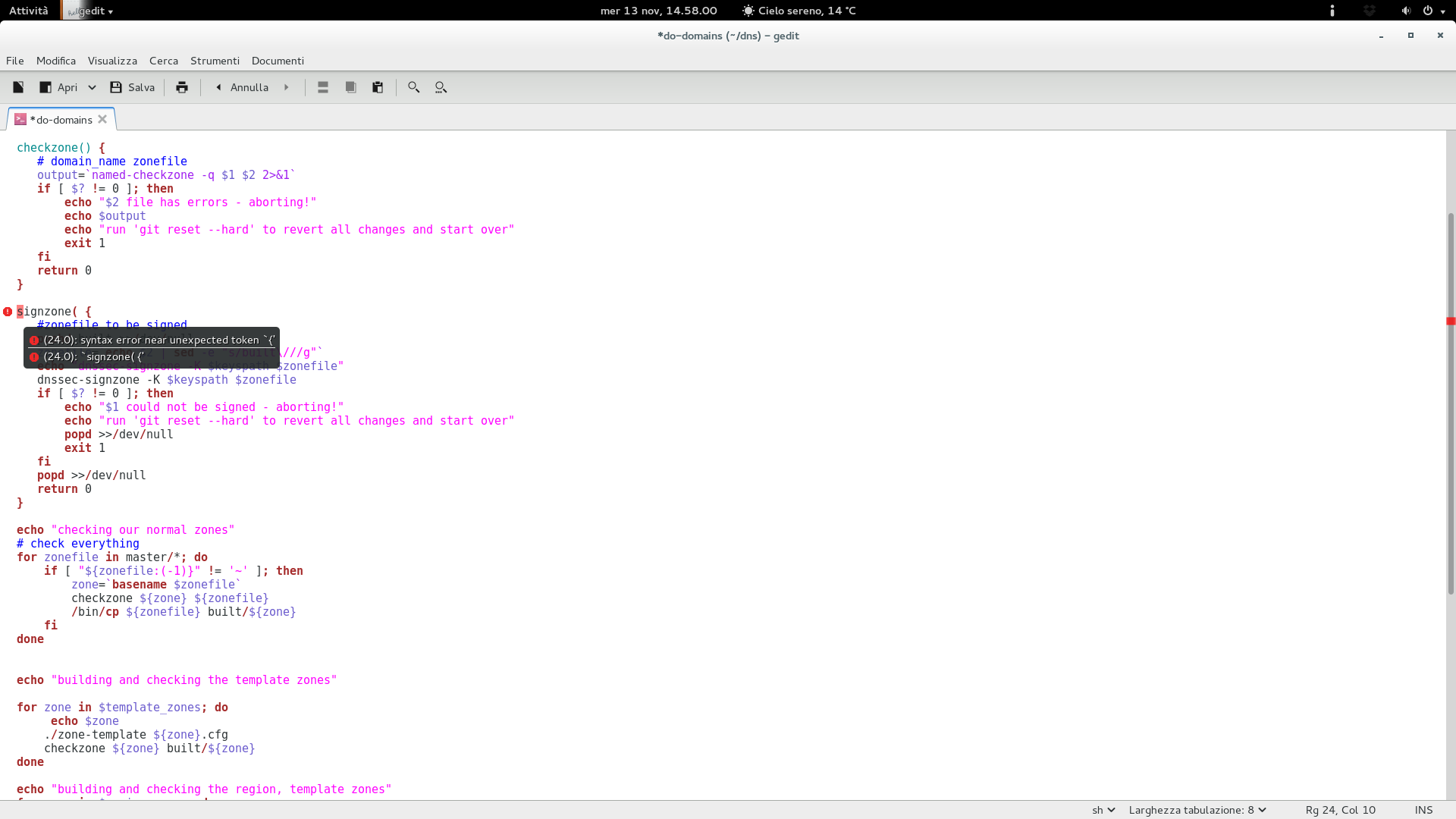
Choosing which method to use is really up to you. Once that is done you can go ahead and sign the zone file. As of myself I m making use of the do-domain script taken from the Fedora Infrastructure Team s repositories. If you are going to use it yourself, make sure to adjust all the relevant variables to match your setup, especially keyspath, region_zones, template_zone, signed_zones and AREA. The do-domain script also checks your zone file through named-checkzone before signing it.
/me while editing the do-domains script with the preview of gnome-code-assistance!

/me while editing the do-domains script with the preview of gnome-code-assistance!

If instead you don t want to use the script above, you can sign the zone file manually in the following way:
dnssec-signzone -K /path/to/your/dnssec/keys -e +3024000 -N INCREMENT gnome.org


By default, the above command will append .signed to the file name, you can modify that behaviour by appending the -f flag to the dnssec-signzone call. The -N INCREMENT will increment the serial number automatically making use of the RFC 1982 arithmetics while the -e flag will extend the zone signature end date from the default 30 days to 35. (this way we can safely run a monthly cron job that will sign the zone file automatically) You can make use of the following script to achieve the above:
#!/bin/sh
SIGNZONE="/usr/sbin/dnssec-signzone"
DNSSEC_KEYS="/srv/dnssec-keys"
NAMEDCHROOT="/var/named/chroot"
ZONEFILES="gnome.org"
cd $NAMEDCHROOT
for ZONE in $ZONEFILES; do
$SIGNZONE -K $DNSSEC_KEYS -e +3024000 -f $ZONE.signed -N INCREMENT $ZONE
done
/sbin/service named reload


Once the zone file has been signed just make sure to include it on named.conf and restart named:
zone "gnome.org"  
file "gnome.org.signed";
 ;


When you re done with that we should be moving ahead adding a DS record for our domain at our domain registrar. My example is taken from the known gandi.net registrar.
gandi

Gandi s DNSSEC interface

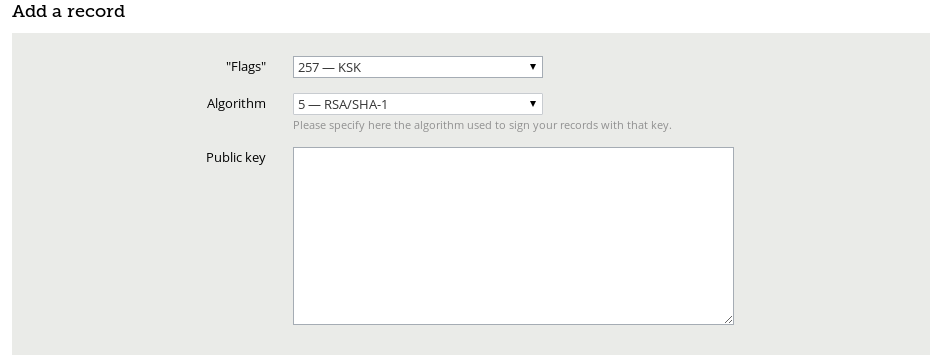
Select KSK (257) and (RSA/SHA-1) on the dropdown list and paste your public key on the box. You will find the public key you need on one of the Kgnome.org*.key files, you should look for the DNSKEY 257 entry as dig DNSKEY gnome.org shows:
;; ANSWER SECTION:
gnome.org. 888 IN DNSKEY 257 3 5 AwEAAbRD7AymDFuKc2iXta7HXZMleMkUMwjOZTsn4f75ZUp0of8TJdlU DtFtqifEBnFcGJU5r+ZVvkBKQ0qDTTjayL54Nz56XGGoIBj6XxbG8Es+ VbZCg0RsetDk5EsxLst0egrvOXga27jbsJ+7Me3D5Xp1bkBnQMrXEXQ9 C43QfO2KUWJVljo1Bii3fTfnHSLRUsbRn8Puz+orK71qxs3G9mgGR6rm n91brkpfmHKr3S9Rbxq8iDRWDPiCaWkI7qfASdFk4TLV0gSVlA3OxyW9 TCkPZStZ5r/WRW2jhUY/kjHERQd4qX5dHAuYrjJSV99P6FfCFXoJ3ty5 s3fl1RZaTo8=


Once that is done you should have a fully covered DNSSEC domain, you can verify that this way:
dig . DNSKEY   grep -Ev '^($ ;)' > root.keys
dig +sigchase +trusted-key=./root.keys gnome.org. A   cat -n


The result:
105 ;; WE HAVE MATERIAL, WE NOW DO VALIDATION
106 ;; VERIFYING DS RRset for org. with DNSKEY:59085: success
107 ;; OK We found DNSKEY (or more) to validate the RRset
108 ;; Ok, find a Trusted Key in the DNSKEY RRset: 19036
109 ;; VERIFYING DNSKEY RRset for . with DNSKEY:19036: success
110
111 ;; Ok this DNSKEY is a Trusted Key, DNSSEC validation is ok: SUCCESS

Bonus content: Adding SSHFP entries for your domain and verifying them You can retrieve the SSHFP entries for a specific host with the following command:
ssh-keygen -r $(hostname --fqdn) -f /etc/ssh/ssh_host_rsa_key.pub


When retrieved just add the SSHFP entry on the zone file for your domain and verify it:
ssh -oVerifyHostKeyDNS=yes -v subdomain.gnome.org


Or directly add the above parameter into your /etc/ssh/ssh_config file this way:
VerifyHostKeyDNS=yes


And run ssh -v subdomain.gnome.org , the result you should receive:
debug1: Server host key: RSA 00:39:fd:1a:a4:2c:6b:28:b8:2e:95:31:c2:90:72:03
debug1: found 1 secure fingerprints in DNS
debug1: matching host key fingerprint found in DNS
debug1: ssh_rsa_verify: signature correct

That s it! Enjoy!

Joachim Breitner: Constructing a list in a Monad

In Haskell, lists are ubiquitous. In real-world Haskell, monads are ubiquitous. So it should be an easy task to fill a list with values obtained in a monad, i.e. a list of n random numbers (in the Rand monad), or getting some input from the user, and storing it in a list, until the user chooses to finish the input. The task For now, assume a function getInput :: IO Int; we want to run it 10000 and then have the list of the values returned. Sounds simple and straight forward, but it is actually really hard to get the run-time behaviour that we naively and optimistically expect. The expectation In an imperative setting, we would have a simple counting loop. In the loop, we run getInput, allocate a new cell for the linked list, and append it to the list. Clearly, this
  • consumes no stack space and
  • at the end of the loop, the list is already fully evaluated in memory, ready to be used.
Can we achieve that with Haskell? Let s look at a few alternatives (complete code available)
Attempt 1: The accumulator I ll start with the probably worst attempt. Unfortunately, from what I have seen from correcting Haskell exams, this is what beginners would write, especially if they have the above imperative algorithm in mind, and know about the convert loops to recursion with accumulators approach to solving Haskell problems:
accumAppend :: Int -> IO [Int]
accumAppend n = go n []
  where
    go 0 l = return l
    go n l = do  x <- getInput; go (n-1) (l++[x]) 
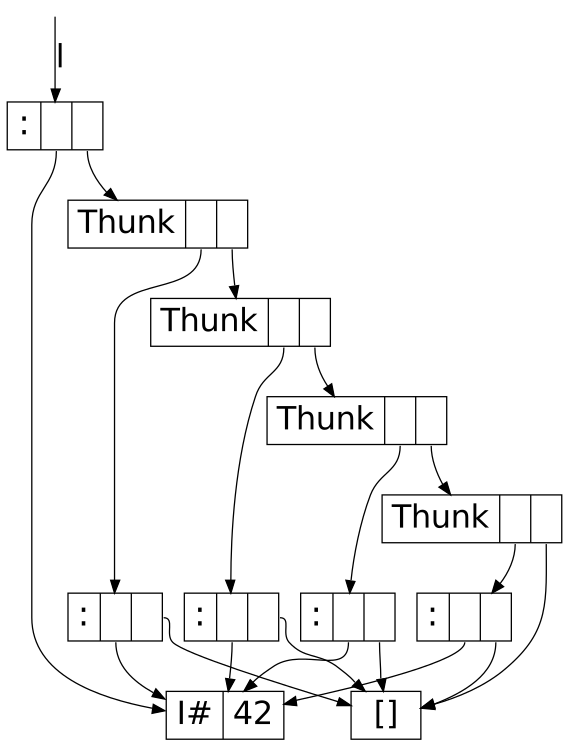
To check the space usage of this, I pass -Kn to the GHC runtime and see what limit is just enough to let this program calculate accumAppend 10000 and fully evaluate the resulting list. It turns out that we need 328336 bytes of stack space. So what about the second requirement; that the list is fully evaluated? Experienced Haskellers see it immediatelly: The accumulator is not used in the loop, so each iteration adds a thunk around the previous value, that would add the next entry to the end. Only when the list is actually used, these are run, each traversing the whole list, causing quadratic cost. We can verify this using ghc-vis:
Clearly (and not surprisingly) this is not the best solution. Attempt 2: The accumulator (forced) Lets try to fix the second issue, by making sure that the list is always fully evaluated. We import Control.DeepSeq and write
accumAppendSeq :: Int -> IO [Int]
accumAppendSeq n = go n []
  where
    go 0 l = return l
    go n l = do  x <- getInput ; go (n-1) $!! (l++[x]) 
As the accumulator gets fully evaluated before being passed to the next invocation of go, the result will not contain thunks. But note that this has also fixed the stack consumption: The code now runs the smallest setting for -K, 8 bytes. This works as both go and deepseq are tail-recursive. But this is still not the solution we are looking for, as the quadradic cost caused by using ++ is still there. Attempt 3: The accumulator (reversed) Since we know that l++[x] is expensive, but x:l is cheap, we can simply use this to update the accumulator. This has the slightly annoying consequence that the entries of the list are in the reverse order, but we can fix that in the base case:
accumReverse :: Int -> IO [Int]
accumReverse n = go n []
  where
    go 0 l = return (reverse l)
    go n l = do  x <- getInput ; go (n-1) (x:l) 
And indeed, we get noticably faster code that still runs in 8 bytes of stack. Unfortunately, we still don t construct the final list directly. Attempt 4: Naive recursion Maybe we can do without an accumulator. The most naive such code would be
listRecurse :: Int -> IO [Int]
listRecurse n = go n
  where
    go 0 = return []
    go n = do  x <- getInput; r <- go (n-1); return (x:r) 
and I d expect that most experienced Haskellers would write that code (if they are asked not to use a library function). And indeed, this code does create the final list directly. But it requires a large stack or 164616 bytes. The reason is that this is no longer tail recursive: After calling go again we need to take the result and prepend x Attempt 5: library functions Maybe we should simply not worry about the implementation, and use library functions? Clearly, the authors of such libraries have found the best solution. So how does
listReplicateM :: Int -> IO [Int]
listReplicateM n = Control.Monad.replicateM n getInput
fare? Unfortunately, not better than the naive recursion. In fact, the stack space requirement is the same 164616 bytes. The same holds when using special libraries for generating and consuming list, e.g. the Streams module from the vector package:
listStreams :: Int -> IO [Int]
listStreams n = MStream.toList $ MStream.replicateM n getInput
Attempt 6: Difference lists It is time to dig deeper into our box of tricks. What if we have lists with constant time Snoc (a.k.a. appending a new element)? Then Attempt 3 would not require reversing the list. Such lists are provided by difference lists; there are libraries for that, but we can simply implement them using lambdas:
accumDList :: Int -> IO [Int]
accumDList n = go n id
  where
    go 0 l = return (l [])
    go n l = do  x <- getInput; go (n-1) (l . (x:)) 
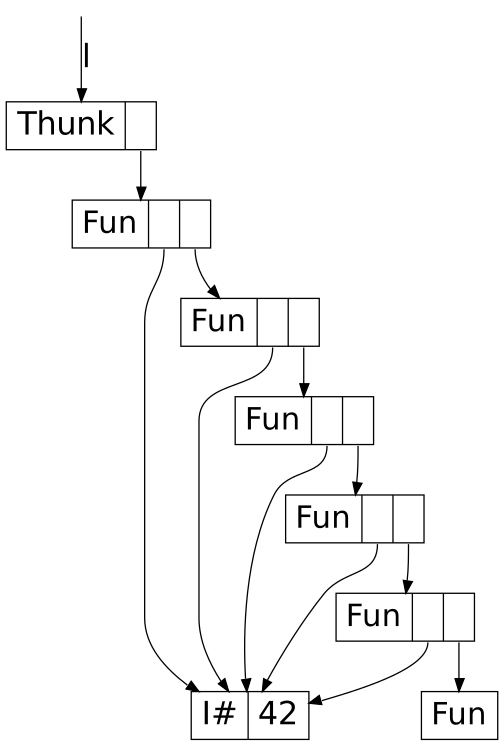
Indeed, no stack is required (8 bytes are enough). But we are cheating here: We are still not constructing the final list, but rather we combine functions that append elements to lists. So when accumDList returns, what we have in memory, is a thunk and sequence of partial function applications in the wrong order, and evaluating the thunk does basically the same thing as reverse in Attempt 3. It might be a bit faster, is still not satisfying enough:
Attempt 7: Unsafe functions Even deepter in the box of tricks, somewhere in the grit and dust where one usually should not reach, there is a function that can help us out here: unsafeInterleaveIO. This allow us to modify the naive recursion in a way that first creates the Cons-cell, and then continues the loop:
listUnsafeInterleave :: Int -> IO [Int]
listUnsafeInterleave n = do  l <- go n; return $!! l 
  where
    go 0 = return []
    go n = do x <- getInput
              r <- unsafeInterleaveIO (go (n-1))
              return (x:r)
The stack consumption is 8 bytes. It is worth noting that the all to deepseq (in $!!) will actually drive the evaluation of go. Also, it guarantees that the unsafe effects of unsafeInterleaveIO are confined to the execution of listUnsafeInterleave, i.e. are actually safe. Run time statistics I ran criterion over the functions (generating lists of length 1000), and found these results:
  • accumAppend: 6.5 ms
  • accumAppendSeq: 8.2 ms
  • accumReverse: 14.0 us
  • listRecurse: 8.0 us (same as listReplicateM and listStreams)
  • accumDList: 12.0 us
  • listUnsafeInterleave: 174.0 us
Conclusion There are many ways to write a list-constructing list in Haskell, none are perfect they either fill the heap, or do not construct the list directly (usually requiring a second pass through it), or rely on IO-specific unsafe functions. The naive recursion performs the best, but may cause a stack overflow (note, though that from GHC 7.8, the stack will be unlimited). The next best option seems to be the difference lists
I m still wondering: What would be required from Haskell, GHC or the monads in question to have a fully satisfactory solution here, i.e. one that is as fast as the naive recursion, as stack efficient as the difference list solution, and allocates no thunks, only list cells?

12 November 2013

Russell Coker: Bad Advertising of Protoplast

Carpal Tunnel Syndrome In early 2010 I wrote about Carpal Tunnel Syndrome, I gave a picture of the wrist brace and a description of the process of creating it [1]. A few months later I wrote a follow-up about how the wrist brace had helped me, at the time I was anticipating wearing it at night for the rest of my life [2]. But my wrist has continued to improve. Nowadays I never wear the wrist brace and hardly even think of it. I am a little more careful about posture than I was before, but mostly it has no impact on my life. I think this counts as a full recovery. At the time I was mildly interested in buying some thermo-plastic of that type to make things, but the only source I found was Jaycar which sold 100 grams for $14.95, Jaycar prices have now dropped to $11.50 for 100 grams or $89.50 for a kilo but it s still expensive [3]. Protoplast When looking at the sites that link to my blog I saw a site advertising Protoplast which is a type of thermo-plastic that can be used for making things [4]. Protoplast have more reasonable prices, E30 ($AU42.75) for a kilo and their web site offers better prices for anyone who purchases 10kg or more (good for hackerspaces etc). As they post no further than Belgium they aren t an option for me but they do seem to make a good offer, better than Jaycar offers in Australia. Protoplast is probably a good product, but I think that their advert is misleading. While it is probably possible to make a wrist-brace similar to mine with Protoplast it s a fact that my wrist brace was not made with it. My wrist brace started out as a flat sheet of plastic which could be formed to the final product without being melted. Converting a packet of plastic granules (as sold by Protoplast or Jaycar) to a sheet to even start work on such a wrist brace would take some work. To make a sheet of plastic out of beads sold by Jaycar or Protoplast you would ideally completely melt the plastic, if you just softened the plastic then it wouldn t be as strong as using a pre-made sheet. During the time that I wore the wrist brace I probably repaired it more than 30 times, this wasn t particularly difficult to do, I poured boiling water over it to soften the part that cracked until it became tacky and then pushed it together again. But the result was significantly weaker than the original due to the difficulty in welding the broken sections together. I ended up cutting some strips from less important parts of the wrist brace (the part nearest to my elbow) to reinforce the weakest part which was between my thumb and fore-finger. That section ended up being about three times thicker than it was originally while also not being as strong as it was originally. I also had difficulty in making it flat so it wasn t nearly as comfortable as the original version. It seems rather misleading to include the picture of my wrist brace on a site advertising plastic which wasn t used to make it and which probably couldn t be used to make something that looks as good with the same ratio of strength to mass. But with a suitable disclaimer indicating that the user probably can t get the same result it would be OK to give it as an example of what could be done. I can imagine someone using a product like Protoplast to make a wrist brace that can hold a mobile phone, that can be worn with a watch, or has other features that aren t offered by medical staff. License Issues The license for my blog doesn t permit people to just copy pictures, it s a Creative Commons Attribution-Noncommercial-Share Alike based license [5]. I am interested in supporting companies that make interesting products and anything that can help people with medical issues is also of interest. So I wouldn t rule out the possibility of a free license for a picture from my blog to be used in the way that they used it (with a link back to the original blog post). But I would want a description that informs readers that it s not an item made with their product, merely something similar that can be used for inspiration.

11 November 2013

Simon Josefsson: Using Replicant on Samsung Galaxy S III

For the last half-year I have used CyanogenMod on an Nexus 4 as my main phone. Recently the touch functionality stopped working on parts of the display, and the glass on the back has started to crack. It seems modern phones are not built to last. For comparison, before the N4 I used a Nokia N900 for around 3 years without any hardware damages (in my drawer now, still working). A few weeks ago I started looking for a replacement. My experience with CyanogenMod had been good, but the number of proprietary blobs on the N4 concerned me. Finding something better wasn t easy though, so I m documenting my experience here. My requirements were, briefly, that I wanted a phone that I could buy locally that had a free software community around it that produced a stable environment. I have modest requirements for things I wouldn t give up on: telephony, data connection (3G), email (IMAP+SMTP), chat (XMPP), and a web browser. I like the philosophy and openness around the Firefox OS but the more I have read about it, it seems unlikely that it would deliver what I need today. In particular none of the devices capable of running Firefox OS appealed to me, and the state of email reading seemed unclear. I m sure I ll revisit Firefox OS as an alternative for me in the future.

As I had been happy with CyanogenMod, but concerned about its freeness, it felt natural to move on and test the more free software friendly project Replicant. Replicant only supports a small number of devices. After talking with people in the #replicant IRC channel, it seemed the Samsung S3 would be a decent choice for me. The Samsung S2 would have worked as well, but it cost almost as much as the S3 where I looked. Despite the large number of Samsung S3 devices out there, it seems the prices even for used devices are high (around 2500 SEK in Sweden, ~380 USD). I ended up buying a brand new one for 3200 SEK (~500 USD) which felt expensive, especially after recalling the recent $199 sale for Nexus 4. Noticing that brand new Nexus 4 devices are still over 3000 SEK in Sweden comforted me a bit. I would have preferred a more robust phone, like the CAT B15, but the state of free software OSes on them seem unclear and I wanted something stable. So, enough about the background, let s get started. Building and installing Replicant on the device was straight forward. I followed the Replicant Samsung S3 Build instructions to build my own images. The only issue I had was that I had not set JAVA_HOME and the defaults were bad; make sure to set JAVA_HOME before building. I built everything on my Lenovo X201 running Debian Wheezy, with OpenJDK 6 as the Java implementation. Installing the newly built firmware was easy, I just followed the installation process documentation. I made sure to take a clockworkmod backup to an external SD card before wiping the old system. To get a really clean new device, I also re-formated /sdcard inside clockworkmod; I noticed there were some traces left of the old system there. I spent about one week testing various configurations before settling on something I could use daily. A fair amount of time was spent looking into backup and restore options for Android devices. My idea was that I would take a backup of the apps I ran on the N4 and transfer them to the S3. The Android Debug Bridge (adb) has a backup/restore command, however it (intentionally) ignores apps marked as allowBackup=false which a number of apps has. It doesn t seem possible to override that settings so much for the freedom to backup your own device. I then discovered oandbackup. It can backup your entire system, saving each app (together with associated data) into a separate directory, for simple review and inspection before restore. You can do batch backups and batch restore. I couldn t get it to automatically restore things, though, which would be neat for really automated re-installations (there is an open issue about this feature). After noticing that some apps did not like being moved from the N4 (running Android 4.2) to the S3 (running 4.0), I ended up installing most apps from scratch on a freshly installed Replicant. I use oandbackup to the external SD card so that I can quickly restore my phone. For backup/restore of SMS/MMS and Call Log, I use SMS Backup+ against my own IMAP server. Camera pictures are synced manually using adb when I am connected to my laptop. There is a number of apps that deserve to be mentioned because they are what I use on a daily basis. All of them come via the free software market F-Droid. For email (IMAP/SMTP), I use K-9 Mail which is feature rich but still easy to use. For chat, I use Xabber. I use NewsBlur s free software app to read RSS flows. For two-factor authentication, I use Google Authenticator. I haven t evaluated different PDF viewers, but the first one I tried (APV PDF Viewer) has worked fine so far. Handling a a synchronized address book and calendar deserve its own blog post because it is a challenging topic, but briefly, I m currently using a combination of aCal and DAVdroid. Finally, since Replicant is still work in progress, some words about stability and notes on what doesn t work. This is probably the most interesting part if you are considering running Replicant on an S3 yourself. Overall system stability is flawless, I hadn t had any crash or problem with the fundamental functionality (telephony, 3G, Camera). People have said graphics feels a bit laggy, but I cannot compare with the stock ROM and it doesn t get in the way of daily use. First some notes about non-free aspects:
  • Bluetooth doesn t work by default. After installing /system/vendor/firmware/bcm4334.hcd (MD5 b6207104da0ca4a0b1da66448af7ed4c) pairing and testing with a Bluetooth headset worked fine.
  • Front camera doesn t work by default. After installing /system/vendor/firmware/fimc_is_fw.bin (MD5 52eeaf0889bc9206860075cd9b7f80b9and) and /system/vendor/firmware/setfile.bin (MD5 0e6fdeb378fb154c39fd508ae28eaf2a) it works. The extensions are *.bin but I don t believe this code is executed on the main CPU.
  • GPS doesn t work by default. After installing /system/bin/gpsd (MD5 6757ed2e2a283259e67c62e6b2b9cfef), /system/lib/libsecril-client.so (MD5 a836df0f947d2aa2ef20dcb213317517), /system/lib/hw/gps.exynos4.so (MD5 1ea1d67f297dd52d59d40dbad9b02a0a) it works. This is code that runs on the main CPU, and even more alarming, it embeds a copy of OpenSSL and talks to various online servers for A-GPS, and is thus a likely (and probably not too challenging) attack vector for anyone wanting to remotely exploit any phone.
  • Wifi doesn t work, and I haven t gotten this to work. There is a list of non-free S3 firmware on the Replicant wiki however my stock ROM did not ship with those files. I don t believe any of the blobs run on the main CPU.
  • NFC doesn t work, and I haven t gotten it to work. It seems the infrastructure for NFC is missing in Replicant 4.0, it doesn t even expose the NFC hardware permission capability. This is quite unfortunate for me, since I daily work with YubiKey NEO and would have preferred to replace Google Authenticator with the YubiOATH that uses the NEO for OATH secret storage.
Some other observations:
  • Panorama mode in the Camera crashes; see issue about it.
  • There is a number of smaller graphical issues. I believe these are related to the EGL but haven t understood the details. What I ve noticed are the following issues. The task switcher doesn t show mini screenshots of all running apps (the screenshots are just black). ZXing is not able to QR decode images (I m told this is because Replicant uses a RGB color plane instead of the required YUV color plane). Video playback in the gallery is laggy to the point of being unusable. Video playback on Youtube in the default web browser works in full screen (not laggy), but not embedded in the webpage.
  • MTP has been a bit unreliable, my main laptop is able to import photos, but another laptop (also running Debian Wheezy) just stalls when talking to it. This may be a host issue, I have experience similar issues with a Nexus 7 2nd generation device.
I am quite happy with the setup so far, and I will continue to use it as my primary phone. flattr this!

Vincent Bernat: Snimpy: SNMP & Python

While quite old fashioned, SNMP is still an ubiquitous protocol supported by most network equipments. It comes handy to expose various metrics, like network interface counters, to be gathered for the purpose of monitoring. It can also be used to retrieve and modify equipments configuration. Variables exposed by SNMP agents (servers) are organized inside a Management Information Base (MIB) which is a hierarchical database1. Each entry is identified by an OID. Querying a specific OID allows a manager (client) to get the value of an associated variable. For example, one common MIB-module is IF-MIB defined in RFC 2863. It contains objects used to manage network interfaces. One of them is ifTable whose rows are representing agent s logical network interfaces. Each row will expose the interface name, characteristics and various associated counters.
ifIndex ifDescr ifPhysAddress ifOperStatus ifOutOctets
1 lo up 545721741
2 eth0 0:18:f3:3:4e:4 up 78875421
3 eth1 0:18:f3:3:4e:5 down 0
ifTable is indexed by its first column ifIndex. If you want to get the operational status of the second interface, you need to query IF-MIB::ifOperStatus.2 which is translated to OID .1.3.6.1.2.1.2.2.1.8.2 using information provided by the MIB definition.

Scripting SNMP An SNMP agent can deliver a lot of interesting information: You can gather those information manually with tools like snmpget and snmpwalk:
$ snmpwalk -v 2c -c public localhost IF-MIB::ifDescr      
IF-MIB::ifDescr.1 = STRING: lo
IF-MIB::ifDescr.2 = STRING: eth0
IF-MIB::ifDescr.3 = STRING: eth1
However, building robust scripts with them is quite challenging. For example, if you wanted to get the descriptions of all active interfaces as well as the total number of octets transmitted, you could do something like that:
#!/bin/sh
set -e
host="$ 1:-localhost "
community="$ 2:-public "
args="-v2c -c $community $host"
for idx in $(snmpwalk -Ov -OQ $args IF-MIB::ifIndex); do
    descr=$(snmpget -Ov -OQ $args IF-MIB::ifDescr.$idx)
    oper=$(snmpget -Ov -OQ $args IF-MIB::ifOperStatus.$idx)
    in=$(snmpget -Ov -OQ $args IF-MIB::ifInOctets.$idx)
    out=$(snmpget -Ov -OQ $args IF-MIB::ifOutOctets.$idx)
    [ x"$descr" != x"lo" ]   continue
    [ x"$oper" = x"up" ]   continue
    echo $descr $in $out
done
Hopefully, SNMP bindings in various languages are pretty common. For example, Net-SNMP ships with a Python binding:
import argparse
import netsnmp
parser = argparse.ArgumentParser()
parser.add_argument("host", default="localhost", nargs="?",
                    help="Agent to retrieve variables from")
parser.add_argument("community", default="public", nargs="?",
                    help="Community to query the agent")
options = parser.parse_args()
args =  
    "Version": 2,
    "DestHost": options.host,
    "Community": options.community
 
for idx in netsnmp.snmpwalk(netsnmp.Varbind("IF-MIB::ifIndex"),
                            **args):
    descr, oper, cin, cout = netsnmp.snmpget(
        netsnmp.Varbind("IF-MIB::ifDescr", idx),
        netsnmp.Varbind("IF-MIB::ifOperStatus", idx),
        netsnmp.Varbind("IF-MIB::ifInOctets", idx),
        netsnmp.Varbind("IF-MIB::ifOutOctets", idx),
        **args)
    assert(descr is not None and
           cin is not None and
           cout is not None) #  
    if descr == "lo":
        continue
    if oper != "1": #  
        continue
    print("     ".format(descr, cin, cout))
This binding is quite primitive and has several drawbacks:
  1. It exports everything as strings. See .
  2. Error handling is just deficient. If you mispell something, like a variable name, you ll get snmp_build: unknown failure on the standard error. No exception. If a variable does not exist, you ll get None instead. See .
This inability to sanely handle failures makes this binding quite dangerous to use in scripts. Imagine making important modifications on the basis of the returned values. If you forget to check against None, your script may cause havoc!

Snimpy Because I didn t find any reliable Python binding for SNMP, I decided to write Snimpy with two goals in mind:
  1. Leverage information contained in MIBs to provide a pythonic interface.
  2. Any error condition should raise an exception.
Here is how the previous script could be written:
#!/usr/bin/env snimpy
import argparse
parser = argparse.ArgumentParser()
parser.add_argument("host", default="localhost", nargs="?",
                    help="Agent to retrieve variables from")
parser.add_argument("community", default="public", nargs="?",
                    help="Community to query the agent")
options = parser.parse_args()
m = M(options.host, options.community, 2)
load("IF-MIB")
for idx in m.ifDescr:
    if m.ifDescr[idx] == "lo":
        continue
    if m.ifOperStatus[idx] != "up":
        continue
    print("     ".format(m.ifDescr[idx],
                            m.ifInOctets[idx],
                            m.ifOutOctets[idx]))
You can also use a list comprehension:
load("IF-MIB")
print("\n".join([ "     ".format(m.ifDescr[idx],
                                    m.ifInOctets[idx],
                                    m.ifOutOctets[idx])
                  for idx in m.ifDescr
                  if m.ifDescr[idx] != "lo"
                  and m.ifOperStatus[idx] == "up" ]))
Here is another simple example to get the routing database from the agent:
load("IP-FORWARD-MIB")
m=M("localhost", "public", 2)
routes = m.ipCidrRouteNextHop
for x in routes:
    net, netmask, tos, src = x
    print(" :>15s / :<15s  via  :<15s  src  :<15s ".format(
        net, netmask, routes[x], src))
IP-FORWARD-MIB::ipCidrRouteNextHop is a more complex table with a compound index. Despite this, querying the table still seems natural. Have a look at Snimpy s documentation for more information. Behind the hood, SNMP requests are handled by PySNMP and MIB parsing is done with libsmi2. Snimpy supports both Python 2, Python 3 and Pypy.

  1. A MIB is defined using a subset of ASN.1 called SMI. However, it is not uncommon to refer to the definition as a MIB too.
  2. Unfortunately, there is currently no robust SMI parser written in pure Python. For example, PySNMP relies on smidump which comes with libsmi. Snimpy uses a custom CFFI wrapper around libsmi.

Gunnar Wolf: Talking in Paran : Free Software philosophy / the Debian project. PS: Want to contribute?

I'm very happy: I was finally able to present a talk at a Free Software conference in Paran , Argentina Regina's hometown. Not only in Paran , but at the Vieja Usina culture center, half a block away from her parents' house. So, I must doubly thank Laura: First, for letting us know there would be a Free Software conference there, and second, for taking some pictures :- What was this conference? Conferencia Regional de Software Libre, organized by Grupo de Usuarios de GNU/Linux de Entre R os (GUGLER). Of course, flying to Argentina (and more specifically, to Paran , which is ~500Km away from the international airport) just for a one day conference was out of the question So I gave the talk by videoconference. Of course, given we will be travelling for the December vacations to Argentina, I expect to meet in person the GUGLER guys soon. I gave a single talk, mixing together two different topics: (my very personal take on) the Free Software philosophy and Debian's place in the Free Software universe. I had a very good time giving the talk, and while I was unable to look at my audience, I got reports saying they were happy and interested. I even got some mails from them, which makes me quite happy ;-) Now, one of the recurring points whenever I talk about Debian: I often tell people that I cannot tell them why they should use Debian instead of other distributions. My years testing every distribution I come across are long gone, and I nowadays am familiar with Debian only. But I also tell them that personally I gain nothing by having more Debian users in the world What I want to achieve is the next logical step: To have more people contributing to Debian. So, here is a great opportunity for interested people, specifically a group that often has a hard time finding a way to collaborate with Free Software projects. Today, Paul Tagliamonte published a call for proposals for Debian 8 (Jessie)'s artwork. So, given many people always want to find a way to contribute to Free Software without being a coder, here's a golden opportunity. You can look at the themes sent for Debian 7 as a reference; look also at the technical requirements for your artwork, and... Well, you have until early February to work on it!

10 November 2013

Gregor Herrmann: RC bugs 2013/45

here's the list of RC bugs I've worked on during the last week.
  • #713582 src:malaga: "malaga: FTBFS: ld: canvas.o: undefined reference to symbol 'ceil@@GLIBC_2.2.5'"
    add patches from Ubuntu / Matthias Klose, upload to DELAYED/2
  • #713595 src:goocanvas: "goocanvas: FTBFS: ld: demo.o: undefined reference to symbol 'sincos@@GLIBC_2.2.5'"
    add patch from Ubuntu / Matthias Klose, upload to DELAYED/2
  • #713635 src:osm-gps-map: "osm-gps-map: FTBFS: osm-gps-map-widget.c:778:21: error: format '%lld' expects argument of type 'long long int', but argument 4 has type 'goffset' [-Werror=format=]"
    add patch from upstream git, package FTBFS again later
  • #713666 src:gnustep-base: "gnustep-base: FTBFS: GSXML.m:983:38: error: dereferencing pointer to incomplete type"
    add patch from Ubuntu / Benjamin Drung, upload to DELAYED/2
  • #713700 src:gsnmp: "gsnmp: FTBFS: gsnmp.h:27:18: fatal error: gnet.h: No such file or directory"
    apply patch from Ubuntu / Daniel T Chen, upload to DELAYED/2
  • #713701 src:libmatchbox: "libmatchbox: FTBFS: ld: dump-image.o: undefined reference to symbol 'XOpenDisplay'"
    add patches from Ubuntu / Daniel T Chen, upload to DELAYED/2
  • #713708 src:gtkgl2: "gtkgl2: FTBFS: ld: zktor.o: undefined reference to symbol 'atan2@@GLIBC_2.2.5'"
    apply patch from Ubuntu / Daniel T Chen, upload to DELAYED/2
  • #713727 src:xmlroff: "xmlroff: FTBFS: ld: ../libfo/.libs/libfo-0.6.a(fo-datatype.o): undefined reference to symbol 'floor@@GLIBC_2.2.5'"
    apply patch from Ubuntu / Daniel T Chen, upload to DELAYED/2
  • #713728 src:matchbox-panel: "matchbox-panel: FTBFS: ld: mb-applet-menu-launcher.o: undefined reference to symbol 'XInternAtom'"
    update patch to link against more libs, upload to DELAYED/2
  • #724080 src:libgraph-perl: "libgraph-perl: FTBFS: make: *** [clean] Error 1"
    fix clean target in debian/rules, upload to DELAYED/2, then moved to 0-day with maintainer's consent
  • #724085 src:myspell: "myspell: FTBFS: POD errors"
    prepare a patch
  • #724115 src:hunspell: "hunspell: FTBFS: POD error"
    prepare a patch
  • #724142 src:xmltv: "xmltv: FTBFS: Tests failed"
    investigate error
  • #724750 electrum: "electrum fails to launch from terminal"
    add missing dependency, upload to DELAYED/2
  • #726801 biomaj: "biomaj: fails to install with Recommends enabled"
    tag unreproducible, later further analyzed as a java dependency problem by follow DD

Sylvain Le Gall: opam2debian, a tool to create Debian binary package out of OPAM

One week ago, a thread in opam-devel mailing list started about the possibility to create binary snapshot to distribute OPAM packages. Distributing binary packages with everything already compiled is pretty useful when you want to make sure that everyone has the same version of packages installed and you don't want to spend time configuring all the computer of your colleague. As a matter of fact I was also interested to see that happening. I have several computers where I want to install a set of packages and I want to snapshot OPAM archives when I am ready for an upgrade. I have tested for a long time another source distribution: GODI. I even wrote a puppet module to drive it. This was a fun experience, but as with any source only distribution, there are some drawbacks. Especially even if it is fully automated, you get a lot of errors and timeout when trying to build automatically from source. This is how opam2debian has started. I wanted a replacement for puppet-godi that takes advantage of OPAM and the possibility to distribute my set of packages everywhere quickly. The goals of this project are:
  1. generate a Debian binary package with all the dependencies set on external packages (like libpcre)
  2. use OPAM to build everything
  3. use standard Debian process to build package
  4. create snapshot of OPAM repository that allow to rebuild exactly the same thing on different arches
The real challenge behind opam2debian was to be able to use standard Debian process to create package to get all the power of dependencies computation provided by the Debian maintainer scripts. My great achievement on this topic was to find a tool called proot that allows you to bind mount a directory as a user. This is an achievement because it allows to create a package using a directory where you are not allowed to write (i.e. /opt/opam2debian directory which is owned by root). This is a way to do it on any Jenkins builder without root access and a standard way for Debian to build packages. Usage example I need to compile a set of package to install on all my Jenkins builder. Here is the list of packages I need and I also want to use the latest OCaml version. I want to build a Debian package for Debian Wheezy which has only OCaml 3.12.1. Building the package:
$ opam2debian create --build --name opam2debian-test2 --compiler 4.01.0 \
 ocamlfind fileutils ocaml-data-notation ocaml-expect ounit \
 ocamlmod ocamlify oasis yojson sexplib extlib pcre-ocaml \
 calendar ocaml-inifiles ocamlnet ocurl gettext inotify ocaml-sqlexpr \
 ocamlrss ocaml-xdg-basedir
Getting the package list right can be tricky because the process will stop at the first error -- and if it is because the last package fails to build it can be long. I have implemented a --keep-build-dir in case you want to tune the package list live. The program will build everything and it can takes quite a while. At the end you get a file opam2debian-test2_20131105_amd64.deb which has a reasonable size of 232MB. That is big, but it looks like the biggest directory is $OPAMROOT/4.01.0/build, I am not sure if I can remove it but we may save some space here (the build directory represents 50% of the package size). Then you can just do a standard Debian installation:
$ sudo dpkg -i opam2debian-test2_20131105_amd64.deb
And you can use it:
$ eval $(opam config env --root /opt/opam2debian/opam2debian-test2/)
$ which ocamlfind
 /opt/opam2debian/opam2debian-test2/4.01.0/bin/ocamlfind
$ ocamlfind list
 [...]
 stdlib              (version: [distributed with Ocaml])
 str                 (version: [distributed with Ocaml])
 threads             (version: [distributed with Ocaml])
 threads.posix       (version: [internal])
 threads.vm          (version: [internal])
 type_conv           (version: 109.41.00)
 unidiff             (version: 0.0.2)
 unix                (version: [distributed with Ocaml])
 userconf            (version: 0.3.1)
 xdg-basedir         (version: 0.0.3)
 xmlm                (version: 1.1.1)
 yojson              (version: 1.1.5)
A nice thing to note, is that it is a standard OPAM install. You can install, update and upgrade OPAM from there, as root. However, I would recommend not to do it, and just rebuild a newer Debian package to upgrade. Install You will need the opam and proot Debian package available in Debian jessie and sid. You will also need various OCaml libraries (cmdliner, calendar, fileutils and jingoo). Download the opam2debian tarball on the forge, build and install it. The project is hosted on github. Open issues On the initial list of goals of the project. Not everything is completed. I have still several open issues. In particular 4. (create snapshot of OPAM repository) was blocked by a bug in opam-mk-repo, that prevents snapshots (see my pull-request to solve it). Another issues is about licenses of the included files. I should list them all and I need to figure out a way to extract every licences. Submit bugs directly to github.

Petter Reinholdtsen: Running TP-Link MR3040 as a batman-adv mesh node using openwrt

Continuing my research into mesh networking, I was recommended to use TP-Link 3040 and 3600 access points as mesh nodes, and the pair I bought arrived on Friday. Here are my notes on how to set up the MR3040 as a mesh node using OpenWrt. I started by following the instructions on the OpenWRT wiki for TL-MR3040, and downloaded the recommended firmware image (openwrt-ar71xx-generic-tl-mr3040-v2-squashfs-factory.bin) and uploaded it into the original web interface. The flashing went fine, and the machine was available via telnet on the ethernet port. After logging in and setting the root password, ssh was available and I could start to set it up as a batman-adv mesh node. I started off by reading the instructions from Wireless Africa, which had quite a lot of useful information, but eventually I followed the recipe from the Open Mesh wiki for using batman-adv on OpenWrt. A small snag was the fact that the opkg install kmod-batman-adv command did not work as it should. The batman-adv kernel module would fail to load because its dependency crc16 was not already loaded. I reported the bug to the openwrt project and hope it will be fixed soon. But the problem only seem to affect initial testing of batman-adv, as configuration seem to work when booting from scratch. The setup is done using files in /etc/config/. I did not bridge the Ethernet and mesh interfaces this time, to be able to hook up the box on my local network and log into it for configuration updates. The following files were changed and look like this after modifying them: /etc/config/network
config interface 'loopback'
        option ifname 'lo'
        option proto 'static'
        option ipaddr '127.0.0.1'
        option netmask '255.0.0.0'
config globals 'globals'
        option ula_prefix 'fdbf:4c12:3fed::/48'
config interface 'lan'
        option ifname 'eth0'
        option type 'bridge'
        option proto 'dhcp'
        option ipaddr '192.168.1.1'
        option netmask '255.255.255.0'
        option hostname 'tl-mr3040'
        option ip6assign '60'
config interface 'mesh'
        option ifname 'adhoc0'
        option mtu '1528'
        option proto 'batadv'
        option mesh 'bat0'
/etc/config/wireless
config wifi-device 'radio0'
        option type 'mac80211'
        option channel '11'
        option hwmode '11ng'
        option path 'platform/ar933x_wmac'
        option htmode 'HT20'
        list ht_capab 'SHORT-GI-20'
        list ht_capab 'SHORT-GI-40'
        list ht_capab 'RX-STBC1'
        list ht_capab 'DSSS_CCK-40'
        option disabled '0'
config wifi-iface 'wmesh'
        option device 'radio0'
        option ifname 'adhoc0'
        option network 'mesh'
        option encryption 'none'
        option mode 'adhoc'
        option bssid '02:BA:00:00:00:01'
        option ssid 'meshfx@hackeriet'
/etc/config/batman-adv
config 'mesh' 'bat0'
        option interfaces 'adhoc0'
        option 'aggregated_ogms'
        option 'ap_isolation'
        option 'bonding'
        option 'fragmentation'
        option 'gw_bandwidth'
        option 'gw_mode'
        option 'gw_sel_class'
        option 'log_level'
        option 'orig_interval'
        option 'vis_mode'
        option 'bridge_loop_avoidance'
        option 'distributed_arp_table'
        option 'network_coding'
        option 'hop_penalty'
# yet another batX instance
# config 'mesh' 'bat5'
#       option 'interfaces' 'second_mesh'
The mesh node is now operational. I have yet to test its range, but I hope it is good. I have not yet tested the TP-Link 3600 box still wrapped up in plastic.

Russell Coker: Aldi Changes, Cheap Telcos, and Estimating Costs

I ve been using Aldi as my mobile phone provider for two months now since Kogan was shut down [1]. Now Aldi have cut the transfer quota on their Unlimited plan from 5G per month to 2.5G per month. The most charitable interpretation of this would be that Aldi got a lot of former Kogan customers who needed the 6G per month that Kogan offered and that forced them to make changes to remain profitable. But the most likely possibility is that with less competition Aldi can just offer less for the same price. This isn t a huge problem for me, in two months on Aldi my biggest month involved almost exactly 2.5G of data transfer. But it s annoying to lose something and it s enough to make me consider other options. Also some of my relatives are looking for new plans so now is a good time to research the options. Other Pre-paid Options Lebara offers Unlimited plans that start at $30 per month and offer 1.5G of data [2], this compares well to the Unlimited plan of $35 per month from Aldi which has 2.5G of data (depending on whether 1.5G is enough). Amaysim has an Unlimited plan that includes 4G of data for $40 per month [3]. If you make lots of phone calls and transfer more than 2.5G of data per month then that would be a really good deal. Lebara uses the Vodafone network and Amaysim uses Optus. Neither of them compare to the Telstra 3G network if you want access outside major urban areas. I had Virgin (Optus network) work well for me for years and Three (their own network now part of Vodafone) work well for many years before that. But data transfer is becoming more important to me and the Telstra network is a major feature of Aldi. Lebara has one of the wost web sites I ve ever seen and Amaysim isn t much better. Aldi is great, they just provide all the key data in one page. Aldi and Amaysim have Android apps that can be used for recharging and viewing the balance, Aldi s app works well but I haven t been able to test the Amaysim app. Lebara doesn t even have an app. Generally Lebara doesn t seem to have anything going for it unless you want to make lots of calls to other Lebara customers, you want to make calls to certain other countries where Lebara has very low international rates, or unless you need a plan with unlimited calls but don t need more than 1.5G of data. The following table summarises the costs of the three pre-paid telcos.
Telco Flagfall Cost/min (Australia calls) SMS Data Cost/Meg Data Increment Credit Expiry and Minimum 30day Data Packs
Aldi 0 $0.12 $0.12 $0.05 1M 1 year $15 2G=$15
Lebara $0.29 $0.15 $0.15 $0.05 1K 90 days $10
Amaysim 0 $0.12 $0.12 $0.05 1M 90 days $5 1G=$10 2G=$20 4G=$30
Post-paid Options Virgin s cheapest offer is $20 per month for $200 of calls (at $0.98/min + $0.40 flagfall) and 200M of data [4], they currently have a special offer of an extra 1G if you sign up before the 18th of November. Virgin have a long history of periodically offering special deals so if you want to sign up with them some time in the next few months it s best to poll their web site and wait for a deal. The TeleChoice Global Liberty plan is a slightly better deal of $20 per month for $500 of calls (at $0.97/min + $0.40 flagfall) and 1G of data which also has free SMS [5]. TeleChoice Global Rebel Texter is a plan for $15 per month that includes $200 of calls and 200M of data and free SMS [6]. They also have a $10 per month plan which charges $0.22 per SMS, which would be bad value for anyone who sends 1 SMS per day. At Aldi rates if you spend $15 per month on 2G of data and $5 on calls then you will get 41 * one minute calls as opposed to $200/($0.98+$0.40)==145 * one minute calls with the cheapest Virgin plan. It seems to me that there is little possibility for those two $20 post-paid plans (which seem to be two of the best value plans currently available) to compete well with the pre-paid options from Aldi and Lebara. Even if you have the same usage pattern every month there are only particular patterns which make the Virgin or TeleChoice deals most appealing options, for example if you need to make more than 40 minutes of calls but less than 145 minutes of calls then Virgin will look good. TeleChoice Global Liberty looks good if you make between 40 and $500/($0.97+$0.40)==365 * one minute calls. If you only need a small amount of data transfer (less than 200M billed in 10K increments) then the TeleChoice Rebel Texter plan would look good as the Aldi 1M increments matter for small amounts of data transfer. But I don t think that many people are in that situation, even my mother in law can t easily stick within 200M of data transfer. Measuring Phone Use The first program I used for measuring phone calls is the Call & SMS Stats app from the Android Market [7]. I wouldn t recommend this to technical users as it demands a lot of access to the phone (including reading SMS, accessing the phone storage, and sending data to the Internet), but it s good for less technical users. For my use I prefer Call Meter 3G from the F-Droid repository [8]. I trust the Call Meter 3G program more because it s source is available under the GPL and it also has the convenient feature of adding up the costs of the calls, SMS, and data used. According to Call Meter 3G I m using less than $20 of calls and SMS per month, so if I continue my current use with a 2G data pack every month from Aldi instead of buying a $35 Unlimited pack and don t use more than 2G of data then I ll save at least a few dollars every month. My wife makes fewer calls so I ve already moved her phone away from the Unlimited plan and I ll move my phone later if it looks like it will save money she will now use my phone for making calls when we are together so the Unlimited plan may become good value when we share it. The Case for Aldi Aldi offers competitive options for phones for most levels of usage. While there are some post-paid plans which are better in some areas such as the ones from TeleChoice Aldi has the benefit of flexibility. A phone with Aldi can have it s plan scaled up or down easily with no penalty fees. For a phone to be usable for an entire year the cheapest option at the moment is Aldi which has a $15 recharge that lasts for a year. The next best option seems to be Amaysim with a $5 recharge that lasts for 90 days. Saving Money In the past I ve been used to SMS being significantly cheaper than phone calls. When I was on Virgin and calls just over $1 per minute ($0.98 per minute plus the flag-fall) and SMS were $0.28 which made a simple question and answer cheaper by SMS than calling. But with Aldi charging the same for a 1 minute call and sending an SMS a simple question and answer will cost half as much if it s done with a call so SMS isn t a good deal. Also I ve started using Google Hangouts to communicate with my wife instead of SMS as extra use of Hangouts is essentially free (we both have it running all the time for Ingress related communication anyway). The financial incentive now is to use Google Hangouts to replace some calls. One down-side to saving money in such ways is that it restricts usage of the phone. While moving from SMS to Google Hangouts (or any other instant-messaging system) isn t any great cost having to reduce the number of calls does. The ability to talk for as long as you want without bothering about cost is something that s worth paying for. I Hate Telcos For most things that I spend money on I wouldn t invest much effort to try and save $10 or $15 per month. Even when doing research that will help my friends and relatives and random people on the Internet I probably wouldn t take so much time for a small saving. But the Telcos seems to avoid competing as much as possible which is obvious from the way that they increase prices and decrease services at the same time. Also most Telcos seem to have a business model that is based around exploiting customers, they have confusing terms in the contracts that make it very likely for customers to go over the included usage and hit penalty rates and charge unreasonable prices for the phones that are bundled with a telephony contract. I want to reduce the amount of money I pay to Telcos as a matter of principle. Aldi is better than most Telcos, they have clear terms that are explained on a single web page [9], and they have an Android app to show the remaining credit that can reduce the risk of excessive fees if a 2G data block is used. Aldi sells phones in their stores at low prices, the phones that they sell aren t the highest quality but the customer gets what they pay for and the warranty return policy is good. But we still need to find the best options so that market forces will encourage Telcos to make more reasonable offers.

9 November 2013

Ricardo Mones: The Debian Project...

...is reading my mind!

I didn't tell anybody, but a couple of months ago, when I finally had time at work to upgrade my work computer desktop from Squeeze to Wheezy I also switched from GNOME to XFCE. Now I read via LWN that Debian is doing the same, at least for a while :)

BTW, I knew newer GNOME was different (had seen it in Fedora 18 for example), anyway I installed it (because I was lazy enough just to apt-get dist-upgrade the box) and tried it.

Maybe it's me, becoming an old dog which doesn't want to learn new tricks, but in order to get my work done as fast as usually I had to install something usable, hence went back to XFCE. I had to manually convert GNOME panel launchers to XFCE launchers but, besides that and some missing applet I'm pretty happy with the switch.

Russ Allbery: Review: Fantasy & Science Fiction, July/August 2011

Review: Fantasy & Science Fiction, July/August 2011
Editor: Gordon van Gelder
Issue: Volume 121, No. 1 & 2
ISSN: 1095-8258
Pages: 258
Nothing of particular interest in the book reviews in this issue, although I was entertained to see Charles de Lint review a collection of the Prince Valiant strip. I have memories of that strip being one of the most boring works of art created by mankind. De Lint, of course, quite likes it. Our tastes seem to be very disjoint, although I have to admit that I've not read it collected and it may be more coherent and more interesting in that format. The science column in this issue, by Paul Doherty and Pat Murphy, deserves special mention. It's on roshambo (rock-paper-scissors), human difficulties with randomness, and strategy in roshambo competitions. It's also the first essay I've read that clearly explains how there can be strategy to roshambo, and why that strategy is worth studying. Even though the primary topic of the column is randomness, it's worth reading from the perspective of strategy in competitive human vs. human games. "Bronsky's Dates with Death" by Peter David: Anyone familiar with PAD's body of work will immediately expect a humorous story with some deeper thoughtful bits, and that's exactly what this is. Bronsky, the title character, is a man almost incapable of saying exactly what's on his mind, and what's on his mind is his eventual death. Not that it bothers him that much; he's just thinking a lot about it. But his incessant discussion of it certainly bothers the people around him. This leads to a few entertaining exchanges with his family, and then to more entertaining exchanges with Death. Or Deaths, as there appear to be several different kinds. I found the exact metaphysics a bit confused, but the ending was still touching and a bit funny. (7) "The Way It Works Out and All" by Peter S. Beagle: This is a reprint of a special fund-raising story about Avram Davidson, so a lot of it was lost on me given that I know almost nothing about Davidson and have yet to get to any of his novels I own. But even without that background, it's a diverting story of hidden and parallel worlds and unexpected explorations. There isn't all that much in the way of a plot, but it's a nice bit of characterization set against a fun SF twist. (6) "Less Stately Mansions" by Rob Chilson: This is a story about conservatism in life, about a farmer staying on his farm and resisting change, and about nostalgia, but I liked it much better than I normally like stories with those themes. It's set against a future world in which climate change is making life increasingly untenable. Humans are migrating into space colonies of various types, but Jacob refuses. This frustrates some parts of the family who want a piece of the substantial cash-out he's being offered for his farm, which of course makes Jacob even more stubborn. It's more of an elegy than a story, but I think it captures a particular stubborn mood, and a conscious decision to go with what one knows even if it doesn't have a long future, quite well. (7) "The Ants of Flanders" by Robert Reed: This is the novella of the issue, and, as you might expect from the author, it's thoughtful, meaty, and satisfying. At the start of the book, the planet is visited by an extraterrestrial ship (or ships it's not entirely clear at first). One of the people near one landing is Bloch, a huge teenager who has an odd lack of natural fear. He stays near the center of the story as Reed slowly develops a cosmology and a galactic political background that makes it clear humans may be incidental to everything that's happening. I liked this. It's a touch depressing in spots, and Bloch is a strange protagonist, but the cosmology is not the normal SF background and sparks some thoughts about how a status quo would be maintained by powers that don't care much about individual lives. The interlude with the leopard is nicely done, even if its significance is inobvious at first. (7) "Hair" by Joan Aiken: This is one of those weird Gothic horror stories about creepy families and half-explained supernatural events that some people love and that do nothing for me. (3) "The Witch of Corinth" by Steven Saylor: This is straight historical fantasy, featuring a Roman and his Greek tutor (heroes, apparently, of a series of historical mysteries) visiting the ruins of Corinth and encountering some bloody and dangerous local conflicts. It's slow and atmospheric, carried along by good characterization and description of ruins. It's not that much of a mystery the characters don't figure things out as much as stick around until the answer becomes obvious but it kept me entertained throughout a sizable story. Numerous elements of the story appear to be fantasy and then get other explanations, but there is a fantasy twist to the ending. (6) "Sir Morgravain Speaks of Night Dragons and Other Things" by Richard Bowes: This odd story is set among the knights of King Arthur on Avalon, where they sleep (mostly), awaiting their call to aid Britain again. Most of the story is told as one-sided dialogue from Morgravain, interspersed with some italic narration. Again, not much of a plot; the story, as such, is figuring out what Morgravain is doing and the point of his interactions with the other knights. I thought it was slight and oddly pointless, but I may have just missed the point. (4) "Someone Like You" by Michael Alexander: A time travel story, but one that's less about time travel per se than about examining and speculating about the alternate paths childhood could take and whether those changes produce different people. It takes some time to figure out what's going on, during which Alexander fills in the protagonist's past and the murder mystery that drives the tale. The time travel mechanism is blatantly hand-waved, making this more of a fantasy than an SF story, which matches the emphasis on emotion and psychology. It's not a bad story, and I think I see where the author was going with the slowly-constructed central conflict, but I still found it hard to take the conflict that seriously. One of the problems with time travel is that undermining of causality also undermines finality of decisions and consequences in ways that can rob stories of their punch. (6) "The Ramshead Algorithm" by KJ Kabza: The first-person protagonist is a well-respected and experienced fixer in a world of chaos and dimensional connection, a world with physics and inhabitants very much unlike ours. But the story doesn't spend much time there; his connection to his home earth is threatened, and he returns to try to stabilize it, which leads to the reader discovering that his family considers him a worthless appendage on a wealthy business family whose sole purpose in life is to stay out of their way. And his portal is rooted in a hedge maze that his father intends to demolish. This is one of those stories that gets more interestingly complex the deeper one gets into it. Ramshead's family is badly screwed up along multiple axes, but not without some hope of redemption. He's desperate and ineffective in his home universe, but more confident and capable when it comes to dealing with dimensional portal problems (although he still seems very young and relies on tools given to him by others). And there's always more going on than it first appears, and not as few obvious villains as it first appears. Good stuff, although I would have liked to understand more about Ramshead's world. (7) Rating: 7 out of 10

Next.

Previous.