Search Results: "he"

24 July 2017

Norbert Preining: Garmin fenix 5x broken by design

Some month ago I upgrade my (European) fenix3 to a (Japanese) fenix 5x, looking forward to the built-in maps as well as support for Japanese. I was about to write a great review, how content I have been with the fenix 3 and how much better the 5x is. Well, until I realized that Garmin s engineers seem to be brain-damaged and shipping broken by design devices: Just one word: Set an alarm on the watch, and wonder .. because you will never wake up the next day, since the alarm was deleted due to an unattended (so-called) sync operation. Happened to me, several times, worst was when I was with clients working as guide. So the problem is well known, see this link and this link and this link, and it is not restricted to the fenix. The origin of the problem is that Garmin is incapable of implementing a synchronization protocol. They have three sources of data: The Connect website, the Connect application on the smartphone, and the watch itself. And interestingly they only do pushes from Web to application to device, overwriting settings on the lower end. Which means, any alarm that I create on the watch will be overwritten, ie deleted, on every sync sorry, not sync, on every forced push from the mobile. It is a bit depressing, but I think the urgent solution is to exempt alarms from the synchronization completely, and remove them from both the connect web page and the application, until a better, a real, synchronization is implemented. I found a work-around in one of the threads on the Garmin forum, that is: create an alarm on the web or application, better alarms for each of the times you might need it. These will be synced to the device, and can be activated/deactivated on the device without problems. But to be honest this is not a solution I can really trust in when I need to get up in the morning. Besides this issue, which is unfortunately rather severe a restriction for me as mountaineer and mountain guide, I really love the watch and will write a more detailed review soon.

Jonathan McDowell: Learning to love Ansible

This post attempts to chart my journey towards getting usefully started with Ansible to manage my system configurations. It s a high level discussion of how I went about doing so and what I got out of it, rather than including any actual config snippets - there are plenty of great resources out there that handle the actual practicalities of getting started much better than I could. I ve been convinced about the merits of configuration management for machines for a while now; I remember conversations about producing an appropriate set of recipes to reproduce our haphazard development environment reliably over 4 years ago. That never really got dealt with before I left, and as managing systems hasn t been part of my day job since then I never got around to doing more than working my way through the Puppet Learning VM. I do, however, continue to run a number of different Linux machines - a few VMs, a hosted dedicated server and a few physical machines at home and my parents . In particular I have a VM which handles my parents email, and I thought that was a good candidate for trying to properly manage. It s backed up, but it would be nice to be able to redeploy that setup easily if I wanted to move provider, or do hosting for other domains in their own VMs. I picked Ansible, largely because I wanted something lightweight and the agentless design appealed to me. All I really need to do is ensure Python is on the host I want to manage and everything else I can bootstrap using Ansible itself. Plus it meant I could use the version from Debian testing on my laptop and not require backports on the stable machines I wanted to manage. My first attempt was to write a single Ansible YAML file which did all the appropriate things for the email VM; installed Exim/Apache/Roundcube, created users, made sure the appropriate SSH keys were in place, installed configuration files, etc, etc. This did the job, but I found myself thinking it was no better than writing a shell script to do the same things. Things got a lot better when instead of concentrating on a single host I looked at what commonality was shared between hosts. I started with simple things; Debian is my default distro so I created an Ansible role debian-system which configured up APT and ensured package updates were installed. Then I added a task to setup my own account and install my SSH keys. I was then able to deploy those 2 basic steps across a dozen different machine instances. At one point I got an ARM64 VM from Scaleway to play with, and it was great to be able to just add it to my Ansible hosts file and run the playbook against it to get my basic system setup. Adding email configuration got trickier. In addition to my parents email VM I have my own email hosted elsewhere (along with a whole bunch of other users) and the needs of both systems are different. Sitting down and trying to manage both configurations sensibly forced me to do some rationalisation of the systems, pulling out the commonality and then templating the differences. Additionally I ended up using the lineinfile module to edit the Debian supplied configurations, rather than rolling out my own config files. This helped ensure more common components between systems. There were also a bunch of differences that had grown out of the fact each system was maintained by hand - I had about 4 copies of each Let s Encrypt certificate rather than just putting one copy in /etc/ssl and pointing everything at that. They weren t even in the same places on different systems. I unified these sorts of things as I came across them. Throughout the process of this rationalisation I was able to easily test using containers. I wrote an Ansible role to create systemd-nspawn based containers, doing all of the LVM + debootstrap work required to produce a system which could then be managed by Ansible. I then pointed the same configuration as I was using for the email VM at this container, and could verify at each step along the way that the results were what I expected. It was still a little nerve-racking when I switched over the live email config to be managed by Ansible, but it went without a hitch as hoped. I still have a lot more configuration to switch to being managed by Ansible, especially on the machines which handle a greater number of services, but it s already proved extremely useful. To prepare for a jessie to stretch upgrade I fired up a stretch container and pointed the Ansible config at it. Most things just worked and the minor issues I was able to fix up in that instance leaving me confident that the live system could be upgraded smoothly. Or when I want to roll out a new SSH key I can just add it to the Ansible setup, and then kick off an update. No need to worry about whether I ve updated it everywhere, or correctly removed the old one. So I m a convert; things were a bit more difficult by starting with existing machines that I didn t want too much disruption on, but going forward I ll be using Ansible to roll out any new machines or services I need, and expect that I ll find that new deployment to be much easier now I have a firm grasp on the tools available.

Jonathan Carter: Plans for DebCamp17

In a few days, I ll be attending DebCamp17 in Montr al, Canada. Here are a few things I plan to pay attention to:

Joerg Jaspert: Automated wifi login, update

With recent changes the automated login script for WifiOnICE stopped working. Fortunately a fix is easy, it is enough to add a referrer header to the call and have de/ added to the url. Updated script:
#!/bin/bash
# (Some) docs at
# https://wiki.ubuntuusers.de/NetworkManager/Dispatcher/
IFACE=$ 1:-"none" 
ACTION=$ 2:-"up" 
case $ ACTION  in
    up)
        CONID=$ CONNECTION_ID:-$(iwgetid "$ IFACE " -r) 
        if [[ $ CONID  == WIFIonICE ]]; then
            /usr/bin/timeout -k 20 15 /usr/bin/wget -q -O - --referer http://www.wifionice.de/de/ http://www.wifionice.de/de/?login > /dev/null
        fi
        ;;
    *)
        # We are not interested in this
        :
        ;;
esac

23 July 2017

Gregor Herrmann: RC bugs 2017/08-29

long time no blog post. & the stretch release happened without many RC bug fixes from me; in practice, the auto-removals are faster & more convenient. what I nevertheless did in the last months was to fix RC bugs in pkg-perl packages (it still surprises me how fast rotting & constantly moving code is); prepare RC bug fixes for jessie (also for pkg-perl packages); & in the last weeks provide patches & carry out NMUs for perl packages as part of the ongoing perl 5.26 transition.

Norbert Preining: Gaming: Refunct

A lovely little game, Refunct, just crossed my Steam installation. A simple platformer developed with much love. The game play consists of reviving a lost area by stepping on towers, finding buttons, and making more towers appear through this. The simple game play idea is enriched with wonderful lightening due to the movement of the sun. I really enjoyed the changing of environment and mood that was created by this effect.
Although not terrible useful by now, one can also swim and dive and enjoy the world from below, which is just an added nice bonus.
The game is currently (till Monday night as far as I see) on sale on Steam for 149 Yen, i.e., slightly above a Euro/Dollar. Well worth the investment for about 1h of game play. Addition: The fastest run at the moment is at 2:46.57, that is under 3min! I managed barely under 25min. Incredible.

Vincent Fourmond: Screen that hurts my eyes, take 2

Six month ago, I wrote a lengthy post about my new computer hurting my eyes. I haven't made any progress with that, but I've accidentally upgraded my work computer from Kernel 4.4 to 4.8 and the nvidia drivers from 340.96-4 to 375.66-2. Well, my work computer now hurts, I've switched back to the previous kernel and drivers, I hope it'll be back to normal.Any ideas of something specific that changed, either between 4.4 and 4.8 (kernel startup code, default framebuffer modes, etc ?), or between the 340.96 and the 375.66 drivers ? In any case, I'll try that specific combination of kernels/drivers home to see if I can get it to a useable state.Update, July 23rdI reverted to the earlier drivers/kernel, to no avail. But it seems in fact the problem with my work computer is linked to an allergy of some kind, since antihistamine drugs have an effect (there are construction works in my lab, perhaps they are the cause ?). No idea still for my home computer, for which the problem is definitely not solved.

22 July 2017

Sean Whitton: I'm going to DebCamp17, Montr al, Canada

Here s what I m planning to work on please get in touch if you want to get involved with any of these items. In rough order of priority/likelihood of completion:

Norbert Preining: Making fun of Trump thanks France

I mean, it is easy to make fun of Trump, he is just too stupid and incapable and uneducated. But what the French president Emmanuel Macron did on Bastille Day, in presence of the usual Trumpies, was just above the usual level of making fun of Trump. The French made Trump watch a French band playing a medley of Daft Punk. And as we know Trump seemed to be very unimpressed, most probably because he doesn t have a clue. I mean, normally you play these pathetic rubbish, look at the average US (or Chinese or North Korean) parades, and here we have the celebration of an event much older then anything the US can put on the table, and they are playing Daft Punk! France, thanks. You made my day actually not only one!

Niels Thykier: Improving bulk performance in debhelper

Since debhelper/10.3, there has been a number of performance related changes. The vast majority primarily improves bulk performance or only have visible effects at larger input sizes. Most visible cases are: For debhelper, this mostly involved: How to take advantage of these improvements in tools that use Dh_Lib: Credits: I would like to thank the following for reporting performance issues, regressions or/and providing patches. The list is in no particular order: Should I have missed your contribution, please do not hesitate to let me know.
Filed under: Debhelper, Debian

Junichi Uekawa: asterisk fails to start on my raspberry pi.

asterisk fails to start on my raspberry pi. I don't quite understand what the error message is but systemctl tells me there was a timeout. Don't know which timeout it hits.

21 July 2017

Michal Čihař: Making Weblate more secure and robust

Having publicly running web application always brings challenges in terms of security and in generally in handling untrusted data. Security wise Weblate has been always quite good (mostly thanks to using Django which comes with built in protection against many vulnerabilities), but there were always things to improve in input validation or possible information leaks. When Weblate has joined HackerOne (see our first month experience with it), I was hoping to get some security driven core review, but apparently most people there are focused on black box testing. I can certainly understand that - it's easier to conduct and you need much less knowledge of the tested website to perform this. One big area where reports against Weblate came in was authentication. Originally we were mostly fully relying on default authentication pipeline coming with Python Social Auth, but that showed some possible security implications and we ended up with having heavily customized authentication pipeline to avoid several risks. Some patches were submitted back, some issues reported, but still we've diverged quite a lot in this area. Second area where scanning was apparently performed, but almost none reports came, was input validation. Thanks to excellent XSS protection in Django nothing was really found. On the other side this has triggered several internal server errors on our side. At this point I was really happy to have Rollbar configured to track all errors happening in the production. Thanks to having all such errors properly recorded and grouped it was really easy to go through them and fix them in our codebase. Most of the related fixes have landed in Weblate 2.14 and 2.15, but obviously this is ongoing effort to make Weblate better with every release.

Filed under: Debian English SUSE Weblate

20 July 2017

Gunnar Wolf: Hey, everybody, come share the joy of work!

I got several interesting and useful replies, both via the blog and by personal email, to my two previous posts where I mentioned I would be starting a translation of the Made With Creative Commons book. It is my pleasure to say: Welcome everybody, come and share the joy of work! Some weeks ago, our project was accepted as part of Hosted Weblate, lowering the bar for any interested potential contributor. So, whoever wants to be a part of this: You just have to log in to Weblate (or create an account if needed), and start working! What is our current status? Amazingly better than anything I have exepcted: Not only we have made great progress in Spanish, reaching >28% of translated source strings, but also other people have started translating into Norwegian Bokm l (hi Petter!) and Dutch (hats off to Heimen Stoffels!). So far, Spanish (where Leo Arias and myself are working) is most active, but anything can happen. I still want to work a bit on the initial, pre-po4a text filtering, as there are a small number of issues to fix. But they are few and easy to spot, your translations will not be hampered much when I solve the missing pieces. So, go ahead and get to work! :-D Oh, and if you translate sizeable amounts of work into Spanish: As my university wants to publish (in paper) the resulting works, we would be most grateful if you can fill in the (needless! But still, they ask me to do this...) authorization for your work to be a part of a printed book.

Norbert Preining: The poison of academia.edu

All those working in academics or research have surely heard about academia.edu. It started out as a service for academics, in their own words:
Academia.edu is a platform for academics to share research papers. The company s mission is to accelerate the world s research.
But as with most of these platforms, they need to get money, and since some months now academia.edu is pressing users to pay into a premium account at the incredible rate of 8.25USD per month. This is about he same you pay for Netflix, or some other streaming service. If you remain on the free side, what remains for you to do is SNS-like stuff, and uploading your papers so that academia.edu can make money from it. What I am really surprised that they can pull this of at a .edu domain. The registry requirements state
For Institutions Within the United States. To obtain an Internet name in the .edu domain, your institution must be a postsecondary institution that is institutionally accredited by an agency on the U.S. Department of Education s list of Nationally Recognized Accrediting Agencies (see recognized accrediting bodies).
Educause web site
Seeing what they are doing I think it is high time to request removal of the domain name. So let us see what they are offering for their paid service: On the other hand, the free service is consisting of SNS elements where you can follow other researchers, see when they upload/input an event, and that is it more or less. They have lured a considerable amount of academics into this service, gathered lots of papers, and now they are showing their real face money. In contrast to LinkedIn, which also offers paid tier, but keeps the free tier reasonably usable, academia.edu has broken its promise to accelerate the world s research and even worse, it is NOT a platform for academics to share research papers . They are collecting papers and sell access to them, like the publisher paywalls. I consider this kind of service highly poisonous for the academic environment and researchers.

Benjamin Mako Hill: Testing Our Theories About Eternal September

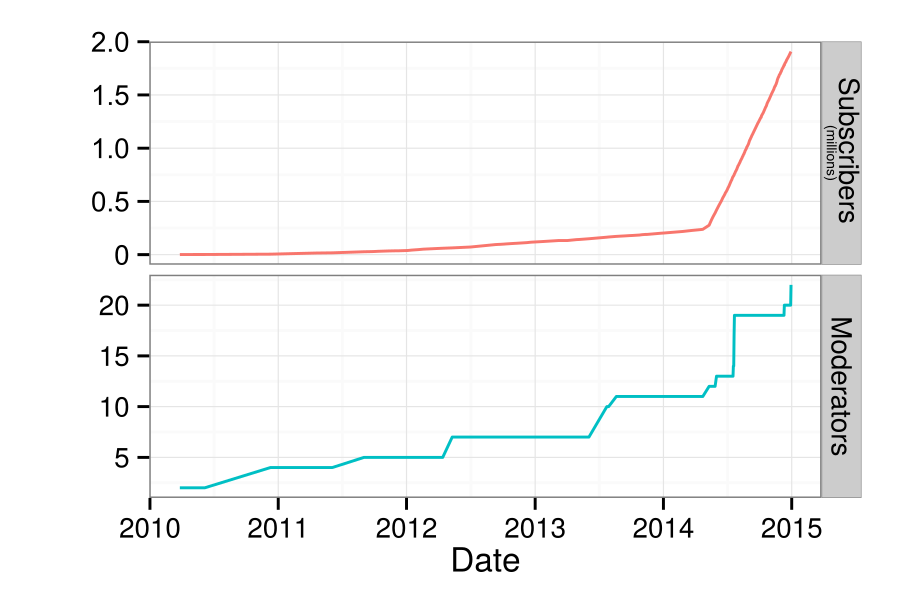
Graph of subscribers and moderators over time in /r/NoSleep. The image is taken from our 2016 CHI paper.
Last year at CHI 2016, my research group published a qualitative study examining the effects of a large influx of newcomers to the /r/nosleep online community in Reddit. Our study began with the observation that most research on sustained waves of newcomers focuses on the destructive effect of newcomers and frequently invokes Usenet s infamous Eternal September. Our qualitative study argued that the /r/nosleep community managed its surge of newcomers gracefully through strategic preparation by moderators, technological systems to reign in on norm violations, and a shared sense of protecting the community s immersive environment among participants. We are thrilled that, less a year after the publication of our study, Zhiyuan Jerry Lin and a group of researchers at Stanford have published a quantitative test of our study s findings! Lin analyzed 45 million comments and upvote patterns from 10 Reddit communities that a massive inundation of newcomers like the one we studied on /r/nosleep. Lin s group found that these communities retained their quality despite a slight dip in its initial growth period. Our team discussed doing a quantitative study like Lin s at some length and our paper ends with a lament that our findings merely reflected, propositions for testing in future work. Lin s study provides exactly such a test! Lin et al. s results suggest that our qualitative findings generalize and that sustained influx of newcomers need not doom a community to a descent into an Eternal September. Through strong moderation and the use of a voting system, the subreddits analyzed by Lin appear to retain their identities despite the surge of new users. There are always limits to research projects work quantitative and qualitative. We think the Lin s paper compliments ours beautifully, we are excited that Lin built on our work, and we re thrilled that our propositions seem to have held up! This blog post was written with Charlie Kiene. Our paper about /r/nosleep, written with Charlie Kiene and Andr s Monroy-Hern ndez, was published in the Proceedings of CHI 2016 and is released as open access. Lin s paper was published in the Proceedings of ICWSM 2017 and is also available online.

19 July 2017

Dirk Eddelbuettel: RcppAPT 0.0.4

A new version of RcppAPT -- our interface from R to the C++ library behind the awesome apt, apt-get, apt-cache, ... commands and their cache powering Debian, Ubuntu and the like -- arrived on CRAN yesterday. We added a few more functions in order to compute on the package graph. A concrete example is shown in this vignette which determines the (minimal) set of remaining Debian packages requiring a rebuild under R 3.4.* to update their .C() and .Fortran() registration code. It has been used for the binNMU request #868558. As we also added a NEWS file, its (complete) content covering all releases follows below.

Changes in version 0.0.4 (2017-07-16)
  • New function getDepends
  • New function reverseDepends
  • Added package registration code
  • Added usage examples in scripts directory
  • Added vignette, also in docs as rendered copy

Changes in version 0.0.3 (2016-12-07)
  • Added dumpPackages, showSrc

Changes in version 0.0.2 (2016-04-04)
  • Added reverseDepends, dumpPackages, showSrc

Changes in version 0.0.1 (2015-02-20)
  • Initial version with getPackages and hasPackages

A bit more information about the package is available here as well as as the GitHub repo.

This post by Dirk Eddelbuettel originated on his Thinking inside the box blog. Please report excessive re-aggregation in third-party for-profit settings.

Lars Wirzenius: Dropping Yakking from Planet Debian

A couple of people objected to having Yakking on Planet Debian, so I've removed it.

18 July 2017

Daniel Silverstone: Yay, finished my degree at last

A little while back, in June, I sat my last exam for what I hoped would be the last module in my degree. For seven years, I've been working on a degree with the Open University and have been taking advantage of the opportunity to have a somewhat self-directed course load by taking the 'Open' degree track. When asked why I bothered to do this, I guess my answer has been a little varied. In principle it's because I felt like I'd already done a year's worth of degree and didn't want it wasted, but it's also because I have been, in the dim and distant past, overlooked for jobs simply because I had no degree and thus was an easy "bin the CV". Fed up with this, I decided to commit to the Open University and thus began my journey toward 'qualification' in 2010. I started by transferring the level 1 credits from my stint at UCL back in 1998/1999 which were in a combination of basic programming in Java, some mathematics including things like RSA, and some psychology and AI courses which at the time were aiming at a degree called 'Computer Science with Cognitive Sciences'. Then I took level 2 courses, M263 (Building blocks of software), TA212 (The technology of music) and MS221 (Exploring mathematics). I really enjoyed the mathematics course and so... At level 3 I took MT365 (Graphs, networks and design), M362 (Developing concurrent distributed systems), TM351 (Data management and analysis - which I ended up hating), and finally finishing this June with TM355 (Communications technology). I received an email this evening telling me the module result for TM355 had been posted, and I logged in to find I had done well enough to be offered my degree. I could have claimed my degree 18+ months ago, but I persevered through another two courses in order to qualify for an honours degree which I have now been awarded. Since I don't particularly fancy any ceremonial awarding, I just went through the clicky clicky and accepted my qualification of 'Batchelor of Science (Honours) Open, Upper Second-class Honours (2.1)' which grants me the letters 'BSc (Hons) Open (Open)' which, knowing me, will likely never even make it onto my CV because I'm too lazy. It has been a significant effort, over the course of the past few years, to complete a degree without giving up too much of my personal commitments. In addition to earning the degree, I have worked, for six of the seven years it has taken, for Codethink doing interesting work in and around Linux systems and Trustable software. I have designed and built Git server software which is in use in some universities, and many companies, along with a good few of my F/LOSS colleagues. And I've still managed to find time to attend plays, watch films, read an average of 2 novel-length stories a week (some of which were even real books), and be a member of the Manchester Hackspace. Right now, I'm looking forward to a stress free couple of weeks, followed by an immense amount of fun at Debconf17 in Montr al!

Foteini Tsiami: Internationalization, part three

The first builds of the LTSP Manager were uploaded and ready for testing. Testing involves installing or purging the ltsp-manager package, along with its dependencies, and using its GUI to configure LTSP, create users, groups, shared folders etc. Obviously, those tasks are better done on a clean system. And the question that emerges is: how can we start from a clean state, without having to reinstall the operating system each time? My mentors pointed me to an answer for that: VirtualBox snapshots. VirtualBox is a virtualization application (others are KVM or VMware) that allows users to install an operating system like Debian in a contained environment inside their host operating system. It comes with an easy to use GUI, and supports snapshots, which are points in time where we mark the guest operating system state, and can revert to that state later on. So I started by installing Debian Stretch with the MATE desktop environment in VirtualBox, and I took a snapshot immediately after the installation. Now whenever I want to test LTSP Manager, I revert to that snapshot, and that way I have a clean system where I can properly check the installation procedure and all of its features!

Next.

Previous.