Search Results: "ean"

7 September 2010

Raphaël Hertzog: How to use multiple upstream tarballs in Debian source packages?

Since the introduction of the 3.0 (quilt) source format, it is now possible to integrate multiple upstream tarballs in Debian source packages. This article will show you how to do the same with your own package shall you need it. It s quite useful to easily integrate supplementary plugins, translations, or documentation that the upstream developers are providing in separate tarballs. Step by step explanation We ll take the spamassassin source package as an example. The upstream version is 3.3.1. The main upstream tarball is named as usual (spamassassin_3.3.1.orig.tar.gz) and contains the top directory of our source package. We already have a debian directory because the package is not new. Upstream provides spamassassin rules in a separate tarball named Mail-SpamAssassin-rules-3.3.1.r901671.tgz. We grab it, rename it to spamassassin_3.3.1.orig-pkgrules.tar.gz and put it next to the main tarball. The pkgrules part is the component name that we choose to identify the tarball, it s also the name of the directory in which it will be extracted inside the source package. For now that directory doesn t exist yet so we must create it.
$ mv Mail-SpamAssassin-rules-3.3.1.r901671.tgz spamassassin_3.3.1.orig-pkgrules.tar.gz
$ cd spamassassin-3.3.1
$ mkdir pkgrules
$ tar -C pkgrules -zxf ../spamassassin_3.3.1.orig-pkgrules.tar.gz
This is already enough, the next time that you will build the source package, the supplementary tarball will be automatically integrated in the generated source package.
$ dpkg-buildpackage -S
[...]
 dpkg-source -b spamassassin-3.3.1
dpkg-source: info: using source format  3.0 (quilt)'
dpkg-source: info: building spamassassin using existing ./spamassassin_3.3.1.orig-pkgrules.tar.gz ./spamassassin_3.3.1.orig.tar.gz
dpkg-source: info: building spamassassin in spamassassin_3.3.1-1.debian.tar.gz
dpkg-source: info: building spamassassin in spamassassin_3.3.1-1.dsc
The supplementary tarball is now part of the source package but we re not making anything useful out of it. We have to modify debian/rules (or debian/spamassin.install) to install the new files in the binary package. A special case: bundling related software In very rare cases, you might want to create a bundle of several software (small perl modules for example) and you don t have any main tarball, you only have several small tarballs. Rename all the tarballs following the same logic as above and when building the source package you can ask dpkg-source to create an empty (and fake) main archive for you with the option --create-empty-orig:
$ dpkg-buildpackage -S --source-option=--create-empty-orig
Use with care as the version number you give to the bundle is what users will see and it s likely unrelated to the version number of each individual software. Common mistakes Forgetting to extract the supplementary tarball If you forget to extract the content of the supplementary tarball in the pkgrules directory, dpkg-source will emit lots of warnings about those files being deleted. In fact, you did not delete them but you only forgot to create them in the first place.
dpkg-source: warning: ignoring deletion of directory pkgrules
dpkg-source: warning: ignoring deletion of file pkgrules/20_fake_helo_tests.cf
dpkg-source: warning: ignoring deletion of file pkgrules/60_shortcircuit.cf
[...]
Using a bad version number for the supplementary tarball Sometimes the supplementary tarball has a version of its own that does not match the upstream version. You must still name the file in a way that matches the upstream version of the main tarball otherwise it will not be picked up by dpkg-source and it will generate a new patch in debian/patches/ containing the whole new directory. It s possible to encode the version number of the supplementary tarball in the component name (in our example above we could have picked pkgrules-r901671 as component name) but this means that the name of the associated directory will regularly change and you must adapt your packaging rules to cope with this. However this last trick has the benefit of being able to update the additional tarball without bumping the upstream version. A sourceful upload of a new revision of the package will be accepted by the archive: the main tarball is ignored since it s unchanged but the supplementary tarball is taken since it s a new file for the archive (it has a different filename). Be sure to move away old versions of the additional tarball when you do that if you don t want to upload several versions of the same tarball by mistake! Misextracting the supplementary tarball dpkg-source is very smart when it extracts the supplementary tarball and you should be as well when you manually extract it. If the tarball contains only a single top-level directory, that directory is extracted, renamed to match the component name and moved in the source package directory.
If the tarball contains several top-level files or directories, then the target directory is first created and the content of the archive is directly extracted into that directory. Here are commands to install the files in both cases (we re already in the source package directory):
$ mkdir pkgrules
# Archive contains a single top-level directory
$ tar -C pkgrules --strip-components=1 -zxf ../spamassassin_3.3.1.orig-pkgrules.tar.gz
# Archive contains many top-level entries
$ tar -C pkgrules -zxf ../spamassassin_3.3.1.orig-pkgrules.tar.gz
Flattr this Share/Bookmark 2 comments Support my work

Gerfried Fuchs: flattr

I started to give flattr a try, too. It is a social micropayment site and the similarity of its name to the verb flatter is on intention. It is meant to say thanks in small amounts month by month to "things" you like. One such thing I created is my blog you can find the link to it below every entry. To be able to flattr someone one needs to create an account on the site and put money into their account. After that it's possible to follow the flattr button links. If you are reading my blog on my site and have JavaScript enabled you just have to click the flattr part of the image (not the number) to do so. If you are reading it through my feed or with JavaScript disabled you will have to click a second time on the flattr site to make the flattring happen. Another thing I've created is Debian BTS: cleaning up. I use this link in my mails to the Debian BTS for my stable RC cleanup efforts, or general proper closing of bugs that aren't getting archived. Through the help of UDD I've created me helpful overview pages of bugs that need attention for this. The third thing I've created is Package Maintenance. If you are a fan of one of the packages I maintain and want to thank me for taking proper care of it, feel free to also click this one. Please be aware that this shouldn't be seen as an Upstream appreciation if one of the projects I package for Debian uses flattr themself then you should definitely (also) consider flattring them for their own. About Upstream projects that use flattr: One of the packages I invest quite a lot of effort into started using flattr: wesnoth. They have put the flattr button on their entry page at wesnoth.org, here is the direct link to their first and general thing: The Battle for Wesnoth. Please be reminded that the things you did flattr in a previous month can again be flattred the next month. This is especially true for general purpose things like what I am using currently. Others might create things for every single blog entry, or very specific tasks, to allow people to flattr them more often in a month and get a bigger share of the cake. So keep in mind which things are general ones and consider returning to them. Enjoy!

/debian permanent link Comments: 1 Flattr this

Benjamin Mako Hill: Selectricity Source

After a semi-recent thread on debian-devel, I poked around and realized that I'd never actually gotten around to formally announcing the release of source code for Selectricity, a piece of web-based election software designed to allow for preferential decision-making and to provide "election machinery for the masses." Selectricity is useful for a range of decisions but it targets all those quick little decisions that we might want to decide preferentially but where running a vote would be overkill. Things were delayed through a drawn out set of negotiations with the MIT Technology Licensing Office over how to release the code under a free software license of my choosing. I was swamped when things finally came through. Over time, I managed to forget that I never did a formal announcement, never setup a mailing list, and never did all those things that I have tried to teach other people in the Free Software Project Management HOWTO. Code just sort of appeared on my website under the GNU Affero General Public License. It was until the debian-devel thread that I remembered I'd never made a formal announcement. Sorry about that! The git repository has been online and accessible through searches for more than a year now. Most folks who wanted the code seem to have been able to find it there. Indeed, a number of people have set up their own instances and a few have submitted patches to the code! But more visibility for the source means more empowered users, more visibility for free software, and more developers. So I've shipped all the code into a project in Gitorious (its like GitHub, except free), announced things on the Selectricity Blog, changed the Selectricity footer of to include a prominent link to the source. I've also created a mailing list. The Gitorious project page includes a wiki. I also want to mention this all here because the attention of the current development team seems mostly to have moved on to other projects. The current team seems able to keep the hosted version up and running, and even gets around to little improvements now and then, but there's definitely room for new life and new leadership. There are some nearly-complete and "complete minus further testing" features in the development tree that might provide low hanging fruit for folks interested in elections and decision-making who might want to get involved in Selectricity development. If you're interested and know (or want to learn) Rails, feel free to check out the code, introduce yourself on the list or contact team@selectricity.org to coordinate.

Biella Coleman: Ireland

This summer of 2010 has been memorable. It started with a difficult period following the hospitalization and death of my mother, a series of very intense and equally memorable conferences catapulting me out of my funk and ending with a trip to Ireland, perhaps one of my most pleasant trips ever. I have always wanted to go there, as I have some good Irish friends and I was also quite attracted to the place due to its history, so when the opportunity came for me to go, I did not hesitate to book my ticket. I was not left disappointed in any way, shape or form, although since I barely experienced the gray, misty, and rainy weather Irish is famous for, my experience may admittedly be a bit skewed. These are some of things I did and some of my fragmented thoughts about Ireland and some photos, proof that the weather was UnIrish Ireland and The Irish: Well I can t as no one can speak of The Irish as if they were some unitary group but I did learn a lot about Irish history and managed hang out with a number Irish folks (even a family) and one thing that seems to mark Ireland as distinct, what makes it stand out from the rest of its Western European brothers and sisters, is the pervasive sense of history bleeding into the ambiance, perhaps because it is so tragic. The short version of the history, if you don t know it, is that the Irish, especially the Catholics, got repeatedly screwed by the British monarchs/rulers/planters/government/ for nearly a thousand years, the last five hundred of those being particularly harsh and ugly, a cycle of slight gains crushed by various forms of tyranny and violence at least until part of the country achieved independence (Northern Ireland is a bit of a different story). I may have gone a bit out of my way to learn about Irish history, more than I have done for any other place, but this historical consciousness seemed to be inescapable, precipitating into all sorts of conversations and places. To take one example, I went to see Gaelic Football, one of the two beloved national sports (the other being hurling), and the minute you learn anything about this sport, you learn that it is intimately bound with the Irish fight for independence and nationalism. The Irish are also very warm, kind, and outgoing. They also seem to curse an awful lot as well, so much so cursing is a bit of a national pastime, which yes, I (f*cking) loved as I tend to have a bit of a foul mouth myself, curbed I will admit, in recent years and in the classroom. It crept up in a lot of places but was most pronounced during the All Ireland Semi-Final Gaelic football game when the ladies (not lads, mind you) behind me were constantly yelling at the referee, hurling the c-word (rhymes with trunk) whenever they made a call they disagreed with. EASA/Maynooth.: I went to Ireland to attend the largest Anthropological meetings in Europe, and in specific an all day panel on digital anthropology, which seemed like a great opportunity given we are a a bit of a minority. The conference was impressively large with roughly 1200 attendees (can you believe there are that many anthropologists?), smoothly run, and the all-day panel on digital media was quite lively and I got to meet some really interesting folks. I was a tad sad to find out Maynooth is the only university in Ireland with an Anthropology department (for crying shame lads!!!) but at least it is located in a darn stunning university: the old quarters of the campus are strikingly beautiful. Anonymous: I have done some work on Anonymous and well when I found out there was going to be a raid/protest at the Church of Scientology (a pretty dismal, and run down church), I got in contact with Irish anon to let them know I was coming. Although someone first decapitated me (at least in character with their norms, right?), when I showed up in person, they were not only civil but really quite hospitable (greeting me with one of my favorite songs). Overall it was a great day. I was reminded of important differences among Anons (Irish Anon s take their anonymity pretty seriously, the New York Anons do not) and also good to experience the social life and metabolism of a protest, especially one attended by folks who have lost family to the church. Dublin: Since I stayed with my friend and his family in Dublin, this is where I spent most of my time. I was able to hook up with various friends, including one from graduate school who just got back from years of fieldwork in Rwanda and hearing about his experiences and stunning but stunningly sad project made me feel like mine in comparison was Child s Play (in fact, it really was). I got to see the Debian crew (many who work at Google) and I finally paid a visit to the office, which was exactly how I imagined it to be (good and abundant food, good lighting, lots of toys and bikes, lots of Star Wars posters.. Yep, it could have been in Silicon Valley). But I was surprised at the young age of the marketing and sales folks who were hanging in their lounge when I ran into them. In fact when I saw them I thought like I was looking at my freshman class or something! It was great to see the Debian folks (though no one I met was actually Irish), as well, one of my favorite things to do whenever I visit a foreign city. I walked my heart out in the city getting a blister in a shoe that I thought was blister proof and while not as picturesque as some other European cities, it has a ton of character and no shortage of Guinness and pubs (no surprise there). My favorite places/things were: The National Library (great exhibit on Yeats, but make sure to use the multi-media as that is where all the information is stuffed), St. Stephen s Park (overflowing with chubby ducks and lovely flowers), the prison Kilmainham Gaol (would not advise a visit if you are feeling in any way down, there is some heavy shit you learn during the tour), the simple stained glass that seemed pretty common, and finally the Long Room in Trinity Church, which you enter after the Book of Kells (I realized just how much I adore books when I visited this old library stuffed from floor to ceiling with old old old books). The West Coast: I did not think I was going to head out west but after hurricane Earl started its burst along the eastern Seaboard and I was able to change my ticket for free so I stayed a few more days. I went to the Burren and the Cliffs of Moher both totally stunning, really majestic. As is often the case with these type of these natural wonders, I am often left elated and awed but such strikingly wondrous places also seem to subsequently spur a more melancholic state of mind and heart. Friends, Family, and Dogs: While in Dublin I stayed with my friend A. and his extremely hospitable family, which included, a brother, a father, and three Irish mutts, one of which, Buster (pitt bull/lab mix), pretty much stole my heart. Buster s true love, is food, so much so he almost poised himself to death a little while back snorting down something he shouldn t have costing the family a pretty penny to save him. My friend no longer lives there but came from Berlin and it was a real treat to not only spend days layered upon each other with a friend (it has been an awful long since I have done that outside of conferences) but also meet his family. You learn a lot about your friends that way and in this case, there is some serious and I mean serious intellectual jousting that happens, sometimes bordering on warfare but generally it plays out in more contained, civil and fascinating fashion. Now I understand why my friend is armed with seemingly endless knowledge: it was needed for purposes of defense at home. So in essence, a great, great trip and a fantastic way to end a memorable summer and transition into what I hope will be a bit of a monkish (I call it monk mode) period for this academic year. I am (so so so) fortunate enough to have a fellowship at the Institute for Advanced Study and am going to try my darnest to take advantage of the fact I am not teaching (Hell Yes!) and hide away and accomplish all that I have set out to do.

6 September 2010

Joey Hess: freedombox for a solar powered house

I'm swinging on the front porch shade, with happy wifi bars lit up on my laptop. A good network makes for a happy home, isn't that how the saying goes? (Maybe not yet.) Typically that's easy to achieve -- here it wasn't. The house is solar powered, the only connection to the outside is a phone line. So I needed a computer that would work in that environment, using minimal (12 volt) power, and getting the most out of the limited bandwidth while providing those happy wifi bars. At DebConf we learned that the name for these little home servers we have been building for years is "FreeDomBox". All right then, here's my latest FreedomBox build.
A typical inexplicable tangle of computer bits.
Since the solar house is in the sticks, the result is a server I call "stick".

Craig Small: psmisc 22.13, gjay 0.3.1-2 and son 2.0

Debian OpenLogo

Image via Wikipedia

Two updates for Debian today.

I'm the upstream for psmisc and 22.13 finally got released, which also meant 22.13-1 Debian package got released too. There was some delay to it (see below why) but it is now out. Unless you run a mips or superH architecture, there is not really any exciting changes, but should make it compile for those two architectures and then at least get the mips buildd underway so the versions all line up.

Secondly, gjay had two minor bug fixes and was updated. If the analysis daemon kept playing music instead of looking at it or the vorbis files were not being recognised, then this new version will help there. The mpg123 command line patch will be rolled into the upstream too.

I'm also working on getting gjay to work with the Exaile player. If you want it to work with your player the easiest thing is to send me patches or code snippets that do the following:
Last of all, my second son was born last week. It's back to those night feeds again and is probably why I've not written as much code as I normally would; but I wouldn't change that either.


<script defer="defer" src="http://static.zemanta.com/readside/loader.js" type="text/javascript"></script>

5 September 2010

Andrew McMillan: I guess I should have known better

Really, I should have known better than to buy myself a rather 'bleeding-edge' laptop. I suppose I've been lucky with my last couple of laptops and was thinking that pretty much everything works on Linux. Or maybe I'm being picky, because in fact pretty much everything does work on my new Dell Studio. I bought this laptop mainly because it has a 1920x1080 screen, without being a 17" monster. I had such a monster about four laptops ago (an enormous Sony Vaio weighing in at around 5kg and with a 1hr battery life) and it was an disaster: lots of weird proprietary stuff that never worked, like the external speakers in the docking station. But I loved that screen right up until the day Fraser threw a pair of scissors into it. With the advent of mass-market 1920x1080 screens I've been waiting for them to arrive in laptops at a reasonable price, and the availability of this screen in a few possible laptops seemed to me to be that point. It's a Dell Studio 15, and as well as the nice screen, it comes with a new Intel i7 Quad Core CPU, 6G RAM, 640G hard drive and a Blu-ray drive. While there are a few similar models around this one seemed to have the best mix of features-for-weight-and-price, so I bought my first Dell. I built a USB key with the latest Debian Installer from Squeeze and installed that and everything came up pretty well. I had to use the broadcom-sta driver for the wireless, since the BCM 43224 is not (yet) supported by the free b43 driver (though from looking the mailing list people seem to be working on it, and it looks like it might not be too far away). Everything seemed good. X came up on the (georgeous) screen. I don't care too much about 3D performance, but it was nice to note that the ATI 5000 series is expected to have full support as soon as it's integrated into the right places - it seems the code is written, and public, it just isn't incorporated into the 'radeon' driver quite yet. The fact that ATI is nowadays a free-software friendly company was one of the reasons for choosing this, in preference to an NVidia-based laptop. But it seems that it isn't all roses. The fan in the laptop seems permanently on, and not on, in a quiet-just-barely-audible way, but ON, in an 'IN UR LAPTOPZ KOOLIN UR P0RCESSAZ' kind of a way. Too damn noisy for me to concentrate in a quiet room. I've investigated what's going on, and it seems likely there are some ACPI misunderstandings happening. Some googling and some pecking around in /sys makes me wonder if the laptop expects some kind of configuration choice between favouring Active cooling and Passive cooling, and it's defaulted to the first one. Perhaps you get better benchmarks that way. Linux ACPI also seems to only half understand it, it has two thermal zones, and one of them always appears with 0 temperature. I can see set points for the fans, but have no control over them. In particular this got me out reading the ACPI 4.0 specification, and it explicitly mentions this choice of favouring 'Active' vs 'Passive' as being done by configuring the passive trip point setting to a higher value than the low & high active trip points. In the ACPI 4 spec (page 409) it says:
To implement a preference towards performance or energy conservation,
OSPM can request that the platform change the priority of active cooling
(performance) versus passive cooling (energy conservation/silence) by evaluating
the _SCP (Set Cooling Policy) object for the thermal zone or a corresponding
OS-specific interface to individual devices within a thermal zone.
This laptop is showing 'passive' at 95000 millidegrees celsius, and 'active' at 55000 / 75000 so right in line with the suggestion. However I don't see any way in Linux to change these trip point values, and in any case I'm not convinced the laptop is actually obeying them at all. It should be that if I do nothing on the laptop for a while the temperature would surely drop below 55 degrees celsius. Surely a modern laptop will sit at under 40 degrees when it's quiescent, and the temperature sensor that does show me something sits at around 30 degrees in this too, 26.8, to be overprecise. That one doesn't budge either. Looking in /sys/ I can't for the life of me find a way to set that cooling policy, and when I disassemble the DSDT it looks like a noop... Thinking that perhaps there was a newer BIOS, I looked at the Dell site and found there was one. Great! Investigating even further, it seems Dell hardware has some interesting capability via libsmbios and some utilities which will let me install my BIOS from a Linux system... even better! Linux is a second-class citizen though, and when I look for the Dell BIOS Hdr file I need there is no version of the file for this laptop - let alone the current BIOS version. And when I download the BIOS from Dell's website and unzip the first layer of packaging I find that both of the files inside will only run on Windows. I added a FreeDOS boot stanza to Grub 2 in order to discover this, also discovering in the process that this is not well explained, and I could not find how to do it on the FreeDOS or Grub2 websites, so in passing, here is what I added into /etc/grub/40_custom :
menuentry 'BIOS Flash 1558 A09' --class os  
        set root='(hd0,msdos1)'
        linux16 /boot/memdisk
        initrd16  /boot/1558_A09.img
 
Which certainly does boot FreeDOS from Grub2, into the image built from the 8M FreeDOS base image, and which I called '1558_A09.img' because that seems to be one of Dell's reference numbers for this model / BIOS version. So still no BIOS update for Andrew, it seems, and the laptop is probably going to continue to be noisy for some time. Possibly forever. Suspend/Resume works though. Kernel mode-setting for the ATI Radeon Mobility HD 5450 (or whatever it is) seems to work. Building kernels seems to work. The Blu-ray drive seems to work, at least as far as reading CDs - just because I got a laptop with a "Full HD" screen doesn't mean I watch movies on it: those pixels are for programming on! In any case, after reading the literature of pain about playing Blu-ray disks on Linux I'm convinced that we won't be shelling out to buy one any any time soon. After a bit more frustration I did manage to get the BIOS installed, using the hack I found here of running the Windows BIOS update under Wine and copying the BIOS file out of the temp directory while the error message is displayed. I could then download a random DOS-installable Phoenix BIOS to get copy of phlash16.exe and put those two files on the FreeDOS image I created earlier. Finally I was able to put that learning about how to boot FreeDOS from Grub2 to good use! Unfortunately, having jumped through all of those hoops (including the frustration of trying to build and use Dell's firmware-extract tools on a Debian system), the fan continues to grind away at annoying volume, with no way that I have been able to find to control it, and the temperature sensors also seem wrong, since one doesn't budge from 0 and the other doesn't budge from 26800. During boot I get a bunch of error messages, like:
[    1.049936] \_SB_.PCI0:_OSC invalid UUID
[    1.052202] pci 0000:00:1c.0: PME# supported from D0 D3hot D3cold
[    1.052210] pci 0000:00:1c.0: PME# disabled
[    1.065228] pci 0000:07:00.2: PME# supported from D0 D1 D2 D3hot D3cold
[    1.065237] pci 0000:07:00.2: PME# disabled
[    1.079086] Unable to assume PCIe control: Disabling ASPM
[    1.086412] HEST: Table is not found!
[    1.249906] ACPI: Fan [FAN0] (off)
[    1.249959] ACPI: Fan [FAN1] (off)
[    1.250093] [Firmware Bug]: ACPI: ACPI brightness control misses _BQC function
[    1.259118] acpi device:02: registered as cooling_device2
[    1.262132] thermal LNXTHERM:01: registered as thermal_zone0
[    1.262139] ACPI: Thermal Zone [TZ00] (27 C)
[    1.262561] thermal LNXTHERM:02: registered as thermal_zone1
[    1.262571] ACPI: Thermal Zone [TZ01] (0 C)
[    1.262598] ERST: Table is not found!
[    2.769664] i801_smbus 0000:00:1f.3: PCI INT C -> GSI 18 (level, low) -> IRQ 18
[    2.769670] ACPI: resource 0000:00:1f.3 [io  0x1840-0x185f] conflicts with ACPI
                         region SMBI [bus 1840-184f pref window disabled]
[    2.769672] ACPI: If an ACPI driver is available for this device, you should use it
                         instead of the native driver
I don't yet know what this all means, so I guess I'll be signing up for the linux-acpi mailing list to see if there's anything I can do to get things working better. Any pointers will be gratefully received :-) Right about now I wonder if maybe I should have gone for the HP or the Asus, even if they were a little heavier and a bit more expensive and next time I get a new laptop I must remember not to spend more than $900 (USD$600) on it. [Updated: 2010-09-08... Noise Problems Solved

3 September 2010

Richard Darst: DebConf Fundraising

The following post is the work of Pablo Duboue, the DebConf10 fundraising team leader.So you want to make DebConf, eh? You will need quite a bit of money then. That's when fundraising comes into play.There are traditionally two sources for funds for DebConf: government and businesses. A third one, micro-donors, has been mentioned, but haven't been explored yet. (Note, in this text I use the terms sponsors and donors interchangeably, as all sponsors are actually doing a donation to the Debian project earmarked for the use at a given DebConf.)Government funding has been key in a number of DebConfs. In DC10, though, by the time fundraising proper started, it was too late to secure it. Extrapolating from two DebConfs that had government funding, I would venture the following two pieces of advice: target a government level as local as possible (city, provincial level) and try to secure the funding at the time of the bid (which, by the way, can help you win the bid). A successful process will include government representatives aware of the bid status and the whole bidding process. This partnership can help unlock extra government resources such as housing or transportation. But to reiterate, if you haven't at least applied for government grants by the time the DebConf previous to yours is happening, then you have to plan to go along without government funding.Business funding for DebConf includes a significant amount of recurring donors. Keeping them happy is even more important than any money they will put forward for a given DebConf. Now, because of the high level of recurrence and the fact that government funding can cover easily one third of our costs, fundraising without government funding really means your projected funds are one third off. If that is the case, make sure to communicate that to the rest of debconf-team and even the larger Debian community (see below "asking for help").This entry has been truncated read the full entry.

2 September 2010

Russell Coker: Raw Satire Usually Fails on the Internet

Sarcasm and satire usually don t work on the Internet. One cause of this is the lack of out of band signalling via facial expression or tone of voice. Another issue is the fact that in real life people usually know something about the person who they listen to while on the Internet it s most common to read articles without knowing much about the author. So the reader can t use I know that the author isn t an asshole as a starting point to determine whether a message should be interpreted literally. This is really nothing new. The standard in printed communication for a long time has been to use Emoticons (Wikipedia) to indicate emotion and other interpretation that might not be deduced from a direct reading of the text. The Wikipedia page cites examples of emoticon use dating back to 1857 although the combinations of characters used for different emotions has changed significantly many times. The common uses that we now know on the Internet date back to 1982. In my experience the symbol :-# is commonly used to note sarcasm or satire. Unfortunately it seems that none of the Internet search engines allow searching for such strings so I couldn t find an early example of this being used. While I haven t found a reference describing this practice, I regularly receive messages annotated with it and find that people generally understand what I mean when I use it in my own email. But that is usually applied to a sentence or two. For a larger section of text a pseudo-HTML tag such as </satire> can be used to signal the end of satire. It seems that a matching start tag is optional as recognising the start of satire is a lot easier once the reader knows that some of the content is satirical. In spoken English a phrase such as but seriously may be used for the same purpose, but such a subtle signal may be missed on the Internet particularly by readers who don t use English as their first language. Another way of signaling a non-literal interpretation is by using Scare Quotes the deliberate usage of quotation symbols to indicate that the writer disagrees with the content that is written. That is common for the case of referencing a phrase or sentence that you disagree with, but doesn t work for a larger section of text. A final option is to make the satire or sarcasm so extreme that no-one can possibly mistake it for being literal. This is not always possible, Poe s Law holds that Without a winking smiley or other blatant display of humor, it is impossible to create a parody of Fundamentalism that SOMEONE won t mistake for the real thing [1]. I think that Poe was understating the case, it is impossible to create a parody of religion that most people won t mistake for the real thing without signals or context. For an example read LandOverBaptist.org and Chick.com, of course if you know those sites then you will know whether they are satirical or serious but I expect that most readers of my blog won t invest enough effort into either of those religious sites to determine whether they are serious or satire. But satire and sarcasm without signals or a reputation usually fails. One example of success is The Onion which is a long running and well known satirical news site [2]. But even The Onion it is regularly mistaken for being serious the number of occasions when people forward me Onion articles for amusement are vastly outnumbered by the number of occasions when I see people taking it seriously. Even when material is known to be satirical it can still fail grossly. An example is the Chaser s satire of the Make A Wish Foundation [3]. Even material that is well known to be satirical seems to fail when it attacks bad targets or attacks in a bad way. One difficulty is in satirising bigoted people, to effectively satirise them without attacking the minority groups that they dislike can be a difficult challenge. Finally, when you write some satire and members of your audience don t recognise it you should consider the possibility that you failed to do it properly. If you can t get a hit rate close to 100% for people with the same background as you then it s probably a serious failure.

1 September 2010

Gunnar Wolf: Cycling, cycling everywhere!

I have been wanting to post for several days already, at least since this last Sunday. I have repeatedly bragged about taking part in the Ciclot n: The last Sunday every month, the city's government closes to automotive transit a ~33Km circuit, for cyclists to enjoy. And by cyclists, I mean people from all expertise ranges Well, the very elite bikers will not take part of such a massive thing, but there are people pedalling a couple of blocks, people taking their small kids to drive a bit, and I recognized an amazingly large proportion of people doing the whole route. Well, this last Sunday one lap was not enough for me I did two laps, ~65Km. (oh, and just for keeping the complaint current: After all, SportsTracker did release a version of thier software for the N95... But it requires Flash for using the webpage at all. I have several pointers at other applications... but am time-starved right now to start reviewing :-/ ) Anyway, I decided to do this double ciclot n in order to train for next week. If you are anywhere near Mexico City, you are invited - this is meant to be a large group ride, and looks very fun! Doble Marat n Ciclista Urbano del Bicentenario We are two weeks away from the 200 year conmemoration of the beginning of the Independence War in Mexico. A group of cyclists came up with the idea to organize a Double Marathon to celebrate! 84Km of biking in Mexico City: For some reason, the distance numbers in that map were made... in miles :-P Anyway, the planned route will be:
  1. Jardin de los periodistas ilustres (Delegaci n Venustiano Carranza)
  2. Aeropuerto Internacional de la Ciudad de M xico
  3. Circuito Bicentenario ( antes circuito interior )
  4. Monumento a La Raza - Hospital La Raza
  5. R o San Joaquin
  6. Viaducto Bicentenario ( carril confinado sin interrumpir la circulacion )
  7. Torres de Sat lite 50 aniversario
  8. Presidencia municipal de Tlalnepantla
  9. Presidencia municipal de Naucalpan
  10. Anillo Periferico Sur
  11. Secretar a de la Defensa
  12. Bosque de Chapultepec 1 y 2 secci n
  13. Segundo Piso del Distrito Federal
  14. Ciudad Universitaria patrimonio cultural de la humanidad
  15. Insurgentes Sur
  16. Miguel ngel de Quevedo
  17. Calzada de Tlapan
  18. Z calo centro historico del distrito federal
  19. Calle 16 de septiembre fin del recorrido
It looks very fun. Besides, although it is not that flat, it is one of the flattest long distance routes you will ever have. The toughest part will be IMO the Northern part of Circuito Bicentenario and possibly some bits of Perif rico towards Naucalpan. Then, a long flat stretch, with one long but not steep way up in Segundo Piso (near Las Flores), and a little stretch towards Ciudad Universitaria. Other than that, it looks very doable if you are in a moderately decent condition. And taking part in such a thing is very very worthy! As a final note... This same Sunday, it has been somewhat publicized the first D a Nacional de la Bicicleta (Bycicling National Day) will be held all over the country, kickstarting the National Cycling Crusade. Sounds nice, right? Even impressive? Yeah, but... If you look at the published information (in the page I just linked), you will see several cities are opening cyclist circuits. For one day only, which means, it does not build awareness among the population on how easy, how convenient and how fun it is to use the bicycle as means of transportation. And not only that The cyclist routes clearly make a point that cycling is a good way, at most, to have fun... But not a general habit we should all embrace. Lets see, as an example, the distances offered (only for the cities quoting route length): ...And so it goes. As you can see, several very important cities (i.e. Monterrey, Chilpancingo, Cuernavaca) put only a 2km route. 2Km by bike is... Nothing. 2Km is done at a leisurely pace in less than 15 minutes (I often sustain 20Km/h, which would mean 2Km in 6 minutes). And, in this short sample (the linked page has the information for several other states, but the pattern holds), most states are only making this in the largest city or two, completely forgetting the bulk of their territories. In my opinion, this "effort" was done backwardsly, and ends up delivering the exact opposite message to what should be done.

Russ Allbery: git-pbuilder 1.16

Getting the git-pbuilder script included in git-buildpackage has significantly increased the usage, which means lots more people finding new features and facilities that they need. I love that part of free software work. Here's a new version with a few new facilities. Since the previous release announcement (for 1.13), this adds: You can get the latest version from my scripts distribution page.

Sylvain Le Gall: OCaml 3.12 with Debian Sid right now!

Some careful readers of Planet OCamlCore should wonder why the OCaml packages in Debian has not yet been upgraded to 3.12.0. For the Planet Debian readers, this is the latest version of the Objective Caml programming language. The answer is simple: Debian Squeeze froze on 6th August. This means that Debian folks focus on fixing release critical bugs and avoid doing big transitions in unstable (Sid). In particular, the Debian OCaml maintainers has decided to keep OCaml 3.11.2 for Squeeze, because the delay was really too short: OCaml 3.12 was out on 2nd August. A great work has already been done by S. Glondu and the rest of the Debian OCaml maintainers to spot possible problems. The result was a series of bugs submitted to the Debian BTS. This effort has started quite early and have been updated with various OCaml release candidates. S. Glondu has also built an unofficial Debian repository of OCaml 3.12.0 packages here. Let's use it to experiment with OCaml 3.12.0. schroot setup Following my last post about schroot and CentOS, we will use a schroot to isolate our installation of unofficial OCaml 3.12.0 packages. approx approx is a debian caching proxy server for Debian archive files. It is very effective and simple to setup. It is already on my server (Debian Lenny, approx v3.3.0). I just have to add a single line to create a proxy for ocaml 3.12 packages:
 $ echo "ocaml-312   http://ocaml.debian.net/debian/ocaml-3.12.0" >> /etc/approx/approx.conf
 $ invoke-rc.d approx restart
approx is written in OCaml, if you want to know how I come to it. debootstrap and schroot We create a chroot environment with Debian Sid:
# PROXY = host where approx is installed, debian/ points to official Debian repository of 
# your choice. 
$ debootstrap sid sid-amd64-ocaml312 http://PROXY:9999/debian
We create a section for sid-amd64-ocaml312 in /etc/schroot/schroot.conf (Debian Lenny):
[sid-amd64-ocaml312]
description=Debian sid/amd64 with OCaml 3.12.0
type=directory
location=/srv/chroot/sid-amd64-ocaml312
priority=3
users=XXX
root-groups=root
run-setup-scripts=true
run-exec-scripts=true
Replace XXX by your login. And we install additional softwares:
 $ schroot -c sid-amd64-ocaml312 apt-get update
 $ schroot -c sid-amd64-ocaml312 apt-get install vim-nox sudo
OCaml 3.12 packages Now we can start the setup to access OCaml 3.12.0 packages. The repository is signed by S. Glondu GPG key (see here). We need to get it and inject it into apt:
$ gpg --recv-key 49881AD3 
gpg: requ te de la cl  49881AD3 du serveur hkp keys.gnupg.net
gpg: cl  49881AD3:   St phane Glondu <steph@glondu.net>   n'a pas chang 
gpg:        Quantit  totale trait e: 1
gpg:                      inchang e: 1
$ gpg -a --export 49881AD3 > glondu.gpg
$ schroot -c sid-amd64-ocaml312 apt-key add glondu.gpg
The following part is done in the schroot:
$ schroot -c sid-amd64-ocaml312
# PROXY = host where approx is installed
(sid-amd64-ocaml312)$ echo "deb http://PROXY:9999/ocaml-312 sid main" >> /etc/apt/sources.list
(sid-amd64-ocaml312)$ cat <<EOF >> /etc/apt/preferences
Package: *
Pin: release l=ocaml
Pin-Priority: 1001
EOF
(sid-amd64-ocaml312)$ apt-get update 
...
(sid-amd64-ocaml312)$ apt-cache policy ocaml
  Install : (aucun)
  Candidat : 3.12.0-1~38
 Table de version :
     3.12.0-1~38 0
       1001 http://atto/ocaml-312/ sid/main amd64 Packages
     3.11.2-1 0
        500 http://atto/debian/ sid/main amd64 Packages
(sid-amd64-ocaml312)$ apt-get install ocaml-nox libtype-conv-camlp4-dev libounit-ocaml-dev...
That's it. The apt-policy command shows that OCaml 3.12 for the ocaml-312 repository has an higher priority for installation. Good luck playing with OCaml 3.12.0.

Cyril Brulebois: SD: Travel with your bugs

(For Those Who Care About An Introduction: Christine Spang gave a talk during DebConf10 about Simple Defects (SD), and blogged about it later on.) Folks maintaining Debian packages are already able to partially-clone bugs.debian.org s bug database thanks to the local-debbugs tool. But what about upstream s bug tracker? Taking a (shamelessly self-centered) example: X.Org packages are hosted on FreeDesktop.org s bugzilla. Thanks to SD, it s possible to fetch bugs from there as well! Here s the obligatory picture: SD example This means that you can browse/search them locally while being offline (or well-connected, but without having to use that !$\ %$^ bugzilla web interface). Many of the replica types support both reading and writing, meaning you can also queue some changes locally, and push them later. Currently, sd help sync says that read-write support is available for RT, Hiveminder, Trac, Google Code, and GitHub. There s also read-only support for redmine. Debbugs is being worked on, see Christine s blog post about her SD talk for more info. Given there was no support for bugzilla, I had a quick look and reported my findings. The main point being: \o/ Bugzilla s XMLRPC \o/ A little while later (I m not exactly fluent in Perl ), I came up with a tentatively-mergeable branch adding preliminary read-only support for bugzilla. There s still a lot of work, but I m trying to work on it on a regular basis, adding support for more properties, and fixing bugs (tests should be written some day, too). Flattr this!

31 August 2010

John Goerzen: Life snippets

#1: Dreams of a (almost) 4-year-old Yesterday, Terah had something going on in the evening, so it was just Jacob, Oliver, and me. Due to how the logistics worked out, she brought them to the office after work and I took them from there. We went to the post office, pharmacy, and a restaurant. Jacob and I had this conversation at the pharmacy. Jacob: Ooo! We are at the Goessel pharmacy! *claps happily* Me: Hmmm Actually Goessel doesn t have a pharmacy. This is the Hesston pharmacy. Jacob: *gets a serious look on his face* Dad, actually Goessel has a pharmacy . Look! A fire station! Me: That s right. And what can you see inside it? Jacob: FIRE TRUCKS! They are all still. Me: I guess there isn t a fire. Jacob: I think the Goessel pharmacy is on fire! Shall they go there now? Me: I hope it s not on fire. (what are you going to say to that?) Were you wanting to see a fire? Jacob: YEAH! I think it IS on fire. Shall we go see? So now he has an imaginary pharmacy with an imaginary fire and he wants to go see. Fortunately he was OK with just going inside Hesston Pharmacy instead. #2: The Songs on a Ceiling I read a book and sing a song to Jacob for bedtime every night. Over the weekends, sometimes I do that for him at nap time too. This weekend, he wanted us both to get on his bed, lie on our backs, and look at the imaginary songs on his ceiling. He gave me a whole tour, pointing to various (to me, nondescript) parts of the ceiling as he did so. Over there is a song about railroad tracks. There is one about trains. That train is upside down. That other one is stuck. There is a song about Word World. There is a song about preschool. There are the train tracks. There is a train on them. It might bump into the other train. Shall you sing a song about two trains on the tracks and they bump into the other train and go BLAM? He appeared to have a whole map in his head of his songs. The train songs were all at a specific place on the ceiling. #3: Younger Brother Oliver has really been changing lately. He occasionally will take a few steps by himself, and he has started to say a few parts of words. He communicates really well, though, especially with things he wants. He has a deep, vigorous nod to say yes, and sometimes it s accompanied by yesh for extra emphasis. His face is incredibly expressive too, and he has a distinctive Yoda-like expression at times. I almost expect to hear him say one day, Like that green bean I do not. Watermelon better is. Jacob, of course, is a lot bigger and sometimes is rough with Oliver. But they also have started to play together. Sometimes Jacob will put his head by Oliver s face. Oliver will grab fistfuls of Jacob s hair in both hands and pull. Both of them apparently find this hilarious and laugh on and on about it. #4: Viruses and Stomachs Sunday Jacob was complaining of a stomach ache. We were driving home, and shortly after we got home, he vomited on the driveway. Jacob really doesn t like throwing up. It s unpleasant and maybe a bit scary for him. He was about to start crying after vomiting, except One of our cats was hanging around. Claire came over, sniffed Jacob s vomit, and started eating it. Jacob was so fascinated by what was happening that he stopped sniffling and stood there staring at the cat, then gave an excited report of events to Terah and me. That evening, he was afraid he would throw up in bed. So we had a large bowl he held *directly* under his chin during story time. But then he didn t want to lie down, since he was afraid he d throw up in bed. Terah pointed out that he could have the bowl close while he slept. I went up and checked up on him an hour or two later, and he was sound asleep, face in the large bowl. #5: The Jukebox After the pharmacy, Jacob saw Skoops, a local 50s greasy spoon diner place across the street. He really wanted to eat there and get the birthday cake ice cream flavor. So we did. He was jabbering about getting a corn dog as we walked over, so that s what he had to eat. I don t know how he knew Skoops had them, as I don t think he s ever had a corn dog. Oh well. There s a jukebox inside Skoops, and every fifteen minutes or so, it ll spring to life and play a random song even if nobody put coins in it. This was very exciting for Oliver. He d twist all around in his highchair to watch it. And, most amusingly, he d start bopping his head. Not really in time with the music or anything, but it was cute to watch. Sometimes he d get really excited and pretty much his whole body was dancing. Well, as much dancing as you can do when you re 1 and strapped into a high chair, at any rate. One time, he heard the music, started dancing , and looked at me expectantly. So I started nodding in time with the music, and then Jacob saw us both and started sort of flailing about, somewhat in time with the music. All three of us wound up laughing after that.

Jordi Mallach: De mar a mar, hiking across the Pyrenees

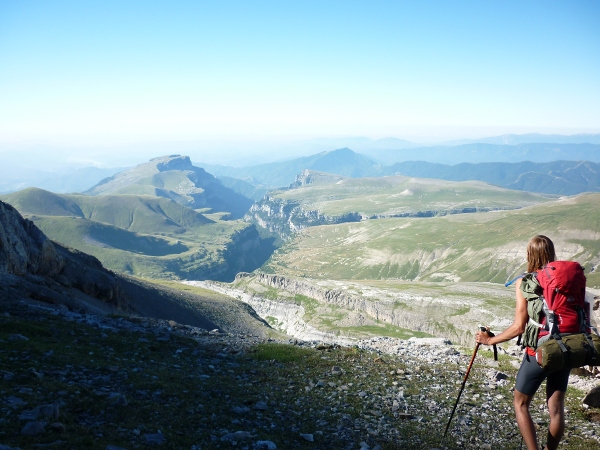
Two weeks ago, Maria and I completed one of our dreams when we arrived in Cap de Creus, where the Pyrenean range sinks in the Mediterranean. To get there, we walked hundreds of kilometres during a month, crossed dozens of steep valleys and enjoyed one of the richest experiences of our lives.
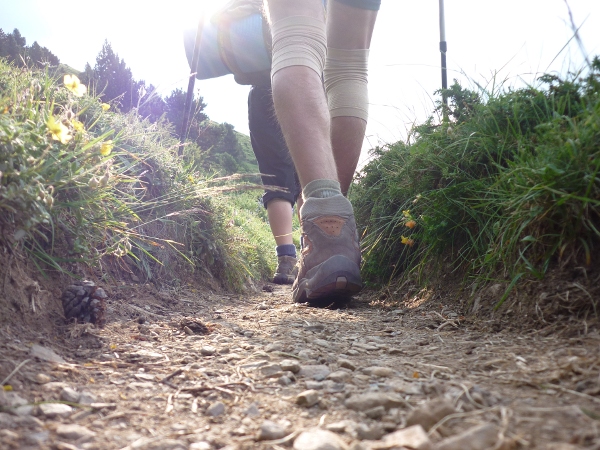
We managed to complete this challenge without facing major problems or pains, and after the first five our six days, our legs seemed to have gotten used to the daily effort and it started to be easier and easier. Our morale kept growing as days passed and we advanced east. When I started walking on a cold and rainy morning in Hondarribia, after barely no rest in the night bus to Ir n, I thought for myself that it was improbable that we'd manage to get anywhere near Catalunya, that one of us would get injuried way before, or we'd just give up and go for the easy beach vacation in the Basque Country.
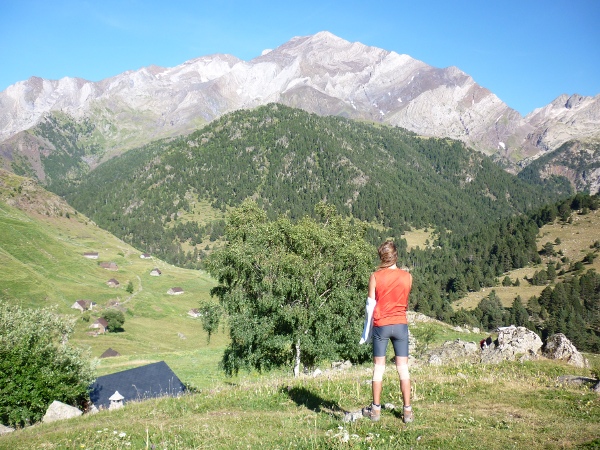

Biad s refuge, under Posets But we didn't, and after a somewhat painful start, with our boots soaking wet during the stages that crossed the enchanting Selva de Irati which ended up with me getting the biggest blister I've ever seen, we started to walk farther every day, extending the stages when we felt strong after reaching their official end. When we crossed from Nafarroa to Aragonese territory, the mental wall that I had built over the toughest stages in our quest started to fall apart. Days later, we found ourselves climbing down to Pineta, leaving Ordesa behind and enjoying a feeling that our adventure could not go better. The weather had been perfect for over a week and our legs and back were strong to go all over the way to the sea.


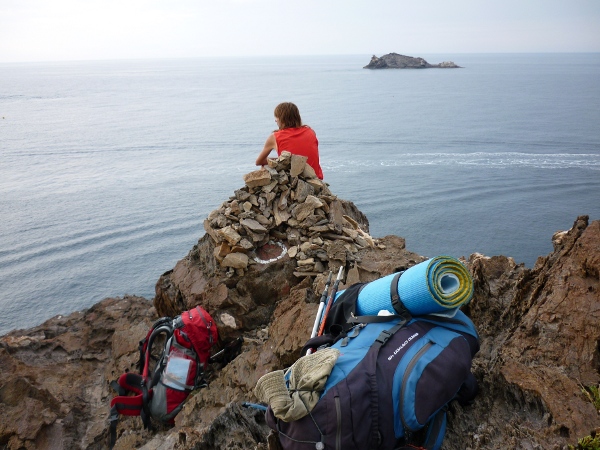
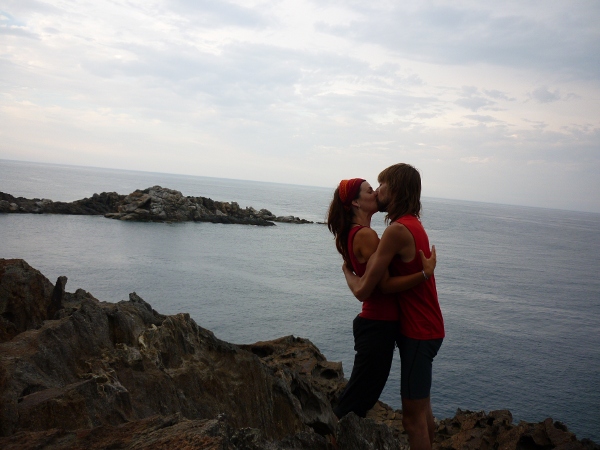
Ca n de A isclo, on our way to Pineta When we finally saw that huge blue stain on the horizon, the day before getting to the last mark, we got really excited. We had made it, but as we walked towards the cape, happiness slowly got mixed with melancholy. An unforgettable adventure was about to end, and we didn't want to face our return to the city and our routines. It had been many days surrounded only by awesome landscapes, and living without watches, with only sunlight and weariness marking the time to get in our sleeping bags.


At the very last red and white mark of our journey We've had plenty of time to meet great people. Starting with the Navarrian brothers we met in the early stage, which provided us with a good pace to follow while our leg muscles were still building up; or Kike and Ana, who drove from Pamplona to visit us during the first Aragonese stages (thanks for the supplies!). Tom s and Roger, young hikers from Matar , surprised us with their maturity and experience as mountaineers; we had the pleasure to join forces during four days, walking a really cool variant through the Infiernos and Collado del Letrero which avoided going through the ghost city of Panticosa. Roger and Tom s, we really hope to meet you soon! Andreu, Manel, Ghandi and Ga la visited us at the Vall de N ria and were unlucky to suffer a frightening hail and thunder storm when they left our shelter on their way back to their car. Thanks! All of you have been a very special part of our experience!

This adventure through GR 11 has been incredibly positive for us for several reasons. We've learned a lot about ourselves and strengthened our relation, and now I know how powerful drive can be; to get somewhere, no matter how far, it's really easy if you just believe you can do it and desire to get there. Maria and I are proud of what we've done, and no wonder we're looking for new challenges. An obvious one would be repeating this experience, going through the French side of the Pyrenees, but for now, the Corsican GR 20 seems the most appealing. We'll see, next summer!

30 August 2010

Tim Retout: Hacking

Here in the UK we've had a bank holiday weekend. Usually I would have gone to Cambridge for the Debian BBQ, but this year I joined forces with Thomas Adam for some SmoothWall Express on Debian hacking. There are several challenges involved in moving the SWE3 code from its native distribution to Debian; this weekend we worked around some of the permissions problems. On SWE3, the web server and most of the service daemons run as the user 'nobody'. This means that the web server can write out configuration files as the same user as everything else; it can also read the system log files. When the web interface needs to run a privileged action (like setting firewall rules), it sends a command to 'smoothd', which is a daemon running as root. (Admin ssh access is always directly as the root user.) However, web servers in Debian tend to run as user 'www-data', which does not have permission to read log files. Similarly, writing out configuration files as that user would mean that any cgi script (not just ones in the swe3 package) could modify them. I would prefer to run the swe3 cgi scripts as a separate user, and grant this user permission to view logs etc. This debian-webapps thread makes it sound very easy, but if you want to do that with cgi scripts rather than fastcgi, I think you have to run a separate web server for each user. On Sunday afternoon, in a dramatic display of corner-cutting, I gave up on that approach and added www-data to the 'adm' and 'proxy' groups in the postinst. Thomas heroically patched all the cgis to call the "config writers" via smoothd, although I'm wondering whether some careful use of the chgrp command in the postinst might be better than running that code as root. Another hack: in order to actually start a firewall, we needed to know which network card is the "RED" interface, in SWE3 terms; i.e. which one is meant to be the public-facing network device. It's also nice to know which one is "GREEN". So two debconf questions and some hardcoded magic numbers later, we have a basic firewall init script. Lovely. Oh, and at some point I removed the htaccess file, so any user on your network can mess with your firewall. Should probably fix that. Today I started some awful scripts which use Simple-CDD to build an iso containing all the packages we want. We are going to need to extend the networking configuration in the installer to set up multiple network cards. Then we need to figure out a nicer way of assigning IP addresses to devices; unlike on the proprietary version of the product, there seems to be no web configuration of network settings in Express. I've not figured all of this out yet. So, in summary: we are deliberately trading some technical debt in order to quickly produce an initial release that might interest people. (But please note the disclaimer of warranty in the README file in that directory.) And in other news, I've been working at Smoothwall Ltd. for just over one year. Hmm. So this is what they call 'experience'.

Mart&iacute;n Ferrari: Some LaTeX stuff

The last few weeks I have been using LaTex a lot, to write the final report for my master's course. During that period I found a couple of LaTeX goodies that might be interesting to share: the memoir class, gnuplot integration, and some stuff to help preparing cover pages. The memoir class is a kind of all-in-one package. It is meant to be used in place of the book and report classes, but it can also replace simpler environments, such as article. It provides many ready-to-use templates, and loads of commands to easily customize them. It seems to be specially tailored for dead-tree publication, dedicating an entire chapter in the manual to page layout. It also aims at removing the usual cruft you have to add into any medium sized project, it is macro-compatible with: abstract, appendix, array, booktabs, ccaption, chngcntr, chngpage, dcolumn, delarray, enumerate, epigraph, framed, ifmtarg, ifpdf, index, makeidx, moreverb, needspace, newfile, nextpage, parskip, patchcmd, setspace, shortvrb, showidx, tabularx, titleref , titling, tocbibind, tocloft, verbatim, and verse. Furthermore, it provides functionality equivalent to the following packages: crop, fancyhdr, geometry, sidecap, subfigure, titlesec. In the end, you have a project that only needs a couple of packages, and a few customisation commands, which is nice and also eases distribution. Other nice thing I have found is that there is not one, but many ways of merging gnuplot graphs into your text while having LaTeX typeset all the labels. There is some LaTeX packages aimed at this, but I have more success using a special gnuplot terminal. Again, there is more than one option: eepic, epslatex, latex, lua, mp, pslatex, pstex, pstricks, texdraw, and tpic. While I could not try them all, I tried a few and the easiest and prettiest was epslatex. This terminal creates two files: a EPS file, as would have been created with the usual postscript terminal, except that it does not contain any text; and a LaTeX snippet meant to be included with \input foo . Finally, I could generate graphs that match the rest of the document! To end this post, a couple of things about creating the dreaded cover page. First, a suggestion: don't fret too much about finding a ready-made template, once you understood the basics of how to insert arbitrary spaces around text, it is quite easy to roll your own cover! Having said that, the memoir manual has some sample cover pages that can be useful to use as a base, and there is another really useful resource I have found: titlepages.pdf, a collection of 40 sample title pages with source code for you to choose. Tags: Planet Debian, Planet Lugfi, latex

Matt Zimmerman: Traveling at home

For me, the most enjoyable part of traveling is the inspiration that I derive from visiting different places, talking to people, and generally being outside of my normal environment. This bank holiday weekend, when so many Londoners visit faraway lands, my partner and I stayed in London instead, and my sought inspiration closer to home. The city has been delightfully quiet, and in contrast to the preceding week, the weather was mostly pleasant, apart from the sudden downpours the BBC described as squally showers .
Photo of deer in Richmond Park

Photo credit: M rcio Cabral de Moura


We spent Saturday afternoon in Richmond Park, a 2500-acre nature preserve easily accessible via public transport from London. The plentiful oak trees, fallow deer, and various species of water fowl made it easy to forget the city for a while. Having visited a few times on foot, I think it would be fun to cycle next time, and see different areas of the park. Afterward, we had dinner at a tapas restaurant in Parsons Green which offered notably excellent service as well as good food. By this time, it was nearly 7:00pm, and we took a chance on getting last-minute theatre tickets to see Jeff Goldblum and Mercedes Ruehl in Neil Simon s The Prisoner of Second Avenue. We arrived at the theatre just in time for the show, which was not sold out, and in fact had quite reasonable seats available. The show had several good laughs, holding up fairly well after nearly 40 years since the original Broadway production.
Photo of the exhibition at the Design Museum

Photo credit: Gary Bembridge


On Sunday, we visited the Design Museum for the first time. Having been disappointed by the nearby Fashion and Textile Museum, our expectations were not too high, but it turned out to be very worthwhile. The Brit Insurance Designs of the Year exhibition showcased designs from architecture, fashion, furniture, transport and more. Some of my favorites were: I was delighted to see that there were a half dozen or so exhibits which related to open source software. Even including the theatre tickets, it was a very inexpensive holiday compared to traveling overseas, and generated a lot less CO2. I was more than satisfied with the inspiration available within a relatively small radius. I don t think I ll give up traveling, as I really enjoy seeing friends who live far away, but I think I ll be more inclined to stay home during peak travel times and enjoy local activities.

Russell Coker: Interesting Developments in Islamic Culture

Shereen El Feki gave an inspiring TED talk about Islamic youth culture [1]. She shows some interesting exerpts from the 4SHBAB TV network which is known as Islamic MTV , the music video from the US was of particularly high quality while I expect high quality videos to be made in the US I don t generally expect quality Islamic videos from the US (or anywhere else really). She also notes that the videos show a kinder gentler face of Islam . She contrasts that with a clip by Haifa Wehbe [2] a Lebanese pop star who appears to have a lot in common with Britney Spears (Shereen describes her as a pan-Arab pinup-girl ). She cites the comic The 99 which has Islamic super-heros who represent the 99 attributes of Allah. One thing that I found very interesting was that the 99 character Jemi is shown using what is obviously an OLPC. This seems to indicate some very positive trends for the interaction of Islamic culture with the European and American culture which is Christian and Atheist dominated. Kavita Ramdas gave an interesting TED talk about radical women embracing tradition [3]. She highlights a woman who teaches girls to read in Afghanistan based on the religious edict that every Muslim should read the Koran and a Croatian Lesbian choir that sings traditional folk songs. Naif al-Mutawa gave an interesting TED talk about the creation of The 99 [4]. He starts by comparing some of the characters in the Justice League of America to Christian traditions and then describes the back story behind his Islamic super-heroes. His major aim is to provide positive role models for Muslim children. Apparently a cross-over production involving characters from The 99 and the Justice League of America is being developed at the moment Wonder Woman wears clothing that is less revealing than usual though. It s worth noting that Naif is a practicing psychologist who s clients include victims of political torture, so he seems to have some insight into the problems that most people will never have.

29 August 2010

Steve Kemp: Proxies and Robots

I don't like repeating myself, but I'm very tempted to past my mini-review of the Roomba Vacuum Cleaner robot into this blog. Instead I will practise restraint and summerise: 250. Worth. Every. Penny. In more Debian-friendly news I've been fighting HTTP proxies today. I've noticed a lot of visitors to the various websites I host are logged as 127.0.0.1 - which is an irritation. My personal machine looks like this:
Internet -> Apache listening on *:80 -> thttpd on 127.0.0.1:xxxx
(This has been documented previously - primarily it is a security restriction. It means I can run per-UID web-servers.) I had previous added a patch to thttpd to honour the X-Forwarded-For: header - so that it would receive the correct remote address passed on from Apache. However the fact that so many visitors are logged as coming from 127.0.0.1 meant it wasn't working 100% correctly, and I wanted to understand why. Today I used ngrep to capture the incoming headers and the source of the problem became apparent:
skx:~# ngrep  -d lo  X-For ' port 1007'
..
T 127.0.0.1:41886 -> 127.0.0.1:1007 [AP]
  GET /about/ HTTP/1.1..Host: images.steve.org.uk..If-Modified-Since: Mon, 07
   Jun 2010 15:24:33 GMT..User-Agent: Mozilla/5.0 (X11; U; Linux x86_64; en-U
  S; rv:1.9.1.10) Gecko/20100701 Iceweasel/3.5.10 (like Firefox/3.5.10)..Acce
  pt: text/html,application/xhtml+xml,application/xml;q=0.9,*/*;q=0.8..Accept
  -Language: en-us,en;q=0.5..Accept-Encoding: gzip,deflate..Accept-Charset: I
  SO-8859-1,utf-8;q=0.7,*;q=0.7..Referer: http://images.steve.org.uk/2009/11/
  20/img_0471.html..X-Forwarded-For: 127.0.0.1, 11.22.33.123..Cache-Control:
  max-age=0..X-Forwarded-Host: images.steve.org.uk..X-Forwarded-Server: image
  s.steve.org.uk..Connection: Keep-Alive....
I bolded the important input; just in case that didn't jump out it was:
X-Forwarded-For: 127.0.0.1, 11.22.33.123
My patch to thttpd was making it read the first address, rather than the second - which meant that requests were being logged as coming from 127.0.0.1 and avoiding my efforts to track sources. Now I understand the problem - The X-Forwarded-Host header is being tweaked by a proxy server, such as Squid, upstream of my server. For the moment I've updated the thttpd patch to read:
        else if ( strncasecmp( buf, "X-Forwarded-For:", 16 ) == 0 )
            char *tmp = NULL;
            /* Jump to the header-value  */
            cp = &buf[16];
            cp += strspn( cp, " \t" );
            /*
             * If the first change is a 127.0.0.1, then we'll
             * jump over it.  Cope with Squid, et al.
             */
            if (  ( tmp = strstr( cp, "127.0.0.1, " ) ) != NULL )
              cp = tmp + strlen( "127.0.0.1, " );
            /* Parse the IP */
           inet_aton( cp, &(hc->client_addr.sa_in.sin_addr) );
         
That's not perfect, but the alternative would be: Or something equally hacky and security-by-obscurity-alike. Really I just want a simple way of always getting the correct remote IP. Shouldn't be so hard, should it? *pout*. ObQuote: "You don't mess with fate, Peanut. People die when they are meant to die. There's no discussion. There's no negotiation. When life's done, it's done." - Dead Like Me.

Next.

Previous.