Search Results: "ema"

21 February 2009

Biella Coleman: Visualizing Copyright

Copyright Digital Slider and the Spinner

20 February 2009

Biella Coleman: Debian Geek NYC

A Debian geek s view of NYC

Biella Coleman: Debian Geek NYC

A Debian geek s view of NYC

Biella Coleman: FVL at NYU

As an die hard anthropologist, I never thought I would cavort so much with legal types. But given the nature of my project, it is pretty much impossible to avoid. Thankfully, the legal crowd dealing with digital issues, is pretty entertaining, interesting, and fun to listen to. And probably one of my favorite legal thinkers is coming to NYU to give a talk this coming Monday. If you are into this sort of thing and have not heard FVL speak, do make the time to join.

Biella Coleman: FVL at NYU

As an die hard anthropologist, I never thought I would cavort so much with legal types. But given the nature of my project, it is pretty much impossible to avoid. Thankfully, the legal crowd dealing with digital issues, is pretty entertaining, interesting, and fun to listen to. And probably one of my favorite legal thinkers is coming to NYU to give a talk this coming Monday. If you are into this sort of thing and have not heard FVL speak, do make the time to join.

18 February 2009

Jon Dowland: mml

Some time ago, I wrote some quick-and-dirty greasemonkey javascripts to parse plain text bodies of mail messages and mark up things such as quotes, so you could collapse/expand them, colour quotes differently depending on depth, etc. As a result of that experience and countless flamewars about top vs. bottom posting, I've often thought that a markup language specifically designed for email was a good idea. top/bottom posting could be a presentation decision of the client; you could GPG-verify quoted mail; conventions like 'Re:' could be internationalized, again on the client side, etc. This morning I discovered Mail Markup Language which is exactly that. Unfortunately, it appears to have some outright bizarre features. The RFC draft describing it is enormous, including a full XSLT description of the markup language (and not in an appendix either); a legal preface claiming that the entire thing was patent pending (and using a subset of MML would be considered patent infringement); it claimes to obsolete 1939, 3501, 5322, which are POP3, IMAP4r1, and Internet Message Format respectively. You shouldn't judge a book by it's cover, but the fact their website displays awfully for me (epiphany 2.22.x) did prepare me somewhat for the zaniness that followed.

Biella Coleman: Medpedia

Given the fact that patients have been shamelessly and copiously sharing information on the web since, well, it first sprung up, it is nice to see that the medical establishment has gotten on board with the idea of collaboration. Medpedia is firmly an expert project (though it looks like anyone can provide suggestions) and I am not bothered by this limitation. What I do hope to see is a recognition of the controversies that abound in the realm of medicine (Lyme disease, fibromylagia, and a real hot rod issue = autism). There is much about diagnosis and therapy in medicine that exists in the I am not sure (how to diagnose/treat category and I wonder if this will be reflected in this new project. I certainly hope so.

Biella Coleman: Medpedia

Given the fact that patients have been shamelessly and copiously sharing information on the web since, well, it first sprung up, it is nice to see that the medical establishment has gotten on board with the idea of collaboration. Medpedia is firmly an expert project (though it looks like anyone can provide suggestions) and I am not bothered by this limitation. What I do hope to see is a recognition of the controversies that abound in the realm of medicine (Lyme disease, fibromylagia, and a real hot rod issue = autism). There is much about diagnosis and therapy in medicine that exists in the I am not sure (how to diagnose/treat category and I wonder if this will be reflected in this new project. I certainly hope so.

17 February 2009

Gunnar Wolf: Inviting: First VC for the EDUSOL 2009 Seminar - Thursday, Feb 26

It's time to drive some buzz this way ;-) Although this post will only be a pointer towards the Spanish post I made on Planeta EDUSOL, for reasons soon to become obvious. In any case, the information I'm posting here is not exactly the same. Can you read Spanish? Please go on to the invitation for the first videoconference for the EDUSOL Seminar. This year, we the organizers of the On-line Encounter of Education and Free Software (EDUSOL) are aiming higher - we are not "just" having a two-week encounter at the end of the year - We are having an all-year-long Seminar, focusing on the collaborative construction of knowledge. People from quite distinct backgrounds will be part of this project, and we aim to drive it towards the publication of a book. We (mainly, Alejandro Miranda and me) have been quite busy bootstrapping this seminar, getting the proposed authors, thinking over the intended communication channels and ways, and setting up the needed infrastructure) and are ready to start the public-facing activities. We will be having monthly videoconferencing sessions, the last Thursday each month, 16:00-18:00 Mexico Central time (currently GMT-6; GMT-5 after the beginning of April). The VC sessions will be also relayed through Ogg streams, and we will have an IRC channel available to offer full interactivity for those who do not have access to a H.323 VC setup. This first session will be moderated by Victor Manuel Mart nez; the speakers will be Alejandro Miranda and myself - The topics we will present are: If you have access to videoconferencing facilities, please get in touch with Carlos Cruz, the Videoconferences Coordinator at the Economic Research Institute, as soon as possible for all the needed coordination.

Adrian von Bidder: Bowflex machine

After dropping all (pretense at) regular exercise after leaving high/grammar/secondary school (the german word is Gymnasium) and doing more or less nothing for more than 10 years, I've taken up weight training (after a not very successful attempt at volleyball; I like the sport but the team fell apart) two years ago. Since I actually managed to work out regularly (twice a week) in the first year, and since membership in a gym is not cheap, and since I moved and thus had to find a different solution anyway, I decided to buy a Bowflex Sport home gym. I can't compare it to other home equipment, and it apparently it has been discontinued by Nautilus, but nonetheless, a few thoughts: The conclusion first: Would I buy it again? No. Was it a waste of money? No, it's not that bad. In detail: Closing remarks: I'll probably keep it for quite a while. I've thought about spending much less money and just getting a bench and a few weights, but I really like to have a lat tower. Overall I can do what I want to do with the exception of cardio workouts. The other angle is that there is quite a bit of bad press around about the founder of Nautilus, Arhur Jones. I can't comment on how trustworthy these articles are, and I can't comment on Nautilus' business practices today (Mr. Jones seems to be dead), so take this with a large pinch of salt before making a buying decision based on moral/ethical standards.

David Welton: Gmail: Associate Addresses to Interlocutors

I have a number of different email addresses that all wind up in my gmail account. Some of them are personal, some business. Gmail is smart enough to use a particular email address in your reply when someone writes to you with it, but it would be nice if it went a step further and looked at what address you normally use with a given person, and defaulted to that, so that whenever I write person A, it uses the business address, and switches to the personal address when I write new emails to person B. I guess that's one of the problems with relying on software you don't have the source code to.

John Goerzen: How To Think About Compression

and the case against bzip2 Compression is with us all the time. I want to talk about general-purpose lossless compression here. There is a lot of agonizing over compression ratios: the size of output for various sizes of input. For some situations, this is of course the single most important factor. For instance, if you re Linus Torvalds putting your code out there for millions of people to download, the benefit of saving even a few percent of file size is well worth the cost of perhaps 50% worse compression performance. He compresses a source tarball once a month maybe, and we are all downloading it thousands of times a day. On the other hand, when you re doing backups, the calculation is different. Your storage media costs money, but so does your CPU. If you have a large photo collection or edit digital video, you may create 50GB of new data in a day. If you use a compression algorithm that s too slow, your backup for one day may not complete before your backup for the next day starts. This is even more significant a problem when you consider enterprises backing up terabytes of data each day. So I want to think of compression both in terms of resulting size and performance. Onward Starting Point I started by looking at the practical compression test, which has some very useful charts. He has charted savings vs. runtime for a number of different compressors, and with the range of different settings for each. If you look at his first chart, you ll notice several interesting things: All this was very interesting, but had one limitation: it applied only to the gimp source tree, which is something of a best-case scenario for compression tools. A 6GB Test
I wanted to try something a bit more interesting. I made an uncompressed tar file of /usr on my workstation, which comes to 6GB of data. My /usr contains highly compressible data such as header files and source code, ELF binaries and libraries, already-compressed documentation files, small icons, and the like. It is a large, real-world mix of data. In fact, every compression comparison I saw was using data sets less than 1GB in size hardly representative of backup workloads. Let s start with the numbers:
Tool MB saved Space vs. gzip Time vs. gzip Cost
gzip 3398 100.00% 100.00% 0.15
bzip2 3590 92.91% 333.05% 0.48
pbzip2 3587 92.99% 183.77% 0.26
lzma -1 3641 91.01% 195.58% 0.28
lzma -2 3783 85.76% 273.83% 0.37
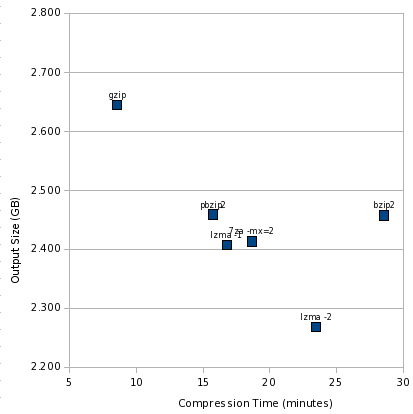
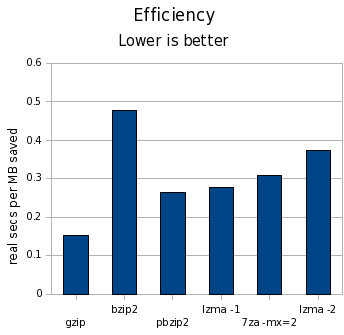
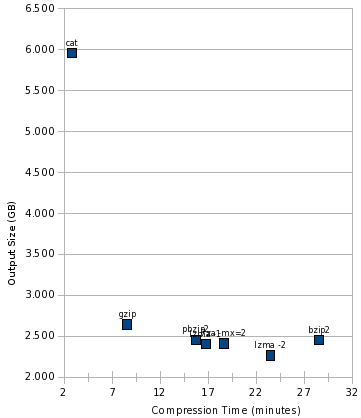
In the MB saved column, higher numbers are better; in all other columns, lower numbers are better. I m using clock seconds here on a dual-core machine. The cost column is clock seconds per MB saved. What does this tell us? Some Pretty Charts First, let s see how the time vs. size numbers look: compress-zoomed Like the other charts, the best area is the lower left, and worst is upper right. It s clear we have two outliers: gzip and bzip2. And a cluster of pretty similar performers. This view somewhat magnifies the differences, though. Let s add cat to the mix: compress-big And finally, look at the cost: compress-efficiency Conclusions First off, the difference in time is far larger than the difference in space. We re talking a difference of 15% at the most in terms of space, but orders of magnitude for time. I think this pretty definitively is a death knell for bzip2. lzma -1 can achieve better compression in significantly less time, and lzma -2 can achieve significantly better compression in a little less time. pbzip2 can help even that out in terms of clock time on multicore machines, but 7za already has a parallel LZMA implementation, and it seems only a matter of time before /usr/bin/lzma gets it too. Also, if I were to chart CPU time, the numbers would be even less kind to pbzip2 than to bzip2. bzip2 does have some interesting properties, such as resetting everything every 900K, which could provide marginally better safety than any other compressor here though I don t know if lzma provides similar properties, or could. I think a strong argument remains that gzip is most suitable for backups in the general case. lzma -1 makes a good contender when space is at more of a premium. bzip2 doesn t seem to make a good contender at all now that we have lzma. I have also made my spreadsheet (OpenOffice format) containing the raw numbers and charts available for those interested. Update Part 2 of this story is now available, which considers more compression tools, and looks at performance compressing files individually rather than the large tar file.
16 February 2009

Steve McIntyre: Release++

Thanks to everyone involved. Just finished my pieces of the release process, generating 502 CD/DVD/BD images. And technically it's still February 14th, somewhere... :-) I should go and get some (more!) sleep, but I want to see us completely finished before I do. Update: (15th Feb) People have been asking about the BD images. We decided a while back that we wouldn't ship full-size BD ISO images, simply due to the sizes of those images. For the same reason, we didn't generate them for all architectures, just concentrating on i386, amd64 and source. If you're looking for the BD images, you can download/make them via jigdo. Update #2: (16th Feb) Yes, it's possible that we could make a multi-arch BD image containing all of i386, amd64 and source, similar to the multi-arch DVD. Last time I built that, it would just about fit on a dual-layer disc. That would be a really expensive disc to burn, but let me know by email and I can make the image for you if you really want it.

Erich Schubert: Congratulations, Debian

Debian Lenny Banner Congratulations to all developers (DDs or not, we have sponsored uploads, Debian contributors and such, too!) who contributed to the release of Debian GNU/Linux "lenny" 5.0. I must admit that I've been largely inactive recently, I just managed to keep the bugs on my remaining packages low. Funnily, just the day lenny was released I learned about a bug in Enigma on AMD64 that is probably worth fixing through proposed updates ...

Martin-Éric Racine: Roadmap to a better FreeDesktop: ridding us of the Firefox filth

Lately, I've been pondering how to solve one annoying aspect of the FreeDesktop, namely how to eject the piece of bloat called Firefox from the picture and get myself a fast web browser that I can rely on and that yet offers a similar UI experience based upon native GTK2 widgets rather than XUL components. Just to investigate possible options, I tested Epiphany, Galeon and Konqueror. My conclusions were than a Gecko-based Epiphany or Gaelon is incredibly fast and that Konqueror offers a similarily efficient experience albeit using QT, rather than GTK2 widgets. Why is Firefox so bloody bloated then, if it uses the same Gecko engine as Epiphany and Galeon? The only possible conclusion I could come up with is that its crappy XUL implementation, rather than leverage existing native GTK2 or QT widgets, tries to reinvent the wheel with its own UI toolkit running as a gigantic RAM blackhole. One option that I wanted to investigate but found too deficient was a Webkit-based port of Epiphany. Unfortunately, at its current stage, the GTK2 port of Webkit simply isn't mature enough to consider, although the fact that Webkit has been succesfully ported to a number of platforms and constitutes the basis for Safari on Mac OS suggests that the potential is significant. That only leaves one single aspect on which Firefox wins hands-down: its UI concept; it just works well, whereas Epiphany simply has a UI concept that is utterly inadequate, because it is too crude, lacking basic necessities such as a session saving feature that also works when purposely unloading the application, rather than only as a crash recovery measure. Simply put, Epiphany's premise that a browser should never be closed and thus ought to always remain open in the background of a desktop session is utterly flawed; it doesn't work like that in real life and Firefox acknowledges this, while Epiphany stubbornly doesn't because someone wreaked Havoc in our desktop paradigm. Anyhow, to me the solution is clear: regardless of which rendering engine it uses, Epiphany's UI concept needs to become more like Firefox, before it can truly gain acceptance as the default browser among Linux distributions.

Biella Coleman: Ironic Technics

The title of this book makes me realize how much a good and catchy title matters for a book. This one really caught my attention as I am fond of both irony and technics. Never thought of putting them together but someone surely has and it sounds like he has written a pretty nifty philosophical book on technology.

Biella Coleman: Ironic Technics

The title of this book makes me realize how much a good and catchy title matters for a book. This one really caught my attention as I am fond of both irony and technics. Never thought of putting them together but someone surely has and it sounds like he has written a pretty nifty philosophical book on technology.

15 February 2009

Michael Prokop: Debian GNU/Linux 5.0 codename Lenny - News for sysadmins

Alright, Debian GNU/Linux 5.0 AKA as Lenny has been released. Time for a Debian unstable unfreeze party! 8-) What does the new stable release bring for system administrators? I ll give an overview what news you might expect when upgrading from Debian GNU/Linux 4.0, codename Etch (released on 8th April 2007) to the current version Debian GNU/Linux 5.0, codename Lenny (released on 14th February 2009). I try to avoid duplicated information so make sure to read the release announcement and the official release notes for Lenny beforehand. Noteworthy Changes Virtualisation Virtualisation related new tools: Desktop oriented packages like virtualbox and qemu are available as well of course. Noteworthy Updates This is a (selective) list of some noteworthy updates: New packages Lenny ships over 7000 new packages. Lists of new/removed/replaced packages are available online. I ll name 238 sysadmin related packages that might be worth a look. (Note: I don t list addon stuff like optional server-modules, docs-only and kernel-source related packages. I plan to present some of the following packages in more detail in separate blog entries.) Further Ressources

14 February 2009

Biella Coleman: Overeducation for the ladies

Ok, so I know many have come across this as it was featured on BB but I would like to archive it here so I can find it later. It was just so well done

Biella Coleman: Overeducation for the ladies

Ok, so I know many have come across this as it was featured on BB but I would like to archive it here so I can find it later. It was just so well done

Next.

Previous.