Search Results: "ean"

13 September 2010

Alastair McKinstry: So what should we call these things ?

The Exoclimes conference ended on an interesting perennial problem: what should we call these things we work on? The climate folks pointed out what the astronomers have grown used to: the telephone numbers we use as planet names. The two most studied Hot Jupiters, for example, are HD209458b and HD189733b. Come on, we could do better than that. In fact the naming worries started earlier when Frank Selsis asked people to avoid calling the planets he works on "super-Earths" (or should that be Super-Earths?). Dimitar Sasselov had accidentally kicked up a kerfuffle in the media a few weeks back by calling them "Earth-like" planets, when he meant "Earth-sized" planets. Selsis pointed out non-scientists will interpret "super-Earth" to mean "like Earth, only Better!", when we mean its just a bigger ball of rock and ice than Earth. But what to call them? Well, at least one planet already has a name, sort of: HD 209458b is frequently called 'Osiris'. And there is a published list of possible planet names. But Osiris the Egyptian god is more famous than Osiris the planet, confusing google. And people are going to assume things based on the planet names: are we really going to name a planet Vulcan? One suggestion was that if we found a system with seven planets we could call them after the Seven Dwarfs, but this was ruled out: don't mention the war (but dwarfs could also mean brown dwarfs!) At the end of the conference, there was show of hands: who agreed with naming planets? of about 100 present, all in favour, none against. The delegate to the IAU commision on the matter, which had voted against, duly noted. Perhaps we will name them then. Tags , ,

Amaya Rodrigo: Of inner peace and struggle

[Nothing related to Debian here, move on if you don't care about my recurring obsession with the end of the world, Cassandra pains, or Big Phat Living Room Revolution yearnings].

Although I am still looking for a community of anarcho-primitivists that want to accept me joining their frugal living, and simply slip off the social construct, the system, the fucking face of earth, call it what you will, I could find some comfort in my favourite feminist blogger's take on the subject of my midlife crisis regarding ecology, capitalism, patriarchy, child bearing, overpopulation, meat consumption and all the rumination of consuming thoughts that (still) make my life miserable and have kept me running away from human contact for a year.

[Emphasis mine]

At what point does human culture depart from the Natural? With the invention of computers? TV? Cars? The cotton gin? Electricity? Taco stands? Gunpowder? The printing press? Written language? Shoes? Crop cultivation? Yurts? The wheel? Did humans become unnatural when the good old days of picturesque, endless agrarian toil, feudal oppression, unchecked disease, ignorance, and death from dysentery at 35 turned into the bad new days of urban post-industrial capitalism where a pound of fair-trade organic coffee costs $12.99 and your email inbox is full of spam?

ah. Everything humans do, or have ever done, is natural. We can t do anything else. The idea that modern culture is un-natural is nostalgic and inaccurate. Living off the grid in a yurt is good in some absolute sense, whereas driving an SUV from a suburban bungalow to the stripmall is bad ? Come on. This a romantic, but misguided view. The cosmic reaction to a 20 Ford Expedition is the same as to a sanctimonious Prius: bupkis. The universe doesn t give a fuck about you or your lifestyle choices. It doesn t give a fuck about the economy, oil spills, or civil unrest in Blargistan. It doesn t give a fuck about katydids. Eventually our whole planet will be erased from space, and the galaxy won t bat an eye. The inevitable extinction of our species (imminent, according to research here at Spinster Laboratories) via the exhaustion of available resources is as natural as a fresh-picked peach. As Andre 3000 and other dude philosophers have observed, nothing is forever.

Yes, yes, when people use the word natural what they really mean is free of chemical additives and maybe some of the assorted hippie concepts that go with that narrative. Barter economies, home furnishings made from bamboo, vegan cookbooks, living in the country. While I would argue that it is just as natural for people to put chemical additives in things as it is to not put chemical additives in things, I admit that it is appealing to fantasize that the source of human misery is an unnatural isolation from Nature, and that doing yoga on an organic rubber mat and drinking organic spinach smoothies will put me back in sync with the cosmos.

But alas, I m already in sync with the cosmos, and so are you. In other words, this is it. This is what we ve become, and this is what we get. Which is not to say that a person can t fantasize about a verdant paradise full of songbirds and polar bears and Bengal tigers, untouched by human influence. Only, that world isn t a world we could actually live in. The minute you add contented children, lazy from a carefree day at the swimming hole, eating ripe plums on the porch at sunset to that scenario, natural history changes, and it s right back to our scorched-earth dystopia. Our giant brains use up resources, it s as simple as that.

As long as we re still here, though, we might as well try to make the best of it.

http://blog.iblamethepatriarchy.com/2010/06/19/heads-up-art-week-starts-on-monday/


Though the comfort is somewhat ephemeral, because deep inside, I know she's wrong, I know another way is feasible, but I have given up already, I have very well come to terms with extiction, I get an enormous pleasure from the thought of the very well deserved human mass suicide-by-cop^Wnature, and in fact, I trust and hope it will save me personally from facing the hard times ahead, as I am a damn coward, paralized by fear, hopeless about the flock ever getting it (is it so hard, really?), while doing as much as I can but completely overwhelmed by the need of changing a world everyone seems to like just as it is. I can certainly empathize with much more disturbed ways of airing similar anguish, among many other examples, such as The Unabomber, or The Weather Underground. I don't even want to go there as I know violence all too well and it is not fun to be on the receiving end. But I see the screaming desperation behind the motives of acts I am not at the liberty to discuss here. I wonder if consumption of resources in the form of books will numb the disorder or make it worse and what sort of medical arrangement the stablishment has for it. As you click away the previous links will mean nothing to you because a)it is Wikipedia after all, and b)you probably don't even understand what the problem of eating animal corpses is, humans are omnivores after all, and what is all this nonsense about dropping language altogether.

WTF, there was no comfort after all, and I am still a nutjob.

Ingo Juergensmann: Upgrading PostgreSQL 8.3 to 8.4 on Squeeze

Currently upgrading Debian Lenny to Squeeze is not that easy, because PostgreSQL 8.3 from Lenny is getting to be removed while PostgreSQL 8.4 won't be installed because of some dependency issues:
# apt-get install postgresql-8.4 postgresql-8.4-postgis postgresql-contrib-8.4
Reading package lists... Done
Building dependency tree
Reading state information... Done
Some packages could not be installed. This may mean that you have
requested an impossible situation or if you are using the unstable
distribution that some required packages have not yet been created
or been moved out of Incoming.
The following information may help to resolve the situation: The following packages have unmet dependencies.
postgresql-8.4: Depends: libgssapi-krb5-2 (>= 1.8+dfsg) but it is not going to be installed
Depends: libkrb5-3 (>= 1.6.dfsg.2) but it is not going to be installed
Depends: libpq5 (>= 8.4~0cvs20090328) but 8.3.11-0lenny1 is to be installed
Depends: postgresql-client-8.4 but it is not going to be installed
postgresql-contrib-8.4: Depends: libpq5 (>= 8.4~0cvs20090328) but 8.3.11-0lenny1 is to be installed
E: Broken packages
Well, yes, I know Squeeze is still Testing and such, but as libkrb5-3 and libgssapi-krb5-2 are required but seem to be unavailable, I wonder when this issue will get solved? There seems no bug report for postgresql-8.4, libkrb5-3 or libgssapi-krb5-2. Is that for a reason? Or is the reason for uninstallable postgresql-8.4 something else? UPDATE:
# apt-cache policy postgresql-8.4
postgresql-8.4:
Installed: (none)
Candidate: 8.4.4-2
Version table:
8.4.4-2 0
500 http://ftp.de.debian.org squeeze/main Packages
# apt-cache policy libkrb5-3
libkrb5-3:
Installed: 1.8.3+dfsg~beta1-1
Candidate: 1.8.3+dfsg~beta1-1
Version table:
*** 1.8.3+dfsg~beta1-1 0
500 http://ftp.de.debian.org/debian/ squeeze/main amd64 Packages
100 /var/lib/dpkg/status
UPDATE 2:
This issue seems to be caused by #596678. Thanks Rhonda & Martin!

12 September 2010

Lucas Nussbaum: Ruby packaging in Debian and Ubuntu: Mythbusting and FAQ

A lot is being said on how Ruby is packaged in Debian and Ubuntu. In this post, I m trying to go through the most common myths and give my position as a Debian Ruby maintainer. Note that those are my views, not necessarily those of the other Debian Ruby maintainers. Myth: Ruby is completely outdated in Debian and Ubuntu There s a culture in the Ruby community of always using the latest bleeding-edge version. There s also a culture (though this one has recessed a bit, I think) that it s perfectly fine to change APIs in incompatible ways if it makes the software slightly better. In Debian (and Ubuntu) stable releases, we try to provide a rock-solid version of Ruby that won t be allowed to change API during the support lifetime of a release. Bugfixes for important bugs can be applied, but that s basically all. So it s not surprising that Ruby in released versions of Debian and Ubuntu is behind the latest upstream version. In development branches, we are following the latest upstream versions quite closely. Debian 6.0 squeeze , to be released by the end of the year, includes Ruby 1.8.7-p302, and will include 1.9.2-p0 (the currently of Ruby 1.9.2 in squeeze is currenty a SVN snapshot from beginning of august). There are people interested in installing a packaged Ruby that just works, and other people interested in installing their own version of Ruby (through RVM and such). People in the Ruby community tend to forget about the first category, and consider that, because they install Ruby from source or with RVM, that should be the solution for everybody. We need the Ruby community to respect that different people have different ways of using Ruby, and to stop recommending that everyone using Debian and Ubuntu should install Ruby from source. We also need to leverage the backports services for both Debian and Ubuntu to provide a way to install the latest upstream version on stable releases. The only reason why we are not doing it yet is lack of time. Myth: Ruby is split into a myriad of packages in Debian In the past (pre-2005), a decision was made to split some libraries from the standard library into separate packages. This was motivated by: Most of the split was undone a very long time ago, and the readline and openssl splits were undone this year. The current package in Debian squeeze has: It is always possible to merge more packages, but merging any of the other packages would significantly increase the size of what you get by default, and might discourage people to use it in some contexts (disk space is not always cheap. Think embedded systems and smartphones). Myth: Rubygems is crippled in Debian There are two differences in the rubygems Debian packages. First, gems are installed in /var/lib/gems, not /usr/local/lib/gems. That is because rubygems are seen as state for the Rubygems package, not independant software installed separately. A change for this is currently being discussed, and should be done after the squeeze release. (I don t think that it s reasonable to push that change now). A consequence of installing to /var/lib/gems is that gems binary are outside of $PATH. After the change, gems binary would also be installed in /usr/local/bin. Second, gem update --sytem is disabled in the Debian package, because that would replace code from the Rubygems Debian package with code downloaded from the Internet, and can break your system in subtle ways. We have changed this (in SVN, not in any package in the archive yet) to allow gem update --system if a specific environment variable is set, which gives us the opportunity to display a warning message. Myth: Ruby is slow on Debian Ruby is built with the pthread threading code, because not using it breaks many native Ruby libraries (Ruby-gnome2, for example). And other Linux distributions are doing the same. There are some very old benchmark results floating around in some blogs that show that the pthread code has a performance impact of about 20%. There are been patches for that for a long time (applied in Ruby Enterprise Edition), but they were never properly sent back. Actually, all the discussions about this issue were rumors and blog posts, and there wasn t even a bug report about it! After the bug was reported properly, it was fixed in a timely manner. The fix is not yet included in the Ruby 1.8.7, but is being applied as a patch to the Debian package since 1.8.7.299-2. (So the Debian package is actually newer and faster than upstream Ruby in that regard). What makes Ruby so difficult to maintain in Debian? The main problems we have with Ruby are portability issues. The only officially supported platform for Ruby is IA32 (i386 in Debian), and everything else is best effort. It means that it is not even supported officially on x86_64/amd64! Debian supports a dozen of architectures, and the Ruby package has to work on each of them. Ruby 1.8 is mostly OK nowadays thanks to the help of Debian porters, but we still have serious problems with 1.9.2, since the test suite fails on sparc, hppa, ia64 and Debian GNU/kFreeBSD. Why doesn t Ruby use the alternatives system on Debian? The alternatives system provides a way to switch between different software providing the same functionality. Currently, if you want to use Ruby 1.9.2, you need to use the ruby1.9.1 executable (1.9.1 = ruby compatibility version here). The alternatives system would allow to switch ruby to ruby1.9.1 on a system-wide basis. However, the situation of applications and libraries working only with Ruby 1.8 should be clarified: those should use /usr/bin/ruby1.8 instead of /usr/bin/ruby. Another problem is that the way to specify packages dependencies still need to be determined. There s nothing impossible to do about that, it just needs someone to do the work. Where do we go from here? The Ruby developers (or expert users) community is generally very hostile towards Debian. Many harsh words and insults are used in discussions mentioning Debian in the ruby-core@ mailing list, and there are frequent recommendations to avoid the Debian packages and install from sources, which is quite demotivating (Actually, what prompted that blog post is someone calling Debian-specific changes unforgivable). This atmosphere makes it hard to recruit people, and the Debian Ruby teams are completely understaffed, which is clearly the major blocker to improving the situation further. We are 3 co-maintainers for the interpreter packages, and I m the only Debian Developer that is really active on a regular basis in the pkg-ruby-extras team (that does libraries and applications packaging). We desperately need help, but at the same time I have no time to improve our documentation and make it easier to join the team. While I haven t reached a final decision yet, I am also likely to stop doing Ruby work in Debian after squeeze is released, as I am getting increasingly tired and demotivated.

Alastair McKinstry: Exoclimes: the diversity of planetary scientists

I'm just back from ExoClimes 2010: Exploring the Diversity of Planetary Atmospheres. An excellent conference: the PDFs of the talks and posters are now online, and they are putting the videos of the talks up soon. But in particular the organizers deserves thanks for bringing exoplanetary scientists and observers together with climate modelers doing Earth (and Mars, Titan, Venus, ...) models.
Model complexity graph Peter Cox on model complexity
The last talk on Friday was by Peter Cox on Climate change and exoplanet sciences that was far better than expected for the "graveyard shift". One theme of the conference was the need for a 'heirarchy' of models, from simple energy-balance models to full circulation (GCM) models: using progressively more complex models to understand more bits of whats going on. Exoplanet workers mostly use simpler models, progressing now to GCMs, while Earth modellers are moving beyond GCMs to "Earth system" models including biology, etc. Peter pointed out the two styles of work: the exoplanet modelers are short of data, and risk being too speculative. We know little of what the planets are like, and concentrate on implementing physics in the models to see what they might be like. Earth modelers on the other hand are if anything swamped with data: the tendency here is to make the model fit the data, by adjusting parameters until it does so. The danger of this approach is that the model will then not work away from current present-Earth conditions. Tim Lenton pointed out some work that was done with the Met Office model, where they took the radiative transfer part of the model and tested it for other planets, and paleo-Earth conditions. The model blew up : it wasn't capable of x2 or x4 current CO2 levels. (This has since been corrected). Over dinner there were interesting discussions on the different styles within the communities. While the underlying GCMs used come from the Earth sciences, its quite common within the exoplanetary community for a researcher to work on all parts of the model: dynamics one day, radiative transfer the next. In Earth climate work people have become more specialized and someone is a 'radiative transfer' person, and won't touch other parts of the code (even if they can follow them in the huge codes we have today!). On the other hand, there is a greater tradition of model inter-comparison in Earth sciences, where we compare the model outputs to each other for some known test cases ( Held & Suarez, the CMIP5 project, etc.) Apart from some initial work by Emily Rauscher, little has been done on this in exoplanetary models; it was agreed more of this would be a good idea. Radiative transfer (the interaction of 'sunlight' with the atmosphere, where it gets absorbed, scattered and re-radiated) in particular seems to be an area that could benefit from this. In this middle ground Francois Forget showed the work on the LMDZ model and applying GCMs to terrestrial planets. They've successfully applied this model to Mars, Titan, and partially to Venus (a much tougher problem, due to its heavy clouds giving a long radiative timescale). There are problems with correctly explaining super-rotation though. This is where the atmosphere rotates faster than the planet: on Venus for example the planet rotates every 243 days, while the clouds rotate around the planet every 4 days. Sebastian Lebonnois described the possible mechanisms for Venus and Titan; Johnathan Mitchell so did some interesting work on this recently. Different regimes are involved for different rotation rates of the planet. Ralph Lorenz pointed out the lack of "real paleo-Earth" climate work at the moment. While geology has inspired a lot of work on the atmospheric composition, what with the different gas mixtures (meaning earth-model radiative transfer codes don't work) and the faster dynamics meaning super-rotation could apply (Earth's day was about 8 hours long in the Archean era), we don't have a model of the climate yet. It looks like we should treat Earth as an exoplanet. Tags , , ,

10 September 2010

Bernd Zeimetz: refactoring the guruplug server plus

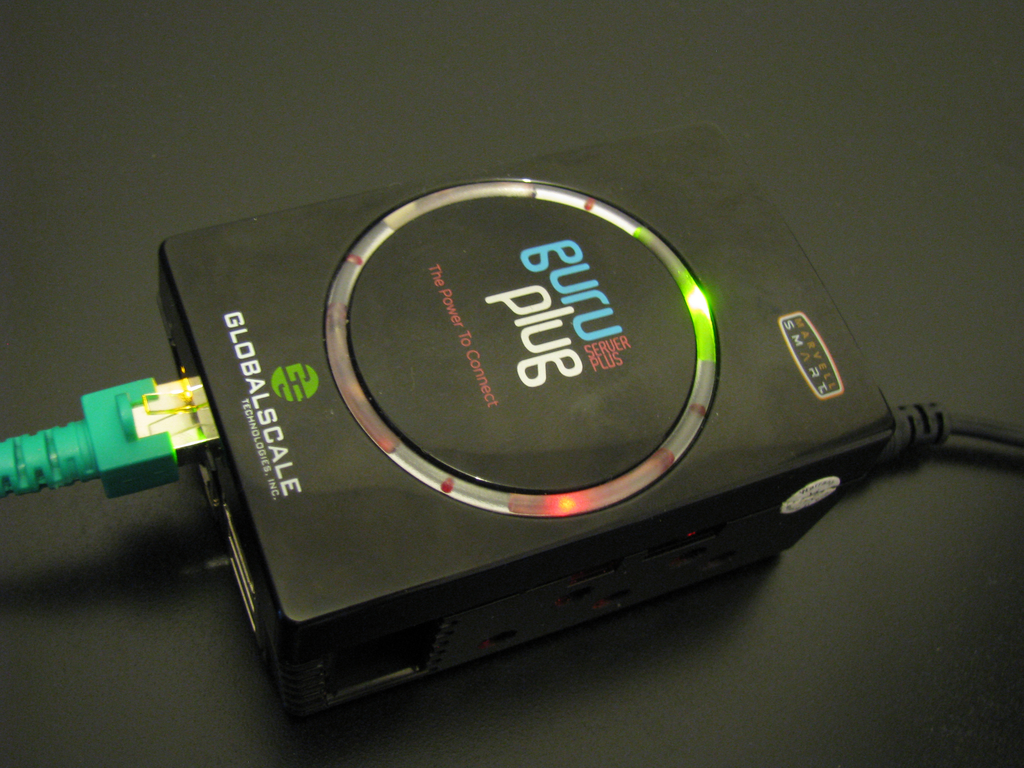
As mentioned in my last blog post the GuruPlug Server Plus needs some major refactoring before it can be used. Not doing so will make you end up with a fried brick. There are various stories in the forums about cooling it properly, so you might want to have a look first instead of following mine blindly. And of course - whatever you do - it is your fault when you end up with a brick, not mine!.

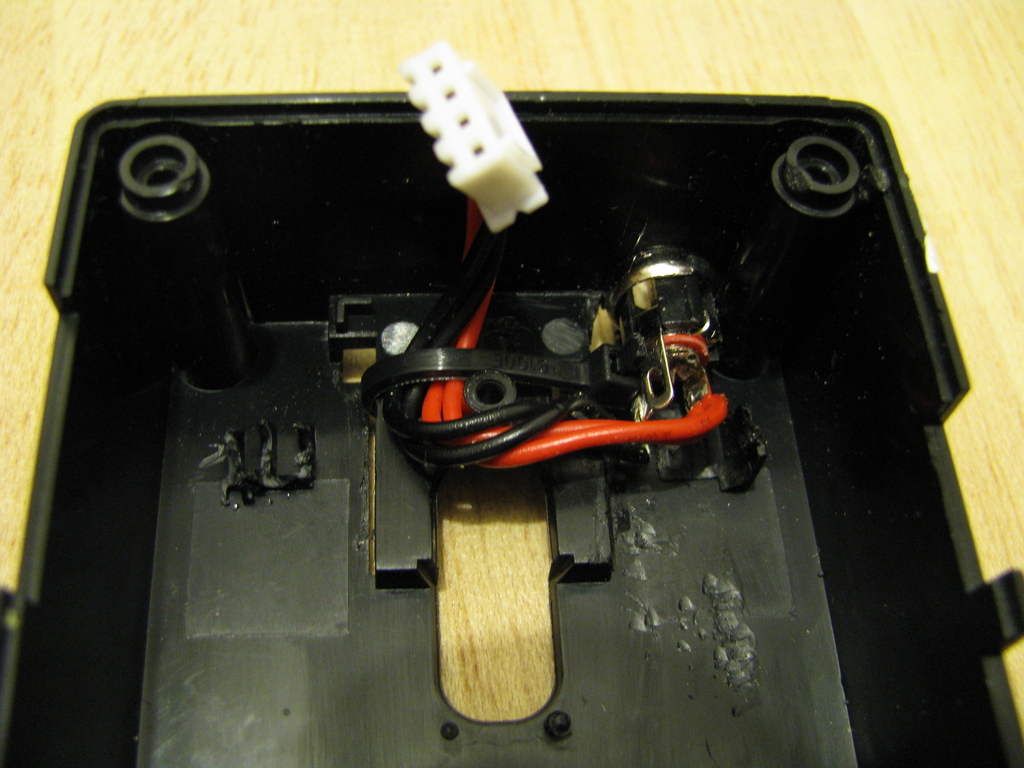
Replacing the power supply As I would never ever trust the PSU (see my last blog post for the gory details) and some additional free space in the case is necessary, it is time to rip it out. As replacement I've ordered an external 5V/20W PSU. To connect it to the plug I've drilled a hole into the case and added a proper connector after soldering the original cable from the old PSU to it. Make sure to add some retainer to stop the cable from touching the CPU/memory heat sinks later. GuruPlug Server Plus PSU replacement GuruPlug Server Plus PSU cabling

Proper heatsinks One of the biggest problems in the original GuruPlug design is the heat spreading and collecting piece of alloy, which probably makes things even worse than better. After some discussion in #debian-devel the idea came up, that the board should be able to run fine without a heatsink - at least when idling. That is the case, indeed. So let's get rid of that piece of alloy, together with the holders and springs. Unfortunately heat things are necessary to handle some work load. To mount them make sure you get some good thermal glue as you don't want to insulate the chips from their heat sinks. I've used Arctic Silver II thermal glue - not cheap, but working well. Make sure to clean the heat sinks and chips properly with alcohol (2-Propanol is my favourite for that), so there is no fat and dust left. When you use the glue be careful to read the documentation properly and make sure you apply only as much as necessary - a thin coating is enough. After applying the glue and mounting the heat sink you need a clamp to put some pressure on it while the glue dries.

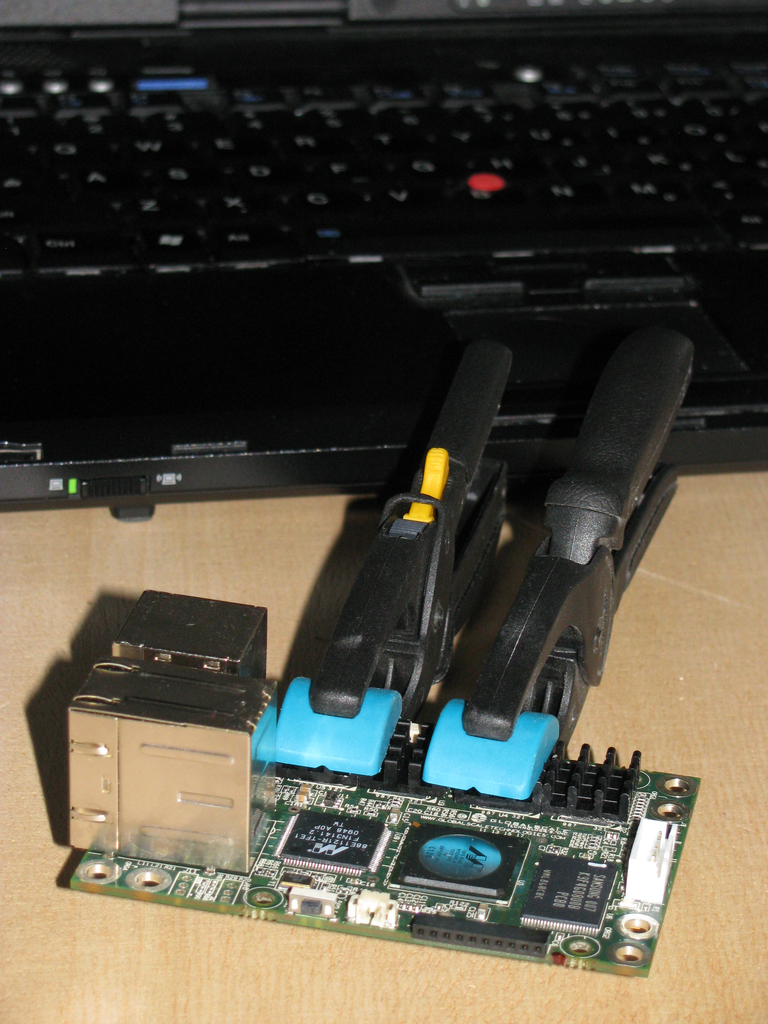
Heat sinks for the memory As there is a lot of space around the memory chips, I've got some 14x14x6mm heat sinks. Luckily there are only small parts on the other side of the board, so it was not hard to attach clamps to ensure the glue is able to dry properly. In case largish amounts of glue are squeezing out between heat sink and chip you probably want to start from scratch and clean everything (quickly!) with alcohol again. GuruPlug Server Plus memory heat sink clamping

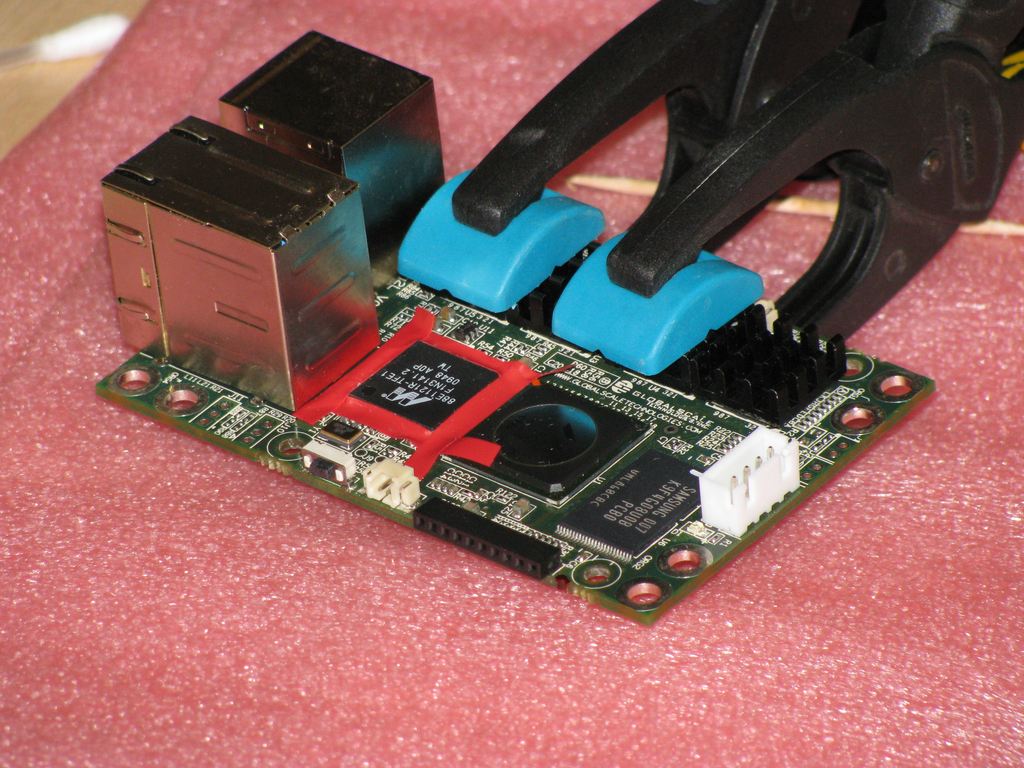
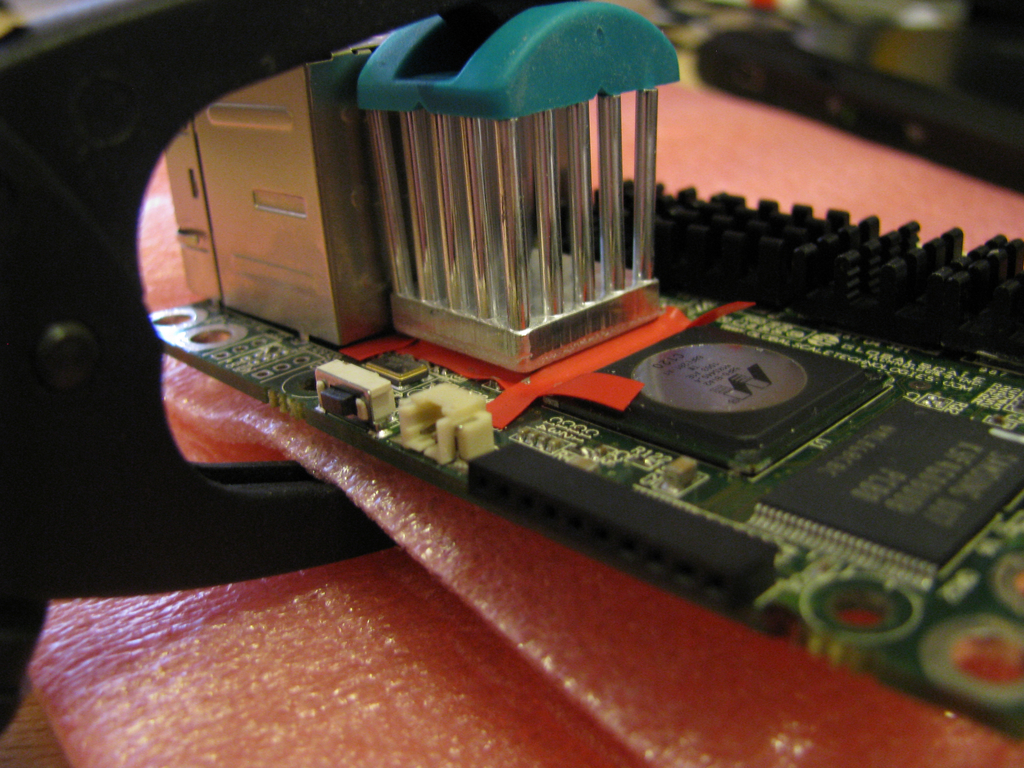
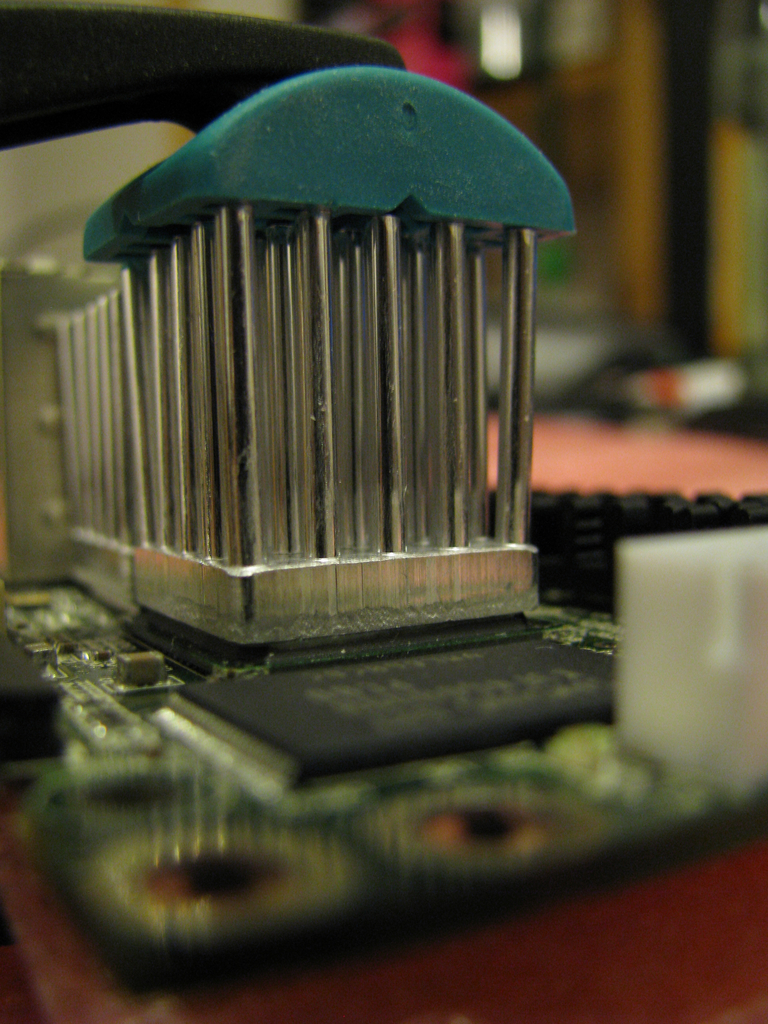
Gigabit Ethernet PHY and CPU heatsinks PHY and CPU need proper heatsinks as they're becoming pretty hot under load. Due to space limitations I had to stick with a 17x17x20mm heat sink for the PHY. I've tried to get a largish heat sink with BGA mount for the CPU, but I was not able to find one in short time and without ordering 1000 of them. So I've got another one of the 17x17x20mm model for the CPU. Later I found two other heat sinks which might fit on the GuruPlug's CPU: Malico 19x19x25mm or a Advanced Thermal Solutions Maxigrip. But for now the smaller one will have to do the job, also I'm scared to removed it without destroying the CPU. To mount the heat sink on the PHY a bit of preparation is necessary to ensure that the glue doesn't result in short cuts on the IC's pins. The arctic silver documentation recommends to use silicone on the pins to stop the glue. As I neither had the proper silicone nor did I want to make such a mess, I've decided to get a sticky insulating tape and some tooth picks to mount it properly on the IC pins. Make sure to do a proper job here! With good clamps you can work on the PHY while the memory heat sink glue is still drying. GuruPlug Server Plus - preparing the PHY The other problem on this side of the board is that some higher parts are mounted on the lower side of the board, so make sure to get some foam to protect them from your clamps. Except of the size of the heat sinks there is no real difference to the small ones: add glue, mount the heat sink and fix it with a clamp. GuruPlug Server Plus - mounting the PHY heatsink Before the glue dries completely make sure you remove the duct tape strips again. Be careful not to wipe any excess glue onto the IC pins. If you manage to do so you might want to remove and clean everything properly. So just be careful and everything should be fine. GuruPlug Server Plus - mounting the PHY heatsink 3 Mounting the heat sink on the CPU is easier as the CPU is a nice BGA package. No need to protect pins an there are none. GuruPlug Server Plus - mounting the CPU heatsink

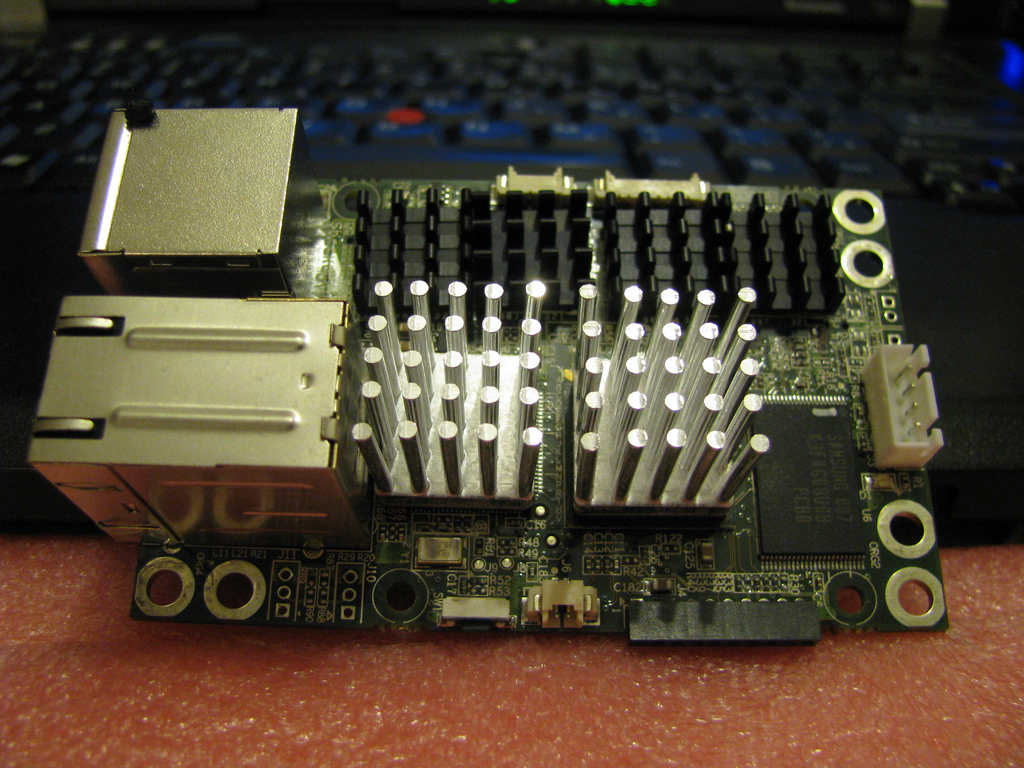
Finished As you're able to see on the photo I did not the very perfect job, but fine enough to work properly. GuruPlug Server Plus - heatsinks

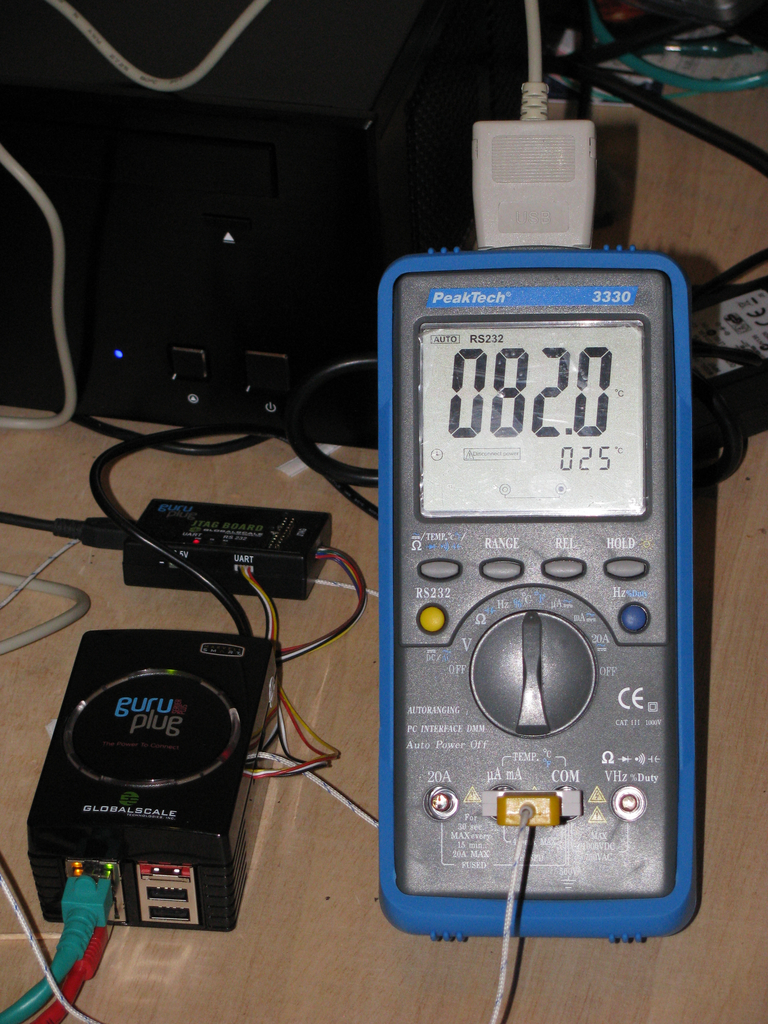
First tests with the new heatsinks Some tests with stress and some heavy network traffic showed quickly that the heat sinks are working well! But not well enough to be able to mount them into the original closed case (how the hell was this supposed to work before!?). Without any air to breath the temperature on the CPU heat sink went up to 85 deg C quickly. So on the CPU's die are > 100 deg C, which is at least close to the max allowed temperature. GuruPlug Server Plus - still too hot

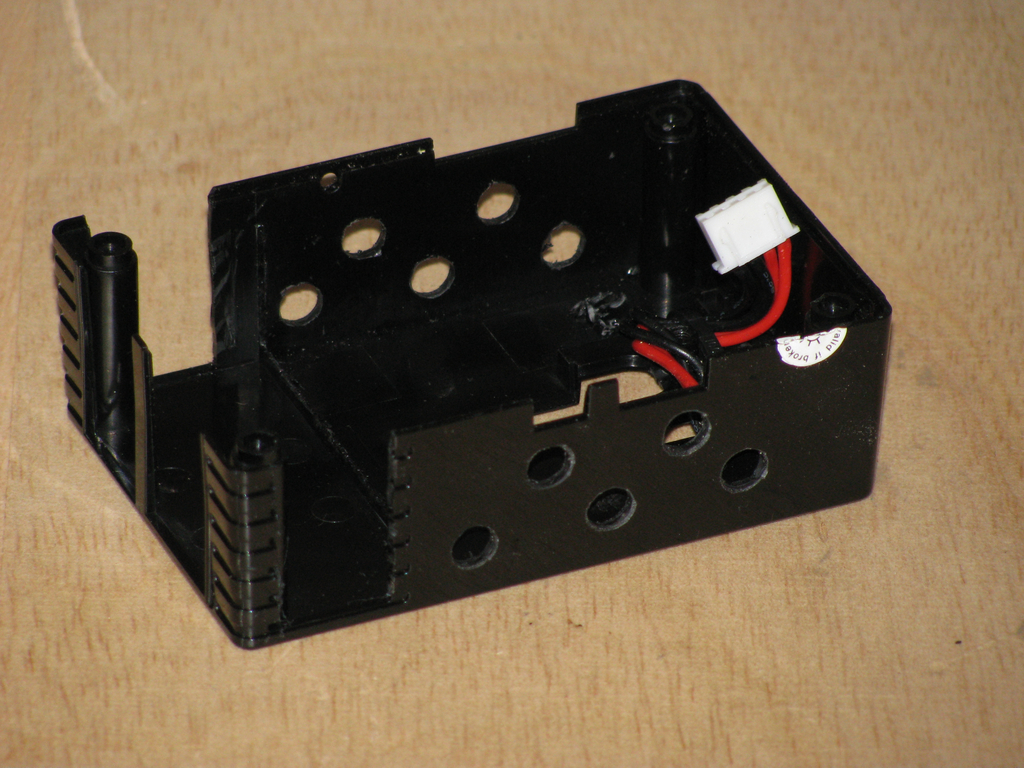
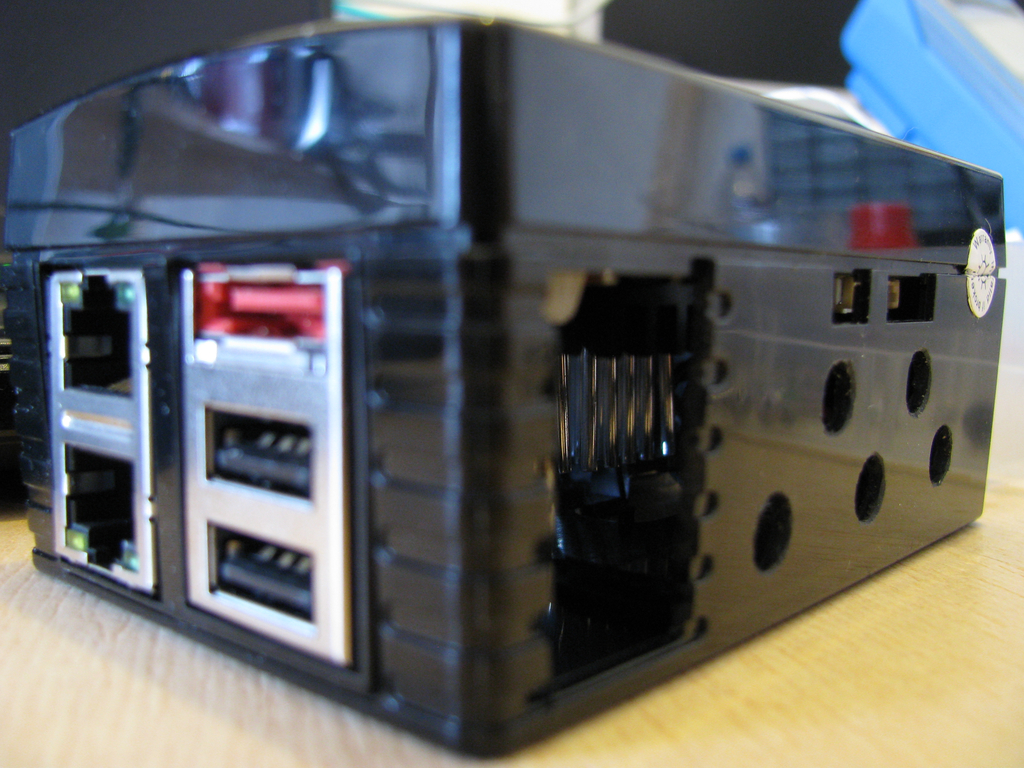
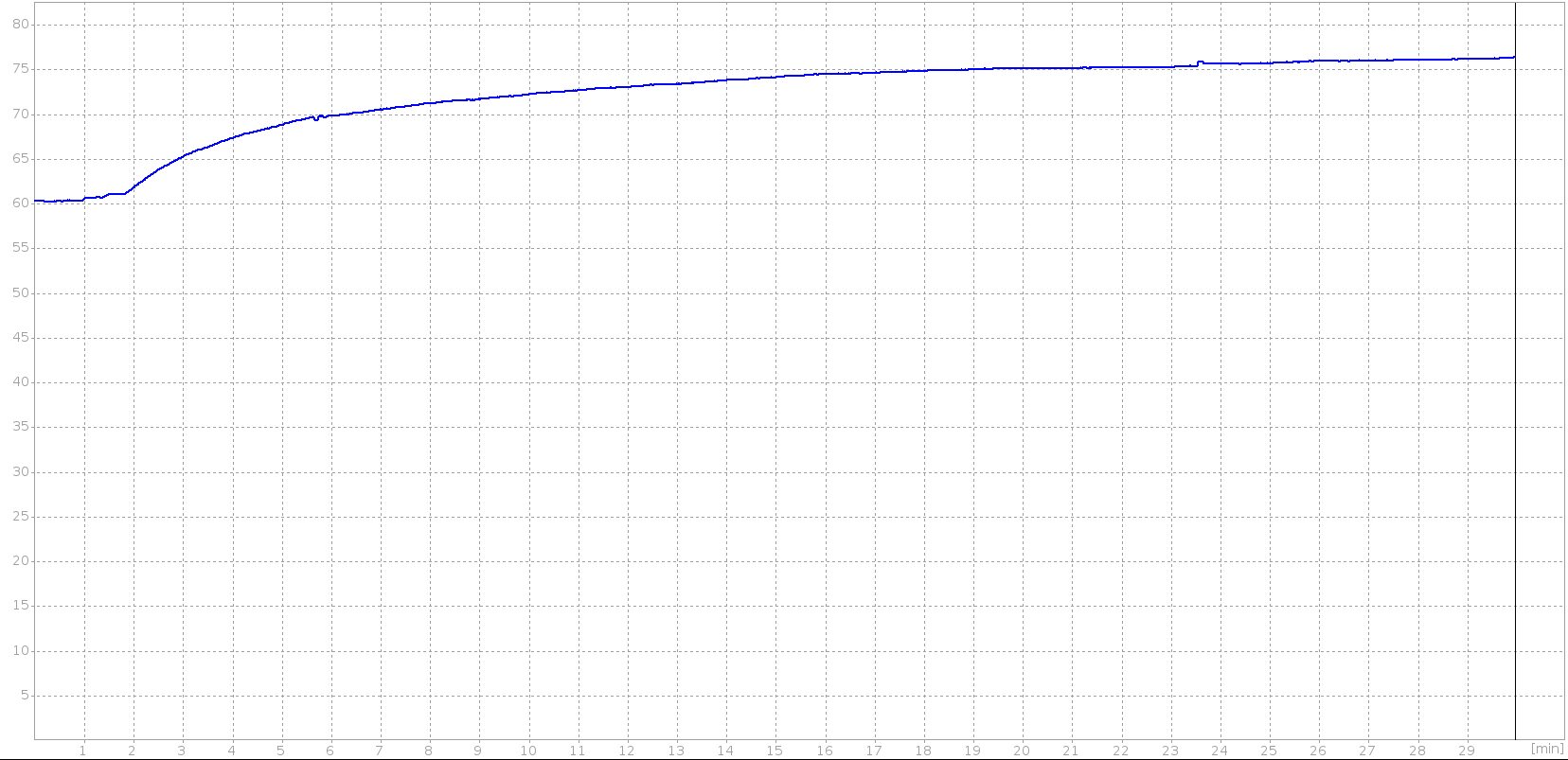
Adding air holes Obviously some additional air holes are necessary. After meeting my drill and cutter, the original case looks a bit like a piece of cheese now. GuruPlug Server Plus - case with air holes 1 GuruPlug Server Plus - case with air holes 2 Some more tests show that the temperature sticks around 76 deg C under heavy load now. That is still pretty hot, especially when the temperature in the room becomes hotter in summer. As I'm not going to run a lot of traffic trough it (my cable connection is limited to 20 MBit/s anyway), I guess it will work. Below is a graph I've recorded with my multimeter and qtdmm. It shows that the temperature rises to ~76 deg C and stays there. GuruPlug Server Plus - temperature curve Not sure if I could introuce some more load, the CPU had a load of 6 running stress. Network traffic was around 2x100MBit/s again. I could imagine with 2xGBit the CPU and PHY would become much hotter (no idea if it would be able to handle it at all, though). The PHY was usually a bit cooler than the CPU, so I didn't spend time to measure the temperature properly.

Conclusion My opinion is still the the original design of the plug is an insane QA and design failure. There is no way that it could ever work as shipped originally. If I'd have to design a new case for it, it should have a single insulated compartment for a PSU to ensure that no contact with high voltage is possible. The case around all other parts should be made of alloy with a lot of air holes. So the case could be used as heat sink (properly done, not with these insulating duct tape strips) and at the same time allow air circulation and a nice view on the LEDs on the board. Of course the case would be much more expensive than, but I'm sure it would work properly and would be worth the money. And if done peoperly, it would look much better than this blinking plastic thing. I could imagine it would sell well! So at the end I'm wondering what GlobalScale Technologies will do. I doubt it will be possible to create the 'professional upgrade kit' as they had announced before. Replacing all units is the only proper way. We'll see what happens. At least my GuruPlug is working well now and it will be used as replacement for my OpenWRT router soon. WiFi is not working, but that will be handled by my media center anyway. GuruPlug Server Plus - running plug

Gerfried Fuchs: Lenny: 900 RC bugs

It is a while since we managed to get below the 1000 stable RC mark. Last weekend we managed the next mark, that is we are below 900 now! Obviously my effort during the RCBC did take us a fair step in that direction, but I don't want to take full credit for it. The last bit that got us below the 900 happened through an event of last weekend: The current point release of lenny. Be aware that the BTS doesn't know about proposed-updates, so bugs closed through uploads to there only are seen when they hit the main pool which is the reason for point releases. It were something around 25 RC bugs that were closed by that. I haven't checked who exactly is to thank here, but looking at the non-DSA packages one finds some perl packages and at least two font packages. Thanks to the corresponding teams for their help! I plan to continue these efforts, so if you think it's a good idea you might want to flattr it. I think this quote sums up the motivation behind this pretty well:
<jwilk> Yay, only 900 bugs to fix and we can release lenny! Oh wait...

/debian permanent link Comments: 0 Flattr this

Keith Packard: altos-release

AltOS The Altus Metrum Operating System Altos is the core of the software for all of the Altus Metrum products. It runs on the 8051-based micro-controllers within both the flight computer and the ground station devices. AltOS a small cooperatively multi-tasking operating system. AltOS Version 0.7.1 Released Bdale and I have just released AltOS version 0.7.1. Version 0.7.1 is the first release to include the new Java-based ground station software which runs on Linux, Mac OS X and various Windows flavors. AltOS Changes in 0.7.1
  1. Deal with Windows and Mac OSX USB stacks. These two operating systems do interesting things with USB and found some boundary conditions within the AltOS USB stack which couldn t be tested on Linux. With test cases discovered, the panic calls were turned into code that dealt with these cases correctly.
  2. Increase packet mode payload size and add callsigns. The callsigns are set by the master end of the packet link (normally the TeleDongle) so that the entire radio conversation conforms to regulatory requirements. Increasing the payload size makes data transfers go faster.
  3. Place configuration data in fixed flash addresses. This change makes it possible to read the serial number and radio calibration data back out of the flash data when reprogramming a device.
TeleMetrum Changes in 0.7.1
  1. Ensure GPS date information is written to on-board data logger. The GPS date information is used when constructing eeprom log file names; without this, the eeprom downloading tool would generate a filename based on the current date.
  2. Allow TeleMetrum to be used as a programming dongle. This means the user can reprogram a TeleDongle or another TeleMetrum using the TeleMetrum as a programming dongle. Before this, only the TeleDongle could be used to program other devices.
AltosUI - Ground Station Software for Altus Metrum devices Version 0.7.1 is the first release containing our new cross-platform Java-based user interface. AltosUI can: Three Operating Systems, One AltosUI AltosUI provides all of these features on the three target operating systems, Linux, Mac OS X (version 10.5 or newer) and Windows (XP, Vista or 7). The bulk of the software is written in Java and is built once and tested and delivered on all three target platforms. A tiny shim library is built on each system to provide access to the Altus Metrum devices connected over the USB link. Thanks to our contributors! We ve gotten lots of help getting this software built and tested: Future Plans With the basic AltOS and AltosUI functionality running, we ve got lots of ideas about where to take the system in the future. And, we d love to hear ideas from you as well. Some of the ideas we ve like to get done include:
  1. Google Earth file export. We had a Linux-based C program to export a KML (Keyhole Markup Language) file that Google Earth can read and present to the user overlayed on satellite photo data.
  2. Data Plotting. Being able to plot flight data right in the UI would be nice, and there are several Java plotting packages available to try out.
  3. State-dependent display. When the rocket is on the pad, you only want to know if it s ready to fly. When the rocket is descending on a chute, you want to know where it is in the sky and how fast its falling. Presenting a limited amount of information that is most likely interesting to the user should make the display more useful.
  4. Ejection charge testing. The TeleMetrum firmware has the ability to fire ejection charges over the USB or radio links. Safely hooking this up to the user interface will allow for wireless ejection system testing. The key here is safely , of course, which means figuring out a fool proof user interface.
I m sure there are any number of additions that could be made to this list; feel free to send along ideas that you ve got. Of course, all of this software is licensed under the GNU General Public License, so you can get the source and hack on it in the comfort of your own home.

9 September 2010

Cyril Brulebois: SD: Bugzilla gets history support

(Disclaimer: Possibly one of my longest post ever, you may want to scroll to the bottom and only look at the pictures.) So, what s new in SD since last week? Fetching everything From http://bugs.freedesktop.org/, it was possible to download all the bugs I reported there (that means 2 ), but trying to download those reported by Julien led to a crash without any trace. Dichotomy FTW, I came up with a bunch of bugs which would lead to the same result, which confirmed that the amount of bugs processed at once wasn t the issue. Playing around with strace, it appeared that exchanges with the remote server were apparently fine, so an issue on the client-side SOAP machinery got suspected. So let s enable tracing:
use SOAP::Lite +trace => 'all';
Tada! The issue was indeed local: malformed XML got received, leading to a die call issued from the XML-RPC layer. Thankfully, one can set up a fault handler, which I used to display the range of bug IDs which triggered that bug, so that people can look into it and determine what to add to the blacklist until the underlying issue s been investigated (presumably, bugzilla s at fault). Speeding things up With that blacklisting of buggy bugs, one can then try to move to other queries, dealing with more bugs. Some examples follow:
reporter=kibi@d.o
product=xorg&component=Driver/VMWare
product=xorg&component=Driver/nouveau
product=xorg&component=Server/general
product=xorg&component=Driver/intel
Moving from 2 bugs to 10-100 bugs (Julien s or VMWare s) was OK. But then moving to several hundreds of bugs (Driver/nouveau = 500+ bugs) led to noticeable performance issues. Not to mention what happened when one reaches several thousands of bugs (Driver/intel = 2500+ bugs). Indeed, even with network exchanges cached into a local file, processing data was taking up to several dozens of minutes. I knew about Perl s -d:DProf, which helps figuring out where time is spent, but was pointed to -d:NYTProf (and its accompanying tool, nytprofhtml). Some hotspots got noticed: Things got better, but not good enough. There are several Prophet (the engine under the hood) backends, so one can play with:
PROPHET_REPLICA_TYPE=sqlite   # the default for SD
PROPHET_REPLICA_TYPE=prophet
Switching to prophet was a big win, but still not good enough. Indeed, many tiny files are written, and most of the time is spent in I/O. Although I m nothing like a performance guru, I guessed that running on an average laptop, with ext3 and its default commit interval of 5 seconds might not be helping, so I gave a quick try to -o remount,commit=60, and that seemed to help. Even though there are probably other tricks to find in that area (which hopefully won t require root privileges ), there s already a patch which landed in prophet s master branch, replacing File::Spec->catfile with an optimized version: that function alone was eating 10% of runtime In the sqlite case, disabling the auto-commit feature helped reducing the I/O load, but a proper patch is still lacking for now (running into locked database issues, or into missing tables after having created them isn t fun, so I postponed debugging that). Since performance issues looked like they could be solved eventually, I switched back to implementing missing features. Handling more than comments Currently 3 types of stuff are currently fetched from the bugzilla server: (Yes, that means that attachments are totally ignored for now.) Until now, only bug comments were considered. The first comment was used to determine a pseudo-title (using its first line), the reporter, and the creation date. This approach was chosen to try and get a basic sync working quickly, so as to get: Now, the algorithm is the following: from the bug status, determine a set of properties of interest; then walk the history backwards, and update the properties incrementally until the (presumed) initial state is reached. Then create the ticket using this initial state . Adding the incremental property changes to that initial ticket makes it possible to represent the bug s life as a list of Prophet::ChangeSet objects. That s where the fun begins, since properties in the bug status may not match properties in the bug history, so one needs to establish property correspondence. Also, some properties can be multivalued for added fun. I believe that s where most of the time is going to be spent while developing a new replica type in SD: once one knows how to get a hand on needed info on the remote server, the main question is what to do with it. For now, I decided to ignore many fields to make it possible to do a big sync like Server/general, property support will be improved later on. Screenshots Instead of pasting lengthy terminal excerpt, let s use some screenshots instead (sorry, I m not sure how to present such things in an accessible way, suggestions welcome). Cloning Julien s bugs, listing all open tickets, listing all tickets, searching using a regular expression: Cloning, listing, searching Displaying bug 42 (that s the local ID): Displaying Now, let s start the embedded web server through sd server --port 1234 and point the browser there. List of RESOLVED bugs: List of RESOLVED bugs Status and comments for bug 42: Status and comments for bug 42 History for bug 42: History for bug 42 Compared to the original bugzilla page: Same bug on FreeDesktop.org Next time Some items which need work: Flattr this!

Joerg Jaspert: Debian work

It has been a pretty exhausting time since my last blog post in my area of Debian land . If you followed the news you should have seen some of it. Last weekend there was the point release. For those I have the (good?) position to sit in the middle of the working queue, where the hardest part (sorting out which stuff to include, getting it all build, etc) is already done. Still, due to the amount of steps neccessary to take its usually a multi-hour thing. This one release was even slower, as we had to wait for hours until the package lists had all been built - unfortunately the thing writing that keeps berkeley db files of data around as cache - and uses the FULL path to the files as key. How stupidly annoying when the path changes during a server move. Ohwell. The other big part that got a tiny bit of press coverage was the move from www.backports.org over to backports.debian.org. This was actually waiting for me for a good longish while already (err, well, since well before DC9 this was decided to happen) but now I finally got myself moved. This turned out to be much more work than I ever feared (which is part of the reason why it took so long), but some numbers: The db update alone took me a week to figure out which steps to do in which order. Good to have an automated system, if you the manage to have the updates run specific to the main archive. Ups. When I was done with the database (during which I managed to just erase all work done by formorer and rhonda on the webpage, ups^2) I had some code and config cleanups to do, and especially manage to get it all running with a new path layout. Much less complicated, but enough work to do, before I finally was far enough to get it all move so far that formorer could start testing it and we could turn off the old system. At this time I had to fix up our shell scripts for our cron jobs, but that (with one exception) was a nearly straight forward easy task. And on Wednesday I managed another goal - backports is fully running the master branch of dak, the exact same code as on ftp-master. The cronjobs are slightly different, as well as the config (of course, duh), but otherwise its the same. My current goal and the last things left on this move todo is to change the cronjobs so that debian as well as backports do run the SAME scripts, but their configs list which tools should be run when. Considering that my dinstall cron already contains something pretty much a state machine I think I m insane enough to get this in shell, but when I told that to Mark (you know, the second ftpmaster :) ), I heard something very much like vomiting (you know, 700km between us, this might mean something) and then the plea to use a real language for the task. Oh my. I like my shell. :)
There is one big black cloud on the horizon to see. I have to do something similar for security. They are at a dak (and database) version pretty similar to what bpo had. They do need to support this obnoxious spare new format too before they can support security for squeeze, so there is no way I can ignore that archive for much longer. I already asked DSA for a vm in which I can play (not good to interrupt security archive for long), but probably wont start on this before the upcoming FTPMaster meeting. Pretty busy otherwise. Wellwell, I hope it will be less painful, as I now know the steps already. :)

Matthew Garrett: Linux backlight control

Backlight control is one of those things that you'd think would be simple, but ha ha this is computing so of course it's an utter disaster and everything is a huge mess. There's three main classes of backlight control in the x86 world, all of which have drawbacks:

Right now, if there's an ACPI backlight interface then that's usually the only thing we'll show you. We can do that because we can identify if there's an ACPI backlight interface when we parse the ACPI tables at the start of booting, and that information can be registered before we start setting up any other backlights. The problem comes when we have no ACPI backlight interface. We don't have any idea whether there's a platform mechanism until a platform driver loads, which could be at any time. As a result, we've been reluctant to expose GPU-level backlight control because doing so would often give you two separate backlight controls and no indication as to which should be used. Userspace doesn't really have a way to make that decision either, so everyone ends up unhappy.

This is especially problematic with some machines which provide no ACPI or known platform control (or, in the case of some Samsungs, only provide platform control if you have a special Linux BIOS that Samsung won't give you) but can control the backlight via the gpu. Right now you get nothing, because giving you something would potentially break other systems and the needs of the many etc. Sorry! But this is obviously problematic in the long term, especially because multi-GPU machines tend to have multiple ACPI backlight interfaces, so I've been working on a better approach.

When a backlight device is registered, it appears under /sys/class/backlight. If it's an ACPI device it has a symlink pointing to some random ACPI device. If it's a platform device it's pointing at something like "dell-laptop" which is approximately unhelpful when it comes to figuring out what it controls. If it's a GPU-level device then it probably points at the PCI device, which is helpful except in the case where you have multiple backlight controls on a single GPU. So, by and large, you have no good way to identify which backlight control is preferable unless you keep a huge list of all possible backlights along with some scoring.

The first thing I've added to improve this is a "type" attribute. This tells you whether a given backlight is firmware-level (like ACPI), platform-level (like the various laptop drivers) or performs raw register writes (like a GPU driver). That lets userspace decide which interface is preferable. It'll typically be the ACPI interface, because that's the most likely to keep synchronisation and so avoid bizarre brightness bugs. The next thing has been to start fixing up the parent links. There's nothing we can do for the platform level devices, but the ACPI drivers could at least point at PCI devices rather than into ACPI space. That means that multi-GPU systems can now identify which interface to use based on the currently active GPU. Finally, I've started pointing the GPU-level backlight controls at the specific output rather than merely at the PCI device. This probably makes little difference for laptops as such, but once we start exposing backlight control for monitors that support ddcci it'll make things much easier as we'll know which backlight control corresponds to which monitor.

I've then written a small library that accepts information about the output and picks the "best" backlight for the device. It's obviously based on a pile of heuristics and there's a couple of bits of API that I suspect need to be nailed down yet, but it means that this code only needs to be written once. It's then simple to glue this into X drivers, which means that they can expose a "Backlight" xrandr property on each relevant display. That means that backlight control is then handled at the session level with the X server acting as the privileged agent, which simplifies a bunch of things and means we can finally let hal die entirely. Long-term this means we'll have unified backlight control for all of your displays, which is a wonderful thing.

Summary: We kind of suck right now, but there's a reasonably clear path to getting better.

Christian Perrier: Care about samba in squeeze?

If you do care about having good samba packages in squeeze, you can help. If you're in a hurry and don't want to read the blah-blah, just skip to the end of this story and read the last paragraph. Thanks to the confidence of the release team, we (samba packagers) have been "authorized" to upload samba 3.5.4 in unstable, thus targeting having that version in squeeze. Up to July, we were indeed targeting 3.4.8 for squeeze, on the assumption that, as usual, samba upstream releases need some maturation before being strong guarantee that no regression happens. In July we were ready to move and finally upload in unstable the 3.5 packages we kept in experimental until then. The final decision was to be taken during DebConf10. It was roughly taken with Steve Langasek, but....I couldn't upload immediately (most people know that working on major packages during DebConf is a dream)...and had holidays afteer. In the meantime, the freeze happened so we got theoretically screwed... Still, I could manage to convince the release team that long term support for samba 3.5 will certainly be better than 3.4...and that functionality in that version (particularly several Win7-related fixes and a much improved code for printing support) and we got a notice "please upload to unstable and come back to us in a few weeks". That happened, finally. So, now, we need YOU, samba users and admins, to test these packages. Merging our packaging branches was hard (thanks, Steve Langasek, for your help) and glitches are always possible. So, please TEST these packages by installing samba, winbind, libsmbclient and friends from unstable....and report bugs, preferrably the release critical ones....

Stefano Zacchiroli: yes we can

(... achieve Debian world domination without endorsing Facebook) Yes Raphael, we can.
Nobody said it would have been easy, to reach Total World Domination endorsing Free Software only, but that's not a reason to stop trying. I've recently stumbled upon a very nice article by Benjamin Mako Hill, titled Free Software Needs Free Tools, which I believe it's the best possible commentary to the proposal of having an official Debian Facebook page. Of course there is nothing wrong in having non-official, or let's call them "fan" pages, about Debian on Facebook. As a matter of fact we already have one, as you point out. And I also agree that it would be better to know who is behind that page. Individuals, including Debian Developers, are obviously free to use whatever media they please to spread the cause of Debian. After all, as individuals, each of us decide upon her own personal trade-offs (for instance, a trade-off of mine is to have both identi.ca and twitter accounts and to post only to the former with forwarding to the latter). There is no way to have an official Debian Facebook page and pretend that we are not, de facto, endorsing Facebook. That's why I believe having official Debian presence on Facebook, or on any other non Free Software platform, will just weaken our cause. It will send out the message that Free Software it's something which is good for others to use, but not necessarily for Debian as a project. That does not mean that we live under a rock and that we consider social networks useless to promote the Debian cause. It just mean that we should be picky in choosing social networks that respect our Free Software principles, as we are picky in choosing licenses that are DSFG-free. For instance, I'm glad to mention here that the Debian publicity team has recently obtained access to http://identi.ca/debian and will start using it soon. Subscribe! :-) PS This post also gives me a chance to comment on a so called "community page" of mine on Facebook. As I've briefly commented a few days ago I've nothing to do with that page. TTBOMK its content is just automatically injected from Wikipedia. The "Stefano Zacchiroli is on Facebook" claim on the upper left is true only in the sense that there are other people with my name on Facebook. IANAL, but such a claim (not the page in itself) will probably be considered an abusive advertisement in many countries around the world. update: re-word the identi.ca/debian paragraph, to better blend with surrounding text
update: mention "Debian" in heading

Rapha&#235;l Hertzog: Can Debian achieve world domination without being on Facebook?

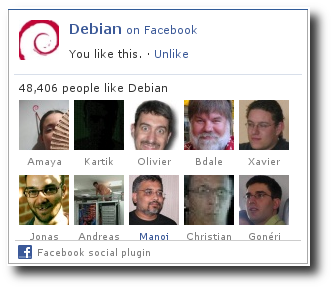
Debian Developers who like Debian on FacebookFacebook is not very popular among free software hackers. When I announced my Facebook page on identi.ca (see here) I got a few replies suggesting it was odd for me to use Facebook. Indeed there are many good reasons why Facebook should be avoided: it is a centralized and proprietary service that is not very privacy-friendly. But the truth is that lots of people are using it (even Debian developers, can you recognize them on the picture?) and some are using their Facebook news feed as their main source of news. You might wonder how many persons that represents, so here are the figures: the Debian Facebook page has 48,361 fans and the Ubuntu one has 247,932 fans. That s right, an announce put on the Debian facebook page would reach more persons than the most popular announce list that Debian is currently running (debian-announce@lists.debian.org has about 29,000 subscribers). Unfortunately that Debian Facebook page is empty and I don t even know who the administrator is. The Ubuntu page on the contrary is properly configured to relay news from The Fridge and Jono Bacon is posting some custom updates from time to time. Debian contributors regularly mention world domination as the ultimate goal of the universal operating system (I even feature this in my blog header banner! :-) ). But working towards world domination means in my opinion that we should communicate our ideals of freedom to as many people as possible, even if they are using a service that we don t want to promote. The Debian social contract acknowledges that some users have to use non-free software and we provide the non-free section for them. In the same spirit, I believe we must have a presence on Facebook. That does not mean that we endorse Facebook, and we should surely promote Joindiaspora once it s usable. But in the mean time we should reach out to Facebook users and allow them to follow us with the platform of their choice. That s the choice I recently made when I decided to setup a public facebook page featuring my free software work, my blog and my book. So if you are a Facebook user, click here to visit my page and click on Like if you want to follow this blog in your Facebook news feed. I also share interesting Debian or Ubuntu related articles that I discover while reading my RSS subscriptions. Below are the usual facebook widgets for the 3 pages quoted in this article (they might not show up if you read this article through an RSS feed):
<iframe allowtransparency="true" frameborder="0" scrolling="no" src="http://www.facebook.com/plugins/likebox.php?id=103161013077063&amp;width=292&amp;connections=0&amp;stream=false&amp;header=false&amp;height=62" style="border:none; overflow:hidden; width:292px; height:62px;"></iframe>
<iframe allowtransparency="true" frameborder="0" scrolling="no" src="http://www.facebook.com/plugins/likebox.php?id=9801962186&amp;width=292&amp;connections=0&amp;stream=false&amp;header=false&amp;height=62" style="border:none; overflow:hidden; width:292px; height:62px;"></iframe>
<iframe allowtransparency="true" frameborder="0" scrolling="no" src="http://www.facebook.com/plugins/likebox.php?id=6723083591&amp;width=292&amp;connections=0&amp;stream=false&amp;header=false&amp;height=62" style="border:none; overflow:hidden; width:292px; height:62px;"></iframe> Flattr this Share/Bookmark 14 comments Support my work

Martin Meredith: Mini Rant: Emails

Please, those of you who send me emails, remember the following:-

8 September 2010

Ingo Juergensmann: Solved: Problems with IPv6 and Bridging/Xen

Since I ordered a new dedicated rootserver, I had problems with my IPv6 setup. Thanks to Niggurath@#debian.de/ircnet and his tips, I finally found the reason for all the mess when I migrated from my old rootserver with Lenny to the new one running Squeeze. The problem was that in /etc/sysctl.conf there was the following setting on the old server:
net.ipv6.conf.all.forwarding=1
Due to a issue in Lenny, this setting had basically no effect on the old server. Sysctl.conf was called before the IPv6 interface went up, so this setting failed or never got active. Meanwhile in Squeeze IPv6 seems to be enabled at an earlier point in the boot process and the forwarding setting will succeed. This in return resulted in my not working IPv6 setup. When I disable the line in sysctl.conf everything works just fine: the domU honors the Router Advertisments of radvd again and everything is fine again. Sometimes the solution is so simple, you can't find it yourself. :-)

Dirk Eddelbuettel: Straight, curly, or compiled?

Christian Robert, whose blog I commented-on here once before, had followed up on a recent set of posts by Radford Neal which had appeared both on Radford's blog and on the r-devel mailing list. Now, let me prefix this by saying that I really enjoyed Radford's posts. He obviously put a lot of time into finding a number of (all somewhat small in isolation) inefficiencies in R which, when taken together, can make a difference in performance. I already spotted one commit by Duncan in the SVN logs for R so this is being looked at. Yet Christian, on the other hand, goes a little overboard in bemoaning performance differences somewhere between ten and fifteen percent -- the difference between curly and straight braces (as noticed in Radford's first post). Maybe he spent too much time waiting for his MCMC runs to finish to realize the obvious: compiled code is evidently much faster. And before everybody goes and moans and groans that that is hard, allow me to just interject and note that it is not. It really doesn't have to be. Here is a quick cleaned up version of Christian's example code, with proper assigment operators and a second variable x. We then get to the meat and potatoes and load our Rcpp package as well as inline to define the same little test function in C++. Throw in rbenchmark which I am becoming increasingly fond of for these little timing tests, et voila, we have ourselves a horserace:
# Xian's code, using <- for assignments and passing x down
f <- function(n, x=1) for (i in 1:n) x=1/(1+x)
g <- function(n, x=1) for (i in 1:n) x=(1/(1+x))
h <- function(n, x=1) for (i in 1:n) x=(1+x)^(-1)
j <- function(n, x=1) for (i in 1:n) x= 1/ 1+x 
k <- function(n, x=1) for (i in 1:n) x=1/ 1+x 
# now load some tools
library(Rcpp)
library(inline)
# and define our version in C++
l <- cxxfunction(signature(ns="integer", xs="numeric"),
                 'int n = as<int>(ns); double x=as<double>(xs);
                  for (int i=0; i<n; i++) x=1/(1+x);
                  return wrap(x); ',
                 plugin="Rcpp")
# more tools
library(rbenchmark)
# now run the benchmark
N <- 1e6
benchmark(f(N, 1), g(N, 1), h(N, 1), j(N, 1), k(N, 1), l(N, 1),
          columns=c("test", "replications", "elapsed", "relative"),
          order="relative", replications=10)
And how does it do? Well, glad you asked. On my i7, which the other three cores standing around and watching, we get an eighty-fold increase relative to the best interpreted version:
/tmp$ Rscript xian.R
Loading required package: methods
     test replications elapsed relative
6 l(N, 1)           10   0.122    1.000
5 k(N, 1)           10   9.880   80.984
1 f(N, 1)           10   9.978   81.787
4 j(N, 1)           10  11.293   92.566
2 g(N, 1)           10  12.027   98.582
3 h(N, 1)           10  15.372  126.000
/tmp$ 
So do we really want to spend time arguing about the ten and fifteen percent differences? Moore's law gets you those gains in a couple of weeks anyway. I'd much rather have a conversation about how we can get people speed increases that are orders of magnitude, not fractions. Rcpp is one such tool. Let's get more of them.

7 September 2010

John Goerzen: Labor Day with Jacob and Oliver

Yesterday started out with Jacob and me going to a men/boys breakfast organized by my great uncle and some others. He s in his 80s and this is probably his last year doing this. It was out in the woods by the Little Arkansas River. They cooked up bacon, sausage, and eggs and it was a fun time. Jacob enjoyed throwing sticks in the river and sitting on some logs. Terah, meanwhile, went to Wichita with Oliver. So it was just Jacob and me when we got home. Jacob spent two hours playing rivers with me. A few weeks ago, he and I set this up outside. I found an old length of pipe on our property (my dad thinks it used to carry water from a well) and some cement blocks. I set it up on the blocks so that one end is higher than the other, and the lower end empties out at the top of a small dirt pile. Then I brought a water hose over to it, turned on the water at a very slow speed, and put the hose in the pipe. The result is a small stream of water coming out at the dirt pile. After it runs just a little while, the dirt is soft enough that you can dig out little channels, or rivers , with your fingers or a stick. Jacob enjoyed this the first time he played, but yesterday he really enjoyed it. We had a fork in the river, and he informed me that he would sit on his bank and I would sit on mine. He also wanted to give river food to his river (the fork closest to him). River food was loose dirt that he d pick up and sprinkle over the water, and watch it get carried on down. I spotted some random bug in the area once, and that bug got food too. I think Jacob and the bug disagreed about whether this was particularly helpful. Jacob enjoyed playing other games with the pipe. I had showed him that we could send things through the pipe, so he would take out the hose, stuff some dirt in one end, and then make sure I was watching to see if it came out the other end. He sometimes made a fountain by setting the hose on top of the cement blocks and watching the water drip down from level to level. Then later in the day, I introduced him to Tuxpaint. This is a painting program aimed at children. I had told him I had a painting game to show him a few days ago, but because he made some bad behavior choices, he had lost access to my computer for a few days. Anyhow, we tried it yesterday and wow he loved it. There was constant laughter and excitement. I first showed him how to select colors for the paintbrush. He quickly figured out how to make lines, change colors, and change brushes. Tuxpaint has sound effects for just about everything, which he loved too. Then we explored the interface together and I showed him the stamps feature, which lets you paste pre-made pictures into a drawing. Tuxpaint comes with dozens of these, on kid-friendly themes such as animals, cars, fire trucks, signs, etc. This he loved even more. Terah and Oliver got home about this time, and Oliver and Jacob both sat on my lap for a time, both laughing loudly each time Jacob discovered something new to paste into his picture. Of course, then Oliver tried to eat my keyboard and smash my monitor, but there you go.

Brett Parker: Discovering Netgear ProSafe switches and IP Power 9258 devices

So, we have some netgear prosafe switches and some IP Power 9258 devices where I'm currently working, unfortunately, these don't always get the IP configuration that you'd expect (or, they get a DHCP lease from a DHCP server that I can't query the leases from...), however both come with little windows utilities that "magically" find the devices and give back (quite a lot, really) information on the IP configuration of the device. Being somewhat of a "oh god, I don't want to use windows, please don't make me" type person, and knowing the the IPPower 9258 boxes were going to a remote site where I'll only have linux machines on the same network as them, I figured that it would be a good idea to sit with wireshark and find out how the heck these tools worked. Turns out that both just send out a UDP broadcast packet (or two) and then sit and wait for responses - this meant that to get the information that I wanted out of them I could get away with writing very little python, taking the UDP packet that I got back, taking the payload and dismantling it piece by piece so that I could display that information. The scripts aren't at all polished, but if anyone happens to need something (that should work multi-platform, too) to discover either of these, let me know and I can throw you what I've got.

Thomas Girard: Playing with C++0x -- lambdas

C++0x has a workload of new features[2]... Today I'm having a look at lambdas. Lambdas are available in g++-4.5, for now only available in experimental. What are lambdas? You can think of it as something akin to a struct with operator(). But it's a more than that: it's closer from a closure, something that Scheme fans are very familiar with: the closure code block captures its outter environment in its body. Closures are a very powerful tool that are being retrofitted in many languages (for instance Java). They can be used as building blocks for many useful programing idioms such as continuations. Enough for theory, let's have a look at this new beast. How do they look like?
  [](int i)   return i + 1;  ;
This is the increment lambda. You can declare a lambda in any function or method. Written like this, the lambda compiles[1] but it's not very useful: it's an anonynous lambda that is neither stored nor used. How to read this? The square brackets open the declaration of a lambda. Then you declare lambda parameters and its body. Nothing suprising so far except for the declaration opening. Using a lambda To use it add arguments, for instance:
  [](int i)   return i + 1;  (0);
would compute the value 1. Storing a lambda The type of a lambda is automatically deduced. You can hint its return type if you need to. To store it you need to use another new C++0x keywork, auto, that was taken back from C:
  auto inc = [](int i)   return i + 1;  ;
  std::cout << inc(0) << std::endl;
Notice that calling a named lambda is not different from calling a function. If you need to hint the lambda return type you can use ->:
  auto mult = [](int x, double y) -> double   return x * y;  ;
Capturing environment You can use lambdas to capture outter environment. A more complex, not working, example:
  void f()  
    int x = 5;
    [](int w)   return w + x;  (0);
   
Tha lambda declaration + invocation does not work, because the x variable we're referring to is declared in the outter scope. To enable capture of the outter scope, we can rewrite the previous example like this:
  void f()  
    int x = 5;
    [=](int w)   return w + x;  (0);
   
The = sign in the square brackets (which are really the capturing clause) means we will copy every variable from the outter scope. Hence we can access x from our anonymous lambda. Now what if you want to change x?
  void f()  
    int x = 5;
    [=](int w)   return w + ++x;  (0);
   
This does not compile: the environment is read-only by default. If you really want to increment x then you need to write:
  void f()  
    int x = 5;
    [=](int w) mutable   return w + ++x;  (0);
   
Yes, mutable. The value returned from the lambda is what you would expect. But guess what? x value is not changed when the lambda returns. Indeed, we've copied outter scope variables by value. To really affect outter scope you need to change the capture clause:
  void f()  
    int x = 5;
    [&](int w)   return w + ++x;  (0);
   
We use the ampersand to capture the environment by reference, and thus we can change x value. We could also be more explicit about what we want to capture:
struct A  
    int z;
    A() : z(0)  
    void f()  
      int x = 5;
      [this, &x](int w)   z = w + ++x;  (0);
      std::cout << "x: " << x << ", z: " << z << std::endl;
     
 ;
The lambda in f() explicitely mentions environment variables which are captured by value: this, because we change this->z, and also the local variable x. Complete example It's easier to write functionnal-style code. As Sarah just said: 10 years from now everyone will realize how powerful functional programming is, then we'll be the masters of the universe!
#include <algorithm>
#include <iostream>
#include <vector>
int main(int argc, char* argv[])
 
  std::vector<int> v =   1, 2, 3  ;
  // Show then increment
  std::for_each(v.begin(), v.end(), [](int& e)   std::cout << e++ << std::endl;  );
  // Show content now
  std::for_each(v.begin(), v.end(), [](int e)   std::cout << e << std::endl;  );
 return 0;
 
[1] Use g++-4.5 --std=c++0x to activate C++0x mode
[2] More complete g++ C++0x feature list available here

Next.

Previous.