Search Results: "agi"

20 November 2005

Jordi Mallach: One year of Blue Gold

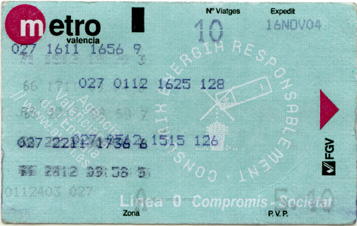
Today, my magic metro card is one year old. When I bought it twelve months ago, I never thought I'd be so lucky. I don't know exact figures, but I think I've done 200 more train rides that it should have let me, and the card should have expired the 1st of February. But it didn't, and I've been using it over and over throught the year. I only was very, very careful when inserting the card or storing it in my wallet so it wouldn't bend or be damaged in some way... it's worth a lot of money! While my primary means of transportation is the bicycle once again, having this handy is a great way to save maybe 25 every month. The Blue Gold Rush is eternal, although time does leave marks on it.


The magic card, when I found its magic properties After some hundred uses...


Go on, my blue friend! I should find someone with equipment that can copy the data in the magnetic band. That would rock.

17 November 2005

Ross Burton: Express Tosh

If I had known that the Daily Express front page yesterday was just so damn good I'd have bought a copy myself. With a paper bag on my head, obviously. Instead I have to make do with a small image. Diana Fund Pays Out To Gypsies And Asylum Seekers I'm still not sure that this isn't some great spoof or prank. Maybe someone broke in and changed the front page just as it went to press? What do we have here: Marvellous stuff. I can only imagine the Express has taken to being a parody of itself... NP: Individuality, Rachelle Ferrell

16 November 2005

Brett Parker: Django Release!

Django has finally got a release! I'll be packaging it very shortly, once I sort out the few problems that I've got in the current packages that I've built. I might even finally get round to getting something useful working in it, I just haven't had time to rewrite my site yet to use django, I'm still using a (rather non-elegant) home grown set of scripts to apply my 'template' to my site, but I think that I can make it all a lot nicer using django, and much easier to update :) Django is really quite nice, but it does need some tweaks to fit in to the FHS better, which I'll do against this nice shiny new tar ball release shortly.

Horms: Ulead Photo Explorer5 (.pe5)

I have had an unverified report form myself that the following will allow file to correctly detect Ulead Photo Explorer5 (.pe5) files.
cat >> $HOME/.magic << EOF
# Ulead Photo Explorer5
# Source: http://www.jisyo.com/cgibin/view.cgi?EXT=pe5 (Japanese)
0	string		IIO2H		Ulead Photo Explorer5
EOF
Its Debian Bug #339397 for now.

Anthony Towns: Hacking dak

Who can resist a good rhyme? Or a bad one? So this round of dak hacking turned out to make the AJ Market scheme another notch more confusing – hence the delay in blogging, and the teaser in my last post. The issue leading to the confusion is that the major item on the list to start hacking on was SCC, which unlike the projects I’ve undertaken so far, is more than a day’s hacking. In fact, due to the need to give mirrors a chance to adapt to the new system between it being implemented and actually used, it’s actually more of a multi-week task. And doing it as a one-day-a-week project would extend that into a multi-month task afaics. I guess that’s still better than never, but obviously it’s worth looking into alternatives. Naturally, then, the first phase of a longer project like this is threefold. We’ll call it “the three P’s”. Planning My theory at this point was to come up with a plan for what to do, try figuring out how much work it’d take, and then see what sort of financial arrangements might be plausible – not involving me cutting a few weeks out of my life for spare change, but without making the whole thing an unleapable chasm from what the AJ Market’s currently managing either. I figured writing it up as a semi-formal proposal makes most sense:
Summary Implementation of the outstanding mirror split proposal for the Debian archive to allow new architectures, particularly amd64, to be included in the archive. Benefit In spite (or perhaps because) of its simplicity, this project has been languishing for over two years, and is not currently being worked on; so at present it’s not even possible to estimate when it would otherwise be completed. It is most notably preventing amd64 from being integrated into the normal Debian development environment, causing derived distributions to maintain amd64 specific patches themselves. In the longer term, reducing the constraints imposed on the archive size may allow the introduction of additional suites, such as backports or volatile, as well as additional architectures; though significant further discussion on this would be needed. Background Since at least mid-2003 the Debian archive has been closed to new architectures due to the already large amount of space and bandwidth required to become a Debian mirror. At present, the archive uses some 158GiB of disk, and about 1GiB per day; additional architectures are expected to require approximately an additional 10GiB each, and there are likely around half a dozen architectures that will be considered for addition once the moratorium on new architectures is rescinded (incl amd64, armeb, sh variants, kfreebsd and possibly partial architectures for arch variants such as s390x and ppc64). The primary work needed to fix this involves:
  • ensuring the mirror network operates correctly when a majority of mirrors are partial; this reduces the impact on bandwidth and storage capacity
  • optimising portions of the archive maintenance software, particularly apt-ftparchive; this reduces the load on the archive server
  • providing appropriate guidelines on the qualification criteria new architectures need to meet in order to be added to the archive; this provides a limit on future increases, allowing growth to be appropriately controlled
Actual work I expect there will be six phases to the project:
  1. cleanup of the archive as it stands, and establishing a clear categorisation of its contents to define what a partial mirror by architecture or suite should officially contain
  2. providing appropriate scripts to ensure mirror sites can easily comply with the previously defined expectations for partial mirroring
  3. devise an appropriate structure for the new mirror network, that can easily incorporate existing mirrors, and coexist with the existing structure
  4. provide information on the new structure to both mirror admins and users; assist with the transition, and resolve any problems found
  5. ensure the archive management software is appropriately optimised, and that archive inclusion criteria have been debated and established
  6. add new ports that have passed the qualification requirements to the archive
In theory, a couple of days for each of those sound plausible, so making that twelve days actual work (with a couple of week’s delay in between for mirrors to have some time to adapt to the new network). On the downside, twelve days at a day a week is over three months of real time, not counting the possibility of doing other things with the one day a week, or Christmas, or the aforementioned delay for mirrors. Yick. So much for planning. Preparation So the next “p” is preparation. In this case that’s finally getting around to fix dak CVS, which has been slightly broken since May. The extent of the actual breakage was just the loss of the ChangeLog history, aiui (or at least, that was the unrecovered breakage), but the result of that was months of uncommitted changes on both ftp-master and security (and reportedly from Ubuntu’s dak installation too). The changelog for the first set of commits (not counting buildd changes from ftp-master, security changes or Ubuntu changes that haven’t made it to ftp-master) looks like:
        * tiffani: new script to do patches to Packages, Sources and Contents
        files for quicker downloads.
        * ziyi: update to authenticate tiffani generated files
        * dak: new script to provide a single binary with less arbitrary names
        for access to dak functionality.
        * cindy: script implemented
        * saffron: cope with suites that don't have a Priority specified
        * heidi: use get_suite_id()
        * denise: don't hardcode stable and unstable, or limit udebs to unstable
        * denise: remove override munging for testing (now done by cindy)
        * helena: expanded help, added new, sort and age options, and fancy headers
        * jennifer: require description, add a reject for missing dsc file
        * jennifer: change lock file
        * kelly: propogation support
        * lisa: honour accepted lock, use mtime not ctime, add override type_id
        * madison: don't say "dep-retry"
        * melanie: bug fix in output (missing %)
        * natalie: cope with maintainer_override == None; add type_id for overrides
        * nina: use mtime, not ctime
        * katie.py: propogation bug fixes
        * logging.py: add debugging support, use   as the logfile separator
        * katie.conf: updated signing key (4F368D5D)
        * katie.conf: changed lockfile to dinstall.lock
        * katie.conf: added Lisa::AcceptedLockFile, Dir::Lock
        * katie.conf: added tiffani, cindy support
        * katie.conf: updated to match 3.0r6 release
        * katie.conf: updated to match sarge's release
        * apt.conf: update for sarge's release
        * apt.conf.stable: update for sarge's release
        * apt.conf: bump daily max Contents change to 25MB from 12MB
        * cron.daily: add accepted lock and invoke cindy  
        * cron.daily: add daily.lock
        * cron.daily: invoke tiffani
        * cron.daily: rebuild accepted buildd stuff
        * cron.daily: save rene-daily output on the web site
        * cron.daily: disable billie
        * cron.daily: add stats pr0n
        * cron.hourly: invoke helena
        * pseudo-packages.maintainers,.descriptions: miscellaneous updates
        * vars: add lockdir, add etch to copyoverrides
        * Makefile: add -Ipostgresql/server to CXXFLAGS
        * docs/: added README.quotes
        * docs/: added manpages for alicia, catherine, charisma, cindy, heidi,
        julia, katie, kelly, lisa, madison, melanie, natalie, rhona.
        * TODO: correct spelling of "conflicts"
Ugh. Still, that’s enough to start work. And the final “P”? Come on, be honest with yourself, you know what it’s going to be. Procrastination Okay, that’s not entirely fair; the irrelevant bit of work was actually on to TODO list before SCC (mostly because it was something that I could get done reasonably quickly) and in fact was this line of the above changelog:
        * dak: new script to provide a single binary with less arbitrary names
        for access to dak functionality.
All the various model/actress names have been getting more than a little confusing recently, with almost forty in the dak suite, and another two dozen or so in use elsewhere – and then there’s the fact that the whole hot babes thing is both a bit offensive, and getting a bit old. OTOH, you need something to rename them to. We ended up deciding on the “version control solution” and introducing a “dak” command that’d launch all the different little bits of functionality depending on arguments, in the same way cvs, svn, tla, bzr, darcs etc do. The implementation’s kinda neat: we have a list of commands (like “ls”) and their description (“Show which suites packages are in”), along with the python module and function they’re in (“madison”, “main()”). That let’s us not actually have to change any of the other scripts immediately, and lets “dak ls foo” work the same as “madison foo”. It also means that down the track we don’t need to have separate modules for each subcommand, and that we can rename modules and functions without affecting the user interface. Of course it also means that all the internal scripts haven’t changed to use the new names yet, leaving the new interface a bit underused, but hey, “dak ls” at least manages to be one character shorter than “madison”, so that’s a win! To be continued…

15 November 2005

Steve Kemp: Holidays + Xine + Stats

Yesterday
I missed a holiday
I managed to fail to go away on holiday for four days by virtue of being asleep and missing the train. That sucks. Although on balance probably for the best, I was very tired.
xine-ui bug triage
I did a minor amount of triage upon the xine-ui package. There’s been an annoying bug in the package for about 40/50 days - where if you right-click upon the screen the GUI would crash. This had been reported four or five times, so I merged all the bug reports together added a patch which I’d tested. Then I mailed the maintainer asking if they’d object to an NMU to fix it. Today I got a go-ahead, so I’ll be making an upload shortly.
Debian Admin webstats
Almost more hits upon the website in the first four days of this month than in last month combined. Wow. We’re averaging close to 50,000 hits a day. When I think things like that I get all paranoid and have to remember that it doesn’t matter how good the writing is ..,

Steve Kemp: GNUMP3d + apt

Security Updates
A new version of GNUMP3d is out. This is primarily a security update. Install it now if you use it publically. (Local mirror in case you’re running from source and the gnump3d.org site hasn’t updated yet)
Apt Updates
I’ve updated my personal APT repository. This now uses reprepro to create/update/manage it. The reprepro tool is utterly wonderful. (Although I used the backported Sarge version, rather than the older one). Expect an article on the Debian Administration website shortly. Now I have an “incoming” directory I can upload new package builds to, and have them magically migrate into the relevent section. The other significant change is that now I can host packages with Arch: All, as well as i386. This is useful as I distribute several perl scripts/libraries which were previously unavailable to non-x86 users. Talking of which I still have to finish my review of The Debian System written by Martin Kraft - I’ve been sitting on that for too long. (Summary: Great Book, buy it if you can’t get one donated to review ;) ).

14 November 2005

Gergely Nagy: I need a scream!

Here's the deal: I'm terribly bad at screaming, really. Yet, I often find I want to scream at somebody, and all I can do is raise my voice a little. A few minutes ago, on #debian-devel@OFTC, a rethorical question was put out:
<Yoe> Whee
<Yoe> Don't you just *love* C++
And that got me thinking: "Would I get screamed at, loudly, if I said yes?" I could record that, and replay them when I feel like screaming. Nothing beats the angry scream of a roomful of debian developers, I'd imagine. Unfortunately, a beating was all people could promise me. That doesn't worth the trouble, though. However, as it was said shortly after, it would be a nice project for some developer gathering. And from there things followed... and now, I have a plan set out! It's quite certain that I can't attend FOSDEM (or any other conference, unless it's held in hungary on a weekend); I'd like to record some screaming; I have worked with video software before... so, the conclusion reached on #debian-devel: I should get a setup together, where I can anger the audience from my own room, at a safe distance, and record the screaming I get in return. All this using and demoing free software. Sweet, ain't it? Now I just have to find some time to do the setup and test it. Looking forward to christmas, when I plan to have a few days off of work. The relevant parts of the IRC log are, of course, available.

Clint Adams: On joue au cache-cache dans le royaume des r ves fragiles

I don't understand avoidant people, I said. They're usually scared. I don't know why she would be, but in my line of work, that's been my experience. Sometimes they're scared of themselves. she said.

13 November 2005

Matthew Palmer: Snail Racing (The Legal System)

I previously mentioned in a sidenote to another post that I've been involved in a court case over the last few weeks, and I promised a few people I'd blog about my adventures there. Obviously, not quite everything can be discussed in an open forum, but I checked with the legal beagles and I'm OK as long as I stick to generalities. Which is fine by me, since the detailed specifics are actually immensely boring. Executive Summary: It's the law Jim, but not as the TV shows it. I have to recommend that everybody spend a bit of time watching a case or two at their local court. It's surprising how different reality is to what you see on TV (of course, Australian courts are going to be different to the US courts we primarily see on TV, but even the dramatic representations of Australian courts I've seen are fairly inaccurate). The legal system, while appearing to be out in it's own little world, is a vital and integral part of most societies, so it's useful to have at least a basic idea of what goes on in them -- not because you'll end up in one (and even if you did, your lawyer will tell you what to do) but because it's an interesting insight into a part of our world that often affects us, but we don't like to look at. (Going and watching your houses of parliament, or an abboitoir, is a similar thing). Second, if you can possibly avoid it, don't get involved in a case. Not as a defendant, not as a litigant (in a civil case), and not as a witness. Litigants and defendants get screwed because they're stuck in a small room with a bunch of people they don't know or particularly like, for days or months, with a limited understanding of what's going on. Boooooooring. For witnesses, it's a different kind of pain. But I'll leave the details of that for another post. One of the things that quite surprised me is the general good nature and decent relationship between all of the legal professionals involved. They're willing to help each other out, they concede points graciously, and there's a surprising amount of banter between all of the lawyers and (in some cases) the witness as well. I'm told that this was peculiar in my case because I was involved in a voir dire[1], and everyone's on their more formal behaviour when there's a jury in the room. At times, it was almost a pleasure to watch the proceedings -- like a slightly dry but nonetheless compelling play. Most of the time, though, I characterised as "Snail Racing" -- about the most dull activity one could imagine, but nevertheless you just can't tear your attention away in case something interesting happens while you're blinking. When I say that the lawyers are good natured, that's not to imply that they're not vehemently arguing their case. Toward the end of the voir dire, in particular, counsel for the defence started to get rather vocal as to the lack of proper procedure on the part of the Crown. Over the entire voir dire, too, both counsel were always pressing hard and always trying to get their case seen in the best light. But their vigourous pursuit of the case never got personal or competitive. I think that's actually something that a lot of free software people could take on board (myself included) -- argue strongly for your position, but never internalise it or make it personal. Your position may be rather important (the defendant in my case was looking at up to 14 years if he got sent down) but making it a personal attack isn't going to help your case. I was amazed at the speed with which counsel picked up on new concepts and ideas. Unsurprisingly, the expertise I provided was quite technical, and counsel were not particularly computer literate. However, over lunches, I was able to essentially brain dump fair chunks of knowledge at the barrister, and he then went inside and laid it all out, usually accurately and very good presentation. It's also intensely satisfying to know that the questions that are being presented were suggested by you, and the skillful way that the ideas and queries were weaved together. I guess you'd get a similar buzz writing a play and then watching skilled performers bring it to life -- not necessarily exactly the way you imagined, but with an undeniable skill and vibrance. I've got a lot more material about my adventures in the legal system, which I'll be posting over the next while, but I figure this is probably well enough to be going on with for now.
1. A voir dire (as explained to me) is a sort of "trial within a trial", used to determine a point of fact or the admissability of a particular piece of evidence. It is run in the absence of a jury. They're only supposed to run for a couple of days; apparently mine was extraordinary at three weeks, although mention was made of a six week marathon (in the context of "this better not be like $OTHER_VOIR_DIRE").

12 November 2005

Anand Kumria: Onella - Party People

<p> Zeeshan Ali <a href="http://www.advogato.org/person/zeenix/diary.html?start=77">writes about Finnish women</a>. Onella is actually one of the better bars in Helsinki, hopefully you discovered the two "secret" bars after the inital heavy-metal one. The first is your typical dance-floor, the other is a uniquely Finnish experience. </p> <p> Basically it consists of drunk Finns, mainly drunk Finnish women, getting up on the table &mdash; dancing as best they can &mdash; and singing along to all the recent songs. <strong>Except it is all in Finnish!</strong>. Every song you know, and some you wish you didn't, will be sung, the audio will sound familiar but the words are Finnish. Distinctly odd. </p> <p> Yes, Zeeshan, Finns are very weird. I can not imagine anything like <a title="No secrets in Finland" href="http://today.reuters.com/news/newsArticle.aspx?type=oddlyEnoughNews&storyID=2005-11-02T150542Z_01_EIC254324_RTRUKOC_0_US-FINLAND-WAGES1.xml">this</a> happening anywhere else. Even the BBC's <a href="http://news.bbc.co.uk/1/hi/programmes/from_our_own_correspondent/4384992.stm">Night out in Helsinki</a> is fairly tame to my experience at Debconf5 </p> <p> Over the course of many nights, I saw </p> <ul> <li>Drunk women falling off tables (many times &ndash; and cute ones too!)</li> <li>People punching fists into windows</li> <li>Large brawls</li> <li>Pepper spray indiscriminately bandied about</li> <li>Bottles being thrown &ndash; by the bar staff at customers</li> </ul> <p>It makes for lots of fun adventures &mdash; If you ever meet <a title="Horms" href="http://www.vergenet.net/~horms">Simon Horman</a>, he can fill you in far better than I can</p>

Anand Kumria: Plugins I have installed

<p> <a href="http://www.stillhq.com/">Michael Still</a> <a title="trackback pings" href="http://www.stillhq.com/blosxom/000007.html">writes</a> about <a href="http://www.movabletype.org/trackback/beginners/">Trackback pings</a>. </p> <p> I'm still not used to blosxom and how everything fits together but I thought I'd enumerate the plugins I've installed. </p> <dl> <dt><a href="http://www.insanum.com/downloads/BlosxomV2/categorytree.gz">categorytree</a><dt> <dd>I've actually got this named as 01categorytree, so it runs first, but it gives me the listing of topics I've posted too</dd> <dt><a href="http://www.hecker.org/blosxom/extensionless">extrensionless</a></dt> <dd>I'm a big fan of <a href="http://www.w3.org/Provider/Style/URI">Cool URIs</a>, this helps me almost get there. Bonus points to those who can work out where I don't quite make the magic happen seemlessly. Oh, named 02extensionless.</dd> <dt><a href="http://www.blosxom.com/downloads/plugins/atomfeed">atomfeed</a></dt> <dd>As every good blogger knows, syndication is the name of the game. While you got use the deprecated RSS, <a href="http://atomenabled.org/">Atom</a> is where is it at. I've actually disabled RSS feeds in preference to atom</dd> <dt><a href="http://www.blosxom.com/downloads/plugins/breadcrumbs">breadcrumbs</a></dt> <dd>On permalink posts, you'll see a click-trail. All professional websites have them, so I figured I should too.</dd> <dt><a href="http://molelog.molehill.org/blox/Computers/Internet/Web/Blosxom/Calendar/">calendar</a></dt> <dd>Presents a calendar with all the posts you've done on various days highlighted, so you can quickly determine when someone has been sleeping or has been an insomniac</dd> <dt><a href="http://www.blosxom.com/downloads/plugins/config">config</a></dt> <dd>Comes with the Debian blosxom package, and originates with the author. Allows you to customise configuration dependant on where the post is in your heirarchy and other magic.</dd> <dt><a href="http://my-security.net/bloxsom/directorybrowse.txt">directorybrowse</a></dt> <dd>If you have deep category hierarchies this makes all the elements of the paths clickable. It's cool, you want it.</dd> <dt><a href="http://www.hecker.org/blosxom/plugins/feedback">feedback</a></dt> <dd>Part of the blogging scene is to allow other people to comment upon what you've written. This gives them comments and trackbacks. I've modified this somewhat and still need to fixup how comments are previewed but otherwise this plugin is gold</dd> <dt><a href="http://www.blosxom.com/downloads/plugins/flavourdir">flavourdir</a></dt> <dd>Also part of the <a href="http://packages.debian.org/blosxom">blosxom</a> package, this means you do not have to have your blog entries intermingled with the page templates (known as flavours) used to display them</dd> <dt><a href="http://www.blosxom.com/downloads/plugins/interpolate_fancy">interpolate_fancy</a></dt> <dd>For large plugins, like feedback, you might end with some text on your template that you only want displayed some of the time. This enhances blosxom so your template (flavour) can have conditionals, comparisons and whatnot.</dd> <dt><a href="http://noone.org/blosxom/multcat">multcat</a></dt> <dd>Not everything can be easily catagorised into one thing. This lets you put a post into multiple places. It'd be nice if all the categories a post was under was displayed as part of the category path</dd> <dt><a href="http://www.insanum.com/downloads/BlosxomV2/rendertime.gz">rendertime</a></dt> <dd>Calculates the amount of time the page took to render</dd> <p> On my todo list is to convert from a table based layout to a fluid CSS one. It'll probably be a 3-columned look with fixed-width sidebars since negative margins looks are harder to get right.</p>

Anand Kumria: Blogging with a phone

<p> Or '<a href="http://en.wikipedia.org/wiki/Moblog">mobloging</a>' for short. Basically it is using your mobile phone to add content to your blog. All very interesting, except when you get to the details. </p> <p> <a href="http://www.flamingspork.com/blog/">Stewart Smith</a> gave it a whirl ([<a title="first attempt" href="http://www.flamingspork.com/blog/?p=503">1</a>], [<a title="take two" href="http://www.flamingspork.com/blog/?p=504">2</a>]) with fairly predictable results. This is because the message you might receive is dependent on the phone manufacturer <em>and</em> the <aabr title="Multimedia Messaging Centre">MMC</abbr> does to your message. And that is before it might be mangled along the way via email. </p> <p> Basically most phones (or MMCs) will convert the content to either <a href="http://en.wikipedia.org/wiki/Base32">Base32</a> or, more commonly, <a href="http://en.wikipedia.org/wiki/Base64">Base64</a>. Generally the MMS is composed of only two parts, and then sent to an email address. From there you'll have to write something that takes the email and converts it into a blog entry. </p> <p> A while ago a friend of mine wanted to do the same, so I wrote some perl to do it for him. It seemed to work for him (with some tweaks) and it might be enough for you too. You can grab it <a title="Code to help with mobile blogging" href="http://www.progsoc.org/~wildfire/arch/projects/moblog--devo--1.0/">here</a> However you might find it simpler to use <a href="">GNU Arch</a> and register <code>http://www.progsoc.org/~wildfire/arch/projects/</code> and then browse in <code>wildfire@progsoc.org--projects/moblog</code>. </p>

11 November 2005

Robert McQueen: On contributing to Gaim

Whilst I can’t claim to have done anywhere near as much for Gaim as Christian Hammond has, I did contribute to Gaim some time ago, and for my efforts I managed at least to attain the status of “Crazy Patch Writer”. However, I gave up trying to contribute to Gaim about three years ago. After starting out as the Debian package maintainer, and one of the founders of #gaim (yes, I know, I’m sorry, it wasn’t always like that), I spent about two years submitting patches which were ignored by almost all of the developers, being forced to beg people with access (including the support/bug triaging guy, who doesn’t really code C) to review and commit them. At the time, nobody was being given CVS access because of a recalcitrant and unresponsive former developer holding the reigns of the Sourceforge project. A few developers came and went, and in what I thought was a miracle, the now lead developer was made an administrator of the Sourceforge project and gradually started handing out access to other people who had been contributing. Except… I was passed over time and time again, and other contributors who had around for less time than myself were given access. I could accept this if I was given some justification, but I was ignored when I asked about getting CVS access and never given any reasons, despite having contributed hours and hours of my time and helped rewrite and clean up sizeable chunks of code. It actually had me close to tears on several occasions, and still upsets me a huge deal that no explanation was ever offered to me. After starting out with packaging work in Debian, Gaim was the first project where I became involved with actual development, and I learnt a great deal from hacking on it, but when I started at university I decided I’d spent enough time pouring my heart into such an unwelcoming recipient, and I moved on quietly.

10 November 2005

David Nusinow: Modular Server Debs!

I've been relatively quiet lately because I've been plodding along, working on modular packages for Xorg. For those who don't know, the next release of Xorg will actually be two releases of the same code. One release, 6.9, will be based on the old monolithic build system. This system requires me to build every single part of Xorg whenever I want to update any one part. This means that whenever I push out an Xorg fix, no matter which component it's in, you have to download all the other components even if they are 100% identical to the previous version already on your hard drive. We've all lived with this for a long time, and while it's not pleasant, we all seem to get by. The packaging apparatus for this system is mature, stable, and well understood, if complex. That's why I've been able to get the 6.9 release candidate packages out to experimental fairly quickly after they are released.

The other release happening is for 7.0, which is obviously a major version number bump. The actual code you run for 6.9 and 7.0 is 100% identical, but the build system has been totally rewritten around the venerable autotools (you know... configure /make/make install). Each piece has been split out from the others so that you can build any one component without building all the others. This means that if we want to ship a driver update, you don't have to download all of the fonts and other things that weren't touched. That also means that you won't have to install the drivers for cards you don't own if you don't want them. Furthermore, it lowers the barrier for things like hacking on X significantly.

The problem with the modular tree is that the packages for it are brand new. Ubuntu shipped modularized versions of the libraries, and I've already stolen those, fixed them up for Debian, and built them locally (they're sitting in our svn repo, but running them won't get you anything at this point.) The server and driver packages are brand new, and I've been taking the packages from Ubuntu's development branch and working on them for Debian. Today was a milestone day because in addition to the libs, with Daniel Stone's constant help I've finally managed to build packages for the modular X server itself. Now I can't run it yet (I haven't packaged the drivers and a few other bits) but the fact that I managed to produce what will be a functional server package is a huge step, and constitutes the cornerstone of the whole thing.

Once we can create packages that can actually run on at least the machines of the XSF, we can start looking at getting the packages in to the archive. Since these aren't well tested like the monolithic packages, we'll have to do a lot of polishing to get them to the same level of quality. My goal is to get that done for etch though, and I think we can do it. Exciting things are happening, and I'm hoping that the modular packages will encourage more people to hack on X, leading to even more exciting things. Build that momentum.

9 November 2005

Ian Murdock: No good deed goes unpunished

One of the big Debian stories of the week is that a company called Nexenta Systems has made a version of Ubuntu that’s based on OpenSolaris rather than the Linux kernel. Personally, I find the emergence of a Debian-based OpenSolaris distribution exciting, as it promises to vastly improve Solaris installation, packaging, and overall usability. Solaris is great technology with an incredible pedigree and some very compelling features (DTrace, in particular, sounds like a godsend, as I’m sure anyone who’s debugged kernel code via endless iterations of inserting printfs at strategic places would agree), not to mention that it’s now open source. However, when a Linux developer eager to have a look at all this neat new open source stuff boots up Solaris for the first time, it’s a bit of a throwback to an earlier time (not to mention the fact that apt-get is a hard habit to break..). And, so, I’m more than a little embarrassed at how certain members of the Debian community reacted to Nexenta’s work. The vitriol surprised even me, knowing as much as I know about how, uh, strongly the Debian community feels about certain issues. The issue in this case: Nexenta links GPL-licensed programs (including dpkg) with the Sun C library, which is licensed under the GPL-incompatible but still free software/open source CDDL license. Granted, Nexenta didn’t go about introducing themselves to the Debian community in the best way, and there may (may) be issues around whether or not what they are doing is permitted by the GPL, but couldn’t we at least engage them in a more constructive manner? In terms of the actual issue being discussed here, am I the only one who doesn’t get it? It seems to me the argument that linking a GPL application to a CDDL library and asserting that that somehow makes the library a derivative work of the application is, to say the least, a stretch—not to mention the fact that we’re talking about libc here, a library with a highly standard interface that’s been implemented any number of times and, heck, that’s even older than the GPL itself. It’s interpretations like this, folks, that give the GPL its reputation of being viral, and I know how much Richard Stallman hates that word. It’s one thing to ensure that actual derivative works of GPL code are themselves licensed under similar terms; it’s quite another to try to apply the same argument to code that clearly isn’t a derivative work in an attempt to spread free software at any cost. I’ve been a big GPL advocate for a long time, but that just strikes me as wrong.

Jonathan McDowell: OpenID enabled

Right, I think I've now done the magic to OpenID enable comments. Thanks to Slarti for the basis of the Blosxom support to do this. If you've got a Livejournal you already have an OpenID and if not then you can just a service like that provided by ImperialViolet, which is what I'm doing at present until I find time to knock a server up for earth.li.

7 November 2005

Simon Law: Jeff Bailey Love Day


Jeff Waugh escaped
Originally uploaded by magicfab.
Two Sundays ago, Jim and I walked down to Ubuntu Love Day. The Ubuntu Below Zero conference is being held at the Holiday Inn in Chinatown. That's the one with the fake Chinese tiles on the roof, which is sort of tacky. We found our way downstairs to the conference room and sat down. The previous night's revelries still had quite the effect, so I'm afraid I drifted in and out while listening to people speak. I thought I had rid myself of this habit, but apparently university has trained me to consider digital projectors as sleeping aids. I'll have to do something about this one day. I got to see some fairly interesting people: Mattias Klaus, whom I met earlier at Jeff Bailey's place; Fabio Di Nitto, who is incredibly jolly; Chris Peterman, who was with his classmates from Clarkson; Colin Watson, whom I thanked for working so hard on Debian; Jeff Waugh, who dressed up as an inmate; and plenty of others. Oh, I managed to meet Andrew Mitchell in person, but we failed to have a proper CHUG meeting while we were all in town. We broke for lunch, which was held in the hotel restaurant. A buffet, with some Chinese-style dishes, was being served. There, we had to negotiate with the unilingual (Cantonese) staff to find out what Jeff could eat. We had a special order of plain white rice brought for him and we were informed that it was safe for him to eat the stir-fried vegetables. I suggested to Jeff that he ought to keep a phrasebook on him whenever he travels. On each page, one per language, there should be a written description of what he can and cannot eat. Then, he just has to show this to waiters who don't speak English or French.

Stocking the buffet
Originally uploaded by magicfab.
For reference, the characters that mean "vegetarian" in Chinese are and . Most of the time, they mean "vegan", but there are some places where eggs and oysters are considered vegetarian. After lunch, Mark Shuttleworth gave Jeff a very nice birthday speech. He also gave Jeff a nice bottle of wine, which was very nice. And Matthias came up to give Jeff a bottle of fish-oil pills, which was very odd. Then, there were two Birds Of a Feather sessions, involving how to make an Ubuntu package and how to be an Ubuntu advocate. Being upstream to both these issues, I sat in the middle of the room and listened to both presentations at once. This was quite interesting, and slightly taxing. After this was done, we broke up once more. The plan for the evening was to meet for dinner in the hotel lobby. This transformed to meeting outside the front door. Jim, [info]wlach, and I showed up and were greeted by this mass of people. Since there were stragglers and I knew where dinner was to be held, Jeff took a group of nineteen people in the metro. I followed about ten minutes later with a group of eighteen. We met up on St-Denis, and by this time we had lost some of the more impatient, and more hungry, people. Eventually, a group of twenty-three were milling about outside Le Nil Bleu. Angie had made arrangements for us to be served a set meal, and they had agreed to seat twenty-five of us. I went inside to let the staff know that we had arrived. When 20:30 came around, we were let into the restaurant and seated. I think the kitchen was still preparing food, because we had to wait about an hour before being served. Unlike my previous experience there with Jeff, the food was quite good this time and the service was very attentive. We enjoyed ourselves very much, and Jeff seemed to be having a very excellent birthday dinner. Some of the guests were not so happy, because the food was a little spicy for their European palates. Since gratuities are not standardised around the world, we discovered that some people had not tipped. To cover the embarassment, Angie and I made sure that the wait-staff were adequately compensated for their efforts. I'll be sure to go back to this restaurant again, but with a more significant crowd to ensure good service. After eating, a group of us including Matthias and Tollef went up to B l K , which was just a little north on Mont-Royal. That's a really interesting bar with beautiful tiled floors and ostrich heads on the walls. We enjoyed the lovely music, had a very good conversation there, and laughed until we were all exhausted. Since the Canonical people had to be awake for the 09:00 keynote speech the next day, they left early. Jim and I bid goodnight to them before we staggered home.
Adeodato Sim : New email address

From now on, I’ll be using dato(at)the-barrel.org as my main address, instead of asp16(at)alu.ua.es. (But this second one, provided by my Uni, will continue to work for some more years, and not unlikely forever.) I was not that dissatisfied with the MX host for alu.ua.es, but it has been getting on my nerves on occasion during the last five years, so I decided it was better for my health to make the change. Kudos to Alberto Gonzalez Iniesta (agi@d.o) for being my postmaster from now on, since I really didn’t feel like running my own mailserver. The story behind the-barrel.org is certainly not unrelated to this Google search.

4 November 2005

Adam Rosi-Kessel: Scowcroft on Bush

Fascinating New Yorker interview with Brent Scowcroft, National Security Advisor to Bush 41. I wonder how the author, Jeffrey Goldberg, gets this degree of access: he’s apparently emailing back and forth with Bush 41, having coffee with Colin Powell, and engaging in frank discussion with Scowcroft for a significant period of time. This sort of reporting is the antithesis of what you see in most newspapers, where the reporter probably spends no more than a few hours piecing together information that is widely available. This is also consistent with everything I’ve seen in the New Yorker for the past few months I’ve been subscribing—high quality writing and primary source information that you won’t pick up just from reading blogs. In any case, it’s interesting to see all these conservative ideologues from the Reagan-Bush era turn on the neoconservatives. If Brent Scowcroft thinks the war in Iraq is misguided, does the current administration have any hope at all?

Next.

Previous.