Search Results: "ag"

3 February 2017

Holger Levsen: Going to FOSDEM after switching away from Debian

So last weekend I attended Devconf.cz in Brno and together with Dennis Gilmore gave a talk about Reproducible Builds and Fedora (Slides) which was fun and - I think - pretty well received. Then on the following Tuesday, so three days ago, after using Debian as the primary OS on my primary computer for more than two decades, I finally made the long anticipated switch and I must say, so far I'm really happy with my new environment, even though I'm not yet again using a tiled window manager (but instead Xfce), cannot yet do all the things I could do before and even have to reconfigure a VM twice and restart another to get back wireless network after suspend and resume So what have I done? Nothing too dramatic: I've switched to Qubes OS and now I'm running Debian jessie and stretch and Fedora and Whonix on my primary computer, just not as my primary OS :-) IOW: hardware is basically software and while I want the red pill, who knows what's really inside the box? If you have no idea what I'm talking about, this intro about Qubes OS might be helpful. Or you dive directly into this six year old post, where Joanna Rutkowska described how she partitioned her digital life using Qubes. I'm not sure where this journey will lead me to, but I'm confident this is the right direction. And in case you wondered, I'll keep working on Debian, as far as I know now ;-)

Benjamin Mako Hill: New Dataset: Five Years of Longitudinal Data from Scratch

Scratch is a block-based programming language created by the Lifelong Kindergarten Group (LLK) at the MIT Media Lab. Scratch gives kids the power to use programming to create their own interactive animations and computer games. Since 2007, the online community that allows Scratch programmers to share, remix, and socialize around their projects has drawn more than 16 million users who have shared nearly 20 million projects and more than 100 million comments. It is one of the most popular ways for kids to learn programming and among the larger online communities for kids in general.
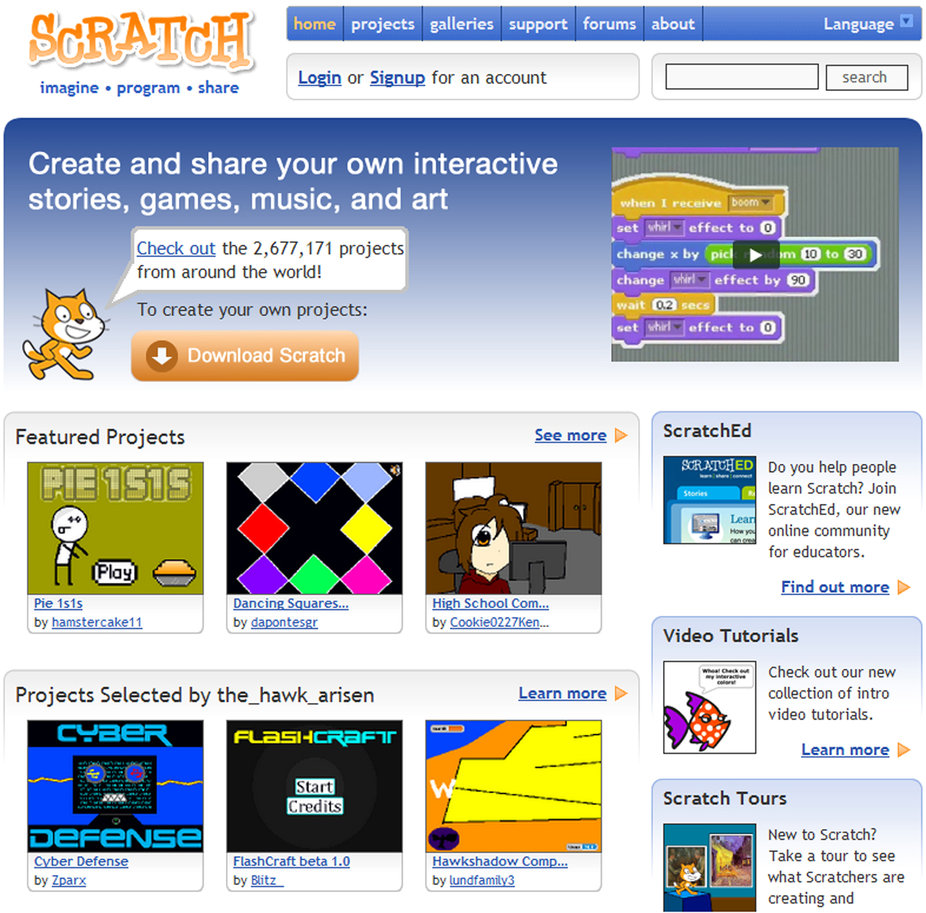
Front page of the Scratch online community (https://scratch.mit.edu) during the period covered by the dataset.
Since 2010, I have published a series of papers using quantitative data collected from the database behind the Scratch online community. As the source of data for many of my first quantitative and data scientific papers, it s not a major exaggeration to say that I have built my academic career on the dataset. I was able to do this work because I happened to be doing my masters in a research group that shared a physical space ( The Cube ) with LLK and because I was friends with Andr s Monroy-Hern ndez, who started in my masters cohort at the Media Lab. A year or so after we met, Andr s conceived of the Scratch online community and created the first version for his masters thesis project. Because I was at MIT and because I knew the right people, I was able to get added to the IRB protocols and jump through the hoops necessary to get access to the database. Over the years, Andr s and I have heard over and over, in conversation and in reviews of our papers, that we were privileged to have access to such a rich dataset. More than three years ago, Andr s and I began trying to figure out how we might broaden this access. Andr s had the idea of taking advantage of the launch of Scratch 2.0 in 2013 to focus on trying to release the first five years of Scratch 1.x online community data (March 2007 through March 2012) most of the period that the codebase he had written ran the site. After more work than I have put into any single research paper or project, Andr s and I have published a data descriptor in Nature s new journal Scientific Data. This means that the data is now accessible to other researchers. The data includes five years of detailed longitudinal data organized in 32 tables with information drawn from more than 1 million Scratch users, nearly 2 million Scratch projects, more than 10 million comments, more than 30 million visits to Scratch projects, and much more. The dataset includes metadata on user behavior as well the full source code for every project. Alongside the data is the source code for all of the software that ran the website and that users used to create the projects as well as the code used to produce the dataset we ve released. Releasing the dataset was a complicated process. First, we had navigate important ethical concerns about the the impact that a release of any data might have on Scratch s users. Toward that end, we worked closely with the Scratch team and the the ethics board at MIT to design a protocol for the release that balanced these risks with the benefit of a release. The most important features of our approach in this regard is that the dataset we re releasing is limited to only public data. Although the data is public, we understand that computational access to data is different in important ways to access via a browser or API. As a result, we re requiring anybody interested in the data to tell us who they are and agree to a detailed usage agreement. The Scratch team will vet these applicants. Although we re worried that this creates a barrier to access, we think this approach strikes a reasonable balance. Beyond the the social and ethical issues, creating the dataset was an enormous task. Andr s and I spent Sunday afternoons over much of the last three years going column-by-column through the MySQL database that ran Scratch. We looked through the source code and the version control system to figure out how the data was created. We spent an enormous amount of time trying to figure out which columns and rows were public. Most of our work went into creating detailed codebooks and documentation that we hope makes the process of using this data much easier for others (the data descriptor is just a brief overview of what s available). Serializing some of the larger tables took days of computer time. In this process, we had a huge amount of help from many others including an enormous amount of time and support from Mitch Resnick, Natalie Rusk, Sayamindu Dasgupta, and Benjamin Berg at MIT as well as from many other on the Scratch Team. We also had an enormous amount of feedback from a group of a couple dozen researchers who tested the release as well as others who helped us work through through the technical, social, and ethical challenges. The National Science Foundation funded both my work on the project and the creation of Scratch itself. Because access to data has been limited, there has been less research on Scratch than the importance of the system warrants. We hope our work will change this. We can imagine studies using the dataset by scholars in communication, computer science, education, sociology, network science, and beyond. We re hoping that by opening up this dataset to others, scholars with different interests, different questions, and in different fields can benefit in the way that Andr s and I have. I suspect that there are other careers waiting to be made with this dataset and I m excited by the prospect of watching those careers develop. You can find out more about the dataset, and how to apply for access, by reading the data descriptor on Nature s website.

Marc 'Zugschlus' Haber: insecssh

Yes, You Should Not discard cached ssh host keys without looking. An unexpected change of an ssh host key is always a reason to step back from the keyboard and think. However, there are situations when you know that a systems ssh host key has changed, for example when the system reachable under this host name has been redeployed, which happens increasingly often proportionally to the devopsness of your environment, or for example in test environments. Later versions of ssh offer you the ssh-keygen -R command line to paste from the error message, so that you can abort the connection attempt, paste the command and reconnect again. This will still ask for confirmation of the new host key though. Almost every sysadmin has an alias or wrapper to make handling of this situation easier. Solutions range from using StrictHostKeyChecking no and/or UserKnownHostsFile /dev/null , turning off this layer of securit altogether either globally or usually too broadly, to more-or-less sophisticated solutions that involve turning off know-host file hashing, parsing client output and/or grep-sed-awk magic. grml even comes with an insecssh script that is rather neat and that I used until I developed my own. Later ssh versions (not including the 6.7 in Debian jessie, but the 7.4 in debian sid) do offer a -G command line option which will give access to configuration options after the complete client configurtion was processed. This will allow you to neatly get access to the actual hostname the ssh client will connect to. This can, in turn be used to obtain the IP address so that all traces of the host and its IP addresses can be removed from the known_hosts file before the actual connection is done. The following script is the insecssh that I currently use. It only uses documented interfaces to the ssh client which I consider rather neat.
#!/bin/bash
HOSTNAME=$(ssh -G  $@    grep  ^hostname '   awk  print $2 )
CNAME= 1 
while [ -n  $CNAME  ]; do
  CNAME=$(dig +short +search -t CNAME  $HOSTNAME )
  if [ -n  $CNAME  ]; then
    HOSTNAME= $CNAME 
  fi
done
IP4ADDRESS=$(dig +short +search -t A  $HOSTNAME )
IP6ADDRESS=$(dig +short +search -t AAAA  $HOSTNAME )
echo  HOSTNAME $HOSTNAME 
echo  IP4ADDRESS $IP4ADDRESS 
echo  IP6ADDRESS $IP6ADDRESS 
[ -n  $HOSTNAME  ] && ssh-keygen -R  $HOSTNAME 
[ -n  $IP4ADDRESS  ] && ssh-keygen -R  $IP4ADDRESS 
[ -n  $IP6ADDRESS  ] && ssh-keygen -R  $IP6ADDRESS 
ssh -oStrictHostKeyChecking=no -oVisualHostKey=yes  $@ 
Ugliness results from the necessity of following CNAMEs manually since there is - to my knowlegde (educate me!) - no command line utility that has the output simplicity and selection powers of dig which can automatically follow CNAMEs without relying on the recursor having the CNAME cached or not. Use this script if you know that a host has changed its host key. It will first zap all knowledge of the previous host key from known_hosts and then invoke the ssh client with the given arguments from its command line, with options added so that you ll see the new host key in random art and that you don t need to manually confirm the new host key.

Dirk Eddelbuettel: RPushbullet 0.3.0

RPpushbullet demo A major new update of the RPushbullet package is now on CRAN. RPushbullet interfacing the neat Pushbullet service for inter-device messaging, communication, and more. It lets you easily send alerts like the one to the to your browser, phone, tablet, ... -- or all at once. This release owes a lot to Seth Wenchel who was instrumental in driving several key refactorings. We now use the curl package instead of relying on system() calls to the binary. We also switched from RJSONIO to jsonlite. A new helper function to create the required resourcefile was added, and several other changes were made as detailed below in the extract from the NEWS.Rd file.

Changes in version 0.3.0 (2017-02-03)
  • The curl binary use was replaced by use of the curl package; several new helper functions added (PRs #30, #36 by Seth closing #29)
  • Use of RJSONIO was replaced by use of jsonlite (PR #32 by Seth closing #31)
  • A new function pbSetup was added to aid creating the resource file (PRs #34, #37 by Seth and Dirk)
  • The package intialization was refactored so that non-loading calls such as RPushbullet::pbPost(...) now work (#33 closing #26)
  • The test suite was updated and extended
  • The Travis script was updated use run.sh
  • DESCRIPTION, README.md and other files were updated for current R CMD check standards
  • Deprecated parts such as 'type=address' were removed, and the documentation was updated accordingly.
  • Coverage support was added (in a 'on-demand' setting as automated runs would need a Pushbullet API token)

Courtesy of CRANberries, there is also a diffstat report for this release. More details about the package are at the RPushbullet webpage and the RPushbullet GitHub repo.

This post by Dirk Eddelbuettel originated on his Thinking inside the box blog. Please report excessive re-aggregation in third-party for-profit settings.

Petter Reinholdtsen: A day in court challenging seizure of popcorn-time.no for #domstolkontroll

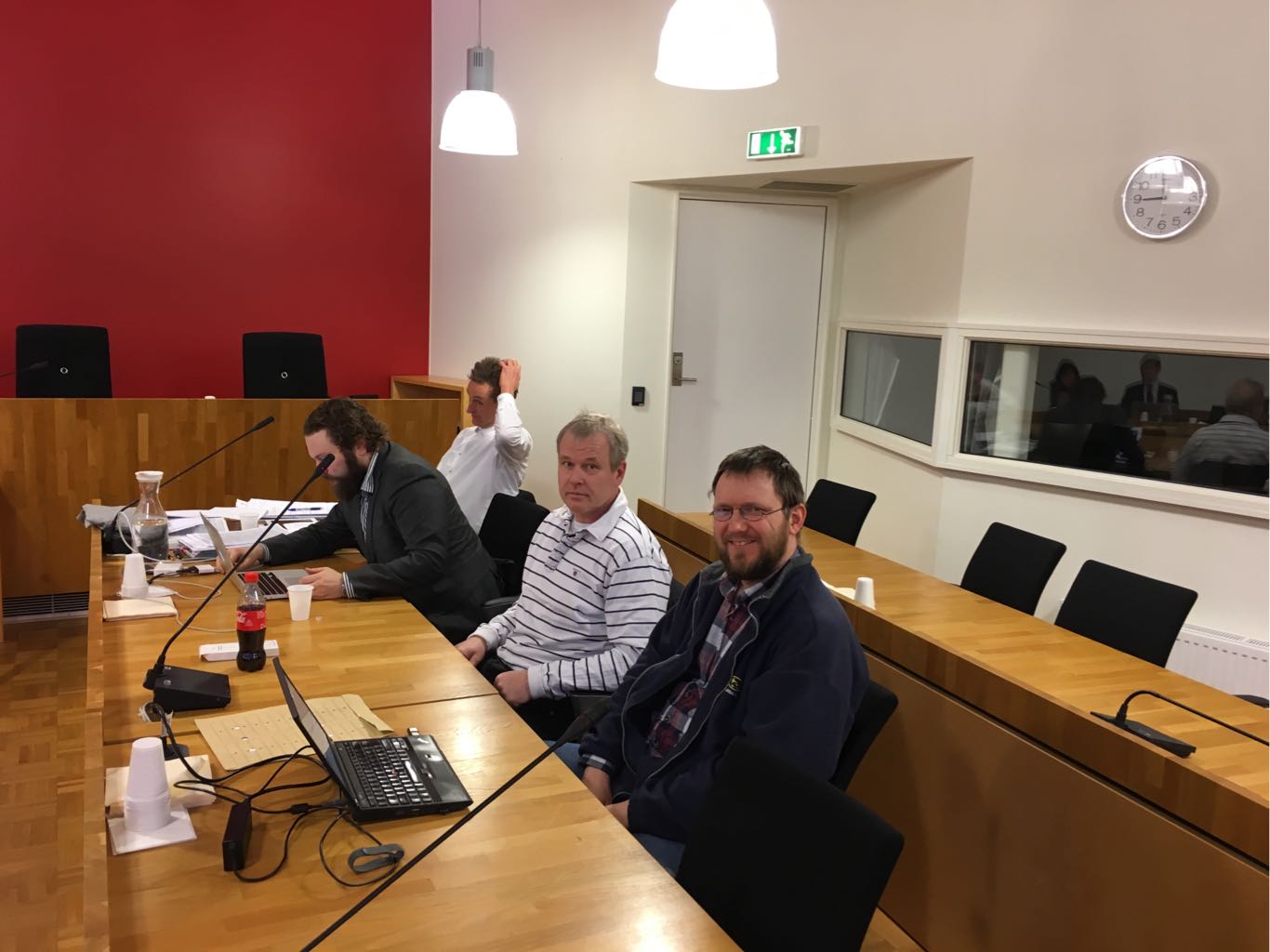
On Wednesday, I spent the entire day in court in Follo Tingrett representing the member association NUUG, alongside the member association EFN and the DNS registrar IMC, challenging the seizure of the DNS name popcorn-time.no. It was interesting to sit in a court of law for the first time in my life. Our team can be seen in the picture above: attorney Ola Tellesb , EFN board member Tom Fredrik Blenning, IMC CEO Morten Emil Eriksen and NUUG board member Petter Reinholdtsen. The case at hand is that the Norwegian National Authority for Investigation and Prosecution of Economic and Environmental Crime (aka kokrim) decided on their own, to seize a DNS domain early last year, without following the official policy of the Norwegian DNS authority which require a court decision. The web site in question was a site covering Popcorn Time. And Popcorn Time is the name of a technology with both legal and illegal applications. Popcorn Time is a client combining searching a Bittorrent directory available on the Internet with downloading/distribute content via Bittorrent and playing the downloaded content on screen. It can be used illegally if it is used to distribute content against the will of the right holder, but it can also be used legally to play a lot of content, for example the millions of movies available from the Internet Archive or the collection available from Vodo. We created a video demonstrating legally use of Popcorn Time and played it in Court. It can of course be downloaded using Bittorrent. I did not quite know what to expect from a day in court. The government held on to their version of the story and we held on to ours, and I hope the judge is able to make sense of it all. We will know in two weeks time. Unfortunately I do not have high hopes, as the Government have the upper hand here with more knowledge about the case, better training in handling criminal law and in general higher standing in the courts than fairly unknown DNS registrar and member associations. It is expensive to be right also in Norway. So far the case have cost more than NOK 70 000,-. To help fund the case, NUUG and EFN have asked for donations, and managed to collect around NOK 25 000,- so far. Given the presentation from the Government, I expect the government to appeal if the case go our way. And if the case do not go our way, I hope we have enough funding to appeal. From the other side came two people from kokrim. On the benches, appearing to be part of the group from the government were two people from the Simonsen Vogt Wiik lawyer office, and three others I am not quite sure who was. kokrim had proposed to present two witnesses from The Motion Picture Association, but this was rejected because they did not speak Norwegian and it was a bit late to bring in a translator, but perhaps the two from MPA were present anyway. All seven appeared to know each other. Good to see the case is take seriously. If you, like me, believe the courts should be involved before a DNS domain is hijacked by the government, or you believe the Popcorn Time technology have a lot of useful and legal applications, I suggest you too donate to the NUUG defense fund. Both Bitcoin and bank transfer are available. If NUUG get more than we need for the legal action (very unlikely), the rest will be spend promoting free software, open standards and unix-like operating systems in Norway, so no matter what happens the money will be put to good use. If you want to lean more about the case, I recommend you check out the blog posts from NUUG covering the case. They cover the legal arguments on both sides.

Pau Garcia i Quiles: Almost at FOSDEM. Video volunteers?

I am boarding my flight to Brussels to attend FOSDEM. The Desktops DevRoom will be a blast again this year. While I have been in charge of it for 6? years already, the last two (since my twins) were born I had organized remotely and local duties were carried on by the Desktops DevRoom team (thank you Christophe Fergeau, Philippe Caseiro and others!). I am anxious at meeting old friends again. I will be at the beer event today. Video streaming will be available thanks to the Video Team. If you want to help, please contact us in the desktops-devroom@lists.fosdem.org mailing list, or directly at the devroom. Also, this year will be the first for me using the job corner to recruit: my company (everis) is recruiting globally for many open positions. Drop us a mail at fosdem@everis.com with your CV, desired position and location (we have direct presence in 13 countries and indirect in 40 countries) and I will make sure it reaches the right inbox.

2 February 2017

intrigeri: First Tails beta release based on Stretch

Today, I have released the first beta for Tails 3.0, that will be the first version of Tails based on Debian 9 (Stretch). Our automated test suite pretends it works pretty well and matches our safety expectations. I'm inclined to trust it. But as we learned after porting Tails to Squeeze, Wheezy and Jessie: quick, exploratory testing of pre-releases will not identify all the remaining regressions. So this time I'm trying to change this narrative a bit. I have committed to provide security updates for the 3.0~ series, just like we do for stable versions of Tails. This was the only missing bit to make me feel comfortable asking my fellow Tails contributors to upgrade to Tails 3.0~beta1 for their daily usage. I hope this helps us release a great Tails 3.0 on June 13 and a better Debian Stretch too: the more early users of Tails based on Stretch, the more chances they identify a few annoying regressions in Stretch before it's called stable :) For details, see the official announcement. Next step: FOSDEM. And then, back to organizing an event that aims at improving both social and technical aspects of Debian (to be announced in about a week, stay tuned); because the way we get organized and how power is distributed matter.

Steinar H. Gunderson: Not going to FOSDEM but a year of Nageru

It's that time of the year :-) And FOSDEM is fun. But this year I won't be going; there was a scheduling conflict, and I didn't really have anything new to present (although I probably could have shifted around priorities to get something). But FOSDEM 2017 also means there's a year since FOSDEM 2016, where I presented Nageru, my live video mixer. And that's been a pretty busy year, so I thought I'd do a live cap from high up above. First of all, Nageru has actually been used in production we did Solskogen and Fyrrom, and both gave invaluable input. Then there have been some non-public events, which have also been useful. The Nageru that's in git right now is evolved considerably from the 1.0.0 that was released last year. diffstat shows 19660 insertions and 3543 deletions; that's counting about 2500 lines of vendored headers, though. Even though I like deleting code much more than adding it, the doubling (from ~10k to ~20k lines) represents a significant amount of new features: 1.1.x added support for non-Intel GPUs. 1.2.x added support for DeckLink input cards (through Blackmagic's proprietary drivers), greatly increasing hardware support, and did a bunch of small UI changes. 1.3.x added x264 support that's strong enough that Nageru has really displaced VLC as my go-to tool for just video-signal-to-H.264-conversion (even though it feels overkill), and also added hotplug support. 1.4.x added multichannel audio support including support for MIDI controllers, and also a disk space indicator (because when you run out of disk during production without understanding that's what happens, it really sucks), and brought extensive end-user documentation. And 1.5.x, in development right now, will add HDMI/SDI output, which, like all the previous changes, requires various rearchitecting and fixing. Of course, there are lots of things that haven't changed as well; the basic UI remains the same, including the way the theme (governing the look-and-feel of the finished video stream) works. The basic design has proved sound, and I don't think I would change a lot if I were to design something like 1.0.0 again. As a small free software project, you have to pick your battles, and I'm certainly glad I didn't start out doing something like network support (or a distributed architecture in general, really). So what's for the next year of Nageru? It's hard to say, and it will definitely depend on the concrete needs of events. A hot candidate (since I might happen to need it) is chroma keying, although good keying is hard to get right and this needs some research. There's also been some discussion around other concrete features, but I won't name them until a firm commitment has been made; priorities can shift around, and it's important to stay flexible. So, enjoy FOSDEM! Perhaps I'll return with a talk in 2018. In the meantime, I'll preparing the stream for the 2017 edition of Fyrrom, and I know for sure there will be more events, more features and more experiences to be had. And, inevitably, more bugs. :-)

Shirish Agarwal: The $100 used laptop and getting riled up.

Lenovo-ThinkPad-T500 - Source - Wikimedia commons

Lenovo-ThinkPad-T500 Source Wikimedia commons

I was reading a thread on phoronix where a student was sharing that it is or can be expensive to get even a used laptop and he shared his predicament and was hammered a bit for it to some going to the extent of questioning his life-choices. While I m not a student it still triggered something in me. I am not dirt poor but neither am I insanely rich. The same questions he has, similar questions I have had. While in his case he is probably in his early to late 20 s, I am pushing 40. Most of the money I make goes in for everyday purchases, veggies, house-rent, electricity, landline, broadband and cell phone bills. What little is left is most of the time kept for a rainy day as there is no Government pension. From what I have heard and read on the web, in the west specifically in the States, if I buy a used laptop, I usually get a 6 months 1 year warranty . Here, while you could get a used laptop for around INR 10k there is no warranty/guarantee, so I never get into that. It s buyer s beware all the time. For people who like/want FOSS or specifically something like Free DOS (like me), I had to wait for almost 6 years to get a model I was happy with, with the specs. I was ok with. Was really lucky enough to get a Thinkpad T440 with 8 GB of RAM for around INR 80k/- with Free DOS. The specs T440 Core I 5 (4300) / Dos (NEW MODEL) 20B7A1SD00 Intel Core i5 4300M (2.5 GHz / 3 MB / 5 GT/s) / Intel QM87 Chipset / Integrated 802.11 n WIFI LAN + Bluetooth 4.0 / 8GB DDR III Memory (2 DIMM SLOT) / 500 GB SATA HDD @ 7200 RPM / 14.0 HDy / FPR / Dos / 2 USB , VGA Port , RJ 45 Port /GB LAN /Track Point with 5 button Glass Touch Pad /Stereo Speakers with Dolby Enhanced Audio / 6 Cell Battery /Approx 2.14KG/ While it is/was actually pretty expensive but then wanted something which can take a beating, deal with all the heat, noise and dust (specifically where I live, right in the middle of the city). The reason I used the word lucky is that now there is no model in the T-series range which has FreeDOS on it. Of course, I hopefully will use it for another 4-5 years at the very least depending on how much it cooperates with me, I have heard that Thinkpads function for a long period of time even in dusty environments so banking on that.  What probably pissed me is the condensing note in the comment, how does he know what pressures an another individual might be in. It s almost like saying You are refugee because you made a wrong life choice or something to that effect which again is stupid. I actually feel/felt embarrassed to bring this up as I truly am lucky to be safe, secure, have food on the table, am able to sleep on a bed at night, have a workstation AND a laptop, have somewhat of a sound mind  and a body which is able to move around without any hassles. Add to that, incredibly as it may sound, was also able to see another country for a few days In relation to people being persecuted and having to run off to save their own lives or even people living on the streets, I am actually living in luxury. While I can t go through life feeling guilty for all the good things that have happened with me, I do feel disgusted when I see some people put blinding statements like that. One of the biggest reasons that GNU/Linux and Debian in particular gelled with me was that it s incredibly flexible and generous. Nobody tells me which packages I should or shouldn t have. I do right things, good, I do something wrong, an opportunity to learn and hopefully learn from my mistakes. In either case, one of the most forgiving kind of system to learn and hack on. While speaking of mistakes, could somebody look at #849684 . It almost feels like a tennis match going between the maintainers concerned. While I don t have the technical skills to ascertain who s right and who is not, it would be nice if some cooler heads can make sense and see if a way could be found out. Can somebody help ?
Filed under: Miscellenous Tagged: #debian, #Life Choices, #Thinkpad440, laptop

Guido G nther: Debian Fun in January 2017

Debian LTS November marked the 21st month I contributed to Debian LTS under the Freexian umbrella. I had 8 hours allocated which I used for: Other Debian stuff Some other Free Software activites

Urvika Gola: Outreachy- Week 6 & 7 Progress

Working with Date, Calendar, SimpleDateFormat in Android. As I mentioned In my last blog, I would talk about how I used Calendar and Date classes for the user to designate silent mode by setting time constraints and weekdays, in Lumicall. Date class to used to interpret dates as year, month, day, hour, minute, and second values. I had to compare whether the current time falls between Start Time and End Time specified by the user. So that, silent mode can be enabled within that time frame. I used Calendar Class to get the current hour in 24-Hour format and minute.

 Calendar now = Calendar.getInstance();
 int hour = now.get(Calendar.HOUR_OF_DAY);  
 int minute = now.get(Calendar.MINUTE);
Now, Since the user enters the Time in EditText Widgets, the values were retrieved as strings.
String hhStart, mmStart, hhEnd, mmEnd store these values from Edit text widgets.
To interpret these strings as a representation of a date and time, we need to parse it A Date class object s format looks like-
unnamed
Since, I was only interested in fetching the HH:MM values, i.e the fourth field in the format, To set and compare only the HH:MM values, Android provides lovely, SimpleDateFormat class to access the particular value we want in the Date object.
To access the year, use letter Y
To access the time zone, use letter z
To access the Hour and minute, we use letter H and m.
SimpleDateFormat simpleDateFormat= new SimpleDateFormat( HH:mm , Locale.ENGLISH);
Date currentTime = parseDate(hour + ":" + minute)
Date timeCompareOne = parseDate(hhStart + : +mmStart);  
Date timeCompareTwo = parseDate(hhEnd + : +mmEnd);

Rest everything in the date object are values set by default. Eg, Year 1970. Which we din t set / access , hence did not change. To check if the start time is before the current time. And the endtime is after the current time,
if(timeCompareOne.before(currentTime) && timeCompareTwo.after(currentTime))
 
Switch on the silent mode;
 
Added a try catch block to handle the exception which will arise if the SimpleDateFormat.parse method is unable to parse the given Java String.
public Date parseDate(String date)  
  
try 
   
return inputParser.parse(date);
  
catch (java.text.ParseException e)  
   
return new Date(0);  
   
 
Comparing Time? Done!
Now to check whether the selected weekday in the checkboxes matches the current week day,
Calendar calendar = Calendar.getInstance(); 
int day = calendar.get(Calendar.DAY_OF_WEEK); 
If it s sunday, value returned by calendar.get(Calendar.DAY_OF_WEEK) is 1, if monday, 2 and so on..
Weekdays compared too!  Thanks for reading,
U

Steve Kemp: I've built a product, not a project

The past few days I've been doing more arduino-work. In between dying of sleep-exhaustion. One thing that always annoyed me was that I had to hard-code my WiFi credentials in my projects, with code like this:
//
// Connect to the SCOTLAND network
//
WiFi.mode(WIFI_STA);
WiFi.hostname("tram-clock");
WiFi.begin("SCOTLAND", "highlander1");
//
// Attempt to connect - TODO: Timeout on failure
//
while (WiFi.status() != WL_CONNECTED)
    delay(500);
//
// Now we're connected show the local IP address.
//
lcd.print("WiFi connected  ");
lcd.print(WiFi.localIP());
Whilst looking at another project I found a great solution though. There is a library called WiFiManager which behaves perfectly: The code for this is beautifully simple:
//
// Connect to WiFI with saved credentials, if any.
//
// Otherwise work as an access-point, named TRAM-TIMES, and
// let the user fill out their details.
//
WiFiManager wifiManager;
wifiManager.autoConnect("TRAM-TIMES");
This means my current project, which continues to revolve around tram-times, is so very much more user-friendly. It is a product you could package and take to a friends house, not a project you have to recompile to tweak. For that reason, user-niceness, I reworked the on-board HTTP status-page to use bootstrap, be themed, and look nicer. Other than being housed in a horrid case the project actually looks like a product. Not one I'd buy, but neither one I'm ashamed of sharing.

Paul Wise: FLOSS Activities January 2017

Changes

Issues

Review

Administration
  • Debian: reboot 1 non-responsive VM, redirect 2 users to support channels, redirect 1 contributor to xkb upstream, redirect 1 potential contributor, redirect 1 bug reporter to mirror team, ping 7 folks about restarting processes with upgraded libs, manually restart the sectracker process due to upgraded libs, restart the package tracker process due to upgraded libs, investigate failures connecting to the XMPP service, investigate /dev/shm issue on abel.d.o, clean up after rename of the fedmsg group.
  • Debian mentors: lintian/security updates & reboot
  • Debian packages: deploy 2 contributions to the live server
  • Debian wiki: unblacklist 1 IP address, whitelist 10 email addresses, disable 18 accounts with bouncing email, update email for 2 accounts with bouncing email, reported 1 Debian member as MIA, redirect 1 user to support channels, add 4 domains to the whitelist.
  • Reproducible builds: rescheduled Debian pyxplot:amd64/unstable for themill.
  • Openmoko: security updates & reboots.

Debian derivatives
  • Send the annual activity ping mail.
  • Happy new year messages on IRC, forward to the list.
  • Note that SerbianLinux does not provide source packages.
  • Expand URL shortener on SerbianLinux page.
  • Invite PelicanHPC, Netrunner, DietPi, Hamara Linux (on IRC), BitKey to the census.
  • Add research publications link to the census template
  • Fix Symbiosis sources.list
  • Enquired about SalentOS downtime
  • Fixed and removed some 404 BlankOn links (blog, English homepage)
  • Fixed changes to AstraLinux sources.list
  • Welcome Netrunner to the census

Sponsors I renewed my support of Software Freedom Conservancy. The openchange 1:2.2-6+deb8u1 upload was sponsored by my employer. All other work was done on a volunteer basis.

1 February 2017

Iustin Pop: The snow is gone

Almost all traces of the snow are gone. After a very dry December, January was an awesome month. Lots of snow, even in the city, that held for (I think) three weeks very rare for Z rich. This happened because the temperature never went above -5 C, even during the day proper winter for the city! It was awesome to bike in these conditions. At first fresh snow (best! but slow), then packed snow, it never actually became dangerous ice. And then, at the end of last week, temperatures started climbing. First near zero, then 1-2 C above, then it finally started going warm (above freezing even during the night). And the snow started melting a bit, then more, and then it started raining. And it rained for three days. The worst thing, seeing snow being rained upon. Dirty grey snow, slowly melting away I don't like this picture. At least now the snow is gone, and the streets are almost dry, and we can look to either some more snow (I wish ) or spring. I'd rather take -2 C global average temperatures than +2 C. I'm not sure what -5 would mean, but compared to no winter

Wouter Verhelst: Resetting a Raspberry Pi to default using Ansible

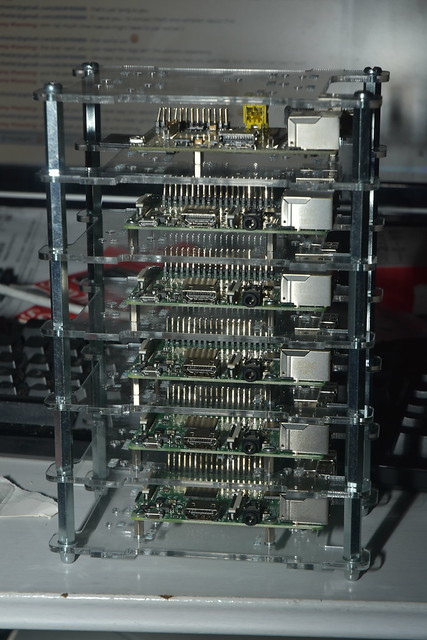
I got myself a bunch of Raspberry Pi 3s a short while ago: Stack of Raspberry Pis ...the idea being that I can use those to run a few experiments on. After the experiment, I would need to be able to somehow remove the stuff that I put on them again. The most obvious way to do that is to reimage them after every experiment; but the one downside of the multi-pi cases that I've put them in is that removing the micro-SD cards from the Pis without removing them from the case, while possible, is somewhat fiddly. That, plus the fact that I cared more about price than about speed when I got the micro-SD cards makes "image all the cards of these Raspberry Pis" something I don't want to do every day. So I needed a different way to reset them to a clean state, and I decided to use ansible to get it done. It required a bit of experimentation, but eventually I came up with this:
---
- name: install package-list fact
  hosts: all
  remote_user: root
  tasks:
  - name: install libjson-perl
    apt:
      pkg: libjson-perl
      state: latest
  - name: create ansible directory
    file:
      path: /etc/ansible
      state: directory
  - name: create facts directory
    file:
      path: /etc/ansible/facts.d
      state: directory
  - name: copy fact into ansible facts directory
    copy:
      dest: /etc/ansible/facts.d/allowclean.fact
      src: allowclean.fact
      mode: 0755
- name: remove extra stuff
  hosts: pis
  remote_user: root
  tasks:
  - apt: pkg=  item   state=absent purge=yes
    with_items: "  ansible_local.allowclean.cleanable_packages  "
- name: remove package facts
  hosts: pis
  remote_user: root
  tasks:
  - file:
      path: /etc/ansible/facts.d
      state: absent
  - apt:
      pkg: libjson-perl
      state: absent
      autoremove: yes
      purge: yes
This ansible playbook has three plays. The first play installs a custom ansible fact (written in perl) that emits a json file which defines cleanable_packages as a list of packages to remove. The second uses that fact to actually remove those packages; and the third removes the fact (and the libjson-perl library we used to produce the JSON). Which means, really, that all the hard work is done inside the allowclean.fact file. That looks like this:
#!/usr/bin/perl
use strict;
use warnings;
use JSON;
open PACKAGES, "dpkg -l ";
my @packages;
my %whitelist = (
    ...
);
while(<PACKAGES>)  
    next unless /^ii\s+(\S+)/;
    my $pack = $1;
    next if(exists($whitelist $pack ));
    if($pack =~ /(.*):armhf/)  
        $pack = $1;
     
    push @packages, $1;
 
my %hash;
$hash cleanable_packages  = \@packages;
print to_json(\%hash);
Basically, we create a whitelist, and compare the output of dpkg -l against that whitelist. If a certain package is in the whitelist, then we don't add it to our "packages" list; if it isn't, we do. The whitelist is just a list of package => 1 tuples. We just need the hash keys and don't care about the data, really; I could equally well have made it package => undef, I suppose, but whatever. Creating the whitelist is not that hard. I did it by setting up one raspberry pi to the minimum that I wanted, running
dpkg -l awk '/^ii/ print "\t\""$2"\" => 1," ' > packagelist
and then adding the contents of that packagelist file in place of the ... in the above perl script. Now whenever we apply the ansible playbook above, all packages (except for those in the whitelist) are removed from the system. Doing the same for things like users and files is left as an exercise to the reader. Side note: ... is a valid perl construct. You can write it, and the compiler won't complain. You can't run it, though.

Russ Allbery: Review: A Closed and Common Orbit

Review: A Closed and Common Orbit, by Becky Chambers
Series: Wayfarers #2
Publisher: Harper Voyager
Copyright: October 2016
ISBN: 0-06-256942-2
Format: Kindle
Pages: 384
A Closed and Common Orbit has two threads, one that takes place twenty years in the past and one that happens simultaneously with the very end of The Long Way to a Small, Angry Planet. That second part is the motivating plot thread, but it's unfortunately impossible to talk about in any depth without seriously spoiling the previous book. You could otherwise read them out of order, but I think the previous book is too good to spoil, so you want to carefully avoid reading any descriptions of this book until after you've read The Long Way to a Small, Angry Planet. Per my normal review policy, I'm going to try to avoid spoilers, but just about everything about half of this book would give away spoilers if you're paying attention. So you may want to just go read the other book before reading this review. (It's excellent!) The part that I can safely say is that half this book is about Pepper, her partner Blue, Pepper's store and Blue's art, and her attempt to help a friend find a place and a sense of identity that she'd never asked for or expected, while keeping a very dangerous secret. That friend starts somewhat passive, but one of the things I liked the most about this story is that Pepper is neither always right in her advice nor always wrong. Sidra is wrong about some of the limitations that she thinks she has and some of the things she thinks she wants, but she's also right about other things where Pepper is wrong. She has a complicated, careful, and courageous journey. The best part of this book for me, though, was the other half, told in alternating chapters with Sidra's story. This is Pepper's own backstory, which is rather awful (although Chambers does avoid being too graphic about the most horrible parts), but is also an amazing story of someone finding her own power, her own skills, and her own identity. And building a relationship that's something quite special. At first, this seems only vaguely related to Sidra's story and the other half of the book, but they both come together in a way that's both heartbreaking and wonderful. I found this story particularly wonderful because one of my favorite SF tropes is sentient computers or sentient ships, which play a significant role in Pepper's backstory. And one of my favorite characters to read about is the technician who can cobble together fixes to things and who is always finding something to repair. Pepper is a delight, her story explains so much about how she became the person she is (and adds so much emotional heft to it), and she has a relentless, practical determination that I loved reading about. A Closed and Common Orbit doesn't have the sprawling cast of The Long Way to a Small, Angry Planet. The story is tightly focused on five characters. I think I liked that even better than the previous book, even when I was finding Sidra a bit too passive and not as interesting. Chambers's characters have so much depth, thoughtfulness, and basic decency, while still being uniquely themselves, that I feel like I could read about them for months and keep uncovering new, interesting facets. I particularly loved the occasional excerpts from the chat system where Pepper hangs out (and would have loved about three times more of them). Speaking as someone who spends a lot of time in chat, Chambers got the tone just about perfect. Just about the only complaint I have about this book is that I thought the ending was too abrupt. It's so important, the climax of Pepper's story and a hugely significant piece of character development, and I wanted more than the short scene and aftermath we got. I really wanted to spend some time feeling with the characters, savoring the emotional release. Another three or four pages would have been greatly appreciated. The Long Way to a Small, Angry Planet was a happy surprise in 2015. A Closed and Common Orbit is fully as good, if not better. If you liked the previous book, you will definitely want to read this. I pre-ordered it and then read it within months after it was released, something that I almost never do. I can hardly wait to read whatever Chambers writes next. Rating: 9 out of 10

Hideki Yamane: How to check your package for FTBFS with clang

GCC 7 doesn't go into Debian9, but gcc maintainers now file FTBFS bugs for it.

Also you can check packages via building with clang easily. I've already prepared pbuilder (and cowbuilder) build hook script for it. So, if you want to check a package with clang 4.0,

$ mkdir ~/hookdir
$ ln -s /usr/share/doc/pbuilder/examples/D65various-compiler-support ~/pbuilder-hookdir
(modify your pbuilderrc as adding 1 line like below)
HOOKDIR=/home/henrich/pbuilder-hookdir
$ sudo CHOOSE_COMPILER="clang-4.0" cowbuilder --build yourpackage_1.0-1.dsc

That's all - it's handy, isn't it? Please try it to make your package more healthy :)

Antoine Beaupr : Testing new hardware with Stressant

I got a new computer and wondered... How can I test it? One of those innocent questions that brings hours and hours of work and questionning...

A new desktop: Intel NUC devices After reading up on Jeff Atwood's blog and especially his article on the scooter computer, I have discovered a whole range of small computers that could answer my need for a faster machine in my office at a low price tag and without taking up too much of my precious desk space. After what now seems like a too short review I ended up buying a new Intel NUC device from NCIX.com, along with 16GB of RAM and an amazing 500GB M.2 hard drive for around 750$. I am very happy with the machine. It's very quiet and takes up zero space on my desk as I was able to screw it to the back of my screen. You can see my review of the hardware compatibility and installation report in the Debian wiki. I wish I had taken more time to review the possible alternatives - for example I found out about the amazing Airtop PC recently and, although that specific brand is a bit too expensive, the space of small computers is far and wide and deserves a more thorough review than just finding the NUC by accident while shopping for laptops on System76.com...

Reviving the Stressant project But this, and Atwood's Is Your Computer Stable? article, got me thinking about how to test new computers. It's one thing to build a machine and fire it up, but how do you know everything is actually really working? It is common practice to do a basic stress test or burn-in when you get a new machine in the industry - how do you proceed with such tests? Back in the days when I was working at Koumbit, I wrote a tool exactly for that purpose called Stressant. Since I am the main author of the project and I didn't see much activity on it since I left, I felt it would be a good idea to bring it under my personal wing again, and I have therefore moved it to my Gitlab where I hope to bring it back to life. Parts of the project's rationale are explained in an "Intent To Package" the "breakin" tool (Debian bug #707178), which, after closer examination, ended up turning into a complete rewrite. The homepage has a bit more information about how the tool works and its objectives, but generally, the idea is to have a live CD or USB stick that you can just plugin into a machine to run a battery of automated tests (memtest86, bonnie++, stress-ng and disk wiping, for example) or allow for interactive rescue missions on broken machines. At Koumbit, we had Debirf-based live images that we could boot off the network fairly easily that we would use for various purposes, although nothing was automated yet. The tool is based on Debian, but since it starts from boot, it should be runnable on any computer. I was able to bring the project back to life, to a certain extent, by switching to vmdebootstrap instead of debirf for builds, but that removed netboot support. Also, I hope that Gitlab could provide with an autobuilder for the images, but unfortunately there's a bug in Docker that makes it impossible to mount loop images in Docker images (which makes it impossible to build Docker in Docker, apparently).

Should I start yet another project? So there's still a lot of work to do in this project to get it off the ground. I am still a bit hesitant in getting into this, however, for a few reasons:
  1. It's yet another volunteer job - which I am trying to reduce for health and obvious economic reasons. That's a purely personal reason and there isn't much you can do about it.
  2. I am not sure the project is useful. It's one thing to build a tool that can do basic tests on a machine - I can probably just build an live image for myself that will do everything I need - it's another completely different thing to build something that will scale to multiple machines and be useful for more various use cases and users.
(A variation of #1 is how everything and everyone is moving to the cloud. It's become a common argument that you shouldn't run your own metal these days, and we seem to be fighting an uphill economic battle when we run our own datacenters, rack or even physical servers these days. I still think it's essential to have some connexion to metal to be autonomous in our communications, but I'm worried that focusing on such a project is another of my precious dead entreprises... ) Part #2 is obviously where you people come in. Here's a few questions I'd like to have feedback on:
  1. (How) do you perform stress-testing of your machines before putting them in production (or when you find issues you suspect to be hardware-related)?
  2. Would a tool like breakin or stressant be useful in your environment?
  3. Which tools do you use now for such purposes?
  4. Would you contribute to such a project? How?
  5. Do you think there is room for such a project in the existing ecology of projects) or should I contribute to an existing project?
Any feedback here would be, of course, greatly appreciated.

Antoine Beaupr : My free software activities, January 2017

manpages.debian.org launched The debmans package I had so lovingly worked on last month is now officially abandoned. It turns out that another developer, Michael Stapelberg wrote his own implementation from scratch, called debiman. Both software share a similar design: they are both static site generators that parse an existing archive and call another tool to convert manpages into HTML. We even both settled on the same converter (mdoc). But while I wrote debmans in Python, debiman is written in Go. debiman also seems much faster, being written with concurrency in mind from the start. Finally, debiman is more feature complete: it properly deals with conflicting packages, localization and all sorts redirections. Heck, it even has a pretty logo, how can I compete? While debmans was written first and was in the process of being deployed, I had to give it up. It was a frustrating experience because I felt I wasted a lot of time working on software that ended up being discarded, especially because I put so much work on it, creating extensive documentation, an almost complete test suite and even filing a detailed core infrastructure best practices report In the end, I think that was the right choice: debiman seemed clearly superior and the best tool should win. Plus, it meant less work for me: Michael and Javier (the previous manpages.debian.org maintainer) did all the work of putting the site online. I also learned a lot about the CII best practices program, flask, click and, ultimately, the Go programming language itself, which I'll refer to as Golang for brievity. debiman definitely brought Golang into the spotlight for me. I had looked at Go before, but it seemed to be yet another language. But seeing Michael beat me to rebuilding the service really made me look at it again more seriously. While I really appreciate Python and I will probably still use it as my language of choice for GUI work and smaller scripts, but for daemons, network programs and servers, I will seriously consider Golang in the future. The site is now online at https://manpages.debian.org/. I even got credited in the about page which makes up for the disappointment.

Wallabako downloads Wallabag articles on my Kobo e-reader This obviously brings me to the latest project I worked on, Wallabako, my first Golang program ever. Wallabako is basically a client for the Wallabag application, which is a free software "read it later" service, an alternative to the likes of Pocket, Pinboard or Evernote. Back in April, I had looked downloading my "unread articles" into my new ebook reader, going through convoluted ways like implementing OPDS support into Wallabag, which turned out to be too difficult. Instead, I used this as an opportunity to learn Golang. After reading the quite readable golang specification over the weekend, I found the language to be quite elegant and simple, yet very powerful. Golang feels like C, but built with concurrency and memory (and to a certain extent, type) safety in mind, along with a novel approach to OO programming. The fact that everything can be compiled in one neat little static binary was also a key feature in selecting golang for this project, as I do not have much control over the platform my E-Reader is running: it is a Linux machine running under the ARM architecture, but beyond that, there isn't much available. I couldn't afford to ship a Python interpreter in there and while there are solutions there like pyinstaller, I felt that it may be so easy to deploy on ARM. The borg team had trouble building a ARM binary, restoring to tricks like building on a Raspberry PI or inside an emulator. In comparison, the native go compiler supports cross-compilation out of the box through a simple environment variable. So far Wallabako works amazingly well: when I "bag" a new article in Wallabag, either from my phone or my web browser, it will show up on my ebook reader then next time I open the wifi. I still need to "tap" the screen to fake the insertion of the USB cable, but we're working on automating that. I also need to make the installation of the software much easier and improve the documentation, because so far it's unlikely that someone unfamiliar with Kobo hardware hacking will be able to install it.

Other work According to Github, I filed a bunch of bugs all over the place (25 issues in 16 repositories), sent patches everywhere (13 pull requests in 6 repositories), and tried to fix everythin (created 38 commits in 7 repositories). Note that excludes most of my work, which happens on Gitlab. January was still a very busy month, especially considering I had an accident which kept me mostly offline for about a week. Here are some details on specific projects.

Stressant and a new computer I revived the stressant project and got a new computer. This is be covered in a separate article.

Linkchecker forked After much discussions, it was decided to fork the linkchecker project, which now lives in its own organization. I still have to write community guidelines and figure out the best way to maintain a stable branch, but I am hopeful that the community will pick up the project as multiple people volunteer to co-maintain the project. There has already been pull requests and issues reported, so that's a good sign.

Feed2tweet refresh I re-rolled my pull requests to the feed2tweet project: last time they were closed before I had time to rebase them. The author was okay with me re-submitting them, but he hasn't commented, reviewed or merged the patches yet so I am worried they will be dropped again. At that point, I would more likely rewrite this from scratch than try to collaborate with someone that is clearly not interested in doing so...

Debian uploads

Debian Long Term Support (LTS) This is my 10th month working on Debian LTS, started by Raphael Hertzog at Freexian. I took two months off last summer, which means it's actually been a year of work on the LTS project. This month I worked on a few issues, but they were big issues, so they took a lot of time. I have done a lot of work trying to backport the heading sanitization patches for CVE-2016-8743. The full report explain all the gritty details, but I ran out of time and couldn't upload the final version either. The issue mostly affects Apache servers in proxy configurations so it's not so severe as to warrant an immediate upload anyways. A lot of my time was spent battling the tiff package. The report mentions fixes for 15 CVEs and I uploaded the result in the DLA-795-1 advisory. I also worked on a small update to graphics magic for CVE-2016-9830 that is still pending because the issue is minor and we're waiting for more to pile up. See the full report for details. Finally, there was a small discussion surrounding tools to use when building and testing update to LTS packages. The resulting conversation was interesting, but it showed that we have a big documentation problem in the Debian project. There are a lot of tools, and the documentation is old and distributed everywhere. Every time I want to contribute something to the documentation, I never know where to start or go. This is why I wrote a separate debian development guide instead of contributing to existing documentation...

31 January 2017

Enrico Zini: Links for February 2017

On Progress and Historical Change [archive]
Is progress inevitable? Is it natural? Is it fragile? Is it possible? Is it a problematic concept in the first place? Many people are reexamining these kinds of questions as 2016 draws to a close, so I thought this would be a good moment to share the sort-of zoomed out discussions the subject that historians like myself are always having.
A projection of the ISS live feed as a night light [archive]
I always wanted the ISS live feed as a "night light" / ambiance to fall asleep to on my ceiling how to build a "night light" that is actually a small video projector projecting the ISS live feed
Vatican Climate Forest [archive]
The Vatican Climate Forest, to be located in the B kk National Park, Hungary, was donated to the Vatican City by a carbon offsetting company. The forest is to be sized to offset the carbon emissions generated by the Vatican during 2007. The Vatican's acceptance of the offer, at a ceremony on July 5, 2007, was reported as being "purely symbolic", and a way to encourage Catholics to do more to safeguard the planet. No trees have been planted under the project and the carbon offsets have not materialised. I'm fascinated by how purely symbolic "purely symbolic" can be.

Next.

Previous.