Search Results: freedom

6 July 2010

Matt Zimmerman: We ve packaged all of the free software what now?

Today, virtually all of the free software available can be found in packaged form in distributions like Debian and Ubuntu. Users of these distributions have access to a library of thousands of applications, ranging from trivial to highly sophisticated software systems. Developers can find a vast array of programming languages, tools and libraries for constructing new applications. This is possible because we have a mature system for turning free software components into standardized modules (packages). Some software is more difficult to package and maintain, and I m occasionally surprised to find something very useful which isn t packaged yet, but in general, the software I want is packaged and ready before I realize I need it. Even the long tail of niche software is generally packaged very effectively. Thanks to coherent standards, sophisticated management tools, and the principles of software freedom, these packages can be mixed and matched to create complete software stacks for a wide range of devices, from netbooks to supercomputing clusters. These stacks are tightly integrated, and can be tested, released, maintained and upgraded as a unit. The Debian system is unparalleled for this purpose, which is why Ubuntu is based on it. The vision, for a free software operating system which is highly modular and customizable, has been achieved. Rough edges This is a momentous achievement, and the Debian packaging system fulfills its intended purpose very well. However, there are a number of areas where it introduces friction, because the package model doesn t quite fit some new problems. Most of these are becoming more common over time as technology evolves and changes shape. Why are we stuck?
I suppose it is tempting, if the only tool you have is a hammer, to treat everything as if it were a nail.
Abraham Maslow
The packaging ecosystem is very strong. Not only do we have powerful tools for working with packages, we also benefit from packages being a well-understood concept, and having established processes for developing, exchanging and talking about them. Once something is packaged, we know what it is and how to work with it, and it fits into everything else. So, it is tempting to package everything in sight, as we already know how to make sense of packages. However, this may not always be the right tool for the job. Various attempts have been made to extend the packaging concept to make it more general, for example: Other package managers aim to solve a specific problem, such as providing lightweight package management for embedded systems, or lazy dependency installation, or fixing the filesystem hierarchy. There is a long list of package managers of various levels which solve different problems. Most of these systems suffer from an important fundamental tradeoff: they are designed to manage the entire system, from the kernel through applications, and so they must be used wholesale in order to reap their full benefit. In other words, in their world, everything is a package, and anything which is not a package is out of scope. Therefore, each of these systems requires a separate collection of packages, and each time we invent a new one, its adherents set about packaging everything in the new format. It takes a very long time to do this, and most of them lose momentum before a mature ecosystem can form around them. This lock-in effect makes it difficult for new packaging technologies to succeed. Divide and Conquer No single package management framework is flexible enough to accommodate all of the needs we have today. Even more importantly, a generic solution won t account for the needs we will have tomorrow. I propose that in order to move forward, we must make it possible to solve packaging problems separately, rather than attempting to solve them all within a single system. But I like things how they are! We don t have a choice. The world is changing around us, and distributions need to evolve with it. If we don t adapt, we will eventually give way to systems which do solve these problems. Take, for example, modern web browsers like Firefox and Chromium. Arguably the most vital application for users, the browser is coming under increasing pressure to keep up with the breakneck pace of innovation on the web. The next wave of real-time collaboration and multimedia applications relies on the rapid development of new capabilities in web browsers. Browser makers are responding by accelerating deployment in the field: both aggressively push new releases to their users. A report from Google found that Chrome upgrades 97% of their users within 21 days of a new release, and Firefox 85% (both impressive numbers). Mozilla recently changed their maintenance policies, discontinuing maintenance of stable releases and forcing Ubuntu to ship new upstream releases to users. These applications are just the leading edge of the curve, and the pressure will only increase. Equally powerful trends are pressing server applications, embedded systems, and data to adapt as well. The ideas I ve presented here are only one possible way forward, and I m sure there are more and better ideas brewing in distribution communities. I m sure that I m not the only one thinking about these problems. Whatever it looks like in the end, I have no doubt that change is ahead.

22 June 2010

Craig Small: Book: Do Androids Dream of Electric Sheep?

Actually they're more interested in freedom, to be no longer slaves to humans. I don't think it's any spoiler to mention that an electric sheep does appear in the book.

This is a classic science fiction story of a dark not-so-distant future. In fact given that it's over 40 years old it could be set in some alternate now. Some disaster has occurred and many have either left earth or died. Some andriods, or andys have escaped and bounty hunters are after them.

You may not know the book by its correct title, but you may of heard the movie that is based upon it, called Blade Runner. Like most movies based on books, it takes some of the concepts and ideas of the book but in my opinion is a pale imitation.

I'm glad I read this book. It hasn't aged that much and it's very though provoking. Sci-Fi often uses some alternate reality to put a mirror up to what happens in the real world and this book is no exception.

And a token link to Debian, if you want you own electric sheep you can install the screensaver electricsheep package which draw pretty fractals on your screen.

<script defer="defer" src="http://static.zemanta.com/readside/loader.js" type="text/javascript"></script>

14 June 2010

Biella Coleman: Baby Panda wants YOU to submit to DEBCONF


bad mood destroyer, originally uploaded by the biella.
People s the deadline is fast approaching. Don t worry though, the best ideas come under deadlines and your proposal need not be lengthy. So get those typing hands out and submit a proposal (a few sentences suffices) for a presentation!
The annual Debian conference is being held in NYC this year. First time
setting foot in the imperial empire. Are you doing something related to
free software that might be interesting to share, show off or talk about
at Debconf? I bet you are! We are looking for art installations,
performances, movie screenings, maybe you are wanting to host a
roundtable/panel discussion, coordinate a workshop (you dont have to
know the subject deeply to do this!). I know the deadline is soon, but don t let that scare you. The
submission requirement bar is very low, and we are flexible! here is the submission information: [1] ********************* Calling all potential contributors to DebConf10! One more week until
the final submission deadline! The DebConf team is excited to announce that we are now accepting
proposals for contributions to this year s Debian conference! We
invite you to submit proposals for how you would contribute until the
deadline: soon There are many ways you can contribute, you could present a technical
paper, host a panel discussion, put on a tutorial, do a performance,
an art installation, a debate, host a meeting (BoFS, or Birds of a
Feather Session), or other possibilities that you devise. This year we
are also accepting proposals for tracks=E2=80=94a thematic grouping around a
particular subject, and people to coordinate those tracks. If you are
looking for ideas of things that you could contribute, or have ideas
for things that you would like to see happen at DebConf, have a look
at the Contribution Brainstorm[0] page. DebConf talks will be broadcast live on the Internet where possible,
unless otherwise requested. Videos of the talks will be published on
the web along with the presentation slides and papers. =3D=3D Step 1. Submit Proposal =3D=3D Proposals should provide an overview of your proposed contribution,
similar to an abstract, and be no more than 600 words. Since
contributions can cover a range of issues, please describe what your
proposal covers, be it political (Free Software, law, advocacy,
access, etc.), technical (d-i, OpenPGP, etc.), social (Debian
structures and groups). It s okay to hit all three of these. Your
proposal should also include some information on why you re qualified
to present, or coordinate this topic. For example, you can include
links to posts you have made to Debian mailing lists or other material
that indicates your qualifications. Proposals and their abstracts will
be accepted until May 1st, 2010, 23h59 UTC. To submit your proposal, go to Penta[1] and register as an
attendee. Once you are registered, there is a Submit a proposal
link. You will see your proposal on the site. You can choose between
different presentation types. If you are unsure what type you should
use, please read our glossary of definitions[2]. If it s not there for
some reason, or you have questions, please contact us immediately at
mailto:talks@debconf.org. =3D=3D Step 2. Committee Review =3D=3D The review committee for this year will make its decision by May 1st,
2010. All correspondence will be done by email. =3D=3D Step 3. Paper Submission =3D=3D Like last year, we are asking for papers to be submitted along with
the presentations. A full paper is optional, however we strongly
encourage you to submit one if possible as we intend to provide
written information along with transcripts of the sessions for later
viewing. Having written papers in advance will allow us to get
translations done to help non-native-English speakers feel more
comfortable with the topics presented. Papers are due by July 1st,
2010, and should cover the topic in reasonable depth (3 pages A4 text,
plus pictures and diagrams). We will use LaTeX to typeset the
proceedings. Please submit your paper formatted in LaTeX. Should you
be unfamiliar with LaTeX earlier submission in plain text is also
fine. =3D=3D Step 4. Live Presentation =3D=3D Longer presentations may have a break in the middle and should include
workshop items that directly involve the participants. If using slides
or any other presentation, please consider that your audience will
consist of people who use free software, and your choice of
application to prepare and display the slides should reflect this if
at all possible. =3D=3D Fine Print Publication Rights =3D=3D DebConf requires non-exclusive publication rights to papers,
presentations, and any additional handouts or audio/visual materials
used in conjunction with the presentation. The authors have the
freedom to pick a DFSG-free license for the papers themselves and
retain all copyrights. The presentations will be recorded, and may be
broadcast over the Internet. Any copies of the presentation will be
made available =3D=3D Failure to Submit =3D=3D In the event that a deadline is missed we reserve the right to revoke
any offer to present. =3D=3D About DebConf =3D=3D The annual DebConf conference is a technical and social forum for
Debian developers, sponsors, affiliates, and friends. It allows
various groups within Debian a chance to come together, network, and
share their work. Until we see you in the big city,
DebConf Talks Team [1] introduction written by Micah Anderson

8 June 2010

Russell Coker: Is the PC Dying?

I just read an interesting article about the dispute between Microsoft and Apple about types of PC [1]. Steve Jobs predicted a switch from desktop PCs to portable devices, while Steve Ballmer of Microsoft claimed that the iPad is just a new PC. Defining a PC I think that the defining characteristic of the IBM Compatible PC was it s open architecture. Right from the start the PC could have it s hardware expanded by adding new circuit boards into slots on the motherboard (similar to other PC systems of that era such as the Apple 2 and the S-100 bus). The deal with IBM included Intel sharing all it s CPU designs with other manufacturers such as NEC and AMD from the 8086 until the mid-90 s. AMD specialised in chips that were close copies of Intel chips at low prices and higher clock rates while NEC added new instructions. Compaq started the PC clone market as well as the laptop market, and system software for the IBM compatible PCs was primarily available from IBM and Microsoft in the early days, along with less popular variants such as CP/M86, Novell Netware and others. In the late 80 s there was OS/2 as an alternate OS and Windows as one of several optional GUI environments to run on top of MS-DOS or PC-DOS. In the mid 90 s PCs were used for running protected mode OSs such as Linux and Windows/NT. Now if we look at a system such as a Netbook then it clearly misses some of the defining characteristics of the desktop PC. I can t upgrade a Netbook in any meaningful way changing a storage device or adding more RAM does not compare to adding an ISA/MCA/EISA/VL-Bus/PCI/PCIe expansion card. With my EeePC 701 I don t even have an option of replacing the storage as it is soldered to the motherboard! A laptop allows me to add a PCMCIA or PC-Card device to expand it, but with a maximum of two cards and a high price this isn t a great option. What is Best for Home Users? For a while now my parents have been using 3G net access for their home Internet use [2]. So it seems that a laptop provides greater benefits for their use now than it previously did when they used Cable and ADSL net access. My parents have been considering getting a new monitor (1920*1080 resolution monitors are getting insanely cheap nowadays) and driving such a monitor effectively might require a more capable PC. I recently bought myself a nice refurbished Thinkpad for $796 [3], it seems likely that I could find a refurbished Thinkpad at auction which is a little older and slower for a lower price, even buying an old T41p would be a reasonable option. This would give my parents not only the option of using the Internet when on holidays, but also in a different part of their house when they are at home. The Apple iPad would probably be quite a reasonable Internet platform for my parents if it wasn t for the fact that it uses DRM. While it s not a great platform for writing, my parents probably don t do enough that it would be a huge problem for them. So I might look for a less restrictive tablet platform for my parents. At the moment the best resolution for a tablet seems to be 1024*768, but I expect that some tablets (maybe with a hybrid tablet/laptop design like the Always Innovating Smartbook [4]) with a higher resolution will be released soon. I hope that the iPad and other closed devices don t get any serious market share, but it seems likely that OSs such as Android which are only slightly more open will have a significant market share. Ultra-Mobile Design vs PCs Design One significant problem with ultra-mobile devices is that they make significant engineering trade-offs to get the small size. For a desktop system there are lots of ways of doing things inefficiently, running the AMD64 or i386 architecture which is wasteful of energy and having lots of unused space inside the box in case you decide to upgrade it. But for a laptop there are few opportunities for being inefficient, and for a tablet or smart phone everything has to be optimised. When the optimisation of a device starts by choosing a CPU that s unlike most other systems (note that there is a significant range of ARM CPUs that are not fully compatible with each other) it makes it very difficult to produce free software to run it. I can salvage a desktop PC from a rubbish bin and run Linux on it (and I ve done that many times), but I wouldn t even bother trying to run Linux on an old mobile phone. It seems that in the near future my parents (and many other people with similar needs) will be best suited by having a limited device such as a tablet that stores all data on the Internet and not having anything that greatly resembles a PC. In many ways it would be easier for me to support my parents by storing their data in the cloud and then automatically backing it up to removable SATA disks than with my current situation of supporting a fully capable PC and backing it up to a USB device whenever I visit them. I m also considering what to do for some relatives who are about to go on a holiday in Europe, they want to be able to send email etc. It might not be possible just yet, but it seems like an ideal way of doing this would be to provide them with something like an iPad that they can use with a local 3G SIM for the country that they stay in and they could then upload all their best photos to some server that I can backup and send email to everyone they know. An iPad isn t good for this now as you don t want to go on holidays in another country while carrying something that is really desirable to thieves. Ultra Mobile Devices are Killing PCs It seems to me that Google Android and the Apple iPad/iPhone OS are taking over significant parts of the PC market. The people who are doing traditional PC things are increasingly using Laptops and Netbooks, and the number of people who get the freedom that a PC user did in the 80 s and 90 s is decreasing rapidly. I predict that by 2012 the majority of Linux systems will be running Google Android on hardware that doesn t easily allow upgrading to more open software. At the moment probably the majority of Linux systems are wireless routers and other embedded devices that people don t generally think about. But when iPad type devices running a locked-down Linux installation start replacing Ubuntu and Fedora desktop systems people will take notice. I don t think that the death of the PC platform as we know it will kill Linux, but it certainly won t do us any good. If there were smarter people at Microsoft then they would be trying to work with the Linux community on developing innovative new ways of using desktop PCs. Of all the attempts that Microsoft has made to leave the PC platform the only success has been the X-Box which is apparently doing well. Tablet devices such as the iPad could work really well in a corporate environment (where MS makes most of it s money). On many occasions I ve been in a meeting and we had to adjourn due to someone needing to go to their desk to look something up. If everyone had an iPad type device at their desk that used a wired network when it was available and encrypted wireless otherwise then for a meeting everyone could take their tablet without it s keyboard and be able to consult all the usual sources of data without any interruption. Could a high-resolution version of the iPad kill MS-Windows in the corporate environment?

25 May 2010

Matt Zimmerman: The behavioral economics of free software

People who use and promote free software cite various reasons for their choice, but do those reasons tell the whole story? If, as a community, we want free software to continue to grow in popularity, especially in the mainstream, we should understand better the true reasons for choosing it especially our own. Some believe that it offers higher quality, that the availability of source code results in a better product with higher reliability. Although it s difficult to do an apples-to-apples comparison of software, there are certainly instances where free software components have been judged superior to their proprietary counterparts. I m not aware of any comprehensive analysis of the general case, though, and there is plenty of anecdotal evidence on both sides of the debate. Others prefer it for humanitarian reasons, because it s better for society or brings us closer to the world we want to live in. These are more difficult to analyze objectively, as they are closely linked to the individual, their circumstances and their belief system. For developers, a popular reason is the possibility of modifying the software to suit their needs, as enshrined in the Free Software Foundation s freedom 1. This is reasonable enough, though the practical value of this opportunity will vary greatly depending on the software and circumstances. The list goes on: cost savings, educational benefits, universal availability, social rewards, etc. The wealth of evidence of cognitive bias indicates that we should not take these preferences at face value. Not only are human choices seldom rational, they are rarely well understood even by the human themselves. When asked to explain our preferences, we often have a ready answer indeed, we may never run out of reasons but they may not withstand analysis. We have many different ways of fooling ourselves with regard to our own past decisions and held beliefs, as well as those of others. Behavioral economics explores the way in which our irrational behavior affects economies, and the results are curious and subtle. For example, the riddle of experience versus memory (TED video), or the several examples in The Marketplace of Perception (Harvard Magazine article). I think it would be illuminating to examine free software through this lens, and consider that the vagaries of human perception may have a very strong influence on our choices. Some questions for thought: If you re aware of any studies along these lines, I would be interested to read about them.

Russell Coker: Links May 2010

AdRevenge is an interesting concept to pay for Google Adsense adverts about how companies suck [1]. If a suitably large group of people pay to warn you about a company then it s a good signal that the company is actually doing the wrong thing. A guest post by Mili on Charles Stross blog has an interesting analysis of the economcs of Intellectual Property and concludes that content is a public good [2]. New Age Terrorists Develop Homeopathic Bomb [3], an amusing satire of medical fraud and security theatre. The sit has a lot of other good satire too. Mark Shuttleworth wrote an interesting post about new window management changes that will soon go into Ubuntu [4]. He points out that the bottom status bar in applications is a throw-back to Windows 3.1 and notes that a large part of the incentive for removing it (and using the title-bar for the status) is the work on the Netbook version of Ubuntu. This is really ironic given that the resolution of current Netbooks is quite similar to that of desktop systems that were current when Windows 3.1 came out. Omar Ahmad gave an insightful TED talk about the benefit of using a pen and paper to send a letter to a politician [5]. Sebastian Wernicke gave an amusing and informative TED talk about how to give a good TED talk [6]. His talk gives some useful ideas for public speaking that are worth considering. Catherine Mohr gave a brief and interesting TED talk about how to build an energy efficient house with low embodied energy [7]. Her blog at www.301monroe.com has the details. Stephen Wolfram (of Mathematica fame) gave an interesting TED talk [8]. He covers a lot of interesting things that can be done with computers, primarily based on the Wolfram Alpha [9] platform which allows natural language queries of a large data set. He also talks about the search for a Theory of Everything. Esther Duflo gave an interesting TED talk about using social experiments to fight poverty [10]. She describes how scientific tests have been used to determine the effectiveness of various ways of preventing disease and encouraging education in developing countries. One example of the effectiveness of such research is the DeWormTheWorld.org project which was founded after it was discovered that treating intestinal worms was the most cost effective way of getting African children to spend longer at school. David L. Rosenhan wrote an interesting research paper On Being Sane In Insane Places about pseudo-patients admitted to psychiatric hospitals [11]. It seems that psychiatric staff were totally unable to recognise a sane person who was admitted even though other patients could do so. It also documents how psychiatric patients were treated as sub-human. One would hope that things had improved since 1973, but it seems likely that many modern psychiatric hospitals are as bad as was typical in 1973. It s also worth considering the issue of the treatment in society of people who have been diagnosed with a mental illness, it seems likely that the way people are treated in the community would have similar bad results to that which was documented for treatment in psychiatric hospitals even the sanest people will act strangely if treated in an insane manner! Also it seems to me that there could be potential for using a panel of patients assembled via the Delphi Method as part of the psychiatric assessment process as it has been demonstrated that patients can sometimes assess other patients more accurately than psychiatrists! Simon Sinek gave an inspiring TED talk about how great leaders inspire action [12]. Of course the ideas he describes don t just apply to great leaders, they should apply to ordinary people who just want to convince others to adopt their ideas. Stephen Collins write a good article summarising the main reasons why the proposed great firewall of Australia is a bad idea [13]. Lenore Skenazy who is famous for letting her 9yo son catch the metro alone during broad daylight on a pre-planned route home has created a web site about Free Range Kids [14]. She seems to be starting a movement to oppose Helicopter Parenting and has already written a book about her ideas for parenting. The incidence of crime has been steadily increasing, as has the ability of the police to apprehend criminals and recover abducted children. There s no reason for children to be prevented from doing most of the things that children did when I was young!

John Goerzen: Free-Range Kids: A Parental Rant

There s a lot of unreasonable panic out there these days. Parents that don t want to let their kids even walk to the mailbox because of an irrational fear of abduction. (Children are more likely to die falling out of bed than be abducted, and before anyone panics, that s also exceptionally rare.) A woman that let her 11-year-old travel unaccompanied on the NYC subway he d been riding all his life unleashed a huge controversy. And there s also this maddening tendency for some parents to be so worried about wounding their children s self-esteem that they never want to say they ve done something wrong, and be so positive to them. Recent studies, as well as common sense, suggest that both attitudes are rather harmful. Terah and I are believers in letting children have cheap mistakes . If I see Jacob running through the kitchen about to trip over a toy he left out, I probably won t say anything. Him crashing to the floor after running on it won t even hurt him enough that he ll cry, but it will probably be far more effective at teaching safety than 20 days worth of me saying no running in the kitchen. Of course, we ll provide comfort for him when he s sad and be there to support him, but also give him more and more freedom to succeed or fail as he grows. This starts even younger. When he first started feeding himself, he got into this habit of throwing food on the floor. We had some natural consequences as a result. If his supper landed on the floor, then he would be all done eating. (Note: Jacob was always on the heavy side at that age anyway.) He couldn t reach his supper on the floor, and we weren t going to keep bending over to pick it up for him. Fixed that problem pretty quickly at least until he learned that he could wait until he was pretty full before throwing his food down on the floor (at which point we added a brief time-out). Or how about our reaction when he has mistakes. When he breaks something, whether accidentally or on purpose, we don t give him some sort of affirmation like Oh, that s OK, we can fix it or good try; you ll do better next time. It is NOT OK to rip the pull-up flaps out of a book or to stomp on those peas you dropped on the floor, and there will be predictable and reasonable consequences for doing so. As a result, when he does a good job, it ll mean more. He, at 3, has started sounding out letters, knows his alphabet, and can count to about 15 in English and about 3 in German. And those are things we give him a good job about. Two of the best things we can do for our children are: 1) be honest about their successes and failures; and 2) give them room to succeed and room to fail, so they can learn from both while the consequences mean a skinned knee or broken toy instead of a broken rib or foreclosure on a mortgage. The Free Range Kids FAQ makes excellent reading, and discusses how many of today s parents grew up enjoying this kind of freedom, and for various reasons are too scared to allow their children that today. Rather sad, really, especially given that today s world is safer.

20 May 2010

Gustavo Noronha Silva: WebKitGTK+ and WebM

So you probably heard about WebM, right? It s the awesome new media format being pushed by Google and a large number of partners, including Collabora, following the release of the VP8 video codec free of royalties and patents, along with a Free Software implementation. It turns out that if you are a user or developer of applications that use the GStreamer framework, you can start taking advantage of all that freedom right away! Collabora Multimedia has developed, along with Entropy Wave GStreamer support for the new format, and the code has already landed in the public repositories, and is already being packaged for some distributions. I just couldn t wait the few days it will take for the support to be properly landed in Debian unstable, so I went ahead and downloaded all of the current packages from the pkg-gstreamer svn repository, built everything after having the libvpx-dev package installed, and went straight to a rather unknown, small video site called Youtube with my GStreamer-powered WebKitGTK+-based browser, Epiphany!:
Youtube showing a webm video in Epiphany
If you re running Debian unstable, or any of the other distributions which will be lucky to get the new codecs, and support packages soon, you should be able to get this working out of the box real soon now. Check the tips on WebM s web site on how to find WebM videos on youtube.

13 May 2010

Aigars Mahinovs: Hacker Neo caught in Latvia

A scandal has been brewing in Latvia over the last half year and yesterday the activity spiked shocking the media and some IT people in the country. I ll go back and explain what happened first, what is happening now and why this could have a heavy impact on IT and journalists in Latvia. At the end of last year, there were rumours that the IT system of Latvia s Internal Revenue System was hacked and millions of documents had been downloaded by multiple organizations. Shortly thereafter more details on the glaring security hole became public (after it was closed). There is a full electronic interface to give all reports to the IRS electronically (at http://eds.vid.gov.lv) and as part of that system you could also view and export monthly report summaries about your organization into XML and PDF files. After the system checked that you are authorized to access the report, you were redirected to the URL to actually download the report by report ID (as a single param in a GET request). Unfortunately, report IDs were predicable and the script that gave the reports for download did not check if you were authorized to get that report. It did not even check if were logged into the system. There were suspicions that the authorization was disabled on purpose to allow to leak data on purpose, but apparently it was an error of forgetting to disable debug code in production environment. The error was discovered only because the firewall administrator noticed an unexplained stable increase of traffic, especially during night hours when typically the traffic fully stopped. Apparently a single hacker (who later identified himself as Neo to the press) discovered the flaw and wrote a script to just try all possible report ids and get as much data out as possible. This had been going on for months, before someone noticed. After the flaw was discovered and a bit of time passed, Neo made his first move he published the list of top salaries in a governmental company, that clearly showed that the top leadership of this company failed to cut their salary by 40%, like everyone elses during harsh budget cuts of 2009. He stripped the names and ids of the specific employees, but named the company which made it pretty easy to figure out who was who. The society was outraged that the top managers in a government owned company failed to comply with the strict pay cut that everyone else in government had to endure. But after a few weeks the outrage subsided and no action followed from the government or law enforcement. Neo continued to release documents detailing salaries of top managers in different Latvian government companies. And each time after short outrage, nothing happened. Neo gave an interview where he said that he was disappointed in the passivity of the Latvian people in face of such blatant injustices. After a few month Neo went silent, promising to return before parliamentary elections this fall. However, this week a new development shocked everyone in the middle of the night two police SWAT teams went into action: one detained Ilm rs Poik ns, a researcher in artificial intelligence at the University of Latvia s Computer Science department and another raided the home of a Latvian TV journalist Ilze Nagle who interviewed Neo. Poik ns confessed of being Neo the next day and was released (with travel restrictions, pending trial) today. Politicians reacted immediately opposition demanded the resignation of the Interior Minister over such blatant disregard of freedom of press and another politician (who is also a famous lawyer) Aleksejs Loskutovs volunteered to defend Neo pro-bono (on Twitter, no less). Almost all Latvian online media have the arrest of Neo and the raid on the home of a journalist as main stories of the day. As a legal titbit, we also know that Neo is being charged with breaking statutes 145 and and 244p2 of the criminal law. Statute 145 is hard to find applicable in this situation as talks about actions done by people authorized (..) to access [private] information . Statute 244p2 will also be hard to pin down as it mentions influencing system resources of (an IT system) and if such action caused severe harm . It looks like the first part talks about at least a DoS attack (which did not happen in this case) and also there was no measurable harm from these leaks. Also Neo was careful to strip all personally identifying information (such as names, social security numbers and addresses of the employees in question), so it will be hard to pin him on that. Also no actual breaking or other modification of an IT system occurred. And no specialized software was used beyond a trivial script such as :
for i in range(0,7000000):
    wget('https://eds.vid.gov.lv/getRep.aspx?id='+str(i))
A lot of commentators on the Internet likened the situation to walking trough an unlocked door and stealing something. I think that analogy is very incorrect there was no door, and nothing went missing after the action. I came up with a different analogy there was this corridor with a lot of doors in IRS, locked steel doors. You were instructed to go to a room with a specified number and given a key to that room to unlock it and see your secret info. However, that corridor opened out to the street on one end, oh and also the walls of the rooms with all the secrets were transparent. So Neo walked into the corridor, looked at some of the secrets, wrote them down (to remember them better) and then went out and discussed the worst examples abuses of power he saw. In the end IRS had to learn their lesson if you have to put naked photos of yourself on the Internet (or something equally embarrassing), then make damn sure you password protect that, but if you don t then don t cry that someone hacked you and stole you pictures. What other people think:
http://freespeechlatvia.blogspot.com/2010/05/neo-released-under-restrictions.html We ll see how the story develops soon.

10 May 2010

Stefano Zacchiroli: UDD - consolidating bazaar metadata for QA and data mining

Eclectic paper on the Ultimate Debian Database A few months ago, I've co-authored with Lucas a paper on UDD, which has just been presented at this year IEEE's Mining Software Repository conference, continuing my recent tradition of eclectic papers. The paper is titled The Ultimate Debian Database: Consolidating Bazaar Metadata for Quality Assurance and Data Mining and is available for download from my publications page. For Debian people already familiar with UDD there is probably not much to learn from it, as the main target of the paper is the community of scientists doing data mining on software repositories. For them, UDD offers a valuable entry point to Debian "facts", as data sources reflected in the database are easily joinable together and to some extent already validated by other UDD users (e.g. QA people). Nevertheless the first two sections of the paper are probably of more broad interest. There we have given our point of view on the so called Debian Data Hell: why it exists, how it's related to the nature of Debian and similar distros, etc. I've already noted in the past how that is also related to the culture of freedom that in Debian we value not only in our software, but also in our infrastructure and procedures. We should just get rid of a bit of inertia, and total world domination will then be just around the corner :-) I'm happy to conclude quoting the acknowledgments section of the paper: Acknowledgments
The authors would like to thank all UDD contributors, and in particular: Christian von Essen and Marc Brockschmidt (student and co-mentor in the Google Summer of Code which witnessed the first UDD implementation), Olivier Berger for his support and FLOSSmole contacts, Andreas Tille who contributed several gatherers, the Debian community at large, the "German cabal" and Debian System Administrators for their UDD hosting and support.

3 May 2010

Russell Coker: Flash, Apple, and Linux

Steve Jobs has published an interesting article about Flash [1]. He criticises Flash for being proprietary, this seems a little hypocritical coming from Apple (who s the only competitor for Microsoft in terms of being the most proprietary computer company) but is in fact correct. Steve advocates HTML5 which is a better technical solution to a lot of the things that Flash does. He claims that Apple users aren t missing out on much, but I think that sites such as Physics Games [2] demonstrate the benefits of Flash. I think that Apple s attack on Flash is generally a good thing. HTML5 web sites will work everywhere which will be a good incentive for web designers to fix their sites. I also think that we want to deprecate it, but as it s unfortunately popular it s useful to have tools such as GNASH to use Flash based web sites with free software. Microsoft has belatedly tried to compete with flash, but it s Silverlight system and the free but patent encumbered Linux equivalent Moonlight have very little content to play and will probably disappear soon. As an aside the relentless determination of GNOME people to force the MONO project (including Moonlight) on it s users convinced me to remove GNOME from all systems that I run. OS News has a good analysis of the MPEG-LA patents [3] which are designed to prevent anyone making any commercial use of H.264 which includes putting such videos on sites that contain Google advertising! These patent terms are so horrible that they want to control video streams that were ever encoded with them, so you can t even transcode a H.264 stream to an open format without potentially having the scum at MPEG-LA going after you. This is worth noting when examining Apple s actions, they support MPEG patents and therefore seem happy to do anything that reduces the freedom of their customers. Apple s 1984 commercial has been proven to be a lie, it s Apple that wants to control our freedom. Charles Stross makes some good points about the issues related to Apple and Flash [4]. He believes that it s all part of an Apple push to cloud computing and that Apple wants to own all our data at the back-end while providing a relatively reliable front-end (IE without all the anti-virus nonsense that is needed on the MS-Windows platform. Cloud computing is a good thing and I can t wait for the Linux support for it to improve, I support a number of relatives who run Linux and it would be a lot easier for me if they could have the primary storage for everything be on the cloud so that I can do central backups of user data and they can use their own data while visiting each other. I think that a network filesystem that is similar in concept to offline-IMAP would be a really good thing, I know that there are some filesystems such as AFS and CODA that are designed for wide area network use with client-side caching but as far as I am aware they aren t designed for the type of operation that offline/caching IMAP supports. Matt Brubeck has given a good status report of the work porting Firefox to Android [5]. He notes that the next version of Fennec (mobile Firefox) will have Electrolysis the Firefox one process per tab feature that was first implemented in Google Chrome [6]. I think that the development of Fennec and the one process per tab feature are both great developments. Matt also says One of my personal goals is to make Firefox compatible with more mobile sites, and to give web developers the tools and information they need to make their sites work great in mobile Firefox. I ll write much more about this in future articles , that sounds great, I look forward to the results of his coding and to reading his blog posts about it!

30 April 2010

Biella Coleman: Baby Panda wants YOU to submit to DEBCONF


bad mood destroyer, originally uploaded by the biella.
People s the deadline is fast approaching. Don t worry though, the best ideas come under deadlines and your proposal need not be lengthy. So get those typing hands out and submit a proposal (a few sentences suffices) for a presentation! The annual Debian conference is being held in NYC this year. First time
setting foot in the imperial empire. Are you doing something related to
free software that might be interesting to share, show off or talk about
at Debconf? I bet you are! We are looking for art installations,
performances, movie screenings, maybe you are wanting to host a
roundtable/panel discussion, coordinate a workshop (you dont have to
know the subject deeply to do this!). I know the deadline is soon, but don t let that scare you. The
submission requirement bar is very low, and we are flexible! here is the submission information: [1] ********************* Calling all potential contributors to DebConf10! One more week until
the final submission deadline! The DebConf team is excited to announce that we are now accepting
proposals for contributions to this year s Debian conference! We
invite you to submit proposals for how you would contribute until the
deadline: soon There are many ways you can contribute, you could present a technical
paper, host a panel discussion, put on a tutorial, do a performance,
an art installation, a debate, host a meeting (BoFS, or Birds of a
Feather Session), or other possibilities that you devise. This year we
are also accepting proposals for tracks=E2=80=94a thematic grouping around a
particular subject, and people to coordinate those tracks. If you are
looking for ideas of things that you could contribute, or have ideas
for things that you would like to see happen at DebConf, have a look
at the Contribution Brainstorm[0] page. DebConf talks will be broadcast live on the Internet where possible,
unless otherwise requested. Videos of the talks will be published on
the web along with the presentation slides and papers. =3D=3D Step 1. Submit Proposal =3D=3D Proposals should provide an overview of your proposed contribution,
similar to an abstract, and be no more than 600 words. Since
contributions can cover a range of issues, please describe what your
proposal covers, be it political (Free Software, law, advocacy,
access, etc.), technical (d-i, OpenPGP, etc.), social (Debian
structures and groups). It s okay to hit all three of these. Your
proposal should also include some information on why you re qualified
to present, or coordinate this topic. For example, you can include
links to posts you have made to Debian mailing lists or other material
that indicates your qualifications. Proposals and their abstracts will
be accepted until May 1st, 2010, 23h59 UTC. To submit your proposal, go to Penta[1] and register as an
attendee. Once you are registered, there is a Submit a proposal
link. You will see your proposal on the site. You can choose between
different presentation types. If you are unsure what type you should
use, please read our glossary of definitions[2]. If it s not there for
some reason, or you have questions, please contact us immediately at
mailto:talks@debconf.org. =3D=3D Step 2. Committee Review =3D=3D The review committee for this year will make its decision by May 1st,
2010. All correspondence will be done by email. =3D=3D Step 3. Paper Submission =3D=3D Like last year, we are asking for papers to be submitted along with
the presentations. A full paper is optional, however we strongly
encourage you to submit one if possible as we intend to provide
written information along with transcripts of the sessions for later
viewing. Having written papers in advance will allow us to get
translations done to help non-native-English speakers feel more
comfortable with the topics presented. Papers are due by July 1st,
2010, and should cover the topic in reasonable depth (3 pages A4 text,
plus pictures and diagrams). We will use LaTeX to typeset the
proceedings. Please submit your paper formatted in LaTeX. Should you
be unfamiliar with LaTeX earlier submission in plain text is also
fine. =3D=3D Step 4. Live Presentation =3D=3D Longer presentations may have a break in the middle and should include
workshop items that directly involve the participants. If using slides
or any other presentation, please consider that your audience will
consist of people who use free software, and your choice of
application to prepare and display the slides should reflect this if
at all possible. =3D=3D Fine Print Publication Rights =3D=3D DebConf requires non-exclusive publication rights to papers,
presentations, and any additional handouts or audio/visual materials
used in conjunction with the presentation. The authors have the
freedom to pick a DFSG-free license for the papers themselves and
retain all copyrights. The presentations will be recorded, and may be
broadcast over the Internet. Any copies of the presentation will be
made available =3D=3D Failure to Submit =3D=3D In the event that a deadline is missed we reserve the right to revoke
any offer to present. =3D=3D About DebConf =3D=3D The annual DebConf conference is a technical and social forum for
Debian developers, sponsors, affiliates, and friends. It allows
various groups within Debian a chance to come together, network, and
share their work. Until we see you in the big city,
DebConf Talks Team [1] introduction written by Micah Anderson

26 April 2010

Jan Hauke Rahm: Talking about Free Software

When I first started using Free Software yes, that s quite some time ago I found it the right thing to do. It felt like I was first time ever really controlling what my computer does. Took just a bit of time to notice I really never knew anything about it. Well, almost at least. Then when I started contributing to Free Software this obviously changed. One of the freedoms is to learn from the code you re running. And I did it by reading, contributing, doing nonsense with it, reimplementing it you know the deal. Starting to work on Debian was something that just evolved out of it. Doing so gave me the opportunity to give back. I never achieved that actually, though. At least I don t consider my contributions even remotely sufficient to make up for the great deal of software that I use sometimes without noticing it. Still there s lots of stuff that I don t have a clue of and I rely on other developers to do their (volunteer) job. Otherwise my knowledge wouldn t help much. I could never continue kernel development if those kernel hackers all stepped back for instance. I guess, it s getting more and more difficult the closer the piece of code is to hardware. Another thought I had was about Free Software in general. It s more than just the code (although it might be the most important part), it s also a concept that needs to be communicated. Firefox on Windows shows how Free Software can have a big market share in an otherwise closed source environment. Yet I m not sure all users know about it being open source and what that means (hear them talk about Freeware instead). And who is dealing with this conceptual stuff? I decided to do something about all that. Now I don t really have money but a bit I thought I could share. And I could set yet another sign by publicly talking about it, or casually mentioning that I consider Free Software and Linux a good thing. So you will see a mail signature now below all my mails. I always wondered what one might gain with such and now I found a reason to include one. It reads:
Debian Developer                                 www.debian.org
Member of the Linux Foundation                    www.linux.com
Fellow of the Free Software Foundation Europe      www.fsfe.org

23 April 2010

Ingo Juergensmann: Cleanternet - for a cleaner and safer Internet

Alexander Lehmann, creator of the great videos "Du bist Terrorist" (You're a Terrorist) and "Rette deine Freiheit" (Save your Freedom), has created another fine piece of video art:


http://cleanternet.org

It's about the new plan by EU commissionar Cecilia Malmstr m of censoring the Internet in the name of the fight against child porn. In Germany we had this discussion in the last year and although a law has been brought into action, all political parties don't want that law anymore. Putting up STOP signs in front of webpages is the wrong way to fight child porn.

22 April 2010

Matt Zimmerman: On Cloud

If you re convinced that cloud is a useless buzzword, being used to describe everything under the sun, old and new, then well, you re right that is, except for the useless part. It s true that this word is being (ab)used in many different products, services and technologies, which do not seem to relate to each other in any concrete way. Cloud in the abstract is being defined in many different ways, based on different fundamental characteristics of cloud technology . Nonetheless, there is something genuinely important going on here, and this is my view of what it s about. The hype Countless business which only had web sites or web applications in 2008 now call them cloud services . They aren t delivering any new benefits to their users, and they haven t redesigned their infrastructure. What do they mean by this? Cloud is defined, some say, by where your data is kept, and cloud means storing your data on remote servers instead of internal ones. Millions of Gmail and Flickr users have been in the cloud without even knowing it, and so has everyone who reads their mail over IMAP, or uses voicemail. In short, cloud is just data that is somewhere else.

Credit: jurvetson

Last September, I watched a presentation on Cloud computing where Symantec pitched their anti-virus product as having something like three different cloud computing technologies. These, it turned out, all involved downloading files over the Internet. In this view, cloud is essentially about the network, derived from our habit of using a drawing of a cloud in our network diagrams for so many years. Wikipedia currently shares this view, as its Cloud computing article opens with Cloud computing is Internet-based computing . No Internet, no cloud. Maybe cloud is just SaaS, and any service provided on a pay-per-use basis over the Internet is a cloud service. It would seem that cloud is about paying for things, especially on a utility basis. The cloud is computing by the hour; it s something you buy. Others maintain that cloud is just virtualization, so if you re using KVM or VMWare, you ve got a cloud already. In this view, cloud is about operating systems, and whether they re running on real or virtual hardware. Cloud means deploying applications as virtual appliances, and creating new servers entirely in software. If your servers only have one OS on them, then they re not cloud-ready. If this vagueness and contradiction irritates you, then you re not alone. It bugs me, and a lot of other people who are getting on with developing, using and providing technology and services. Cloud is not just a new name for these familiar technologies. In fact, it isn t a technology at all. I don t think it even makes sense to categorize technologies as cloud and non-cloud , though some may be more cloudy than others. Nonetheless, there is some meaning and validity in each of these interpretations of cloud. So what is it? A different perspective

Credit: TangYauHoong

Cloud is a transition, a trend, a paradigm shift. It isn t something which exists or not: it is happening, and we won t understand its essential nature until it s over. Simon Wardley explains this, in presentation format, much better than I could in this blog post, so if you haven t already, I suggest that you take 14 minutes of your time and go and watch him do his thing. This change doesn t have a clear beginning or an end. Early on, it was a disconnected set of ideas without any identity. We re now somewhere in the middle of the bell curve, with enough insight to give it a name, and sufficient momentum to guess at what happens next. In the end, it will be absorbed into the way things are . What s going on? So, what is actually changing? The key trends I see are:
  1. People and organizations are becoming more comfortable relying on resources which do not exist in any particular place. Rather than storing precious metals under our beds, we entrust our finances to banks, which store our data and provide us with services which let us use our money . In computing terms, we re no longer enamored with keeping all of our programs and our data on our hard drive: as it turns out, it s not very safe there after all, and in some ways we can actually exercise more control over programs and data out there than in here . We can no longer hoard our gold, or drive off would-be thieves with a pistol, but that wasn t a productive way to spend our energies anyway. While we can t put our hands on our money, we can know exactly what s happening with it from minute to minute, and use it in a variety of ways at a moment s notice.
  2. IT products are ceding ground to services. In many cases, we no longer need to build software, or even buy it: we can simply use it. As computing needs become better understood, and can be met by commodity products, it becomes more feasible to develop services to meet them on-demand. This is why we see a spike in acronyms ending in aaS . Simon explains the progression in detail in his talk, linked above.
  3. Hardware, software and data are being reorganized according to new models, in order to provide these services effectively. Architectural patterns, such as hardware/OS/framework/application are giving way to new ones, like hardware/OS/IaaS/OS/PaaS/SaaS/Internet/web browser/OS/hardware . These are still evolving, and the lines between them are blurry. It s a bit early to say what the dominant patterns will be, but system, network, data and application architecture are all being transformed. No single technology or architecture defines cloud, but virtualization (at the infrastructure level) and the web (at the application level) both seem to resonate strongly with cloudy design patterns.
These trends are reinforcing and accelerating each other, driving information technologies and businesses in a common direction. That, in a nutshell, is what cloud is all about. So what? This transformation is disruptive in many different ways, but the angles which most interest me at the moment are: I d like to explore some of these topics in future posts.

8 April 2010

John Goerzen: Face to Face With Destruction

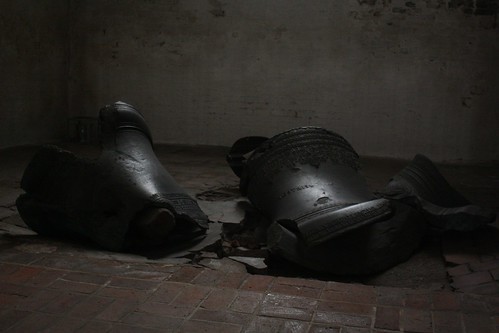
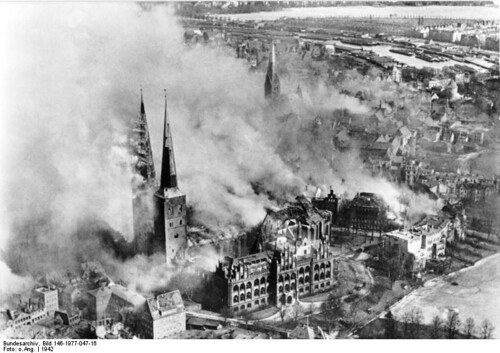
IMG_2641 Seeing these church bells in L beck wasn t easy for me. They melted and fell to the ground after an air raid in 1942, and have been left exactly as they fell. I wasn t alive in 1942, and even my parents hadn t yet been born. My grandfather was relocated by the American government because he refused to fight in the military for religious reasons. And yet, I still felt a sense of embarrassment, being an American standing there in Germany next to those bells. My country* did things like this. Why? Even if there s a war on, and whatever the other side may be doing, do we really have to bomb all their churches? Then, we went to the Dom (cathedral). It has a small gallery of photos of the destruction in 1942, and how it took 40 years to restore (though some original works are simply irreplaceable.) Burning L beck Cathedral after an air raid in 1942 I had just been walking through the beautiful Dom, and then saw pictures like that. It was very sad. I imagined the people in 1942, seeing the smoking remains of so many buildings that had been important to the town for centuries. Places where, no doubt, some of them worshiped, and their parents and grandparents had too. I imagined my sadness if a country bombed one of the churches that my ancestors helped start or build. I felt ashamed of what the democracy in which I live (and its allies) did to the Dom, to Marienkirche, and to the other churches and civilians there. Then, a few days ago, Wikileaks posted a video from an American helicopter in which our soldiers begged Come on, let us shoot! at people, most or all of which were completely unarmed. They killed a bunch of people. Then a van came to try to get the wounded to the hospital. Then the soldiers in helicopter killed those people, and wounded some children. Even if they thought their lives were in danger, I d expect to hear some quiet sadness at what they thought was a regrettable need to use force. Instead, you d hear them cheering whenever they killed someone, as if they had just won a round on some video game. They killed civilians, and considered it a fun experience and a mission accomplished. There was no sadness for knocking a man to the ground, leaving him writhing. Just jokes. There was no more care for human life here than there was 60 years ago. It saddens me that every year we celebrate our military on independence day celebrating its ability to kill, not its ability to feed. I wish that we could rather celebrate the times Americans have saved lives, whether in Berlin or in Port-au-Prince, or helped to topple dictatorships. Military power shouldn t be our first choice so often. L beck wasn t attacked for any strategic purpose; the British did it to destroy the morale of the enemy civil population , as the Americans did in Dresden or the Germans in London. In other words, those bells fell to the ground for no reason other than that they were German. People lost their lives for the same reason in Germany and in London. The British had no reason to believe that those civilians meant them any harm, that they were anything but caught between two strong powers. And the same held true in Iraq. When we went to Berlin, we walked through the replica of Checkpoint Charlie, with the big sign announcing that you are leaving the American sector. There is little positive to be said about the Cold War, but there is something the British and American military did of which I am not the least ashamed: the Berlin Airlift. Although I didn t see it, I feel a sense of the USA having been a force for good when I read about the Berlin Airlift Monument at Tempelhof, which has the names of the 70 British and American men that lost their lives in the airlift (due to accidents), above the inscription They gave their lives for the freedom of Berlin. That s the spirit I wish we d see more often in the world today: people giving their lives not just for their own security, but for strangers in need on a different continent. We Americans have been, compared to many countries in Europe, relatively sheltered from the ravages of war in our own midst. I wish that more of us would have the opportunity to gaze at fallen church bells, to wonder through a magnificent old church and then to see photos of it on fire, or to see a monument to our soldiers in a far away land. Perhaps then we could better learn from history, and see firsthand that some of our most positive contributions to the world have come in the form of coal and candy bars instead of incendiary devices. A small post script Many historic buildings or locations we saw in Germany had plaques on their exterior with a brief history, often in German and in English. I was interested to note that some (though not all) of these plaques had language such as destroyed by fire in 1942 , with no mention that the cause of the fire was a bombing. I was even more interested to note that same sort of description at several sites in Prague Castle, mentioning that the original building was lost in the fire of 1142. It was only on the third or fourth building in the Castle that we learned that the fire of 1142 was caused by a military siege of Prague Castle. * I know it was the British at L beck, but the Americans did similar things elsewhere. I also acknowledge that, at a macro level at least, the Berlin Airlift wasn t purely an altruistic act, as there were geopolitical factors in play. But I am speaking of the actions of the airmen here, who took on considerable risk to help others.

20 March 2010

Robert Collins: LibrePlanet 2010 Day 2

John Gilmore keynote What do we do next, having produced a free software system for our computers? Perhaps we should aim at Windows? Wine + an extended ndiswrapper to run other hardware drivers + a better system administration interface/resources/manuals. However that means knowing a lot about windows internals something that open source developers don t seem to want to do. We shouldn t just carry on tweaking its not inspiring; whats our stretch goal? Discussion followed reactos, continue integrating software and people with a goal of achieving really close integration: software as human rights issue! Desktop paradigm needs to be replaced : need to move away from a document based desktop to a device based desktop. Concern about the goal of running binary drivers for hardware: encourages manufacturers to sell hardware w/out specs; we shouldn t encourage the idea that that is ok. Lots of concern about cloning, lots of concern about what will bring more freedom to users, and what it will take to have a compelling vision to inspire 50000 free software hackers. Free software in cars lots of safety issues in .e.g brake controllers, accelerators. Eben Moglen We re at the inflection point of free software because any large scale global projects these days are not feasible without free software. Claims that doing something that scales from tiny to huge environment requires us A claim I would (sadly) dispute. Lots of incoming and remaining challenges. Entirely clear that the patent systems relationship to technology is pathological and dangerous that I agree with! Patent muggings are a problem patent holders are unhappy with patents granted to other people :) . Patent pools are helping slowly as they grow. Companies which don t care about the freedom aspect of GPLv3 are adopting it because of the patent protection aspects. Patent system is at the head of the list of causes-of-bad-things affecting free software. SFLC is building coalitions outside the core community to protect the interests of the free software community. We are starting to be taken for granted at the high end of mgmt in companies that build on free software. We face a problem in the erosion of privacy. We need to build a stack, running on commodity hardware that runs federated services rather than folk needing centralised services. Marina Zhurakhinskaya on GNOME Shell: Integrates old and new ideas in an overall comprehensive design. Marina ran through the various goals of the shell growing with users, being delightful, starting simply so new users are not overwhelmed. The activities screen looks pretty nice ;) The workspace rearrangement UI is really good. The notifications thing is interesting; you can respond to a chat message in-line in the notification. Richard Stallman on Software as a Service he presented verbally the case made in the paper. Some key quotes All your data on a server is equivalent to total spyware I think this is a worst-case analogy; it suggests that you can never trust another party: kindof a sad state of paranoia to assume that all network servers are always out to get you all the time. And I have to ask should we get rid of Savannah then (because all the data is stored there) the argument for why Savannah is not SaaS is not convincing: its just file storage, so what makes it different to e.g. Ubuntu One? If there is a server and only a little bit of it is SaaS, perhaps just say don t worry about it because that little bit is often the hardest bit to replace. Lets write systems for collaborative word process that don t involve a central server abiword w/the sharing plugin ? :) RMS seems to be claiming that someone else sysadmining a server for you is better than someone else sysadmining a time-shared server for you: I don t actually see the difference, unless you re also asserting that you ll always have root over your own machine . The argument seems very fuzzy and unclear to me as to why there is really a greater risk in particular when there is a commercial relationship with the operator (as opposed to, say, an advertising supported relationship).

14 March 2010

DebConf team: DebConf10 call for contributions (Posted by DebConf10 Talks Team)

The Debconf team is excited to announce that we are now accepting proposals for contributions to this year s Debian conference! We invite you to submit proposals for how you would contribute until the deadline: May 1st, 2010, 23h59 UTC. There are many ways you can contribute, you could present a technical paper, host a panel discussion, put on a tutorial, do a performance, an art installation, a debate, host a meeting (BoFs, or Birds of a Feather Session), or other possibilities that you devise. This year we are also accepting proposals for tracks a thematic grouping around a particular subject, and people to coordinate those tracks. If you are looking for ideas of things that you could contribute, or have ideas for things that you would like to see happen at Debconf, have a look at the Contribution Brainstorm page. DebConf talks will be broadcast live on the Internet where possible, unless otherwise requested. Videos of the talks will be published on the web along with the presentation slides and papers. Step 1. Submit Proposal Proposals should provide an overview of your proposed contribution, similar to an abstract, and be no more than 600 words. Since contributions can cover a range of issues, please describe what your proposal covers, be it political (Free Software, law, advocacy, access, etc.), technical (d-i, OpenPGP, etc.), social (Debian structures and groups). It s okay to hit all three of these. Your proposal should also include some information on why you re qualified to present, or coordinate this topic. For example, you can include links to posts you have made to Debian mailing lists or other material that indicates your qualifications. Proposals and their abstracts will be accepted until May 1st, 2010, 23h59 UTC. To submit your proposal, go to http://debconf10.debconf.org/register.xhtml and register as an attendee. Once you are registered, there is a Submit a proposal link. You will see your proposal on the site. You can choose between different presentation types. If you are unsure what type you should use, please read our definitions first. If it s not there for some reason, or you have questions, please contact us immediately. Step 2. Committee Review The review committee for this year will make its decision by May 1st, 2010. All correspondence will be done by email. Step 3. Paper Submission Like last year, we are asking for papers to be submitted along with the presentations. A full paper is optional, however we strongly encourage you to submit one if possible as we intend to provide written information along with transcripts of the sessions for later viewing. Having written papers in advance will allow us to get translations done to help non-native-English speakers feel more comfortable with the topics presented. Papers are due by July 1st, 2010, and should cover the topic in reasonable depth (3 pages A4 text, plus pictures and diagrams). We will use LaTeX to typeset the proceedings. Please submit your paper formatted in LaTeX. Should you be unfamiliar with LaTeX earlier submission in plain text is also fine. Step 4. Live Presentation Longer presentations may have a break in the middle and should include workshop items that directly involve the participants. If using slides or any other presentation, please consider that your audience will consist of people who use free software, and your choice of application to prepare and display the slides should reflect this if at all possible. Fine Print Publication Rights Debconf requires non-exclusive publication rights to papers, presentations, and any additional handouts or audio/visual materials used in conjunction with the presentation. The authors have the freedom to pick a DFSG-free license for the papers themselves and retain all copyrights. The presentations will be recorded, and may be broadcast over the Internet. Any copies of the presentation will be made available under a license like the MIT/X11 license. Failure to Submit In the event that a deadline is missed we reserve the right to revoke any offer to present.

10 March 2010

Peter Eisentraut: Looking for Free Hosting

I'm looking for a way to do free hosting. But I mean free as in freedom, not free as in beer. Let me explain.

When I'm using a piece of free and open-source software such as OpenOffice.org, Evolution, or anything else, I have certain possibilities, freedoms if you will, of interacting with the software beyond just consuming it. I can look at the source code to study how it works. I can rebuild it to have a higher degree of confidence that I'm actually running that code. I can fix a bug or create an enhancement. I can send the patch upstream and wait for the next release, or in important cases I can create a local build. With the emerge of new project hosting sites such as GitHub, it's getting even easier to share one's modifications so others can use them. And so on.

As a lot of software moves to the web, how will this work in the future? There are those that say that it won't, and that it will be a big problem, and that's why you shouldn't use such services. Which is what probably a lot of free-software conscious users are doing right now. But I think that in the longer run, resisting isn't going to win over the masses to free software.

First of all, of course, the software would need to be written. So a free web office suite, a free web mail suite that matches the capabilities of the leading nonfree provider, and so on. We have good starts with Identi.ca and OpenStreetMap, for example, but we'd need a lot more. Then you throw it on a machine, and people can use it. Now as a user of this service, how do I get the source code? Of course you could offer a tarball for download, and that is the approach that the AGPL license takes. One problem with that is, if you are used to apt-get source or something similar for getting the source, everyone putting a tarball on their web site in a different place isn't going to make you happy. A standardized packaging-type thing ought to be wrapped around that. Another problem is that even if you trust the site's operator that that's the source code that's actually running on your site (even without malice, it could for example be outdated against the deployed version), it probably won't contain the local configuration files and setup scripts that would allow me to duplicate the service. And if I just want to study how the program is running in actuality, there is not much I can do.

Giving everyone SSH access to the box is probably not a good idea, and won't really solve all the issues anyway. In the future, when virtualization is standardized, ubiquitous, and awesome, one might imagine that a packaging of a web service won't be "put these files on the file system and reload a daemon" but instead "put these files and this configuration on that machine and activate it". This might give rise to a new generation of Linux "distributors". Getting the source tarball or "source package" might then involve getting a snapshot of that image, which you can examine, modify, and redeploy elsewhere. That could work for OpenStreetMap, for example, modulo the space and time required for their massive database. (But you might chose to fork only the code, not the data.) But it won't be easy to do the right thing in many cases, because with a web service, there is usually other people's data on the machine as well, which would need to be masked out or something. Maybe this really can't be done correctly, and the future will be more distributed, like in the way Jabber attempted to supplant centralized services such as ICQ. Distributed web mail makes sense, distributed OpenStreetMap perhaps less so.

Ideas anyone? Does anyone perhaps have experiences with running a web service that attempts to give users the freedoms and practical benefits that are usually associated with locally installed software?

9 March 2010

John Goerzen: Review: The Future of Faith by Harvey Cox

I know I ve been on something of a religion streak on the blog of late, and this will be the last such post for awhile. I first hear of Harvey Cox s book The Future of Faith during an excellent hour-long interview with NPR s Diane Rehm. It was intriguing enough that I bought the Kindle edition of the book and read it. The title of the book is both very accurate and rather misleading. A lot of the book and, to me, the most fascinating parts of it focus on the history of faith. Cox s repeated point is that we are only now regaining a notion of faith that the earliest Christians had, and it is a notion that happens to be compatible with modern science and incompatible with fundamentalism and intolerance in all its stripes. Throughout this post, it should be understood that quotes or passages are from the book. Cox is so quotable that a good chunk of this review will be showing you some of his quotes, with a bit of discussion around them. I very much enjoyed this book, and highly recommend it. Faith vs. Belief
It is true that for many people faith and belief are just two words for the same thing. But they are not the same and it is important to clarify the difference. Faith is about deep-seated confidence. In everyday speech we usually apply it to people we trust or the values we treasure a matter of what the Hebrews spoke of as the heart. Belief, on the other hand, is more like opinion. We often use the term to express a degree of uncertainty We can believe something to be true without it making much difference to us, but we place our faith only in something that is vital for the way we live.
This is an important distinction, and if you stop and think about it, Cox is arguing with a common notion about faith almost from page 1. Faith isn t about intellectual assent to a set of propositions. It s about what we hold dear, what we think works for us in life. Creeds
Creeds are clusters of beliefs. But Christianity is not a history of creeds. It is the story of a people of faith who sometimes cobbled together creeds out of beliefs. It is also the history of equally faithful people who questioned, altered, and discarded those same creeds But both the doctrinal canons and the architectural constructions are means to an end. Making either the defining element warps the underlying reality of faith.
Cox here reinforces the point that Christianity isn t about believing certain statements, and it isn t even about a literal (or not) reading of the Bible. It s what C. S. Lewis talked about as the inward transformation in onesself. Creeds, such as the Nicene Creed, are rather irrelevant to him. Cox separates the history of Christianity into three periods: the age of faith, stretching from the time of Jesus only a few centuries until Constantine; the age of belief, stretching from Constantine until the 20th century; and the age of the spirit, now dawning. During the age of faith, their sharing in the living Spirit of Christ united Christians with each other, and faith meant hope and assurance in the dawning of a new era of freedom, healing, and compassion that Jesus had demonstrated. Cox makes the point that doctrinal questions just weren t all that important back then, and though differences existed, they weren t considered to be fundamental to the religion. Confidence in Christ was their primary orientation, and hope for his [earthly] Kingdom their motivating drive. Further, he argues that the age of the spirit is a return to this earlier age, albeit with modern twists.
Christianity is growing faster than it ever has before, but mainly outside the West and in movements that accent spiritual experience, discipleship, and hope; pay scant attention to creeds; and flourish without hierarchies. We are now witnessing the beginning of a post-Constantinian era.
Cox describes a person that described himself as a practicing Christian, not always a believing one. He suggests that the belief/non-believer statement is a disservice to Christianity and to other religions. He then quoted a Catholic bishop as saying: The line between belief and unbelief runs through the middle of each one of us, including myself, a bishop of the church. In other words, The experience of the divine is displacing theories about it. Faith and Belief in Bible reading
Creation myths such as the first chapters of Genesis were not primarily composed to answer the how or when questions. They are not scientific accounts, even though their poetical language, when read literally (which is always a mistake), may sound that way. Rather, they grapple with the linked mysteries of both why there is a universe and what our place in it is They are more like lyrical cantatas, symphonies of symbols through which humans have tried to make sense of their place in the world This is where the distinction between faith and belief is vital. These stories are literally not to be believed. They are, rather, artifacts human beings have crafted to try to wring some meaning from the mystery. They are not themselves the mystery.
I liken this to Michael Crichton s novel Jurassic Park. If you were to read it 1000 years in the future, it might not have been conveniently shelved above the word fiction. Would a reader in the future know that it was not meant to be a literal description of facts? I think sometimes we make this mistake when we read the Bible. Note, though, that although we all understand that Jurassic Park wasn t meant to be a literal description of facts, it seems to have been valued by quite a large part of society. And it didn t even address big mysteries. Cox argues against ridding ourselves of the creation myths, suggesting that they are an important reminder that we are similar to humans who grappled with the same big questions centuries ago as we do today.
The ill-advised transmuting of symbols into a curious kind of facts has created an immense obstacle to faith for many thoughtful people. Instead of helping them confront the great mystery, it has effectively prevented them from doing so the objective knowledge science rightly insists on is not the only kind of knowledge human beings need Faith, although it is evoked by the mystery that surrounds us, is not the mystery itself.
Constantine and the Age of Belief
One of the most devastating blunders made by the church, especially as the Age of Belief began, was to insist that the Spirit is present only in believers.
Cox spends a lot of time covering the very interesting topic of how and why the church moved to the Age of Belief. His central thesis is that money, power, and prestige were primarily responsible, and that an unrighteous collusion between bishops and Constantine, each using Christianity for their own purposes, finally made it happen. This is very interesting stuff, but this post is too long already, so I will not spend a lot of time on it. I found the Council of Nicea to be particularly interesting, considering that the Nicean Creed came about partially by exile or execution of those Christians that disagreed with it. Cox also points out that there never was a single early Christianity ; there were many, and the idea of heresy was unknown.
The time is ripe to retrieve the term Way for Christianity and followers of the Way for Christians. It is at once more accurate, more original, and more contemporary than believers.
To the future Cox describes attending a meeting of the church in Hong Kong in 2003, and uses it as a metaphor for the future of faith:
Their idea of interfaith dialogue was to work with their fellow Asians of whatever religion to advance the Kingdom that Jesus had inspired them, as Christians, to strive for, regardless of what the others called it. They were neither fundamentalist nor modernist. They seemed more attuned to the element of mystery at the core of Christianity and to its vision of justice. They were also clearly impatient with many of the disputes that preoccupy the different wings of the American churches.
Conclusion I found this book to be both enlightening and informative. I highly recommend it, even if you disagree with some of Cox s conclusions. It is a fascinating view into how the world s largest religion evolved over the years, and a candid look at the mistakes it has made in that time.

Next.

Previous.