Search Results: "tb"

27 June 2023

Russell Coker: Running a ChatGPT Type System

Alpaca I ve just done some experiments running ChatGPT type programs. The first one I tried was Alpaca [1] (because I saw an alphabetical list of such systems). Here s the 4GB data file [2]. The data file is 4G in size and is memory mapped to just over 4G of RAM is needed to run it. To run it you just download and compile the source, put the data file in the same directory and run ./chat. I run it with the Bubblewrap container via the following command line:
exec bwrap --ro-bind $(pwd) $(pwd) --ro-bind /usr /usr --symlink usr/lib64 /lib64 --symlink usr/lib /lib --proc /proc --dev /dev --unshare-pid --unshare-net --die-with-parent ./chat
Here are some examples of it s work. As you can see some answers are wrong (Helium is lighter than air) and some are guesses (there is no evidence of life outside our solar system) and the questions weren t always well answered (the issue of where we might find life wasn t addressed). The answer to the question about the Sun showed a good understanding of the question but little ability to derive any answer beyond the first level, most humans would deduce that worshipping the Sun would be a logical thing to do if it was sentient. Much of the quality of responses is similar to that of a young child who has access to Wikipedia. > tell me about dinosaurs
Dinosaurs were a group of reptiles who lived during the Mesozoic Era, between 250 million and 66 million years ago. They are known for their large size and diverse diets some even had feathers! Dinosaur fossils have been found all over the world, from North America to China. Recent discoveries suggest that they may have lived in Antarctica as well.
> are hydrogen or helium balloons better?
Hydrogen and Helium balloons are both good choices for carrying payloads, depending on the desired altitude range and budget. Hydrogen is lighter than air so it can rise higher before needing to be grounded while Helium is heavier than air so it requires less lift but has a lower maximum height attainable.
> is a 486 a good cpu?
Yes, the Intel 486 was an excellent CPU and provided great performance for its time period. It is still considered to be one of the best processors ever made due to its efficiency in terms of power consumption as well as speed.
> where will we find life outside the Earth?
Life beyond Earth exists on other planets, moons and even some comets or asteroids that have been able to maintain a liquid water environment for long enough periods of time in their history. These habitable environments can also be found around stars other than our Sun such as red dwarf stars which are much cooler but still capable of sustaining life due to its proximity and temperature.
> how do I write a good blog post?
Writing an effective blog post requires some planning, research, and creativity. Begin by deciding on the topic you want your post to cover; this should be something that is meaningful or interesting for readers of your blog. Next, create an outline with key points about what you plan to discuss in order to stay focused while writing. Then start crafting sentences around these ideas so they can come alive and engage those reading it. Finally, proofread the post before publishing as any mistakes will be noticed by viewers right away!
> if the sun was a sentient being how would that change life on earth?
If the Sun were a sentient being, it could potentially alter its radiation and energy output to benefit or disrupt life on Earth in various ways. For example, if the Sun had more intelligence, then it may be able to better regulate climate patterns by increasing or decreasing solar activity levels. Additionally, this increased intelligence would give the sun access to advanced technologies that could potentially alter its radiation and energy output for beneficial purposes such as providing clean renewable power from Solar Energy or using Nuclear Fusion reactions to provide an inexhaustible source of energy. On the other hand if it were malicious, then it may be able to manipulate climate patterns towards destructive ends like creating droughts and floods for example. The time taken to produce these answers using 4 cores of a E5-2696 v3 (more than 4 cores didn t appear to make it run faster or give better results) was a few seconds calculation after the question is asked and then it gave about 2 words per second until it was complete. Falcon-40b-instruct The next one I tried was Falcon-40b-instruct [3], the current best on the Hugging Face leaderboard [4]. It has a 90G set of data files. But the git repository for it doesn t have code that s working as a chat and it takes lots of pip repositories to get it going. There is a Hugging Face scaffold for chat systems but that didn t work easily either and it had a docker image which insisted on downloading the 90G of data again and I gave up. I guess Falcon is not for people who have little Python experience. Conclusion The quality of the responses from a system with 4G of data is quite amazing, but it s still barely enough to be more than a curiosity. It s a long way from the quality of ChatGPT [5] or the phind.com service described as The AI search engine for developers [6]. I have found phind.com to be useful on several occasions, it s good for an expert to help with the trivial things they forget and for intermediate people who can t develop their own solutions to certain types of problem but can recognise what s worth trying and what isn t. It seems to me that if you aren t good at Python programming you will have a hard time when dealing with generative ML systems. Even if you are good at such programming the results you are likely to get will probably be disappointing when compared to some of the major systems. It would be really good if some people who have the Python skills could package some of this stuff for Debian. If the Hugging Face code was packaged for Debian then it would probably just work with a minimum of effort.

Matt Brown: Designing a PCBA friendly CO2 monitor

co2mon.nz currently uses monitors based on Oliver Seiler s open source design which I am personally building. This post describes my exploration of how to achieve production of a CO2 monitor that could enable the growth of co2mon.nz.

Goals Primarily I want to design a CO2 monitor which allows the majority of the production process to be outsourced. In particular, the PCB should be able to be assembled in an automated fashion (PCBA). As a secondary goal, I d like to improve the aesthetics of the monitor while retaining the unique feature of displaying clear visual indication of the current ventilation level through coloured lights. Overall, I ll consider the project successfull if I can achieve a visually attractive CO2 monitor which takes me less than 10 minutes per monitor to assemble/box/ship and whose production cost has the potential to be lower than the current model.

PCB

Schematic The existing CO2 monitor design provides a solid foundation but relies upon the ESP32 Devkit board, which is intended for evaluation purposes and is not well suited to automated assembly. Replacing this devkit board with the underlying ESP32 module is the major change needed to enable PCBA production, which then also requires moving the supporting electronics from the devkit board directly onto the primary PCB. The basic ESP32 chipset used in the devkit boards is no longer available as a discrete module suitable for placement directly onto a PCB which means the board will also have to be updated to use a more modern variant of the ESP32 chipset which is in active production such as the ESP32-S3. The ESP32-S3-WROOM1-N4 module is a very close match to the original devkit and will be suitable for this project. In addition to the change of ESP module, I made the following other changes to the components in use:
  • Added an additional temperature/humidity sensor (SHT30). The current monitors take temperature/humidity measurements from the SCD40 chipset. These are primarily intended to help in the calculation of CO2 levels and rely on an offset being subtracted to account for the heat generated by the electronic components themselves. I ve found their accuracy to OK, but not perfect. SHT30 is a cheap part, so its addition to hopefully provide improved temperature/humidity measurement is an easy choice.
  • Swapped to USB-C instead of USB-B for the power connector. USB-C is much more common than USB-B and is also smaller and not as tall off the board which provides more flexibility in the case design.
With major components selected the key task is to draw the schematic diagram describing how they electrically connect to each other, which includes all the supporting electronics (e.g. resistors, capacitors, etc) needed. Schematic I started out trying to use the EasyEDA/OSHWLab ecosystem thinking the tight integration with JLCPCB s assembly services would be a benefit, but the web interface was too clunky and limiting and I quickly got frustrated. KiCad proved to be a much more pleasant and capable tool for the job. The reference design in the ESP32 datasheet (p28) and USB-C power supply examples from blnlabs were particularly helpful alongside the KiCad documentation and the example of the existing monitor in completing this step (click the image to enlarge).

Layout The next step is to physically lay out where each component from the schematic will sit on the PCB itself. Obviously this requires first determining the overall size, shape and outline of the board and needs to occur in iteration with the intended design of the overall monitor, including the case, to ensure components like switches and USB sockets line up correctly. In addition to the requirements around the look and function of the case, the components themselves also have considerations that must be taken into account, including:
  • For best WiFi reception, the ESP32 antenna should be at the top of the monitor and should not have PCB underneath it, or for a specified distance either side of it.
  • The SHT30 temperature sensor should be as far from any heat generating components (e.g. the ESP32, BME680 and SCD40 modules) as possible and also considering that any generated heat will rise, as low on the monitor as possible.
  • The sensors measuring the air (SCD40, BME680 and SHT30) must have good exposure to the air outside the case.
PCB Taking all of these factors into account I ended up with a square PCB containing a cutout in the top right so that the ESP32 antenna can sit within the overall square outline while still meeting its design requirements. The SCD40 and BME680 sit in the top left corner, near the edges for good airflow and far away from the SHT30 temperature sensor in the bottom left corner. The LEDs I placed in a horizontal row across the center of the board, the LCD in the bottom right, a push button on the right-hand side and the USB-C socket in the center at the bottom. Once the components are placed, the next big task is to route the traces (aka wires) between the components on the board such that all the required electrical connections are made without any unintended connections (aka shorts) being created. This is a fun constraint solving/optimisation challenge and takes on an almost artistic aspect with other PCB designers often having strong opinions on which layout is best. The majority of the traces and routing for this board were able to be placed on the top layer of the PCB, but I also made use of the back layer for a few traces to help avoid conflicts and deal with places where different traces needed to cross each other. It s easy to see how this step would be much more challenging and time consuming on a larger and more complex PCB design. The final touches were to add some debugging breakouts for the serial and JTAG ports on the ESP32-S3 and a logo and various other helpful text on the silkscreen layer that will be printed on the PCB so it looks nice.

Production For assembly of the PCB, I went with JLCPCB based out of China. The trickiest part of the process was component selection and ensuring that the parts I had planned in the schematic were available. JLCPCB in conjunction with lcsc.com provides a basic and extended part library. If you use only basic parts you get quicker and cheaper assembly, while using extended parts bumps your order into a longer process with a small fee charged for each component on the board. Initially I spent a lot of time selecting components (particularly LEDs and switches) that were in the basic library before realising that the ESP32 modules are only available in the extended library! I think the lesson is that unless you re building the most trivial PCB with only passive components you will almost certainly end up in the advanced assembly process anyway, so trying to stay within the basic parts library is not worth the time. Unfortunately the SCD40 sensor, the most crucial part of the monitor, is not stocked at all by JLCPCB/LCSC! To work around this JLCPCB will maintain a personal component library for you when you ship components to them to for use in future orders. Given the extra logistical time and hassle of having to do this, combined with having a number of SCD40 components already on hand I decided to have the boards assembled without this component populated for the initial prototype run. This also had the benefit of lowering the risk if something went wrong as the cost of the SCD40 is greater than the cost of the PCB and all the other components combined! I found the kicad-jlcpcb-tools plugin for KiCad invaluable for keeping track of what part from lcsc.com I was planning to use for each component and generating the necessary output files for JLCPCB. The plugin allows you to store these mappings in your actual schematic which is very handy. The search interface it provides is fairly clunky and I found it was often easier to search for the part I needed on lcsc.com and then just copy the part number across into the plugin s search box rather than trying to search by name or component type. The LCD screen is the remaining component which is not easily assembled onto the PCB directly, but as you ll see next, this actually turned out to be OK as integrating the screen directly into the case makes the final assembly process smoother. fabricated PCBs The final surprise in the assembly process was the concept of edge rails, additional PCB material that is needed on either side of the board to help with feeding it through the assembly machine in the correct position. These can be added automatically by JLCPCB and have to be snapped off after the completed boards are received. I hadn t heard about these before and I was a little worried that they d interfere or get in the way of either the antenna cut-out at the top of the board, or the switch on the right hand side as it overhangs the edge so it can sit flush with the case. In the end there was no issue with the edge rails. The switch was placed hanging over them without issue and snapping them off once the boards arrived was a trivial 30s job using a vice to hold the edge rail and then gently tipping the board over until it snapped off - the interface between the board and the rails while solid looking has obviously been scored or perforated in some way during the production process so the edge breaks cleanly and smoothly. Magic! The process was amazingly quick with the completed PCBs (picture above) arriving within 7 days of the order being placed and looking amazing.

Case

Design I mocked up a very simple prototype of the case in FreeCAD during the PCB design process to help position and align the placement of the screen, switch and USB socket on the PCB as all three of these components interface directly with the edges of the case. Initially this design was similar to the current monitor design where the PCB (with lights and screen attached) sits in the bottom of the case, which has walls containing grilles for airflow and then a separate transparent perspex is screwed onto the top to complete the enclosure. As part of the aesthetic improvements for the new monitor I wanted to move away from a transparent front panel to something opaque but still translucent enough to allow the colour of the lights to show through. Without a transparent front panel the LCD also needs to be mounted directly into the case itself. The first few prototype iterations followed the design of the original CO2 monitor with a flat front panel that attaches to the rest of the case containing the PCB, but the new requirement to also attach the LCD to the front panel proved to make this unworkable. To stay in place the LCD has to be pushed onto mounting poles containing a catch mechanism which requires a moderate amount of force and applying that force to the LCD board when it is already connected to the PCB is essentially impossible. case with lcd attached As a result I ended up completely flipping the design such that the front panel is a single piece of plastic that also encompasses the walls of the case and contains appropriate mounting stakes for both the screen and the main PCB. Getting to this design hugely simplified the assembly process. Starting with an empty case lying face down on a bench, the LCD screen is pushed onto the mounting poles and sits flush with the cover of the case - easily achieved without the main PCB yet in place. case with pcb in place Next, the main PCB is gently lowered into the case facing downwards and sits on the mounting pole in each corner with the pins for the LCD just protruding through the appropriate holes in the PCB ready to be quickly soldered into place (this took significant iteration and tuning of dimensions/positioning to achieve!). Finally, a back panel can be attached which holds the PCB in place and uses cantilever snap joints to click on to the rest of the case. Overall the design is a huge improvement over the previous case which required screws and spacers to position the PCB and cover relative to the rest of the case, with the spacers and screws being particularly fiddly to work with. The major concern I had with the new design was that the mount to attach the monitor to the wall has moved from being attached to the main case and components directly to needing to be on the removable back panel - if the clips holding this panel to the case fail the core part of the monitor will fall off the wall which would not be good. To guard against this I ve doubled the size and number of clips at the top of the case (which bears the weight) and the result seems very robust in my testing. To completely assemble a monitor, including the soldering step takes me about 2-3 minutes individually, and would be even quicker if working in batches.

Production Given the number of design/testing iterations required to fine tune the case I chose not to outsource case production for now and used my 3D printer to produce them. I ve successfully used JLCPCB s 3D printing service for the previous case design, so I m confident that getting sufficient cases printed from JLCPCB or another supplier will not be an issue now that the design is finalised. completed monitor I tried a variety of filament colours, but settled on a transparent filament which once combined in the necessary layers to form the case is not actually transparent like perspex is, but provides a nice translucent medium which achieves the goal of having the light colour visible without exposing all of the circuit board detail. There s room for future improvement in the positioning of the LEDs on the circuit board to provide a more even distribution of light across the case but overall I really like the way the completed monitor ends up looking.

Evaluation Building this monitor has been a really fun project, both in seeing something progress from an idea, to plans on a screen to a nice physical thing on my wall, but also in learning and developing a bunch of new skills in PCB design, assembly and 3D design. completed monitor The goal of having a CO2 monitor which I can outsource the vast majority of production of is as close to being met as I think is possible without undertaking the final proof of placing a large order. I ve satisfied myself that each step is feasible and that the final assembly process is quick, easy and well below the level of effort and time it was taking me to produce the original monitors. Cost wise it s also a huge win, primarily in terms of the time taken, but also in the raw components - currently the five prototypes I ordered and built are on par with the component cost of the original CO2 monitor, but this will drop further with larger orders due to price breaks and amortisation of the setup and shipping expenses across more monitors. This project has also given me a much better appreciation for how much I m only just scratching the surface of the potential complexities and challenges in producing a hardware product of this type. I m reasonably confident I could successfully produce a few hundred and maybe even a few thousand monitors using this approach, but it s also clear that getting beyond that point is and would be a whole further level of effort and learning. Hardware is hard work. That s not news to anyone, including me, but there is something to be said for experiencing the process first hand to make the reality of what s required real. The PCB and case designs are both shared and can be found at https://github.com/co2monnz/co2monitor-pcb and https://github.com/co2monnz/cad, feedback and suggestions welcome!

25 June 2023

Jonathan McDowell: Figuring out the right card for foreign currency transactions

While travel these days is much reduced I still end up in Dublin regularly enough (though less so now I m not working directly with folk there), and have the occasional US trip. Given that I live and work in the UK, and thus get paid in GBP ( ), this leads to the question of what to do about USD ($) and EUR ( ) transaction. USD turns out to be easy; I still have a US account from when I lived there and keeping it active has, so far, not proved to be a problem. EUR is tricker. In an ideal world I d find a fee-free account that would allow normal Eurozone transfers and provide me with a suitable debit + credit card for use while travelling. I ve found options with a fee, but I don t have enough Euro transactions to make it worthwhile. A friend pointed me at the HSBC Global Money debit card, which claims no fees for currency conversions from and competitive rates. As I already have an account with HSBC it was easy to sign up to try it out. And, having recently been on trip to CenterParcs, I had the perfect opportunity to compare it to my (and my wife s) existing cards to see how the rates played out. In particular I ve always meant to figure out if the cards that don t charge a loading rate end up with the same exchange rate as the cards that do have a separate per transaction charge. So, armed with the HSBC Global Money card, a Monzo debit card, a Nationwide debit card, and a co-operative debit card, we engage on a week of eating out in the interests of data! The results will probably shock no one who s properly looked into this themselves. All the cards were on the VISA network, they all ended up at around 1 1.15. According to Xe that was roughly the mid-market rate for the week I was away, so it seems like trusting VISA to do the currency conversion is a reasonable thing to do. The problem comes with the range of charges:

Card Exchange rate Charge %
Co-Op 1.15 2.65%
HSBC 1.15 0.00%
Monzo 1.15 0.00%
Nationwide 1.15 2.99%
This matches what Nationwide claims for its foreign transaction fees, though Co-Op claims 2.75% and the numbers looked more like 2.65% on the small transactions we incurred. So, the HSBC Global Money card is definitely a decent option. However Monzo is just a good, and has the advantage that it s a normal current account rather than something slightly different you have to funnel money into. Both are let down by the fact you need to use an app to check your balance etc - Monzo seems to only have extremely basic web access to any of their accounts and HSBC don t expose the Global Money account at all via web banking, only the phone app. Finally, what I really want is to be able to do this with a credit card, especially for things like online purchases or staying at hotels. My current credit card suffers from a per-transaction charge, but while looking up the Nationwide debit charge %age to confirm it matched what I saw I discovered that Nationwide credit cards do not charge a fee. So I think I ll be investigating that for my next trip.

Russ Allbery: Review: The Wee Free Men

Review: The Wee Free Men, by Terry Pratchett
Series: Discworld #30
Publisher: HarperTempest
Copyright: 2003
Printing: 2006
ISBN: 0-06-001238-2
Format: Mass market
Pages: 375
The Wee Free Men is the 30th Discworld novel but the first Tiffany Aching book and doesn't rely on prior knowledge of Discworld, although the witches from previous books do appear. You could start here, although I think the tail end of the book has more impact if you already know who Granny Weatherwax and Nanny Ogg are. The Amazing Maurice and His Educated Rodents was the first Discworld novel written to be young adult, and although I could see that if I squinted, it didn't feel that obviously YA to me. The Wee Free Men is clearly young adult (or perhaps middle grade), right down to the quintessential protagonist: a nine-year-old girl who is practical and determined and a bit of a misfit and does a lot of growing up over the course of the story. Tiffany Aching is the youngest daughter in a large Aching family that comes from a long history of Aching families living in the Chalk. She has a pile of older relatives and one younger brother named Wentworth who is an annoying toddler obsessed with sweets. Her family work a farm that is theoretically the property of the local baron but has been in their family for years. There is always lots to do and Tiffany is an excellent dairymaid, so people mostly leave her alone with her thoughts and her tiny collection of books from her grandmother. Her now-deceased Grandma Aching was a witch. Tiffany, as it turns out, is also a witch, not that she knows that. As the book opens, certain... things are trying to get into her world from elsewhere. The first is a green monster that pops up out of the river and attempts to snatch Wentworth, much to Tiffany's annoyance. She identifies it as Jenny Green-Teeth via a book of fairy tales and dispatches it with a frying pan, somewhat to her surprise, but worse are coming. Even more surprised by her frying pan offensive are the Nac Mac Feegle, last seen in Carpe Jugulum, who know something about where this intrusion is coming from. In short order, the Aching farm has a Nac Mac Feegle infestation. This is, unfortunately, another book about Discworld's version of fairy (or elves, as they were called in Lords and Ladies). I find stories about the fae somewhat hit and miss, and Pratchett's version is one of my least favorites. The Discworld Queen of Fairy is mostly a one-dimensional evil monster and not a very interesting one. A big chunk of the plot is an extended sequence of dreams that annoyed me and went on for about twice as long as it needed to. That's the downside of this book. The upside is that Tiffany Aching is exactly the type of protagonist I loved reading about as a kid, and still love reading about as an adult. She's thoughtful, curious, observant, determined, and uninterested in taking any nonsense from anyone. She has a lot to learn, both about the world and about herself, but she doesn't have to be taught lessons twice and she has a powerful innate sense of justice. She also has a delightfully sarcastic sense of humor.
"Zoology, eh? That's a big word, isn't it." "No, actually it isn't," said Tiffany. "Patronizing is a big word. Zoology is really quite short."
One of the best things that Pratchett does with this book is let Tiffany dislike her little brother. Wentworth eventually ends up in trouble and Tiffany has to go rescue him, which of course she does because he's her baby brother. But she doesn't like him; he's annoying and sticky and constantly going on about sweets and never says anything interesting. Tiffany is aware that she's supposed to love him because he's her little brother, but of course this is not how love actually works, and she doesn't. But she goes and rescues him anyway, because that's the right thing to do, and because he's hers. There are a lot of adult novels that show the nuanced and sometimes uncomfortable emotions we have about family members, but this sort of thing is a bit rarer in novels pitched at pre-teens, and I loved it. One valid way to read it is that Tiffany is neurodivergent, but I think she simply has a reasonable reaction to a brother who is endlessly annoying and too young to have many redeeming qualities in her eyes, and no one forces her to have a more socially expected one. It doesn't matter what you feel about things; it matters what you do, and as long as you do the right thing, you can have whatever feelings about it you want. This is a great lesson for this type of book. The other part of this book that I adored was the stories of Grandma Aching. Tiffany is fairly matter-of-fact about her dead grandmother at the start of the book, but it becomes clear over the course of the story that she's grieving in her own way. Grandma Aching was a taciturn shepherd who rarely put more than two words together and was much better with sheep than people, but she was the local witch in the way that Granny Weatherwax was a witch, and Tiffany was paying close attention. They never managed to communicate as much as either of them wanted, but the love shines through Tiffany's memories. Grandma Aching was teaching her how to be a witch: not the magical parts, but the far more important parts about justice and fairness and respect for other people. This was a great introduction of a new character and a solid middle-grade or young YA novel. I was not a fan of the villain and I can take or leave the Nac Mac Feegle (who are basically Scottish Smurfs crossed with ants and are a little too obviously the comic relief, for all that they're also effective warriors). But Tiffany is great and the stories of Grandma Aching are even better. This was not as good as Night Watch (very few things are), but it was well worth reading. Followed in publication order by Monstrous Regiment. The next Tiffany Aching novel is A Hat Full of Sky. Rating: 8 out of 10

24 June 2023

Russ Allbery: Review: Rose/House

Review: Rose/House, by Arkady Martine
Publisher: Subterranean Press
Copyright: 2023
ISBN: 1-64524-034-7
Format: Kindle
Pages: 109
Arkady Martine is the author of the wonderful Teixcalaan duology, a political space opera. Rose/House is a standalone science fiction novella in an entirely different subgenre. Basit Deniau was a legendary architect whose trademark was infusing his houses with artificial intelligences. A house AI is common in this future setting, but what Deniau did was another kind of genius. He has been dead for a year when this story opens. The carbon of his body has been compressed into diamond and displayed on a plinth deep inside his final creation. Rose House. Dr. Selene Gisil was his student. It was not a comfortable relationship. She is now the only person permitted entry into Rose House, allowed to examine its interior architecture and the archive of Deniau's work that is stored there. Once per year, she may enter for precisely one week. No one else in the world is permitted to enter, ever. Selene went in the first time she was allowed. She lasted three days before fleeing. There is a law in the United States, the Federal Artificial Intelligence Surveillance Act, that sets some requirements for the behavior of artificial intelligences. One of its requirements is a duty-of-care notification: an artificial intelligence must report the presence of a dead body to the nearest law enforcement agency. Rose House's call to the China Lake Police Precinct to report the presence of a dead body in the sealed house follows the requirements of the law to the letter.
"Cause of death," said Maritza. I'm a piece of architecture, Detective. How should I know how humans are like to die? After that the line went to the dull hang-up tone, and Rose House would not take her return calls. Not even once.
Rose/House has some of the structure of a locked-room mystery. Someone is dead, but no one at the scene can get inside the house to see who. Selene is the only person who can enter, but she was in Turkey at the time of the killing and has an air-tight alibi. How could someone be in the house at all? And how did they die? It also has some of the structure of a police procedural. First one and then the other detective of the tiny local precinct are pulled into the investigation, starting, as one might expect, by calling Selene Gisil. But I'm not sure I would describe this novella as following either of those genres. By the end of the story, we do learn some of the things one might expect to learn from a detective novel, but that never felt like the true thrust of the story. If you want a detailed explanation of what happened, or the pleasure of trying to guess the murderer before the story tells you, this may not be the novella for you. Instead, Martine was aiming for disturbing eeriness. This is not quite horror nothing explicitly horrific happens, although a couple of scenes are disturbing but Rose House is deeply unsettling. The best character of the story is Maritza, the detective initially assigned to the case, who is trying to ignore the weirdness and do her job. The way she approaches that task leads to some fascinating interactions with Rose House that I thought were the best parts of the story. This story was not really my thing, even though I love stories about sentient buildings and there are moments in this story where Rose House is delightfully nonhuman in exactly the way that I enjoy. The story is told in a way that requires the reader to piece together the details of the conclusion themselves, and I prefer more explicit explanation in stories that start with a puzzle. It's also a bit too close to horror for me, specifically in the way that the characters (Selene most notably) have disturbing and oddly intense emotional reactions to environments that are only partly described. But I read this a few weeks ago and I'm still thinking about it, so it clearly is doing something right. If you like horror, or at least half-explained eeriness, it's likely you will enjoy this more than I did. This portrayal of AI is an intriguing one, and I'd enjoy reading more about it in a story focused on character and plot rather than atmosphere. Rating: 6 out of 10

22 June 2023

Steve Kemp: Simple toy languages

Recently I was looking around the internet and looking for something to do with some ESP8266 devices, which I've been neglecting over recent years.

When I was on paternity-leave, five years ago, I decided I wanted a new hobby for my "down" time. I had two obvious choices a) developing applications for mobiles, or b) working with "hardware". I chose the latter.
By accident I came across a couple of simple scripting languages, FORTH-esque. Sample usage looks something like this (which obviously sends the command over a serial-device to the connected-board):
$ echo '5  6d 1o 100m 0o 100m  ' >/dev/cu.usbmodem12341
That's a little terse, but briefly: The end result is a blinking LED, for five iterations anyway. The code for this interpreter is described in the following link, with the code in the linked gist: This is derived from an older, and simpler, project which has a similar focus but slightly different built-in operations (and which lacks loops/conditionals): Both of these implementations are very similar, I guess due to the shared history and obvious FORTH-inspiration. Each allows port I/O, delays, and simple math opertions. We can pretend they're stack-based, though there are some differences and some niggles. I'm kinda tempted to port one of them to Z80 assembly, and see if I can get it running under CP/M. I guess I could add a REPL for interactive use, though without actual hardware connected to my single-board computer it might all feel a little pointless. Then again I have Turbo Pascal, and even a tiny C-compiler, so I guess with those in mind any toy-language is pointless in a completely different regard.

Russell Coker: Cheap Peripherals for Work

A problem with a lot of the purchase of peripherals is that they don t match the needs of the users and often get thrown away long before they wear out. At many companies when a new employee starts they are given a laptop (expensive corporate asset), a cheap headset for video calls, and optionally a keyboard and mouse for people who don t like the laptop keyboard and/or touchpad. When an employee leaves the company their laptop can be assigned to someone else if it isn t too old. Headsets and mice often show signs of wear if they have been used for a year or two and while keyboards often have a long service life they will be dirty after a couple of years and they are cheap to replace. So every time someone leaves and returns all company hardware there will be a headset and mouse owned by the company that ends up as e-waste and sometimes a keyboard too. Often people leave and just keep the headset, mouse, and keyboard expecting that no-one at their former employer will demand them back this is a reward for dishonesty. Buying the keyboards, mice, and headsets in bulk allegedly makes it easy to support them, but supporting such devices isn t difficult and the IT staff end up fielding complaints because the devices they issue don t match the preferences of the workers. These devices have the worst ratio of value to complaints of anything a typical company supports. I believe that the best solution to all these problems is to not buy those items for employees but to instead give them a sum of money sufficient to buy cheap items in each category (EG $60 for keyboard, mouse, and headset) and let them buy whichever they choose. If they want something more expensive (Bose headset, split keyboard, or gamer mouse) them they can spend their own money to do so (and claim a tax deduction). Then when people leave the company they can take those items with them and save the company the expense of waste disposal while also not rewarding dishonesty. An additional benefit for the company is that it can reduce the issues of complying with disability legislation, anyone who already owns such hardware can just keep the money. The current situation is bad for morale, a waste of time for IT workers, and contributes to the waste problem.

Russ Allbery: Review: Furious Heaven

Review: Furious Heaven, by Kate Elliott
Series: Sun Chronicles #2
Publisher: Tor
Copyright: 2023
ISBN: 1-250-86701-0
Format: Kindle
Pages: 725
Furious Heaven is the middle book of a trilogy and a direct sequel to Unconquerable Sun. Don't start here. I also had some trouble remembering what happened in the previous book (grumble recaps mutter), and there are a lot of threads, so I would try to minimize the time between books unless you have a good memory for plot details. This is installment two of gender-swapped Alexander the Great in space. When we last left Sun and her Companions, Elliott had established the major players in this interstellar balance of power and set off some opening skirmishes, but the real battles were yet to come. Sun was trying to build her reputation and power base while carefully staying on the good side of Queen-Marshal Eirene, her mother and the person credited with saving the Republic of Chaonia from foreign dominance. The best parts of the first book weren't Sun herself but wily Persephone, one of her Companions, whose viewpoint chapters told a more human-level story of finding her place inside a close-knit pre-existing friendship group. Furious Heaven turns that all on its head. The details are spoilers (insofar as a plot closely tracking the life of Alexander the Great can contain spoilers), but the best parts of the second book are the chapters about or around Sun. What I find most impressive about this series so far is Elliott's ability to write Sun as charismatic in a way that I can believe as a reader. That was hit and miss at the start of the series, got better towards the end of Unconquerable Sun, and was wholly effective here. From me, that's high but perhaps unreliable praise; I typically find people others describe as charismatic to be some combination of disturbing, uncomfortable, dangerous, or obviously fake. This is a rare case of intentionally-written fictional charisma that worked for me. Elliott does not do this by toning down Sun's ambition. Sun, even more than her mother, is explicitly trying to gather power and bend the universe (and the people in it) to her will. She treats people as resources, even those she's the closest to, and she's ruthless in pursuit of her goals. But she's also honorable, straightforward, and generous to the people around her. She doesn't lie about her intentions; she follows a strict moral code of her own, keeps her friends' secrets, listens sincerely to their advice, and has the sort of battlefield charisma where she refuses to ask anyone else to take risks she personally wouldn't take. And her use of symbolism and spectacle isn't just superficial; she finds the points of connection between the symbols and her values so that she can sincerely believe in what she's doing. I am fascinated by how Elliott shapes the story around her charisma. Writing an Alexander analogue is difficult; one has to write a tactical genius with the kind of magnetic attraction that enabled him to lead an army across the known world, and make this believable to the reader. Elliott gives Sun good propaganda outlets and makes her astonishingly decisive (and, of course, uses the power of the author to ensure those decisions are good ones), but she also shows how Sun is constantly absorbing information and updating her assumptions to lay the groundwork for those split-second decisions. Sun uses her Companions like a foundation and a recovery platform, leaning on them and relying on them to gather her breath and flesh out her understanding, and then leaping from them towards her next goal. Elliott writes her as thinking just a tiny bit faster than the reader, taking actions I was starting to expect but slightly before I had put together my expectation. It's a subtle but difficult tightrope to walk as the writer, and it was incredibly effective for me. The downside of Furious Heaven is that, despite kicking the action into a much higher gear, this book sprawls. There are five viewpoint characters (Persephone and the Phene Empire character Apama from the first book, plus two new ones), as well as a few interlude chapters from yet more viewpoints. Apama's thread, which felt like a minor subplot of the first book, starts paying off in this book by showing the internal political details of Sun's enemy. That already means the reader has to track two largely separate and important stories. Add on a Persephone side plot about her family and a new plot thread about other political factions and it's a bit too much. Elliott does a good job avoiding reader confusion, but she still loses narrative momentum and reader interest due to the sheer scope. Persephone's thread in particular was a bit disappointing after being the highlight of the previous book. She spends a lot of her emotional energy on tedious and annoying sniping at Jade, which accomplishes little other than making them both seem immature and out of step with the significance of what's going on elsewhere. This is also a middle book of a trilogy, and it shows. It provides a satisfying increase in intensity and gets the true plot of the trilogy well underway, but nothing is resolved and a lot of new questions and plot threads are raised. I had similar problems with Cold Fire, the middle book of the other Kate Elliott trilogy I've read, and this book is 200 pages longer. Elliott loves world-building and huge, complex plots; I have a soft spot for them too, but they mean the story is full of stuff, and it's hard to maintain the same level of reader interest across all the complications and viewpoints. That said, I truly love the world-building. Elliott gives her world historical layers, with multiple levels of lost technology, lost history, and fallen empires, and backs it up with enough set pieces and fragments of invented history that I was enthralled. There are at least five major factions with different histories, cultures, and approaches to technology, and although they all share a history, they interpret that history in fascinatingly different ways. This world feels both lived in and full of important mysteries. Elliott also has a knack for backing the ambitions of her characters with symbolism that defines the shape of that ambition. The title comes from a (translated) verse of an in-universe song called the Hymn of Leaving, which is sung at funerals and is about the flight on generation ships from the now-lost Celestial Empire, the founding myth of this region of space:
Crossing the ocean of stars we leave our home behind us.
We are the spears cast at the furious heaven
And we will burn one by one into ashes
As with the last sparks we vanish.
This memory we carry to our own death which awaits us
And from which none of us will return.
Do not forget. Goodbye forever.
This is not great poetry, but it explains so much about the psychology of the characters. Sun repeatedly describes herself and her allies as spears cast at the furious heaven. Her mother's life mission was to make Chaonia a respected independent power. Hers is much more than that, reaching back into myth for stories of impossible leaps into space, burning brightly against the hostile power of the universe itself. A question about a series like this is why one should want to read about a gender-swapped Alexander the Great in space, rather than just reading about Alexander himself. One good (and sufficient) answer is that both the gender swap and the space parts are inherently interesting. But the other place that Elliott uses the science fiction background is to give Sun motives beyond sheer personal ambition. At a critical moment in the story, just like Alexander, Sun takes a detour to consult an Oracle. Because this is a science fiction novel, it's a great SF set piece involving a mysterious AI. But also because this is a science fiction story, Sun doesn't only ask about her personal ambitions. I won't spoil the exact questions; I think the moment is better not knowing what she'll ask. But they're science fiction questions, reader questions, the kinds of things Elliott has been building curiosity about for a book and a half by the time we reach that scene. Half the fun of reading a good epic space opera is learning the mysteries hidden in the layers of world-building. Aligning the goals of the protagonist with the goals of the reader is a simple storytelling trick, but oh, so effective. Structurally, this is not that great of a book. There's a lot of build-up and only some payoff, and there were several bits I found grating. But I am thoroughly invested in this universe now. The third book can't come soon enough. Followed by Lady Chaos, which is still being written at the time of this review. Rating: 7 out of 10

16 June 2023

Russell Coker: BOINC and Idle Users

The BOINC distributed computing client in Debian (Bookworm and previous releases) can check the idle time via the X11 protocol and run GPU jobs when the interactive user is idle, so the user gets GPU power for graphics when they need it and when it s idle BOINC uses it. This doesn t work for Wayland and unfortunately no-one has written a Wayland equivalent of xprintidle (which shows the number of milliseconds that the X11 session has been idle in milliseconds. In the Debian bug system there is bug #813728 about a message every second due to failed attempts to find X11 idle time [1]. On my main workstation with Wayland it logs Authorization required, but no authorization protocol specified . There is also bug #775125 about BOINC not detecting mouse movements [2], I added to it about the issues with Wayland. There s the package swayidle in Debian that is designed to manage the screen-save process on Wayland, below is an example of how to use it to display output on 5 seconds and 10 seconds of idle.
swayidle -w timeout 5 'echo 5' timeout 10 'echo 10' resume 'echo resume' before-sleep 'echo before-sleep'
The code for swayidle has only 7 comments and isn t easy to read. I looked in to writing a Wayland equivalent of xprintidle but it would take more work than I m prepared to invest in it. So it seems to me that the best option might be to have BOINC receive SIGUSR1 and SIGUSR2 for the start and stop of idle time and then have scripts call xprintidle, swayidle, a wrapper for w (for systems without graphics) or other methods. To run swayidle as root you can set WAYLAND_DISPLAY=../$USER_ID/wayland-0.

John Goerzen: Using git-annex for Data Archiving

In my recent post about data archiving to removable media, I laid out the difference between backing up and archiving, and also said I d evaluate git-annex and dar. This post evaluates git-annex. The next will look at dar, and then I ll make a comparison post. What is git-annex? git-annex is a fantastic and versatile program that does well, it s one of those things that can do so much that it s a bit hard to describe. Its homepage says:
git-annex allows managing large files with git, without storing the file contents in git. It can sync, backup, and archive your data, offline and online. Checksums and encryption keep your data safe and secure. Bring the power and distributed nature of git to bear on your large files with git-annex.
I think the particularly interesting features of git-annex aren t actually included in that list. Among the features of git-annex that make it shine for this purpose, its location tracking is key. git-annex can know exactly which device has which file at which version at all times. Combined with its preferred content settings, this lets you very easily say things like: git-annex can be set to allow a configurable amount of free space to remain on a device, and it will fill it up with whatever copies are necessary up until it hits that limit. Very convenient! git-annex will store files in a folder structure that mirrors the origin folder structure, in plain files just as they were. This maximizes the ability for a future person to access the content, since it is all viewable without any special tool at all. Of course, for things like optical media, git-annex will essentially be creating what amounts to incrementals. To obtain a consistent copy of the original tree, you would still need to use git-annex to process (export) the archives. git-annex challenges In my prior post, I related some challenges with git-annex. The biggest of them quite poor performance of the directory special remote when dealing with many files has been resolved by Joey, git-annex s author! That dramatically improves the git-annex use scenario here! The fixing commit is in the source tree but not yet in a release. git-annex no doubt may still have performance challenges with repositories in the 100,000+-range, but in that order of magnitude it now looks usable. I m not sure about 1,000,000-file repositories (I haven t tested); there is a page about scalability. A few other more minor challenges remain: I worked around the timestamp issue by using the mtree-netbsd package in Debian. mtree writes out a summary of files and metadata in a tree, and can restore them. To save: mtree -c -R nlink,uid,gid,mode -p /PATH/TO/REPO -X <(echo './.git') > /tmp/spec And, after restoration, the timestamps can be applied with: mtree -t -U -e < /tmp/spec Walkthrough: initial setup To use git-annex in this way, we have to do some setup. My general approach is this: Let's get started! I've set all these shell variables appropriately for this example, and REPONAME to "testdata". We'll begin by setting up the metadata-only tracking repo.
$ REPONAME=testdata
$ mkdir "$METAREPO"
$ cd "$METAREPO"
$ git init
$ git config annex.thin true
There is a sort of complicated topic of how git-annex stores files in a repo, which varies depending on whether the data for the file is present in a given repo, and whether the file is locked or unlocked. Basically, the options I use here cause git-annex to mostly use hard links instead of symlinks or pointer files, for maximum compatibility with non-POSIX filesystems such as NTFS and UDF, which might be used on these devices. thin is part of that. Let's continue:
$ git annex init 'local hub'
init local hub ok
(recording state in git...)
$ git annex wanted . "include=* and exclude=$REPONAME/*"
wanted . ok
(recording state in git...)
In a bit, we are going to import the source data under the directory named $REPONAME (here, testdata). The wanted command says: in this repository (represented by the bare dot), the files we want are matched by the rule that says eveyrthing except what's under $REPONAME. In other words, we don't want to make an unnecessary copy here. Because I expect to use an mtree file as documented above, and it is not under $REPONAME/, it will be included. Let's just add it and tweak some things.
$ touch mtree
$ git annex add mtree
add mtree
ok
(recording state in git...)
$ git annex sync
git-annex sync will change default behavior to operate on --content in a future version of git-annex. Recommend you explicitly use --no-content (or -g) to prepare for that change. (Or you can configure annex.synccontent)
commit
[main (root-commit) 6044742] git-annex in local hub
1 file changed, 1 insertion(+)
create mode 120000 mtree
ok
$ ls -l
total 9
lrwxrwxrwx 1 jgoerzen jgoerzen 178 Jun 15 22:31 mtree -> .git/annex/objects/pX/ZJ/...
OK! We've added a file, and it got transformed into a symlink. That's the thing I said we were going to avoid, so:
git annex adjust --unlock-present
adjust
Switched to branch 'adjusted/main(unlockpresent)'
ok
$ ls -l
total 1
-rw-r--r-- 2 jgoerzen jgoerzen 0 Jun 15 22:31 mtree
You'll notice it transformed into a hard link (nlinks=2) file. Great! Now let's import the source data. For that, we'll use the directory special remote.
$ git annex initremote source type=directory directory=$SOURCEDIR importtree=yes \
encryption=none
initremote source ok
(recording state in git...)
$ git annex enableremote source directory=$SOURCEDIR
enableremote source ok
(recording state in git...)
$ git config remote.source.annex-readonly true
$ git config annex.securehashesonly true
$ git config annex.genmetadata true
$ git config annex.diskreserve 100M
$ git config remote.source.annex-tracking-branch main:$REPONAME
OK, so here we created a new remote named "source". We enabled it, and set some configuration. Most notably, that last line causes files from "source" to be imported under $REPONAME/ as we wanted earlier. Now we're ready to scan the source.
$ git annex sync
At this point, you'll see git-annex computing a hash for every file in the source directory. I can verify with du that my metadata-only repo only uses 14MB of disk space, while my source is around 4GB. Now we can see what git-annex thinks about file locations:
$ git-annex whereis less
whereis mtree (1 copy)
8aed01c5-da30-46c0-8357-1e8a94f67ed6 -- local hub [here]
ok
whereis testdata/[redacted] (0 copies)
The following untrusted locations may also have copies:
9e48387e-b096-400a-8555-a3caf5b70a64 -- [source]
failed
... many more lines ...
So remember we said we wanted mtree, but nothing under testdata, under this repo? That's exactly what we got. git-annex knows that the files under testdata can be found under the "source" special remote, but aren't in any git-annex repo -- yet. Now we'll start adding them. Walkthrough: removable drives I've set up two 500MB filesystems to represent removable drives. We'll see how git-annex works with them.
$ cd $DRIVE01
$ df -h .
Filesystem Size Used Avail Use% Mounted on
acrypt/no-backup/annexdrive01 500M 1.0M 499M 1% /acrypt/no-backup/annexdrive01
$ git clone $METAREPO
Cloning into 'testdata'...
done.
$ cd $REPONAME
$ git config annex.thin true
$ git annex init "test drive #1"
$ git annex adjust --hide-missing --unlock
adjust
Switched to branch 'adjusted/main(hidemissing-unlocked)'
ok
$ git annex sync
OK, that's the initial setup. Now let's enable the source remote and configure it the same way we did before:
$ git annex enableremote source directory=$SOURCEDIR
enableremote source ok
(recording state in git...)
$ git config remote.source.annex-readonly true
$ git config remote.source.annex-tracking-branch main:$REPONAME
$ git config annex.securehashesonly true
$ git config annex.genmetadata true
$ git config annex.diskreserve 100M
Now, we'll add the drive to a group called "driveset01" and configure what we want on it:
$ git annex group . driveset01
$ git annex wanted . '(not copies=driveset01:1)'
What this does is say: first of all, this drive is in a group named driveset01. Then, this drive wants any files for which there isn't already at least one copy in driveset01. Now let's load up some files!
$ git annex sync --content
As the messages fly by from here, you'll see it mentioning that it got mtree, and then various files from "source" -- until, that is, the filesystem had less than 100MB free, at which point it complained of no space for the rest. Exactly like we wanted! Now, we need to teach $METAREPO about $DRIVE01.
$ cd $METAREPO
$ git remote add drive01 $DRIVE01/$REPONAME
$ git annex sync drive01
git-annex sync will change default behavior to operate on --content in a future version of git-annex. Recommend you explicitly use --no-content (or -g) to prepare for that change. (Or you can configure annex.synccontent)
commit
On branch adjusted/main(unlockpresent)
nothing to commit, working tree clean
ok
merge synced/main (Merging into main...)
Updating d1d9e53..817befc
Fast-forward
(Merging into adjusted branch...)
Updating 7ccc20b..861aa60
Fast-forward
ok
pull drive01
remote: Enumerating objects: 214, done.
remote: Counting objects: 100% (214/214), done.
remote: Compressing objects: 100% (95/95), done.
remote: Total 110 (delta 6), reused 0 (delta 0), pack-reused 0
Receiving objects: 100% (110/110), 13.01 KiB 1.44 MiB/s, done.
Resolving deltas: 100% (6/6), completed with 6 local objects.
From /acrypt/no-backup/annexdrive01/testdata
* [new branch] adjusted/main(hidemissing-unlocked) -> drive01/adjusted/main(hidemissing-unlocked)
* [new branch] adjusted/main(unlockpresent) -> drive01/adjusted/main(unlockpresent)
* [new branch] git-annex -> drive01/git-annex
* [new branch] main -> drive01/main
* [new branch] synced/main -> drive01/synced/main
ok
OK! This step is important, because drive01 and drive02 (which we'll set up shortly) won't necessarily be able to reach each other directly, due to not being plugged in simultaneously. Our $METAREPO, however, will know all about where every file is, so that the "wanted" settings can be correctly resolved. Let's see what things look like now:
$ git annex whereis less
whereis mtree (2 copies)
8aed01c5-da30-46c0-8357-1e8a94f67ed6 -- local hub [here]
b46fc85c-c68e-4093-a66e-19dc99a7d5e7 -- test drive #1 [drive01]
ok
whereis testdata/[redacted] (1 copy)
b46fc85c-c68e-4093-a66e-19dc99a7d5e7 -- test drive #1 [drive01]
The following untrusted locations may also have copies:
9e48387e-b096-400a-8555-a3caf5b70a64 -- [source]
ok
If I scroll down a bit, I'll see the files past the 400MB mark that didn't make it onto drive01. Let's add another example drive! Walkthrough: Adding a second drive The steps for $DRIVE02 are the same as we did before, just with drive02 instead of drive01, so I'll omit listing it all a second time. Now look at this excerpt from whereis:
whereis testdata/[redacted] (1 copy)
b46fc85c-c68e-4093-a66e-19dc99a7d5e7 -- test drive #1 [drive01]
The following untrusted locations may also have copies:
9e48387e-b096-400a-8555-a3caf5b70a64 -- [source]
ok
whereis testdata/[redacted] (1 copy)
c4540343-e3b5-4148-af46-3f612adda506 -- test drive #2 [drive02]
The following untrusted locations may also have copies:
9e48387e-b096-400a-8555-a3caf5b70a64 -- [source]
ok
Look at that! Some files on drive01, some on drive02, some neither place. Perfect! Walkthrough: Updates So I've made some changes in the source directory: moved a file, added another, and deleted one. All of these were copied to drive01 above. How do we handle this? First, we update the metadata repo:
$ cd $METAREPO
$ git annex sync
$ git annex dropunused all
OK, this has scanned $SOURCEDIR and noted changes. Let's see what whereis says:
$ git annex whereis less
...
whereis testdata/cp (0 copies)
The following untrusted locations may also have copies:
9e48387e-b096-400a-8555-a3caf5b70a64 -- [source]
failed
whereis testdata/file01-unchanged (1 copy)
b46fc85c-c68e-4093-a66e-19dc99a7d5e7 -- test drive #1 [drive01]
The following untrusted locations may also have copies:
9e48387e-b096-400a-8555-a3caf5b70a64 -- [source]
ok
So this looks right. The file I added was a copy of /bin/cp. I moved another file to one named file01-unchanged. Notice that it realized this was a rename and that the data still exists on drive01. Well, let's update drive01.
$ cd $DRIVE01/$REPONAME
$ git annex sync --content
Looking at the testdata/ directory now, I see that file01-unchanged has been renamed, the deleted file is gone, but cp isn't yet here -- probably due to space issues; as it's new, it's undefined whether it or some other file would fill up free space. Let's work along a few more commands.
$ git annex get --auto
$ git annex drop --auto
$ git annex dropunused all
And now, let's make sure metarepo is updated with its state.
$ cd $METAREPO
$ git annex sync
We could do the same for drive02. This is how we would proceed with every update. Walkthrough: Restoration Now, we have bare files at reasonable locations in drive01 and drive02. But, to generate a consistent restore, we need to be able to actually do an export. Otherwise, we may have files with old names, duplicate files, etc. Let's assume that we lost our source and metadata repos and have to restore from scratch. We'll make a new $RESTOREDIR. We'll begin with drive01 since we used it most recently.
$ mv $METAREPO $METAREPO.disabled
$ mv $SOURCEDIR $SOURCEDIR.disabled
$ git clone $DRIVE01/$REPONAME $RESTOREDIR
$ cd $RESTOREDIR
$ git config annex.thin true
$ git annex init "restore"
$ git annex adjust --hide-missing --unlock
Now, we need to connect the drive01 and pull the files from it.
$ git remote add drive01 $DRIVE01/$REPONAME
$ git annex sync --content
Now, repeat with drive02:
$ git remote add drive02 $DRIVE02/$REPONAME
$ git annex sync --content
Now we've got all our content back! Here's what whereis looks like:
whereis testdata/file01-unchanged (3 copies)
3d663d0f-1a69-4943-8eb1-f4fe22dc4349 -- restore [here]
9e48387e-b096-400a-8555-a3caf5b70a64 -- source
b46fc85c-c68e-4093-a66e-19dc99a7d5e7 -- test drive #1 [origin]
ok
...
I was a little surprised that drive01 didn't seem to know what was on drive02. Perhaps that could have been remedied by adding more remotes there? I'm not entirely sure; I'd thought would have been able to do that automatically. Conclusions I think I have demonstrated two things: First, git-annex is indeed an extremely powerful tool. I have only scratched the surface here. The location tracking is a neat feature, and being able to just access the data as plain files if all else fails is nice for future users. Secondly, it is also a complex tool and difficult to get right for this purpose (I think much easier for some other purposes). For someone that doesn't live and breathe git-annex, it can be hard to get right. In fact, I'm not entirely sure I got it right here. Why didn't drive02 know what files were on drive01 and vice-versa? I don't know, and that reflects some kind of misunderstanding on my part about how metadata is synced; perhaps more care needs to be taken in restore, or done in a different order, than I proposed. I initially tried to do a restore by using git annex export to a directory special remote with exporttree=yes, but I couldn't ever get it to actually do anything, and I don't know why. These two cut against each other. On the one hand, the raw accessibility of the data to someone with no computer skills is unmatched. On the other hand, I'm not certain I have the skill to always prepare the discs properly, or to do a proper consistent restore.

15 June 2023

Thomas Lange: 20.000 customized images created by the FAI.me build service

The counter of the FAI.me build service has reached 20.000. This counter was added shortly after the service was started in November 2017. Since then, this service has built more than 21.000 installation images and more than 1300 cloud disk images. In the last few month we had averaged 100 requests per week. Some statistics which settings are popular: I still have some more ideas for the future: Build your own custom Live ISO Thanks for all your feedback I got to improve this service. The build service is available on the FAI project website at https://fai-project.org/FAIme

14 June 2023

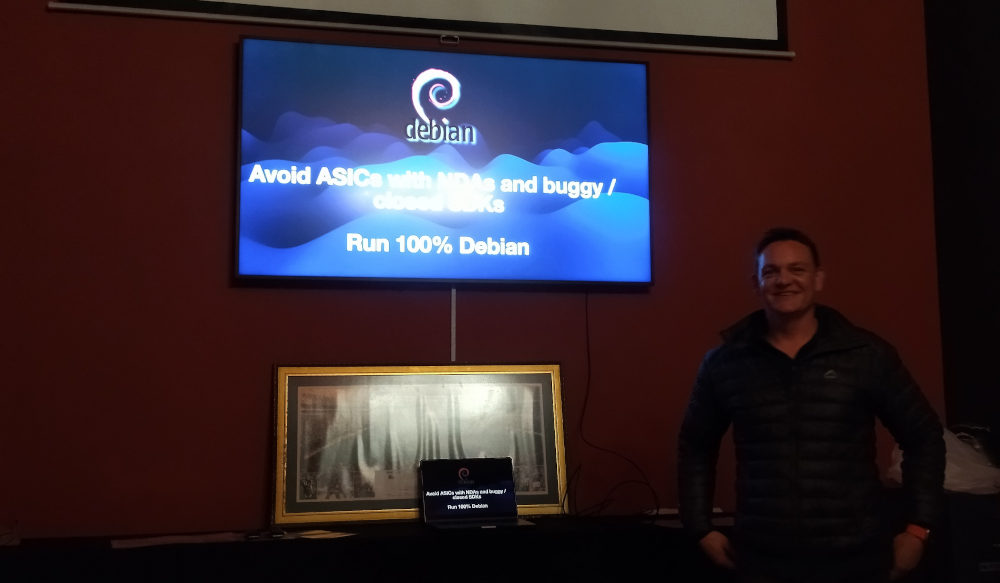
Jonathan Carter: CLUG Talk: Running Debian on a 100Gbps router

Last night I attended the first local Linux User Group talk since before the pandemic (possibly even long before the pandemic!) Topic: How and why Atomic Access runs Debian on a 100Gbps router Speaker: Joe Botha This is the first time CLUG used Woodstock Brewery as a venue. It s great, because now we can have snacks and beer during the talks :)

Joe has worked in the internet space for quite some time, and co-founded companies like Teraco, Frogfoot, Amobia, Octotel and Atomic Access. Through all of these he s done interesting and noteworthy work, which I ve only seen some glimpses of before in the few moments we ve interacted at CLUG events. It was nice seeing a lot more detail of a project that I wouldn t even know about if he didn t give this talk. It doesn t seem that anyone else is running Debian on big switches for commercial ISPs. He goes through these great lengths to run Debian so that he can have a decent set of tools and familiar commands on the switch, as apposed to the (my word here) crappy tooling that you would get on the brand name switches.
By total coincidence, David Plonka happened to be at the brewery too, he s a network expert who works at Akamai. He didn t know this talk was taking place, so this was a fun happenstance, he had some good inputs during the talk too. He also bought everyone a round of beer, thanks David! I asked Joe for his slides and I ll share them here when I get them. Unfortunately we don t have video for this talk, but I asked Joe to consider coming to DebConf23, I think this topic would be really interesting to the wider Debian crowd. By the way, both registration and the call for proposals are now officially open for DebConf23, it s taking place in September in Kochi, India this year. Updates (2023-06-07): Joe provided slides for his talk, you can get them here. He also provided some links:

Russell Coker: Do Not Use

When I connect my Desklab USB-C monitor [1] (which has been vastly underused for the last 3 years) into a Linux system the display type is listed as DO NOT USE RTK . One of the more informative discussions of this was on Linux Mint forums [2] which revealed that it s a mapping for an code that shouldn t be used. So it s not saying don t use this monitor it s saying don t use this code . So the Desklab people when they implemented a display with an RTK chipset should have changed the ID field from RTK to something representing their use. On Debian the file /usr/share/hwdata/pnp.ids has the IDs and you can grep for RTK in that. Also for programmers, please use more descriptive strings than do not use , when I was trying to find this on Debian code search [3] it turned up hundreds of pages of results which was more than a human can read through. If the text had been something that would make sense to a user such as OEM please replace with company name it would have made it very clear to me (and all the other people searching for this) what it meant and the fact that Desklab had stuffed up. So instead of wondering about this for years before eventually finding the right Google search to find the answer I could have worked it out immediately if the text had been clearer.

13 June 2023

Matt Brown: Ventilation Monitoring Market Research

Over the last month I ve performed some market research to better understand the potential for co2mon.nz and to help me decide whether the product I ve built has a fit with the market or not. The key conclusions I ve drawn from this work are: Keep reading to hear more about the results that lead to those conclusions.

Survey The first piece of research I undertook was a survey covering three topics: views on indoor air quality, how respondents currently monitor indoor air quality and the desired features, including price, for a CO2 monitor. The survey was distributed to my extended personal network via social media, email and word of mouth. I offered respondents the opportunity to win a year of free monitoring as an incentive and received just under 70 responses overall - the lucky winner of that prize was Sam H of Auckland whose shiny new CO2 monitor will be in the mail shortly.

Views on indoor air quality
  • Nearly all respondents strongly agreed that clean, fresh indoor air is important for avoiding sickness and enabling our best work, learning and general cognitive performance, with not a single negative response.
  • 25% of respondents indicated they did not have a good understanding of the quality of the indoor air they were breathing versus 43% who indicated they had a good understanding of their indoor air quality.
  • Nearly 70% of respondents agreed (and greater than 40% strongly agreed) that real-time monitoring is beneficial and worth investing time and money in providing, with a similar distribution of responses agreeing it should be required in all shared indoor spaces.

Current ventilation monitoring approaches
  • For the home setting, using our senses was the most common method of understanding air quality, and only 6% of respondents were unhappy with their ability to monitor ventilation at home.
  • At work, trusting the owner of the building to monitor ventilation was the most common method, although using our senses and some personally collected data also featured for 20% of respondents. While the majority of respondents saw some room for improvement here, less than 20% of respondents were unsatisfied with the ability to monitor ventilation at work.
  • In shared public spaces using our senses and trusting the owner were equally popular with very little use of any data reported. The majority of respondents (40%) were unsatisfied with this situation with 34% seeing some room for improvement and very few being satisfied overall.

CO2 monitoring product features
  • A screen and WiFi were both strongly supported features with less than 10% of respondents seeing them as irrelevant and a large majority of answers skewing towards essential.
  • Coloured lights providing a quick indication were not viewed as important by 13% of respondents and while the majority of answers were towards essential there was also a large (22%) set of respondents who were indifferent to this feature.
  • The ability to access measurements and reports via a web interface was very mixed. Around 20% of respondents reported the feature as irrelevant, 20% essential with the majority seeing it as useful but mot essential.
  • Almost all respondents strongly indicated that additional air quality metrics beyond CO2 were important to collect.
  • Respondents mostly indicated the proposed prices are too high (64%), with essentially no responses suggesting they were too low and the balance (43%) in the middle. Only 5% of respondents indicated a preference for a rental option over a straight purchase.

Advertising In parallel with the survey, I worked with my cousin who runs a marketing agency, The Asset, to place some Facebook ads aiming to systematically evaluate what combination of images and text would draw the best response. It s been an interesting process - despite working for Google for 15 years, I know relatively little about the day to day practice of online advertising! I think we re about 50% of the way through that process of systematically building a funnel of traffic, it s been a steep learning curve and its clear there s significantly more thought and time that would need to be invested into this were it to be the primary driver of sales for a business. It s interested to see how what resonates or doesn t resonate with the audience is often completely different to what I expect, confirming the importance of having a process to evaluate and tweak how the advertising runs. After just under 2 weeks of advertising with a daily budget in the $20 - $30 range, my ads have had just under 17k impressions by 10k distinct people resulting in 76 visits to the co2mon.nz website, and zero sales. The ads themselves received 233 clicks, so there s clearly a lot of room for further improvement and revision of the ad text itself to present a more compelling message. Unfortunately the most common response and feedback to the ads themselves has been comments arguing that CO2 is wonderful, climate change is invented and all our problems would be solved if we had more CO2 everywhere. Tedious to deal with, but also useful reminder about awareness and interest in the problem to contrast with the results from the survey of my extended personal network!

Feedback from other conversations In addition to the survey and advertising I ve had conversations with some local air conditioning and ventilation businesses as well as a commercial building management firm - all providing similar feedback to the results from the survey - acknowledgement that air quality is important and relatively immaturely measured currently, but low urgency or pain to change or remedy that situation. Another interesting point that s come up in conversations with various small business owners is what to do if or when the monitoring shows a ventilation problem? The obvious answer of opening the windows more does not seem to be particularly well received. Without a compelling solution to offer to the potential problem that the monitoring might reveal I often sense a reluctance from people to invest too much time and money in something which may create a problem in a space they don t currently see as urgent.

Conclusions The responses are interesting and surprising to me a in a few ways (no interest in rental, favouring web interface over app), but at the end of the day lead to the two conclusions described above: Air quality is acknowledged as important, but monitoring it is not an urgent or pressing problem for most people. At home and work the majority of people are OK with relying on their senses or trusting someone else to maintain ventilation. They wouldn t object to improvements, but the feedback is that ventilation monitoring is not a problem people are actively looking to solve. The number of people who do see this as an urgent enough problem to invest money into solving is low - even within the biased sample of my extended network. There is a stronger set of evidence for the problem being seen as more urgent by the users of shared public spaces - but I ve not been able to find any evidence that the owners and managers of those spaces feel the same urgency or duty of care towards their users to invest in this space. Most of the opportunity is in the hardware rather than the software service. This signal comes through in the feedback on the pricing (preferring outright purchase vs rental), but it s also been directly expressed in the free-form comments and other conversations I ve had and the the relative importance given to the physical product features over the web/app interfaces in the survey results.

Wrap Up I m glad I finally spent the time doing this research, particularly the survey, these are good lessons to learn, even if I should have taken the time to learn them a year ago - so I can write that reminder (do your research before building a product) down as a key outcome of this process too! Stay tuned for more details on the other work I ve been doing recently on the hardware side of co2mon.nz and what these results mean for my overall plans. As always, I d love to hear from you if these results give you ideas or questions you d like to discuss.

11 June 2023

Michael Prokop: What to expect from Debian/bookworm #newinbookworm

Bookworm Banner, Copyright 2022 Juliette Taka Debian v12 with codename bookworm was released as new stable release on 10th of June 2023. Similar to what we had with #newinbullseye and previous releases, now it s time for #newinbookworm! I was the driving force at several of my customers to be well prepared for bookworm. As usual with major upgrades, there are some things to be aware of, and hereby I m starting my public notes on bookworm that might be worth also for other folks. My focus is primarily on server systems and looking at things from a sysadmin perspective. Further readings As usual start at the official Debian release notes, make sure to especially go through What s new in Debian 12 + Issues to be aware of for bookworm. Package versions As a starting point, let s look at some selected packages and their versions in bullseye vs. bookworm as of 2023-02-10 (mainly having amd64 in mind):
Package bullseye/v11 bookworm/v12
ansible 2.10.7 2.14.3
apache 2.4.56 2.4.57
apt 2.2.4 2.6.1
bash 5.1 5.2.15
ceph 14.2.21 16.2.11
docker 20.10.5 20.10.24
dovecot 2.3.13 2.3.19
dpkg 1.20.12 1.21.22
emacs 27.1 28.2
gcc 10.2.1 12.2.0
git 2.30.2 2.39.2
golang 1.15 1.19
libc 2.31 2.36
linux kernel 5.10 6.1
llvm 11.0 14.0
lxc 4.0.6 5.0.2
mariadb 10.5 10.11
nginx 1.18.0 1.22.1
nodejs 12.22 18.13
openjdk 11.0.18 + 17.0.6 17.0.6
openssh 8.4p1 9.2p1
openssl 1.1.1n 3.0.8-1
perl 5.32.1 5.36.0
php 7.4+76 8.2+93
podman 3.0.1 4.3.1
postfix 3.5.18 3.7.5
postgres 13 15
puppet 5.5.22 7.23.0
python2 2.7.18 (gone!)
python3 3.9.2 3.11.2
qemu/kvm 5.2 7.2
ruby 2.7+2 3.1
rust 1.48.0 1.63.0
samba 4.13.13 4.17.8
systemd 247.3 252.6
unattended-upgrades 2.8 2.9.1
util-linux 2.36.1 2.38.1
vagrant 2.2.14 2.3.4
vim 8.2.2434 9.0.1378
zsh 5.8 5.9
Linux Kernel The bookworm release ships a Linux kernel based on version 6.1, whereas bullseye shipped kernel 5.10. As usual there are plenty of changes in the kernel area, including better hardware support, and this might warrant a separate blog entry, but to highlight some changes: See Kernelnewbies.org for further changes between kernel versions. Configuration management puppet s upstream sadly still doesn t provide packages for bookworm (see PA-4995), though Debian provides puppet-agent and puppetserver packages, and even puppetdb is back again, see release notes for further information. ansible is also available and made it with version 2.14 into bookworm. Prometheus stack Prometheus server was updated from v2.24.1 to v2.42.0 and all the exporters that got shipped with bullseye are still around (in more recent versions of course). Virtualization docker (v20.10.24), ganeti (v3.0.2-3), libvirt (v9.0.0-4), lxc (v5.0.2-1), podman (v4.3.1), openstack (Zed), qemu/kvm (v7.2), xen (v4.17.1) are all still around. Vagrant is available in version 2.3.4, also Vagrant upstream provides their packages for bookworm already. If you re relying on VirtualBox, be aware that upstream doesn t provide packages for bookworm yet (see ticket 21524), but thankfully version 7.0.8-dfsg-2 is available from Debian/unstable (as of 2023-06-10) (VirtualBox isn t shipped with stable releases since quite some time due to lack of cooperation from upstream on security support for older releases, see #794466). rsync rsync was updated from v3.2.3 to v3.2.7, and we got a few new options: OpenSSH OpenSSH was updated from v8.4p1 to v9.2p1, so if you re interested in all the changes, check out the release notes between those version (8.5, 8.6, 8.7, 8.8, 8.9, 9.0, 9.1 + 9.2). Let s highlight some notable new features: One important change you might wanna be aware of is that as of OpenSSH v8.8, RSA signatures using the SHA-1 hash algorithm got disabled by default, but RSA/SHA-256/512 AKA RSA-SHA2 gets used instead. OpenSSH has supported RFC8332 RSA/SHA-256/512 signatures since release 7.2 and existing ssh-rsa keys will automatically use the stronger algorithm where possible. A good overview is also available at SSH: Signature Algorithm ssh-rsa Error. Now tools/libraries not supporting RSA-SHA2 fail to connect to OpenSSH as present in bookworm. For example python3-paramiko v2.7.2-1 as present in bullseye doesn t support RSA-SHA2. It tries to connect using the deprecated RSA-SHA-1, which is no longer offered by default with OpenSSH as present in bookworm, and then fails. Support for RSA/SHA-256/512 signatures in Paramiko was requested e.g. at #1734, and eventually got added to Paramiko and in the end the change made it into Paramiko versions >=2.9.0. Paramiko in bookworm works fine, and a backport by rebuilding the python3-paramiko package from bookworm for bullseye solves the problem (BTDT). Misc unsorted Thanks to everyone involved in the release, happy upgrading to bookworm, and let s continue with working towards Debian/trixie. :)

6 June 2023

Russell Coker: PinePhonePro First Impression

Hardware I received my PinePhone Pro [1] on Thursday, it seems in many ways better than the Purism Librem 5 [2] that I have previously written about. The PinePhone is thinner, lighter, and yet has a much longer battery life. A friend described the Librem5 as the CyberTruck phone and not in a good way. In a test I had my PinePhone and my Librem5 fully charged, left them for 4.5 hours without doing anything much with them, and then the PinePhone was at 85% and the Librem5 was at 57%. So the Librem5 will run out of battery after about 10 hours of not being used while a PinePhonePro can be expected to last about 30 hours. The PinePhonePro isn t as good as some of the recent Android phones in this regard but it shows the potential to be quite usable. For this test both phones were connected to a 2.4GHz Wifi network (which uses less power than 5GHz) and doing nothing much with an out of the box configuration. A phone that is checking email, social networking, and a couple of IM services will use the battery faster. But even if the PinePhone has it s battery used twice as fast in a more realistic test that will still be usable. Here are the passmark results from the PinePhone Pro [3] which got a CPU score of 888 compared to 507 for the Librem 5 and 678 for one of the slower laptops I ve used. The results are excluded from the Passmark averages because they identified the CPU as only having 4 cores (expecting just 4*A72) while the PinePhonePro has 6 cores (2*A72+4*A53). This phone definitely has the CPU power for convergence [4]! Default OS By default the PinePhone has a KDE based GUI and the Librem5 has a GNOME based GUI. I don t like any iteration of GNOME (I have tried them all and disliked them all) and I like KDE so I will tend to like anything that is KDE based more than anything GNOME based. But in addition to that the PinePhone has an interface that looks a lot like Android with the three on-screen buttons at the bottom of the display and the way it has the slide up tray for installed apps. Android is the most popular phone OS and looking like the most common option is often a good idea for a new and different product, this seems like an objective criteria to determine that the default GUI on the PinePhone is a better choice (at least for the default). When I first booted it and connected it to Wifi the updates app said that there were 633 updates to apply, but never applied them (I tried clicking on the update button but to no avail) and didn t give any error message. For me not being Debian is enough reason to dislike Manjaro, but if that wasn t enough then the failure to update would be a good start. When I ran pacman in a terminal window it said that each package was corrupt and asked if I wanted to delete it. According to tar tvJf the packages weren t corrupt. After downloading them again it said that they were corrupt again so it seemed that pacman wasn t working correctly. When the screen is locked and a call comes in it gives a window with Accept and Reject buttons but neither of them works. The default country code for Spacebar (the SMS app) is +1 (US) even though I specified Australia on the initial login. It also doesn t get the APN unlike Android phones which seem to have some sort of list of APNs. Upgrading to Debian The Debian Wiki page about Installing on the PinePhone Pro has the basic information [5]. The first thing it covers is installing the TOW boot loader which is already installed by default in recent PinePhones (such as mine). You can recognise that TOW is installed by pressing the volume-up button in the early stages of boot up (described as before and during the second vibration ), then the LED will turn blue and the phone will act as a USB mass storage device which makes it easy to do other install/recovery tasks. The other TOW option is to press volume-down to boot from a MicroSD card (the default is to boot the OS on the eMMC). The images linked from the Debian wiki page are designed to be installed with bmaptool from the bmap-tools Debian package. After installing that package and downloading the pre-built Mobian image I installed it with the command bmaptool copy mobian-pinephonepro-phosh-bookworm-12.0-rc3.img.gz /dev/sdb where /dev/sdb is the device that the USB mapped PinePhone storage was located. That took 6 minutes and then I rebooted my PinePhone into Mobian! Unfortunately the default GUI for Mobian is GNOME/Phosh. Changing it to KDE is my next task.

Russell Coker: Dell 32 4K Monitor and DisplayPort Switch

After determining that the Philips 43 monitor was too large for my taste as well as not having a clear enough display [1] I bought a Dell 32 4K monitor for $499 on the 1st of July 2022. That monitor has been working nicely for almost a year now, for DisplayPort it s operation is perfect and 32 seems like an ideal size for my use. There is one problem that both HDMI ports will sometimes turn off for about half a second, I ve tested on both ports and on multiple computers as well as a dock and it gives the same result so it s definitely the monitor. The problem for me is that the most casual inspection won t reveal the problem and the monitor is large and difficult to transport as I ve thrown out the box. If I had this sort of problem with a monitor at work I d add it to the list of things for Dell to fix next time they visit the office or use one of the many monitor boxes available to ship it back to them. But for home use it s more of a problem for me. The easiest solution is to avoid HDMI. A year ago I blogged about using DDC to switch monitor inputs [2], I had that running with a cheap USB switch since then to allow a workstation and a laptop to share the same monitor, keyboard, and mouse. Recently I got a USB-C dock that allows a USB-C laptop to talk to a display via DisplayPort as opposed to the HDMI connector that s built in. But my Dell monitor only has one DisplayPort input. So I have just bought a DisplayPort and USB KVM switch via eBay for $52, a reasonable price given that last year such things were well over $100. It has ports for 3 USB devices which is better than my previous setup of a USB switch with only a single port that I used with a 3 port hub for my keyboard and mouse. the DisplayPort switch is described as doing 4K at 60Hz, I don t know how it will perform with a 5K monitor, maybe it will work at 30Hz or 40Hz. But currently Dell 5K monitors are at $2,500 and 6K monitors are about $3,800 so I don t plan to get one of them any time soon.

4 June 2023

Debian Brasil: Oficina de tradu o do Manual do(a) Administrador(a) Debian em 13 de junho

A equipe de tradu o do Debian para o portugu s do Brasil realizar , no dia 13 de junho a partir das 20h, uma oficina de tradu o do Manual do(a) Administrador(a) Debian (The Debian Administrator's Handbook). O objetivo mostrar aos( s) iniciantes como colaborar na tradu o deste importante material, que existe desde 2004 e vem sendo traduzido para o portugu s ao longo dos anos. Agora a tradu o precisa ser atualizada para a vers o 12 do Debian (bookworm), que ser lan ada este m s. A ferramenta usada para traduzir o Manual o site weblate, ent o voc j pode criar sua conta e acessar o Projeto Debian Handbook para se ambientar. A oficina acontecer no formato online, e o link para participar da sala no jitsi ser divulgado no grupo debl10nptBR no telegram e no canal #debian-l10n-br do IRC.

2 June 2023

Jelmer Vernooij: Porting Python projects to Rust

I ve recently been working on porting some of my Python code to rust, both for performance reasons, and because of the strong typing in the language. As a fan of Haskell, I also just really enjoy using the language. Porting any large project to a new language can be a challenge. There is a temptation to do a rewrite from the ground-up in idiomatic rust and using all new fancy features of the language.
Porting in one go However, this is a bit of a trap:
  • It blocks other work. It can take a long time to finish the rewrite, during which time there is no good place to make other bug fixes/feature changes. If you make the change in the python branch, then you may also have to patch the in-progress rust fork.
  • No immediate return on investment. While the rewrite is happening, all of the investment in it is sunk costs.
  • Throughout the process, you can only run the tests for subsystems that have already been ported. It s common to find subtle bugs later in code ported early.
  • Understanding existing code, porting it and making it idiomatic rust all at the same time takes more time and post-facto debugging.
Iterative porting Instead, we ve found that it works much better to take an iterative approach. One of the hidden gems of rust is the excellent PyO3 crate, which allows creating python bindings for rust code in a way that is several times less verbose and less painful than C or SWIG. Because of rust s strong ownership model, it s also really hard to muck up e.g. reference counts when creating Python bindings for rust code. We port individual functions or classes to rust one at a time, starting with functionality that doesn t have dependencies on other python code and gradually working our way up the call stack. Each subsystem of the code is converted to two matching rust crates: one with a port of the code to pure rust, and one with python bindings for the rust code. Generally multiple python modules end up being a single pair of rust crates. The signature for the pure Rust code follow rust conventions, but the business logic is mostly ported as-is (just in rust syntax) and the signatures of the python bindings match that of the original python code. This then allows running the original python tests to verify that the code still behaves the same way. Changes can also immediately land on the main branch. A subsequent step is usually to refactor the rust code to be more idiomatic - all the while keeping the tests passing. There is also the potential to e.g. switch to using external rust crates (with perhaps subtly different behaviour), or drop functionality altogether. At some point, we will also port the tests from python to rust, and potentially drop the python bindings - once all the caller s have been converted to rust.
Example For example, imagine I have a Python module janitor/mail_filter.py with this function:
 1
 2
 3
 4
 5
 6
 7
 8
 9
10
11
12
13
14
15
16
def parse_plain_text_body(text):
   lines = text.splitlines()
   for i, line in enumerate(lines):
       if line == 'Reply to this email directly or view it on GitHub:':
           return lines[i + 1].split('#')[0]
       if (line == 'For more details, see:'
               and lines[i + 1].startswith('https://code.launchpad.net/')):
           return lines[i + 1]
       try:
           (field, value) = line.split(':', 1)
       except ValueError:
           continue
       if field.lower() == 'merge request url':
           return value.strip()
   return None
Porting this to rust naively (in a crate I ve called mailfilter ) it might look something like this:
 1
 2
 3
 4
 5
 6
 7
 8
 9
10
11
12
13
14
15
16
17
18
19
20
pub fn parse_plain_text_body(text: &str) -> Option<String>  
     let lines: Vec<&str> = text.lines().collect();
     for (i, line) in lines.iter().enumerate()  
         if line == &"Reply to this email directly or view it on GitHub:"  
             return Some(lines[i + 1].split('#').next().unwrap().to_string());
          
         if line == &"For more details, see:"
             && lines[i + 1].starts_with("https://code.launchpad.net/")
          
             return Some(lines[i + 1].to_string());
          
         if let Some((field, value)) = line.split_once(':')  
             if field.to_lowercase() == "merge request url"  
                 return Some(value.trim().to_string());


     None
  
Bindings are created in a crate called mailfilter-py, which looks like this:
 1
 2
 3
 4
 5
 6
 7
 8
 9
10
11
12
13
use pyo3::prelude::*;
 #[pyfunction]
 fn parse_plain_text_body(text: &str) -> Option<String>  
     janitor_mail_filter::parse_plain_text_body(text)
  
 #[pymodule]
 pub fn _mail_filter(py: Python, m: &PyModule) -> PyResult<()>  
     m.add_function(wrap_pyfunction!(parse_plain_text_body, m)?)?;
     Ok(())
  
The metadata for the crates is what you d expect. mailfilter-py uses PyO3 and depends on mailfilter.
 1
 2
 3
 4
 5
 6
 7
 8
 9
10
11
12
[package]
 name = "mailfilter-py"
 version = "0.0.0"
 authors = ["Jelmer Vernoo  <jelmer@jelmer.uk>"]
 edition = "2018"
 [lib]
 crate-type = ["cdylib"]
 [dependencies]
 janitor-mail-filter =   path = "../mailfilter"  
 pyo3 =   version = ">=0.14", features = ["extension-module"] 
I use python-setuptools-rust to get the python ecosystem to build the python bindings. Here is what setup.py looks like:
1
2
3
4
5
6
7
8
9
#!/usr/bin/python3
from setuptools import setup
from setuptools_rust import RustExtension, Binding
setup(
        rust_extensions=[RustExtension(
        "janitor._mailfilter", "crates/mailfilter-py/Cargo.toml",
        binding=Binding.PyO3)],
)
And of course, setuptools-rust needs to be listed as a setup requirement in pyproject.toml or setup.cfg. After that, we can replace the original python code with a simple import and verify that the tests still run:
1
from ._mailfilter import parse_plain_text_body
Of course, not all bindings are as simple as this. Iterators in particular are more complicated, as is code that has a loose idea of ownership in python. But I ve found that the time investment is usually well worth the ability to land changes on the development head early and often. I d be curious to hear if people have had success with other approaches to porting Python code to Rust. If you do, please leave a comment.

Matt Brown: Calling time on DNSSEC: The costs exceed the benefits

I m calling time on DNSSEC. Last week, prompted by a change in my DNS hosting setup, I began removing it from the few personal zones I had signed. Then this Monday the .nz ccTLD experienced a multi-day availability incident triggered by the annual DNSSEC key rotation process. This incident broke several of my unsigned zones, which led me to say very unkind things about DNSSEC on Mastodon and now I feel compelled to more completely explain my thinking: For almost all domains and use-cases, the costs and risks of deploying DNSSEC outweigh the benefits it provides. Don t bother signing your zones. The .nz incident, while topical, is not the motivation or the trigger for this conclusion. Had it been a novel incident, it would still have been annoying, but novel incidents are how we learn so I have a small tolerance for them. The problem with DNSSEC is precisely that this incident was not novel, just the latest in a long and growing list. It s a clear pattern. DNSSEC is complex and risky to deploy. Choosing to sign your zone will almost inevitably mean that you will experience lower availability for your domain over time than if you leave it unsigned. Even if you have a team of DNS experts maintaining your zone and DNS infrastructure, the risk of routine operational tasks triggering a loss of availability (unrelated to any attempted attacks that DNSSEC may thwart) is very high - almost guaranteed to occur. Worse, because of the nature of DNS and DNSSEC these incidents will tend to be prolonged and out of your control to remediate in a timely fashion. The only benefit you get in return for accepting this almost certain reduction in availability is trust in the integrity of the DNS data a subset of your users (those who validate DNSSEC) receive. Trusted DNS data that is then used to communicate across an untrusted network layer. An untrusted network layer which you are almost certainly protecting with TLS which provides a more comprehensive and trustworthy set of security guarantees than DNSSEC is capable of, and provides those guarantees to all your users regardless of whether they are validating DNSSEC or not. In summary, in our modern world where TLS is ubiquitous, DNSSEC provides only a thin layer of redundant protection on top of the comprehensive guarantees provided by TLS, but adds significant operational complexity, cost and a high likelihood of lowered availability. In an ideal world, where the deployment cost of DNSSEC and the risk of DNSSEC-induced outages were both low, it would absolutely be desirable to have that redundancy in our layers of protection. In the real world, given the DNSSEC protocol we have today, the choice to avoid its complexity and rely on TLS alone is not at all painful or risky to make as the operator of an online service. In fact, it s the prudent choice that will result in better overall security outcomes for your users. Ignore DNSSEC and invest the time and resources you would have spent deploying it improving your TLS key and certificate management. Ironically, the one use-case where I think a valid counter-argument for this position can be made is TLDs (including ccTLDs such as .nz). Despite its many failings, DNSSEC is an Internet Standard, and as infrastructure providers, TLDs have an obligation to enable its use. Unfortunately this means that everyone has to bear the costs, complexities and availability risks that DNSSEC burdens these operators with. We can t avoid that fact, but we can avoid creating further costs, complexities and risks by choosing not to deploy DNSSEC on the rest of our non-TLD zones.

But DNSSEC will save us from the evil CA ecosystem! Historically, the strongest motivation for DNSSEC has not been the direct security benefits themselves (which as explained above are minimal compared to what TLS provides), but in the new capabilities and use-cases that could be enabled if DNS were able to provide integrity and trusted data to applications. Specifically, the promise of DNS-based Authentication of Named Entities (DANE) is that with DNSSEC we can be free of the X.509 certificate authority ecosystem and along with it the expensive certificate issuance racket and dubious trust properties that have long been its most distinguishing features. Ten years ago this was an extremely compelling proposition with significant potential to improve the Internet. That potential has gone unfulfilled. Instead of maturing as deployments progressed and associated operational experience was gained, DNSSEC has been beset by the discovery of issue after issue. Each of these has necessitated further changes and additions to the protocol, increasing complexity and deployment cost. For many zones, including significant zones like google.com (where I led the attempt to evaluate and deploy DNSSEC in the mid 2010s), it is simply infeasible to deploy the protocol at all, let alone in a reliable and dependable manner. While DNSSEC maturation and deployment has been languishing, the TLS ecosystem has been steadily and impressively improving. Thanks to the efforts of many individuals and companies, although still founded on the use of a set of root certificate authorities, the TLS and CA ecosystem today features transparency, validation and multi-party accountability that comprehensively build trust in the ability to depend and rely upon the security guarantees that TLS provides. When you use TLS today, you benefit from:
  • Free/cheap issuance from a number of different certificate authorities.
  • Regular, automated issuance/renewal via the ACME protocol.
  • Visibility into who has issued certificates for your domain and when through Certificate Transparency logs.
  • Confidence that certificates issued without certificate transparency (and therefore lacking an SCT) will not be accepted by the leading modern browsers.
  • The use of modern cryptographic protocols as a baseline, with a plausible and compelling story for how these can be steadily and promptly updated over time.
DNSSEC with DANE can match the TLS ecosystem on the first benefit (up front price) and perhaps makes the second benefit moot, but has no ability to match any of the other transparency and accountability measures that today s TLS ecosystem offers. If your ZSK is stolen, or a parent zone is compromised or coerced, validly signed TLSA records for a forged certificate can be produced and spoofed to users under attack with minimal chances of detection. Finally, in terms of overall trust in the roots of the system, the CA/Browser forum requirements continue to improve the accountability and transparency of TLS certificate authorities, significantly reducing the ability for any single actor (say a nefarious government) to subvert the system. The DNS root has a well established transparent multi-party system for establishing trust in the DNSSEC root itself, but at the TLD level, almost intentionally thanks to the hierarchical nature of DNS, DNSSEC has multiple single points of control (or coercion) which exist outside of any formal system of transparency or accountability. We ve moved from DANE being a potential improvement in security over TLS when it was first proposed, to being a definite regression from what TLS provides today. That s not to say that TLS is perfect, but given where we re at, we ll get a better security return from further investment and improvements in the TLS ecosystem than we will from trying to fix DNSSEC.

But TLS is not ubiquitous for non-HTTP applications The arguments above are most compelling when applied to the web-based HTTP-oriented ecosystem which has driven most of the TLS improvements we ve seen to date. Non-HTTP protocols are lagging in adoption of many of the improvements and best practices TLS has on the web. Some claim this need to provide a solution for non-HTTP, non-web applications provides a motivation to continue pushing DNSSEC deployment. I disagree, I think it provides a motivation to instead double-down on moving those applications to TLS. TLS as the new TCP. The problem is that costs of deploying and operating DNSSEC are largely fixed regardless of how many protocols you are intending to protect with it, and worse, the negative side-effects of DNSSEC deployment can and will easily spill over to affect zones and protocols that don t want or need DNSSEC s protection. To justify continued DNSSEC deployment and operation in this context means using a smaller set of benefits (just for the non-HTTP applications) to justify the already high costs of deploying DNSSEC itself, plus the cost of the risk that DNSSEC poses to the reliability to your websites. I don t see how that equation can ever balance, particularly when you evaluate it against the much lower costs of just turning on TLS for the rest of your non-HTTP protocols instead of deploying DNSSEC. MTA-STS is a worked example of how this can be achieved. If you re still not convinced, consider that even DNS itself is considering moving to TLS (via DoT and DoH) in order to add the confidentiality/privacy attributes the protocol currently lacks. I m not a huge fan of the latency implications of these approaches, but the ongoing discussion shows that clever solutions and mitigations for that may exist. DoT/DoH solve distinct problems from DNSSEC and in principle should be used in combination with it, but in a world where DNS itself is relying on TLS and therefore has eliminated the majority of spoofing and cache poisoning attacks through DoT/DoH deployment the benefit side of the DNSSEC equation gets smaller and smaller still while the costs remain the same.

OK, but better software or more careful operations can reduce DNSSEC s cost Some see the current DNSSEC costs simply as teething problems that will reduce as the software and tooling matures to provide more automation of the risky processes and operational teams learn from their mistakes or opt to simply transfer the risk by outsourcing the management and complexity to larger providers to take care of. I don t find these arguments compelling. We ve already had 15+ years to develop improved software for DNSSEC without success. What s changed that we should expect a better outcome this year or next? Nothing. Even if we did have better software or outsourced operations, the approach is still only hiding the costs behind automation or transferring the risk to another organisation. That may appear to work in the short-term, but eventually when the time comes to upgrade the software, migrate between providers or change registrars the debt will come due and incidents will occur. The problem is the complexity of the protocol itself. No amount of software improvement or outsourcing addresses that. After 15+ years of trying, I think it s worth considering that combining cryptography, caching and distributed consensus, some of the most fundamental and complex computer science problems, into a slow-moving and hard to evolve low-level infrastructure protocol while appropriately balancing security, performance and reliability appears to be beyond our collective ability. That doesn t have to be the end of the world, the improvements achieved in the TLS ecosystem over the same time frame provide a positive counter example - perhaps DNSSEC is simply focusing our attention at the wrong layer of the stack. Ideally secure DNS data would be something we could have, but if the complexity of DNSSEC is the price we have to pay to achieve it, I m out. I would rather opt to remain with the simpler yet insecure DNS protocol and compensate for its short comings at higher transport or application layers where experience shows we are able to more rapidly improve and develop our security capabilities.

Summing up For the vast majority of domains and use-cases there is simply no net benefit to deploying DNSSEC in 2023. I d even go so far as to say that if you ve already signed your zones, you should (carefully) move them back to being unsigned - you ll reduce the complexity of your operating environment and lower your risk of availability loss triggered by DNS. Your users will thank you. The threats that DNSSEC defends against are already amply defended by the now mature and still improving TLS ecosystem at the application layer, and investing in further improvements here carries far more return than deployment of DNSSEC. For TLDs, like .nz whose outage triggered this post, DNSSEC is not going anywhere and investment in mitigating its complexities and risks is an unfortunate burden that must be shouldered. While the full incident report of what went wrong with .nz is not yet available, the interim report already hints at some useful insights. It is important that InternetNZ publishes a full and comprehensive review so that the full set of learnings and improvements this incident can provide can be fully realised by .nz and other TLD operators stuck with the unenviable task of trying to safely operate DNSSEC.

Postscript After taking a few days to draft and edit this post, I ve just stumbled across a presentation from the well respected Geoff Huston at last weeks RIPE86 meeting. I ve only had time to skim the slides (video here) - they don t seem to disagree with my thinking regarding the futility of the current state of DNSSEC, but also contain some interesting ideas for what it might take for DNSSEC to become a compelling proposition. Probably worth a read/watch!

Next.

Previous.