Search Results: "pm"

8 March 2023

Jelmer Vernooij: The Kali Janitor

The Debian Janitor is an automated system that commits fixes for (minor) issues in Debian packages that can be fixed by software. It gradually started proposing merges in early December. The first set of changes sent out ran lintian-brush on sid packages maintained in Git. This post is part of a series about the progress of the Janitor. Kali Linux have been running their own instance of the Janitor for the last year, under the kali-bot user on GitLab. Their web site has some excellent documentation explaining how the bot works. Both projects share some common components - the core janitor codebase, Silver-Platter and the various codemods (lintian-brush and deb-new-upstream). The site and some of the review logic is different for Kali. The Kali bot has several campaigns:

The last campaign doesn t exist in the Debian janitor, and pulls in new changes from packages that have been imported from other distributions.

For more information about the Janitor s lintian-fixes efforts, see the landing page.

Anton Gladky: Boost C++: default for Debian Bookworm will remain 1.74.0

Boost C++ is a popular set of free, open-source C++ libraries that provide developers with powerful tools and functionality to enhance their software development projects. The newest version, 1.81.0, has been available in Debian Bookworm for about a month now, but the default version for boost-dependent packages is still the older 1.74.0. The transition to the newer library has been postponed due to possible regressions that could take more time to resolve. This means that the default version for boost-dependent packages in Debian Bookworm will remain 1.74.0 until after the release. If you re working on your own project, you can use the newest version of Boost C++ (1.81.0) to take advantage of its new features and improvements. Debian Bullseye users can also access Boost C++ 1.81.0 from the bullseye-backports repository. Thanks Freexian for supporting this effort.

7 March 2023

Robert McQueen: Flathub in 2023

It s been quite a few months since the most recent updates about Flathub last year. We ve been busy behind the scenes, so I d like to share what we ve been up to at Flathub and why and what s coming up from us this year. I want to focus on: Today Flathub is going strong: we offer 2,000 apps from over 1,500 collaborators on GitHub. We re averaging 700,000 app downloads a day, with 898 million HTTP requests totalling 88.3 TB served by our CDN each day (thank you Fastly!). Flatpak has, in my opinion, solved the largest technical issue which has held back the mainstream growth and acceptance of Linux on the desktop (or other personal computing devices) for the past 25 years: namely, the difficulty for app developers to publish their work in a way that makes it easy for people to discover, download (or sideload, for people in challenging connectivity environments), install and use. Flathub builds on that to help users discover the work of app developers and helps that work reach users in a timely manner. Initial results of this disintermediation are promising: even with its modest size so far, Flathub has hundreds of apps that I have never, ever heard of before and that s even considering I ve been working in the Linux desktop space for nearly 20 years and spent many of those staring at the contents of dselect (showing my age a little) or GNOME Software, attending conferences, and reading blog posts, news articles, and forums. I am also heartened to see that many of our OS distributor partners have recognised that this model is hugely complementary and additive to the indispensable work they are doing to bring the Linux desktop to end users, and that having more apps available to your users is a value-add allowing you to focus on your core offering and not a zero-sum game that should motivate infighting. Ongoing Progress Getting Flathub into its current state has been a long ongoing process. Here s what we ve been up to behind the scenes: Development Last year, we concluded our first engagement with Codethink to build features into the Flathub web app to move from a build service to an app store. That includes accounts for users and developers, payment processing via Stripe, and the ability for developers to manage upload tokens for the apps they control. In parallel, James Westman has been working on app verification and the corresponding features in flat-manager to ensure app metadata accurately reflects verification and pricing, and to provide authentication for paying users for app downloads when the developer enables it. Only verified developers will be able to make direct uploads or access payment settings for their apps. Legal So far, the GNOME Foundation has acted as an incubator and legal host for Flathub even though it s not purely a GNOME product or initiative. Distributing software to end users along with processing and forwarding payments and donations also has a different legal profile in terms of risk exposure and nonprofit compliance than the current activities of the GNOME Foundation. Consequently, we plan to establish an independent legal entity to own and operate Flathub which reduces risk for the GNOME Foundation, better reflects the independent and cross-desktop interests of Flathub, and provides flexibility in the future should we need to change the structure. We re currently in the process of reviewing legal advice to ensure we have the right structure in place before moving forward. Governance As Flathub is something we want to set outside of the existing Linux desktop and distribution space and ensure we represent and serve the widest community of Linux users and developers we ve been working on a governance model that ensures that there is transparency and trust in who is making decisions, and why. We have set up a working group with myself and Mart n Abente Lahaye from GNOME, Aleix Pol Gonzalez, Neofytos Kolokotronis, and Timoth e Ravier from KDE, and Jorge Castro flying the flag for the Flathub community. Thanks also to Neil McGovern and Nick Richards who were also more involved in the process earlier on. We don t want to get held up here creating something complex with memberships and elections, so at first we re going to come up with a simple/balanced way to appoint people into a board that makes key decisions about Flathub and iterate from there. Funding We have received one grant for 2023 of $100K from Endless Network which will go towards the infrastructure, legal, and operations costs of running Flathub and setting up the structure described above. (Full disclosure: Endless Network is the umbrella organisation which also funds my employer, Endless OS Foundation.) I am hoping to grow the available funding to $250K for this year in order to cover the next round of development on the software, prepare for higher operations costs (e.g., accounting gets more complex), and bring in a second full-time staff member in addition to Bart omiej Piotrowski to handle enquiries, reviews, documentation, and partner outreach. We re currently in discussions with NLnet about funding further software development, but have been unfortunately turned down for a grant from the Plaintext Group for this year; this Schmidt Futures project around OSS sustainability is not currently issuing grants in 2023. However, we continue to work on other funding opportunities. Remaining Barriers My personal hypothesis is that our largest remaining barrier to Linux desktop scale and impact is economic. On competing platforms mobile or desktop a developer can offer their work for sale via an app store or direct download with payment or subscription within hours of making a release. While we have taken the time to first download time down from months to days with Flathub, as a community we continue to have a challenging relationship with money. Some creators are lucky enough to have a full-time job within the FLOSS space, while a few superstar developers are able to nurture some level of financial support by investing time in building a following through streaming, Patreon, Kickstarter, or similar. However, a large proportion of us have to make do with the main payback from our labours being a stream of bug reports on GitHub interspersed with occasional conciliatory beers at FOSDEM (other beverages and events are available). The first and most obvious consequence is that if there is no financial payback for participating in developing apps for the free and open source desktop, we will lose many people in the process despite the amazing achievements of those who have brought us to where we are today. As a result, we ll have far fewer developers and apps. If we can t offer access to a growing base of users or the opportunity to offer something of monetary value to them, the reward in terms of adoption and possible payment will be very small. Developers would be forgiven for taking their time and attention elsewhere. With fewer apps, our platform has less to entice and retain prospective users. The second consequence is that this also represents a significant hurdle for diverse and inclusive participation. We essentially require that somebody is in a position of privilege and comfort that they have internet, power, time, and income not to mention childcare, etc. to spare so that they can take part. If that s not the case for somebody, we are leaving them shut out from our community before they even have a chance to start. My belief is that free and open source software represents a better way for people to access computing, and there are billions of people in the world we should hope to reach with our work. But if the mechanism for participation ensures their voices and needs are never represented in our community of creators, we are significantly less likely to understand and meet those needs. While these are my thoughts, you ll notice a strong theme to this year will be leading a consultation process to ensure that we are including, understanding and reflecting the needs of our different communities app creators, OS distributors and Linux users as I don t believe that our initiative will be successful without ensuring mutual benefit and shared success. Ultimately, no matter how beautiful, performant, or featureful the latest versions of the Plasma or GNOME desktops are, or how slick the newly rewritten installer is from your favourite distribution, all of the projects making up the Linux desktop ecosystem are subdividing between ourselves an absolutely tiny market share of the global market of personal computers. To make a bigger mark on the world, as a community, we need to get out more. What s Next? After identifying our major barriers to overcome, we ve planned a number of focused initiatives and restructuring this year: Phased Deployment We re working on deploying the work we have been doing over the past year, starting first with launching the new Flathub web experience as well as the rebrand that Jakub has been talking about on his blog. This also will finally launch the verification features so we can distinguish those apps which are uploaded by their developers. In parallel, we ll also be able to turn on the Flatpak repo subsets that enable users to select only verified and/or FLOSS apps in the Flatpak CLI or their desktop s app center UI. Consultation We would like to make sure that the voices of app creators, OS distributors, and Linux users are reflected in our plans for 2023 and beyond. We will be launching this in the form of Flathub Focus Groups at the Linux App Summit in Brno in May 2023, followed up with surveys and other opportunities for online participation. We see our role as interconnecting communities and want to be sure that we remain transparent and accountable to those we are seeking to empower with our work. Whilst we are being bold and ambitious with what we are trying to create for the Linux desktop community, we also want to make sure we provide the right forums to listen to the FLOSS community and prioritise our work accordingly. Advisory Board As we build the Flathub organisation up in 2023, we re also planning to expand its governance by creating an Advisory Board. We will establish an ongoing forum with different stakeholders around Flathub: OS vendors, hardware integrators, app developers and user representatives to help us create the Flathub that supports and promotes our mutually shared interests in a strong and healthy Linux desktop community. Direct Uploads Direct app uploads are close to ready, and they enable exciting stuff like allowing Electron apps to be built outside of flatpak-builder, or driving automatic Flathub uploads from GitHub actions or GitLab CI flows; however, we need to think a little about how we encourage these to be used. Even with its frustrations, our current Buildbot ensures that the build logs and source versions of each app on Flathub are captured, and that the apps are built on all supported architectures. (Is 2023 when we add RISC-V? Reach out if you d like to help!). If we hand upload tokens out to any developer, even if the majority of apps are open source, we will go from this relatively structured situation to something a lot more unstructured and we fear many apps will be available on only 64-bit Intel/AMD machines. My sketch here is that we need to establish some best practices around how to integrate Flathub uploads into popular CI systems, encouraging best practices so that we promote the properties of transparency and reproducibility that we don t want to lose. If anyone is a CI wizard and would like to work with us as a thought partner about how we can achieve this make it more flexible where and how build tasks can be hosted, but not lose these cross-platform and inspectability properties we d love to hear from you. Donations and Payments Once the work around legal and governance reaches a decent point, we will be in the position to move ahead with our Stripe setup and switch on the third big new feature in the Flathub web app. At present, we have already implemented support for one-off payments either as donations or a required purchase. We would like to go further than that, in line with what we were describing earlier about helping developers sustainably work on apps for our ecosystem: we would also like to enable developers to offer subscriptions. This will allow us to create a relationship between users and creators that funds ongoing work rather than what we already have. Security For Flathub to succeed, we need to make sure that as we grow, we continue to be a platform that can give users confidence in the quality and security of the apps we offer. To that end, we are planning to set up infrastructure to help ensure developers are shipping the best products they possibly can to users. For example, we d like to set up automated linting and security scanning on the Flathub back-end to help developers avoid bad practices, unnecessary sandbox permissions, outdated dependencies, etc. and to keep users informed and as secure as possible. Sponsorship Fundraising is a forever task as is running such a big and growing service. We hope that one day, we can cover our costs through some modest fees built into our payments but until we reach that point, we re going to be seeking a combination of grant funding and sponsorship to keep our roadmap moving. Our hope is very much that we can encourage different organisations that buy into our vision and will benefit from Flathub to help us support it and ensure we can deliver on our goals. If you have any suggestions of who might like to support Flathub, we would be very appreciative if you could reach out and get us in touch. Finally, Thank You! Thanks to you all for reading this far and supporting the work of Flathub, and also to our major sponsors and donors without whom Flathub could not exist: GNOME Foundation, KDE e.V., Mythic Beasts, Endless Network, Fastly, and Equinix Metal via the CNCF Community Cluster. Thanks also to the tireless work of the Freedesktop SDK community to give us the runtime platform most Flatpaks depend on, particularly Seppo Yli-Olli, Codethink and others. I wanted to also give my personal thanks to a handful of dedicated people who keep Flathub working as a service and as a community: Bart omiej Piotrowski is keeping the infrastructure working essentially single-handedly (in his spare time from keeping everything running at GNOME); Kolja Lampe and Bart built the new web app and backend API for Flathub which all of the new functionality has been built on, and Filippe LeMarchand maintains the checker bot which helps keeps all of the Flatpaks up to date. And finally, all of the submissions to Flathub are reviewed to ensure quality, consistency and security by a small dedicated team of reviewers, with a huge amount of work from Hubert Figui re and Bart to keep the submissions flowing. Thanks to everyone named or unnamed for building this vision of the future of the Linux desktop together with us. (originally posted to Flathub Discourse, head there if you have any questions or comments)

5 March 2023

Enrico Zini: Heart-driven drum loop

I have Python code for reading a heart rate monitor. I have Python code to generate MIDI events. Could I resist putting them together? Clearly not. Here's Jack Of Hearts, a JACK MIDI drum loop generator that uses the heart rate for BPM, and an improvised way to compute heart rate increase/decrease to add variations in the drum pattern. It's very simple minded and silly. To me it was a fun way of putting unrelated things together, and Python worked very well for it.

Reproducible Builds: Reproducible Builds in February 2023

Welcome to the February 2023 report from the Reproducible Builds project. As ever, if you are interested in contributing to our project, please visit the Contribute page on our website.
FOSDEM 2023 was held in Brussels on the 4th & 5th of February and featured a number of talks related to reproducibility. In particular, Akihiro Suda gave a talk titled Bit-for-bit reproducible builds with Dockerfile discussing deterministic timestamps and deterministic apt-get (original announcement). There was also an entire track of talks on Software Bill of Materials (SBOMs). SBOMs are an inventory for software with the intention of increasing the transparency of software components (the US National Telecommunications and Information Administration (NTIA) published a useful Myths vs. Facts document in 2021).
On our mailing list this month, Larry Doolittle was puzzled why the Debian verilator package was not reproducible [ ], but Chris Lamb pointed out that this was due to the use of Python s datetime.fromtimestamp over datetime.utcfromtimestamp [ ].
James Addison also was having issues with a Debian package: in this case, the alembic package. Chris Lamb was also able to identify the Sphinx documentation generator as the cause of the problem, and provided a potential patch that might fix it. This was later filed upstream [ ].
Anthony Harrison wrote to our list twice, first by introducing himself and their background and later to mention the increasing relevance of Software Bill of Materials (SBOMs):
As I am sure everyone is aware, there is a growing interest in [SBOMs] as a way of improving software security and resilience. In the last two years, the US through the Exec Order, the EU through the proposed Cyber Resilience Act (CRA) and this month the UK has issued a consultation paper looking at software security and SBOMs appear very prominently in each publication. [ ]

Tim Retout wrote a blog post discussing AlmaLinux in the context of CentOS, RHEL and supply-chain security in general [ ]:
Alma are generating and publishing Software Bill of Material (SBOM) files for every package; these are becoming a requirement for all software sold to the US federal government. What s more, they are sending these SBOMs to a third party (CodeNotary) who store them in some sort of Merkle tree system to make it difficult for people to tamper with later. This should theoretically allow end users of the distribution to verify the supply chain of the packages they have installed?

Debian

F-Droid & Android

diffoscope diffoscope is our in-depth and content-aware diff utility. Not only can it locate and diagnose reproducibility issues, it can provide human-readable diffs from many kinds of binary formats. This month, Chris Lamb released versions 235 and 236; Mattia Rizzolo later released version 237. Contributions include:
  • Chris Lamb:
    • Fix compatibility with PyPDF2 (re. issue #331) [ ][ ][ ].
    • Fix compatibility with ImageMagick version 7.1 [ ].
    • Require at least version 23.1.0 to run the Black source code tests [ ].
    • Update debian/tests/control after merging changes from others [ ].
    • Don t write test data during a test [ ].
    • Update copyright years [ ].
    • Merged a large number of changes from others.
  • Akihiro Suda edited the .gitlab-ci.yml configuration file to ensure that versioned tags are pushed to the container registry [ ].
  • Daniel Kahn Gillmor provided a way to migrate from PyPDF2 to pypdf (#1029741).
  • Efraim Flashner updated the tool metadata for isoinfo on GNU Guix [ ].
  • FC Stegerman added support for Android resources.arsc files [ ], improved a number of file-matching regular expressions [ ][ ] and added support for Android dexdump [ ]; they also fixed a test failure (#1031433) caused by Debian s black package having been updated to a newer version.
  • Mattia Rizzolo:
    • updated the release documentation [ ],
    • fixed a number of Flake8 errors [ ][ ],
    • updated the autopkgtest configuration to only install aapt and dexdump on architectures where they are available [ ], making sure that the latest diffoscope release is in a good fit for the upcoming Debian bookworm freeze.

reprotest Reprotest version 0.7.23 was uploaded to both PyPI and Debian unstable, including the following changes:
  • Holger Levsen improved a lot of documentation [ ][ ][ ], tidied the documentation as well [ ][ ], and experimented with a new --random-locale flag [ ].
  • Vagrant Cascadian adjusted reprotest to no longer randomise the build locale and use a UTF-8 supported locale instead [ ] (re. #925879, #1004950), and to also support passing --vary=locales.locale=LOCALE to specify the locale to vary [ ].
Separate to this, Vagrant Cascadian started a thread on our mailing list questioning the future development and direction of reprotest.

Upstream patches The Reproducible Builds project detects, dissects and attempts to fix as many currently-unreproducible packages as possible. We endeavour to send all of our patches upstream where appropriate. This month, we wrote a large number of such patches, including:

Testing framework The Reproducible Builds project operates a comprehensive testing framework (available at tests.reproducible-builds.org) in order to check packages and other artifacts for reproducibility. In February, the following changes were made by Holger Levsen:
  • Add three new OSUOSL nodes [ ][ ][ ] and decommission the osuosl174 node [ ].
  • Change the order of listed Debian architectures to show the 64-bit ones first [ ].
  • Reduce the frequency that the Debian package sets and dd-list HTML pages update [ ].
  • Sort Tested suite consistently (and Debian unstable first) [ ].
  • Update the Jenkins shell monitor script to only query disk statistics every 230min [ ] and improve the documentation [ ][ ].

Other development work disorderfs version 0.5.11-3 was uploaded by Holger Levsen, fixing a number of issues with the manual page [ ][ ][ ].
Bernhard M. Wiedemann published another monthly report about reproducibility within openSUSE.
If you are interested in contributing to the Reproducible Builds project, please visit the Contribute page on our website. You can get in touch with us via:

4 March 2023

Matt Brown: Retrospective: Feb 2023

February ended up being a very short work month as I made a last minute decision to travel to Adelaide for the first 2 weeks of the month to help my brother with some house renovations he was undertaking. I thought I might be able to keep up with some work and my writing goals in the evenings while I was there, but days of hard manual labour are such an unfamiliar routine for me that I didn t have any energy left to make good on that intention. The majority of my time and focus for the remaining one and half weeks of the month was catching up on the consulting work that I had pushed back while in Adelaide. So while it doesn t make for a thrilling first month to look back and report on, overall I m not unhappy with what I achieved given the time available. Next month, I hope to be able to report some more exciting progress on the product development front as well.

Monthly Scoring Rubric I m evaluating each goal using a 10 point scale based on execution velocity and risk level, rather than absolute success (which is what I will look at in the annual/mid-year review). If velocity is good and risk is low or well managed the score is high, if either the velocity is low, or risk is high then the score is low. E.g:
  • 10 - perfect execution with low-risk, on track for significantly overachieving the goal.
  • 7 - good execution with low or well managed risk, highly likely to achieve the goal.
  • 5 - execution and risk are OK, should achieve the goal if all goes well.
  • 3 - execution or risk have problems, goal is at risk.
  • 0 - stalled, with no obvious path to recovery or success.

Goals

Consulting - 6/10 Goal: Execute a series of successful consulting engagements, building a reputation for myself and leaving happy customers willing to provide testimonials that support a pipeline of future opportunities.
  • I have one active local engagement assisting a software team with migrating their application from a single to multi-region architecture.
  • Two promising international engagements which were close to starting both cancelled based on newly issued company policies freezing their staffing/outsourcing budgets due to the current economic climate.
I m happy with where this is at - I hit 90% of my target hours in February (taking into account 2 weeks off) and the feedback I m receiving is positive. The main risk is the future pipeline of engagements, particularly if the cancellations indicate a new pattern. I m not overly concerned yet, as all the opportunities to date have been from direct or referred contacts in my personal network, so there s plenty of potential to more actively solicit work to create a healthier pipeline.

Product Development - 3/10 Goal: Grow my product development skill set by taking several ideas to MVP stage with customer feedback received, and launch at least one product which generates revenue and has growth potential.
  • Accelerating electrification - I continued to keep up with industry news and added some interesting reports to my reading queue, but made no significant progress towards identifying a specific product opportunity.
  • Farm management SaaS - no activity or progress at all.
  • co2mon.nz - I put significant thought and planning into how to approach a second iteration of this product. I started writing and completed 80% of a post to communicate the revised business plan, but it s not ready for publication yet, and even if it was, the real work towards it would need to actually happen to score more points here.
I had high hopes to make at least some progress in all three areas in February, but it just didn t happen due to lack of time. The good news is that since the low score here is purely execution driven, there s no new risks or blockers that will hinder much better progress here in March.

Professional Network Development - 8/10 Goal: To build a professional relationship with at least 30 new people this year. This is off to a strong start, I made 4 brand new connections and re-established contact with 9 other existing people I d not talked to for a while. I ve found the conversations energising and challenging and I m looking forward to continuing to keep this up.

Writing - 2/10 Goal: To publish a high-quality piece of writing on this site at least once a week. Well off track as already noted. I am enjoying the writing process and I continue to find it useful in developing my thoughts and forcing me to challenge my assumptions, but coupling the writing process with the thinking/planning that is a prerequisite to get those benefits definitely makes my output a lot slower than I was expecting. The slower speed, combined with the obvious time constraints of this month are not a great doubly whammy to be starting with, but I think with some planning and preparation it should have been avoidable by having a backlog of pre-written content for use in weeks where I m on holiday or otherwise busy. It s worth noting that among all the useful feedback I received, this writing target was often called out as overly ambitious, or likely to be counterproductive to producing quality writing. The feedback makes sense - for now I m not planning to change the goal (I might at my 6-month review point), but I am going to be diligent about adhering to my quality standard, which in turn means I m choosing to accept missing a weekly post here and there and taking a lower score on the goal overall. I apologise if you ve been eagerly waiting for writing that never arrived over February!

Community - 5/10 Goal: To support the growth of my local technical community by volunteering my experience and knowledge with others through activities such as mentoring, conference talks and similar.
  • I was an invited participant of the monthly KiwiSRE meet-up which was discussing SRE team models, and in particular I was able to speak to my experiences as described in an old CRE blog post on this topic.
  • I joined the program committee for SREcon23 APAC which is scheduled for mid-June in Singapore. I also submitted two talk proposals of my own (not sharing the details for now, since the review process is intended to be blind) which I m hopeful might make the grade with my fellow PC members!

Feedback As always, I d love to hear from you if you have thoughts or feedback triggered by anything I ve written above. In particular, it would be useful to know whether you find this type of report interesting to read and/or what you d like to see added/removed or changed.

28 February 2023

Russell Coker: Links February 2023

Vox has an insightful interview with the author of Slouching Towards Utopia: An Economic History of the Twentieth Century [1]. The main claim of that book is that The 140 years from 1870 to 2010 of the long twentieth century were, I strongly believe, the most consequential years of all humanity s centuries . A claim that seems well supported. PostMarketOS is an interesting OS for hardware designed for Android [2]. It is based on Alpine Linux, is small, and modular. If you want to change something just change that package not the entire image. Also an aim is to have as much commonality between devices as possible, all phones with the same CPU family can run the same packages apart from the kernel and maybe some utilities related to hardware. Abhijithpa blogged about getting started with pmOS, it seems easy to do [3]. Interesting article about gay samurai [4]. Regarding sex with men or women an elderly arbiter, after hearing the impassioned arguments of the two sides, counsels that the wisest course is to follow both paths in moderation, thereby helping to prevent overindulgence in either . Wow. The SCP project is an interesting collaborative SciFi/horror fiction project [5] based on an organisation that aims to Secure and Contain dangerous objects and beings and Protect the world from them. The series of stories about the Anti-Memetics Division [6] is a good place to start reading.

27 February 2023

Billy Warren: My take on IRCs - let's rest from Slack and Discord for a while.

I want to interest those that haven t used IRCs for a while through this article. This article generally leans toward the Debian Community but I hope it gives you some perspectives into IRCs and also interests you in joining the Debian Community as well. Most Generation Z developers I know have at least used slack, discord, discourse and so many other communication tools but so few have used IRCs so heavily and this could be because they find it boring and limited to what kind of content they can share and what community they are participating in. I got interested in using IRCs when I joined Debian and was able to navigate my way through using some online resources. While IRC may not be as popular as other communication tools like Slack or Discord, it remains a valuable tool for communication and collaboration within the open-source community. Its open-source nature and lightweight protocol make it a flexible and customizable tool that can be used in various settings. Internet Relay Chat (IRC) is a communication protocol that has been around since the late 1980s. Despite its age, it is still a popular tool for communication and collaboration, especially within the open-source community. It is mostly known to be used by people that work on boring projects or maintain legacy code (I can t state how true this is though). Interesting facts about IRC include that it was created by a Finnish developer named Jarkko Oikarinen, who wanted to create a communication tool that would allow him to chat with his friends in real-time (the FaceBook of those days). The first IRC network was called EFnet, and it quickly grew in popularity as more and more people began to use the protocol for communication and collaboration. IRC allows users to connect to servers and join channels (chat rooms) where they can communicate in real time with other users who have also joined the same channel. Many open-source projects use IRC channels for communication and collaboration among developers. The Debian project has a number of IRC channels that are used for communication and collaboration among developers and users. I have at least interacted with three of them which include;- To start using IRC, you will need to choose an IRC client, which is software that allows you to connect to IRC networks. Some popular IRC clients for Debian users include HexChat, irssi, and WeeChat. These clients are free and open source, and can be downloaded from the Debian repositories.Once you have chosen an IRC client, you can connect to an IRC network and start joining channels. Many open-source projects have their own IRC channels, where developers can discuss the project and collaborate in real time. One of the benefits of using IRC that I found out was that it is a lightweight protocol, which means that it can be used on a wide variety of devices, including desktop computers and smartphones. This makes it an ideal communication tool for developers who may be working on different devices and need to communicate with each other quickly and easily. IRC is still a valuable tool for communication and collaboration within the open-source community even if it is not given the same popularity as other communication tools. Like some of the good old legacy designs whose function never goes old, IRC is one of them.

25 February 2023

Petter Reinholdtsen: OpenSnitch available in Debian Sid and Bookworm

Thanks to the efforts of the OpenSnitch lead developer Gustavo I iguez Goya allowing me to sponsor the upload, the interactive application firewall OpenSnitch is now available in Debian Testing, soon to become the next stable release of Debian. This is a package which set up a network firewall on one or more machines, which is controlled by a graphical user interface that will ask the user if a program should be allowed to connect to the local network or the Internet. If some background daemon is trying to dial home, it can be blocked from doing so with a simple mouse click, or by default simply by not doing anything when the GUI question dialog pop up. A list of all programs discovered using the network is provided in the GUI, giving the user an overview of how the machine(s) programs use the network. OpenSnitch was uploaded for NEW processing about a month ago, and I had little hope of it getting accepted and shaping up in time for the package freeze, but the Debian ftpmasters proved to be amazingly quick at checking out the package and it was accepted into the archive about week after the first upload. It is now team maintained under the Go language team umbrella. A few fixes to the default setup is only in Sid, and should migrate to Testing/Bookworm in a week. During testing I ran into an issue with Minecraft server broadcasts disappearing, which was quickly resolved by the developer with a patch and a proposed configuration change. I've been told this was caused by the Debian packages default use if /proc/ information to track down kernel status, instead of the newer eBPF module that can be used. The reason is simply that upstream and I have failed to find a way to build the eBPF modules for OpenSnitch without a complete configured Linux kernel source tree, which as far as we can tell is unavailable as a build dependency in Debian. We tried unsuccessfully so far to use the kernel-headers package. It would be great if someone could provide some clues how to build eBPF modules on build daemons in Debian, possibly without the full kernel source. As usual, if you use Bitcoin and want to show your support of my activities, please send Bitcoin donations to my address 15oWEoG9dUPovwmUL9KWAnYRtNJEkP1u1b.

22 February 2023

Dirk Eddelbuettel: RcppArmadillo 0.12.0.1.0 on CRAN: New Upstream, New Features

armadillo image Armadillo is a powerful and expressive C++ template library for linear algebra and scientific computing. It aims towards a good balance between speed and ease of use, has a syntax deliberately close to Matlab, and is useful for algorithm development directly in C++, or quick conversion of research code into production environments. RcppArmadillo integrates this library with the R environment and language and is widely used by (currently) 1042 other packages on CRAN, downloaded 28.1 million times (per the partial logs from the cloud mirrors of CRAN), and the CSDA paper (preprint / vignette) by Conrad and myself has been cited 513 times according to Google Scholar. This release brings a new upstream release 12.0.1. We found a small regression with the 12.0.0 release when we tested prior to a CRAN upload. Conrad very promptly fixed this with a literal one liner and made it 12.0.1 which we wrapped up as 0.12.0.1.0. Subsequent testing revealed no issues for us, and CRAN autoprocessed it as I tweeted earlier. This is actually quite impressive given the over 1000 CRAN packages using it all of which got tested again by CRAN. All this is testament to the rigour, as well as the well-oiled process at the repository. Our thanks go to the tireless maintainers! The releases actually has a rather nice set of changes (detailed below) to which we added one robustification thanks to Kevin. The full set of changes follows. We include the previous changeset as we may have skipped the usual blog post here.

Changes in RcppArmadillo version 0.12.0.1.0 (2023-02-20)
  • Upgraded to Armadillo release 12.0.1 (Cortisol Profusion)
    • faster fft() and ifft() via optional use of FFTW3
    • faster min() and max()
    • faster index_min() and index_max()
    • added .col_as_mat() and .row_as_mat() which return matrix representation of cube column and cube row
    • added csv_opts::strict option to loading CSV files to interpret missing values as NaN
    • added check_for_zeros option to form 4 of sparse matrix batch constructors
    • inv() and inv_sympd() with options inv_opts::no_ugly or inv_opts::allow_approx now use a scaled threshold similar to pinv()
    • set_cout_stream() and set_cerr_stream() are now no-ops; instead use the options ARMA_WARN_LEVEL, or ARMA_COUT_STREAM, or ARMA_CERR_STREAM
    • fix regression (mis-compilation) in shift() function (reported by us in #409)
  • The include directory order is now more robust (Kevin Ushey in #407 addressing #406)

Changes in RcppArmadillo version 0.11.4.4.0 (2023-02-09)
  • Upgraded to Armadillo release 11.4.4 (Ship of Theseus)
    • extended pow() with various forms of element-wise power operations
    • added find_nan() to find indices of NaN elements
    • faster handling of compound expressions by sum()
  • The package no longer sets a compilation standard, or progagates on in the generated packages as R ensures C++11 on all non-ancient versions
  • The CITATION file was updated to the current format

Courtesy of my CRANberries, there is a diffstat report relative to previous release. More detailed information is on the RcppArmadillo page. Questions, comments etc should go to the rcpp-devel mailing list off the R-Forge page. If you like this or other open-source work I do, you can sponsor me at GitHub.

This post by Dirk Eddelbuettel originated on his Thinking inside the box blog. Please report excessive re-aggregation in third-party for-profit settings.

21 February 2023

Billy Warren: A straight Guide to Salsa CI - A Debian Continuous Integration tool

I won t waste your time with introductions. The title says it all so let s jump right in. I ll give you as many links as possible so that this article stays as short as possible. So first, what is Salsa? Salsa is a name of a GitLab instance that is used by Debian teams to manage Debian packages and also collaborate on Development. If you have used GitLab before, the Salsa platform is not any different. To have a feel of it, it is available at https://salsa.debian.org. Still, want to know more? Find more information in the wiki. Intrigued to a point of getting started? Setup up your account by following this information Secondly, what is Salsa CI? Like many large projects with different contributors and strict maintenance, Debian is no different. This Linux distribution is made up of many packages which need to follow a certain standard and structure or purpose of compatibility, scalability and maintainability. The Salsa CI is a continuous integration tool that does just that. I hope that is precise and satisfying . I would have ended here but since our focus is Salsa CI tool, let me get a little deeper and wider. You could also make great use of your time when I provide more information. The Salsa CI was developed to continuously check for the health of Debian packages before they can be uploaded to the archive by running a series of CI/CD jobs. The jobs are run against setup images that are already uploaded and updated regularly to reduce build time. A screenshot showing the Salsa Ci jobs. The use of Salsa CI is becoming prominent ever since its inception. The Salsa CI pipeline has become popular (used by ~8k projects, from MariaDB to the Linux kernel packaging), and it is even the base for more complex CI pipelines used by other Linux flavours. The issue is the more popular it becomes, the more efficient it has to get and the more need to make the build time as shorter as possible. This happens by iterating and testing out different tools during different stages of the pipeline to find the best industrial tool. This is one of the priorities for anyone who develops for or maintains Salsa CI. So that is how deep I can go for now. But wait, what if you what to contribute?
If you have working knowledge in bash, git, CI, python and knowledge in building Debian packages it could be easy for you to figure out where components are and how they interact with each other. What if you don t have the knowledge? Then that is where the fun comes in. Getting started on making a meaningful contribution to Salsa CI will need more passion and discipline, the expertise comes later and slowly. I have contributed to Salsa CI even without high-level expertise and knowledge in some of the tools. When I started contributing to Salsa CI what a Debian package is, I even didn t know that the tool that I am trying to navigate is being used by prominent software teams. But it is the challenge that I set for myself that as of now, enabled me to be able to work on a crucial part of the whole Continous integration. Wanna know what it is? I am, as at the time of writing this article, integrating sbuild into Salsa CI to replace it with dpkg-buildpackage. This in turn will help to reduce the build time by getting rid of some jobs hence making the CI work faster. Cool, right? Contributing to such a significant project can be a little challenging at the start but when you realize how important the piece you are working on is, you suddenly fall in love with it and want to follow through so that you can also be part of the large community that helps to make this world a better place in obscure ways. So why don t you check out some of the Salsa CI open issues and see if you d be interested in improving it?

19 February 2023

Russell Coker: New 18 Core CPU and NVMe

I just got a E5-2696 v3 CPU for my ML110 Gen9 home workstation, this has a Passmark score of 23326 which is almost 3 times faster than the E5-2620 v4 which rated 9224. Previously it took over 40 minutes real time to compile a 6.10 kernel that was based on the Debian kernel configuration, now it takes 14 minutes of real time, 202 minutes of user time, and 37 minutes of system CPU time. That s a definite benefit of having a faster CPU, I don t often compile kernels but when I do I don t want to wait 40+ minutes for a result. I also expanded the system from 96G of RAM to 128G, most of the time I don t need so much RAM but it s better to have too much than too little, particularly as my friend got me a good deal on RAM. The extra RAM might have helped improve performance too, going from 6/8 DIMM slots full to 8/8 might help the CPU balance access. That series of HP machines has a plastic mounting bracket for the CPU, see this video about the HP Proliant Smart Socket for details [1]. I was working on this with a friend who has the same model of HP server as I do, after buying myself a system I was so happy with it that I bought another the same when I saw it going for a good price and then sold it to my friend when I realised that I had too many tower servers at home. It turns out that getting the same model of computer as a friend is a really good strategy so then you can work together to solve problems with it. My friend s first idea was to try and buy new clips for the new CPUs (which would have delayed things and cost more money), but Reddit and some blog posts suggested that you can just skip the smart-socket guide clip and when the chip was resting in the socket it felt secure as the protrusions on the sides of the socket fit firmly enough into the notches in the CPU to prevent it moving far enough to short a connection. Testing on 2 systems showed that you don t need the clip. As an aside it would be nice if Intel made every CPU that fits a particular socket have the same physical dimensions so clips and heatsinks can work well on all CPUs. The TDP of the new CPU is 145W and the old one was 85W. One would hope that in a server class system that wouldn t make a lot of difference but unfortunately the difference was significant. Previously I could have the system running 7/8 cores with BOINC 24*7 and I wouldn t notice the fans being louder. It is possible that 100% CPU use on a hot day might make the fans sound louder if I didn t have an air-conditioner on that was loud enough to drown them out, but the noteworthy fact is that with the previous CPU the system fans were a minor annoyance. Now if I have 16 cores running BOINC it s quite loud, the sort of noise that makes most people avoid using tower servers as workstations! I ve found that if I limit it to 4 or 5 cores then the system is about as quiet as it was before. As a rough approximation I can use as much CPU power as before without making the fans louder but if I use more CPU power than was previously available it gets noisy. I also got some new NVMe devices, I was previously using 2*Crucial 1TB P1 NVMes in a BTRFS RAID-1 and now I have 2*Crucial 1TB P3 NVMes (where P1 is the slowest Crucial offering, P3 is better and more expensive, P5 is even better, etc). When doing the BTRFS migrations to move my workstation to new NVMe devices and my server to the old NVMe devices I found that the P3 series seem to have a limit of about 70MB/s for sustained random writes and the P1 series is about 35MB/s. Apparently with the cheaper NVMe devices they slow down if you do lots of random writes, pity that all the review articles talking about GB/s speeds don t mention this. To see how bad reviews are Google some reviews of these SSDs, you will find a couple of comment threads on places like Reddit of them slowing down with lots of writes and lots of review articles on well known sites that don t mention it. Generally I d recommend not upgrading from P1 to P3 NVMe devices, the benefit isn t enough to cover the effort. For every capacity of NVMe devices the most expensive devices cost more than twice as much as the cheapest devices, and sometimes it will be worth the money. Getting the most expensive device won t guarantee great performance but getting cheap devices will guarantee that it s slow. It seems that CPU development isn t progressing as well as it used to, the CPU I just bought was released in 2015 and scored 23,343 according to Passmark [2]. The most expensive Intel CPU on offer at my local computer store is the i9-13900K which was released this year and scores 62,914 [3]. One might say that CPUs designed for servers are different from ones designed for desktop PCs, but the i9 in question has a TDP Up of 253W which is too big for the PSU I have! According to the HP web site the new ML110 Gen10 servers aren t sold with a CPU as fast as the E5-2696 v3! In the period from 1988 to about 2015 every year there were new CPUs with new capabilities that were worth an upgrade. Now for the last 8 years or so there hasn t been much improvement at all. Buy a new PC for better USB ports or something not for a faster CPU!

16 February 2023

Scarlett Gately Moore: KDE Snaps, Security updates, Debian Freeze

Icy morning Witch Wells AzIcy morning Witch Wells Az
Much like our trees, Debian is now in freeze stage for Bookworm. I am still working on packages locally until development opens up again. My main focus is getting mycroft packages updated to the new fork at https://github.com/orgs/OpenVoiceOS/repositories. On the KDE Snaps side of things: My PPA is not going well. There is a problem in Focal here qhelpgenerator-qt5 is a missing dependency, HOWEVER it is there as shown here: https://launchpad.net/ubuntu/focal/+package/qhelpgenerator-qt5 a fun circular dependency for qtbase. It also builds fine in a focal chroot. I have tried copying packages, source recipe builds, adding another PPA with successful builds, to no avail. My PPA does not seem to use its own packages, or universe for that matter. I have tried all of the dependency settings available and nothing changes. If any of you launchpad experts out there want to help me out, or point me in the right direction, it would be appreciated ! This PPA is mandatory for our core20 snaps moving forward, as they currently have no security updates, and I refuse to have my name on security riddled snaps. As for the kde-neon extension for core22, I have fixed most of the tests and Sergio is wrapping it up, thank you!!!! I am still looking for work!!! Please reach out if you, or anyone you know is looking for my skill set. Once again, I ask for you to please consider a donation. We managed to get the bills paid this month ( Big thank you! ) but, March is quickly approaching. The biggest thing is Phone/Internet so I can keep working on things and Job hunt. Thank you so much for your support! https://gofund.me/a9c36b87

15 February 2023

Marco d'Itri: I replaced grub with systemd-boot

To be able to investigate and work on the the measured boot features I have switched from grub to systemd-boot (sd-boot). This initial step is optional, but it is useful because this way /etc/kernel/cmdline will become the new place where the kernel command line can be configured:

. /etc/default/grub
echo "root=/dev/mapper/root $GRUB_CMDLINE_LINUX $GRUB_CMDLINE_LINUX_DEFAULT" > /etc/kernel/cmdline
Do not forget to set the correct root file system there, because initramfs-tools does not support discovering it at boot time using the Discoverable Partitions Specification. The installation has been automated since systemd version 252.6-1, so installing the package has the effect of installing sd-boot in the ESP, enabling it in the UEFI boot sequence and then creating boot loader entries for the kernels already installed on the system:
apt install systemd-boot
If needed, it could be manually installed again just by running bootctl install. I like to show the boot menu by default, at least until I will be more familiar with sd-boot:
bootctl set-timeout 4
Since other UEFI binaries can be easily chainloaded, I am also going to keep around grub for a while, just to be sure:
cat <<END > /boot/efi/loader/entries/grub.conf
title Grub
linux /EFI/debian/grubx64.efi
END
At this point sd-boot works, but I still had to enable secure boot. So far sd-boot has not been signed with a Debian key known to the shim bootloader, so I needed to create a Machine Owner Key (MOK), enroll it in UEFI and then use it to sign everything. I dislike the complexity of mokutil and the other related programs, so after removing it and the boot shim I have decided to use sbctl instead. With it I easily created new keys, enrolled them in the EFI key store and then signed everything:
sbctl create-keys
sbctl enroll-keys
for file in /boot/efi/*/*/linux /boot/efi/EFI/*/*.efi; do
  sbctl sign -s $file
done
Since there is no sbctl package yet I need to make sure that also the kernels installed in the future will be automatically signed, so I have created a trivial script in /etc/kernel/install.d/ which automatically runs sbctl sign -s or sbctl remove-file. The Debian wiki SecureBoot page documents how do do this with mokutil and sbsigntool, but I think that sbctl is much friendlier. Since I am not using the boot shim, I also had to set DisableShimForSecureBoot=true in /etc/fwupd/uefi_capsule.conf to make firmware updates work automatically. As a bonus, I have also added to the boot menu the excellent Debian-based GRML live distribution. Since sd-boot is not capable of loopback-mounting CD-ROM images like grub, I first had to extract the kernel and initramfs and copy them to the ESP:
mount -o loop /boot/grml/grml64-full_2022.11.iso /mnt/
mkdir /boot/efi/grml/
cp /mnt/boot/grml64full/* /boot/efi/grml/
umount /mnt/
cat <<END > /boot/efi/loader/entries/grml.conf
title GRML
linux /grml/vmlinuz
initrd /grml/initrd.img
options boot=live bootid=grml64full202211 findiso=/grml/grml64-full_2022.11.iso live-media-path=/live/grml64-full net.ifnames=0 
END
As expected, after a reboot bootctl reports the new security features:
System:
      Firmware: UEFI 2.70 (Lenovo 0.4496)
 Firmware Arch: x64
   Secure Boot: enabled (user)
  TPM2 Support: yes
  Boot into FW: supported
Current Boot Loader:
      Product: systemd-boot 252.5-2
     Features:   Boot counting
                 Menu timeout control
                 One-shot menu timeout control
                 Default entry control
                 One-shot entry control
                 Support for XBOOTLDR partition
                 Support for passing random seed to OS
                 Load drop-in drivers
                 Support Type #1 sort-key field
                 Support @saved pseudo-entry
                 Support Type #1 devicetree field
                 Boot loader sets ESP information
          ESP: /dev/disk/by-partuuid/1b767f8e-70fa-5a48-b444-cfe5c272d66e
         File:  /EFI/systemd/systemd-bootx64.efi
...
Relevant documentation:

14 February 2023

Holger Levsen: 20230214-i-love-osuosl

I love free software and I OSUOSL So in December 2018 I was approached somewhat out of the blue by someone from OSUOSL who offered eight servers to the Reproducible Builds project and as these machines had 32 cores and 144 GB Ram each (plus 3 TB on a single HDD) and they also offered free hosting, I very happyly said yes. And since them I'm a very happy Oregon State University Open Source Labs user, and these days we're switching the setup to different machines, which is another story to tell some other time...! ;-) My point now is: since 2018 I got to know OSUOSL and every year I like them more. They are super friendly, reliable (a working ticket system and a great IRC channel), offer help in various ways, be it with DNS names (and renamings...) or finding new hardware suited to our needs or whatever else we come up with. They are really dedicated to help free software projects and I'm grateful having the privilege to enjoy this since more than four years now. To quote https://osuosl.org/: "The Open Source Lab is a nonprofit organization working for the advancement of open source technologies. The lab, in partnership with the School of Electrical Engineering and Computer Science at Oregon State University, provides hosting for more than 160 projects, including those of worldwide leaders like the Apache Software Foundation, the Linux Foundation and Drupal. Together, the OSL s hosted sites deliver nearly 430 terabytes of information to people around the world every month. The most active organization of its kind, the OSL offers world-class hosting services, professional software development and on-the-ground training for promising students interested in open source management and programming." So, IOW, I'm just seeing a very tiny tip of the iceberg of their awesome work. Check out https://osuosl.org/communities/ to see what I mean with very tiny tip. Search for "Debian" and "Reproducible" on that page :) Thank you, everybody at OSUOSL! You rock and make a big difference for many projects!

13 February 2023

Jonathan Dowland: A visit to Prusa Labs

.
.

In September I was in Czechia for a Red Hat event. I ended up travelling via Prague, and had an unexpected extra day due to an airline strike causing my flight home to be cancelled. I took the opportunity to visit Prusa's offices/factory/Lab, and it was amazing! The Prusa team were all busy getting ready for the Prague Maker Faire that was happening the day afterwards.1 On arriving at the street which houses Prusa's Lab and Office buildings, the first thing that hit me was the smell. I find the melted-plastic smell of FDM printing (with PLA, at least) quite pleasant, and this was a super-condensed version of that, pumping out of their ground-floor windows. I started at the reception area on the ground floor. Outside reception there's a lovely sculpture representing the history of the development of the MK3S+.
The Reception The Reception
SLS Farm in the former Hack lab SLS Farm in the former Hack lab
History of the MK3S+ History of the MK3S+

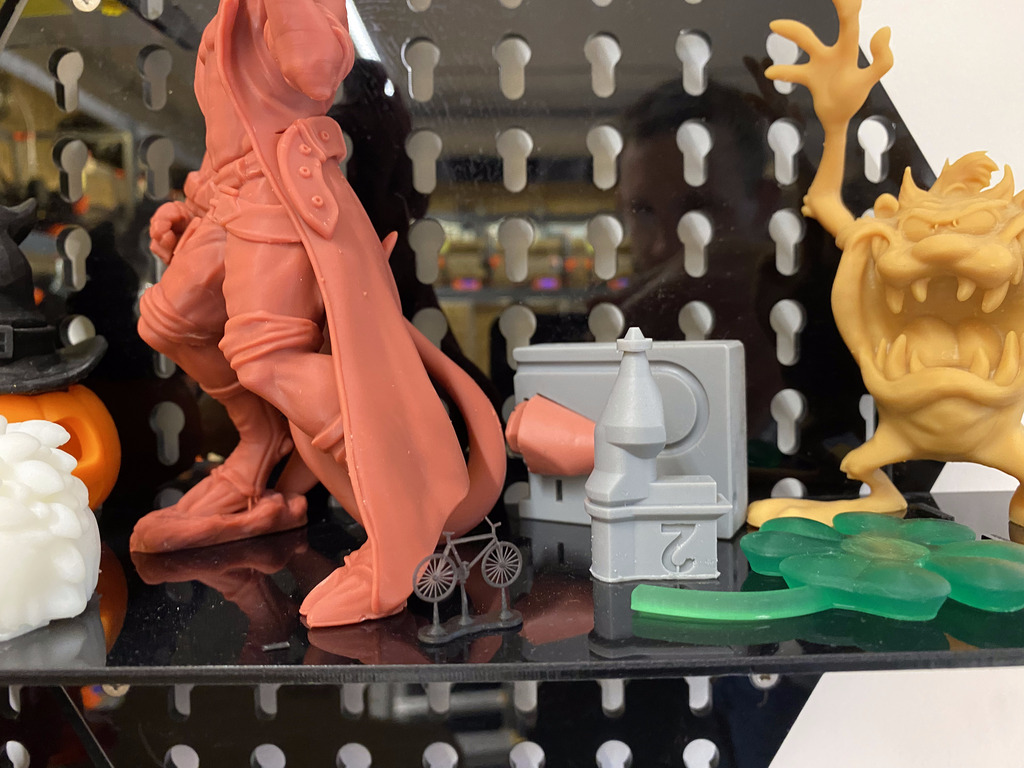
At the reception you have a small waiting area with shelves of demonstration prints and some spools of Prusament. From here, our kind guide first took us to a region on the ground floor that used to be (prior to COVID times) the public maker/hack lab. The lab contained two modest farms of printers: one of their flagship FDM printer, the MK3S+, and another of their SLS resin printers. A close up of some example resin models is pictured above. The bicycle was tiny: about the size of a thumbnail.
A Historic display A Historic display
Bespoke QE equipment Bespoke QE equipment
The MK3S+ Farm The MK3S+ Farm

. Moi in the Farm
2KG orange PLA spools for the Farm 2KG orange PLA spools for the Farm
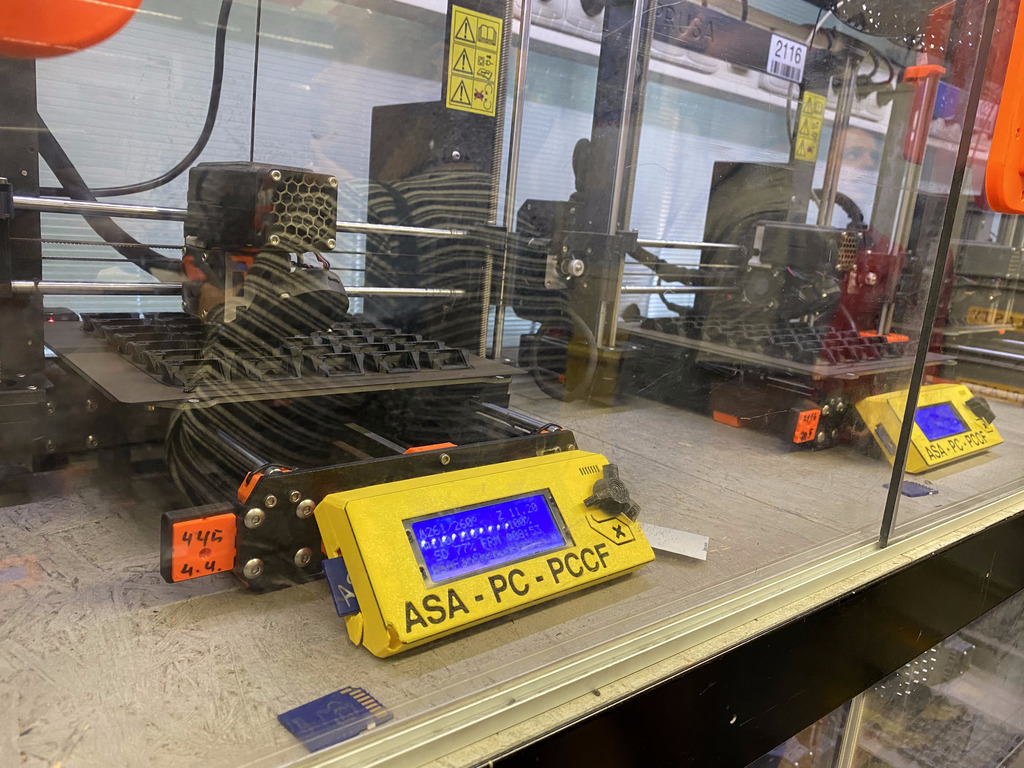
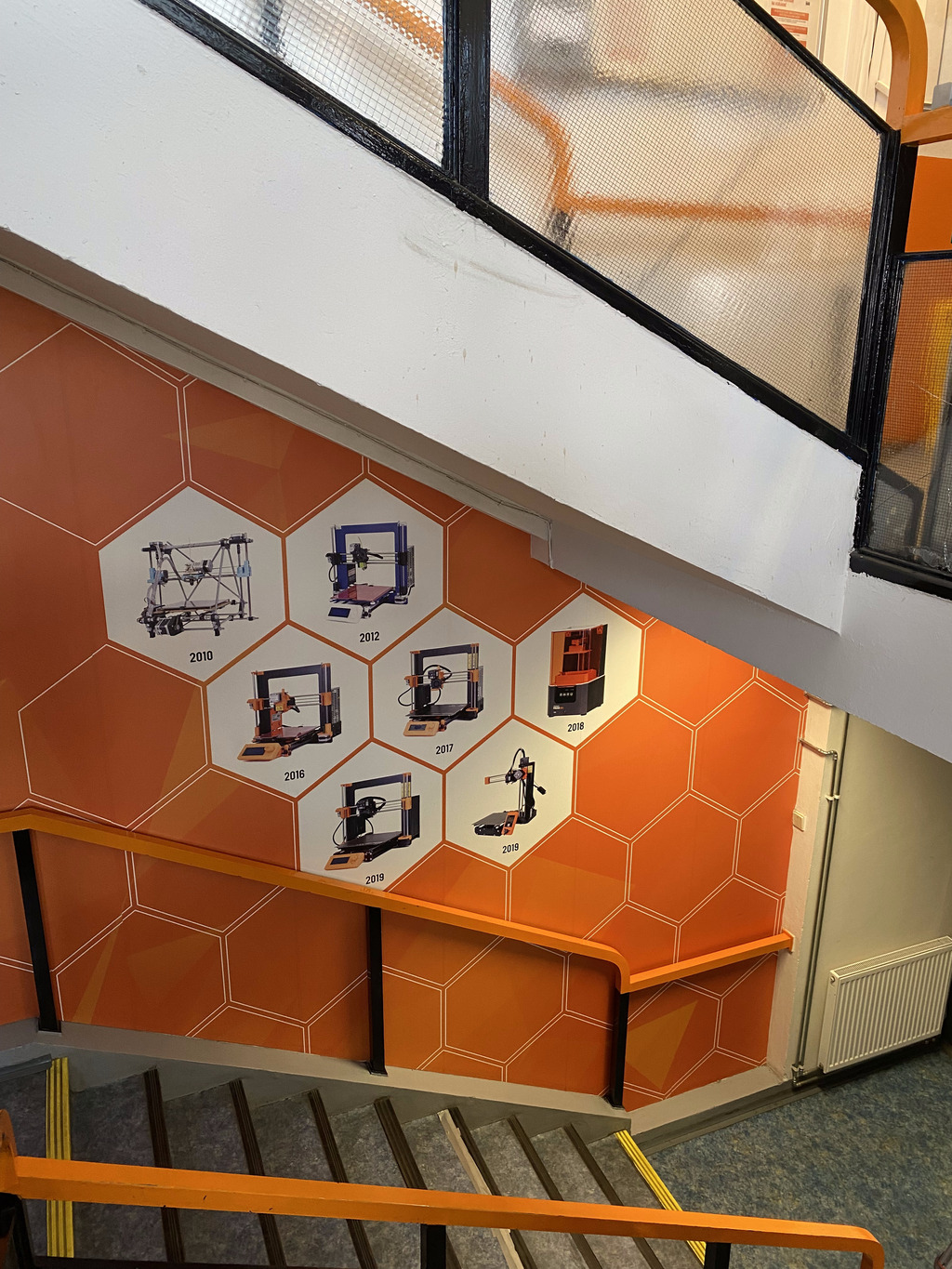
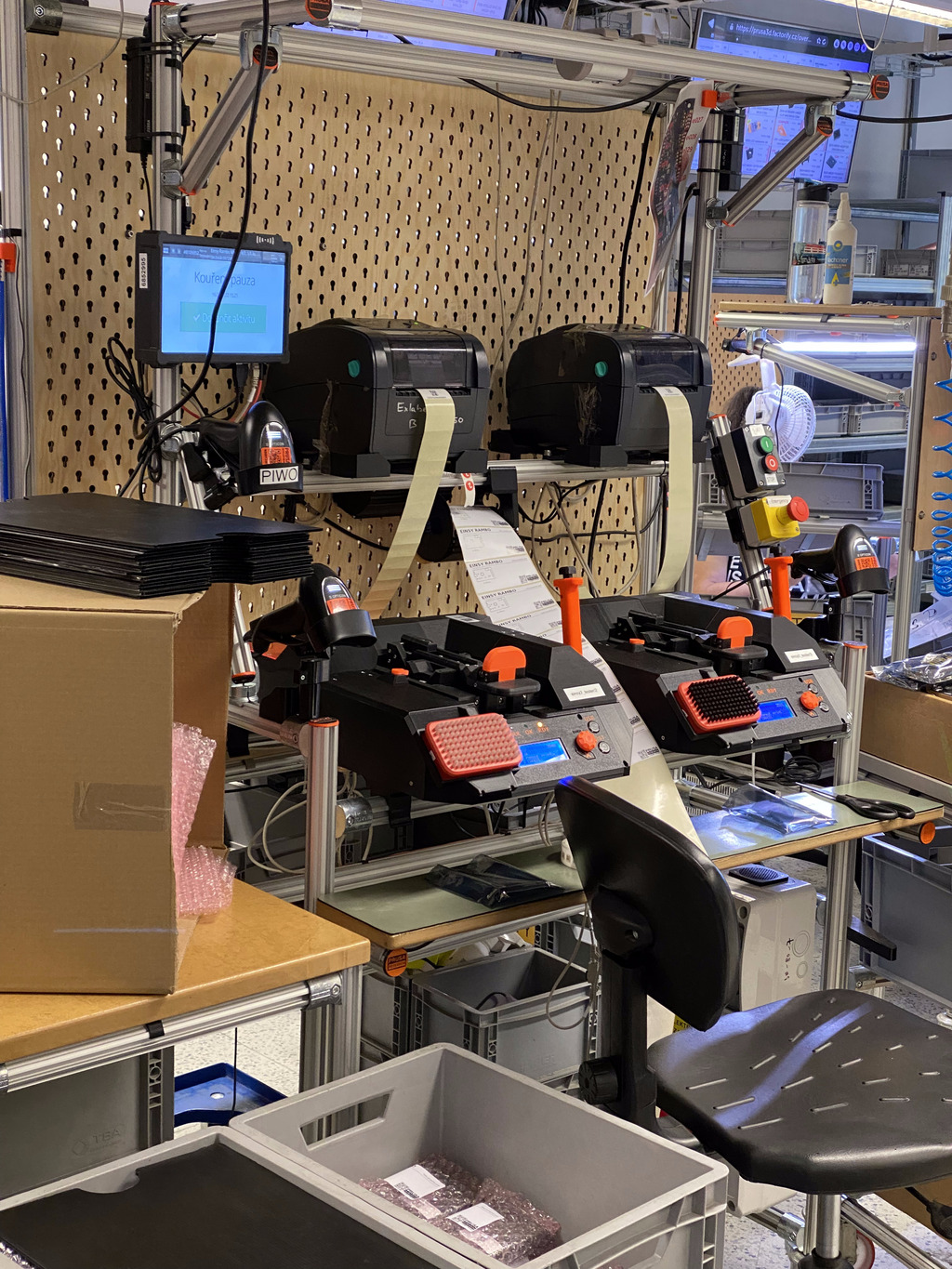
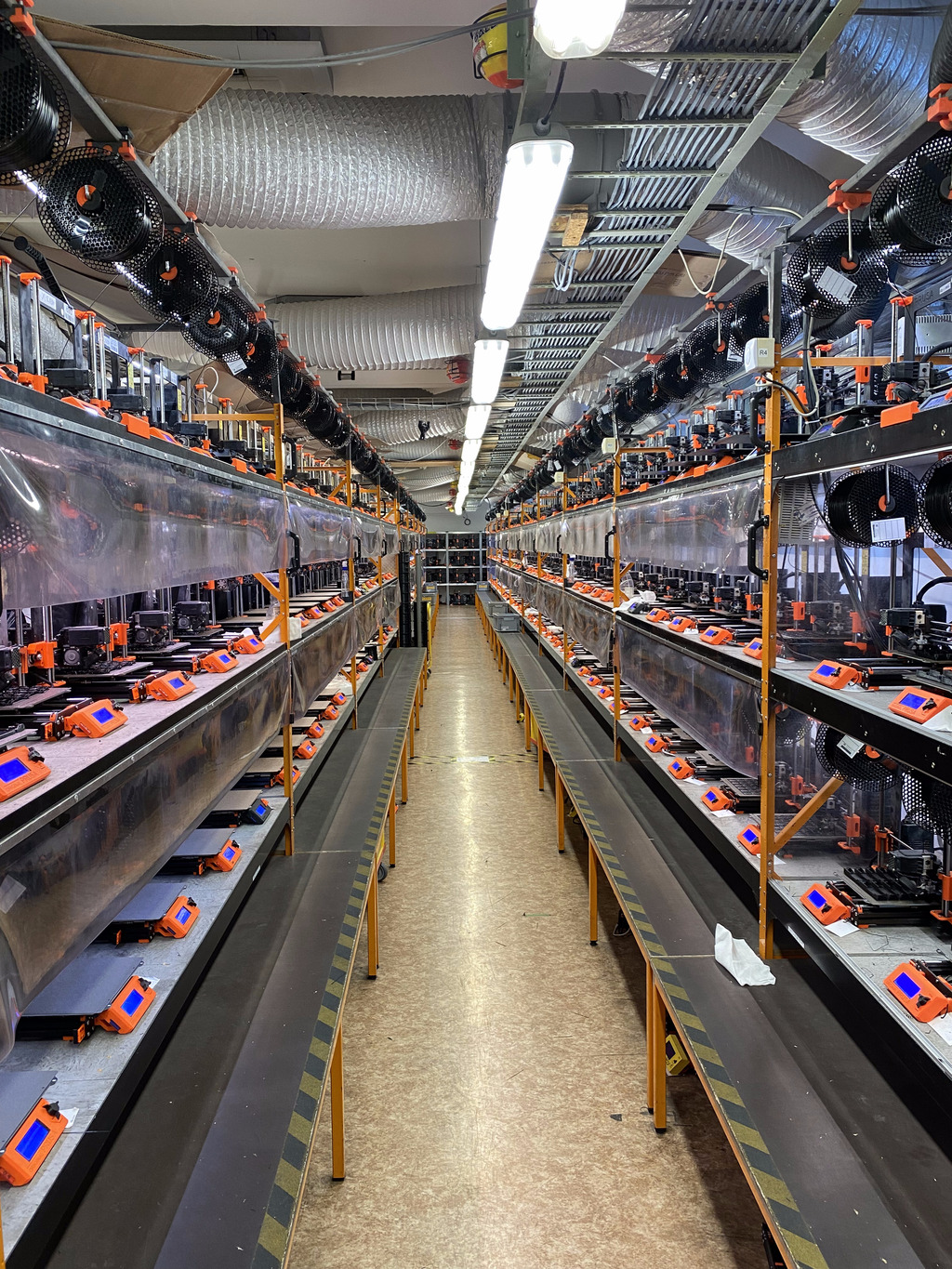
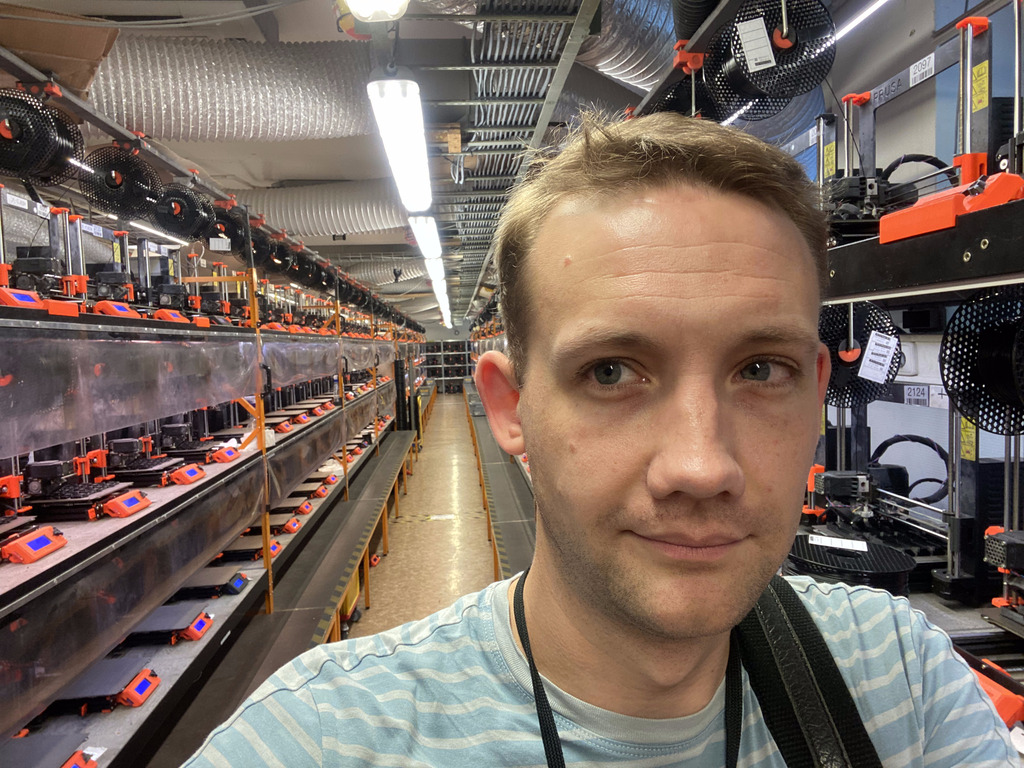
The rest of the ground floor area was full of heavy machinery and prototyping equipment. Onwards we went to the upstairs floors. Upstairs, past a nice graphic of Prusa's historic products, we visited the assembly and QE testing areas. They have a very organised system of parts buckets and some thorough QE processes, including some bespoke equipment that produces the "receipt" of tests and calibration that they provide for you in the box when you buy a 3D printer. After that, we visited the production Farm: a large room full of MK3S+ printers churning out parts for other printers. The noise was remarkable. The printers were running custom firmware to continually print the part they had been set for. Some of the printers were designated for printing with ASA: they were colour-coded (yellow controller surround) and within boxed regions to prevent the fumes causing problems. (picture at the top) Outside the room sat palettes of orange PETG plastic for the printer farm on 2KG spools (not a size they sell to the public just yet) The final part of the trip was outside, to the real farm: Prusa have a smallholding with Alpacas at the rear of their estate. Whilst we visited it, Josef Prusa himself turned up (in a snazzy looking custom colour Tesla) to feed the animals, say hello and pose for a picture. Overall, it was a fantastic visit. I'm very grateful to Air France for cancelling my flight home, and to Prusa Labs (in particular Luk ) for allowing me to come and say hello!

  1. I managed to squeeze that in too on my way to my rescheduled flight, although it was a rush visit and I don't have much to say or show from it. Suffice to say that it was lovely and bittersweet since the UK Maker Faire used to be hosted in my fair home city of Newcastle before they stopped.

6 February 2023

Vincent Bernat: Fast and dynamic encoding of Protocol Buffers in Go

Protocol Buffers are a popular choice for serializing structured data due to their compact size, fast processing speed, language independence, and compatibility. There exist other alternatives, including Cap n Proto, CBOR, and Avro. Usually, data structures are described in a proto definition file (.proto). The protoc compiler and a language-specific plugin convert it into code:
$ head flow-4.proto
syntax = "proto3";
package decoder;
option go_package = "akvorado/inlet/flow/decoder";
message FlowMessagev4  
  uint64 TimeReceived = 2;
  uint32 SequenceNum = 3;
  uint64 SamplingRate = 4;
  uint32 FlowDirection = 5;
$ protoc -I=. --plugin=protoc-gen-go --go_out=module=akvorado:. flow-4.proto
$ head inlet/flow/decoder/flow-4.pb.go
// Code generated by protoc-gen-go. DO NOT EDIT.
// versions:
//      protoc-gen-go v1.28.0
//      protoc        v3.21.12
// source: inlet/flow/data/schemas/flow-4.proto
package decoder
import (
        protoreflect "google.golang.org/protobuf/reflect/protoreflect"
Akvorado collects network flows using IPFIX or sFlow, decodes them with GoFlow2, encodes them to Protocol Buffers, and sends them to Kafka to be stored in a ClickHouse database. Collecting a new field, such as source and destination MAC addresses, requires modifications in multiple places, including the proto definition file and the ClickHouse migration code. Moreover, the cost is paid by all users.1 It would be nice to have an application-wide schema and let users enable or disable the fields they need. While the main goal is flexibility, we do not want to sacrifice performance. On this front, this is quite a success: when upgrading from 1.6.4 to 1.7.1, the decoding and encoding performance almost doubled!
goos: linux
goarch: amd64
pkg: akvorado/inlet/flow
cpu: AMD Ryzen 5 5600X 6-Core Processor
                              initial.txt                 final.txt               
                                 sec/op        sec/op     vs base                 
Netflow/with_encoding-12      12.963    2%   7.836    1%  -39.55% (p=0.000 n=10)
Sflow/with_encoding-12         19.37    1%   10.15    2%  -47.63% (p=0.000 n=10)

Faster Protocol Buffers encoding I use the following code to benchmark both the decoding and encoding process. Initially, the Decode() method is a thin layer above GoFlow2 producer and stores the decoded data into the in-memory structure generated by protoc. Later, some of the data will be encoded directly during flow decoding. This is why we measure both the decoding and the encoding.2
func BenchmarkDecodeEncodeSflow(b *testing.B)  
    r := reporter.NewMock(b)
    sdecoder := sflow.New(r)
    data := helpers.ReadPcapPayload(b,
        filepath.Join("decoder", "sflow", "testdata", "data-1140.pcap"))
    for _, withEncoding := range []bool true, false   
        title := map[bool]string 
            true:  "with encoding",
            false: "without encoding",
         [withEncoding]
        var got []*decoder.FlowMessage
        b.Run(title, func(b *testing.B)  
            for i := 0; i < b.N; i++  
                got = sdecoder.Decode(decoder.RawFlow 
                    Payload: data,
                    Source: net.ParseIP("127.0.0.1"),
                 )
                if withEncoding  
                    for _, flow := range got  
                        buf := []byte 
                        buf = protowire.AppendVarint(buf, uint64(proto.Size(flow)))
                        proto.MarshalOptions .MarshalAppend(buf, flow)


         )
     
 
The canonical Go implementation for Protocol Buffers, google.golang.org/protobuf is not the most efficient one. For a long time, people were relying on gogoprotobuf. However, the project is now deprecated. A good replacement is vtprotobuf.3
goos: linux
goarch: amd64
pkg: akvorado/inlet/flow
cpu: AMD Ryzen 5 5600X 6-Core Processor
                              initial.txt               bench-2.txt              
                                sec/op        sec/op     vs base                 
Netflow/with_encoding-12      12.96    2%   10.28    2%  -20.67% (p=0.000 n=10)
Netflow/without_encoding-12   8.935    2%   8.975    2%        ~ (p=0.143 n=10)
Sflow/with_encoding-12        19.37    1%   16.67    2%  -13.93% (p=0.000 n=10)
Sflow/without_encoding-12     14.62    3%   14.87    1%   +1.66% (p=0.007 n=10)

Dynamic Protocol Buffers encoding We have our baseline. Let s see how to encode our Protocol Buffers without a .proto file. The wire format is simple and rely a lot on variable-width integers. Variable-width integers, or varints, are an efficient way of encoding unsigned integers using a variable number of bytes, from one to ten, with small values using fewer bytes. They work by splitting integers into 7-bit payloads and using the 8th bit as a continuation indicator, set to 1 for all payloads except the last.
Variable-width integers encoding in Protocol Buffers: conversion of 150 to a varint
Variable-width integers encoding in Protocol Buffers
For our usage, we only need two types: variable-width integers and byte sequences. A byte sequence is encoded by prefixing it by its length as a varint. When a message is encoded, each key-value pair is turned into a record consisting of a field number, a wire type, and a payload. The field number and the wire type are encoded as a single variable-width integer called a tag.
Message encoded with Protocol Buffers: three varints, two sequences of bytes
Message encoded with Protocol Buffers
We use the following low-level functions to build the output buffer: Our schema abstraction contains the appropriate information to encode a message (ProtobufIndex) and to generate a proto definition file (fields starting with Protobuf):
type Column struct  
    Key       ColumnKey
    Name      string
    Disabled  bool
    // [ ]
    // For protobuf.
    ProtobufIndex    protowire.Number
    ProtobufType     protoreflect.Kind // Uint64Kind, Uint32Kind,  
    ProtobufEnum     map[int]string
    ProtobufEnumName string
    ProtobufRepeated bool
 
We have a few helper methods around the protowire functions to directly encode the fields while decoding the flows. They skip disabled fields or non-repeated fields already encoded. Here is an excerpt of the sFlow decoder:
sch.ProtobufAppendVarint(bf, schema.ColumnBytes, uint64(recordData.Base.Length))
sch.ProtobufAppendVarint(bf, schema.ColumnProto, uint64(recordData.Base.Protocol))
sch.ProtobufAppendVarint(bf, schema.ColumnSrcPort, uint64(recordData.Base.SrcPort))
sch.ProtobufAppendVarint(bf, schema.ColumnDstPort, uint64(recordData.Base.DstPort))
sch.ProtobufAppendVarint(bf, schema.ColumnEType, helpers.ETypeIPv4)
For fields that are required later in the pipeline, like source and destination addresses, they are stored unencoded in a separate structure:
type FlowMessage struct  
    TimeReceived uint64
    SamplingRate uint32
    // For exporter classifier
    ExporterAddress netip.Addr
    // For interface classifier
    InIf  uint32
    OutIf uint32
    // For geolocation or BMP
    SrcAddr netip.Addr
    DstAddr netip.Addr
    NextHop netip.Addr
    // Core component may override them
    SrcAS     uint32
    DstAS     uint32
    GotASPath bool
    // protobuf is the protobuf representation for the information not contained above.
    protobuf      []byte
    protobufSet   bitset.BitSet
 
The protobuf slice holds encoded data. It is initialized with a capacity of 500 bytes to avoid resizing during encoding. There is also some reserved room at the beginning to be able to encode the total size as a variable-width integer. Upon finalizing encoding, the remaining fields are added and the message length is prefixed:
func (schema *Schema) ProtobufMarshal(bf *FlowMessage) []byte  
    schema.ProtobufAppendVarint(bf, ColumnTimeReceived, bf.TimeReceived)
    schema.ProtobufAppendVarint(bf, ColumnSamplingRate, uint64(bf.SamplingRate))
    schema.ProtobufAppendIP(bf, ColumnExporterAddress, bf.ExporterAddress)
    schema.ProtobufAppendVarint(bf, ColumnSrcAS, uint64(bf.SrcAS))
    schema.ProtobufAppendVarint(bf, ColumnDstAS, uint64(bf.DstAS))
    schema.ProtobufAppendIP(bf, ColumnSrcAddr, bf.SrcAddr)
    schema.ProtobufAppendIP(bf, ColumnDstAddr, bf.DstAddr)
    // Add length and move it as a prefix
    end := len(bf.protobuf)
    payloadLen := end - maxSizeVarint
    bf.protobuf = protowire.AppendVarint(bf.protobuf, uint64(payloadLen))
    sizeLen := len(bf.protobuf) - end
    result := bf.protobuf[maxSizeVarint-sizeLen : end]
    copy(result, bf.protobuf[end:end+sizeLen])
    return result
 
Minimizing allocations is critical for maintaining encoding performance. The benchmark tests should be run with the -benchmem flag to monitor allocation numbers. Each allocation incurs an additional cost to the garbage collector. The Go profiler is a valuable tool for identifying areas of code that can be optimized:
$ go test -run=__nothing__ -bench=Netflow/with_encoding \
>         -benchmem -cpuprofile profile.out \
>         akvorado/inlet/flow
goos: linux
goarch: amd64
pkg: akvorado/inlet/flow
cpu: AMD Ryzen 5 5600X 6-Core Processor
Netflow/with_encoding-12             143953              7955 ns/op            8256 B/op        134 allocs/op
PASS
ok      akvorado/inlet/flow     1.418s
$ go tool pprof profile.out
File: flow.test
Type: cpu
Time: Feb 4, 2023 at 8:12pm (CET)
Duration: 1.41s, Total samples = 2.08s (147.96%)
Entering interactive mode (type "help" for commands, "o" for options)
(pprof) web
After using the internal schema instead of code generated from the proto definition file, the performance improved. However, this comparison is not entirely fair as less information is being decoded and previously GoFlow2 was decoding to its own structure, which was then copied to our own version.
goos: linux
goarch: amd64
pkg: akvorado/inlet/flow
cpu: AMD Ryzen 5 5600X 6-Core Processor
                              bench-2.txt                bench-3.txt              
                                 sec/op        sec/op     vs base                 
Netflow/with_encoding-12      10.284    2%   7.758    3%  -24.56% (p=0.000 n=10)
Netflow/without_encoding-12    8.975    2%   7.304    2%  -18.61% (p=0.000 n=10)
Sflow/with_encoding-12         16.67    2%   14.26    1%  -14.50% (p=0.000 n=10)
Sflow/without_encoding-12      14.87    1%   13.56    2%   -8.80% (p=0.000 n=10)
As for testing, we use github.com/jhump/protoreflect: the protoparse package parses the proto definition file we generate and the dynamic package decodes the messages. Check the ProtobufDecode() method for more details.4 To get the final figures, I have also optimized the decoding in GoFlow2. It was relying heavily on binary.Read(). This function may use reflection in certain cases and each call allocates a byte array to read data. Replacing it with a more efficient version provides the following improvement:
goos: linux
goarch: amd64
pkg: akvorado/inlet/flow
cpu: AMD Ryzen 5 5600X 6-Core Processor
                              bench-3.txt                bench-4.txt              
                                 sec/op        sec/op     vs base                 
Netflow/with_encoding-12       7.758    3%   7.365    2%   -5.07% (p=0.000 n=10)
Netflow/without_encoding-12    7.304    2%   6.931    3%   -5.11% (p=0.000 n=10)
Sflow/with_encoding-12        14.256    1%   9.834    2%  -31.02% (p=0.000 n=10)
Sflow/without_encoding-12     13.559    2%   9.353    2%  -31.02% (p=0.000 n=10)
It is now easier to collect new data and the inlet component is faster!

Notice Some paragraphs were editorialized by ChatGPT, using editorialize and keep it short as a prompt. The result was proofread by a human for correctness. The main idea is that ChatGPT should be better at English than me.


  1. While empty fields are not serialized to Protocol Buffers, empty columns in ClickHouse take some space, even if they compress well. Moreover, unused fields are still decoded and they may clutter the interface.
  2. There is a similar function using NetFlow. NetFlow and IPFIX protocols are less complex to decode than sFlow as they are using a simpler TLV structure.
  3. vtprotobuf generates more optimized Go code by removing an abstraction layer. It directly generates the code encoding each field to bytes:
    if m.OutIfSpeed != 0  
        i = encodeVarint(dAtA, i, uint64(m.OutIfSpeed))
        i--
        dAtA[i] = 0x6
        i--
        dAtA[i] = 0xd8
     
    
  4. There is also a protoprint package to generate proto definition file. I did not use it.

Reproducible Builds: Reproducible Builds in January 2023

Welcome to the first report for 2023 from the Reproducible Builds project! In these reports we try and outline the most important things that we have been up to over the past month, as well as the most important things in/around the community. As a quick recap, the motivation behind the reproducible builds effort is to ensure no malicious flaws can be deliberately introduced during compilation and distribution of the software that we run on our devices. As ever, if you are interested in contributing to the project, please visit our Contribute page on our website.


News In a curious turn of events, GitHub first announced this month that the checksums of various Git archives may be subject to change, specifically that because:
the default compression for Git archives has recently changed. As result, archives downloaded from GitHub may have different checksums even though the contents are completely unchanged.
This change (which was brought up on our mailing list last October) would have had quite wide-ranging implications for anyone wishing to validate and verify downloaded archives using cryptographic signatures. However, GitHub reversed this decision, updating their original announcement with a message that We are reverting this change for now. More details to follow. It appears that this was informed in part by an in-depth discussion in the GitHub Community issue tracker.
The Bundesamt f r Sicherheit in der Informationstechnik (BSI) (trans: The Federal Office for Information Security ) is the agency in charge of managing computer and communication security for the German federal government. They recently produced a report that touches on attacks on software supply-chains (Supply-Chain-Angriff). (German PDF)
Contributor Seb35 updated our website to fix broken links to Tails Git repository [ ][ ], and Holger updated a large number of pages around our recent summit in Venice [ ][ ][ ][ ].
Noak J nsson has written an interesting paper entitled The State of Software Diversity in the Software Supply Chain of Ethereum Clients. As the paper outlines:
In this report, the software supply chains of the most popular Ethereum clients are cataloged and analyzed. The dependency graphs of Ethereum clients developed in Go, Rust, and Java, are studied. These client are Geth, Prysm, OpenEthereum, Lighthouse, Besu, and Teku. To do so, their dependency graphs are transformed into a unified format. Quantitative metrics are used to depict the software supply chain of the blockchain. The results show a clear difference in the size of the software supply chain required for the execution layer and consensus layer of Ethereum.

Yongkui Han posted to our mailing list discussing making reproducible builds & GitBOM work together without gitBOM-ID embedding. GitBOM (now renamed to OmniBOR) is a project to enable automatic, verifiable artifact resolution across today s diverse software supply-chains [ ]. In addition, Fabian Keil wrote to us asking whether anyone in the community would be at Chemnitz Linux Days 2023, which is due to take place on 11th and 12th March (event info). Separate to this, Akihiro Suda posted to our mailing list just after the end of the month with a status report of bit-for-bit reproducible Docker/OCI images. As Akihiro mentions in their post, they will be giving a talk at FOSDEM in the Containers devroom titled Bit-for-bit reproducible builds with Dockerfile and that my talk will also mention how to pin the apt/dnf/apk/pacman packages with my repro-get tool.
The extremely popular Signal messenger app added upstream support for the SOURCE_DATE_EPOCH environment variable this month. This means that release tarballs of the Signal desktop client do not embed nondeterministic release information. [ ][ ]

Distribution work

F-Droid & Android There was a very large number of changes in the F-Droid and wider Android ecosystem this month: On January 15th, a blog post entitled Towards a reproducible F-Droid was published on the F-Droid website, outlining the reasons why F-Droid signs published APKs with its own keys and how reproducible builds allow using upstream developers keys instead. In particular:
In response to [ ] criticisms, we started encouraging new apps to enable reproducible builds. It turns out that reproducible builds are not so difficult to achieve for many apps. In the past few months we ve gotten many more reproducible apps in F-Droid than before. Currently we can t highlight which apps are reproducible in the client, so maybe you haven t noticed that there are many new apps signed with upstream developers keys.
(There was a discussion about this post on Hacker News.) In addition:
  • F-Droid added 13 apps published with reproducible builds this month. [ ]
  • FC Stegerman outlined a bug where baseline.profm files are nondeterministic, developed a workaround, and provided all the details required for a fix. As they note, this issue has now been fixed but the fix is not yet part of an official Android Gradle plugin release.
  • GitLab user Parwor discovered that the number of CPU cores can affect the reproducibility of .dex files. [ ]
  • FC Stegerman also announced the 0.2.0 and 0.2.1 releases of reproducible-apk-tools, a suite of tools to help make .apk files reproducible. Several new subcommands and scripts were added, and a number of bugs were fixed as well [ ][ ]. They also updated the F-Droid website to improve the reproducibility-related documentation. [ ][ ]
  • On the F-Droid issue tracker, FC Stegerman discussed reproducible builds with one of the developers of the Threema messenger app and reported that Android SDK build-tools 31.0.0 and 32.0.0 (unlike earlier and later versions) have a zipalign command that produces incorrect padding.
  • A number of bugs related to reproducibility were discovered in Android itself. Firstly, the non-deterministic order of .zip entries in .apk files [ ] and then newline differences between building on Windows versus Linux that can make builds not reproducible as well. [ ] (Note that these links may require a Google account to view.)
  • And just before the end of the month, FC Stegerman started a thread on our mailing list on the topic of hiding data/code in APK embedded signatures which has been made possible by the Android APK Signature Scheme v2/v3. As part of this, they made an Android app that reads the APK Signing block of its own APK and extracts a payload in order to alter its behaviour called sigblock-code-poc.

Debian As mentioned in last month s report, Vagrant Cascadian has been organising a series of online sprints in order to clear the huge backlog of reproducible builds patches submitted by performing NMUs (Non-Maintainer Uploads). During January, a sprint took place on the 10th, resulting in the following uploads: During this sprint, Holger Levsen filed Debian bug #1028615 to request that the tracker.debian.org service display results of reproducible rebuilds, not just reproducible CI results. Elsewhere in Debian, strip-nondeterminism is our tool to remove specific non-deterministic results from a completed build. This month, version 1.13.1-1 was uploaded to Debian unstable by Holger Levsen, including a fix by FC Stegerman (obfusk) to update a regular expression for the latest version of file(1) [ ]. (#1028892) Lastly, 65 reviews of Debian packages were added, 21 were updated and 35 were removed this month adding to our knowledge about identified issues.

Other distributions In other distributions:

diffoscope diffoscope is our in-depth and content-aware diff utility. Not only can it locate and diagnose reproducibility issues, it can provide human-readable diffs from many kinds of binary formats. This month, Chris Lamb made the following changes to diffoscope, including preparing and uploading versions 231, 232, 233 and 234 to Debian:
  • No need for from __future__ import print_function import anymore. [ ]
  • Comment and tidy the extras_require.json handling. [ ]
  • Split inline Python code to generate test Recommends into a separate Python script. [ ]
  • Update debian/tests/control after merging support for PyPDF support. [ ]
  • Correctly catch segfaulting cd-iccdump binary. [ ]
  • Drop some old debugging code. [ ]
  • Allow ICC tests to (temporarily) fail. [ ]
In addition, FC Stegerman (obfusk) made a number of changes, including:
  • Updating the test_text_proper_indentation test to support the latest version(s) of file(1). [ ]
  • Use an extras_require.json file to store some build/release metadata, instead of accessing the internet. [ ]
  • Updating an APK-related file(1) regular expression. [ ]
  • On the diffoscope.org website, de-duplicate contributors by e-mail. [ ]
Lastly, Sam James added support for PyPDF version 3 [ ] and Vagrant Cascadian updated a handful of tool references for GNU Guix. [ ][ ]

Upstream patches The Reproducible Builds project attempts to fix as many currently-unreproducible packages as possible. This month, we wrote a large number of such patches, including:

Testing framework The Reproducible Builds project operates a comprehensive testing framework at tests.reproducible-builds.org in order to check packages and other artifacts for reproducibility. In January, the following changes were made by Holger Levsen:
  • Node changes:
  • Debian-related changes:
    • Only keep diffoscope s HTML output (ie. no .json or .txt) for LTS suites and older in order to save diskspace on the Jenkins host. [ ]
    • Re-create pbuilder base less frequently for the stretch, bookworm and experimental suites. [ ]
  • OpenWrt-related changes:
    • Add gcc-multilib to OPENWRT_HOST_PACKAGES and install it on the nodes that need it. [ ]
    • Detect more problems in the health check when failing to build OpenWrt. [ ]
  • Misc changes:
    • Update the chroot-run script to correctly manage /dev and /dev/pts. [ ][ ][ ]
    • Update the Jenkins shell monitor script to collect disk stats less frequently [ ] and to include various directory stats. [ ][ ]
    • Update the real year in the configuration in order to be able to detect whether a node is running in the future or not. [ ]
    • Bump copyright years in the default page footer. [ ]
In addition, Christian Marangi submitted a patch to build OpenWrt packages with the V=s flag to enable debugging. [ ]
If you are interested in contributing to the Reproducible Builds project, please visit the Contribute page on our website. You can get in touch with us via:

5 February 2023

Mike Gabriel: Call for translations: Lomiri / Ubuntu Touch 20.04

Prologue For over a year now, Fre(i)e Software GmbH (my company) is involved in Ubuntu Touch development. The development effort currently is handled by a mix of paid and voluntary developers/contributors under the umbrella of the UBports Foundation. We are approaching the official first release of Ubuntu Touch 20.04 with rapid pace. And, if you are a non-Englisch native speaker, we'd like to ask you for help... Read below. light+love
Mike (aka sunweaver at debian.org, Mastodon, IRC, etc.) Internationalization (i18n) of Ubuntu Touch 20.04 The UBports team has moved most of the translation workflows for localizing Ubuntu Touch over to Hosted Weblate: To contribute to the UBports projects you need to register here: The localization platform of all UBports / Lomiri components is sponsored by Hosted Weblate via their free hosting plan for Libre and Open Source Projects. Many thanks for providing this service. Translating Lomiri The translation components in the Lomiri project have already been set up and are ready for being updated by translators. Please expect some translation template changes for all those components to occur in the near future, but this should not hinder you from starting translation work right away. Translating Lomiri will bring the best i18n experience to Ubuntu Touch 20.04 end users for the core libraries and the pre-installed (so called) Core Apps. Translating Ubuntu Touch Apps For App Developers (apps that are not among the Core Apps) we will now offer a translation slot under the UBports project on hosted.weblate.org: If you are actively maintaining an Ubuntu Touch app, please ask for a translation component slot on hosted.weblate.org and we will set up your app's translation workflow for and with you. Using the translation service at Hosted Weblate is not a must for app developers, it's rather a service we offer to ease i18n work on Ubuntu Touch apps. Who to contact? To get translations for your app set up on Hosted Weblate, please get in touch with us on https://t.me/ubports, please highlight @sunweaver (Mike Gabriel), @BetaBreak (Raoul Kramer), @cibersheep and @Danfro with your request.

Russell Coker: Wayland in Bookworm

We are getting towards the freeze for Debian/Bookworm so the current state of packages isn t going to change much before the release. Bugs will get fixed but missing features will mostly be missing until the next release. Anarcat wrote an excellent blog post about using Wayland with the Sway window manager [1]. It seems pretty good if you like Sway, but I like KDE and plan to continue using it. Several of the important utility programs referenced by Anarcat won t run with KDE/Wayland and give errors such as Compositor doesn t support wlr-output-management-unstable-v1 . One noteworthy thing about Wayland is the the Window manager and the equivalent to the X server are the same program so KDE has different Wayland code than Sway and doesn t support some features. The lack of these features limits my ability to manage multiple displays and therefore makes KDE/Wayland unsuitable for many laptop uses. My work laptop runs Ubuntu 22.04 with KDE and wouldn t correctly display on the pair of monitors on a USB-C dock that s the standard desktop configuration where I work. In my previous post about Wayland [2] I wrote about converting 2 of my systems to Wayland. Since then I had changed them back to X because of problems with supporting strange monitor configurations on laptops and also due to the KDE window manager crashing occasionally which terminates the session in Wayland but merely requires restarting the window manager in X. More recently I had a problem with the GPU in my main workstation sometimes not being recognised by the system (reporting no PCIe device), when I got a new one I couldn t get X to work with the error Cannot run in framebuffer mode. Please specify busIDs for all framebuffer devices so I tried Wayland again. Now in the later stage of the Bookworm development process it seems that the problem with the KDE window manager crashing has been solved or mitigates and there is a new problem of the plasmashell process crashing. As I can restart plasmashell without logging out that s much less annoying. So now my main workstation is running on Wayland with a slower GPU than I previously had while also giving a faster user experience so Wayland is providing a definite performance benefit. Maybe for Trixie (the next release of Debian after Bookworm) we should have a release goal of having full Wayland support in all the major GUI systems.

Next.

Previous.