Search Results: "oku"

22 November 2005

Edd Dumbill: Opinions and opinionated software

Since interviewing the creator of Ruby on Rails, David Heinemeier Hansson, I've been thinking a little more about what he calls "opinionated software." That handy little phrase seems to sum up what attracts me to a lot of technology, at all levels. What I like Free software--it's not really economics that drew me to free software, but the principles and aims. When you release or use free software, you're exercising your right to free speech and adding your voice to an argument. Desktop environments--GNOME 2.0: The move from GNOME 1.0 to version 2.0 was highly opinionated (Mac users, think OS 9 to OS X). Complexity of user interface was thrown out in favour of sensible defaults. Web standards--CSS, RDF, XHTML: not only is there a right way to do things, but it turns out to be better too! I don't automatically fall in love with everything that emerges from the W3C, but some things are so obviously the right way it's impossible not to love them--warts and all. Muine music player--this player throws out the paraphernalia of iTunes clones and gets you close to the music. Queue, play. What I want to do. Epiphany web browser--a simple text bar does for bookmark lookup, search and URLs. The bookmarks work like del.icio.us tags. Despite the lure of Firefox extensions, simplicity and efficiency keeps me with Epiphany. Make friends and enemies The thing about opinions is that people are inclined to disagree with them. Opinions won't please everybody and, being opinionated, you will never carry everybody with you. But opinions give you something with which to scythe through indifference. In both my writing and software development work taking a particular stance enables me to create interest, and gives direction to my projects. I tend to get bored easily, and if I'm bored, then my readers and users will never make it. Being opinionated in software development is easier when there's a strong leader, or it's a one-person project. It's more of a dilemma if you're running a free software project with multiple contributors. Such projects need such contributions, but run a risk of losing focus and style. I think that there we need to be brave again. If being opinionated means losing potential users, it also means losing potential contributors. Opinions help in dealing with users, too. It's obvious that the mere act of listening to users isn't good enough. They often won't say what they mean, or their requests mask a deeper issue. How often have you given your boss exactly what he asked for, to find it wasn't what he wanted? A combination of reading-between-the-lines and having opinions helps cut a way through the noise of user feedback. Stirring the pot Here are a few wishes for some free software projects that I want to see succeed further, but which really need to get opinionated to be effective. These projects aren't failing, but they're not reaching the potential I know is there. Each of them are infrastructural in some way, and that's probably where the temptation to avoid being opinionated is strongest. But here's the genius: the rewards of being opinionated here are high. Ruby on Rails is the existence proof. What's better? A handful of users with the "right" idea about how fundamentally important you are to everything, or loads of users who only see a portion of the capabilities of a project? Copy the experts It may seem like cheating to copy Apple's lead, but a lot of what they've done in OS X is to take a stand on what's useful and not. On many occasions this has inconvenienced people, but it's not eroded that special lure that Apple products hold. There's not harm in asking "What have Apple done?" with some of our projects. Another poster-child for being opinionated is Ubuntu Linux. Technically, it's only marginally better than other Linux distributions. Strategically, it's miles ahead. Its founder, Mark Shuttleworth, had very solid opinions about where Ubuntu should go, and pursued them. Over time, these have pervaded the product itself, but at the start it was the message and the style that made the difference. Opinions not expressed are rarely effective.

Sam Hocevar: Suspicious Activity? Indeed

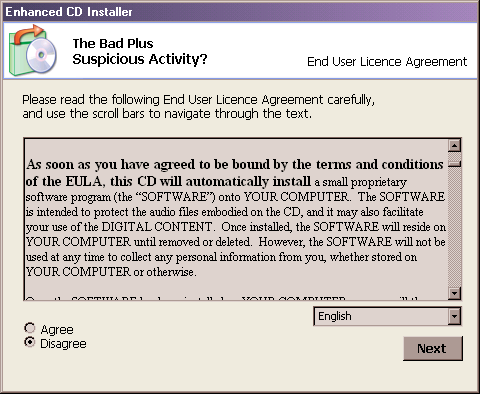
The Bad Plus I spent the whole weekend looking for a DRM-encumbered Sony CD so that I could check for myself whether my code was really being redistributed without permission. I eventually found one: Suspicious Activity?, by The Bad Plus. A rather enjoyable post-modern jazz album. I am rather lucky, it could have been C line Dion. As expected, installing the CD s custom player also installed a stealth aries.sys driver along with a few other interesting files such as $sys$DRMServer.exe, all hidden in a $sys$filesystem directory. I rapidly got rid of this cruft and started studying the really important file, ECDPlayerControl.ocx. It is the file Sebastian Porst and Matti Nikki found to be containing parts of mpglib, LAME, faad2, VLC... Suspicious Installer? Evidence that the DRMS code comes from VLC There are of course obvious similarities between some functions and structures of ECDPlayerControl.ocx and the ones in VLC s source. However, given how precise the implementation of a cryptographic protocol needs to be, the possibility that two separate implementations show many similarities must not be dismissed. The data structures and constant tables especially are likely to be identical. I think however that I found strong enough evidence that this is not the case here. The original drms.c was written by Jon on 01/05/04. I then hacked on that file on 01/18/04 and reorganised it, also replacing the reverse-engineered MD5 and AES functions with clean implementations, then Jon added DRMSv2 support on 05/05/04 and I reorganised the code again on 05/08/04. Some of these changes were specific to VLC (not in that they made the code unusable outside of VLC, but rather that they made it possible to use an external MD5 hash provider, for instance), so they were the bits I was looking for in ECDPlayerControl.ocx. For instance, Jon s original code had the following instruction:
p_acei[ 4 ] = 0x5476212A;
Since all bytes of this long word are comprised between 0x20 and 0x7f, it was later rewritten like this:
char p_secret1[] = "Tv!*";
This change makes the code more human-readable because many other secrets in the Apple DRMS protocol are ASCII strings. Also, I know how to look for binaries that use the string "Tv!*", but it takes me some more time to think of a way to find binaries that use 0x5476212A. And the Sony rootkit uses the following (only relevant lines shown):
 .text:100883B8   mov   cl, byte ptr ds:xxxxx+4 ; 0
 .text:100883C2   mov   eax, dword ptr ds:xxxxx ; "Tv!*"
 .text:100883C8   mov   [esp+70h+yyyyy], eax
 .text:100883DC   mov   [esp+7Ch+zzzzz], cl
The use of xxxxx+4 shows that ECDPlayerControl.ocx uses a string instead of a 32 bits integer to store the secret, disregarding the fact that the 5th character of the string (a null char) is never used. Another example: in this commit I reorganised the DoExtShuffle() function, merging FourthPass() and FifthPass() and discarding a structure allocated on the stack. What is important here is that DoExtShuffle() was built by a complex combination of choices, the main purpose of which being to reduce the size of the C functions:
 static void DoExtShuffle( uint32_t * p_bordel )
  
     uint32_t i_ret;
     i_ret = FirstPass( p_bordel );
     SecondPass( p_bordel, i_ret );
     ThirdPass( p_bordel );
     FourthPass( p_bordel );
  
Note how i_ret is not reused and could be merged into the p_bordel array, or maybe SecondPass() merged into FirstPass(). This choice is definitely a legacy of how the code evolved. And the Sony equivalent: a perfect match.
 .text:10089F3C xxxxx:
 .text:10089F3C   mov   ecx, esi
 .text:10089F3E   call  yyyyy
 .text:10089F43   push  eax
 .text:10089F44   mov   eax, esi
 .text:10089F46   call  zzzzz
 .text:10089F4B   add   esp, 4
 .text:10089F4E   call  ttttt
 .text:10089F53   call  uuuuu
After having studied the Sony code for a while, I have of course gathered dozens of such examples. But I also discovered a few new things. Where does the DRMS code come from? The code undoubtedly comes originally from VLC, but it has traveled a lot. I would be surpried if it came directly from VLC, as no other part of VLC is included with the rootkit. And although there are parts of FAAC in the Sony code and FAAC includes VLC s drms.c, the version currently in the FAAC CVS is horribly outdated. Sebastian Porst also noticed a few obvious differences between the Sony code and the version of drms.c present in VLC. The most obvious being this one:
 if( p_shuffle->i_version == 0x01000300 )
  
     DoExtShuffle( p_bordel );
  
Which became:
 .text:10089F2E   cmp   eax, 1000300h
 .text:10089F33   jz    short DoExtShuffle
 .text:10089F35   cmp   eax, 1000400h
 .text:10089F3A   jnz   short skip
 .text:10089F3C DoExtShuffle:
 .text:10089F3C   ...
 .text:10089F58 skip:
 .text:10089F58   ...
That 0x01000400 is a version check for 4th generation iPods firmwares. I also discovered at least 40 KB of new lookup tables that seem to be used for more buffer shuffling. At first I thought it was simply F4I s DRM implementation, but the shuffling calls are nested with iPod hardware information retrieval from our DRMS code, so they re really part of drms.c. Sony distributing a DRMSv3 descrambler? The only explanation I can think of is that someone took the VLC code, added support for an upcoming Apple DRMS format version and redistributed the software without letting the VLC authors know, probably violating the GPL (I only say that because I have not found the software yet, but I feel pretty safe in saying it). Since it is based on GPL software, I was already entitled to ask Sony for the source code of ECDPlayerControl.ocx. But as the copyright holder of a significant part of the software they counterfeited, maybe I have a greater chance of being heard. Not that it would be difficult to reverse-engineer it yet another time, but it would be awesome if the next opensource iTunes Music Store file player was contributed by Sony!

8 November 2005

NOKUBI Takatsugu: limit of GNU regex

I have only one connectivity method between Motorola M1000 and Linux, it is Bluetooth. M1000 has "Desktop Suite" application to connect other PC via USB or Bluetooth. I refered an article posted on symbianos.org forum to connect my Linux box with M1000, but it was failed. pppd said:
Nov  8 16:04:59 otaniemi udev[10350]: creating device node '/dev/rfcomm0'
Nov  8 16:05:00 otaniemi dund[10348]: New connection from 00:0A:28:8E:F2:90
Nov  8 16:05:00 otaniemi pppd[10358]: pppd 2.4.3 started by root, uid 0
Nov  8 16:05:00 otaniemi pppd[10358]: using channel 31
Nov  8 16:05:00 otaniemi pppd[10358]: Using interface ppp1
Nov  8 16:05:00 otaniemi pppd[10358]: Connect: ppp1 <--> /dev/rfcomm0
:
(snip)
:
Nov  8 16:19:32 otaniemi pppd[10786]: local  IP address 192.168.99.1
Nov  8 16:19:32 otaniemi pppd[10786]: remote IP address 192.168.99.2
Nov  8 16:19:32 otaniemi pppd[10786]: Script /etc/ppp/ip-up started (pid 10797)
Nov  8 16:19:32 otaniemi pppd[10786]: Script /etc/ppp/ip-up finished (pid 10797)
Nov  8 16:19:32 otaniemi pppd[10786]: rcvd [LCP TermReq id=0x3]
Nov  8 16:19:32 otaniemi pppd[10786]: LCP terminated by peer
It seems that M1000 terminates the connection when it was established. I don't know why the reason...

1 November 2005

Wouter Verhelst: 327780

Yes, I know that number by heart now. It's not a silly number, it's a bug. A grave bug on binutils which I opened, since the current version of binutils in unstable is, well, rather broken. I spent today tracking it down, and I found it. I must say I didn't expect that—I know next to nothing about the ELF file format, and even less about the binutils internals, so... But anyway, this is what I did: I'm pretty excited about this, both because we've had this bug for almost two months now (and we really needed to get rid of it) and because it's actually the first time I track down a bug in anything toolchain-related. This is nice.

28 October 2005

NOKUBI Takatsugu: xpkg - ipkg cross build framework

I treid to use X/Qt 2 on Zaurus. So I need to build many binary packages from CVS HEAD. X/Qt has a good cross build framework, named xpkg. It looks like Portage or ports/pkgsrc but be specific for cross build. By the way, I got too many writeback spam, so I installed anti-spam plugin, but it seems to shut all writbacks out... X-)

Next.

Previous.