Search Results: "nion"

18 December 2014

Mario Lang: deluXbreed #2 is out!

The third installment of my crossbreed digital mix podcast is out! This time, I am featuring Harder & Louder and tracks from Behind the Machine and the recently released Remixes.
  1. Apolloud - Nagazaki
  2. Apolloud - Hiroshima
  3. SA+AN - Darksiders
  4. Im Colapsed - Cleaning 8
  5. Micromakine & Switch Technique - Ascension
  6. Micromakine - Cyberman (Dither Remix)
  7. Micromakine - So Good! (Synapse Remix)
How was DarkCast born and how is it done? I always loved 175BPM music. It is an old thing that is not going away soon :-). I recently found that there is a quite active culture going on, at least on BandCamp. But single tracks are just that, not really fun to listen to in my opinion. This sort of music needs to be mixed to be fun. In the past, I used to have most tracks I like/love as vinyl, so I did some real-world vinyl mixing myself. But these days, most fun music is only available digitally, at least easily. Some people still do vinyl releases, but they are actually rare. So for my personal enjoyment, I started to digitally mix tracks I really love, such that I can listen to them without "interruption". And since I am an iOS user since three years now, using the podcast format to get stuff onto my devices was quite a natural choice. I use SoX and a very small shell script to create these mixes. Here is a pseudo-template:
sox --combine mix-power \
" sox \" sox 1.flac -p\" \" sox 3.flac -p speed 0.987 delay 2:28.31 2:28.31\" -p" \
" sox \" sox 2.flac -p delay 2:34.1 2:34.1\" -p" \
mix.flac
As you can imagine, it is quite a bit of fiddling to get these scripts to do what you want. But it is a non-graphical method to get things done. If you know of a better tool, possibly with a bit of real-time controls, to get the same job done, wihtout having to resort to a damn GUI, let me know.

17 December 2014

Keith Packard: MST-monitors

Multi-Stream Transport 4k Monitors and X I'm sure you've seen a 4k monitor on a friends desk running Mac OS X or Windows and are all ready to go get one so that you can use it under Linux. Once you've managed to acquire one, I'm afraid you'll discover that when you plug it in, you're limited to 30Hz refresh rates at the full size, unless you're running a kernel that is version 3.17 or later. And then... Good Grief! What Is My Computer Doing! Ok, so now you're running version 3.17 and when X starts up, it's like you're using a gigantic version of Google Cardboard. Two copies of a very tall, but very narrow screen greets you. Welcome to MST island. In order to drive these giant new panels at full speed, there isn't enough bandwidth in the display hardware to individually paint each pixel once during each frame. So, like all good hardware engineers, they invented a clever hack. This clever hack paints the screen in parallel. I'm assuming that they've got two bits of display hardware, each one hooked up to half of the monitor. Now, each paints only half of the pixels, avoiding costly redesign of expensive silicon, at least that's my surmise. In the olden days, if you did this, you'd end up running two monitor cables to your computer, and potentially even having two video cards. Today, thanks to the magic of Display Port Multi-Stream Transport, we don't need all of that; instead, MST allows us to pack multiple cables-worth of data into a single cable. I doubt the inventors of MST intended it to be used to split a single LCD panel into multiple "monitors", but hardware engineers are clever folk and are more than capable of abusing standards like this when it serves to save a buck. Turning Two Back Into One We've got lots of APIs that expose monitor information in the system, and across which we might be able to wave our magic abstraction wand to fix this:
  1. The KMS API. This is the kernel interface which is used by all graphics stuff, including user-space applications and the frame buffer console. Solve the problem here and it works everywhere automatically.
  2. The libdrm API. This is just the KMS ioctls wrapped in a simple C library. Fixing things here wouldn't make fbcons work, but would at least get all of the window systems working.
  3. Every 2D X driver. (Yeah, we're trying to replace all of these with the one true X driver). Fixing the problem here would mean that all X desktops would work. However, that's a lot of code to hack, so we'll skip this.
  4. The X server RandR code. More plausible than fixing every driver, this also makes X desktops work.
  5. The RandR library. If not in the X server itself, how about over in user space in the RandR protocol library? Well, the problem here is that we've now got two of them (Xlib and xcb), and the xcb one is auto-generated from the protocol descriptions. Not plausible.
  6. The Xinerama code in the X server. Xinerama is how we did multi-monitor stuff before RandR existed. These days, RandR provides Xinerama emulation, but we've been telling people to switch to RandR directly.
  7. Some new API. Awesome. Ok, so if we haven't fixed this in any existing API we control (kernel/libdrm/X.org), then we effectively dump the problem into the laps of the desktop and application developers. Given how long it's taken them to adopt current RandR stuff, providing yet another complication in their lives won't make them very happy.
All Our APIs Suck Dave Airlie merged MST support into the kernel for version 3.17 in the simplest possible fashion -- pushing the problem out to user space. I was initially vaguely tempted to go poke at it and try to fix things there, but he eventually convinced me that it just wasn't feasible. It turns out that all of our fancy new modesetting APIs describe the hardware in more detail than any application actually cares about. In particular, we expose a huge array of hardware objects: Each of these objects exposes intimate details about the underlying hardware -- which of them can work together, and which cannot; what kinds of limits are there on data rates and formats; and pixel-level timing details about blanking periods and refresh rates. To make things work, some piece of code needs to actually hook things up, and explain to the user why the configuration they want just isn't possible. The sticking point we reached was that when an MST monitor gets plugged in, it needs two CRTCs to drive it. If one of those is already in use by some other output, there's just no way you can steal it for MST mode. Another problem -- we expose EDID data and actual video mode timings. Our MST monitor has two EDID blocks, one for each half. They happen to describe how they're related, and how you should configure them, but if we want to hide that from the application, we'll have to pull those EDID blocks apart and construct a new one. The same goes for video modes; we'll have to construct ones for MST mode. Every single one of our APIs exposes enough of this information to be dangerous. Every one, except Xinerama. All it talks about is a list of rectangles, each of which represents a logical view into the desktop. Did I mention we've been encouraging people to stop using this? And that some of them listened to us? Foolishly? Dave's Tiling Property Dave hacked up the X server to parse the EDID strings and communicate the layout information to clients through an output property. Then he hacked up the gnome code to parse that property and build a RandR configuration that would work. Then, he changed to RandR Xinerama code to also parse the TILE properties and to fix up the data seen by application from that. This works well enough to get a desktop running correctly, assuming that desktop uses Xinerama to fetch this data. Alas, gtk has been "fixed" to use RandR if you have RandR version 1.3 or later. No biscuit for us today. Adding RandR Monitors RandR doesn't have enough data types yet, so I decided that what we wanted to do was create another one; maybe that would solve this problem. Ok, so what clients mostly want to know is which bits of the screen are going to be stuck together and should be treated as a single unit. With current RandR, that's some of the information included in a CRTC. You pull the pixel size out of the associated mode, physical size out of the associated outputs and the position from the CRTC itself. Most of that information is available through Xinerama too; it's just missing physical sizes and any kind of labeling to help the user understand which monitor you're talking about. The other problem with Xinerama is that it cannot be configured by clients; the existing RandR implementation constructs the Xinerama data directly from the RandR CRTC settings. Dave's Tiling property changes edit that data to reflect the union of associated monitors as a single Xinerama rectangle. Allowing the Xinerama data to be configured by clients would fix our 4k MST monitor problem as well as solving the longstanding video wall, WiDi and VNC troubles. All of those want to create logical monitor areas within the screen under client control What I've done is create a new RandR datatype, the "Monitor", which is a rectangular area of the screen which defines a rectangular region of the screen. Each monitor has the following data: There are three requests to define, delete and list monitors. And that's it. Now, we want the list of monitors to completely describe the environment, and yet we don't want existing tools to break completely. So, we need some way to automatically construct monitors from the existing RandR state while still letting the user override portions of it as needed to explain virtual or tiled outputs. So, what I did was to let the client specify a list of outputs for each monitor. All of the CRTCs which aren't associated with an output in any client-defined monitor are then added to the list of monitors reported back to clients. That means that clients need only define monitors for things they understand, and they can leave the other bits alone and the server will do something sensible. The second tricky bit is that if you specify an empty rectangle at 0,0 for the pixel geometry, then the server will automatically compute the geometry using the list of outputs provided. That means that if any of those outputs get disabled or reconfigured, the Monitor associated with them will appear to change as well. Current Status Gtk+ has been switched to use RandR for RandR versions 1.3 or later. Locally, I hacked libXrandr to override the RandR version through an environment variable, set that to 1.2 and Gtk+ happily reverts back to Xinerama and things work fine. I suspect the plan here will be to have it use the new Monitors when present as those provide the same info that it was pulling out of RandR's CRTCs. KDE appears to still use Xinerama data for this, so it "just works". Where's the code As usual, all of the code for this is in a collection of git repositories in my home directory on fd.o:
git://people.freedesktop.org/~keithp/randrproto master
git://people.freedesktop.org/~keithp/libXrandr master
git://people.freedesktop.org/~keithp/xrandr master
git://people.freedesktop.org/~keithp/xserver randr-monitors
RandR protocol changes Here's the new sections added to randrproto.txt
                   
1.5. Introduction to version 1.5 of the extension
Version 1.5 adds monitors
   A 'Monitor' is a rectangular subset of the screen which represents
   a coherent collection of pixels presented to the user.
   Each Monitor is be associated with a list of outputs (which may be
   empty).
   When clients define monitors, the associated outputs are removed from
   existing Monitors. If removing the output causes the list for that
   monitor to become empty, that monitor will be deleted.
   For active CRTCs that have no output associated with any
   client-defined Monitor, one server-defined monitor will
   automatically be defined of the first Output associated with them.
   When defining a monitor, setting the geometry to all zeros will
   cause that monitor to dynamically track the bounding box of the
   active outputs associated with them
This new object separates the physical configuration of the hardware
from the logical subsets  the screen that applications should
consider as single viewable areas.
1.5.1. Relationship between Monitors and Xinerama
Xinerama's information now comes from the Monitors instead of directly
from the CRTCs. The Monitor marked as Primary will be listed first.
                   
5.6. Protocol Types added in version 1.5 of the extension
MONITORINFO   name: ATOM
          primary: BOOL
          automatic: BOOL
          x: INT16
          y: INT16
          width: CARD16
          height: CARD16
          width-in-millimeters: CARD32
          height-in-millimeters: CARD32
          outputs: LISTofOUTPUT  
                   
7.5. Extension Requests added in version 1.5 of the extension.
 
    RRGetMonitors
    window : WINDOW
      
    timestamp: TIMESTAMP
    monitors: LISTofMONITORINFO
 
    Errors: Window
    Returns the list of Monitors for the screen containing
    'window'.
    'timestamp' indicates the server time when the list of
    monitors last changed.
 
    RRSetMonitor
    window : WINDOW
    info: MONITORINFO
 
    Errors: Window, Output, Atom, Value
    Create a new monitor. Any existing Monitor of the same name is deleted.
    'name' must be a valid atom or an Atom error results.
    'name' must not match the name of any Output on the screen, or
    a Value error results.
    If 'info.outputs' is non-empty, and if x, y, width, height are all
    zero, then the Monitor geometry will be dynamically defined to
    be the bounding box of the geometry of the active CRTCs
    associated with them.
    If 'name' matches an existing Monitor on the screen, the
    existing one will be deleted as if RRDeleteMonitor were called.
    For each output in 'info.outputs, each one is removed from all
    pre-existing Monitors. If removing the output causes the list of
    outputs for that Monitor to become empty, then that Monitor will
    be deleted as if RRDeleteMonitor were called.
    Only one monitor per screen may be primary. If 'info.primary'
    is true, then the primary value will be set to false on all
    other monitors on the screen.
    RRSetMonitor generates a ConfigureNotify event on the root
    window of the screen.
 
    RRDeleteMonitor
    window : WINDOW
    name: ATOM
 
    Errors: Window, Atom, Value
    Deletes the named Monitor.
    'name' must be a valid atom or an Atom error results.
    'name' must match the name of a Monitor on the screen, or a
    Value error results.
    RRDeleteMonitor generates a ConfigureNotify event on the root
    window of the screen.
                   

15 December 2014

Thomas Goirand: Supporting 3 init systems in OpenStack packages

tl;dr: Providing support for all 3 init systems (sysv-rc, Upstart and systemd) isn t hard, and generating the init scripts / Upstart job / systemd using a template system is a lot easier than I previously thought. As always, when writing this kind of blog post, I do expect that others will not like what I did. But that s the point: give me your opinion in a constructive way (please be polite even if you don t like what you see I had too many times had to read harsh comments), and I ll implement your ideas if I find it nice. History of the implementation: how we came to the idea I had no plan to do this. I don t believe what I wrote can be generalized to all of the Debian archive. It s just that I started doing things, and it made sense when I did it. Let me explain how it happened. Since it s clear that many, and especially the most advanced one, may have an opinion about which init system they prefer, and because I also support Ubuntu (at least Trusty), I though it was a good idea to support all the main init system: sysv-rc, Upstart and systemd. Though I have counted (for the sake of being exact in this blog) : OpenStack in Debian contains currently 64 init scripts to run daemons in total. That s quite a lot. A way too much to just write them, all by hand. Though that s what I was doing for the last years until this the end of this last summer! So, doing all by hand, I first started implementing Upstart. Its support was there only when building in Ubuntu (which isn t the correct thing to do, this is now fixed, read further ). Then we thought about adding support for systemd. Gustavo Panizzo, one of the contributors in the OpenStack packages, started implementing it in Keystone (the auth server for OpenStack) for the Juno release which was released this October. He did that last summer, early enough so we didn t expect anyone to use the Juno branch Keystone. After some experiments, we had kind of working. What he did was invoking /etc/init.d/keystone start-systemd , which was still using start-stop-daemon. Yes, that s not perfect, and it s better to use systemd foreground process handling, but at least, we had a unique place where to write the startup scripts, where we check the /etc/default for the logging configuration, configure the log file, and so on. Then around in october, I took a step backward to see the whole picture with sysv-rc scripts, and saw the mess, with all the tiny, small difference between them. It became clear that I had to do something to make sure they were all the same, with the support for the same things (like which log system to use, where to store the PID, create /var/lib/project, /var/run/project and so on ). Last, on this month of December, I was able to fix the remaining issues for systemd support, thanks to the awesome contribution of Mikael Cluseau on the Alioth OpenStack packaging list. Now, the systemd unit file is still invoking the init script, but it s not using start-stop-daemon anymore, no PID file involved, and daemons are used as systemd foreground processes. Finally, daemons service files are also activated on installation (they were not previously). Implementation So I took the simplistic approach to use always the same template for the sysv-rc switch/case, and the start and stop functions, happening it at the end of all debian/*.init.in scripts. I started to try to reduce the number of variables, and I was surprised of the result: only a very small part of the init scripts need to change from daemon to daemon. For example, for nova-api, here s the init script (LSB header stripped-out):
DESC="OpenStack Compute API"
PROJECT_NAME=nova
NAME=$ PROJECT_NAME -api
That is it: only 3 lines, defining only the name of the daemon, the name of the project it attaches (eg: nova, cinder, etc.), and a long description. There s of course much more complicated init scripts (see the one for neutron-server in the Debian archive for example), but the vast majority only needs the above. Here s the sysv-rc init script template that I currently use:
#!/bin/sh
# The content after this line comes from openstack-pkg-tools
# and has been automatically added to a .init.in script, which
# contains only the descriptive part for the daemon. Everything
# else is standardized as a single unique script.
# Author: Thomas Goirand <zigo@debian.org>
# PATH should only include /usr/* if it runs after the mountnfs.sh script
PATH=/sbin:/usr/sbin:/bin:/usr/bin
if [ -z "$ DAEMON " ] ; then
	DAEMON=/usr/bin/$ NAME 
fi
PIDFILE=/var/run/$ PROJECT_NAME /$ NAME .pid
if [ -z "$ SCRIPTNAME " ] ; then
	SCRIPTNAME=/etc/init.d/$ NAME 
fi
if [ -z "$ SYSTEM_USER " ] ; then
	SYSTEM_USER=$ PROJECT_NAME 
fi
if [ -z "$ SYSTEM_USER " ] ; then
	SYSTEM_GROUP=$ PROJECT_NAME 
fi
if [ "$ SYSTEM_USER " != "root" ] ; then
	STARTDAEMON_CHUID="--chuid $ SYSTEM_USER :$ SYSTEM_GROUP "
fi
if [ -z "$ CONFIG_FILE " ] ; then
	CONFIG_FILE=/etc/$ PROJECT_NAME /$ PROJECT_NAME .conf
fi
LOGFILE=/var/log/$ PROJECT_NAME /$ NAME .log
if [ -z "$ NO_OPENSTACK_CONFIG_FILE_DAEMON_ARG " ] ; then
	DAEMON_ARGS="$ DAEMON_ARGS  --config-file=$ CONFIG_FILE "
fi
# Exit if the package is not installed
[ -x $DAEMON ]   exit 0
# If ran as root, create /var/lock/X, /var/run/X, /var/lib/X and /var/log/X as needed
if [ "x$USER" = "xroot" ] ; then
	for i in lock run log lib ; do
		mkdir -p /var/$i/$ PROJECT_NAME 
		chown $ SYSTEM_USER  /var/$i/$ PROJECT_NAME 
	done
fi
# This defines init_is_upstart which we use later on (+ more...)
. /lib/lsb/init-functions
# Manage log options: logfile and/or syslog, depending on user's choosing
[ -r /etc/default/openstack ] && . /etc/default/openstack
[ -r /etc/default/$NAME ] && . /etc/default/$NAME
[ "x$USE_SYSLOG" = "xyes" ] && DAEMON_ARGS="$DAEMON_ARGS --use-syslog"
[ "x$USE_LOGFILE" != "xno" ] && DAEMON_ARGS="$DAEMON_ARGS --log-file=$LOGFILE"
do_start()  
	start-stop-daemon --start --quiet --background $ STARTDAEMON_CHUID  --make-pidfile --pidfile $ PIDFILE  --chdir /var/lib/$ PROJECT_NAME  --startas $DAEMON \
			--test > /dev/null   return 1
	start-stop-daemon --start --quiet --background $ STARTDAEMON_CHUID  --make-pidfile --pidfile $ PIDFILE  --chdir /var/lib/$ PROJECT_NAME  --startas $DAEMON \
			-- $DAEMON_ARGS   return 2
 
do_stop()  
	start-stop-daemon --stop --quiet --retry=TERM/30/KILL/5 --pidfile $PIDFILE
	RETVAL=$?
	rm -f $PIDFILE
	return "$RETVAL"
 
do_systemd_start()  
	exec $DAEMON $DAEMON_ARGS
 
case "$1" in
start)
	init_is_upstart > /dev/null 2>&1 && exit 1
	log_daemon_msg "Starting $DESC" "$NAME"
	do_start
	case $? in
		0 1) log_end_msg 0 ;;
		2) log_end_msg 1 ;;
	esac
;;
stop)
	init_is_upstart > /dev/null 2>&1 && exit 0
	log_daemon_msg "Stopping $DESC" "$NAME"
	do_stop
	case $? in
		0 1) log_end_msg 0 ;;
		2) log_end_msg 1 ;;
	esac
;;
status)
	status_of_proc "$DAEMON" "$NAME" && exit 0   exit $?
;;
systemd-start)
	do_systemd_start
;;  
restart force-reload)
	init_is_upstart > /dev/null 2>&1 && exit 1
	log_daemon_msg "Restarting $DESC" "$NAME"
	do_stop
	case $? in
	0 1)
		do_start
		case $? in
			0) log_end_msg 0 ;;
			1) log_end_msg 1 ;; # Old process is still running
			*) log_end_msg 1 ;; # Failed to start
		esac
	;;
	*) log_end_msg 1 ;; # Failed to stop
	esac
;;
*)
	echo "Usage: $SCRIPTNAME  start stop status restart force-reload systemd-start " >&2
	exit 3
;;
esac
exit 0
Nothing particularly fancy here You ll noticed that it s really OpenStack centric (see the LOGFILE and CONFIGFILE things ). You may have also noticed the call to init_is_upstart which is needed for upstart support. I m not sure if it s at the correct place in the init script. Should I put that on top of the script? Was I right with the exit values for it? Please send me your comments Then I thought about generalizing all of this. Because not only the sysv-rc scripts needed to be squared-up, but also Upstart. The approach here was to source the sysv-rc script in debian/*.init.in, and then generate the Upstart job accordingly, using the above 3 variables (or more as needed). Here, the fun is that, instead of taking the approach of calculating everything at runtime with the sysv-rc, for Upstart jobs, many things are calculated at build time. For each debian/*.init.in script that the debian/rules finds, pkgos-gen-upstart-job is called. Here s pkgos-gen-upstart-job:
#!/bin/sh
INIT_TEMPLATE=$ 1 
UPSTART_FILE= echo $ INIT_TEMPLATE    sed 's/.init.in/.upstart/' 
# Get the variables defined in the init template
. $ INIT_TEMPLATE 
## Find out what should go in After=
#SHOULD_START= cat $ INIT_TEMPLATE    grep "# Should-Start:"   sed 's/# Should-Start://' 
#
#if [ -n "$ SHOULD_START " ] ; then
#	AFTER="After="
#	for i in $ SHOULD_START  ; do
#		AFTER="$ AFTER $ i .service "
#	done
#fi
if [ -z "$ DAEMON " ] ; then
        DAEMON=/usr/bin/$ NAME 
fi
PIDFILE=/var/run/$ PROJECT_NAME /$ NAME .pid
if [ -z "$ SCRIPTNAME " ] ; then
	SCRIPTNAME=/etc/init.d/$ NAME 
fi
if [ -z "$ SYSTEM_USER " ] ; then
	SYSTEM_USER=$ PROJECT_NAME 
fi
if [ -z "$ SYSTEM_GROUP " ] ; then
	SYSTEM_GROUP=$ PROJECT_NAME 
fi
if [ "$ SYSTEM_USER " != "root" ] ; then
	STARTDAEMON_CHUID="--chuid $ SYSTEM_USER :$ SYSTEM_GROUP "
fi
if [ -z "$ CONFIG_FILE " ] ; then
	CONFIG_FILE=/etc/$ PROJECT_NAME /$ PROJECT_NAME .conf
fi
LOGFILE=/var/log/$ PROJECT_NAME /$ NAME .log
DAEMON_ARGS="$ DAEMON_ARGS  --config-file=$ CONFIG_FILE "
echo "description \"$ DESC \"
author \"Thomas Goirand <zigo@debian.org>\"
start on runlevel [2345]
stop on runlevel [!2345]
chdir /var/run
pre-start script
	for i in lock run log lib ; do
		mkdir -p /var/\$i/$ PROJECT_NAME 
		chown $ SYSTEM_USER  /var/\$i/$ PROJECT_NAME 
	done
end script
script
	[ -x \"$ DAEMON \" ]   exit 0
	DAEMON_ARGS=\"$ DAEMON_ARGS \"
	[ -r /etc/default/openstack ] && . /etc/default/openstack
	[ -r /etc/default/\$UPSTART_JOB ] && . /etc/default/\$UPSTART_JOB
	[ \"x\$USE_SYSLOG\" = \"xyes\" ] && DAEMON_ARGS=\"\$DAEMON_ARGS --use-syslog\"
	[ \"x\$USE_LOGFILE\" != \"xno\" ] && DAEMON_ARGS=\"\$DAEMON_ARGS --log-file=$ LOGFILE \"
	exec start-stop-daemon --start --chdir /var/lib/$ PROJECT_NAME  \\
		$ STARTDAEMON_CHUID  --make-pidfile --pidfile $ PIDFILE  \\
		--exec $ DAEMON  -- --config-file=$ CONFIG_FILE  \$ DAEMON_ARGS 
end script
" >$ UPSTART_FILE 
The only thing which I don t know how to do, is how to implement the Should-Start / Should-Stop in an Upstart job. Can anyone shoot me a mail and tell me the solution? Then, I wanted to add support for systemd. Here, we cheated, since we only just called the sysv-rc script from the systemd unit, however, the systemd-start target uses exec, so the process stays in the foreground. It s also much smaller than the Upstart thing. However, here, I could implement the After thing, corresponding to the Should-Start:
#!/bin/sh
INIT_TEMPLATE=$ 1 
SERVICE_FILE= echo $ INIT_TEMPLATE    sed 's/.init.in/.service/' 
# Get the variables defined in the init template
. $ INIT_TEMPLATE 
if [ -z "$ SCRIPTNAME " ] ; then
	SCRIPTNAME=/etc/init.d/$ NAME 
fi
if [ -z "$ SYSTEM_USER " ] ; then
	SYSTEM_USER=$ PROJECT_NAME 
fi
if [ -z "$ SYSTEM_GROUP " ] ; then
	SYSTEM_GROUP=$ PROJECT_NAME 
fi
# Find out what should go in After=
SHOULD_START= cat $ INIT_TEMPLATE    grep "# Should-Start:"   sed 's/# Should-Start://' 
if [ -n "$ SHOULD_START " ] ; then
	AFTER="After="
	for i in $ SHOULD_START  ; do
		AFTER="$ AFTER $ i .service "
	done
fi
echo "[Unit]
Description=$ DESC 
$AFTER
[Service]
User=$ SYSTEM_USER 
Group=$ SYSTEM_GROUP 
WorkingDirectory=/var/lib/$ PROJECT_NAME 
PermissionsStartOnly=true
ExecStartPre=/bin/mkdir -p /var/lock/$ PROJECT_NAME  /var/log/$ PROJECT_NAME  /var/lib/$ PROJECT_NAME 
ExecStartPre=/bin/chown $ SYSTEM_USER :$ SYSTEM_GROUP  /var/lock/$ PROJECT_NAME  /var/log/$ PROJECT_NAME  /var/lib/$ PROJECT_NAME 
ExecStart=$ SCRIPTNAME  systemd-start
Restart=on-failure
[Install]
WantedBy=multi-user.target
" >$ SERVICE_FILE 
As you can see, it s calling /etc/init.d/$ SCRIPTNAME sytemd-start, which isn t great. I d be happy to have comments from systemd user / maintainers on how to fix it to make it better. Integrating in debian/rules To integrate with the Debian package build system, we only need had to write this:
override_dh_installinit:
	# Create the init scripts from the template
	for i in  ls -1 debian/*.init.in  ; do \
		MYINIT= echo $$i   sed s/.init.in//  ; \
		cp $$i $$MYINIT.init ; \
		cat /usr/share/openstack-pkg-tools/init-script-template >>$$MYINIT.init ; \
		pkgos-gen-systemd-unit $$i ; \
	done
	# If there's an upstart.in file, use that one instead of the generated one
	for i in  ls -1 debian/*.upstart.in  ; do \
		MYPKG= echo $$i   sed s/.upstart.in//  ; \
		cp $$MYPKG.upstart.in $$MYPKG.upstart ; \
	done
	# Generate the upstart job if there's no already existing .upstart.in
	for i in  ls debian/*.init.in  ; do \
		MYINIT= echo $$i   sed s/.init.in/.upstart.in/  ; \
		if ! [ -e $$MYINIT ] ; then \
			pkgos-gen-upstart-job $$i ; \
		fi \
	done
	dh_installinit --error-handler=true
	# Generate the systemd unit file
	# Note: because dh_systemd_enable is called by the
	# dh sequencer *before* dh_installinit, we have
	# to process it manually.
	for i in  ls debian/*.init.in  ; do \
		pkgos-gen-systemd-unit $$i ; \
		MYSERVICE= echo $$i   sed 's/debian\///'  ; \
		MYSERVICE= echo $$MYSERVICE   sed 's/.init.in/.service/'  ; \
		dh_systemd_enable $$MYSERVICE ; \
	done
As you can see, it s possible to use a debian/*.upstart.in and not use the templating system, in the more complicated case (I needed it mostly for neutron-server and neutron-plugin-openvswitch-agent). Conclusion I do not pretend that what I wrote in the openstack-pkg-tools is the ultimate solution. But I m convince that it answers our own need as the OpenStack maintainers in Debian. There s a lot of room for improvements (like implementing the Should-Start in Upstart jobs, or stop calling the sysv-rc script in the systemd units), but that this is a very good move that we did to use templates and generated scripts, as the init scripts are a way more easy to maintain now, in a much more unified way. As I m not completely satisfied for the systemd and Upstart implementation, I m sure that there s already a huge improvements on the sysv-rc script maintainability. Last and again: please send your comments and help improving the above! :)

25 November 2014

Erich Schubert: Installing Debian with sysvinit

First let me note that I am using systemd, so these things here are untested by me. See e.g. Petter's and Simon's blog entries on the same overall topic.
According to the Debian installer maintainers, the only accepted way to install Debian with sysvinit is to use preseeding. This can either be done at the installer boot prompt by manually typing the magic spell:
preseed/late_command="in-target apt-get install -y sysvinit-core"
or by using a preseeding file (which is a really nice feature I used for installing my Hadoop nodes) to do the same:
d-i preseed/late_command string in-target apt-get install -y sysvinit-core
If you are a sysadmin, using preseeding can save you a lot of typing. Put all your desired configuration into preseeding files, put them on a webserver (best with a short name resolvable by local DNS). Let's assume you have set up the DNS name d-i.example.com, and your DHCP is configured such that example.com is on the DNS search list. You can also add a vendor extension to DHCP to serve a full URL. Manually enabling preseeding then means adding
auto url=d-i
to the installer boot command line (d-i is the hostname I suggested to set up in your DNS before, and the full URL would then be http://d-i.example.com/d-i/jessie/./preseed.cfg. Preseeding is well documented in Appendix B of the installer manual, but nevertheless will require a number of iterations to get everything work as desired for a fully automatic install like I used for my Hadoop nodes.

There might be an easier option.
I have filed a wishlist bug suggesting to use the tasksel mechanism to allow the user to choose sysvinit at installation time. However, it got turned down by the Debian installer maintainers quire rudely in a "No." - essentially this is a "shut the f... up and go away", which is in my opinion an inappropriate to discard a reasonable user wishlist request.
Since I don't intend to use sysvinit anymore, I will not be pursuing this option further. It is, as far as I can tell, still untested. If it works, it might be the least-effort, least-invasive option to allow the installation of sysvinit Jessie (except for above command line magic).
If you have interest in sysvinit, you (because I don't use sysvinit) should now test if this approach works.
  1. Get the patch proposed to add a task-sysvinit package.
  2. Build an installer CD with this tasksel (maybe this documentation is helpful for this step).
  3. Test whether the patch works. Report results to above bug report, so that others interested in sysvinit can find them easily.
  4. Find and fix bugs if it didn't work. Repeat.
  5. Publish the modified ("forked") installer, and get user feedback.
If you are then still up for a fight, you can try to convince the maintainers (or go the nasty way, and ask the CTTE for their opinion, to start another flamewar and make more maintainers give up) that this option should be added to the mainline installer. And hurry up, or you may at best get this into Jessie reloaded, 8.1. - chance are that the release manager will not accept such patches this late anymore. The sysvinit supporters should have investigated this option much, much earlier instead of losing time on the GR.
Again, I won't be doing this job for you. I'm happy with systemd. But patches and proof-of-concept is what makes open source work, not GRs and MikeeUSA's crap videos spammed to the LKML...
(And yes, I am quite annoyed by the way the Debian installer maintainers handled the bug report. This is not how open-source collaboration is supposed to work. I tried to file a proper wishlist bug reporting, suggesting a solution that I could not find discussed anywhere before and got back just this "No. Shut up." answer. I'm not sure if I will be reporting a bug in debian-installer ever again, if this is the way they handle bug reports ...)
I do care about our users, though. If you look at popcon "vote" results, we have 4179 votes for sysvinit-core and 16918 votes for systemd-sysv (graph) indicating that of those already testing jessie and beyond - neglecting 65 upstart votes, and assuming that there is no bias to not-upgrade if you prefer sysvinit - about 20% appear to prefer sysvinit (in fact, they may even have manually switched back to sysvinit after being upgraded to systemd unintentionally?). These are users that we should listen to, and that we should consider adding an installer option for, too.

22 November 2014

Sune Vuorela: Is linux about choice?

Occasionally, various quotes from people having an opinion if linux is about choice or not. Even pages like http://www.islinuxaboutchoice.com/ has shown up. My short answer is YES . Linux is about choice. And you get all your choices directly from your f/loss definition of choice (FSF s 4 freedoms / OSI s opensource definition / Debian Free Software Guidelines) It doesn t mean that you get all the gui configuration bits that you want. It doesn t mean that you without any problems can switch out any component. But it does mean that you can get it exactly your way. But it might require you to edit some source code and compile some stuff.

20 November 2014

Neil McGovern: Barbie the Debian Developer

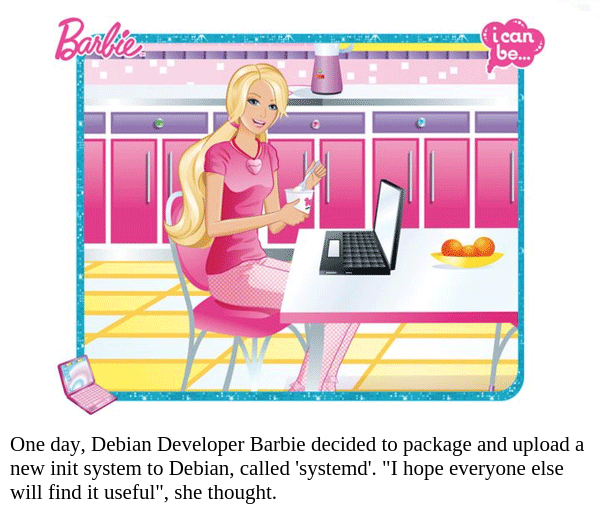
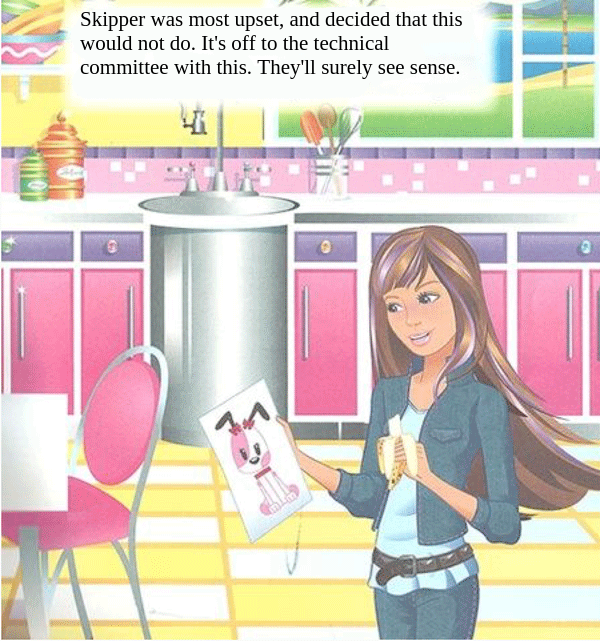
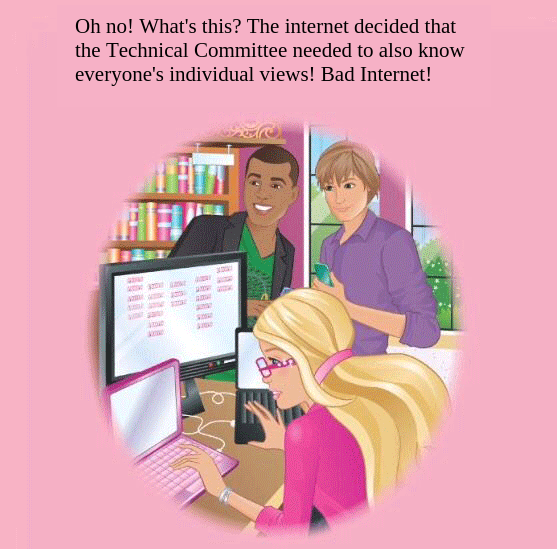
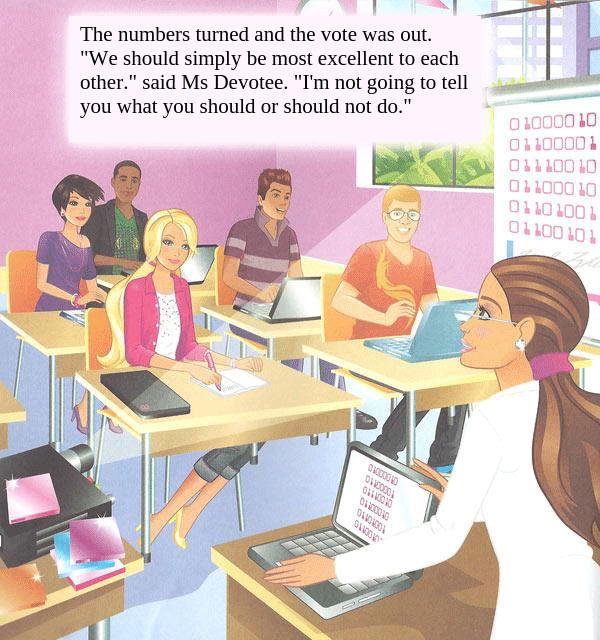
Some people may have seen recently that the Barbie series has a rather sexist book out about Barbie the Computer Engineer. Fortunately, there s a way to improve this by making your own version. Thus, I made a short version about Barbie the Debian Developer and init system packager. (For those who don t know me, this is satirical. Any resemblance to people is purely coincidental.) Edit: added text in alt tags. Also, hai reddit!

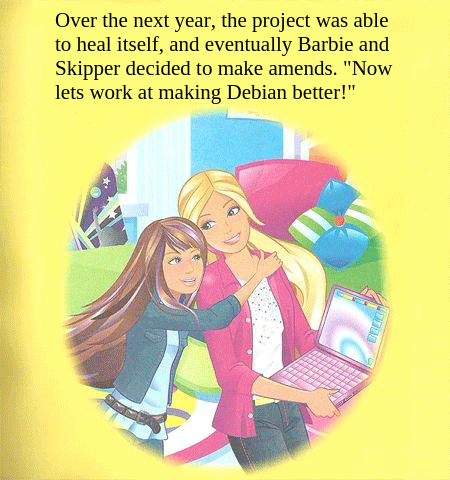
One day, Debian Developer Barbie decided to package and upload a new init system to Debian, called 'systemd'. I hope everyone else will find it useful, she thought.Oh no says Skipper! You'll never take my init system away from me! It's horrendous and Not The Unix Way! Oh dear said Barbie, What have I let myself in to?Skipper was most upset, and decided that this would not do. It's off to the technical committee with this. They'll surely see sense.Oh no! What's this? The internet decided that the Technical Committee needed to also know everyone's individual views! Bad Internet!There was much discussion and consideration. Opinions were reviewed, rows were had, and months passed. Eventually, a decision was agreed upon.Barbie was successful! The will of the Technical Committee was that systemd would be the default! But wait...Skipper still wasn't happy. We need to make sure this never affects me! I'm going to call for a General Resolution!And so, Ms Devotee was called in to look at the various options. She said that the arguments must stop, and we should all accept the result of the general resolution.The numbers turned and the vote was out. We should simply be most excellent to each other said Ms Devotee. I'm not going to tell you what you should or should not do.Over the next year, the project was able to heal itself and eventually Barbie and Skipper decided to make amends. Now let's work at making Debian better!

18 November 2014

Josselin Mouette: Introspection (not the GObject one)

Disclaimer: I m not used to writing personal stuff on Debian channels. However, there is nothing new here for those who know me from other public channels.


Yesterday, I received the weirdest email from well-known troll MikeeUSA. He thought I shared his views of a horrible world full of bloodthirsty feminists using systemd in their quest for domination over poor white male heterosexuals. The most nauseating paragraph was probably the one where he showed signs of the mentality of a pedocriminal.

At first, I shrugged it off and sent him an email explaining I didn t want anything with his stinky white male supremacist theories, assorted with a bit of taunting. But after discovering all that stuff was actually sent to public mailing lists, I took the time for a second look and started a bit of introspection.

MikeeUSA thought I was a white male supremacist because of the so-called SmellyWerewolf incident, 6 years ago.
Oh boy, people change in six years. Upon re-reading that, I had trouble admitting I was the one to write it. Memory is selective, and with time, you tend not to remember some gruesome details, especially the ones that conflict most with your moral values.

I can assure every reader that the only people I intended to mock then were those who mistook Debian mailing lists for advertising channels; but I understand now that my message must have caused pain to a lot more people than that. So, it may come late, but let me take this opportunity to offer my sincerest apologies to anyone I may have hurt at that time.


It may seem strange for someone with deeply-rooted values of equality to have written that. To have considered that it was okay to stereotype people. And I think I found this okay because to me, those people were given equal rights, and were therefore equal. But the fight for equality is not over when everyone is given the same rights. Not until they are given the same opportunities to exert those rights. Which does not happen when they live in a society that likes to fit them in little archetypal peg holes, never giving you the chance to question where those stereotypes come from.

For me, that chance came from an unusual direction: the fight against prostitution. This goes way back for me. Since when I was a teenager, I have always been ticked off at the idea of nonconsensual sex that somehow evades criminal responsibility because of money compensation. I never understood why it wasn t considered as rape. Yet it sounded weird that a male heterosexual would hold such opinions; after all, male heterosexuals should go to prostitutes as a kind of social ritual, right?

It was only three years ago that an organization of men against prostitution was founded in France. Not only did I find out that I was not alone with my progressive ideas, I was given the opportunity to exchange with many men and women who had studied prostitution: its effects on victims, its relationship to rape culture and more generally to the place men and women hold in society. Because eventually, it all boils down to little peg holes in which we expect people to fit: the virile man or the faggot, the whore or the mother. For me, it was liberating. I could finally get rid of the discomfort of being a white male heterosexual that didn t enter the little peg holes that were made for me.

And now, after Sweden 15 years ago, a new group of countries are finally adopting laws to criminalize the act of paying for sex. Including France. That s too bad for MikeeUSA, but this country is no longer the eldorado for white male supremacists. And I m proud that our lobbying made a contribution, however small, to that change.

16 November 2014

John Goerzen: Contemplative Weather

Sometimes I look out the window and can t help but feel this weather is deep. Deep with meaning, with import. Almost as if the weather is confident of itself, and is challenging me to find some meaning within it. This weekend brought the first blast of winter to the plains of Kansas. Saturday was chilly and windy, and overnight a little snow fell. Just enough to cover up the ground and let the tops of the blades of grass poke through. Just enough to make the landscape look totally different, without completely hiding what lies beneath. Laura and I stood silently at the window for a few minutes this morning, gazing out over the untouched snow, extending out as far as we can see. Yesterday, I spent some time with my great uncle and aunt. My great uncle isn t doing so well. He s been battling cancer and other health issues for some time, and can t get out of the house very well. We talked for an hour and a half about news of the family, struggles in life now and in the past, and joys. There were times when all three of us had tears in our eyes, and times when all of us were laughing so loudly. My great uncle managed to stand up twice while I was there this took quite some effort once to give me a huge hug when I arrived, and another to give me an even bigger hug when I left. He has always been a person to give the most loving hugs. He hadn t been able to taste food for awhile, due to treatment for cancer. When I realized he could taste again, I asked, When should I bring you some borscht? He looked surprised, then got a huge grin, glanced at his watch, and said, Can you be back by 3:00? His brother, my grandpa, was known for his beef borscht. I also found out my great uncle s favorite kind of bread, and thought that maybe I would do some cooking for him sometime soon. Today on my way home from church, I did some shopping. I picked up the ingredients for borscht and for bread. I came home, said hi to the cats that showed up to greet me, and went inside. I turned on the radio Prairie Home Companion was on and started cooking. It takes a long time to prepare what I was working on I spent a solid two hours in the kitchen. As I was chopping up a head of cabbage, I remembered coming to what is now my house as a child, when my grandpa lived here. I remembered his borscht, zwiebach, monster cookies; his dusty but warm wood stove; his closet with toys in it. I remembered two years ago, having nearly 20 Goerzens here for Christmas, hosted by the boys and me, and the 3 gallons of borscht I made for the occasion. I poured in some tomato sauce, added some water. The radio was talking about being kind to people, remembering that others don t always have the advantages we do. Garrison Keillor s fictional boy in a small town, when asked what advantages he had, mentioned belonging. Yes, that is an advantage. We all deal with death, our own and that of loved ones, but I am so blessed by belonging to a loving family, two loving churches, a wonderful community. Out came three pounds of stew beef. Chop, chop, slice, plunk into the cast iron Dutch oven. It s my borscht pot. It looks as if it would be more at home over a campfire than a stovetop, but it works anywhere. Outside, the sun came up. The snow melts a little, and the cats start running around even though it s still below freezing. They look like they re having fun playing. I m chopping up parsley and an onion, then wrapping them up in a cheesecloth to make the spice ball for the borscht. I add the basil and dill, some salt, and plonk them in, too. My 6-quart pot is nearly overflowing as I carefully stir the hearty stew. On the radio, a woman who plays piano in a hospital and had dreamed of being on that particular radio program for 13 years finally was. She played with passion and delight I could hear through the radio. Then it s time to make bread. I pour in some warm water, add some brown sugar, and my thoughts turn to Home On The Range. I am reminded of this verse:
How often at night when the heavens are bright
With the light from the glittering stars
Have I stood here amazed and asked as I gazed
If their glory exceeds that of ours.
There s something about a beautiful landscape out the window to remind a person of all the blessings in life. This has been a quite busy weekend actually, a busy month but despite the fact I have a relative that is sick in the midst of it all, I am so blessed in so many ways. I finish off the bread, adding some yeast, and I remember my great uncle thanking me so much for visiting him yesterday. He commented that a lot of younger people have no use for visiting an old geezer like me. I told him, I ve never been like that. I am so glad I could come and visit you today. The best gifts are those that give in both directions, and this surely is that. Then I clean up the kitchen. I wipe down the counters from all the bits of cabbage that went flying. I put away all the herbs and spices I used, and finally go to sit down and reflect. From the kitchen, the smells of borscht and bread start to seep out, sweeping up the rest of the house. It takes at least 4 hours for the borscht to cook, and several hours for the bread, so this will be an afternoon of waiting with delicious smells. Soon my family will be home from all their activities of the day, and I will be able to greet them with a warm house and the same smells I stepped into when I was a boy. I remember this other verse from Home On the Range:
Where the air is so pure, the zephyrs so free,
The breezes so balmy and light,
That I would not exchange my home on the range
For all of the cities so bright.
Today s breeze is an icy blast from the north maybe not balmy in the conventional sense. But it is the breeze of home, the breeze of belonging. Even today, as I gaze out at the frozen landscape, I realize how balmy it really is, for I know I wouldn t exchange my life on the range for anything.

Bernhard R. Link: Enabling Change

Big changes are always a complicated thing to get done and can be the harder the bigger or more diverse an organization is it is taking place in. Transparency Ideally every change is well communicated early and openly. Leaving people in the dark about what will change and when means people have much less time to feeling comfortable about it or arranging with it mentally. Especially bad can be extending the change later or or shortening transition periods. Letting people think they have some time to transition only to force them to rush later will remove any credibility you have and severely reduce their ability to believe you are not crossing them. Making a new way optional is a great way to create security (see below), but making that obligatory before the change even arrives as optional with them will not make them very willing to embrace change. Take responsibility Every transformation means costs. Even if some change did only improve and did not make anything worse once implemented (the ideal change you will never meet in reality), the deployment of the change still costs: processes have adapted to it, people have to relearn how to do things, how to detect if something goes wrong, how to fix it, documentation has to be adopted and and and. Even as the change causes more good than costs in the whole organization (let's hope it does, I hope you wouldn't try to do something if the total benefit is negative), the benefits and thus the benefit to cost ratio will differ for the different parts of your organization or the different people within it. It's hardly avoidable that for some people there will not be much benefit, much less perceived benefit compared to the costs they have to burden for it. Those are the people whose good will you want to fight for, not the people you want to fight against. They have to pay with their labor/resources and thus their good will for your benefit the overall benefit. This is much easier if you acknowledge that fact. If you blame them for having the costs, claim their situation does not even exist or even ridicule them for not embracing change you only prepare yourself for frustration. You might be able to persuade yourself that everyone that is not willing to invest in the change is just acting out of malevolent self-interest. But you will hardly be able to persuade people that it is evil to not help your cause if you treat them as enemies. And once you ignored or played down costs that later actually happen, your credibility in being able to see the big picture will simply cease to exist at all for the next change. Allow different metrics People have different opinions about priorities, about what is important, about how much something costs and even about what is a problem. If you want to persuade them, try to take that into account. If you do not understand why something is a reason, it might be because the given point is stupid. But it might also be that you miss something. And often there is simple a different valuation of what is important, what the costs are and what are problems. If you want to persuade people, it is worth to try to understand those. If all you want to do is persuade some leader or some majority then ridiculing their concerns might get you somewhere. But how do you want to win people over if you do not even appear to understand their problems. Why should people trust you that their costs will be worth the overall benefits if you tell them the costs that they clearly see do not exist? How credible is referring to the bigger picture if the part of the picture they can see does not match what you say the bigger picture looks like? Don't get trolled and don't troll There will always be people that might be unreasonable or even try to provoke you. Don't allow being provoked. Remember that for successful changes you need to win broad support. Feeling personally attacked or feeling presented a large amount of pointless arguments easily results in not bringing proper responses or actually looking at arguments. If someone is only trolling and purely malevolent, they will tease you best if they bring actual concerns of people in a way you likely degrade your yourself and your point in answering. Becoming impertinent with the troll is like attacking the annoying little goblin hiding next to the city guards with area damage. When not being able to persuade people, it is also far to easy to consider them in bad faith and/or attacking them personally. This can only escalate even more. Worst case you frustrate someone in good faith. In most cases you poison the discussion so much that people actually in good faith will no longer contribute the discussion. It might be rewarding short term because after some escalation only obviously unreasonable people will talk against you, but it makes it much harder to find solutions together that could benefit anyone and almost impossible to persuade those that simply left the discussion. Give security Last but not least, remember that humans are quite risk-averse. In general they might invest in (even small) chances to win, but go a long way to avoid risks. Thus an important part of enabling change is to reduce risks, real and perceived ones and give people a feeling of security. In the end, almost every measure boils down to that: You give people security by giving them the feeling that the whole picture is considered in decisions (by bringing them early into the process, by making sure their concerns are understood and part of the global profit/cost calculation and making sure their experiences with the change are part of the evaluation). You give people security by allowing them to predict and control things (by transparency about plans, how far the change will go and guaranteed transitions periods, by giving them enough time so they can actually plan and do the transition). You give people security by avoiding early points of no return (by having wide enough tests, rollback scenarios,...). You give people security by not letting them alone (by having good documentation, availability of training, ...). Especially side-by-side availability of old and new is an extremely powerful tool, as it fits all of the above: It allows people to actually test it (and not some little prototype mostly but not quite totally unrelated to reality) so their feedback can be heard. It makes it more predictable as all the new ways can be tried before the old ones no longer work. It is the ultimate role-back scenario (just switch off the new). And allows for learning the new before losing the old. Of course giving the people a feeling of security needs resources. But it is a very powerful way to get people to embrace the chance. Also in my experience people only fearing for themselves will usually mostly be passive by not pushing forward and trying to avoid or escape the changes. (After all, working against something costs energy, so purely egoistic behavior is quite limiting in that regard). Most people actively pushing back do it because they fear for something larger than only them. And any measure to making them fear less that you ruin the overall organization, not only avoids unnecessary hurdles rolling out the change but also has some small chance to actually avoid running into disaster with closed eyes.

11 November 2014

Richard Hartmann: One pot noodles

I had prepared a long and somewhat emotional blog post called "On unintended consequences" to write a rather sad bit of news off of my heart. While I believe the points raised were logical, courteous, and overall positive, I decided to do something different and replace sad things with happy things. So anyway, for 3-4 people you will need: Proceed to the cooky part of the evening: If you don't have any of those ingredients on hand and/or want to add something else: Just do so. This is not an exact science and it will taste wonderful any way you make it.

10 November 2014

Gustavo Noronha Silva: Yay, the left won! Or did it?

Originally published on politi.kov I have been asked by a bunch of friends from outside of Brazil for my opinion regarding the recent elections we had in Brazil, and it is a bit complicated to explain it without some background, so I decided to write this piece providing a bit of history so that people can understand my opinion. The elections this year were a rematch of our traditional polarization between the workers party (PT) and the social democracy party (PSDB), which has been going on since 1994. PT and PSDB used to be allies. In the 80s, when the dictatorship dropped the law that forbade more than 2 parties, the opposition party, MDB, began breaking up in several smaller ones. PSDB was founded by politicians and intelectuals who were inspired by Europe s social democracy and political systems. Parliamentarism, for instance, is one of the historical causes of the party. The workers party had a more grassroots origin, with union leaders, marxist intelectuals and marxist-inspired catholic priests being the main founders. They drew their inspiration from the USSR and Cuba, and were very close to social movements.
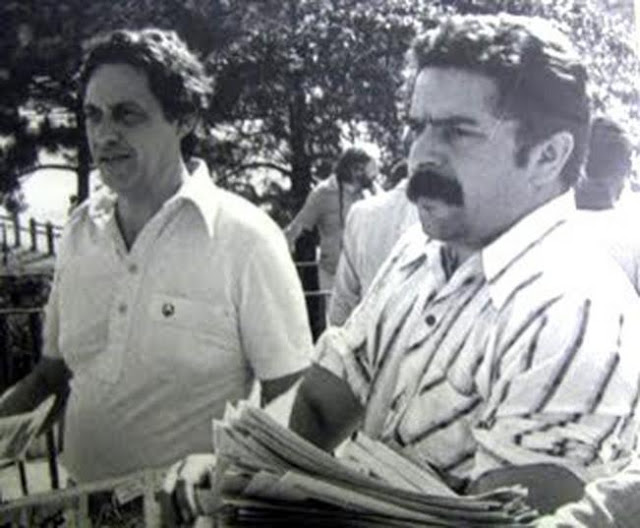
Lula and FHC campaigning together in 1981, by Cl vis Cranchi Sobrinho

Lula (PT) and FHC (PSDB) campaigning together in 1981, by Cl vis Cranchi Sobrinho

Some people have celebrated the reelection of Dilma Roussef as a victory of the left against the right. In my opinion that view is wrong for several reasons. First, because I disagree that PSDB and A cio Neves in particular are right-wing, both in terms of economics and social/moral issues. Second, because I believe Dilma s first government has taken a quite severe turn to the right in several topics that matter a lot to me. Since comparisons with PSDB s government during the 90s has been one of the main strategies of the campaign this year, I ll argue why I think it was actually a pretty good government with a lot of left in it. Unlike what happens in most other places, Brazil does not really have an actual right-wing party, economics-wise. Although we might see the birth of a couple in the near future, no current party is really against public health, education and social security being provided by the state as rights, or wants to decrease state size and lower taxes significantly. It should come as no surprise that even though it has undergone a lot of liberal reforms over the last 20 years, Brazil is still a very closed country, with very high import tariffs and a huge presence of the state in the economy. There is a certain consensus about all of that, with disagreements being essentially on implementation details, not goals. On the other hand, and contrary to popular belief, when it comes to social and moral issues we are a very conservative people. Ironically, the two parties which have been in power over the last 20 years are quite progressive, being historically proponents of diversity, minorities rights, reproductive rights. They have had to compromise on those causes to become viable alternatives, given the conservative nature of the majority of the voters. Despite their different origins and beliefs, both parties share socialist inclinations and were allies from the onset. That changed in 1992, when president Collor, who had been elected on a runoff against Lula (who PSDB supported), was impeached by Congress for corruption. With no formal political support and a chaotic situation in his hands, Itamar Franco, the vice president, called for a national union government to go through the last two years of his term. PSDB answered the call, but the workers party decided against being part of the government. Fernando Henrique Cardoso, a sociologist who was one of the leaders of PSDB was chosen to lead the Foreign Relations Ministry, but a few months later got nominated to the Economy. At the time, Brazil lived under hyperinflation of close to 1000% a year, and several stabilization plans had been attempted. Economy Ministers did not last very much in office at the time. FHC gathered a team of economists and sponsored their stabilization plan, which turned out to be highly successful: the Plano Real ( Real Plan ). In addition to introducing a new currency, something that was becoming pretty common to Brazilians by then, it also attacked the structural causes of inflation. Lula was counting on the failure of the Plano Real when he ran against FHC in 1994, but the plan succeeded, giving FHC two terms as president. During those two terms, FHC introduced several institutional changes that made Brazil a saner country. In addition to the hyperinflation, Brazil had lived a debt crises for decades and was still in default. FHC s team renegotiated the debts, reopened lines of credit, but most importantly, introduced reforms that made the Brazilian finances and financial system credible. The problem was not even that Brazil had a fiscal d ficit, it just did not have any control whatsoever of money supply and budget. Banks, regardless of whether they were private or public, had very little regulation and took advantage of the hyperinflation to hide monstrous holes in their balances. When inflation was gone and regulation became more strict, those became apparent, and it was pretty clear that the system would collapse if nothing was done. Some people like to say that FHC was a president who ruled for the rich and didn t care about the poor. I think the way the potential collapse of the banking system was handled is a great counter-example of that. The government passed laws that made the owners of the banks responsible for the financial problems, regardless of whether caused by mismanagement or fraud. If a bank went under, the central bank intervened and added enough money to protect the deposits, but that money was a loan that had to be repaid by the owners of the bank, and the owners properties were added as collateral to the loan. As a brazilian journalist once said, the people did not risk losing their deposits, the bankers did risk losing the banks, though. Today, we have a separate fund, filled with money from the banks, that does what the central bank did back then when required. Compare that to countries where the banking system was saved with tax payer money and executives kept getting huge bonuses regardless, while owners kept their profits. It is hard to find an initiative that is more focused on the public interest against the interest of the rich people who caused the problem. This legislation, called PROER, is still in place today, and it came along with solid regulation of the banking system. It should come as no surprise that Brazil went through the financial crisis of 2008 with not a single hiccup of the banking system and no fear of bank runs. Despite having been against PROER back in the day, Lula celebrated its existence in 2008, when it was clear it was one of the reasons we would not suffer much. He even advertised it as something that should be adopted by the US and Europe. It is also pretty common to hear that under FHC social questions were not a priority. I believe it is pretty simple to see that that was not the case both by inspecting the growth of social spending and the improvement of social indicators for the period, such as UN s human development index. One area in which people are particularly critical of the FHC government is the investment on higher education, and they are actually quite right. Brazil has free Federal universities and those did not get a lot of priority in the 90s. However, I would argue that while it is a matter of priorities, it is not one of education versus something else, but rather of what to invest on inside education. The reality is basic education was the priority. When FHC came to power, Brazil had a significant number of children who were not going to school at all. The goal was to make access to schools universal for young children, and that goal was reached. Every child has been going to school since the early 2000s, and that is a significant achievement which reaches the poorest. While the federal universities are attended essentially by the Brazilian elite, given the difficulty of passing the exams and the relative lack of quality of free public schools compared to private ones, which is still a reality to this day, investment on getting children to even go to school for the early years has a significant impact on the lives of the poorest. It is important to remember that getting every child to go to school is also what gave birth to one of the most celebrated programs from the Lula era: Bolsa Fam lia ( Family Allowance ) is a direct money transfer to poor families, particularly those who have children and has been an important contribution to lowering inequality and getting people out of extreme poverty. To get the money, the families need to ensure their children are 1) attending school and 2) getting vaccinated. That program comes from the FHC government, in which it was created with the name Bolsa Escola ( School Allowance ), in its turn inspired by a program of the same name by governor Cristovam Buarque, from PT. What Lula did, and he deserves a lot of credit for this, was to merge a series of smaller programs with Bolsa Escola, and then expand the program to ensure it got to more and more people. Interestingly, during the announcement of the program he credited the idea of doing that to a state governor from PSDB. You can see why I think these two should be allies again. When faced with all these arguments, people will eventually say that FHC was bad because he privatized companies and used orthodox economic policies. Well, if that is what it takes, then we ll have to take Lula down with him, because his first term was essentially a continuation of FHC s second term: orthodox economic policies to keep inflation down, along with privatization of several state-owned companies and banks. But Lula, whom I voted for and whose government I believe was a good one, is not my subject: Dilma is. On Lula s second term, Dilma gained a lot of power when other major leaders of PT went down for corruption. She became second in command and started leading several programs. A big believer in developmentalism, she started pushing for a bigger role of the state in the coordination of the productive sector, with a clear focus on growing the industrial base. One of the initiatives she sponsored was a sizable increase on the number and size of subsidized loans given out by the national development bank (BNDES). Brazil started an unnofficial national champions program, where the government elected a few big companies to get a huge amount of subsidized credit. The goal was for these selected firms to get big enough to be competitive on the global market. The criteria for the choices is completely opaque, if it even exists, and includes handing out milions in subsidized credit for Eike Batista, who became Brazil s richest enterpreneur for a while, and lost pretty much everything when it became clear the oil would not be pumping out of his camps after all, sinking with them a huge amount of public funds invested by BNDES. The way this policy was enacted, it is unclear how much it really costs in terms of public funds: the Brazilian treasury emits debt to capitalize, lends that money to BNDES with higher than market interest, and BNDES then lends it out to the big companies with a lower than market interest rate. Although it is obviously unsustainable, the problem does not yet show in the balance because the grace period for BNDES debt with the treasury is 2040. The fact that this has a cost and, perhaps more importantly, a huge opportunity cost is not clear because it is not part of the government budget. Why are we putting money in this rather than quadrupling Bolsa Fam lia, which studies show generates 1,78 reais in GDP for every 1 real invested? Worse, why are we not even updating Bolsa Fam lia enough to cover inflation? When Dilma got elected in 2010, the first signs were pretty bad. She was already seen as someone who did not care much for the environment, and on her first month in power she made good on that promise by pushing to get the Belo Monte Dam building started as soon as possible regardless of conditionalities being satisfied. To this day there are several issues with how the building of the dam is going: the handling of the indigenous people and the small city nearby are lacking, conditionalities are not met. Beyond Belo Monte, indigenous leaders are being assassinated, deforestation in the Amazon forest has increased by 122% in 2014 alone. Dilma s answer to people who question her on these kinds of issues is essentially: would you rather not have electric power? Her populist authoritarian nature and obsession with industry are also pretty evident when it comes to her policies in the energy area as a whole. She showed up in national tv on the eve of our independence day celebration to announce a reduction in electric tariffs, mainly for industry, but also for homes. Nobody really knew how. The following week she sent a fast-track project to Congress to automatically renew concessions of power grid operators, requiring those who accepted it to lower tariffs, instead of doing an auction, which was already necessary anyway because the concessions were up on 2015. There was no discussion with stakeholders, there was just a populist announcement and a great deal of rhethoric to paint anyone who opposed as being against the people. And now, everything went into the crapper because that represented a breach of contract that required indemnification, and we had a pretty bad drought that made power more expensive given the need to turn on the thermal generators. Combining the costs of the thermal generation, indemnity, and financial fallout that the grid operators suffered, we are already at 105 billion reais and counting, nobody knows how high the cost will reach. Any reduction in tariffs has long been invalidated. And the fact that industry has lowered production significantly ends up being good news, we would probably be under rationing already if that was not the case. You would expect someone who fought a dictatorship to be pretty good in terms of human and civil rights. What we see in reality is a lack of respect for those things. During the world cup, Dilma has put the army on the streets and has supported arbitrary behaviour from state polices throughout the country. They jailed a bunch of demonstrators preemptively. No shit. The would be demonstrators were kept in jail throghout the tournament under false accusations. Dilma s Minister of Justice said several times that the case against them was solid and that the arrests were legal, but it turned out the case simply did not exist. Just this week we had a number of executions orchestrated by policemen in the state of Par and there is zero reaction from the federal government. In the oil industry, Dilma has enacted a policy of subsidizing gas prices by using a fixed price that used to be lower than the international prices (it is no longer the case with the fall in international prices). That would not be a problem if Brazil was selfsufficient in oild and gas, which we are not: we had to import a significant amount of both. The implicit subsidy cost Petrobr s a huge amount of cash the more gas it sold, the bigger the losses. This lead not only to decreasing the company s market value (it is a state-controlled, but open company), but to reducing its capacity of investment as well. That is more problematic than it sounds because, with our current concession model, every single oil camp needs to have Petrobr s as a member of the consortium. Limiting the company s investment capacity limits the rate at which our pre-salt oil camps can be explored and thus the speed at which we can become selfsufficient. Chicken and egg anyone? To make things worse, Dilma has made policies that lowered taxes on car production, used to foster economic activity during the crisis in 2008-2010, essentially permanent. This lead to a significant increase in traffic and polution on Brazilian cities, while at the same time increasing the pressure on Petrobr s, which had to import more and more gas. Meanwhile, Brazilian cities suffer from a severe lack of mobility infrastructure. A recent study has shown that Brazil has spend almost twice as much subsidized money on pro-car policies than on pro-mass transit projects. Talk about good usage of public funds. One of the only remaining good news the government was still able to mention was the constant reduction in extreme poverty. Dilma was actually ellected promising to erradicate extreme poverty and changed the government s slogan to A rich country is a country with no poverty (Pa s rico pa s sem pobreza). Well, it turns out all of these policies caused inequality and extreme poverty both to stop falling as of 2013. And given the policies were actually deepened in 2014, I believe it is very likely we ll see an increase in both when we get the data for 2014, next year. Other than that, her policies ended up being a complete failure. Despite giving tax benefits to several sectors, investment has fallen, growth has fallen and inflation is quite high at 6,6% for the last 12 months. In terms of minorities, her government has been a severe set back, with the government going back on educational material against homophoby saying it would not do advertisement of sexual choice , and going back on a decree that allowed the public health system to perform abortions on the cases allowed by the law (essentially if the woman has been raped). Looking at Dilma s policies, I really can t see that much of the left, honestly. So why, you might ask, has this victory been deemed a victory of the left over the right? My explanation is the aura the workers party still manages to keep over itself. There s a notion that whatever PT does, it will still be more to the left than PSDB, which I think is just crazy. There is also a fair amount of idealizing Dilma just because she is Lula s proteg . People will forgive anything, provided it is the workers party doing it. Thankfully, the number of people aligned on the left that supported the candidate from PSDB this election tells me this is changing quite rapidly. Hopefully that leads to PT having to reinvent itself, and get in touch with the left again.

Petter Reinholdtsen: A Debian package for SMTP via Tor (aka SMTorP) using exim4

The right to communicate with your friends and family in private, without anyone snooping, is a right every citicen have in a liberal democracy. But this right is under serious attack these days. A while back it occurred to me that one way to make the dragnet surveillance conducted by NSA, GCHQ, FRA and others (and confirmed by the whisleblower Snowden) more expensive for Internet email, is to deliver all email using SMTP via Tor. Such SMTP option would be a nice addition to the FreedomBox project if we could send email between FreedomBox machines without leaking metadata about the emails to the people peeking on the wire. I proposed this on the FreedomBox project mailing list in October and got a lot of useful feedback and suggestions. It also became obvious to me that this was not a novel idea, as the same idea was tested and documented by Johannes Berg as early as 2006, and both the Mailpile and the Cables systems propose a similar method / protocol to pass emails between users. To implement such system one need to set up a Tor hidden service providing the SMTP protocol on port 25, and use email addresses looking like username@hidden-service-name.onion. With such addresses the connections to port 25 on hidden-service-name.onion using Tor will go to the correct SMTP server. To do this, one need to configure the Tor daemon to provide the hidden service and the mail server to accept emails for this .onion domain. To learn more about Exim configuration in Debian and test the design provided by Johannes Berg in his FAQ, I set out yesterday to create a Debian package for making it trivial to set up such SMTP over Tor service based on Debian. Getting it to work were fairly easy, and the source code for the Debian package is available from github. I plan to move it into Debian if further testing prove this to be a useful approach. If you want to test this, set up a blank Debian machine without any mail system installed (or run apt-get purge exim4-config to get rid of exim4). Install tor, clone the git repository mentioned above, build the deb and install it on the machine. Next, run /usr/lib/exim4-smtorp/setup-exim-hidden-service and follow the instructions to get the service up and running. Restart tor and exim when it is done, and test mail delivery using swaks like this:
torsocks swaks --server dutlqrrmjhtfa3vp.onion \
  --to fbx@dutlqrrmjhtfa3vp.onion
This will test the SMTP delivery using tor. Replace the email address with your own address to test your server. :) The setup procedure is still to complex, and I hope it can be made easier and more automatic. Especially the tor setup need more work. Also, the package include a tor-smtp tool written in C, but its task should probably be rewritten in some script language to make the deb architecture independent. It would probably also make the code easier to review. The tor-smtp tool currently need to listen on a socket for exim to talk to it and is started using xinetd. It would be better if no daemon and no socket is needed. I suspect it is possible to get exim to run a command line tool for delivery instead of talking to a socket, and hope to figure out how in a future version of this system. Until I wipe my test machine, I can be reached using the fbx@dutlqrrmjhtfa3vp.onion mail address, deliverable over SMTorP. :)

Matthias Klumpp: Introducing Limba a software installer experiment

As some of you already know, since the larger restructuring in PackageKit for the 1.0 release, I am rethinking Listaller, the 3rd-party application installer for Linux systems, as well. During the past weeks, I was playing around with a lot of different ideas and code, to make installations of 3rd-party software easily possible on Linux, but also working together with the distribution package manager. I now have come up with an experimental project, which might achieve this. Motivation Many of you know Lennart s famous blogpost on how we put together Linux distributions. And he makes a lot of good and valid points there (in fact, I agree with his reasoning there). The proposed solution, however, is not something which I am very excited about, at least not for the use-case of installing a simple application[1]. Leaving things like the exclusive dependency on technology like Btrfs aside, the solution outlined by Lennart basically bypasses the distribution itself, instead of working together with it. This results in a duplication of installed libraries, making it harder to overview which versions of which software component are actually running on the system. There is also a risk for security holes due to libraries not being updated. The security issues are worked around by a superior sandbox, which still needs to be implemented (but will definitively come soon, maybe next year). I wanted to explore a different approach of managing 3rd-party applications on Linux systems, which allows sharing as much code as possible between applications. Limba Glick2 and Listaller concepts mergedlimba-small In order to allow easy creation of software packages, as well as the ability to share software between different 3rd-party applications, I took heavy inspiration from Alexander Larssons Glick2 project, combining it with ideas from the application-directory based Listaller. The result is Limba (named after Limba tree, not the voodoo spirit I needed some name starting with li to keep the prefix used in Listaller, and for a tool like this the name didn t really matter ;-) ). Limba uses OverlayFS to combine an application with its dependencies before running it, as well as mount namespaces and shared subtrees. Except for OverlayFS, which just landed in the kernel recently, all other kernel features needed by Limba are available for years now (and many distributions ship with OverlayFS on older kernels as well). How does it work? In order to to achieve separation of software, each software component is located in a separate container (= package). A software component can be an application, like Kate or GEdit, but also be a single shared library (openssl) or even a full runtime (KDE Frameworks 5 parts, GNOME 3). Each of these software components can be identified via AppStream metadata, which is just a few bits of XML. A Limba package can declare a dependency on any other software component. In case that software is available in the distribution s repositories, the version found there can be used. Otherwise, another Limba package providing the software is required. Limba packages can be provided from software repositories (e.g. provided by the distributor), or be nested in other packages. For example, imagine the software Kate requires a version of the Qt5 libraries, >= 5.2. The downloadable package for Kate can be bundled with that dependency, by including the Qt5 5.2 Limba package in the Kate package. In case another software is installed later, which also requires the same version of Qt, the already installed version will be used. Since the software components are located in separate directories under /opt/software, an application will not automatically find its dependencies, or be able to locate its own files. Therefore, each application has to be run by a special tool, which merges the directory trees of the main application and it s dependencies together using OverlayFS. This has the nice sideeffect that the main application could override files from its dependencies, if necessary. The tool also sets up a new mount namespace, so if the application is compiled with a certain prefix, it does not need to be relocatable to find its data files. At installation time, to achieve better system integration, certain files (like e.g. the .desktop file) are split out of the installed directory tree, so the newly installed application achieves almost full system integration. AQNAY* Can I use Limba now? Limba is an experiment. I like it very much, but it might happen that I find some issues with it and kill it off again. So, if you feel adventurous, you can compile the source code and use the example Foobar application to play around with Limba. Before it can be used in production (if at all), some more time is needed. I will publish documentation on how to test the project soon. Doesn t OverlayFS have a maximum stacking depth? Oh yes it has! The How does it work explanation doesn t tell the whole truth in that regard (mainly to keep the section small). In fact, Limba will generate a runtime for the newly installed software, which is a directory with links to the actual individual software components the runtime consists of. The runtime is identified by an UUID. This runtime is then mounted together with the respective applications using OverlayFS. This works pretty great, and also results in no dependency-resolution to be done immediately before an application is started. Than dependency stuff gives me a headache Admittedly, allowing dependencies adds a whole lot of complexity. Other approaches, like the one outlined by Lennart work around that (and there are good reasons for doing that as well). In my opinion, the dependency-sharing and de-duplication of software components, as well as the ability to use the components which are packaged by your Linux distribution is worth the extra effort. Can you give an overview of future plans for Limba? Sure, so here is the stuff which currently works: These features are planned for the new future: Remember that Limba is an experiment, still ;-) XKCD 927 Technically, I am replacing one solution with another one here, so the situation does not change at all ;-). But indeed, some duplicate work is done due to more people working in this area now on similar questions. But I think this is a good thing, because the solutions worked on are fundamentally different approaches, and by exploring multiple ways of doing things, we will come up with something great in the end. (XKCD reference) Doesn t the use of OverlayFS have an impact on the performance of software running with Limba? I ran some synthetic benchmarks and didn t notice any problems even the startup speed of Limba applications is only a few milliseconds slower than the startup of the raw native application. However, I will still have to run further tests to give a definitive answer on this. How do you solve ABI compatibility issues? This approach requires software to keep their ABI stable. But since software can have strict dependencies on a specific version of a software (although I d discourage that), even people who are worried about this issue can be happy. We are getting much better at tracking unwanted ABI breaks, and larger projects offer stable API/ABI during a major release cycle. For smaller dependencies, there are, as explained above, stricter dependencies. In summary, I don t think ABI incompatibilities will be a problem with this approach at least not more than they have been in general. (The libuild facilities from Listaller to minimize dependencies will still be present im Limba, of course) You are wrong because of $X! Please leave a comment in this case! I d love to discuss new ideas and find the limits of the Limba concept that s why I am writing C code afterall, since what looks great on paper might not work in reality or have issues one hasn t thought about before. So any input is welcomed! Conclusion Last but not least I want to thank Alexander Larsson for writing Glick2, which Limba is heavily inspired from, and for his patient replies to my emails. If Limba turns out to be a good idea, you can expect a few more blog posts about it soon.
* Answered questions nobody asked yet [1]: Don t get me wrong, I would like to have these ideas implemented they offer great value. But I think for simple software deployment, the solution is an overkill.

John Goerzen: Debian A plea to worry about what matters, and not take ourselves too seriously

I posted this on debian-devel today. I am also posting it here, because I believe it is important to more than just Debian developers. Good afternoon, This message comes on the heels of Sam Hartman s wonderful plea for compassion [1] and the sad news of Joey Hess s resignation from Debian [2]. I no longer frequently post to this list, but when you ve been a Debian developer for 18 years, and still care deeply about the community and the project, perhaps you have a bit of perspective to share. Let me start with this: Debian is not a Free Software project. Debian is a making-the-world-better project, a caring for people project, a freedom-spreading project. Free Software is our tool. As many of you, hopefully all of you, I joined Debian because I enjoyed working on this project. We all did, didn t we? We joined Debian because it was fun, because we were passionate about it, because we wanted to make the world a better place and have fun doing it. In short, Debian is life-giving, both to its developers and its users. As volunteers, it is healthy to step back every so often, and ask ourselves two questions: 1) Is this activity still life-giving for me? 2) Is it life-giving for others? I have my opinions about init. Strong ones, in fact. [3] They re not terribly relevant to this post. Because I can see that they are not really all that relevant. 14 years ago, I proposed what was, until now anyhow, one of the most controversial GRs in Debian history. It didn t go the way I hoped. I cared about it deeply then, and still care about the principles. I had two choices: I could be angry and let that process ruin my enjoyment of Debian. Or I could let it pass, and continue to have fun working on a project that I love. I am glad I chose the latter. Remember, for today, one way or another, jessie will still boot. 18 years ago when I joined Debian, our major concerns were helping newbies figure out how to compile their kernels, finding manuals for monitors so we could set the X modelines properly, finding some sort of Free web browser, finding some acceptable Office-type software. Wow. We WON, didn t we? Not just Debian, but everyone. Freedom won. I promise you 18 years from now, it will not matter what init Debian chose in 2014. It will probably barely matter in 3 years. This is not key to our goals of making the world a better place. Jessie will still boot. I say that even though my system runs out of memory every few days because systemd-logind has a mysterious bug [4]. It will be fixed. I say that even though I don t know what init system it will use, or how much choice there will be. I say that because it is simply true. We are Debian. We will make it work, one way or another. I don t post much on this list anymore because my personal passion isn t with posting on this list anymore. I make liberal use of my Delete Thread keybinding on -vote these days, because although I care about the GR, I don t care about it enough to read all the messages about it. I have not yet decided if I will spend the time researching it in order to vote. Instead of debating the init GR, sometimes I sit on the sofa with my wife. Sometimes I go out and fly the remote-control airplane I m learning to fly. Sometimes I repair my plane after a flight that was shorter than planned. Sometimes I play games with my boys, or help them with homework, or share my 8-year-old s delight as a text file full of facts about the Titanic that he wrote in Emacs comes spitting out of the printer. Sometimes I write code or play with the latest Linux filesystems or build a new server for my basement. All these things matter more to me than init. I have been using Debian at home for almost 20 years, at various workplaces for almost that long, and it is not going to stop being a part of my life any time soon. Perhaps I will have to learn how to administer a new init system. Well, so be it; I enjoy learning new things. Or perhaps I will have to learn to live with some desktop limitations with an old init system. Well, so be it; it won t bother me much anyhow. Either way, I m still going to be using what is, to me, the best operating system in the world, made by one of the world s foremost Freedom projects. My hope is that all of you may also have the sense of peace I do, that you may have your strong convictions, but may put them all in perspective. That we as a project realize that the enemy isn t the lovers of the other init, but the people that would use law and technology to repress people all over the world. We are but one shining beacon on a hill, but the world will be worse off if our beacon winked out. My plea is that we each may get angry at what matters, and let go of the smaller frustrations in life; that we may each find something more important than init/systemd to derive enjoyment and meaning from. [5] May you each find that airplane to soar freely in the skies, to lift your soul so that the joy of using Free Software to make the world a better place may still be here, regardless of what /sbin/init is. [1] https://lists.debian.org/debian-project/2014/11/msg00002.html [2] https://lists.debian.org/debian-devel/2014/11/msg00174.html [3] A hint might be that in my more grumpy moments, I realize I haven t ever quite figured out why the heck this dbus thing is on so many of my systems, or why I have to edit XML to configure it ;-) [4] #765870 [5] No disrespect meant to the init/systemd maintainers. Keep enjoying what you do, too!

9 November 2014

Erich Schubert: GR vote on init coupling

Overregulation is bad, and the project is suffering from the recent Anti-Systemd hate campaigning.
There is nothing balanced about the original GR proposal. It is bullshit from a policy point of view (it means we must remove software from Debian that would not work with other inits, such as gnome-journal, by policy).At the same time, it uses manipulative language like "freedom to select a different init system" (as if this would otherwise be impossible) and "accidentally locked in". It is exactly this type of language and behavior which has made Debian quite poisonous the last months.
In fact, the GR pretty much says "I don't trust my fellow maintainers to do the right thing, therefore I want a new hammer to force my opinion on them". This is unacceptable in my opinion, and the GR will only demotivate contributors. Every Debian developer (I'm not talking about systemd upstream, but about Debian developers!) I've met would accept a patch that adds support for sysvinit to a package that currently doesn't. The proposed GR will not improve sysvinit support. It is a hammer to kick out software where upstream doesn't want to support sysvinit, but it won't magically add sysvinit support anywhere.
What some supporters of the GR may not have realized - it may as well backfire on them. Some packages that don't yet work with systemd would violate policy then, too... - in my opinion, it is much better to make the support on a "as good as possible, given available upstream support and patches" basis, instead of a "must" basis. The lock-in may come even faster if we make init system support mandatory: it may be more viable to drop software to satisfy the GR than to add support for other inits - and since systemd is the current default, software that doesn't support systemd are good candidates to be dropped, aren't they? (Note that I do prefer to keep them, and have a policy that allows keeping them ...)
For these reasons I voted:
  1. Choice 4: GR not required
  2. Choice 3: Let maintainers do their work
  3. Choice 2: Recommended, but not mandatory
  4. Choice 5: No decision
  5. Choice 1: Ban packages that don't work with every init system
Fact is that Debian maintainers have always been trying hard to allow people to choose their favorite software. Until you give me an example where the Debian maintainer (not upstream) has refused to include sysvinit support, I will continue to trust my fellow DDs. I've been considering to place Choice 2 below "further discussion", but essentially this is a no-op GR anyway - in my opinion "should support other init systems" is present in default Debian policy already anyway...
Say no to the haters.
And no, I'm not being unfair. One of the most verbose haters going by various pseudonyms such as Gregory Smith (on Linux Kernel Mailing list), Brad Townshend (LKML) and John Garret (LKML) has come forward with his original alias - it is indeed MikeeUSA, a notorious anti-feminist troll (see his various youtube "songs", some of them include this pseudonym). It's easy to verify yourself.
He has not contributed anything to the open source community. His songs and "games" are not worth looking at, and I'm not aware of any project that has accepted any of his "contributions". Yet, he uses several sock puppets to spread his hate.
The anti-systemd "crowd" (if it acually is more than a few notorious trolls) has lost all its credibility in my opinion. They spread false information, use false names, and focus on hate instead of improving source code. And worse, they tolerate such trolling in their ranks.

Charles Plessy: Did we need a general resolution?

In 2009 I called for a general resolution regarding membership procedures in Debian, to block a change that, in my opinion, was going against our values. Results, even if they satisfied the majority came with a bitter feeling and it became questioned whether a better solution could have been reached without using a constraining procedure. I did not think so, but not to the point of not having doubts about it, and therefore, regrets. This year, we are again having a vote related to a change that some people think it goes against our values, and again the existence of this vote makes it hard to find compromises. Bitterness will win whatever the result is. For the avoidance of doubt, I have proposed the amendment number 3, stating that this general resolution should not have been started. I hope that this amendment will defeat the original proposition and will make people think twice before pressing Debian's alarm button next time. PS: amendment 3, that is amendment C, that is choice 4. If there was a need for an example that the procedure is complex, here it is...

8 November 2014

Ingo Juergensmann: Bind9 vs. PowerDNS - part 2

AttachmentSize
dnssec.sh.txt3.55 KB
Two weeks ago I wrote about implementing DNSSEC with Bind9 or PowerDNS and asked for opinions, because Bind9 appeared to me to be too complex to set it up with regular key signing and such and PowerDNS seemed to me to be nice and easy, but some kind of black box where I don't now what's happening. I think I've now found the best and most suitable way for me to deal with DNSSEC. Or in short words: Bind9 won! It won because of its inline-signing config option that you can use in bind9.9, which happens to be in backports. Another tip I can give due to my findings on the web: if you plan to implement DNSSEC with Bind9, do NOT! search for "bind dnssec" on the web. This will only bring up old HowTos and manuals which leaves you with the burden of manually update your keys. Just add the magic word "inline-signing" to your search phrase and you'll find proper results like the one from Michael McNally on a subpage of ISC.org: In-line Signing With NSEC3 in BIND 9.9+ -- A Walk-through. It's a fairly good starting point, but still left me with several manual steps to do to get a DNSSEC-signed zone. I'm quite a lazy guy when it comes down to manual steps that needs to get executed repeatedly, as many others in IT as well, I think. So I wrote some sort of small wrapper script to do the necessary steps of creating the keys, adding the necessary config options to your named.conf.local, enabling nsec3params, add the DS records to your zone file and displaying the DNSKEY to you, so that you just need to upload it to your registrar. One problem was still open: when doing auto-signing/inline-signing with bind9, you are left with your plain text zone file whereas your signed zone file will keep to increase the serial with each key rollover. When changing your plain text zone file by adding, changing or removing RRs of that domain, you'll be left with the manual task of finding out was your actual serial is that is currently used, because it's not your serial +1 from your plain text zone file anymore. This is of course an awkward part I wanted to get rid off. And therefor my script includes an option to edit zone files with your favorite editor, increase the serial automatically by determing the currently highest number, either on disk or in DNS and raising this serial by 1. Finally the zone is automatically reloaded by rndc. That way I now have the same comfort as in PowerDNS with Bind9, but also know what's going on, because it's not a black box anymore. Me happy. :-) P.S.: I don't know whether this script is of interest to other users, because it relies heavily on my own setting, e.g. paths and such. But if there's interest, just ask... P.P.S.: Well, I think it's better when you can decide yourself if my script is of interest to you... please find it attached...
Kategorie:

7 November 2014

Russ Allbery: On tolerating personal abuse

While I don't consider myself part of the science fiction community directly (my con-going days are probably over), I do follow it across a wide variety of blogs. There are a lot of hard conversations and considerable soul-searching going on right now concerning an on-line commentator in that community who had been nasty and vicious to people, but originally for reasons that many people thought were good causes. (I had been one of those people. It's always very, very tempting to appreciate a good vitriolic rant from someone who shares your world view. And very easy to lose track of the people those rants are aimed at, or the excesses to which those rants go.) I'm not going to go into the details of the SF community issues here, since I have no context other than what I've read, and it's something to work out within that community. But I've been taking it as a useful reminder that abusive behavior is not acceptable, even if it comes from people who are arguably on your side. Anger is important. Anger is often how the world changes. But anger and abuse are not the same thing. I wrote something a little bit ago in a different context. Given that reminder, and given some of the arguments that are going on in the free software community as well, it seemed like a good idea to post a somewhat edited version of it in a more public place: None of us should be willing to continue to participate in a project in which we're expected to tolerate being abused and attacked, and all consequences of that abuse are our problem to deal with. It is simply not fun, and not motivating, and not interesting, and does not lead to us doing good work. I say this from lots of hard-won personal experience. I was deeply involved in Usenet governance for many years. I have made all the same arguments that I see today in favor of "blunt" speech, vitriol, and attacks. I have been a passionate advocate for the "free speech" approach. I have told other people to just filter and use killfiles. I have said that words aren't worth getting worked up about, and it's easy to ignore people. I was wrong. It took a long time for me to figure out that I was wrong, not just for other people, but for myself as well. It took me much longer to walk away from Usenet governance for good because the environment was too toxic. It remains one of the best decisions I have ever made in my life. It was the best bit of self-care that I ever did. I learned from that experience, and earlier this year, I walked away from a job for related reasons. I enjoyed the work, the job was much easier than the job that I have now, and I had a lot of time to work on free software and on Debian, but the emotional environment was toxic. (It was not as openly abusive, but it was an environment of disrespect, hierarchical dominance games, fear, blame, and emotional blackmail.) As a result, I've had to shift priorities considerably, but I'm a much happier person. It's worth having less time for things that I was previously enjoying to not to have to deal with an emotionally negative and confrontational environment. Life is too short, and I have the luxury of having choices. Both of those incidents taught me that it's very easy for me to leave that sort of situation to fester for too long, and that I underestimate how much of an improvement it is for my quality of life to walk away from abusive and negative emotional situations. I am belatedly learning how to be more ready and willing to do this. I very much understand the people who are concerned with ensuring there is space for strongly-worded opinions and heartfelt anger. But we have to draw a line, and that line needs to rule out emotional abuse of people in our community even in the name of passionate polemics about something that's important. We have to enforce that line, and if that means ejecting people from our community, that's what we have to do. Because, if we don't, we're also ejecting people from our community: the quiet people, the people who are just trying to get work done, or the people who have had past experience with abusive environments and understand the need to bail when an environment starts going in that direction. I'm not going to put up with the sort of environment I put up with when doing Big Eight newsgroup creation. I'm not saying this as some sort of threat -- I'm saying this to try to be very clear that not standing up for the members of our community and not supporting each other against abuse and emotional attacks also has consequences, and will destroy that community for a lot of us. I'm saying that I am not interested in living in an environment of fear and blame. And one should never underestimate the human power of giving people space and community in which they can be comfortable, relaxed, and truly happy. Walking the line between this stance and the "tone argument," in which people who are being abused or disenfranchised are attacked for being angry, is very difficult. There are some helpful rules of thumb, such as distinguishing between punching up and punching down, but those rules of thumb can fail or be distorted, as the SF community is learning. It's important that people be able to express anger. It's also important that people be able to name names and identify specific behaviors that they believe are worthy of that anger. But when that anger escalates into attacks, there is a real danger that passionate righteousness turns into passionate abusiveness, a danger of losing the sense of community in our own sense of righteousness. And that's not something we can or should accept. It's going to take a lot of hard work, a lot of open conversation, and a lot of empathy and care to find that line. There are many things in the world right now that should provoke anger, and with that anger comes power for good. But with that anger can also come a destructive blindness. The anger I want is the anger that drives us to change the world together, the anger that leads to confronting others with a reflection of their own better natures and challenging them to become better, more compassionate people. The anger that leads a man to feed the homeless in the true meaning of civil disobedience. Not the anger that crushes our enemies.

5 November 2014

Carl Chenet: Send the same short message on Twitter, Pump.io, Diaspora* and a lot more

Follow me on Identi.ca or Twitter or Diaspora*diaspora-banner This is a feedback about installing a self hosted instance of Friendica on a Debian server (Jessie). If you re not interested in why I use Friendica, just go to Prerequisite for Friendica section below. Frustration about social networks Being a huge user of short messages, I was quite frustated to spend so much time on my Twitter account. To be quite honest, there is no much I like about this social network, except the huge population of people being potentially interested in what I write. twitter-logo I also have been using Identi.ca (now powered by Pump.io) for a while. But I tried for a while to manage both networks Pump.io and Twitter by hand and it was quite painful. And something was telling me another social network was going to appear from nowhere one of these days and I ll be just horrible to try to keep it up this way. identica-logo So I was looking for a scalable solution not asking too much personal investment. Subscribing to Diaspora* some days ago on the Framasphere pod, tintouli told me to try Friendica. Hmmm, what s Friendica ? f-intro Friendica is a content manager you can plug on almost anything: social networks (Facebook, Twitter, Pump.io, Diaspora*, ), but also WordPress, XMPP, emails I m in fact just discovering the power of this tool but to plug it on my different social network accounts was quite a good use case for me. And I guess if you re still reading, for you too. I tried to use some shared public servers but I was not quite happy with the result, one connector was still missing or public servers were really unstable. So I m at last self hosting my Friendica. Here is how. Prerequisite for Friendica You need to install the following packages: # apt-get install apache2 libapache2-mod-php5 php5 php5-curl php5-gd php5-mysql mysql-server git Having a already self-modified /etc/php5/apache2/php.ini, I encountered a small issue with libCurl and had to manually add the following line in the php.ini: extension=curl.so Setting up MySQL Connect to MySQL and create an empty database with a dedicated user: # mysql -u root -pV3rYS3cr3t -e create database friendica; GRANT ALL PRIVILEGES ON friendica.* TO friendica@localhost IDENTIFIED BY R3AlLyH4rdT0Gu3ss mysql Setting up Apache My server hosts several services, so I use a subdomain friendica.mydomain.com. If you use a subdomain, of course check you do have declared this subdomain in your DNS zone. apache-logo I use SSL encryption with a wildcard certificate for all my subdomains. My Friendica data are stored in /var/www/friendica. Here is my virtual host configuration for Friendica stored in the file /etc/apache2/sites-available/friendicassl.conf : <VirtualHost *:443>
ServerName friendica.mydomain.com
DocumentRoot /var/www/friendica/
DirectoryIndex index.php index.html
ErrorLog /var/log/apache2/friendica-error-ssl.log
TransferLog /var/log/apache2/friendica-access-ssl.log SSLEngine on
SSLCertificateFile /etc/ssl/certs/mydomain/mydomain.com.crt
SSLCertificateKeyFile /etc/ssl/private/mydomain.com.key
SSLVerifyClient None <Directory /var/www/friendica/>
AllowOverride All
Options FollowSymLinks
Order allow,deny
Allow from all
</Directory>
</VirtualHost> After writing the configuration file, just launch the following commands and it should be good for the Apache configuration: # a2ensite friendicassl && /etc/init.d/apache2 reload friendica-trust Setting up Friendica Get the master zip file of Friendica, copy it on your server and decompress it. Something like : # cd /var/www/ && wget https://github.com/friendica/friendica/archive/master.zip && unzip master.zip && mv friendica-master friendica You need to give www-data (Apache user) the rights to write in /var/www/friendica/view/smarty3/ : # chown -R www-data:www-data /var/www/friendica/view/smarty3 && chmod -R ug+w var/www/friendica/view/smarty3 Ok, I guess we re all set, lets launch the installation process! Using your web browser, connect to friendica.mydomain.com. First step you ll see the installation window which checks the prerequisite before installing. Complete if something is missing.
friendica-installation

First window of the Friendica installation process

Second step asks the host/user/password of the database, complete and the installation process starts. Hopefully all goes just fine. Next you ll have to create a /var/www/friendica/.htconfig.php with the content that the last page of the installation process provides. Just copy/paste, check the rights of this file and now you can connect again to see the register page of friendica at the url https://friendlica.mydomain.com/register . Pretty cool! Register a user That s a fairly easy step. You just need to check before that your server is able to send emails, because the password is going to be sent to you by email. If it is ok, you should now identify on the welcome page of friendica and access your account. That s a huge step to broadcast your short messages everywhere, but we have some last steps before being able to send your short messages on all the social networks we need. A small break, create an app for twitter on apps.twitter.com To send your short messages to Twitter, you need to create an app on apps.twitter.com. Just check you re logged in Twitter and connect to apps.twitter.com. Create an app called with a unique name (apparently), then go to the Keys and Access tokens page, note the consumer key and the consumer secret. You ll later need the name of the app, the consumer key and the consumer secret. friendica-decentralized-network Install and configure the addons Friendica uses an addon system in order to plug on the different third-parties it needs. We are going to configure Twitter, Pump.io and the Diaspora* plug. Let s go back to our server and launches some commands: # cd /tmp && git clone https://github.com/friendica/friendica-addons.git && cd friendica-addons # tar xvf twitter.tgz -C /var/www/friendica/addon # tar xvf pumpio.tgz -C /var/www/friendica/addon # cp -a diaspora /var/www/friendica/addon You need to modify your /var/www/friendica/.htconfig.php file and add the following content at the end: // names of your addons, separated by a comma $a->config['system']['addon'] = pumpio, twitter, diaspora ; // your Twitter consumer key
$a->config['twitter']['consumerkey'] = P4Jl2Pe4j7Lj91eIn0AR8vIl2 ; // your Twitter consumer secret
$a->config['twitter']['consumersecret'] = 1DnVkllPik9Ua8jW4fncxwtXZJbs9iFfI5epFzmeI8VxM9pqP1 ; // you Twitter app name $a->config['twitter']['application_name'] = whatever-twitter ; banner_friendica Connect again to Friendica. Go to settings => social networks, you will see the options for Twitter, Pump.io and Diaspora*. Complete the requested information for each of them. Important options you should not forget to check are: Pump.io Twitter Diaspora* Done? Now it s time to send your first broadcasted short message. Yay! Send a short message to your different social networks Connect to Friendica, click on the network page, write your short message in the Share box. Click on the lock lock, you ll see the following setup: friendica-post-default It means your short messages will be broadcasted to the three networks. Or more, it s up to you! That s my setup, feel free to modify. Now close the lock window and send your message. For me it takes some time to appear on Twitter and Diaspora* and it immediatly appears on Identi.ca. Last words friendica-stand Friendica offers to take back the control of your data, by broadcasting content on different media from a single source. While self hosting, you keep your data whatever happends and are not subject to companies losing your data like recently Twitpic. Moreover the philosophy behind Friendica pushed me to dig and test the solution What about you? How do you proceed to broadcast your short messages? Does Friendica offer a good solution in your opinion? Are you interested in the philosophy behind this project? Feel free to share your thoughs in the comments. LAST MINUTE: hey, this article is on Hacker News, don t hesitate to vote for it if you liked it!

4 November 2014

Tiago Bortoletto Vaz: A few words on the recent Brazilian elections

The Brazilian presidential election was exceedingly intense this year. Among many inferences that we can make by following the news and investigating data from the voting results I'd like to share this one, which in my opinion reflects quite well the vote preferences in the country. First, let me introduce you "Bel gua", a small town located in the Northeast region of Brazil. It has 6,524 habitants, 3 buses and 2 hospitals. According to the Brazilian Institute of Geography and Statistics (IBGE), the income per person in Bel gua is $146 BRL (or U$59) per month. Believe it or not, it used to be much less. Actually, the city reported in 2013 the highest economic jump in the country, rising more than a thousand positions in the ranking of GDP per capita (from position 4,991 to 3,849). This recent growth was consequence of the social welfare program of the Brazilian government, which also boosted artisanal and manioc flour production. This federal assistance is called "Bolsa fam lia", which benefits 1.814 families in Bel gua.
"Bolsa Fam lia currently gives families with per-capita monthly income below $140 BRL (poverty line, ~$56 USD) a monthly stipend of $32 BRL (~$13 USD) per vaccinated child (< 16 years old) attending school (up to 5), and $38 BRL (~$15 USD) per youth (16 or 17 years old) attending school (up to 2). Furthermore, to families whose per-capita monthly income below $70 BRL (extreme poverty line, ~$28 USD), the program gives the Basic Benefit $70 BRL per month." (from Wikipedia)
Contrary to what many of my middle-class friends believe, and as you can calculate yourself, this little amount of money does not offer anybody a luxury life. It does not make anybody stopping working, nor stopping looking for paid job (but yes, it makes people to start saying NO to forced labor, which is amazing, right?).
/images/belagua.jpg

Bel gua, where Dilma got 93.93% of votes (photo by Clarissa Carramilo / from G1)

Also, Bel gua has no much physicians around because doctors in Brazil usually wouldn't live in a such city. But now Bel gua population can be treated by foreign doctors imported by the recently launched program "Mais M dicos" (More Physicians for Brazil), which hosts two Cuban doctors 15km away. Finally, Bel gua people have light, due to the "Luz para Todos" ("Light for All") program. It's not surprising that Bel gua has re-elected the party which has motivated these changes. For 2014 presidential election, Bel gua people gave 3.558 votes (93.93%) to Dilma Rousseff (candidate of the current government, from a left-ish party), against 230 (6,07%) to A cio Neves (from the right coalition), being the city with the largest amount of votes for Dilma, proportionally, followed by "Serrano do Maranh o" (93,75%), which is located in the same region. On the other hand, the city which gave, proportionally, the largest amount of votes for A cio Neves has a population of 5,564,635 habitants, where most of citizens are not Brazilians, not yet. Miami, located in US, was the city where Brazilian residents would elect A cio by 7,225 votes (91,79%), against 646 (8,21%) for Dilma, followed by Atlanta/US (89,47%) and Houston/US (89,22%).
/images/miami.jpg

Miami, where 91,79% of Brazilians voted A cio (photo by Marc Averette / from Wikipedia)

It's so clear that we do what people call "selfish vote". In general, we don't care about which party has better proposals for the society as whole. Rich people will go against any serious social equality proposal, which will necessarily be followed by higher taxes on their fortunes. As middle class citizens, we care about dollar rates, because we want to get cheaper iStuff from Miami. We're also very upset by the fact that new apartments are being built without that small room in the back, which has been used to accommodate a subservient housemaid who, until last year was not even legally considered a worker. Those people from Bel gua, who used to live in extreme poverty for decades, serving as slaves, they mostly care about having something to eat. Now they eat, so they can think better, they can work, they can sell what they produce in their little yard. And like middle-class and rich citizens, they will give their vote in exchange of what they think is better for them. The big difference here is, if we ask Bel gua people why they voted for Dilma, with no embarrassment they will make it very clear, that's because her government has provided them lots of benefits. Asking the same question for most Brazilians in Miami, Atlant, Houston or S o Paulo, you'll get not only a bunch of allegedly moral/altruistic reasons, but they will also try to delegitimize in many ways the votes from those marginalized citizens. You'll never get the real reasons from them. They will even try to convince you that whoever receives federal assistance should automatically lose right to vote. Such a statement may seem ridiculous, however it has been very present recently. Actually, such hate speech is happening right now. While I'm writing this post about 2500 people are protesting in S o Paulo streets, asking for an immediate military coup because they don't agree with the elections result. These people keep pushing the limits of ridiculousness. Dilma won with 51.64% of valid votes, a very tight result. The country is clearly divided, mostly by hate, unfortunately.

Next.

Previous.