Search Results: "mt"

26 September 2017

Norbert Preining: Debian/TeX Live 2017.20170926-1

A full month or more has past since the last upload of TeX Live, so it was high time to prepare a new package. Nothing spectacular here I have to say, two small bugs fixed and the usual long list of updates and new packages. From the new packages I found fontloader-luaotfload and interesting project. Loading fonts via lua code in luatex is by now standard, and this package allows for experiments with newer/alternative font loaders. Another very interesting new-comer is pdfreview which lets you set pages of another PDF on a lined background and add notes to it, good for reviewing. Enjoy. New packages abnt, algobox, beilstein, bib2gls, cheatsheet, coelacanth, dijkstra, dynkin-diagrams, endofproofwd, fetchcls, fixjfm, fontloader-luaotfload, forms16be, hithesis, ifxptex, komacv-rg, ku-template, latex-refsheet, limecv, mensa-tex, multilang, na-box, notes-tex, octave, pdfreview, pst-poker, theatre, upzhkinsoku, witharrows. Updated packages 2up, acmart, acro, amsmath, animate, babel, babel-french, babel-hungarian, bangorcsthesis, beamer, beebe, biblatex-gost, biblatex-philosophy, biblatex-source-division, bibletext, bidi, bpchem, bxjaprnind, bxjscls, bytefield, checkcites, chemmacros, chet, chickenize, complexity, curves, cweb, datetime2-german, e-french, epstopdf, eqparbox, esami, etoc, fbb, fithesis, fmtcount, fnspe, fontspec, genealogytree, glossaries, glossaries-extra, hvfloat, ifptex, invoice2, jfmutil, jlreq, jsclasses, koma-script, l3build, l3experimental, l3kernel, l3packages, latexindent, libertinust1math, luatexja, lwarp, markdown, mcf2graph, media9, nddiss, newpx, newtx, novel, numspell, ocgx2, philokalia, phfqit, placeat, platex, poemscol, powerdot, pst-barcode, pst-cie, pst-exa, pst-fit, pst-func, pst-geometrictools, pst-ode, pst-plot, pst-pulley, pst-solarsystem, pst-solides3d, pst-tools, pst-vehicle, pst2pdf, pstricks, pstricks-add, ptex-base, ptex-fonts, pxchfon, quran, randomlist, reledmac, robustindex, scratch, skrapport, spectralsequences, tcolorbox, tetex, tex4ht, texcount, texdef, texinfo, texlive-docindex, texlive-scripts, tikzducks, tikzsymbols, tocloft, translations, updmap-map, uplatex, widetable, xepersian, xetexref, xint, xsim, zhlipsum.

19 September 2017

Reproducible builds folks: Reproducible Builds: Weekly report #125

Here's what happened in the Reproducible Builds effort between Sunday September 10 and Saturday September 16 2017: Upcoming events Reproduciblity work in Debian devscripts/2.17.10 was uploaded to unstable, fixing #872514. This adds a script to report on reproducibility status of installed packages written by Chris Lamb. #876055 was opened against Debian Policy to decide the precise requirements we should have on a build's environment variables. Bugs filed: Non-maintainer uploads: Reproduciblity work in other projects Patches sent upstream: Reviews of unreproducible packages 16 package reviews have been added, 99 have been updated and 92 have been removed in this week, adding to our knowledge about identified issues. 1 issue type has been updated: diffoscope development reprotest development trydiffoscope development Version 65 was uploaded to unstable by Chris Lamb including these contributions: Reproducible websites development tests.reproducible-builds.org Misc. This week's edition was written by Ximin Luo, Bernhard M. Wiedemann, Chris Lamb, Holger Levsen and Daniel Shahaf & reviewed by a bunch of Reproducible Builds folks on IRC & the mailing lists.

13 September 2017

Shirish Agarwal: Android, Android marketplace and gaming addiction.

This would be a longish piece so please bear and play with tea, coffee, beer or anything stronger that you desire while reading below  I had bought an Android phone, a Samsung J5 just before going to debconf 2016. It was more for being in-trend rather than really using it. The one which I shared is the upgraded version (recentish) the one I have is 2 GB for which I had paid around double of what the list price was. The only reason I bought the model is that it had removable battery at the price point I was willing to pay. I did see that Samsung has the same ham-handed issues with audio as previous Nokia devices use to, the speakers and microphone probably the cheapest you can get on the market. Nokia was same too, at least on the lower-end of the market, while Oppo has loud ringtones and loud music, perfect for those who are a bit hard of hearing (as yours truly is). I had been pleasantly surprised by the quality of photos Samsung J5 was churning even though I m less than average shooter, never been really into it so was a sort of wake-up call for where camera sensor technology is advancing. And of course with newer phones the kind of detail it can capture is mesmerizing to say the least, although wide-angle shots still would take some time to get right I guess. If memory serves me right, sometime back Laura Arjona Reina (who handles part of debian-publicity and part of debian-women among other responsibilities) shared a blog post on p.d.o. where she had shared the troubles she had while exporting data from the phone. While she shared that and I lack the time or the energy to try and find it ( the entry is really bookmarkable, at least that specific blog post). What was interesting though that I had gone few years ago to Bangalore, there is an organization which I like and admire CIS great for researchers. Anyways they had done a project getting between 10-20 phones from the market made of Chinese origin (almost all mobiles sold in India, the fabrication of CPU and APU etc. are done in China/Taiwan and then assembled here). Here what is done at the most is assembly which for all political purposes is called manufacturing . All the mobiles kept quite a bit of info. on the device even after you wiped them clean/put some other ROM on them. The CIS site is more than a bit cluttered otherwise would have shared the direct link. I do hope to send an e-mail to CIS and hopefully they will respond with the report and will share that here as and when. It would be interesting to know if after people flash a custom rom if the status quo is the same as it was before. I do suspect it would be the former as flashing ROMs on phones is still a bit of specialized subject at least here in India with even an average phone costing a month or two s salary or more and the idea of bricking the phone scares most people (including yours truly). Anyways, for a long time I was on bed and had the phone. I used 2 games from the android marketplace which both mum and I enjoy and enjoyed. Those are Real jigsaw and Jigsaw puzzle HD . The permissions dialog which Real jigsaw among other games has is horrible and part of me freaks that all such apps. have unrestricted access to my storage area. Ideally, what Android should have done is either partition or give functionality to the user to have private space for their photos and whatever media they have and the rest of the area is like a public park. If anybody has any thoughts on partitioning on Android phone would like to hear that. One game though which really hooked mumma and me is The Island Experiment . It reminded me of my younger days when gaming addiction was not treated as a disease but thankfully now is . I would call myself somewhat of a functional addict as in do my every day things, work etc. but do dream about the game as to what it will show me next. A part of it is the game is web-based (which means it needs constant internet connection) and web access is somewhat pricey, although with Reliance Jio an upcoming data network operator having bundles of money and promising the moon, network issues at least on low-bandwidth game which I and mum are playing hopefully will not have any issues. I haven t used tshark or any such tool to analyze the traffic but I guess it probably just sends short messages of number of clicks in a time period and things like that, all the rest (I guess) is happening on the mobile itself. I know at sometime I probably will try to put a custom rom on it but which one is the question as there are so many and also which is most compatible with my device. It seems I would have to do lot of homework before I can make any choices. Couple of months back, a friend of mine Akshat who has been using Android for few years enabled Developer Options which I didn t know about till he shared that info. with me. I do hope people do check Akshat s repo. as he has made/has quite a few useful scripts, especially if you are into digital photography. I have shared with him gimp scripting few days back so along with imagemagick you might see him doing some rough scripts in it. Of course, if people use it and give feedback he might clean the scripts a bit so it gives useful error messages and gives statement like gimp is not installed on your system, please install it or ask for specific version but as it works in free software it is somewhat directly proportional to the number of users, bugs and users behind it. A good example of what I mean is youtube-dl . I filed 873853 where I shared the upstream ticket. Apparently YouTube again changed few days back and while upstream has fixed it, the youtube-dl maintainer probably needs to find time and get the new version up. Apparently the issues lies in [$] dpkg -L youtube-dl grep youtube.py
/usr/lib/python3/dist-packages/youtube_dl/extractor/youtube.py
Hopefully somebody does the needful. Btw, I find f-droid extremely useful and especially osmand but sadly both of them are not shared or talked about by people  The reason I shared about Developer Options in Android is that few days back I noticed that the phone wonks off and has unpredictable behaviour such as not letting me browse the web, do additions or deletions using the google play store and alike . Things came to a head when few days back I saw a fibre-optic splicing operation being carried by some workers near my home by the state operator which elated me and wanted to shoot the video for it but the battery died/there was no power even though I hadn t used it much. I have deliberately shared the hindi version which tells how that knowledge is now coming to the masses. I had seen fibre-optic splicing more than a decade and a half back at some net conference where it was going to be in your neighbourhood soonish, hopefully it will happen soon  I had my suspicions for quite sometime all the issues with the phone were not due to proper charging. During course of my investigation, found out that in Developer Options there is an option called USB Configuration and changing that from the default MTP (Media Transfer Protocol) (which is basically used to put or take movies, music or any file from the phone to the computer or vice-versa improved much better behaviour on my android phone. But this caused an unexpected side-effect, I got pretty aggressive polling of the phone by the computer even after saying I do not want to share the phone details with the computer. This I filed as 874216 . The phone and I am guessing most Samsung phones today come with an adaptor with a USB male socket which goes in to the phone s usb port. There is the classical port for electricity but like most people heavily rely on usb charging even for deep fully powered down phone for full charging. One interesting project which I saw which came in Debian some days back is dummydroid. I did file a bug about it . I do hope that either the maintainer gives some more documentation. I am sure many people might use and add to the resource if the documentation was/is there. I did take a look at the package and the profile seems to be like an xml pair kind of database. Having more profiles shouldn t be hard if we knew what info. needs to be added and how do we find that info. Lastly, I am slowly transferring all the above knowledge to my mum as well, although in small doses. She, just like me has and had problems coming from resistive touchscreen to capacitive touchscreen. You can call me wrong but resistive touchscreen seemed to be superior and not as error-prone or liable to commit mistakes as is possible in capacitive touchscreens. There may be a setting to higher/lower the threshold for touching which I have not been able to find as of yet. Hope somebody finds something useful in there. I do hope that Debian does become a replacement to be used on such mobiles but then they would have to duplicate/also have some sort of mainstream content with editors to help people find stuff, something that Debian is not so good at currently. Also I m not sure Synaptic is good fit as a mobile store.
Filed under: Miscellenous Tagged: #Android, #capacitive touchscreen, #custom ROMs, #digital photography, #dummydroid, #f-droid, #fabrication, #flashing, #game addiction, #Google Play Store, #Mainstreaming Debian, #mobile connectivity, #Oppo, #osmand, #planet-debian, #resistive touchscreen, #Samsung Galaxy J5, #scripting, #USB charging, #USB configuration, #youtube-dl, gaming

Vincent Bernat: Route-based IPsec VPN on Linux with strongSwan

A common way to establish an IPsec tunnel on Linux is to use an IKE daemon, like the one from the strongSwan project, with a minimal configuration1:
conn V2-1
  left        = 2001:db8:1::1
  leftsubnet  = 2001:db8:a1::/64
  right       = 2001:db8:2::1
  rightsubnet = 2001:db8:a2::/64
  authby      = psk
  auto        = route
The same configuration can be used on both sides. Each side will figure out if it is left or right . The IPsec site-to-site tunnel endpoints are 2001:db8: 1::1 and 2001:db8: 2::1. The protected subnets are 2001:db8: a1::/64 and 2001:db8: a2::/64. As a result, strongSwan configures the following policies in the kernel:
$ ip xfrm policy
src 2001:db8:a1::/64 dst 2001:db8:a2::/64
        dir out priority 399999 ptype main
        tmpl src 2001:db8:1::1 dst 2001:db8:2::1
                proto esp reqid 4 mode tunnel
src 2001:db8:a2::/64 dst 2001:db8:a1::/64
        dir fwd priority 399999 ptype main
        tmpl src 2001:db8:2::1 dst 2001:db8:1::1
                proto esp reqid 4 mode tunnel
src 2001:db8:a2::/64 dst 2001:db8:a1::/64
        dir in priority 399999 ptype main
        tmpl src 2001:db8:2::1 dst 2001:db8:1::1
                proto esp reqid 4 mode tunnel
[ ]
This kind of IPsec tunnel is a policy-based VPN: encapsulation and decapsulation are governed by these policies. Each of them contains the following elements: When a matching policy is found, the kernel will look for a corresponding security association (using reqid and the endpoint source and destination addresses):
$ ip xfrm state
src 2001:db8:1::1 dst 2001:db8:2::1
        proto esp spi 0xc1890b6e reqid 4 mode tunnel
        replay-window 0 flag af-unspec
        auth-trunc hmac(sha256) 0x5b68[ ]8ba2904 128
        enc cbc(aes) 0x8e0e377ad8fd91e8553648340ff0fa06
        anti-replay context: seq 0x0, oseq 0x0, bitmap 0x00000000
[ ]
If no security association is found, the packet is put on hold and the IKE daemon is asked to negotiate an appropriate one. Otherwise, the packet is encapsulated. The receiving end identifies the appropriate security association using the SPI in the header. Two security associations are needed to establish a bidirectionnal tunnel:
$ tcpdump -pni eth0 -c2 -s0 esp
13:07:30.871150 IP6 2001:db8:1::1 > 2001:db8:2::1: ESP(spi=0xc1890b6e,seq=0x222)
13:07:30.872297 IP6 2001:db8:2::1 > 2001:db8:1::1: ESP(spi=0xcf2426b6,seq=0x204)
All IPsec implementations are compatible with policy-based VPNs. However, some configurations are difficult to implement. For example, consider the following proposition for redundant site-to-site VPNs: Redundant VPNs between 3 sites A possible configuration between V1-1 and V2-1 could be:
conn V1-1-to-V2-1
  left        = 2001:db8:1::1
  leftsubnet  = 2001:db8:a1::/64,2001:db8:a6::cc:1/128,2001:db8:a6::cc:5/128
  right       = 2001:db8:2::1
  rightsubnet = 2001:db8:a2::/64,2001:db8:a6::/64,2001:db8:a8::/64
  authby      = psk
  keyexchange = ikev2
  auto        = route
Each time a subnet is modified on one site, the configurations need to be updated on all sites. Moreover, overlapping subnets (2001:db8: a6::/64 on one side and 2001:db8: a6::cc:1/128 at the other) can also be problematic. The alternative is to use route-based VPNs: any packet traversing a pseudo-interface will be encapsulated using a security policy bound to the interface. This brings two features:
  1. Routing daemons can be used to distribute routes to be protected by the VPN. This decreases the administrative burden when many subnets are present on each side.
  2. Encapsulation and decapsulation can be executed in a different routing instance or namespace. This enables a clean separation between a private routing instance (where VPN users are) and a public routing instance (where VPN endpoints are).

Route-based VPN on Juniper Before looking at how to achieve that on Linux, let s have a look at the way it works with a JunOS-based platform (like a Juniper vSRX). This platform as long-standing history of supporting route-based VPNs (a feature already present in the Netscreen ISG platform). Let s assume we want to configure the IPsec VPN from V3-2 to V1-1. First, we need to configure the tunnel interface and bind it to the private routing instance containing only internal routes (with IPv4, they would have been RFC 1918 routes):
interfaces  
    st0  
        unit 1  
            family inet6  
                address 2001:db8:ff::7/127;


routing-instances  
    private  
        instance-type virtual-router;
        interface st0.1;
     
 
The second step is to configure the VPN:
security  
    /* Phase 1 configuration */
    ike  
        proposal IKE-P1  
            authentication-method pre-shared-keys;
            dh-group group20;
            encryption-algorithm aes-256-gcm;
         
        policy IKE-V1-1  
            mode main;
            proposals IKE-P1;
            pre-shared-key ascii-text "d8bdRxaY22oH1j89Z2nATeYyrXfP9ga6xC5mi0RG1uc";
         
        gateway GW-V1-1  
            ike-policy IKE-V1-1;
            address 2001:db8:1::1;
            external-interface lo0.1;
            general-ikeid;
            version v2-only;
         
     
    /* Phase 2 configuration */
    ipsec  
        proposal ESP-P2  
            protocol esp;
            encryption-algorithm aes-256-gcm;
         
        policy IPSEC-V1-1  
            perfect-forward-secrecy keys group20;
            proposals ESP-P2;
         
        vpn VPN-V1-1  
            bind-interface st0.1;
            df-bit copy;
            ike  
                gateway GW-V1-1;
                ipsec-policy IPSEC-V1-1;
             
            establish-tunnels on-traffic;


We get a route-based VPN because we bind the st0.1 interface to the VPN-V1-1 VPN. Once the VPN is up, any packet entering st0.1 will be encapsulated and sent to the 2001:db8: 1::1 endpoint. The last step is to configure BGP in the private routing instance to exchange routes with the remote site:
routing-instances  
    private  
        routing-options  
            router-id 1.0.3.2;
            maximum-paths 16;
         
        protocols  
            bgp  
                preference 140;
                log-updown;
                group v4-VPN  
                    type external;
                    local-as 65003;
                    hold-time 6;
                    neighbor 2001:db8:ff::6 peer-as 65001;
                    multipath;
                    export [ NEXT-HOP-SELF OUR-ROUTES NOTHING ];


The export filter OUR-ROUTES needs to select the routes to be advertised to the other peers. For example:
policy-options  
    policy-statement OUR-ROUTES  
        term 10  
            from  
                protocol ospf3;
                route-type internal;
             
            then  
                metric 0;
                accept;


The configuration needs to be repeated for the other peers. The complete version is available on GitHub. Once the BGP sessions are up, we start learning routes from the other sites. For example, here is the route for 2001:db8: a1::/64:
> show route 2001:db8:a1::/64 protocol bgp table private.inet6.0 best-path
private.inet6.0: 15 destinations, 19 routes (15 active, 0 holddown, 0 hidden)
+ = Active Route, - = Last Active, * = Both
2001:db8:a1::/64   *[BGP/140] 01:12:32, localpref 100, from 2001:db8:ff::6
                      AS path: 65001 I, validation-state: unverified
                      to 2001:db8:ff::6 via st0.1
                    > to 2001:db8:ff::14 via st0.2
It was learnt both from V1-1 (through st0.1) and V1-2 (through st0.2). The route is part of the private routing instance but encapsulated packets are sent/received in the public routing instance. No route-leaking is needed for this configuration. The VPN cannot be used as a gateway from internal hosts to external hosts (or vice-versa). This could also have been done with JunOS security policies (stateful firewall rules) but doing the separation with routing instances also ensure routes from different domains are not mixed and a simple policy misconfiguration won t lead to a disaster.

Route-based VPN on Linux Starting from Linux 3.15, a similar configuration is possible with the help of a virtual tunnel interface3. First, we create the private namespace:
# ip netns add private
# ip netns exec private sysctl -qw net.ipv6.conf.all.forwarding=1
Any private interface needs to be moved to this namespace (no IP is configured as we can use IPv6 link-local addresses):
# ip link set netns private dev eth1
# ip link set netns private dev eth2
# ip netns exec private ip link set up dev eth1
# ip netns exec private ip link set up dev eth2
Then, we create vti6, a tunnel interface (similar to st0.1 in the JunOS example):
# ip tunnel add vti6 \
   mode vti6 \
   local 2001:db8:1::1 \
   remote 2001:db8:3::2 \
   key 6
# ip link set netns private dev vti6
# ip netns exec private ip addr add 2001:db8:ff::6/127 dev vti6
# ip netns exec private sysctl -qw net.ipv4.conf.vti6.disable_policy=1
# ip netns exec private sysctl -qw net.ipv4.conf.vti6.disable_xfrm=1
# ip netns exec private ip link set vti6 mtu 1500
# ip netns exec private ip link set vti6 up
The tunnel interface is created in the initial namespace and moved to the private one. It will remember its original namespace where it will process encapsulated packets. Any packet entering the interface will temporarily get a firewall mark of 6 that will be used only to match the appropriate IPsec policy4 below. The kernel sets a low MTU on the interface to handle any possible combination of ciphers and protocols. We set it to 1500 and let PMTUD do its work. We can then configure strongSwan5:
conn V3-2
  left        = 2001:db8:1::1
  leftsubnet  = ::/0
  right       = 2001:db8:3::2
  rightsubnet = ::/0
  authby      = psk
  mark        = 6
  auto        = route
  keyexchange = ikev2
  keyingtries = %forever
  ike         = aes256gcm16-prfsha384-ecp384!
  esp         = aes256gcm16-prfsha384-ecp384!
  mobike      = no
The IKE daemon configures the following policies in the kernel:
$ ip xfrm policy
src ::/0 dst ::/0
        dir out priority 399999 ptype main
        mark 0x6/0xffffffff
        tmpl src 2001:db8:1::1 dst 2001:db8:3::2
                proto esp reqid 1 mode tunnel
src ::/0 dst ::/0
        dir fwd priority 399999 ptype main
        mark 0x6/0xffffffff
        tmpl src 2001:db8:3::2 dst 2001:db8:1::1
                proto esp reqid 1 mode tunnel
src ::/0 dst ::/0
        dir in priority 399999 ptype main
        mark 0x6/0xffffffff
        tmpl src 2001:db8:3::2 dst 2001:db8:1::1
                proto esp reqid 1 mode tunnel
[ ]
Those policies are used for any source or destination as long as the firewall mark is equal to 6, which matches the mark configured for the tunnel interface. The last step is to configure BGP to exchange routes. We can use BIRD for this:
router id 1.0.1.1;
protocol device  
   scan time 10;
 
protocol kernel  
   persist;
   learn;
   import all;
   export all;
   merge paths yes;
 
protocol bgp IBGP_V3_2  
   local 2001:db8:ff::6 as 65001;
   neighbor 2001:db8:ff::7 as 65003;
   import all;
   export where ifname ~ "eth*";
   preference 160;
   hold time 6;
 
Once BIRD is started in the private namespace, we can check routes are learned correctly:
$ ip netns exec private ip -6 route show 2001:db8:a3::/64
2001:db8:a3::/64 proto bird metric 1024
        nexthop via 2001:db8:ff::5  dev vti5 weight 1
        nexthop via 2001:db8:ff::7  dev vti6 weight 1
The above route was learnt from both V3-1 (through vti5) and V3-2 (through vti6). Like for the JunOS version, there is no route-leaking between the private namespace and the initial one. The VPN cannot be used as a gateway between the two namespaces, only for encapsulation. This also prevent a misconfiguration (for example, IKE daemon not running) from allowing packets to leave the private network. As a bonus, unencrypted traffic can be observed with tcpdump on the tunnel interface:
$ ip netns exec private tcpdump -pni vti6 icmp6
tcpdump: verbose output suppressed, use -v or -vv for full protocol decode
listening on vti6, link-type LINUX_SLL (Linux cooked), capture size 262144 bytes
20:51:15.258708 IP6 2001:db8:a1::1 > 2001:db8:a3::1: ICMP6, echo request, seq 69
20:51:15.260874 IP6 2001:db8:a3::1 > 2001:db8:a1::1: ICMP6, echo reply, seq 69
You can find all the configuration files for this example on GitHub. The documentation of strongSwan also features a page about route-based VPNs.

  1. Everything in this post should work with Libreswan.
  2. fwd is for incoming packets on non-local addresses. It only makes sense in transport mode and is a Linux-only particularity.
  3. Virtual tunnel interfaces (VTI) were introduced in Linux 3.6 (for IPv4) and Linux 3.12 (for IPv6). Appropriate namespace support was added in 3.15. KLIPS, an alternative out-of-tree stack available since Linux 2.2, also features tunnel interfaces.
  4. The mark is set right before doing a policy lookup and restored after that. Consequently, it doesn t affect other possible uses (filtering, routing). However, as Netfilter can also set a mark, one should be careful for conflicts.
  5. The ciphers used here are the strongest ones currently possible while keeping compatibility with JunOS. The documentation for strongSwan contains a complete list of supported algorithms as well as security recommendations to choose them.

4 September 2017

Jonathan Dowland: Sortpaper: 16:9 edition

sortpaper 16:9 sortpaper 16:9
Back in 2011 I stumbled across a file "sortpaper.png", which was a hand-crafted wallpaper I'd created some time in the early noughties to help me organise icons on my computer's Desktop. I published it at the time in the blog post sortpaper. Since then I rediscovered the blog post, and since I was looking for an excuse to try out the Processing software, I wrote a Processing Sketch to re-create it, but with the size and colours parameterized: sortpaper.pde.txt. The thumbnail above links to an example 1920x1080 rendering.

Jonathan Dowland: sortpaper.pde

Daniel Pocock: Spyware Dolls and Intel's vPro

Back in February, it was reported that a "smart" doll with wireless capabilities could be used to remotely spy on children and was banned for breaching German laws on surveillance devices disguised as another object. Would you trust this doll? For a number of years now there has been growing concern that the management technologies in recent Intel CPUs (ME, AMT and vPro) also conceal capabilities for spying, either due to design flaws (no software is perfect) or backdoors deliberately installed for US spy agencies, as revealed by Edward Snowden. In a 2014 interview, Intel's CEO offered to answer any question, except this one. The LibreBoot project provides a more comprehensive and technical analysis of the issue, summarized in the statement "the libreboot project recommends avoiding all modern Intel hardware. If you have an Intel based system affected by the problems described below, then you should get rid of it as soon as possible" - eerily similar to the official advice German authorities are giving to victims of Cayla the doll. All those amateur psychiatrists suggesting LibreBoot developers suffer from symptoms of schizophrenia have had to shut their mouths since May when Intel confirmed a design flaw (or NSA backdoor) in every modern CPU had become known to hackers. Bill Gates famously started out with the mission to put a computer on every desk and in every home. With more than 80% of new laptops based on an Intel CPU with these hidden capabilities, can you imagine the NSA would not have wanted to come along for the ride? Four questions everybody should be asking

  • If existing laws can already be applied to Cayla the doll, why haven't they been used to alert owners of devices containing Intel's vPro?
  • Are exploits of these backdoors (either Cayla or vPro) only feasible on a targeted basis, or do the intelligence agencies harvest data from these backdoors on a wholesale level, keeping a mirror image of every laptop owner's hard disk in one of their data centers, just as they already do with phone and Internet records?
  • How long will it be before every fast food or coffee chain with a "free" wifi service starts dipping in to the data exposed by these vulnerabilities as part of their customer profiling initiatives?
  • Since Intel's admissions in May, has anybody seen any evidence that anything is changing though, either in what vendors are offering or in terms of how companies and governments outside the US buy technology?
Share your thoughts This issue was recently raised on the LibrePlanet mailing list. Please feel free to join the list and click here to reply on the thread.

28 August 2017

John Goerzen: The Joy of Exploring: Old Phone Systems, Pizza, and Discovery

This story involves boys pretending to be pizza deliverymen using a working automated Strowger telephone exchange demonstrator on display in a museum, which is very old and is, to my knowledge, the only such working exhibit in the world. (Yes, I have video.) But first, a thought on exploration. There are those that would say that there is nothing left to explore anymore that the whole earth is mapped, photographed by satellites, and, well, known. I prefer to look at it a different way: the earth is full of places that billions of people will never see, and probably don t even know about. Those places may be quiet country creeks, peaceful neighborhoods one block away from major tourist attractions, an MTA museum in Brooklyn, a state park in Arkansas, or a beautiful church in Germany. Martha is not yet two months old, and last week she and I spent a surprisingly long amount of time just gazing at tree branches she was mesmerized, and why not, because to her, everything is new. As I was exploring in Portland two weeks ago, I happened to pick up a nearly-forgotten book by a nearly-forgotten person, Beryl Markham, a woman who was a pilot in Africa about 80 years ago. The passage that I happened to randomly flip to in the bookstore, which really grabbed my attention, was this:
The available aviation maps of Africa in use at that time all bore the cartographer s scale mark, 1/2,000,000 one over two million. An inch on the map was about thitry-two miles in the air, as compared to the flying maps of Europe on which one inch represented no more than four air miles. Moreover, it seemed that the printers of the African maps had a slightly malicious habit of including, in large letters, the names of towns, junctions, and villages which, while most of them did exist in fact, as a group of thatched huts may exist or a water hold, they were usually so inconsequential as completely to escape discovery from the cockpit. Beyond this, it was even more disconcerting to examine your charts before a proposed flight only to find that in many cases the bulk of the terrain over which you had to fly was bluntly marked: UNSURVEYED . It was as if the mapmakers had said, We are aware that between this spot and that one, there are several hundred thousands of acres, but until you make a forced landing there, we won t know whether it is mud, desert, or jungle and the chances are we won t know then! Beryl Markham, West With the Night
My aviation maps today have no such markings. The continent is covered with radio beacons, the world with GPS, the maps with precise elevations of the ground and everything from skyscrapers to antenna towers. And yet, despite all we know, the world is still a breathtaking adventure. Yesterday, the boys and I were going to fly to Abilene, KS, to see a museum (Seelye Mansion). Circumstances were such that we neither flew, nor saw that museum. But we still went to Abilene, and wound up at the Museum of Independent Telephony, a wondrous place for anyone interested in the history of technology. As it is one of those off-the-beaten-path sorts of places, the boys got 2.5 hours to use the hands-on exhibits of real old phones, switchboards, and also the schoolhouse out back. They decided why not? to use this historic equipment to pretend to order pizzas. Jacob and Oliver proceeded to invent all sorts of things to use the phones for: ordering pizza, calling the cops to chase the pizza delivery guys, etc. They were so interested that by 2PM we still hadn t had lunch and they claimed we re not hungry despite the fact that we were going to get pizza for lunch. And I certainly enjoyed the exhibits on the evolution of telephones, switching (from manual plugboards to automated switchboards), and such. This place was known it even has a website, I had been there before, and in fact so had the boys (my parents took them there a couple of years ago). But yesterday, we discovered the Strowger switch had been repaired since the last visit, and that it, in fact, is great for conversations about pizza. Whether it s seeing an eclipse, discovering a fascination with tree branches, or historic telephones, a spirit of curiosity and exploration lets a person find fun adventures almost anywhere.

27 August 2017

Andrew Cater: BBQ Cambridge 2017 - post 5 - and a bit of a retrospective

Thanks to all the sponsors of this BBQ who have made this so awesome.

This is also post 100 in this blog - looking back, 90 or so of the 100 have been from Cambridge which just goes to show how much of the world revolves around a radius of about five miles from here

Likewise, there are folk in the room whom I've known for 20 years even if I'm dreadful with remembering stuff. There's also scope for remembering absent friends who have got us this far and are no longer with us, for whatever reason.

I've just handed over some CDs and DVDs which, if readable, have a collective memory back to Debian 0.93 in about 1994 - even if not readable, they're a document of how far we've come from boot floppies to VMs, Bu-Ray size images and architectures undreamt of all those years ago.

25 August 2017

Steve Kemp: Interesting times debugging puppet

I recently upgraded a bunch of systems from Jessie to Stretch, and as a result of that one of my hosts has started showing me a lot of noise in an hourly cron-email:
Command line is not complete. Try option "help"
I've been ignoring these emails for the past while, but today I sat down to track down the source. It was obviously coming from facter, the system that puppet uses to gather information about hosts. Running facter -debug made that apparent:
 root@smaug ~ # facter --debug
 Found no suitable resolves of 1 for ec2_metadata
 value for ec2_metadata is still nil
 value for netmask_git is still nil
 value for ipaddress6_lo is still nil
 value for macaddress_lo is still nil
 value for ipaddress_master is still nil
 value for ipaddress6_master is still nil
 Command line is not complete. Try option "help"
 value for netmask_master is still nil
 value for ipaddress_skx_mail is still nil
 ..
There we see the issue, and it is obviously relating to our master interface. To cut a long-story short /usr/lib/ruby/vendor_ruby/facter/util/ip.rb contains some code which eventually runs this:
 ip link show $interface
That works on all other interfaces I have:
  $ ip link show git
  6: git: <BROADCAST,MULTICAST,UP,LOWER_UP> mtu 1500 qdisc pfifo_fast state UNKNOWN mode DEFAULT group default qlen 1000
But not on master:
  $ ip link show master
  Command line is not complete. Try option "help"
I ninja-edited the code from this:
  ethbond = regex.match(%x /sbin/ip link show '# interface ' )
to:
  ethbond = regex.match(%x /sbin/ip link show dev '# interface ' )
And suddenly puppet-runs without any errors. I'm not 100% sure if this is a bug bug, but it is something of a surprise anyway.
This host runs KVM guests, one of the guests is a puppet-master, with a local name master. Hence the name of the interface. Similarly the interface git is associated with the KVM guest behind git.steve.org.uk.

20 August 2017

Vincent Bernat: IPv6 route lookup on Linux

TL;DR: With its implementation of IPv6 routing tables using radix trees, Linux offers subpar performance (450 ns for a full view 40,000 routes) compared to IPv4 (50 ns for a full view 500,000 routes) but fair memory usage (20 MiB for a full view).
In a previous article, we had a look at IPv4 route lookup on Linux. Let s see how different IPv6 is.

Lookup trie implementation Looking up a prefix in a routing table comes down to find the most specific entry matching the requested destination. A common structure for this task is the trie, a tree structure where each node has its parent as prefix. With IPv4, Linux uses a level-compressed trie (or LPC-trie), providing good performances with low memory usage. For IPv6, Linux uses a more classic radix tree (or Patricia trie). There are three reasons for not sharing:
  • The IPv6 implementation (introduced in Linux 2.1.8, 1996) predates the IPv4 implementation based on LPC-tries (in Linux 2.6.13, commit 19baf839ff4a).
  • The feature set is different. Notably, IPv6 supports source-specific routing1 (since Linux 2.1.120, 1998).
  • The IPv4 address space is denser than the IPv6 address space. Level-compression is therefore quite efficient with IPv4. This may not be the case with IPv6.
The trie in the below illustration encodes 6 prefixes: Radix tree For more in-depth explanation on the different ways to encode a routing table into a trie and a better understanding of radix trees, see the explanations for IPv4. The following figure shows the in-memory representation of the previous radix tree. Each node corresponds to a struct fib6_node. When a node has the RTN_RTINFO flag set, it embeds a pointer to a struct rt6_info containing information about the next-hop. Memory representation of a routing table The fib6_lookup_1() function walks the radix tree in two steps:
  1. walking down the tree to locate the potential candidate, and
  2. checking the candidate and, if needed, backtracking until a match.
Here is a slightly simplified version without source-specific routing:
static struct fib6_node *fib6_lookup_1(struct fib6_node *root,
                                       struct in6_addr  *addr)
 
    struct fib6_node *fn;
    __be32 dir;
    /* Step 1: locate potential candidate */
    fn = root;
    for (;;)  
        struct fib6_node *next;
        dir = addr_bit_set(addr, fn->fn_bit);
        next = dir ? fn->right : fn->left;
        if (next)  
            fn = next;
            continue;
         
        break;
     
    /* Step 2: check prefix and backtrack if needed */
    while (fn)  
        if (fn->fn_flags & RTN_RTINFO)  
            struct rt6key *key;
            key = fn->leaf->rt6i_dst;
            if (ipv6_prefix_equal(&key->addr, addr, key->plen))  
                if (fn->fn_flags & RTN_RTINFO)
                    return fn;
             
         
        if (fn->fn_flags & RTN_ROOT)
            break;
        fn = fn->parent;
     
    return NULL;
 

Caching While IPv4 lost its route cache in Linux 3.6 (commit 5e9965c15ba8), IPv6 still has a caching mechanism. However cache entries are directly put in the radix tree instead of a distinct structure. Since Linux 2.1.30 (1997) and until Linux 4.2 (commit 45e4fd26683c), almost any successful route lookup inserts a cache entry in the radix tree. For example, a router forwarding a ping between 2001:db8:1::1 and 2001:db8:3::1 would get those two cache entries:
$ ip -6 route show cache
2001:db8:1::1 dev r2-r1  metric 0
    cache
2001:db8:3::1 via 2001:db8:2::2 dev r2-r3  metric 0
    cache
These entries are cleaned up by the ip6_dst_gc() function controlled by the following parameters:
$ sysctl -a   grep -F net.ipv6.route
net.ipv6.route.gc_elasticity = 9
net.ipv6.route.gc_interval = 30
net.ipv6.route.gc_min_interval = 0
net.ipv6.route.gc_min_interval_ms = 500
net.ipv6.route.gc_thresh = 1024
net.ipv6.route.gc_timeout = 60
net.ipv6.route.max_size = 4096
net.ipv6.route.mtu_expires = 600
The garbage collector is triggered at most every 500 ms when there are more than 1024 entries or at least every 30 seconds. The garbage collection won t run for more than 60 seconds, except if there are more than 4096 routes. When running, it will first delete entries older than 30 seconds. If the number of cache entries is still greater than 4096, it will continue to delete more recent entries (but no more recent than 512 jiffies, which is the value of gc_elasticity) after a 500 ms pause. Starting from Linux 4.2 (commit 45e4fd26683c), only a PMTU exception would create a cache entry. A router doesn t have to handle those exceptions, so only hosts would get cache entries. And they should be pretty rare. Martin KaFai Lau explains:
Out of all IPv6 RTF_CACHE routes that are created, the percentage that has a different MTU is very small. In one of our end-user facing proxy server, only 1k out of 80k RTF_CACHE routes have a smaller MTU. For our DC traffic, there is no MTU exception.
Here is how a cache entry with a PMTU exception looks like:
$ ip -6 route show cache
2001:db8:1::50 via 2001:db8:1::13 dev out6  metric 0
    cache  expires 573sec mtu 1400 pref medium

Performance We consider three distinct scenarios:
Excerpt of an Internet full view
In this scenario, Linux acts as an edge router attached to the default-free zone. Currently, the size of such a routing table is a little bit above 40,000 routes.
/48 prefixes spread linearly with different densities
Linux acts as a core router inside a datacenter. Each customer or rack gets one or several /48 networks, which need to be routed around. With a density of 1, /48 subnets are contiguous.
/128 prefixes spread randomly in a fixed /108 subnet
Linux acts as a leaf router for a /64 subnet with hosts getting their IP using autoconfiguration. It is assumed all hosts share the same OUI and therefore, the first 40 bits are fixed. In this scenario, neighbor reachability information for the /64 subnet are converted into routes by some external process and redistributed among other routers sharing the same subnet2.

Route lookup performance With the help of a small kernel module, we can accurately benchmark3 the ip6_route_output_flags() function and correlate the results with the radix tree size: Maximum depth and lookup time Getting meaningful results is challenging due to the size of the address space. None of the scenarios have a fallback route and we only measure time for successful hits4. For the full view scenario, only the range from 2400::/16 to 2a06::/16 is scanned (it contains more than half of the routes). For the /128 scenario, the whole /108 subnet is scanned. For the /48 scenario, the range from the first /48 to the last one is scanned. For each range, 5000 addresses are picked semi-randomly. This operation is repeated until we get 5000 hits or until 1 million tests have been executed. The relation between the maximum depth and the lookup time is incomplete and I can t explain the difference of performance between the different densities of the /48 scenario. We can extract two important performance points:
  • With a full view, the lookup time is 450 ns. This is almost ten times the budget for forwarding at 10 Gbps which is about 50 ns.
  • With an almost empty routing table, the lookup time is 150 ns. This is still over the time budget for forwarding at 10 Gbps.
With IPv4, the lookup time for an almost empty table was 20 ns while the lookup time for a full view (500,000 routes) was a bit above 50 ns. How to explain such a difference? First, the maximum depth of the IPv4 LPC-trie with 500,000 routes was 6, while the maximum depth of the IPv6 radix tree for 40,000 routes is 40. Second, while both IPv4 s fib_lookup() and IPv6 s ip6_route_output_flags() functions have a fixed cost implied by the evaluation of routing rules, IPv4 has several optimizations when the rules are left unmodified5. Those optimizations are removed on the first modification. If we cancel those optimizations, the lookup time for IPv4 is impacted by about 30 ns. This still leaves a 100 ns difference with IPv6 to be explained. Let s compare how time is spent in each lookup function. Here is a CPU flamegraph for IPv4 s fib_lookup(): IPv4 route lookup flamegraph Only 50% of the time is spent in the actual route lookup. The remaining time is spent evaluating the routing rules (about 30 ns). This ratio is dependent on the number of routes we inserted (only 1000 in this example). It should be noted the fib_table_lookup() function is executed twice: once with the local routing table and once with the main routing table. The equivalent flamegraph for IPv6 s ip6_route_output_flags() is depicted below: IPv6 route lookup flamegraph Here is an approximate breakdown on the time spent:
  • 50% is spent in the route lookup in the main table,
  • 15% is spent in handling locking (IPv4 is using the more efficient RCU mechanism),
  • 5% is spent in the route lookup of the local table,
  • most of the remaining is spent in routing rule evaluation (about 100 ns)6.
Why does the evaluation of routing rules is less efficient with IPv6? Again, I don t have a definitive answer.

History The following graph shows the performance progression of route lookups through Linux history: IPv6 route lookup performance progression All kernels are compiled with GCC 4.9 (from Debian Jessie). This version is able to compile older kernels as well as current ones. The kernel configuration is the default one with CONFIG_SMP, CONFIG_IPV6, CONFIG_IPV6_MULTIPLE_TABLES and CONFIG_IPV6_SUBTREES options enabled. Some other unrelated options are enabled to be able to boot them in a virtual machine and run the benchmark. There are three notable performance changes:
  • In Linux 3.1, Eric Dumazet delays a bit the copy of route metrics to fix the undesirable sharing of route-specific metrics by all cache entries (commit 21efcfa0ff27). Each cache entry now gets its own metrics, which explains the performance hit for the non-/128 scenarios.
  • In Linux 3.9, Yoshifuji Hideaki removes the reference to the neighbor entry in struct rt6_info (commit 887c95cc1da5). This should have lead to a performance increase. The small regression may be due to cache-related issues.
  • In Linux 4.2, Martin KaFai Lau prevents the creation of cache entries for most route lookups. The most sensible performance improvement comes with commit 4b32b5ad31a6. The second one is from commit 45e4fd26683c, which effectively removes creation of cache entries, except for PMTU exceptions.

Insertion performance Another interesting performance-related metric is the insertion time. Linux is able to insert a full view in less than two seconds. For some reason, the insertion time is not linear above 50,000 routes and climbs very fast to 60 seconds for 500,000 routes. Insertion time Despite its more complex insertion logic, the IPv4 subsystem is able to insert 2 million routes in less than 10 seconds.

Memory usage Radix tree nodes (struct fib6_node) and routing information (struct rt6_info) are allocated with the slab allocator7. It is therefore possible to extract the information from /proc/slabinfo when the kernel is booted with the slab_nomerge flag:
# sed -ne 2p -e '/^ip6_dst/p' -e '/^fib6_nodes/p' /proc/slabinfo   cut -f1 -d:
   name            <active_objs> <num_objs> <objsize> <objperslab> <pagesperslab>
fib6_nodes         76101  76104     64   63    1
ip6_dst_cache      40090  40090    384   10    1
In the above example, the used memory is 76104 64+40090 384 bytes (about 20 MiB). The number of struct rt6_info matches the number of routes while the number of nodes is roughly twice the number of routes: Nodes The memory usage is therefore quite predictable and reasonable, as even a small single-board computer can support several full views (20 MiB for each): Memory usage The LPC-trie used for IPv4 is more efficient: when 512 MiB of memory is needed for IPv6 to store 1 million routes, only 128 MiB are needed for IPv4. The difference is mainly due to the size of struct rt6_info (336 bytes) compared to the size of IPv4 s struct fib_alias (48 bytes): IPv4 puts most information about next-hops in struct fib_info structures that are shared with many entries.

Conclusion The takeaways from this article are:
  • upgrade to Linux 4.2 or more recent to avoid excessive caching,
  • route lookups are noticeably slower compared to IPv4 (by an order of magnitude),
  • CONFIG_IPV6_MULTIPLE_TABLES option incurs a fixed penalty of 100 ns by lookup,
  • memory usage is fair (20 MiB for 40,000 routes).
Compared to IPv4, IPv6 in Linux doesn t foster the same interest, notably in term of optimizations. Hopefully, things are changing as its adoption and use at scale are increasing.

  1. For a given destination prefix, it s possible to attach source-specific prefixes:
    ip -6 route add 2001:db8:1::/64 \
      from 2001:db8:3::/64 \
      via fe80::1 \
      dev eth0
    
    Lookup is first done on the destination address, then on the source address.
  2. This is quite different of the classic scenario where Linux acts as a gateway for a /64 subnet. In this case, the neighbor subsystem stores the reachability information for each host and the routing table only contains a single /64 prefix.
  3. The measurements are done in a virtual machine with one vCPU and no neighbors. The host is an Intel Core i5-4670K running at 3.7 GHz during the experiment (CPU governor set to performance). The benchmark is single-threaded. Many lookups are performed and the result reported is the median value. Timings of individual runs are computed from the TSC.
  4. Most of the packets in the network are expected to be routed to a destination. However, this also means the backtracking code path is not used in the /128 and /48 scenarios. Having a fallback route gives far different results and make it difficult to ensure we explore the address space correctly.
  5. The exact same optimizations could be applied for IPv6. Nobody did it yet.
  6. Compiling out table support effectively removes those last 100 ns.
  7. There is also per-CPU pointers allocated directly (4 bytes per entry per CPU on a 64-bit architecture). We ignore this detail.

Dirk Eddelbuettel: #10: Compacting your Shared Libraries, After The Build

Welcome to the tenth post in the rarely ranting R recommendations series, or R4 for short. A few days ago we showed how to tell the linker to strip shared libraries. As discussed in the post, there are two options. One can either set up ~/.R/Makevars by passing the strip-debug option to the linker. Alternatively, one can adjust src/Makevars in the package itself with a bit a Makefile magic. Of course, there is a third way: just run strip --strip-debug over all the shared libraries after the build. As the path is standardized, and the shell does proper globbing, we can just do
$ strip --strip-debug /usr/local/lib/R/site-library/*/libs/*.so
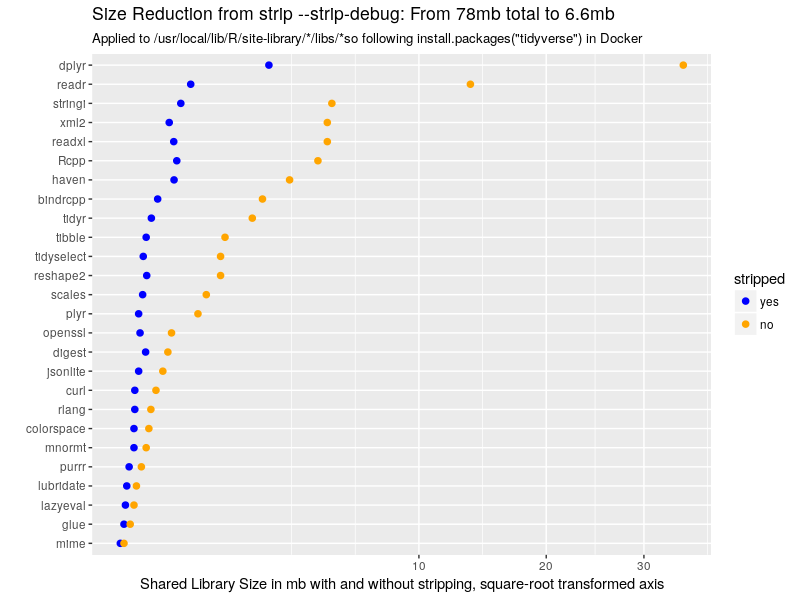
using a double-wildcard to get all packages (in that R package directory) and all their shared libraries. Users on macOS probably want .dylib on the end, users on Windows want another computer as usual (just kidding: use .dll). Either may have to adjust the path which is left as an exercise to the reader. The impact can be Yuge as illustrated in the following dotplot:
This illustration is in response to a mailing list post. Last week, someone claimed on r-help that tidyverse would not install on Ubuntu 17.04. And this is of course patently false as many of us build and test on Ubuntu and related Linux systems, Travis runs on it, CRAN tests them etc pp. That poor user had somehow messed up their default gcc version. Anyway: I fired up a Docker container, installed r-base-core plus three required -dev packages (for xml2, openssl, and curl) and ran a single install.packages("tidyverse"). In a nutshell, following the launch of Docker for an Ubuntu 17.04 container, it was just
$ apt-get update
$ apt-get install r-base libcurl4-openssl-dev libssl-dev libxml2-dev
$ apt-get install mg          # a tiny editor
$ mg /etc/R/Rprofile.site     # to add a default CRAN repo
$ R -e 'install.packages("tidyverse")'
which not only worked (as expected) but also installed a whopping fifty-one packages (!!) of which twenty-six contain a shared library. A useful little trick is to run du with proper options to total, summarize, and use human units which reveals that these libraries occupy seventy-eight megabytes:
root@de443801b3fc:/# du -csh /usr/local/lib/R/site-library/*/libs/*so
4.3M    /usr/local/lib/R/site-library/Rcpp/libs/Rcpp.so
2.3M    /usr/local/lib/R/site-library/bindrcpp/libs/bindrcpp.so
144K    /usr/local/lib/R/site-library/colorspace/libs/colorspace.so
204K    /usr/local/lib/R/site-library/curl/libs/curl.so
328K    /usr/local/lib/R/site-library/digest/libs/digest.so
33M     /usr/local/lib/R/site-library/dplyr/libs/dplyr.so
36K     /usr/local/lib/R/site-library/glue/libs/glue.so
3.2M    /usr/local/lib/R/site-library/haven/libs/haven.so
272K    /usr/local/lib/R/site-library/jsonlite/libs/jsonlite.so
52K     /usr/local/lib/R/site-library/lazyeval/libs/lazyeval.so
64K     /usr/local/lib/R/site-library/lubridate/libs/lubridate.so
16K     /usr/local/lib/R/site-library/mime/libs/mime.so
124K    /usr/local/lib/R/site-library/mnormt/libs/mnormt.so
372K    /usr/local/lib/R/site-library/openssl/libs/openssl.so
772K    /usr/local/lib/R/site-library/plyr/libs/plyr.so
92K     /usr/local/lib/R/site-library/purrr/libs/purrr.so
13M     /usr/local/lib/R/site-library/readr/libs/readr.so
4.7M    /usr/local/lib/R/site-library/readxl/libs/readxl.so
1.2M    /usr/local/lib/R/site-library/reshape2/libs/reshape2.so
160K    /usr/local/lib/R/site-library/rlang/libs/rlang.so
928K    /usr/local/lib/R/site-library/scales/libs/scales.so
4.9M    /usr/local/lib/R/site-library/stringi/libs/stringi.so
1.3M    /usr/local/lib/R/site-library/tibble/libs/tibble.so
2.0M    /usr/local/lib/R/site-library/tidyr/libs/tidyr.so
1.2M    /usr/local/lib/R/site-library/tidyselect/libs/tidyselect.so
4.7M    /usr/local/lib/R/site-library/xml2/libs/xml2.so
78M     total
root@de443801b3fc:/# 
Looks like dplyr wins this one at thirty-three megabytes just for its shared library. But with a single stroke of strip we can reduce all this down a lot:
root@de443801b3fc:/# strip --strip-debug /usr/local/lib/R/site-library/*/libs/*so
root@de443801b3fc:/# du -csh /usr/local/lib/R/site-library/*/libs/*so
440K    /usr/local/lib/R/site-library/Rcpp/libs/Rcpp.so
220K    /usr/local/lib/R/site-library/bindrcpp/libs/bindrcpp.so
52K     /usr/local/lib/R/site-library/colorspace/libs/colorspace.so
56K     /usr/local/lib/R/site-library/curl/libs/curl.so
120K    /usr/local/lib/R/site-library/digest/libs/digest.so
2.5M    /usr/local/lib/R/site-library/dplyr/libs/dplyr.so
16K     /usr/local/lib/R/site-library/glue/libs/glue.so
404K    /usr/local/lib/R/site-library/haven/libs/haven.so
76K     /usr/local/lib/R/site-library/jsonlite/libs/jsonlite.so
20K     /usr/local/lib/R/site-library/lazyeval/libs/lazyeval.so
24K     /usr/local/lib/R/site-library/lubridate/libs/lubridate.so
8.0K    /usr/local/lib/R/site-library/mime/libs/mime.so
52K     /usr/local/lib/R/site-library/mnormt/libs/mnormt.so
84K     /usr/local/lib/R/site-library/openssl/libs/openssl.so
76K     /usr/local/lib/R/site-library/plyr/libs/plyr.so
32K     /usr/local/lib/R/site-library/purrr/libs/purrr.so
648K    /usr/local/lib/R/site-library/readr/libs/readr.so
400K    /usr/local/lib/R/site-library/readxl/libs/readxl.so
128K    /usr/local/lib/R/site-library/reshape2/libs/reshape2.so
56K     /usr/local/lib/R/site-library/rlang/libs/rlang.so
100K    /usr/local/lib/R/site-library/scales/libs/scales.so
496K    /usr/local/lib/R/site-library/stringi/libs/stringi.so
124K    /usr/local/lib/R/site-library/tibble/libs/tibble.so
164K    /usr/local/lib/R/site-library/tidyr/libs/tidyr.so
104K    /usr/local/lib/R/site-library/tidyselect/libs/tidyselect.so
344K    /usr/local/lib/R/site-library/xml2/libs/xml2.so
6.6M    total
root@de443801b3fc:/#
Down to six point six megabytes. Not bad for one command. The chart visualizes the respective reductions. Clearly, C++ packages (and their template use) lead to more debugging symbols than plain old C code. But once stripped, the size differences are not that large. And just to be plain, what we showed previously in post #9 does the same, only already at installation stage. The effects are not cumulative.

This post by Dirk Eddelbuettel originated on his Thinking inside the box blog. Please report excessive re-aggregation in third-party for-profit settings.

17 August 2017

Reproducible builds folks: Reproducible Builds: Weekly report #120

Here's what happened in the Reproducible Builds effort between Sunday 6th and Saturday 12th August 2017: Notes about reviews of unreproducible packages 13 package reviews have been added, 7 have been updated and 34 have been removed in this week, adding to our knowledge about identified issues. Packages reviewed and fixed, and reproducibility related bugs filed Upstream packages: Other bugs filed diffoscope development trydiffoscope development tests.reproducible-builds.org Misc. This week's edition was written by Chris Lamb & Holger Levsen & reviewed by a bunch of Reproducible Builds folks on IRC & the mailing lists.

12 August 2017

Steve Kemp: A day in the life of Steve

I used to think I was a programmer who did "sysadmin-stuff". Nowadays I interact with too many real programmers to believe that. Or rather I can code/program/develop, but I'm not often as good as I could be. These days I'm getting more consistent with writing tests, and I like it when things are thoroughly planned and developed. But too often if I'm busy, or distracted, I think to myself "Hrm .. compiles? Probably done. Oops. Bug, you say?" I was going to write about working with golang today. The go language is minimal and quite neat. I like the toolset: Instead I think today I'm going to write about something else. Since having a child a lot of my life is different. Routine becomes something that is essential, as is planning and scheduling. So an average week-day goes something like this: In short I'm responsible for Oiva from 6ish-8ish in the morning, then from 6PM-10PM (with a little break while he's put to bed.) There are some exceptions to this routine - for example I work from home on Monday/Friday afternoons, and Monday evenings he goes to his swimming classes. But most working-days are the same. Weekends are a bit different. There I tend to take him 6AM-8AM, then 1PM-10PM with a few breaks for tea, and bed. At the moment we're starting to reach the peak-party time of year, which means weekends often involve negotiation(s) about which parent is having a party, and which parent is either leaving early, or not going out at all. Today I have him all day, and it's awesome. He's just learned to say "Daddy" which makes any stress, angst or unpleasantness utterly worthwhile.

8 August 2017

Jonathan Dowland: libraries

Cover for The Rise Of The Meritocracy Cover for The Rise Of The Meritocracy
At some point during my Undergraduate years I lost the habit of using Libraries. On reflection this is probably Amazon's fault. In recent years I've tried to get back into the habit of using them. Using libraries is a great idea if you are trying to lead a more minimalist life. I am registered to use Libraries in two counties: North Tyneside, where I live, and Newcastle, where I work. The union of the two counties' catalogues is pretty extensive. Perhaps surprisingly I have found North Tyneside to offer both better customer service and a more interesting selection of books. Sometimes there are still things that are hard to get ahold of. After listening to BBC Radio 4's documentary The Rise and Fall of Meritocracy, presented by Toby Young, I became interested in reading The Rise of the Meritocracy: an alarmist, speculative essay that coined the term meritocracy, written by Toby's father, Michael Young. The book was not on either catalogue. It is out of print, with the price of second hand copies fluctuating but generally higher than I am prepared to pay. I finally managed to find a copy in Newcastle University's Library. As an associate of the School of Computing I have access to the Library services. It's an interesting read, and I think if it were framed more as a novel than as an essay it might be remembered in the same bracket as Brave New World or 1984.

2 August 2017

Jonathan Dowland: Debian on the Raspberry Pi3

Back in November, Michael Stapelberg blogged about running (pure) Debian on the Raspberry Pi 3. This is pretty exciting because Raspbian still provide 32 bit packages, so this means you can run a true ARM64 OS on the Pi. Unfortunately, one of the major missing pieces with Debian on the Pi3 at this time is broken video support. A helpful person known as "SandPox" wrote to me in June to explain that they had working video for a custom kernel build on top of pure Debian on the Pi, and they achieved this simply by enabling CONFIG_FB_SIMPLE in the kernel configuration. On request, this has since been enabled for official Debian kernel builds. Michael and I explored this and eventually figured out that this does work when building the kernel using the upstream build instructions, but it doesn't work when building using the Debian kernel package's build instructions. I've since ran out of time to look at this more, so I wrote to request help from the debian-kernel mailing list, alas, nobody has replied yet. I've put up the dmesg.txt for a boot with the failing kernel, which might offer some clues. Can anyone help figure out what's wrong? Thanks to Michael for driving efforts for Debian on the Pi, and to SandPox for getting in touch to make their first contribution to Debian. Thanks also to Daniel Silverstone who loaned me an ARM64 VM (from Scaleway) upon which I performed some of my kernel builds.

1 August 2017

Thorsten Alteholz: My Debian Activities in July 2017

FTP assistant This month I am back to normal numbers and accepted 319 packages. I also kept the promise from last month and rejected 26 uploads. Debian LTS This was my thirty-seventh month that I did some work for the Debian LTS initiative, started by Raphael Hertzog at Freexian. This month my all in all workload went up to 23.5h. During that time I did LTS uploads of: I could also remove libtorrent-rasterbar and pspp from dla-needed.txt as the affected code was not in the Wheezy version or it was just a simple bug. Last but not least I also had a few days of frontdesk duties. Other stuff This month I uploaded a new version of entropybroker with a revised set of systemd service files. At the moment there is public instance of entropybroker running at eb.debian.net. Its entropy is fed by several Entropy Keys made by Simtec Electronics. Though it is public, it is not yet anonymous, so if you need some entropy please drop me a line. At the moment there are two consumers, but the buffers are still filled. I also uploaded several new packages, orcania, yder, hoel and ulfius. If everything works as expected, there will be soon an oauth2 server available in Debian. Last but not least my DOPOM of this month has been ptunnel.

Russell Coker: QEMU for ARM Processes

I m currently doing some embedded work on ARM systems. Having a virtual ARM environment is of course helpful. For the i586 class embedded systems that I run it s very easy to setup a virtual environment, I just have a chroot run from systemd-nspawn with the --personality=x86 option. I run it on my laptop for my own development and on a server my client owns so that they can deal with the hit by a bus scenario. I also occasionally run KVM virtual machines to test the boot image of i586 embedded systems (they use GRUB etc and are just like any other 32bit Intel system). ARM systems have a different boot setup, there is a uBoot loader that is fairly tightly coupled with the kernel. ARM systems also tend to have more unusual hardware choices. While the i586 embedded systems I support turned out to work well with standard Debian kernels (even though the reference OS for the hardware has a custom kernel) the ARM systems need a special kernel. I spent a reasonable amount of time playing with QEMU and was unable to make it boot from a uBoot ARM image. The Google searches I performed didn t turn up anything that helped me. If anyone has good references for getting QEMU to work for an ARM system image on an AMD64 platform then please let me know in the comments. While I am currently surviving without that facility it would be a handy thing to have if it was relatively easy to do (my client isn t going to pay me to spend a week working on this and I m not inclined to devote that much of my hobby time to it). QEMU for Process Emulation I ve given up on emulating an entire system and now I m using a chroot environment with systemd-nspawn. The package qemu-user-static has staticly linked programs for emulating various CPUs on a per-process basis. You can run this as /usr/bin/qemu-arm-static ./staticly-linked-arm-program . The Debian package qemu-user-static uses the binfmt_misc support in the kernel to automatically run /usr/bin/qemu-arm-static when an ARM binary is executed. So if you have copied the image of an ARM system to /chroot/arm you can run the following commands like the following to enter the chroot: cp /usr/bin/qemu-arm-static /chroot/arm/usr/bin/qemu-arm-static
chroot /chroot/arm bin/bash Then you can create a full virtual environment with /usr/bin/systemd-nspawn -D /chroot/arm if you have systemd-container installed. Selecting the CPU Type There is a huge range of ARM CPUs with different capabilities. How this compares to the range of x86 and AMD64 CPUs depends on how you are counting (the i5 system I m using now has 76 CPU capability flags). The default CPU type for qemu-arm-static is armv7l and I need to emulate a system with a armv5tejl. Setting the environment variable QEMU_CPU=pxa250 gives me armv5tel emulation. The ARM Architecture Wikipedia page [2] says that in armv5tejl the T stands for Thumb instructions (which I don t think Debian uses), the E stands for DSP enhancements (which probably isn t relevant for me as I m only doing integer maths), the J stands for supporting special Java instructions (which I definitely don t need) and I m still trying to work out what L means (comments appreciated). So it seems clear that the armv5tel emulation provided by QEMU_CPU=pxa250 will do everything I need for building and testing ARM embedded software. The issue is how to enable it. For a user shell I can just put export QEMU_CPU=pxa250 in .login or something, but I want to emulate an entire system (cron jobs, ssh logins, etc). I ve filed Debian bug #870329 requesting a configuration file for this [1]. If I put such a configuration file in the chroot everything would work as desired. To get things working in the meantime I wrote the below wrapper for /usr/bin/qemu-arm-static that calls /usr/bin/qemu-arm-static.orig (the renamed version of the original program). It s ugly (I would use a config file if I needed to support more than one type of CPU) but it works. #include <stdio.h>
#include <unistd.h>
#include <stdlib.h> int main(int argc, char **argv)

if(setenv("QEMU_CPU", "pxa250", 1))

printf("Can't set $QEMU_CPU\n");
return 1;

execv("/usr/bin/qemu-arm-static.orig", argv);
printf("Can't execute \"%s\" because of qemu failure\n", argv[0]);
return 1;

31 July 2017

Russell Coker: Running a Tor Relay

I previously wrote about running my SE Linux Play Machine over Tor [1] which involved configuring ssh to use Tor. Since then I have installed a Tor hidden service for ssh on many systems I run for clients. The reason is that it is fairly common for them to allow a server to get a new IP address by DHCP or accidentally set their firewall to deny inbound connections. Without some sort of VPN this results in difficult phone calls talking non-technical people through the process of setting up a tunnel or discovering an IP address. While I can run my own VPN for them I don t want their infrastructure tied to mine and they don t want to pay for a 3rd party VPN service. Tor provides a free VPN service and works really well for this purpose. As I believe in giving back to the community I decided to run my own Tor relay. I have no plans to ever run a Tor Exit Node because that involves more legal problems than I am willing or able to deal with. A good overview of how Tor works is the EFF page about it [2]. The main point of a Middle Relay (or just Relay ) is that it only sends and receives encrypted data from other systems. As the Relay software (and the sysadmin if they choose to examine traffic) only sees encrypted data without any knowledge of the source or final destination the legal risk is negligible. Running a Tor relay is quite easy to do. The Tor project has a document on running relays [3], which basically involves changing 4 lines in the torrc file and restarting Tor. If you are running on Debian you should install the package tor-geoipdb to allow Tor to determine where connections come from (and to not whinge in the log files). ORPort [IPV6ADDR]:9001 If you want to use IPv6 then you need a line like the above with IPV6ADDR replaced by the address you want to use. Currently Tor only supports IPv6 for connections between Tor servers and only for the data transfer not the directory services. Data Transfer I currently have 2 systems running as Tor relays, both of them are well connected in a European DC and they are each transferring about 10GB of data per day which isn t a lot by server standards. I don t know if there is a sufficient number of relays around the world that the share of the load is small or if there is some geographic dispersion algorithm which determined that there are too many relays in operation in that region.

29 July 2017

Antoine Beaupr : My free software activities, July 2017

Debian Long Term Support (LTS) This is my monthly working on Debian LTS. This time I worked on various hairy issues surrounding ca-certificates, unattended-upgrades, apache2 regressions, libmtp, tcpdump and ipsec-tools.

ca-certificates updates I've been working on the removal of the Wosign and StartCom certificates (Debian bug #858539) and, in general, the synchronisation of ca-certificates across suites (Debian bug #867461) since at least last march. I have made an attempt at summarizing the issue which led to a productive discussion and it seems that, in the end, the maintainer will take care of synchronizing information across suites. Guido was right in again raising the question of synchronizing NSS across all suites (Debian bug #824872) which itself raised the other question of how to test reverse dependencies. This brings me back to Debian bug #817286 which, basically proposed the idea of having "proposed updates" for security issues. The problem is while we can upload test packages to stable proposed-updates, we can't do the same in LTS because the suite is closed and we operate only on security packages. This issue came up before in other security upload and we need to think better about how to solve this.

unattended-upgrades Speaking of security upgrades brings me to the question of a bug (Debian bug #867169) that was filed against the wheezy version of unattended-upgrades, which showed that the package simply stopped working since the latest stable release, because wheezy became "oldoldstable". I first suggested using the "codename" but that appears to have been introduced only after wheezy. In the end, I proposed a simple update that would fix the configuration files and uploaded this as DLA-1032-1. This is thankfully fixed in later releases and will not require such hackery when jessie becomes LTS as well.

libmtp Next up is the work on the libmtp vulnerabilities (CVE-2017-9831 and CVE-2017-9832). As I described in my announcement, the work to backport the patch was huge, as upstream basically backported a whole library from the gphoto2 package to fix those issues (and probably many more). The lack of a test suite made it difficult to trust my own work, but given that I had no (negative) feedback, I figured it was okay to simply upload the result and that became DLA-1029-1.

tcpdump I then looked at reproducing CVE-2017-11108, a heap overflow triggered tcpdump would parse specifically STP packets. In Debian bug #867718, I described how to reproduce the issue across all suites and opened an issue upstream, given that the upstream maintainers hadn't responded responded in weeks according to notes in the RedHat Bugzilla issue. I eventually worked on a patch which I shared upstream, but that was rejected as they were already working on it in their embargoed repository. I can explain this confusion and duplication of work with:
  1. the original submitter didn't really contact security@tcpdump.org
  2. he did and they didn't reply, being just too busy
  3. they replied and he didn't relay that information back
I think #2 is most likely: the tcpdump.org folks are probably very busy with tons of reports like this. Still, I should probably have contacted security@tcpdump.org directly before starting my work, even though no harm was done because I didn't divulge issues that were already public. Since then, tcpdump has released 4.9.1 which fixes the issue, but then new CVEs came out that will require more work and probably another release. People looking into this issue must be certain to coordinate with the tcpdump security team before fixing the actual issues.

ipsec-tools Another package that didn't quite have a working solution is the ipsec-tools suite, in which the racoon daemon was vulnerable to a remotely-triggered DOS attack (CVE-2016-10396). I reviewed and fixed the upstream patch which introduced a regression. Unfortunately, there is no test suite or proof of concept to control the results. The reality is that ipsec-tools is really old, and should maybe simply be removed from Debian, in favor of strongswan. Upstream hasn't done a release in years and various distributions have patched up forks of those to keep it alive... I was happy, however, to know that a maintainer will take care of updating the various suites, including LTS, with my improved patch. So this fixes the issue for now, but I would strongly encourage users to switch away from ipsec-tools in the future.

apache2 Finally, I was bitten by the old DLA-841-1 upload I did all the way back in February, as it introduced a regression (Debian bug #858373). It turns out it was possible to segfault Apache workers with a trivial HTTP request, in certain (rather exotic, I might add) configurations (ErrorDocument 400 directive pointing to a cgid script in worker mode). Still, it was a serious regression and I found a part of the nasty long patch we worked on back then that was faulty, and introduced a small fix to correct that. The proposed package unfortunately didn't yield any feedback, and I can only assume it will work okay for people. The result is the DLA-841-2 upload which fixes the regression. I unfortunately didn't have time to work on the remaining CVEs affecting apache2 in LTS at the time of writing.

Triage I also did some miscellaneous triage by filing Debian bug #867477 for poppler in an effort to document better the pending issue. Next up was some minor work on eglibc issues. CVE-2017-8804 has a patch, but it's been disputed. since the main victim of this and the core of the vulnerability (rpcbind) has already been fixed, I am not sure this vulnerability is still a thing in LTS at all. I also looked at CVE-2014-9984, but the code is so different in wheezy that I wonder if LTS is affected at all. Unfortunately, the eglibc gymnastics are a little beyond me and I do not feel confident enough to just push those issues aside for now and let them open for others to look at.

Other free software work And of course, there's my usual monthly volunteer work. My ratio is a little better this time, having reached an about even ratio between paid and volunteer work, whereas this was 60% volunteer work in march.

Announcing ecdysis I recently published ecdysis, a set of template and code samples that I frequently reuse across project. This is probably the least pronounceable project name I have ever chosen, but this is somewhat on purpose. The goal of this project is not collaboration or to become a library: it's just a personal project which I share with the world as a curiosity. To quote the README file:
The name comes from what snakes and other animals do to "create a new snake": they shed their skin. This is not so appropriate for snakes, as it's just a way to rejuvenate their skin, but is especially relevant for anthropods since then "ecdysis" may be associated with a metamorphosis:
Ecdysis is the moulting of the cuticle in many invertebrates of the clade Ecdysozoa. Since the cuticle of these animals typically forms a largely inelastic exoskeleton, it is shed during growth and a new, larger covering is formed. The remnants of the old, empty exoskeleton are called exuviae. Wikipedia
So this project is metamorphosed into others when the documentation templates, code examples and so on are reused elsewhere. For that reason, the license is an unusally liberal (for me) MIT/Expat license. The name also has the nice property of being absolutely unpronounceable, which makes it unlikely to be copied but easy to search online.
It was an interesting exercise to go back into older projects and factor out interesting code. The process is not complete yet, as there are older projects I'm still curious in reviewing. A bunch of that code could also be factored into upstream project and maybe even the Python standard library. In short, this is stuff I keep on forgetting how to do: a proper setup.py config, some fancy argparse extensions and so on. Instead of having to remember where I had written that clever piece of code, I now shove it in the crazy chaotic project where I can find it again in the future.

Beets experiments Since I started using Subsonic (or Libresonic) to manage the music on my phone, album covers are suddenly way more interesting. But my collection so far has had limited album covers: my other media player (gmpc) would download those on the fly on its own and store them in its own database - not on the filesystem. I guess this could be considered to be a limitation of Subsonic, but I actually appreciate the separation of duty here. Garbage in, garbage out: the quality of Subsonic's rendering depends largely on how well setup your library and tags are. It turns out there is an amazing tool called beets to do exactly that kind of stuff. I originally discarded that "media library management system for obsessive-compulsive [OC] music geeks", trying to convince myself i was not an "OC music geek". Turns out I am. Oh well. Thanks to beets, I was able to download album covers for a lot of the albums in my collection. The only covers that are missing now are albums that are not correctly tagged and that beets couldn't automatically fix up. I still need to go through those and fix all those tags, but the first run did an impressive job at getting album covers. Then I got the next crazy idea: after a camping trip where we forgot (again) the lyrics to Georges Brassens, I figured I could start putting some lyrics on my ebook reader. "How hard can that be?" of course, being the start of another crazy project. A pull request and 3 days later, I had something that could turn a beets lyrics database into a Sphinx document which, in turn, can be turned into an ePUB. In the process, I probably got blocked from MusixMatch a hundred times, but it's done. Phew! The resulting e-book is about 8000 pages long, but is still surprisingly responsive. In the process, I also happened to do a partial benchmark of Python's bloom filter libraries. The biggest surprise there was the performance of the set builtin: for small items, it is basically as fast as a bloom filter. Of course, when the item size grows larger, its memory usage explodes, but in this case it turned out to be sufficient and bloom filter completely overkill and confusing. Oh, and thanks to those efforts, I got admitted in the beetbox organization on GitHub! I am not sure what I will do with that newfound power: I was just scratching an itch, really. But hopefully I'll be able to help here and there in the future as well.

Debian package maintenance I did some normal upkeep on a bunch of my packages this month, that were long overdue:
  • uploaded slop 6.3.47-1: major new upstream release
  • uploaded an NMU for maim 5.4.64-1.1: maim was broken by the slop release
  • uploaded pv 1.6.6-1: new upstream release
  • uploaded kedpm 1.0+deb8u1 to jessie (oldstable): one last security fix (Debian bug #860817, CVE-2017-8296) for that derelict password manager
  • uploaded charybdis 3.5.5-1: new minor upstream release, with optional support for mbedtls
  • filed Debian bug #866786 against cryptsetup to make the remote initramfs SSH-based unlocking support multiple devices: thanks to the maintainer, this now works flawlessly in buster and may be backported to stretch
  • expanded on Debian bug #805414 against gdm3 and Debian bug #845938 against pulseaudio, because I had trouble connecting my computer to this new Bluetooth speaker. turns out this is a known issue in Pulseaudio: whereas it releases ALSA devices, it doesn't release Bluetooth devices properly. Documented this more clearly in the wiki page
  • filed Debian bug #866790 regarding old stray Apparmor profiles that were lying around my system after an upgrade, which got me interested in Debian bug #830502 in turn
  • filed Debian bug #868728 against cups regarding a weird behavior I had interacting with a network printer. turns out the other workstation was misconfigured... why are printers still so hard?
  • filed Debian bug #870102 to automate sbuild schroots upgrades
  • after playing around with rash tried to complete the packaging (Debian bug #754972) of percol with this pull request upstream. this ended up to be way too much overhead and I reverted to my old normal history habits.

Next.

Previous.