Search Results: "matthew"

30 August 2008

Steve McIntyre: Been a bit quiet lately

Sorry, ever since Debconf I've been busy, ill and otherwise distracted. I'm still catching up... Stuff that's happened: Dude, you're married! For the second year running, I had to leave Debconf a day early to attend a wedding party. My good friend Matthew married Oxana last Monday. I've just put my photos of the happy event online today. After a successful Debconf where I managed to evade the normal plague, it hit hard on the Tuesday morning and I've been struggling with it ever since. Just about over it now, but I've been feeling crap for over a week. On the way to Buenos Aires to catch my flight back to England, I received a text message telling me the sad news that my uncle, John Bolton had passed away. This means that the eldest two of my mum's three brothers have died this year, in the space of just a few months, and it's been a very hard time for the family. The funeral happened earlier this week, so I was away and mostly off-line for a couple of days travelling there and back. I'm trying to get back up to speed on a whole host of different things at the moment; if you're waiting on a response from me about Debian-related stuff, please feel free to prod me via email or IRC.

29 August 2008

Meike Reichle: Where's Meike?

As September is traditionally the "conference month" I'll be travelling all around Germany within the next weeks. So, inspired by Matthew, here's a short list of events I'll attend in September 2008. If anyone's up for a coffee, keysigning or something let me know!

26 August 2008

Matthew Garrett

Jesus fuck, Dell, why do you have a WMI event interface that seems to do nothing but pass back things that look awfully like keyboard scancodes? I mean, E045? Come on, now.

Driver forthcoming for those who really want the little battery button on their Precision M6300s to work.

24 August 2008

Jonathan McDowell: DebConf8 writeup

I took a note of the various talks I attended at DebConf, with the aim of writing a few notes about each so that I could try to explain to my work mates exactly what I get out of going. However I think a lot of the benefit is about general face to face contact with fellow DDs and random conversations that happen. Having worked from home for over 3 years I'm finding it quite nice to be back in an office with people working on the same things as me; there are conversations that you will have over a quick cup of coffee or in the corridor that you wouldn't bother typing on IRC or email or picking up the phone for. Debian is a lot like a large organisation full of telecommuters and DebConf provides a vital opportunity for us to have those "minor" conversations that prove quite useful and to remind each other what we're actually like in person. I didn't end up writing a lot of notes during the talks so these are just snippets after the fact. If I'd been more organised I'd have done a write up on a daily basis rather than leaving it all until the week after. A lot of the below is fragmented thoughts, but the longer I leave it the less relevant it gets and the more chance I forget something. It'd have been up faster if I hadn't been fighting Movable Type to try and get some sort of headings. Sunday
Introduction, Marga The "Welcome to DebConf" bit. Marga got up and talked about how at DebConf4 (Brazil) she hadn't been a DD and now she was and how it had been a life changing event. She'd thought she was to blame for DebConf8 in Argentina, but trawling mail archives had shown it was originally Mart n's idea. She hadn't realised at the start quite how much work it would be. Steve's DPL talk, Steve McIntyre The DPL welcomes us to DebConf and talks about Debian's achievements, some of the results of his team survey (the teams largely say they need more manpower. Not really a huge surprise.). NM/User Survey BOF, Paul Wise Paul emailed debian-user, debian-newmaint and various other places (I think) asking about people's experiences as a Debian user or applicant to New Maint. His final results aren't yet published and I got the impression a disappointing number of our users had replied. The NM problems these days seem to be largely down to a lack of AMs, at least according to the stats on nm.debian.org. Meet SPI board - bdale, maulkin, jimmy, michael, others A chance to meet those of the SPI board who were present. The usual "If you're involved with Debian you should seriously consider joining SPI". Some discussion about the fact that although SPI was originally mostly Debian these days other projects are making more and more use of it - OFTC, PostgreSQL and Madwifi for example. Not a huge amount of new information for me. I've been an SPI member for some time and I think they perform a vital role for Debian. They've had issues in the past but it's really good to see them overcome and more projects on board. Monday
http://hp.com/go/debian, bdale Bdale talks about the history of Debian and HP. And makes the point that HP aren't doing any of this to be "nice"; their primary responsibility is to their shareholders. Not surprising, but it's good that even with that criteria at the fore front Debian ends up a good idea for a large multinational. Managing 666 packages, Mart n Ferrari Mostly centered around the pkg-perl experience and the tools/workflow they have to help manage things. Impressive web tool (DEHS) to help track packages with new upstreams, issues or pending uploads. Quality Assurance in Lenny + 1 I can't remember a lot of this, which is a bit bad. I remember a discussion about whether we should release with orphaned packages, or if they should be removed. The argument for not removing them seemed to revolve around a theory that if they weren't buggy then what was the harm, the argument for was that if they were unmaintained and not really used than how did we actually know they weren't buggy, and was it reasonable that they potentially held up library transitions etc? Bugs in large packages Don Armstrong and ways in which the BTS can help people with lots of bugs. This (thankfully) doesn't affect me, but it was interesting to hear Don talk about his work on the BTS and his various ideas. I was sorry I'd missed his talk on SOAP access to it; I shall have to find time to watch the video. Tuesday
Debian and Ubuntu, Mark Shuttleworth The usual interaction with Debian stuff, including how we interact with our upstreams. If a bug is raised with an Ubuntu package then it might well be appropriate to raise it with Debian and upstream as well, but each set of people should be able to use their own bug reporting systems rather than having to go to a foreign system. I don't think it was actually said, but I guess the idea is that launchpad is the thing that will do this gluing together. He also talked about Ubuntu as an "experiment" rather than a fork of Debian; something that has potentially different ideas about how to do things but that these ideas may lead to things that should be fed back into Debian. The point was made that even if you consider Ubuntu a fork they've forked 9 times now; it hasn't been a case of forking once and diverging wildly since thast point. I have a few thoughts on all the whole Debian/Ubuntu stuff which I should really try to form into something coherant and post. I think it's important to take Mark's talk in the context of bdale's "Shareholders come first" point. Derivatives round table Didn't stay for most of this. Ubuntu, Debian-EDU (which I hadn't realised was a derivative rather than a team within Debian, but apparently there are various things it was much easier for them just to patch now and try to work towards a generic solution later), someone from Extramadura and someone from the Munich government Linux stuff. I'm sure I've missed someone off. tdebs/i18n This was a useful BOF. It helped that we said no to the usual video team requirement that if you want to speak you had to wait for the microphone. This works fine for a normal talk, but really impedes the flow of conversation in something like a BOF. tdebs are something that have partly come from a need of Emdebian to reduce installed package size and partly from the desire of the i18n team to be able to update package translations without having to do a full binary NMU of a package. We had some of the FTP team, the release team, the i18n team and Emdebian there and I think some progress has been made. There'd been various conversations had before this meeting which I think helped people think about the issues and objections so that we had answers by the time we all sat down together - an excellent example of the use of DebConf. DebConf9 C ceres Various bits of discussion about next year's DebConf in Extramadura. Temperature is likely to be an issue for me as they reckon it could easily get up to 40C! I'll melt! Venue sounds good; some queries regarding late night hacklabs and net connections to same, but I'm sure the networking team will sort it all out as usual. ;) DebConf10 bids Venezela and New York were both pitching. Lots of people don't want to travel to the US or think they'll have problems doing so (I hadn't realised there was such an issue for people from South America). I suspect various people will have issues with Venezela as well; I heard expressions of doubt over their political stability expressed. However I'd be happy to go to either (and preferably both! DebConf10 + 12 perhaps?) Speaking of which, what ever happened to the Sarajevo bid? If they're reading, have you considered DebConf11? Wednesday
A day trip to an Argentinian ranch and lunch was an asido. Fantastic food and a pleasant afternoon spent sitting in the sun chatting to people. That evening was the formal, but thanks to having stayed up until after 4 on Tuesday I had to wimp out and go to bed fairly early. Not until I'd seen the DPL dance though. :) Thursday
Internationalization in Debian I forget most of this other than pretty graphs from Christian regarding what's translated and what other languages we might have; e.g. you can consider South America to be covered largely by Spanish and Portuguese, or you can consider it to not be covered very much at all by the local indigenous languages. dh-make-webapp: yeah right! Mainly what I took away from this was "It'll never happen thanks to the fact that every web app author uses a different system" and that more work needs to be done on the web apps best practices document. I don't really do web apps, but having them easily installable on my systems is a good thing so I hope some standardisation within Debian comes from this. Best practises in team-maintaining packages Various team members got up to talk about work flow in their teams. Not unsurprisingly different things seem to work for different people. Predictable PRNG in the Vulnerable Debian OpenSSL Package Lucian giving his Black Hat talk about the OpenSSL issues we faced earlier this year. Some queries about automated testing and that it should have found this, which originally I agreed with until I thought about it - you'd have to have run > 65536 tests and compared all the data to find this; something like the FIPS tests against a single run wouldn't have shown any issues. Lucian wanted feedback on ensuring he was presenting the Debian side of things acceptably as well. Keysigning Run by Don Armstrong. Nothing to really remark except I think key signing attendance is dropping off after things like the Helsinki experience. Also I've now managed to get my new RSA key signed by keys other than my own (and I'll try to get sorted out to sign keys myself soon). Friday
LessWatts Intel's drive towards reducing power usage. Odd to hear such things from someone who wasn't Matthew Garrett and I think I'd heard most of it before. Debian technical policy update Sorry Manoj, I should have been paying more attention. Debian Policy is something I think is important, but I'm not enough of a nitpicker to really feel I can contribute a whole lot. Virtualisation in Debian - Present and future This was depressing. What I took away was "We had 2 forms of virtualisation in etch (Xen + vserver) and we're supporting neither for Lenny". As someone running a Xen machine this is problematic. The host does have the hardware support that would allow kvm, but I'm worried about smooth migration (it's a colo box). There was some mention of Xenner, which isn't packaged for Debian. I took a look at doing so but there are some worrying items in the TODO list (like, oh, locking to enable reliable SMP) and I've spectacularly failed to get it compiling so far. I should have another go. Emdebian update Neil Williams about where Emdebian is and waved his Balloon3 about. Some interest from the Openmoko guys and discussion about why it might be better than OpenEmbedded. And equally what it couldn't do that OpenEmbedded can manage (mainly very small installs; a minimal Emdebian install is 24MB+ and with X that goes up to 75MB+ I believe). netconf I'd never actually seen Martin talk about netconf before. Am impressive flow of control diagram. It all sounds quite complex for little benefit at present, but if he pulls it off then I can see it being a much more flexible replacement for the likes of Network Manager. Saturday
Lenny - The Road To Release Neil played with putting the heads of the release team on random images. And tried to tell us all how to behave during the release process in terms of what should and shouldn't be uploaded etc. Most of it is just common sense, but apparently everything he talked about he'd experienced. Also pointed out we were supposed to release in 3 weeks and didn't even have the appropriate kernel in testing yet so it's probably not going to happen. Colour me surprised. Sustainable Computing Low power consumption/affordable computing. Interesting points about the OLPC being used in the middle of nowhere with no chance of an Internet connection being close by compared to neighbours in large cities where people can't necessarily afford top of the line computers or individual connections - in this sort of scenario mesh networking is really viable in terms of getting people connected up. Multi winner voting Manoj needs pretty diagrams, probably drawn by Martin Krafft. ;) Semi-interesting discussion about multi-winner voting (e.g. SPI board elections) and how the current Debian voting system is completely tied to Debian's infrastructure eg the LDAP setup. Manoj would like to make it more generic so it could be used by other groups as well as for different sorts of votes in Debian.

18 August 2008

Ross Burton: Sound Juicer "I Don't Know What You Heard But It's Mandatory" 2.23.2

Sound Juicer "I Don't Know What You Heard But It's Mandatory" 2.23.2 has been released. Tarballs are available on burtonini.com, or from the GNOME FTP servers. Lots of fixes from the Amazing Matthew Martin:

14 August 2008

Daniel Stone: ryan farmer is a spammer

Unfortunately, Matthew is correct, and it seems that Ryan Farmer is the idiot that signed a few of us up to about 200 mailing lists this morning. Not only do I trust Matthew's analysis (and was watching him go through the various steps on IRC as it happened), but then there were two other bits.
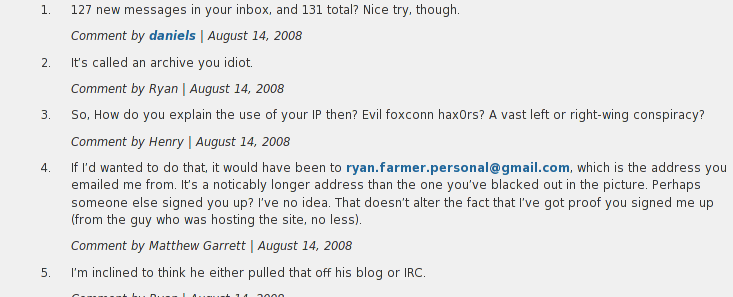
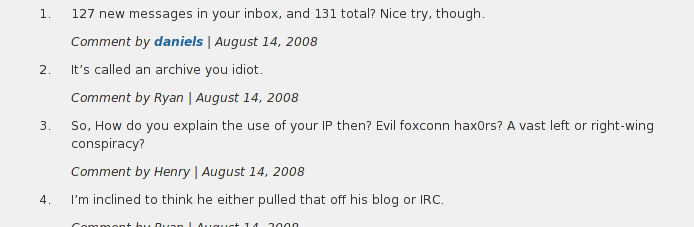
Ryan refused to approve two of my comments I made on his latest blog entry (more than happy to screenshot this). He claimed he too had been spammed, and had to abandon his email address of a few years. Even if you ignore the length of the text blanked out in the title bar not even remotely matching the length of his personal email address, there were only 131 messages in the inbox, of which 127 were unread, and no others but spam visible. He claimed they were archived; I offered to publicly apologise if he'd do a quick screencast showing him logging into that account and showing some messages from the archive to prove the point. Unfortunately he didn't bother approving these comments. (Incidentally, if you had to 'abandon' an email address due to an avalance of newsletters, et al, which took an hour or two to fully unsubscribe from, would you still bother blacking out the address everywhere?)

As per his standard 'insult everyone with random images from the internet and YouTube videos, then wildly claim conspiracies against him' policy, he went on to claim Matthew was conspiring against him, but given the choice between Matthew conspiring and severely irritating a few of his friends in the process, and some scorned 16-year old continuing his track record of acting like an irrational, immature idiot, I know which one I'd pick.

It takes some skill to be banned from all the Ubuntu IRC channels and the Ubuntu forums both, but I guess this morning showed that was completely justified. Apologies to everyone waiting on the announcement of sponsorship for XDS, as well as hotels, but unfortunately some people just can't conceive of having better things to do than acting like chavs. Hopefully IzanbardPrince/TheAlmightyCthulu/etc goes back to impersonating Kevin Carmony, flaming the bejesus out of companies using BIOSes which trip Linux bugs, and other, equally productive, uses of his time.

Matthew Garrett

What amuses me about complaints about censorship is that they often seem to be associated with, uhm, censorship. Compare and contrast:


Bored now.

Matthew Garrett: Things I have learned in the past 24 hours

Edited to add:

07-08-2008 03:25:56 -!- AlmightyCthulhu!n=Almighty@c-68-57-223-4.hsd1.in.comcast.net has joined #ubuntu-kernel

$ host c-68-57-223-4.hsd1.in.comcast.net
c-68-57-223-4.hsd1.in.comcast.net has address 68.57.223.4

Just in case anyone thought I was being unfair here.

13 August 2008

Matthew Garrett

To the lovely person who subscribed me to around 200 mailing lists this evening:

I will find you.

6 August 2008

Matthew Garrett

Testing 2.6.27-rc2 with the current released (not development) BIOS on the Foxconn G33M reveals the following:Summary: Almost all problems caused by bugs in Linux, one problem caused by BIOS vendors interpreting the ACPI specification differently to the Linux implementation and trivially worked around. No sabotage.

Thanks very much to Carl at Foxconn for being able to get me information about what was causing the reboot issue - I spent significantly longer putting the system together than I did fixing it.

4 August 2008

Ross Burton: Sound Juicer "We're Singing In Tune But Now It's Over" 2.23.1

Sound Juicer "We're Singing In Tune But Now It's Over" 2.23.1 has been released. Tarballs are available on burtonini.com, or from the GNOME FTP servers. Nothing that amazing here, sorry:

1 August 2008

Matthew Garrett

Coincidentally, I had the opportunity to poke at a machine that actually does deliberately treat Linux differently in its ACPI tables today. Jeremy was poking at an Acer Aspire One before installing Fedora on it, and Dave noticed that it printing a bootup message indicating that the firmware was testing for _OSI("Linux"). A bit of poking later, and we have the following:
            If (_OSI ("Linux"))
             
                Store (0x03E8, OSYS)
                Store (0x0A, \_SB.PCI0.LPC.S4TM)
                Store (0x43, \_SB.PCI0.EXP2.PXS2.LSMP)
                Store (One, \_SB.PCI0.EXP2.LL0S)
                Store (One, \_SB.PCI0.EXP2.LLL1)
             
            Else
             
                If (_OSI ("Windows 2006"))
                 
                    Store (0x07D6, OSYS)
                    Store (0x06, \_SB.PCI0.LPC.S4TM)
                    Store (Zero, \_SB.PCI0.EXP2.PXS2.LSMP)
                    Store (Zero, \_SB.PCI0.EXP2.LL0S)
                    Store (Zero, \_SB.PCI0.EXP2.LLL1)
                 
Other OSes get the same values as Linux, other than the OSYS field. Now, what do these writes do? They're all to PCI config space, so since the machine in question is a 945/ICH7 machine we have publically available docs. A bit of digging later and it shows that the firmware is disabling PCIE active state link control and programming more conservative timings for entry into the C4 processor idle power saving state. In other words, certain bits of power management functionality are compromised if it detects that it's running anything other than Vista. Weirdly, it also flags the HPET as present but invisible on Linux, but I suspect that's an oversight rather than anything deliberate.

Why would they do this? I've no idea. I suspect it's something to do with the degree of platform validation performed rather than a subtle attempt to degrade Linux's battery life on the hardware (frankly, we do a good enough job of that ourselves right now), but this is exactly the kind of reason we removed _OSI("Linux") support from the kernel. Vendors will do stupid things with it.

31 July 2008

Matthew Garrett

Various people have asked me why there'd ever be a justification for ACPI tables to base various types of behaviour on the operating system they're running on, and why Linux claims to be Windows. There's pretty straightforward explanations that don't involve conspiracies, but they're not necessarily obvious. Let's start from the beginning.

ACPI provides two mechanisms for determining the OS, _OS and _OSI. _OS is an ACPI object containing a string. This string is supposed to represent the operating system. Windows 98 contained "Microsoft Windows", NT4 "Microsoft Windows NT" and ME "Microsoft WindowsME: Millennium Edition". All later versions of Windows contain "Microsoft Windows NT". Linux was "Linux" up until 2.6.9, and has been "Microsoft Windows NT" since then.

The obvious drawback to _OS is that it's a single string. _OSI was introduced with later versions of ACPI, providing an interface for ACPI tables to request which interfaces an OS supported. Interfaces may be something like "3.0 Thermal Model", indicating support for a specific aspect of ACPI, but may also be used to indicate the interfaces supported by the OS. The _OSI method is passed a string and returns either true or false depending on whether the OS claims to support that interface. The OS can therefore claim to support many different interfaces. Linux implements pretty much every aspect of ACPI that Windows does, and so claims to support all the interfaces that Windows implements. As a result, Linux will return true when asked if it implements support for any of the Windows interfaces (up to and including Vista).

That's all straightforward enough, but leaves two questions. The first is why Linux now claims "Microsoft Windows NT" for _OS. That's actually pretty simple - some DSDTs only check for various _OSI strings if _OS is "Microsoft Windows NT". This is stupid of them, but not a violation of the ACPI spec. The second is why Linux returns false for _OSI("Linux"). This is a little more subtle, but it basically boils down to "There is no Linux interface". The behaviour of Linux changes over time. We make no guarantees that its behaviour will be consistent over time as we find and fix bugs. Microsoft take a different approach. Their ACPI behaviour has few changes over time. Something claiming to be Windows 2000 will always behave the same way. We can't even bump the interface string per release - doing so would require us to maintain every broken behaviour we've ever implemented and switch between them depending on what the BIOS asked us for. Linux does not provide a stable ACPI API to platform firmware, and we make no guarantees that it ever will. The only behaviour you can depend on is that Linux will conform to either the ACPI spec or (where it differs) the behaviour of Windows. If you find behaviour that does not fall into either of those categories, then it's likely that the behaviour will change when we notice. The reason we removed Linux from the supported interfaces list in 2.6.24 was that we were beginning to see BIOSes that changed behaviour when they detected that they were running on Linux, and changes we wanted to make could have potentially broken these BIOSes.

Anyway. That's why we claim to be Windows. Now, why would a DSDT want to do anything with that information? It should be noted that making decisions based on this is not a contravention of the ACPI spec - section 5.7.2 even describes a case of this. There are a few situations under which this can be helpful. The first is due to varying interpretations of the spec. Early versions of Windows require that hotswap bays signal their removal by sending a bus check notification to the parent IDE bus. Later versions want a device check notification on the device itself. Both are valid, but you ideally want to use the right one on the corresponding OS. Checking the OS version lets you do so.


Red Stripe makes a lousy spec-compliant ACPI implementation. That is because it is not a spec-compliant ACPI implementation, it is beer! Hooray beer!

Another is user experience. Not all hardware is supported by all operating systems. For instance, older versions of Windows don't support high-precision event timers (HPET). The HPET is defined as an ACPI device, and so will show up as an unknown device in the Windows device manager unless the firmware disables it. This is acheived by altering a flag in the _STA response depending on the Windows version - earlier versions are told that the device should be invisible, and later versions are told that it should be exposed. Finally, there's bug workarounds. An example of this is Windows 98 crashing if a thermal zone reports a temperature of less than 15.8 degrees celsius. Working around that seems like a perfectly reasonable thing for a piece of hardware to do, since Microsoft don't make it easy for vendors to provide hotpatched versions of Windows.

The final part of this mystery is why various BIOSes attempt to check whether they're running on Linux. Almost all the BIOSes I've examined do nothing with this information, which is consistent with someone writing an OS lookup table many years ago and adding Linux just in case someone found it useful. People don't generally write ACPI tables from scratch (doing so would be very dull), so they'll base it on the one from a previous version. Code won't be removed unless it's breaking things, so you'll end up with various odd evolutionary dead ends that have persisted anyway. If your ACPI firmware checks for Linux, this is not inherently a bug in your BIOS. It's more likely that nobody cared enough to remove two lines of code that might turn out to be useful one day.

30 July 2008

Matthew Garrett

The Linux Plumbers Call for Papers is open for another day or so. It's looking like we'll have an excellent spread of interesting power management topics, but if you've got anything interesting to say then throw it forward. We're looking for kernel issues that have an impact on userspace, userspace issues that need kernel support and anything else that involves the interesting interactions between the two.


Hats for everyone and cab it to the Gold Club

San Francisco has been somewhat hectic, but yesterday included a quick trip to the office to discuss community involvement in improving power management. Look forward to developments there. Independently, I now join Brian the guy who had been clean too long to get onto the drugs rehab program (hurrah voicemail) in being an ex-owner of my US phone number. Probably best to delete it if you have it.

In other news, Foxconn are sending me a board with the "controversial" AMI BIOS in order to figure out what's going on. Progress by this time next week, with luck.

27 July 2008

Matthew Garrett

FOR THE LOVE OF CHRIST T-MOBILE WHY ARE YOU TRIGGERING VOICEMAIL NOTIFICATIONS AT THE RATE OF ONE EVERY FIVE MINUTES WHEN I AM UNABLE TO EVEN ACCESS MY VOICEMAIL I AM GOING TO BURN YOU TO THE GROUND

Matthew Garrett

The Farm Cafe - baked brie with fruit sauce followed by goat cheese ravioli, accompanied by an excellent range of beers. The assault on dessert was abandoned after the realisation that emergency dessert capacity had been pressed into service as backup cheese repository.

I'd forgotten that I liked Portland.

26 July 2008

Matthew Garrett: Further Foxconn fun

Ryan kindly sent me a copy of the ACPI tables for his motherboard, so I've had the opportunity to look at them in a little more detail. There's nothing especially surprising. The first method of interest is OSFL, which I've annotated below:
   Method (OSFL, 0, NotSerialized)
     
        If (LNotEqual (OSVR, Ones))
         
            Return (OSVR)
         
This block simply skips the checks if they've already been evaluated and returns the cached value
        If (LEqual (PICM, Zero))
         
            Store (0xAC, DBG8)
         
If the programmable interrupt controller has been set up in PIC mode rather than APIC mode, 0xAC is written to i/o port 0x80. This would then show up on a plug-in card if one were attached. Simply debug code
        Store (One, OSVR)
Set OSVR to 1, which in this case clearly means "Unknown OS"
        If (CondRefOf (_OSI, Local1))
This checks whether the OS supports the _OSI method. If it does, the following block is executed. If not, the older _OS method is used to detect the OS
         
            If (_OSI ("Windows 2000"))
             
                Store (0x04, OSVR)
             
Newer versions of Windows will also claim to support the interfaces defined in older versions, so this set of checks is done in release order
            If (_OSI ("Windows 2001"))
             
                Store (Zero, OSVR)
             
            If (_OSI ("Windows 2001 SP1"))
             
                Store (Zero, OSVR)
             
            If (_OSI ("Windows 2001 SP2"))
             
                Store (Zero, OSVR)
             
            If (_OSI ("Windows 2001.1"))
             
                Store (Zero, OSVR)
             
            If (_OSI ("Windows 2001.1 SP1"))
             
                Store (Zero, OSVR)
             
            If (_OSI ("Windows 2006"))
             
                Store (Zero, OSVR)
             
If we've got this far, OSVR is now set to 0. Linux will claim to support all of these interfaces, and so OSVR should be 0 on Linux systems. Note that there is no _OSI check for Linux - the 2.6.24 change to remove Linux from the set of claimed interfaces is therefore irrelevant
         
        Else
         
Linux supports _OSI, so we should never be here. But if we somehow are...
            If (MCTH (_OS, "Microsoft Windows NT"))
             
                Store (0x04, OSVR)
             
Linux has responded to _OS with "Microsoft Windows NT" since 2.6.9. MCTH is simply a string matching routine defined elsewhere in the DSDT. So, worst case here is that OSVR is 4
            Else
             
                If (MCTH (_OS, "Microsoft WindowsME: Millennium Edition"))
                 
                    Store (0x02, OSVR)
                 
                If (MCTH (_OS, "Linux"))
                 
                    Store (0x03, OSVR)
                 
..because this could never be true unless you're running 2.6.8.1 or earlier. But even so, getting here would still indicate failure - we've supported _OSI since before then, and so should never come anywhere near this code block.
             
         
        Return (OSVR)
     
In summary, we end up with the following values:
ValueOS
0Windows XP, 2003 or Vista. Linux (assuming absence of bugs)
1Unknown OS
2Windows ME
3A version of Linux that doesn't implement _OSI and is from before 2.6.9
4Windows NT 4 and 2000. A version of Linux that doesn't implement _OSI and is 2.6.9 or later (I don't believe any such version exists

Now, where is this used? The majority of the OSFL checks only check whether the return value is 1 or 2, which will only be true for an OS that (a) doesn't claim to be Windows or (b) is Windows ME. Linux doesn't fall into either of these categories, so we can ignore them. The first interesting hit we have is in the HPET code, where _STA will return 0xf (device present and working) if OSFL is 0 and 0xb (device present and working, but should not be shown in the UI) otherwise. This is just to keep the HPET from showing up in versions of Windows that don't know what it is. The only other interesting hit is the following code from the PCI bus initialisation pathway:
 
                               If (LEqual (OSFL (), Zero))
                                 
                                    Store (0x59, SMIC)
                                 
                                Else
                                 
                                    If (LEqual (OSFL (), 0x04))
                                     
                                        Store (0x5A, SMIC)
                                     
                                    Else
                                     
                                        Store (0x58, SMIC)
                                     
                                 
This writes different values to SMIC (which turns out to be i/o port 0xb2) depending on the OS. 0xb2 is the standard(ish) way to trigger a system management interrupt, which causes the CPU to execute some code from a memory region that can't be accessed by the OS. This isn't that unusual, but it's a little weird. In any case, note that there's no check for whether OSFL is 3 here (which would be true if the _OS call returned Linux), and so Linux is being treated identically to Windows ME and any unknown OS. In reality, Linux will be treated identically to either Vista or 2000. This block provides no evidence of conspiracy. Finally, the OS version flag is written to a region of memory before suspend and read back afterwards. Nothing appears to be done with this information - it's conceivable that the low-level resume code in the BIOS has conditionals based on this, but I suspect that it's just boilerplate code that's ignored.

To summarise:What's the problem, then? I've no idea. The only "significant" issue is that the OEMB table provided by the BIOS has an incorrect checksum. Given that the OEMB table is never used by Linux (it's a vendor extension of some kind, with the best hint I've been able to find being that it can be used to pass information from the BIOS to the OS - kind of like the rest of ACPI, then...), this is pretty unimportant. And given that the OEMB table isn't part of the ACPI spec, it's certainly entirely irrelevant when it comes to determining whether the system is ACPI compliant or not.

Are there ACPI issues with Ryan's system? It sounds like it. The "Error attaching device data" complaints indicate some kind of failure on the part of the kernel to work out how the devices correspond to the ACPI namespace, but I strongly suspect that this is a Linux bug. Failure to reboot after suspend? Could be anything (I'd need direct access to the hardware to figure it out properly), but again it's almost certainly a Linux bug. The standard way Linux reboots systems is to bang the keyboard controller, and it's conceivable that something we're doing on resume is leaving the keyboard controller in a slightly confused state. We're clearly doing something wrong there, given that my Dell comes up without a keyboard about one resume in twenty - I just haven't had time to look into it yet.

The only remaining thing is the mutex handwaving. I've got no clue what's going on there. Ryan's suggested change (from Acquire (MUTE, 0x03E8) to Acquire (MUTE, 0xFFFF)) simply means that the OS will wait forever until it acquires the mutex - in the past it would only wait a second. The reason the compiler generates a warning here is that the firmware never checks whether it acquired the mutex or not! Bumping the timeout to infinity obviously fixes this warning (there's no need to check the return code if you're happy to wait forever rather than failing), but the original code is merely stupid as opposed to a spec violation.

Take home messages? There's no evidence whatsoever that the BIOS is deliberately targeting Linux. There's also no obvious spec violations, but some further investigation would be required to determine for sure whether the runtime errors are due to a Linux bug or a firmware bug. Ryan's modifications should result in precisely no reasonable functional change to the firmware (if it's ever hitting the mutex timeout, something has already gone horribly wrong), and if they do then it's because Linux isn't working as it's intended to. I can't find any way in which the code Foxconn are shipping is worse than any other typical vendor. This entire controversy is entirely unjustified.

Matthew Garrett

As an update to this, it turns out that I can't read and talking about _OSI isn't very helpful when the DSDT in question is calling _OS, but it does leave me somewhat more confused - Linux has claimed to be Windows NT since approximately forever. Without the original DSDT I've got absolutely no clue what's going on, but comments like:

Find and replace all seven occurences of Acquire (MUTE, 0x03E8) and replace with Acquire (MUTE, 0xFFFF), it appears they're trying to crash the kernel by locking a region of memory that shouldn't be locked, but without access to their source code comments, I can only speculate, this tells it to lock a memory address that is always reserved instead. ;)

don't give me a lot of confidence in any of this being a correct diagnosis given that the second argument to Acquire is a timeout and not an address (0x03e8 gives a timeout of a second, while 0xffff is "Block on acquiring this mutex forever").

In any case, it's highly unlikely that this is any attempt by Foxconn to prevent Linux from working. The majority of checks for Linux in ACPI tables are copy and pasted from reference tables that Intel (and other manufacturers) have provided at various points - even the Intel Macs attempt to check for Linux! Most vendors will never attempt to boot Linux on their boards or validate them appropriately, so it's entirely conceivable that they'll end up screwing things up in such a way that the only tested paths are the ones that are run by Windows. This is why we now attempt to ensure that Linux reports itself as Windows. If we're running Linux-specific code in the DSDT, then that's a bug in Linux.

Anyway. Accusing companies of conspiring against us when the most likely explanation is simply that they don't care is a fucking ridiculous thing to do and does nothing to get rid of the impression that Linux users are a bunch of whining childish hatemongers. Next time, try talking to someone who actually understands this stuff first?

25 July 2008

Matthew Garrett

Linux hasn't claimed to be Linux in response to OSI queries since 2.6.24, so this is an interesting sidenote but basically irrelevant.

21 July 2008

Matthew Garrett: The fallacy of the completely inclusive community

Emma Jane Hogbin gave a presentation on the gender gap in free software at Lugradio Live this weekend. One of the central messages was that a great deal of how to avoid putting women off computing can be distilled down to "Don't be a dick". This ties in well with Mako's restatement of the Ubuntu code of conduct as "Be excellent to each other" (a wonderful phrasing which demonstrates that Bill and Ted's Excellent Adventure is the most philosophically worthwhile film that Keanu Reeves has ever appeared in, and certainly not The fucking Matrix) and led to my 5 minute rant on why I hate the Linux community slightly later in the day, but does leave a certain problem. What standards are used to define whether given behaviour is dickish or not? The comments here show that there's disagreement even within a single sub-community of the larger free software world. Ben suggests that the reaction to perceived inappropriate behaviour is perhaps even more discouraging than the original behaviour, suggesting that bitching about things that offend you is dickish behaviour in and of itself. How do we decide whether someone is being a dick or helping the community? Is lack of tolerance a form of exclusionary behaviour?

This topic is actually one of the issues discussed in the Geek Social Fallacies, but here's a nice easy example. Would tolerating planet posts encouraging the eradication of the Jewish population be inclusive or exclusive? I suspect that most people would agree that it wouldn't be acceptable behaviour, which leads us to the next question. Why? There's two obvious arguments here. The first is that at a community level we have some form of rough moral consensus that advocating genocide is Just Wrong, and so criticising Nazis is obviously the right thing to do. The second argument is more pragmatic than philosophical - alienating millions of people in order to avoid alienating hate groups could be considered to reduce our potential contributor base in an unfortunate way.

I'm a fan of the second argument. The example I gave is emotive and relatively recent history has resulted in people tending to be pretty uniform in considering genocide to be a bad thing, but many other cases aren't clear cut. What I consider to be objectification of women is seen by others as appreciation of natural beauty. What I think of as sexist jokes are perceived by others as acceptable humour. When I advocate intolerance of certain behaviour, people are going to see me not having enough tolerance. So we end up in a situation where people make the "We should all just get along and be tolerant of each other" argument, which sounds fine but is fundamentally flawed in one significant way.

Advocating tolerance excludes the intolerant.

The reason people fail to see this is that it doesn't sound like a flaw. If you ask people whether we need to support intolerance, the immediate answer is probably no. But by advocating exclusion of intolerance, you're excluding all those who have good reasons to be intolerant. You're excluding the women who don't want to feel that the community sees them as a pair of breasts attached to some legs. You're excluding the ethnic groups who would prefer to avoid racist slurs or ethnic stereotyping. Telling anti-fascism protestors that they're being intolerant isn't likely to endear you to them. Advocating tolerance is telling the intolerant that they're wrong and should just deal with whatever it is that makes them unhappy.

So, ironically, tolerating certain types of intolerance is probably required in order to avoid alienating many potential contributors. That means some way of deciding what kinds of behaviour are acceptable and which are unacceptable. In the absence of either pre-existing community consensus or some philosophical breakthrough that allows unambiguous determination of the "rightness" of a given action, I'm going to suggest that we look at it from a pragmatic viewpoint. How many potential contributors do we discourage by criticising a certain type of behaviour? How many do we discourage by tolerating it?

The fallacy of the completely inclusive community is the idea that it includes everyone. The reality is that a certain level of social exclusion is required in order to include a wider range of people. So don't criticise people purely for criticising someone else's behaviour - make an argument for why that behaviour benefits the community. And when you see behaviour that you think discourages others, call people on it. Even if nobody's behaviour changes as a result, you're sending a signal that not everyone in the community agrees. Sometimes all people want is to know that there'll be some people on their side.

But, above all, try not to be a dick.

Next.

Previous.