Search Results: "js"

19 August 2016

Zlatan Todori : Defcon24

I went to Defcon24 as Purism representative. It was (as usual) held in Las Vegas, the city of sin. In the same module as with DebConf, here we go with good, bad and ugly. Good Badges are really cool. You can find good hackers here and there (but very small number compared to total number). Some talks are good and workshop + village idea looks good (although I didn't manage to attend any workshop as there was place for 1100 and there were 22000 attendees). The movie night idea is cool and Arcade space (where you can play old arcade games, relax and hack and also listen to some cool music) is really lovely. Also you have a camp/village for kids learning things such as electronics, soldering etc but you need to pay attention that they don't see too much of twisted folks that also gather on this con. And that's it. Oh, yea, Dark Tangent appears actually to be cool dude. Bad One does not simply hold a so-called hacker conference in Las Vegas. Having a conference inside hotel/casino where you mix with gamblers and casino workes (for good or for bad) is simply not in hacker spirit and certainly brings all kind of people to the same place. Also, there were simply not enough space for 22000 Defcon attendees, and you don't get proud of having on average ONLY 40min lines. You get proud if you don't have lines! Organization is not the strongest part of Defcon. Huge majority of attendees are not hackers. They are script kiddies, hacker wannabes, comic con people, few totally lost souls etc etc. That simply brings the quality of a conference down. Yes it is cool to have mix of many diverse people but not for the sake of just having people. Ugly They lack Code of Conduct (everyone knows I am not in favor of any writens rules how people should behave but after Defcon I clearly see need for it). Actually, tbh, they do have it but no one gives a damn about it. And you should report to Goons, more about them below. Sexism is huge here. I remember and hear about stories of sexual harassment in IT industry, but Debian somehow mitigated that before me entering its domains, so I never experienced it. The sheer number of sexist behavior on Defcon is tremendous. It appears to me that those people had lonely childhood and now they act as a spoiled 6 year old: they're spoiled, they need to yell to show their point, they have low and stupid sexist jokes and they simply think that is cool. Majority of Goons (their coordinators or whatever) are simply idiots. I don't know do they feel they have some superpowers, or are drunk or just stupid but yelling on people, throwing low jokes on people, more yelling, cursing all the time, more yelling - simply doesn't work for me. So now you can see the irony of CoC on Defcon. They even like to say, hey we are old farts, let us our con be as we want it to be. So no real diversity there. Either it is their way, and god forsaken if you try to change something for better and make them stop cursing or throwing sexist jokes ("squeeze, people. together, touch each other, trust me it will feel good"), or highway. Also it appears that to huge number of vocal people, word "fuck" has some fetish meaning. Either it needs to show how "fucking awesome this con or they are" or to "fucking tell few things about random fucking stuff". Thank you, but no thank you. So what did I do during con. I attended few talks, had some discussion with people, went to one party (great DJs, again people doing stupid things, like breaking invertory to name just one of them) and had so much time (read "I was bored") that I bought domain, brough up server on which I configured nginx and cp'ed this blog to blog.zlatan.tech (yes, recently I added letsencrypt because it is, let me be in Defcon mood, FUCKING AWESOME GRRR UGH) and now I even made .onion domain for it. What can boredom do to people, right? So the ultimate question is - would I go again to Defcon. I am strongly leaning to no, but in my nature is to give second chance and now I have more experience (and I also have thick skin so I guess I can play calm for one more round).


17 August 2016

Raphaël Hertzog: My Free Software Activities in July 2016

My monthly report covers a large part of what I have been doing in the free software world. I write it for my donators (thanks to them!) but also for the wider Debian community because it can give ideas to newcomers and it s one of the best ways to find volunteers to work with me on projects that matter to me. DebConf 16 I was in South Africa for the whole week of DebConf 16 and gave 3 talks/BoF. You can find the slides and the videos in the links of their corresponding page: I was a bit nervous about the third BoF (on using Debian money to fund Debian projects) but discussed with many persons during the week and it looks like the project evolved quite a bit in the last 10 years and while it s still a sensitive topic (and rightfully so given the possible impacts) people are willing to discuss the issues and to experiment. You can have a look at the gobby notes that resulted from the live discussion. I spent most of the time discussing with people and I did not do much technical work besides trying (and failing) to fix accessibility issues with tracker.debian.org (help from knowledgeable people is welcome, see #830213). Debian Packaging I uploaded a new version of zim to fix a reproducibility issue (and forwarded the patch upstream). I uploaded Django 1.8.14 to jessie-backports and had to fix a failing test (pull request). I uploaded python-django-jsonfield 1.0.1 a new upstream version integrating the patches I prepared in June. I managed the (small) ftplib library transition. I prepared the new version in experimental, ensured reverse build dependencies do still build and coordinated the transition with the release team. This was all triggered by a reproducible build bug that I got and that made me look at the package last time upstream had disappeared (upstream URL was even gone) but it looks like he became active again and he pushed a new release. I filed wishlist bug #832053 to request a new deblog command in devscripts. It should make it easier to display current and former build logs. Kali related Debian work I worked on many issues that were affecting Kali (and Debian Testing) users: Thanks See you next month for a new summary of my activities.

3 comments Liked this article? Click here. My blog is Flattr-enabled.

15 August 2016

Shirish Agarwal: The road to TOR

Happy Independence Day to all. I had been looking forward to this day so I can use to share with my brothers and sisters what little I know about TOR . Independence means so many things to many people. For me, it means having freedom, valuing it and using it to benefit not just to ourselves but to people at large. And for that to happen, at least on the web, it has to rise above censorship if we are to get there at all. I am 40 years old, and if I can t read whatever I want to read without asking the state-military-Corporate trinity than be damned with that. Debconf was instrumental as I was able to understand and share many of the privacy concerns that we all have. This blog post is partly a tribute to being part of a community and being part of Debconf16. So, in that search for privacy couple of years ago, I came across TOR . TOR stands for The Onion Router project. Explaining tor is simple. Let us take the standard way in which we approach the website using a browser or any other means. a. We type out a site name, say debian.org in the URL/URI bar .
b. Now the first thing the browser would do is look into its DNS Cache to see if the name/URL has been used before. If it is something like debian.org which has been used before and is *fresh* and there is content already it would serve the content from the cache there itself.
c. In case, if it s not or the content is stale or something, it would generate a DNS lookup through the various routing tables till the DNS IP Address is found and information relayed to the browser.
d. The browser takes the IP Address and opens a TCP connection to the server, you have the handshake happen and after that it s business as usual.
e. In case if it doesn t work, you could get errors like Could not connect to server xyz or some special errors with error codes. This is a much simplified version of what happens or goes through normally with most/all of the browsers. One good way to see how the whole thing happens is to use traceroute and use the whois service. For e.g. [$] traceroute debian.org and then [$] whois 5.153.231.4 grep inetnum
inetnum: 5.153.231.0 - 5.153.231.255
Just using whois IP Address gives much more. I just shared a short version because I find it interesting that Debian has booked all 255 possible IP Addresses but speculating on that would be probably be a job for a different day. Now the difference when using TOR are two things a. The conversation is encrypted (somewhat like using https but encrypted through the relays)
b. The conversation is relayed over 2-3 relays and it will give a somewhat different identification to the DNS server at the other end.
c. It is only at the end-points that the conversation will be in plain text. For e.g. the TOR connection I m using atm is from me France (relay) Switzerland (relay) Germany (relay) WordPress.com . So wordpress thinks that all the connection is happening via Germany while I m here in India. It would also tells that I m running MS-Windows some version and a different browser while I m from somewhere in India, on Debian, using another browser altogether There are various motivations for doing that. For myself, I m just a private person and do not need or want that any other person/s or even the State should be looking over my shoulder as to what I m doing. And the argument that we need to spy on citizens because Terrorists are there doesn t hold water over me. There are many ways in which they can pass messages even without tor or web. The Government-Corporate-Military just get more powerful if and when they know what common people think, do, eat etc. So the question is how does you install tor if you a private sort of person . If you are on a Debian machine, you are one step closer to doing that. So the first thing that you need to do is install the following $ sudo aptitude install ooniprobe python-certifi tor tor-geoipdb torsocks torbrowser-launcher Once the above is done, then run torbrowser-launcher. This is how it would work out the first time it is run [$] torbrowser-launcher Tor Browser Launcher
By Micah Lee, licensed under MIT
version 0.2.6
https://github.com/micahflee/torbrowser-launcher
Creating GnuPG homedir /home/shirish/.local/share/torbrowser/gnupg_homedir
Downloading and installing Tor Browser for the first time.
Downloading https://dist.torproject.org/torbrowser/update_2/release/Linux_x86_64-gcc3/x/en-US
Latest version: 6.0.3
Downloading https://dist.torproject.org/torbrowser/6.0.3/tor-browser-linux64-6.0.3_en-US.tar.xz.asc
Downloading https://dist.torproject.org/torbrowser/6.0.3/tor-browser-linux64-6.0.3_en-US.tar.xz
Verifying signature
Extracting tor-browser-linux64-6.0.3_en-US.tar.xz
Running /home/shirish/.local/share/torbrowser/tbb/x86_64/tor-browser_en-US/start-tor-browser.desktop
Launching './Browser/start-tor-browser --detach'...
As can be seen above, you basically download the tor browser remotely from the website. Obviously, for this port 80 needs to be opened. One of the more interesting things is that it tells you where it installs the browser. /home/shirish/.local/share/torbrowser/tbb/x86_64/tor-browser_en-US/Browser/start-tor-browser and then detaches. The first time the TOR browser actually runs it looks something similar to this
Torbrowser picture

Torbrowser picture

Additionally it would give you 4 choices. Depending on your need for safety, security and convenience you make a choice and live with it. Now the only thing remaining to do is have an alias for your torbrowser. So I made [$] alias tor tor=/home/shirish/.local/share/torbrowser/tbb/x86_64/tor-browser_en-US/Browser/start-tor-browser It is suggested that you do not use the same usernames on the onion network. Also apart from the regular URL addresses such as flossexperiences.wordpress.com you will also see sites such as https://www.abc12defgh3ijkl.onion.to (fictional address) Now there would be others who would want to use the same/similar settings say as there are in their Mozilla Firefox installation. To do that do the following steps a. First close down both Torbrowser and Mozilla Firefox .
b. Open your file browser and go to where your mozilla profile details are. In typical Debian installations it is at ~/.mozilla/firefox/5r7t1r92.default In the next tab, navigate to ~/.local/share/torbrowser/tbb/x86_64/tor-browser_en-US/Browser/TorBrowser/Data/Browser/profile.default c. Now copy the following files over from your mozilla profile to your tor browser profile and you can resume where you left off.
    cert8.db
    chromeappsstore.sqlite
    content-prefs.sqlite
    cookies.sqlite
    formhistory.sqlite
    key3.db
    logins.json (Firefox 32 and above)
    mimeTypes.rdf
    permissions.sqlite
    persdict.dat
    places.sqlite
    signons3.txt (if exists)
    webappsstore.sqlite
and the following folders/directories
    bookmarkbackups
    chrome (if it exists)
    searchplugins (if it exists)
Once the above is done, fire up your torbrowser with the alias shared. This is usually put it in your .bashrc file or depending on whatever terminal interpreter you use, wherever the config file will be. Welcome to the world of TOR. Now, after a time if you benefit from tor and would like to give back to the tor community, you should look up tor bridges and relay. As the blog post has become long enough, I would end it now and hopefully we can talk about tor bridges and relay some other day.
Filed under: Miscellenous Tagged: #anonymity, #Debconf16, #debian, #tor, #torbrowser, GNU, Linux, Privacy

14 August 2016

David Moreno: Deploying a Dancer app on Heroku

There s a few different posts out there on how to run Perl apps, such as Mojolicious-based, on Heroku, but I d like to show how to deploy a Perl Dancer application on Heroku. The startup script of a Dancer application (bin/app.pl) can be used as a PSGI file. With that in mind, I was able to take the good work of Miyagawa s Heroku buildpack for general PSGI apps and hack it a little bit to use Dancer s, specifically. What I like about Miyagawa s approach is that uses the fantastic cpanm and makes it available within your application, instead of the monotonous cpan, to solve dependencies. Let s make a simple Dancer app to show how to make this happen:
/tmp $ dancer -a heroku
+ heroku
+ heroku/bin
+ heroku/bin/app.pl
+ heroku/config.yml
+ heroku/environments
+ heroku/environments/development.yml
+ heroku/environments/production.yml
+ heroku/views
+ heroku/views/index.tt
+ heroku/views/layouts
+ heroku/views/layouts/main.tt
+ heroku/MANIFEST.SKIP
+ heroku/lib
heroku/lib/
+ heroku/lib/heroku.pm
+ heroku/public
+ heroku/public/css
+ heroku/public/css/style.css
+ heroku/public/css/error.css
+ heroku/public/images
+ heroku/public/500.html
+ heroku/public/404.html
+ heroku/public/dispatch.fcgi
+ heroku/public/dispatch.cgi
+ heroku/public/javascripts
+ heroku/public/javascripts/jquery.js
+ heroku/t
+ heroku/t/002_index_route.t
+ heroku/t/001_base.t
+ heroku/Makefile.PL
Now, you already know that by firing perl bin/app.pl you can get your development server up and running. So I ll just proceed to show how to make this work on Heroku, you should already have your development environment configured for it:
/tmp $ cd heroku/
/tmp/heroku $ git init
Initialized empty Git repository in /private/tmp/heroku/.git/
/tmp/heroku :master $ git add .
/tmp/heroku :master $ git commit -a -m 'Dancer on Heroku'
[master (root-commit) 6c0c55a] Dancer on Heroku
22 files changed, 809 insertions(+), 0 deletions(-)
create mode 100644 MANIFEST
create mode 100644 MANIFEST.SKIP
create mode 100644 Makefile.PL
create mode 100755 bin/app.pl
create mode 100644 config.yml
create mode 100644 environments/development.yml
create mode 100644 environments/production.yml
create mode 100644 lib/heroku.pm
create mode 100644 public/404.html
create mode 100644 public/500.html
create mode 100644 public/css/error.css
create mode 100644 public/css/style.css
create mode 100755 public/dispatch.cgi
create mode 100755 public/dispatch.fcgi
create mode 100644 public/favicon.ico
create mode 100644 public/images/perldancer-bg.jpg
create mode 100644 public/images/perldancer.jpg
create mode 100644 public/javascripts/jquery.js
create mode 100644 t/001_base.t
create mode 100644 t/002_index_route.t
create mode 100644 views/index.tt
create mode 100644 views/layouts/main.tt
/tmp/heroku :master $
And now, run heroku create, please note the buildpack URL, http://github.com/damog/heroku-buildpack-perl.git:
/tmp/heroku :master $ heroku create --stack cedar --buildpack http://github.com/damog/heroku-buildpack-perl.git
Creating blazing-beach-7280... done, stack is cedar
http://blazing-beach-7280.herokuapp.com/   git@heroku.com:blazing-beach-7280.git
Git remote heroku added
/tmp/heroku :master $
And just push:
/tmp/heroku :master $ git push heroku master
Counting objects: 34, done.
Delta compression using up to 4 threads.
Compressing objects: 100% (30/30), done.
Writing objects: 100% (34/34), 40.60 KiB, done.
Total 34 (delta 3), reused 0 (delta 0)
-----> Heroku receiving push
-----> Fetching custom buildpack... done
-----> Perl/PSGI Dancer! app detected
-----> Bootstrapping cpanm
Successfully installed JSON-PP-2.27200
Successfully installed CPAN-Meta-YAML-0.008
Successfully installed Parse-CPAN-Meta-1.4404 (upgraded from 1.39)
Successfully installed version-0.99 (upgraded from 0.77)
Successfully installed Module-Metadata-1.000009
Successfully installed CPAN-Meta-Requirements-2.122
Successfully installed CPAN-Meta-2.120921
Successfully installed Perl-OSType-1.002
Successfully installed ExtUtils-CBuilder-0.280205 (upgraded from 0.2602)
Successfully installed ExtUtils-ParseXS-3.15 (upgraded from 2.2002)
Successfully installed Module-Build-0.4001 (upgraded from 0.340201)
Successfully installed App-cpanminus-1.5015
12 distributions installed
-----> Installing dependencies
Successfully installed ExtUtils-MakeMaker-6.62 (upgraded from 6.55_02)
Successfully installed YAML-0.84
Successfully installed Test-Simple-0.98 (upgraded from 0.92)
Successfully installed Try-Tiny-0.11
Successfully installed HTTP-Server-Simple-0.44
Successfully installed HTTP-Server-Simple-PSGI-0.14
Successfully installed URI-1.60
Successfully installed Test-Tester-0.108
Successfully installed Test-NoWarnings-1.04
Successfully installed Test-Deep-0.110
Successfully installed LWP-MediaTypes-6.02
Successfully installed Encode-Locale-1.03
Successfully installed HTTP-Date-6.02
Successfully installed HTML-Tagset-3.20
Successfully installed HTML-Parser-3.69
Successfully installed Compress-Raw-Bzip2-2.052 (upgraded from 2.020)
Successfully installed Compress-Raw-Zlib-2.054 (upgraded from 2.020)
Successfully installed IO-Compress-2.052 (upgraded from 2.020)
Successfully installed HTTP-Message-6.03
Successfully installed HTTP-Body-1.15
Successfully installed MIME-Types-1.35
Successfully installed HTTP-Negotiate-6.01
Successfully installed File-Listing-6.04
Successfully installed HTTP-Daemon-6.01
Successfully installed Net-HTTP-6.03
Successfully installed HTTP-Cookies-6.01
Successfully installed WWW-RobotRules-6.02
Successfully installed libwww-perl-6.04
Successfully installed Dancer-1.3097
29 distributions installed
-----> Installing Starman
Successfully installed Test-Requires-0.06
Successfully installed Hash-MultiValue-0.12
Successfully installed Devel-StackTrace-1.27
Successfully installed Test-SharedFork-0.20
Successfully installed Test-TCP-1.16
Successfully installed Class-Inspector-1.27
Successfully installed File-ShareDir-1.03
Successfully installed Filesys-Notify-Simple-0.08
Successfully installed Devel-StackTrace-AsHTML-0.11
Successfully installed Plack-0.9989
Successfully installed Net-Server-2.006
Successfully installed HTTP-Parser-XS-0.14
Successfully installed Data-Dump-1.21
Successfully installed Starman-0.3001
14 distributions installed
-----> Discovering process types
Procfile declares types -> (none)
Default types for Perl/PSGI Dancer! -> web
-----> Compiled slug size is 2.7MB
-----> Launching... done, v4
http://blazing-beach-7280.herokuapp.com deployed to Heroku
To git@heroku.com:blazing-beach-7280.git
* [new branch] master -> master
/tmp/heroku :master $
And you can confirm it works: Please note that the environment it runs on is deployment . The backend server it uses is the great Starman, also by the great Miyagawa. Now, if you add or change dependencies on Makefile.PL, next time you push, those will get updated. Very cool, right? :)

12 August 2016

Markus Koschany: My Free Software Activities in July 2016

Welcome to gambaru.de. Here is my monthly report that covers what I have been doing for Debian. Debian Android Debian Games Debian Java Debian LTS This was my sixth month as a paid contributor and I have been paid to work 14,7 hours on Debian LTS. In that time I did the following: Misc and QA

10 August 2016

Tom Marble: webica

webica I've just pushed the first version of my new Clojure wrapper for Selenium called webica. The reason I need webica is that I want to do automated browser testing for ClojureScript based web applications. Certainly NodeJS, PhantomJS, Nashorn and the like are useful... but these can't quite emulate the full browser experience. We want to test our ClojureScript web apps in browsers -- ideally via our favorite automated continuous integration tools.

Selenium
My new approach with the webica library is to do full Java introspection in the spirit that amazonica does for the AWS API. In fact I wanted to take it a step further by actually generating Clojure source code via introspection that can be used by Codox to generate nice API docs (which you don't get with amazonica). That, alas, was a little trickier than expected due to pesky Quine-like problems :) . If you load the library on the REPL you can get a feeling for each namespace by calling the show-functions function. I realize this approach of aggressive introspection, playing fast and loose with types and application level dynamic dispatch are crazy antipatterns. In my defense I started out playing around to see "if I could do it". After seeing the result in the form of a shell script in Clojure -- imitating lmgtfy -- perhaps webica will actually be useful! I plan to talk about webica tonight at clojure.mn -- hope to see you there!

9 August 2016

Reproducible builds folks: Reproducible builds: week 67 in Stretch cycle

What happened in the Reproducible Builds effort between Sunday July 31 and Saturday August 6 2016: Toolchain development and fixes Packages fixed and bugs filed The following 24 packages have become reproducible - in our current test setup - due to changes in their build-dependencies: alglib aspcud boomaga fcl flute haskell-hopenpgp indigo italc kst ktexteditor libgroove libjson-rpc-cpp libqes luminance-hdr openscenegraph palabos petri-foo pgagent sisl srm-ifce vera++ visp x42-plugins zbackup The following packages have become reproducible after being fixed: The following newly-uploaded packages appear to be reproducible now, for reasons we were not able to figure out. (Relevant changelogs did not mention reproducible builds.) Some uploads have addressed some reproducibility issues, but not all of them: Patches submitted that have not made their way to the archive yet: Package reviews and QA These are reviews of reproduciblity issues of Debian packages. 276 package reviews have been added, 172 have been updated and 44 have been removed in this week. 7 FTBFS bugs have been reported by Chris Lamb. Reproducibility tools Test infrastructure For testing the impact of allowing variations of the buildpath (which up until now we required to be identical for reproducible rebuilds), Reiner Herrmann contribed a patch which enabled build path variations on testing/i386. This is possible now since dpkg 1.18.10 enables the --fixdebugpath build flag feature by default, which should result in reproducible builds (for C code) even with varying paths. So far we haven't had many results due to disturbances in our build network in the last days, but it seems this would mean roughly between 5-15% additional unreproducible packages - compared to what we see now. We'll keep you updated on the numbers (and problems with compilers and common frameworks) as we find them. lynxis continued work to test LEDE and OpenWrt on two different hosts, to include date variation in the tests. Mattia and Holger worked on the (mass) deployment scripts, so that the - for space reasons - only jenkins.debian.net GIT clone resides in ~jenkins-adm/ and not anymore in Holger's homedir, so that soon Mattia (and possibly others!) will be able to fully maintain this setup, while Holger is doing siesta. Miscellaneous Chris, dkg, h01ger and Ximin attended a Core Infrastricture Initiative summit meeting in New York City, to discuss and promote this Reproducible Builds project. The CII was set up in the wake of the Heartbleed SSL vulnerability to support software projects that are critical to the functioning of the internet. This week's edition was written by Ximin Luo and Holger Levsen and reviewed by a bunch of Reproducible Builds folks on IRC.

6 August 2016

Norbert Preining: Debian/TeX Live 2016.20160805-1

TUG 2016 is over, and I have returned from a wonderful trip to Toronto and Maine. High time to release a new checkout of the TeX Live packages. After that I will probably need some time for another checkout, as there are a lot of plans on the table: upstream created a new collection, which means new package in Debian, which needs to go through NEW, and I am also planning to integrate tex4ht to give it an update. Help greatly appreciated here. texlive2016-debian This package also sees the (third) revision of how config files for pdftex and luatex are structured, since then we have settled down. Hopefully this will close some of the issues that have appeared. New packages biblatex-ijsra, biblatex-nottsclassic, binarytree, diffcoeff, ecgdraw, fvextra, gitfile-info, graphics-def, ijsra, mgltex, milog, navydocs, nodetree, oldstandardt1, pdflatexpicscale, randomlist, texosquery Updated packages 2up, acmart, acro, amsmath, animate, apa6, arabluatex, archaeologie, autobreak, beebe, biblatex-abnt, biblatex-gost, biblatex-ieee, biblatex-mla, biblatex-source-division, biblatex-trad, binarytree, bxjscls, changes, cloze, covington, cs, csplain, csquotes, csvsimple, datatool, datetime2, disser, dvipdfmx, dvips, emisa, epstopdf, esami, etex-pkg, factura, fancytabs, forest, genealogytree, ghsystem, glyphlist, gost, graphics, hyperref, hyperxmp, imakeidx, jadetex, japanese-otf, kpathsea, latex, lstbayes, luatexja, mandi, mcf2graph, mfirstuc, minted, oldstandard, optidef, parnotes, philosophersimprint, platex, protex, pst-pdf, ptex, pythontex, readarray, reledmac, sepfootnotes, sf298, skmath, skrapport, stackengine, sttools, tcolorbox, tetex, texinfo, texlive-docindex, texlive-es, texlive-scripts, thesis-ekf, tools, toptesi, tudscr, turabian-formatting, updmap-map, uplatex, uptex, velthuis, xassoccnt, ycbook. Enjoy.

1 August 2016

Chris Lamb: Free software activities in July 2016

Here is my monthly update covering a large part of what I have been doing in the free software world (previously):


Debian
  • Created a proof-of-concept wrapper for pymysql to reduce the diff between Ubuntu and Debian's packaging of python-django. (tree)
  • Improved the NEW queue HTML report to display absolute timestamps when placing the cursor over relative times as well as to tidy the underlying HTML generation.
  • Tidied and pushed for the adoption of a patch against dak to also send mails to the signer of an uploaded package on security-master. (#796784)

LTS

This month I have been paid to work 14 hours on Debian Long Term Support (LTS). In that time I did the following:
  • "Frontdesk" duties, triaging CVEs, etc.
  • Improved the bin/lts-cve-triage.py script to ignore packages that have been marked as unsupported.
  • Improved the bin/contact-maintainers script to print a nicer error message if you mistype the package name.
  • Issued the following advisories:
    • DLA 541-1 for libvirt making the password policy consistent across the QEMU and VNC backends with respect to empty passwords.
    • DLA 574-1 for graphicsmagick fixing two denial-of-service vulnerabilities.
    • DLA 548-1 and DLA 550-1 for drupal7 fixing an open HTTP redirect vulnerability and a privilege escalation issue respectfully.
    • DLA 557-1 for dietlibc removing the current directory from the current path.
    • DLA 577-1 for redis preventing the redis-cli tool creating world-readable history files.

Uploads
  • redis:
    • 3.2.1-2 Avoiding race conditions in upstream test suite.
    • 3.2.1-3 Correcting world_readable ~/.rediscli_history files.
    • 3.2.1-4 Preventing a race condition in the previous upload's patch.
    • 3.2.2-1 New upstream release.
    • 3.2.1-4~bpo8+1 Backport to jessie-backports.
  • strip-nondeterminism:
    • 0.020-1 Improved the PNG handler to not blindly trust chunk sizes, rewriting most of the existing code.
    • 0.021-1 Correcting a regression in the PNG handler where it would leave temporary files in the generated binaries.
    • 0.022-1 Correcting a further regression in the PNG handler with respect to IEND chunk detection.
  • python-redis (2.10.5-1~bpo8+1) Backport to jessie-backports.
  • reprotest (0.2) Sponsored upload.

Patches contributed


I submitted patches to fix faulty initscripts in lm-sensors, rsync, sane-backends & vsftpd.

In addition, I submitted 7 patches to fix typos in debian/rules against cme:, gnugk: incorrect reference to dh_install_init, php-sql-formatter, python-django-crispy-forms, libhook-lexwrap-perl, mknbi & ruby-unf-ext.

I also submitted 6 patches to fix reproducible toolchain issues (ie. ensuring the output is reproducible rather than the package itself) against libextutils-parsexs-perl: Please make the output reproducible, perl, naturaldocs, python-docutils, ruby-ronn & txt2tags.

Lastly, I submitted 65 patches to fix specific reproducibility issues in amanda, boolector, borgbackup, cc1111, cfingerd, check-all-the-things, cobbler, ctop, cvs2svn, eb, eurephia, ezstream, feh, fonts-noto, fspy, ftplib, fvwm, gearmand, gngb, golang-github-miekg-pkcs11, gpick, gretl, hibernate, hmmer, hocr, idjc, ifmail, ironic, irsim, lacheck, libmemcached-libmemcached-perl, libmongoc, libwebsockets, minidlna, mknbi, nbc, neat, nfstrace, nmh, ntopng, pagekite, pavuk, proftpd-dfsg, pxlib, pysal, python-kinterbasdb, python-mkdocs, sa-exim, speech-tools, stressapptest, tcpflow, tcpreen, ui-auto, uisp, uswsusp, vtun, vtwm, why3, wit, wordgrinder, xloadimage, xmlcopyeditor, xorp, xserver-xorg-video-openchrome & yersinia.

RC bugs

I also filed 68 RC bugs for packages that access the internet during build against betamax, curl, django-localflavor, django-polymorphic, dnspython, docker-registry, elasticsearch-curator, elib.intl, elib.intl, elib.intl, fabulous, flask-restful, flask-restful, flask-restful, foolscap, gnucash-docs, golang-github-azure-go-autorest, golang-github-fluent-fluent-logger-golang, golang-github-franela-goreq, golang-github-mesos-mesos-go, golang-github-shopify-sarama, golang-github-unknwon-com, golang-github-xeipuuv-gojsonschema, htsjdk, lemonldap-ng, libanyevent-http-perl, libcommons-codec-java, libfurl-perl, libgravatar-url-perl, libgravatar-url-perl, libgravatar-url-perl, libgravatar-url-perl, libgravatar-url-perl, libhttp-async-perl, libhttp-oai-perl, libhttp-proxy-perl, libpoe-component-client-http-perl, libuv, libuv1, licenseutils, licenseutils, licenseutils, musicbrainzngs, node-oauth, node-redis, nodejs, pycurl, pytest, python-aiohttp, python-asyncssh, python-future, python-guacamole, python-latexcodec, python-pysnmp4, python-qtawesome, python-simpy, python-social-auth, python-structlog, python-sunlight, python-webob, python-werkzeug, python-ws4py, testpath, traitlets, urlgrabber, varnish-modules, webtest & zurl.


Finally, I filed 100 FTBFS bugs against abind, backup-manager, boot, bzr-git, cfengine3, chron, cloud-sptheme, cookiecutter, date, django-uwsgi, djangorestframework, docker-swarm, ekg2, evil-el, fasianoptions, fassets, fastinfoset, fest-assert, fimport, ftrading, gdnsd, ghc-testsuite, golang-github-magiconair-properties, golang-github-mattn-go-shellwords, golang-github-mitchellh-go-homedir, gplots, gregmisc, highlight.js, influxdb, jersey1, jflex, jhdf, kimwitu, libapache-htpasswd-perl, libconfig-model-itself-perl, libhtml-tidy-perl, liblinux-prctl-perl, libmoox-options-perl, libmousex-getopt-perl, libparanamer-java, librevenge, libvirt-python, license-reconcile, louie, mako, mate-indicator-applet, maven-compiler-plugin, mgt, mgt, mgt, misc3d, mnormt, nbd, ngetty, node-xmpp, nomad, perforate, pyoperators, pyqi, python-activipy, python-bioblend, python-cement, python-gevent, python-pydot-ng, python-requests-toolbelt, python-ruffus, python-scrapy, r-cran-digest, r-cran-getopt, r-cran-lpsolve, r-cran-rms, r-cran-timedate, resteasy, ruby-berkshelf-api-client, ruby-fog-libvirt, ruby-grape-msgpack, ruby-jquery-rails, ruby-kramdown-rfc2629, ruby-moneta, ruby-parser, ruby-puppet-forge, ruby-rbvmomi, ruby-redis-actionpack, ruby-unindent, ruby-web-console, scalapack-doc, scannotation, snow, sorl-thumbnail, svgwrite, systemd-docker, tiles-request, torcs, utf8proc, vagrant-libvirt, voms-api-java, wcwidth, xdffileio, xmlgraphics-commons & yorick.

FTP Team

As a Debian FTP assistant I ACCEPTed 114 packages: apertium-isl-eng, apertium-mk-bg, apertium-urd-hin, apprecommender, auto-apt-proxy, beast-mcmc, caffe, caffe-contrib, debian-edu, dh-make-perl, django-notification, dpkg-cross, elisp-slime-nav, evil-el, fig2dev, file, flightgear-phi, friendly-recovery, fwupd, gcc-5-cross, gdbm, gnustep-gui, golang-github-cznic-lldb, golang-github-dghubble-sling, golang-github-docker-leadership, golang-github-rogpeppe-fastuuid, golang-github-skarademir-naturalsort, golang-glide, gtk+2.0, gtranscribe, kdepim4, kitchen, lepton, libcgi-github-webhook-perl, libcypher-parser, libimporter-perl, liblist-someutils-perl, liblouis, liblouisutdml, libneo4j-client, libosinfo, libsys-cpuaffinity-perl, libtest2-suite-perl, linux, linux-grsec, lua-basexx, lua-compat53, lua-fifo, lua-http, lua-lpeg-patterns, lua-mmdb, lua-openssl, mash, mysql-5.7, node-quickselect, nsntrace, nvidia-graphics-drivers, nvidia-graphics-drivers-legacy-304xx, nvidia-graphics-drivers-legacy-340xx, openorienteering-mapper, oslo-sphinx, p4est, patator, petsc, php-mailparse, php-yaml, pykdtree, pypass, python-bioblend, python-cotyledon, python-jack-client, python-mido, python-openid-cla, python-os-api-ref, python-pydotplus, python-qtconsole, python-repoze.sphinx.autointerface, python-vispy, python-zenoss, r-cran-bbmle, r-cran-corpcor, r-cran-ellipse, r-cran-minpack.lm, r-cran-rglwidget, r-cran-rngtools, r-cran-scatterd3, r-cran-shinybs, r-cran-tibble, reproject, retext, ring, ruby-github-api, ruby-rails-assets-jquery-ui, ruby-swd, ruby-url-safe-base64, ruby-vmstat, ruby-webfinger, rustc, shadowsocks-libev, slepc, staticsite, steam, straight.plugin, svgwrite, tasksh, u-msgpack-python, ufo2otf, user-mode-linux, utf8proc, vizigrep, volk, wchartype, websockify & wireguard.

31 July 2016

Paul Tagliamonte: Hacking a Projector in Hy

About a year ago, I bought a Projector after I finally admitted that I could actually use a TV in my apartment. I settled on buying a ViewSonic PJD5132. It was a really great value, and has been nothing short of a delight to own. I was always a bit curious about the DB9 connector on the back of the unit, so I dug into the user manual, and found some hex code strings in there. So, last year, between my last gig at the Sunlight Foundtion and USDS, I spent some time wandering around the US, hitting up DebConf, and exploring Washington DC. Between trips, I set out to figure out exactly what was going on with my Projector, and see if I could make it do anything fun. So, I started off with basics, and tried to work out how these command codes were structured. I had a few working codes, but to write clean code, I'd be better off understanding why the codes looked like they do. Let's look at the "Power On" code. 0x06 0x14 0x00 0x04 0x00 0x34 0x11 0x00 0x00 0x5D Some were 10 bytes, other were 11, and most started with similar looking things. The first byte was usually a 0x06 or 0x07, followed by two bytes 0x14 0x00, and either a 0x04 or 0x05. Since the first few bytes were similarly structured, I assumed the first octet (either 0x06 or 0x07) was actually a length, since the first 4 octets seemed always present. So, my best guess is that we have a Length byte at index 0, followed by two bytes for the Protocol, a flag for if you're Reading or Writing (best guess on that one), and opaque data following that. Sometimes it's a const of sorts, and sometimes an octet (either little or big endian, confusingly).
Length
           Read / Write
                 
     Protocol                Data
       ----           ------------------------ 
0x06 0x14 0x00 0x04 0x00 0x34 0x11 0x00 0x00 0x5D
Right. OK. So, let's get to work. In the spirit of code is data, data is code, I hacked up some of the projector codes into a s-expression we can use later. The structure of this is boring, but it'll let us both store the command code to issue, as well as define the handler to read the data back.
(setv *commands*
  ;  function                       type family         control
  '((power-on                         nil nil            (0x06  0x14 0x00  0x04  0x00 0x34 0x11 0x00 0x00 0x5D))
    (power-off                        nil nil            (0x06  0x14 0x00  0x04  0x00 0x34 0x11 0x01 0x00 0x5E))
    (power-status                   const power          (0x07  0x14 0x00  0x05  0x00 0x34 0x00 0x00 0x11 0x00 0x5E))
    (reset                            nil nil            (0x06  0x14 0x00  0x04  0x00 0x34 0x11 0x02 0x00 0x5F))
    ...
As well as defining some of the const responses that come back from the Projector itself. These are pretty boring, but it's helpful to put a name to the int that falls out.
(setv *consts*
  '((power        ((on           (0x00 0x00 0x01))
                   (off          (0x00 0x00 0x00))))
    (freeze       ((on           (0x00 0x00 0x01))
                   (off          (0x00 0x00 0x00))))
    ...
After defining a few simple functions to write the byte arrays to the serial port as well as reading and understanding responses from the projector, I could start elaborating on some higher order functions that can talk projector. So the first thing I wrote was to make a function that converts the command entry into a native Hy function.
(defn make-api-function [function type family data]
   (defn ~function [serial]
      (import [PJD5132.dsl [interpret-response]]
              [PJD5132.serial [read-response/raw]])
      (serial.write (bytearray [~@data]))
      (interpret-response ~(str type) ~(str family) (read-response/raw serial))))
Fun. Fun! Now, we can invoke it to create a Hy & Python importable API wrapper in a few lines!
(import [PJD5132.commands [*commands*]]
        [PJD5132.dsl [make-api-function]])
(list (map (fn [(, function type family command)]
               (make-api-function function type family command)) *commands*)))
Cool. So, now we can import things like power-on from *commands* which takes a single argument (serial) for the serial port, and it'll send a command, and return the response. The best part about all this is you only have to define the data once in a list, and the rest comes for free. Finally, I do want to be able to turn my projector on and off over the network so I went ahead and make a Flask "API" on top of this. First, let's define a macro to define Flask routes:
(defmacro defroute [name root &rest methods]
  (import os.path)
  (defn generate-method [path method status]
     (with-decorator (app.route ~path) (fn []
       (import [PJD5132.api [~method ~(if status status method)]])
       (try (do (setv ret (~method serial-line))
               ~(if status  (setv ret (~status serial-line)))
                (json.dumps ret))
       (except [e ValueError]
          (setv response (make-response (.format "Fatal Error: ValueError:  " (str e))))
          (setv response.status-code 500)
          response)))))
  (setv path (.format "/projector/ " name))
  (setv actions (dict methods))
   (do ~(generate-method path root nil)
       ~@(list-comp (generate-method (os.path.join path method-path) method root)
                    [(, method-path method) methods])))
Now, we can define how we want our API to look, so let's define the power route, which will expand out into the Flask route code above.
(defroute power
  power-status
  ("on"  power-on)
  ("off" power-off))
And now, let's play with it!
$ curl http://192.168.1.50/projector/power
"off"
$ curl http://192.168.1.50/projector/power/on
"on"
$ curl http://192.168.1.50/projector/power
"on"
Or, the volume!
$ curl 192.168.1.50/projector/volume
10
$ curl 192.168.1.50/projector/volume/decrease
9
$ curl 192.168.1.50/projector/volume/decrease
8
$ curl 192.168.1.50/projector/volume/decrease
7
$ curl 192.168.1.50/projector/volume/increase
8
$ curl 192.168.1.50/projector/volume/increase
9
$ curl 192.168.1.50/projector/volume/increase
10
Check out the full source over at github.com/paultag/PJD5132!

24 July 2016

Gregor Herrmann: RC bugs 2016/01-29

seems I've neglected both my blog & my RC bug fixing activities in the last months. anyway, since I still keep track of RC bugs I worked on, I thought I might as well publish the list:

20 July 2016

Michal Čihař: New projects on Hosted Weblate

For almost two months I found very little time to process requests to host free software on Hosted Weblate. Today the queue has been emptied, what means that you can find many new translations there. To make it short, here is list of new projects: PS: If you didn't receive reply for your hosting request today, it was probably lost, so don't hesitate to ask again.

Filed under: Debian English Weblate 0 comments

19 July 2016

Michael Prokop: DebConf16 in Capetown/South Africa: Lessons learnt

DebConf 16 in Capetown/South Africa was fantastic for many reasons. My Capetown/South Africa/Culture/Flight related lessons: My technical lessons from DebConf16: BTW, thanks to the video team the recordings from the sessions are available online.

Dirk Eddelbuettel: Rcpp 0.12.6: Rolling on

The sixth update in the 0.12.* series of Rcpp has arrived on the CRAN network for GNU R a few hours ago, and was just pushed to Debian. This 0.12.6 release follows the 0.12.0 release from late July, the 0.12.1 release in September, the 0.12.2 release in November, the 0.12.3 release in January, the 0.12.4 release in March, and the 0.12.5 release in May --- making it the tenth release at the steady bi-montly release frequency. Just like the previous release, this one is once again more of a refining maintenance release which addresses small bugs, nuisances or documentation issues without adding any major new features. That said, some nice features (such as caching support for sourceCpp() and friends) were added. Rcpp has become the most popular way of enhancing GNU R with C or C++ code. As of today, 703 packages on CRAN depend on Rcpp for making analytical code go faster and further. That is up by about fourty packages from the last release in May! Similar to the previous releases, we have contributions from first-time committers. Artem Klevtsov made na_omit run faster on vectors without NA values. Otherwise, we had many contributions from "regulars" like Kirill Mueller, James "coatless" Balamuta and Dan Dillon as well as from fellow Rcpp Core contributors. Some noteworthy highlights are encoding and string fixes, generally more robust builds, a new iterator-based approach for vectorized programming, the aforementioned caching for sourceCpp(), and several documentation enhancements. More details are below.
Changes in Rcpp version 0.12.6 (2016-07-18)
  • Changes in Rcpp API:
    • The long long data type is used only if it is available, to avoid compiler warnings (Kirill M ller in #488).
    • The compiler is made aware that stop() never returns, to improve code path analysis (Kirill M ller in #487 addressing issue #486).
    • String replacement was corrected (Qiang in #479 following mailing list bug report by Masaki Tsuda)
    • Allow for UTF-8 encoding in error messages via RCPP_USING_UTF8_ERROR_STRING macro (Qin Wenfeng in #493)
    • The R function Rf_warningcall is now provided as well (as usual without leading Rf_) (#497 fixing #495)
  • Changes in Rcpp Sugar:
    • Const-ness of min and max functions has been corrected. (Dan Dillon in PR #478 fixing issue #477).
    • Ambiguities for matrix/vector and scalar operations have been fixed (Dan Dillon in PR #476 fixing issue #475).
    • New algorithm header using iterator-based approach for vectorized functions (Dan in PR #481 revisiting PR #428 and addressing issue #426, with futher work by Kirill in PR #488 and Nathan in #503 fixing issue #502).
    • The na_omit() function is now faster for vectors without NA values (Artem Klevtsov in PR #492)
  • Changes in Rcpp Attributes:
    • Add cacheDir argument to sourceCpp() to enable caching of shared libraries across R sessions (JJ in #504).
    • Code generation now deals correctly which packages containing a dot in their name (Qiang in #501 fixing #500).
  • Changes in Rcpp Documentation:
    • A section on default parameters was added to the Rcpp FAQ vignette (James Balamuta in #505 fixing #418).
    • The Rcpp-attributes vignette is now mentioned more prominently in question one of the Rcpp FAQ vignette.
    • The Rcpp Quick Reference vignette received a facelift with new sections on Rcpp attributes and plugins begin added. (James Balamuta in #509 fixing #484).
    • The bib file was updated with respect to the recent JSS publication for RProtoBuf.
Thanks to CRANberries, you can also look at a diff to the previous release. As always, even fuller details are on the Rcpp Changelog page and the Rcpp page which also leads to the downloads page, the browseable doxygen docs and zip files of doxygen output for the standard formats. A local directory has source and documentation too. Questions, comments etc should go to the rcpp-devel mailing list off the R-Forge page.

This post by Dirk Eddelbuettel originated on his Thinking inside the box blog. Please report excessive re-aggregation in third-party for-profit settings.

12 July 2016

Dirk Eddelbuettel: RProtoBuf 0.4.4, and new JSS paper

A new release 0.4.4 of RProtoBuf is now on CRAN, and corresponds to the source archive for the Journal of Statistical Software paper about RProtoBuf as JSS vol71 issue 02. The paper is also included as a pre-print in the updated package. RProtoBuf provides R bindings for the Google Protocol Buffers ("Protobuf") data encoding library used and released by Google, and deployed as a language and operating-system agnostic protocol by numerous projects. This release brings small cleanups as well as build-system updates for the updated R 3.3.0 infrastructure based on g++ 4.9.*.
Changes in RProtoBuf version 0.4.4 (2016-07-10)
  • New vignette based on our brand-new JSS publication (v71 i02)
  • Some documentation enhancements were made, as well as other minor cleanups to file modes and operations
  • Unit-test vignette no longer writes to /tmp per CRAN request
  • The new Windows toolchain (based on g++ 4.9.*) is supported
CRANberries also provides a diff to the previous release. The RProtoBuf page has an older package vignette, a 'quick' overview vignette, a unit test summary vignette, and the pre-print for the JSS paper. Questions, comments etc should go to the GitHub issue tracker off the GitHub repo.

This post by Dirk Eddelbuettel originated on his Thinking inside the box blog. Please report excessive re-aggregation in third-party for-profit settings.

10 July 2016

Michal Čihař: Weblate 2.7

Slightly later than on monthly schedule but Weblate 2.7 is out today. This release brings improvements to the API and is first to officially support wlc a command line client for Weblate. Full list of changes for 2.7: If you are upgrading from older version, please follow our upgrading instructions. You can find more information about Weblate on https://weblate.org, the code is hosted on Github. If you are curious how it looks, you can try it out on demo server. You can login there with demo account using demo password or register your own user. Weblate is also being used https://hosted.weblate.org/ as official translating service for phpMyAdmin, OsmAnd, Aptoide, FreedomBox, Weblate itself and many other projects. Should you be looking for hosting of translations for your project, I'm happy to host them for you or help with setting it up on your infrastructure. Further development of Weblate would not be possible without people providing donations, thanks to everybody who have helped so far! The roadmap for next release is just being prepared, you can influence this by expressing support for individual issues either by comments or by providing bounty for them.

Filed under: Debian English SUSE Weblate 0 comments

6 July 2016

Daniel Pocock: Avoiding SMS vendor lock-in with SMPP

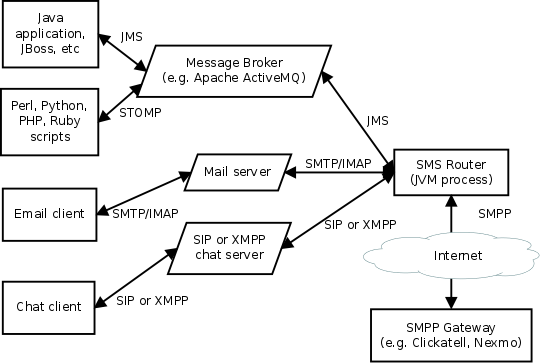
There is increasing demand for SMS notifications about monitoring alerts, trading notifications, flight delays and other events. Various companies are offering SMS transmission services to meet this demand and many of them aggressively pushing their own proprietary interfaces to the SMS world rather than using the more open and widely supported SMPP. There is good reason for this: if users write lots of of scripts to access the REST API of an SMS service, the users won't be able to change their service provider without having to change all their code. Well, that is good if you are an SMPP vendor but not if you are their customer. If an SMS gateway company goes out of business or has a system meltdown, the customers linked to their REST API will have a much bigger effort to migrate to a new provider than those using SMPP. The HTTP REST APIs offered by many vendors hide some details of the SMS protocol and payload. At first glance, this may feel easier. In fact, this leads to unpredictable results when delivering messages to users in different countries and different character sets/languages. It is better to start with SMPP from the beginning and avoid discovering those pitfalls later. The SMS Router free/open source software project helps overcome the SMPP learning curve by using APIs you are already familiar with. More troublesome for large organizations, some of the REST APIs offered by SMS gateways want to make callbacks to your own servers: this means your servers need public IP addresses accessible from the Internet. In some organizations that can take months to organize. SMPP works over one or more outgoing TCP connections initiated from your own server(s) and doesn't require any callback connections from the SMPP gateway. SMS Router lets SMS users have the best of both worlds: the flexibility of linking to any provider who supports SMPP and the convenience of putting messages into the system using any of the transports supported by an Apache Camel component. Popular examples include camel-jms (JMS) for Java and J2EE users, STOMP for scripting languages, camel-mail (SMTP and IMAP) for email integration and camel-sip (SIP) or camel-xmpp (XMPP) for chat/instant messaging systems. If you really want to, you can also create your own in-house HTTP REST API too using camel-restlet for internal applications. In all these cases, SMS Router always uses standard SMPP to reach any gateway of your choice. Architecture overview SMS Router is based on Apache Camel. Multiple instances can be operated in parallel for clustering, load balancing and high availability. It can be monitored using JMX solutions such as JMXetric. The SMPP support is based on the camel-smpp component which is in turn based on the jSMPP library, which comprehensively implements the SMPP protocol in Java. camel-smpp can be used with minimal configuration but for those who want to, many SMPP features can be tweaked on a per-message basis using various headers. The SMPP gateway settings can be configured and changed at will using the sms-router.properties file. The process doesn't require any other files or databases at runtime. The SMS Router is ready-to-run with one queue for sending messages and another queue for incoming messages. The routing logic can be customized by editing the RouteBuilder class to use other Camel components or any of Camel's wide range of functions for inspecting, modifying and routing messages. For example, you can extend it to failover to multiple SMPP gateways using Camel's load-balancer pattern. SMS Router based projects are already used successfully in production, for example, the user registration mechanism for the Lumicall secure VoIP app for Android. Getting started See the README for instructions. Feel free to ask questions about this project on the Camel users mailing list. Disclaimer SMS is not considered secure, the SMS Router developers and telecommunications industry experts discourage the use of this technology for two-factor authentication. Please see the longer disclaimer in the README file and my earlier blog about SMS logins: an illusion of security. The bottom line: if your application is important enough to need two-factor authentication, do it correctly using smart cards or tokens. There are many popular free software projects based on these full cryptographic solutions, for example, the oath-toolkit and dynalogin.

3 July 2016

Daniel Stender: My work for Debian in June

At least a little much more time lst month for helping to improve the operating system we're working on. I've worked on a couple of package updates, mostly they are for PAPT, DPMT, Debian Science, or pkg-go (in order of completion): New packages: Sponsored Uploads: Again some further ahead with these ones. My "new package of the month" is going to be Theano. I'm still working on the introduction, it'll come hereafter very soon.

Petter Reinholdtsen: How to use the Signal app if you only have a land line (ie no mobile phone)

For a while now, I have wanted to test the Signal app, as it is said to provide end to end encrypted communication and several of my friends and family are already using it. As I by choice do not own a mobile phone, this proved to be harder than expected. And I wanted to have the source of the client and know that it was the code used on my machine. But yesterday I managed to get it working. I used the Github source, compared it to the source in the Signal Chrome app available from the Chrome web store, applied patches to use the production Signal servers, started the app and asked for the hidden "register without a smart phone" form. Here is the recipe how I did it. First, I fetched the Signal desktop source from Github, using
git clone https://github.com/WhisperSystems/Signal-Desktop.git
Next, I patched the source to use the production servers, to be able to talk to other Signal users:
cat <<EOF   patch -p0
diff -ur ./js/background.js userdata/Default/Extensions/bikioccmkafdpakkkcpdbppfkghcmihk/0.15.0_0/js/background.js
--- ./js/background.js  2016-06-29 13:43:15.630344628 +0200
+++ userdata/Default/Extensions/bikioccmkafdpakkkcpdbppfkghcmihk/0.15.0_0/js/background.js    2016-06-29 14:06:29.530300934 +0200
@@ -47,8 +47,8 @@
          );
      );
 
-    var SERVER_URL = 'https://textsecure-service-staging.whispersystems.org';
-    var ATTACHMENT_SERVER_URL = 'https://whispersystems-textsecure-attachments-staging.s3.amazonaws.com';
+    var SERVER_URL = 'https://textsecure-service-ca.whispersystems.org:4433';
+    var ATTACHMENT_SERVER_URL = 'https://whispersystems-textsecure-attachments.s3.amazonaws.com';
     var messageReceiver;
     window.getSocketStatus = function()  
         if (messageReceiver)  
diff -ur ./js/expire.js userdata/Default/Extensions/bikioccmkafdpakkkcpdbppfkghcmihk/0.15.0_0/js/expire.js
--- ./js/expire.js      2016-06-29 13:43:15.630344628 +0200
+++ userdata/Default/Extensions/bikioccmkafdpakkkcpdbppfkghcmihk/0.15.0_0/js/expire.js2016-06-29 14:06:29.530300934 +0200
@@ -1,6 +1,6 @@
 ;(function()  
     'use strict';
-    var BUILD_EXPIRATION = 0;
+    var BUILD_EXPIRATION = 1474492690000;
 
     window.extension = window.extension    ;
 
EOF
The first part is changing the servers, and the second is updating an expiration timestamp. This timestamp need to be updated regularly. It is set 90 days in the future by the build process (Gruntfile.js). The value is seconds since 1970 times 1000, as far as I can tell. Based on a tip and good help from the #nuug IRC channel, I wrote a script to launch Signal in Chromium.
#!/bin/sh
cd $(dirname $0)
mkdir -p userdata
exec chromium \
  --proxy-server="socks://localhost:9050" \
  --user-data-dir= pwd /userdata --load-and-launch-app= pwd 
The script start the app and configure Chromium to use the Tor SOCKS5 proxy to make sure those controlling the Signal servers (today Amazon and Whisper Systems) as well as those listening on the lines will have a harder time location my laptop based on the Signal connections if they use source IP address. When the script starts, one need to follow the instructions under "Standalone Registration" in the CONTRIBUTING.md file in the git repository. I right clicked on the Signal window to get up the Chromium debugging tool, visited the 'Console' tab and wrote 'extension.install("standalone")' on the console prompt to get the registration form. Then I entered by land line phone number and pressed 'Call'. 5 seconds later the phone rang and a robot voice repeated the verification code three times. After entering the number into the verification code field in the form, I could start using Signal from my laptop. As far as I can tell, The Signal app will leak who is talking to whom and thus who know who to those controlling the central server, but such leakage is hard to avoid with a centrally controlled server setup. It is something to keep in mind when using Signal - the content of your chats are harder to intercept, but the meta data exposing your contact network is available to people you do not know. So better than many options, but not great. And sadly the usage is connected to my land line, thus allowing those controlling the server to associate it to my home and person. I would prefer it if only those I knew could tell who I was on Signal. There are options avoiding such information leakage, but most of my friends are not using them, so I am stuck with Signal for now.

2 July 2016

Lior Kaplan: Implementing NATO s standards (STANAG)

I recently joined Linnovate, and while working on one of the open source projects the company produces, we needed to process video content according to NATO s standard agreement (STANAG) 4609: NATO Digital Motion Imagery Standard. Obviously we started with trying to find code already done, but we only found some implementation in Java, while our project is written in JavaScript. We decided to just implement the standard in the way most convenient to us, and later refactoring the project when more standards (STANAGs) will get implemented. So I m happy to introduce our new project: STANAG at https://github.com/linnovate/stanag , also available with NPM (see https://www.npmjs.com/package/stanag).
Filed under: Linnovate

Next.

Previous.