Search Results: "ina"

21 July 2025

Jonathan Dowland: Nine Inch Nails, Paris, 2025-07-07

On July 7th I did a quick one-day trip to Paris to watch Nine Inch Nails, who were performing one of their last shows for the European leg of the tour. I'd missed all the UK dates, which were announced after I was committed to a family holiday. The setup for these shows differs a lot from the norm. First, the support act was German-Iraqi techno DJ Boys Noize, who TR&AR had collaborated with on their soundtrack for the recent movie Challengers. BN did a 75-minute opening set:
Stripped down Set 1 Stripped down Set 1
The main gig was divided into four acts. Act 1 took place on a square "B Stage", situated in the middle of the main floor. Trent and 2-3 band members performed three stripped-down songs, with interpolations to other songs, alternative lyrics, and the like. I enjoyed this section more than I expected to.
Main stage lighting Main stage lighting
They then transition to the main stage for a six-song full-band set. The main stage was draped in layers of transparent curtains. One of the team was on-stage, walking around with a video camera, and the live camera footage was processed and projected onto the curtains in realtime. The visuals were truly fantastic. For the third act, Trent and Atticus returned to the B stage, to be joined by Boys Noize, who then performed four songs in a reworked, remixed, electronic dance format. This ended up being the highlight of the gig for me. I felt the reworkings breathed new life into some old songs.
remix Set 3 remix Set 3
Finally, back to the main stage to close out with a final seven songs. The traditional triad of closers was adjusted, substituting "The Hand That Feeds" for "The Perfect Drug"; a song that wasn't played at all from 1997 to 2018, and has now become a regular fixture. Several tapers recorded the show, and their recordings are up at nin.live. Overall it was great fun: I ended up flying via London and the airport time was a bit of a pain, but I did get a good start on my corrections. I was home the next afternoon. I'm trying not to think of the cost.

20 July 2025

Michael Prokop: What to expect from Debian/trixie #newintrixie

Trixie Banner, Copyright 2024 Elise Couper Update on 2025-07-28: added note about Debian 13/trixie support for OpenVox (thanks, Ben Ford!) Debian v13 with codename trixie is scheduled to be published as new stable release on 9th of August 2025. I was the driving force at several of my customers to be well prepared for the upcoming stable release (my efforts for trixie started in August 2024). On the one hand, to make sure packages we care about are available and actually make it into the release. On the other hand, to ensure there are no severe issues that make it into the release and to get proper and working upgrades. So far everything is looking pretty well and working fine, the efforts seemed to have payed off. :) As usual with major upgrades, there are some things to be aware of, and hereby I m starting my public notes on trixie that might be worth for other folks. My focus is primarily on server systems and looking at things from a sysadmin perspective. Further readings As usual start at the official Debian release notes, make sure to especially go through What s new in Debian 13 + issues to be aware of for trixie (strongly recommended read!). Package versions As a starting point, let s look at some selected packages and their versions in bookworm vs. trixie as of 2025-07-20 (mainly having amd64 in mind):
Package bookworm/v12 trixie/v13
ansible 2.14.3 2.19.0
apache 2.4.62 2.4.64
apt 2.6.1 3.0.3
bash 5.2.15 5.2.37
ceph 16.2.11 18.2.7
docker 20.10.24 26.1.5
dovecot 2.3.19 2.4.1
dpkg 1.21.22 1.22.21
emacs 28.2 30.1
gcc 12.2.0 14.2.0
git 2.39.5 2.47.2
golang 1.19 1.24
libc 2.36 2.41
linux kernel 6.1 6.12
llvm 14.0 19.0
lxc 5.0.2 6.0.4
mariadb 10.11 11.8
nginx 1.22.1 1.26.3
nodejs 18.13 20.19
openjdk 17.0 21.0
openssh 9.2p1 10.0p1
openssl 3.0 3.5
perl 5.36.0 5.40.1
php 8.2+93 8.4+96
podman 4.3.1 5.4.2
postfix 3.7.11 3.10.3
postgres 15 17
puppet 7.23.0 8.10.0
python3 3.11.2 3.13.5
qemu/kvm 7.2 10.0
rsync 3.2.7 3.4.1
ruby 3.1 3.3
rust 1.63.0 1.85.0
samba 4.17.12 4.22.3
systemd 252.36 257.7-1
unattended-upgrades 2.9.1 2.12
util-linux 2.38.1 2.41
vagrant 2.3.4 2.3.7
vim 9.0.1378 9.1.1230
zsh 5.9 5.9
Misc unsorted apt The new apt version 3.0 brings several new features, including: systemd systemd got upgraded from v252.36-1~deb12u1 to 257.7-1 and there are lots of changes. Be aware that systemd v257 has a new net.naming_scheme, v257 being PCI slot number is now read from firmware_node/sun sysfs file. The naming scheme based on devicetree aliases was extended to support aliases for individual interfaces of controllers with multiple ports. This might affect you, see e.g. #1092176 and #1107187, the Debian Wiki provides further useful information. There are new systemd tools available: The tools provided by systemd gained several new options: Debian s systemd ships new binary packages: Linux Kernel The trixie release ships a Linux kernel based on latest longterm version 6.12. As usual there are lots of changes in the kernel area, including better hardware support, and this might warrant a separate blog entry. To highlight some changes with Debian trixie: See Kernelnewbies.org for further changes between kernel versions. Configuration management For puppet users, Debian provides the puppet-agent (v8.10.0), puppetserver (v8.7.0) and puppetdb (v8.4.1) packages. Puppet s upstream does not provide packages for trixie, yet. Given how long it took them for Debian bookworm, and with their recent Plans for Open Source Puppet in 2025, it s unclear when (and whether at all) we might get something. As a result of upstream behavior, also the OpenVox project evolved, and they already provide Debian 13/trixie support (https://apt.voxpupuli.org/openvox8-release-debian13.deb). FYI: the AIO puppet-agent package for bookworm (v7.34.0-1bookworm) so far works fine for me on Debian/trixie. Be aware that due to the apt-key removal you need a recent version of the puppetlabs-apt for usage with trixie. The puppetlabs-ntp module isn t yet ready for trixie (regarding ntp/ntpsec), if you should depend on that. ansible is available and made it with version 2.19 into trixie. Prometheus stack Prometheus server was updated from v2.42.0 to v2.53, and all the exporters that got shipped with bookworm are still around (in more recent versions of course). Trixie gained some new exporters: Virtualization docker (v26.1.5), ganeti (v3.1.0), libvirt (v11.3.0, be aware of significant changes to libvirt packaging), lxc (v6.0.4), podman (v5.4.2), openstack (see openstack-team on Salsa), qemu/kvm (v10.0.2), xen (v4.20.0) are all still around. Proxmox already announced their PVE 9.0 BETA, being based on trixie and providing 6.14.8-1 kernel, QEMU 10.0.2, LXC 6.0.4, OpenZFS 2.3.3. Vagrant is available in version 2.3.7, but Vagrant upstream does not provide packages for trixie yet. Given that HashiCorp adopted the BSL, the future of vagrant in Debian is unclear. If you re relying on VirtualBox, be aware that upstream doesn t provide packages for trixie, yet. VirtualBox is available from Debian/unstable (version 7.1.12-dfsg-1 as of 2025-07-20), but not shipped with stable release since quite some time (due to lack of cooperation from upstream on security support for older releases, see #794466). Be aware that starting with Linux kernel 6.12, KVM initializes virtualization on module loading by default. This prevents VirtualBox VMs from starting. In order to avoid this, either add kvm.enable_virt_at_load=0 parameter into kernel command line or unload the corresponding kvm_intel / kvm_amd module. If you want to use Vagrant with VirtualBox on trixie, be aware that Debian s vagrant package as present in trixie doesn t support the VirtualBox package version 7.1 as present in Debian/unstable (manually patching vagrant s meta.rb and rebuilding the package without Breaks: virtualbox (>= 7.1) is known to be working). util-linux The are plenty of new options available in the tools provided by util-linux: Now no longer present in util-linux as of trixie: The following binaries got moved from util-linux to the util-linux-extra package: And the util-linux-extra package also provides new tools: OpenSSH OpenSSH was updated from v9.2p1 to 10.0p1-5, so if you re interested in all the changes, check out the release notes between those versions (9.3, 9.4, 9.5, 9.6, 9.7, 9.8, 9.9 + 10.0). Let s highlight some notable behavior changes in Debian: There are some notable new features: Thanks to everyone involved in the release, looking forward to trixie + and happy upgrading!
Let s continue with working towards Debian/forky. :)

19 July 2025

Jonathan Carter: DebConf25

The last two weeks I attended DebConf and DebCamp in Brest, France. Usually, I like to do a more detailed write-up of DebConf, but I was already quite burnt out when I got here, so I ll circle back to a few things that were important to me in later posts. In the meantime, thanks to everyone who made this DebConf possible, whether you volunteered for one task or were part of the organisation team. Also a special thanks to the wonderful sponsors who made this entire event possible! See you next year in Argentina!
Jellyfish taken during daytrip at aquarium.

Jellyfish, taken during daytrip at aquarium.

18 July 2025

Valhalla's Things: FreeSoftWear

Posted on July 18, 2025
Tags: madeof:bits, topic:debian, FreeSoftWear
There may have been a lightning talk. Things similar to the rest of this article may have been said. I think that most people in this room care about running Freely licensed software on their computers. Some probably would also like, when possible, to use Freely licensed hardware, or to enjoy Freely licensed art. And then there are very few people who decided that they d prefer to wear DFSG-Free clothing. If you make your own, it s not that different from software: you get a pattern, the source code, and compilation instructions. The compilation process is a bit manual, but there are a lot of people who enjoy that. It doesn t have to be sewing, it can be knitting, crochet, any craft that can be used to build something that you wear and has patterns or other kinds of source code. I d say that a certain tartan also qualifies. If you re interested in the idea, these are the places I know of that do FreeSoftWear: two are personal websites, included mine, freesewing is a community and an online platform to design patterns. And debian has some useful software, including valentina, for sewing patterns, and kxstitch for cross-stitch and other counted thread embroidery.

17 July 2025

Gunnar Wolf: About our proof-of-concept LLM tool for navigating Debian's manpages

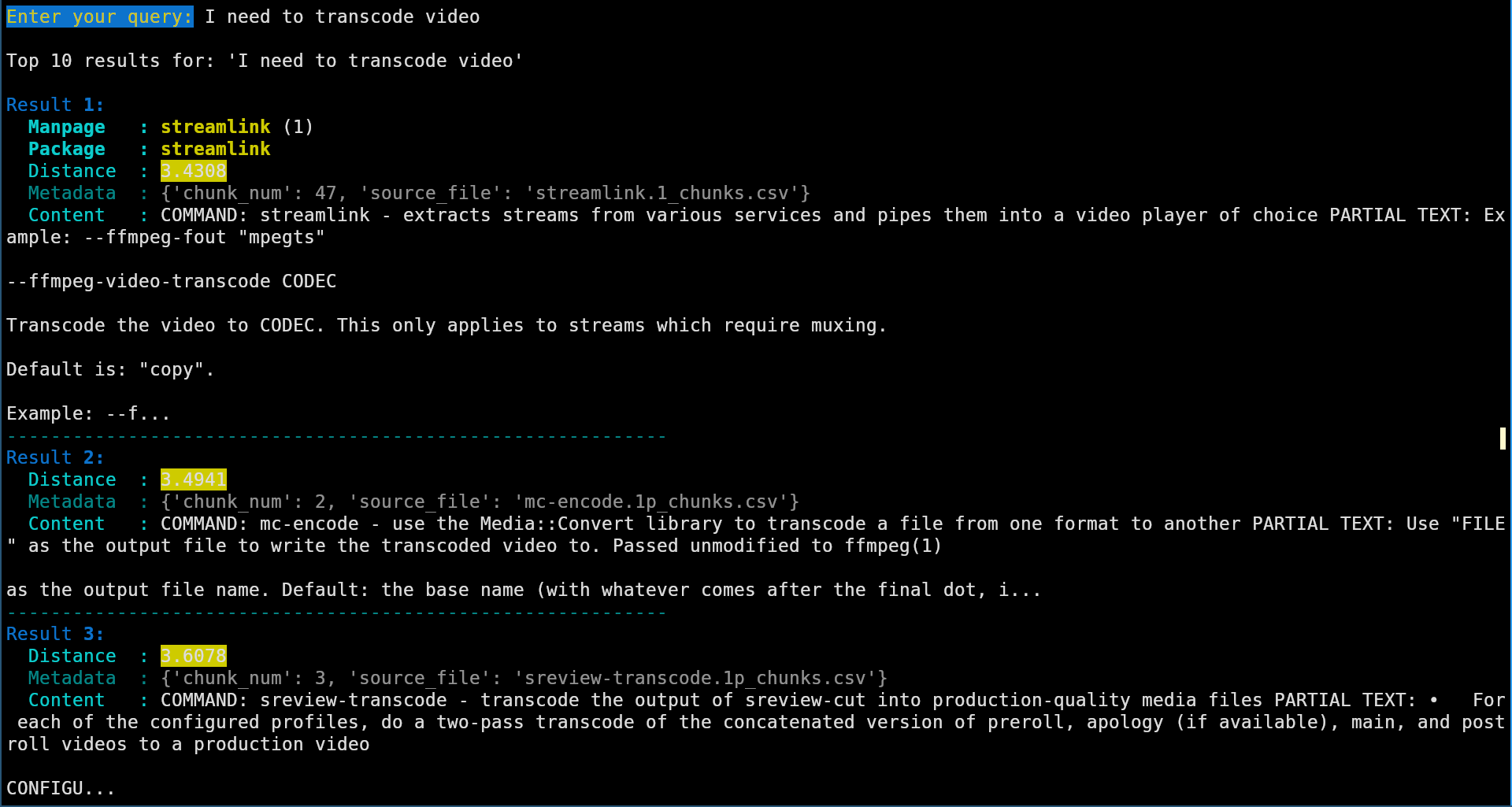
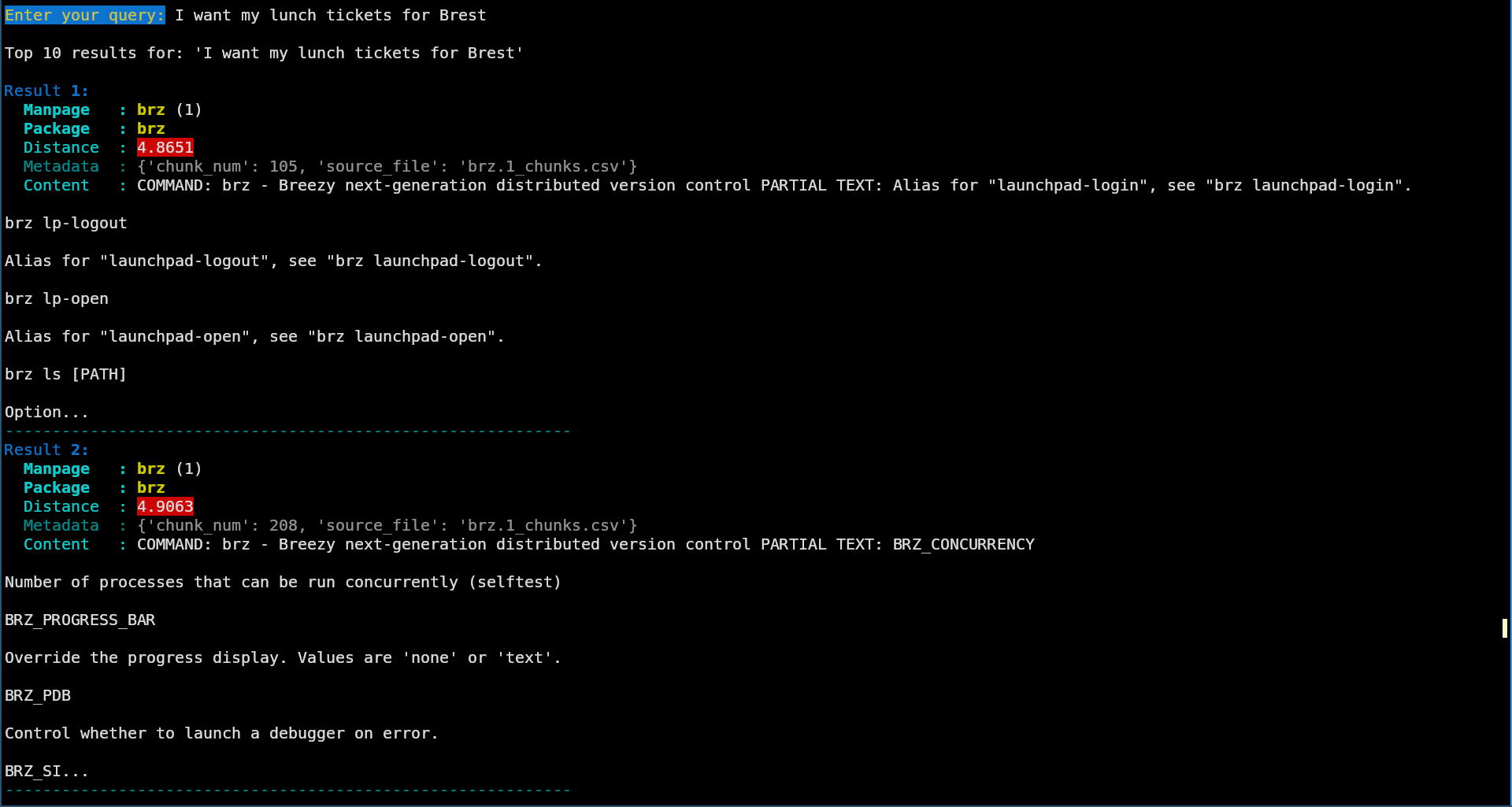
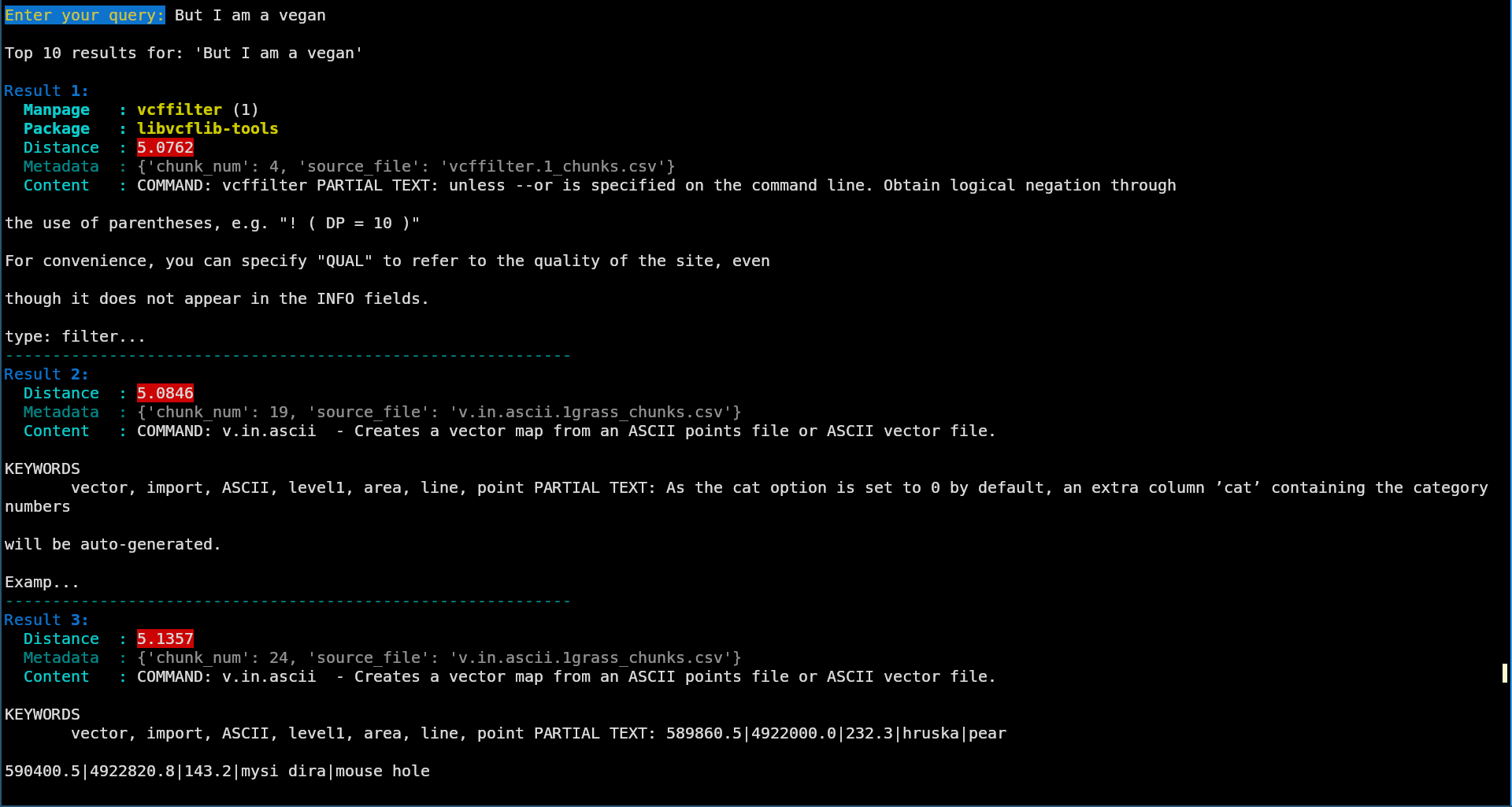
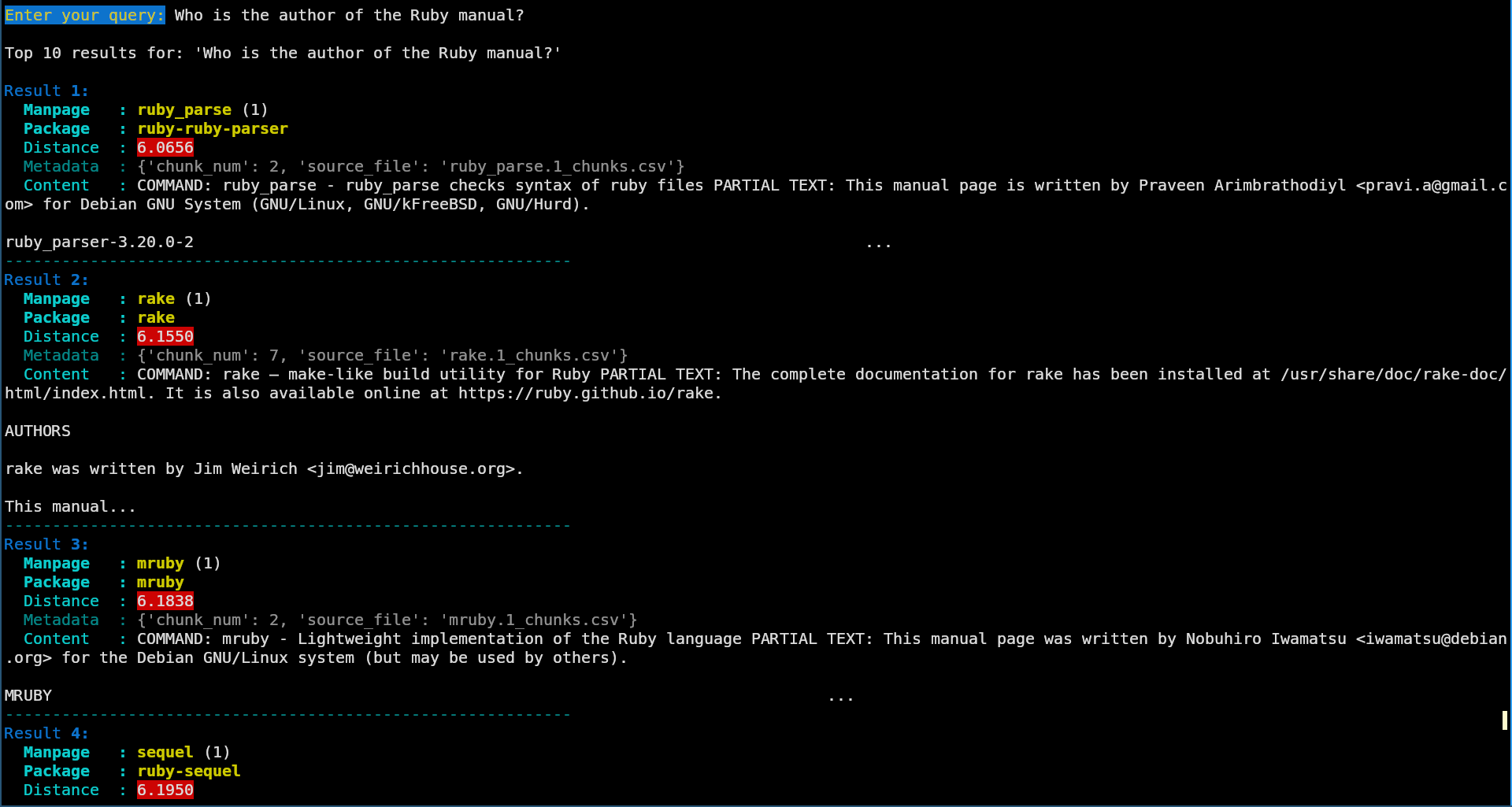
So, for the first year, this year s DebConf had the DebConf Academic Track , that is, content for a one-day-long set of short sessions, for which of them there was a written article presenting the content often with a very academic format, but not necessarily. I hope that for future DebConfs we will continue to hold this track, and that we can help bridge the gap: to get people that are not usually from the academic / universitary prepare content that will be formally expressed and included in a long-lasting, indexed book of proceedings. We did have (informal) proceedings in many of the early DebConfs, and I m very happy to regain that, but with 20 years of better practices. Anyway, of course, I took the opportunity to join this experiment, and together with my Mexican colleague Tzolkin Gardu o who is finishing her PhD here in France (or should I say, second to her, as she is the true leading author of our work). And here you can see the paper we submitted to the DebConf Academic Track, which will be published soon: A retrieval-augmented-generation pipeline to help users query system-provided documentation The corresponding source code is all available at Tzolkin s repository in GitHub. So, what is it about, in shorter words and layman terms? Debian has lots of documentation, but lacks in discoverability. We targetted our venerable manpages: It is well known that manpages are relevant, well-organized documentation describing how to use each of the binaries we ship in Debian. Eric Raymond wrote in his well-known essay The Art of Unix Programming (2003) that the Unix cultural style is telegraphic but complete. It does not hold you by the hand, but it usualy points in the right direction. Our original intent was to digest all of the information in our manpages, but we narrowed it to only the first section of the manual due to the limitations of the hardware a good friend lent us to play with LLMs. We took four different base, redistributable (although, yes, non-DFSG-free) Large Language Models downloaded from HuggingFace (T5-small, MiniLM-L6-v2, BGE-small-en and Multilingual-e5-small), and trained them with the 34579 pages found inside /usr/share/man/man1 of all of the existing Debian packages. We did some interesting fine-tuning (for further details, please refer to the paper itself or to our GitHub repository. The idea is to present an interactive tool that udnerstand natural language queries, and answers with the specific manpage to which they better relate (I d like to say they answer best , but Tzolkin has repeatedly tried to correct my understanding of the resulting vectorial distances). I had prepared some images to present as interaction examples, but I ll wrap up this post with something even better So, this is what you would get with the following queries: We were happy to present like this. During DebCamp, however, I was able to devote some time to translating my client into a Web-accessible system. Do note that it s a bit brittle, and might break now and then. But you are welcome to play with it! Play with the Web interface for our RAG for Debian manuals! I find it worth sharing that, while we used quite a bit of GPU for the training (not too much a couple of nights on an old-although-powerful nVidia 1070 card lent to us by the Felipe Esquivel Fund for Science and Cultural Support), all querying takes place in the CPU, and I usually get between 0.1 and 0.3 seconds per query. My server s architecture is far from rock-solid, and it can break now and then but at least it should respawn upon failure And it should at least be available there for a couple of weeks into August. Anyway, this has been a very interesting journey getting my toes wet in the waters of LLM, and while current results are a bit crude, I think this can be made into an interesting tool for Debian exploration.

Birger Schacht: My first tag2upload upload

Following the DebConf25 talk by Ian Jackson tag2upload - upload simply by pushing a signed git tag I decided to use the quiet time during the day of the DayTrip on DebConf 25 to try out uploading a package using tag2upload. Given the current freeze a couple of the packages I maintainer have new releases waiting. I decided on uploading the new version of labwc to experimental. Labwc is a Wayland compositor based on the wlroots compositor library (the library that sway is using). Labwc is inspired by the Openbox window manager. The upstream team of Labwc released version 0.9.0 last week, the first version that is based on wlroots 0.19.x. Wlroots 0.19.x is also only available in experimental, so that was a good fit for trying an upload with tag2upload. I first used my usual workflow, going into my package repository, doing get fetch origin, checking out the tag of the new release and tagging that with git tag upstream/0.9.0. Then I bumped the version in the debian/experimental branch, adapted the debian/control file for the changed wlroots dependency, committed and built the package using git-buildpackage to check if it builds fine and there are no lintian errors. Then I moved on to look at tag2upload. As a starting point for using tag2upload I read the blogpost by Jonathan Carter My first tag2upload upload. It pointed me to one very important option of git debpush, namely the --baredebian option which I have to use because I use the bare Debian git layout. Given that the last upload of labwc I did was to unstable, I also had to add the --force=changed-suite. I also started right away to use the --tag-only option, because for my first tests I only wanted to have local changes and nothing pushed to anywhere. I also used the --dry-run option. This led to the following command:
> git debpush --baredebian --force=changed-suite --dry-run --tag-only
tags 0.9.0, upstream/0.9.0 all exist in this repository
tell me which one you want to make an orig.tar from: git deborig --just-print '--version=0.9.0-1' TAG
git-debpush: git-deborig failed; maybe try git-debpush --upstream=TAG
This was a bit confusing, because the error message talked about git-deborig, but I was using git-debpush. I also did not want to make an orig.tar! The --upstream option in the git-debpush(1) manual gave an explanation for this:
When pushing a non-native package, git-debpush needs a tag for the upstream part of your package. By default git-debpush asks git-deborig(1), which searches for a suitable tag based on the upstream version in debian/changelog.
So apparently git-debpush can not find out what the correct tag for the upstream version is, because git-deborig can not find out what the correct tag for the upstream version is. git-debpush simply calls git deborig --just-print --version="$version" in line 437. This fails because I initially created a second upstream/0.9.0 to the existing 0.9.0 release tag. I do this for git-buildpackage to find the upstream sources, but with multiple tags git-deborig is not sure which one is the tag it should use (although both point to the same commit). So I removed the upstream/0.9.0 tag and ran git debpush again and now there was no error message (besides the warning regarding the changed suite) but it also did not give an feedback about what is happening. So I tried without the --dry-run option. Again, no output whatsoever, other than the warning about the changed release, BUT my gnupg asked me for permission to sign via my yubikey! And when I looked at the list of tags, I saw that there is now a debian/0.9.0-1 tag that was not there before! Looking at the tag I saw that it was a tag in the format described in the tag2upload(5) manual page, containing the following lines:
labwc release 0.9.0-1 for experimental
[dgit distro=debian split --quilt=baredebian]
[dgit please-upload source=labwc version=0.9.0-1 upstream-tag=0.9.0 upstream=4beee3851f75b53afc2e8699c594c0cc222115bd]
and the tag was signed by me. The 4beee3851f75b53afc2e8699c594c0cc222115bd commit ID is the commit the 0.9.0 tag points to. Now that I had a signed commit tag in the correct format, I went to the labwc packaging repository on salsa and enabled the webhook to trigger the tag2upload service (I just saw that the documentation was updated and there is now a global webhook on salsa, so this step is not needed anymore). Finally I pushed the tags using git push --tags. I could also have used git-debpush for this step, but I d rather use git directly. I then looked at the tag2upload queue and saw how a worker built and uploaded the newest labwc release and I also got an email from the tag2upload service [tag2upload 275] uploaded labwc 0.9.0-1. And a couple of minutes later I got the confirmation that labwc 0.9.0-1 was accepted into experimental. Great! So, to conclude: for tag2upload to work we simply need a git tag in the correct format. The tag2upload service now gets triggered by every pushed tag on salsa but only acts on tags that adhere to the tag2upload(5) format. git-debpush is a simply bash script that creates such a tag and by default also pushes the tag. I think the script could be a bit more verbose, for example telling me that it created a tag and the name of that tag. I think the dependency on git-deborig is also a problem. I use git-buildpackage to build my packages and by default git-buildpacakge assumes upstream tags are of the form upstream/%(version)s (source). I could now change that for all the packages I maintain, but I also think it makes sense to control the tag myself and not use a tag that is controlled by upstream. Upstream could change or delete that tag or I might need to create a tag for a version that is not tagged by upstream. I also think git-debpush is a rather mileading command name, given that the main task of the script is to create a tag in the correct format. Other than that, I m pretty happy about this service. I have a rather crappy uplink at home and it is not so uncommon for my uploads to fail because the connection dropped during dput. Using a simple git based upload approach makes these problems a thing of the past. I might look into other ways to create the needed tag, though.

Otto Kek l inen: Debcraft Easiest way to modify and build Debian packages

Featured image of post Debcraft   Easiest way to modify and build Debian packagesDebian packaging is notoriously hard. Far too many new contributors give up while trying, and many long-time contributors leave due to burnout from having to do too many thankless maintenance tasks. Some just skip testing their changes properly because it feels like too much toil. Debcraft is my attempt to solve this by automating all the boring stuff, and making it easier to learn the correct practices and helping new and old packagers better track changes in both source code and build artifacts.

The challenge of declarative packaging code Unlike how rpm or apk packages are done, the deb package sources by design avoid having one massive procedural packaging recipe. Instead, the packaging is defined in multiple declarative files in the debian/ subdirectory. For example, instead of a script running install -m 755 bin/btop /usr/bin/btop there is a file debian/btop.install containing the line usr/bin/btop. This makes the overall system more robust and reliable, and allows, for example, extensive static analysis to find problems without having to build the package. The notable exception is the debian/rules file, which contains procedural code that can modify any aspect of the package build. Almost all other files are declarative. Benefits include, among others, that the effect of a Debian-wide policy change can be relatively easily predicted by scanning what attributes and configurations all packages have declared. The drawback is that to understand the syntax and meaning of each file, one must understand which build tools read which files and traverse potentially multiple layers of abstraction. In my view, this is the root cause for most of the perceived complexity.

Common complaints about .deb packaging Related to the above, people learning Debian packaging frequently voice the following complaints:
  • Debian has too many tools to learn, often with overlapping or duplicate functionality.
  • Too much outdated and inconsistent documentation that makes learning the numerous tools needlessly hard.
  • Lack of documentation of the generally agreed best practices, mainly due to Debian s reluctance as a project to pick one tool and deprecate the alternatives.
  • Multiple layers of abstraction and lack of clarity on what any single change in the debian/ subdirectory leads to in the final package.
  • Requirement of Debian packages to be developed on a Debian system.

How Debcraft solves (some of) this Debcraft is intentionally opinionated for the sake of simplicity, and makes heavy use of git, git-buildpackage, and most importantly Linux containers, supporting both Docker and Podman. By using containers, Debcraft frees the user from the requirement of having to run Debian. This makes .deb packaging more accessible to developers running some other Linux distro or even Mac or Windows (with WSL). Of course we want developers to run Debian (or a derivative like Ubuntu) but we want them even more to build, test and ship their software as .deb. Even for Debian/Ubuntu users having everything done inside clean hermetic containers of the latest target distribution version will yield more robust, secure and reproducible builds and tests. All containers are built automatically on-the-fly using best practices for layer caching, making everything easy and fast. Debcraft has simple commands to make it easy to build, rebuild, test and update packages. The most fundamental command is debcraft build, which will not only build the package but also fetch the sources if not already present, and with flags such as --distribution or --source-only build for any requested Debian or Ubuntu release, or generate source packages only for Debian or PPA upload purposes. For ease of use, the output is colored and includes helpful explanations on what is being done, and suggests relevant Debian documentation for more information. Most importantly, the build artifacts, along with various logs, are stored in separate directories, making it easy to compare before and after to see what changed as a result of the code or dependency updates (utilizing diffoscope among others). While the above helps to debug successful builds, there is also the debcraft shell command to make debugging failed builds significantly easier by dropping into a shell where one can run various dh commands one-by-one. Once the build works, testing autopkgtests is as easy as running debcraft test. As with all other commands, Debcraft is smart enough to read information like the target distribution from the debian/changelog entry. When the package is ready to be released, there is the debcraft release command that will create the Debian source package in the correct format and facilitate uploading it either to your Personal Package Archive (PPA) or if you are a Debian Developer to the official Debian archive.

Automatically improve and update packages Additionally, the command debcraft improve will try to fix all issues that are possible to address automatically. It utilizes, among others, lintian-brush, codespell and debputy. This makes repetitive Debian maintenance tasks easier, such as updating the package to follow the latest Debian policies. To update the package to the latest upstream version there is also debcraft update. It will read the package configuration files such as debian/gbp.conf and debian/watch and attempts to import the latest upstream version, refresh patches, build and run autopkgtests. If everything passes, the new version is committed. This helps automate the process of updating to new upstream versions.

Try out Debcraft now! On a recent version of Debian and Ubuntu, Debcraft can be installed simply by running apt install debcraft. To use Debcraft on some other distribution or to get the latest features available in the development version install it using:
git clone https://salsa.debian.org/debian/debcraft.git
cd debcraft
make install-local
To see exact usage instructions run debcraft --help.

Contributions welcome Current Debcraft version 0.5 still has some rough edges and missing features, but I have personally been using it for over a year to maintain all my packages in Debian. If you come across some issue, feel free to file a report at https://salsa.debian.org/debian/debcraft/-/issues or submit an improvement at https://salsa.debian.org/debian/debcraft/-/merge_requests. The code is intentionally written entirely in shell script to keep the barrier to code contribution as low as possible.
By the way, if you aspire to become a Debian Developer, and want to follow my examples in using state-of-the-art tooling and collaborate using salsa.debian.org, feel free to reach out for mentorship. I am glad to see more people contribute to Debian!

Arnaud Rebillout: Acquire-By-Hash for APT packages repositories, and the lack of it in Kali Linux

This is a lenghty blog post. It features a long introduction that explains how apt update acquires various files from a package repository, what is Acquire-By-Hash, and how it all works for Kali Linux: a Debian-based distro that doesn't support Acquire-By-Hash, and which is distributed via a network of mirrors and a redirector. In a second part, I explore some "Hash Sum Mismatch" errors that we can hit with Kali Linux, errors that would not happen if only Acquire-By-Hash was supported. If anything, this blog post supports the case for adding Acquire-By-Hash support in reprepro, as requested at https://bugs.debian.org/820660. All of this could have just remained some personal notes for myself, but I got carried away and turned it into a blog post, dunno why... Hopefully others will find it interesting, but you really need to like troubleshooting stories, packed with details, and poorly written at that. You've been warned! Introducing Acquire-By-Hash Acquire-By-Hash is a feature of APT package repositories, that might or might not be supported by your favorite Debian-based distribution. A repository that supports it says so, in the Release file, by setting the field Acquire-By-Hash: yes. It's easy to check. Debian and Ubuntu both support it:
$ wget -qO- http://deb.debian.org/debian/dists/sid/Release   grep -i ^Acquire-By-Hash:
Acquire-By-Hash: yes
$ wget -qO- http://archive.ubuntu.com/ubuntu/dists/devel/Release   grep -i ^Acquire-By-Hash:
Acquire-By-Hash: yes
What about other Debian derivatives?
$ wget -qO- http://http.kali.org/kali/dists/kali-rolling/Release   grep -i ^Acquire-By-Hash:   echo not supported
not supported
$ wget -qO- https://archive.raspberrypi.com/debian/dists/trixie/Release   grep -i ^Acquire-By-Hash:   echo not supported
not supported
$ wget -qO- http://packages.linuxmint.com/dists/faye/Release   grep -i ^Acquire-By-Hash:   echo not supported
not supported
$ wget -qO- https://apt.pop-os.org/release/dists/noble/Release   grep -i ^Acquire-By-Hash:   echo not supported
not supported
Huhu, Acquire-By-Hash is not ubiquitous. But wait, what is Acquire-By-Hash to start with? To answer that, we have to take a step back and cover some basics first. The HTTP requests performed by 'apt update' What happens when one runs apt update? APT first requests the Release file from the repository(ies) configured in the APT sources. This file is a starting point, it contains a list of other files (sometimes called "Index files") that are available in the repository, along with their hashes. After fetching the Release file, APT proceeds to request those Index files. To give you an idea, there are many kinds of Index files, among which: There's an excellent Wiki page that details the structure of a Debian package repository, it's there: https://wiki.debian.org/DebianRepository/Format. Note that APT doesn't necessarily download ALL of those Index files. For simplicity, we'll limit ourselves to the minimal scenario, where apt update downloads only the Packages files. Let's try to make it more visual: here's a representation of a apt update transaction, assuming that all the components of the repository are enabled:
apt update -> Release -> Packages (main/amd64)
                      -> Packages (contrib/amd64)
                      -> Packages (non-free/amd64)
                      -> Packages (non-free-firmware/amd64)
Meaning that, in a first step, APT downloads the Release file, reads its content, and then in a second step it downloads the Index files in parallel. You can actually see that happen with a command such as apt -q -o Debug::Acquire::http=true update 2>&1 grep ^GET. For Kali Linux you'll see something pretty similar to what I described above. Try it!
$ podman run --rm kali-rolling apt -q -o Debug::Acquire::http=true update 2>&1   grep ^GET
GET /kali/dists/kali-rolling/InRelease HTTP/1.1    # <- returns a redirect, that is why the file is requested twice
GET /kali/dists/kali-rolling/InRelease HTTP/1.1
GET /kali/dists/kali-rolling/non-free/binary-amd64/Packages.gz HTTP/1.1
GET /kali/dists/kali-rolling/main/binary-amd64/Packages.gz HTTP/1.1
GET /kali/dists/kali-rolling/non-free-firmware/binary-amd64/Packages.gz HTTP/1.1
GET /kali/dists/kali-rolling/contrib/binary-amd64/Packages.gz HTTP/1.1
However, and it's now becoming interesting, for Debian or Ubuntu you won't see the same kind of URLs:
$ podman run --rm debian:sid apt -q -o Debug::Acquire::http=true update 2>&1   grep ^GET
GET /debian/dists/sid/InRelease HTTP/1.1
GET /debian/dists/sid/main/binary-amd64/by-hash/SHA256/22709f0ce67e5e0a33a6e6e64d96a83805903a3376e042c83d64886bb555a9c3 HTTP/1.1
APT doesn't download a file named Packages, instead it fetches a file named after a hash. Why? This is due to the field Acquire-By-Hash: yes that is present in the Debian's Release file. What does Acquire-By-Hash mean for 'apt update' The idea with Acquire-By-Hash is that the Index files are named after their hash on the repository, so if the MD5 sum of main/binary-amd64/Packages is 77b2c1539f816832e2d762adb20a2bb1, then the file will be stored at main/binary-amd64/by-hash/MD5Sum/77b2c1539f816832e2d762adb20a2bb1. The path main/binary-amd64/Packages still exists (it's the "Canonical Location" of this particular Index file), but APT won't use it, instead it downloads the file located in the by-hash/ directory. Why does it matter? This has to do with repository updates, and allowing the package repository to be updated atomically, without interruption of service, and without risk of failure client-side. It's important to understand that the Release file and the Index files are part of a whole, a set of files that go altogether, given that Index files are validated by their hash (as listed in the Release file) after download by APT. If those files are simply named "Release" and "Packages", it means they are not immutable: when the repository is updated, all of those files are updated "in place". And it causes problems. A typical failure mode for the client, during a repository update, is that: 1) APT requests the Release file, then 2) the repository is updated and finally 3) APT requests the Packages files, but their checksum don't match, causing apt update to fail. There are variations of this error, but you get the idea: updating a set of files "in place" is problematic. The Acquire-By-Hash mechanism was introduced exactly to solve this problem: now the Index files have a unique, immutable name. When the repository is updated, at first new Index files are added in the by-hash/ directory, and only after the Release file is updated. Old Index files in by-hash/ are retained for a while, so there's a grace period during which both the old and the new Release files are valid and working: the Index files that they refer to are available in the repo. As a result: no interruption of service, no failure client-side during repository updates. This is explained in more details at https://www.chiark.greenend.org.uk/~cjwatson/blog/no-more-hash-sum-mismatch-errors.html, which is the blog post from Colin Watson that came out at the time Acquire-By-Hash was introduced in... 2016. This is still an excellent read in 2025. So you might be wondering why I'm rambling about a problem that's been solved 10 years ago, but then as I've shown in the introduction, the problem is not solved for everyone. Support for Acquire-By-Hash server side is not for granted, and unfortunately it never landed in reprepro, as one can see at https://bugs.debian.org/820660. reprepro is a popular tool for creating APT package repositories. In particular, at Kali Linux we use reprepro, and that's why there's no Acquire-By-Hash: yes in the Kali Release file. As one can guess, it leads to subtle issues during those moments when the repository is updated. However... we're not ready to talk about that yet! There's still another topic that we need to cover: this window of time during which a repository is being updated, and during which apt update might fail. The window for Hash Sum Mismatches, and the APT trick that saves the day Pay attention! In this section, we're now talking about packages repositories that do NOT support Acquire-By-Hash, such as the Kali Linux repository. As I've said above, it's only when the repository is being updated that there is a "Hash Sum Mismatch Window", ie. a moment when apt update might fail for some unlucky clients, due to invalid Index files. Surely, it's a very very short window of time, right? I mean, it can't take that long to update files on a server, especially when you know that a repository is usually updated via rsync, and rsync goes to great length to update files the most atomically as it can (with the option --delay=updates). So if apt update fails for me, I've been very unlucky, but I can just retry in a few seconds and it should be fixed, isn't it? The answer is: it's not that simple. So far I pictured the "package repository" as a single server, for simplicity. But it's not always what it is. For Kali Linux, by default users have http.kali.org configured in their APT sources, and it is a redirector, ie. a web server that redirects requests to mirrors that are nearby the client. Some context that matters for what comes next: the Kali repository is synced with ~70 mirrors all around the world, 4 times a day. What happens if your apt update requests are redirected to 2 mirrors close-by, and one was just synced, while the other is still syncing (or even worse, failed to sync entirely)? You'll get a mix of old and new Index files. Hash Sum Mismatch! As you can see, with this setup the "Hash Sum Mismatch Window" becomes much longer than a few seconds: as long as nearby mirrors are syncing the window is opened. You could have a fast and a slow mirror next to you, and they can be out of sync with each other for several minutes every time the repository is updated, for example. For Kali Linux in particular, there's a "detail" in our network of mirrors that, as a side-effect, almost guarantees that this window lasts several minutes at least. This is because the pool of mirrors includes kali.download which is in fact the Cloudflare CDN, and from the redirector point of view, it's seen as a "super mirror" that is present in every country. So when APT fires a bunch of requests against http.kali.org, it's likely that some of them will be redirected to the Kali CDN, and others will be redirected to a mirror nearby you. So far so good, but there's another point of detail to be aware of: the Kali CDN is synced first, before the other mirrors. Another thing: usually the mirrors that are the farthest from the Tier-0 mirror are the longest to sync. Packing all of that together: if you live somewhere in Asia, it's not uncommon for your "Hash Sum Mismatch Window" to be as long as 30 minutes, between the moment the Kali CDN is synced, and the moment your nearby mirrors catch up and are finally in sync as well. Having said all of that, and assuming you're still reading (anyone here?), you might be wondering... Does that mean that apt update is broken 4 times a day, for around 30 minutes, for every Kali user out there? How can they bear with that? Answer is: no, of course not, it's not broken like that. It works despite all of that, and this is thanks to yet another detail that we didn't go into yet. This detail lies in APT itself. APT is in fact "redirector aware", in a sense. When it fetches a Release file, and if ever the request is redirected, it then fires the subsequent requests against the server where it was initially redirected. So you are guaranteed that the Release file and the Index files are retrieved from the same mirror! Which brings back our "Hash Sum Mismatch Window" to the window for a single server, ie. something like a few seconds at worst, hopefully. And that's what makes it work for Kali, literally. Without this trick, everything would fall apart. For reference, this feature was implemented in APT back in... 2016! A busy year it seems! Here's the link to the commit: use the same redirection mirror for all index files. To finish, a dump from the console. You can see this behaviour play out easily, again with APT debugging turned on. Below we can see that only the first request hits the Kali redirector:
$ podman run --rm kali-rolling apt -q -o Debug::Acquire::http=true update 2>&1   grep -e ^Answer -e ^HTTP
Answer for: http://http.kali.org/kali/dists/kali-rolling/InRelease
HTTP/1.1 302 Found
Answer for: http://mirror.freedif.org/kali/dists/kali-rolling/InRelease
HTTP/1.1 200 OK
Answer for: http://mirror.freedif.org/kali/dists/kali-rolling/non-free-firmware/binary-amd64/Packages.gz
HTTP/1.1 200 OK
Answer for: http://mirror.freedif.org/kali/dists/kali-rolling/contrib/binary-amd64/Packages.gz
HTTP/1.1 200 OK
Answer for: http://mirror.freedif.org/kali/dists/kali-rolling/main/binary-amd64/Packages.gz
HTTP/1.1 200 OK
Answer for: http://mirror.freedif.org/kali/dists/kali-rolling/non-free/binary-amd64/Packages.gz
HTTP/1.1 200 OK
Interlude Believe it or not, we're done with the introduction! At this point, we have a good understanding of what apt update does (in terms of HTTP requests), we know that Release files and Index files are part of a whole, and we know that a repository can be updated atomically thanks to the Acquire-By-Hash feature, so that users don't experience interruption of service or failures of any sort, even with a rolling repository that is updated several times a day, like Debian sid. We've also learnt that, despite the fact that Acquire-By-Hash landed almost 10 years ago, some distributions like Kali Linux are still doing without it... and yet it works! But the reason why it works is more complicated to grasp, especially when you add a network of mirrors and a redirector to the picture. Moreover, it doesn't work as flawlessly as with the Acquire-By-Hash feature: we still expect some short (seconds at worst) "Hash Sum Mismatch Windows" for those unlucky users that run apt update at the wrong moment. This was a long intro, but that really sets the stage for what comes next: the edge cases. Some situations in which we can hit some Hash Sum Mismatch errors with Kali. Error cases that I've collected and investigated over the time... If anything, it supports the case that Acquire-By-Hash is really something that should be implemented in reprepro. More on that in the conclusion, but for now, let's look at those edge cases. Edge Case 1: the caching proxy If you put a caching proxy (such as approx, my APT caching proxy of choice) between yourself and the actual packages repository, then obviously it's the caching proxy that performs the HTTP requests, and therefore APT will never know about the redirections returned by the server, if any. So the APT trick of downloading all the Index files from the same server in case of redirect doesn't work anymore. It was rather easy to confirm that by building a Kali package during a mirror sync, and watch if fail at the "Update chroot" step:
$ sudo rm /var/cache/approx/kali/dists/ -fr
$ gbp buildpackage --git-builder=sbuild
+------------------------------------------------------------------------------+
  Update chroot                                Wed, 11 Jun 2025 10:33:32 +0000  
+------------------------------------------------------------------------------+
Get:1 http://http.kali.org/kali kali-dev InRelease [41.4 kB]
Get:2 http://http.kali.org/kali kali-dev/contrib Sources [81.6 kB]
Get:3 http://http.kali.org/kali kali-dev/main Sources [17.3 MB]
Get:4 http://http.kali.org/kali kali-dev/non-free Sources [122 kB]
Get:5 http://http.kali.org/kali kali-dev/non-free-firmware Sources [8297 B]
Get:6 http://http.kali.org/kali kali-dev/non-free amd64 Packages [197 kB]
Get:7 http://http.kali.org/kali kali-dev/non-free-firmware amd64 Packages [10.6 kB]
Get:8 http://http.kali.org/kali kali-dev/contrib amd64 Packages [120 kB]
Get:9 http://http.kali.org/kali kali-dev/main amd64 Packages [21.0 MB]
Err:9 http://http.kali.org/kali kali-dev/main amd64 Packages
  File has unexpected size (20984689 != 20984861). Mirror sync in progress? [IP: ::1 9999]
  Hashes of expected file:
   - Filesize:20984861 [weak]
   - SHA256:6cbbee5838849ffb24a800bdcd1477e2f4adf5838a844f3838b8b66b7493879e
   - SHA1:a5c7e557a506013bd0cf938ab575fc084ed57dba [weak]
   - MD5Sum:1433ce57419414ffb348fca14ca1b00f [weak]
  Release file created at: Wed, 11 Jun 2025 07:15:10 +0000
Fetched 17.9 MB in 9s (1893 kB/s)
Reading package lists...
E: Failed to fetch http://http.kali.org/kali/dists/kali-dev/main/binary-amd64/Packages.gz  File has unexpected size (20984689 != 20984861). Mirror sync in progress? [IP: ::1 9999]
   Hashes of expected file:
    - Filesize:20984861 [weak]
    - SHA256:6cbbee5838849ffb24a800bdcd1477e2f4adf5838a844f3838b8b66b7493879e
    - SHA1:a5c7e557a506013bd0cf938ab575fc084ed57dba [weak]
    - MD5Sum:1433ce57419414ffb348fca14ca1b00f [weak]
   Release file created at: Wed, 11 Jun 2025 07:15:10 +0000
E: Some index files failed to download. They have been ignored, or old ones used instead.
E: apt-get update failed
The obvious workaround is to NOT use the redirector in the approx configuration. Either use a mirror close by, or the Kali CDN:
$ grep kali /etc/approx/approx.conf 
#kali http://http.kali.org/kali <- do not use the redirector!
kali  http://kali.download/kali
Edge Case 2: debootstrap struggles What if one tries to debootstrap Kali while mirrors are being synced? It can give you some ugly logs, but it might not be fatal:
$ sudo debootstrap kali-dev kali-dev http://http.kali.org/kali
[...]
I: Target architecture can be executed
I: Retrieving InRelease 
I: Checking Release signature
I: Valid Release signature (key id 827C8569F2518CC677FECA1AED65462EC8D5E4C5)
I: Retrieving Packages 
I: Validating Packages 
W: Retrying failed download of http://http.kali.org/kali/dists/kali-dev/main/binary-amd64/Packages.gz
I: Retrieving Packages 
I: Validating Packages 
W: Retrying failed download of http://http.kali.org/kali/dists/kali-dev/main/binary-amd64/Packages.gz
I: Retrieving Packages 
I: Validating Packages 
W: Retrying failed download of http://http.kali.org/kali/dists/kali-dev/main/binary-amd64/Packages.gz
I: Retrieving Packages 
I: Validating Packages 
W: Retrying failed download of http://http.kali.org/kali/dists/kali-dev/main/binary-amd64/Packages.gz
I: Retrieving Packages 
I: Validating Packages 
I: Resolving dependencies of required packages...
I: Resolving dependencies of base packages...
I: Checking component main on http://http.kali.org/kali...
I: Retrieving adduser 3.152
[...]
To understand this one, we have to go and look at the debootstrap source code. How does debootstrap fetch the Release file and the Index files? It uses wget, and it retries up to 10 times in case of failure. It's not as sophisticated as APT: it doesn't detect when the Release file is served via a redirect. As a consequence, what happens above can be explained as such:
  1. debootstrap requests the Release file, gets redirected to a mirror, and retrieves it from there
  2. then it requests the Packages file, gets redirected to another mirror that is not in sync with the first one, and retrieves it from there
  3. validation fails, since the checksum is not as expected
  4. try again and again
Since debootstrap retries up to 10 times, at some point it's lucky enough to get redirected to the same mirror as the one from where it got its Release file from, and this time it gets the right Packages file, with the expected checksum. So ultimately it succeeds. Edge Case 3: post-debootstrap failure I like this one, because it gets us to yet another detail that we didn't talk about yet. So, what happens after we successfully debootstraped Kali? We have only the main component enabled, and only the Index file for this component have been retrieved. It looks like that:
$ sudo debootstrap kali-dev kali-dev http://http.kali.org/kali
[...]
I: Base system installed successfully.
$ cat kali-dev/etc/apt/sources.list
deb http://http.kali.org/kali kali-dev main
$ ls -l kali-dev/var/lib/apt/lists/
total 80468
-rw-r--r-- 1 root root    41445 Jun 19 07:02 http.kali.org_kali_dists_kali-dev_InRelease
-rw-r--r-- 1 root root 82299122 Jun 19 07:01 http.kali.org_kali_dists_kali-dev_main_binary-amd64_Packages
-rw-r--r-- 1 root root    40562 Jun 19 11:54 http.kali.org_kali_dists_kali-dev_Release
-rw-r--r-- 1 root root      833 Jun 19 11:54 http.kali.org_kali_dists_kali-dev_Release.gpg
drwxr-xr-x 2 root root     4096 Jun 19 11:54 partial
So far so good. Next step would be to complete the sources.list with other components, then run apt update: APT will download the missing Index files. But if you're unlucky, that might fail:
$ sudo sed -i 's/main$/main contrib non-free non-free-firmware/' kali-dev/etc/apt/sources.list
$ cat kali-dev/etc/apt/sources.list
deb http://http.kali.org/kali kali-dev main contrib non-free non-free-firmware
$ sudo chroot kali-dev apt update
Hit:1 http://http.kali.org/kali kali-dev InRelease
Get:2 http://kali.download/kali kali-dev/contrib amd64 Packages [121 kB]
Get:4 http://mirror.sg.gs/kali kali-dev/non-free-firmware amd64 Packages [10.6 kB]
Get:3 http://mirror.freedif.org/kali kali-dev/non-free amd64 Packages [198 kB]
Err:3 http://mirror.freedif.org/kali kali-dev/non-free amd64 Packages
  File has unexpected size (10442 != 10584). Mirror sync in progress? [IP: 66.96.199.63 80]
  Hashes of expected file:
   - Filesize:10584 [weak]
   - SHA256:71a83d895f3488d8ebf63ccd3216923a7196f06f088461f8770cee3645376abb
   - SHA1:c4ff126b151f5150d6a8464bc6ed3c768627a197 [weak]
   - MD5Sum:a49f46a85febb275346c51ba0aa8c110 [weak]
  Release file created at: Fri, 23 May 2025 06:48:41 +0000
Fetched 336 kB in 4s (77.5 kB/s)  
Reading package lists... Done
E: Failed to fetch http://mirror.freedif.org/kali/dists/kali-dev/non-free/binary-amd64/Packages.gz  File has unexpected size (10442 != 10584). Mirror sync in progress? [IP: 66.96.199.63 80]
   Hashes of expected file:
    - Filesize:10584 [weak]
    - SHA256:71a83d895f3488d8ebf63ccd3216923a7196f06f088461f8770cee3645376abb
    - SHA1:c4ff126b151f5150d6a8464bc6ed3c768627a197 [weak]
    - MD5Sum:a49f46a85febb275346c51ba0aa8c110 [weak]
   Release file created at: Fri, 23 May 2025 06:48:41 +0000
E: Some index files failed to download. They have been ignored, or old ones used instead.
What happened here? Again, we need APT debugging options to have a hint:
$ sudo chroot kali-dev apt -q -o Debug::Acquire::http=true update 2>&1   grep -e ^Answer -e ^HTTP
Answer for: http://http.kali.org/kali/dists/kali-dev/InRelease
HTTP/1.1 304 Not Modified
Answer for: http://http.kali.org/kali/dists/kali-dev/contrib/binary-amd64/Packages.gz
HTTP/1.1 302 Found
Answer for: http://http.kali.org/kali/dists/kali-dev/non-free/binary-amd64/Packages.gz
HTTP/1.1 302 Found
Answer for: http://http.kali.org/kali/dists/kali-dev/non-free-firmware/binary-amd64/Packages.gz
HTTP/1.1 302 Found
Answer for: http://kali.download/kali/dists/kali-dev/contrib/binary-amd64/Packages.gz
HTTP/1.1 200 OK
Answer for: http://mirror.sg.gs/kali/dists/kali-dev/non-free-firmware/binary-amd64/Packages.gz
HTTP/1.1 200 OK
Answer for: http://mirror.freedif.org/kali/dists/kali-dev/non-free/binary-amd64/Packages.gz
HTTP/1.1 200 OK
As we can see above, for the Release file we get a 304 (aka. "Not Modified") from the redirector. Why is that? This is due to If-Modified-Since also known as RFC-7232. APT supports this feature when it retrieves the Release file, it basically says to the server "Give me the Release file, but only if it's newer than what I already have". If the file on the server is not newer than that, it answers with a 304, which basically says to the client "You have the latest version already". So APT doesn't get a new Release file, it uses the Release file that is already present locally in /var/lib/apt/lists/, and then it proceeeds to download the missing Index files. And as we can see above: it then hits the redirector for each requests, and might be redirected to different mirrors for each Index file. So the important bit here is: the APT "trick" of downloading all the Index files from the same mirror only works if the Release file is served via a redirect. If it's not, like in this case, then APT hits the redirector for each files it needs to download, and it's subject to the "Hash Sum Mismatch" error again. In practice, for the casual user running apt update every now and then, it's not an issue. If they have the latest Release file, no extra requests are done, because they also have the latest Index files, from a previous apt update transaction. So APT doesn't re-download those Index files. The only reason why they'd have the latest Release file, and would miss some Index files, would be that they added new components to their APT sources, like we just did above. Not so common, and then they'd need to run apt update at a unlucky moment. I don't think many users are affected in practice. Note that this issue is rather new for Kali Linux. The redirector running on http.kali.org is mirrorbits, and support for If-Modified-Since just landed in the latest release, version 0.6. This feature was added by no one else than me, a great example of the expression "shooting oneself in the foot". An obvious workaround here is to empty /var/lib/apt/lists/ in the chroot after debootstrap completed. Or we could disable support for If-Modified-Since entirely for Kali's instance of mirrorbits. Summary and Conclusion The Hash Sum Mismatch failures above are caused by a combination of things: At the same time: All in all, it seems that all those issues would go away if only Acquire-By-Hash was supported in the Kali packages repository. Now is not a bad moment to try to land this feature in reprepro. After development halted in 2019, there's now a new upstream, and patches are being merged again. But it won't be easy: reprepro is a C codebase of around 50k lines of code, and it will take time and effort for the newcomer to get acquainted with the codebase, to the point of being able to implement a significant feature like this one. As an alternative, aptly is another popular tool to manage APT package repositories. And it seems to support Acquire-By-Hash already. Another alternative: I was told that debusine has (experimental) support for package repositories, and that Acquire-By-Hash is supported as well. Options are on the table, and I hope that Kali will eventually get support for Acquire-By-Hash, one way or another. To finish, due credits: this blog post exists thanks to my employer OffSec. Thanks for reading!

16 July 2025

Sven Hoexter: Windows 10 to Ubuntu Migration

I know that Canonical / Ubuntu people are sometimes not well received due to promotion of Canonical tooling (some might remember upstart and Mir, or more recently snap and netplan). Thus for some positive vibes consider that I could hand out the Ubuntu Desktop image on a USB flash drive to a family member, and the family member could just replace Windows 10 without any assistance. It just worked. This was made possible by the will to keep a slightly dated ThinkPad in use, which it's not supported by Windows 11. I've to admit that I never looked at Ubuntu Desktop before, but the user experience is on par with everything else I know. Thanks to all the folks at Canonical who made that possible! Luckily the times when you had to fiddle with modelines for XFree86, and sleepless nights about configuring lpd to get printing up and running are long gone. I believe now that Microsoft is doing Microsoft things with rolling Windows updates which force users to replace completely fine working hardware is the time to encourage more people to move to open operating systems, and Ubuntu Desktop seems to be a very suitable choice. Things to Improve Albeit I think the out of the box experience is great, there are a few niche topics where things could improve. Default Access to Apt / Ubuntu Universe Well snaps are promoted as the primary application source, but having some graphical interface like synaptic available by default to just install from Ubuntu Universe would be helpful. In this case we wanted to install keepass2 to access the users keepass file kept from the Windows setup. Having to tell someone "open the terminal and type sudo apt install" is something that requires support. Snaps and Isolation Overrides I'm fine with snaps having least privileges, but it would be nice if one could add overrides easily. Here the family member was playing with an Arduino Uno and there is one sample in the workbook that utilizes a Java application called Processing. It's available as a snap, but that one doesn't have access to the required serial port device file. I tried hard to make it work - full details in the snapcraft forum - but failed, and opted to use the --devmode to install it without isolation enforcement. As far as I understood snap that results in no more automatic updates for the application. If someone from the Ubuntu crowd with more snap debug experience has additional hints on how to narrow down which change is required, I would love to improve that and create a PR for the processing developers. Either reply in the forum or reach out via mail sven at stormbind dot net.

Sven Hoexter: Google Cloud Oddities Summer 2025 Edition

Latest oddities I ran into with Google Cloud products before I start to forget about them again. e2 Compute Instances vs CloudNAT Years ago I already had a surprising encounter with the Google Cloud e2 instances. Back then we observed CPU steal time from 20-60%, which made the instances unusable for anything remotely latency sensitive. Now someone started to run a workload which creates many outbound connections to the same destination IP:Port. To connect to the internet we utilize the Google Cloud product "CloudNAT" which implements a NAT solution somewhere in the network layer. Starting the workload let after a few seconds to all sort of connection issues, and of course logs from CloudNAT that it dropped connections. The simplest reproducer I could find was while true; do curl http://sven.stormbind.net; done which already let to connection drops on CloudNAT. We starred a bit at output of gcloud compute routers get-nat-mapping-info our-default-natgw, but allocating additional ports still worked fine in general. Further investigation let to two differences between a project which was fine and those that failed:
  1. c2d or n2d machine types instead of e2 and
  2. usage of gVNIC.
Moving away from the e2 instances instantly fixed our issue. Only some connection drops could be observed on CloudNAT if we set the min_ports_per_vm value too low and it could not allocate new ports in time. Thus we did some additional optimizations: See also upstream documentation regarding timeouts. To complete the setup alignment we also enabled gVNIC on all GKE pools. Noteworthy detail a colleague figured out: If you use terraform to provision GKE pools make sure to use at least google provider v6.33.0 to avoid a re-creation of your node pool. GKE LoadBalancer Force allPorts: true on Forwarding Rule Technically it's possible to configure a forwarding rule to listen on some or all ports. That gets more complicated if you do not configure the forwarding rule via terraform or gcloud cli, but use a GKE resource kind: Service with spec.type: LoadBalancer. The logic documented by Google Cloud is that the forwarding rule will have per port configuration if it's five or less, and above that it will open for all ports. Sadly that does not work e.g. in cases where you've an internal load balancer and a serviceAttachment attached to the forwarding rule. In my experience reconfiguring was also unreliable in cases without a serviceAttachment and required a manual deletion of the service load balancer to have the operator reconcile it and create it correctly. Given that we wanted to have all ports open to allow us to dynamically add more ports on a specific load balancer, but there is no annotation for that, I worked around with this beauty:
      ports:
        - name: dummy-0
          port: 2342
          protocol: TCP
          targetPort: 2342
        - name: dummy-1
          port: 2343
          protocol: TCP
          targetPort: 2343
        - name: dummy-2
          port: 2344
          protocol: TCP
          targetPort: 2344
        - name: dummy-3
          port: 2345
          protocol: TCP
          targetPort: 2345
        - name: service-1
          port: 4242
          protocol: TCP
          targetPort: 4242
        - name: service-2
          port: 4343
          protocol: TCP
          targetPort: 4343
If something in that area did not work out there's basically two things to check:
  1. Is the port open on the forwarding rule / is the forwarding rule configured with allPorts: true?
  2. Got the VPC firewall rule created by the service operator in GKE updated to open all required ports?
Rate Limiting with Cloud Armor on Global TCP Proxy Load Balancer According to the Google Cloud support rate limiting on a TCP proxy is a preview feature. That seems to be the excuse why it's all very inconsistent right now, but it works. Terraform Sample Snippet
  rule  
    description = "L3-L4 Rate Limit"
    action      = "rate_based_ban"
    priority    = "2342"
    match  
      versioned_expr = "SRC_IPS_V1"
      config  
        src_ip_ranges = ["*"]
       
     
    rate_limit_options  
      enforce_on_key = "IP"
      # exceed_action only supports deny() with a response code
      exceed_action = "deny(429)"
      rate_limit_threshold  
        count        = 320
        interval_sec = 60
       
      ban_duration_sec = 240
      ban_threshold  
        count        = 320
        interval_sec = 60
       
      conform_action = "allow"
     
   
Config-Connector Sample Snippet
  - action: rate_based_ban
    description: L3-L4 Rate Limit
    match:
      config:
        srcIpRanges:
          - "*"
      versionedExpr: SRC_IPS_V1
    preview: false
    priority: 2342
    rateLimitOptions:
      banDurationSec: 240
      banThreshold:
        count: 320
        intervalSec: 60
      conformAction: allow
      enforceOnKey: IP
      exceedAction: deny
      rateLimitThreshold:
         count: 320
         intervalSec: 60

15 July 2025

Alberto Garc a: Converting QEMU qcow2 images directly to stdout

Introduction Some months ago, my colleague Madeeha Javed and I wrote a tool to convert QEMU disk images into qcow2, writing the result directly to stdout. This tool is called qcow2-to-stdout.py and can be used for example to create a new image and pipe it through gzip and/or send it directly over the network without having to write it to disk first. This program is included in the QEMU repository: https://github.com/qemu/qemu/blob/master/scripts/qcow2-to-stdout.py If you simply want to use it then all you need to do is have a look at these examples: $ qcow2-to-stdout.py source.raw > dest.qcow2
$ qcow2-to-stdout.py -f dmg source.dmg gzip > dest.qcow2.gz If you re interested in the technical details, read on.

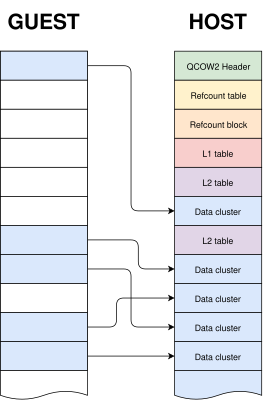
A closer look under the hood QEMU uses disk images to store the contents of the VM s hard drive. Images are often in qcow2, QEMU s native format, although a variety of other formats and protocols are also supported. I have written in detail about the qcow2 format in the past (for example, here and here), but the general idea is very easy to understand: the virtual drive is divided into clusters of a certain size (64 KB by default), and only the clusters containing non-zero data need to be physically present in the qcow2 image. So what we have is essentially a collection of data clusters and a set of tables that map guest clusters (what the VM sees) to host clusters (what the qcow2 file actually stores).
A qcow2 file is a collection of data clusters plus some metadata to map them to what the guest VM sees.
qemu-img is a powerful and versatile tool that can be used to create, modify and convert disk images. It has many different options, but one question that sometimes arises is whether it can use stdin or stdout instead of regular files when converting images. The short answer is that this is not possible in general. qemu-img convert works by checking the (virtual) size of the source image, creating a destination image of that same size and finally copying all the data from start to finish. Reading a qcow2 image from stdin doesn t work because data and metadata blocks can come in any arbitrary order, so it s perfectly possible that the information that we need in order to start writing the destination image is at the end of the input data . Writing a qcow2 image to stdout doesn t work either because we need to know in advance the complete list of clusters from the source image that contain non-zero data (this is essential because it affects the destination file s metadata). However, if we do have that information then writing a new image directly to stdout is technically possible. The bad news is that qemu-img won t help us here: it uses the same I/O code as the rest of QEMU. This generic approach makes total sense because it s simple, versatile and is valid for any kind of source and destination image that QEMU supports. However, it needs random access to both images. If we want to write a qcow2 file directly to stdout we need new code written specifically for this purpose, and since it cannot reuse the logic present in the QEMU code this was written as a separate tool (a Python script). The process itself goes like this:
  • Read the source image from start to finish in order to determine which clusters contain non-zero data. These are the only clusters that need to be present in the new image.
  • Write to stdout all the metadata structures of the new image. This is now possible because after the previous step we know how much data we have and where it is located.
  • Read the source image again and copy the clusters with non-zero data to stdout.
Images created with this program always have the same layout: header, refcount tables and blocks, L1 and L2 tables, and finally all data clusters. One problem here is that, while QEMU can read many different image formats, qcow2-to-stdout.py is an independent tool that does not share any of the code and therefore can only read raw files. The solution here is to use qemu-storage-daemon. This program is part of QEMU and it can use FUSE to export any file that QEMU can read as a raw file. The usage of qemu-storage-daemon is handled automatically and the user only needs to specify the format of the source file: $ qcow2-to-stdout.py -f dmg source.dmg > dest.qcow2 qcow2-to-stdout.py can only create basic qcow2 files and does not support features like compression or encryption. However, a few parameters can be adjusted, like the cluster size (-c), the width of the reference count entries (-r) and whether the new image is created with the input as an external data file (-d and -R). And this is all, I hope that you find this tool useful and this post informative. Enjoy!

Acknowledgments This work has been developed by Igalia and sponsored by Outscale, a Dassault Syst mes brand.
Logos of Igalia and Outscale

This problem would not happen if the input data was in raw format but in this case we would not know the size in advance.

Dirk Eddelbuettel: anytime 0.3.12 on CRAN: Minor Bugfix and Maintenance

A maintenance release 0.3.132 of the anytime package arrived on CRAN today. The package is fairly feature-complete, and code and functionality remain mature and stable. anytime is a very focused package aiming to do just one thing really well: to convert anything in integer, numeric, character, factor, ordered, input format to either POSIXct (when called as anytime) or Date objects (when called as anydate) and to do so without requiring a format string as well as accomodating different formats in one input vector. See the anytime page, or the GitHub repo for a few examples, and the beautiful documentation site for all documentation. This release covers a corner case reported in a GitHub issue: the (nonsensical but possible) input of zero-length (floating point or integer) vectors was not dealt with properly which lead to an error. We now return the requested type (POSIXct or Date, depending on the call) also with length zero. Two minor maintenance tasks were also addressed since the last release six months ago. The short list of changes follows.

Changes in anytime version 0.3.12 (2025-07-14)
  • Continuous integration now uses r-ci action with embedded bootstrap
  • The versioned depends on Rcpp now requires 1.0.8 or newer to support use of the updated header file structure
  • The corner-case of an empty (numeric or integer) vector argument is now addressed, new tests have been added (#135)))

Courtesy of my CRANberries, there is also a diffstat report of changes relative to the previous release. The issue tracker tracker off the GitHub repo can be use for questions and comments. More information about the package is at the package page, the GitHub repo and the documentation site.

This post by Dirk Eddelbuettel originated on his Thinking inside the box blog. If you like this or other open-source work I do, you can now sponsor me at GitHub.

14 July 2025

David Bremner: Hibernate on the pocket reform 6/n

Context

Another kernel patch?
  • Confused about prerequisites, I wrote
  • A reply from Niklas Cassel suggested I look at https://lore.kernel.org/linux-pci/1744940759-23823-1-git-send-email-shawn.lin@rock-chips.com/
  • EDIT It turns out that this patch is already shipped as part of the mnt research kernel. It will need rebasing for 6.16.x.

Applying the prerequisites
  • Niklas also point me to https://lore.kernel.org/linux-pci/20250508-pcie-reset-slot-v4-0-7050093e2b50@linaro.org/
  • Since the new patch doesn't apply to linux master either, I guess I need to apply that series. But part of it is already applied, fun.
  • I'm not claiming this is the best way...
# index 31090770fffcc94e15 from the first patch in the series
$ git log --raw --all --find-object=31090770fffcc94e15
# The applied version of the first patch is  b06d125e6280603a34d9064cd9c12748ca2edb04 
$ git switch -c base b06d125e6280603a34d9064cd9c12748ca2edb04^
$ mbox-extract-patch < ~/Downloads/PATCH-v4-1-5-PCI-ERR-Remove-misleading-TODO-regarding-kernel-panic.mbox   git am
$ git rebase -i master  # two applied patches skipped
$ git switch master && git merge base
  • mbox-extract-patch is from package mailscripts.
  • git am -3 ~/tmp/PATCH-v3-PCI-dw-rockchip-Add-support-for-slot-reset-on-link-down-event.txt
  • Currently can't get the "Add system PM support" patch to apply, will test the others first.
  • Except that a test build tells me I need to rebase all of my patches against 6.15.x, rather the the current 6.16~rcX
previous episode next episode

12 July 2025

Bits from Debian: Debconf25 welcomes its sponsors

DebConf25 logo DebConf25, the 26th edition of the Debian conference is taking place in Brest Campus of IMT Atlantique Bretagne-Pays de la Loire, France. We appreciate the organizers for their hard work, and hope this event will be highly beneficial for those who attend in person as well as online. This event would not be possible without the help from our generous sponsors. We would like to warmly welcome the sponsors of DebConf 25, and introduce them to you. We have five Platinum sponsors. Our Gold sponsors are: Our Silver sponsors are: Bronze sponsors: And finally, our Supporter level sponsors: A special thanks to the IMT Atlantique Bretagne-Pays de la Loire, our Venue Partner and our Network Partner ResEl! Thanks to all our sponsors for their support! Their contributions enable a diverse global community of Debian developers and maintainers to collaborate, support one another, and share knowledge at DebConf25.

Christian Kastner: Easy dynamic dispatch using GLIBC Hardware Capabilities

TL;DR With GLIBC 2.33+, you can build a shared library multiple times targeting various optimization levels, and the dynamic linker/loader will pick the highest version supported by the current CPU. For example, with the layout below, on a Ryzen 9 5900X, x86-64-v3/libfoo0.so would be loaded:
/usr/lib/glibc-hwcaps/x86-64-v4/libfoo0.so
/usr/lib/glibc-hwcaps/x86-64-v3/libfoo0.so
/usr/lib/glibc-hwcaps/x86-64-v2/libfoo0.so
/usr/lib/libfoo0.so
Longer Version GLIBC Hardware Capabilities or "hwcaps" are an easy, almost trivial way to add a simple form of dynamic dispatch to any amd64 or POWER build, provided that either the build target or the compiler's optimizations can make use of certain CPU extensions. Mo Zhou pointed me towards this when I was faced with the challenge of creating a performant Debian package for ggml, the tensor library behind llama.cpp and whisper.cpp.
The Challenge A performant yet universally loadable library needs to make use of some form of dynamic dispatch to leverage the most effective SIMD extensions available on any given CPU it may run on. Last January, when I first started with the packaging of ggml for Debian, ggml did have support for this through its GGML_CPU_ALL_VARIANTS=ON option, but this was limited to amd64. This meant that on all the other architectures that Debian supports, I would need to target some ancient baseline, thus effectively crippling the package there.
Dynamic Dispatch using hwcaps hwcaps were introduced in GLIBC 2.33 and replace the (now) Legacy Hardware Capabilities, which were removed in 2.37. The way hwcaps work is delightfully simple: the dynamic linker/loader will look for a shared library not just in the standard library paths, but also in subdirectories thereof of the form hwcaps/<level>, starting with the highest <level> that the current CPU supports. The levels are predefined. I'm using the amd64 levels below. For ggml, this meant that I simply could build the library in multiple passes, each time targeting a different <level>, and install the result in the corresponding subdirectory, which resulted in the following layout (reduced to libggml.so for brevity):
/usr/lib/x86_64-linux-gnu/ggml/glibc-hwcaps/x86-64-v4/libggml.so
/usr/lib/x86_64-linux-gnu/ggml/glibc-hwcaps/x86-64-v3/libggml.so
/usr/lib/x86_64-linux-gnu/ggml/glibc-hwcaps/x86-64-v2/libggml.so
/usr/lib/x86_64-linux-gnu/ggml/libggml.so
In practice, this means that on a CPU supporting AVX512, the linker/loader would load x86-64-v4/libggml.so if it existed, and otherwise continue to look for the other levels, all the way down to the lowest one. On a CPU which supported only SSE4.2, the lookup process would be the same, ending with picking x86-64-v2/libggml.so. With QEMU, all of this was quickly verified. Note that the lowest-level library, targeting x86-64-v1, is not installed to a subdirectory, but to the path where the library would normally have been installed. This has the nice property that on systems not using GLIBC, and thus not having hwcaps available, package installation will still result in a loadable library, albeit the version with the worst performance. And a careful observer might have noticed that in the example above, the library is installed to a private ggml/ directory, so this mechanism also works when using RUNPATH or LD_LIBRARY_PATH. As mentioned above, Debian's ggml package will soon switch to GGML_CPU_ALL_VARIANTS=ON, but this was still quite the useful feature to discover.

Reproducible Builds: Reproducible Builds in June 2025

Welcome to the 6th report from the Reproducible Builds project in 2025. Our monthly reports outline what we ve been up to over the past month, and highlight items of news from elsewhere in the increasingly-important area of software supply-chain security. If you are interested in contributing to the Reproducible Builds project, please see the Contribute page on our website. In this report:
  1. Reproducible Builds at FOSSY 2025
  2. Distribution work
  3. diffoscope
  4. OSS Rebuild updates
  5. Website updates
  6. Upstream patches
  7. Reproducibility testing framework

Reproducible Builds at FOSSY 2025 On Saturday 2nd August, Vagrant Cascadian and Chris Lamb will be presenting at this year s FOSSY 2025. Their talk, titled Never Mind the Checkboxes, Here s Reproducible Builds!, is being introduced as follows:
There are numerous policy compliance and regulatory processes being developed that target software development but do they solve actual problems? Does it improve the quality of software? Do Software Bill of Materials (SBOMs) actually give you the information necessary to verify how a given software artifact was built? What is the goal of all these compliance checklists anyways or more importantly, what should the goals be? If a software object is signed, who should be trusted to sign it, and can they be trusted forever?
The talk will introduce the audience to Reproducible Builds as a set of best practices which allow users and developers to verify that software artifacts were built from the source code, but also allows auditing for license compliance, providing security benefits, and removes the need to trust arbitrary software vendors. Hosted by the Software Freedom Conservancy and taking place in Portland, Oregon, USA, FOSSY aims to be a community-focused event: Whether you are a long time contributing member of a free software project, a recent graduate of a coding bootcamp or university, or just have an interest in the possibilities that free and open source software bring, FOSSY will have something for you . More information on the event is available on the FOSSY 2025 website, including the full programme schedule. Vagrant and Chris will also be staffing a table this year, where they will be available to answer any questions about Reproducible Builds and discuss collaborations with other projects.

Distribution work In Debian this month:
  • Holger Levsen has discovered that it is now possible to bootstrap a minimal Debian trixie using 100% reproducible packages. This result can itself be reproduced, using the debian-repro-status tool and mmdebstrap s support for hooks:
      $ mmdebstrap --variant=apt --include=debian-repro-status \
           --chrooted-customize-hook=debian-repro-status \
           trixie /dev/null 2>&1   grep "Your system has"
       INFO  debian-repro-status > Your system has 100.00% been reproduced.
    
  • On our mailing list this month, Helmut Grohne wrote an extensive message raising an issue related to Uploads with conflicting buildinfo filenames:
    Having several .buildinfo files for the same architecture is something that we plausibly want to have eventually. Imagine running two sets of buildds and assembling a single upload containing buildinfo files from both buildds in the same upload. In a similar vein, as a developer I may want to supply several .buildinfo files with my source upload (e.g. for multiple architectures). Doing any of this is incompatible with current incoming processing and with reprepro.
  • 5 reviews of Debian packages were added, 4 were updated and 8 were removed this month adding to our ever-growing knowledge about identified issues.

In GNU Guix, Timothee Mathieu reported that a long-standing issue with reproducibility of shell containers across different host operating systems has been solved. In their message, Timothee mentions:
I discovered that pytorch (and maybe other dependencies) has a reproducibility problem of order 1e-5 when on AVX512 compared to AVX2. I first tried to solve the problem by disabling AVX512 at the level of pytorch, but it did not work. The dev of pytorch said that it may be because some components dispatch computation to MKL-DNN, I tried to disable AVX512 on MKL, and still the results were not reproducible, I also tried to deactivate in openmpi without success. I finally concluded that there was a problem with AVX512 somewhere in the dependencies graph but I gave up identifying where, as this seems very complicated.

The IzzyOnDroid Android APK repository made more progress in June. Not only have they just passed 48% reproducibility coverage, Ben started making their reproducible builds more visible, by offering rbtlog shields, a kind of badge that has been quickly picked up by many developers who are proud to present their applications reproducibility status.
Lastly, in openSUSE news, Bernhard M. Wiedemann posted another monthly update for their work there.

diffoscope diffoscope is our in-depth and content-aware diff utility that can locate and diagnose reproducibility issues. This month, Chris Lamb made the following changes, including preparing and uploading versions 298, 299 and 300 to Debian:
  • Add python3-defusedxml to the Build-Depends in order to include it in the Docker image. [ ]
  • Handle the RPM format s HEADERSIGNATURES and HEADERIMMUTABLE as a special-case to avoid unnecessarily large diffs. Thanks to Daniel Duan for the report and suggestion. [ ][ ]
  • Update copyright years. [ ]
In addition, @puer-robustus fixed a regression introduced in an earlier commit which resulted in some differences being lost. [ ][ ] Lastly, Vagrant Cascadian updated diffoscope in GNU Guix to version 299 [ ][ ] and 300 [ ][ ].

OSS Rebuild updates OSS Rebuild has added a new network analyzer that provides transparent HTTP(S) interception during builds, capturing all network traffic to monitor external dependencies and identify suspicious behavior, even in unmodified maintainer-controlled build processes. The text-based user interface now features automated failure clustering that can group similar rebuild failures and provides natural language failure summaries, making it easier to identify and understand patterns across large numbers of build failures. OSS Rebuild has also improved the local development experience with a unified interface for build execution strategies, allowing for more extensible environment setup for build execution. The team also designed a new website and logo.

Website updates Once again, there were a number of improvements made to our website this month including:
  • Arnaud Brousseau added Stage , a new Linux distribution, to our Tools page.
  • Chris Lamb improved the docker instructions on the diffoscope website. [ ]


Upstream patches The Reproducible Builds project detects, dissects and attempts to fix as many currently-unreproducible packages as possible. We endeavour to send all of our patches upstream where appropriate. This month, we wrote a large number of such patches, including:

Reproducibility testing framework The Reproducible Builds project operates a comprehensive testing framework running primarily at tests.reproducible-builds.org in order to check packages and other artifacts for reproducibility. In June, however, a number of changes were made by Holger Levsen, including:
  • reproduce.debian.net-related:
    • Installed and deployed rebuilderd version 0.24 from Debian unstable in order to make use of the new compression feature added by Jarl Gullberg for the database. This resulted in massive decrease of the SQLite databases:
      • 79G 2.8G (all)
      • 84G 3.2G (amd64)
      • 75G 2.9G (arm64)
      • 45G 2.1G (armel)
      • 48G 2.2G (armhf)
      • 73G 2.8G (i386)
      • 72G 2.7G (ppc64el)
      • 45G 2.1G (riscv64)
      for a combined saving from 521G 20.8G. This naturally reduces the requirements to run an independent rebuilderd instance and will permit us to add more Debian suites as well.
    • During migration to the latest version of rebuilderd, make sure several services are not started. [ ]
    • Actually run rebuilderd from /usr/bin. [ ]
    • Raise temperatures for NVME devices on some riscv64 nodes that should be ignored. [ ][ ]
    • Use a 64KB kernel page size on the ppc64el architecture (see #1106757). [ ]
    • Improve ordering of some failed to reproduce statistics. [ ]
    • Detect a number of potential causes of build failures within the statistics. [ ][ ]
    • Add support for manually scheduling for the any architecture. [ ]
  • Misc:
    • Update the Codethink nodes as there are now many kernels installed. [ ][ ]
    • Install linux-sysctl-defaults on Debian trixie systems as we need ping functionality. [ ]
    • Limit the fs.nr_open kernel turnable. [ ]
    • Stop submitting results to deprecated buildinfo.debian.net service. [ ][ ]
In addition, Jochen Sprickerhof greatly improved the statistics and the logging functionality, including adopting to the new database format of rebuilderd version 0.24.0 [ ] and temporarily increasing maximum log size in order to debug a nettlesome build [ ]. Jochen also dropped the CPUSchedulingPolicy=idle systemd flag on the workers. [ ]

Finally, if you are interested in contributing to the Reproducible Builds project, please visit our Contribute page on our website. However, you can get in touch with us via:

Louis-Philippe V ronneau: Adulting

In the last past weeks, I have done something I had been meaning to do for a while but always pushed back at the bottom of my TODO pile: prepare for my death. I am still quite young and perfectly healthy (mentally and physically) and I do plan to live a long and full life, but death is something that comes from us all and can strike anytime. Having witnessed friends and colleagues who lost loved ones who did not prepare adequately for their passing, dealing with all this legal stuff ahead of time seems like the best gift you can leave them. Writing my will was the easiest part of this "preparation for death" process. I have few material possessions and I'm leaving everything to my SO. As for the copyright for my code, I have decided everything I wrote will be licensed under CC0 (public domain) when I die. Quebec where I live also accepts holograph wills, which means I didn't have to hire a notary. Apart from the will, I also wrote a protection mandate1, filled out Quebec's organ donation form2, took a contract for prearranged funeral services3 and finally, wrote a disaster recovery plan. This recovery plan was by far the longest and most tedious part of this entire ordeal. If all your machines use full-disk encryption and you die or forget your passwords (for example after a head injury), can your data be recovered? How do you arbitrate between easy recovery and data security? If all your local devices burn down and you also pass away in the process, how will your next of kin access your remote backups and extract the relevant data (in my case, my password manager)? I had to ask myself many complex questions in this process and although I won't be sharing my disaster recovery plan here (security through obscurity), I urge you to take the time to do something similar yourself and make sure you will leave a house in order when you go away.

  1. in case I become incapacitated and can't make choices by myself anymore.
  2. it's sadly still opt-in here...
  3. you pay now for the services you want, the money is kept in a trust in your name and you can't be charged extra when you do pass away. This protects you from inflation and is a great way to make sure your next of kin don't have to deal with the complexities of funeral services while grieving.

Freexian Collaborators: Monthly report about Debian Long Term Support, June 2025 (by Roberto C. S nchez)

Like each month, have a look at the work funded by Freexian s Debian LTS offering.
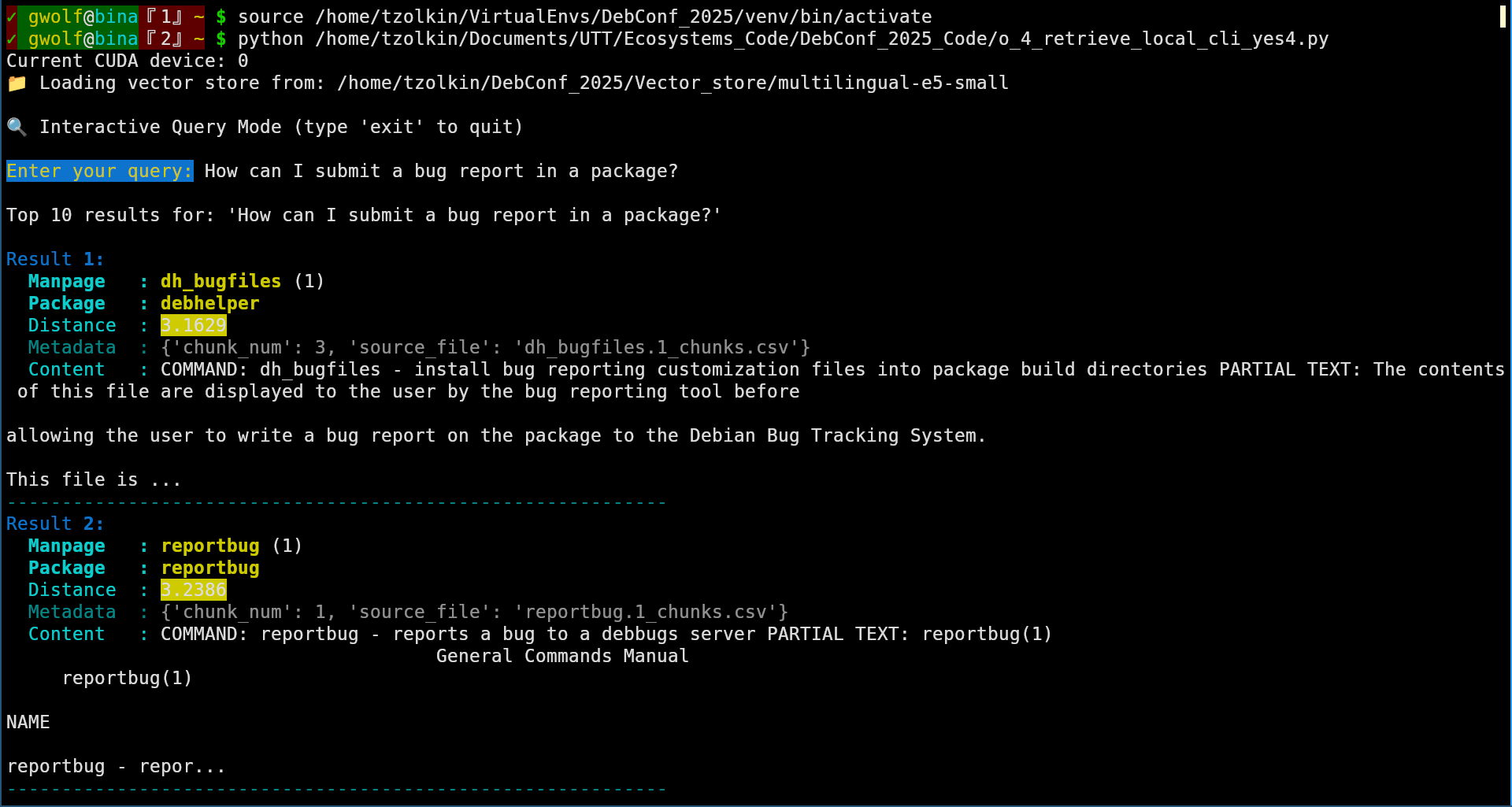
Debian LTS contributors In June, 20 contributors have been paid to work on Debian LTS, their reports are available:
  • Abhijith PA did 14.0h (out of 14.0h assigned).
  • Adrian Bunk did 23.5h (out of 23.5h assigned).
  • Andreas Henriksson did 3.0h (out of 3.0h assigned and 17.0h from previous period), thus carrying over 17.0h to the next month.
  • Andrej Shadura did 2.0h (out of 3.0h assigned and 7.0h from previous period), thus carrying over 8.0h to the next month.
  • Bastien Roucari s did 20.0h (out of 20.0h assigned).
  • Ben Hutchings did 8.0h (out of 7.5h assigned and 16.0h from previous period), thus carrying over 15.5h to the next month.
  • Carlos Henrique Lima Melara did 12.0h (out of 12.0h assigned).
  • Chris Lamb did 18.0h (out of 18.0h assigned).
  • Daniel Leidert did 22.0h (out of 22.5h assigned and 1.0h from previous period), thus carrying over 1.5h to the next month.
  • Emilio Pozuelo Monfort did 23.5h (out of 16.75h assigned and 6.75h from previous period).
  • Guilhem Moulin did 14.0h (out of 11.5h assigned and 3.5h from previous period), thus carrying over 1.0h to the next month.
  • Jochen Sprickerhof did 21.0h (out of 0.5h assigned and 22.75h from previous period), thus carrying over 2.25h to the next month.
  • Lucas Kanashiro did 20.0h (out of 20.0h assigned).
  • Markus Koschany did 23.25h (out of 17.0h assigned and 6.25h from previous period).
  • Roberto C. S nchez did 21.25h (out of 20.75h assigned and 3.25h from previous period), thus carrying over 2.75h to the next month.
  • Santiago Ruano Rinc n did 12.75h (out of 15.0h assigned), thus carrying over 2.25h to the next month.
  • Sean Whitton did 1.0h (out of 4.25h assigned and 1.75h from previous period), thus carrying over 5.0h to the next month.
  • Sylvain Beucler did 23.5h (out of 23.5h assigned).
  • Thorsten Alteholz did 15.0h (out of 15.0h assigned).
  • Tobias Frost did 2.5h (out of 12.0h assigned), thus carrying over 9.5h to the next month.

Evolution of the situation In June, we released 35 DLAs.
  • Notable security updates:
    • mariadb-10.5, prepared by Otto Kek l inen, fixes vulnerabilities which could result in denial of service, information disclosure, or unauthorized data modification
    • python-django, prepared by Chris Lamb, fixes vulnerabilities which would result in log injection or denial of service
    • webkit2gtk, prepared by Emilio Pozuelo Monfort, fixes many vulnerabilities which could results in a wide range of issues
    • xorg-server, prepared by Emilio Pozuelo Monfort, fixes multiple vulnerabilities which may result in privilege escalation
    • sudo, prepared by Thorsten Alteholz, fixes a vulnerability which could result in privilege escalation
  • Notable non-security updates:
    • debian-security-support, prepared by Santiago Ruano Rinc n, updates status of packages which receive limited security support or which have reached the end of security support
    • dns-root-data, prepared by Sylvain Beucler, updates the DNSSEC trust anchors
This month s contributions from outside the regular team include the mariadb-10.5 update mentioned above, prepared by Otto Kek l inen (the package maintainer); an update to libfile-find-rule-perl, prepared by Salvatore Bonaccorso (a member of the Debian Security Team); an update to activemq, prepared by Emmanuel Arias (a maintainer of the package). Additionally, LTS Team members contributed stable updates of the following packages:
  • curl, prepared by Carlos Henrique Lima Melara
  • python-tornado, prepared by Daniel Leidert
  • python-flask-cors, prepared by Daniel Leidert
  • common-vfs, prepared by Daniel Leidert
  • cjson, prepared by Adrian Bunk
  • icu, prepared by Adrian Bunk
  • node-tar-fs, prepared by Adrian Bunk
  • rar, prepared by Adrian Bunk
Something of particular noteworthiness is that LTS contributor Carlos Henrique Lima Melara discovered a regression in the upstream fix for CVE-2023-2753 in curl. The corrective action which he took included providing a patch to upstream, uploading a stable update of curl, and further updating the version of curl in LTS. DebConf, the annual Debian Conference, is coming up in July and, as is customary each year, the week preceding the conference will feature an event called DebCamp. The DebCamp week provides an opportunity for teams and other interested groups/individuals to meet together in person in the same venue as the conference itself, with the purpose of doing focused work, often called sprints . LTS coordinator Roberto C. S nchez has announced that the LTS Team is planning to hold a sprint primarily focused on the Debian security tracker and the associated tooling used by the LTS Team and the Debian Security Team.

Thanks to our sponsors Sponsors that joined recently are in bold.

Freexian Collaborators: Debian Contributions: unschroot, DebConf 25 preparations and more! (by Anupa Ann Joseph)

Debian Contributions: 2025-06 Contributing to Debian is part of Freexian s mission. This article covers the latest achievements of Freexian and their collaborators. All of this is made possible by organizations subscribing to our Long Term Support contracts and consulting services.

unschroot, by Helmut Grohne Quite a while back, the sbuild maintainers added the unshare backend to enable better isolation of builds, but in doing so sbuild now effectively bundles a container runtime. unschroot is an attempt to separate containment from sbuild by implementing the same features and more in a schroot-compatible way. Last year, vague feature parity was achieved, but going beyond required changing the model from keeping state in the filesystem to keeping Linux namespaces as session state. A proof of concept is now available. While it still has sharp corners, it enables building packages on a squashfs with an overlayfs or id-mapped bind mounting of your ccache neither of which is possible with sbuild s unshare backend. There shall be a DebConf25 presentation about this work.

DebConf 25, by Stefano Rivera, Santiago Ruano Rinc n and Lucas Kanashiro DebConf 25 is now under way in Brest, France. Santiago is part of the local team running the event, and Stefano Rivera is part of the DebConf committee, supporting the event, as well as the video team. Both have spent considerable time in the last month, getting things ready for DebConf. Lucas Kanashiro built the schedule for DebConf 25. Also followed-up on multiple requests from speakers and stakeholders.

Miscellaneous contributions
  • Carles did general maintenance on simplemonitor, qnetload and qdacco packages; provided simplemonitor upstream feedback on new feature.
  • Carles s updates about po-debconf-manager: prepared for DebCamp/DebConf, used it for reviewing and merging different packages. Also fixed multispeech po-debconf templates.
  • Colin Watson found a crash in pterm (PuTTY s terminal emulator) when running in a Wayland session, and backported the resulting upstream fix to trixie.
  • Colin responded to an upstream groff bug report about URLs being dropped from PDF output in some cases on Debian, and backported the fix to trixie.
  • Helmut dealt with issues related to /usr-move. Most prominently Christian Hofstaedler reported an upgrade failure. /usr-move is a contributing factor here as that s what caused systemd to upgrade a number of Breaks and Replaces to Conflicts. dumat needed some help with dropping mips64el from testing and Theodore Ts o forwarded a fuse2fs upgrade failure.
  • Helmut sent patches for 25 cross build failures.
  • Helmut debugged rebootstrap failures and worked around build failures related to gcc-15 when they had patches and sent ones otherwise.
  • Thorsten Alteholz uploaded cups to fix a FTBFS-bug. This bug was introduced by a change in systemd, which bumped the maximum number of open files. This resulted in a longer test duration that triggered a timeout so that the build failed. Thorsten also uploaded mtink and lprng, which got new translation files.
  • Lucas Kanashiro followed-up on multiple unblock requests for ruby packages due to reproducible builds fixes. All of them were accepted into trixie.
  • Lucas Kanashiro discussed license issues with upstream involving Redis 8 new license and the possibility of backporting patches to old versions with a different license. Outcome is that upstream is adding a new paragraph to their license to allow the backport for security fixes.
  • Lucas Kanashiro fixed multiple CVEs reported against valkey in unstable and trixie.
  • Lucas Kanashiro gave a Debian packaging course of 8 hours for students at a free software development course at the University of Sao Paulo.
  • Lucas Kanashiro fixed a couple of cross building issues in the ruby ecosystem with Helmut s help.
  • Lucas Kanashiro is working on a debci fix for #1107645 (ongoing).
  • Stefano Rivera updated python-mitogen to the latest beta releases with upstream support for Ansible 12.
  • Stefano Rivera spent some time winding up DebConf 24 books.
  • Stefano Rivera fixed packages that were blocking cPython 3.13.5 from migrating to trixie, and filed an unblock request.
  • Stefano Rivera investigated a regression in cPython 3.13 that was breaking OpenStack Nova. There is a patch in progress for cPython, but it is not ready for use, yet.
  • Santiago reviewed different MRs in Salsa CI. For example, the MR !605 proposed by Aquila that aims to introduce a new debdiff job, as well as the autopkgtest MR !33 to extend the support to architectures other than amd64. Also reviewed MR !611 by Aayush Raj that fixes the autopkgtest images cleanup. And the MR !614, prepared by Charles, to change the suffix name used to bump the version used in the pipeline.
  • Anupa procured supplies needed for the DebConf ID tag for the DebConf registration team and co-ordinated its transport to the venue.
  • Anupa joined Nattie to complete the registration team tasks.

11 July 2025

Jamie McClelland: Avoiding Apache Max Request Workers Errors

Wow, I hate this error:
AH00484: server reached MaxRequestWorkers setting, consider raising the MaxRequestWorkers setting
For starters, it means I have to relearn how MaxRequestWorkers functions in Apache:
For threaded and hybrid servers (e.g. event or worker), MaxRequestWorkers restricts the total number of threads that will be available to serve clients. For hybrid MPMs, the default value is 16 (ServerLimit) multiplied by the value of 25 (ThreadsPerChild). Therefore, to increase MaxRequestWorkers to a value that requires more than 16 processes, you must also raise ServerLimit.
Ok remind me what ServerLimit refers to?
For the prefork MPM, this directive sets the maximum configured value for MaxRequestWorkers for the lifetime of the Apache httpd process. For the worker and event MPMs, this directive in combination with ThreadLimit sets the maximum configured value for MaxRequestWorkers for the lifetime of the Apache httpd process. For the event MPM, this directive also defines how many old server processes may keep running and finish processing open connections. Any attempts to change this directive during a restart will be ignored, but MaxRequestWorkers can be modified during a restart. Special care must be taken when using this directive. If ServerLimit is set to a value much higher than necessary, extra, unused shared memory will be allocated. If both ServerLimit and MaxRequestWorkers are set to values higher than the system can handle, Apache httpd may not start or the system may become unstable. With the prefork MPM, use this directive only if you need to set MaxRequestWorkers higher than 256 (default). Do not set the value of this directive any higher than what you might want to set MaxRequestWorkers to. With worker, use this directive only if your MaxRequestWorkers and ThreadsPerChild settings require more than 16 server processes (default). Do not set the value of this directive any higher than the number of server processes required by what you may want for MaxRequestWorkers and ThreadsPerChild. With event, increase this directive if the process number defined by your MaxRequestWorkers and ThreadsPerChild settings, plus the number of gracefully shutting down processes, is more than 16 server processes (default).
Got it? In other words, you can consider raising the MaxRequestWorkers setting all you want, but you can t just change that setting, you have to read about several other compliated settings, do some math, and spend a lot of time wondering if you are going to remember what you just did and how to undo it if you blow up your server. On the plus side, typically, nobody should increase this limit - because if the server runs out of connections, it usually means something else is wrong. In our case, on a shared web server running Apache2 and PHP-FPM, it s usually because a single web site has gone out of control. But wait! How can that happen, we are using PHP-FPM s max_children setting to prevent a single PHP web site from taking down the server? After years of struggling with this problem I have finally made some headway. Our PHP pool configuration typically looks like this:
user = site342999writer
group = site342999writer
listen = /run/php/8.1-site342999.sock
listen.owner = www-data
listen.group = www-data
pm = ondemand
pm.max_children = 12
pm.max_requests = 500
php_admin_value[memory_limit] = 256M
And we invoke PHP-FPM via this apache snippet:
<FilesMatch \.php$>
        SetHandler "proxy:unix:/var/run/php/8.1-site342999.sock fcgi://localhost"
</FilesMatch>
With these settings in place, what happens when we use up all 12 max_children? According to the docs:
By default, mod_proxy will allow and retain the maximum number of connections that could be used simultaneously by that web server child process. Use the max parameter to reduce the number from the default. The pool of connections is maintained per web server child process, and max and other settings are not coordinated among all child processes, except when only one child process is allowed by configuration or MPM design.
The max parameter seems to default to the ThreadsPerChild, so it seems that the default here is to allow any web site to consume ThreadsPerChild (25) x ServerLimit (16), which is also the max number of over all connections. Not great. To make matter worse, there is another setting available which is mysteriously called acquire:
If set, this will be the maximum time to wait for a free connection in the connection pool, in milliseconds. If there are no free connections in the pool, the Apache httpd will return SERVER_BUSY status to the client.
By default this is not set which seems to suggest Apache will just hang on to connections forever until a free PHP process becomes available (or some other time out happens). So, let s try something different:
 <Proxy "fcgi://localhost">
    ProxySet acquire=1 max=12
  </proxy>
This snippet is the way you can configure the proxy configuration we setup in the SetHandler statement above. It s documented on the Apache mod_proxy page. Now we limit the maximum pool size per process to half of what is available for the entire server and we tell Apache to immediately throw a 503 error if we have exceeded our maximum number of connecitons. Now, if a site is overwhelmed with traffic, instead of maxing out the available Apache connections while leaving user with constantly spinning browsers, the users will get 503 ed and the server will be able to server other sites.

Next.

Previous.