Search Results: "enrico"

2 March 2006

Enrico Zini: DPL Elections - My questions for the candidates

Campaigning started and everyone is trying their best to ask something that's never been asked before to a DPL candidate. It tickles me, and today I don't feel like hacking: I have to try. Here's my list of questions:
  • Please write a list of 5 Debian Developers you would like to kick out of the project.
  • Please write a list of 5 Debian Developers you would like to see as DPL instead of you.
  • Please point to 5 threads in which you were happy to take part.
  • Please point to 5 threads in which you didn't want to take part, but you ended up doing it anyway.
  • Please point to 5 websites you usually visit.
  • Vim or Emacs?
  • What do you see in the image at http://tinyurl.com/d6s59 ?
  • What is the next word in the sequence "GIANT ROBOTS, sex, JET PACKS, sex, CITIES ON THE MOON, sex, SPACE COLONIES, sex, FLYING CARS, beer..." ?
  • Please ask yourself a question, then answer it.
  • Is life a dream, or dreams help to live better?
(this blog post is dedicated to Gigi Marzullo) Update: http://www.enricozini.org/store/dplquestion.grm

Enrico Zini: My ideas for a DPL platform

My ideas for a DPL platform I regret I didn't candidate because this year I have great ideas for a DPL charter. Here's a list.
Debian press No more people in charge of press: we replace it with a polygen grammar generating press messages, and we run it once a week. This way we won't have the problem of a silent press team, and Debian will be a steady, rocking voice in the world of Linux distributions. This will solve visibility problems compared to Ubuntu, where people perceive that Ubuntu is more important than Debian because they make more frequent and flashy press releases.
Debian releases Whenever the autogenerated polygen press message will mention a new release, we immediately release. This will allow Debian to finally release early and often like a good Open Source project should do, and still won't make us give up the unpredictability of the release cycle that makes things interesting and fun.
Security support This goes in two steps:
  1. By correctly designing the frequency patterns of the Press polygen grammar, we can tweak the mean time between releases to be about a month.
  2. We increase the quality of security support we offer to our users by supporting release updates for both stable and oldstable.
This means having to do security support for a package for no more than 2 months, and would greatly ease the workload of the Security Team.
Migration of packages into testing The migration procedure of a package into testing needs to be changed. In particular, every version of a package which is a suitable candidate for testing must be manually approved by the maintainer using a non-obvious procedure. Say, send a cryptographically signed mail to a bot that will reply with an encrypted mail with a one-shot web link to a page requiring Java to log in so that you can't set your browser to remember your password. And instructions written in very long complicated phrases by a literate Italian and then translated into English by a literate German. This will ensure that only maintainers motivated enough to maintain good quality in their packages will have them transitioned to testing, and ultimately in the stable release. In case of maintainers who are MIA or don't care about their packages, then the damage they would cause to the stable release would be drastically limited.
Version numbers As a GNU/Linux distribution, we have a duty to protest against the new crazy versioning scheme adopted by the Linux Kernel. For that purpose, I propose to adopt a new versioning scheme for our releases (and possibly for our packages as well). The idea is simple: replace numbers with names of fruits and vegetables, properly alphabetically sorted. Such as:
  1. Artichoke
  2. Banana
  3. Carrot
  4. Dates
  5. Eucaliptus
  6. Fig
  7. Garlic
...and so on. Etch release would then be "Debian GNU/Linux Etch 3.Banana". This would also help when choosing an alternative logo for the release, in case the release name summons only bad ideas like it happened with Sarge. In case one has to choose among various fruits and vegetables with the same initials, please prefer the ones that are in season at the time of the release.
Flamewars Flamewars are easily solved by approval of this extra-reduced community guideline:
  1. If you think that mailing list are unpleasant, stop reading them for a while and fix some bugs.
  2. If you think mailing lists are lots of fun, chances are that you're wasting too much time on them and you should fix some bugs instead.
The simplicity of these guidelines also makes them easily enforceable with a simple algorithm:
  • You can only post in the mailing lists if you have fixed some bugs.
  • Fixing a bugs entitles you to post up to 2 messages in the Debian mailing lists.
  • All further postings will be held until bugs are fixed, and automatically discarded if not enough bugs are fixed within 1 day of the message being held.

Jordi Mallach: FOSDEM 2006

I'm so glad I finally decided to attend FOSDEM this year, as last weekend in Bruxelles was so cool it reminded me of the unforgettable week in Helsinki for DebConf 5 last summer. I travelled early on Friday with Ivan Vilata, the dude who dragged me into the Catalan translations world, and about 12:30 we were finding our way through Bruxelles airport. We had barely no problems getting to Ra l's place in Boulevard Louis Schmidt, thanks to the detailed HOWTO he provided a few days before. We dropped our bags in his appartment and went out with him and Virginia after a well deserved mini-nap. On our way to the Grand' Place, where we'd hook up with the Softcatal crowd and the rest of FOSDEM people, we stopped in A la Morte Subite, where we Ivan and I started our personal training on Belgian beers. The Roy d'Espagne is an excellent name for a place where to meet our friends from Catalunya. I didn't know that was a formal meeting point that kickstarts FOSDEM, so I was really impressed when I got to the second floor and found the place was packed with Free Software people, many of them I already knew in person. Reaching Softcatala's table near the window took about 15 minutes, and after saying hi to most people, we decided we could use a quieter place to have dinner, and then go back.
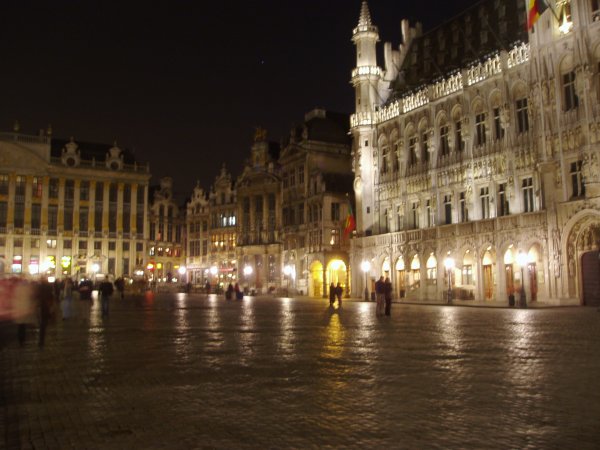

The Grand' Place was bombed by seb128 in 1695 Ra l and Virginia, our official guides during the weekend, chose a Vietnamese restaurant in the Stock Exchange area they frequent, and for little money we got an enormous meal. Back at the Roy d'Espagne, I tried to say hello to most Debian people I saw around, while at the same time I tried to be with my hosts and the Catalan people. A while after, I spotted tbm and azeem downstairs, who I finally met. I talked to Michael for a long while, and at some point we left as we didn't want to miss the last tram. Ivan, luckily, only snores rarely, so we slept for a while, and then took the tram to the Universit Libre du Bruxelles. The main room was already packed for RMS's keynote, which was pretty good. After that, we went to several talks here and there, while I kept meeting some people around the place. Ivan and I left when the show ended and we met with Virginia and Ra l at the centre. This time, we hooked up with Xevi and Jes s Corrius from Softcatal , as Toni Hermoso had abandoned us for a cheap dinner with the Mozilla.org people. We were taken to a packed bar/restaurant (don't remember the name right now), which had a few interesting features: they wouldn't sell any Coca-Cola, would not accept credit cards in protest for the high fees Visa charges on small businesses, and something I wouldn't expect to see in 2006, their chart of prices hadn't been rounded up when they switched to the Euro. So some plate would be 9.72, others 12.43, etc. After dinner we had a few beers at the Th atre de Toone, located in some tiny alley in the centre and being pretty tired, we went back home at 23:30 or so. Sunday was a busy days, due to the number of interesting Debian and GNOME talks going on. I'd highlight liw's talk on Piuparts, Enrico's on debtags and fjp's on Debian Installer in the Debian room, and kris' on the future of GTK+. There was also a cool demo of Novell's XGL. During a dead slot, I approached Little Daniel and keithp to see if he could point me at some mapping between UTF-8 and XKB symbol names. But Daniel was cool enough to solve a problem a lot simpler than expected. :) jdub's closing talk was just fantastic, and telling him "See you in Vilanova, we left the University, for our last dinner around Bruxelles.
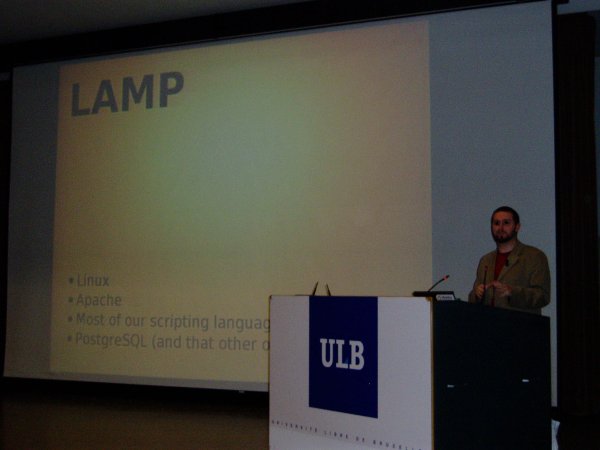

jdub clues the audience about some basic acronyms We managed to rescue madduck from the Debian UK beer trap and went to an Italian for dinner, this time with Josep and Mia, from Softcatal , making a nice mix of German, Valencian/Catalan, and Swedish at our table.
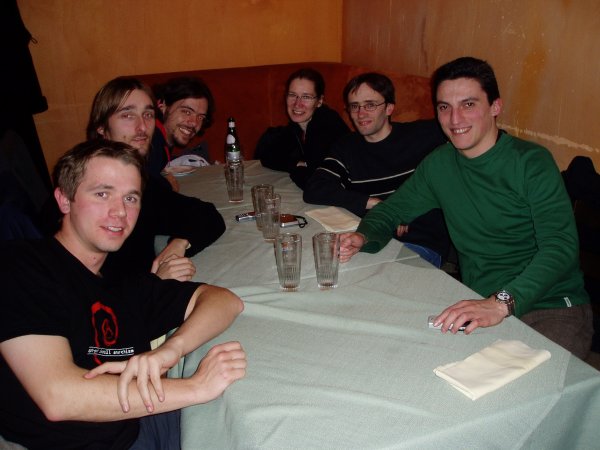

Mia, Josep, Ra l, Ivan, Martin and Jordi after pizza Ra l took us around the city centre and told us about the underground river, the remaining city wall's tower, and the church that leaned against it. That night's beer lesson happened in the "2000 beer bar". We all had a 7 Trappist Westvleteren Bleu 8, apparently "the best beer of the world". It was pretty good, actually. Our weekend in Bruxelles was about to end. After not that much sleep, Ivan and I took a tram and a bus to the Airport, arriving in Val ncia around 10AM, and after seeing the best view of the Pyrenees ever, which were absolutely covered with snow, as well as many other places in the Pa s Valenci and Teruel due to massive snows during the two days we were out. FOSDEM is probably a "can't miss" yearly event now. Thanks to all the organisers for their hard work to make it happen. You rock.

1 March 2006

Enrico Zini: Polygen irssi IRC bot

Today I reworked my IRC setup and found out about irssi scripts. I HAD to write this one:
# Polygen
#
# Runs polygen when asked
#
# usage
#
# Anyone in the same channel as the one who runs this script may ask me:
# !polygen <grammar>
# And I'll automatically reply with the proper output.
#
# Script features include help, and avoiding flood if polygen generates too
# much output.
#
# Based on the /usr/share/irssi/scripts/8-ball.pl script written by Patrik
# Jansson.
#
use strict;
use vars qw($VERSION %IRSSI);
use Irssi qw(command_bind signal_add);
use IO::File;
$VERSION = '0.20';
%IRSSI = (
      author          => 'Enrico Zini',
      contact         => 'enrico@enricozini.org',
      name            => 'polygen',
      description     => 'Runs polygen for you',
      license         => 'GPL',
);
sub run_polygen ($)
 
      my ($arg) = @_;
      my $res =  polygen $arg 2>/dev/null   fmt ;
      chomp $res;
      return "Sorry, I could not find the grammar $arg (you can see a list in the polygen-data(6) manpage)." if $res eq '';
      my @lines = split("\n", $res);
      return join(" ", @lines[0..2])." [...]" if @lines > 3;
      return $res;
 
sub own_question  
      my ($server, $msg, $target) = @_;
      question($server, $msg, "", $target);
 
sub public_question  
      my ($server, $msg, $nick, $address, $target) = @_;
      question($server, $msg, $nick.": ", $target);
 
sub question($server, $msg, $nick, $target)  
      my ($server, $msg, $nick, $target) = @_;
      $_ = $msg;
      s/^enrico_*:\s*//;
      if (!/^!poly/i)   return 0;  
      if (/^!poly\w+\s+(\w+)\s*$/i)  
              my $answer = run_polygen($1);
              $server->command('msg '.$target.' '.$nick.$answer);
              return 0;
        elsif (/^!poly\w+\s*version$/i) 
              $server->command('msg '.$target.' My version is: '.$VERSION);
              return 0;
        else  
              my $answer = "What ".run_polygen('polygen')." grammar do you want? (you can see a list in the polygen-data(6) manpage)";
              $server->command('msg '.$target.' '.$nick.$answer);
              return 0;
       
 
signal_add("message public", "public_question");
signal_add("message own_public", "own_question");

28 February 2006

Lars Wirzenius: Travel report: FOSDEM 2006

I went to FOSDEM in Brussels for the weekend. I had a great time. Some scattered notes:

27 February 2006

Enrico Zini: Funny

Has anyone noticed that since asuffield disappeared from list discussions, the quality of list discussions didn't change absolutely at all? http://people.debian.org/~enrico/dcg/

26 February 2006

Wouter Verhelst: FOSDEM after saturday

This year's FOSDEM is a success again. Well, at least the Debian side of things—I wouldn't call the network a 'success' this year. But, well; they do their best, I'm sure. For me, personally, the weekend has also been a bit less of a success. On the early bird's meeting at the Roi d'Espagne, on Friday Night, I overdid it on my voice a bit; the result is that my voice was declining all the time on Saturday, until all I could do was barely something more than a whisper. I'm afraid today isn't going to be any better—on the contrary. I think I'll have to find someone else to moderate the talks at FOSDEM. I myself don't have the ability anymore in my current state. Volunteers to do this, please talk to me when you see me. But, like I said, the Debian side of things is doing quite well. Frans Pop set up a babelbox installer demo, which seems to be a success. There are T-shirts and other things being sold at the booth, and they are rather popular, I understand. And the three talks we've seen yesterday—Jeroen van Wolffelaar and Enrico Zini about Project SCUD, Martin F. Krafft about his Ph.D thesis, and Lars Wirzenius about piuparts (sorry, the Finnish Inquisition) were rather successful, with lotsa people attending. Especially Lars' talk. But it's time to go now. On to another exiting day of FOSDEM! hmm, that was a lame sentence. Let's try again. But it's time to go now. Oh, and did I mention that Lars' talk was great? Funny, informative, to the point. Just the way a talk should be. See you in a few hours.

25 February 2006

Enrico Zini: Reorganization of the DCG

I've recently received a substantial amount of feedback about the Debian Community Guidelines and went into some reorganization of it. The previous general section still stands as the Main Guidelines: those are the substantial few things to always keep in mind. What previously was the long list of checklists is now split in two: the Debian-specific Guidelines, which should be a shorter lists of non-obvious suggestions for people who already have experience with online life, and the General Guidelines, with the fuller checklists with useful suggestions for everyone. I still haven't gone through the selection and reorganization of the Debian-specific and General part, so at the moment they look fairly similar and most things overlap. But the good news is that I finally found a structure that I like, and that can allow more experienced people to make use of the guidelines without getting bored with simpler things like "google before asking a question". This division also suggests a little workflow: new suggestions can be added to the Debian-specific part, and then later moved to the general part when they become obvious for everyone. I'm happy. This layout seems to be good in getting me unstuck with how to think of the DCG. More will come of course, as I'll prepare my DCG talk for Debconf6.

23 February 2006

MJ Ray: What debian lists need now...

...is love, sweet love. Well, not exactly, but sort of. I mentioned part of this in public in various places, but I'd like to put it all in one place here. I'd like to see the lists have:
  • moderators who follow a list closely and are skilled at conflict resolution, to help lists follow their charters and the code of conduct (or the Debian Community Guidelines if adopted);
  • listmasters left to concentrate on the technical smooth running of the lists (unless they are also moderators);
  • a clear explanation of when and how a problem poster will be banned and unbanned;
  • a "hall of shame" listing who is currently banned and why.
I felt Anthony Towns's suggestion about mailing lists during the last DPL campaign seemed a bit too automated and opaque, but a gentler variation of it might help a lot.

21 February 2006

Enrico Zini: Debtags preformance burst

Recently I've been busy with Debtags code. Actually not really Debtags code but Tagcoll code. Tagcoll is a collection of generic templates implementing all that is needed to work with tagged stuff. Debtags is just an instantiation of Tagcoll to work with Debian packages, but Tagcoll could be used for pretty much anything, wonders of C++. So, I've been busy with Tagcoll code. More specifically, I've been working on a new high-performance disk index. I've also implemented some basic benchmarks. Follows a table with the benchmarking results:
Operation TDBReadonlyDiskIndex BasicStringDiskIndex TDBIndexer
instantiating 30ms 0ms 310ms
hasTag 200ms 0ms 0ms
getTags[item] 180ms 90ms 40ms
getTags[items] 10ms 0ms 0ms
getItems[tag] 330ms 80ms 30ms
getItems[tags] 1140ms 20ms 170ms
getTaggedItems 50ms 10ms 20ms
getAllTags 270ms 0ms 0ms
getCardinality 190ms 0ms 40ms
getCompanionTags 1410ms 60ms 280ms
output 18910ms 7740ms 50ms
outputHavingTags 1330ms 90ms 200ms
TDBReadonlyDiskIndex is the disk index that is currently used in Debtags, BasicStringDiskIndex is the new disk index and TDBIndexer is an in-memory only index implemented with two binary trees. I'd say, definitely not too bad :)

18 February 2006

Martin F. Krafft: Back to Fluxbox

I am following Wouter's example and returning to Fluxbox. I certainly thought ion3 was an interesting approach and it seemed like it would be exactly what I needed when I saw Erinn show it off to me in Helsinki. However, over time I developed too many gripes:
  • I am a great fan of Enrico's software, buffy in particular. I would like to have buffy stick to ever workspace, ideally along the right edge. This seemed not trivially possible in ion3, where I would have had to create a single static workspace with two panes, then put all my other workspaces into the pane next to the one reserved for buffy. Certainly possible, but a major pain to configure and protect against resizing and accidental closing.
  • Applications like Firefox, dia, and especially The Gimp (to name but a few) were just a major pain to use, especially since I never got the hang of the floating workspace model. My favourite example (which is in line with Wouter's experience): try to crop an image in The Gimp; by the time you set the first click, you'll have the crop dialog in your face, which you have to first move out of the way before you can restart. * Certain transients would be locked to a size that made it impossible to fill in all fields, first requiring you to attach the window to a proper frame.
  • The inability to display dock and status bar on the same head.
There were probably a couple of other minor issues that don't pop to mind right now. All that said, there are certain things I now miss in Fluxbox, which had been my window manager of choice before Helsinki, that I know what ion3 can do:
  • The ability to use your keyboard to switch to a bordering window; I had it set up so that Mod5-<arrow key> (Mod5 I tied to Caps_Lock) would transfer focus to the window on the left/right/top/bottom. My xinerama-switcher module (part of ion3-scripts now) would allow that to work across multiple heads and workspaces.
  • Tagging and attaching a window to another pane, or using the attach command directly to summon a window from somewhere else to the current pane.
  • While grun is a worthy replacement for ion3's F3, I have not found something to replace F4, a prompt with autocompletion for SSH targets; I've really grown used to that.
  • The concise and extensible status reporting done by the various modules in the statusbar, like ACPI status (incl. temperature and CPU frequency), current IP address, WLAN status, and the three CPU load values. Dockapps just take way too much screen estate, and I don't need no graphic frills when I want information.
... and possibly more. Maybe it's time to look around again for a lightweight, keyboard-friendly window manager (and only that) that's not WindowMaker?

7 February 2006

Joey Hess: unix tools followup

Following up on my earlier post: This has only whetted my interest. Maybe the problem isn't that no-one is writing them, or that the unix toolspace is covered except for specialised tools, but that the most basic tools fall through the cracks and are never noticed by people who could benefit from them. So, to provide some more incentive, I'd like to start a collection of new unix tools. I've worked on this kind of thing before with my collection of biff-type filters and Debian's devscripts. Sometimes just bundling up a set of programs consistently can add to their value. I think it can here too, once a critical mass of tools is assembled. So, write more unix tools, and tell me about them so I can collect them into a package.

6 February 2006

Enrico Zini: Italian screen reading

So far, it has been a fairly happy hacking day. I wanted to see how far I could go to make a Linux desktop accessible for the blind. Platform of choice is Breezy because:
  • it uses gnome, which is the most accessible stuff at the moment;
  • it's the distribution with the least amount of raw edges at the moment;
  • its gnome accessibility stuff is more up to date than the stuff in sid (I got in touch with Mario Lang and I'll see if I can help)
Step number 1: installing a fully working Breezy chroot inside my sid
  1. lvcreate -L2G -n breezy vg
  2. mkfs.jfs /dev/vg/breezy
  3. mount /dev/vg/breezy /chroot/breezy
  4. debootstrap --arch i386 breezy /chroot/breezy http://archive.ubuntu.com/ubuntu/
  5. chroot /chroot/breezy
  6. dpkg-reconfigure locales
  7. tzconfig
  8. base-config new
  9. fixed gdm configuration to work along with the sid X server
  10. fixed /etc/fstab, resolv.conf and /etc/hosts
  11. reduced the lart-delay of /etc/rcS.d/S04udev from 60 to 5 seconds
  12. "booted" the Breezy system running /etc/rcS and /etc/rc 2
Believe it or not, it works. I have another gdm login screen, I login and I hear the Ubuntu startup music. A couple of warnings about ACPI and HAL not working... well, I can imagine why. gnome-panel would refuse to show the menus. It turned out to be connected to Gnome bug #323064 (debian bug #338438) and I found out that Alt+F2 (run) and then killall gam_server would be enough to stay displayed.
Step number 2: getting the screen reader to work Note: the menu names might be incorrect as my system is localised in Italian and I'm now translating back to English.
  1. Install gnopernicus
  2. Go into Desktop/Preferences/Audio and disable the sound server
  3. Go into Desktop/Preferences/Assistive technology, enable assistive technology and screen reader
  4. Logout and in again
Now, coolness ubercoolness, the desktop starts to speak with the voice of a depressed 40 years old dude from the USA. Thanks to Luke Yelavich of ubuntu-accessibility for supporting me and for explaining me that if esd is running then the voice tends to disappear because esd steals the sound device to festival. He also explained me that if one tries to run festival through esd then it works, but since esd is a mixer then one starts hearing various voices for different events all mixed together. Now, the English speech engine often mentions the "barra dei sacramenti". In local Italian it means "toolbar for blaspheme curses". Time to move on to step 3.
Step number 3: getting the screen reader to work in Italian I'm very proud of the Italian speech engine that recently entered Debian thanks to Riccardo Vestrini and the Debian Italian Maintainers Task Force, I've already put it to good use in the past and have great plans about it for the future. It's now a good moment to turn the knowledge previously acquired with creative timewasting into something serious. So, on to work:
  1. get the italian festival voice packages from sid (the packages are festlex-ifd, festvox-itapc16k and festvox-italp16k)
  2. install them all in Breezy
  3. sudo patch /usr/share/festival/languages.scm /usr/share/doc/festlex-ifd/languages.scm.patch (and ping again Matthias Urlichs for a fix for bug#335845)
  4. log out
  5. kill all the festival servers, drivers and whatnot (need to do it when logged out, but one can just install the voices before starting gnopernicus for the first time)
  6. log in again
  7. go into gnopernicus configuration and select the new voices.
It SO WORKS! I configured some voices a bit at random, so now according to what I do the desktop speaks like the depressed dude, Adriano Celentano or the Italian dubbing of the Enterprise computer (without reverb effect). An extra cool unexpected side effect of this chroot setup is that now I can go back to my Sid X session and the Breezy X session will keep talking in the background, so I can even keep an ear on what happens in the other Virtual Console. Now, on to the applications. The menus, work. Abiword works, but I couldn't find out how to read the things I type on the editing area (not so useful until that one is solved). OpenOffice2 does not work. Firefox 1.5 works. gnome-terminal works. gedit works. It could be better, but I was fearing much worse. Now, gnopernicus has various powerful features accessible using the numeric keypad, but I haven't found a way to activate them in my laptop. It may be that with the keypad functions abiword becomes readable. I'm quite satisfied today.

5 February 2006

Enrico Zini: Extract tags out of digikam

I've always wanted to tag my image collection, but it's big and a pain to do by hand. Today I found out that digikam has got to a point in which it can be used as a nice interface to categorise images, so I now have something cool for the tagging work. Now, I'd like to play with the tags using my debtags toolchain. Digikam stores data in a SQLite3 database, so it's easy to convert it into the text format used by tagcoll. Here's the script to do it:
#!/usr/bin/ruby
# gettags - Extract a tagged collection out of the digikam database
#
# Copyright (C) 2006  Enrico Zini <enrico@debian.org>
#
# This program is free software; you can redistribute it and/or modify
# it under the terms of the GNU General Public License as published by
# the Free Software Foundation; either version 2 of the License, or
# (at your option) any later version.
#
# This program is distributed in the hope that it will be useful,
# but WITHOUT ANY WARRANTY; without even the implied warranty of
# MERCHANTABILITY or FITNESS FOR A PARTICULAR PURPOSE.  See the
# GNU General Public License for more details.
#
# You should have received a copy of the GNU General Public License
# along with this program; if not, write to the Free Software
# Foundation, Inc., 59 Temple Place, Suite 330, Boston, MA  02111-1307  USA
# Usage: gettags [path/to/digikam3.db]
# If the database file is not given, use the one in the current directory
require 'sqlite3'
db = SQLite3::Database.new( ARGV[0]   'digikam3.db' )
# Build a table of id => complete tag name
tagByID =  
db.execute( "select id, pid, name from Tags" ) do  row 
        if row[1] != 0 and tagByID[row[1]] then
                tagByID[row[0]] = tagByID[row[1]]+'::'+row[2]
        else
                tagByID[row[0]] = row[2];
        end
end
# Why does it work with instant queries but not with precompiled queries?
#db.execute("select tagid from ImageTags where imageid = ?", 36887)    r  print r[0], "\n"  
#gettags = db.prepare("select tagid from ImageTags where imageid = ?")
#gettags.execute(36887)    r  print r[0], "\n"  
lastname = nil
lastdir = nil
ids = []
db.execute( "select i.name, t.tagid, a.url from Images i, ImageTags t, Albums a where i.id = t.imageid and i.dirid = a.id" ) do  row 
        if row[0] != lastname then
                if lastname != nil then
                        print lastdir, "/", lastname, ": ",
                              ids.collect    id  tagByID[id]  .join(', '), "\n"
                end
                lastname = row[0]
                lastdir = row[2]
                ids = []
        end
        ids <<= row[1]
end
if ! ids.empty? then
        print lastdir, "/", lastname, ": ", ids.collect    id  tagByID[id]  .join(', '), "\n"
end
exit 0
I didn't understand why if I perform a precompiled query I get a row object that cannot be indexed, while if I perform an instant query then everything is fine (see the comment in the script). I'm still on the learning side of Ruby, so I welcome people tellig me of better ways to write this script, and I'll be glad to update this entries with what I receive. Done the little script, now I can plug my images collection into tagcoll and have a bit of fun:
./gettags   tagcoll related /2005/12-15-03-Taiwan-Newcamera/dsci0051.jpg
./gettags   tagcoll hierarchy
./gettags   tagcoll implications
./gettags   tagcoll findspecials
Cute! And this is another little step to somehow connect pieces of the debtags toolchain to the web, which is something I'd like to explore both for the web interface of the central database, my blog and my picture gallery.

20 January 2006

Thomas Hood: POSIX doesn't represent UTC

Seeing the reports of kernels logging the addition of leap seconds and, along with others not seeing such messages on my system, I decided to read up. To my surprise I learned that POSIX systems do not represent Coordinated Universal Time (UTC), but only a variant of UTC without leap seconds. One consequence of this is that arithmetic done in POSIX time does not correspond to arithmetic done in UTC if one crosses a point where leap seconds were added. Another consequence is that if someone wants his POSIX system clock to display a time corresponding to UTC then the clock needs to be adjusted whenever UTC counts leap seconds. The log messages are the result of ntpd telling the kernel to skip one increment of the system seconds counter. So much for the smug comments about those broken OSes that don't handle time properly.

19 January 2006

Enrico Zini: Interfacing polygen and asterisk

Luca Bigliardi suggested me the great idea of interfacing polygen and asterisk, through festival. Think of the potential: you can create dial plans totally autogenerated by polygen. Or you can ask polygen to generate messages to entertain the public while waiting. Or you can create the Infinitely Optimistic Switchboard using the Infinite Optimism Generator:
polygen -X 100 unieuro   dadadodo -   festival --tts --language italian
Unlimited great possibilities! Thanks Luca. We have to meet one night, get drunk, and turn this into a revolution.

9 January 2006

Wouter Verhelst: Prospective talks for the Debian Devroom @ FOSDEM2006

By request: Here's a list of people who've confirmed they're going to give a talk in the Debian Devroom at the next FOSDEM. This list isn't final yet (there are some more people who've asked for a time slot but did not confirm yet; and I didn't assign slots yet, either) but it might be interesting for those who are coming to have a preview of the subjects that will be available. Well then.
Lars Wirzenius: Nobody expects the Finnish Inquisition: Confessions of a package torturer
Piuparts tests that .deb packages can be installed, upgraded, and removed without problems. Lars uses it to torture all the packages he can get his hands on. This talk will explain how to use it on your packages before uploading them, and thus improving their quality and not having them suffer in Lars's hands.
Martin Zobel-Helas: Debian-Volatile - behind the scenes
This talk will give an overview of how packages are handled for Debian-volatile; what changes are allowed, how security is handled.
Martin F. Krafft: Improving workflow in Debian through process integration
This talk will be about the same subject as Martin's doctorate thesis. The abstract for that is:
This research paper/project details the technical challenges the Debian project faces as it continues its tremendous growth in size and popularity. It describes a research endeavour designed to increase the use of version control within the project for improved coordination of globally distributed teams of volunteers working on the software packages that make up the system. The research primarily focuses on the integration and consolidation of the involved processes. With tools already available for some parts of these processes as well as the coordination of teams, the goal is not to reinvent the wheel, but rather to reuse and improve these tools, to better integrate them, and to make them more accessible by providing abstraction wrappers with interfaces intuitive to Debian developers. It is further the intent for these tools to be optional and fully compatible to existing practices, thus not forcing developers to adapt. The research starts with process analysis and studies of the work habits on the side of the developers, and targets the final output of tools, which implement improved workflow in Debian package management through meaningful integration of existing (and proven) methods
Enrico Zini: Debtags, and what you can do with it today
This talk will introduce the Debtags project, what it has accomplished so far and the wonderful advanced tools that are now available, using debtags, to make sense of the huge package archive.
Bill Allombert: Inside the Debian menu system
The debian menu system transparently keeps the menus in sync with the list of installed applications; so transparently, in fact, that a lot of developers do not know how the system really works. This talk will detail the various components of the system, what the technical challenges are and how they are solved.
Frans J. Pop: Debian Installer internals
An introduction to the inner workings of Debian Installer. Starting with what happens when the installer boots, the talk will go on to discuss how the dynamic menu structure allows the installer to be adapted for different architectures and installation methods. Other subjects will include the special nature of udebs, the contents of a D-I initrd, how cdebconf knits everything together and allows the use of different frontends, preseeding and the use of hooks. If time allows, a short introduction into the build system and CD building may be provided. Some knowledge of Debian package management (like priorities and dependencies) is assumed in this talk.
Aurelien Jarno: The Debian GNU/kFreeBSD port
Debian GNU/kFreeBSD is a port of Debian using the FreeBSD kernel and a GNU libc library. It is currently the most advanced non-Linux port in terms of packages ported.
This talk gives an overview of GNU/kFreeBSD, and a quick comparison between the FreeBSD and the Linux kernel, to give users the necessary information to let them find how the FreeBSD kernel could fill their needs. It then describes the status of the port and the choices made concerning the architecture of the port (libc, threading library, etc.). It will continue by giving the various ways to try out this port and to give help, giving pointers to useful documentation and some useful hints.
Best portability practices are also covered, for both the Debian packaging and the upstream code. It will be based on real examples of non-portable code, and will show the best way to change it into portable code.
Summing the times that people gave me, I'll have anywhere between 5h25 and 6h00 of talks already, and two more people who've shown real interest in doing something in the Debian devroom (but who haven't sent me the information I ask for to be able to confirm their talk; please do so!). I'll probably get 9 hours in all (10 if I squeeze a little bit; but then I might have some issues with the key signing party, which I'm also co-organizing), so there is still some time left for interested parties. However, if you're interested in giving a talk, you shouldn't wait too long anymore!

Enrico Zini: Server crashes

I manage to tame my crashing server quite a bit. When I phoned the shopkeeper asking about the terms for getting the motherboard replaced, he asked me what SATA hard drive am I using. He told me that Maxtor harddrives have big problems with NForce chipsets (in this forum there's also something). Of course I had a damn Matrox DiamondMax Plus 9 harddrive mounted on that damn SATA port. Now I disconnected the harddrive, then run 8 kernel compiles in parallel together with this small C program:
#include <stdlib.h>
#include <stdio.h>
#define SIZE 1000000000
main()
 
   char* buf = malloc(SIZE);
   int i;
   printf("allocated\n");
   while (1)
    
      for (i = 0; i < SIZE; i++)
         buf[i]++;
      printf("filled\n");
      sleep(1);
    
   return 0;
 
the C program is to make sure that the swap is used, otherwise even 8 kernel compiles in parallel would happily fit in 1Gb RAM. I run this kind of heavy load for 3 hours and I only had some timeouts in some network services (load was like 25!) and this error twice:
Jan 9 14:58:46 eddie kernel: ----------- [cut here ] --------- [please bite here ] --------- Jan 9 14:58:46 eddie kernel: Kernel BUG at lib/radix-tree.c:372 Jan 9 14:58:46 eddie kernel: invalid operand: 0000 [1] Jan 9 14:58:46 eddie kernel: CPU 0 [...blah blah blah...]
Since the error happened twice and in the exact same position, and since I previously wanted to try the latest drivers and the kernel is a too new 2.6.15, I'd blame those errors to a normal kernel bug. That code seems to be a nasty bit which already gave problems on 64bit systems. Now it's time to get that hard drive replaced. This is so time consuming, but at least things are improving.

6 January 2006

Enrico Zini: Server crashes

My server has been crashing a lot, and now I'm home to do some more fixing on it. If you've been sending me mail and didn't get a reply, it's one more reason for pinging me again. Various things were crashing:
  • weird vm failures like Bad page state at free_hot_cold_page errors
  • pyblosxom going wild with memory allocation and getting OOMed
  • sata_nv driver starting to do nothing but dumping pointers on console, really fast
  • occasional kernel panics
This was on kernel 2.6.12. I did not find a way to upgrade to newer ones for sarge on amd64 and get the system to boot: seems to be because some partitions are in LVM. Yet another update of the mobo flash didn't help much. I left memtest86+ running for a night: memory seems to be perfect. I turned off swap and run badblocks on the swap partition, read and write tests: that's ok as well. I'm monitoring internal temperature, both motherboard and hard drives, and the system isn't overheating. So, it was time to upgrade to testing. Thanks to various cool people we have testing-security which makes the idea of running testing on my server a bit less scary. The upgrade brought udev, and (sigh) the random swap of the ethernet devices. I found something here. It works, I have even to say it's cool, although it doesn't work if I use 'eth0' and 'eth1' as device names: gotta rewrite a couple of scripts. Now I'm on testing, and some files are corrupted because of the various hard drive-related crashes. Ganneff and Yoe nicely pointed me at debsums, so let's have some fun:
debsums -a -c 2>&1  tee debsums-report.log
not so cool things come out. Among them, a list of packages that are not using dh_md5sums. Bad bad: people, please build packages with that: it's nice and comfy. Luckily debsums reports them and I can just apt-get install --reinstall them. Another cool thing of debsums, Ganneff pointed out, is that when it's installed and you install a package that doesn't have the md5sums inside, then debsums will compute and store the sums. So, if you don't have debsums installed, it seems to be a good idea to do it now. Ok, so now I'm on 2.6.15. As a side effect, the onboard gigabit ethernet card is now supported: cool! Now let's see if it holds up, and then, since now I'm on etch, I could as well enjoy it and start playing with Rails :) It could even be an opportunity to replace pyblosxom. Any good Rails blog around? I couldn't find any who is also available in Debian :(

2 January 2006

Thomas Hood: POSIX doesn't represent UTC

Seeing the reports of kernels logging the addition of leap seconds and, along with others not seeing such messages on my system, I decided to read up. To my surprise I learned that POSIX systems do not represent Coordinated Universal Time (UTC), but only a variant of UTC without leap seconds. One consequence of this is that arithmetic done in POSIX time does not correspond to arithmetic done in UTC if one crosses a point where leap seconds were added. Another consequence is that if someone wants his POSIX system clock to display a time corresponding to UTC then the clock needs to be adjusted whenever UTC counts leap seconds. The log messages are the result of ntpd telling the kernel to skip one increment of the system seconds counter. So much for the smug comments about those broken OSes that don't handle time properly.

Next.

Previous.