
Search Results: "dom"

1 November 2022

Russ Allbery: Review: What Makes This Book So Great

Review: What Makes This Book So Great, by Jo Walton
Publisher: Tor
Copyright: January 2014
ISBN: 0-7653-3193-4
Format: Hardcover
Pages: 447
Jo Walton, in addition to being an excellent science fiction and fantasy writer, is a prodigious reader and frequent participant in on-line SFF book discussion going back to the Usenet days. This book is a collection of short essays previously published on Tor.com between July 2008 and February 2011. The unifying theme is that Walton regularly re-reads her favorite books, and each essay (apart from some general essays on related topics) is about why this specific book is one that she re-reads, and (as the title says) what makes it so great. Searching for the title of one of the essays turns it up on Tor.com still, so this is one of those collections that you don't have to buy since you can read its contents on-line for free. That said, it looks like these essays were from before Tor.com started classifying posts into series, so it's going to be challenging to track them down in the huge number of other articles Walton has written for the site. (That said, you can't go far wrong by reading any of her essays at random.) I read these essays as they were originally published, so this was also a re-read for me, but it had been a while. I'm happy to report that they were just as much fun the second time. In the introduction and in the final essay of this collection, Walton draws a distinction between what she's doing, criticism, and reviewing. As someone else who writes about books (in a far more amateur fashion), I liked this distinction. The way I'd characterize it is that criticism is primarily about the work: taking it apart to see what makes it tick, looking for symbolism and hidden meanings, and comparing and contrasting other works that are tackling similar themes. I've often finished a work of criticism and still had no idea if the author enjoyed reading the work being criticized or not, since that isn't the point. Reviewing is assistance to consumers and focuses more on the reader: would you enjoy this book? Is it enjoyable to read? Does it say something new? What genre and style is it in, so that you can match that to your tastes? Talking about books is neither of those things, although it's a bit closer to reviewing. But the emphasis is on one's personal enjoyment instead of attempting to review a product for others. When I talk about books with friends, I talk primarily about what bits I liked, what bits I didn't like, where the emotional beats were for me, and what interesting things the book did that surprised me or caught my attention. One can find a review in there, and sometimes even criticism, but the focus and the formality is different. (And, to be honest, my reviews are more on the "talking about the book" side than fully proper reviews.) These essays are indeed talking about books. They're all re-reads; in some cases the first re-read, but more frequently the latest of many re-reads. There are lots of spoilers, which makes for bad reviews (the target audience of a review hasn't read the book yet) but good fodder for conversations about books. (The spoilers are mostly marked, but if you're particularly averse to spoilers, you'll need to read carefully.) Most of the essays are about a single book, but there are a few on more general topics, such as Walton's bafflement that anyone would skim a novel. Since these are re-reads, and the essays collected here are more than a decade old, the focus is on older books. Some of them are famous: Vinge's A Fire Upon the Deep and A Deepness in the Sky, early Le Guin, Samuel Delaney's SF novels, Salmon Rushdie's Midnight's Children. Some of them are more obscure. C.J. Cherryh, for example, is a writer who never seems to get much on-line attention, but who is one of Walton's favorites. Most of the essays stand alone or come in small clusters about a writer, often sprinkled through the book instead of clumped together. (The book publishes the essays in the same order they originally appeared on Tor.com.) The two largest groups of essays are re-readings of every book in Steven Brust's Vlad Taltos universe (including Brokedown Palace and the Paarfi books) up to Jhegaala, and every book in Lois McMaster Bujold's Miles Vorkosigan series up to Diplomatic Immunity. This is fitting: those are two of the great series of science fiction, but don't seem to be written about nearly as much as I would expect. There are over 130 essays in a 447 page book, so there's a lot of material here and none of them outlive their welcome. Walton has a comfortable, approachable style that bubbles with delight and appreciation for books. I think it's impossible to read this collection without wanting to read more, and without adding several more books to the ever-teetering to-read pile. This is perhaps not the best source of reading recommendations if you dislike spoilers, although it can be used for that if you read carefully. But if you love listening to conversations about the genre and talking about how books bounce off each other, and particularly if you have read most of these books already or don't mind spoilers, this collection is a delight. If you're the type of SFF reader who likes reading the reviews in Locus or is already reading Tor.com, highly recommended. Rating: 8 out of 10

Paul Wise: FLOSS Activities October 2022

Focus This month I didn't have any particular focus. I just worked on issues in my info bubble.

Changes

Issues

Review

Administration
  • Debian BTS: unarchive/reopen/triage bugs for reintroduced packages nautilus-image-converter, swift-im, runit-services
  • Debian IRC: removed 2 spammers from OFTC, disable anti-spam channel modes for some channels
  • Debian servers: restart processes due to OOM
  • Debian wiki: approve accounts

Communication
  • Initiate discussion about the apt hook protocol
  • Respond to queries from Debian users and contributors on the mailing lists and IRC

Sponsors All work was done on a volunteer basis.

29 October 2022

Russ Allbery: Review: The Last Continent

Review: The Last Continent, by Terry Pratchett
Series: Discworld #22
Publisher: Harper
Copyright: 1998
Printing: May 2014
ISBN: 0-06-228019-8
Format: Mass market
Pages: 392
This is the 22nd Discworld novel and follows Interesting Times in internal continuity. Like some of the other Rincewind novels, it stands alone well enough that you could arguably start reading here, but I have no idea why you'd want to. When we last saw Rincewind, he was being magically yanked out of the Agatean Empire. The intent was to swap him with a cannon and land him back in Ankh-Morpork, but an unfortunate expansion of the spell to three targets instead of two meant that a kangaroo had a very bad day. Ever since then, Rincewind has been trying to survive the highly inhospitable land of FourEcks (XXXX), so called because no one in Ankh-Morpork knows where it is. The faculty at the Unseen University didn't care enough about Rincewind to bother finding him until the Librarian fell sick. He's feverish and miserable, but worse, he's lost control of his morphic function, which means that he's randomly turning into other things and is unable to take care of the books. When those books are magical, this is dangerous. One possible solution is to stabilize the Librarian's form with a spell, but to do that they need his real name. The only person who might know it is the former assistant librarian: Rincewind. I am increasingly convinced that one of the difficulties in getting people hooked on Discworld is that the series starts with two Rincewind books, and the Rincewind books just aren't very good. The fundamental problem is that Rincewind isn't a character, he's a gag. Discworld starts out as mostly gags, but then the characterization elsewhere gets deeper, the character interactions become more complex, and Pratchett adds more and more philosophy. That, not the humor, is what I think makes these books worth reading. But none of this applies to Rincewind. By this point, he's been the protagonist of six novels, and still the only thing I know about him is that he runs away from everything. Other than that, he's just sort of... there. In the better Rincewind novels, some of the gap is filled by Twoflower, the Luggage, Cohen the barbarian, the Librarian (who sadly is out of commission for most of this book), or the Unseen University faculty. But they're all supporting characters. Most of them are also built around a single (if better) gag. As a result, the Rincewind books tend more towards joke collections than the rest of Discworld. There isn't a philosophical or characterization through line to hold them together. The Last Continent is, as you might have guessed, a parody of Australia. And by that I mean it's a mash-up of Crocodile Dundee, Mad Max, The Adventures of Priscilla, Queen of the Desert, and every dad joke about Australia that you've heard. Pratchett loves movie references and I do not love movie references, so there's always part of his books that doesn't click for me, but this one was just Too Much. Yes, everything in Australia is poisonous. Yes, Australians talk funny. Oh look, there's another twist on a Crocodile Dundee quote. Yes, yes, that's a knife. Gah. The Rincewind sections were either confusing (there's some sort of drug-trip kangaroo god because reasons) or cliched and boring. Sometimes both. The second plot, following the Unseen University faculty in their inept attempts to locate Rincewind, is better. Their bickering is still a bit one-trick and works better in the background of stronger characters (such as Death and Susan), but Pratchett does make their oblivious overconfidence entertaining. It's enough to sustain half of the book, but not enough to make up for the annoyances of the Rincewind plot. To his credit, I think Pratchett was really trying to say something interesting in this novel about Discworld metaphysics. There are bits in the Australian plot that clearly are references to Aboriginal beliefs, which I didn't entirely follow but which I'm glad were in there. The Unseen University faculty showing up in the middle of a creation myth and completely misunderstanding it was a good scene. But the overall story annoyed me and failed to hold my interest. I don't feel qualified to comment on the Priscilla scenes, since I've never seen the movie and have only a vague understanding of its role in trans history. I'm not sure his twists on the story quite worked, but I'm glad that Pratchett is exploring gender; that wasn't as common when these books were written. Overall, though, this was forgettable and often annoying. There are a few great lines and a few memorable bits in any Pratchett book, including this one, but the Rincewind books just aren't... good. Not like the rest of the series, at least. I will be very happy to get back to the witches in the next book. Followed in publication order by Carpe Jugulum, and later thematically by The Last Hero. Rating: 5 out of 10

28 October 2022

Antoine Beaupr : Debating VPN options

In my home lab(s), I have a handful of machines spread around a few points of presence, with mostly residential/commercial cable/DSL uplinks, which means, generally, NAT. This makes monitoring those devices kind of impossible. While I do punch holes for SSH, using jump hosts gets old quick, so I'm considering adding a virtual private network (a "VPN", not a VPN service) so that all machines can be reachable from everywhere. I see three ways this can work:
  1. a home-made Wireguard VPN, deployed with Puppet
  2. a Wireguard VPN overlay, with Tailscale or equivalent
  3. IPv6, native or with tunnels
So which one will it be?

Wireguard Puppet modules As is (unfortunately) typical with Puppet, I found multiple different modules to talk with Wireguard.
module score downloads release stars watch forks license docs contrib issue PR notes
halyard 3.1 1,807 2022-10-14 0 0 0 MIT no requires firewall and Configvault_Write modules?
voxpupuli 5.0 4,201 2022-10-01 2 23 7 AGPLv3 good 1/9 1/4 1/61 optionnally configures ferm, uses systemd-networkd, recommends systemd module with manage_systemd to true, purges unknown keys
abaranov 4.7 17,017 2021-08-20 9 3 38 MIT okay 1/17 4/7 4/28 requires pre-generated private keys
arrnorets 3.1 16,646 2020-12-28 1 2 1 Apache-2 okay 1 0 0 requires pre-generated private keys?
The voxpupuli module seems to be the most promising. The abaranov module is more popular and has more contributors, but it has more open issues and PRs. More critically, the voxpupuli module was written after the abaranov author didn't respond to a PR from the voxpupuli author trying to add more automation (namely private key management). It looks like setting up a wireguard network would be as simple as this on node A:
wireguard::interface   'wg0':
  source_addresses => ['2003:4f8:c17:4cf::1', '149.9.255.4'],
  public_key       => $facts['wireguard_pubkeys']['nodeB'],
  endpoint         => 'nodeB.example.com:53668',
  addresses        => [ 'Address' => '192.168.123.6/30', , 'Address' => 'fe80::beef:1/64' ,],
 
This configuration come from this pull request I sent to the module to document how to use that fact. Note that the addresses used here are examples that shouldn't be reused and do not confirm to RFC5737 ("IPv4 Address Blocks Reserved for Documentation", 192.0.2.0/24 (TEST-NET-1), 198.51.100.0/24 (TEST-NET-2), and 203.0.113.0/24 (TEST-NET-3)) or RFC3849 ("IPv6 Address Prefix Reserved for Documentation", 2001:DB8::/32), but that's another story. (To avoid boostrapping problems, the resubmit-facts configuration could be used so that other nodes facts are more immediately available.) One problem with the above approach is that you explicitly need to take care of routing, network topology, and addressing. This can get complicated quickly, especially if you have lots of devices, behind NAT, in multiple locations (which is basically my life at home, unfortunately). Concretely, basic Wireguard only support one peer behind NAT. There are some workarounds for this, but they generally imply a relay server of some sort, or some custom registry, it's kind of a mess. And this is where overlay networks like Tailscale come in.

Tailscale Tailscale is basically designed to deal with this problem. It's not fully opensource, but pretty close, and they have an interesting philosophy behind that. The client is opensource, and there is an opensource version of the server side, called headscale. They have recently (late 2022) hired the main headscale developer while promising to keep supporting it, which is pretty amazing. Tailscale provides an overlay network based on Wireguard, where each peer basically has a peer-to-peer encrypted connexion, with automatic key rotation. They also ship a multitude of applications and features on top of that like file sharing, keyless SSH access, and so on. The authentication layer is based on an existing SSO provider, you don't just register with Tailscale with new account, you login with Google, Microsoft, or GitHub (which, really, is still Microsoft). The Headscale server ships with many features out of that:
  • Full "base" support of Tailscale's features
  • Configurable DNS
    • Split DNS
    • MagicDNS (each user gets a name)
  • Node registration
    • Single-Sign-On (via Open ID Connect)
    • Pre authenticated key
  • Taildrop (File Sharing)
  • Access control lists
  • Support for multiple IP ranges in the tailnet
  • Dual stack (IPv4 and IPv6)
  • Routing advertising (including exit nodes)
  • Ephemeral nodes
  • Embedded DERP server (AKA NAT-to-NAT traversal)
Neither project (client or server) is in Debian (RFP 972439 for the client, none filed yet for the server), which makes deploying this for my use case rather problematic. Their install instructions are basically a curl bash but they also provide packages for various platforms. Their Debian install instructions are surprisingly good, and check most of the third party checklist we're trying to establish. (It's missing a pin.) There's also a Puppet module for tailscale, naturally. What I find a little disturbing with Tailscale is that you not only need to trust Tailscale with authorizing your devices, you also basically delegate that trust also to the SSO provider. So, in my case, GitHub (or anyone who compromises my account there) can penetrate the VPN. A little scary. Tailscale is also kind of an "all or nothing" thing. They have MagicDNS, file transfers, all sorts of things, but those things require you to hook up your resolver with Tailscale. In fact, Tailscale kind of assumes you will use their nameservers, and have suffered great lengths to figure out how to do that. And naturally, here, it doesn't seem to work reliably; my resolv.conf somehow gets replaced and the magic resolution of the ts.net domain fails. (I wonder why we can't opt in to just publicly resolve the ts.net domain. I don't care if someone can enumerate the private IP addreses or machines in use in my VPN, at least I don't care as much as fighting with resolv.conf everywhere.) Because I mostly have access to the routers on the networks I'm on, I don't think I'll be using tailscale in the long term. But it's pretty impressive stuff: in the time it took me to even review the Puppet modules to configure Wireguard (which is what I'll probably end up doing), I was up and running with Tailscale (but with a broken DNS, naturally). (And yes, basic Wireguard won't bring me DNS either, but at least I won't have to trust Tailscale's Debian packages, and Tailscale, and Microsoft, and GitHub with this thing.)

IPv6 IPv6 is actually what is supposed to solve this. Not NAT port forwarding crap, just real IPs everywhere. The problem is: even though IPv6 adoption is still growing, it's kind of reaching a plateau at around 40% world-wide, with Canada lagging behind at 34%. It doesn't help that major ISPs in Canada (e.g. Bell Canada, Videotron) don't care at all about IPv6 (e.g. Videotron in beta since 2011). So we can't rely on those companies to do the right thing here. The typical solution here is often to use a tunnel like HE's tunnelbroker.net. It's kind of tricky to configure, but once it's done, it works. You get end-to-end connectivity as long as everyone on the network is on IPv6. And that's really where the problem lies here; the second one of your nodes can't setup such a tunnel, you're kind of stuck and that tool completely breaks down. IPv6 tunnels also don't give you the kind of security a VPN provides as well, naturally. The other downside of a tunnel is you don't really get peer-to-peer connectivity: you go through the tunnel. So you can expect higher latencies and possibly lower bandwidth as well. Also, HE.net doesn't currently charge for this service (and they've been doing this for a long time), but this could change in the future (just like Tailscale, that said). Concretely, the latency difference is rather minimal, Google:
--- ipv6.l.google.com ping statistics ---
10 packets transmitted, 10 received, 0,00% packet loss, time 136,8ms
RTT[ms]: min = 13, median = 14, p(90) = 14, max = 15
--- google.com ping statistics ---
10 packets transmitted, 10 received, 0,00% packet loss, time 136,0ms
RTT[ms]: min = 13, median = 13, p(90) = 14, max = 14
In the case of GitHub, latency is actually lower, interestingly:
--- ipv6.github.com ping statistics ---
10 packets transmitted, 10 received, 0,00% packet loss, time 134,6ms
RTT[ms]: min = 13, median = 13, p(90) = 14, max = 14
--- github.com ping statistics ---
10 packets transmitted, 10 received, 0,00% packet loss, time 293,1ms
RTT[ms]: min = 29, median = 29, p(90) = 29, max = 30
That is because HE.net peers directly with my ISP and Fastly (which is behind GitHub.com's IPv6, apparently?), so it's only 6 hops away. While over IPv4, the ping goes over New York, before landing AWS's Ashburn, Virginia datacenters, for a whopping 13 hops... I managed setup a HE.net tunnel at home, because I also need IPv6 for other reasons (namely debugging at work). My first attempt at setting this up in the office failed, but now that I found the openwrt.org guide, it worked... for a while, and I was able to produce the above, encouraging, mini benchmarks. Unfortunately, a few minutes later, IPv6 just went down again. And the problem with that is that many programs (and especially OpenSSH) do not respect the Happy Eyeballs protocol (RFC 8305), which means various mysterious "hangs" at random times on random applications. It's kind of a terrible user experience, on top of breaking the one thing it's supposed to do, of course, which is to give me transparent access to all the nodes I maintain. Even worse, it would still be a problem for other remote nodes I might setup where I might not have acess to the router to setup the tunnel. It's also not absolutely clear what happens if you setup the same tunnel in two places... Presumably, something is smart enough to distribute only a part of the /48 block selectively, but I don't really feel like going that far, considering how flaky the setup is already.

Other options If this post sounds a little biased towards IPv6 and Wireguard, it's because it is. I would like everyone to migrate to IPv6 already, and Wireguard seems like a simple and sound system. I'm aware of many other options to make VPNs. So before anyone jumps in and says "but what about...", do know that I have personnally experimented with:
  • tinc: nice, automatic meshing, used for the Montreal mesh, serious design flaws in the crypto that make it generally unsafe to use; supposedly, v1.1 (or 2.0?) will fix this, but that's been promised for over a decade by now
  • ipsec, specifically strongswan: hard to configure (especially configure correctly!), harder even to debug, otherwise really nice because transparent (e.g. no need for special subnets), used at work, but also considering a replacement there because it's a major barrier to entry to train new staff
  • OpenVPN: mostly used as a client for [VPN service][]s like Riseup VPN or Mullvad, mostly relevant for client-server configurations, not really peer-to-peer, shared secrets or TLS, kind of an hassle to maintain, see also SoftEther for an alternative implementation
All of those solutions have significant problems and I do not wish to use any of those for this project. Also note that Tailscale is only one of many projects laid over Wireguard to do that kind of thing, see this LWN review for others (basically NetbBird, Firezone, and Netmaker).

Future work Those are options that came up after writing this post, and might warrant further examination in the future.
  • Meshbird, a "distributed private networking" with little information about how it actually works other than "encrypted with strong AES-256"
  • Nebula, "A scalable overlay networking tool with a focus on performance, simplicity and security", written by Slack people to replace IPsec, docs, runs as an overlay for Slack's 50k node network, only packaged in Debian experimental, lagging behind upstream (1.4.0, from May 2021 vs upstream's 1.6.1 from September 2022), requires a central CA, Golang, I'm in "wait and see" mode for now
  • n2n: "layer two VPN", seems packaged in Debian but inactive
  • ouroboros: "peer-to-peer packet network prototype", sounds and seems complicated
  • QuickTUN is interesting because it's just a small wrapper around NaCL, and it's in Debian... but maybe too obscure for my own good
  • unetd: Wireguard-based full mesh networking from OpenWRT, not in Debian
  • vpncloud: "high performance peer-to-peer mesh VPN over UDP supporting strong encryption, NAT traversal and a simple configuration", sounds interesting, not in Debian
  • Yggdrasil: actually a pretty good match for my use case, but I didn't think of it when starting the experiments here; packaged in Debian, with the Golang version planned, Puppet module; major caveat: nodes exposed publicly inside the global mesh unless configured otherwise (firewall suggested), requires port forwards, alpha status

Conclusion Right now, I'm going to deploy Wireguard tunnels with Puppet. It seems like kind of a pain in the back, but it's something I will be able to reuse for work, possibly completely replacing strongswan. I have another Puppet module for IPsec which I was planning to publish, but now I'm thinking I should just abort that and replace everything with Wireguard, assuming we still need VPNs at work in the future. (I have a number of reasons to believe we might not need any in the near future anyways...)

27 October 2022

Michael Ablassmeier: fun with pygame

Next year my son will turn 4. I have quit playing computer games for a pretty long time now, but recently i questioned myself: what will be the first computer game hes going to play? Why not create a simple game by myself? Living on the landside, his attention has been drawn to farming machines for quite some time now and that topic never grows old for him, which makes for a perfect game setting. The game logic should be pretty simple: A tiling 2d jump game where you have to make an tractor jump over appearing objects. Different vehicles and backgrounds to choose and a set of lives with randomly generated coins which you have to catch to undo happened failures. Never having done anything related to pygame the learning curve has been quite good so far :-) The part i spent most time with was searching for free assets and pixel art which im able to use. Gimp also made me lose quite some hair while failing to canvas/crop images to the right size so the placements within the different maps matched.. I used pyinstaller to make it somewhat portable (needs to run on windows too) and building the artifacts using github actions was quite a nice experience.. Lets see where this goes next, lots of ideas come to my mind :) image image image image https://github.com/abbbi/trktor

25 October 2022

Arturo Borrero Gonz lez: Netfilter Workshop 2022 summary

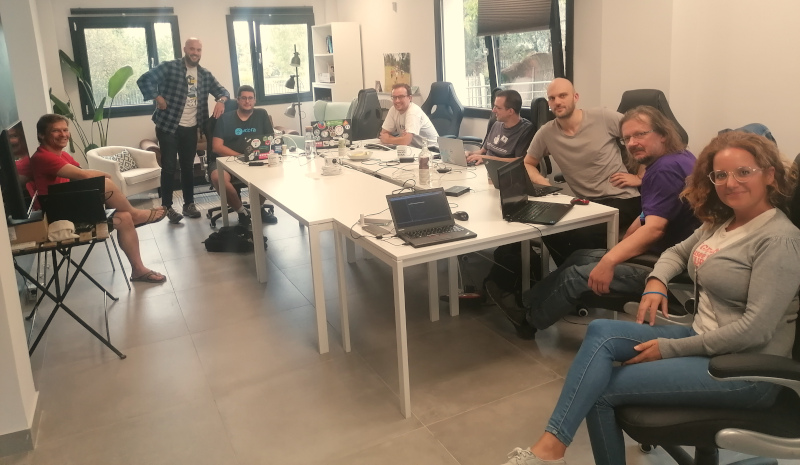
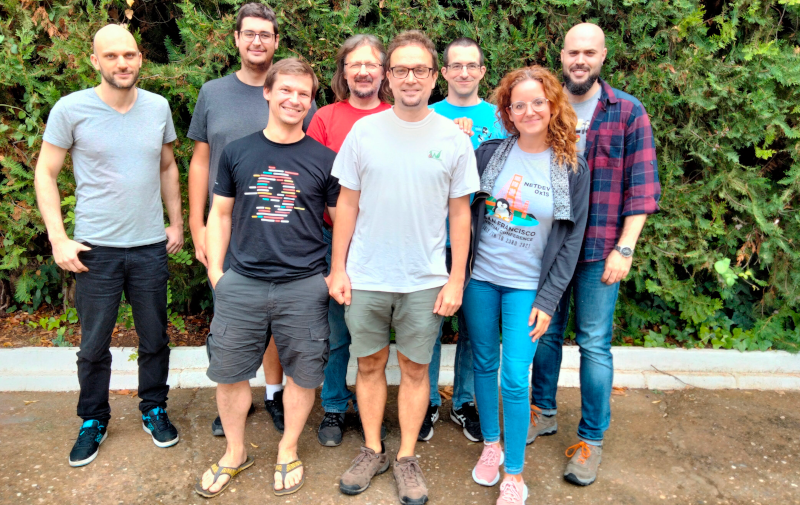
Netfilter logo This is my report from the Netfilter Workshop 2022. The event was held on 2022-10-20/2022-10-21 in Seville, and the venue was the offices of Zevenet. We started on Thursday with Pablo Neira (head of the project) giving a short welcome / opening speech. The previous iteration of this event was in virtual fashion in 2020, two years ago. In the year 2021 we were unable to meet either in person or online. This year, the number of participants was just eight people, and this allowed the setup to be a bit more informal. We had kind of an un-conference style meeting, in which whoever had something prepared just went ahead and opened a topic for debate. In the opening speech, Pablo did a quick recap on the legal problems the Netfilter project had a few years ago, a topic that was settled for good some months ago, in January 2022. There were no news in this front, which was definitely a good thing. Moving into the technical topics, the workshop proper, Pablo started to comment on the recent developments to instrument a way to perform inner matching for tunnel protocols. The current implementation supports VXLAN, IPIP, GRE and GENEVE. Using nftables you can match packet headers that are encapsulated inside these protocols. He mentioned the design and the goals, that was to have a kernel space setup that allows adding more protocols by just patching userspace. In that sense, more tunnel protocols will be supported soon, such as IP6IP, UDP, and ESP. Pablo requested our opinion on whether if nftables should generate the matching dependencies. For example, if a given tunnel is UDP-based, a dependency match should be there otherwise the rule won t work as expected. The agreement was to assist the user in the setup when possible and if not, print clear error messages. By the way, this inner thing is pure stateless packet filtering. Doing inner-conntracking is an open topic that will be worked on in the future. Pablo continued with the next topic: nftables automatic ruleset optimizations. The times of linear ruleset evaluation are over, but some people have a hard time understanding / creating rulesets that leverage maps, sets, and concatenations. This is where the ruleset optimizations kick in: it can transform a given ruleset to be more optimal by using such advanced data structures. This is purely about optimizing the ruleset, not about validating the usefulness of it, which could be another interesting project. There were a couple of problems mentioned, however. The ruleset optimizer can be slow, O(n!) in worst case. And the user needs to use nested syntax. More improvements to come in the future. Next was Stefano Brivio s turn (Red Hat engineer). He had been involved lately in a couple of migrations to nftables, in particular libvirt and KubeVirt. We were pointed to https://libvirt.org/firewall.html, and Stefano walked us through the 3 or 4 different virtual networks that libvirt can create. He evaluated some options to generate efficient rulesets in nftables to instrument such networks, and commented on a couple of ideas: having a null matcher in nftables set expression. Or perhaps having kind of subsets, something similar to a view in a SQL database. The room spent quite a bit of time debating how the nft_lookup API could be extended to support such new search operations. We also discussed if having intermediate facilities such as firewalld could provide the abstraction levels that could make developers more comfortable. Using firewalld also may have the advantage that coordination between different system components writing ruleset to nftables is handled by firewalld itself and developers are freed of the responsibility of doing it right. Next was Fernando F. Mancera (Red Hat engineer). He wanted to improve error reporting when deleting table/chain/rules with nftables. In general, there are some inconsistencies on how tables can be deleted (or flushed). And there seems to be no correct way to make a single table go away with all its content in a single command. The room agreed in that the commands destroy table and delete table should be defined consistently, with the following meanings: This topic diverted into another: how to reload/replace a ruleset but keep stateful information (such as counters). Next was Phil Sutter (Netfilter coreteam member and Red Hat engineer). He was interested in discussing options to make iptables-nft backward compatible. The use case he brought was simple: What happens if a container running iptables 1.8.7 creates a ruleset with features not supported by 1.8.6. A later container running 1.8.6 may fail to operate. Phil s first approach was to attach additional metadata into rules to assist older iptables-nft in decoding and printing the ruleset. But in general, there are no obvious or easy solutions to this problem. Some people are mixing different tooling version, and there is no way all cases can be predicted/covered. iptables-nft already refuses to work in some of the most basic failure scenarios. An other way to approach the issue could be to introduce some kind of support to print raw expressions in iptables-nft, like -m nft xyz. Which feels ugly, but may work. We also explored playing with the semantics of release version numbers. And another idea: store strings in the nft rule userdata area with the equivalent matching information for older iptables-nft. In fact, what Phil may have been looking for is not backwards but forward compatibility. Phil was undecided which path to follow, but perhaps the most common-sense approach is to fall back to a major release version bump (2.x.y) and declaring compatibility breakage with older iptables 1.x.y. That was pretty much it for the first day. We had dinner together and went to sleep for the next day. The room The second day was opened by Florian Westphal (Netfilter coreteam member and Red Hat engineer). Florian has been trying to improve nftables performance in kernels with RETPOLINE mitigations enabled. He commented that several workarounds have been collected over the years to avoid the performance penalty of such mitigations. The basic strategy is to avoid function indirect calls in the kernel. Florian also described how BPF programs work around this more effectively. And actually, Florian tried translating nf_hook_slow() to BPF. Some preliminary benchmarks results were showed, with about 2% performance improvement in MB/s and PPS. The flowtable infrastructure is specially benefited from this approach. The software flowtable infrastructure already offers a 5x performance improvement with regards the classic forwarding path, and the change being researched by Florian would be an addition on top of that. We then moved into discussing the meeting Florian had with Alexei in Zurich. My personal opinion was that Netfilter offers interesting user-facing interfaces and semantics that BPF does not. Whereas BPF may be more performant in certain scenarios. The idea of both things going hand in hand may feel natural for some people. Others also shared my view, but no particular agreement was reached in this topic. Florian will probably continue exploring options on that front. The next topic was opened by Fernando. He wanted to discuss Netfilter involvement in Google Summer of Code and Outreachy. Pablo had some personal stuff going on last year that prevented him from engaging in such projects. After all, GSoC is not fundamental or a priority for Netfilter. Also, Pablo mentioned the lack of support from others in the project for mentoring activities. There was no particular decision made here. Netfilter may be present again in such initiatives in the future, perhaps under the umbrella of other organizations. Again, Fernando proposed the next topic: nftables JSON support. Fernando shared his plan of going over all features and introduce programmatic tests from them. He also mentioned that the nftables wiki was incomplete and couldn t be used as a reference for missing tests. Phil suggested running the nftables python test-suite in JSON mode, which should complain about missing features. The py test suite should cover pretty much all statements and variations on how the nftables expression are invoked. Next, Phil commented on nftables xtables support. This is, supporting legacy xtables extensions in nftables. The most prominent problem was that some translations had some corner cases that resulted in a listed ruleset that couldn t be fed back into the kernel. Also, iptables-to-nftables translations can be sloppy, and the resulting rule won t work in some cases. In general, nft list ruleset nft -f may fail in rulesets created by iptables-nft and there is no trivial way to solve it. Phil also commented on potential iptables-tests.py speed-ups. Running the test suite may take very long time depending on the hardware. Phil will try to re-architect it, so it runs faster. Some alternatives had been explored, including collecting all rules into a single iptables-restore run, instead of hundreds of individual iptables calls. Next topic was about documentation on the nftables wiki. Phil is interested in having all nftables code-flows documented, and presented some improvements in that front. We are trying to organize all developer-oriented docs on a mediawiki portal, but the extension was not active yet. Since I worked at the Wikimedia Foundation, all the room stared at me, so at the end I kind of committed to exploring and enabling the mediawiki portal extension. Note to self: is this perhaps https://www.mediawiki.org/wiki/Portals ? Next presentation was by Pablo. He had a list of assorted topics for quick review and comment. Following this, a new topic was introduced by Stefano. He wanted to talk about nft_set_pipapo, documentation, what to do next, etc. He did a nice explanation of how the pipapo algorithm works for element inserts, lookups, and deletion. The source code is pretty well documented, by the way. He showed performance measurements of different data types being stored in the structure. After some lengthly debate on how to introduce changes without breaking usage for users, he declared some action items: writing more docs, addressing problems with non-atomic set reloads and a potential rework of nft_rbtree. After that, the next topic was kubernetes & netfilter , also by Stefano. Actually, this topic was very similar to what we already discussed regarding libvirt. Developers want to reduce packet matching effort, but also often don t leverage nftables most performant features, like sets, maps or concatenations. Some Red Hat developers are already working on replacing everything with native nftables & firewalld integrations. But some rules generators are very bad. Kubernetes (kube-proxy) is a known case. Developers simply won t learn how to code better ruleset generators. There was a good question floating around: What are people missing on first encounter with nftables? The Netfilter project doesn t have a training or marketing department or something like that. We cannot force-educate developers on how to use nftables in the right way. Perhaps we need to create a set of dedicated guidelines, or best practices, in the wiki for app developers that rely on nftables. Jozsef Kadlecsik (Netfilter coreteam) supported this idea, and suggested going beyond: such documents should be written exclusively from the nftables point of view: stop approaching the docs as a comparison to the old iptables semantics. Related to that last topic, next was Laura Garc a (Zevenet engineer, and venue host). She shared the same information as she presented in the Kubernetes network SIG in August 2020. She walked us through nftlb and kube-nftlb, a proof-of-concept replacement for kube-proxy based on nftlb that can outperform it. For whatever reason, kube-nftlb wasn t adopted by the upstream kubernetes community. She also covered latest changes to nftlb and some missing features, such as integration with nftables egress. nftlb is being extended to be a full proxy service and a more robust overall solution for service abstractions. In a nutshell, nftlb uses a templated ruleset and only adds elements to sets, which is exactly the right usage of the nftables framework. Some other projects should follow its example. The performance numbers are impressive, and from the early days it was clear that it was outperforming classical LVS-DSR by 10x. I used this opportunity to bring a topic that I wanted to discuss. I ve seen some SRE coworkers talking about katran as a replacement for traditional LVS setups. This software is a XDP/BPF based solution for load balancing. I was puzzled about what this software had to offer versus, for example, nftlb or any other nftables-based solutions. I commented on the highlighs of katran, and we discussed the nftables equivalents. nftlb is a simple daemon which does everything using a JSON-enabled REST API. It is already packaged into Debian, ready to use, whereas katran feels more like a collection of steps that you need to run in a certain order to get it working. All the hashing, caching, HA without state sharing, and backend weight selection features of katran are already present in nftlb. To work on a pure L3/ToR datacenter network setting, katran uses IPIP encapsulation. They can t just mangle the MAC address as in traditional DSR because the backend server is on a different L3 domain. It turns out nftables has a nft_tunnel expression that can do this encapsulation for complete feature parity. It is only available in the kernel, but it can be made available easily on the userspace utility too. Also, we discussed some limitations of katran, for example, inability to handle IP fragmentation, IP options, and potentially others not documented anywhere. This seems to be common with XDP/BPF programs, because handling all possible network scenarios would over-complicate the BPF programs, and at that point you are probably better off by using the normal Linux network stack and nftables. In summary, we agreed that nftlb can pretty much offer the same as katran, in a more flexible way. Group photo Finally, after many interesting debates over two days, the workshop ended. We all agreed on the need for extending it to 3 days next time, since 2 days feel too intense and too short for all the topics worth discussing. That s all on my side! I really enjoyed this Netfilter workshop round.

24 October 2022

Russ Allbery: Review: Nona the Ninth

Review: Nona the Ninth, by Tamsyn Muir
Series: The Locked Tomb #3
Publisher: Tordotcom
Copyright: 2022
ISBN: 1-250-85412-1
Format: Kindle
Pages: 480
Nona the Ninth is the third book of the Locked Tomb series and entirely pointless to read if you have not read the series to date. It completely spoils the previous books, assuming you would be able to figure out who these people were and why you should care about them. This is only for readers who are already invested. This series was originally supposed to be a trilogy, and this book was supposed to be Alecto the Ninth. Muir says in the acknowledgments, and has said at more length elsewhere, that Nona changed all of her plans and demanded her own book. Hence this book, postponing the end of the series and lengthening it to four books. After reading it, I understand why Muir decided to write a whole book about Nona. She's an interesting character in ways that wouldn't have come out if she was a small part of the concluding book. Unfortunately, it's also obvious that this book wasn't part of the plan. It's not entirely correct to say that Nona the Ninth is devoid of series plot, but the plot advances very little, and mostly at the end. Instead, we get Nona, who is physically a teenager who acts like someone several years younger, most of the time. She lives with her family (who I won't name to avoid spoilers for Harrow the Ninth), helps at a local school (although her level of understanding is about that of the students), and is a member of a kid's gang. She also has dreams every night about a woman with a painted face, dreams her family are very interested in. This sounds weirdly normal for this series, but Nona and her family live in a war-torn city full of fighting, refugees, and Blood of Eden operatives. The previous books of the series took place in the rarefied spaces of the Houses. Here we see a bit of the rest of the universe, although it's not obvious at first what we're looking at and who these people are. Absolutely no concession is made to the reader's fading memory, so expect to need either a re-read, help from friends with better memories, or quality time with a wiki. And, well, good luck with the latter if you've not already read this book, since the Locked Tomb Wiki has now been updated with spoilers for Nona. The other challenge, besides memory for the plot, is that this book is told from a tight third-person focus on Nona, and Nona is not a very reliable narrator. She doesn't lie, exactly, but she mostly doesn't understand what's going on, often doesn't care, and tends not to focus on what the reader is the most interested in. Nona is entirely uninterested in developing the series plot. Her focus is on her child friends (who are moderately interesting but not helpful if you're trying to figure out the rest of the story) and the other rhythms of a strange life that's normal to her. For me at least, that meant the first half of this book involved a lot of "what the heck is going on and why do I care about any of this?" I liked Harrow the Ninth a lot, despite how odd and ambiguous it was, but I was ready for revelations and plot coherence and was not thrilled by additional complexity, odd allusions, and half-revealed details. I didn't mind the layers of complexity added on by Harrow, but for me Nona was a bit too much and I started getting frustrated rather than intrigued. We do, at last, get most of the history of this universe, including the specific details of how John became God Emperor and how the Houses were founded. That happens in odd interludes with a forced and somewhat artificial writing style, but it's more straightforward and comprehensible than I feared at first. The pace of the story picks up considerably towards the end of the book, finally providing the plot momentum that I was hoping for. Unfortunately, it also gets more cryptic at the end of the book in ways that I didn't enjoy. The epilogue, which is vital to understanding the climax of the novel, took me three readings before I think I understood what happened. If you preferred the clarity of Gideon the Ninth, be warned that Nona is more like Harrow and Muir seems to be making the plot more cryptic as she goes. I am hoping this trend reverses in Alecto the Ninth. This book made me grumpy. Nona is okay as a character, but the characters in this series that I really like mostly do not appear or appear in heavily damaged and depressing forms. Muir does bring back a couple of my favorite characters, but then does something to them that's a major spoiler but that I think was intended to be a wonderful moment for them and instead left me completely cold and unhappy. There are still some great moments of humor, but overall it felt more strained. That said, I still had tons of fun discussing this book and its implications with friends who were reading it at the same time. I think that is the best way to read this series. Muir is being intentionally confusing and is inserting a blizzard of references. Some of them are pop culture jokes, but some of them are deep plot clues, and I'm not up to deciphering them all by myself. Working through them with other people is much more fun. (It also gives me an opportunity to feel smug about guessing correctly what was happening at the end of Harrow the Ninth, when I'm almost never the person who makes correct guesses about that sort of thing.) I think your opinion of this one will depend on how much you like Nona as a character, how much patience you have for the postponement of plot resolution, and how much tolerance you have for even more cryptic references. I'm still invested in this series until the end, but this was not my favorite installment. I suspect it (and the rest of the series) would benefit immensely from re-reading, but life is short and my reading backlog is long. What Muir is doing is interesting and has a lot of depth, but she's asking quite a lot of the reader. Content warning: Nona has an eating disorder, which occupied rather more of my mental space while reading this book than I was comfortable with. Followed by Alecto the Ninth, which does not have a publication date scheduled as of this writing. Rating: 7 out of 10

23 October 2022

Dirk Eddelbuettel: RDieHarder 0.2.4 on CRAN: Packaging Updates

An new version 0.2.4 of the random-number generator tester RDieHarder (based on the DieHarder suite developed / maintained by Robert Brown with contributions by David Bauer and myself along with other contributors) is now on CRAN. This release comes ten months after the previous release 0.2.3. It is once more related to R and requested CRAN changes as clang-15 brings additional warnings concerning -Wstrict-prototyping. This make use of C more solid, but it was a metric ton of work (see pull request #8). Thanks to CRANberries, you can also look at the most recent diff. If you like this or other open-source work I do, you can now sponsor me at GitHub.

This post by Dirk Eddelbuettel originated on his Thinking inside the box blog. Please report excessive re-aggregation in third-party for-profit settings.

20 October 2022

Dirk Eddelbuettel: qlcal 0.0.3 on CRAN: Maintenance and Updates

The third release of the still pretty new qlcal package arrivied at CRAN today. qlcal is based on the calendaring subset of QuantLib. It is provided (for the R package) as a set of included files, so the package is self-contained and does not depend on an external QuantLib library (which can be demanding to build). qlcal covers over sixty country / market calendars and can compute holiday lists, its complement (i.e. business day lists) and much more. This release fixes a small bug affecting one function, brings calendar updates from QuantLib 1.27 and 1.28, and applies a little bit of polish to appease clang++-15.

Changes in version 0.0.3 (2022-10-19)
  • Correct the isBusinessDay() functionality (Fixes #2)
  • Update Australia and Saudi Arabia calendars from QuantLib 1.27
  • Update United Kingdom calendar from QuantLib 1.28
  • Convert one source file to utf-8 to appease clang-15

See the project page and package documentation for more details, and more examples. If you like this or other open-source work I do, you can now sponsor me at GitHub.

This post by Dirk Eddelbuettel originated on his Thinking inside the box blog. Please report excessive re-aggregation in third-party for-profit settings.

19 October 2022

Shirish Agarwal: Pune Rains, Uncosted Budgets, Hearing Loss Covid, Fracking

Pune Rains Lemme start with a slightly funny picture that tells as much about Pune, my city as anything else does.
Pune- Leave your attitude behind, we have our own
This and similar tags, puns and whatnot you will find if you are entering Pune from the road highway. You can also find similar similar symbols and Puns all over the city and they are partly sarcasm and ironic and partly the truth. Puneities work from the attitude that they know everything rather than nothing, including yours truly  . What is the basis of that or why is there such kind of confidence I have no clue or idea, it is what it is. Approximately 24 hrs. ago, apparently we had a cloudburst. What I came to know later is that we got 100 mm of rain. Sharing from local news site. Much more interesting was a thread made on Reddit where many people half-seriously asked where they can buy a boat. One of the reasons being even if it s October, in fact, we passed middle of October and it s still raining. Even today in the evening, it rained for quite a while. As I had shared in a few blog posts before, June where rains should have started, it didn t, it actually started late July or even August, so something has shifted. The current leadership does not believe in Anthropogenic Climate Change or human activity induced climate change even though that is a reality. I could share many links and even using the term above should give links to various studies. Most of the people who are opposed to it are either misinformed or influenced from the fossil fuel industry. Again, could share many links, but will share just one atm. I have talked to quite a few people about it but nobody has ever been able to give a convincing answer as to why GM had to crush the cars. Let s even take the argument that it was the worst manufactured car in history and there have been quite a few, have the others been crushed? If not, then the reason shared or given by most people sounds hollow. And if you look into it, they had an opportunity that they let go, and now most of them are scrambling and yet most of the legacy auto manufacturers will be out of existence if they don t get back into the game in the next 2-3 years. There have been a bunch of announcements but we are yet to see. The Chinese though have moved far ahead, although one has to remark that they have been doing that for the last decade, so they have a 10-year head start, hardly surprising then. But I need to get back to the subject, another gentleman on Reddit remarked that if you start to use boat, and others start to use boat, then the Govt. will tax it. In fact, somebody had shared the below the other day
Different types of taxes collected by GOI
Many of the taxes that I have shared above are by the Modi Govt. who came on the platform, manifesto that once they come to power they will reduce taxes for the common man, they have reduced taxes but only for the Corporates. For the common man, the taxes have only gone up, both direct tax and indirect tax. Any reference to the Tory party who have also done similar things and have also shared that it is labor who had done large expenditures even though they have been 8 years in power, I am sure for most is purely coincidental. Incidentally, that is the same tack that was taken even by the Republican party. They all like to give tax benefits to the 1% while for the rest is austerity claiming some reason, even if it has been proven to be false.
Corporate Tax Rate, Revenue Loss to Govt.
The figures mentioned above are findings of parliamentary panel so nobody can accuse of anybody having a bias. Also, I probably had shared this but still feel the need to re-share it as people still believe that 2G scam happened even though there are plenty of arguments I can share to prove how it was all a fabricated lie.
Vinod Rai Mafinama in Uttarakhand High Court.
Part 2 of the same Mafinama.
How pathetic Mr. Rai s understanding of economics is can be gauged from the fact that he was made Chairman of IDFC and subsequently had to be thrown out. That whole lie was engineered to throw UPA out and it worked. There are and have been many such coincidences happening over the last 8 years, parallel stories happening in India and UK. This was just yesterday, about a year back Air India was given back to the Tatas, There was controversy about the supposed auctions as only Indigo was the only other party allowed to be at auction but not allowed to buy but more as a spectator as they already have 60% of the Indian civil aviation market. And there was lot of cheering from the Govt. side that finally Air India has been bought home to its true owners, the Tatas. The Tatas too started cheering and sharing how they will take down all the workers, worker unions and everything will be happy glory within a year. In fact, just couple of days back they shared new plans. Btw for the takeover of Air India, they had bought loans from the Banks and they are in the category of too big to fail. As I have shared couple of times before, RBI has not shared any inspection reports of nationalized or private banks after 2013/14. While by law, RBI is supposed to do inspection reports every 3 months and share them in the Public domain. And if you ask any of their supporter, for everything they will say UPA did x or y, which only goes to show morally bankrupt the present Govt. is. Coming back to the topic, before I forget, the idea of sharing their plans is so that they can again borrow money from the banks. But that is not the only story. Just one day back, Smita Prakash, one of the biggest cheerleaders of the present Govt. (she is the boss at Asia News International (ANI)) posted how Air India had treated her sister and other 21 passengers. Basically, they had bought business tickets but the whole cabin was dirty, they complained and they were forced to sit in economy class, not just her cousin sister but the other 21 odd passengers too. Of course Ms Smita became calm as her sister was given free air tickets on Vistara and other goodies. Of course, after that she didn t post anything about the other 21 odd passengers after that. And yes, I understand she is supposed to be a reporter but as can be seen from the twitter thread, there is or was no follow up. Incidentally, she is one of many who has calling others about Revdi culture (freebies to the masses.) but guess that only applies to other people not her or her sister. Again, if there are any coincidences of similar nature in the UK or when Trump was P.M. of the U.S. they are just coincidental .

The Uncosted budget India and the UK have many parallels, it s mind boggling. Before we get into the nitty-gritties, saw something that would be of some interest to the people here.
For those who might not be able to see above, apparently there is place in UK called Tufton Street where there are quite a few organizations that are shadowy and whose finances are not known as to how they are financed. Ms. Truss and quite a few of the people in the cabinet are from the same shadowy organizations. Mr. Kwasi Kwarteng, the just-departed chancellor is and was part of the same group. Now even for me it was a new term to learn and understand what is an uncosted budget is. To make it much more easier I share the example using a common person who goes to the bank for a loan

Now M/S X wants a loan of say Rs. 1000/- for whatever reason. He/she/they go to the bank and asks give me a loan of say INR 1000/- The banks asks them to produce a statement of accounts to show what their financial position is. They produce a somewhat half-filled statement of accounts In which all liabilities are shown, but incomes are not. The bank says you already have so much liabilities, how are you gonna pay those, accounts have to be matched otherwise you are not solvent. M/s X adamantly refuses to do any changes citing that they don t need to. At this point, M/s X credit rating goes down and nobody in the market will give them a loan. At the same time, the assets they had held, their value also depreciates because it became known that they can t act responsibly. So whose to say whether or not M/s X has those number of assets and priced them accurately. But the drama doesn t end there, M/s X says this is the responsibility of actually Mr. Z ( cue The Bank of England) as they are my accountant/lawyer etc. M/s Z says as any lawyer/accountant should. This is not under my remit. If the clients either gives incomplete information or false information or whatever then it is their responsibility not mine. And in fact, the Chancellor is supposed to be the one who is given the responsibility of making the budget. The Chancellor is very similar to our Finance Minister. Because the UK has constitutional monarchy, I am guessing the terms are slightly different, otherwise the functionality seems to be the same. For two weeks, there was lot of chaos, lot of pension funds lost quite a bit in the market and in the end Mr. Kwasi Kwarteng was ousted out of the job. Incredibly, the same media and newspapers who had praised Mr. Kwarteng just few weeks back as the best Tory budget, they couldn t wait to bury him. And while I have attempted to simplify what happened, the best explanation of what has happened can be found in an article from the guardian. Speculation is rife in the UK as to who s ruling atm as the new Chancellor has reversed almost all the policies that Ms. Truss had bought and she is now more or less a figurehead. Mr. Hunt, the new chancellor doesn t have anybody behind him. Apparently, the gentleman wanted to throw his hat the ring in the Tory leadership contest that was held about a month back and he couldn t get 20 MP s to support him. Another thing that is different between UK and India is that in UK by law the PM has to answer questions put up to him or her by the opposition leaders. That is the way accountability is measured there. This is known as PMQ s or Prime Minister Questions and Answers. One can just go to YouTube or any streaming service and give Liz Truss and PMQ s and if they are interested of a certain date, give a date and they can see how she answered the questions thrown at her. Unfortunately, all she could do in both times were non-answers. In fact, the Tories seem to be using some of Labor s policies after they had bad-mouthed the same policies. Politics of right-wing both in the UK and the US seems so out of touch with the people whom they are supposed to protect and administer. An article about cyclists which is sort of half-truth, half irony shows how screwed up the policies are of the RW (right-wing). Now they are questions about the pensions triple-lock. Sadly, it is the working class who would suffer the most, most of the rich have already moved their money abroad several years ago. The Financial Times, did share a video about how things have been unfolding

Seems Ms. Truss forgot to add Financial Times in the list of anti-growth coalition she is so fond of. Also, the Tory party seems to want to create more tax havens in the UK and calling them investment zones. Of course, most of the top tax havens are situated around the UK itself. I wouldn t go more into as that would probably require its own article, although most of that information is all in public domain. Fracking I don t really want to take much time as the blog post has become long. There have been many articles written why Fracking is bad and that is why even the Tories had put in their Manifesto that they won t allow Fracking but apparently, today they are trying to reopen Fracking. And again how bad it is and can be found out by the article in Guardian.

14 October 2022

Shirish Agarwal: Dowry, Racism, Railways

Dowry Few days back, had posted about the movie Raksha Bandhan and whatever I felt about it. Sadly, just couple of days back, somebody shared this link. Part of me was shocked and part of me was not. Couple of acquaintances of mine in the past had said the same thing for their daughters. And in such situations you are generally left speechless because you don t know what the right thing to do is. If he has shared it with you being an outsider, how many times he must have told the same to their wife and daughters? And from what little I have gathered in life, many people have justified it on similar lines. And while the protests were there, sadly the book was not removed. Now if nurses are reading such literature, how their thought process might be forming, you can tell :(. And these are the ones whom we call for when we are sick and tired :(. And I have not taken into account how the girls/women themselves might be feeling. There are similar things in another country but probably not the same, nor the same motivations though although feeling helplessness in both would be a common thing. But such statements are not alone. Another gentleman in slightly different context shared this as well
The above is a statement shared in a book recommended for CTET (Central Teacher s Eligibility Test that became mandatory to be taken as the RTE (Right To Education) Act came in.). The statement says People from cold places are white, beautiful, well-built, healthy and wise. And people from hot places are black, irritable and of violent nature. Now while I can agree with one part of the statement that people residing in colder regions are more fair than others but there are loads of other factors that determine fairness or skin color/skin pigmentation. After a bit of search came to know that this and similar articulation have been made in an idea/work called Environmental Determinism . Now if you look at that page, you would realize this was what colonialism is and was all about. The idea that the white man had god-given right to rule over others. Similarly, if you are fair, you can lord over others. Seems simplistic, but yet it has a powerful hold on many people in India. Forget the common man, this thinking is and was applicable to some of our better-known Freedom fighters. Pune s own Bal Gangadhar Tilak The Artic Home to the Vedas. It sort of talks about Aryans and how they invaded India and became settled here. I haven t read or have access to the book so have to rely on third-party sources. The reason I m sharing all this is that the right-wing has been doing this myth-making for sometime now and unless and until you put a light on it, it will continue to perpetuate  . For those who have read this blog, do know that India is and has been in casteism from ever. They even took the fair comment and applied it to all Brahmins. According to them, all Brahmins are fair and hence have god-given right to lord over others. What is called the Eton boy s network serves the same in this casteism. The only solution is those idea under limelight and investigate. To take the above, how does one prove that all fair people are wise and peaceful while all people black and brown are violent. If that is so, how does one count for Mahatma Gandhi, Martin Luther King Junior, Nelson Mandela, Michael Jackson the list is probably endless. And not to forget that when Mahatma Gandhiji did his nonviolent movements either in India or in South Africa, both black and brown people in millions took part. Similar examples of Martin Luther King Jr. I know and read of so many non-violent civl movements that took place in the U.S. For e.g. Rosa Parks and the Montgomery Bus Boycott. So just based on these examples, one can conclude that at least the part about the fair having exclusive rights to being fair and noble is not correct. Now as far as violence goes, while every race, every community has had done violence in the past or been a victim of the same. So no one is and can be blameless, although in light of the above statement, the question can argumentated as to who were the Vikings? Both popular imagination and serious history shares stories about Vikings. The Vikings were somewhat nomadic in nature even though they had permanent settlements but even then they went on raids, raped women, captured both men and women and sold them at slaves. So they are what pirates came to be, but not the kind Hollywood romanticizes about. Europe in itself has been a tale in conflict since time immemorial. It is only after the formation of EU that most of these countries stopped fighting each other From a historical point perspective, it is too new. So even the part of fair being non-violent dies in face of this evidence. I could go on but this is enough on that topic.

Railways and Industrial Action around the World. While I have shared about Railways so many times on this blog, it continues to fascinate me that how people don t understand the first things about Railways. For e.g. Railways is a natural monopoly. What that means is and you can look at all and any type of privatization around the world, you will see it is a monopoly. Unlike the road or Skies, Railways is and would always be limited by infrastructure and the ability to have new infrastructure. Unlike in road or Skies (even they have their limits) you cannot run train services on a whim. At any particular point in time, only a single train could and should occupy a stretch of Railway network. You could have more trains on one line, but then the likelihood of front or rear-end collisions becomes a real possibility. You also need all sorts of good and reliable communications, redundant infrastructure so if one thing fails then you have something in place. The reason being a single train can carry anywhere from 2000 to 5000 passengers or more. While this is true of Indian Railways, Railways around the world would probably have some sort of similar numbers.It is in this light that I share the below videos.
To be more precise, see the fuller video
Now to give context to the recording above, Mike Lynch is the general secretary at RMT. For those who came in late, both UK and the U.S. have been threatened by railway strikes. And the reason for the strikes or threat of strikes is similar. Now from the company perspective, all they care is to invest less and make the most profits that can be given to equity shareholders. At the same time, they have freezed the salaries of railway workers for the last 3 years. While the politicians who were asking the questions, apparently gave themselves raise twice this year. They are asking them to negotiate at 8% while inflation in the UK has been 12.3% and projected to go higher. And it is not only the money. Since the 1980s when UK privatized the Railways, they stopped investing in the infrastructure. And that meant that the UK Railway infrastructure over period of time started getting behind and is even behind say Indian Railways which used to provide most bang for the buck. And Indian Railways is far from ideal. Ironically, most of the operators on UK are nationalized Railways of France, Germany etc. but after the hard Brexit, they too are mulling to cut their operations short, they have too  There is also the EU Entry/Exit system that would come next year. Why am I sharing about what is happening in UK Rail, because the Indian Government wants to follow the same thing, and fooling the public into saying we would do it better. What inevitably will happen is that ticket prices go up, people no longer use the service, the number of services go down and eventually they are cancelled. This has happened both in Indian Railways as well as Airlines. In fact, GOI just recently announced a credit scheme just a few days back to help Airlines stay afloat. I was chatting with a friend who had come down to Pune from Chennai and the round-trip cost him INR 15k/- on that single trip alone. We reminisced how a few years ago, 8 years to be precise, we could buy an Air ticket for 2.5k/- just a few days before the trip and did it. I remember doing/experiencing at least a dozen odd trips via air in the years before 2014. My friend used to come to Pune, almost every weekend because he could afford it, now he can t do that. And these are people who are in the above 5-10% of the population. And this is not just in UK, but also in the United States. There is one big difference though, the U.S. is mainly a freight carrier while the UK Railway Operations are mostly passenger based. What was and is interesting that Scotland had to nationalize their services as they realized the Operators cannot or will not function when they were most needed. Most of the public even in the UK seem to want a nationalized rail service, at least their polls say so. So, it would definitely be interesting to see what happens in the UK next year. In the end, I know I promised to share about books, but the above incidents have just been too fascinating to not just share the news but also share what I think about them. Free markets function good where there is competition, for example what is and has been happening in China for EV s but not where you have natural monopolies. In all Railway privatization, you have to handover the area to one person, then they have no motivation. If you have multiple operators, then there would always be haggling as to who will run the train and at what time. In either scenario, it doesn t work and raises prices while not delivering anything better  I do take examples from UK because lot of things are India are still the legacy of the British. The whole civil department that was created in 1953 is/was a copy of the British civil department at that time and it is to this day. P.S. Just came to know that the UK Chancellor Kwasi Kwarteng was just sacked as UK Chancellor. I do commend Truss for facing the press even though she might be dumped a week later unlike our PM who hasn t faced a single press conference in the last 8 odd years.

https://www.youtube.com/watch?v=oTP6ogBqU7of The difference in Indian and UK politics seems to be that the English are now asking questions while here in India, most people are still sleeping without a care in the world. Another thing to note Minidebconf Palakkad is gonna happen 12-13th November 2022. I am probably not gonna go but would request everyone who wants to do something in free software to attend it. I am not sure whether I would be of any use like this and also when I get back, it would be an empty house. But for people young and old, who want to do anything with free/open source software it is a chance not to be missed. Registration of the same closes on 1st of November 2022. All the best, break a leg  Just read this, beautifully done.

10 October 2022

Ian Jackson: Skipping releases when upgrading Debian systems

Debian does not officially support upgrading from earlier than the previous stable release: you re not supposed to skip releases. Instead, you re supposed to upgrade to each intervening major release in turn. However, skipping intervening releases does, in fact, often work quite well. Apparently, this is surprising to many people, even Debian insiders. I was encouraged to write about it some more. My personal experience I have three conventionally-managed personal server systems (by which I mean systems which aren t reprovisioned by some kind of automation). Of these at least two have been skip upgraded at least once: The one I don t think I ve skip-upgraded (at least, not recently) is my house network manager (and now VM host) which I try to keep to a minimum in terms of functionality and which I keep quite up to date. It was crossgraded from i386 (32-bit) to amd64 (64-bit) fairly recently, which is a thing that Debian isn t sure it supports. The crossgrade was done a hurry and without any planning, prompted by Spectre et al suddenly requiring big changes to Xen. But it went well enough. My home does random stuff server (media server, web cache, printing, DNS, backups etc.), has etckeeper records starting in 2015. I upgraded directly from jessie (Debian 8) to buster (Debian 10). I think it has probably had earlier skip upgrade(s): the oldest file in /etc is from December 1996 and I have been doing occasional skip upgrades as long as I can remember. And of course there s chiark, which is one of the oldest Debian installs in existence. I wrote about the most recent upgrade, where I went directly from jessie i386 ELTS (32-bit Debian 8) to bulleye amd64 (64-bit Debian 11). That was a very extreme case which required significant planning and pre-testing, since the package dependencies were in no way sufficient for the proper ordering. But, I don t normally go to such lengths. Normally, even on chiark, I just edit the sources.list and see what apt proposes to do. I often skip upgrade chiark because I tend to defer risky-looking upgrades partly in the hope of others fixing the bugs while I wait :-), and partly just because change is disruptive and amortising it is very helpful both to me and my users. I have some records of chiark s upgrades from my announcements to users. As well as the recent skip skip up cross grade, direct , I definitely did a skip upgrade of chiark from squeeze (Debian 6) to jessie (Debian 8). It appears that the previous skip upgrade on chiark was rex (Debian 1.2) to hamm (Debian 2.0). I don t think it s usual for me to choose to do a multi-release upgrade the officially supported way, in two (or more) stages, on a server. I have done that on systems with a GUI desktop setup, but even then I usually skip the intermediate reboot(s). When to skip upgrade (and what precautions to take) I m certainly not saying that everyone ought to be doing this routinely. Most users with a Debian install that is older than oldstable probably ought to reinstall it, or do the two-stage upgrade. Skip upgrading almost always runs into some kind of trouble (albeit, usually trouble that isn t particularly hard to fix if you know what you re doing). However, officially supported non-skip upgrades go wrong too. Doing a two-or-more-releases upgrade via the intermediate releases can expose you to significant bugs in the intermediate releases, which were later fixed. Because Debian s users and downstreams are cautious, and Debian itself can be slow, it is common for bugs to appear for one release and then be fixed only in the next. Paradoxically, this seems to be especially true with the kind of big and scary changes where you d naively think the upgrade mechanisms would break if you skipped the release where the change first came in. I would not recommend a skip upgrade to someone who is not a competent Debian administrator, with good familiarity with Debian package management, including use of dpkg directly to fix things up. You should have a mental toolkit of manual bug workaround techniques. I always should make sure that I have rescue media (and in the case of a remote system, full remote access including ability to boot a different image), although I don t often need it. And, when considering a skip upgrade, you should be aware of the major changes that have occurred in Debian. Skip upgrading is more likely to be a good idea with a complex and highly customised system: a fairly vanilla install is not likely to encounter problems during a two-stage update. (And, a vanilla system can be upgraded by reinstalling.) I haven t recently skip upgraded a laptop or workstation. I doubt I would attempt it; modern desktop software seems to take a much harder line about breaking things that are officially unsupported, and generally trying to force everyone into the preferred mold. A request to Debian maintainers I would like to encourage Debian maintainers to defer removing upgrade compatibility machinery until it is actually getting in the way, or has become hazardous, or many years obsolete. Examples of the kinds of things which it would be nice to keep, and which do not usually cause much inconvenience to retain, are dependency declarations (particularly, alternatives), and (many) transitional fragments in maintainer scripts. If you find yourself needing to either delete some compatibility feature, or refactor/reorganise it, I think it is probably best to delete it. If you modify it significantly, the resulting thing (which won t be tested until someone uses it in anger) is quite likely to have bugs which make it go wrong more badly (or, more confusingly) than the breakage that would happen without it. Obviously this is all a judgement call. I m not saying Debian should formally support skip upgrades, to the extent of (further) slowing down important improvements. Nor am I asking for any change to the routine approach to (for example) transitional packages (i.e. the technique for ensuring continuity of installation when a package name changes). We try to make release upgrades work perfectly; but skip upgrades don t have to work perfectly to be valuable. Retaining compatibility code can also make it easier to provide official backports, and it probably helps downstreams with different release schedules. The fact that maintainers do in practice often defer removing compatibility code provides useful flexibility and options to at least some people. So it would be nice if you d at least not go out of your way to break it. Building on older releases I would also like to encourage maintainers to provide source packages in Debian unstable that will still build on older releases, where this isn t too hard and the resulting binaries might be basically functional. Speaking personally, it s not uncommon for me to rebuild packages from unstable and install them on much older releases. This is another thing that is not officially supported, but which often works well. I m not saying to contort your build system, or delay progress. You ll definitely want to depend on a recentish debhelper. But, for example, retaining old build-dependency alternatives is nice. Retaining them doesn t constitute a promise that it works - it just makes life slightly easier for someone who is going off piste. If you know you have users on multiple distros or multiple releases, and wish to fully support them, you can go further, of course. Many of my own packages are directly buildable, or even directly installable, on older releases.

comment count unavailable comments

Joachim Breitner: rec-def: Minesweeper case study

I m on the train back from MuniHac, where I gave a talk about the rec-def library that I have excessively blogged about recently (here, here, here and here). I got quite flattering comments about that talk, so if you want to see if they were sincere, I suggest you watch the recording of Getting recursive definitions off their bottoms (but it s not necessary for the following). After the talk, Franz Thoma approached me and told me a story of how we was once implementing the game Minesweeper in Haskell, and in particular the part of the logic where, after the user has uncovered a field, the game would automatically uncover all fields that are next to a neutral field, i.e. one with zero adjacent bombs. He was using a comonadic data structure, which makes a context-dependent parallel computation such as uncovering one field quite natural, and was hoping that using a suitable fix-point operator, he can elegantly obtain not just the next step, but directly the result of recursively uncovering all these fields. But, much to his disappointment, that did not work out: Due to the recursion inherent in that definition, a knot-tying fixed-point operator will lead to a cyclic definition.
Microsoft Minesweeper Microsoft Minesweeper
He was wondering if the rec-def library could have helped him, and we sat down to find out, and this is the tale of this blog post. I will avoid the comonadic abstractions and program it more naively, though, to not lose too many readers along the way. Maybe read Chris Penner s blog post and Finch s functional pearl Getting a Quick Fix on Comonads if you are curious about that angle.

Minesweeper setup Let s start with defining a suitable data type for the grid of the minesweeper board. I ll use the Array data type, it s Ix-based indexing is quite useful for grids: The library lacks a function to generate an array from a generating function, but it is easy to add: Let s also fix the size of the board, as a pair of lower and upper bounds (this is the format that the Ix type class needs): Now board is simply a grid of boolean values, with True indicating that a bomb is there: It would be nice to be able to see these board in a nicer way. So let us write A function that prints a grid, including a frame, given a function that prints something for each coordinate. Together with a function that prints a bomb (as *), we can print the board: The expression b ! c looks up a the coordinate in the array, and is True when there is a bomb at that coordinate. So here is our board, with two bombs:
ghci> putStrLn $ pBombs board1
######
#    #
#*   #
#*   #
#    #
######
But that s not what we want to show to the user: Every field should have have a number that indicates the number of bombs in the surrounding fields. To that end, we first define a function that takes a coordinate, and returns all adjacent coordinates. This also takes care of the border, using inRange: With that, we can calculate what to display in each cell a bomb, or a number: With a suitable printing function, we can now see the full board: And here it is:
ghci> putStrLn $ pBoard board1
######
#11  #
#*2  #
#*2  #
#11  #
######
Next we have to add masks: We need to keep track of which fields the user already sees. We again use a grid of booleans, and define a function to print a board with the masked fields hidden behind ?:
So this is what the user would see
ghci> putStrLn $ pMasked board1 mask1
######
#11 ?#
#????#
#????#
#????#
######

Uncovering some fields With that setup in place, we now implement the piece of logic we care about: Uncovering all fields that are next to a neutral field. Here is the first attempt: The idea is that we calculate the new mask m1 from the old one m0 by the following logic: A field is visible if it was visible before (m0 ! c), or if any of its neighboring, neutral fields are visible. This works so far: I uncovered the three fields next to the one neutral visible field:
ghci> putStrLn $ pMasked board1 $ solve0 board1 mask1
######
#11  #
#?2  #
#????#
#????#
######
But that s not quite what we want: We want to keep doing that to uncover all fields.

Uncovering all fields So what happens if we change the logic to: A field is visible if it was visible before (m0 ! c), or if any of its neighboring, neutral fields will be visible. In the code, this is just a single character change: Instead of looking at m0 to see if a neighbor is visible, we look at m1: (This is roughly what happened when Franz started to use the kfix comonadic fixed-point operator in his code, I believe.) Does it work? It seems so:
ghci> putStrLn $ pMasked board1 $ solve1 board1 mask1
######
#11  #
#?2  #
#?2  #
#?1  #
######
Amazing, isn t it! Unfortunately, it seems to work by accident. If I start with a different mask: which looks as follows:
ghci> putStrLn $ pMasked board1 mask2
######
#11??#
#????#
#????#
#??? #
######
Then our solve1 function does not work, and just sits there:
ghci> putStrLn $ pMasked board1 $ solve1 board1 mask2
######
#11^CInterrupted.
Why did it work before, but now now? It fails to work because as the code tries to figure out if a field, it needs to know if the next field will be uncovered. But to figure that out, it needs to know if the present field will be uncovered. With the normal boolean connectives ( and or), this does not make progress. It worked with mask1 more or less by accident: None of the fields on in the first column don t have neutral neighbors, so nothing happens there. And for all the fields in the third and forth column, the code will know for sure that they will be uncovered based on their upper neighbors, which come first in the neighbors list, and due to the short-circuting properties of , it doesn t have to look at the later cells, and the vicious cycle is avoided.

rec-def to the rescue This is where rec-def comes in: By using the RBool type in m1 instead of plain Bool, the recursive self-reference is not a problem, and it simply works: Note that I did not change the algorithm, or the self-reference through m1; I just replaced Bool with RBool, with RB. and or with RB.or. And used RB.get at the end to get a normal boolean out. And , here we go:
ghci> putStrLn $ pMasked board1 $ solve2 board1 mask2
######
#11  #
#?2  #
#?2  #
#?1  #
######
That s the end of this repetition of let s look at a tying-the-knot-problem and see how rec-def helps , which always end up a bit anti-climatic because it just works , at least in these cases. Hope you enjoyed it nevertheless.

9 October 2022

Sergio Talens-Oliag: Shared networking for Virtual Machines and Containers

This entry explains how I have configured a linux bridge, dnsmasq and iptables to be able to run and communicate different virtualization systems and containers on laptops running Debian GNU/Linux. I ve used different variations of this setup for a long time with VirtualBox and KVM for the Virtual Machines and Linux-VServer, OpenVZ, LXC and lately Docker or Podman for the Containers.

Required packagesI m running Debian Sid with systemd and network-manager to configure the WiFi and Ethernet interfaces, but for the bridge I use bridge-utils with ifupdown (as I said this setup is old, I guess ifupdow2 and ifupdown-ng will work too). To start and stop the DNS and DHCP services and add NAT rules when the bridge is brought up or down I execute a script that uses:
  • ip from iproute2 to get the network information,
  • dnsmasq to provide the DNS and DHCP services (currently only the dnsmasq-base package is needed and it is recommended by network-manager, so it is probably installed),
  • iptables to configure NAT (for now docker kind of forces me to keep using iptables, but at some point I d like to move to nftables).
To make sure you have everything installed you can run the following command:
sudo apt install bridge-utils dnsmasq-base ifupdown iproute2 iptables

Bridge configurationThe bridge configuration for ifupdow is available on the file /etc/network/interfaces.d/vmbr0:
# Virtual servers NAT Bridge
auto vmbr0
iface vmbr0 inet static
    address         10.0.4.1
    network         10.0.4.0
    netmask         255.255.255.0
    broadcast       10.0.4.255
    bridge_ports    none
    bridge_maxwait  0
    up              /usr/local/sbin/vmbridge $ IFACE  start nat
    pre-down        /usr/local/sbin/vmbridge $ IFACE  stop nat
Warning: To use a separate file with ifupdown make sure that /etc/network/interfaces contains the line:
source /etc/network/interfaces.d/*
or add its contents to /etc/network/interfaces directly, if you prefer.
This configuration creates a bridge with the address 10.0.4.1 and assumes that the machines connected to it will use the 10.0.4.0/24 network; you can change the network address if you want, as long as you use a private range and it does not collide with networks used in your Virtual Machines all should be OK. The vmbridge script is used to start the dnsmasq server and setup the NAT rules when the interface is brought up and remove the firewall rules and stop the dnsmasq server when it is brought down.

The vmbridge scriptThe vmbridge script launches an instance of dnsmasq that binds to the bridge interface (vmbr0 in our case) that is used as DNS and DHCP server. The DNS server reads the /etc/hosts file to publish local DNS names and forwards all the other requests to the the dnsmasq server launched by NetworkManager that is listening on the loopback interface. As this server already does catching we disable it for our server, with the added advantage that, if we change networks, new requests go to the new resolvers because the DNS server handled by NetworkManager gets restarted and flushes its cache (this is useful if we connect to a new network that has internal DNS servers that are configured to do split DNS for internal services; if we use this model all requests get the internal address as soon as the DNS server is queried again). The DHCP server is configured to provide IPs to unknown hosts for a sub range of the addresses on the bridge network and use fixed IPs if the /etc/ethers file has a MAC with a matching hostname on the /etc/hosts file. To make things work with old DHCP clients the script also adds checksums to the DHCP packets using iptables (when the interface is not linked to a physical device the kernel does not add checksums, but we can fix it adding a rule on the mangle table). If we want external connectivity we can pass the nat argument and then the script creates a MASQUERADE rule for the bridge network and enables IP forwarding. The script source code is the following:
/usr/local/sbin/vmbridge
#!/bin/sh
set -e
# ---------
# VARIABLES
# ---------
LOCAL_DOMAIN="vmnet"
MIN_IP_LEASE="192"
MAX_IP_LEASE="223"
# ---------
# FUNCTIONS
# ---------
get_net()  
  NET="$(
    ip a ls "$ BRIDGE " 2>/dev/null   sed -ne 's/^.*inet \(.*\) brd.*$/\1/p'
  )"
  [ "$NET" ]   return 1
 
checksum_fix_start()  
  iptables -t mangle -A POSTROUTING -o "$ BRIDGE " -p udp --dport 68 \
    -j CHECKSUM --checksum-fill 2>/dev/null   true
 
checksum_fix_stop()  
  iptables -t mangle -D POSTROUTING -o "$ BRIDGE " -p udp --dport 68 \
    -j CHECKSUM --checksum-fill 2>/dev/null   true
 
nat_start()  
  [ "$NAT" = "yes" ]   return 0
  # Configure NAT
  iptables -t nat -A POSTROUTING -s "$ NET " ! -d "$ NET " -j MASQUERADE
  # Enable forwarding (just in case)
  echo 1 >/proc/sys/net/ipv4/ip_forward
 
nat_stop()  
  [ "$NAT" = "yes" ]   return 0
  iptables -t nat -D POSTROUTING -s "$ NET " ! -d "$ NET " \
    -j MASQUERADE 2>/dev/null   true
 
do_start()  
  # Bridge address
  _addr="$ NET%%/* "
  # DNS leases (between .MIN_IP_LEASE and .MAX_IP_LEASE)
  _dhcp_range="$ _addr%.* .$ MIN_IP_LEASE ,$ _addr%.* .$ MAX_IP_LEASE "
  # Bridge mtu
  _mtu="$(
    ip link show dev "$ BRIDGE "  
      sed -n -e '/mtu/   s/^.*mtu \([0-9]\+\).*$/\1/p  '
  )"
  # Compute extra dnsmasq options
  dnsmasq_extra_opts=""
  # Disable gateway when not using NAT
  if [ "$NAT" != "yes" ]; then
    dnsmasq_extra_opts="$dnsmasq_extra_opts --dhcp-option=3"
  fi
  # Adjust MTU size if needed
  if [ -n "$_mtu" ] && [ "$_mtu" -ne "1500" ]; then
    dnsmasq_extra_opts="$dnsmasq_extra_opts --dhcp-option=26,$_mtu"
  fi
  # shellcheck disable=SC2086
  dnsmasq --bind-interfaces \
    --cache-size="0" \
    --conf-file="/dev/null" \
    --dhcp-authoritative \
    --dhcp-leasefile="/var/lib/misc/dnsmasq.$ BRIDGE .leases" \
    --dhcp-no-override \
    --dhcp-range "$ _dhcp_range " \
    --domain="$ LOCAL_DOMAIN " \
    --except-interface="lo" \
    --expand-hosts \
    --interface="$ BRIDGE " \
    --listen-address "$ _addr " \
    --no-resolv \
    --pid-file="$ PIDF " \
    --read-ethers \
    --server="127.0.0.1" \
    $dnsmasq_extra_opts
  checksum_fix_start
  nat_start
 
do_stop()  
  nat_stop
  checksum_fix_stop
  if [ -f "$ PIDF " ]; then
    kill "$(cat "$ PIDF ")"   true
    rm -f "$ PIDF "
  fi
 
do_status()  
  if [ -f "$ PIDF " ] && kill -HUP "$(cat "$ PIDF ")"; then
    echo "dnsmasq RUNNING"
  else
    echo "dnsmasq NOT running"
  fi
 
do_reload()  
  [ -f "$ PIDF " ] && kill -HUP "$(cat "$ PIDF ")"
 
usage()  
  echo "Uso: $0 BRIDGE (start stop [nat]) status reload"
  exit 1
 
# ----
# MAIN
# ----
[ "$#" -ge "2" ]   usage
BRIDGE="$1"
OPTION="$2"
shift 2
NAT="no"
for arg in "$@"; do
  case "$arg" in
  nat) NAT="yes" ;;
  *) echo "Unknown arg '$arg'" && exit 1 ;;
  esac
done
PIDF="/var/run/vmbridge-$ BRIDGE -dnsmasq.pid"
case "$OPTION" in
start) get_net && do_start ;;
stop) get_net && do_stop ;;
status) do_status ;;
reload) get_net && do_reload ;;
*) echo "Unknown command '$OPTION'" && exit 1 ;;
esac
# vim: ts=2:sw=2:et:ai:sts=2

NetworkManager ConfigurationThe default /etc/NetworkManager/NetworkManager.conf file has the following contents:
[main]
plugins=ifupdown,keyfile
[ifupdown]
managed=false
Which means that it will leave interfaces managed by ifupdown alone and, by default, will send the connection DNS configuration to systemd-resolved if it is installed. As we want to use dnsmasq for DNS resolution, but we don t want NetworkManager to modify our /etc/resolv.conf we are going to add the following file (/etc/NetworkManager/conf.d/dnsmasq.conf) to our system:
/etc/NetworkManager/conf.d/dnsmasq.conf
[main]
dns=dnsmasq
rc-manager=unmanaged
and restart the NetworkManager service:
$ sudo systemctl restart NetworkManager.service
From now on the NetworkManager will start a dnsmasq service that queries the servers provided by the DHCP servers we connect to on 127.0.0.1:53 but will not touch our /etc/resolv.conf file.

Configuring systemd-resolvedIf we start using our own name server but our system has systemd-resolved installed we will no longer need or use the DNS stub; programs using it will use our dnsmasq server directly now, but we keep running systemd-resolved for the host programs that use its native api or access it through /etc/nsswitch.conf (when libnss-resolve is installed). To disable the stub we add a /etc/systemd/resolved.conf.d/disable-stub.conf file to our machine with the following content:
# Disable the DNS Stub Listener, we use our own dnsmasq
[Resolve]
DNSStubListener=no
and restart the systemd-resolved to make sure that the stub is stopped:
$ sudo systemctl restart systemd-resolved.service

Adjusting /etc/resolv.confFirst we remove the existing /etc/resolv.conf file (it does not matter if it is a link or a regular file) and then create a new one that contains at least the following line (we can add a search line if is useful for us):
nameserver 10.0.4.1
From now on we will be using the dnsmasq server launched when we bring up the vmbr0 for multiple systems:
  • as our main DNS server from the host (if we use the standard /etc/nsswitch.conf and libnss-resolve is installed it is queried first, but the systemd-resolved uses it as forwarder by default if needed),
  • as the DNS server of the Virtual Machines or containers that use DHCP for network configuration and attach their virtual interfaces to our bridge,
  • as the DNS server of docker containers that get the DNS information from /etc/resolv.conf (if we have entries that use loopback addresses the containers that don t use the host network tend to fail, as those addresses inside the running containers are not linked to the loopback device of the host).

TestingAfter all the configuration files and scripts are in place we just need to bring up the bridge interface and check that everything works:
$ # Bring interface up
$ sudo ifup vmbr0
$ # Check that it is available
$ ip a ls dev vmbr0
4: vmbr0: <NO-CARRIER,BROADCAST,MULTICAST,UP> mtu 1500 qdisc noqueue state DOWN
          group default qlen 1000
    link/ether 0a:b8:ef:b8:07:6c brd ff:ff:ff:ff:ff:ff
    inet 10.0.4.1/24 brd 10.0.4.255 scope global vmbr0
       valid_lft forever preferred_lft forever
$ # View the listening ports used by our dnsmasq servers
$ sudo ss -tulpan   grep dnsmasq
udp UNCONN 0 0  127.0.0.1:53     0.0.0.0:* users:(("dnsmasq",pid=1733930,fd=4))
udp UNCONN 0 0  10.0.4.1:53      0.0.0.0:* users:(("dnsmasq",pid=1705267,fd=6))
udp UNCONN 0 0  0.0.0.0%vmbr0:67 0.0.0.0:* users:(("dnsmasq",pid=1705267,fd=4))
tcp LISTEN 0 32 10.0.4.1:53      0.0.0.0:* users:(("dnsmasq",pid=1705267,fd=7))
tcp LISTEN 0 32 127.0.0.1:53     0.0.0.0:* users:(("dnsmasq",pid=1733930,fd=5))
$ # Verify that the DNS server works on the vmbr0 address
$ host www.debian.org 10.0.4.1
Name: 10.0.4.1
Address: 10.0.4.1#53
Aliases:
www.debian.org has address 130.89.148.77
www.debian.org has IPv6 address 2001:67c:2564:a119::77

Managing running systemsIf we want to update DNS entries and/or MAC addresses we can edit the /etc/hosts and /etc/ethers files and reload the dnsmasq configuration using the vmbridge script:
$ sudo /usr/local/sbin/vmbridge vmbr0 reload
That call sends a signal to the running dnsmasq server and it reloads the files; after that we can refresh the DHCP addresses from the client machines or start using the new DNS names immediately.

6 October 2022

Matthew Garrett: Cloud desktops aren't as good as you'd think

Fast laptops are expensive, cheap laptops are slow. But even a fast laptop is slower than a decent workstation, and if your developers want a local build environment they're probably going to want a decent workstation. They'll want a fast (and expensive) laptop as well, though, because they're not going to carry their workstation home with them and obviously you expect them to be able to work from home. And in two or three years they'll probably want a new laptop and a new workstation, and that's even more money. Not to mention the risks associated with them doing development work on their laptop and then drunkenly leaving it in a bar or having it stolen or the contents being copied off it while they're passing through immigration at an airport. Surely there's a better way?

This is the thinking that leads to "Let's give developers a Chromebook and a VM running in the cloud". And it's an appealing option! You spend far less on the laptop, and the VM is probably cheaper than the workstation - you can shut it down when it's idle, you can upgrade it to have more CPUs and RAM as necessary, and you get to impose all sorts of additional neat security policies because you have full control over the network. You can run a full desktop environment on the VM, stream it to a cheap laptop, and get the fast workstation experience on something that weighs about a kilogram. Your developers get the benefit of a fast machine wherever they are, and everyone's happy.

But having worked at more than one company that's tried this approach, my experience is that very few people end up happy. I'm going to give a few reasons here, but I can't guarantee that they cover everything - and, to be clear, many (possibly most) of the reasons I'm going to describe aren't impossible to fix, they're simply not priorities. I'm also going to restrict this discussion to the case of "We run a full graphical environment on the VM, and stream that to the laptop" - an approach that only offers SSH access is much more manageable, but also significantly more restricted in certain ways. With those details mentioned, let's begin.

The first thing to note is that the overall experience is heavily tied to the protocol you use for the remote display. Chrome Remote Desktop is extremely appealing from a simplicity perspective, but is also lacking some extremely key features (eg, letting you use multiple displays on the local system), so from a developer perspective it's suboptimal. If you read the rest of this post and want to try this anyway, spend some time working with your users to find out what their requirements are and figure out which technology best suits them.

Second, let's talk about GPUs. Trying to run a modern desktop environment without any GPU acceleration is going to be a miserable experience. Sure, throwing enough CPU at the problem will get you past the worst of this, but you're still going to end up with users who need to do 3D visualisation, or who are doing VR development, or who expect WebGL to work without burning up every single one of the CPU cores you so graciously allocated to their VM. Cloud providers will happily give you GPU instances, but that's going to cost more and you're going to need to re-run your numbers to verify that this is still a financial win. "But most of my users don't need that!" you might say, and we'll get to that later on.

Next! Video quality! This seems like a trivial point, but if you're giving your users a VM as their primary interface, then they're going to do things like try to use Youtube inside it because there's a conference presentation that's relevant to their interests. The obvious solution here is "Do your video streaming in a browser on the local system, not on the VM" but from personal experience that's a super awkward pain point! If I click on a link inside the VM it's going to open a browser there, and now I have a browser in the VM and a local browser and which of them contains the tab I'm looking for WHO CAN SAY. So your users are going to watch stuff inside their VM, and re-compressing decompressed video is going to look like shit unless you're throwing a huge amount of bandwidth at the problem. And this is ignoring the additional irritation of your browser being unreadable while you're rapidly scrolling through pages, or terminal output from build processes being a muddy blur of artifacts, or the corner case of "I work for Youtube and I need to be able to examine 4K streams to determine whether changes have resulted in a degraded experience" which is a very real job and one that becomes impossible when you pass their lovingly crafted optimisations through whatever codec your remote desktop protocol has decided to pick based on some random guesses about the local network, and look everyone is going to have a bad time.

The browser experience. As mentioned before, you'll have local browsers and remote browsers. Do they have the same security policy? Who knows! Are all the third party services you depend on going to be ok with the same user being logged in from two different IPs simultaneously because they lost track of which browser they had an open session in? Who knows! Are your users going to become frustrated? Who knows oh wait no I know the answer to this one, it's "yes".

Accessibility! More of your users than you expect rely on various accessibility interfaces, be those mechanisms for increasing contrast, screen magnifiers, text-to-speech, speech-to-text, alternative input mechanisms and so on. And you probably don't know this, but most of these mechanisms involve having accessibility software be able to introspect the UI of applications in order to provide appropriate input or expose available options and the like. So, I'm running a local text-to-speech agent. How does it know what's happening in the remote VM? It doesn't because it's just getting an a/v stream, so you need to run another accessibility stack inside the remote VM and the two of them are unaware of each others existence and this works just as badly as you'd think. Alternative input mechanism? Good fucking luck with that, you're at best going to fall back to "Send synthesized keyboard inputs" and that is nowhere near as good as "Set the contents of this text box to this unicode string" and yeah I used to work on accessibility software maybe you can tell. And how is the VM going to send data to a braille output device? Anyway, good luck with the lawsuits over arbitrarily making life harder for a bunch of members of a protected class.

One of the benefits here is supposed to be a security improvement, so let's talk about WebAuthn. I'm a big fan of WebAuthn, given that it's a multi-factor authentication mechanism that actually does a good job of protecting against phishing, but if my users are running stuff inside a VM, how do I use it? If you work at Google there's a solution, but that does mean limiting yourself to Chrome Remote Desktop (there are extremely good reasons why this isn't generally available). Microsoft have apparently just specced a mechanism for doing this over RDP, but otherwise you're left doing stuff like forwarding USB over IP, and that means that your USB WebAuthn no longer works locally. It also doesn't work for any other type of WebAuthn token, such as a bluetooth device, or an Apple TouchID sensor, or any of the Windows Hello support. If you're planning on moving to WebAuthn and also planning on moving to remote VM desktops, you're going to have a bad time.

That's the stuff that comes to mind immediately. And sure, maybe each of these issues is irrelevant to most of your users. But the actual question you need to ask is what percentage of your users will hit one or more of these, because if that's more than an insignificant percentage you'll still be staffing all the teams that dealt with hardware, handling local OS installs, worrying about lost or stolen devices, and the glorious future of just being able to stop worrying about this is going to be gone and the financial benefits you promised would appear are probably not going to work out in the same way.

A lot of this falls back to the usual story of corporate IT - understand the needs of your users and whether what you're proposing actually meets them. Almost everything I've described here is a corner case, but if your company is larger than about 20 people there's a high probability that at least one person is going to fall into at least one of these corner cases. You're going to need to spend a lot of time understanding your user population to have a real understanding of what the actual costs are here, and I haven't seen anyone do that work before trying to launch this and (inevitably) going back to just giving people actual computers.

There are alternatives! Modern IDEs tend to support SSHing out to remote hosts to perform builds there, so as long as you're ok with source code being visible on laptops you can at least shift the "I need a workstation with a bunch of CPU" problem out to the cloud. The laptops are going to need to be more expensive because they're also going to need to run more software locally, but it wouldn't surprise me if this ends up being cheaper than the full-on cloud desktop experience in most cases.

Overall, the most important thing to take into account here is that your users almost certainly have more use cases than you expect, and this sort of change is going to have direct impact on the workflow of every single one of your users. Make sure you know how much that's going to be, and take that into consideration when suggesting it'll save you money.

comment count unavailable comments

4 October 2022

Russ Allbery: Review: The Dragon Never Sleeps

Review: The Dragon Never Sleeps, by Glen Cook
Publisher: Night Shade Books
Copyright: 1988
Printing: 2008
ISBN: 1-59780-099-6
Format: MOBI
Pages: 449
Canon Space is run, in a way, by the noble mercantile houses, who spread their cities, colonies, and mines through the mysterious Web that allows faster-than-light interstellar travel. The true rulers of Canon Space, though, are the Guardships: enormous, undefeatable starships run by crews who have become effectively immortal by repeated uploading and reincarnation. Or, in the case of the Deified, without reincarnation, observing, ordering, advising, and meddling from an entirely virtual existence. The Guardships have enforced the status quo for four thousand years. House Tregesser thinks they have the means to break the stranglehold of the Guardships. They have contact with Outsiders from beyond Canon Space who can provide advanced technology. They have their own cloning technology, which they use to create backup copies of their elites. And they have Lupo Provik, a quietly brilliant schemer who has devoted his life to destroying Guardships. This book was so bad. A more sensible person than I would have given up after the first hundred pages, but I was too stubborn. The stubbornness did not pay off. Sometimes I pick up an older SFF novel and I'm reminded of how much the quality bar in the field has been raised over the past twenty years. It's not entirely fair to treat The Dragon Never Sleeps as typical of 1980s science fiction: Cook is far better known for his Black Company military fantasy series, this is one of his minor novels, and it's only been intermittently in print. But I'm dubious this would have been published at all today. First, the writing is awful. It's choppy, cliched, awkward, and has no rhythm or sense of beauty. Here's a nearly random paragraph near the beginning of the book as a sample:
He hurled thunders and lightnings with renewed fury. The whole damned universe was out to frustrate him. XII Fulminata! What the hell? Was some malign force ranged against him? That was his most secret fear. That somehow someone or something was using him the way he used so many others.
(Yes, this is one of the main characters throwing a temper tantrum with a special effects machine.) In a book of 450 pages, there are 151 chapters, and most chapters switch viewpoint characters. Most of them also end with a question or some vaguely foreboding sentence to try to build tension, and while I'm willing to admit that sometimes works when used sparingly, every three pages is not sparingly. This book is also weirdly empty of description for its size. We get a few set pieces, a few battles, and a sentence or two of physical description of most characters when they're first introduced, but it's astonishing how little of a mental image I had of this universe after reading the whole book. Cook probably describes a Guardship at some point in this book, but if he does, it completely failed to stick in my memory. There are aliens that everyone recognizes as aliens, so presumably they look different than humans, but for most of them I have no idea how. Very belatedly we're told one important species (which never gets a name) has a distinctive smell. That's about it. Instead, nearly the whole book is dialogue and scheming. It's clear that Cook is intending to write a story of schemes and counter-schemes and jousting between brilliant characters. This can work if the dialogue is sufficiently sharp and snappy to carry the story. It is not.
"What mischief have you been up to, Kez Maefele?" "Staying alive in a hostile universe." "You've had more than your share of luck." "Perhaps luck had nothing to do with it, WarAvocat. Till now." "Luck has run out. The Ku Question has run its course. The symbol is about to receive its final blow."
There are hundreds of pages of this sort of thing. The setting is at least intriguing, if not stunningly original. There are immortal warships oppressing human space, mysterious Outsiders, great house politics, and an essentially immortal alien warrior who ends up carrying most of the story. That's material for a good space opera if the reader slowly learns the shape of the universe, its history, and its landmarks and political factions. Or the author can decline to explain any of that. I suppose that's also a choice. Here are some things that you may have been curious about after reading my summary, and which I'm still curious about after having finished the book: What laws do the Guardships impose and what's the philosophy behind those laws? How does the economic system work? Who built the Guardships originally, and how? How do the humans outside of Canon Space live? Who are the Ku? Why did they start fighting the humans? How many other aliens are there? What do they think of this? How does the Canon government work? How have the Guardships remained technologically superior for four thousand years? Even where the reader gets a partial explanation, such as what Web is and how it was built, it's an unimportant aside that's largely devoid of a sense of wonder. The one piece of world-building that this book is interested in is the individual Guardships and the different ways in which they've handled millennia of self-contained patrol, and even there we only get to see a few of them. There is a plot with appropriately epic scope, but even that is undermined by the odd pacing. Five, ten, or fifty years sometimes goes by in a sentence. A war starts, with apparently enormous implications for Canon Space, and then we learn that it continues for years without warranting narrative comment. This is done without transitions and without signposts for the reader; it's just another sentence in the narration, mixed in with the rhetorical questions and clumsy foreshadowing. I would like to tell you that at least the book has a satisfying ending that resolves the plot conflict that it finally reveals to the reader, but I had a hard time understanding why the ending even mattered. The plot was so difficult to follow that I'm sure I missed something, but it's not difficult to follow in the fun way that would make me want to re-read it. It's difficult to follow because Cook doesn't seem able to explain the plot in his head to the reader in any coherent form. I think the status quo was slightly disrupted? Maybe? Also, I no longer care. Oh, and there's a gene-engineered sex slave in this book, who various male characters are very protective and possessive of, who never develops much of a personality, and who has no noticeable impact on the plot despite being a major character. Yay. This was one of the worst books I've read in a long time. In retrospect, it was an awful place to start with Glen Cook. Hopefully his better-known works are also better-written, but I can't say I feel that inspired to find out. Rating: 2 out of 10

3 October 2022

Paul Wise: FLOSS Activities September 2022

Focus This month I didn't have any particular focus. I just worked on issues in my info bubble.

Changes

Issues

Review

Administration
  • Debian QA services: deploy changes
  • Debian wiki: approve accounts

Communication
  • Respond to queries from Debian users and contributors on the mailing lists and IRC

Sponsors All work was done on a volunteer basis.

25 September 2022

Sergio Talens-Oliag: Kubernetes Static Content Server

This post describes how I ve put together a simple static content server for kubernetes clusters using a Pod with a persistent volume and multiple containers: an sftp server to manage contents, a web server to publish them with optional access control and another one to run scripts which need access to the volume filesystem. The sftp server runs using MySecureShell, the web server is nginx and the script runner uses the webhook tool to publish endpoints to call them (the calls will come from other Pods that run backend servers or are executed from Jobs or CronJobs).

HistoryThe system was developed because we had a NodeJS API with endpoints to upload files and store them on S3 compatible services that were later accessed via HTTPS, but the requirements changed and we needed to be able to publish folders instead of individual files using their original names and apply access restrictions using our API. Thinking about our requirements the use of a regular filesystem to keep the files and folders was a good option, as uploading and serving files is simple. For the upload I decided to use the sftp protocol, mainly because I already had an sftp container image based on mysecureshell prepared; once we settled on that we added sftp support to the API server and configured it to upload the files to our server instead of using S3 buckets. To publish the files we added a nginx container configured to work as a reverse proxy that uses the ngx_http_auth_request_module to validate access to the files (the sub request is configurable, in our deployment we have configured it to call our API to check if the user can access a given URL). Finally we added a third container when we needed to execute some tasks directly on the filesystem (using kubectl exec with the existing containers did not seem a good idea, as that is not supported by CronJobs objects, for example). The solution we found avoiding the NIH Syndrome (i.e. write our own tool) was to use the webhook tool to provide the endpoints to call the scripts; for now we have three:
  • one to get the disc usage of a PATH,
  • one to hardlink all the files that are identical on the filesystem,
  • one to copy files and folders from S3 buckets to our filesystem.

Container definitions

mysecureshellThe mysecureshell container can be used to provide an sftp service with multiple users (although the files are owned by the same UID and GID) using standalone containers (launched with docker or podman) or in an orchestration system like kubernetes, as we are going to do here. The image is generated using the following Dockerfile:
ARG ALPINE_VERSION=3.16.2
FROM alpine:$ALPINE_VERSION as builder
LABEL maintainer="Sergio Talens-Oliag <sto@mixinet.net>"
RUN apk update &&\
 apk add --no-cache alpine-sdk git musl-dev &&\
 git clone https://github.com/sto/mysecureshell.git &&\
 cd mysecureshell &&\
 ./configure --prefix=/usr --sysconfdir=/etc --mandir=/usr/share/man\
 --localstatedir=/var --with-shutfile=/var/lib/misc/sftp.shut --with-debug=2 &&\
 make all && make install &&\
 rm -rf /var/cache/apk/*
FROM alpine:$ALPINE_VERSION
LABEL maintainer="Sergio Talens-Oliag <sto@mixinet.net>"
COPY --from=builder /usr/bin/mysecureshell /usr/bin/mysecureshell
COPY --from=builder /usr/bin/sftp-* /usr/bin/
RUN apk update &&\
 apk add --no-cache openssh shadow pwgen &&\
 sed -i -e "s ^.*\(AuthorizedKeysFile\).*$ \1 /etc/ssh/auth_keys/%u "\
 /etc/ssh/sshd_config &&\
 mkdir /etc/ssh/auth_keys &&\
 cat /dev/null > /etc/motd &&\
 add-shell '/usr/bin/mysecureshell' &&\
 rm -rf /var/cache/apk/*
COPY bin/* /usr/local/bin/
COPY etc/sftp_config /etc/ssh/
COPY entrypoint.sh /
EXPOSE 22
VOLUME /sftp
ENTRYPOINT ["/entrypoint.sh"]
CMD ["server"]
The /etc/sftp_config file is used to configure the mysecureshell server to have all the user homes under /sftp/data, only allow them to see the files under their home directories as if it were at the root of the server and close idle connections after 5m of inactivity:
etc/sftp_config
# Default mysecureshell configuration
<Default>
   # All users will have access their home directory under /sftp/data
   Home /sftp/data/$USER
   # Log to a file inside /sftp/logs/ (only works when the directory exists)
   LogFile /sftp/logs/mysecureshell.log
   # Force users to stay in their home directory
   StayAtHome true
   # Hide Home PATH, it will be shown as /
   VirtualChroot true
   # Hide real file/directory owner (just change displayed permissions)
   DirFakeUser true
   # Hide real file/directory group (just change displayed permissions)
   DirFakeGroup true
   # We do not want users to keep forever their idle connection
   IdleTimeOut 5m
</Default>
# vim: ts=2:sw=2:et
The entrypoint.sh script is the one responsible to prepare the container for the users included on the /secrets/user_pass.txt file (creates the users with their HOME directories under /sftp/data and a /bin/false shell and creates the key files from /secrets/user_keys.txt if available). The script expects a couple of environment variables:
  • SFTP_UID: UID used to run the daemon and for all the files, it has to be different than 0 (all the files managed by this daemon are going to be owned by the same user and group, even if the remote users are different).
  • SFTP_GID: GID used to run the daemon and for all the files, it has to be different than 0.
And can use the SSH_PORT and SSH_PARAMS values if present. It also requires the following files (they can be mounted as secrets in kubernetes):
  • /secrets/host_keys.txt: Text file containing the ssh server keys in mime format; the file is processed using the reformime utility (the one included on busybox) and can be generated using the gen-host-keys script included on the container (it uses ssh-keygen and makemime).
  • /secrets/user_pass.txt: Text file containing lines of the form username:password_in_clear_text (only the users included on this file are available on the sftp server, in fact in our deployment we use only the scs user for everything).
And optionally can use another one:
  • /secrets/user_keys.txt: Text file that contains lines of the form username:public_ssh_ed25519_or_rsa_key; the public keys are installed on the server and can be used to log into the sftp server if the username exists on the user_pass.txt file.
The contents of the entrypoint.sh script are:
entrypoint.sh
#!/bin/sh
set -e
# ---------
# VARIABLES
# ---------
# Expects SSH_UID & SSH_GID on the environment and uses the value of the
# SSH_PORT & SSH_PARAMS variables if present
# SSH_PARAMS
SSH_PARAMS="-D -e -p $ SSH_PORT:=22  $ SSH_PARAMS "
# Fixed values
# DIRECTORIES
HOME_DIR="/sftp/data"
CONF_FILES_DIR="/secrets"
AUTH_KEYS_PATH="/etc/ssh/auth_keys"
# FILES
HOST_KEYS="$CONF_FILES_DIR/host_keys.txt"
USER_KEYS="$CONF_FILES_DIR/user_keys.txt"
USER_PASS="$CONF_FILES_DIR/user_pass.txt"
USER_SHELL_CMD="/usr/bin/mysecureshell"
# TYPES
HOST_KEY_TYPES="dsa ecdsa ed25519 rsa"
# ---------
# FUNCTIONS
# ---------
# Validate HOST_KEYS, USER_PASS, SFTP_UID and SFTP_GID
_check_environment()  
  # Check the ssh server keys ... we don't boot if we don't have them
  if [ ! -f "$HOST_KEYS" ]; then
    cat <<EOF
We need the host keys on the '$HOST_KEYS' file to proceed.
Call the 'gen-host-keys' script to create and export them on a mime file.
EOF
    exit 1
  fi
  # Check that we have users ... if we don't we can't continue
  if [ ! -f "$USER_PASS" ]; then
    cat <<EOF
We need at least the '$USER_PASS' file to provision users.
Call the 'gen-users-tar' script to create a tar file to create an archive that
contains public and private keys for users, a 'user_keys.txt' with the public
keys of the users and a 'user_pass.txt' file with random passwords for them 
(pass the list of usernames to it).
EOF
    exit 1
  fi
  # Check SFTP_UID
  if [ -z "$SFTP_UID" ]; then
    echo "The 'SFTP_UID' can't be empty, pass a 'GID'."
    exit 1
  fi
  if [ "$SFTP_UID" -eq "0" ]; then
    echo "The 'SFTP_UID' can't be 0, use a different 'UID'"
    exit 1
  fi
  # Check SFTP_GID
  if [ -z "$SFTP_GID" ]; then
    echo "The 'SFTP_GID' can't be empty, pass a 'GID'."
    exit 1
  fi
  if [ "$SFTP_GID" -eq "0" ]; then
    echo "The 'SFTP_GID' can't be 0, use a different 'GID'"
    exit 1
  fi
 
# Adjust ssh host keys
_setup_host_keys()  
  opwd="$(pwd)"
  tmpdir="$(mktemp -d)"
  cd "$tmpdir"
  ret="0"
  reformime <"$HOST_KEYS"   ret="1"
  for kt in $HOST_KEY_TYPES; do
    key="ssh_host_$ kt _key"
    pub="ssh_host_$ kt _key.pub"
    if [ ! -f "$key" ]; then
      echo "Missing '$key' file"
      ret="1"
    fi
    if [ ! -f "$pub" ]; then
      echo "Missing '$pub' file"
      ret="1"
    fi
    if [ "$ret" -ne "0" ]; then
      continue
    fi
    cat "$key" >"/etc/ssh/$key"
    chmod 0600 "/etc/ssh/$key"
    chown root:root "/etc/ssh/$key"
    cat "$pub" >"/etc/ssh/$pub"
    chmod 0600 "/etc/ssh/$pub"
    chown root:root "/etc/ssh/$pub"
  done
  cd "$opwd"
  rm -rf "$tmpdir"
  return "$ret"
 
# Create users
_setup_user_pass()  
  opwd="$(pwd)"
  tmpdir="$(mktemp -d)"
  cd "$tmpdir"
  ret="0"
  [ -d "$HOME_DIR" ]   mkdir "$HOME_DIR"
  # Make sure the data dir can be managed by the sftp user
  chown "$SFTP_UID:$SFTP_GID" "$HOME_DIR"
  # Allow the user (and root) to create directories inside the $HOME_DIR, if
  # we don't allow it the directory creation fails on EFS (AWS)
  chmod 0755 "$HOME_DIR"
  # Create users
  echo "sftp:sftp:$SFTP_UID:$SFTP_GID:::/bin/false" >"newusers.txt"
  sed -n "/^[^#]/   s/:/ /p  " "$USER_PASS"   while read -r _u _p; do
    echo "$_u:$_p:$SFTP_UID:$SFTP_GID::$HOME_DIR/$_u:$USER_SHELL_CMD"
  done >>"newusers.txt"
  newusers --badnames newusers.txt
  # Disable write permission on the directory to forbid remote sftp users to
  # remove their own root dir (they have already done it); we adjust that
  # here to avoid issues with EFS (see before)
  chmod 0555 "$HOME_DIR"
  # Clean up the tmpdir
  cd "$opwd"
  rm -rf "$tmpdir"
  return "$ret"
 
# Adjust user keys
_setup_user_keys()  
  if [ -f "$USER_KEYS" ]; then
    sed -n "/^[^#]/   s/:/ /p  " "$USER_KEYS"   while read -r _u _k; do
      echo "$_k" >>"$AUTH_KEYS_PATH/$_u"
    done
  fi
 
# Main function
exec_sshd()  
  _check_environment
  _setup_host_keys
  _setup_user_pass
  _setup_user_keys
  echo "Running: /usr/sbin/sshd $SSH_PARAMS"
  # shellcheck disable=SC2086
  exec /usr/sbin/sshd -D $SSH_PARAMS
 
# ----
# MAIN
# ----
case "$1" in
"server") exec_sshd ;;
*) exec "$@" ;;
esac
# vim: ts=2:sw=2:et
The container also includes a couple of auxiliary scripts, the first one can be used to generate the host_keys.txt file as follows:
$ docker run --rm stodh/mysecureshell gen-host-keys > host_keys.txt
Where the script is as simple as:
bin/gen-host-keys
#!/bin/sh
set -e
# Generate new host keys
ssh-keygen -A >/dev/null
# Replace hostname
sed -i -e 's/@.*$/@mysecureshell/' /etc/ssh/ssh_host_*_key.pub
# Print in mime format (stdout)
makemime /etc/ssh/ssh_host_*
# vim: ts=2:sw=2:et
And there is another script to generate a .tar file that contains auth data for the list of usernames passed to it (the file contains a user_pass.txt file with random passwords for the users, public and private ssh keys for them and the user_keys.txt file that matches the generated keys). To generate a tar file for the user scs we can execute the following:
$ docker run --rm stodh/mysecureshell gen-users-tar scs > /tmp/scs-users.tar
To see the contents and the text inside the user_pass.txt file we can do:
$ tar tvf /tmp/scs-users.tar
-rw-r--r-- root/root        21 2022-09-11 15:55 user_pass.txt
-rw-r--r-- root/root       822 2022-09-11 15:55 user_keys.txt
-rw------- root/root       387 2022-09-11 15:55 id_ed25519-scs
-rw-r--r-- root/root        85 2022-09-11 15:55 id_ed25519-scs.pub
-rw------- root/root      3357 2022-09-11 15:55 id_rsa-scs
-rw------- root/root      3243 2022-09-11 15:55 id_rsa-scs.pem
-rw-r--r-- root/root       729 2022-09-11 15:55 id_rsa-scs.pub
$ tar xfO /tmp/scs-users.tar user_pass.txt
scs:20JertRSX2Eaar4x
The source of the script is:
bin/gen-users-tar
#!/bin/sh
set -e
# ---------
# VARIABLES
# ---------
USER_KEYS_FILE="user_keys.txt"
USER_PASS_FILE="user_pass.txt"
# ---------
# MAIN CODE
# ---------
# Generate user passwords and keys, return 1 if no username is received
if [ "$#" -eq "0" ]; then
  return 1
fi
opwd="$(pwd)"
tmpdir="$(mktemp -d)"
cd "$tmpdir"
for u in "$@"; do
  ssh-keygen -q -a 100 -t ed25519 -f "id_ed25519-$u" -C "$u" -N ""
  ssh-keygen -q -a 100 -b 4096 -t rsa -f "id_rsa-$u" -C "$u" -N ""
  # Legacy RSA private key format
  cp -a "id_rsa-$u" "id_rsa-$u.pem"
  ssh-keygen -q -p -m pem -f "id_rsa-$u.pem" -N "" -P "" >/dev/null
  chmod 0600 "id_rsa-$u.pem"
  echo "$u:$(pwgen -s 16 1)" >>"$USER_PASS_FILE"
  echo "$u:$(cat "id_ed25519-$u.pub")" >>"$USER_KEYS_FILE"
  echo "$u:$(cat "id_rsa-$u.pub")" >>"$USER_KEYS_FILE"
done
tar cf - "$USER_PASS_FILE" "$USER_KEYS_FILE" id_* 2>/dev/null
cd "$opwd"
rm -rf "$tmpdir"
# vim: ts=2:sw=2:et

nginx-scsThe nginx-scs container is generated using the following Dockerfile:
ARG NGINX_VERSION=1.23.1
FROM nginx:$NGINX_VERSION
LABEL maintainer="Sergio Talens-Oliag <sto@mixinet.net>"
RUN rm -f /docker-entrypoint.d/*
COPY docker-entrypoint.d/* /docker-entrypoint.d/
Basically we are removing the existing docker-entrypoint.d scripts from the standard image and adding a new one that configures the web server as we want using a couple of environment variables:
  • AUTH_REQUEST_URI: URL to use for the auth_request, if the variable is not found on the environment auth_request is not used.
  • HTML_ROOT: Base directory of the web server, if not passed the default /usr/share/nginx/html is used.
Note that if we don t pass the variables everything works as if we were using the original nginx image. The contents of the configuration script are:
docker-entrypoint.d/10-update-default-conf.sh
#!/bin/sh
# Replace the default.conf nginx file by our own version.
set -e
if [ -z "$HTML_ROOT" ]; then
  HTML_ROOT="/usr/share/nginx/html"
fi
if [ "$AUTH_REQUEST_URI" ]; then
  cat >/etc/nginx/conf.d/default.conf <<EOF
server  
  listen       80;
  server_name  localhost;
  location /  
    auth_request /.auth;
    root  $HTML_ROOT;
    index index.html index.htm;
   
  location /.auth  
    internal;
    proxy_pass $AUTH_REQUEST_URI;
    proxy_pass_request_body off;
    proxy_set_header Content-Length "";
    proxy_set_header X-Original-URI \$request_uri;
   
  error_page   500 502 503 504  /50x.html;
  location = /50x.html  
    root /usr/share/nginx/html;
   
 
EOF
else
  cat >/etc/nginx/conf.d/default.conf <<EOF
server  
  listen       80;
  server_name  localhost;
  location /  
    root  $HTML_ROOT;
    index index.html index.htm;
   
  error_page   500 502 503 504  /50x.html;
  location = /50x.html  
    root /usr/share/nginx/html;
   
 
EOF
fi
# vim: ts=2:sw=2:et
As we will see later the idea is to use the /sftp/data or /sftp/data/scs folder as the root of the web published by this container and create an Ingress object to provide access to it outside of our kubernetes cluster.

webhook-scsThe webhook-scs container is generated using the following Dockerfile:
ARG ALPINE_VERSION=3.16.2
ARG GOLANG_VERSION=alpine3.16
FROM golang:$GOLANG_VERSION AS builder
LABEL maintainer="Sergio Talens-Oliag <sto@mixinet.net>"
ENV WEBHOOK_VERSION 2.8.0
ENV WEBHOOK_PR 549
ENV S3FS_VERSION v1.91
WORKDIR /go/src/github.com/adnanh/webhook
RUN apk update &&\
 apk add --no-cache -t build-deps curl libc-dev gcc libgcc patch
RUN curl -L --silent -o webhook.tar.gz\
 https://github.com/adnanh/webhook/archive/$ WEBHOOK_VERSION .tar.gz &&\
 tar xzf webhook.tar.gz --strip 1 &&\
 curl -L --silent -o $ WEBHOOK_PR .patch\
 https://patch-diff.githubusercontent.com/raw/adnanh/webhook/pull/$ WEBHOOK_PR .patch &&\
 patch -p1 < $ WEBHOOK_PR .patch &&\
 go get -d && \
 go build -o /usr/local/bin/webhook
WORKDIR /src/s3fs-fuse
RUN apk update &&\
 apk add ca-certificates build-base alpine-sdk libcurl automake autoconf\
 libxml2-dev libressl-dev mailcap fuse-dev curl-dev
RUN curl -L --silent -o s3fs.tar.gz\
 https://github.com/s3fs-fuse/s3fs-fuse/archive/refs/tags/$S3FS_VERSION.tar.gz &&\
 tar xzf s3fs.tar.gz --strip 1 &&\
 ./autogen.sh &&\
 ./configure --prefix=/usr/local &&\
 make -j && \
 make install
FROM alpine:$ALPINE_VERSION
LABEL maintainer="Sergio Talens-Oliag <sto@mixinet.net>"
WORKDIR /webhook
RUN apk update &&\
 apk add --no-cache ca-certificates mailcap fuse libxml2 libcurl libgcc\
 libstdc++ rsync util-linux-misc &&\
 rm -rf /var/cache/apk/*
COPY --from=builder /usr/local/bin/webhook /usr/local/bin/webhook
COPY --from=builder /usr/local/bin/s3fs /usr/local/bin/s3fs
COPY entrypoint.sh /
COPY hooks/* ./hooks/
EXPOSE 9000
ENTRYPOINT ["/entrypoint.sh"]
CMD ["server"]
Again, we use a multi-stage build because in production we wanted to support a functionality that is not already on the official versions (streaming the command output as a response instead of waiting until the execution ends); this time we build the image applying the PATCH included on this pull request against a released version of the source instead of creating a fork. The entrypoint.sh script is used to generate the webhook configuration file for the existing hooks using environment variables (basically the WEBHOOK_WORKDIR and the *_TOKEN variables) and launch the webhook service:
entrypoint.sh
#!/bin/sh
set -e
# ---------
# VARIABLES
# ---------
WEBHOOK_BIN="$ WEBHOOK_BIN:-/webhook/hooks "
WEBHOOK_YML="$ WEBHOOK_YML:-/webhook/scs.yml "
WEBHOOK_OPTS="$ WEBHOOK_OPTS:--verbose "
# ---------
# FUNCTIONS
# ---------
print_du_yml()  
  cat <<EOF
- id: du
  execute-command: '$WEBHOOK_BIN/du.sh'
  command-working-directory: '$WORKDIR'
  response-headers:
  - name: 'Content-Type'
    value: 'application/json'
  http-methods: ['GET']
  include-command-output-in-response: true
  include-command-output-in-response-on-error: true
  pass-arguments-to-command:
  - source: 'url'
    name: 'path'
  pass-environment-to-command:
  - source: 'string'
    envname: 'OUTPUT_FORMAT'
    name: 'json'
EOF
 
print_hardlink_yml()  
  cat <<EOF
- id: hardlink
  execute-command: '$WEBHOOK_BIN/hardlink.sh'
  command-working-directory: '$WORKDIR'
  http-methods: ['GET']
  include-command-output-in-response: true
  include-command-output-in-response-on-error: true
EOF
 
print_s3sync_yml()  
  cat <<EOF
- id: s3sync
  execute-command: '$WEBHOOK_BIN/s3sync.sh'
  command-working-directory: '$WORKDIR'
  http-methods: ['POST']
  include-command-output-in-response: true
  include-command-output-in-response-on-error: true
  pass-environment-to-command:
  - source: 'payload'
    envname: 'AWS_KEY'
    name: 'aws.key'
  - source: 'payload'
    envname: 'AWS_SECRET_KEY'
    name: 'aws.secret_key'
  - source: 'payload'
    envname: 'S3_BUCKET'
    name: 's3.bucket'
  - source: 'payload'
    envname: 'S3_REGION'
    name: 's3.region'
  - source: 'payload'
    envname: 'S3_PATH'
    name: 's3.path'
  - source: 'payload'
    envname: 'SCS_PATH'
    name: 'scs.path'
  stream-command-output: true
EOF
 
print_token_yml()  
  if [ "$1" ]; then
    cat << EOF
  trigger-rule:
    match:
      type: 'value'
      value: '$1'
      parameter:
        source: 'header'
        name: 'X-Webhook-Token'
EOF
  fi
 
exec_webhook()  
  # Validate WORKDIR
  if [ -z "$WEBHOOK_WORKDIR" ]; then
    echo "Must define the WEBHOOK_WORKDIR variable!" >&2
    exit 1
  fi
  WORKDIR="$(realpath "$WEBHOOK_WORKDIR" 2>/dev/null)"   true
  if [ ! -d "$WORKDIR" ]; then
    echo "The WEBHOOK_WORKDIR '$WEBHOOK_WORKDIR' is not a directory!" >&2
    exit 1
  fi
  # Get TOKENS, if the DU_TOKEN or HARDLINK_TOKEN is defined that is used, if
  # not if the COMMON_TOKEN that is used and in other case no token is checked
  # (that is the default)
  DU_TOKEN="$ DU_TOKEN:-$COMMON_TOKEN "
  HARDLINK_TOKEN="$ HARDLINK_TOKEN:-$COMMON_TOKEN "
  S3_TOKEN="$ S3_TOKEN:-$COMMON_TOKEN "
  # Create webhook configuration
    
    print_du_yml
    print_token_yml "$DU_TOKEN"
    echo ""
    print_hardlink_yml
    print_token_yml "$HARDLINK_TOKEN"
    echo ""
    print_s3sync_yml
    print_token_yml "$S3_TOKEN"
   >"$WEBHOOK_YML"
  # Run the webhook command
  # shellcheck disable=SC2086
  exec webhook -hooks "$WEBHOOK_YML" $WEBHOOK_OPTS
 
# ----
# MAIN
# ----
case "$1" in
"server") exec_webhook ;;
*) exec "$@" ;;
esac
The entrypoint.sh script generates the configuration file for the webhook server calling functions that print a yaml section for each hook and optionally adds rules to validate access to them comparing the value of a X-Webhook-Token header against predefined values. The expected token values are taken from environment variables, we can define a token variable for each hook (DU_TOKEN, HARDLINK_TOKEN or S3_TOKEN) and a fallback value (COMMON_TOKEN); if no token variable is defined for a hook no check is done and everybody can call it. The Hook Definition documentation explains the options you can use for each hook, the ones we have right now do the following:
  • du: runs on the $WORKDIR directory, passes as first argument to the script the value of the path query parameter and sets the variable OUTPUT_FORMAT to the fixed value json (we use that to print the output of the script in JSON format instead of text).
  • hardlink: runs on the $WORKDIR directory and takes no parameters.
  • s3sync: runs on the $WORKDIR directory and sets a lot of environment variables from values read from the JSON encoded payload sent by the caller (all the values must be sent by the caller even if they are assigned an empty value, if they are missing the hook fails without calling the script); we also set the stream-command-output value to true to make the script show its output as it is working (we patched the webhook source to be able to use this option).

The du hook scriptThe du hook script code checks if the argument passed is a directory, computes its size using the du command and prints the results in text format or as a JSON dictionary:
hooks/du.sh
#!/bin/sh
set -e
# Script to print disk usage for a PATH inside the scs folder
# ---------
# FUNCTIONS
# ---------
print_error()  
  if [ "$OUTPUT_FORMAT" = "json" ]; then
    echo " \"error\":\"$*\" "
  else
    echo "$*" >&2
  fi
  exit 1
 
usage()  
  if [ "$OUTPUT_FORMAT" = "json" ]; then
    echo " \"error\":\"Pass arguments as '?path=XXX\" "
  else
    echo "Usage: $(basename "$0") PATH" >&2
  fi
  exit 1
 
# ----
# MAIN
# ----
if [ "$#" -eq "0" ]   [ -z "$1" ]; then
  usage
fi
if [ "$1" = "." ]; then
  DU_PATH="./"
else
  DU_PATH="$(find . -name "$1" -mindepth 1 -maxdepth 1)"   true
fi
if [ -z "$DU_PATH" ]   [ ! -d "$DU_PATH/." ]; then
  print_error "The provided PATH ('$1') is not a directory"
fi
# Print disk usage in bytes for the given PATH
OUTPUT="$(du -b -s "$DU_PATH")"
if [ "$OUTPUT_FORMAT" = "json" ]; then
  # Format output as  "path":"PATH","bytes":"BYTES" 
  echo "$OUTPUT"  
    sed -e "s%^\(.*\)\t.*/\(.*\)$% \"path\":\"\2\",\"bytes\":\"\1\" %"  
    tr -d '\n'
else
  # Print du output as is
  echo "$OUTPUT"
fi
# vim: ts=2:sw=2:et:ai:sts=2

The s3sync hook scriptThe s3sync hook script uses the s3fs tool to mount a bucket and synchronise data between a folder inside the bucket and a directory on the filesystem using rsync; all values needed to execute the task are taken from environment variables:
hooks/s3sync.sh
#!/bin/ash
set -euo pipefail
set -o errexit
set -o errtrace
# Functions
finish()  
  ret="$1"
  echo ""
  echo "Script exit code: $ret"
  exit "$ret"
 
# Check variables
if [ -z "$AWS_KEY" ]   [ -z "$AWS_SECRET_KEY" ]   [ -z "$S3_BUCKET" ]  
  [ -z "$S3_PATH" ]   [ -z "$SCS_PATH" ]; then
  [ "$AWS_KEY" ]   echo "Set the AWS_KEY environment variable"
  [ "$AWS_SECRET_KEY" ]   echo "Set the AWS_SECRET_KEY environment variable"
  [ "$S3_BUCKET" ]   echo "Set the S3_BUCKET environment variable"
  [ "$S3_PATH" ]   echo "Set the S3_PATH environment variable"
  [ "$SCS_PATH" ]   echo "Set the SCS_PATH environment variable"
  finish 1
fi
if [ "$S3_REGION" ] && [ "$S3_REGION" != "us-east-1" ]; then
  EP_URL="endpoint=$S3_REGION,url=https://s3.$S3_REGION.amazonaws.com"
else
  EP_URL="endpoint=us-east-1"
fi
# Prepare working directory
WORK_DIR="$(mktemp -p "$HOME" -d)"
MNT_POINT="$WORK_DIR/s3data"
PASSWD_S3FS="$WORK_DIR/.passwd-s3fs"
# Check the moutpoint
if [ ! -d "$MNT_POINT" ]; then
  mkdir -p "$MNT_POINT"
elif mountpoint "$MNT_POINT"; then
  echo "There is already something mounted on '$MNT_POINT', aborting!"
  finish 1
fi
# Create password file
touch "$PASSWD_S3FS"
chmod 0400 "$PASSWD_S3FS"
echo "$AWS_KEY:$AWS_SECRET_KEY" >"$PASSWD_S3FS"
# Mount s3 bucket as a filesystem
s3fs -o dbglevel=info,retries=5 -o "$EP_URL" -o "passwd_file=$PASSWD_S3FS" \
  "$S3_BUCKET" "$MNT_POINT"
echo "Mounted bucket '$S3_BUCKET' on '$MNT_POINT'"
# Remove the password file, just in case
rm -f "$PASSWD_S3FS"
# Check source PATH
ret="0"
SRC_PATH="$MNT_POINT/$S3_PATH"
if [ ! -d "$SRC_PATH" ]; then
  echo "The S3_PATH '$S3_PATH' can't be found!"
  ret=1
fi
# Compute SCS_UID & SCS_GID (by default based on the working directory owner)
SCS_UID="$ SCS_UID:=$(stat -c "%u" "." 2>/dev/null) "   true
SCS_GID="$ SCS_GID:=$(stat -c "%g" "." 2>/dev/null) "   true
# Check destination PATH
DST_PATH="./$SCS_PATH"
if [ "$ret" -eq "0" ] && [ -d "$DST_PATH" ]; then
  mkdir -p "$DST_PATH"   ret="$?"
fi
# Copy using rsync
if [ "$ret" -eq "0" ]; then
  rsync -rlptv --chown="$SCS_UID:$SCS_GID" --delete --stats \
    "$SRC_PATH/" "$DST_PATH/"   ret="$?"
fi
# Unmount the S3 bucket
umount -f "$MNT_POINT"
echo "Called umount for '$MNT_POINT'"
# Remove mount point dir
rmdir "$MNT_POINT"
# Remove WORK_DIR
rmdir "$WORK_DIR"
# We are done
finish "$ret"
# vim: ts=2:sw=2:et:ai:sts=2

Deployment objectsThe system is deployed as a StatefulSet with one replica. Our production deployment is done on AWS and to be able to scale we use EFS for our PersistenVolume; the idea is that the volume has no size limit, its AccessMode can be set to ReadWriteMany and we can mount it from multiple instances of the Pod without issues, even if they are in different availability zones. For development we use k3d and we are also able to scale the StatefulSet for testing because we use a ReadWriteOnce PVC, but it points to a hostPath that is backed up by a folder that is mounted on all the compute nodes, so in reality Pods in different k3d nodes use the same folder on the host.

secrets.yamlThe secrets file contains the files used by the mysecureshell container that can be generated using kubernetes pods as follows (we are only creating the scs user):
$ kubectl run "mysecureshell" --restart='Never' --quiet --rm --stdin \
  --image "stodh/mysecureshell:latest" -- gen-host-keys >"./host_keys.txt"
$ kubectl run "mysecureshell" --restart='Never' --quiet --rm --stdin \
  --image "stodh/mysecureshell:latest" -- gen-users-tar scs >"./users.tar"
Once we have the files we can generate the secrets.yaml file as follows:
$ tar xf ./users.tar user_keys.txt user_pass.txt
$ kubectl --dry-run=client -o yaml create secret generic "scs-secret" \
  --from-file="host_keys.txt=host_keys.txt" \
  --from-file="user_keys.txt=user_keys.txt" \
  --from-file="user_pass.txt=user_pass.txt" > ./secrets.yaml
The resulting secrets.yaml will look like the following file (the base64 would match the content of the files, of course):
secrets.yaml
apiVersion: v1
data:
  host_keys.txt: TWlt...
  user_keys.txt: c2Nz...
  user_pass.txt: c2Nz...
kind: Secret
metadata:
  creationTimestamp: null
  name: scs-secret

pvc.yamlThe persistent volume claim for a simple deployment (one with only one instance of the statefulSet) can be as simple as this:
pvc.yaml
apiVersion: v1
kind: PersistentVolumeClaim
metadata:
  name: scs-pvc
  labels:
    app.kubernetes.io/name: scs
spec:
  accessModes:
  - ReadWriteOnce
  resources:
    requests:
      storage: 8Gi
On this definition we don t set the storageClassName to use the default one.

Volumes in our development environment (k3d)In our development deployment we create the following PersistentVolume as required by the Local Persistence Volume Static Provisioner (note that the /volumes/scs-pv has to be created by hand, in our k3d system we mount the same host directory on the /volumes path of all the nodes and create the scs-pv directory by hand before deploying the persistent volume):
k3d-pv.yaml
apiVersion: v1
kind: PersistentVolume
metadata:
  name: scs-pv
  labels:
    app.kubernetes.io/name: scs
spec:
  capacity:
    storage: 8Gi
  volumeMode: Filesystem
  accessModes:
  - ReadWriteOnce
  persistentVolumeReclaimPolicy: Delete
  claimRef:
    name: scs-pvc
  storageClassName: local-storage
  local:
    path: /volumes/scs-pv
  nodeAffinity:
    required:
      nodeSelectorTerms:
      - matchExpressions:
        - key: node.kubernetes.io/instance-type
          operator: In
          values:
          - k3s
And to make sure that everything works as expected we update the PVC definition to add the right storageClassName:
k3d-pvc.yaml
apiVersion: v1
kind: PersistentVolumeClaim
metadata:
  name: scs-pvc
  labels:
    app.kubernetes.io/name: scs
spec:
  accessModes:
  - ReadWriteOnce
  resources:
    requests:
      storage: 8Gi
  storageClassName: local-storage

Volumes in our production environment (aws)In the production deployment we don t create the PersistentVolume (we are using the aws-efs-csi-driver which supports Dynamic Provisioning) but we add the storageClassName (we set it to the one mapped to the EFS driver, i.e. efs-sc) and set ReadWriteMany as the accessMode:
efs-pvc.yaml
apiVersion: v1
kind: PersistentVolumeClaim
metadata:
  name: scs-pvc
  labels:
    app.kubernetes.io/name: scs
spec:
  accessModes:
  - ReadWriteMany
  resources:
    requests:
      storage: 8Gi
  storageClassName: efs-sc

statefulset.yamlThe definition of the statefulSet is as follows:
statefulset.yaml
apiVersion: apps/v1
kind: StatefulSet
metadata:
  name: scs
  labels:
    app.kubernetes.io/name: scs
spec:
  serviceName: scs
  replicas: 1
  selector:
    matchLabels:
      app: scs
  template:
    metadata:
      labels:
        app: scs
    spec:
      containers:
      - name: nginx
        image: stodh/nginx-scs:latest
        ports:
        - containerPort: 80
          name: http
        env:
        - name: AUTH_REQUEST_URI
          value: ""
        - name: HTML_ROOT
          value: /sftp/data
        volumeMounts:
        - mountPath: /sftp
          name: scs-datadir
      - name: mysecureshell
        image: stodh/mysecureshell:latest
        ports:
        - containerPort: 22
          name: ssh
        securityContext:
          capabilities:
            add:
            - IPC_OWNER
        env:
        - name: SFTP_UID
          value: '2020'
        - name: SFTP_GID
          value: '2020'
        volumeMounts:
        - mountPath: /secrets
          name: scs-file-secrets
          readOnly: true
        - mountPath: /sftp
          name: scs-datadir
      - name: webhook
        image: stodh/webhook-scs:latest
        securityContext:
          privileged: true
        ports:
        - containerPort: 9000
          name: webhook-http
        env:
        - name: WEBHOOK_WORKDIR
          value: /sftp/data/scs
        volumeMounts:
        - name: devfuse
          mountPath: /dev/fuse
        - mountPath: /sftp
          name: scs-datadir
      volumes:
      - name: devfuse
        hostPath:
          path: /dev/fuse
      - name: scs-file-secrets
        secret:
          secretName: scs-secrets
      - name: scs-datadir
        persistentVolumeClaim:
          claimName: scs-pvc
Notes about the containers:
  • nginx: As this is an example the web server is not using an AUTH_REQUEST_URI and uses the /sftp/data directory as the root of the web (to get to the files uploaded for the scs user we will need to use /scs/ as a prefix on the URLs).
  • mysecureshell: We are adding the IPC_OWNER capability to the container to be able to use some of the sftp-* commands inside it, but they are not really needed, so adding the capability is optional.
  • webhook: We are launching this container in privileged mode to be able to use the s3fs-fuse, as it will not work otherwise for now (see this kubernetes issue); if the functionality is not needed the container can be executed with regular privileges; besides, as we are not enabling public access to this service we don t define *_TOKEN variables (if required the values should be read from a Secret object).
Notes about the volumes:
  • the devfuse volume is only needed if we plan to use the s3fs command on the webhook container, if not we can remove the volume definition and its mounts.

service.yamlTo be able to access the different services on the statefulset we publish the relevant ports using the following Service object:
service.yaml
apiVersion: v1
kind: Service
metadata:
  name: scs-svc
  labels:
    app.kubernetes.io/name: scs
spec:
  ports:
  - name: ssh
    port: 22
    protocol: TCP
    targetPort: 22
  - name: http
    port: 80
    protocol: TCP
    targetPort: 80
  - name: webhook-http
    port: 9000
    protocol: TCP
    targetPort: 9000
  selector:
    app: scs

ingress.yamlTo download the scs files from the outside we can add an ingress object like the following (the definition is for testing using the localhost name):
apiVersion: networking.k8s.io/v1
kind: Ingress
metadata:
  name: scs-ingress
  labels:
    app.kubernetes.io/name: scs
spec:
  ingressClassName: nginx
  rules:
  - host: 'localhost'
    http:
      paths:
      - path: /scs
        pathType: Prefix
        backend:
          service:
            name: scs-svc
            port:
              number: 80

DeploymentTo deploy the statefulSet we create a namespace and apply the object definitions shown before:
$ kubectl create namespace scs-demo
namespace/scs-demo created
$ kubectl -n scs-demo apply -f secrets.yaml
secret/scs-secrets created
$ kubectl -n scs-demo apply -f pvc.yaml
persistentvolumeclaim/scs-pvc created
$ kubectl -n scs-demo apply -f statefulset.yaml
statefulset.apps/scs created
$ kubectl -n scs-demo apply -f service.yaml
service/scs-svc created
$ kubectl -n scs-demo apply -f ingress.yaml
ingress.networking.k8s.io/scs-ingress created
Once the objects are deployed we can check that all is working using kubectl:
$ kubectl  -n scs-demo get all,secrets,ingress
NAME        READY   STATUS    RESTARTS   AGE
pod/scs-0   3/3     Running   0          24s
NAME            TYPE       CLUSTER-IP  EXTERNAL-IP  PORT(S)                  AGE
service/scs-svc ClusterIP  10.43.0.47  <none>       22/TCP,80/TCP,9000/TCP   21s

NAME                   READY   AGE
statefulset.apps/scs   1/1     24s
NAME                         TYPE                                  DATA   AGE
secret/default-token-mwcd7   kubernetes.io/service-account-token   3      53s
secret/scs-secrets           Opaque                                3      39s
NAME                                   CLASS  HOSTS      ADDRESS     PORTS   AGE
ingress.networking.k8s.io/scs-ingress  nginx  localhost  172.21.0.5  80      17s
At this point we are ready to use the system.

Usage examples

File uploadsAs previously mentioned in our system the idea is to use the sftp server from other Pods, but to test the system we are going to do a kubectl port-forward and connect to the server using our host client and the password we have generated (it is on the user_pass.txt file, inside the users.tar archive):
$ kubectl -n scs-demo port-forward service/scs-svc 2020:22 &
Forwarding from 127.0.0.1:2020 -> 22
Forwarding from [::1]:2020 -> 22
$ PF_PID=$!
$ sftp -P 2020 scs@127.0.0.1                                                 1
Handling connection for 2020
The authenticity of host '[127.0.0.1]:2020 ([127.0.0.1]:2020)' can't be \
  established.
ED25519 key fingerprint is SHA256:eHNwCnyLcSSuVXXiLKeGraw0FT/4Bb/yjfqTstt+088.
This key is not known by any other names
Are you sure you want to continue connecting (yes/no/[fingerprint])? yes
Warning: Permanently added '[127.0.0.1]:2020' (ED25519) to the list of known \
  hosts.
scs@127.0.0.1's password: **********
Connected to 127.0.0.1.
sftp> ls -la
drwxr-xr-x    2 sftp     sftp         4096 Sep 25 14:47 .
dr-xr-xr-x    3 sftp     sftp         4096 Sep 25 14:36 ..
sftp> !date -R > /tmp/date.txt                                               2
sftp> put /tmp/date.txt .
Uploading /tmp/date.txt to /date.txt
date.txt                                      100%   32    27.8KB/s   00:00
sftp> ls -l
-rw-r--r--    1 sftp     sftp           32 Sep 25 15:21 date.txt
sftp> ln date.txt date.txt.1                                                 3
sftp> ls -l
-rw-r--r--    2 sftp     sftp           32 Sep 25 15:21 date.txt
-rw-r--r--    2 sftp     sftp           32 Sep 25 15:21 date.txt.1
sftp> put /tmp/date.txt date.txt.2                                           4
Uploading /tmp/date.txt to /date.txt.2
date.txt                                      100%   32    27.8KB/s   00:00
sftp> ls -l                                                                  5
-rw-r--r--    2 sftp     sftp           32 Sep 25 15:21 date.txt
-rw-r--r--    2 sftp     sftp           32 Sep 25 15:21 date.txt.1
-rw-r--r--    1 sftp     sftp           32 Sep 25 15:21 date.txt.2
sftp> exit
$ kill "$PF_PID"
[1]  + terminated  kubectl -n scs-demo port-forward service/scs-svc 2020:22
  1. We connect to the sftp service on the forwarded port with the scs user.
  2. We put a file we have created on the host on the directory.
  3. We do a hard link of the uploaded file.
  4. We put a second copy of the file we created locally.
  5. On the file list we can see that the two first files have two hardlinks

File retrievalsIf our ingress is configured right we can download the date.txt file from the URL http://localhost/scs/date.txt:
$ curl -s http://localhost/scs/date.txt
Sun, 25 Sep 2022 17:21:51 +0200

Use of the webhook containerTo finish this post we are going to show how we can call the hooks directly, from a CronJob and from a Job.

Direct script call (du)In our deployment the direct calls are done from other Pods, to simulate it we are going to do a port-forward and call the script with an existing PATH (the root directory) and a bad one:
$ kubectl -n scs-demo port-forward service/scs-svc 9000:9000 >/dev/null &
$ PF_PID=$!
$ JSON="$(curl -s "http://localhost:9000/hooks/du?path=.")"
$ echo $JSON
 "path":"","bytes":"4160" 
$ JSON="$(curl -s "http://localhost:9000/hooks/du?path=foo")"
$ echo $JSON
 "error":"The provided PATH ('foo') is not a directory" 
$ kill $PF_PID
As we only have files on the base directory we print the disk usage of the . PATH and the output is in json format because we export OUTPUT_FORMAT with the value json on the webhook configuration.

Jobs (s3sync)The following job can be used to synchronise the contents of a directory in a S3 bucket with the SCS Filesystem:
job.yaml
apiVersion: batch/v1
kind: Job
metadata:
  name: s3sync
  labels:
    cronjob: 's3sync'
spec:
  template:
    metadata:
      labels:
        cronjob: 's3sync'
    spec:
      containers:
      - name: s3sync-job
        image: alpine:latest
        command: 
        - "wget"
        - "-q"
        - "--header"
        - "Content-Type: application/json"
        - "--post-file"
        - "/secrets/s3sync.json"
        - "-O-"
        - "http://scs-svc:9000/hooks/s3sync"
        volumeMounts:
        - mountPath: /secrets
          name: job-secrets
          readOnly: true
      restartPolicy: Never
      volumes:
      - name: job-secrets
        secret:
          secretName: webhook-job-secrets
The file with parameters for the script must be something like this:
s3sync.json
 
  "aws":  
    "key": "********************",
    "secret_key": "****************************************"
   ,
  "s3":  
    "region": "eu-north-1",
    "bucket": "blogops-test",
    "path": "test"
   ,
  "scs":  
    "path": "test"
   
 
Once we have both files we can run the Job as follows:
$ kubectl -n scs-demo create secret generic webhook-job-secrets \            1
  --from-file="s3sync.json=s3sync.json"
secret/webhook-job-secrets created
$ kubectl -n scs-demo apply -f webhook-job.yaml                              2
job.batch/s3sync created
$ kubectl -n scs-demo get pods -l "cronjob=s3sync"                           3
NAME           READY   STATUS      RESTARTS   AGE
s3sync-zx2cj   0/1     Completed   0          12s
$ kubectl -n scs-demo logs s3sync-zx2cj                                      4
Mounted bucket 's3fs-test' on '/root/tmp.jiOjaF/s3data'
sending incremental file list
created directory ./test
./
kyso.png
Number of files: 2 (reg: 1, dir: 1)
Number of created files: 2 (reg: 1, dir: 1)
Number of deleted files: 0
Number of regular files transferred: 1
Total file size: 15,075 bytes
Total transferred file size: 15,075 bytes
Literal data: 15,075 bytes
Matched data: 0 bytes
File list size: 0
File list generation time: 0.147 seconds
File list transfer time: 0.000 seconds
Total bytes sent: 15,183
Total bytes received: 74
sent 15,183 bytes  received 74 bytes  30,514.00 bytes/sec
total size is 15,075  speedup is 0.99
Called umount for '/root/tmp.jiOjaF/s3data'
Script exit code: 0
$ kubectl -n scs-demo delete -f webhook-job.yaml                             5
job.batch "s3sync" deleted
$ kubectl -n scs-demo delete secrets webhook-job-secrets                     6
secret "webhook-job-secrets" deleted
  1. Here we create the webhook-job-secrets secret that contains the s3sync.json file.
  2. This command runs the job.
  3. Checking the label cronjob=s3sync we get the Pods executed by the job.
  4. Here we print the logs of the completed job.
  5. Once we are finished we remove the Job.
  6. And also the secret.

Final remarksThis post has been longer than I expected, but I believe it can be useful for someone; in any case, next time I ll try to explain something shorter or will split it into multiple entries.

24 September 2022

Ian Jackson: Please vote in favour of the Debian Social Contract change

tl;dr: Please vote in favour of the Debian Social Contract change, by ranking all of its options above None of the Above. Rank the SC change options above corresponding options that do not change the Social Contract. Vote to change the SC even if you think the change is not necessary for Debian to prominently/officially provide an installer with-nonfree-firmware. Why vote for SC change even if I think it s not needed? I m addressing myself primarily to the reader who agrees with me that Debian ought to be officially providing with-firmware images. I think it is very likely that the winning option will be one of the ones which asks for an official and prominent with-firmware installer. However, many who oppose this change believe that it would be a breach of Debian s Social Contract. This is a very reasonable and arguable point of view. Indeed, I m inclined to share it. If the winning option is to provide a with-firmware installer (perhaps, only a with-firmware installer) those people will feel aggrieved. They will, quite reasonably, claim that the result of the vote is illegitimate - being contrary to Debian s principles as set out in the Social Contract, which require a 3:1 majority to change. There is even the possibility that the Secretary may declare the GR result void, as contrary to the Constitution! (Sadly, I am not making this up.) This would cast Debian into (yet another) acrimonious constitutional and governance crisis. The simplest answer is to amend the Social Contract to explicitly permit what is being proposed. Holger s option F and Russ s option E do precisely that. Amending the SC is not an admission that it was legally necessary to do so. It is practical politics: it ensures that we have clear authority and legitimacy. Aren t we softening Debian s principles? I think prominently distributing an installer that can work out of the box on the vast majority of modern computers would help Debian advance our users freedom. I see user freedom as a matter of practical capability, not theoretical purity. Anyone living in the modern world must make compromises. It is Debian s job to help our users (and downstreams) minimise those compromises and retain as much control as possible over the computers in their life. Insisting that a user buys different hardware, or forcing them to a different distro, does not serve that goal. I don t really expect to convince anyone with such a short argument, but I do want to make the point that providing an installer that users can use to obtain a lot of practical freedom is also, for many of us, a matter of principle.

comment count unavailable comments

17 September 2022

Russ Allbery: Effective altruism and the control trap

William MacAskill has been on a book tour for What We Owe to the Future, which has put effective altruism back in the news. That plus the decision by GiveWell to remove GiveDirectly from their top charity list got me thinking about charity again. I think effective altruism, by embracing long-termism, is falling into an ethical trap, and I'm going to start heavily discounting their recommendations for donations. Background Some background first for people who have no idea what I'm talking about. Effective altruism is the idea that we should hold charities accountable for effectiveness. It's not sufficient to have an appealing mission. A charity should demonstrate that the money they spend accomplishes the goals they claimed it would. There is a lot of debate around defining "effective," but as a basic principle, this is sound. Mainstream charity evaluators such as Charity Navigator measure overhead and (arguable) waste, but they don't ask whether the on-the-ground work of the charity has a positive effect proportional to the resources it's expending. This is a good question to ask. GiveWell is a charity research organization that directs money for donors based on effective altruism principles. It's one of the central organizations in effective altruism. GiveDirectly is a charity that directly transfers money from donors to poor people. It doesn't attempt to build infrastructure, buy specific things, or fund programs. It identifies poor people and gives them cash with no strings attached. Long-termism is part of the debate over what "effectiveness" means. It says we should value impact on future generations more highly than we tend to do. (In other words, we should have a much smaller future discount rate.) A sloppy but intuitive expression of long-termism is that (hopefully) there will be far more humans living in the future than are living today, and therefore a "greatest good for the greatest number" moral philosophy argues that we should invest significant resources into making the long-term future brighter. This has obvious appeal to those of us who are concerned about the long-term impacts of climate change, for example. There is a lot of overlap between the communities of effective altruism, long-termism, and "rationalism." One way this becomes apparent is that all three communities have a tendency to obsess over the risks of sentient AI taking over the world. I'm going to come back to that. Psychology of control GiveWell, early on, discovered that GiveDirectly was measurably more effective than most charities. Giving money directly to poor people without telling them how to spend it produced more benefits for those people and their surrounding society than nearly all international aid charities. GiveDirectly then became the baseline for GiveWell's evaluations, and GiveWell started looking for ways to be more effective than that. There is some logic to thinking more effectiveness is possible. Some problems are poorly addressed by markets and too large for individual spending. Health care infrastructure is an obvious example. That said, there's also a psychological reason to look for other charities. Part of the appeal of charity is picking a cause that supports your values (whether that be raw effectiveness or something else). Your opinions and expertise are valued alongside your money. In some cases, this may be objectively true. But in all cases, it's more flattering to the ego than giving poor people cash. At that point, the argument was over how to address immediate and objectively measurable human problems. The innovation of effective altruism is to tie charitable giving to a research feedback cycle. You measure the world, see if it is improving, and adjust your funding accordingly. Impact is measured by its effects on actual people. Effective altruism was somewhat suspicious of talking directly to individuals and preferred "objective" statistical measures, but the point was to remain in contact with physical reality. Enter long-termism: what if you could get more value for your money by addressing problems that would affect vast numbers of future people, instead of the smaller number of people who happen to be alive today? Rather than looking at the merits of that argument, look at its psychology. Real people are messy. They do things you don't approve of. They have opinions that don't fit your models. They're hard to "objectively" measure. But people who haven't been born yet are much tidier. They're comfortably theoretical; instead of having to go to a strange place with unfamiliar food and languages to talk to people who aren't like you, you can think hard about future trends in the comfort of your home. You control how your theoretical future people are defined, so the results of your analysis will align with your philosophical and ideological beliefs. Problems affecting future humans are still extrapolations of problems visible today in the world, though. They're constrained by observations of real human societies, despite the layer of projection and extrapolation. We can do better: what if the most serious problem facing humanity is the possible future development of rogue AI? Here's a problem that no one can observe or measure because it's never happened. It is purely theoretical, and thus under the control of the smart philosopher or rich western donor. We don't know if a rogue AI is possible, what it would be like, how one might arise, or what we could do about it, but we can convince ourselves that all those things can be calculated with some probability bar through the power of pure logic. Now we have escaped the uncomfortable psychological tension of effective altruism and returned to the familiar world in which the rich donor can define both the problem and the solution. Effectiveness is once again what we say it is. William MacAskill, one of the originators of effective altruism, now constantly talks about the threat of rogue AI. In a way, it's quite sad. Where to give money? The mindset of long-termism is bad for the human brain. It whispers to you that you're smarter than other people, that you know what's really important, and that you should retain control of more resources because you'll spend them more wisely than others. It's the opposite of intellectual humility. A government funding agency should take some risks on theoretical solutions to real problems, and maybe a few on theoretical solutions to theoretical problems (although an order of magnitude less). I don't think this is a useful way for an individual donor to think. So, if I think effective altruism is abandoning the one good idea it had and turning back into psychological support for the egos of philosophers and rich donors, where does this leave my charitable donations? To their credit, GiveWell so far seems uninterested in shifting from concrete to theoretical problems. However, they believe they can do better by picking projects than giving people money, and they're committing to that by dropping GiveDirectly (while still praising them). They may be right. But I'm increasingly suspicious of the level of control donors want to retain. It's too easy to trick oneself into thinking you know better than the people directly affected. I have two goals when I donate money. One is to make the world a better, kinder place. The other is to redistribute wealth. I have more of something than I need, and it should go to someone who does need it. The net effect should be to make the world fairer and more equal. The first goal argues for effective altruism principles: where can I give money to have the most impact on making the world better? The second goal argues for giving across an inequality gradient. I should find the people who are struggling the most and transfer as many resources to them as I can. This is Peter Singer's classic argument for giving money to the global poor. I think one can sometimes do better than transferring money, but doing so requires a deep understanding of the infrastructure and economies of scale that are being used as leverage. The more distant one is from a society, the more dubious I think one should be of one's ability to evaluate that, and the more wary one should be of retaining any control over how resources are used. Therefore, I'm pulling my recurring donation to GiveWell. Half of it is going to go to GiveDirectly, because I think it is an effective way of redistributing wealth while giving up control. The other half is going to my local foodbank, because they have a straightforward analysis of how they can take advantage of economy of scale, and because I have more tools available (such as local news) to understand what problem they're solving and if they're doing so effectively. I don't know that those are the best choices. There are a lot of good ones. But I do feel strongly that the best charity comes from embracing the idea that I do not have special wisdom, other people know more about what they need than I do, and deploying my ego and logic from the comfort of my home is not helpful. Find someone who needs something you have an excess of. Give it to them. Treat them as equals. Don't retain control. You won't go far wrong.

Next.

Previous.