Search Results: "daniel"

14 January 2014

Daniel Pocock: Blog comments working again

Blog comments have been problematic on this site for some months now. I finally had a look into the problem last night and identified the cause of the problem and implemented a workaround which other Drupal Blogspam module users are welcome to copy. Thanks to Steve Kemp for providing the Blogspam service. Anything but thanks to those who provide the spam.

13 January 2014

Daniel Pocock: PostFinance, where is my money?

Update: my money has been returned by PostFinance very soon after this blog appeared There's no better way to get the year off to a good start than finding money has gone missing from your bank account. Where I live in Switzerland, it is mandatory for everybody to make a monthly payment for health insurance (as it is mandatory, it is basically a tax, like the monthly council tax in England). Just like British council tax, the premiums go up each year and every person in the country has to log into their bank's web site and change their standing order. A few days after doing just that, I went back in to the web site to make another payment and noticed that the first health insurance payment for 2014 had been duplicated on two consecutive days, the 30th and 31st of December: I immediately sent them an email to alert them to the fault and ask for the duplicate transaction to be corrected. Normally, when a company makes a mistake, it would be fixed within a couple of days and certainly never reach my blog. Instead of getting a helpful reply, I was astonished to receive this:
There has been a misunderstanding when you have set up your standing order.
You selected "First execution" December 30, 2013 and then "monthly execution" 31. The system has followed your instruction and it results a double execution December 30 and 31.
Unfortunately, we are not able to return you the amount.
Great, apparently it is all my own fault. I thought "monthly" would mean one payment in each one month but apparently not everybody uses the same definition of monthly. (Actually, banks do have systems such as the 360 day calendar but that is another story). So let's look at these faulty instructions I supposedly gave. I immediately went back to the standing order page to take a screenshot. I even compared the page in English (my default language, which they are kind enough to let me use) and French (one of the four official languages of the Swiss Confederation) and I found they say much the same thing: Note: exact amounts and account numbers concealed The form is relatively clear: I authorised a monthly payment (Periodicite: mensuel) with the first (Premiere) payment on 30.12.2013 and then, or so I believed (and still do) a following payment (ensuite) on the 31st of each month, with the last payment at the end of November, for 12 payments in total. Simple, right? Where it says ensuite le 31, I sincerely believe that means the second payment is on 31 January, but Postfinance seem to be arguing that I meant the 31 December: just one day, rather than one month, after the first payment. Delaying tactics I replied to their email, telling them explicitly that I had authorized a monthly payment only and demanding the immediate return of the duplicate payment. When I got their next reply, I didn't know what to think:
We are pleased to do the necessary to revoke the transfer to SWICA. This will take at least two weeks.
On the one hand, it appears they are now starting to accept they may have made a blunder. But two more weeks? This was already 10 days after the money went missing. Do they even know what is wrong with their system? It doesn't give me confidence. I wrote back again and insisted that this is their error and that an immediate correction is required. Pass the buck, take three Today, another reply came back. After almost 14 days, I've now got three fob-off excuse mails and none of my money returned:
We did the request at SWICA to send back the money on your account on the 8th January 2014. The decision will be taken by them if they agree to send back this amount.
Unfortunately, we cannot do more except waiting their answer. You can call them and explain them the situation. With your call, maybe the reimbursement could be faster.
Why is it in the hands of the health insurance company? It is not their fault that Postfinance has a problem processing standing orders. Why do I have to waste my time chasing people, will I get compensation for that? Am I the only victim? With many people configuring their new health insurance payments at this time of the year, I can imagine that there may be other victims of this fault too. Are they all being fobbed off with these excuses? Some may not even realize if they don't check their account closely. What next? Sure, maybe I can just cancel the next health insurance payment: but why should I have that inconvenience? What exactly was I supposed to put on that form to not make this mistake they suggest I made? If I cancel the next payment like they suggest and then set up the payment again from March, how can I be sure the same duplication won't happen again? Using customers as unpaid QA testers Many leading financial organisations have experienced teams of developers, QA testers, and comprehensive regime of simulation/testing with paid participants to ensure their systems are reliable and as friendly and accurate as possible. Here, it feels like PostFinance has skipped all that, deploying a form that is ambiguous at best and they are using real customers like me to test the system and report the bugs. Normally organisations pay me for doing that very same task as part of my job as a software engineer. Not only have Postfinance taken almost 200 CHF of my money, but they have wasted my time with their strategy of fobbing me off and at the same time they are probably sending my feedback to their developers instead of paying a QA tester to check their systems. You be the judge What is your opinion?
  • Daniel can't use a web form, it is definitely Daniel's mistake, nobody else would make a mistake like that
  • The Postfinance form is ambiguous and so it is probably their fault and they should give back the money, it is likely these are cut and paste emails they send to all the customers who are duped by the form
  • Postfinance is completely wrong. Monthly means one payment each month.

9 January 2014

Daniel Pocock: JSCommunicator to power DruCall 2.x

JSCommunicator 1.0.0 appeared over the festive season, making it even easier for people to build WebRTC real-time voice and video capabilities into their web sites. In fact, it is so easy to use that I was simply able to drop it over the top of the drupal-phone.tpl.php template file in DruCall, tweak the drucall.js module to call JSCommManager.init() and DruCall is now the first solid implementation of JSCommunicator. Put it to the test Before pushing this new version out to the community, it is undergoing some testing / baptism by fire. Lumicall recently announced free calling from desktop browser to mobile app powered by JsSIP's "tryit" demo code. The DruCall module has now been deployed here on the Lumicall website as a parallel solution to access the same free calling service. Browser version sensitivity WebRTC is the next big thing: it won't work in old browsers. It depends on JavaScript. At best, we aim to give some helpful error when it can not run. CSS styling opportunity JSCommunicator comes from server-side developers rather than web developers. It provides a solid communications tool but it doesn't look great. The project aims to be a HTML fragment that can drop into just about any page on any web site, so it has been designed to be as raw as possible and allow the styling of the existing web site to influence it. Nonetheless, it could still look a little bit nicer and I would be delighted to see any CSS-based skins that people may develop to enhance it. This is a phone: and now this is too:


and here it is in HTML

6 January 2014

Vincent Sanders: NetSurf Developer Workshop Redux

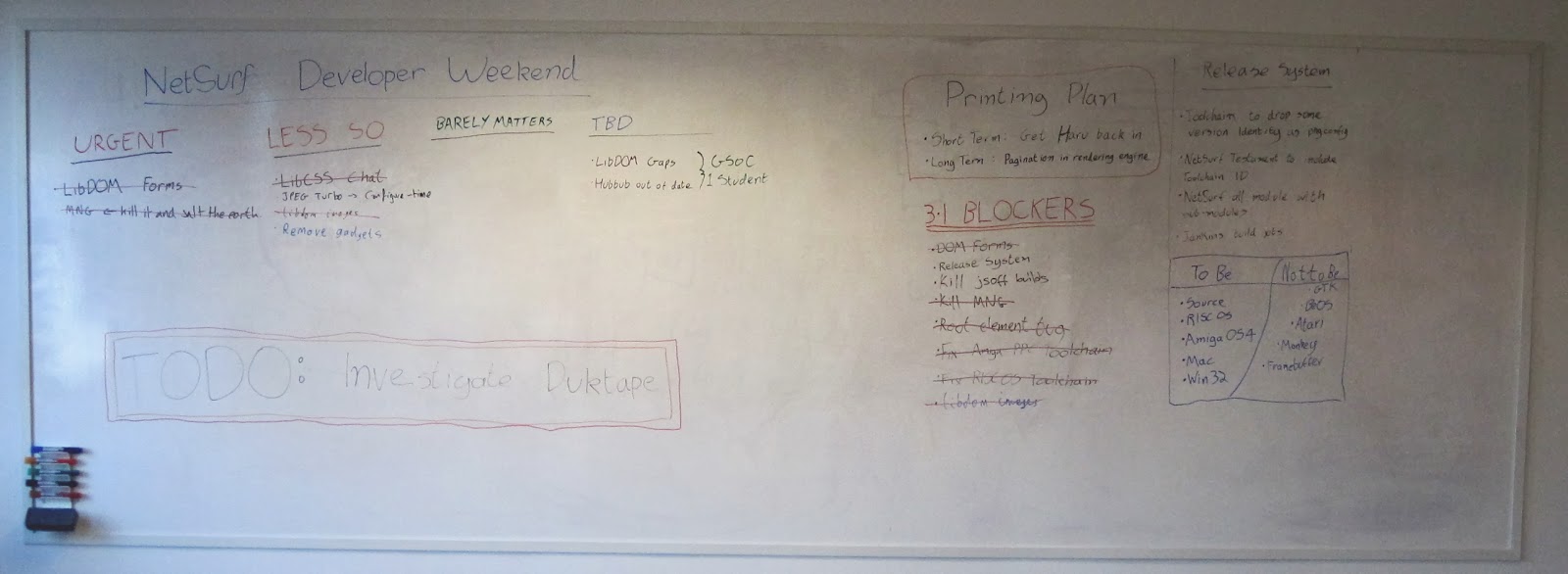
The NetSurf Developers bringing you alternative LOLcat viewing software since 2002Once again the NetSurf developers congregated in Cambridge at the Collabora offices where we were made welcome in a nice environment for the event.

Five developers managed to attend from around the UK Rob Kendrick, Vincent Sanders, Daniel Silverstone, John-Mark Bell and Michael Drake. We also had Chris Young and Fran ois Revol providing some bug fixes remotely.

This was the first time we had all met since the previous event towards the end of 2012 and we took full advantage of this to discuss a pretty extensive agenda in addition to the practical programming tasks.

From Friday lunchtime through to Sunday evening we managed 30 hours of work consisting of over 70 commits to over 100 files.

The whiteboard of our notes

Our main focus was working towards a 3.1 release which is scheduled for early April. Along with the source the release will have binary builds for RISC OS, AmigaOS, Windows and Mac OS X (x86 and ppc). Although the NetSurf project will not be directly releasing binaries for the GTK and Framebuffer frontends we will be ensuring the Debian packages are updated which is our prefered method of distribution for those targets.

We analysed the 3.0 release and formulated an improved process for the future. The 3.1 release will be generated automatically by the CI system ensuring constant results and removing the problems we encountered previously.

A set of release blocking issues was derived which we used as a task list during the workshop.The majority of these were completed including:
DOM based forms
Web forms are a feature Netsurf has supported for a long time and their implementation has not kept up with the rest of the browser. This is a long standing problem area which has resulted in numerous strange bugs with form submission. With this change the form system has been reworked to correctly operate directly from the DOM resulting in the squashing of a large number of bugs and a much improved user experience.

DOM based image loading
Up to now image fetching was performed only during the rendering of a page. With this change when the image link is placed into the DOM during the page parse it is scheduled to be fetched, this should give an improved user experience as images should be available earlier in a pages render.

Removal of MNG support
NetSurf has supported MNG since the 1.0 release, indeed the MNG library used to provide the PNG support too though we have long ago transitioned to libPNG. Alas the web has moved on and MNG has been largely forgotten, the libMNG library that performs the image decoding is old and generally unsupported specifically lacking security updates.

The build issues with libMNG (lack of pkg-config, reliance on libcms1 etc.) were causing maintenance issues in code nobody was actually using (there were crash bugs discovered during its removal!). Because of these issues it was decided to join the vast majority of browsers and remove support for this format.
The developers also addressed several issues with toolchain construction and a number of annoying usability bugs.

Plans for how to improve printing support we made. Initially we intend to fix the existing haru based pdf generation using this to print via pdf and in future have correct css styled page paginated printing render output.

The perennial issue of javascript was discussed however, while efforts to improve the existing support are ongoing, our usage of the spidermonkey library continues to raise various challenges including platform support and API changes between versions.

Due to these issues it has been suggested that we might add support for using the duktape JS engine instead, initial results are promising but given the size of the task of implementing an additional javascript engine binding further investigation is necessary before making a commitment.

Amongst the other discussions the group has also agreed that we will once again apply to be a GSoC organisation for a single student with some very focused projects:
  • Improving our HTML5 parser (hubbub)
  • Improving the DOM library implementing missing functionality.
While neither of these projects are as fashionable as some of our previous proposals they are well defined enough that as a group we believe we could offer enough support to the student to make their experience a pleasurable one and get the resulting code reviewed and merged promptly.

This event was very successful with a great deal achieved, the project is much more likely to be in a good shape to release 3.1 by April now and the meeting has given the developers a much welcomed boost.

I would like to extend the groups thanks to Robert McQueen for letting us use the Collabora offices, Dor e Carrier for organising all the administrative things and to Vivek Dasmohapatra for coming out on his Sunday afternoon to let us back in after locking ourselves out.


21 December 2013

Russell Coker: Links December 2013

Andres Lozano gave an interesting TED talk about the use of electrodes inside the brain (deep brain stimulation) to treat Alzheimers disease, Parkinson s disease, and depression [1]. Daniel Pocock wrote an interesting post commenting on some bad political decisions being made in Australia titled Evacuating Australia [2]. You can read that as a suggestion to leave Australia or to try and make Australia better. Marco Tempest gave an interesting TED talk about Nikola Tesla [3]. The presentation method is one that I ve never seen before so I recommend watching the talk even if you already know all about Tesla. Charmian Gooch gave an interesting TED talk about global corruption [4]. I think we need people to send the information on shell company ownership to organisations like Wikileaks. The punishment for leaking such information would be a lot less than Chelsea Manning is getting and the chance of getting caught is also low. Rich Mogul wrote an interesting and insightful article for Macworld about the Apple approach to security problems [5]. To avoid the problem of users disabling security features they work to make the secure way of doing things EASIER for the user. That won t work with all security problems but it s something we need to think about when working on computer security. Ray Raphael gave an interesting TED talk about the parts of the US revolution that don t appear in history books [6]. He warns the listener to beware of the narrative forms, but another way to interpret his talk is that you should present your version of history in the narrative form that is best accepted. That lesson is well known and it s easy to see history being deliberately distorted in most media outlets. Will Wright gave an interesting TED talk about how he designed the game Spore and his ideas about games in general [7]. Spore is a really good game. Chris Lintott gave an interesting TED talk about crowd-sourced astronomy titled How to Discover a Planet from Your Sofa [8]. He referenced the Zooniverse.org site which lists many crowd-sourced science projects [9]. Jake Socha gave an interesting TED talk about flying snakes, you have to see this to believe it [10]. Nikita Bier gave an interesting TED talk about his webapp to analyse economic policies [11]. Apparently 60% of people were going to vote in their best economic interest before seeing his site and 66% would do so afterwards that could change an election result. Anya Kamenetz wrote an interesting article for Salon about The Iliad Project which aims to use Indigogo to help identify new anti-biotics [12]. The current ways of discovering anti-biotics aren t working, lets hope this one does. Peter Finocchiaro wrote an interesting Salon article about how right-wing politicians in the US were opposed to Nelson Mandela [13] racism meets anti-communism. Katie McDonough wrote an interesting Salon article about Rick Santorum and Bill O Reilly comparing Obamacare to apartheid while supposedly honoring Nelson Mandela [14], Katie also notes that Nelson enshrined universal healthcare in the South African constitution something all countries should do. Mary Elizabeth Williams wrote a Salon article about Susan Boyle s announcement about being diagnosed with Asperger Syndrome [15]. Not a surprise though, some people can be diagnosed with Autism by merely watching them on TV. Amelia Hill wrote an article for The Guardian/The Observer about the educational results of Home Schooling [16]. Apparently Home-Schooled kids learn significantly more and home-educated children of working-class parents achieved considerably higher marks in tests than the children of professional, middle-class parents and that gender differences in exam results disappear among home-taught children . Wow, Home Schooling beats gender and class problems! I m sure it s even better for GLBT kids too. Robert Reich wrote an interesting Salon article about the way rich people in the US give tax-deductable (taxpayer supported) donations to charities that benefit themselves [17]. Dan Savage wrote a very funny review of Sarah Palin s latest Christmas book, one classic quote is why should I have to read the whole thing? Lord knows Sarah Palin didn t write the whole thing [18]. He makes a good point that we should use the term happy holidays instead of happy Christmas just to show that we aren t assholes.

Daniel Kahn Gillmor: Kevin M. Igoe should step down from CFRG Co-chair

I've said recently that pervasive surveillance is wrong. I don't think anyone from the NSA should have a leadership position in the development or deployment of Internet communications, because their interests are at odds with the interest of the rest of the Internet. But someone at the NSA is in exactly such a position. They ought to step down. Here's the background: The Internet Research Task Force (IRTF) is a body tasked with research into underlying concepts, themes, and technologies related to the Internet as a whole. They act as a research organization that cooperates and complements the engineering and standards-setting activities of the Internet Engineering Task Force (IETF). The IRTF is divided into issue-specific research groups, each of which has a Chair or Co-Chairs who have "wide discretion in the conduct of Research Group business", and are tasked with organizing the research and discussion, ensuring that the group makes progress on the relevant issues, and communicating the general sense of the results back to the rest of the IRTF and the IETF. One of the IRTF's research groups specializes in cryptography: the Crypto Forum Research Group (CFRG). There are two current chairs of the CFRG: David McGrew <mcgrew@cisco.com> and Kevin M. Igoe <kmigoe@nsa.gov>. As you can see from his e-mail address, Kevin M. Igoe is affiliated with the National Security Agency (NSA). The NSA itself actively tries to weaken cryptography on the Internet so that they can improve their surveillance, and one of the ways they try to do so is to "influence policies, standards, and specifications". On the CFRG list yesterday, Trevor Perrin requested the removal of Kevin M. Igoe from his position as Co-chair of the CFRG. Trevor's specific arguments rest heavily on the technical merits of a proposed cryptographic mechanism called Dragonfly key exchange, but I think the focus on Dragonfly itself is the least of the concerns for the IRTF. I've seconded Trevor's proposal, and asked Kevin directly to step down and to provide us with information about any attempts by the NSA to interfere with or subvert recommendations coming from these standards bodies. Below is my letter in full:
From: Daniel Kahn Gillmor <dkg@fifthhorseman.net>
To: cfrg@ietf.org, Kevin M. Igoe <kmigoe@nsa.gov>
Date: Sat, 21 Dec 2013 16:29:13 -0500
Subject: Re: [Cfrg] Requesting removal of CFRG co-chair
On 12/20/2013 11:01 AM, Trevor Perrin wrote:
> I'd like to request the removal of Kevin Igoe from CFRG co-chair.
Regardless of the conclusions that anyone comes to about Dragonfly
itself, I agree with Trevor that Kevin M. Igoe, as an employee of the
NSA, should not remain in the role of CFRG co-chair.
While the NSA clearly has a wealth of cryptographic knowledge and
experience that would be useful for the CFRG, the NSA is apparently
engaged in a series of attempts to weaken cryptographic standards and
tools in ways that would facilitate pervasive surveillance of
communication on the Internet.
The IETF's public position in favor of privacy and security rightly
identifies pervasive surveillance on the Internet as a serious problem:
https://www.ietf.org/media/2013-11-07-internet-privacy-and-security.html
The documents Trevor points to (and others from similar stories)
indicate that the NSA is an organization at odds with the goals of the IETF.
While I want the IETF to continue welcoming technical insight and
discussion from everyone, I do not think it is appropriate for anyone
from the NSA to be in a position of coordination or leadership.
----
Kevin, the responsible action for anyone in your position is to
acknowledge the conflict of interest, and step down promptly from the
position of Co-Chair of the CFRG.
If you happen to also subscribe to the broad consensus described in the
IETF's recent announcement -- that is, if you care about privacy and
security on the Internet -- then you should also reveal any NSA activity
you know about that attempts to subvert or weaken the cryptographic
underpinnings of IETF protocols.
Regards,
	--dkg
I'm aware that an abdication by Kevin (or his removal by the IETF chair) would probably not end the NSA's attempts to subvert standards bodies or weaken encryption. They could continue to do so by subterfuge, for example, or by private influence on other public members. We may not be able to stop them from doing this in secret, and the knowledge that they may do so seems likely to cast a pall of suspicion over any IETF and IRTF proceedings in the future. This social damage is serious and troubling, and it marks yet another cost to the NSA's reckless institutional disregard for civil liberties and free communication. But even if we cannot rule out private NSA influence over standards bodies and discussion, we can certainly explicitly reject any public influence over these critical communications standards by members of an institution so at odds with the core principles of a free society. Kevin M. Igoe, please step down from the CFRG Co-chair position. And to anyone (including Kevin) who knows about specific attempts by the NSA to undermine the communications standards we all rely on: please blow the whistle on this kind of activity. Alert a friend, a colleague, or a journalist. Pervasive surveillance is an attack on all of us, and those who resist it are heroes.

20 December 2013

Lars Wirzenius: Configuring gitano

I recently set up a Gitano instance as http://git.liw.fi/. Gitano is a very nice git server, which adds user and group management and access control in front of git itself, and keeps all configuration in git, where it's traceable and auditable nicely. It's also a command line based thing, rather than a slow, resource-hungry web application, and so much more to my liking. Daniel, the Gitano upstream, has a "gitano-all" source tree for creating an unofficial Gitano Debian package, which includes cgit, a fast git web interface. This is not ever going to be accepted in Debian, of course, but it makes it easier to install Gitano on your server. This hanky-panky is needed because Gitano and cgit both use libgit2, and that's a library without a stable API at this time. This makes is difficult to package for Debian. cgit seems to embed other such projects as well. Anyway, once you've installed the Gitano software (and cgit, if you want that), there's the matter of setting up a Gitano instance. Each Gitano instance is its own Unix user, accessed over ssh. Thus, one machine can host any number of Gitano instances, and they'll be nicely isolated from each other by normal Unix setup. Each instance manages its own set of Gitano users and group, which only exist within that instance. Users are identified by ssh public keys: there are no passwords. Here's my slightly edited checklist for setting up a Gitano instance. It assumes Gitano and cgit and their dependencies are installed. Setup Gitano itself: Setup a git daemon for public git repositories:
git stream tcp nowait nobody /usr/bin/git 
git daemon --inetd 
--interpolated-path=/home/git/repos/%D /home/git/repos
Setup cgit and Apache:
# CGIT stuff
DirectoryIndex /cgi-bin/cgit/cgit.cgi
Alias /cgit.png /usr/share/cgit/htdocs/cgit.png
Alias /cgit.css /usr/share/cgit/htdocs/cgit.css
<Directory "/home/git/repos">
    Options FollowSymlinks Indexes
    Allow from all
    AllowOverride none
    Order allow,deny
</Directory>
# Enable caching of up to 1000 output entriess
cache-size=1000
# Specify some default clone prefixes
clone-prefix=git://testgit
# Specify the css url
css=/cgit.css
# Specify the logo url
logo=/cgit.png
# Show extra links for each repository on the index page
enable-index-links=1
# Show number of affected files per commit on the log pages
enable-log-filecount=1
# Show number of added/removed lines per commit on the log pages
enable-log-linecount=1
# Set the title and heading of the repository index page
root-title=testgit
root-desc=Lars's test git repositories
# Allow download of tar.gz, tar.bz2 and zip-files
snapshots=tar.gz
#source-filter=/usr/lib/cgit/filters/syntax-highlighting.sh
remove-suffix=1
enable-git-config=1
strict-export=git-daemon-export-ok
scan-path=/home/git/repos
##
## List of common mimetypes
##
mimetype.git=image/git
mimetype.html=text/html
mimetype.jpg=image/jpeg
mimetype.pdf=application/pdf
mimetype.png=image/png
mimetype.svg=image/svg+xml
Finally, you should review, and possibly alter, Gitano access control rules. Some Gitano commands: Happy hacking. PS. I wrote a yarn test suite for my Gitano ACL, which may be interesting if you're new to Gitano.

18 December 2013

Daniel Pocock: Embedding Python in multi-threaded C++ applications

Embedding Python into other applications to provide a scripting mechanism is a popular practice. Ganglia can run user-supplied Python scripts for metric collection and the Blender project does it too, allowing users to develop custom tools and use script code to direct their animations. There are various reasons people choose Python:
  • Modern, object orientated style of programming
  • Interpreted language (no need to compile things, just edit and run the code)
  • Python has a vast array of modules providing many features such as database and network access, data processing, etc
The bottom line is that the application developer who chooses to embed Python in their existing application can benefit from the product of all this existing code multiplied by the imagination of their users. Enter repro repro is the SIP proxy of the reSIProcate project. reSIProcate is an advanced SIP implementation developed in C++. repro is a multi-threaded process. repro's most serious competitor is the Kamailio SIP proxy. Kamailio has its own bespoke scripting language that it has inherited from the SIP Express Router (SER) family of projects. repro has always been far more rigid in its capabilities than Kamailio. On the other hand, while Kamailio has given users great flexibility, it has also come at a cost: users can easily build configurations that are not valid or may not do what they really intend if they don't understand the intricacies of the SIP protocol. Here is an example of the Kamailio configuration script (from Daniel's excellent blog about building a Skype-like service in less than an hour) Kamailio also has a wide array of plugins for things like database and LDAP access. repro only had embedded bdb and MySQL support. Embedding Python into repro appears to be a quick way to fill many of these gaps and allow users to combine the power of the reSIProcate stack with their own custom routing logic. On the other hand, it is not simply copying the Kamailio scripting solution: rather, it provides a distinctive alternative. Starting the integration Embedding Python is such a popular practice that there is even dedicated documentation on the subject. As well as looking there, I also looked over the example provided by the embedded Python module for Ganglia. Looking over the Ganglia mod_python code I noticed a lot of boilerplate code for reference counting and other tedious activities. Given that reSIProcate is C++ code, I thought I would look for a C++ solution to this and I came across PyCXX. PyCXX is licensed under BSD-like terms similar to reSIProcate itself so it is a good fit. There is also the alternative Boost.Python API, however, reSIProcate has been built without Boost dependencies so I decided to stick with PyCXX. I looked over the PyCXX examples and the documentation and was able to complete a first cut of the embedded Python scripting feature very quickly. Using PyCXX One unusual thing I noticed about PyCXX is that the Debian package, python-cxx-dev does not provide any shared library. Instead, some uncompiled source files are provided and each project using PyCXX must compile them and link them statically itself. Here is how I do that in the Makefile.am for pyroute in repro:
AM_CXXFLAGS = -I $(top_srcdir)
reproplugin_LTLIBRARIES = libpyroute.la
libpyroute_la_SOURCES = PyRoutePlugin.cxx
libpyroute_la_SOURCES += PyRouteWorker.cxx
libpyroute_la_SOURCES += $(PYCXX_SRCDIR)/cxxextensions.c
libpyroute_la_SOURCES += $(PYCXX_SRCDIR)/cxx_extensions.cxx
libpyroute_la_SOURCES += $(PYCXX_SRCDIR)/cxxsupport.cxx
libpyroute_la_SOURCES += $(PYCXX_SRCDIR)/../IndirectPythonInterface.cxx
libpyroute_la_CPPFLAGS = $(DEPS_PYTHON_CFLAGS)
libpyroute_la_LDFLAGS = -module -avoid-version
libpyroute_la_LDFLAGS += $(DEPS_PYTHON_LIBS)
EXTRA_DIST = example.py
noinst_HEADERS = PyRouteWorker.hxx
noinst_HEADERS += PyThreadSupport.hxx
The value PYCXX_SRCDIR must be provided on the configure command line. On Debian, it is /usr/share/python2.7/CXX/Python2 Going multi-threaded My initial implementation simply invoked the Python method from the main routing thread of the repro SIP proxy. This meant that it would only be suitable for executing functions that complete quickly, ruling out the use of any Python scripts that talk to network servers or other slow activities. When the proxy becomes heavily loaded, it is important that it can complete many tasks asynchronously, such as forwarding chat messages between users in real-time. Therefore, it was essential to extend the solution to run the Python scripts in a pool of worker threads. At this point, I had an initial feeling that there may be danger in just calling the Python methods from some other random threads started by my own code. I went to see the manual and I came across this specific documentation about the subject. It looks quite easy, just wrap the call to the user-supplied Python code in something like this:
PyGILState_STATE gstate;
gstate = PyGILState_Ensure();
/* Perform Python actions here. */
result = CallSomeFunction();
/* evaluate result or handle exception */
/* Release the thread. No Python API allowed beyond this point. */
PyGILState_Release(gstate);
Unfortunately, I found that this would not work and that one of two problems occur when using this code:
  • The thread blocks on the call to PyGILState_Ensure()
  • The program crashes with a segmentation fault when the call to a Python method was invoked
Exactly which of these outcomes I experienced seemed to depend on whether I tried to explicitly call PyEval_ReleaseThread() from the main thread after doing the Py_Initialize() and other setup tasks. I tried various permutations of using PyGILState_Ensure()PyGILState_Release() and/or PyEval_SaveThread()/PyEval_ReleaseThread() but I always had one of the same problems. The next thing that occurred to me is that maybe PyCXX provides some framework for thread integration: I had a look through the code and couldn't find any reference to the threading functionality from the C API. I went looking for more articles and mailing list discussions and found implementation notes such as this one in Linux Journal and this wiki from the Blender developers. Most of them just appeared to be repeating what was in the manual, with a few subtle differences, but none of this provided an immediate solution. Eventually, I discovered this other blog about concurrency with embedded Python and it suggests something not highlighted in any of the other resources: calling PyThreadState_New(m_interpreterState) in each thread after it starts and before it does anything else. Combining this with the use of PyEval_SaveThread()/PyEval_ReleaseThread() fixed the problem: the use of PyThreadState_New() was not otherwise mentioned in the relevant section of the Python guide. I decided to take this solution a step further and create a convenient C++ class to encapsulate the logic, you can see this in PyThreadSupport.hxx:
class PyExternalUser
 
   public:
      PyExternalUser(PyInterpreterState* interpreterState)
       : mInterpreterState(interpreterState),
         mThreadState(PyThreadState_New(mInterpreterState))  ;
   class Use
    
      public:
         Use(PyExternalUser& user)
          : mUser(user)
           PyEval_RestoreThread(mUser.getThreadState());  ;
         ~Use()   mUser.setThreadState(PyEval_SaveThread());  ;
      private:
         PyExternalUser& mUser;
    ;
   friend class Use;
   protected:
      PyThreadState* getThreadState()   return mThreadState;  ;
      void setThreadState(PyThreadState* threadState)   mThreadState = threadState;  ;
   private:
      PyInterpreterState* mInterpreterState;
      PyThreadState* mThreadState;
 ;
and the way to use it is demonstrated in the PyRouteWorker class. Observe how PyExternalUser::Use is instantiated in the PyRouteWorker::process() method: when it goes out of scope (either due to a normal return, an error or an exception) the necessary call to PyEval_SaveThread() is made in the PyExternalUser::Use::~Use() destructor. Using other Python modules and DSO problems All of the above worked for basic Python such as this trivial example script:
def on_load():
    '''Do initialisation when module loads'''
    print 'example: on_load invoked'
def provide_route(method, request_uri, headers):
    '''Process a request URI and return the target URI(s)'''
    print 'example: method = ' + method
    print 'example: request_uri = ' + request_uri
    print 'example: From = ' + headers["From"]
    print 'example: To = ' + headers["To"]
    routes = list()
    routes.append('sip:bob@example.org')
    routes.append('sip:alice@example.org')
    return routes
However, it needs a more credible and useful test: using the python-ldap module to try and query an LDAP server appears like a good choice. Upon trying to use import ldap in the Python script, repro would refuse to load the Python script, choking on an error like this:
Traceback (most recent call last):
  File "/usr/lib/python2.7/dist-packages/ldap/__init__.py", line 22, in 
    import _ldap
ImportError: /usr/lib/python2.7/dist-packages/_ldap.so: undefined symbol: PyExc_SystemError
I looked at the file _ldap.so and discovered that it is linked with the LDAP libraries but not explicitly linked to any version of the Python runtime libraries. It expects the application hosting it to provide the Python symbols globally. In my own implementation, my embedded Python encapsulation code is provide as a DSO plugin, similar to the way plugins are loaded in Ganglia or Apache. The DSO links to Python: the DSO is loaded by a dlopen() call from the main process. The main repro binary has no direct link to Python libraries. Adding RTLD_GLOBAL to the top-level dlopen() call for loading the plugin is one way to ensure the Python symbols are made available to the Python modules loaded indirectly by the Python interpreter. This solution may be suitable for applications that don't mix and match many different components. Doing something useful with it Now it was all working nicely, I took a boilerplate LDAP Python example and used it for making a trivial script that converts sip:user@example.org to something like sip:9001@pbx.example.org, assuming that 9001 is the telephoneNumber associated with the user@ email address in LDAP. It is surprisingly simple and easily adaptable to local requirements depending upon the local LDAP structures:
import ldap
from urlparse import urlparse
def on_load():
    '''Do initialisation when module loads'''
    #print 'ldap router: on_load invoked'
def provide_route(method, request_uri, headers):
    '''Process a request URI and return the target URI(s)'''
    #print 'ldap router: request_uri = ' + request_uri
    _request_uri = urlparse(request_uri)
    routes = list()
    
    # Basic LDAP server parameters:
    server_uri = 'ldaps://ldap.example.org'
    base_dn = "dc=example,dc=org"
    # this domain will be appended to the phone numbers when creating
    # the target URI:
    phone_domain = 'pbx.example.org'
    # urlparse is not great for "sip:" URIs,
    # the user@host portion is in the 'path' element:
    filter = "(&(objectClass=inetOrgPerson)(mail=%s))" % _request_uri.path
    #print "Using filter: %s" % filter
    try:
        con = ldap.initialize(server_uri)
        scope = ldap.SCOPE_SUBTREE
        retrieve_attributes = None
        result_id = con.search(base_dn, scope, filter, retrieve_attributes)
        result_set = []
        while 1:
            timeout = 1
            result_type, result_data = con.result(result_id, 0, None)
            if (result_data == []):
                break
            else:
                if result_type == ldap.RES_SEARCH_ENTRY:
                    result_set.append(result_data)
        if len(result_set) == 0:
            #print "No Results."
            return routes
        for i in range(len(result_set)):
            for entry in result_set[i]:
                if entry[1].has_key('telephoneNumber'):
                    phone = entry[1]['telephoneNumber'][0]
                    routes.append('sip:' + phone + '@' + phone_domain)
    except ldap.LDAPError, error_message:
        print "Couldn't Connect. %s " % error_message
    return routes
Embedded Python opens up a world of possibilities After Ganglia 3.1.0 introduced an embedded Python scripting facility, dozens of new modules started appearing in github. Python scripting lowers the barrier for new contributors to a project and makes it much easier to fine tune free software projects to meet local requirements: hopefully we will see similar trends with the repro SIP proxy and other projects that choose Python. The code is committed here in the reSIProcate repository. These features will appear in the next beta release of reSIProcate and Debian packages will be available in unstable in a few days.

C.J. Adams-Collier: Maxine is now running on mariadb

So back when I was working for MySQL AB as support manager for MaxDB, I created an IRC bot to help manage the #maxdb channel on Freenode. We didn t get a lot of traffic, and Daniel De Graaf mentioned that he could use a bot to help manage some iptables factoids over on #netfilter. So I had her join. He taught her all sorts of interesting things. She stored these factoids in a MySQL database. I have just migrated from MySQL to MariaDB which I compiled from source. Here are the packages: http://www.colliertech.org/~cjac/debian/
cjac@mariadb:~$ mysql -u root -p
Enter password: 
Welcome to the MariaDB monitor.  Commands end with ; or \g.
Your MariaDB connection id is 5322
Server version: 5.5.32-MariaDB-1-log (Debian)
Copyright (c) 2000, 2013, Oracle, Monty Program Ab and others.
Type 'help;' or '\h' for help. Type '\c' to clear the current input statement.
MariaDB [(none)]> use maxine;
Reading table information for completion of table and column names
You can turn off this feature to get a quicker startup with -A
Database changed
MariaDB [maxine]> 
15:22 < cj> maxine: iptables?
15:22 < maxine> hmmm... iptables is a generic table structure for the 
                definition of rulesets. Each rule within a chain consists of a 
                number of classifiers (iptables matches) and one optional 
                connected action (iptables target).

Daniel Kahn Gillmor: automatically have uscan check signatures

If you maintain software in debian, one of your regular maintenance tasks is checking for new upstream versions, reviewing them, and preparing them for debian if appropriate. One of those steps is often to verify the cryptographic signature on the upstream source archive. At the moment, most maintainers do the cryptographic check manually, or maybe even don't bother to do it at all. For the common case of detached OpenPGP signatures, though, uscan can now do it for you automatically (as of devscripts version 2.13.3). You just need to tell uscan what keys you expect upstream to be signing with, and how to find the detached signature. So, for example, Damien Miller recently announced his new key that he will be using to sign OpenSSH releases (his new key has OpenPGP fingerprint 59C2 118E D206 D927 E667 EBE3 D3E5 F56B 6D92 0D30 -- you can verify it has been cross-signed by his older key, and his older key has been revoked with the indication that it was superceded by this one). Having done a reasonable verification of Damien's key, if i was the openssh package maintainer, i'd do the following:
cd ~/src/openssh/
gpg --export '59C2 118E D206 D927 E667  EBE3 D3E5 F56B 6D92 0D30' >> debian/upstream-signing-key.pgp
And then upon noticing that the signature files are named with a simple .asc suffix on the upstream distribution site, we can use the following pgpsigurlmangle option in debian/watch:
version=3
opts=pgpsigurlmangle=s/$/.asc/ ftp://ftp.openbsd.org/pub/OpenBSD/OpenSSH/portable/openssh-(.*)\.tar\.gz 
I've filed this specific example as debian bug #732441. If you notice a package with upstream signatures that aren't currently being checked by uscan (or if you are upstream, you sign your packages, and you want your debian maintainer to verify them), you can file similar bugs. Or, if you maintain a package for debian, you can just fix up your package so that this check is there on the next upload. If you maintain a package whose upstream doesn't sign their releases, ask them why not -- wouldn't upstream prefer that their downstream users can verify that each release wasn't tampered with? Of course, none of these checks take the the place of the real work of a debian package maintainer: reviewing the code and the changelogs, thinking about what changes have happened, and how they fit into the broader distribution. But it helps to automate one of the basic safeguards we should all be using. Let's eliminate the possibility that the file was tampered with at the upstream distribution mirror or while in transit over the network. That way, the maintainer's time and energy can be spent where they're more needed.Tags: crypto, devscripts, openpgp, package maintenance, signatures, uscan

15 December 2013

Daniel Pocock: A bias against Bitcoin?

A statement from the European Banking Authority is warning people about the risks of using Bitcoin for payment and investment/speculation. The press notes that the EBA paper stops short of telling people not to use the digital currency. Many of the points made in the warning appear to be well founded on the facts: however, exactly the same points could be made about everything from gift vouchers to bullion. It is not clear why Bitcoin should be singled out for special attention like this. Yes, gold and silver bullion are not issued by any central authority. Bullion values rise and fall many times in each day. When bullion values dipped earlier in 2013, some short term speculators sold at a loss: but for every scared seller, there was also somebody else willing to buy. Has anybody seen any stories of disgruntled investors throwing their gold out with the rubbish when the market moved? A more interesting example is that of the gift vouchers offered by many chains of retail stores. With many stores going through restructuring and liquidation in recent years, customers holding the vouchers have been left high and dry. Unlike temporary dips in bullion or Bitcoin values, the vouchers have often become truly worthless. The story has been repeated again and again around the world, including HMV in the UK and Mothercare in Australia. Community sense When retailers enter bankruptcy, it is usually at the instigation of a single person such as a prominent shareholder or the lender. Bitcoin and bullion, on the other hand, are arguably much harder for any single person or small group to pull the plug on so dramatically. Their value depends on their widespread acceptance around the globe rather than any single point of failure. Bitcoin's future I'm yet to see any evidence that Bitcoin is a long term store of value. Even the most knowledgeable proponents of Bitcoin agree that it is not technically perfect, due to the lack of true anonymity. When a truly anonymous solution is found, it will be interesting to see if the industry migrates away from Bitcoin. On the other hand, the threat of a truly anonymous community cryptocurrency is a scary thing for governments in the surveillance age. It could be argued that governments may become active players in the Bitcoin market in order to keep more anonymous solutions from gaining market share. For example, if a government was to accept remittence of taxes by Bitcoin or if smaller countries were to use Bitcoin to facilitate foreign exchange (bypassing the use of US dollars) this would make the currency far more credible for other mainstream purposes.

13 December 2013

Daniel Kahn Gillmor: OpenPGP Key IDs are not useful

Fingerprints and Key IDsOpenPGPv4 fingerprints are made from an SHA-1 digest over the key's public key material, creation date, and some boilerplate. SHA-1 digests are 160 bits in length. The "long key ID" of a key is the last 64 bits of the key's fingerprint. The "short key ID" of a key is the last 32 bits of the key's fingerprint. You can see both of the key IDs as a hash in and of themselves, as "32-bit truncated SHA-1" is a sort of hash (albeit not a cryptographically secure one). I'm arguing here that short Key IDs and long Key IDs are actually useless, and we should stop using them entirely where we can do so. We certainly should not be exposing normal human users to them. (Note that I am not arguing that OpenPGP v4 fingerprints themselves are cryptographically insecure. I do not believe that there are any serious cryptographic risks currently associated with OpenPGP v4 fingerprints. This post is about Key IDs specifically, not fingerprints.)Key IDs have serious problemsAsheesh pointed out two years ago that OpenPGP short key IDs are bad because they are trivial to replicate. This is called a preimage attack against the short key ID (which is just a truncated fingerprint). Today, David Leon Gil demonstrated that a collision attack against the long key ID is also trivial. A collision attack differs from a preimage attack in that the attacker gets to generate two different things that both have the same digest. Collision attacks are easier than preimage attacks because of the birthday paradox. dlg's colliding keys are not a surprise, but hopefully the explicit demonstration can serve as a wakeup call to help us improve our infrastructure. So this is not a way to spoof a specific target's long key ID on its own. But it indicates that it's more of a worry than most people tend to think about or plan for. And remember that for a search space as small as 64-bits (the long key ID), if you want to find a pre-image against any one of 2k keys, your search is actually only in a (64-k)-bit space to find a single pre-image. The particularly bad news: gpg doesn't cope well with the two keys that have the same long key ID:
0 dkg@alice:~$ gpg --import x
gpg: key B8EBE1AF: public key "9E669861368BCA0BE42DAF7DDDA252EBB8EBE1AF" imported
gpg: Total number processed: 1
gpg:               imported: 1  (RSA: 1)
0 dkg@alice:~$ gpg --import y
gpg: key B8EBE1AF: doesn't match our copy
gpg: Total number processed: 1
2 dkg@alice:~$ 
This probably also means that caff (from the signing-party package) will also choke when trying to deal with these two keys. I'm sure there are other OpenPGP-related tools that will fail in the face of two keys with matching 64-bit key IDs. We should not use Key IDs I am more convinced than ever that key IDs (both short and long) are actively problematic to real-world use of OpenPGP. We want two things from a key management framework: unforgability, and human-intelligible handles. Key IDs fail at both. So reasonable tools should not expose either short or long key IDs to users, or use them internally if they can avoid them. They do not have any properties we want, and in the worst case, they actively mislead people or lead them into harm. What reasonable tool should do that? How to replace Key IDs If we're not going to use Key IDs, what should we do instead? For anything human-facing, we should be using human-intelligible things like user IDs and creation dates. These are trivial to forge, but people can relate to them. This is better than offering the user something that is also trivial to forge, but that people cannot relate to. The job of any key management UI should be to interpret the cryptographic assurances provided by the certifications and present that to the user in a comprehensible way. For anything not human-facing (e.g. key management data storage, etc), we should be using the full key itself. We'll also want to store the full fingerprint as an index, since that is used for communication and key exchange (e.g. on calling cards). There remain parts of the spec (e.g. PK-ESK, Issuer subpackets) that make some use of the long key ID in ways that provide some measure of convenience but no real cryptographic security. We should fix the spec to stop using those, and either remove them entirely, or replace them with the full fingerprints. These fixes are not as urgent as the user-facing changes or the critical internal indexing fixes, though. Key IDs are not useful. We should stop using them.Tags: collision, crypto, gpg, openpgp, pgp, security

Daniel Pocock: xWiki: 10 years and a WebRTC success story

Six months ago, I wrote to the leaders of several open source web frameworks and asked them about their vision for WebRTC and if they would come to the WebRTC Conference in Paris this week (now finished). The most promising response was from Ludovic Dubost, founder of the xWiki project. Ludovic successfully demonstrated their shiny new WebRTC capabilities today in front of an audience including many far more experienced telephony operators who are still only getting to terms with this technology. What is xWiki? Don't let the wiki name limit your perception of this project. xWiki is a lot more than just another wiki hosting framework. As a bare minimum, you can certainly use it in the same way as other wikis, doing lightweight markup that is easier than HTML. On the other hand, xWiki really shines when it comes to extensibility. The xWiki team are Java developers and so xWiki appeals most to other Java developers who may want to leverage some library code from their web portal from time to time, without even having to compile anything. Here are some examples and here is one of the most trivial ones:
 velocity 
Your username is $xcontext.getUser(), welcome to the site.
 /velocity 
WebRTC capabilities The xWiki team chose XMPP as a chat protocol (using the Candy XMPP JavaScript chat) as the foundation for real-time communication. They have then extended this by creating a custom signalling mechanism and making it convenient for users of a chat session to upgrade the session to voice/video with a mouseclick. The whole experience works within the browser without any plugins. 10 years of xWiki It was also xWiki's 10th birthday today and this provided the perfect opportunity for a party: cjdns and enigmabox While at the xWiki office, it was interesting to see a lot of innovative work taking place, including this VoIP setup where a Grandstream phone is attached to an Enigmabox operated by Caleb from the cjdns project.

11 December 2013

Daniel Pocock: Get WebRTC going faster

On Saturday, Lumicall began offering free calls from browser to mobile using the free and open WebRTC technology. It should be no surprise that the service has been popular. Is it really free and open? The only way to prove this technology is free is to help people implement this for themself. On Monday, I uploaded reSIProcate v1.9.0 beta7 packages to Debian. The reSIProcate SIP proxy, repro, is one of the core components of the solution behind the free Lumicall service. Simply install the repro and resiprocate-turn-server packages using apt-get and make the following changes to the configuration (use your own IP addresses of course). I've taken this diff from my own runtime environment, only hiding my passwords, so that you can see exactly how I got it working:
--- repro.config.orig	2013-12-11 17:36:27.179228324 +0100
+++ repro-ws.sip5060.net.config	2013-12-11 17:48:24.159938649 +0100
@@ -143,6 +143,41 @@
 # Transport6TlsClientVerification = None
 # Transport6RecordRouteUri = sip:h1.sipdomain.com;transport=WS
 
+Transport1Interface = 195.8.117.57:80
+Transport1Type = WS
+Transport1RecordRouteUri = auto
+
+Transport2Interface = 2001:67c:1388:1000::57:80
+Transport2Type = WS
+Transport2RecordRouteUri = auto
+
+Transport3Interface = 195.8.117.57:5060
+Transport3Type = TCP
+Transport3RecordRouteUri = auto
+
+Transport4Interface = 2001:67c:1388:1000::57:5060
+Transport4Type = TCP
+Transport4RecordRouteUri = auto
+
+Transport5Interface = 195.8.117.57:443
+Transport5Type = WSS
+#Transport5RecordRouteUri = auto
+Transport5TlsDomain = ws.sip5060.net
+Transport5TlsClientVerification = None
+Transport5RecordRouteUri = sip:ws.sip5060.net;transport=WSS
+Transport5TlsCertificate = /etc/ssl/ssl.crt/ws.sip5060.net-bundle.crt
+Transport5TlsPrivateKey = /etc/ssl/private/ws.sip5060.net-key.pem
+
+Transport6Interface = 2001:67c:1388:1000::57:443
+Transport6Type = WSS
+#Transport6RecordRouteUri = auto
+Transport6TlsDomain = ws.sip5060.net
+Transport6TlsClientVerification = None
+Transport6RecordRouteUri = sip:ws.sip5060.net;transport=WSS
+Transport6TlsCertificate = /etc/ssl/ssl.crt/ws.sip5060.net-bundle.crt
+Transport6TlsPrivateKey = /etc/ssl/private/ws.sip5060.net-key.pem
+
+
 # Comma separated list of DNS servers, overrides default OS detected list (leave blank 
 # for default)
 DNSServers =
@@ -455,7 +490,7 @@
 ForceRecordRouting = false
 
 # Assume path option
-AssumePath = false
+AssumePath = true
 
 # Disable registrar
 DisableRegistrar = false
@@ -481,7 +516,7 @@
 # WARNING: Before enabling this, ensure you have a RecordRouteUri setup, or are using
 # the alternate transport specification mechanism and defining a RecordRouteUri per
 # transport: TransportXRecordRouteUri
-DisableOutbound = true
+DisableOutbound = false
 
 # Set the draft version of outbound to support (default: RFC5626)
 # Other accepted values are the versions of the IETF drafts, before RFC5626 was issued
@@ -505,7 +540,7 @@
 # WARNING: Before enabling this, ensure you have a RecordRouteUri setup, or are using
 # the alternate transport specification mechanism and defining a RecordRouteUri per
 # transport: TransportXRecordRouteUri
-EnableFlowTokens = false
+EnableFlowTokens = true
 
 # Enable use of flow-tokens in non-outbound cases for clients detected to be behind a NAT.  
 # This a more selective flow token hack mode for clients not supporting RFC5626.  The 

This is a diff against the /etc/repro/repro.config file distributed in the Debian package version 1.9.0~beta7-1. In the example above, I've included WSS transport defintions for WebSockets over TLS. Use the standard procedure for creating webserver SSL certificates to create certificates for repro and make sure you insert the correct filenames in the TLS parameters above. I've also duplicated every transport for IPv6. If you don't want TLS/WSS or IPv6, just comment those entries out (and renumber the remaining transports). Web-based SIP proxy setup Once you have repro running, go to the web admin interface (port 5080, username: admin, password: admin) and finish the setup using the web UI. The following steps are essential:
  • Add your domain (and restart the repro daemon after adding your domain)
  • Add some users
  • Add any routes to external services (optional - in my next blog I'll demonstrate how to route WebRTC calls to Asterisk using the Debian packages and less than 20 lines of configuration)
Set up reTurn, the TURN server Just put your IP addresses in /etc/reTurnServer.config and add the following line to /etc/reTurnServer-users.txt:
test:notasecret:reTurn:authorized
IMPORTANT: the realm in the users file (reTurn in the example and default config) must be identical to the AuthenticationRealm in the /etc/reTurnServer.config file. On your own web site Simply install your own apache server and clone the webrtc.lumicall.org demo site. Modify the file js/custom.js and include the settings for your own server.
# cd /var/www
# mkdir webcall
# cd webcall
# wget -r -nH http://webrtc.lumicall.org
# vi js/custom.js
In the custom.js, make sure you use a ws:// URL if you didn't set up SSL certificates and use a wss:// URL if you did. The IP or domain of your repro server must be in the ws:// or wss:// URL. Now navigate to the URL ending with /webcall on your server. For RHEL, Fedora and other RPM users Can somebody please assist with the review of the cajun-jsonapi dependency package so I can upload this new version of reSIProcate to Fedora? I'm also planning to make v1.9.0 available in EPEL6 when it is released in January. Questions? Please come and ask questions or discuss your experiences on the Free RTC mailing list sponsored by FSF Europe.

7 December 2013

Daniel Pocock: Free calling from browser to mobile with free software

Lumicall is now offering free calls from browser to mobile. The whole service is powered by free software using open standards.
  • The person receiving the call must have the open source Lumicall app on their phone (Android and Cyanogenmod phones supported)
  • The person making the call just goes to http://webrtc.lumicall.org and dials the number in international format. For example, for the UK mobile 07123 45678, you need to dial +44712345678
Credits Various open source projects have made this possible, in particular: The service is enabled by WebRTC which is part of the latest HTML and JavaScript standards. You need to have the latest version of Mozilla Firefox, Google Chrome or another modern web browser supporting WebRTC - so there is no need to install any plugin. Feedback and discussion Please come and join us on the mailing list for any of the third-party projects that are involved. Please also join the Free real-time communications list sponsored by the FSF Europe for any general discussion about the future of free communications with free software. WebRTC Conference this week I'll be presenting some of my own work with WebRTC at the WebRTC Conference and Exhibition 2013 in Paris this week. Various other free software developers are also in the program, including Ludovic Dubost from xWiki and Emil Ivov from Jitsi

5 December 2013

Daniel Kahn Gillmor: The legal utility of deniability in secure chat

This Monday, I attended a workshop on Multi-party Off the Record Messaging and Deniability hosted by the Calyx Institute. The discussion was a combination of legal and technical people, looking at how the characteristics of this particular technology affect (or do not affect) the law. This is a report-back, since I know other people wanted to attend. I'm not a lawyer, but I develop software to improve communications security, I care about these questions, and I want other people to be aware of the discussion. I hope I did not misrepresent anything below. I'd be happy if anyone wants to offer corrections. BackgroundOff the Record Messaging (OTR) is a way to secure instant messaging (e.g. jabber/XMPP, gChat, AIM). The two most common characteristics people want from a secure instant messaging program are:
Authentication
Each participant should be able to know specifically who the other parties are on the chat.
Confidentiality
The content of the messages should only be intelligible to the parties involved with the chat; it should appear opaque or encrypted to anyone else listening in. Note that confidentiality effectively depends on authentication -- if you don't know who you're talking to, you can't make sensible assertions about confidentiality.
As with many other modern networked encryption schemes, OTR relies on each user maintaining a long-lived "secret key", and publishing a corresponding "public key" for their peers to examine. These keys are critical for providing authentication (and by extension, for confidentiality). But OTR offers several interesting characteristics beyond the common two. Its most commonly cited characteristics are "forward secrecy" and "deniability".
Forward secrecy
Assuming the parties communicating are operating in good faith, forward secrecy offers protection against a special kind of adversary: one who logs the encrypted chat, and subsequently steals either party's long-term secret key. Without forward secrecy, such an adversary would be able to discover the content of the messages, violating the confidentiality characteristic. With forward secrecy, this adversary is be stymied and the messages remain confidential.
Deniability
Deniability only comes into play when one of the parties is no longer operating in good faith (e.g. their computer is compromised, or they are collaborating with an adversary). In this context, if Alice is chatting with Bob, she does not want Bob to be able to cryptographically prove to anyone else that she made any of the specific statements in the conversation. This is the focus of Monday's discussion. To be clear, this kind of deniability means Alice can correctly say "you have no cryptographic proof I said X", but it does not let her assert "here is cryptographic proof that I did not say X" (I can't think of any protocol that offers the latter assertion). The opposite of deniability is a cryptographic proof of origin, which usually runs something like "only someone with access to Alice's secret key could have said X."
The traditional two-party OTR protocol has offered both forward secrecy and deniability for years. But deniability in particular is a challenging characteristic to provide for group chat which is the domain of Multi-Party OTR (mpOTR). You can read some past discussion about the challenges of deniability in mpOTR (and why it's harder when there are more than two people chatting) from the otr-users mailing list. If you're not doing anything wrong... The discussion was well-anchored by a comment from another participant who cheekily asked "If you're not doing anything wrong, why do you need to hide your chat at all, let alone be able to deny it?" The general sense of the room was that we'd all heard this question many times, from many people. There are lots of problems with the ideas behind the question from many perspectives. But just from a legal perspective, there are at least two problems with the way this question is posed: In these situations, people confront real risk from the law. If we care about these people, we need to figure out if we can build systems to help them reduce that legal risk (of course we also need to fix broken laws, and the legal environment in general, but those approaches were out of scope for this discussion). The Legal Utility of Deniability Monday's meeting was called specifically because it wasn't clear how much real-world usefulness there is in the "deniability" characteristic, and whether this feature is worth the development effort and implementation tradeoffs required. In particular, the group was interested in deniability's utility in legal contexts; many (most?) people in the room were lawyers, and it's also not clear that deniability has much utility outside of a formal legal setting. If your adversary isn't constrained by some rule of law, they probably won't care at all whether there is a cryptographic proof or not that you wrote a particular message (In retrospect, one possible exception is exposure in the media, but we did not discuss that scenario). Places of possible usefulness So where might deniability come in handy during civil litigation or a criminal trial? Presumably the circumstance is that a piece of a chat log is offered as incriminating evidence, and the defendant is trying to deny something that they appear to have said in the log. This denial could take place in two rather different contexts: during rules over admissibility of evidence, or (once admitted) in front of a jury. In legal wrangling over admissibility, apparently a lot of horse-trading can go on -- each side concedes some things in exchange for the other side conceding other things. It appears that cryptographic proof of origin (that is, a lack of deniability) on the chat logs themselves might reduce the amount of leverage a defense lawyer can get from conceding or arguing strongly over that piece of evidence. For example, if the chain of custody of a chat transcript is fuzzy (i.e. the transcript could have been mishandled or modified somehow before reaching trial), then a cryptographic proof of origin would make it much harder for the defense to contest the chat transcript on the grounds of tampering. Deniability would give the defense more bargaining power. In arguing about already-admitted evidence before a jury, deniability in this sense seems like a job for expert witnesses, who would need to convince the jury of their interpretation of the data. There was a lot of skepticism in the room over this, both around the possibility of most jurors really understanding what OTR's claim of deniability actually means, and on jurors' ability to distinguish this argument from a bogus argument presented by an opposing expert witness who is willing to lie about the nature of the protocol (or who misunderstands it and passes on their misunderstanding to the jury). The complexity of the tech systems involved in a data-heavy prosecution or civil litigation are themselves opportunities for lawyers to argue (and experts to weigh in) on the general reliability of these systems. Sifting through the quantities of data available and ensuring that the appropriate evidence is actually findable, relevant, and suitably preserved for the jury's inspection is a hard and complicated job, with room for error. OTR's deniability might be one more element in a multi-pronged attack on these data systems. These are the most compelling arguments for the legal utility of deniability that I took away from the discussion. I confess that they don't seem particularly strong to me, though some level of "avoiding a weaker position when horse-trading" resonates with me. What about the arguments against its utility? Limitations The most basic argument against OTR's deniability is that courts don't care about cryptographic proof for digital evidence. People are convicted or lose civil cases based on unsigned electronic communications (e.g. normal e-mail, plain chat logs) all the time. OTR's deniability doesn't provide any legal cover stronger than trying to claim you didn't write a given e-mail that appears to have originated from your account. As someone who understands the forgeability of e-mail, i find this overall situation troubling, but it seems to be where we are. Worse, OTR's deniability doesn't cover whether you had a conversation, just what you said in that conversation. That is, Bob can still cryptographically prove to an adversary (or before a judge or jury) that he had a communication with someone controlling Alice's secret key (which is probably Alice); he just can't prove that Alice herself said any particular part of the conversation he produces. Additionally, there are runtime tradeoffs depending on how the protocol manages to achieve these features. For example, forward secrecy itself requires an additional round trip or two when compared to authenticated, encrypted communications without forward secrecy (a "round trip" is a message from Alice to Bob followed by a message back from Bob to Alice). Getting proper deniability into the mpOTR spec might incur extra latency (imagine having to wait 60 seconds after everyone joins before starting a group chat, or a pause in the chat of 15 seconds when a new member joins) or extra computational power (meaning that they might not work well on slower/older devices) or an order of magnitude more bandwidth (meaning that chat might not work at all on a weak connection). There could also simply be complexity that makes it harder to correctly implement a protocol with deniability than an alternate protocol without deniability. Incorrectly-implemented software can put its users at risk. I don't know enough about the current state of mpOTR to know what the specific tradeoffs are for the deniability feature, but it's clear there will be some. Who decides whether the tradeoffs are worth the feature? Other kinds of deniability Further weakening the case for the legal utility of OTR's deniability, there seem to be other ways to get deniability in a legal context over a chat transcript. There are deniability arguments that can be made from outside the protocol. For example, you can always claim someone else took control of your computer while you were asleep or using the bathroom or eating dinner, or you can claim that your computer had a virus that exported your secret key and it must have been used by someone else. If you're desperate enough to sacrifice your digital identity, you could arrange to have your secret key published, at which point anyone can make signed statements with it. Having forward secrecy makes it possible to expose your secret key without exposing the content of your past communications to any listener who happened to log them. Conclusion My takeaway from the discussion is that the legal utility of OTR's deniability is non-zero, but quite low; and that development energy focused on deniability is probably only justified if there are very few costs associated with it. Several folks pointed out that most communications-security tools are too complicated or inconvenient to use for normal people. If we have limited development energy to spend on securing instant messaging, usability and ubiquity would be a better focus than this form of deniability. Secure chat systems that take too long to make, that are too complex, or that are too cumbersome are not going to be adopted. But this doesn't mean people won't chat at all -- they'll just use cleartext chat, or maybe they'll use supposedly "secure" protocols with even worse properties: for example, without proper end-to-end authentication (permitting spoofing or impersonation by the server operator or potentially by anyone else); with encryption that is reversible by the chatroom operator or flawed enough to be reversed by any listener with a powerful computer; without forward secrecy; or so on. As a demonstration of this, we heard some lawyers in the room admit to using Skype to talk with their clients even though they know it's not a safe communications channel because their clients' adversaries might have access to the skype messaging system itself. My conclusion from the meeting is that there are a few particular situations where deniability could be useful legally, but that overall, it is not where we as a community should be spending our development energy. Perhaps in some future world where all communications are already authenticated, encrypted, and forward-secret by default, we can look into improving our protocols to provide this characteristic, but for now, we really need to work on usability, popularization, and wide deployment. Thanks Many thanks to Nick Merrill for organizing the discussion, to Shayana Kadidal and Stanley Cohen for providing a wealth of legal insight and legal experience, to Tom Ritter for an excellent presentation of the technical details, and to everyone in the group who participated in the interesting and lively discussion. Tags: chat, deniability, otr, security

3 December 2013

Daniel Pocock: Ski season starts

The ski season has started again, I went down to Andermatt on Sunday to have some fun. Here is a video made with my camera phone:

30 November 2013

Russell Coker: Links November 2013

Shanley wrote an insightful article about microagressions and management [1]. It s interesting to read that and think of past work experiences, even the best managers do it. Bill Stone gave an inspiring TED talk about exploring huge caves, autonamous probes to explore underground lakes (which can be used on Europa) and building a refuelling station on the Moon [2]. Simon Lewis gave an interesting TED talk about consciousness and the technology needed to help him recover from injuries sustained in a serious car crash [3]. Paul Wayper wrote an interesting article about reforming the patent system [4]. He also notes that the patent system is claimed to be protecting the mythical home inventor when it s really about patent trolls (and ex-inventors who work for them). This is similar to the way that ex-musicians work for organisations that promote extreme copyright legislation. Amanda Palmer gave an interesting TED talk about asking for donations/assistance, and the interactions between musicians and the audience [5]. Some part of this are NSFW. Hans Rakers wrote a useful post about how to solve a Dovecot problem with too many files open [6]. His solution was for a Red Hat based system, for Debian you can do the same but by editing /etc/init.d/dovecot. The use of the /proc/N/limits file was interesting, I ve never had a cause to deliberately use that file before. Krebs on Security has an interesting article about Android malware being used to defeat SMS systems to prevent bank fraud [7]. Apparently an infected PC will instruct the user to install an Android app to complete the process. Rick Falkvinge wrote an interesting article about how to apply basic economics terminology to so-called Intellectual Property [8]. Matthew Garrett wrote an interesting post about the way that Ubuntu gets a better result than Debian and Fedora because it has clear fixed goals [9]. He states that many people regard Fedora as a playground to produce a range of niche derivatives , probably a large portion of the Fedora and Debian developers consider this a feature not a bug. Ming Thein wrote an interesting article about the demise of the DSLR [10]. Bruce Schneier wrote an interesting post on the detention of David Miranda by the British authorities [11]. It s mostly speculation as to why they would do such a thing (which seems to go against their own best interests) and whether the NSA even knows which documents Edward Snowden copied. Jaclyn Friedman wrote an interesting article on Mens Rights Movements (MRAs) and how they are bad for MEN as well as for women [12]. Rodney S. Tucker wrote an insightful article for the IEEE about the NBN [13]. Basically the Liberal party are going to spend most of the tax money needed for a full NBN but get a significantly less than the full benefit. Lauren Drell wrote an interesting article for Mashable about TellSpec, a portable spectrometer that communicates with an Android phone to analyse food for allergens [14]. I guess this will stop schools from banning phones. Katie McDonough wrote an interesting article for Salon about the Pope s statements about the problems with unchecked capitalism [15]. His ideas are really nothing new to anyone who has read the Bible and read the news. It seems to me that the most newsworthy part of this is that most Christian leaders don t make similar statements. Daniel Leidert wrote an interesting post about power saving when running Debian on a HP Microserver [16]. Most of it is relevant to other AMD64 hardware too, I ll have to investigate the PCIE ASPM and spin down options on some of my systems that are mostly idle.

26 November 2013

Daniel Pocock: Real-time streaming market data with free software

Here is an overview of the real-time market data architecture based on OpenMAMA: All these components may be running on a single host or they may be distributed across different servers and workstations in a LAN. The OpenMAMA market data bus ties them together. External data sources These are external sources of data. These could be currency trading firms, stock brokers, bullion dealers or even Bitcoin exchanges. Some exchanges don't provide data services directly to the general public and they distribute their price data through third-party data vendors such as Reuters and Bloomberg. Feed handlers The feed handlers manage the connections to external data sources. These are typically daemon processes that implement the wire protocols used by the external vendors for transmitting data over the public internet or a leased line. They typically use a point-to-point topology such as TCP connections. The feed handlers publish the data into the market data bus. In practice, the feed handler may be a proprietary application provided by the data vendor or it may simply be a Python script that fetches exchange rates from a URL every five minutes. OpenMAMA The market data bus is a distributed framework that is accessible to all of the local servers and workstations in the LAN. At the lowest level a messaging middleware solution is used to transport the data. The Avis Event Router is a free middleware. There is upcoming support for Apache QPID as well. Some commcercial middleware is supported too - here is the full list OpenMAMA does not provide a daemon or server process of its own. It is a set of libraries that operate on top of the middleware transport. In very general terms, the OpenMAMA libraries let applications publish messages (such as price ticks) or subscribe to receive the messages published by other applications. Spreadsheet application (for example, LibreOffice) LibreOffice is introducing a new data import feature for streaming time series data. This appears to provide a useful integration point for OpenMAMA and discussion is taking place in the development community. The spreadsheet can operate in various ways. A simple application may simply poll the currency prices when the spreadsheet is opened or refreshed. A more demanding application may see the spreadsheet come alive, recalculating all cells on every tick from the data vendor (several times per second). This latter scenario is more common in dealing rooms and hedge funds. Accounting/billing software There are many free accounting applications today, including PostBooks and GnuCash and some more heavyweight solutions like Adempiere and OpenERP. In a world where credit cards and the world wide web have made international trade an everyday activity, many people are using this software to track expenses and accounts in more than one currency. For example, a British business may be paying some suppliers in Euros and a Canadian may be charging some customers in US dollars. A Swiss person may be keeping some of their savings in gold bullion in the vault of one of their world reknowned Swiss banks. A common requirement for all of these users is the balance sheet. Using real-time market data sources, the balance sheet can be refreshed at any time from the live market prices. A home user may just find it convenient that they can open the balance sheet and always see their net worth immediately without having to manually cut and paste the currency prices from a web page. A business user operating in a competitive industry with low margins may be checking the balance sheet several times per day to ensure they remain solvent and profitable. Web shops Many web shops now offer the customers the convenience of viewing prices in their own currency. It is important to make sure these prices are accurate, especially when dealing with volatile currencies or when the products have a low profit margin. The web application server can receive the market data price ticks just like any other application in the network. Using this data, it can insert live prices into the pages as they are generated. If the currencies are particularly volatile, the web application could stream the prices to the browser using WebSockets and a JavaScript client embedded in the page would update the price field in real time. In fact, this web-based streaming price update mechanism is exactly how many online financial trading services offer live market prices to their customers. Real-time valuation server In a large organisation there may be many users looking at the same values. For example, in a trading desk, many users may need to see the desk's overall position in each market. In a busy web shop, many concurrent users may need to see the prices of common products. Rather than recalculating these values for each user in parallel, a common solution involves setting up a server to receive raw values (such as currency prices) from the data feed, calculate values needed by local users and then broadcast those values over the market data bus. How applications can integrate with real-time market data Here are some steps for getting started:
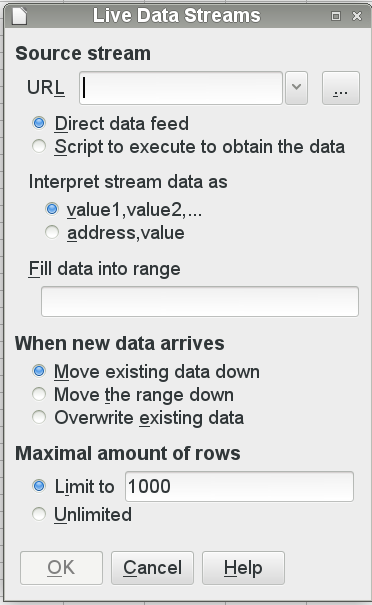
Daniel Pocock: Real-time streaming market data with free software

Here is an overview of the real-time market data architecture based on OpenMAMA: All these components may be running on a single host or they may be distributed across different servers and workstations in a LAN. The OpenMAMA market data bus ties them together. External data sources These are external sources of data. These could be currency trading firms, stock brokers, bullion dealers or even Bitcoin exchanges. Some exchanges don't provide data services directly to the general public and they distribute their price data through third-party data vendors such as Reuters and Bloomberg. Feed handlers The feed handlers manage the connections to external data sources. These are typically daemon processes that implement the wire protocols used by the external vendors for transmitting data over the public internet or a leased line. They typically use a point-to-point topology such as TCP connections. The feed handlers publish the data into the market data bus. In practice, the feed handler may be a proprietary application provided by the data vendor or it may simply be a Python script that fetches exchange rates from a URL every five minutes. OpenMAMA The market data bus is a distributed framework that is accessible to all of the local servers and workstations in the LAN. At the lowest level a messaging middleware solution is used to transport the data. The Avis Event Router is a free middleware. There is upcoming support for Apache QPID as well. Some commcercial middleware is supported too - here is the full list OpenMAMA does not provide a daemon or server process of its own. It is a set of libraries that operate on top of the middleware transport. In very general terms, the OpenMAMA libraries let applications publish messages (such as price ticks) or subscribe to receive the messages published by other applications. Spreadsheet application (for example, LibreOffice) LibreOffice is introducing a new data import feature for streaming time series data. This appears to provide a useful integration point for OpenMAMA and discussion is taking place in the development community. The spreadsheet can operate in various ways. A simple application may simply poll the currency prices when the spreadsheet is opened or refreshed. A more demanding application may see the spreadsheet come alive, recalculating all cells on every tick from the data vendor (several times per second). This latter scenario is more common in dealing rooms and hedge funds. Accounting/billing software There are many free accounting applications today, including PostBooks and GnuCash and some more heavyweight solutions like Adempiere and OpenERP. In a world where credit cards and the world wide web have made international trade an everyday activity, many people are using this software to track expenses and accounts in more than one currency. For example, a British business may be paying some suppliers in Euros and a Canadian may be charging some customers in US dollars. A Swiss person may be keeping some of their savings in gold bullion in the vault of one of their world reknowned Swiss banks. A common requirement for all of these users is the balance sheet. Using real-time market data sources, the balance sheet can be refreshed at any time from the live market prices. A home user may just find it convenient that they can open the balance sheet and always see their net worth immediately without having to manually cut and paste the currency prices from a web page. A business user operating in a competitive industry with low margins may be checking the balance sheet several times per day to ensure they remain solvent and profitable. Web shops Many web shops now offer the customers the convenience of viewing prices in their own currency. It is important to make sure these prices are accurate, especially when dealing with volatile currencies or when the products have a low profit margin. The web application server can receive the market data price ticks just like any other application in the network. Using this data, it can insert live prices into the pages as they are generated. If the currencies are particularly volatile, the web application could stream the prices to the browser using WebSockets and a JavaScript client embedded in the page would update the price field in real time. In fact, this web-based streaming price update mechanism is exactly how many online financial trading services offer live market prices to their customers. Real-time valuation server In a large organisation there may be many users looking at the same values. For example, in a trading desk, many users may need to see the desk's overall position in each market. In a busy web shop, many concurrent users may need to see the prices of common products. Rather than recalculating these values for each user in parallel, a common solution involves setting up a server to receive raw values (such as currency prices) from the data feed, calculate values needed by local users and then broadcast those values over the market data bus. How applications can integrate with real-time market data Here are some steps for getting started:

Next.

Previous.