Go s embed feature lets you bundle static assets into an executable, but it
stores them uncompressed. This wastes space: a web interface with documentation
can bloat your binary by dozens of megabytes. A proposition to optionally
enable compression was declined because it is difficult to handle all use
cases. One solution? Put all the assets into a ZIP archive!
The automatic variable$@ is the rule target, while $^ expands to all
the dependencies, modified or not.
Space gain
Akvorado, a flow collector written in Go, embeds several static assets:
CSV files to translate port numbers, protocols or AS numbers, and
HTML, CSS, JS, and image files for the web interface, and
the documentation.
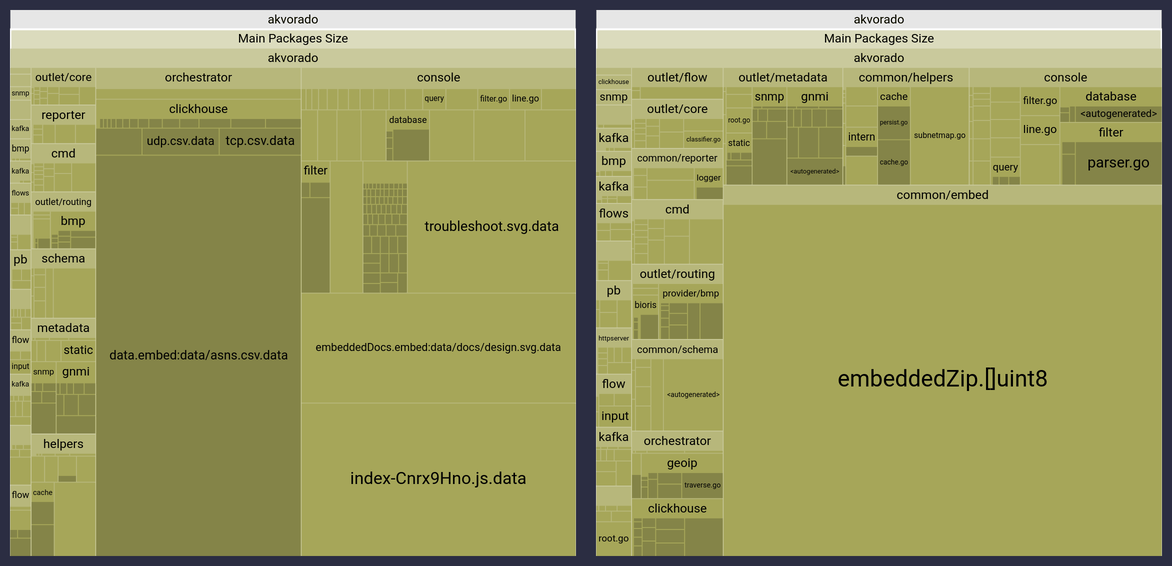
Breakdown of the space used by each component before (left) and after (right) the introduction of embed.zip.
Embedding these assets into a ZIP archive reduced the size of the Akvorado
executable by more than 4 MiB:
Performance loss
Reading from a compressed archive is not as fast as reading a flat file. A
simple benchmark shows it is more than 4 slower. It also allocates some
memory.2
Each access to an asset requires a decompression step, as seen in this flame
graph:
🖼 Flame graph when reading data from embed.zip compared to reading data directly
CPU flame graph comparing the time spent on CPU when reading data from embed.zip (left) versus reading data directly (right). Because the Go testing framework executes the benchmark for uncompressed data 4 times more often, it uses the same horizontal space as the benchmark for compressed data. The graph is interactive.
While a ZIP archive has an index to quickly find the requested file, seeking
inside a compressed file is currently not possible.3 Therefore, the files
from a compressed archive do not implement the io.ReaderAt or io.Seeker
interfaces, unlike directly embedded files. This prevents some features, like
serving partial files or detecting MIME types when serving files over HTTP.
For Akvorado, this is an acceptable compromise to save a few mebibytes from an
executable of almost 100 MiB. Next week, I will continue this futile adventure
by explaining how I prevented Go from disabling dead code elimination!
You can safely read multiple files concurrently. However, it does
not implement ReadDir() and ReadFile() methods.
You could keep frequently accessed assets in memory. This
reduces CPU usage and trades cached memory for resident memory.
SOZip is a profile that enables fast random access in a compressed
file. However, Go s archive/zip module does not support it.
Yeah, again three months have passed since my last (trivial) post, and I really
don t know where the time has flown.
I suppose the biggest problem was the long summer vacation, which threw me
off-track, and then craziness started. Work work work, no time for anything,
which kept me fully busy in August, and then you should travel .
So mid-September I went on my first business trip since Covid, again to
Kirkland, which in itself was awesome. Flew out Sunday, and as I was concerned I
was going to lose too much fitness had a half-marathon planned on the weekend
after the return I ran every morning of the four days I was there. And of
course, on the last day, I woke up even earlier (05:30 AM), went out to run
before sunrise, intending to do a very simple run along the road that borders
the lake for 2.5K, then back . And right at the farthest point, a hundred metres
before my goal of turning around, I tripped, started falling, and as I was
falling, I hit sideways a metal pole. I was in a bus station, it was the pole
that has the schedule at the top, and I hit it at relatively full speed, right
across my left-side ribs. The crash took the entire air out of my lungs, and I
don t remember if I ever felt pain/sensation like that I was seriously not able
to breathe for 20 seconds or so, and I was wondering if I m going to pass out at
this rate.
Only 20 seconds, because my Garmin started howling like a police siren, and the
screen was saying something along the lines of: Incident detected; contacting
emergency services in 40 35 and I was fumbling to cancel that, since a) I
wasn t that bad, b) notifying my wife that I had a crash would have not been a
smart idea.
My left leg was scraped in a few places, my left hand pretty badly, or more than
just scraped, so my focus was on limping back, and finding a fountain to wash my
injuries, which I did, so I kept running with blood dripping down my hand. Fun
fun, everything was hurting, I took an Uber for the ~1Km to the office, had many
meetings, took another Uber and flew back to Zurich. Seattle San Francisco
Z rich, I think 14 hours, with my ribs hurting pretty badly. But I got home
(Friday afternoon), and was wondering if I can run or not on Saturday.
Saturday comes, I feel pretty OK, so I said let s try, will stop if the pain is
too great. I pick up my number, I go to the start, of course in the last block
and not my normal block, and I start running. After 50 metres, I knew this won t
be good enough, but I said, let s make it to the first kilometre. Then to the
first fuelling point, then to the first aid point, at which moment I felt good
enough to go to the second one.
Long story short, I ran the whole half marathon, with pain. Every stop for
fuelling was mentally hard, as the pain stopped, and I knew I had to start
running again, and the pain would resume. In the end, managed to finish: two and
a half hours, instead of just two hours, but alive and very happy. Of course, I
didn t know what was waiting for me Sunday I wake up in heavy pain, and despite
painkillers, I was not feeling much better. The following night was terrible,
Monday morning I went to the doctor, had X-rays, discussion with a radiologist.
Not really broken, but more than just bruised. See this angle here? Bones don t
have angles normally . Painkillers, chest/abdomen wrapping, no running! So my
attempts to not lose fitness put me off running for a couple of weeks.
Then October came, and I was getting better, but work was getting even more
crazy. I don t know where November passed, honestly, and now we re already in
December. I did manage to run, quite well, managed to bike a tiny bit and swim a
little, but I m not in a place where I can keep a regular and consistent
schedule.
On the good side, I managed this year, for the first time since Covid, to not
get sick. Hey, a sport injury is 100 better than a sickness, like I had in
previous years, taking me out for two weeks. But life was crazy enough that I
didn t read some of my email accounts for months, and I m just now starting to
catch up to, well, baseline.
Of course, the rib the lowest one on the left side is long-healed, or so I
thought. After some strength training early this week, I was very sore the next
day, and I wanted to test whether my rib is still sore. I touched it at the
point , and it hurt so badly I couldn t believe. Two and a half months, and it s
not done-done.
And now it s just two weeks before Christmas and New Year s, and that time off
will ruin my rhythm again. At least ski vacation is booked, ski service is done,
and slowly, work is getting in good enough shape to actually enjoy thinking
about vacation.
So, in the end, a very adventurous last third of the year, and that wasn t even
all. As I m writing this, my right wrist is bandaged and for the past 24 hours
it hasn t hurt too much, but that s another, and not so interesting, story.
I ll close with a yay for always being behind/backlogged, but alive and
relatively well. My sport injuries are elective injuries so to speak, and I m
very thankful for that. See you in the next post!
Around a year ago I wrote about Guix Container Images for GitLab CI/CD and these images have served the community well. Besides continous use in CI/CD, these Guix container images are used to confirm reproducibility of the source tarball artifacts in the releases of Libtasn1 v4.20, InetUtils v2.6, Libidn2 v2.3.8, Libidn v1.43, SASL v2.2.2, Guile-GnuTLS v5.0.1, and OATH Toolkit v2.6.13. See how all those release announcements mention a Guix commit? That s the essential supply-chain information about the Guix build environment that allows the artifacts to be re-created. To make sure this is repeatable, the release tarball artifacts are re-created from source code every week in the verify-reproducible-artifacts project, that I wrote about earlier. Guix s time travelling feature make this sustainable to maintain, and hopefully will continue to be able to reproduce the exact same tarball artifacts for years to come.
During the last year, unfortunately Guix was removed from Debian stable. My Guix container images were created from Debian with that Guix package. My setup continued to work since the old stage0 Debian+Guix containers were still available. Such a setup is not sustainable, as there will be bit-rot and we don t want to rely on old containers forever, which (after the removal of Guix in Debian) could not be re-produced any more. Let this be a reminder how user-empowering features such as Guix time-travelling is! I have reworked my Guix container image setup, and this post is an update on the current status of this effort.
The first step was to re-engineer Debian container images with Guix, and I realized these were useful on their own, and warrant a separate project. A more narrowly scoped project makes will hopefully make it easier to keep them working. Now instead of apt-get install guix they use the official Guix guix-install.sh approach. Read more about that effort in the announcement of Debian with Guix.
The second step was to reconsider my approach to generate the Guix images. The earlier design had several stages. First, Debian+Guix containers were created. Then from those containers, a pure Guix container was created. Finally, using the pure Guix container another pure Guix container was created. The idea behind that GCC-like approach was to get to reproducible images that were created from an image that had no Debian left on it. However, I never managed to finish this. Partially because I hadn t realized that every time you build a Guix container image from Guix, you effectively go back in time. When using Guix version X to build a container with Guix on it, it will not put Guix version X into the container but will put whatever version of Guix is available in its package archive, which will be an earlier version, such as version X-N. I had hope to overcome this somehow (running a guix pull in newly generated images may work), but never finished this before Guix was removed from Debian.
So what could a better design look like?
For efficiency, I had already started experimenting with generating the final images directly from the Debian+Guix images, and after reproducibility bugs were fixed I was able to get to reproducible images. However, I was still concerned that the Debian container could taint the process somehow, and was also concerned about the implied dependency on non-free software in Debian.
I ve been using comparative rebuilds using similar distributions to confirm artifact reproducibility for my software projects, comparing builds on Trisquel 11 with Ubuntu 22.04, and AlmaLinux 9 with RockyLinux 9 for example. This works surprisingly well. Including one freedom-respecting distribution like Trisquel will detect if any non-free software has bearing on artifacts. Using different architectures, such as amd64 vs arm64 also help with deeper supply-chain concerns.
My conclusion was that I wanted containers with the same Guix commit for both Trisquel and Ubuntu. Given the similarity with Debian, adapting and launching the Guix on Trisquel/Debian project was straight forward. So we now have Trisquel 11/12 and Ubuntu 22.04/24.04 images with the same Guix on them.
Do you see where the debian-with-guix and guix-on-dpkg projects are leading to?
We are now ready to look at the modernized Guix Container Images project. The tags are the same as before:
The method to create them is different. Now there is a build job that uses the earlier Guix+Trisquel container (for amd64) or Guix+Debian (for arm64, pending Trisquel arm64 containers). The build job create the final containers directly. Next a Ubuntu reproduce job is launched that runs the same commands, failing if it cannot generate the bit-by-bit identical container. Then single-arch images are tested (installing/building GNU hello and building libksba), and then pushed to the GitLab registry, adding multi-arch images in the process. Then the final multi-arch containers are tested by building Guile-GnuTLS and, on success, uploaded to the Docker Hub.
How would you use them? A small way to start the container is like this:
The need for --entrypoint=/bin/sh is because Guix s pack command sets up the entry point differently than most other containers. This could probably be fixed if people want that, and there may be open bug reports about this.
The need for --privileged is more problematic, but is discussed upstream. The above example works fine without it, but running anything more elaborate with guix-daemon installing packages will trigger a fatal error. Speaking of that, here is a snippet of commands that allow you to install Guix packages in the container.
This could be simplified, but we chose to not hard-code in our containers because some of these are things that probably shouldn t be papered over but fixed properly somehow. In some execution environments, you may need to pass --disable-chroot to guix-daemon.
To use the containers to build something in a GitLab pipeline, here is an example snippet:
I created the latest Wikipedia language edition, the Toki Pona Wikipedia, last month.
Unlike most other wikis which start their lives in the Wikimedia Incubator
before the full wiki is created, in this case the community had been using a
completely external MediaWiki site to build the wiki before it was approved as
a "proper" Wikipedia wiki,1 and now that external wiki needed to be imported
to the newly created Wikimedia-hosted wiki. (As far as I'm aware, the last and previously
only time an external wiki has been imported to a Wikimedia project was in 2013 when
Wikitravel was forked as Wikivoyage.)
Creating a Wikimedia wiki these days is actually pretty straightforward, at least
when compared to what it used to be like a couple of years ago. Today the process
mostly involves using a script to generate two configuration changes, one to add
the basic configuration for a wiki to operate and an another to add the wiki to the
list of all wikis that exist, and then running a script to create the wiki database
in between of deploying those two configuration changes. And then you wait half an
hour while the script to tell all Wikidata client wikis about the new wiki runs on
one wiki at a time.
The primary technical challenge in importing a third-party wiki is that there's
no SUL making sure that a single username maps to the same account on both
wikis. This means that the usual strategy of using the functionality I wrote in
CentralAuth to manually create local accounts can't be used as is, and so we
needed to come up with a new way of matching everyone's contributions to their
existing Wikimedia accounts.
(Side note: While the user-facing interface tries to present a single "global"
user account that can be used on all public Wikimedia wikis, in reality the
account management layer in CentralAuth is mostly just a glue layer to link
together individual "local" accounts on each wiki that the user has ever
visited. These local accounts have independent user ID numbers for example I
am user #35938993 on the English Wikipedia but #4 on the new Toki Pona
Wikipedia and are what most of MediaWiki code interacts with except for a few
features specifically designed with cross-wiki usage in mind. This distinction
is also still very much present and visible in the various administrative and
anti-abuse workflows.)
The approach we ended up choosing was to re-write the dump file before importing,
so that a hypothetical account called $Name would be turned $Name~wikipesija.org
after the import.2 We also created empty user accounts that would take
ownership of the edits to be imported so that we could use the standard account
management tools on them later on. MediaWiki supports importing contributions
without a local account to attribute them to, but it doesn't seem to be possible
to convert an imported actor3 to a regular user later on which we wanted
to keep as a possibility, even with the minor downside of creating a few hundred
users that'll likely never get touched again later.
We also made specific decisions to add the username suffix to everyone, not to
just those names that'd conflicted with existing SUL accounts, and to deal with
renaming users that wanted their contributions linked to an existing SUL account
only after the import. This both reduced complexity and thus risk from the
import phase, which already had much more unknowns compared to the rest of the
process, but also were much better options ethically as well: suffixing all names
meant we would not imply that those people chose to be Wikimedians with those
specific usernames (when in reality it was us choosing to import those edits to
the Wikimedia universe), and doing renames using the standard MediaWiki account
management tooling meant that it produced the normal public log entries that
all other MediaWiki administrative actions create.
With all of the edits imported, the only major thing remaining was doing those merges
I mentioned earlier to attribute imported edits to people's existing SUL accounts.
Thankfully, the local account -based system makes it actually pretty simple. Usually
CentralAuth prevents renaming individual local accounts that are attached to a global
account, but that check can be bypassed with a maintenance script or a privileged
enough account. Renaming the user automatically detached it from the previous global
account, after which an another maintenance script could be used to attach the
user to the correct global account.
That external site was a fork of a fork of the original Toki Pona Wikipedia
that was closed in 2005. And because cool URIs don't change,
we made the the URLs that the old Wikipedia was using work again. Try it: https://art-tokipona.wikipedia.org.
wikipesija.org was the domain where the old third-party wiki was hosted on, and
~ was used as a separator character in usernames during the
SUL finalization in the early
2010s so using it here felt appropriate as well.
An actor is a MediaWiki term and a
database table referring to anything that can do edits or logged actions. Usually an actor
is a user account or an IP address, but an imported user name in a specific format can
also be represented as an actor.
My Debian contributions this month were all
sponsored by
Freexian. I had a bit less time than usual, because Freexian collaborators
gathered in Marseille this month for our yearly sprint, doing some planning
for next year.
You can also support my work directly via
Liberapay or GitHub
Sponsors.
OpenSSH
I began preparing for the second stage of the GSS-API key exchange package
split (some
details have changed since that message). It seems that we ll need to wait
until Ubuntu 26.04 LTS has been released, but that s close enough that it s
worth making sure we re ready. This month I just did some packaging
cleanups that would otherwise have been annoying to copy, such as removing
support for direct upgrades from pre-bookworm. I m considering some other
package rearrangements to make the split easier to manage, but haven t made
any decisions here yet.
This also led me to start on a long-overdue bug triage pass, mainly
consisting of applying usertags to lots of our open bugs to sort them by
which program they apply to, and also closing a few that have been fixed,
since some bugs will eventually need to be reassigned to GSS-API packages
and it would be helpful to make them easier to find. At the time of
writing, about 30% of the bug list remains to be categorized this way.
Python packaging
I upgraded these packages to new upstream versions:
I packaged django-pgtransaction and
backported it to trixie, since we plan to use it in Debusine; and I adopted
python-certifi for the Python team.
I fixed or helped to fix several other build/test failures:
Welcome to the report for November 2025 from the Reproducible Builds project!
These monthly reports outline what we ve been up to over the past month, highlighting items of news from elsewhere in the increasingly-important area of software supply-chain security. As always, if you are interested in contributing to the Reproducible Builds project, please see the Contribute page on our website.
In this report:
10 years of Reproducible Builds at SeaGL 2025
On Friday 8th November, Chris Lamb gave a talk called 10 years of Reproducible Builds at SeaGL in Seattle, WA.
Founded in 2013, SeaGL is a free, grassroots technical summit dedicated to spreading awareness and knowledge about free source software, hardware and culture. Chris talk:
[ ] introduces the concept of reproducible builds, its technical underpinnings and its potentially transformative impact on software security and transparency. It is aimed at developers, security professionals and policy-makers who are concerned with enhancing trust and accountability in our software. It also provides a history of the Reproducible Builds project, which is approximately ten years old. How are we getting on? What have we got left to do? Aren t all the builds reproducible now?
Distribution work
In Debian this month, Jochen Sprickerhof created a merge request to replace the use of reprotest in Debian s Salsa Continuous Integration (CI) pipeline with debrebuild. Jochen cites the advantages as being threefold: firstly, that only one extra build needed ; it uses the same sbuild and ccache tooling as the normal build ; and works for any Debian release . The merge request was merged by Emmanuel Arias and is now active.
kpcyrd posted to our mailing list announcing the initial release of repro-threshold, which implements an APT transport that defines a threshold of at least X of my N trusted rebuilders need to confirm they reproduced the binary before installing Debian packages. Configuration can be done through a config file, or through a curses-like user interface.
Holger then merged two commits by Jochen Sprickerhof in order to address a fakeroot-related reproducibility issue in the debian-installer, and J rg Jaspert deployed a patch by Ivo De Decker for a bug originally filed by Holger in February 2025 related to some Debian packages not being archived on snapshot.debian.org.
Elsewhere, Roland Clobus performed some analysis on the live Debian trixie images, which he determined were not reproducible. However, in a follow-up post, Roland happily reports that the issues have been handled. In addition, 145 reviews of Debian packages were added, 12 were updated and 15 were removed this month adding to our knowledge about identified issues.
Lastly, Jochen Sprickerhof filed a bug announcing their intention to binary NMU a very large number of the R programming language after a reproducibility-related toolchain bug was fixed.
Bernhard M. Wiedemann posted another openSUSEmonthly update for their work there.
Julien Malka and Arnout Engelen launched the new hash collection
server for NixOS. Aside from improved reporting to help focus reproducible builds
efforts within NixOS, it collects build hashes as individually-signed attestations
from independent builders, laying the groundwork for further tooling.
Tool development
diffoscope version 307 was uploaded to Debian unstable (as well as version 309). These changes included further attempts to automatically attempt to deploy to PyPI by liaising with the PyPI developers/maintainers (with this experimental feature). [][][]
In addition, reprotest versions 0.7.31 and 0.7.32 were uploaded to Debian unstable by Holger Levsen, who also made the following changes:
Do not vary the architecture personality if the kernel is not varied. (Thanks to Ra l Cumplido). []
Drop the debian/watch file, as Lintian now flags this as error for native Debian packages. [][]
Bump Standards-Version to 4.7.2, with no changes needed. []
Drop the Rules-Requires-Root header as it is no longer required.. []
In addition, however, Vagrant Cascadian fixed a build failure by removing some extra whitespace from an older changelog entry. []
Website updates
Once again, there were a number of improvements made to our website this month including:
Bernhard M. Wiedemann updated the SOURCE_DATE_EPOCH page to fix the Lisp example syntax. []
Web3 applications, built on blockchain technology, manage billions of dollars in digital assets through decentralized applications (dApps) and smart contracts. These systems rely on complex, software supply chains that introduce significant security vulnerabilities. This paper examines the software supply chain security challenges unique to the Web3 ecosystem, where traditional Web2 software supply chain problems intersect with the immutable and high-stakes nature of blockchain technology. We analyze the threat landscape and propose mitigation strategies to strengthen the security posture of Web3 systems.
Their paper lists reproducible builds as one of the mitigating strategies. A PDF of the full text is available to download.
Upstream patches
The Reproducible Builds project detects, dissects and attempts to fix as many currently-unreproducible packages as possible. We endeavour to send all of our patches upstream where appropriate. This month, we wrote a large number of such patches, including:
Finally, if you are interested in contributing to the Reproducible Builds project, please visit our Contribute page on our website. However, you can get in touch with us via:
As with libvirt 11.10 a new flag for backup operation has been
inroduced: VIR_DOMAIN_BACKUP_BEGIN_PRESERVE_SHUTDOWN_DOMAIN.
According to the documentation
It instructs libvirt to avoid termination of the VM if the guest OS shuts down
while the backup is still running. The VM is in that scenario reset and paused
instead of terminated allowing the backup to finish. Once the backup finishes
the VM process is terminated.
Added support for this in virtnbdbackup 2.40.
You may now be asking yourself: why? Fear not, gentle reader, because having two container images of roughly similar software is a great tool for attempting to build software artifacts reproducible, and comparing the result to spot differences. Obviously.
I have been using this pattern to get reproducible tarball artifacts of several software releases for around a year and half, since libntlm 1.8.
Let s walk through how to setup a CI/CD pipeline that will build a piece of software, in four different jobs for Trisquel 11/12 and Ubuntu 22.04/24.04. I am in the process of learning Codeberg/Forgejo CI/CD, so I am still using GitLab CI/CD here, but the concepts should be the same regardless of platform. Let s start by defining a job skeleton:
This installs some packages, clones guile-gnutls (it could be any project, that s just an example), build it and return tarball artifacts. The artifacts are the git-archive and make dist tarballs.
Let s instantiate the skeleton into four jobs, running the Trisquel 11/12 jobs on amd64 and the Ubuntu 22.04/24.04 jobs on arm64 for fun.
Look how beautiful, almost like ASCII art! The commands print SHA256 checksums of the artifacts, sorted in a couple of ways, and then proceeds to compare relevant artifacts. What would the output of such a run be, you may wonder? You can look for yourself in the guix-on-dpkg pipeline but here is the gist of it:
A new release of the still-recent duckdb extension for mlpack, the C++ header-only library for
machine learning, was merged into the duckdb community
extensions repo today, and has been updated at its duckdb
mlpack extension page.
This release 0.0.5 adds one new method: kmeans clustering. We also
added two version accessors for both mlpack and armadillo. We found during the work on
random forests (added in 0.0.4) that the multithreaded random number
generation was not quite right in the respective upstream codes. This
has by now been corrected in armadillo
15.2.2 as well as the trunk version of mlpack so if you build with those, and
set a seed, then your forests and classification will be stable across
reruns. We added a second state variable mlpack_silent that
can be used to suppress even the minimal prediction quality summary some
methods show, and expanded the documentation.
For more details, see the repo for code,
issues and more, and the extension
page for more about this duckdbcommunity
extension.
I started this month with a week of vacation which was followed by a small
planned surgery and two weeks of sick leave. Nonetheless, I packaged and
uploaded new releases of a couple of packages:
swayidle updated to version 1.9.0-1
swaylock updated to version 1.8.4-1
foot updated to version 1.25.0-1
swayimg updated to version 4.6-1
scdoc updated to version 1.11.4-1
wofi updated to version 1.5.1-1
xdg-desktop-portal-wlr updated to version 0.8.0-1
Besides that I reactivated I project I started in summer 2024: debiverse.org.
The idea of that was to have interfaces to Debian bugs and packages that are
usable on mobile devices (I know, ludicrous!). Back then I started with
Flask and
Sqlalchemy, but that soon got out of hand. I now
switched the whole stack to FastAPI and
SQLModel which makes it a lot easier to
manage. And the upside is that it comes with an API and OpenAPI docs. For the
rendered HTML pages I use
Jinja2 with Tailwind as CSS
framework. I am currently using udd-mirror as database backend, which works
pretty good (for this single user project). It would be nice to have some of
the data in a faster index, like Typesense or Meilisearch. This way it would
be possible to have faceted search or more performant full text search. But I
haven t found any software that could provide this that is packaged in Debian.
Rolling back with schnapps
Thanks to the fact that the Omnia uses a
btrfs root filesystem, and the
liberal use of snapshots
around updates, I was able to rollback to the pre-9.0.0 state.
First, I connected to the router using ssh:
ssh root@192.168.1.1
Then I listed the available snapshots:
$ schnapps list
#   Type        Size          Date                          Description
------+-----------+-------------+-----------------------------+------------------------------------
  500   post           15.98MiB   2025-08-09 11:27:48 -0700     Automatic post-update snapshot (TurrisOS 7.2.2 - hbs)
  506   pre            17.92MiB   2025-09-12 03:44:32 -0700     Automatic pre-update snapshot (TurrisOS 7.2.2 - hbs)
  507   post           17.88MiB   2025-09-12 03:45:14 -0700     Automatic post-update snapshot (TurrisOS 7.2.3 - hbs)
  515   time           20.03MiB   2025-11-02 01:05:01 -0700     Snapshot created by cron
  516   time           20.05MiB   2025-11-09 01:05:01 -0800     Snapshot created by cron
  517   time           20.29MiB   2025-11-16 01:05:00 -0800     Snapshot created by cron
  518   time           20.64MiB   2025-11-23 01:05:01 -0800     Snapshot created by cron
  519   time           20.83MiB   2025-11-30 01:05:00 -0800     Snapshot created by cron
  520   pre            87.91MiB   2025-11-30 07:41:10 -0800     Automatic pre-update snapshot (TurrisOS 7.2.3 - hbs)
  521   post          196.32MiB   2025-11-30 07:48:11 -0800     Automatic post-update snapshot (TurrisOS 9.0.0 - hbs)
  523   pre             4.44MiB   2025-11-30 20:47:31 -0800     Automatic pre-update snapshot
  524   post          224.00KiB   2025-11-30 20:47:43 -0800     Automatic post-update snapshot
  525   rollback      224.00KiB   2025-12-01 04:56:32 +0000     Rollback to snapshot factory
  526   pre             4.44MiB   2025-11-30 21:04:19 -0800     Automatic pre-update snapshot
  527   post          272.00KiB   2025-11-30 21:04:31 -0800     Automatic post-update snapshot
  528   rollback      272.00KiB   2025-12-01 05:13:38 +0000     Rollback to snapshot factory
  529   pre             4.52MiB   2025-11-30 21:28:44 -0800     Automatic pre-update snapshot
  530   single        208.00KiB
  531   rollback      224.00KiB   2025-12-01 05:29:47 +0000     Rollback to snapshot factory
Finally, I rolled back to the exact state I was on before the 9.0.0 update:
$ schnapps rollback 520
Current state saved as snapshot number 532
Rolled back to snapshot 520
Full wipe
As an aside, it turns out that the factory reset functionality is
implemented as a brtfs rollback to a special factory snapshot. This is why
is so fast, but it also means that doing a simple factory reset doesn't
wipe the data on your router. If you are planning to sell your device or
otherwise dispose of it, you also need to delete all btrfs snapshots
Conclusion
While this update was very disappointing, especially since it's never
happened before with major updates on Turris OS, it made me discover just
how great the recovery tools are. It would be pretty tricky to fully brick
one of these devices.
Another short status update of what happened on my side last month. Hand holding the
release machinery for Phosh 0.51.0 but
there's more:
See below for details on the above and more:
phosh
Forever and a Day is a coda to Haley Cass's self-published sapphic
romance novel Those Who Wait. There is
no point in reading it unless you have already read and enjoyed the full
book and wanted more of a denouement.
Given that Those Who Wait is a romance novel, it is definitionally
not a spoiler to reveal that Sutton and Charlotte ended up together. This
novella is seven scenes sketching out the next few years of their lives,
interspersed with press clippings and social media commentary. These tie
up loose ends, give the characters a bit more time together, throw in one
more conflict and resolution, add one more sex scene, and stick a few
exclamation points after the happily ever after.
I am the sort of person who likes long denouements in stories, so I'm the
target audience for this sort of sequel that's essentially additional
chapters to the book. (The funniest version of this I've read is
Jacqueline Carey's Saints Astray.) They
are usually not great literature, since there are good reasons for not
including these chapters in the book. That is exactly what this is: a few
more chapters of the characters being happy, entirely forgettable, and of
interest only to people who want that.
Cass does try to introduce a bit of a plot via some light family conflict,
which was sweet and mostly worked, and some conflict over having children,
which was very stereotyped and which I did not enjoy as much. I thought
the earlier chapters of this novella were the stronger ones, although I do
have to give the characters credit in the later chapters for working
through conflict in a mature and fairly reasonable way. It does help,
though, when the conflict is entirely resolved by one character being
right and the other character being happily wrong. That's character
conflict on easy mode.
I was happy to see that Sutton got a career, although as in the novel I
wish Cass had put some more effort into describing Sutton's efforts in
building that career. The details are maddeningly vague, which admittedly
matches the maddeningly vague description of Charlotte's politics but
which left me unsatisfied.
Charlotte's political career continues to be pure wish fulfillment in the
most utterly superficial and trivialized way, and it bothered me even more
in the novella than it did in the novel. We still have absolutely no idea
what she stands for, what she wants to accomplish, and why anyone would
vote for her, and yet we get endless soft-focus paeans to how wonderful
she will be for the country. Her opponents are similarly vague to the
point that the stereotypes Cass uses to signal their inferiority to
Charlotte are a little suspect.
I'm more critical of this in 2025 than I would have been in 2015 because
the last ten years have made clear the amount of damage an absolute
refusal to stand for anything except hazy bromides causes, and I probably
shouldn't be this annoyed that Cass chose to vaguely gesture towards
progressive liberalism without muddying her romance denouement with a
concrete political debate. But, just, gah. I found the last chapter
intensely annoying, in part because the narrative of that chapter was too
cliched and trite to sufficiently distract me from the bad taste of the
cotton-candy politics.
Other than that, this was minor, sweet, and forgettable. If you want
another few chapters of an already long novel, this delivers exactly what
you would expect. If the novel was plenty, nothing about this novella is
going to change your mind and you can safely skip it. I really liked the
scene between Charlotte and Sutton's mom, though, and I'm glad I read the
novella just for that.
Rating: 6 out of 10
Here s my monthly but brief update about the activities I ve done in the FOSS world.
Debian
Whilst I didn t get a chance to do much, here are still a few things that I worked on:
Did a few sessions with the new DFSG team to help kickstart things, et al.
Assited a few folks in getting their patches submitted via Salsa.
Mentoring for newcomers.
Moderation of -project mailing list.
Ubuntu
I joined Canonical to work on Ubuntu full-time back in February 2021.
Whilst I can t give a full, detailed list of things I did, here s a quick TL;DR of what I did:
wordpress: There were multiple vulnerabilities reported in Wordpress, leading to Sent Data & Cross-site Scripting.
[bookworm]: Roberto rightly pointed out that the upload to bookworm hadn t gone through last month, so I re-uploaded wordpress/6.1.9+dfsg1-0+deb12u1 to bookworm-security.
ruby-rack: There were multiple vulnerabilities reported in Rack, leading to DoS (memory exhaustion) and proxy bypass.
[ELTS]: Last month I had backported fixes for CVE-2025-46727 & CVE-2025-32441 to buster and stretch but the other backports were being a bit tricky due to really old versions.
I spent a bit more time but there s a lot to demystify. Gonna take a bit of break from this one and come back to this after doing other updates. Might even consider sending a RFH to the list.
libwebsockets: Multiple issues were reported in LWS causing denial of service and stack-based buffer overflow.
Backporting tests was an interesting exercise as I had to make them compatible with the bullseye version. :)
ceph: Affected by CVE-2024-47866, using the argument x-amz-copy-source to put an object and specifying an empty string as its content leads to the RGW daemon crashing, resulting in a DoS attack.
[LTS]: Whilst the patch is straightforward, backports are a bit tricky. I ve prepared the update but would like to reach out to zigo, the maintainer, to make sure nothing regresses.
[ELTS]: Same as LTS, I d like to get a quick review and upload to LTS first before I start staging uploads for ELTS.
[LTS] Attended the monthly LTS meeting on IRC. Summary here.
It was also followed by a 50-minute post-meeting technical discussion/question session.
[E/LTS] Monitored discussions on mailing lists, IRC, and all the documentation updates. Thanks, Sylvain, for a great documentation summary.
Review: The Last Soul Among Wolves, by Melissa Caruso
Series:
The Echo Archives #2
Publisher:
Orbit
Copyright:
August 2025
ISBN:
0-316-30404-2
Format:
Kindle
Pages:
355
The Last Soul Among Wolves is urban high fantasy with strong
mystery vibes. It is a direct sequel to The Last Hour Between Worlds. You need the previous book for some
character setup (and this book would spoil it badly), but you don't have
to remember the first book in detail. Only the main plot outcomes are
directly relevant and the characters will remind you of those.
Kembrel Thorne is a Hound, the equivalent of a police detective in the
medieval-inspired city setting of this series, but this book does not open
with an official assignment. Instead, she has been dragged by her
childhood friend Jaycel Morningrey as company for a reading of the will of
old lady Lovegrace, reclusive owner of a gothic mansion on an island
connected to the city by an intermittent sandbar. A surprise reunion with
her gang of childhood friends ensues, followed by the revelation that they
are all in serious trouble.
Shortly after Kem left the group to become a Hound, the remaining four,
plus several other apparently random people, got entangled with a powerful
Echo artifact. Now that Lovegrace has died, one of them will inherit the
artifact and the ability to make a wish, but only one. The rest will be
killed at decreasing intervals until only the winner is left alive.
The Last Hour Between Worlds was fae fantasy built around a problem
that was more of a puzzle than a mystery. The Last Soul Among
Wolves is closer to a classic mystery: A cast of characters are brought
together and semi-isolated in a rural house, they start dying, and it's up
to the detective to solve the mystery of their death before it's too late.
In this case, the initial mechanism of death is supernatural and not in
doubt the challenge instead is how to stop it from happening again but
Kem's problems quickly become more complicated.
As mystery plots go, this is more thriller than classical despite the
setting. There are a few scenes of analyzing clues, but Kem is more likely
to use the time-honored protagonist technique of throwing herself into
danger and learning what's going on via the villain monologues. As readers
of the previous book would expect, Rika Nonesuch is here too, hired by
another of Kem's old friends, and the two navigate their personal feelings
and the rivalry between their guilds in much the way that they did in
the Last Hour Between Worlds. As in the first book, there is a
sapphic romance subplot, but it's a very slow burn asexual romance.
The best part of this series continues to be the world-building. The
previous book introduced the idea of the Echoes and sent the characters
exploring into stranger and stranger depths. This book fleshes out the
rules in more detail, creating something that feels partly like a fae
realm and partly like high fantasy involving gods, but diverges from both
into a logic of its own. The ending satisfyingly passes my test of fantasy
mysteries: Resolving the mystery requires understanding and applying the
rules of the setting, which are sufficiently strange to create interesting
outcomes but coherent enough that the reader doesn't feel like the author
is cheating.
There are some hissable villains here, but my favorite part of this book
was the way Caruso added a lot of nuance and poignancy to the Echoes
rather than showing them only as an uncanny threat. That choice made the
world feel deeper and richer. It's not yet clear whether that element is
setup for a longer-term series plot, but I hope Caruso will develop the
story in that direction.
It felt to me like Caruso is aiming for an ongoing series rather than a
multi-volume story with a definite ending. She avoids a full episodic
reset Rika, in particular, gets considerable character development and
new complications that bode well for future volumes but it doesn't feel
like the series is building towards an imminent climax. This is not a
complaint. I enjoy these characters and this world and will happily keep
devouring each new series entry.
If you liked The Last Hour Between Worlds, I think you will like
this. It doesn't have the same delight of initial discovery of the great
world-building, but the plot is satisfying and a bit more complex and the
supporting characters are even better than those in the first book. Once
again, Caruso kept me turning the pages, and I'm now looking forward to a
third volume. Recommended.
The third book in the series has not yet been announced, but there are
indications on social media that it is coming.
Rating: 7 out of 10
I am a huge fan of Git, as I have witnessed how it has made software development so much more productive compared to the pre-2010s era. I wish all Debian source code were in Git to reap the full benefits.
Git is not perfect, as it requires significant effort to learn properly, and the ecosystem is complex with even more things to learn ranging from cryptographic signatures and commit hooks to Git-assisted code review best practices, forge websites, and CI systems.
Sure, there is still room to optimize its use, but Git certainly has proven itself and is now the industry standard. Thus, some readers might be surprised to learn that Debian development in 2025 is not actually based on Git. In Debian, the version control is done by the Debian archive itself. Each commit is a new upload to the archive, and the commit message is the debian/changelog entry. The commit log is available at snapshots.debian.org.
In practice, most Debian Developers (people who have the credentials to upload to the Debian archive) do use Git and host their packaging source code on salsa.debian.org the GitLab instance of Debian. This is, however, based on each DD s personal preferences. The Debian project does not have any policy requiring that packages be hosted on salsa.debian.org or be in version control at all.
Is collaborative software development possible without git and version control software?
Debian, however, has some peculiarities that may be surprising to people who have grown accustomed to GitHub, GitLab or various company-internal code review systems.
In Debian:
The source code of the next upload is not public but resides only on the developer s laptop.
Code contributions are plain patch files, based on the latest revision released in the Debian archive (where the unstable area is equivalent to the main development branch).
These patches are submitted by email to a bug tracker that does no validation or testing whatsoever.
Developers applying these patches typically have elaborate Mutt or Emacs setups to facilitate fetching patches from email.
There is no public staging area, no concept of rebasing patches or withdrawing a patch and replacing it with a better version.
The submitter won t see any progress information until a notification email arrives after a new version has been uploaded to the Debian archive.
This system has served Debian for three decades. It is not broken, but using the package archive just feels well, archaic.
There is a more efficient way, and indeed the majority of Debian packages have a metadata field Vcs-Git that advertises which version control repository the maintainer uses. However, newcomers to Debian are surprised to notice that not all packages are hosted on salsa.debian.org but at various random places with their own account and code submission systems, and there is nothing enforcing or even warning if the code there is out of sync with what was uploaded to Debian. Any Debian Developer can at any time upload a new package with whatever changes, bypassing the Git repository, even when the package advertised a Git repository. All PGP signed commits, Git tags and other information in the Git repository are just extras currently, as the Debian archive does not enforce or validate anything about them.
This also makes contributing to multiple packages in parallel hard. One can t just go on salsa.debian.org and fork a bunch of repositories and submit Merge Requests. Currently, the only reliable way is to download source packages from Debian unstable, develop patches on top of them, and send the final version as a plain patch file by email to the Debian bug tracker. To my knowledge, no system exists to facilitate working with the patches in the bug tracker, such as rebasing patches 6 months later to detect if they or equivalent changes were applied or if sending refreshed versions is needed.
To newcomers in Debian, it is even more surprising that there are packages that are on salsa.debian.org but have the Merge Requests feature disabled. This is often because the maintainer does not want to receive notification emails about new Merge Requests, but rather just emails from bugs.debian.org. This may sound arrogant, but keep in mind that these developers put in the effort to set up their Mutt/Emacs workflow for the existing Debian process, and extending it to work with GitLab notifications is not trivial. There are also purists who want to do everything via the command-line (without having to open a browser, run JavaScript and maintain a live Internet connection), and tools like glab are not convenient enough for the full workflow.
Inefficient ways of working prevent Debian from flourishing
I would claim, based on my personal experiences from the past 10+ years as a Debian Developer, that the lack of high-quality and productive tooling is seriously harming Debian. The current methods of collaboration are cumbersome for aspiring contributors to learn and suboptimal to use for both new and seasoned contributors.
There are no exit interviews for contributors who left Debian, no comprehensive data on reasons to contribute or stop contributing, nor are there any metrics tracking how many people tried but failed to contribute to Debian. Some data points to support my concerns do exist:
Most packages are maintained by one person working alone (just pick any package at random and look at the upload history).
Debian should embrace git, but decision-making is slow
Debian is all about community and collaboration. One would assume that Debian prioritized above all making collaboration tools and processes simpler, faster and less error-prone, as it would help both current and future package maintainers. Yet, it isn t so, due to some reasons unique to Debian.
There is no single company or entity running Debian, and it has managed to operate as a pure meritocracy and do-cracy for over 30 years. This is impressive and admirable. Unfortunately, some of the infrastructure and technical processes are also nearly 30 years old and very difficult to change for the same reason: the nature of Debian s distributed decision-making process.
As a software developer and manager with 25+ years of experience, I strongly feel that developing software collaboratively using Git is a major step forward that Debian needs to take, in one form or another, and I hope to see other DDs voice their support if they agree.
Debian Enhancement Proposal 18
Following how consensus is achieved in Debian, I started drafting DEP-18 in 2024, and it is currently awaiting enough thumbs up at https://salsa.debian.org/dep-team/deps/-/merge_requests/21 to get into CANDIDATE status next.
In summary, the DEP-18 proposes that everyone keen on collaborating should:
Maintain Debian packaging sources in Git on Salsa.
Use Merge Requests to show your work and to get reviews.
Run Salsa CI before upload.
The principles above are not novel. According to stats at e.g. trends.debian.net, and UDD, ~93% of all Debian source packages are already hosted on salsa.debian.org. As of June 1st, 2025, only 1640 source packages remain that are not hosted on Salsa. The purpose of DEP-18 is to state in writing what Debian is currently doing for most packages, and thus express what among others new contributors should be learning and doing, so basic collaboration is smooth and free from structural obstacles.
Most packages are also already allowing Merge Requests and using Salsa CI, but there hasn t been any written recommendation anywhere in Debian to do so. The Debian Policy (v.4.7.2) does not even mention the word Salsa a single time. The current process documentation on how to do non-maintainer uploads or salvaging packages are all based on uploading packages to the archive, without any consideration of using git-based collaboration such as posting a Merge Request first. Personally I feel posting a Merge Request would be a better approach, as it would invite collaborators to discuss and provide code reviews. If there are no responses, the submitter can proceed to merge, but compared to direct uploads to the Debian archive, the Merge Request practice at least tries to offer a time and place for discussions and reviews to happen.
It could very well be that in the future somebody comes up with a new packaging format that makes upstream source package management easier, or a monorepo with all packages, or some other future structures or processes. Having a DEP to state how to do things now does not prevent people from experimenting and innovating if they intentionally want to do that. The DEP is merely an expression of the minimal common denominators in the packaging workflow that maintainers and contributors should follow, unless they know better.
Transparency and collaboration
Among the DEP-18 recommendations is:
The recommended first step in contributing to a package is to use the built-in Fork feature on Salsa. This serves two purposes. Primarily, it allows any contributor to publish their Git branches and submit them as Merge Requests. Additionally, the mere existence of a list of Forks enables contributors to discover each other, and in rare cases when the original package is not accepting improvements, collaboration could arise among the contributors and potentially lead to permanent forks in the general meaning. Forking is a fundamental part of the dynamics in open source that helps drive quality and agreement. The ability to fork ultimately serves as the last line of defense of users rights. Git supports this by making both temporary and permanent forks easy to create and maintain.
Further, it states:
Debian packaging work should be reasonably transparent and public to allow contributors to participate. A maintainer should push their pending changes to Salsa at regular intervals, so that a potential contributor can discover if a particular change has already been made or a bug has been fixed in version control, and thus avoid duplicate work.
Debian maintainers should make reasonable efforts to publish planned changes as Merge Requests on Salsa and solicit feedback and reviews. While pushing changes directly on the main Git branch is the fastest workflow, second only to uploading all changes directly to Debian repositories, it is not an inclusive way to develop software. Even packages that are maintained by a single maintainer should at least occasionally publish Merge Requests to allow new contributors to step up and participate.
I think these are key aspects leading to transparency and true open source collaboration. Even though this talks about Salsa which is based on GitLab the concepts are universal and will work also on other forges, like Forgejo or GitHub. The point is that sharing work-in-progress on a real-time platform, with CI and other supporting features, empowers and motivates people to iterate on code collaboratively. As an example of an anti-pattern, Oracle MySQL publishes the source code for all their releases and is license-compliant, but as they don t publish their Git commits in real-time, it does not feel like a real open source project. Non-Oracle employees are not motivated to participate as second-class developers who are kept in the dark. Debian should embrace git and sharing work in real-time, embodying a true open source spirit.
Recommend, not force
Note that the Debian Enhancement Proposals are not binding. Only the Debian Policy and Technical Committee decisions carry that weight. The nature of collaboration is voluntary anyway, so the DEP does not need to force anything on people who don t want to use salsa.debian.org.
The DEP-18 is also not a guide for package maintainers. I have my own views and have written detailed guides in blog articles if you want to read more on, for example, how to do code reviews efficiently.
Within DEP-18, there is plenty of room to work in many different ways, and it does not try to force one single workflow. The goal here is to simply have agreed-upon minimal common denominators among those who are keen to collaborate using salsa.debian.org, not to dictate a complete code submission workflow.
Once we reach this, there will hopefully be less friction in the most basic and recurring collaboration tasks, giving DDs more energy to improve other processes or just invest in having more and newer packages for Debian users to enjoy.
Next steps
In addition to lengthy online discussions on mailing lists and DEP reviews, I also presented on this topic at DebConf 2025 in Brest, France. Unfortunately the recording is not yet up on Peertube.
The feedback has been overwhelmingly positive. However, there are a few loud and very negative voices that cannot be ignored. Maintaining a Linux distribution at the scale and complexity of Debian requires extraordinary talent and dedication, and people doing this kind of work often have strong views, most of the time for good reasons. We do not want to alienate existing key contributors with new processes, so maximum consensus is desirable.
We also need more data on what the 1000+ current Debian Developers view as a good process to avoid being skewed by a loud minority. If you are a current or aspiring Debian Developer, please add a thumbs up if you think I should continue with this effort (or a thumbs down if not) on the Merge Request that would make DEP-18 have candidate status.
There is also technical work to do. Increased Git use will obviously lead to growing adoption of the new tag2upload feature, which will need to get full git-buildpackage support so it can integrate into salsa.debian.org without turning off Debian packaging security features. The git-buildpackage tool itself also needs various improvements, such as making contributing to multiple different packages with various levels of diligence in debian/gbp.conf maintenance less error-prone.
Eventually, if it starts looking like all Debian packages might get hosted on salsa.debian.org, I would also start building a review.debian.org website to facilitate code review aspects that are unique to Debian, such as tracking Merge Requests across GitLab projects in ways GitLab can t do, highlighting which submissions need review most urgently, feeding code reviews and approvals into the contributors.debian.org database for better attribution, and so forth.
Details on this vision will be in a later blog post, so subscribe to updates!
Activity summary
During the month of October, 21 contributors have been
paid to work on Debian LTS (links to individual
contributor reports are located below).
The team released 37 DLAs fixing 893 CVEs.
The team has continued in its usual rhythm, preparing and uploading security
updates targeting LTS and ELTS, as well as helping with updates to oldstable,
stable, testing, and unstable. Additionally, the team received several
contributions of LTS uploads from Debian Developers outside the standing LTS
Team.
Notable security updates:
https-everywhere, prepared by Markus Koschany, deals with a problem created by ownership of the https-rulesets.org domain passing to a malware operator
openjdk-17 and openjdk-11, prepared by Emilio Pozuelo Monfort, fixes XML external entity and certificate validation vulnerabilities
intel-microcode, prepared by Tobias Frost, fixes a variety of privilege escalation and denial of service vulnerabilities
Notable non-security updates:
distro-info-data, prepared by Stefano Rivera, updates information concerning current and upcoming Debian and Ubuntu releases
Contributions from outside the LTS Team:
Lukas M rdian, a Debian Developer, provided an update of log4cxx
Andrew Ruthven, one of the request-tracker4 maintainers, provided an update of request-tracker4
Christoph Goehre, co-maintainer of thunderbird, provided an update of thunderbird
Beyond the typical LTS updates, the team also helped the Debian community more broadly:
Guilhem Moulin prepared oldstable/stable updates of libxml2, and an unstable update of libxml2.9
Bastien Roucari s prepared oldstable/stable updates of imagemagick
Daniel Leidert prepared an oldstable update of python-authlib, oldstable update of libcommons-lang-java and stable update of libcommons-lang3-java
Utkarsh Gupta prepared oldstable/stable/testing/unstable updates of ruby-rack
The LTS Team is grateful for the opportunity to contribute to making LTS a high quality for sponsors and users. We are also particularly grateful for the collaboration from others outside the time; their contributions are important to the success of the LTS effort.
One of the servers to which I SSH ratcheted up its public key
requirements and thus the Monkeysphere key I've been using for 15
years stopped working.
Unfortunately, monkeysphere gen-subkey hardcodes RSA keys and
if I'm going to be forced to use a new subkey I want mine to
be of the 25519 variety. Therefore, to add a subkey by hand:
gpg --expert --edit-key $KEYID
Follow roughly what's in /usr/share/monkeysphere/m/gen_subkey,
but change the key type to 11 (ECC (set your own capabilities)),
don't bother with Encrypt capability, and pick Curve25519.
monkeysphere subkey-to-ssh-agent and agent-transfer will be all
happy with the "ed25519" subkey without any code modifications,
and you won't need to rewrite monkeysphere from scratch to use
Sequoia for the next 15 years.
The debian-with-guix-container project build and publish container images of Debian GNU/Linux stable with GNU Guix installed.
The images are like normal Debian stable containers but have the guix tool and a reasonable fresh guix pull.
Supported architectures include amd64 and arm64. The multi-arch container is called:
registry.gitlab.com/debdistutils/guix/debian-with-guix-container:stable
It may also be accessed via debian-with-guix at Docker Hub as:
docker.io/jas4711/debian-with-guix:stable
The container images may be used like this:
$ podman run --privileged -it --hostname guix --rm registry.gitlab.com/debdistutils/guix/debian-with-guix-container:stable
root@guix:/# hello
bash: hello: command not found
root@guix:/# guix describe
  guix c9eb69d
    repository URL: https://gitlab.com/debdistutils/guix/mirror.git
    branch: master
    commit: c9eb69ddbf05e77300b59f49f4bb5aa50cae0892
root@guix:/# LC_ALL=C.UTF-8 /root/.config/guix/current/bin/guix-daemon --build-users-group=guixbuild &
[1] 21
root@guix:/# GUIX_PROFILE=/root/.config/guix/current; . "$GUIX_PROFILE/etc/profile"
root@guix:/# guix describe
Generation 2    Nov 28 2025 10:14:11    (current)
  guix c9eb69d
    repository URL: https://gitlab.com/debdistutils/guix/mirror.git
    branch: master
    commit: c9eb69ddbf05e77300b59f49f4bb5aa50cae0892
root@guix:/# guix install --verbosity=0 hello
accepted connection from pid 55, user root
The following package will be installed:
   hello 2.12.2
hint: Consider setting the necessary environment variables by running:
     GUIX_PROFILE="/root/.guix-profile"
     . "$GUIX_PROFILE/etc/profile"
Alternately, see  guix package --search-paths -p "/root/.guix-profile"'.
root@guix:/# GUIX_PROFILE="/root/.guix-profile"
root@guix:/# . "$GUIX_PROFILE/etc/profile"
root@guix:/# hello
Hello, world!
root@guix:/#
Below is an example GitLab pipeline job that demonstrate how to run guix install to install additional dependencies, and then download and build a package that pick up the installed package from the system.
The images were initially created for use in GitLab CI/CD Pipelines but should work for any use.
The images are built in a GitLab CI/CD pipeline, see .gitlab-ci.yml.
The containers are derived from official Debian stable images with Guix installed and a successful run of guix pull, built using buildah invoked from build.sh using image/Containerfile that runs image/setup.sh.
The pipeline also push images to the GitLab container registry, and then also to Docker Hub.
Guix binaries are downloaded from the Guix binary tarballs project because of upstream download site availability and bandwidth concerns.
Enjoy these images! Hopefully they can help you overcome the loss of Guix in Debian which made it a mere apt-get install guix away before.
There are several things that may be improved further. An alternative to using podman --privileged is to use --security-opt seccomp=unconfined --cap-add=CAP_SYS_ADMIN,CAP_NET_ADMIN which may be slightly more fine-grained.
For ppc64el support I ran into an error message that I wasn t able to resolve:
guix pull: error: while setting up the build environment: cannot set host name: Operation not permitted
For riscv64, I can t even find a Guix riscv64 binary tarball for download, is there one anywhere?
For arm64 containers, it seems that you need to start guix-daemon with --disable-chroot to get something to work, at least on GitLab.com s shared runners, otherwise you will get this error message:
guix install: error: clone: Invalid argument
Building the images themselves also require disabling some security functionality, and I was not able to build images with buildah without providing --cap-add=CAP_SYS_ADMIN,CAP_NET_ADMIN otherwise there were errors like this:
guix pull: error: cloning builder process: Operation not permitted
guix pull: error: clone: Operation not permitted
guix pull: error: while setting up the build environment: cannot set loopback interface flags: Operation not permitted
Finally on amd64 it seems --security-opt seccomp=unconfined is necessary, otherwise there is an error message like this, even if you use --disable-chroot:
guix pull: error: while setting up the child process: in phase setPersonality: cannot set personality: Function not implemented
This particular error is discussed upstream, but I think generally that these error suggest that guix-daemon could use more optional use of features: if some particular feature is not available, gracefully fall back to another mode of operation, instead of exiting with an error. Of course, it should never fall back to an insecure mode of operation, unless the user requests that.
Happy Hacking!
 Breakdown of the space used by each component before (left) and after (right) the introduction of
 My Debian contributions this month were all



 A new release of the still-recent


 Another short status update of what happened on my side last month. Hand holding the
release machinery for




 I am a huge fan of Git, as I have witnessed how it has made software development so much more productive compared to the pre-2010s era. I wish all Debian source code were in Git to reap the full benefits.
Git is not perfect, as it requires significant effort to learn properly, and the ecosystem is complex with even more things to learn ranging from cryptographic signatures and commit hooks to Git-assisted code review best practices, forge websites, and CI systems.
Sure, there is still room to optimize its use, but Git certainly has proven itself and is now the industry standard. Thus, some readers might be surprised to learn that Debian development in 2025 is not actually based on Git. In Debian, the version control is done by the Debian archive itself. Each commit is a new upload to the archive, and the commit message is the

 The Debian LTS Team, funded by
